Attention Restoration Space on a University Campus: Exploring Restorative Campus Design Based on Environmental Preferences of Students

Abstract
1. Introduction
2. Materials and Methods
2.1. University Samples
2.2. Landscape Types of University Campus
2.3. Perceptual Factors
2.4. Questionnaire Design
2.5. Participants
2.6. Statistical Analyses
3. Results
3.1. Environmental Preference of Attention Restoration Spaces
3.1.1. Landscape Type Preference
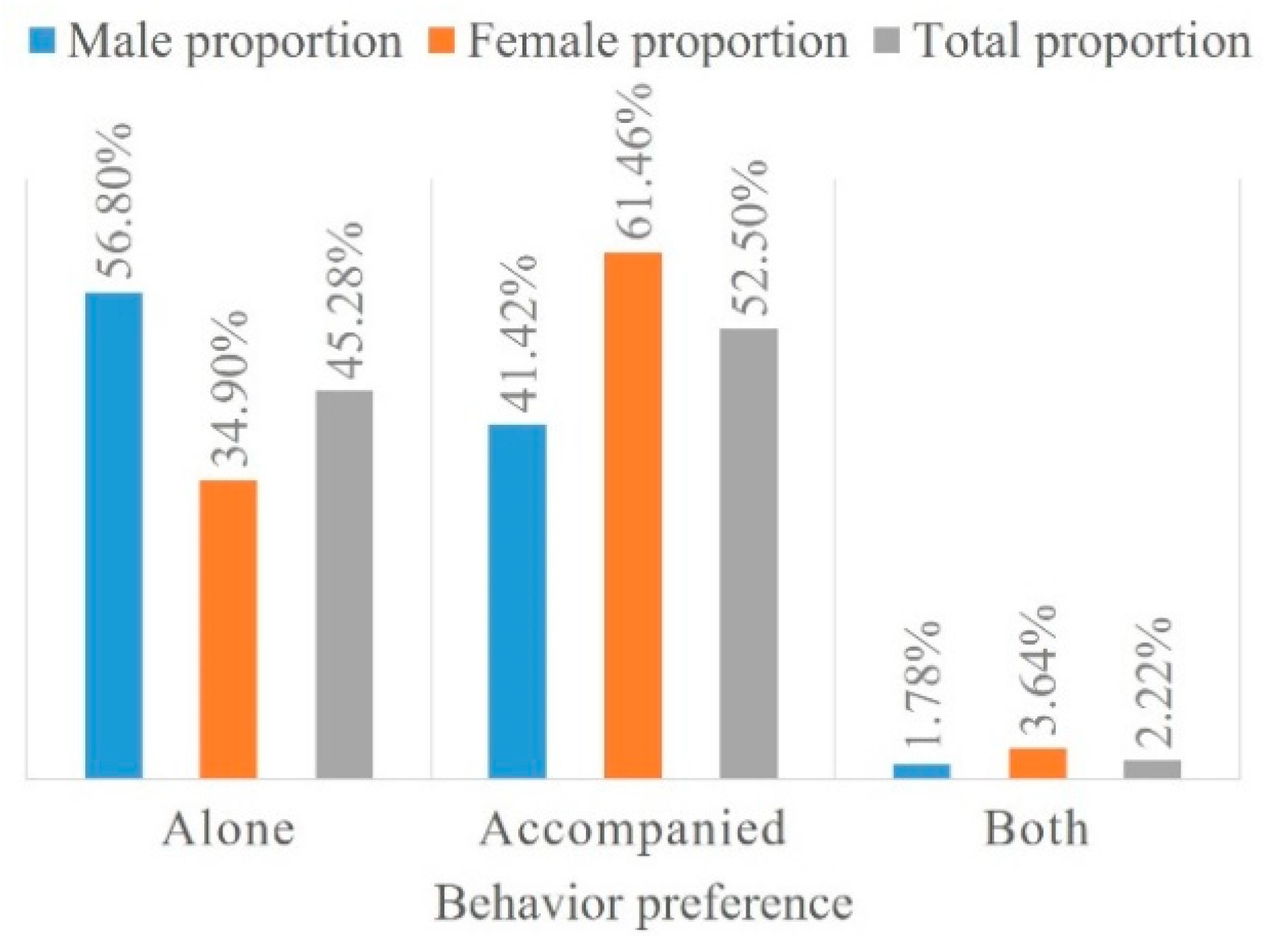
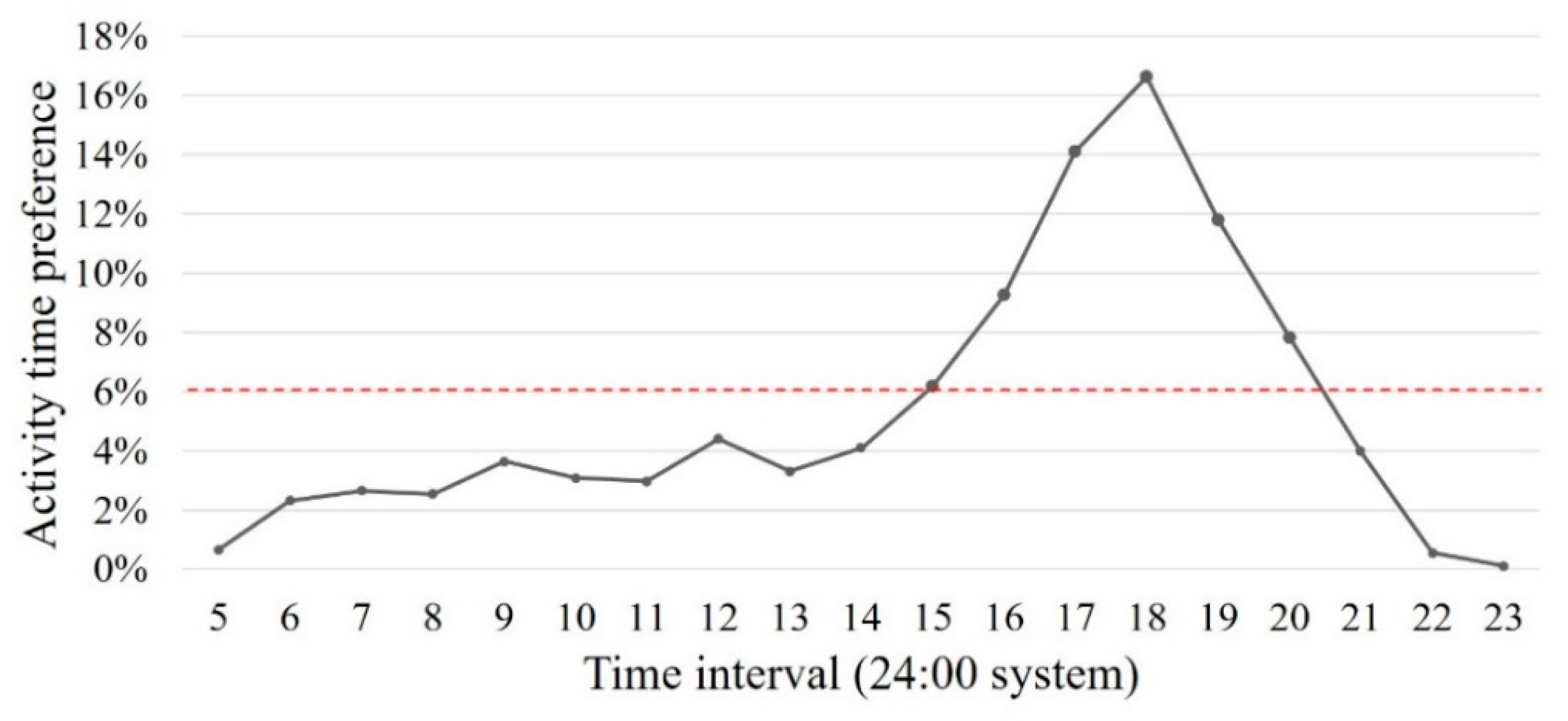
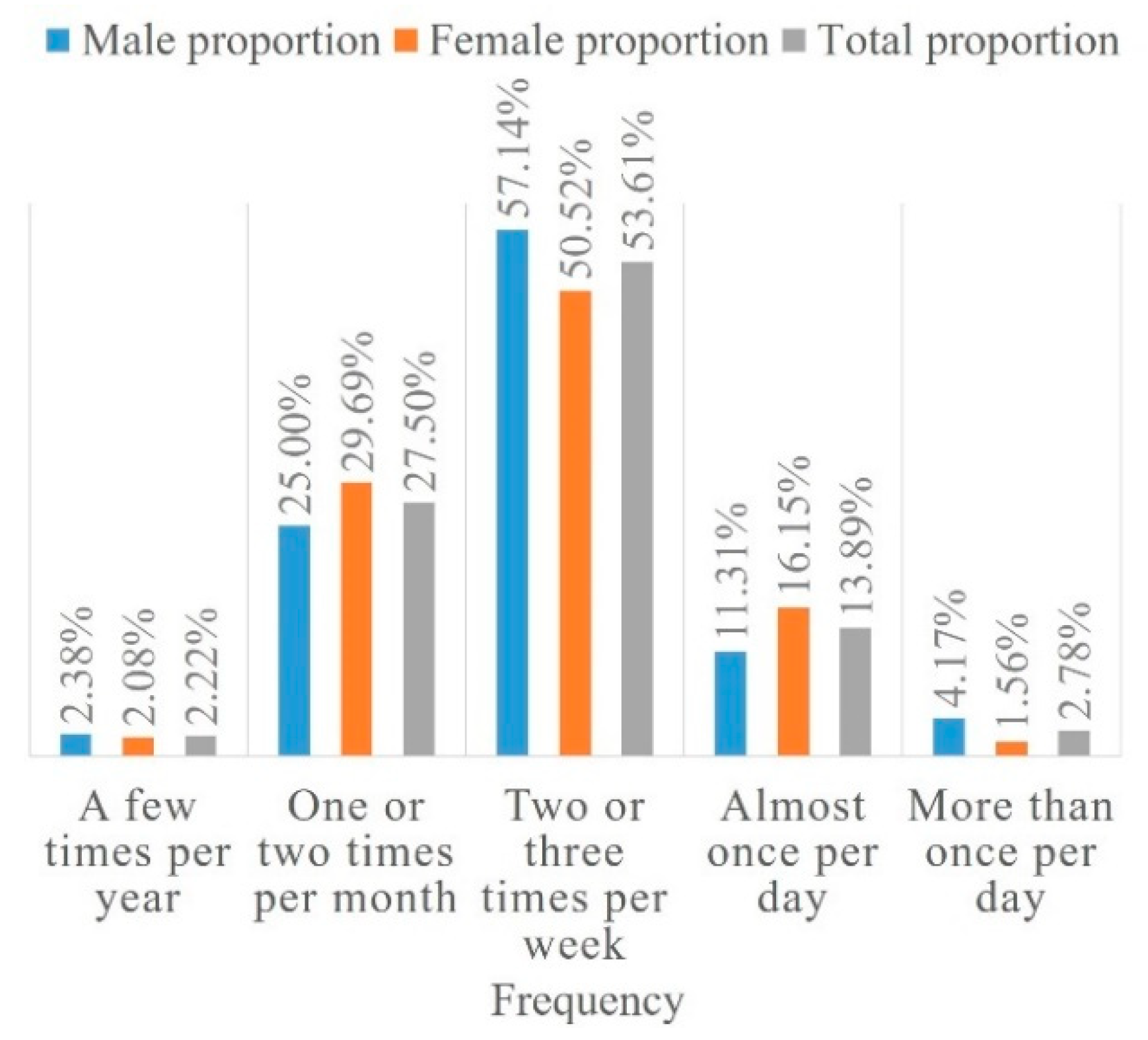
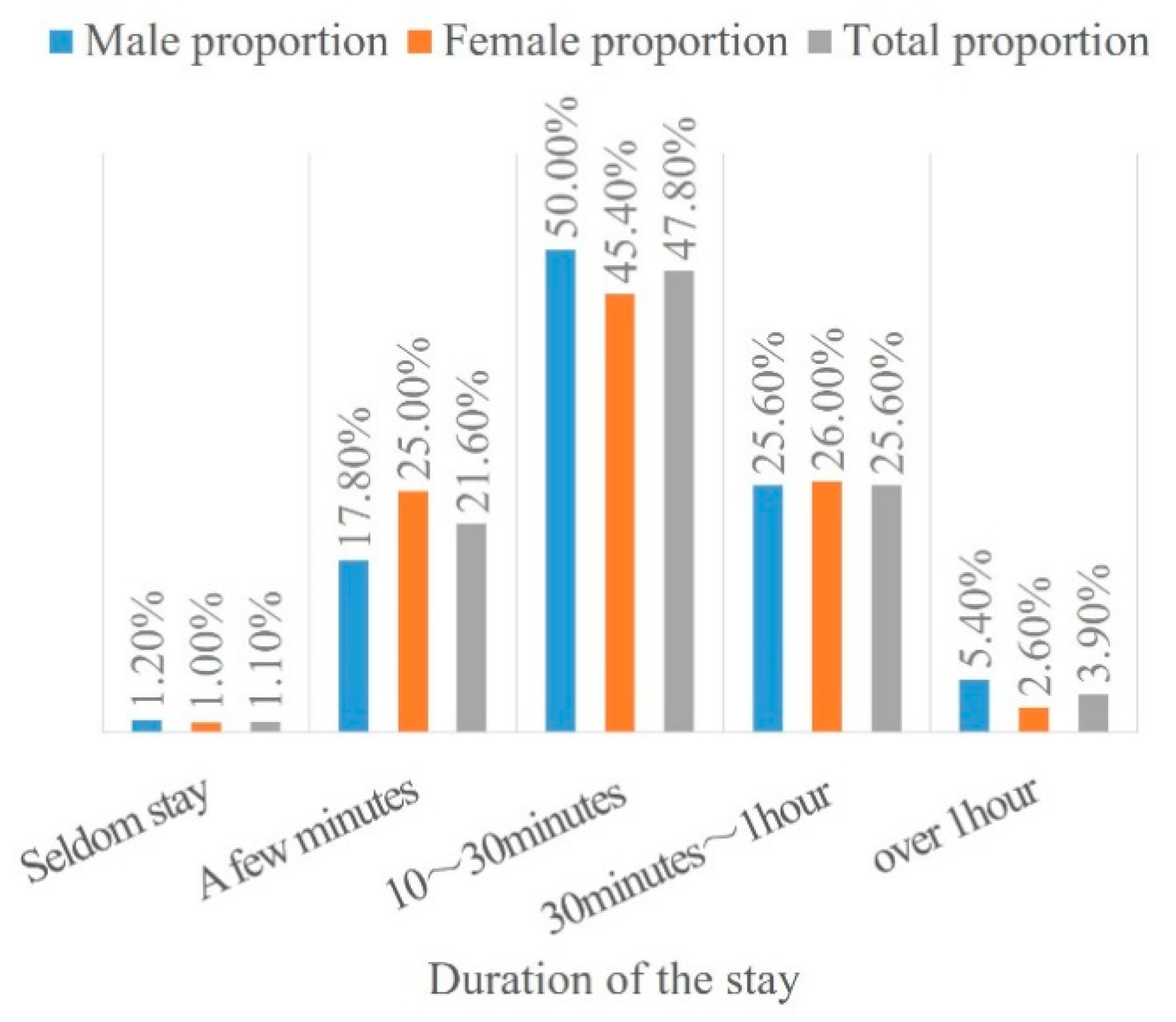
3.1.2. Spatial Usage Preference
3.2. Perceptual Factors of Attention Restoration Space
3.2.1. Primary Perceptual Factors
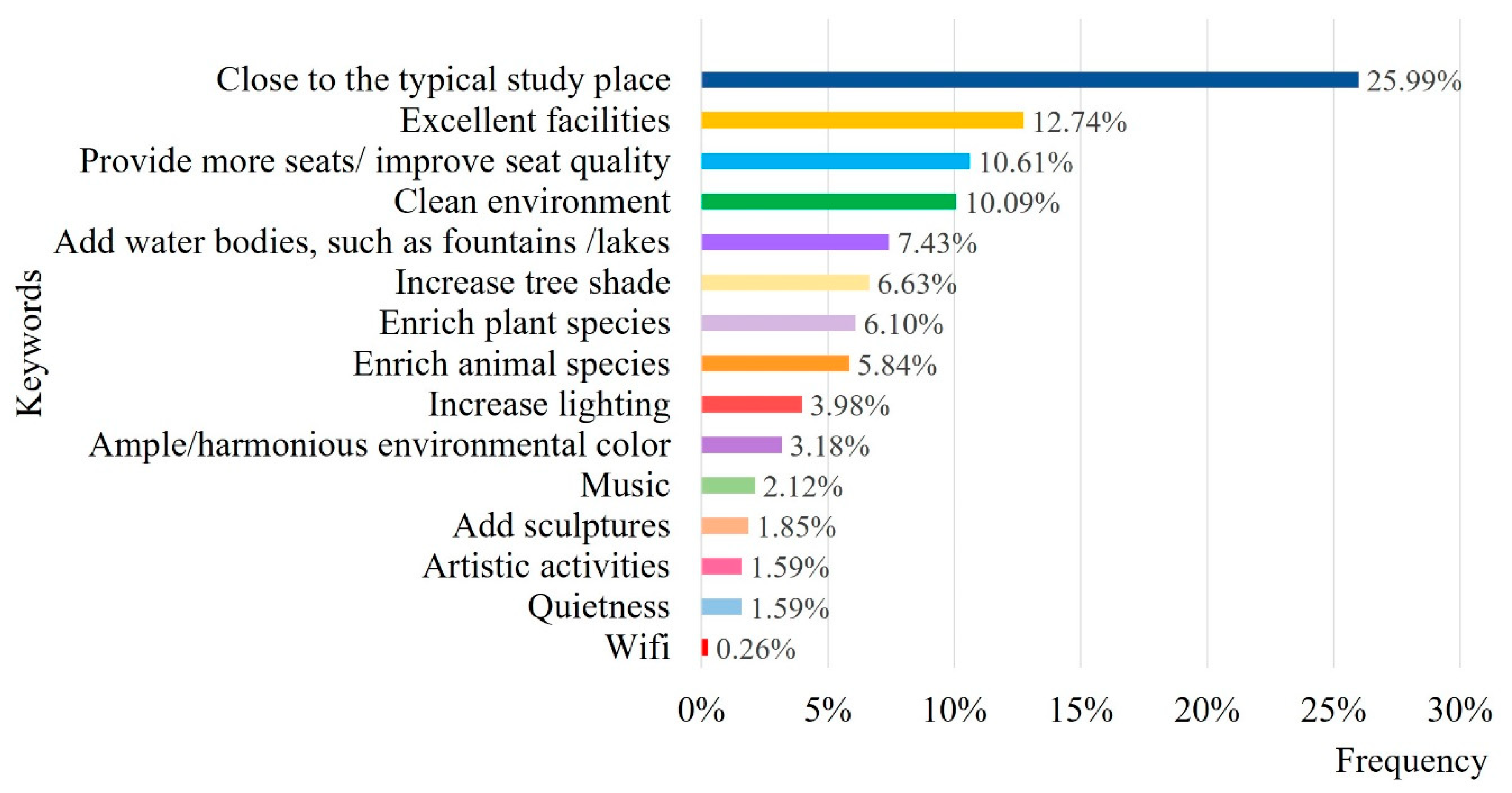
3.2.2. Ideal Perceptual Factors
3.3. CATREG Model of the Design Factors
4. Discussion
4.1. Optimal Selection of Landscape Types based on Environmental Preference
4.2. Spatial Quality Improvement Based on Primary Perceptual Factors
4.3. Comprehensive Evaluation of Key Design Factors
4.4. Limitations and Future Research
5. Conclusions
Author Contributions
Funding
Acknowledgments
Conflicts of Interest
References
- Statista Percentage of U.S. College Students that Felt Tired, Dragged Out or Sleepy within the Past 7 Days as of Fall 2018. Available online: https://www.statista.com/statistics/827009/fatigue-symptoms-among-us-college-students/ (accessed on 27 May 2019).
- Statista Percentage of U.S. College Students that had ever Felt Overwhelming Anxiety as of Fall 2018. Available online: https://www.statista.com/statistics/826896/anxiety-among-us-college-students/ (accessed on 27 May 2019).
- Hibbs, B.J.; Rostain, A. The Stressed Years of Their Lives: Helping Your Kid Survive and Thrive during Their College Years; St. Martin’s Press: New York, NY, USA, 2019; pp. 149–177. [Google Scholar]
- Hipp, J.A.; Gulwadi, G.B.; Alves, S.; Sequeira, S. The Relationship between Perceived Greenness and Perceived Restorativeness of University Campuses and Student-Reported Quality of Life. Environ. Behav. 2016, 48, 1292–1308. [Google Scholar] [CrossRef]
- Holt, E.; Lombard, Q.; Best, N.; Smiley-Smith, S.; Quinn, J. Active and Passive Use of Green Space, Health and Well-Being amongst University Students. Int. J. Environ. Res. Public Health 2019, 16, 424. [Google Scholar] [CrossRef] [PubMed]
- Chang, J. A Study on Campus Landscape of Chinese and Western Universities. Ph.D. Thesis, Nanjing Forestry University, Nanjing, China, 2013. [Google Scholar]
- Coulson, J.; Roberts, P.; Taylor, I. University Planning and Architecture: The Search for Perfection; Routledge: London, UK, 2010; pp. 47–48. [Google Scholar] [CrossRef]
- Lee, K.E.; Williams, K.J.H.; Sargent, L.D.; Williams, N.S.G.; Johnson, K.A. 40-second green roof views sustain attention: The role of micro-breaks in attention restoration. J. Environ. Psychol. 2015, 42, 182–189. [Google Scholar] [CrossRef]
- Li, D.; Sullivan, W.C. Impact of views to school landscapes on recovery from stress and mental fatigue. Landsc. Urban Plan. 2016, 148, 149–158. [Google Scholar] [CrossRef]
- Altaher, Y.; Runnerstrom, M.G. Psychological Restoration Practices among College Students. J. Coll. Student Dev. 2018, 59, 227–232. [Google Scholar] [CrossRef]
- Kaplan, S.; Peterson, C. Health and environment: A psychological analysis. Landsc. Urban Plan. 1993, 26, 17–23. [Google Scholar] [CrossRef]
- Zube, E.H.; Pitt, D.G.; Anderson, T.W. Perception and prediction of scenic resource values of the Northeast: Values, Perceptions and Resources. In Landscape Assessment: Values, Perceptions and Resources; Zube, E.H., Brush, R.O., Fabos, J.F., Eds.; Dowden, Hutchinson and Ross: Stroudsburg, PA, USA, 1975; pp. 151–167. [Google Scholar]
- Zube, E.H. Perception of Landscape and Land Use. In Human Behavior and Environment; Altman, I., Wohlwill, J.F., Eds.; Springer: Boston, MA, USA, 1976. [Google Scholar] [CrossRef]
- Schroeder, H.W. Preference and meaning of arboretum landscapes: Combining quantitative and qualitative data. J. Environ. Psychol. 1991, 11, 231–248. [Google Scholar] [CrossRef]
- Lee, C. The Effect of Landscape Ecological Structure on the Psychological and Physiological Responses in School Environment. Master’s Thesis, National Taiwan University, Taipei, Taiwan, 2011. [Google Scholar]
- Kim, M.; Hong, S.H. Relationship between the reflected brightness of artificial lighting and land-use types: A case study of the University of Arizona campus. Landsc. Ecol. Eng. 2015, 11, 39–45. [Google Scholar] [CrossRef]
- Kong, F.; Nakagoshi, N. Spatial-temporal gradient analysis of urban green spaces in Jinan, China. Landsc. Urban Plan. 2006, 78, 147–164. [Google Scholar] [CrossRef]
- Lausch, A.; Herzog, F. Applicability of landscape metrics for the monitoring of landscape change: Issues of scale, resolution and interpretability. Ecol. Indic. 2002, 2, 3–15. [Google Scholar] [CrossRef]
- Kaplan, R.; Kaplan, S. Well-being, Reasonableness and the Natural Environment. Appl. Psychol. Health Well-Being 2011, 3, 304–321. [Google Scholar] [CrossRef]
- Kaplan, R.; Kaplan, S. The Experience of Nature: A Psychological Perspectiv; Cambridge University Press: New York, NY, USA, 1989; pp. 182–198. [Google Scholar]
- Bagot, K.L.; Allen, F.C.L.; Toukhsati, S. Perceived restorativeness of children’s school playground environments: Nature, playground features and play period experiences. J. Environ. Psychol. 2015, 41, 1–9. [Google Scholar] [CrossRef]
- Ye, H.; Zhu, X. Study on the Effect of Spatial Characteristics and Health Restoration of Urban Parks in Harbin City in Autumn—Taking Zhaolin Park as an Example. J. Hum. Settl. West China 2018, 33, 73–79. [Google Scholar] [CrossRef]
- Berto, R. Assessing the restorative value of the environment: A study on the elderly in comparison with young adults and adolescents. Int. J. Psychol. 2007, 42, 331–341. [Google Scholar] [CrossRef]
- Maas, J.; Verheij, R.A.; Groenewegen, P.P.; Vries, S.D.; Spreeuwenberg, P. Green space, urbanity and health: How strong is the relation? J. Epidemiol. Community Health 2006, 60, 587–592. [Google Scholar] [CrossRef]
- Li, D.; Deal, B.; Zhou, X.; Slavenas, M.; Sullivan, W.C. Moving beyond the neighborhood: Daily exposure to nature and adolescents’ mood. Landsc. Urban Plan. 2018, 173, 33–43. [Google Scholar] [CrossRef]
- Dillen, S.V.; Vries, S.D.; Groenewegen, P.P.; Spreeuwenberg, P. Greenspace in urban neighbourhoods and residents’ health: Adding quality to quantity. J. Epidemiol. Community Health 2012, 66, e8. [Google Scholar] [CrossRef]
- Hajrasouliha, A. Campus score: Measuring university campus qualities. Landsc. Urban Plan. 2017, 158, 166–176. [Google Scholar] [CrossRef]
- Browning, M.; Rigolon, A. School Green Space and Its Impact on Academic Performance: A Systematic Literature Review. Int. J. Environ. Res. Public Health 2019, 16. [Google Scholar] [CrossRef]
- Hartig, T.; Mitchell, R.; De, V.S.; Frumkin, H. Nature and health. Annu. Rev. Public Health 2014, 35, 207–228. [Google Scholar] [CrossRef]
- Owens, P.E.; McKinnon, I. In Pursuit of Nature: The Role of Nature in Adolescents’ Lives. J. Dev. Process. 2009, 4, 43–58. [Google Scholar]
- Sedgwick, P. Convenience sampling. BMJ 2013, 347, f6304. [Google Scholar] [CrossRef]
- Sjoberg, S.A. The Influence of Sensory and Behavioral Factors on Whole Grain Bread Consumption among a Convenience Sample of Adults. Ph.D. Thesis, University of Minnesota, Minneapolis, MN, USA, 2012. [Google Scholar]
- Du, Z. Methods and Practice of Social Investigation; Publishing house of electronics industry: Beijing, China, 2014; pp. 174–175. [Google Scholar]
- Hadavi, S.; Kaplan, R.; Hunter, M.C.R. Environmental affordances: A practical approach for design of nearby outdoor settings in urban residential areas. Landsc. Urban Plan. 2015, 134, 19–32. [Google Scholar] [CrossRef]
- Tavakol, M.; Dennick, R. Making sense of Cronbach’s alpha. Int. J. Med. Educ. 2011, 2, 53–55. [Google Scholar] [CrossRef]
- Kooij, A.J.V.D.; Meulman, J.J.; Heiser, W.J. Local minima in categorical multiple regression. Comput. Stat. Data Anal. 2006, 50, 446–462. [Google Scholar] [CrossRef]
- Tanvatanagul, W.; Uaphanthaseth, R. Statistical analysis of attitude and health care behavior of Chiang Mai University students (Thailand). J. Stat. Manag. Syst. 2005, 8, 659–679. [Google Scholar] [CrossRef]
- Zhang, X. The Dynamics of Chinese Consumers. J. Int. Food Agribus. Mark. 2009, 14, 47–66. [Google Scholar] [CrossRef]
- Meulman, J.J. Optimal scaling methods for multivariate categorical data analysis. In Data Theory Group Faculty of Social and Behavioral Sciences; Leiden University: Leiden, The Netherlands, 1998. [Google Scholar]
- Zar, J.H. Significance Testing of the Spearman Rank Correlation Coefficient. J. Am. Stat. Assoc. 1972, 67, 578–580. [Google Scholar] [CrossRef]
- Gautheir, T.D. Detecting Trends Using Spearman’s Rank Correlation Coefficient. Environ. Forensics 2001, 2, 359–362. [Google Scholar] [CrossRef]
- Pratt, J.W. Dividing the indivisible: Using simple symmetry to partition variance explained. In Proceedings of the Second International Conference in Statistics; University of Tampere: Tampere, Finland, 1987; pp. 245–260. [Google Scholar] [CrossRef]
- Herzog, T.R.; Bosley, P.J. Tranquility and preference as affective qualities of natural environments. J. Environ. Psychol. 1992, 12, 115–127. [Google Scholar] [CrossRef]
- Kaplan, R. The Role of Nature in the Urban Context. In Behavior and the Natural Environment; Springer: Boston, MA, USA, 1983; pp. 127–161. [Google Scholar] [CrossRef]
- Staats, H.; Kieviet, A.; Hartig, T.; Institutet, F.B.O.U.; Humanistisk-samhällsvetenskapliga, V.; Uppsala, U.; Samhällsvetenskapliga, F. Where to recover from attentional fatigue: An expectancy-value analysis of environmental preference. J. Environ. Psychol. 2003, 23, 147–157. [Google Scholar] [CrossRef]
- Kaplan, R. Employees’ reactions to nearby nature at their workplace: The wild and the tame. Landsc. Urban Plan. 2007, 82, 17–24. [Google Scholar] [CrossRef]
- Herzog, T.R.; Colleen; Maguire, P.; Nebel, M.B. Assessing the restorative components of environments. J. Environ. Psychol. 2003, 23, 159–170. [Google Scholar] [CrossRef]
- Lu, Y.; Sarkar, C.; Ye, Y.; Xiao, Y. Using the Online Walking Journal to explore the relationship between campus environment and walking behaviour. J. Transp. Health 2017, 5, 123–132. [Google Scholar] [CrossRef]
- Matilda, A.V.D.B.; Mudu, P.; Uscila, V.; Barrdahl, M.; Kulinkina, A.; Staatsen, B.; Swart, W.; Kruize, H.; Zurlyte, I.; Egorov, A.I. Development of an urban green space indicator and the public health rationale. Scand. J. Public Health 2015, 44, 159–167. [Google Scholar] [CrossRef]
- Nordh, H.; Hartig, T.; Hagerhall, C.M.; Fry, G. Components of small urban parks that predict the possibility for restoration. Urban For. Urban Green. 2009, 8, 225–235. [Google Scholar] [CrossRef]
- Berg, A.E.V.D.; Jorgensen, A.; Wilson, E.R. Evaluating restoration in urban green spaces: Does setting type make a difference? Landsc. Urban Plan. 2014, 127, 173–181. [Google Scholar] [CrossRef]
- Peschardt, K.K.; Stigsdotter, U.K. Associations between park characteristics and perceived restorativeness of small public urban green spaces. Landsc. Urban Plan. 2013, 112, 26–39. [Google Scholar] [CrossRef]
- Scopelliti, M.; Giuliani, M.V. Choosing restorative environments across the lifespan: A matter of place experience. J. Environ. Psychol. 2004, 24, 423–437. [Google Scholar] [CrossRef]
- Appleton, J. Prospects and Refuges Re-Visited. Landsc. J. 1984, 3, 91–103. [Google Scholar] [CrossRef]
- Jiang, B.; Larsen, L.; Deal, B.; Sullivan, W.C. A dose–Response curve describing the relationship between tree cover density and landscape preference. Landsc. Urban Plan. 2015, 139, 16–25. [Google Scholar] [CrossRef]
- Lau, S.S.Y.; Yang, F. Introducing Healing Gardens into a Compact University Campus: Design Natural Space to Create Healthy and Sustainable Campuses. Landsc. Res. 2009, 34, 55–81. [Google Scholar] [CrossRef]




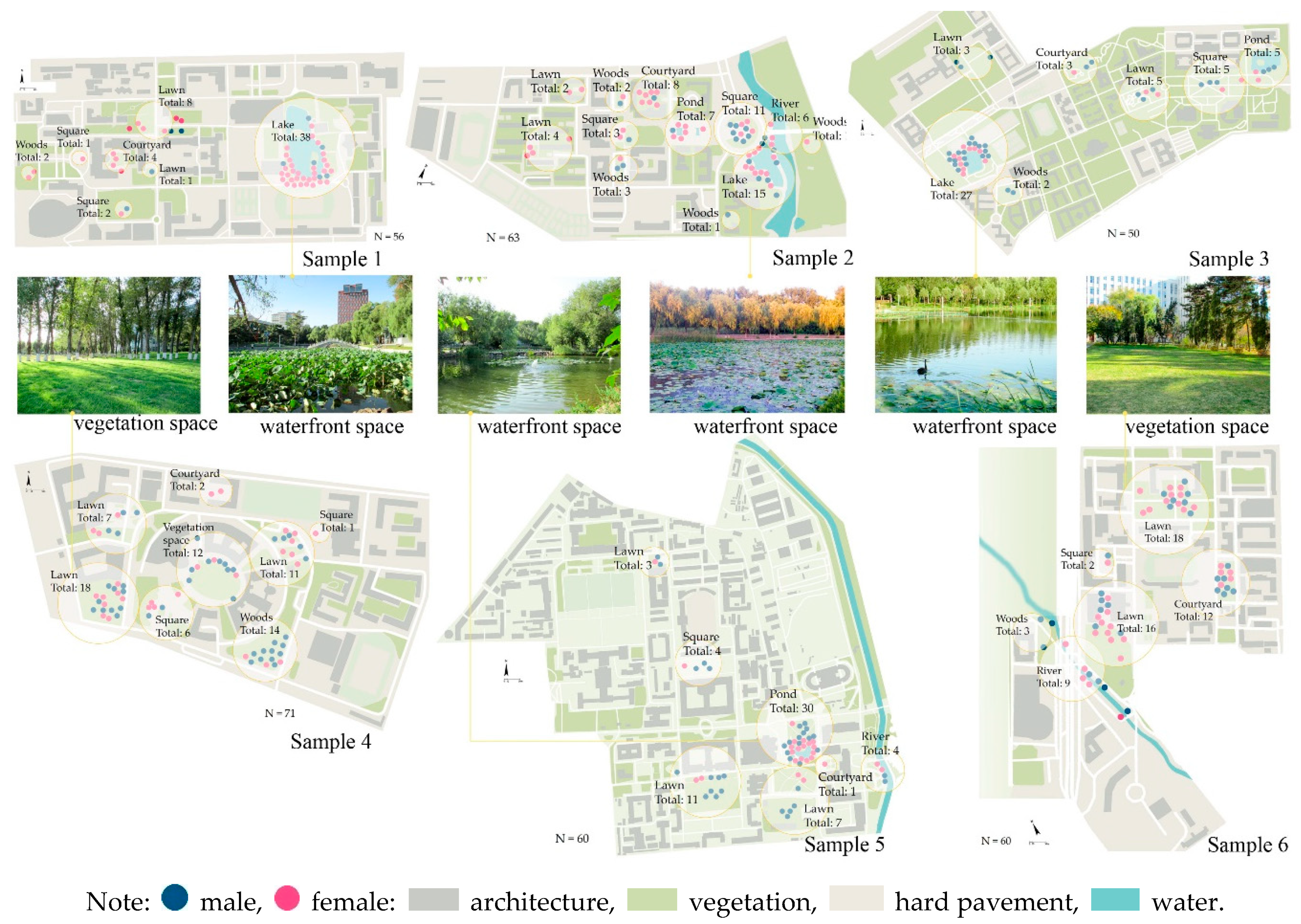
| Sample | University | Area (hm2) | Green Coverage Rate | Campus Built Time | Landscape Types |
|---|---|---|---|---|---|
| 1 | Northeast Normal University (main campus) | 47 | 21% | 1950 | SS, CS, VS, WS |
| 2 | Northeast Normal University (Jingyue campus) | 50 | 38% | 2002 | SS, CS, VS, WS |
| 3 | Jilin University (new campus) | 170 | 33% | 2015 | SS, CS, VS, WS |
| 4 | Jilin Jianzhu University | 41.7 | 28% | 2008 | SS, CS, VS |
| 5 | Harbin Engineering University | 125.61 | 14% | 1994 | SS, CS, VS, WS |
| 6 | Northeast Forestry University | 136 | 27% | 1985 | SS, CS, VS, WS |
| No. | Perceptual Factors | Definitions |
|---|---|---|
| 1 | Accessibility | Easy to reach, no obstacles in space and time. |
| 2 | Visibility | The scope of landscape elements that can be seen, including spatial scale and openness. |
| 3 | Recognition | Easy to find the place and the composition of the layout is easy to understand. |
| 4 | Familiarity | The environmental characters are familiar and accessible. |
| 5 | Comfort | A comfortable environment with good landscape maintenance, such as seating, paving, lighting, etc. |
| 6 | Pleasure | Feel happier with the landscape design or the activities happened here. |
| 7 | Sense of belonging | Feel safe and feel like belong here. |
| 8 | Quietness | A sense of tranquility; the environment is quite or there are natural or pleasant sounds. |
| 9 | Exploration | Attractive and raise curious. |
| 10 | Creativity | Stimulate creative thinking. |
| Perceptual Factors | Correlation Coefficient | Sig. | Correlation Coefficient | Sig. |
|---|---|---|---|---|
| Frequency Using Such Space in Good Weather | Average Time Spent in Such Space | |||
| Accessibility | 0.125 * | 0.018 | 0.01 | 0.85 |
| Visibility | 0.142 ** | 0.007 | −0.01 | 0.853 |
| Recognition | 0.174 ** | 0.001 | −0.042 | 0.428 |
| Familiarity | 0.103 | 0.05 | −0.065 | 0.221 |
| Comfort | 0.103 | 0.051 | 0.112 * | 0.034 |
| Pleasure | 0.093 | 0.078 | 0.091 | 0.086 |
| Sense of belonging | 0.146 ** | 0.006 | 0.004 | 0.943 |
| Quietness | 0.096 | 0.069 | 0 | 0.997 |
| Exploration | 0.092 | 0.081 | 0.01 | 0.854 |
| Creativity | 0.099 | 0.06 | 0.064 | 0.224 |
| Landscape types | R2 | Adjusted R2 | F | Variables | Standardized Coefficients | Sig. | Imp. | |
|---|---|---|---|---|---|---|---|---|
| Beta | Std. Error | |||||||
| Waterfront space | 1.000 | 1.000 | 9,159,344.82 | accessibility | 0.004 | 0.476 | 1.000 | 0.002 |
| visibility | −0.004 | 0.432 | 1.000 | 0.000 | ||||
| recognition | 0.998 | 0.326 | 0.000 * | 0.998 | ||||
| comfort | 0.000 | 0.163 | 0.999 | 0.000 | ||||
| sense of belonging | 0.001 | 0.335 | 1.000 | 0.000 | ||||
| Vegetation space | 0.702 | 0.681 | 33.70 | accessibility | 0.194 | 0.068 | 0.005 * | 0.146 |
| visibility | 0.302 | 0.076 | 0.000 * | 0.247 | ||||
| recognition | 0.245 | 0.071 | 0.000 * | 0.181 | ||||
| comfort | 0.193 | 0.071 | 0.000 * | 0.130 | ||||
| sense of belonging | 0.370 | 0.120 | 0.000 * | 0.297 | ||||
| Courtyard space | 0.953 | 0.930 | 42.53 | accessibility | 0.420 | 0.249 | 0.064 | 0.292 |
| visibility | 0.256 | 0.216 | 0.269 | 0.086 | ||||
| recognition | 0.565 | 0.253 | 0.038 * | 0.381 | ||||
| comfort | 0.498 | 0.260 | 0.045 * | 0.267 | ||||
| sense of belonging | −0.055 | 0.175 | 0.757 | −0.026 | ||||
| Square space | 0.844 | 0.800 | 19.20 | accessibility | 0.370 | 0.105 | 0.000 * | 0.205 |
| visibility | 0.361 | 0.100 | 0.001 * | 0.200 | ||||
| recognition | −0.177 | 0.100 | 0.054 | −0.058 | ||||
| comfort | 0.361 | 0.099 | 0.001 * | 0.245 | ||||
| sense of belonging | 0.529 | 0.098 | 0.000 * | 0.409 | ||||
| Perceptual Factors | Accessibility | Visibility | Comfort | Recognition | Sense of Belonging |
|---|---|---|---|---|---|
| Negative space example |  | 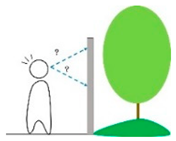 |  |  | 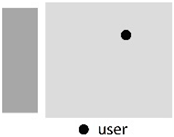 |
| Positive space example |  | 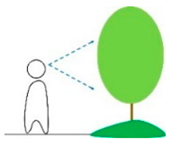 |  |  |  |
| Landscape Types | Primary Perceptual Factors | |
|---|---|---|
| Advantages | Disadvantages | |
| WS | visibility, comfort, sense of belonging | accessibility, recognition |
| VS | - | accessibility, visibility, recognition, comfort, sense of belonging |
| CS | visibility, accessibility, sense of belonging | comfort, recognition |
| SS | recognition | visibility, accessibility, comfort, sense of belonging |
© 2019 by the authors. Licensee MDPI, Basel, Switzerland. This article is an open access article distributed under the terms and conditions of the Creative Commons Attribution (CC BY) license (http://creativecommons.org/licenses/by/4.0/).
Share and Cite
Lu, M.; Fu, J. Attention Restoration Space on a University Campus: Exploring Restorative Campus Design Based on Environmental Preferences of Students. Int. J. Environ. Res. Public Health 2019, 16, 2629. https://doi.org/10.3390/ijerph16142629
Lu M, Fu J. Attention Restoration Space on a University Campus: Exploring Restorative Campus Design Based on Environmental Preferences of Students. International Journal of Environmental Research and Public Health. 2019; 16(14):2629. https://doi.org/10.3390/ijerph16142629
Chicago/Turabian StyleLu, Ming, and Jingwan Fu. 2019. "Attention Restoration Space on a University Campus: Exploring Restorative Campus Design Based on Environmental Preferences of Students" International Journal of Environmental Research and Public Health 16, no. 14: 2629. https://doi.org/10.3390/ijerph16142629
APA StyleLu, M., & Fu, J. (2019). Attention Restoration Space on a University Campus: Exploring Restorative Campus Design Based on Environmental Preferences of Students. International Journal of Environmental Research and Public Health, 16(14), 2629. https://doi.org/10.3390/ijerph16142629