

Investigation of the Contributory Factors to the Guessability of Traffic Signs



Abstract
1. Introduction
2. Method
2.1. Participants
2.2. Instruments
2.3. Traffic Signs
 , 15
, 15  , 25
, 25  , 29
, 29  , 30
, 30  , 31
, 31  , 32
, 32  , 35
, 35  , 37
, 37  , 38
, 38  , 40
, 40  , 43
, 43  , 52
, 52  , 53
, 53  , and 54
  were German signs. Some traffic signs in China are very similar to the same signs in German due to the Vienna Convention on Road Traffic. Thus, we told the participants not to consider factors unrelated to the symbol.
2.4. Questionnaire and Sign Feature Evaluation Sheet
2.4.1. Prospective User Factors
2.4.2. The Rating Scores of Signs along Different Scales
2.5. Procedure
2.6. Analysis
3. Results
3.1. Descriptive Statistics for Guessing Scores
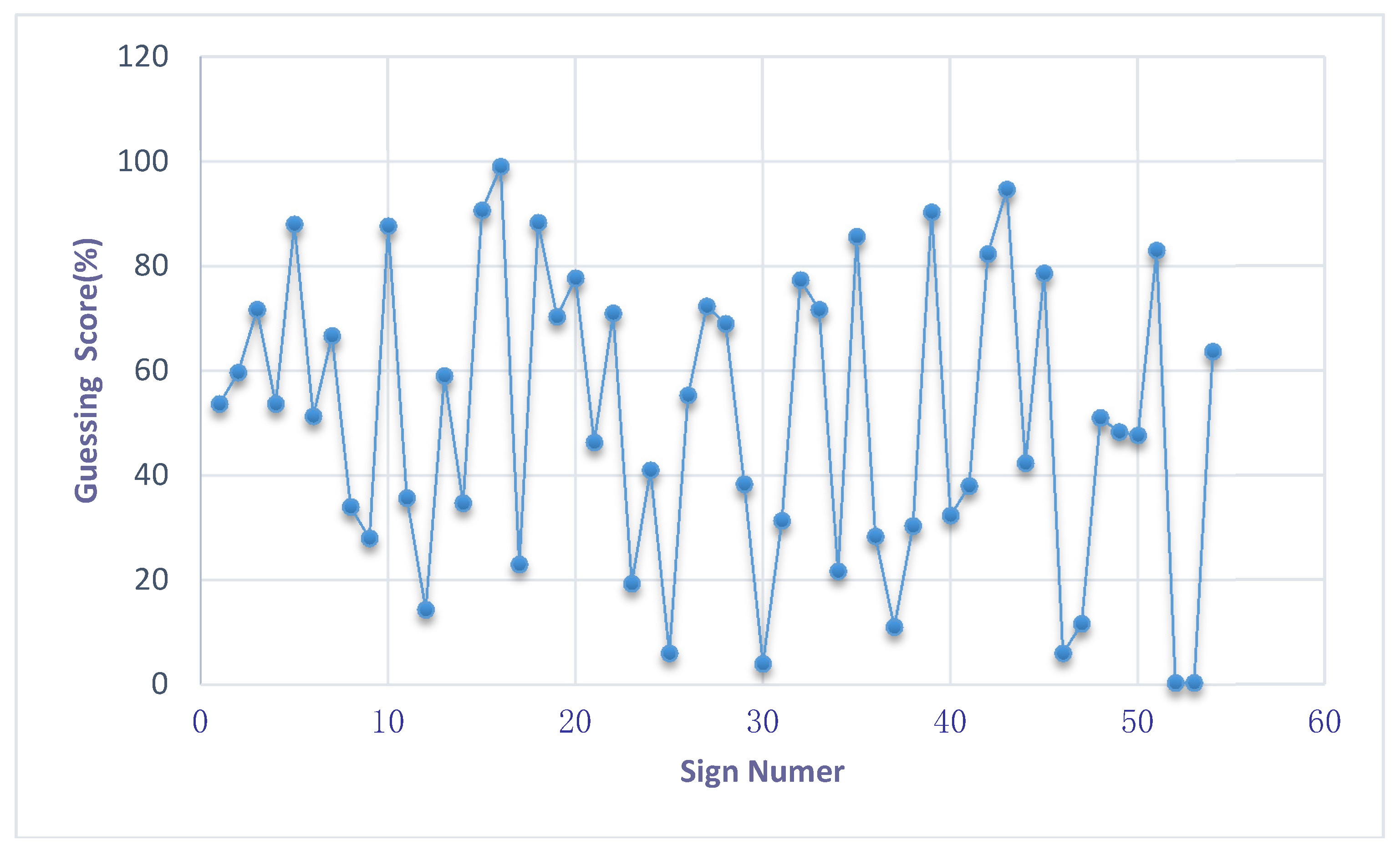
, 31 , 37 , 52 and 53 ). Warning signs had the highest average guessing score (62.88%), whereas the average score for special category signs was the lowest (9.4%). The average guessing score for prohibition signs was 57.09%, but their standard deviation was the highest, indicating large differences among those samples.3.2. Signs with Extremely Variable Scores
), 30 (), 37 (), 46 ( ), 47 (
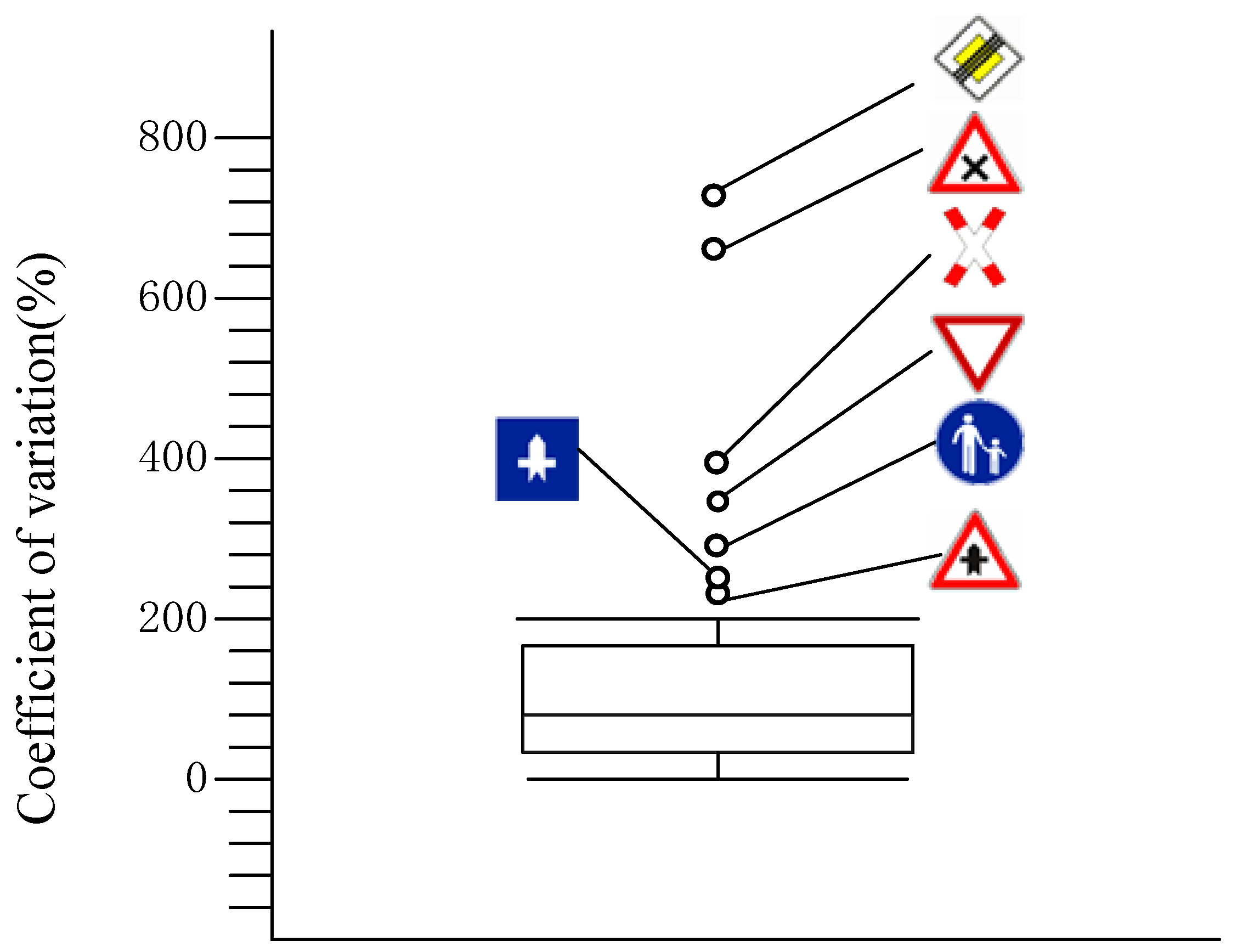
 ), 52 (), and 53 () were assessed as outliers above the box (specific information on these signs is shown in Table 5), indicating that their measure of dispersion was much higher (over 50%) than the other signs, whose coefficients of variation ranged from 8.70% to 145.81%. The guessed scores of the nine signs are also shown in Table 3, including the three most frequent responses to each sign. The signs whose measure of dispersion was much higher than others (25 (), 30 (), 37 (), 46 (), 47 (), 52 (), and 53 ()) also received the lowest guessability scores.) and 52 (), which were German signs, received more than 50% “do not know” responses, which indicates that the subjects did not know how to begin the guessing process. The most frequent response for signs 37 () and 47 () was “rocket.” This finding indicates that the designed symbol was regarded as a rocket, which did not match the true meaning (“Traffic has priority in the main road”). It is surprising that sign 46 () received such a low rating score because it is a common sign in school and residential areas. Furthermore, this sign received a high familiarity score (48.82%), a high confidence in guessing score (46.85%) and a low complexity score (42.42%). Most responses to this sign were concerned with “children” or “school.” It can be inferred that the symbol was regarded as a man holding his child’s hand rather than a place for pedestrians only, and this may explain why the rating score for semantic distance was large (68.41%).
3.3. The Relation between the Guessing Performance of the Subjects and Prospective User Factors
3.3.1. Analysis of Variance and K-W Test for the Prospective User Factors
3.3.2. Analysis of Interaction Effects among User Factors
3.4. Signs’ Cognitive Features
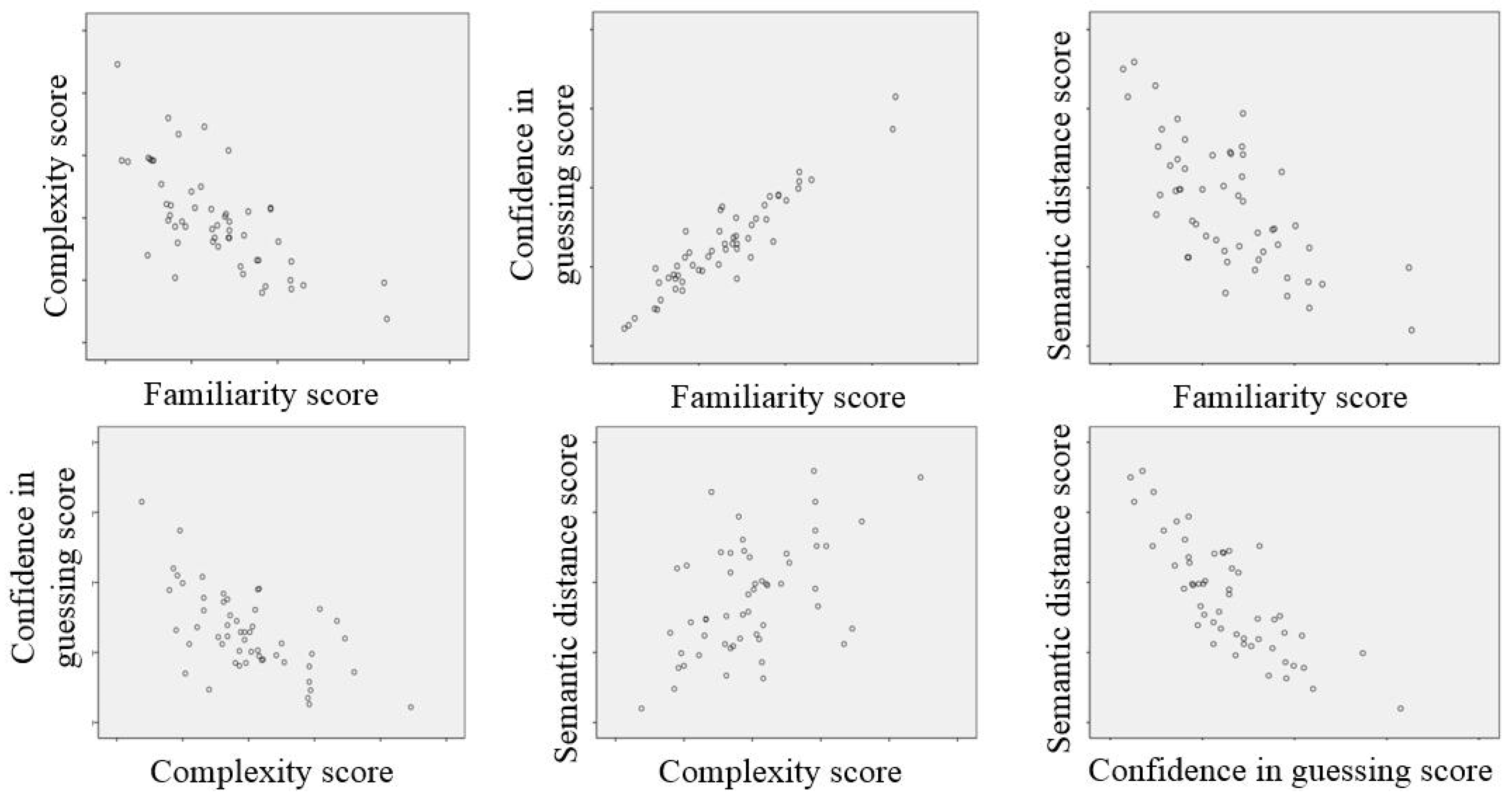
3.4.1. Interrelationships among Traffic Sign Features
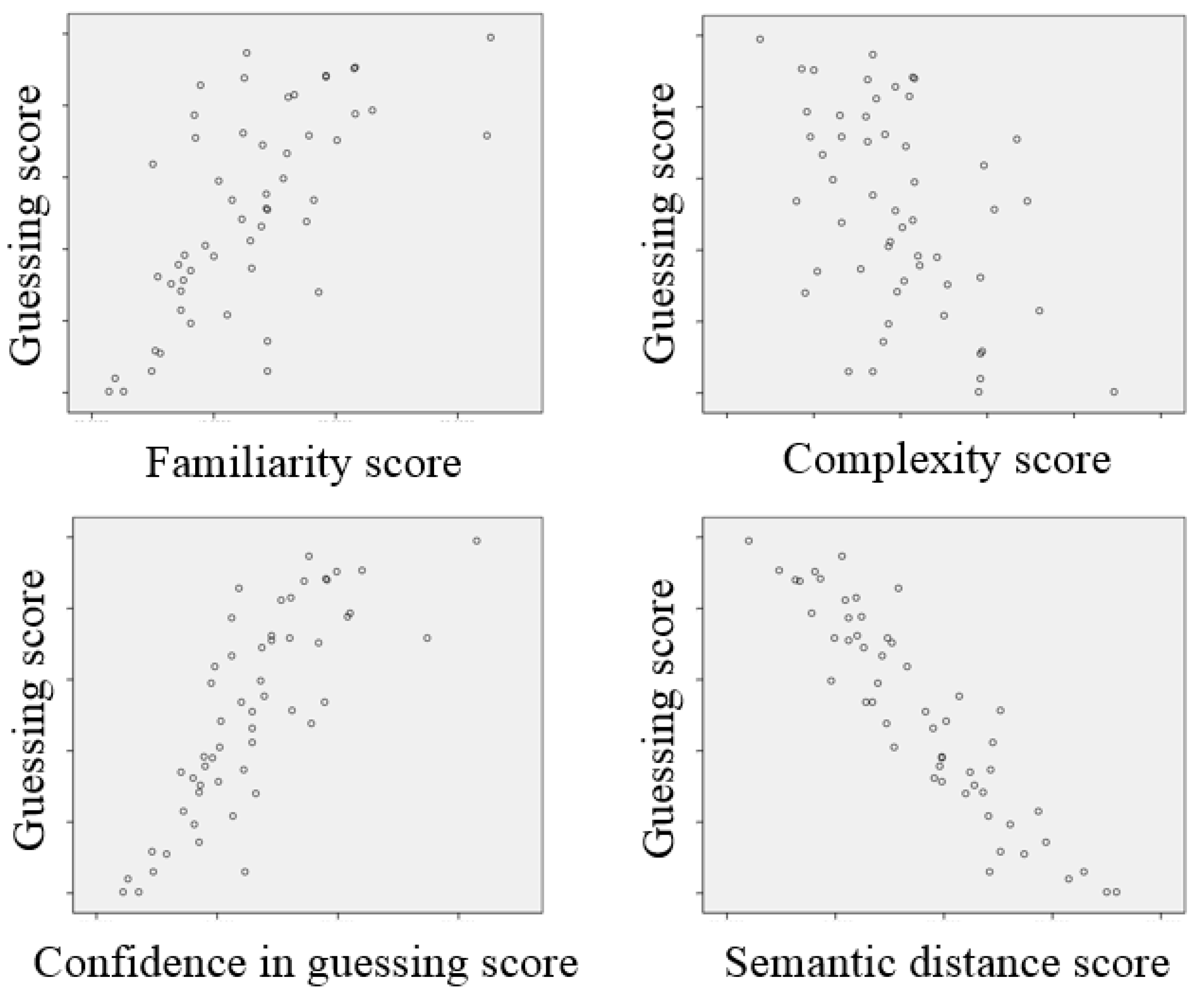
3.4.2. Relationships among Traffic Sign Features and Guessability Score
3.5. Analysis of Subjects’ Guessing Performance on Signs from Two Countries
4. Discussion
4.1. Prospective User Factors
4.2. Signs’ Cognitive Design Features
) and 53 () were regarded as simple designs, but they received the lowest guessing scores, with most subjects responding “Do not know.”4.3. Analysis of Contributory Factors
4.4. Cultural Issues and Suggestions on Design Improvement
(German) and (Chinese)), considering the positive effects of learning experience of Chinese signs on subjects’ guessing performance for German signs, a comparison was made between the German signs with low- and high-guessed scores (none of the subjects had experience visiting Germany or experience learning German signs). Signs 25 (), 30 (), 37 (), 52 (), and 53 () received the lowest level of guessability scores (less than 10%), whereas signs 43 () and 54 () received extremely high-level scores (94.67%, 63.67%). The common characteristics of signs with high-guessed scores were a low semantic distance rating score and high visualization of conveyed information. For instance, sign 43 showed a “3 m” between two trucks, and the edge of the sign was red, which indicated a warning for the distance between trucks. Therefore, the meaning of this sign could be easily understood as “Watch out! the distance should not be less than 3 m.” Signs 52 and 53 received extremely low scores (0.33%). The images used on these signs did not match the meaning they actually represented. Specifically, the meaning of sign 52, “the end of priority road,” is related specifically to the German cultural environment, and it is nearly impossible for foreigners without visiting experience to understand the meaning as “main road” or “end.” Thus, a cultural issue was found in this aspect, which indicates a specific image that can be recognized only by people with a particular cultural background. A previous study recommended that text explanations could also be used when cultural bias is present or the meanings of signs are difficult to convey [25]. Nevertheless, symbols rather than text are a common way of conveying information to different groups of users. We recommend the use of symbols only when a cultural issue needs to be expressed. For example, two signs (sign 25 and sign 33  ) conveying the same meaning are shown in Figure 6. A substantial distance between the rating scores for these two signs was found: sign 33 received a guess score of 71.67%, whereas sign 25 received a guess score of only 6%. The designs of the two signs were identical (both were designed as an inverted triangle), which means that the symbol was not the reason for the difference. It is obvious that the Chinese text in sign 33 contributed substantially to users’ comprehension of the sign, suggesting that an explanation of the symbol helps with the cognitive process. Furthermore, traffic signs in Japan widely use local texts to convey information. However, foreigners who could not understand the text could not guess the meaning of sign 33 by recognizing the meaning of the symbol, just as Chinese subjects could not understand the meaning of sign 25 because the inverted triangle does not match information on yielding. Adding the meaning of the sign in writing also has a disadvantage because it adds to the sign complexity.) as an example, we note the key point that the thicker the lines, the higher the road rights. We attempted to reduce the misunderstanding of “rocket,” so we designed a new sign (
 ) in which we drew the road and the rights line separately.
5. Limitations
6. Conclusions
Author Contributions
Funding
Conflicts of Interest
References
- Malaterre, G. Error analysis and in-depth accident studies. Ergonomics 1990, 33, 1403–1421. [Google Scholar] [CrossRef]
- Retting, R.A.; Weinstein, H.B.; Solomon, M.G. Analysis of motor-vehicle crashes at stop signs in four U.S. cities. J. Saf. Res. 2003, 34, 485–489. [Google Scholar] [CrossRef]
- Massie, D.L.; Campbell, K.L.; Blower, D.F. Development of a collision typology for evaluation of collision avoidance strategies. Accid. Anal. Prev. 1993, 25, 241–257. [Google Scholar] [CrossRef]
- Jordan, P.W. An Introduction to Usability; CRC Press: Boca Raton, FL, USA, 1998. [Google Scholar]
- Ng, A.W.Y.; Chan, A.H.S. Culture Issues in Traffic Sign Usability. Usability and Internationalization. Hci and Culture, Second International Conference on Usability and Internationalization, Ui-Hcii 2007, Held as Part of HCI International 2007; Springer: Berlin/Heidelberg, Germany, 2007; Volume 4559, pp. 379–387. [Google Scholar]
- Chan, A.H.S.; Ng, A.W.Y. Investigation of guessability of industrial safety signs: Effects of prospective-user factors and cognitive sign features. Int. J. Ind. Ergon. 2010, 40, 689–697. [Google Scholar] [CrossRef]
- Chan, A.H.S.; Chan, K.W.L. Effects of prospective-user factors and sign design features on guessability of pharmaceutical pictograms. Patient Educ. Couns. 2013, 90, 268–275. [Google Scholar] [CrossRef] [PubMed]
- Ou, Y.-K.; Liu, Y.-C. Effects of sign design features and training on comprehension of traffic signs in Taiwanese and Vietnamese user groups. Int. J. Ind. Ergon. 2012, 42, 1–7. [Google Scholar] [CrossRef]
- Smith, K. Handbook of Visual Communication: Theory, Methods, and Media; Lawrence Erlbaum: Mahwah, NJ, USA, 2005; p. 523. [Google Scholar]
- Summala, H. American Drivers in Europe—Different Signing Policy may cause Safety Problems at Uncontrolled Intersections. Accid. Anal. Prev. 1998, 30, 285–289. [Google Scholar] [CrossRef]
- Xia, C. Traffic Sign World, 1st ed.; Zhongguo Ji Hua Chu Ban She: Beijing, China, 2002. [Google Scholar]
- Al-Madani, H.; Al-Janahi, A.R. Assessment of drivers’ comprehension of traffic signs based on their traffic, personal and social characteristics. Transp. Res. Part F Traffic Psychol. Behav. 2002, 5, 63–76. [Google Scholar] [CrossRef]
- Al-Madani, H.; Al-Janahi, A.R. Role of drivers’ personal characteristics in understanding traffic sign symbols. Accid. Anal. Prev. 2002, 34, 185–196. [Google Scholar] [CrossRef]
- Ng, A.W.Y.; Chan, A.H.S. The effects of driver factors and sign design features on the comprehensibility of traffic signs. J. Saf. Res. 2008, 39, 321–328. [Google Scholar] [CrossRef]
- Wang, A.H.; Chi, C.C. Effects of hazardous material symbol labeling and training on comprehension according to three types of educational specialization. Int. J. Ind. Ergon. 2003, 31, 343–355. [Google Scholar] [CrossRef]
- Al-Madani, H. Influence of drivers’ comprehension of posted signs on their safety related characteristics. Accid. Anal. Prev. 2000, 32, 575–581. [Google Scholar] [CrossRef]
- Liu, Y.C. A simulated study on the effects of information volume on traffic signs, viewing strategies and sign familiarity upon driver’s visual search performance. Int. J. Ind. Ergon. 2005, 35, 1147–1158. [Google Scholar] [CrossRef]
- Ng, A.W.Y.; Chan, A.H.S. Re-usability of traffic signs for inactive drivers with consideration of personal characteristics and sign feature. J. Int. Hum. Resour. Manag. 2016, 1, 1–8. [Google Scholar]
- Ministry of Public Security of the PRC. The Number of Licensed Drivers Broke 3 Hundred Million. 2014. Available online: http://www.mps.gov.cn/n16/n1237/n1342/n803715/4287614.html (accessed on 30 September 2014).
- Zhang, W.; Huang, Y.; Roetting, M.; Wang, Y.; Wei, H. Driver’s views and behaviors about safety in China—What do they NOT know about driving? Accid. Anal. Prev. 2006, 38, 22–27. [Google Scholar] [CrossRef] [PubMed]
- Duarte, E.; Rebelo, F.; Teles, J.; Wogalter, M.S. Safety sign comprehension by students, adult workers and disabled persons with cerebral palsy. Saf. Sci. 2014, 62, 175–186. [Google Scholar] [CrossRef]
- Laughery, K.R.; Wogalter, M.S. Warnings and risk perception. In Handbook of Human Factors and Ergonomics; Salvendy, G., Ed.; Wiley: London, UK, 1997; pp. 1174–1197. [Google Scholar]
- Ng, A.W.Y.; Chan, A.H.S. The guessability of traffic signs: Effects of prospective-user factors and sign design features. Accid. Anal. Prev. 2007, 39, 1245–1257. [Google Scholar] [CrossRef]
- Robinson, M.D.; Johnson, J.T.; Herndon, F. Reaction time and assessments of cognitive effort as predictors of eyewitness memory accuracy and confidence. J. Appl. Psychol. 1997, 82, 416–425. [Google Scholar] [CrossRef]
- Ng, A.W.Y.; Chan, A.H.S. Cognitive design features on traffic signs. In Recent Advances in Engineering and Computer Science 2007; Ao, S.I., Ed.; Newswood Limited: Hong Kong, China, 2007; pp. 97–102. [Google Scholar]
- Chan, A.H.S.; Ng, A.W.Y. The Guessing of Mine Safety Signs Meaning: Effects of User Factors and Cognitive Sign. Int. J. Occup. Saf. Ergon. 2012, 18, 195–208. [Google Scholar] [CrossRef]
- Sharples, S.; Shalloe, S.; Burnett, G.; Crundall, D. Journey decision making: The influence on drivers of dynamic information presented on variable message signs. Cogn. Technol. Work 2016, 18, 303–317. [Google Scholar] [CrossRef]
- McDougall, S.J.P.; Curry, M.B.; De Bruijn, O. Measuring symbol and icon characteristics: Norms for concreteness, complexity, meaningfulness, familiarity, and semantic distance for 239 symbols. Behav. Res. Methods Instrum. Comput. 1999, 31, 487–519. [Google Scholar] [CrossRef] [PubMed]
- Hatano, G.; Wertsch, J.V. Sociocultural Approaches to Cognitive Development: The Constitutions of Culture in Mind. Hum. Dev. 2001, 44, 77–83. [Google Scholar] [CrossRef]
- Jamieson, S. Likert scale: How to (ab) use them. Med. Educ. 2005, 38, 1217–1218. [Google Scholar] [CrossRef] [PubMed]
- Norusis, M.J. Statistical Package for the Social Sciences (SPSS) 12.0 Statistical Procedures Companion; Pearson: London, UK, 2004. [Google Scholar]
- Ender, P.B. SME: Stata Program to Compute Tests of Simple Main Effects. Statistical Software Components; EconPapers: Boston College, USA, 1999. [Google Scholar]
- Green, S.B.; Salkind, N.J. Using SPSS for Windows and Macintosh: Analyzing and Understanding Data; Prentice Hall: Upper Saddle River, NJ, USA, 2003; p. 169. [Google Scholar]
- Liu, R.X.; Kuang, J.; Gong, Q.; Hou, X.L. Principal component regression analysis with SPSS. Comput. Methods. Programs Biomed. 2003, 71, 141–147. [Google Scholar] [CrossRef]
- McCracken, J.D.; Barcinas, J.D.T. Differences between rural and urban schools, student characteristics, and student aspirations in ohio. J. Res. Rural Educ. 1991, 7, 29–40. [Google Scholar]
- Topolšek, D.; Areh, I.; Cvahte, T. Examination of driver detection of roadside traffic signs and advertisements using eye tracking. Transp. Res. Part F Psychol. Behav. 2016, 43, 212–224. [Google Scholar] [CrossRef]
- Shinar, D.; Dewar, R.E.; Summala, H.; Zakowska, L. Traffic sign symbol comprehension: A cross-cultural study. Ergonomics 2003, 46, 1549–1565. [Google Scholar] [CrossRef] [PubMed]
- Rosson, M.B. Usability Engineering: Scenario-Based Development of Human-Computer Interaction; Academic Press: San Fancisco, CA, USA, 2002; pp. 119–125. [Google Scholar]
- Ais, J.; Zylberberg, A.; Barttfeld, P.; Sigman, M. Individual consistency in the accuracy and distribution of confidence judgments. Cognition 2015, 146, 377–386. [Google Scholar] [CrossRef] [PubMed]
- Bruyas, M.P.; Breton, B.L.; Pauzié, A. Ergonomic guidelines for the design of pictorial information. Int. J. Ind. Ergon. 1998, 21, 407–413. [Google Scholar] [CrossRef]
- Dewar, R. Design and evaluation of public information symbols. In Visual Information for Everyday Use: Design and Research Perspectives; Taylor & Francis: London, UK, 1999; pp. 285–303. [Google Scholar]
- McDougall, S.J.P.; Curry, M.B.; de Bruijn, O. The effects of visual information on users’ mental models: An evaluation of pathfinder analysis as a measure of icon usability. Int. J. Cogn. Ergon. 2001, 5, 59–84. [Google Scholar] [CrossRef]
- Schutte, P.C. How to make the most of your human: Design considerations for human-machine interactions. Cogn. Technol. Work 2017, 19, 233–249. [Google Scholar] [CrossRef]
- Li, G.; Hamilton, I.; Morrisroe, G.; Clarke, T. Driver detection and recognition of lineside signals and signs at different approach speeds. Cogn. Technol. Work 2006, 8, 30–40. [Google Scholar] [CrossRef]
- Kaplan, S.; Bortei-Doku, S.; Prato, C.G. The relation between the perception of safe traffic and the comprehension of road signs in conditions of ambiguous and redundant information. Transp. Res. Part F Traffic Psychol. Behav. 2018, 55, 415–425. [Google Scholar] [CrossRef]



| Sign Number | Sign Pattern | Sign Number | Sign Pattern | Sign Number | Sign Pattern |
|---|---|---|---|---|---|
| 1 |  | 19 |  | 37 (German) |  |
| 2 |  | 20 |  | 38 (German) |  |
| 3 |  | 21 |  | 39 |  |
| 4 |  | 22 |  | 40 (German) |  |
| 5 |  | 23 |  | 41 |  |
| 6 |  | 24 |  | 42 |  |
| 7 |  | 25 (German) |  | 43 (German) |  |
| 8 |  | 26 |  | 44 |  |
| 9 |  | 27 |  | 45 |  |
| 10 |  | 28 |  | 46 |  |
| 11 |  | 29 (German) |  | 47 |  |
| 12 |  | 30 (German) |  | 48 |  |
| 13 |  | 31 (German) |  | 49 |  |
| 14 (German) |  | 32 (German) |  | 50 |  |
| 15 (German) |  | 33 |  | 51 |  |
| 16 |  | 34 |  | 52 (German) |  |
| 17 |  | 35 (German) |  | 53 (German) |  |
| 18 |  | 36 |  | 54 (German) |  |
| Rating | 1 | 2 | 3 | 4 | 5 | |
|---|---|---|---|---|---|---|
| Feature | ||||||
| Familiarity | Completely unfamiliar | Relatively unfamiliar | General/ moderate | Relatively familiar | Very familiar | |
| Complexity | Completely simple | Relatively simple | General/ moderate | Relatively complex | Very complex | |
| Confidence in Guessing | Completely unconfident | Relatively unconfident | General/ moderate | Relatively confident | Very confident | |
| Semantic Distance | Completely consistent | Relatively consistent | General/ moderate | Relatively inconsistent | Completely inconsistent | |
| Guessing Score | ||
|---|---|---|
| N | 201 | |
| Normal Parameters | Mean | 1.52 |
| Deviation | 0.231 | |
| Kolmogorov-Smirnov Z | 6.104 | |
| p-value | 0.647 | |
| Score | Average Guessing Score | Standard Deviation | Coefficient of Variation | Maximum | Minimum | |
|---|---|---|---|---|---|---|
| Types | ||||||
| Warning (17) | 62.88 | 19.59 | 31.16 | 88.33 | 23.00 | |
| Prohibition (15) | 57.09 | 29.49 | 51.66 | 99.00 | 6.00 | |
| Mandatory (12) | 49.67 | 27.80 | 55.97 | 82.33 | 6.00 | |
| Guide (1) | 35.67 | NA | NA | NA | NA | |
| Tourist (2) | 50.00 | 12.73 | 25.46 | 59.00 | 41.00 | |
| Roadwork (2) | 42.50 | 8.91 | 86.15 | 48.80 | 36.20 | |
| Special (5) | 9.40 | 13.01 | 138.45 | 31.33 | 0.33 | |
| Total (54) | 50.70 | 28.11 | 55.44 | 99.00 | 0.33 | |
| Number | Symbols | Correct Meaning | Guessed Score (%) | The Three Most Frequent Responses | ||
|---|---|---|---|---|---|---|
| Mean | Standard Deviation | Coefficient of Variation | ||||
| 47 | | Traffic has priority in the main road | 11.67 | 30.87 | 264.53 | Big rocket? (32%) Go ahead (40%) Main road has the right of passage (6%) |
| 37 | | The right of way for the viewer of the sign at the next crossing | 11.00 | 28.17 | 256.06 | Go ahead (52%) Rocket? (30%) Main road has the right of passing (6%) |
| 25 | | Slow down and yield to pedestrians | 6.00 | 21.10 | 351.67 | Do not know (60%) No entry (24%) Give away (6%) |
| 46 | | Pedestrians only | 6.00 | 17.23 | 287.22 | Watch out for children (48%) School area (40%) Only for walking (6%) |
| 30 | | Level crossing | 4.00 | 15.83 | 395.83 | No entry (73%) Accident ahead (11%) Intersection (6%) |
| 52 | | The end of priority road | 0.33 | 2.34 | 710.00 | Do not know (80%) No passing (10%) Turn right (5%) |
| 53 | | Uncontrolled Intersection ahead, proceed with extreme caution, priority is not assigned. | 0.33 | 2.14 | 650.00 | No entry (60%) Tunnel ahead (15%) Do not know (10%) |
| User Factors | Response | Users Number (%) | Guessing Performance (%) | |
|---|---|---|---|---|
| Mean | Standard Deviation | |||
| Driver’s license training experience | With driver’s license training | 79 (39%) | 61.06 | 9.40 |
| No driver’s license training | 122 (62%) | 43.98 | 5.40 | |
| Grades | Grade one | 68 (34%) | 44.57 | 8.10 |
| Grade two | 73 (36%) | 51.45 | 11.04 | |
| Grade three | 60 (30%) | 56.71 | 10.49 | |
| Gender | Male | 105 (52%) | 51.08 | 11.00 |
| Female | 96(48%) | 48.74 | 11.27 | |
| Vehicle ownership | Vehicle-available household | 76 (38%) | 53.04 | 10.07 |
| Vehicle-unavailable household | 125 (62%) | 49.27 | 11.05 | |
| Attention to the design of traffic signs | Paid attention to traffic signs | 98 (48.76%) | 54.35 | 12.03 |
| No attention to traffic signs | 103 (51.24%) | 47.23 | 8.77 | |
| Traffic incident experience | Had traffic incident experience | 22 (10.94%) | 50.98 | 10.31 |
| No traffic incident experience | 179 (89.06%) | 50.66 | 11.17 | |
| Believe that the sign meaning can be guessed only by yourself | Yes | 113 (56.22%) | 52.04 | 11.75 |
| No | 88 (43.78%) | 48.97 | 9.87 | |
| Living area | Rural areas | 94 (46.77%) | 48.80 | 10.74 |
| Urban areas | 107 (53.23%) | 51.20 | 11.00 | |
| Factor | ANOVA Test | |
|---|---|---|
| F-Value | Sig | |
| Driver’s license training | 266.66 | 0.000 ** |
| Traffic incident experience | 0.16 | 0.69 |
| Kruskal–Wallis test | ||
| χ2-Value | Sig | |
| Grade | 44.435 | 0.000 ** |
| Gender | 1.59 | 0.201 |
| Vehicle ownership | 8.08 | 0.008 * |
| Attention to the design of traffic signs | 16.751 | 0.000 ** |
| Living area | 3.276 | 0.095 |
| Believe that the sign meaning can be guessed only by yourself | 2.33 | 0.55 |
| Features | Familiarity | Complexity | Confidence in Guessing | Semantic Distance |
|---|---|---|---|---|
| Familiarity | — | |||
| Complexity | −0.701 ** | — | ||
| Confidence in guessing | 0.935 ** | −0.622 ** | — | |
| Semantic distance | −0.689 ** | 0.519 ** | −0.813 ** | — |
| Features | Familiarity | Complexity | Confidence in Guessing | Semantic Distance |
|---|---|---|---|---|
| Familiarity | — | |||
| Complexity | −0.701 ** | — | ||
| Confidence in guessing | 0.935 ** | −0.622 ** | — | |
| Semantic distance | −0.689 ** | 0.519 ** | −0.813 ** | — |
| Guessing Score | 0.672 ** | −0.423 ** | 0.820 ** | −0.923 ** |
| Original Sign | Improved Sign | Meaning | Rating Score of the Improved Signs | ||
|---|---|---|---|---|---|
| Confidence in Guessing (%) | Semantic Distance (%) | Change in Guessing Score (%) | |||
 |  | Watch out! Main road has the right of the way | 72.2 | 23.1 | 28.17→78.4 |
 |  | Stop for oncoming vehicles | 53.4 | 32.4 | 34.67→68.5 |
 | 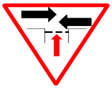 | Slow down and yield to others | 55.6 | 36.4 | 21.10→71.4 |
© 2019 by the authors. Licensee MDPI, Basel, Switzerland. This article is an open access article distributed under the terms and conditions of the Creative Commons Attribution (CC BY) license (http://creativecommons.org/licenses/by/4.0/).
Share and Cite
Liu, J.; Wen, H.; Zhu, D.; Kumfer, W. Investigation of the Contributory Factors to the Guessability of Traffic Signs. Int. J. Environ. Res. Public Health 2019, 16, 162. https://doi.org/10.3390/ijerph16010162
Liu J, Wen H, Zhu D, Kumfer W. Investigation of the Contributory Factors to the Guessability of Traffic Signs. International Journal of Environmental Research and Public Health. 2019; 16(1):162. https://doi.org/10.3390/ijerph16010162
Chicago/Turabian StyleLiu, Jing, Huiying Wen, Dianchen Zhu, and Wesley Kumfer. 2019. "Investigation of the Contributory Factors to the Guessability of Traffic Signs" International Journal of Environmental Research and Public Health 16, no. 1: 162. https://doi.org/10.3390/ijerph16010162
APA StyleLiu, J., Wen, H., Zhu, D., & Kumfer, W. (2019). Investigation of the Contributory Factors to the Guessability of Traffic Signs. International Journal of Environmental Research and Public Health, 16(1), 162. https://doi.org/10.3390/ijerph16010162


