
Omics-Derived Prognostic Biomarkers in Tongue Squamous Cell Carcinoma: A Systematic Review with Risk-of-Bias Appraisal and Translational Prioritization
 , , ,
, , ,
Abstract
1. Introduction
2. Materials and Methods
2.1. Protocol and Registration
2.2. Eligibility Criteria
2.3. Information Sources and Search Strategy
2.4. Study Selection and Screening Process
2.5. Data Charting Process and Data Items
2.6. Risk of Bias and Reporting Quality Assessment
2.7. Data Synthesis and Analysis
2.8. Evidence Tier Framework and Translational Readiness Mapping
3. Results
3.1. Study Selection
3.2. Characteristics of Eligible Studies
3.3. Biomarker Types and Association with TSCC Prognosis
3.3.1. Comparisons Between TSCC Subgroups with Different Clinicopathologic Phenotypes
3.3.2. Comparison of Cancerous with Normal Tissues
3.4. Risk of Bias and Reporting Quality of Included Studies
3.5. Data Synthesis
3.6. Evidence Tiering and Translational Readiness Prioritization

| Biomarker/Signature | Evidence Tier (1–4) | Endpoint (OS/DFS/RFS/DSS) | Adjusted? (Y/N; Covariates) | Validation (None/Internal/External/Multi-Cohort) | Specimen + Assay | Potential Clinical Context of Use (Neck/Adjuvant/Surveillance) | Key Limitations (RoB Flags) |
|---|---|---|---|---|---|---|---|
| CA9 | 1 | OS | Y; (Cox; covariates NR); Y; (multivariable Cox; covariates NR) | Replicated across 2 eligible studies; external (public cohorts: TCGA +GEO) | Microarray; Microarray + NGS (scRNA-seq) (GSE172577) | Adjuvant; surveillance | Cut-off heterogeneity; residual confounding; k = 2 |
| NELL2 | 2 | OS | Y; (multivariable Cox; covariates NR) | External (public cohorts: TCGA + GEO) | NGS (RNA-seq) | Adjuvant; surveillance | Single-study effect; residual confounding |
| PDE4D | 2 | OS | Y; Yes (multivariable Cox; covariates NR) | External (public cohorts: TCGA + GEO) | NGS (RNA-seq) | Adjuvant; surveillance | Single-study effect; residual confounding |
| CTTN | 2 | OS | Y; (multivariable Cox; covariates NR) | External (public cohorts: TCGA + GEO) | NGS (RNA-seq) | Adjuvant; surveillance | Single-study effect; residual confounding |
| HBEGF | 2 | OS | Y; (multivariable Cox; covariates NR) | External (public cohorts: TCGA + GEO) | NGS (RNA-seq) | Adjuvant; surveillance | Single-study effect; residual confounding |
| AC139530.1 | 2 | OS | Y; (multivariable Cox; covariates NR) | Internal (single public cohort: TCGA) | NGS (RNA-seq) | Surveillance | Single-study effect; residual confounding |
| LINC01711 | 3 | OS | Y; (multivariable Cox; covariates NR) | Internal (single public cohort: TCGA) | NGS (RNA-seq) | Surveillance | Single-study effect; residual confounding |
| CCDC96 | 2 | OS | Y; (multivariable Cox; covariates NR) | External (public cohorts: TCGA + GEO) | NGS (RNA-seq) | Surveillance | Single-study effect; residual confounding |
| CYP2J2 | 2 | OS | Y; (multivariable Cox; covariates NR) | External (public cohorts: TCGA + GEO) | NGS (RNA-seq) | Surveillance | Single-study effect; residual confounding |
| SPAG16 | 2 | OS | Y; Y; (multivariable Cox; covariates NR) | External (public cohorts: TCGA + GEO) | NGS (RNA-seq) | Surveillance | Single-study effect; residual confounding |
4. Discussion
5. Conclusions
Supplementary Materials
Author Contributions
Funding
Institutional Review Board Statement
Informed Consent Statement
Data Availability Statement
Acknowledgments
Conflicts of Interest
Abbreviations
| TSCC | Tongue squamous cell carcinoma |
| ASR | Age-standardized incidence rate |
| SCC | Squamous cell carcinoma |
| miRNAs | MicroRNAs |
| IHC | Immunohistochemistry |
| PRISMA | Preferred Reporting Items for Systematic Reviews and Meta-Analyses |
| OS | Overall survival |
| DFS | Disease-free survival |
| DSS | Disease-specific survival |
| OSCC | Oral squamous cell carcinoma |
| IPD | Individual participant data |
| QUIPS | Quality In Prognosis Studies tool for Risk of Bias |
| PROBAST | The Prediction model Risk Of Bias assessment tool |
| REMARK | Reporting Recommendations for Tumor Marker Prognostic Studies |
| HR | Hazard ratio |
| CI | Confidence interval |
| RFS | Recurrence-Free Survival |
| T | Tumor specimen |
| C | Control (non-tumor) specimen |
| TCGA | The Cancer Genome Atlas Project |
| GEO | Gene Expression Omnibus |
| lncRNA or LNC | Long non-coding RNA |
| NGS | Next-generation sequencing |
| N1-N3, or N+ | Tumor specimen with lymph node metastasis |
| N0 | Tumor specimen without lymph node metastasis |
| KEGG | Kyoto Encyclopedia of Genes and Genomes |
| DEG | Differentially expressed gene |
| CNV | Copy number variant |
| LNM | Lymph node metastasis |
| GSVA | Gene Set Variation Analysis |
| GO | Gene Ontology |
| KM | Kaplan–Meier |
| Cox | Cox proportional hazards regression |
References
- Bray, F.; Laversanne, M.; Sung, H.; Ferlay, J.; Siegel, R.L.; Soerjomataram, I.; Jemal, A. Global Cancer Statistics 2022: GLOBOCAN Estimates of Incidence and Mortality Worldwide for 36 Cancers in 185 Countries. CA Cancer J. Clin. 2024, 74, 229–263. [Google Scholar] [CrossRef] [Scilit]
- Patel, S.C.; Carpenter, W.R.; Tyree, S.; Couch, M.E.; Weissler, M.; Hackman, T.; Hayes, D.N.; Shores, C.; Chera, B.S. Increasing Incidence of Oral Tongue Squamous Cell Carcinoma in Young White Women, Age 18 to 44 Years. J. Clin. Oncol. 2011, 29, 1488–1494. [Google Scholar] [CrossRef] [Scilit]
- Ng, J.H.; Iyer, N.G.; Tan, M.H.; Edgren, G. Changing Epidemiology of Oral Squamous Cell Carcinoma of the Tongue: A Global Study. Head Neck 2017, 39, 297–304. [Google Scholar] [CrossRef] [Scilit]
- Bello, I.O.; Soini, Y.; Salo, T. Prognostic Evaluation of Oral Tongue Cancer: Means, Markers and Perspectives (I). Oral Oncol. 2010, 46, 630–635. [Google Scholar] [CrossRef] [Scilit]
- Almangush, A.; Bello, I.O.; Coletta, R.D.; Mäkitie, A.A.; Mäkinen, L.K.; Kauppila, J.H.; Pukkila, M.; Hagström, J.; Laranne, J.; Soini, Y.; et al. For Early-Stage Oral Tongue Cancer, Depth of Invasion and Worst Pattern of Invasion Are the Strongest Pathological Predictors for Locoregional Recurrence and Mortality. Virchows Arch. 2015, 467, 39–46. [Google Scholar] [CrossRef] [Scilit] [PubMed]
- Colevas, A.D.; Cmelak, A.J.; Pfister, D.G.; Spencer, S.; Adkins, D.; Birkeland, A.C.; Brizel, D.M.; Busse, P.M.; Caudell, J.J.; Durm, G.; et al. NCCN Guidelines® Insights: Head and Neck Cancers, Version 2.2025. J. Natl. Compr. Cancer Netw. JNCCN 2025, 23, 2–11. [Google Scholar] [CrossRef] [Scilit] [PubMed]
- Karatas, O.F.; Oner, M.; Abay, A.; Diyapoglu, A. MicroRNAs in Human Tongue Squamous Cell Carcinoma: From Pathogenesis to Therapeutic Implications. Oral Oncol. 2017, 67, 124–130. [Google Scholar] [CrossRef] [Scilit]
- Zhang, H.; Shi, Q.; Yang, Z.; Wang, K.; Zhang, Z.; Huang, Z.; Cui, X.; Li, F. An Extracellular Matrix-Based Signature Associated with Immune Microenvironment Predicts the Prognosis and Therapeutic Responses of Patients with Oesophageal Squamous Cell Carcinoma. Front. Mol. Biosci. 2021, 8, 598427. [Google Scholar] [CrossRef] [Scilit]
- Lorenzo-Pouso, A.I.; Silva, F.F.V.E.; Pérez-Jardón, A.; Chamorro-Petronacci, C.M.; Oliveira-Alves, M.G.; Álvarez-Calderón-Iglesias, Ó.; Caponio, V.C.A.; Pinti, M.; Perrotti, V.; Pérez-Sayáns, M. Overexpression of E-Cadherin Is a Favorable Prognostic Biomarker in Oral Squamous Cell Carcinoma: A Systematic Review and Meta-Analysis. Biology 2023, 12, 239. [Google Scholar] [CrossRef] [Scilit] [PubMed]
- Sun, Y.; Li, Y.; Zhou, W.; Liu, Z. MicroRNA Expression as a Prognostic Biomarker of Tongue Squamous Cell Carcinoma (TSCC): A Systematic Review and Meta-Analysis. BMC Oral Health 2024, 24, 406. [Google Scholar] [CrossRef] [Scilit]
- Almangush, A.; Heikkinen, I.; Mäkitie, A.A.; Coletta, R.D.; Läärä, E.; Leivo, I.; Salo, T. Prognostic Biomarkers for Oral Tongue Squamous Cell Carcinoma: A Systematic Review and Meta-Analysis. Br. J. Cancer 2017, 117, 856–866. [Google Scholar] [CrossRef] [Scilit] [PubMed]
- Page, M.J.; McKenzie, J.E.; Bossuyt, P.M.; Boutron, I.; Hoffmann, T.C.; Mulrow, C.D.; Shamseer, L.; Tetzlaff, J.M.; Akl, E.A.; Brennan, S.E.; et al. The PRISMA 2020 Statement: An Updated Guideline for Reporting Systematic Reviews. BMJ 2021, 372, n71. [Google Scholar] [CrossRef] [Scilit]
- Ouzzani, M.; Hammady, H.; Fedorowicz, Z.; Elmagarmid, A. Rayyan-a Web and Mobile App for Systematic Reviews. Syst. Rev. 2016, 5, 210. [Google Scholar] [CrossRef] [Scilit]
- Hayden, J.A.; van der Windt, D.A.; Cartwright, J.L.; Côté, P.; Bombardier, C. Assessing Bias in Studies of Prognostic Factors. Ann. Intern. Med. 2013, 158, 280–286. [Google Scholar] [CrossRef] [Scilit]
- Wolff, R.F.; Moons, K.G.M.; Riley, R.D.; Whiting, P.F.; Westwood, M.; Collins, G.S.; Reitsma, J.B.; Kleijnen, J.; Mallett, S. PROBAST: A Tool to Assess the Risk of Bias and Applicability of Prediction Model Studies. Ann. Intern. Med. 2019, 170, 51–58. [Google Scholar] [CrossRef] [Scilit]
- Mc Shane, L.M.; Altman, D.G.; Sauerbrei, W.; Taube, S.E.; Gion, M.; Clark, G.M. Reporting Recommendations for Tumor Marker Prognostic Studies (REMARK). J. Natl. Cancer Inst. 2005, 97, 1180–1184. [Google Scholar] [CrossRef] [Scilit]
- Yang, X.; Fang, L.; Zhang, C. CNV Analysis of the Correlation between Preoperative Lymph Node Metastasis and Prognosis of Early Tongue Cancer. J. Cancer 2021, 12, 6135–6144. [Google Scholar] [CrossRef] [Scilit] [PubMed]
- Xiao, F.; Dai, Y.; Hu, Y.; Lu, M.; Dai, Q. Expression Profile Analysis Identifies IER3 to Predict Overall Survival and Promote Lymph Node Metastasis in Tongue Cancer. Cancer Cell Int. 2019, 19, 307. [Google Scholar] [CrossRef] [Scilit]
- Lee, D.Y.; Hun Hah, J.; Jeong, W.J.; Chung, E.J.; Kwon, T.K.; Ahn, S.H.; Sung, M.W.; Kwon, S.K. The Expression of Defensin-Associated Genes May Be Correlated with Lymph Node Metastasis of Early-Stage Tongue Cancer. Clin. Exp. Otorhinolaryngol. 2022, 15, 372–379. [Google Scholar] [CrossRef] [Scilit]
- Lee, D.Y.; Kang, Y.; Im, N.R.; Kim, B.; Kwon, T.K.; Jung, K.Y.; Baek, S.K. Actin-Associated Gene Expression Is Associated with Early Regional Metastasis of Tongue Cancer. Laryngoscope 2021, 131, 813–819. [Google Scholar] [CrossRef] [Scilit] [PubMed]
- Yang, X.; Wu, K.; Li, S.; Hu, L.; Han, J.; Zhu, D.; Tian, X.; Liu, W.; Tian, Z.; Zhong, L.; et al. MFAP5 and TNNC1: Potential Markers for Predicting Occult Cervical Lymphatic Metastasis and Prognosis in Early Stage Tongue Cancer. Oncotarget 2017, 8, 2525–2535. [Google Scholar] [CrossRef] [Scilit] [PubMed]
- Li, Y.; Wan, Q.; Wang, W.; Mai, L.; Sha, L.; Mashrah, M.; Lin, Z.; Pan, C. LncRNA ADAMTS9-AS2 Promotes Tongue Squamous Cell Carcinoma Proliferation, Migration and EMT via the MiR-600/EZH2 Axis. Biomed. Pharmacother. 2019, 112, 108719. [Google Scholar] [CrossRef] [Scilit] [PubMed]
- Kim, S.; Lee, C.; Kim, H.; Yoon, S.O. Genetic Characteristics of Advanced Oral Tongue Squamous Cell Carcinoma in Young Patients. Oral Oncol. 2023, 144, 106466. [Google Scholar] [CrossRef] [Scilit]
- Ren, Y.; Da, J.; Ren, J.; Song, Y.; Han, J. An Autophagy-Related Long Non-Coding RNA Signature in Tongue Squamous Cell Carcinoma. BMC Oral Health 2023, 23, 120. [Google Scholar] [CrossRef] [Scilit]
- Liu, M.; Tong, L.; Liang, B.; Song, X.; Xie, L.; Peng, H.; Huang, D. A 15-Gene Signature and Prognostic Nomogram for Predicting Overall Survival in Non-Distant Metastatic Oral Tongue Squamous Cell Carcinoma. Front. Oncol. 2021, 11, 587548. [Google Scholar] [CrossRef] [Scilit]
- Liu, H.; Li, Q.; Qi, H.; Du, F.; Qiu, Y. Identification of Circular RNA_0000919 as a Potential Diagnostic and Prognostic Biomarker of Tongue Squamous Cell Carcinoma Using Circular RNA Microarray and Reverse Transcription-Quantitative PCR Analyses. Oncol. Lett. 2022, 24, 270. [Google Scholar] [CrossRef] [Scilit] [PubMed]
- Dou, H.; Song, C.; Wang, X.; Feng, Z.; Su, Y.; Wang, H. Integrated Bioinformatics Analysis of SEMA3C in Tongue Squamous Cell Carcinoma Using Machine-Learning Strategies. Cancer Cell Int. 2024, 24, 58. [Google Scholar] [CrossRef] [Scilit]
- Zhu, H.; Tao, Y.; Huang, Q.; Chen, Z.; Jiang, L.; Yan, H.; Zhong, J.; Liang, L. Identification of Ferroptosis-Related Genes as Potential Biomarkers of Tongue Squamous Cell Carcinoma Using an Integrated Bioinformatics Approach. FEBS Open Bio 2022, 12, 412–429. [Google Scholar] [CrossRef] [Scilit]
- Hu, D.; Messadi, D.V. Immune-Related Long Non-Coding RNA Signatures for Tongue Squamous Cell Carcinoma. Curr. Oncol. 2023, 30, 4817–4832. [Google Scholar] [CrossRef] [Scilit]
- Li, Z.; Jiang, C.; Yuan, Y. TCGA Based Integrated Genomic Analyses of CeRNA Network and Novel Subtypes Revealing Potential Biomarkers for the Prognosis and Target Therapy of Tongue Squamous Cell Carcinoma. PLoS ONE 2019, 14, e0216834, Correction in PLoS ONE 2019, 14, e0218987. [Google Scholar] [CrossRef] [Scilit]
- Thangaraj, S.V.; Shyamsundar, V.; Krishnamurthy, A.; Ramshankar, V. Deregulation of Extracellular Matrix Modeling with Molecular Prognostic Markers Revealed by Transcriptome Sequencing and Validations in Oral Tongue Squamous Cell Carcinoma. Sci. Rep. 2021, 11, 250. [Google Scholar] [CrossRef] [Scilit] [PubMed]
- Jin, Y.; Wang, Z.; He, D.; Zhu, Y.; Chen, X.; Cao, K. Identification of Novel Subtypes Based on SsGSEA in Immune-Related Prognostic Signature for Tongue Squamous Cell Carcinoma. Cancer Med. 2021, 10, 8693–8707. [Google Scholar] [CrossRef] [Scilit]
- Wang, S.; Fu, Z.; Wang, Y.; Sun, Y.; Cui, L.; Wang, C.; Liu, Q.; Shao, D.; Wang, Y.; Wen, N. Correlation of Carbonic Anhydrase 9 (CA9) with Pathological T-Stage and Prognosis in Patients with Oral Tongue Squamous Cell Carcinoma. Ann. Transl. Med. 2020, 8, 1521. [Google Scholar] [CrossRef] [Scilit]
- Van Dijk, B.A.C.; Brands, M.T.; Geurts, S.M.E.; Merkx, M.A.W.; Roodenburg, J.L.N. Trends in Oral Cavity Cancer Incidence, Mortality, Survival and Treatment in the Netherlands. Int. J. Cancer 2016, 139, 574–583. [Google Scholar] [CrossRef] [Scilit]
- Mesgari, H.; Esmaelian, S.; Nasiri, K.; Ghasemzadeh, S.; Doroudgar, P.; Payandeh, Z. Epigenetic Regulation in Oral Squamous Cell Carcinoma Microenvironment: A Comprehensive Review. Cancers 2023, 15, 5600. [Google Scholar] [CrossRef] [Scilit]
- Zhou, R.S.; Zhang, E.X.; Sun, Q.F.; Ye, Z.J.; Liu, J.W.; Zhou, D.H.; Tang, Y. Integrated analysis of lncRNA-miRNA-mRNA ceRNA network in squamous cell carcinoma of tongue. BMC Cancer 2019, 19, 779. [Google Scholar] [CrossRef] [Scilit]
- Sedlakova, O.; Svastova, E.; Takacova, M.; Kopacek, J.; Pastorek, J.; Pastorekova, S. Carbonic anhydrase IX, a hypoxia-induced catalytic component of the pH regulating machinery in tumors. Front. Physiol. 2014, 4, 400. [Google Scholar] [CrossRef] [Scilit] [PubMed]
- Aldera, A.P.; Govender, D. Carbonic anhydrase IX: A regulator of pH and participant in carcinogenesis. J. Clin. Pathol. 2021, 74, 350–354. [Google Scholar] [CrossRef] [Scilit]
- Peridis, S.; Pilgrim, G.; Athanasopoulos, I.; Parpounas, K. Carbonic anhydrase-9 expression in head and neck cancer: A meta-analysis. Eur. Arch. Oto-Rhino-Laryngol. 2011, 268, 661–670. [Google Scholar] [CrossRef] [Scilit] [PubMed]
- Hanahan, D.; Weinberg, R.A. Hallmarks of cancer: The next generation. Cell 2011, 144, 646–674. [Google Scholar] [CrossRef] [Scilit]
- Zhang, Y.; Sun, X. Role of Focal Adhesion Kinase in Head and Neck Squamous Cell Carcinoma and Its Therapeutic Prospect. OncoTargets Ther. 2020, 13, 10207–10220. [Google Scholar] [CrossRef] [Scilit]
- Bailey, S.M. Editorial: Hallmark of cancer: Replicative immortality. Front. Oncol. 2023, 13, 1204094. [Google Scholar] [CrossRef] [Scilit]
- Zhang, M.; Wu, L.; Wang, X.; Chen, J. lncKRT16P6 promotes tongue squamous cell carcinoma progression by sponging miR-3180 and regulating GATAD2A expression. Int. J. Oncol. 2022, 61, 111. [Google Scholar] [CrossRef] [Scilit]
- Yu, J.; Liu, Y.; Guo, C.; Zhang, S.; Gong, Z.; Tang, Y.; Yang, L.; He, Y.; Lian, Y.; Li, X.; et al. Upregulated long non-coding RNA LINC00152 expression is associated with progression and poor prognosis of tongue squamous cell carcinoma. J. Cancer 2017, 8, 523–530. [Google Scholar] [CrossRef] [Scilit]
- Song, Y.; Pan, Y.; Liu, J. Functional analysis of lncRNAs based on competitive endogenous RNA in tongue squamous cell carcinoma. PeerJ 2019, 7, e6991. [Google Scholar] [CrossRef] [Scilit]
- Qu, X.; Leung, T.C.N.; Ngai, S.M.; Tsai, S.-N.; Thakur, A.; Li, W.-K.; Lee, Y.; Leung, L.; Ng, T.-H.; Yam, J.; et al. Proteomic Analysis of Circulating Extracellular Vesicles Identifies Potential Biomarkers for Lymph Node Metastasis in Oral Tongue Squamous Cell Carcinoma. Cells 2021, 10, 2179. [Google Scholar] [CrossRef] [Scilit]
- Liang, L.; Li, Y.; Ying, B.; Huang, X.; Liao, S.; Yang, J.; Liao, G. Mutation-associated transcripts reconstruct the prognostic features of oral tongue squamous cell carcinoma. Int J Oral Sci. 2023, 15, 1. [Google Scholar] [CrossRef] [Scilit] [PubMed]
- Lai, J.; Fang, C.; Zhang, G.; Shi, C.; Yu, F.; Gu, W.; Deng, J.; Xu, J.; Liu, C.; Qiu, F. Novel Prognostic Model Construction of Tongue Squamous Cell Carcinoma Based on Apigenin-Associated Genes. Front. Biosci. (Landmark Ed.) 2024, 29, 65. [Google Scholar] [CrossRef] [Scilit]
- Krishnan, N.M.; Dhas, K.; Nair, J.; Palve, V.; Bagwan, J.; Siddappa, G.; Suresh, A.; Kekatpure, V.D.; Kuriakose, M.A.; Panda, B. A Minimal DNA Methylation Signature in Oral Tongue Squamous Cell Carcinoma Links Altered Methylation with Tumor Attributes. Mol Cancer Res. 2016, 14, 805–819. [Google Scholar] [CrossRef] [Scilit] [PubMed]
- Hilly, O.; Pillar, N.; Stern, S.; Strenov, Y.; Bachar, G.; Shomron, N.; Shpitzer, T. Distinctive pattern of let-7 family microRNAs in aggressive carcinoma of the oral tongue in young patients. Oncol Lett. 2016, 12, 1729–1736. [Google Scholar] [CrossRef] [Scilit]
- Fang, Z.; Wu, L.; Wang, L.; Yang, Y.; Meng, Y.; Yang, H. Increased expression of the long non-coding RNA UCA1 in tongue squamous cell carcinomas: A possible correlation with cancer metastasis. Oral Surg. Oral Med. Oral Pathol. Oral Radiol. 2014, 117, 89–95. [Google Scholar] [CrossRef] [Scilit]
- Dharavath, B.; Butle, A.; Pal, A.; Desai, S.; Upadhyay, P.; Rane, A.; Khandelwal, R.; Manavalan, S.; Thorat, R.; Sonawane, K.; et al. Role of miR-944/MMP10/AXL- axis in lymph node metastasis in tongue cancer. Commun. Biol. 2023, 6, 57. [Google Scholar] [CrossRef] [Scilit] [PubMed]
- Bhavsar, M.; Patel, S.; Rawal, R.; Patel, S.; Mankad, A. Identification of Prognostic Biomarkers for Early Detection of Tongue Squamous Cell Carcinoma: A Systematic Retrospective Analysis. Hum. Gene 2023, 38, 201234. [Google Scholar] [CrossRef] [Scilit]
- Yu, M.; Wu, G.; Chen, Y.; Wang, H.; Gao, Y.; Wang, A. Bioinformatic Screening and Experimental Analysis Identify SFRP1 as a Prognostic Biomarker for Tongue Squamous Cell Carcinomas. Arch. Oral Biol. 2020, 110, 104587. [Google Scholar] [CrossRef] [Scilit] [PubMed]
- Yu, Z.; Xia, L.; Leng, W.; Shi, J.; He, W.; Mao, M.; Chai, H.; Yan, Y. A Prognostic five lnc-RNA Expression Signature for Survival Prediction in Patients with Tongue Squamous Cell Carcinoma. Acta Medica Mediterr. 2022, 38, 1641–1648. [Google Scholar] [CrossRef]
- Zhang, M.; Chen, Z.; Zhang, S.; Wu, L.; Jie, Y.; Liao, Y.; Huang, Y.; Chen, J.; Shi, B. Analysis of Differentially Expressed Long Non-Coding RNAs and the Associated TF-MRNA Network in Tongue Squamous Cell Carcinoma. Front. Oncol. 2020, 10, 1421. [Google Scholar] [CrossRef] [Scilit]
- Chen, W.; Wang, P.; Lu, Y.; Jin, T.; Lei, X.; Liu, M.; Zhuang, P.; Liao, J.; Lin, Z.; Li, B.; et al. Decreased Expression of Mitochondrial Mir-5787 Contributes to Chemoresistance by Reprogramming Glucose Metabolism and Inhibiting MT-CO3 Translation. Theranostics 2019, 9, 5739–5754. [Google Scholar] [CrossRef] [Scilit]
- Ananthi, S.; Lakshmi, C.N.P.; Atmika, P.; Anbarasu, K.; Mahalingam, S. Global Quantitative Proteomics Reveal Deregulation of Cytoskeletal and Apoptotic Signalling Proteins in Oral Tongue Squamous Cell Carcinoma. Sci. Rep. 2018, 8, 1567. [Google Scholar] [CrossRef] [Scilit]
- Morita, T.; Uzawa, N.; Mogushi, K.; Sumino, J.; Michikawa, C.; Takahashi, K.I.; Myo, K.; Izumo, T.; Harada, K. Characterizing Genetic Transitions of Copy Number Alterations and Allelic Imbalances in Oral Tongue Carcinoma Metastasis. Genes Chromosomes Cancer 2016, 55, 975–986. [Google Scholar] [CrossRef] [Scilit]
- Gao, W.; Chan, J.Y.W.; Wong, T.S. Long Non-Coding RNA Deregulation in Tongue Squamous Cell Carcinoma. BioMed Res. Int. 2014, 2014, 405860. [Google Scholar] [CrossRef] [Scilit]
- Panda, B.; Krishnan, N.; Gupta, S.; Palve, V.; Varghese, L.; Pattnaik, S.; Jain, P.; Khyriem, C.; Hariharan, A.; Dhas, K.; et al. Integrated Analysis of Oral Tongue Squamous Cell Carcinoma Identifies Key Variants and Pathways Linked to Risk Habits, HPV, Clinical Parameters and Tumor Recurrence. F1000Research 2015, 4, 1215. [Google Scholar] [CrossRef] [Scilit]
- Tan, D.S.W.; Wang, W.; Leong, H.S.; Sew, P.H.; Lau, D.P.; Chong, F.T.; Krisna, S.S.; Lim, T.K.H.; Iyer, N.G. Tongue Carcinoma Infrequently Harbor Common Actionable Genetic Alterations. BMC Cancer 2014, 14, 679. [Google Scholar] [CrossRef] [Scilit] [PubMed]
- Zhang, S.; Cao, R.; Li, Q.; Yao, M.; Chen, Y.; Zhou, H. Comprehensive Analysis of LncRNA-Associated Competing Endogenous RNA Network in Tongue Squamous Cell Carcinoma. PeerJ 2019, 7, e6397. [Google Scholar] [CrossRef] [Scilit] [PubMed]
- Chen, Y.; Tian, T.; Li, Z.Y.; Wang, C.Y.; Deng, R.; Deng, W.Y.; Yang, A.K.; Chen, Y.F.; Li, H. FSCN1 Is an Effective Marker of Poor Prognosis and a Potential Therapeutic Target in Human Tongue Squamous Cell Carcinoma. Cell Death Dis. 2019, 10, 356. [Google Scholar] [CrossRef] [Scilit] [PubMed]
- Tian, T.; Zhang, L.; Tang, K.; Wang, A.; Wang, J.; Wang, J.; Wang, F.; Wang, W.; Ma, X. SEMA3A Exon 9 Expression Is a Potential Prognostic Marker of Unfavorable Recurrence-Free Survival in Patients with Tongue Squamous Cell Carcinoma. DNA Cell Biol. 2020, 39, 555–562. [Google Scholar] [CrossRef] [Scilit]
- Jin, Y.; Wang, Z.; Tang, W.; Liao, M.; Wu, X.; Wang, H. An Integrated Analysis of Prognostic Signature and Immune Microenvironment in Tongue Squamous Cell Carcinoma. Front. Oncol. 2022, 12, 891716. [Google Scholar] [CrossRef] [Scilit]
- Alsofyani, A.A.; Dallol, A.; Farraj, S.A.; Alsiary, R.A.; Samkari, A.; Alhaj-Hussain, B.T.; Khan, J.A.; Al-Maghrabi, J.; Al-Khayyat, S.S.; Alkhatabi, H.; et al. Molecular Characterisation in Tongue Squamous Cell Carcinoma Reveals Key Variants Potentially Linked to Clinical Outcomes. Cancer Biomark. 2020, 28, 213–220. [Google Scholar] [CrossRef] [Scilit]
- Wirsing, A.M.; Bjerkli, I.H.; Steigen, S.E.; Rikardsen, O.; Magnussen, S.N.; Hegge, B.; Seppola, M.; Uhlin-Hansen, L.; Hadler-Olsen, E. Validation of Selected Head and Neck Cancer Prognostic Markers from the Pathology Atlas in an Oral Tongue Cancer Cohort. Cancers 2021, 13, 2387. [Google Scholar] [CrossRef] [Scilit]
- Tan, H.; Huang, H.; Yang, H.; Qian, J.; Wei, L.; Liu, W. Construction and Validation of a Prognostic Model for Tongue Cancer Based on Three Genes Signature. Medicine 2023, 102, E36097. [Google Scholar] [CrossRef] [Scilit]
- Berania, I.; Cardin, G.B.; Clément, I.; Guertin, L.; Ayad, T.; Bissada, E.; Nguyen-Tan, P.F.; Filion, E.; Guilmette, J.; Gologan, O.; et al. Four PTEN-Targeting Co-Expressed MiRNAs and ACTN4- Targeting MiR-548b Are Independent Prognostic Biomarkers in Human Squamous Cell Carcinoma of the Oral Tongue. Int. J. Cancer 2017, 141, 2318–2328. [Google Scholar] [CrossRef] [Scilit] [PubMed]
- Upadhyay, P.; Gardi, N.; Desai, S.; Chandrani, P.; Joshi, A.; Dharavath, B.; Arora, P.; Bal, M.; Nair, S.; Dutt, A. Genomic Characterization of Tobacco/Nut Chewing HPV-Negative Early Stage Tongue Tumors Identify MMP10 as a Candidate to Predict Metastases. Oral Oncol. 2017, 73, 56–64. [Google Scholar] [CrossRef] [Scilit] [PubMed]
- Lv, X.; Yu, X. Signatures and Prognostic Values of Related Immune Targets in Tongue Cancer. Front. Surg. 2023, 9, 952389. [Google Scholar] [CrossRef] [Scilit] [PubMed]
- Chen, W.L.; Wang, X.K.; Wu, W. Identification of ITGA3 as an Oncogene in Human Tongue Cancer via Integrated Bioinformatics Analysis. Curr. Med. Sci. 2018, 38, 714–720. [Google Scholar] [CrossRef] [Scilit]

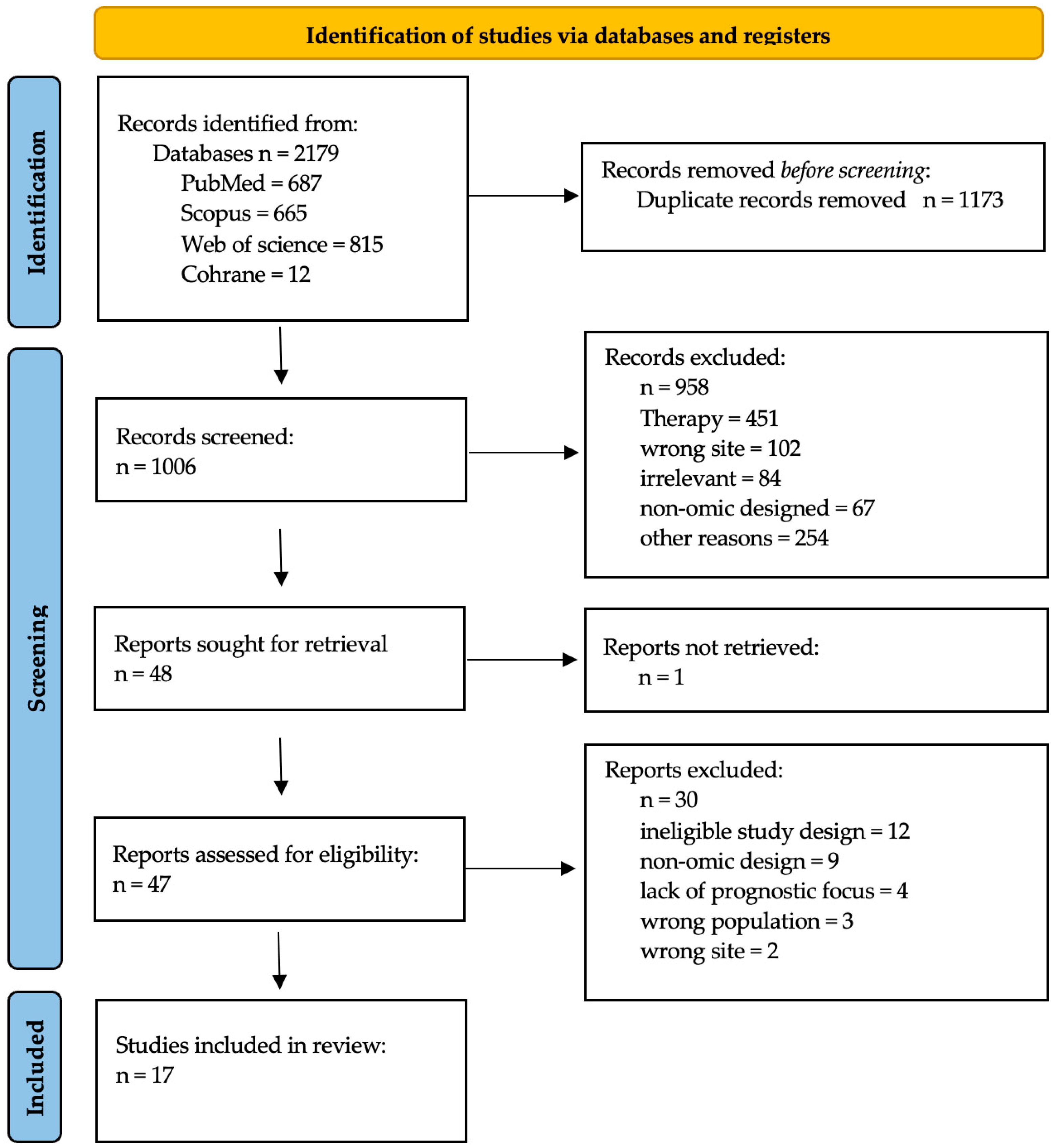


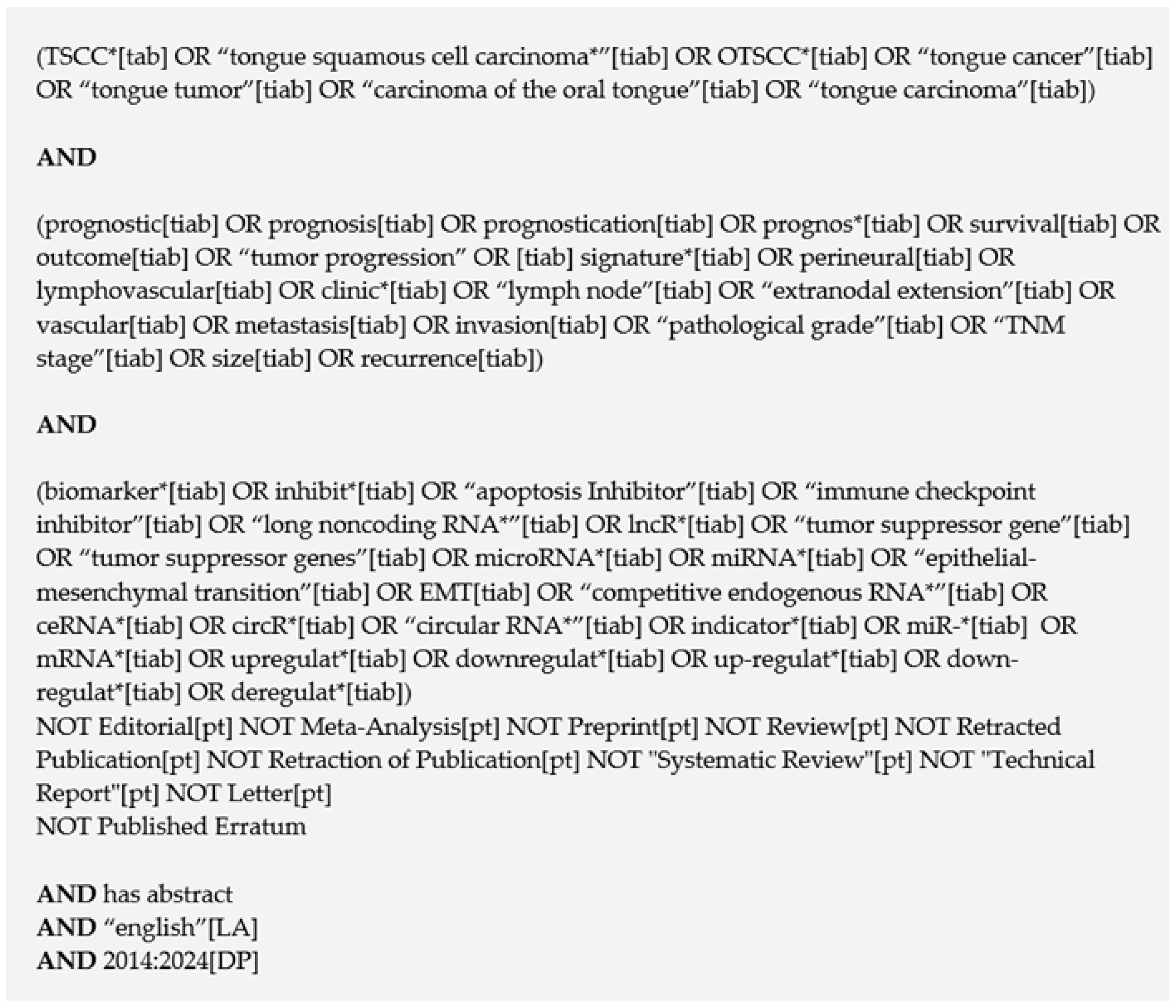
| PICO Element | Systematic Review of Prognostic Molecular Biomarkers in TSCC |
|---|---|
| P—Population | TSCC patients |
| I—Intervention | Identification of molecular biomarkers |
| C—Comparison | Omics-based molecular profiles of TSCC patients, healthy individuals |
| O—Outcome | Prognostic outcomes (OS, DFS, etc.) |
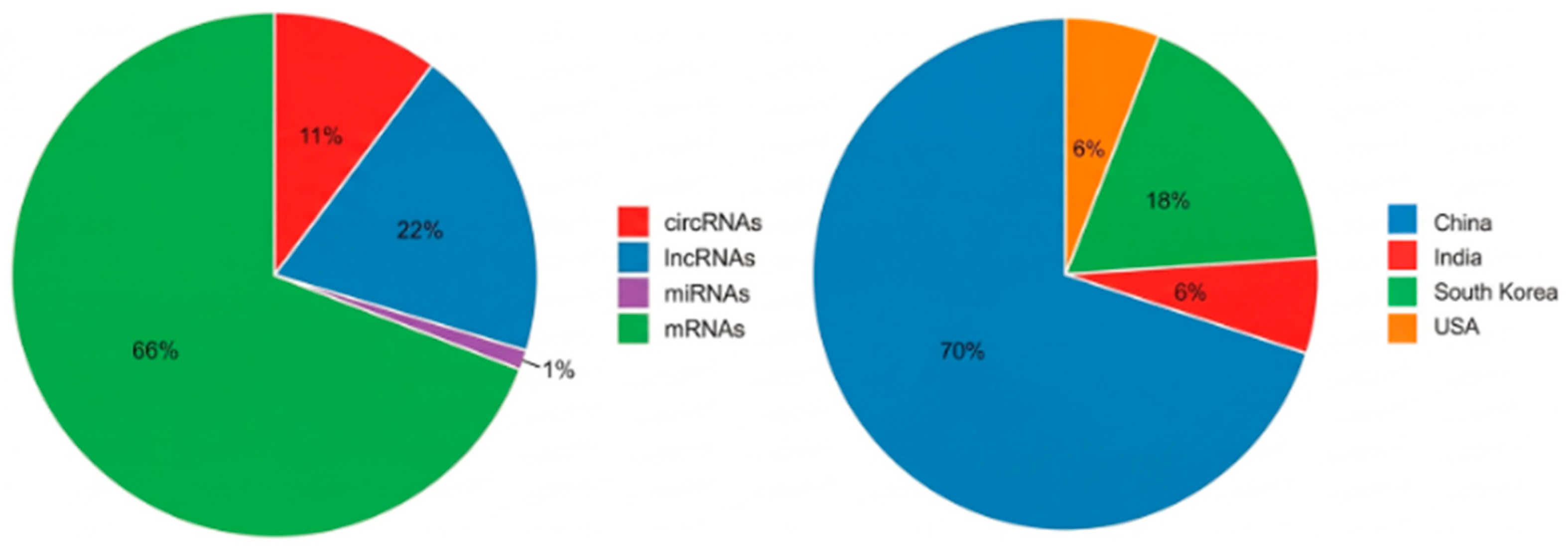
| N0 vs. N+ or T vs. C | Reference | Sample Size | Biomarkers | Method of Biomarker Detection | Biomarker-Associated Pathway | Pathway Sources/Methods | Association with Prognosis | Method of Correlation with Prognosis |
|---|---|---|---|---|---|---|---|---|
| N0 vs. N+ | Yang X et al./2021/ China [17] | 41N0, 19N+ | CNVs of gene TNFRSF10C | NGS (WES) | PI3K-Akt signaling pathway, migration | KEGG | ↑ TNFRSF10C → ↑ DFS, N0 | KM |
| N0 vs. N+ | Xiao F et al./2019/China [18] | 14N0, 5N+ | IER3 gene | Microarray + NGS (RNA-seq) | PI3K-Akt signaling pathway, MAPK signaling pathway, hypoxia, angiogenesis, lymphangiogenesis, VEGF-C, apoptosis | GSVA | ↑ IER3 → poorer OS/DFS, N+ | KM, HR(OS) |
| N0 vs. N+ | Lee DY et al./2022/South Korea [19] | 35 N0, 12N+ | DEFB4A, DEFB103B, and DEFB4 genes | NGS (RNA-seq) | Calcium signaling pathway, muscle contraction | KEGG, GO | ↓ DEFB4A/DEFB103B/DEFB4B → N+ | Expression/DEGs, cell infiltration |
| N0 vs. N+ | Lee DY et al./2021/ S. Korea [20] | 65 N0, 41N+ | ACTA1 gene | NGS (RNA-seq) | Muscle contraction (through actin) | KEGG, GO | ↑ACTA1 → N+ | Expression/limma DEGs |
| N0 vs. N+ | Yang X et al./2017/ China [21] | 6N0, 6N+, 12C | MFAP5 and TNNC1 genes | Microarray | Focal adhesion | KEGG, GO | ↑ MFAP5 → poor prognosis MFAP5 is an independent prognostic biomarker of occult metastasis MFAP5/TNNC1 → TSCC recurrence | KM, log-rank; Cox |
| N0 vs. N+ | Li et al./2019/ China [22] | 41N0, 35N+ | LNC ADAMTS9-AS2 | Microarray (lncRNA) | Growth/invasion | - | ↑ ADAMTS9-AS2 → poor prognosis, ↑ TNM or size, and ↑ clinical stage | KM, log-rank |
| N0 vs. N+ | Kim et al./2023/ S. Korea [23] | 16T (<45 years old), 28T (>45 years old) | TERTp mutations-C228T and C250T mutations | NGS (DNA-based) | - | - | In young TSCC patients: ↑ TERTp mutations → ↑ TNM, ↓ OS | KM, log-rank, Cox |
| T vs. C | Ren Y et al./2023/ China [24] | 147T, 15C (TCGA) | Panel of 10 LNC | NGS (RNA-seq) | MAPK signaling pathway | KEGG, GO, GSEA | Score nomogram: ↑ score → ↑ T, ↓ OS and is independent biomarker | KM, Cox |
| T vs. C | Liu M et al./2021/ China [25] | 127T, 13C (TCGA) & 28T (GEO) | Panel of 15 genes | NGS (RNA-seq) | - | - | Score nomogram: ↑ score → ↓ OS and is independent prognostic biomarker | KM, log-rank, Cox |
| T vs. C | Liu M et al./2022/ China [26] | 60T, 60C | circ_0000919 | Microarray | MAPK signaling pathway, angiogenesis, lymphangiogenesis, VEGF-C | KEGG, GO | ↑ circ_0000919 → ↑ T/N/TNM, ↓ OS | KM, log-rank |
| T vs. C | Dou H et al./2024/ China [27] | 23T, 49C & 62T, 16C (GEO) | Gene SEMA3C | Microarray + NGS (RNA-seq) | Migration, growth/invasion | KEGG, GO | ↑ SEMA3C→ ↓ OS | KM, log-rank, Cox |
| T vs. C | Zhu, H et al./2022/ China [28] | 60T, 60N & 217T, 93C (GEO)-143T (TCGA) | Genes CA9, (TNFAIP3 and NRAS) | Microarray | IL-17 signaling pathway, ECM–receptor interaction | GSEA, GSVA-KEGG, GO | ↑ CA9 → ↓ OS and is independent prognostic biomarker—TNFAIP3 and NRAS did not reach statistical significance | KM, Cox |
| T vs. C | Hu et al./2023/ USA [29] | 94T, 15C (TCGA) | Panel of 6 LNC | Transcriptome data from TCGA | - | - | The risk model was an important independent indicator of OS → distinguish between high- and low-risk TSCC; patients in the high-risk group → ↓ OS | KM, Cox |
| T vs. C | Li et al./2019/ China [30] | 126T, 13C (TCGA) | hsa-miR-1229-3p, AL359851.1 | NGS (RNA-seq) | Cytokine receptor interaction, PI3K-Akt signaling pathway, focal adhesion, MAPK signaling pathway, IL-17 signaling pathway, focal adhesion, calcium signaling pathway | ORA-KEGG, GO | ↓ NAGS, hsa-miR-1229-3p, and AL359851.1 → improved outcomes Data divided into two groups: sub-B → ↑ OS | KM, log-rank |
| T vs. C | Thangaraj et al./2021/ India [31] | 100T, 100C | LAMC2, MMP9 and ECAD at ITF, TNC and PDPN | NGS (RNA-seq) | Cytokine receptor interaction, PI3K-Akt signaling pathway, focal adhesion, ECM–receptor interaction | ORA-KEGG, GO GSEA | ↑ TNC/PDPN → occult N+ MMP9, LAMC2, DSG2, PLAU, FOXM1 and MYO1B are linked to failure of treatment in the early-stage patients | KM, log-rank, Cox |
| T vs. C | Jin et al./2021/ China [32] | 147T, 15C (TCGA) | PGK1, GPI, and RPE | NGS (RNA-seq) | IL-17 signaling pathway | ssGSEA & GSEA-KEGG, GO | ↑ PGK1/GPI/RPE is associated → ↓ OS The risk model was an independent prognostic biomarker | KM, log-rank, Cox |
| T vs. C | Wang et al./2020/ China [33] | 125T, 11C (TCGA), & 23T, 73C (GEO) | CA9 | Microarray + NGS (scRNA-seq) (GSE172577) | Calcium signaling pathway | ORA-KEGG, GO | ↑ CA9 → ↑ T, ↓ OS and is an independent prognostic biomarker | KM, log-rank, Cox |
| Biomarkers | HR (OS) | 95% Lower CI | 95% Upper CI | Sample Size | Survival Analysis Methods |
|---|---|---|---|---|---|
| IER3 * | 2.01 | 1.21 | 3.36 | 19 | Kaplan–Meier |
| MFAP5 + TNNC1 * | 7.854 | 1.64 | 37.621 | 24 | Multivariate |
| TERTp mutation * | 3.003 | 1.028 | 8.759 | 44 | Multivariate |
| AL160006.1 | 0.6723 | 0.4529 | 0.9978 | 162 (TCGA) | Multivariate |
| AC139530.1 | 0.4012 | 0.1923 | 0.8372 | 162 (TCGA) | Multivariate |
| AL139287.1 | 1.2553 | 1.0076 | 1.564 | 162 (TCGA) | Multivariate |
| LINC01711 | 0.2596 | 0.1021 | 0.66 | 162 (TCGA) | Multivariate |
| LINC02560 | 0.9369 | 0.8897 | 0.9866 | 162 (TCGA) | Multivariate |
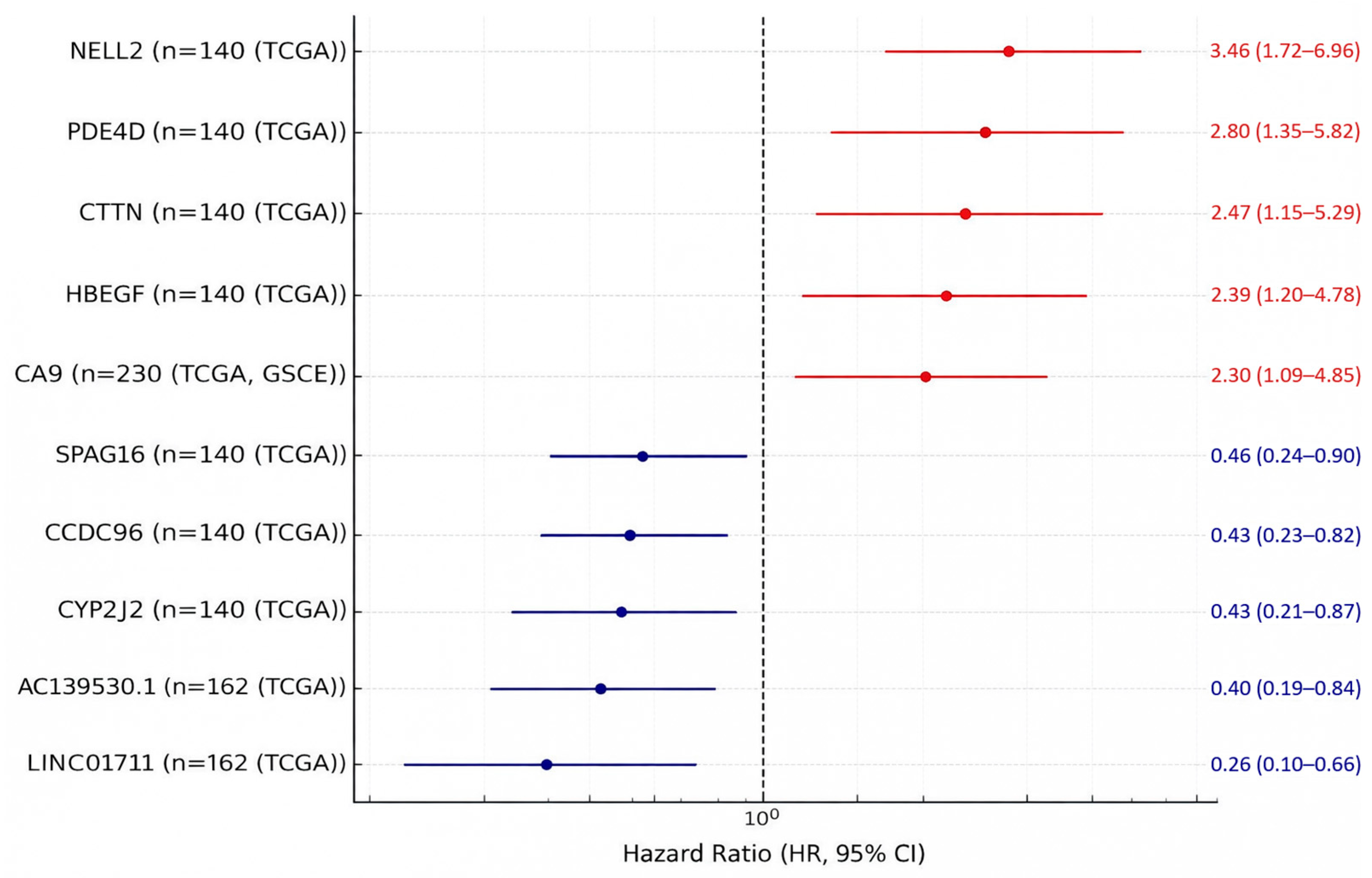
| NELL2 | 3.46 | 1.72 | 6.9 6 | 140 (TCGA) | Multivariate |
| PDE4D | 2.8 | 1.35 | 5.82 | 140 (TCGA) | Multivariate |
| CCDC96 | 0.43 | 0.23 | 0.82 | 140 (TCGA) | Multivariate |
| ADGRG6 | 2.06 | 1.01 | 4.17 | 140 (TCGA) | Multivariate |
| CTTN | 2.47 | 1.15 | 5.29 | 140 (TCGA) | Multivariate |
| HBEGF | 2.39 | 1.2 | 4.78 | 140 (TCGA) | Multivariate |
| ADTRP | 2.15 | 1.06 | 4.35 | 140 (TCGA) | Multivariate |
| CYP2J2 | 0.43 | 0.21 | 0.87 | 140 (TCGA) | Multivariate |
| RFC4 | 2.16 | 1.07 | 4.36 | 140 (TCGA) | Multivariate |
| SPAG16 | 0.46 | 0.24 | 0.9 | 140 (TCGA) | Multivariate |
| ABCA4 | 0.48 | 0.25 | 0.92 | 140 (TCGA) | Multivariate |
| ITGA3 | 1.93 | 1 | 3.7 | 140 (TCGA) | Multivariate |
| circ_0000919 | 6.687 | 1.516 | 29.49 | 120 | Kaplan–Meier/log-rank |
| SEMA3C | 2.284/6.388 | 1.315/1.595 | 3.967/25.58 | 158 (GEO) | Kaplan–Meier/log-rank |
| TNFAIP3 | 0.43 | 0.25 | 0.76 | 573 (GEO, TCGA) | Univariate |
| NRAS | 0.47 | 0.27 | 0.83 | 573 (GEO, TCGA) | Univariate |
| CA9 [28] | 1.263 | 1.0957 | 1.456 | 573 (GEO, TCGA) | Multivariate |
| MIR4713HG | 1.610596 | 1.128103 | 2.299451 | 109 | Multivariate |
| AC104088.1 | 1.402013 | 1.104656 | 1.779414 | 109 | Multivariate |
| AC083967.1 | 1.787962 | 1.418558 | 2.25356 | 109 | Multivariate |
| FNDC1-IT1 | 1.552811 | 1.06642 | 2.261043 | 109 | Multivariate |
| MMP9 | 3.09 | 1.07 | 8.9 | 200 | Univariate |
| LAMC2 | 2.91 | 1.36 | 6.21 | 200 | Univariate |
| ECAD in ITF | 3.11 | 1.48 | 6.51 | 200 | Univariate |
| PGK1 | 1.00557 | 1.00232 | 1.00883 | 162 (TCGA) | Multivariate |
| RPE | 1.07985 | 1.011023 | 1.153363 | 162 (TCGA) | Multivariate |
| GPI | 1.014747 | 1.000517 | 1.02918 | 162 (TCGA) | Multivariate |
| CA9 [33] | 2.3 | 1.09 | 4.854 | 230 (TCGA, GEO) | Multivariate |
| Pathways | Biomarkers | HR | 95% Lower CI | 95% Upper CI |
|---|---|---|---|---|
| Interleukin (IL)-17 signaling pathway | TNFAIP3 | 0.43 | 0.25 | 0.76 |
| NRAS | 0.47 | 0.27 | 0.83 | |
| CA9 [28] | 1.26 | 1.096 | 1.46 | |
| ECM-receptor interaction | LAMC2 | 2.91 | 1.36 | 6.21 |
| ECAD at ITF | 3.11 | 1.48 | 6.51 | |
| MFAP5 + TNNC1 | 7.85 | 1.64 | 37.62 | |
| Focal adhesion | MMP9 | 3.09 | 1.07 | 8.9 |
| LAMC2 | 2.91 | 1.36 | 6.21 | |
| ECAD at ITF | 3.11 | 1.48 | 6.51 |
Disclaimer/Publisher’s Note: The statements, opinions and data contained in all publications are solely those of the individual author(s) and contributor(s) and not of MDPI and/or the editor(s). MDPI and/or the editor(s) disclaim responsibility for any injury to people or property resulting from any ideas, methods, instructions or products referred to in the content. |
© 2026 by the authors. Licensee MDPI, Basel, Switzerland. This article is an open access article distributed under the terms and conditions of the Creative Commons Attribution (CC BY) license.
Share and Cite
Astreidis, I.; Kostidis, I.; Malousi, A.; Paraskevopoulos, K.; Andreadis, D.; Vahtsevanos, K.; Vizirianakis, I. Omics-Derived Prognostic Biomarkers in Tongue Squamous Cell Carcinoma: A Systematic Review with Risk-of-Bias Appraisal and Translational Prioritization. Curr. Issues Mol. Biol. 2026, 48, 389. https://doi.org/10.3390/cimb48040389
Astreidis I, Kostidis I, Malousi A, Paraskevopoulos K, Andreadis D, Vahtsevanos K, Vizirianakis I. Omics-Derived Prognostic Biomarkers in Tongue Squamous Cell Carcinoma: A Systematic Review with Risk-of-Bias Appraisal and Translational Prioritization. Current Issues in Molecular Biology. 2026; 48(4):389. https://doi.org/10.3390/cimb48040389
Chicago/Turabian StyleAstreidis, Ioannis, Ilias Kostidis, Andigoni Malousi, Konstantinos Paraskevopoulos, Dimitrios Andreadis, Konstantinos Vahtsevanos, and Ioannis Vizirianakis. 2026. "Omics-Derived Prognostic Biomarkers in Tongue Squamous Cell Carcinoma: A Systematic Review with Risk-of-Bias Appraisal and Translational Prioritization" Current Issues in Molecular Biology 48, no. 4: 389. https://doi.org/10.3390/cimb48040389
APA StyleAstreidis, I., Kostidis, I., Malousi, A., Paraskevopoulos, K., Andreadis, D., Vahtsevanos, K., & Vizirianakis, I. (2026). Omics-Derived Prognostic Biomarkers in Tongue Squamous Cell Carcinoma: A Systematic Review with Risk-of-Bias Appraisal and Translational Prioritization. Current Issues in Molecular Biology, 48(4), 389. https://doi.org/10.3390/cimb48040389