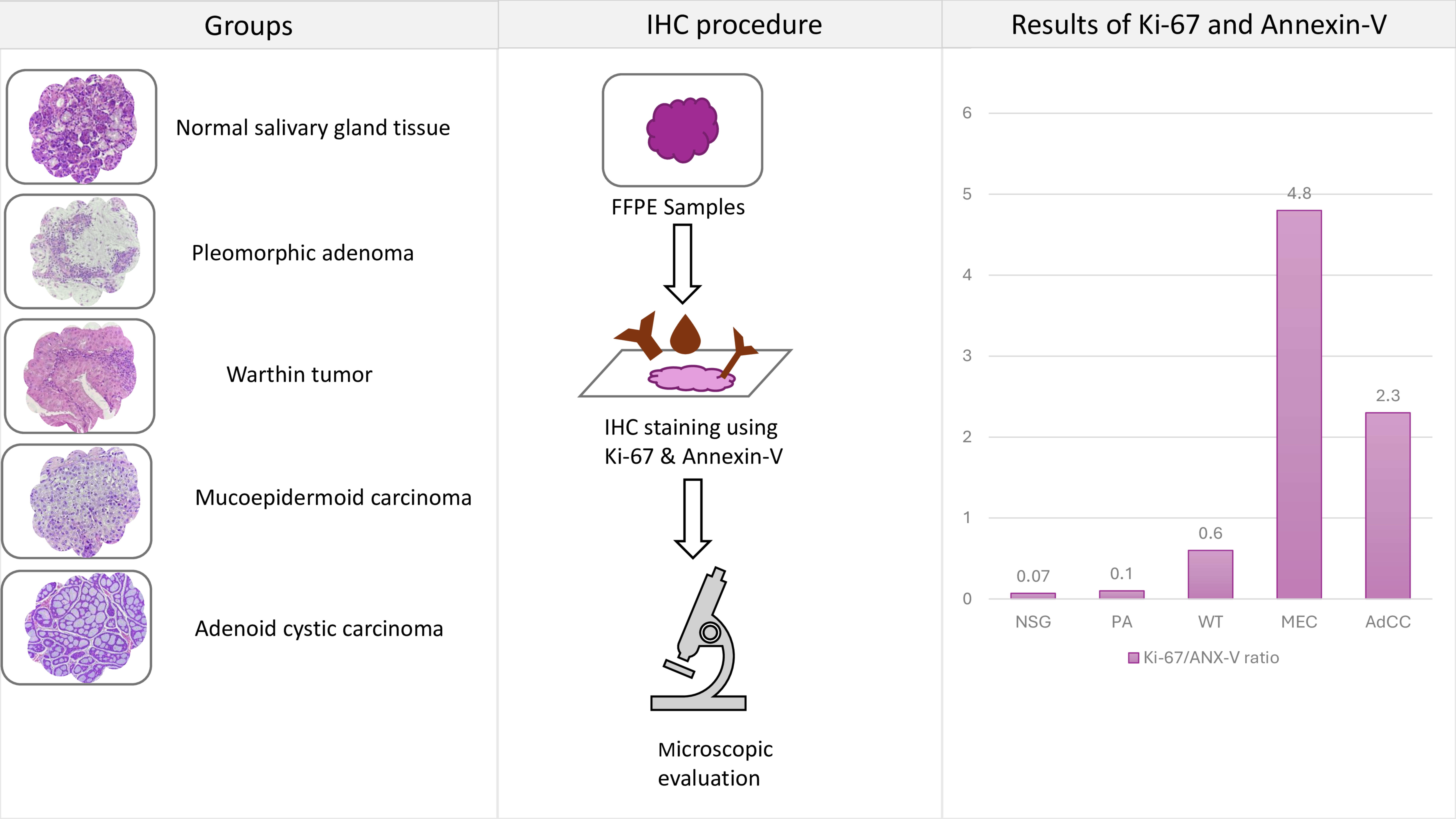


Role of Ki-67 and Annexin V in the Biological Behavior of Salivary Gland Tumors: Insights into Proliferation and Apoptosis



Abstract
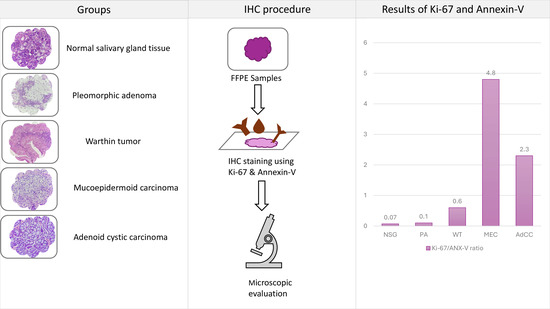
1. Introduction
2. Materials and Methods
2.1. Study Design and Ethical Approval
2.2. Sample Size Calculation, Case Collection, and Data Collection
2.3. Immunohistochemistry (IHC) Procedure
- •
- Mouse monoclonal IgG, anti-Ki67 antibody, dilution 1:100 (ab16667);
- •
- Rabbit polyclonal IgG, anti-Annexin V antibody, dilution 1:1500 (ab140068).
2.4. Interpretation of Staining and Scoring
2.5. Statistical Analysis
3. Results
3.1. Demographic Features
3.2. Ki-67 and Annexin V Immunohistochemistry
3.3. Quantification (Scoring) and Statistics
4. Discussion
5. Conclusions
Supplementary Materials
Author Contributions
Funding
Institutional Review Board Statement
Informed Consent Statement
Data Availability Statement
Acknowledgments
Conflicts of Interest
Abbreviations
| AdCC | Adenoid cystic carcinoma |
| ANX-I | Annexin I |
| ANX-II | Annexin II |
| ANX-V | Annexin V |
| FFPE | Formalin-fixed, paraffin-embedded |
| ICC | Interclass correlation coefficient |
| IHC | Immunohistochemistry |
| MEC | Mucoepidermoid carcinoma |
| NSG(s) | Normal salivary gland(s) |
| PA | Pleomorphic adenoma |
| PI | Proliferation index |
| SD(s) | Striated ducts |
| SG(s) | Salivary gland(s) |
| SGT(s) | Salivary gland tumor(s) |
| WT | Warthin tumor |
References
- Steuer, C.E.; Hanna, G.J.; Viswanathan, K.; Bates, J.E.; Kaka, A.S.; Schmitt, N.C.; Ho, A.L.; Saba, N.F. The evolving landscape of salivary gland tumors. CA Cancer J. Clin. 2023, 73, 597–619. [Google Scholar] [CrossRef]
- Ding, H.; Wu, C.; Su, Z.; Wang, T.; Zhuang, S.; Li, C.; Li, Y. Current landscape and future trends in salivary gland oncology research—A bibliometric evaluation. Gland. Surg. 2024, 13, 969–986. [Google Scholar] [CrossRef] [PubMed] [PubMed Central]
- Mierke, C.T. Cell proliferation, survival, necrosis and apoptosis. In Cellular Mechanics and Biophysics: Structure and Function of Basic Cellular Components Regulating Cell Mechanics; Mierke, C.T., Ed.; Springer International Publishing: Cham, Switzerland, 2020; pp. 743–824. [Google Scholar] [CrossRef]
- Menon, S.S.; Guruvayoorappan, C.; Sakthivel, K.M.; Rasmi, R.R. Ki-67 protein as a tumour proliferation marker. Clin. Chim. Acta 2019, 491, 39–45. [Google Scholar] [CrossRef]
- Kaza, S.; Rao, T.J.M.; Mikkilineni, A.; Ratnam, G.; Rao, D. Ki-67 Index in Salivary Gland Neoplasms. Int. J. Phonosurg. Laryngol. 2016, 66, 1–7. [Google Scholar] [CrossRef]
- Bussari, S.; Ganvir, S.M.; Sarode, M.; Jeergal, P.A.; Deshmukh, A.; Srivastava, H. Immunohistochemical detection of proliferative marker Ki-67 in benign and malignant salivary gland tumors. J. Contemp. Dent. Pract. 2018, 19, 375–383. [Google Scholar] [CrossRef] [PubMed]
- Cole, R.W.; Hunt, D. Light Microscopy as a Tool to Detect Apoptosis and Other Cellular Changes and Damage. J. Biomol. Tech. JBT 2025, 36, 3fc1f5fe.5d696e01. [Google Scholar] [CrossRef] [PubMed] [PubMed Central]
- Rice, A.M.; Jaworski, S.; Fealey, M.E.; Rannikko, A.; Hinderliter, A. Membrane Regulation and Signal Transduction by Annexin A5. Biophys. J. 2014, 106, 97a. [Google Scholar] [CrossRef]
- Gerke, V.; Gavins, F.N.E.; Geisow, M.; Grewal, T.; Jaiswal, J.K.; Nylandsted, J.; Rescher, U. Annexins-a family of proteins with distinctive tastes for cell signaling and membrane dynamics. Nat. Commun. 2024, 15, 1574. [Google Scholar] [CrossRef] [PubMed] [PubMed Central]
- Guzmán-Aránguez, A.; Olmo, N.; Turnay, J.; Lecona, E.; Pérez-Ramos, P.; de Silanes, I.L.; Lizarbe, M.A. Differentiation of human colon adenocarcinoma cells alters the expression and intracellular localization of annexins A1, A2, and A5. J. Cell. Biochem. 2005, 94, 178–193. [Google Scholar] [CrossRef] [PubMed]
- Sacre, S.M.; Moss, S.E. Intracellular localization of endothelial cell annexins is differentially regulated by oxidative stress. Exp. Cell Res. 2002, 274, 254–263. [Google Scholar] [CrossRef] [PubMed]
- Deng, S.; Wang, J.; Hou, L.; Li, J.; Chen, G.; Jing, B.; Zhang, X.; Yang, Z. Annexin A1, A2, A4 and A5 play important roles in breast cancer, pancreatic cancer and laryngeal carcinoma, alone and/or synergistically. Oncol Lett. 2013, 5, 107–112. [Google Scholar] [CrossRef] [PubMed] [PubMed Central]
- Muhammed Ali, H.; Ahmed, B. Immunohistochemical Expression of Annexin A5 in Invasive Ductal Carcinoma and Fibroadenoma of the Breast. Iraqi Postgrad. Med. J. 2024, 23, 157–162. [Google Scholar] [CrossRef]
- Engeland, M.; van den Eijnde, S.M.; Aken, T.; Vermeij-Keers, C.; Ramaekers, F.C.; Schutte, B.; Reutelingsperger, C.P. Detection of apoptosis in ovarian cells in vitro and in vivo using the annexin V-affinity assay. Methods Mol. Med. 2001, 39, 669–677. [Google Scholar] [CrossRef] [PubMed]
- Sun, C.B.; Zhao, A.Y.; Ji, S.; Han, X.Q.; Sun, Z.C.; Wang, M.C.; Zheng, F.C. Expression of annexin A5 in serum and tumor tissue of patients with colon cancer and its clinical significance. World J. Gastroenterol. 2017, 23, 7168–7173. [Google Scholar] [CrossRef] [PubMed] [PubMed Central]
- Donadio, E.; Giusti, L.; Seccia, V.; Ciregia, F.; Da Valle, Y.; Dallan, I.; Ventroni, T.; Giannaccini, G.; Sellari-Franceschini, S.; Lucacchini, A. New insight into benign tumours of major salivary glands by proteomic approach. PLoS ONE 2013, 8, e71874. [Google Scholar] [CrossRef]
- Cardoso, C.M.; de Jesus, S.F.; de Souza, M.G.; Queiroz, L.D.R.P.; Santos, E.M.; Dos Santos, E.P.; Oliveira, L.P.; Cordeiro Santos, C.K.; Santos, S.H.S.; de Paula, A.M.B.; et al. High levels of ANXA2 are characteristic of malignant salivary gland tumors. J. Oral Pathol. Med. 2019, 48, 929–934. [Google Scholar] [CrossRef] [PubMed]
- Lai, C.C.; Lin, C.T.; Lin, Y.H.; Lai, C.C.; Lin, C.T.; Lin, Y.H. Cellularity and its relation with capsular characteristics as an influencing factor for operative strategies of pleomorphic adenoma. Cirugía Cir. 2022, 90, 439–446. [Google Scholar] [CrossRef]
- Hamied, M.A.S.; Kudeir, H.H.; Mohammad, D.N.; Ibraheem, B.F.; Garib, B.T. Clinicopathological Features and ICD-10 Categorization of Oro-maxillofacial Surgical Biopsies from Sulaimani. AL-Kindy Coll. Med. J. 2023, 19, 48–56. [Google Scholar] [CrossRef]
- Mohammad, D.N.; Ibraheem, B.F.; Khudair, H.H.; Mahmood, D.K. Expression of Syndecan-1 and Cyclin D1 in Salivary Gland Tumors in Relation to Clinicopathological Parameters. Int. J. Gen. Med. 2023, 16, 823–835. [Google Scholar] [CrossRef] [PubMed] [PubMed Central]
- Ali, T.K. Overview of Salivary Gland Tumors of General Hospitals in Iraq over 8-Years. Br. J. Nurs. Stud. 2024, 4, 20–27. [Google Scholar] [CrossRef]
- Alsanie, I.; Rajab, S.; Cottom, H.; Adegun, O.; Agarwal, R.; Jay, A.; Graham, L.; James, J.; Barrett, A.W.; van Heerden, W.; et al. Distribution and Frequency of Salivary Gland Tumours: An International Multicenter Study. Head Neck Pathol. 2022, 16, 1043–1054. [Google Scholar] [CrossRef] [PubMed]
- Ungureanu, L.B.; Ghiciuc, C.M.; Costan, V.V.; Ungureanu, C.; Ianole, V.; Apostol, D.G.C. Benign and Malignant Parotid Gland Tumors: Insights from a Five-Year Northeast Romanian Population. J. Clin. Med. 2025, 14, 7087. [Google Scholar] [CrossRef]
- Osman, T.; Eltohami, Y.; Osman, Y. Clinicopathological characteristics and surgical outcomes of pleomorphic adenoma of salivary glands among Sudanese patients. BMC Oral Health 2026, 26, 448. [Google Scholar] [CrossRef] [PubMed] [PubMed Central]
- Wang, X.; Bai, J.; Yan, J.; Li, B. The clinical outcome, pathologic spectrum, and genomic landscape for 454 cases of salivary mucoepidermoid carcinoma. npj Precis. Oncol. 2024, 8, 238. [Google Scholar] [CrossRef]
- Xu, B.; Drill, E.; Ho, A.; Ho, A.; Dunn, L.; Pireto-Granada, C.N.; Chan, T.; Ganly, I.; Ghossein, R.; Katabi, N. Predictors of outcome in adenoid cystic carcinoma of salivary glands: A clinicopathologic study with correlation between MYB fusion and protein expression. Am. J. Surg. Pathol. 2017, 41, 1422–1432. [Google Scholar] [CrossRef] [PubMed] [PubMed Central]
- De Mello Gomes, Á.N.; Nagai, M.A.; Lourenço, S.V.; Coutinho-Camillo, C.M. Apoptosis and proliferation during human salivary gland development. J. Anat. 2019, 234, 830–838. [Google Scholar] [CrossRef] [PubMed] [PubMed Central]
- Meyer, M.T.; Watermann, C.; Dreyer, T.; Ergün, S.; Karnati, S. 2021 Update on Diagnostic Markers and Translocation in Salivary Gland Tumors. Int. J. Mol. Sci. 2021, 22, 6771. [Google Scholar] [CrossRef]
- Rasul, F. Mitotic index and immunohistochemical expression of Ki-67 in pleomorphic adenoma of salivary glands. J. Islam. Med. Dent. Coll. 2022, 11, 3. [Google Scholar] [CrossRef]
- Zhu, X.; Zhang, J.; Chen, X.; Feng, X. Comparison of Ki-67, cyclin, E.; and p63 in benign and malignant human pleomorphic adenoma. Oral Surg. Oral Med. Oral Pathol. Oral Radiol. 2012, 113, 667–672. [Google Scholar] [CrossRef] [PubMed]
- Nagao, T.; Sato, E.; Inoue, R.; Oshiro, H.; Takahashi, R.H.; Nagai, T.; Yoshida, M.; Suzuki, F.; Obikane, H.; Yamashina, M.; et al. Immunohistochemical analysis of salivary gland tumors: Application for surgical pathology practice. Acta Histochem. Cytochem. 2012, 45, 269. [Google Scholar] [CrossRef] [PubMed]
- Matsumiya-Matsumoto, Y.; Morita, Y.; Uzawa, N. Pleomorphic adenoma of the salivary glands and epithelial–mesenchymal transition. J. Clin. Med. 2022, 11, 4210. [Google Scholar] [CrossRef]
- Raja, R.; Shetty, D.C.; Chandrakanta, N.; Juneja, S.; Tandon, A.; Gulati, N. MCM3 proliferative index is worthier over Ki-67 in the characterization of salivary gland tumors. Indian J. Pathol. Microbiol. 2021, 64, 22–27. [Google Scholar] [CrossRef] [PubMed]
- De Rosa, F.; Pignatiello, S.; Sibillo, M.C.; Guadagno, E. Proliferation in pleomorphic adenoma: Lights and shadow on this parameter, in a neoplasm showing unpredictable behavior–An immunohistochemical study and review of the literature. Pathol. Res. Pract. 2022, 232, 153748. [Google Scholar] [CrossRef]
- Abdulrahman, S.S.; Mohammad, D.N.; Hamied, M.A.; Abdulqadir, M.O. Immunohistochemical evaluation of salivary gland tumors differentiation and proliferation by using calponin and telomerase. Saudi Dent. J. 2019, 31, 105–114. [Google Scholar] [CrossRef]
- Faur, A.C.; Sas, I.; Motoc, A.G.M.; Cornianu, M.; Zamfir, C.L.; Lazăr, D.C.; Folescu, R. Ki-67 and p53 immunostaining assessment of proliferative activity in salivary tumors. Rom. J. Morphol. Embryol. 2015, 56, 1429–1439. [Google Scholar] [PubMed]
- Kawano, H.; Kimura, T.; Kikuchi, N.; Ishii, A.; Ikeda, E. Stroma-poor Warthin’s tumor with significant oncocytic hyperplasia: Case presentation and considerations regarding its histogenesis. Rom. J. Morphol. Embryol. 2016, 57, 585–590. [Google Scholar] [PubMed]
- Agaimy, A.; Mantsopoulos, K.; Iro, H.; Stoehr, R. KRAS codon 12 mutations characterize a subset of de novo proliferating “metaplastic” Warthin tumors. Virchows Arch. Int. J. Pathol. 2023, 482, 839–848. [Google Scholar] [CrossRef] [PubMed] [PubMed Central]
- Schwalje, A.T.; Uzelac, A.; Ryan, W.R. Growth rate characteristics of Warthin’s tumours of the parotid gland. Int. J. Oral. Maxillofac. Surg. 2015, 44, 1474–1479. [Google Scholar] [CrossRef]
- Kuzenko, Y.V.; Romanuk, A.M.; Dyachenko, O.O.; Hudymenko, O. Pathogenesis of Warthin’s tumors. Interv. Med. Appl. Sci. 2016, 8, 41–48. [Google Scholar] [CrossRef] [PubMed] [PubMed Central]
- Geethalakshmi, U.; Rupashree, S.; Babu, K. Study of Histopathological Diversity in Salivary Gland Lesions. J. Med. Sci. Health 2021, 7, 67–73. [Google Scholar] [CrossRef]
- Dăguci, L.; Stepan, A.; Mercuţ, V.; Dăguci, C.; Bătăiosu, M.; Florescu, A. Immunohistochemical expression of CK7, CK5/6, CK19, and p63 in Warthin tumor. Rom. J. Morphol. Embryol. 2012, 53, 603–607. [Google Scholar] [PubMed]
- Omitola, O.G.; Iyogun, C.A. Immunohistochemical study of salivary gland tumors in a tertiary institution in South-South Region of Nigeria. J. Oral Maxillofac. Pathol. JOMFP 2018, 22, 163–167. [Google Scholar] [CrossRef] [PubMed] [PubMed Central]
- Cipriani, N.A.; Lusardi, J.J.; McElherne, J.; Pearson, A.T.; Olivas, A.D.; Fitzpatrick, C.; Lingen, M.W.; Blair, E.A. Mucoepidermoid carcinoma: A comparison of histologic grading systems and relationship to MAML2 rearrangement and prognosis. Am. J. Surg. Pathol. 2019, 43, 885–897. [Google Scholar] [CrossRef] [PubMed] [PubMed Central]
- Siddique, S.; ud Din, H.; Hashmi, S.N.; Nazar, M.; ur Rehman, A.; Khadim, T.; Akhtar, F. Role of Ki-67 in the Grading of Mucoepidermoid Carcinomas. J. Rawalpindi Med. Coll. 2015, 19, 120–123. [Google Scholar]
- Adwani, A.; Kheur, S.; Kheur, M.; Mahajan, P. Prognostic biomarkers for salivary adenoid cystic carcinoma: A systematic review. Clin. Cancer Investig. J. 2021, 10, 153–181. [Google Scholar] [CrossRef]
- Kintawati, S.; Darjan, M.; Yohana, W. Analysis of Ki-67 expression as clinicopathological parameters in predicting the prognosis of adenoid cystic carcinoma. Dent. J. Maj. Kedokt. Gigi. 2017, 50, 205–210. [Google Scholar] [CrossRef]
- Nössing, C.; Ryan, K.M. 50 years on and still very much alive: Apoptosis: A basic biological phenomenon with wide-ranging implications in tissue kinetics. Br. J. Cancer 2023, 128, 426–431. [Google Scholar] [CrossRef]
- Morana, O.; Wood, W.; Gregory, C.D. The Apoptosis Paradox in Cancer. Int. J. Mol. Sci. 2022, 23, 1328. [Google Scholar] [CrossRef] [PubMed]
- Dogan, E.; Kara, H.G.; Kosova, B.; Cetintas, V.B. Targeting Apoptosis to Overcome Chemotherapy Resistance. In Metastasis; Sergi, C.M., Ed.; Exon Publications: Brisbane, Australia, 2022. [Google Scholar] [PubMed]
- Sanchez-Michael, L.A.; Sudarshan, V.; Elias, A.; Gutierrez, D.A.; Lopez-Saenz, J.A.; Pena-Zacarias, J.; Torres, G.C.; Varela-Ramirez, A.; Kumar, S.; Karki, S.S.; et al. Functional Characterization of VS-186B, a Novel HDAC Inhibitor with Anticancer Activity. Int. J. Mol. Sci. 2025, 26, 11354. [Google Scholar] [CrossRef] [PubMed] [PubMed Central]
- Anastasio, C.; Donisi, I.; Del Vecchio, V.; Colloca, A.; Mele, L.; Sardu, C.; Marfella, R.; Balestrieri, M.L.; D’Onofrio, N. SGLT2 inhibitor promotes mitochondrial dysfunction and ER-phagy in colorectal cancer cells. Cell. Mol. Biol. Lett. 2024, 29, 80. [Google Scholar] [CrossRef] [PubMed] [PubMed Central]
- Borrego, E.A.; Guerena, C.D.; Schiaffino Bustamante, A.Y.; Gutierrez, D.A.; Valenzuela, C.A.; Betancourt, A.P.; Varela-Ramirez, A.; Aguilera, R.J. A Novel Pyrazole Exhibits Potent Anticancer Cytotoxicity via Apoptosis, Cell Cycle Arrest, and the Inhibition of Tubulin Polymerization in Triple-Negative Breast Cancer Cells. Cells 2024, 13, 1225. [Google Scholar] [CrossRef] [PubMed] [PubMed Central]
- Bronckers, A.L.J.J.; Goei, S.W.; Dumont, E.; Lyaruu, D.M.; Wöltgens, J.H.M.; van Heerde, W.L.; Reutelingsperger, C.P.M.; Van den Eijnde, S.M. In situ detection of apoptosis in dental and periodontal tissues of the adult mouse using annexin-V-biotin. Histochem. Cell Biol. 2000, 113, 293–301. [Google Scholar] [CrossRef] [PubMed]
- Monceau, V.; Belikova, Y.; Kratassiouk, G.; Robidel, E.; Russo-Marie, F.; Charlemagne, D. Myocyte apoptosis during acute myocardial infarction in rats is related to early sarcolemmal translocation of annexin A5 in border zone. Am. J. Physiol. Heart Circ. Physiol. 2006, 291, H965–H971. [Google Scholar] [CrossRef] [PubMed]
- Kenis, H.; Zandbergen, H.R.; Hofstra, L.; Petrov, A.D.; Dumont, E.A.; Blankenberg, F.D.; Haider, N.; Bitsch, N.; Gijbels, M.; Verjans, J.W.; et al. Annexin A5 Uptake in Ischemic Myocardium: Demonstration of Reversible Phosphatidylserine Externalization and Feasibility of Radionuclide Imaging. J. Nucl. Med. 2010, 51, 259–267. [Google Scholar] [CrossRef] [PubMed]
- Takahashi, S.; Nezu, A.; Tanimura, A.; Tamura, C.; Imamachi, K.; Sato, T. Apoptotic cell death during regressive changes in salivary glands: A morphological perspective. J. Oral. Biosci. 2025, 67, 100585. [Google Scholar] [CrossRef]
- Ishikawa, Y.; Cho, G.; Yuan, Z.; Skowronski, M.T.; Pan, Y.; Ishida, H. Water channels and zymogen granules in salivary glands. J. Pharmacol. Sci. 2006, 100, 495–512. [Google Scholar] [CrossRef]
- Jing, J. The relevance, predictability, and utility of Annexin A5 for human physiopathology. Int. J. Mol. Sci. 2024, 25, 2865. [Google Scholar] [CrossRef] [PubMed]
- Dudas, B. Salivary Mucous Gland—An overview. In Human Histology: A Text and Atlas for Physician and Scientits, 1st ed.; Elsevier: Amsterdam, The Netherlands, 2023; pp. 83–117. [Google Scholar]
- Lin, Y.C.; Chipot, C.; Scheuring, S. Annexin-V stabilizes membrane defects by inducing lipid phase transition. Nat. Commun. 2020, 11, 230. [Google Scholar] [CrossRef] [PubMed] [PubMed Central]
- Bouter, A.; Gounou, C.; Bérat, R.; Tan, S.; Gallois, B.; Granier, T.; d’Estaintot, B.L.; Pöschl, E.; Brachvogel, B.; Brisson, A.R. Annexin-A5 assembled into two-dimensional arrays promotes cell membrane repair. Nat. Commun. 2011, 2, 270. [Google Scholar] [CrossRef]
- Themes UFO. 11: Salivary Glands, Salivary Secretion, and Saliva. Pocket Dentistry. 2015. Available online: https://pocketdentistry.com/11-salivary-glands-salivary-secretion-and-saliva/ (accessed on 3 April 2026).
- Suzuki, A.; Ogata, K.; Iwata, J. Cell signaling regulation in salivary gland development. Cell. Mol. Life. Sci. 2021, 78, 3299–3315. [Google Scholar] [CrossRef]
- Melle, C.; Ernst, G.; Schimmel, B.; Urbanek, A.; Koscielny, S.; Wiesner, A.; Bogumil, R.; Möller, U.; Osterloh, D.; Halbhuber, K.J.; et al. Biomarker discovery and identification in laser microdissected head and neck squamous cell carcinoma with ProteinChip (R) technology, two-dimensional gel electrophoresis, tandem mass spectrometry, and immunohistochemistry. Mol. Cell. Proteomics. MCP 2003, 2, 443–452. [Google Scholar] [CrossRef]
- Oflaz, F.E.; Bondarenko, A.I.; Trenker, M.; Waldeck-Weiermair, M.; Gottschalk, B.; Bernhart, E.; Koshenov, Z.; Radulović, S.; Rost, R.; Hirtl, M.; et al. Annexin A5 controls VDAC1-dependent mitochondrial Ca2+ homeostasis and determines cellular susceptibility to apoptosis. EMBO J. 2025, 44, 3413–3447. [Google Scholar] [CrossRef] [PubMed] [PubMed Central]
- Essa, H.; Al-Ghaban, N. Histological and immunohistochemical (ANXA1) analysis of Bisphosphonate (Zoledronate) effect on submandibular and parotid glands in neonatal rats. Int. J. Sci. Res. IJSR 2017, 6, 1768–1772. [Google Scholar]
- Shao, G.; Zhou, H.; Zhang, Q.; Jin, Y.; Fu, C. Advancements of Annexin A1 in inflammation and tumorigenesis. OncoTargets Ther. 2019, 12, 3245–3254. [Google Scholar] [CrossRef] [PubMed] [PubMed Central]
- Triantafyllou, A.; Thompson, L.D.R.; Devaney, K.O.; Bell, D.; Hunt, J.L.; Rinaldo, A.; Vander Poorten, V.; Ferlito, A. Functional Histology of Salivary Gland Pleomorphic Adenoma: An Appraisal. Head Neck Pathol. 2014, 9, 387–404. [Google Scholar] [CrossRef] [PubMed] [PubMed Central]
- Yamaguchi, M.; Abiko, Y.; Nishimura, M.; Saitoh, M.; Kaku, T. An Immunohistochemical Study of the Localization of Inducible Nitric Oxide Synthase (iNOS) and Heat Shock Protein (HSP) in Pleomorphic Adenoma. Acta Histochem. Cytochem. 2004, 37, 267–271. [Google Scholar] [CrossRef]
- Xi, Y.; Ju, R.; Wang, Y. Roles of Annexin A protein family in autophagy regulation and therapy. Biomed. Pharmacother. 2020, 130, 110591. [Google Scholar] [CrossRef]
- Jin, M.; Zhang, J.; Sun, Y.; Liu, G.; Wei, X. ANXA5: Related mechanisms of osteogenesis and additional biological functions. Front. Cell Dev. Biol. 2025, 13, 1553683. [Google Scholar] [CrossRef] [PubMed] [PubMed Central]
- Ferreira, C.R.; Cruz, M.A.E.; Bolean, M.; Andrilli, L.H.S.; Millan, J.L.; Ramos, A.P.; Bottini, M.; Ciancaglini, P. Annexin A5 stabilizes matrix vesicle-biomimetic lipid membranes: Unravelling a new role of annexins in calcification. Eur. Biophys. J. 2023, 52, 721–733. [Google Scholar] [CrossRef] [PubMed] [PubMed Central]
- Mandic, R.; Agaimy, A.; Pinto Quintero, D.; Roth, K.; Teymoortash, A.; Schwarzbach, H.; Stoehr, C.G.; Rodepeter, F.R.; Stuck, B.A.; Bette, M. Aberrant expression of glyceraldehyde-3-phosphate dehydrogenase (GAPDH) in Warthin tumors. Cancers 2020, 12, 1112. [Google Scholar] [CrossRef]
- Hong, M.; Park, N.; Chun, Y.J. Role of Annexin A5 on Mitochondria-Dependent Apoptosis Induced by Tetramethoxystilbene in Human Breast Cancer Cells. Biomol. Ther. 2014, 22, 519–524. [Google Scholar] [CrossRef] [PubMed] [PubMed Central]
- da Silva, G.M.; Saavedra, V.; Ianez, R.C.F.; de Sousa, E.A.; Gomes, Á.N.; Kelner, N.; Nagai, M.A.; Kowalski, L.P.; Soares, F.A.; Lourenço, S.V.; et al. Apoptotic signaling in salivary mucoepidermoid carcinoma. Head Neck 2019, 41, 2904–2913. [Google Scholar] [CrossRef] [PubMed]
- Dozic, B.; Glumac, S.; Boricic, N.; Dozic, M.; Anicic, B.; Boricic, I. Immunohistochemical expression of caspases 9 and 3 in adenoid cystic carcinoma of salivary glands and association with clinicopathological parameters. J. BUON Off. J. Balk. Union Oncol. 2016, 21, 152–160. [Google Scholar] [PubMed]
- Sofiadis, A.; Becker, S.; Hellman, U.; Hultin-Rosenberg, L.; Dinets, A.; Hulchiy, M.; Zedenius, J.; Wallin, G.; Foukakis, T.; Höög, A.; et al. Proteomic profiling of follicular and papillary thyroid tumors. Eur. J. Endocrinol. 2012, 166, 657–667. [Google Scholar] [CrossRef] [PubMed]
- Sun, X.; Liu, S.; Wang, J.; Wei, B.; Guo, C.; Chen, C.; Sun, M.Z. Annexin A5 regulates hepatocarcinoma malignancy via CRKI/II-DOCK180-RAC1 integrin and MEK-ERK pathways. Cell Death Dis. 2018, 9, 637. [Google Scholar] [CrossRef]
- Herrera-López, E.E.; Guerrero-Escalera, D.; Aguirre-Maldonado, I.; López-Hernández, A.; Montero, H.; Gutiérrez-Nava, M.A.; del Pozo-Yauner, L.; Arellanes-Robledo, J.; Camacho, J.; Perez-Carreon, J.I. Annexins A2 and A5 are potential early biomarkers of hepatocarcinogenesis. Sci. Rep. 2023, 13, 6948. [Google Scholar] [CrossRef]
- Li, X.; Ma, W.; Wang, X.; Ci, Y.; Zhao, Y. Annexin A5 overexpression might suppress proliferation and metastasis of human uterine cervical carcinoma cells. Cancer Biomark. 2018, 23, 23–32, Erratum in Cancer Biomark. 2023, 38, 273.. [Google Scholar] [CrossRef] [PubMed]



| Variables | Total | PA | WT | MEC | AdCC | p-Value | |
|---|---|---|---|---|---|---|---|
| No. (%) | No. (%) | No. (%) | No. (%) | No. (%) | |||
| Age | 48 ± 14 | 39.5 ± 18 | 54.6 ± 18 | 51 ± 11.6 | 47 ± 12.7 | 0.086 | |
| Sex | Male | 25 (62.5%) | 3 (30%) | 9 (90%) | 6 (60%) | 7 (70%) | 0.046 |
| Female | 15 (37.5%) | 7 (70%) | 1 (10%) | 4 (40%) | 3 (30%) | ||
| Site | Parotid | 17 (43%) | 5 (50%) | 10 (100%) | 2 (20%) | 0 | <0.001 |
| Submandibular | 5 (12%) | 2 (20%) | 0 | 1 (10%) | 2 (20%) | ||
| Minor | 18 (45%) | 3 (30%) | 0 | 7 (70%) | 8 (80%) | ||
| Size (cm) * | 3.25 ± 2 | 2.49 ± 1.35 | 3.73 ± 1.35 | 3.1 ± 2.9 | 3.8 ± 2.2 | 0.206 | |
| Recurrence status | Primary | 33 (82.5%) | 9 (90%) | 10 (100%) | 8 (80%) | 6 (60%) | 0.109 |
| Recurrent | 7 (17.5%) | 1 (10%) | 0 | 2 (20%) | 4 (40%) | ||
| Survival outcome ** | Alive | 28 (93%) | 9 (100%) | 10 (100%) | 5 (100%) | 4 (67%) | 0.036 |
| Dead | 2 (7%) | 0 | 0 | 0 | 2 (33%) | ||
| Tumor Type | Parameters | No. | Ki-67 (%) | ANX-V (%) | |
|---|---|---|---|---|---|
| PA | Spatial distribution | Periphery | 10 | 3.2 | 54 |
| Center | 3.4 | 53 | |||
| Cellular distribution * | Epithelial component | 10 | 68 | 20 | |
| Mesenchymal component | 32 | 80 | |||
| WT | Spatial distribution | Periphery | 10 | 7 | 41 |
| Center | 8 | 45 | |||
| Cellular distribution * | Luminal | 10 | 14 | 66 | |
| Basal | 86 | 34 | |||
| MEC | Histologic grade | Low | 3 | 6 | 55 |
| Intermediate | 4 | 10.75 | 37.25 | ||
| High | 3 | 18 | 30 | ||
| AdCC | Histologic pattern ** | Cribriform | 3 | 17.5 | 23 |
| Tubular | 3 | 15.5 | 33 | ||
| Solid | 4 | 37 | 17 | ||
| Parameters | Ki-67 Mean ± SD (%) | Correlation (r, p-Value) | ANX-V Mean ± SD (%) | Correlation (r, p-Value) | |
|---|---|---|---|---|---|
| Recurrence status | Primary | 10.4 ± 1.7 | r = 0.186 p = 0.251 | 41.7 ± 3.5 | r = −0.198 p = 0.222 |
| Recurrence | 16.5 ± 5.3 | 31 ± 9 | |||
| Survival outcome | Alive | 8.97 ± 1.7 | r = 0.402 p = 0.028 | 42.8 ± 3.7 | r = −0.421 p = 0.021 |
| Dead | 34.7 ± 8.3 | 7.5 ± 3.5 |
Disclaimer/Publisher’s Note: The statements, opinions and data contained in all publications are solely those of the individual author(s) and contributor(s) and not of MDPI and/or the editor(s). MDPI and/or the editor(s) disclaim responsibility for any injury to people or property resulting from any ideas, methods, instructions or products referred to in the content. |
© 2026 by the authors. Licensee MDPI, Basel, Switzerland. This article is an open access article distributed under the terms and conditions of the Creative Commons Attribution (CC BY) license.
Share and Cite
Garib, B.T.; Abdulla, D.A. Role of Ki-67 and Annexin V in the Biological Behavior of Salivary Gland Tumors: Insights into Proliferation and Apoptosis. Curr. Issues Mol. Biol. 2026, 48, 387. https://doi.org/10.3390/cimb48040387
Garib BT, Abdulla DA. Role of Ki-67 and Annexin V in the Biological Behavior of Salivary Gland Tumors: Insights into Proliferation and Apoptosis. Current Issues in Molecular Biology. 2026; 48(4):387. https://doi.org/10.3390/cimb48040387
Chicago/Turabian StyleGarib, Balkees Taha, and Dalya Ali Abdulla. 2026. "Role of Ki-67 and Annexin V in the Biological Behavior of Salivary Gland Tumors: Insights into Proliferation and Apoptosis" Current Issues in Molecular Biology 48, no. 4: 387. https://doi.org/10.3390/cimb48040387
APA StyleGarib, B. T., & Abdulla, D. A. (2026). Role of Ki-67 and Annexin V in the Biological Behavior of Salivary Gland Tumors: Insights into Proliferation and Apoptosis. Current Issues in Molecular Biology, 48(4), 387. https://doi.org/10.3390/cimb48040387