
Molecular Diversity, Structure–Function Relationship, Mechanism of Action, and Transformative Potential of Black Soldier Fly Antimicrobial Peptides Against Multidrug-Resistant Pathogens


Abstract
1. Introduction
1.1. The Grave Challenge of AMR
1.2. The Rise of AMPs as an Alternative Strategy
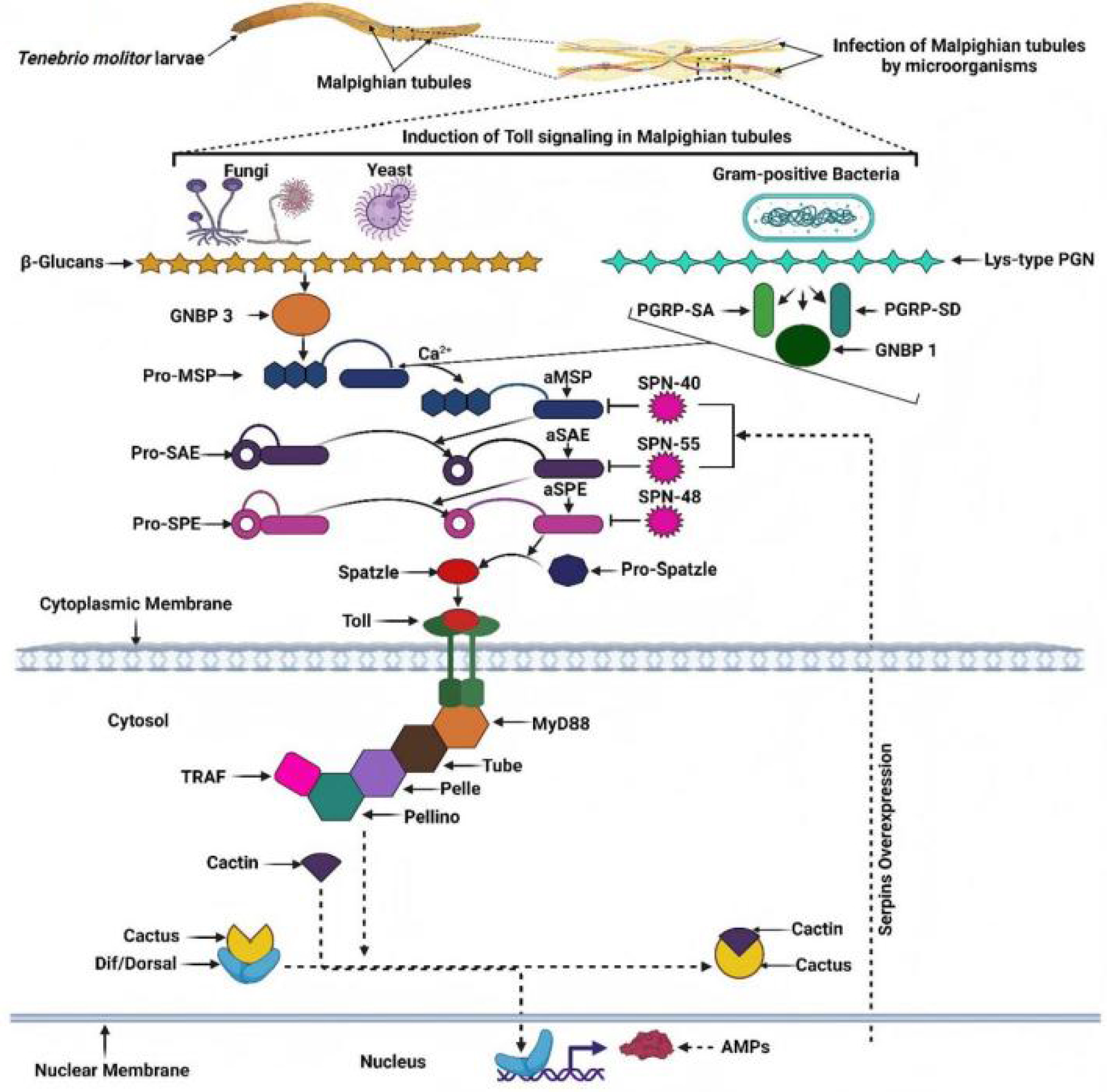
1.3. Hermetia illucens: A Unique Source of Antimicrobial Peptides
2. Molecular Diversity and Identification of Antimicrobial Peptides from Hermetia illucens
2.1. Major AMP Families and Their Characteristics
- Defensins: This group comprises small, cysteine-rich cationic peptides that are crucial to the fly’s immune defense. Their structure is stabilized by 3–4 intramolecular disulfide bonds, forming a compact cysteine-stabilized αβ motif that consists of an α-helix and two antiparallel β-sheets. This configuration confers remarkable resistance to heat and proteolytic degradation. Several defensin-like peptides, such as DLP2, DLP4, and DLP5, have been identified in H. illucens. They exhibit potent activity against Gram-positive bacteria, including Staphylococcus aureus [15], primarily by interacting with specific membrane lipids to disrupt membrane integrity [7]. For example, DLP4 shows significant efficacy against various Gram-positive bacteria, with minimum inhibitory concentration values in the micromolar range.
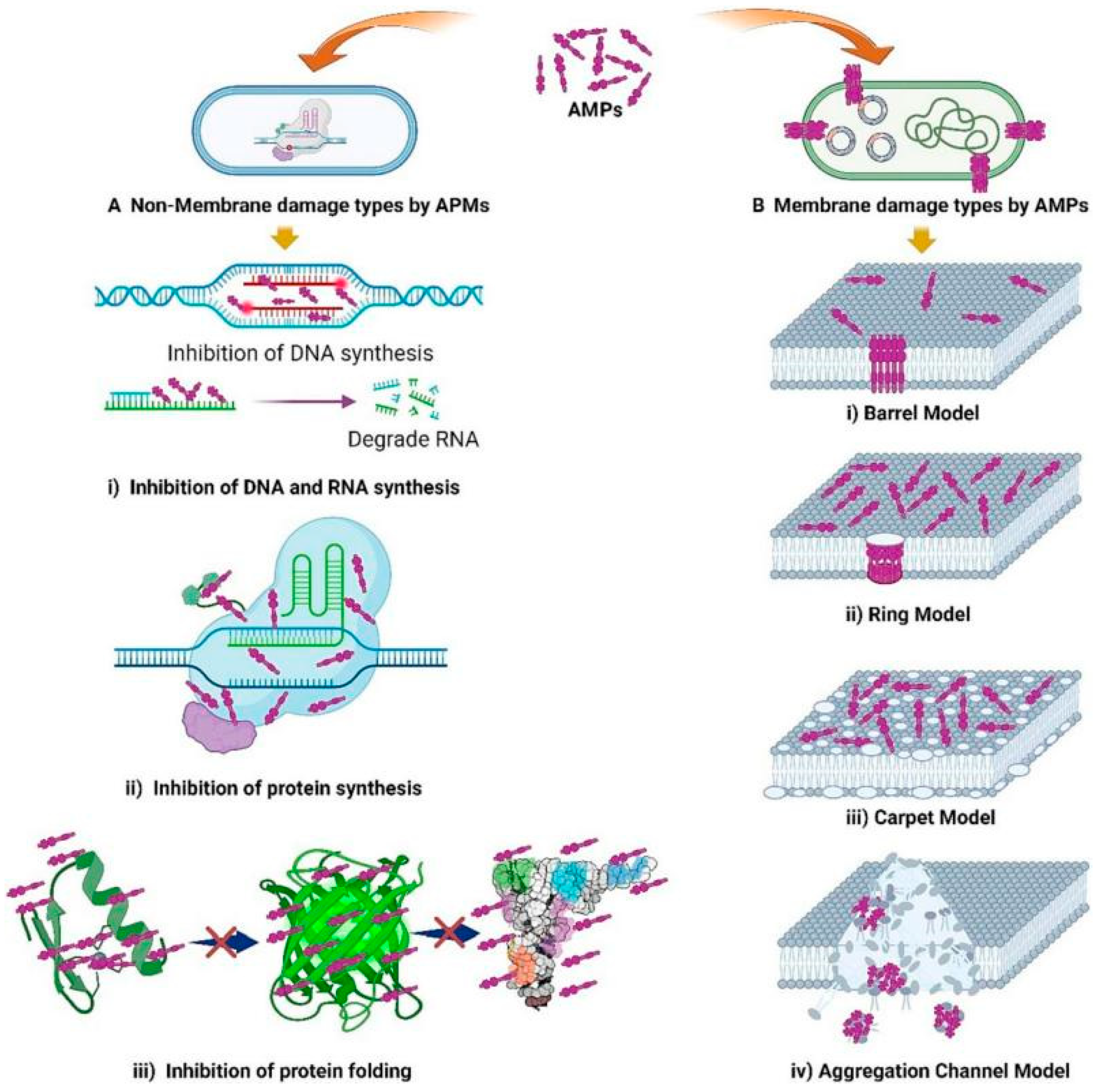
- Cecropins: Among the most extensively studied AMPs in H. illucens, cecropins demonstrate particularly potent activity. Unlike defensins, they are linear, cysteine-free peptides that adopt an amphipathic α-helical conformation [16]. Members like Cecropin Z1 display broad-spectrum antimicrobial activity, effective against both Gram-positive and Gram-negative bacteria, with a pronounced effect on the latter. Their mechanism involves the “carpet model,” where the amphipathic helix lies parallel to the membrane surface and, at a critical concentration, disrupts it through a detergent-like effect, causing content leakage [10]. This family is considered a major contributor to the overall antimicrobial activity observed in H. illucens.
- Attacins: These are relatively large (~20 kDa), glycine-rich peptides, with identified members including HI-attacin and Hill_BB_C10074 [13]. They function mainly against Gram-negative bacteria by inhibiting the synthesis of outer membrane proteins, thereby increasing membrane permeability. While their direct bactericidal activity is limited, attacins exhibit strong synergy with other AMPs, such as cecropins and lysozymes. They are thought to facilitate the action of these co-acting AMPs by compromising the outer membrane barrier.
- Diptericins: Similar to attacins, diptericins are glycine-rich peptides active against Gram-negative bacteria [17]. Their proposed mechanism also involves disrupting bacterial membrane function, although the molecular details require further elucidation.
- Lysozymes: These are enzymes that cleave the β-1,4-glycosidic linkages in peptidoglycan, the primary structural polymer of bacterial cell walls. Several lysozyme genes have been identified in H. illucens.

| Serial Number | AMP Family | AMP Example | Activity Against |
|---|---|---|---|
| 1 | Attacin | HI-attacin | MRSAb E. coli KCCM 11,234 |
| 2 | Cecropin | CLPI 1 | P. aeruginosa KCCM 11,328 E. coli KCCM 11,234 E. aerogenes KCCM 12,177 |
| Trx-somoxynZHla | S. aureus E. coli | ||
| 3 | Defensin | DLP 2 | S. aureus CICC 546 S. aureus ATCC 6538 S. aureus ATCC 25,923 S. aureus ATCC 43,300 S. suis CVCC 606 L. ivanovii ATCC 19,119 |
| DLP 3 | S. aureus KCCM 12,256 S. aureus KCCM 40,881 MRSAb S. epidermis KCCM 25,494 E. coli KCCM 11,234 P. aeruginosa KCCM 11,328 | ||
| DLP 4 | S. aureus CICC 546 S. aureus ATCC 6538 S. aureus ATCC 25,923 S. aureus ATCC 43,300 S. suis CVCC 606 L. ivanovii ATCC 19,119 | ||
| S. aureus KCCM 12,256 S. aureus KCCM 40,881 MRSAb S. epidernidis KCCM 35,494 B. subtilis KCCM 11,316 | |||
| S. snis CVCC 3928 S. epidernis ATCC 12,228 S. aureus CVCC 546 S. pnelumoniae CVCC 2350 | |||
| Hidefensin-1 | E. coli | ||
| Hill BB_C 6571 Hill_BB_C 7985 Hill_BB_C 16,634 Hill_BB_C 46,948 | E. coli | ||
| ID 13 | S. snis CVCC 3928 S. aureus CVCC 546 S. pneumoniae CVCC 2350 S. epidernis ATCC 12,228 | ||
| 4 | Diptericin | Hidiptericin-1 | S. pneumoniae E. coli |
| 5 | IATP | HiCG 13,551 | S. aureus S. pneumoniae E. coli |
- Other Families: In addition to the major families described above, bioinformatic predictions and transcriptome analyses have also identified homologs of other AMP families in Hermetia illucens, including Sarcotoxins, Stomoxysins, and Coleoptericins [19].
- It should be pointed out that the data on the antibacterial activity of Hermetia illucens antimicrobial peptides presented in Table 1 and cited in this paper are derived from multiple independent studies, which exhibit certain differences in experimental methodologies. For instance, the endpoint indicators for activity evaluation may include the minimum inhibitory concentration, minimum bactericidal concentration, or diameter of the inhibition zone; additionally, the culture media used, bacterial inoculum size, peptide purity and concentration may also vary among these studies. Therefore, the “Activity against” summarized in Table 1 should be regarded primarily as a qualitative indicator of the activity range rather than standardized data that can be directly subjected to precise quantitative comparison. Future research needs to establish unified standards for in vitro pharmacodynamic evaluation to enable more reliable comparison of the efficacy of different AMPs.
2.2. Systematic Mining Based on Omics Technologies
- Transcriptomics: This approach is currently the most prominent method for mining novel AMPs. Researchers perform RNA sequencing on H. illucens larvae, comparing samples that are either uninduced or induced with bacteria or pathogen-associated molecular patterns. This allows for the identification of differentially expressed genes [20]. Genes that are significantly upregulated post-induction, particularly those encoding small, secretory, and cationic peptides, become primary candidates for novel AMPs. This strategy has led to the discovery of not only numerous homologs of known AMPs but also entirely novel peptides like DLP-5, which lack known homologous sequences.
- Proteomics: This technique provides analysis at the protein level, offering direct evidence for the actual existence and post-translational modifications of AMPs. Typically, hemolymph is collected from induced larvae, followed by separation and purification using high-performance liquid chromatography. The resulting fractions are then identified using mass spectrometry techniques, such as MALDI-TOF/TOF MS [21]. This “top-down” methodology not only validates peptides predicted by transcriptomics but also discovers mature, active peptides. These mature forms result from direct gene translation followed by modifications such as cleavage, acetylation, or amidation, which are crucial for understanding the true functional activity of AMPs.
- Bioinformatics and Database Utilization: The efficient interpretation of omics data relies heavily on powerful bioinformatics tools and public databases. Researchers utilize databases like NCBI and UniProt for sequence alignment and homology analysis. More importantly, specialized AMP databases, such as the Antimicrobial Peptide Database, the Collection of Antimicrobial Peptides, and the Database of Antimicrobial Peptides, are indispensable [10]. These resources not only catalog sequence and structural information for thousands of known AMPs but also incorporate various prediction algorithms. These algorithms can screen massive transcriptomic or genomic datasets to predict and prioritize potential AMP candidates based on parameters like amino acid composition, net charge, hydrophobicity, and secondary structure propensity, thereby greatly enhancing discovery efficiency.
3. Structure–Function Relationship and Mechanism of Action
3.1. Critical Domains and Antimicrobial Activity
- Cationicity: Most AMPs from the black soldier fly exhibit a high isoelectric point (pI), conferring a net positive charge under physiological pH conditions [22]. This property is determined by an abundance of basic amino acid residues, such as arginine and lysine, in their sequences [16]. This cationic nature is the initial step for target selectivity, enabling AMPs to preferentially adsorb onto the generally negatively charged bacterial membrane surfaces via electrostatic attraction, while interacting only weakly with the neutral membranes of mammalian cells [23].
- Amphipathicity: This is the key structural feature that allows AMPs to insert into and disrupt cell membranes [9]. In their active conformations, hydrophobic amino acid residues and hydrophilic/charged residues segregate to opposite faces of the structure, forming a distinct hydrophobic facet and a hydrophilic facet [7]. This amphipathic architecture enables the AMP, upon membrane binding, to stably insert its hydrophobic face into the lipid core of the membrane, thereby disrupting its ordered packing and ultimately increasing membrane permeability.
- CSαβ Motif: For the defensin family, activity is guaranteed by the Cysteine-Stabilized α-helix/β-sheet motif, which is locked in place by multiple disulfide bonds. This rigid structure not only confers resistance to proteases and extreme pH/temperature but also precisely orients key amino acid residues, allowing the peptide to interact with specific receptors or lipid molecules on the bacterial membrane in an optimal configuration [23].
- α-Helix: For linear peptides like cecropins, the formation of a stable α-helix is a prerequisite for their activity. The helix length and the magnitude of its hydrophobic moment directly influence the depth of membrane insertion and the efficiency of membrane disruption [17].
3.2. Multidimensional Mechanism of Action
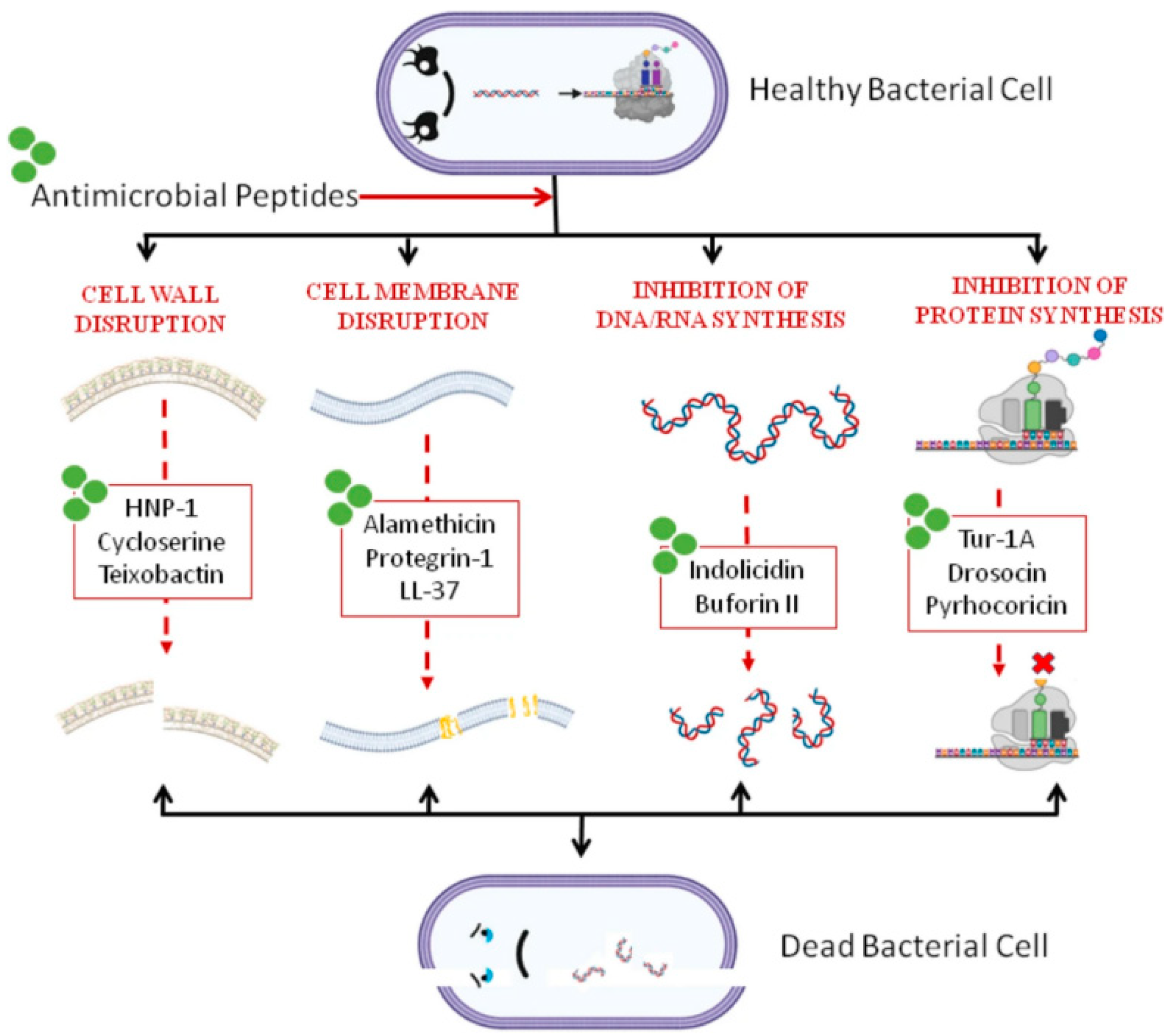
- Membrane-Targeting Mechanisms: This represents the primary and most rapid bactericidal mechanism. As mentioned previously, AMPs can cause irreversible damage to the bacterial cell membrane within minutes via models such as the “barrel-stave”, “toroidal-pore”, or “carpet” models. This leads to the collapse of critical ion gradients and leakage of cellular contents [24]. This physical disruption is a major reason why bacteria struggle to develop resistance.
- Non-Membrane-Targeting Mechanisms: Recent studies have revealed that some AMPs, after traversing the cell membrane, can interact with crucial macromolecules inside the cell, dismantling vital bacterial processes from within. These intracellular targets include:
- Inhibition of Nucleic Acid Synthesis: Certain AMPs can bind to DNA or RNA, obstructing replication and transcription processes [24].
- Inhibition of Protein Synthesis: They may bind to ribosomes, interfering with the translation process.
- Inhibition of Enzymatic Activity: They target and inhibit essential enzymes involved in key pathways such as cell wall synthesis and energy metabolism.
- Immunomodulatory Functions: AMPs are not only “killers” but also vital “messengers” (Figure 3). In in vitro cell experiments, HI-3, an antimicrobial peptide derived from Hermetia illucens, has been proven to exert a significant immunomodulatory effect on RAW264.7 murine macrophage cells and is capable of regulating the release of cytokines such as tumor necrosis factor-α and interleukin-6 [25]. These cell-based findings indicate that antimicrobial peptides derived from Hermetia illucens may not only directly eliminate pathogens but also indirectly enhance the anti-infection capacity by regulating the host’s inflammatory response [26].
- Synergistic Effects: A notable feature of the black soldier fly immune system is the coordinated expression of multiple AMPs [27]. For instance, attacins disrupt the outer membrane of Gram-negative bacteria, creating conditions for smaller yet more potent cecropins to penetrate and damage the inner membrane. The combined bactericidal effect of these two AMPs far exceeds the sum of their individual effects [28,29]. This natural synergy suggests that future drug development could focus on designing AMP-based “cocktail therapies” targeting different mechanisms to combat more stubborn multidrug-resistant infections [24,30].
4. Engineering Modification and Optimization of Hermetia illucens-Derived Antimicrobial Peptides: Advances and Future Prospects
4.1. Traditional Engineering Exploration of Hermetia illucens Antimicrobial Peptides
4.1.1. Identification and Structural Characterization of Core Functional Sequences
4.1.2. Functional Development for Large-Scale Production and Application
4.2. AI-Driven Rational Design
4.2.1. From Virtual Screening to Intelligent Generation
4.2.2. AI-Enabled Strategies for Hermetia illucens Antimicrobial Peptides
4.2.3. Key Challenges and Future Opportunities
4.3. Conclusions and Future Perspectives
5. Translational Potential Against Multidrug-Resistant Bacteria
5.1. Evaluation of Antimicrobial Activity In Vitro
- Broad-Spectrum Activity: Research has demonstrated that black soldier fly crude extracts or purified AMPs can inhibit a range of Gram-positive bacteria and Gram-negative bacteria, as well as certain fungi [28].
- Activity Against MDR Pathogens: More importantly, these AMPs remain effective against many multidrug-resistant strains [23]. For instance, black soldier fly-derived cecropins have been shown to be active against Gram-negative pathogens, including MDR strains. Defensins from this insect, such as DLP2 and DLP4, display potent antimicrobial activity against various Gram-positive bacteria, with minimum inhibitory concentration values reaching the low micromolar range in some cases [16].
- Current Status and Challenges: Despite the encouraging evidence, as of 2025, published studies providing systematic MIC and minimum bactericidal concentration data for purified, single black soldier fly AMPs against internationally recognized “superbugs”—particularly MDR clinical isolates of the ESKAPE pathogens—remain relatively scarce (query result for 2024–2025 MIC data was sparse) [24]. Future research urgently needs to fill this gap by generating more comprehensive and clinically relevant in vitro susceptibility data.
5.2. Efficacy and Safety in Animal Models
- Prospects for Efficacy Studies: Future research should focus on establishing standardized animal infection models. These should include models for skin and soft tissue infections caused by MRSA [45], intra-abdominal infection/sepsis models induced by CRE [46], and pneumonia models mediated by multidrug-resistant Acinetobacter baumannii [47]. Within these models, the efficacy of black soldier fly AMPs should be evaluated via local or systemic administration, specifically assessing their capacity to reduce bacterial load, improve animal survival rates, and ameliorate inflammatory damage.
- Safety Assessment: Safety is a decisive factor determining clinical translation. In vitro safety assessments primarily include hemolysis assays [48] and cytotoxicity tests [49]. Multiple preliminary studies indicate that natural black soldier fly AMPs typically exhibit good selectivity, meaning they demonstrate low toxicity towards mammalian cells at effective bactericidal concentrations [50,51]. However, more comprehensive in vivo toxicological studies—including assessments of acute toxicity, long-term toxicity, and immunogenicity—are mandatory for future regulatory submissions [52]. Currently, detailed toxicological data for black soldier fly AMPs in animal models during the 2024–2025 period is similarly scarce.
5.3. Challenges and Pathways for Commercialization
5.3.1. Challenges
- Large-Scale, Low-Cost Production: Direct extraction from insects yields very low quantities and is costly [53]. Chemical solid-phase synthesis is only suitable for short peptides, with costs increasing exponentially with peptide length [54]. Mainstream recombinant expression systems often face issues such as low yield, susceptibility to degradation by host proteases, or inclusion body formation when expressing cationic, low molecular weight AMPs [27].
- In Vivo Stability and Delivery: Upon entering the systemic circulation, AMPs are susceptible to rapid degradation by proteases, resulting in a short half-life that limits their efficacy for systemic administration [55].
5.3.2. Development Pathways and Solutions
- Optimizing Production Systems: Exploring more suitable expression hosts, such as insect cell expression systems [28], may be more conducive to correct folding and post-translational modifications. Concurrently, genetic engineering of the black soldier fly itself could create “cell factories” that over-secrete specific AMPs. Leveraging its native inducible expression machinery and optimizing induction conditions also represent effective strategies for enhancing yield.
- Diversified Application Scenarios: Beyond their use as systemic therapeutics for severe MDR infections, black soldier fly AMPs hold significant promise in other fields. Potential applications include their development into topical formulations for treating burns and skin infections [53,60]; their use as coating materials for medical devices to prevent biofilm formation [28,61]; and their application as feed additives in livestock and aquaculture industries to replace prophylactic antibiotics [62], promote animal health [22], and help curb the emergence of AMR at its source.
6. Conclusions
- Deepening Fundamental Research: Systematically identify all AMP families within the black soldier fly and employ structural biology techniques to elucidate the atomic-level details of the interactions between key AMPs and bacterial membranes or intracellular targets.
- Strengthening Translational Research: Conduct large-scale in vitro screening to establish activity profiles against a diverse panel of MDR clinical isolates, and accelerate the evaluation of pharmacodynamics and toxicology in animal models such as murine sepsis, pneumonia, and skin infection models.
- Focusing on AI and Engineering: Continue leveraging AI generative models to design novel AMP sequences with enhanced drug-like properties. Integrate chemical modifications and nanodelivery technologies to address the challenge of poor in vivo stability.
- Expanding Application Dimensions: While vigorously promoting their development as human prescription drugs, actively explore their applications in veterinary medicine, functional feed additives, and medical device coatings. This aims to realize their multidimensional value within the “One Health” framework.
Author Contributions
Funding
Institutional Review Board Statement
Informed Consent Statement
Data Availability Statement
Acknowledgments
Conflicts of Interest
References
- Sultana, M.; Perves, N.; Uddin, N.; Chowdhury, M.-E.E.; Amin, N. The Vicious Impact of Antimicrobial Resistance on Global Public Health Security and the Role of Healthcare Systems and Policy in Combating AMR. World J. Public Health 2024, 9, 286–294. [Google Scholar] [CrossRef]
- Tang, K.W.K.; Millar, B.C.; Moore, J.E. Antimicrobial Resistance (AMR). Br. J. Biomed. Sci. 2023, 80, 11387. [Google Scholar] [CrossRef] [PubMed]
- Patra, M.; Gupta, A.; Kumar, D.; Kumar, B. Antimicrobial Resistance: A Rising Global Threat to Public Health. Infect. Drug Resist. 2025, 18, 5419–5437. [Google Scholar] [CrossRef] [PubMed]
- Tizhe, D.T.; Ogra, I.O.; Apollos, S.D.; Enesi, K.O.; Yohanna, A.; Aminu, R.; Kwaga, J.K.P. Antimicrobial resistance as a global public health threat: The way forward. EUREKA Life Sci. 2024, 9, 52–67. [Google Scholar] [CrossRef]
- Billah, M.M.; Rahman, M.S. Salmonella in the environment: A review on ecology, antimicrobial resistance, seafood contaminations, and human health implications. J. Hazard. Mater. Adv. 2024, 13, 100407. [Google Scholar] [CrossRef]
- Arnold, K.E.; Laing, G.; McMahon, B.J.; Fanning, S.; Stekel, D.J.; Pahl, O.; Coyne, L.; Latham, S.M.; McIntyre, K.M. The need for One Health systems-thinking approaches to understand multiscale dissemination of antimicrobial resistance. Lancet Planet. Health 2024, 8, e124–e133. [Google Scholar] [CrossRef]
- Chen, E.H.L.; Wang, C.-H.; Liao, Y.-T.; Chan, F.-Y.; Kanaoka, Y.; Uchihashi, T.; Kato, K.; Lai, L.; Chang, Y.-W.; Ho, M.-C.; et al. Visualizing the membrane disruption action of antimicrobial peptides by cryo-electron tomography. Nat. Commun. 2023, 14, 5464. [Google Scholar] [CrossRef]
- Karmakar, S.; Das, S.; Banerjee, K.K. Interaction of antimicrobial peptides with model membranes: A perspective towards new antibiotics. Eur. Phys. J. Spec. Top. 2024, 233, 2981–2996. [Google Scholar] [CrossRef]
- Tang, Z.; Ma, Q.; Chen, X.; Chen, T.; Ying, Y.; Xi, X.; Wang, L.; Ma, C.; Shaw, C.; Zhou, M. Recent Advances and Challenges in Nanodelivery Systems for Antimicrobial Peptides (AMPs). Antibiotics 2021, 10, 990. [Google Scholar] [CrossRef]
- Ma, X.; Wang, Q.; Ren, K.; Xu, T.; Zhang, Z.; Xu, M.; Rao, Z.; Zhang, X. A Review of Antimicrobial Peptides: Structure, Mechanism of Action, and Molecular Optimization Strategies. Fermentation 2024, 10, 540. [Google Scholar] [CrossRef]
- Morio, K.A.; Sternowski, R.H.; Brogden, K.A. Induction of Endogenous Antimicrobial Peptides to Prevent or Treat Oral Infection and Inflammation. Antibiotics 2023, 12, 361. [Google Scholar] [CrossRef]
- Kang, S.-J.; Nam, S.H.; Lee, B.-J. Engineering Approaches for the Development of Antimicrobial Peptide-Based Antibiotics. Antibiotics 2022, 11, 1338. [Google Scholar] [CrossRef] [PubMed]
- Zhan, S.; Fang, G.; Cai, M.; Kou, Z.; Xu, J.; Cao, Y.; Bai, L.; Zhang, Y.; Jiang, Y.; Luo, X.; et al. Genomic landscape and genetic manipulation of the black soldier fly Hermetia illucens, a natural waste recycler. Cell Res. 2019, 30, 50–60. [Google Scholar] [CrossRef] [PubMed]
- Khan, S.A.; Han, Y.S. Current status of innate immune responses in Malpighian tubules of insects: A review focusing on the Toll signaling pathway. Entomol. Res. 2024, 54, e12716. [Google Scholar] [CrossRef]
- Li, M.; Liu, Y.; Gong, Y.; Yan, X.; Wang, L.; Zheng, W.; Ai, H.; Zhao, Y. Recent advances in nanoantibiotics against multidrug-resistant bacteria. Nanoscale Adv. 2023, 5, 6278–6317. [Google Scholar] [CrossRef]
- Raka, V.; Nandanwar, H. Antimicrobial Peptides (AMPs) as Potential Antibiotics: Classification, Development and Future Prospects in Combating Multi-drug Resistant Pathogens. Indian J. Microbiol. 2025, 65. [Google Scholar] [CrossRef]
- Ji, S.; An, F.; Zhang, T.; Lou, M.; Guo, J.; Liu, K.; Zhu, Y.; Wu, J.; Wu, R. Antimicrobial peptides: An alternative to traditional antibiotics. Eur. J. Med. Chem. 2024, 265, 116072. [Google Scholar] [CrossRef]
- Ghanwat, K.; Mane, S.; Phatake, Y. Black soldier fly (BSF): A source of antimicrobial peptides. Res. J. Chem. Environ. 2025, 11, 131–142. [Google Scholar] [CrossRef]
- Suryati, T.; Julaeha, E.; Farabi, K.; Ambarsari, H.; Hidayat, A.T. Lauric Acid from the Black Soldier Fly (Hermetia illucens) and Its Potential Applications. Sustainability 2023, 15, 10383. [Google Scholar] [CrossRef]
- Klammsteiner, T.; Walter, A.; Bogataj, T.; Heussler, C.D.; Stres, B.; Steiner, F.M.; Schlick-Steiner, B.C.; Arthofer, W.; Insam, H. The Core Gut Microbiome of Black Soldier Fly (Hermetia illucens) Larvae Raised on Low-Bioburden Diets. Front. Microbiol. 2020, 11, 993. [Google Scholar] [CrossRef]
- Candian, V.; Meneguz, M.; Tedeschi, R. Immune Responses of the Black Soldier Fly Hermetia illucens (L.) (Diptera: Stratiomyidae) Reared on Catering Waste. Life 2023, 13, 213. [Google Scholar] [CrossRef] [PubMed]
- Rinaldi, R.; Laurino, S.; Salvia, R.; Russi, S.; De Stefano, F.; Galasso, R.; Sgambato, A.; Scieuzo, C.; Falco, G.; Falabella, P. Biological Activity of Peptide Fraction Derived from Hermetia illucens L. (Diptera: Stratiomyidae) Larvae Haemolymph on Gastric Cancer Cells. Int. J. Mol. Sci. 2025, 26, 1885. [Google Scholar] [CrossRef]
- Park, S.-C.; Son, H.; Kim, Y.-M.; Lee, J.-K.; Park, S.; Lim, H.S.; Lee, J.R.; Jang, M.-K. Design of Antimicrobial Peptides with Cell-Selective Activity and Membrane-Acting Mechanism against Drug-Resistant Bacteria. Antibiotics 2022, 11, 1619. [Google Scholar] [CrossRef]
- Girdhar, M.; Sen, A.; Nigam, A.; Oswalia, J.; Kumar, S.; Gupta, R. Antimicrobial peptide-based strategies to overcome antimicrobial resistance. Arch. Microbiol. 2024, 206, 411. [Google Scholar] [CrossRef]
- Xiaoyan, X.; Hongxia, S.; Jiamin, G.; Huicheng, C.; Ye, L.; Qiang, X. Antimicrobial peptide HI-3 from Hermetia illucens alleviates inflammation in lipopolysaccharide-stimulated RAW264.7 cells via suppression of the nuclear factor kappa-B signaling pathway. Microbiol. Immunol. 2022, 67, 32–43. [Google Scholar] [CrossRef]
- Duarte-Mata, D.I.; Salinas-Carmona, M.C. Antimicrobial peptides’ immune modulation role in intracellular bacterial infection. Front. Immunol. 2023, 14, 1119574. [Google Scholar] [CrossRef]
- Liang, Q.; Liu, Z.; Liang, Z.; Zhu, C.; Li, D.; Kong, Q.; Mou, H. Development strategies and application of antimicrobial peptides as future alternatives to in-feed antibiotics. Sci. Total Environ. 2024, 927, 172150. [Google Scholar] [CrossRef] [PubMed]
- Xu, J.; Luo, X.; Fang, G.; Zhan, S.; Wu, J.; Wang, D.; Huang, Y. Transgenic expression of antimicrobial peptides from black soldier fly enhance resistance against entomopathogenic bacteria in the silkworm, Bombyx mori. Insect Biochem. Mol. Biol. 2020, 127, 103487. [Google Scholar] [CrossRef]
- Sun, Q.; Zhang, X.; Ouyang, Y.; Yu, P.; Man, Y.; Guo, S.; Liu, S.; Chen, Y.; Wang, Y.; Tan, X. Appressoria Formation in Phytopathogenic Fungi Suppressed by Antimicrobial Peptides and Hybrid Peptides from Black Soldier Flies. Genes 2023, 14, 1096. [Google Scholar] [CrossRef] [PubMed]
- Hemmati, S.; Rasekhi Kazerooni, H. Polypharmacological Cell-Penetrating Peptides from Venomous Marine Animals Based on Immunomodulating, Antimicrobial, and Anticancer Properties. Mar. Drugs 2022, 20, 763. [Google Scholar] [CrossRef]
- Fahmy, L.; Generalovic, T.; Ali, Y.M.; Seilly, D.; Sivanesan, K.; Kalmar, L.; Pipan, M.; Christie, G.; Grant, A.J. A novel family of defensin-like peptides from Hermetia illucens with antibacterial properties. BMC Microbiol. 2024, 24, 167. [Google Scholar] [CrossRef] [PubMed]
- Giglio, F.; De Stefano, F.; Fusco, A.; Salvia, R.; Scieuzo, C.; Cos, P.; Donnarumma, G.; Falabella, P. Antibacterial and Antifungal Potential of Hermetia illucens Hemolymph Contained-Peptides. Probiotics Antimicrob. Proteins 2025, 17. [Google Scholar] [CrossRef] [PubMed]
- Van Moll, L.; Wouters, M.; De Smet, J.; De Vooght, L.; Delputte, P.; Van Der Borght, M.; Cos, P. In-depth biological characterization of two black soldier fly anti-Pseudomonas peptides reveals LPS-binding and immunomodulating effects. mSphere 2023, 8, e00454-23. [Google Scholar] [CrossRef]
- Mock, M.; Langmead, C.J.; Grandsard, P.; Edavettal, S.; Russell, A. Recent advances in generative biology for biotherapeutic discovery. Trends Pharmacol. Sci. 2024, 45, 255–267. [Google Scholar] [CrossRef]
- Fahmy, L.; Ali, Y.M.; Seilly, D.; McCoy, R.; Owens, R.M.; Pipan, M.; Christie, G.; Grant, A.J. An attacin antimicrobial peptide, Hill_BB_C10074, from Hermetia illucens with anti-Pseudomonas aeruginosa activity. BMC Microbiol. 2023, 23, 378. [Google Scholar] [CrossRef]
- Zhang, Z.-L.; Meng, Y.-Q.; Li, J.-J.; Zhang, X.-X.; Li, J.-T.; Xu, J.-R.; Zheng, P.-H.; Xian, J.-A.; Lu, Y.-P. Effects of antimicrobial peptides from dietary Hermetia illucens larvae on the growth, immunity, gene expression, intestinal microbiota and resistance to Aeromonas hydrophila of juvenile red claw crayfish (Cherax quadricarinatus). Fish Shellfish Immunol. 2024, 147, 109437. [Google Scholar] [CrossRef]
- Szymczak, P.; Zarzecki, W.; Wang, J.; Duan, Y.; Wang, J.; Coelho, L.P.; de la Fuente-Nunez, C.; Szczurek, E. AI-Driven Antimicrobial Peptide Discovery: Mining and Generation. Acc. Chem. Res. 2025, 58, 1831–1846. [Google Scholar] [CrossRef]
- Cao, J.; Zhang, J.; Yu, Q.; Ji, J.; Li, J.; He, S.; Zhu, Z. TG-CDDPM: Text-guided antimicrobial peptides generation based on conditional denoising diffusion probabilistic model. Brief. Bioinform. 2024, 26, bbae644. [Google Scholar] [CrossRef]
- Dong, R.; Cao, Q.; Song, C. Painting Peptides with Antimicrobial Potency Through Deep Reinforcement Learning. Adv. Sci. 2025, 12, e06332. [Google Scholar] [CrossRef] [PubMed]
- Szymczak, P.; Szczurek, E. Artificial intelligence-driven antimicrobial peptide discovery. Curr. Opin. Struct. Biol. 2023, 83, 102733. [Google Scholar] [CrossRef] [PubMed]
- Lee, J.S.; Kim, J.; Kim, P.M. Score-based generative modeling for de novo protein design. Nat. Comput. Sci. 2023, 3, 382–392. [Google Scholar] [CrossRef]
- Wang, B.; Xie, Q.; Pei, J.; Chen, Z.; Tiwari, P.; Li, Z.; Fu, J. Pre-trained Language Models in Biomedical Domain: A Systematic Survey. ACM Comput. Surv. 2023, 56, 1–52. [Google Scholar] [CrossRef]
- Lasko, T.A.; Strobl, E.V.; Stead, W.W. Why do probabilistic clinical models fail to transport between sites. npj Digit. Med. 2024, 7, 53. [Google Scholar] [CrossRef] [PubMed]
- Asilian Bidgoli, A.; Rahnamayan, S.; Erdem, B.; Erdem, Z.; Ibrahim, A.; Deb, K.; Grami, A. Machine learning-based framework to cover optimal Pareto-front in many-objective optimization. Complex Intell. Syst. 2022, 8, 5287–5308. [Google Scholar] [CrossRef]
- Zhang, J.; Conly, J.; McClure, J.; Wu, K.; Petri, B.; Barber, D.; Elsayed, S.; Armstrong, G.; Zhang, K. A Murine Skin Infection Model Capable of Differentiating the Dermatopathology of Community-Associated MRSA Strain USA300 from Other MRSA Strains. Microorganisms 2021, 9, 287. [Google Scholar] [CrossRef]
- Hua, C.; Urbina, T.; Bosc, R.; Parks, T.; Sriskandan, S.; de Prost, N.; Chosidow, O. Necrotising soft-tissue infections. Lancet Infect. Dis. 2023, 23, e81–e94. [Google Scholar] [CrossRef]
- Dijkshoorn, L.; Nemec, A.; Seifert, H. An increasing threat in hospitals: Multidrug-resistant Acinetobacter baumannii. Nat. Rev. Microbiol. 2007, 5, 939–951. [Google Scholar] [CrossRef]
- von Petersdorff-Campen, K.; Schmid Daners, M. Hemolysis Testing In Vitro: A Review of Challenges and Potential Improvements. ASAIO J. 2021, 68, 3–13. [Google Scholar] [CrossRef]
- Shingatgeri, V. Safety Concerns Using Cell-Based In Vitro Methods for Toxicity Assessment. In Vitro Toxicol. 2018, 33, 187–207. [Google Scholar] [CrossRef]
- Cherene, M.B.; Cavaco, M.C.; Neves, V.L.S.; Castanho, M.A.R.B.; Taveira, G.B.; Guimarães, T.Z.A.; de Oliveira Carvalho, A.; de Oliveira Mello, E.; de Azevedo dos Santos, L.; Gomes, V.M. Non-toxicity of Plant Candicidal Peptides for Mammalian Cell Lines and Galleria mellonella Model to Improving Selectivity for Clinical Use. Int. J. Pept. Res. Ther. 2024, 30, 28. [Google Scholar] [CrossRef]
- Brulé, L.; Misery, B.; Baudouin, G.; Yan, X.; Guidou, C.; Trespeuch, C.; Foltyn, C.; Anthoine, V.; Moriceau, N.; Federighi, M.; et al. Evaluation of the Microbial Quality of Hermetia illucens Larvae for Animal Feed and Human Consumption: Study of Different Type of Rearing Substrates. Foods 2024, 13, 1587. [Google Scholar] [CrossRef]
- Carpenter, A.M.; van Hoek, M.L. Development of a defibrinated human blood hemolysis assay for rapid testing of hemolytic activity compared to computational prediction. J. Immunol. Methods 2024, 529, 113670. [Google Scholar] [CrossRef]
- Xia, J.; Ge, C.; Yao, H. Antimicrobial Peptides from Black Soldier Fly (Hermetia illucens) as Potential Antimicrobial Factors Representing an Alternative to Antibiotics in Livestock Farming. Animals 2021, 11, 1937. [Google Scholar] [CrossRef] [PubMed]
- Mulukutla, A.; Shreshtha, R.; Kumar Deb, V.; Chatterjee, P.; Jain, U.; Chauhan, N. Recent advances in antimicrobial peptide-based therapy. Bioorg. Chem. 2024, 145, 107151. [Google Scholar] [CrossRef]
- Noordin, M.A.M.; Najm, A.A.; Dyari, H.R.E.; Law, D.; Alwi, S.S.S.; Lazim, A.M.; Cheah, Y.H.; Tee, T.T.; Fazry, S. In vivo Pharmacokinetic and ADMET Profiles of Synthetic Antimicrobial Peptides (AMPs). Mini-Rev. Med. Chem. 2025, 25, 579–590. [Google Scholar] [CrossRef]
- Ben-Amram, H.; Azrad, M.; Cohen-Assodi, J.; Sharabi-Nov, A.; Edelstein, S.; Agay-Shay, K.; Peretz, A. Biofilm Formation by Hospital-Acquired Resistant Bacteria Isolated from Respiratory Samples. J. Epidemiol. Glob. Health 2024, 14, 291–297. [Google Scholar] [CrossRef]
- Moreira, L.; Guimarães, N.M.; Pereira, S.; Santos, R.S.; Loureiro, J.A.; Ferreira, R.M.; Figueiredo, C.; Pereira, M.C.; Azevedo, N.F. Engineered liposomes to deliver nucleic acid mimics in Escherichia coli. J. Control. Release 2023, 355, 489–500. [Google Scholar] [CrossRef] [PubMed]
- Chen, B.Z.; He, Y.T.; Zhao, Z.Q.; Feng, Y.H.; Liang, L.; Peng, J.; Yang, C.Y.; Uyama, H.; Shahbazi, M.-A.; Guo, X.D. Strategies to develop polymeric microneedles for controlled drug release. Adv. Drug Deliv. Rev. 2023, 203, 115109. [Google Scholar] [CrossRef]
- Cai, D.; Li, C.; Zhu, T.; Li, R.; Zhang, M.; Li, X.; Liu, Y.; Dai, Z.; Wan, L.; Lu, H. Antimicrobial peptide hydrogels: Synthesis, ROS regulation mechanism, and multimodal therapeutic applications in drug delivery systems. J. Mater. Chem. B 2025, 13, 14556–14592. [Google Scholar] [CrossRef] [PubMed]
- Sousa, M.G.C.; Rezende, T.M.B.; Franco, O.L. Nanofibers as drug-delivery systems for antimicrobial peptides. Drug Discov. Today 2021, 26, 2064–2074. [Google Scholar] [CrossRef] [PubMed]
- Khanda, M.; Seal, P.; Mohan, A.J.; Arya, N.; Boda, S.K. Antimicrobial peptides and their application to combat implant-associated infections—Opportunities and challenges. Nanoscale 2025, 17, 10462–10484. [Google Scholar] [CrossRef] [PubMed]
- Santori, D.; Fausto, A.M.; Gelli, A.; Pifferi, A.R.; Dottarelli, S.; Cucci, S.; Di Donato, F.; Grifoni, G.; Sezzi, E. Impact of Salmonella enteritidis Infection and Mechanical Stress on Antimicrobial Peptide Expression in Hermetia illucens. Insects 2025, 16, 692, Correction in Insects 2025, 16, 1174. [Google Scholar] [CrossRef] [PubMed]


Disclaimer/Publisher’s Note: The statements, opinions and data contained in all publications are solely those of the individual author(s) and contributor(s) and not of MDPI and/or the editor(s). MDPI and/or the editor(s) disclaim responsibility for any injury to people or property resulting from any ideas, methods, instructions or products referred to in the content. |
© 2026 by the authors. Licensee MDPI, Basel, Switzerland. This article is an open access article distributed under the terms and conditions of the Creative Commons Attribution (CC BY) license.
Share and Cite
Yuan, R.-X.; Ma, X.-Y.; Lv, Y.; Si, H.-B. Molecular Diversity, Structure–Function Relationship, Mechanism of Action, and Transformative Potential of Black Soldier Fly Antimicrobial Peptides Against Multidrug-Resistant Pathogens. Curr. Issues Mol. Biol. 2026, 48, 62. https://doi.org/10.3390/cimb48010062
Yuan R-X, Ma X-Y, Lv Y, Si H-B. Molecular Diversity, Structure–Function Relationship, Mechanism of Action, and Transformative Potential of Black Soldier Fly Antimicrobial Peptides Against Multidrug-Resistant Pathogens. Current Issues in Molecular Biology. 2026; 48(1):62. https://doi.org/10.3390/cimb48010062
Chicago/Turabian StyleYuan, Ru-Xi, Xiao-Yang Ma, Yang Lv, and Hong-Bin Si. 2026. "Molecular Diversity, Structure–Function Relationship, Mechanism of Action, and Transformative Potential of Black Soldier Fly Antimicrobial Peptides Against Multidrug-Resistant Pathogens" Current Issues in Molecular Biology 48, no. 1: 62. https://doi.org/10.3390/cimb48010062
APA StyleYuan, R.-X., Ma, X.-Y., Lv, Y., & Si, H.-B. (2026). Molecular Diversity, Structure–Function Relationship, Mechanism of Action, and Transformative Potential of Black Soldier Fly Antimicrobial Peptides Against Multidrug-Resistant Pathogens. Current Issues in Molecular Biology, 48(1), 62. https://doi.org/10.3390/cimb48010062