This is an early access version, the complete PDF, HTML, and XML versions will be available soon.
Open AccessArticle
Exploring the Anti-Inflammatory Effects of Aloe vera Flower (AVF) and Its Active Ingredients in a Skin Inflammation Model Induced by Glyoxal-Derived Advanced Glycation End Products (GO-AGEs)
by
Eun Yoo Lee
 Eun Yoo Lee
Seong-Min Hong
Seong-Min Hong
Sun Yeou Kim
Sun Yeou Kim  and
and
Razia Sultana
Razia Sultana
1
College of Pharmacy, Gachon University, 191 Hambakmoero, Yeonsu-gu, Incheon 21936, Republic of Korea
2
Division of Food Science and Technology, Gyeongsang National University, Jinju 52828, Republic of Korea
3
Gachon Institute of Pharmaceutical Science, Gachon University, 191, Hambakmoe-ro, Yeonsu-gu, Incheon 21936, Republic of Korea
4
Department of Life Science, University of Seoul, Seoul 02504, Republic of Korea
5
Department of Pharmacy, Jagannath University, Dhaka 1100, Bangladesh
*
Authors to whom correspondence should be addressed.
†
These authors contributed equally to this work.
Pharmaceuticals 2026, 19(1), 121; https://doi.org/10.3390/ph19010121 (registering DOI)
Submission received: 25 December 2025
/
Revised: 7 January 2026
/
Accepted: 8 January 2026
/
Published: 9 January 2026
Abstract
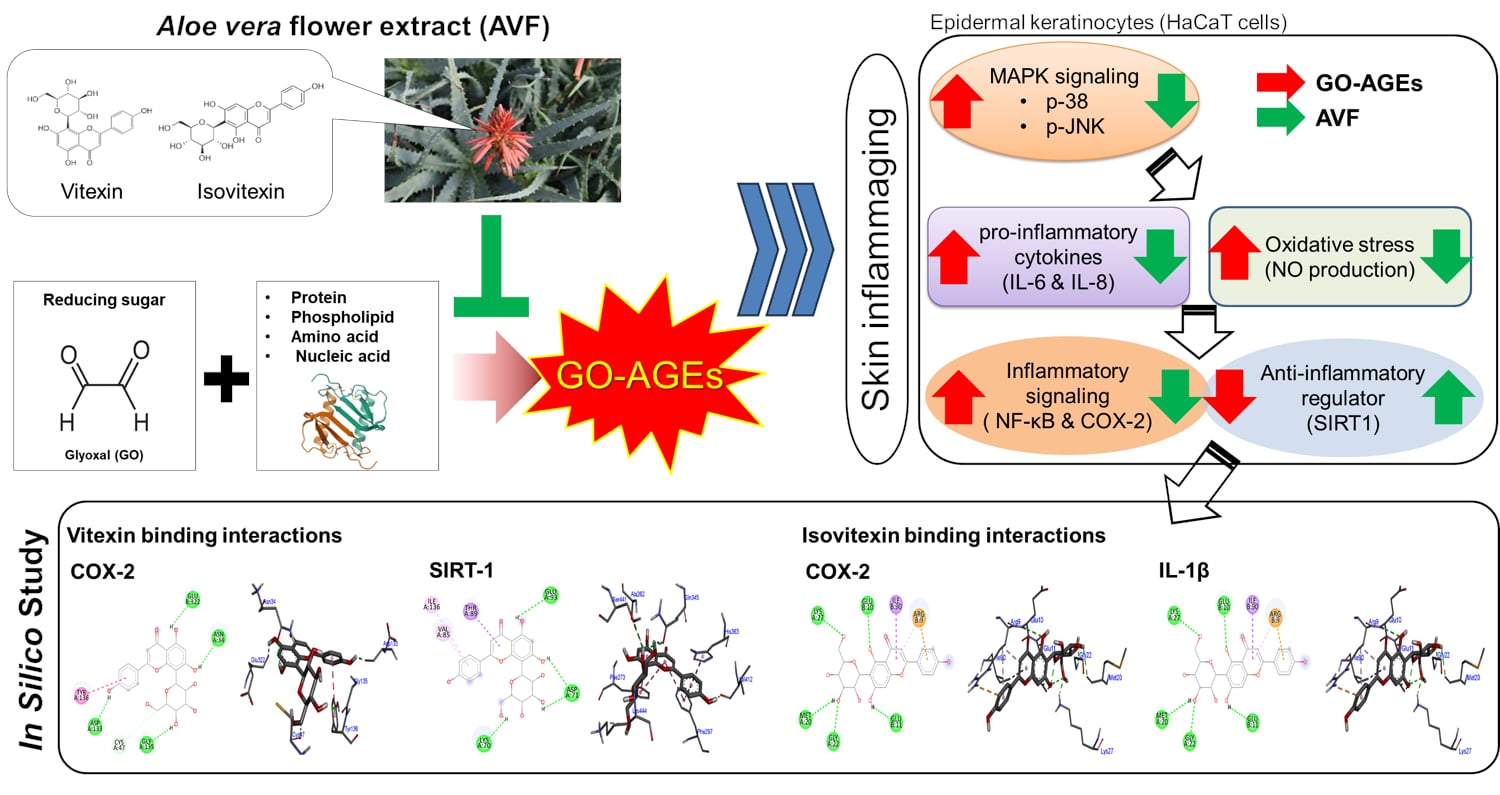
Objective: Advanced glycation end-products (AGEs) contribute to oxidative stress and inflammation, leading to various disorders, including skin inflammation. Here, we investigated the anti-inflammatory effects of Aloe vera flower (AVF) extract and its active constituents, vitexin (V) and isovitexin (IV), in a glyoxal-derived AGE (GO-AGE)-induced skin inflammaging model. Methods: We evaluated the effects of AVF, V, and IV in epidermal keratinocytes (HaCaT cells) using enzyme-linked immunosorbent assay, Western blotting, quantitative real-time polymerase chain reaction, and in silico molecular docking. Results: Treatment of HaCaT cells with AVF, V, or IV significantly suppressed the secretion and expression of interleukins (IL-6 and IL-8) at both the mRNA and protein level, and reduced the expression of key inflammatory proteins, including kappa-light-chain-enhancer of activated B cells (NF-κB) and cyclooxygenase-2 (COX-2), and phosphorylation of mitogen-activated protein kinase (MAPK) pathway proteins. Notably, the inhibitory effects of V and IV on COX-2 expression were more comparable to or exceeded those of the positive control (Epigallocatechin gallate), even at a lower concentration. Conversely, the expression of sirtuin 1 (SIRT1) was upregulated by AVF, V, and IV, with IV showing 1.5-fold upregulation. Molecular docking analyses supported these findings, with IV displaying a particularly high binding affinity for COX-2 (−11.0 kcal/mol). Conclusions: These findings highlight the potential of AVF, V, and IV as novel therapeutic agents for managing skin inflammaging by modulating inflammatory pathways.
Share and Cite
MDPI and ACS Style
Lee, E.Y.; Hong, S.-M.; Kim, S.Y.; Sultana, R.
Exploring the Anti-Inflammatory Effects of Aloe vera Flower (AVF) and Its Active Ingredients in a Skin Inflammation Model Induced by Glyoxal-Derived Advanced Glycation End Products (GO-AGEs). Pharmaceuticals 2026, 19, 121.
https://doi.org/10.3390/ph19010121
AMA Style
Lee EY, Hong S-M, Kim SY, Sultana R.
Exploring the Anti-Inflammatory Effects of Aloe vera Flower (AVF) and Its Active Ingredients in a Skin Inflammation Model Induced by Glyoxal-Derived Advanced Glycation End Products (GO-AGEs). Pharmaceuticals. 2026; 19(1):121.
https://doi.org/10.3390/ph19010121
Chicago/Turabian Style
Lee, Eun Yoo, Seong-Min Hong, Sun Yeou Kim, and Razia Sultana.
2026. "Exploring the Anti-Inflammatory Effects of Aloe vera Flower (AVF) and Its Active Ingredients in a Skin Inflammation Model Induced by Glyoxal-Derived Advanced Glycation End Products (GO-AGEs)" Pharmaceuticals 19, no. 1: 121.
https://doi.org/10.3390/ph19010121
APA Style
Lee, E. Y., Hong, S.-M., Kim, S. Y., & Sultana, R.
(2026). Exploring the Anti-Inflammatory Effects of Aloe vera Flower (AVF) and Its Active Ingredients in a Skin Inflammation Model Induced by Glyoxal-Derived Advanced Glycation End Products (GO-AGEs). Pharmaceuticals, 19(1), 121.
https://doi.org/10.3390/ph19010121
Note that from the first issue of 2016, this journal uses article numbers instead of page numbers. See further details
here.
Article Metrics
Article Access Statistics
For more information on the journal statistics, click
here.
Multiple requests from the same IP address are counted as one view.