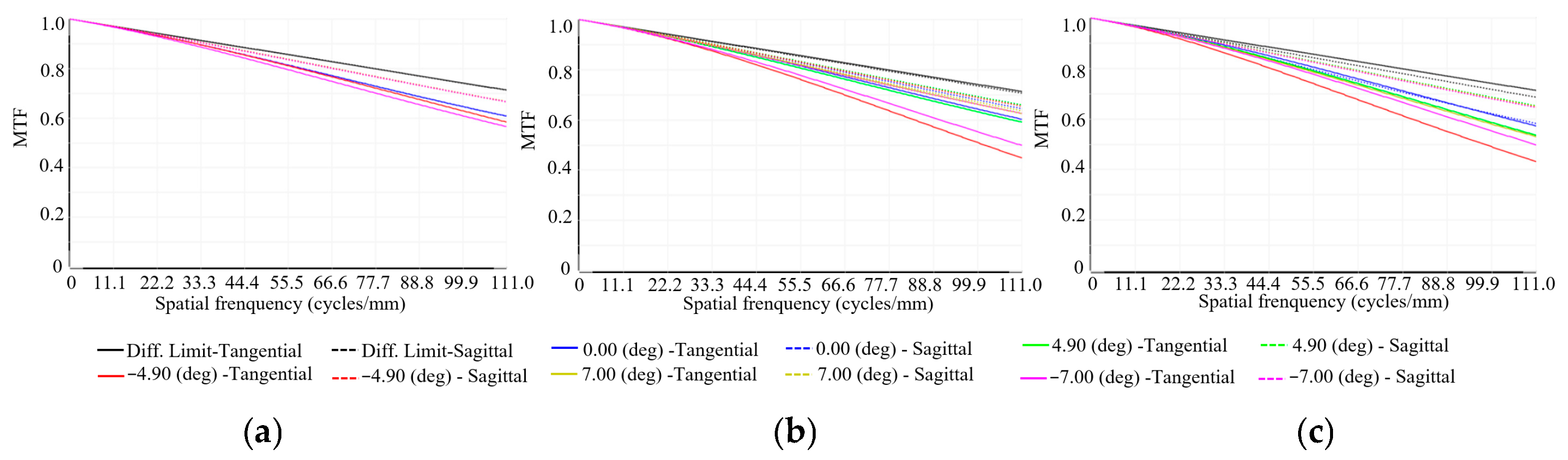
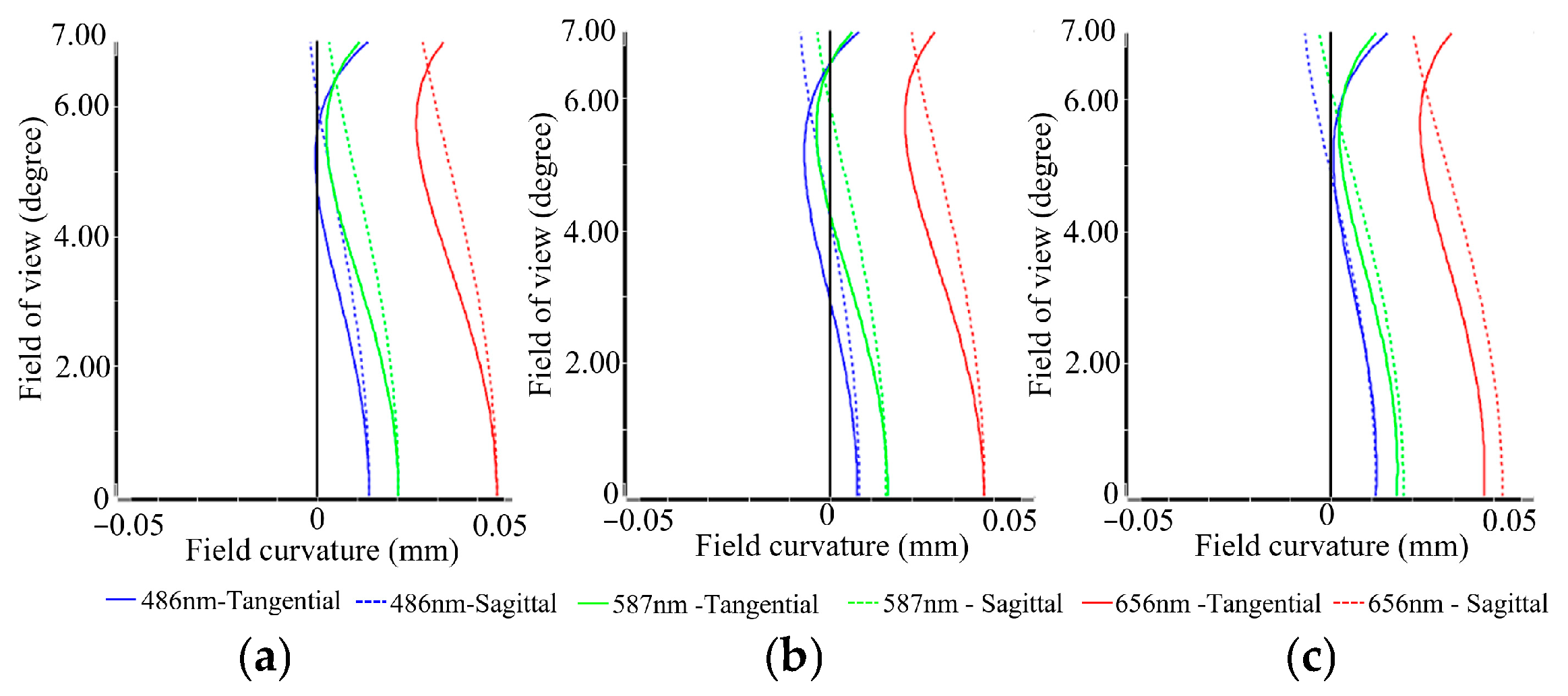
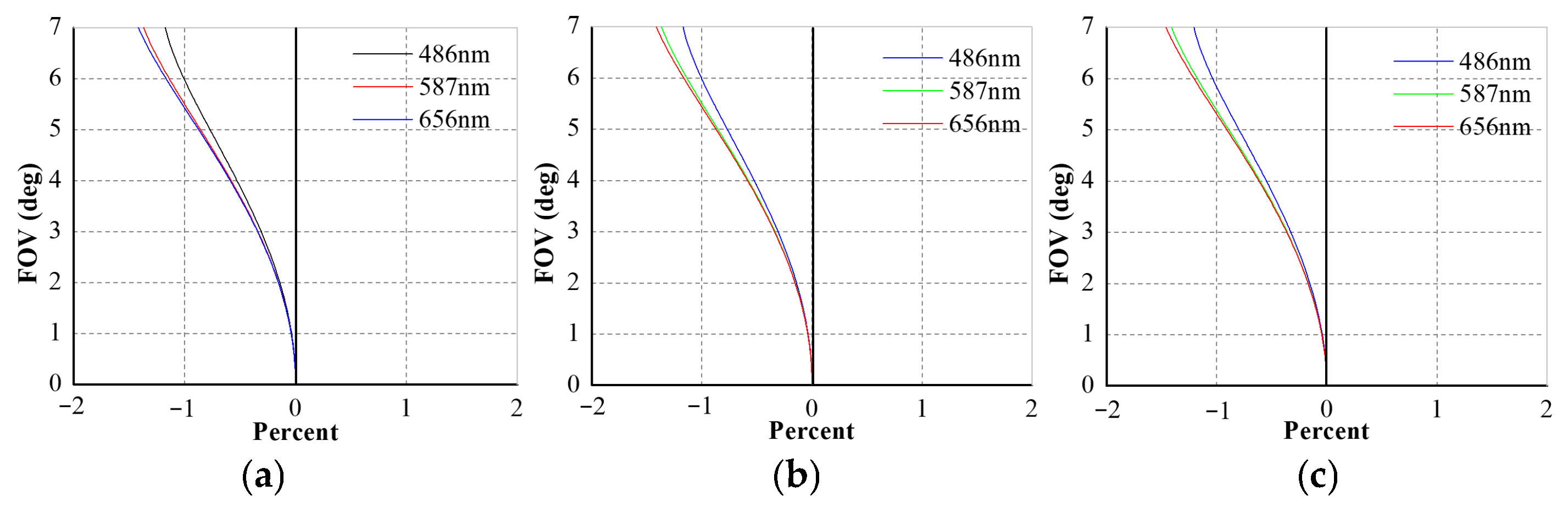
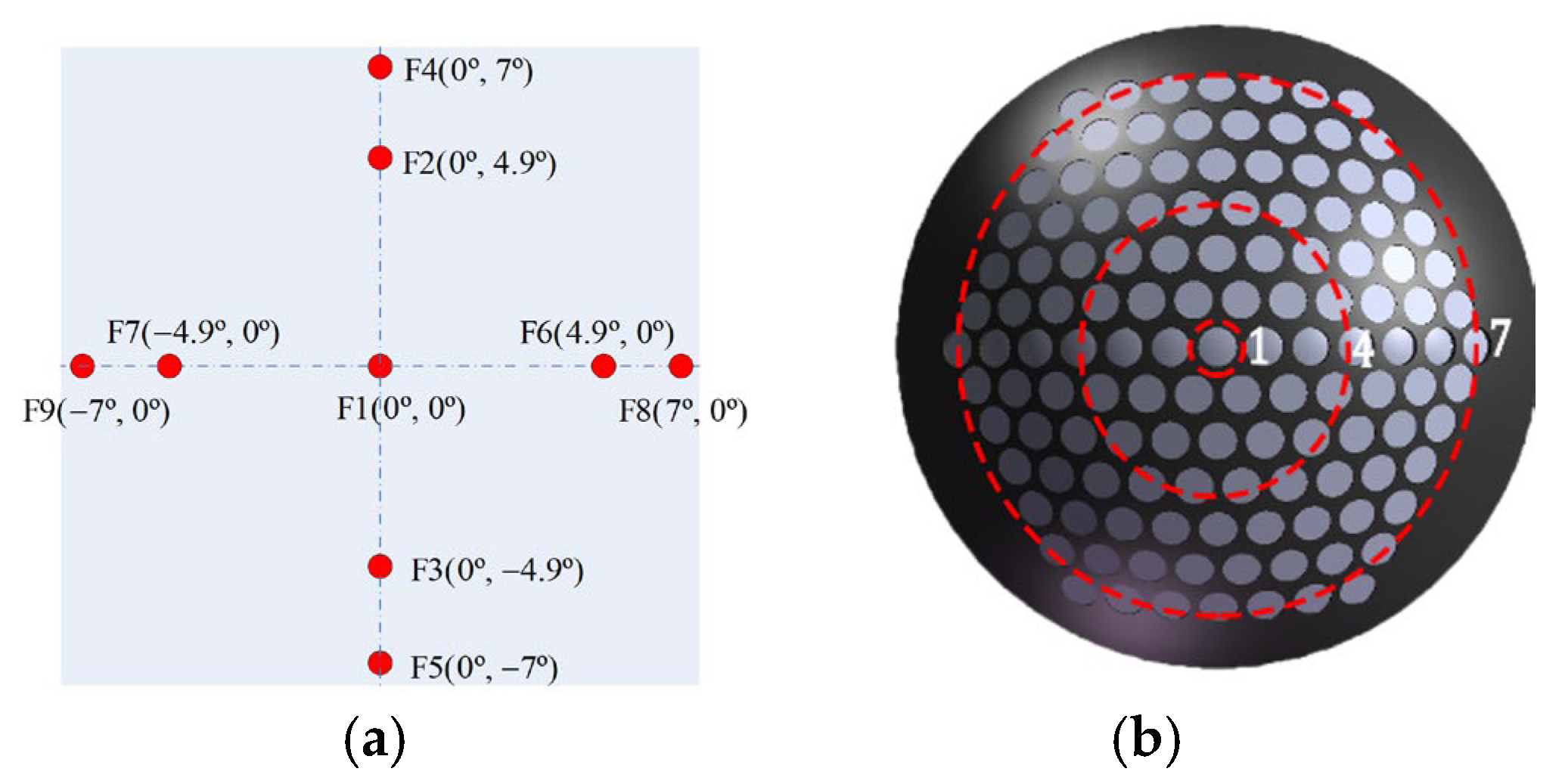
Toward Wide-Field, Extended-Range 3D Vision: A Biomimetic Curved Compound-Eye Imaging System

 and
and
Abstract
1. Introduction
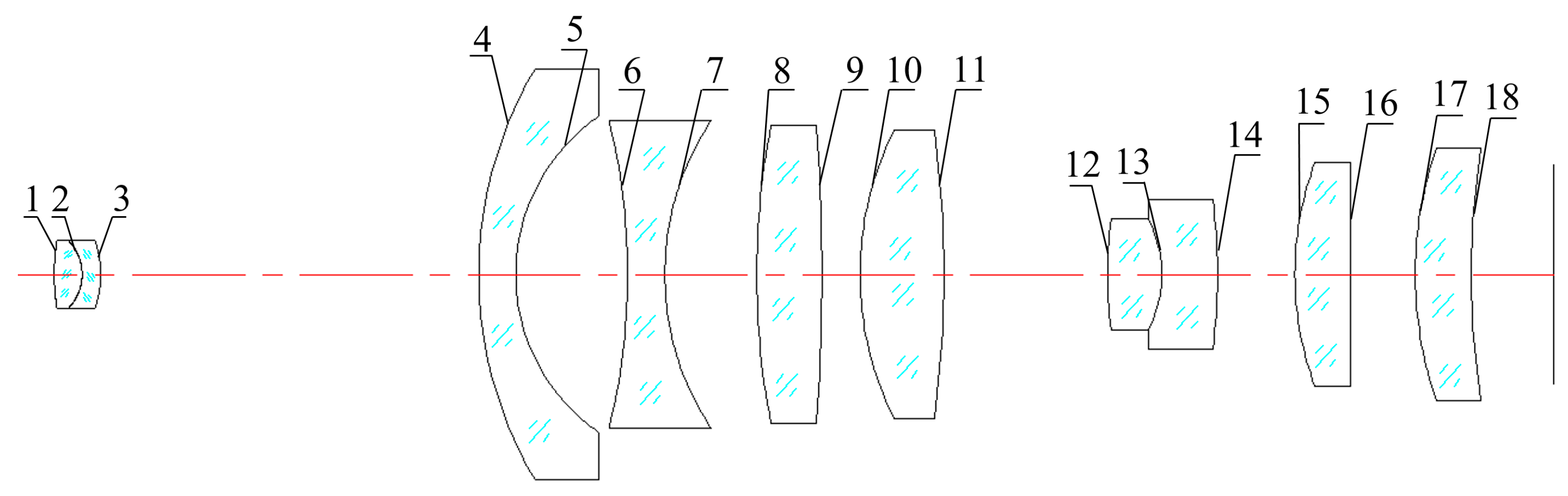
2. Design of the BCCEIS
2.1. Optical Design
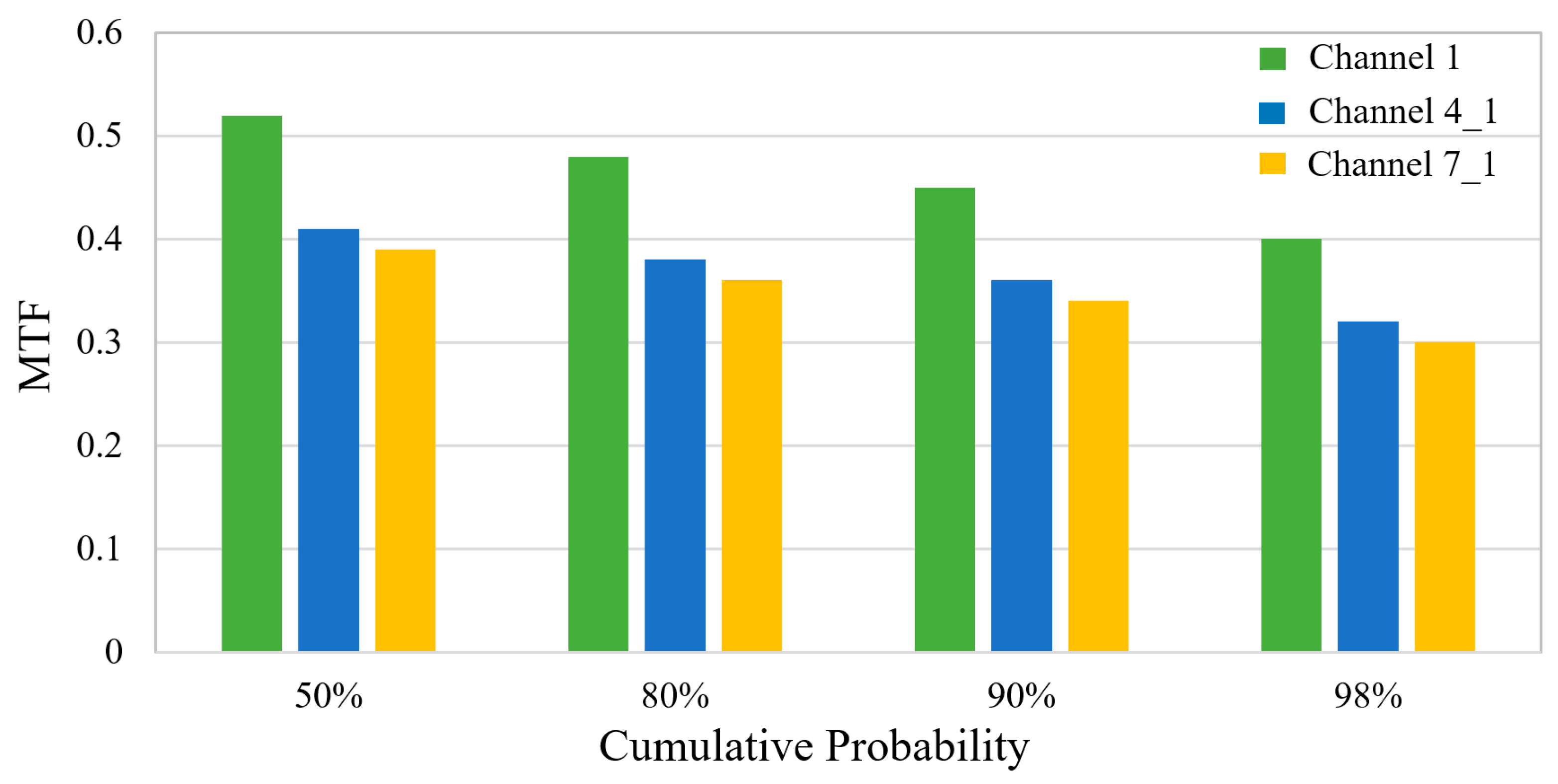
2.2. Optical Design Tolerance Analysis
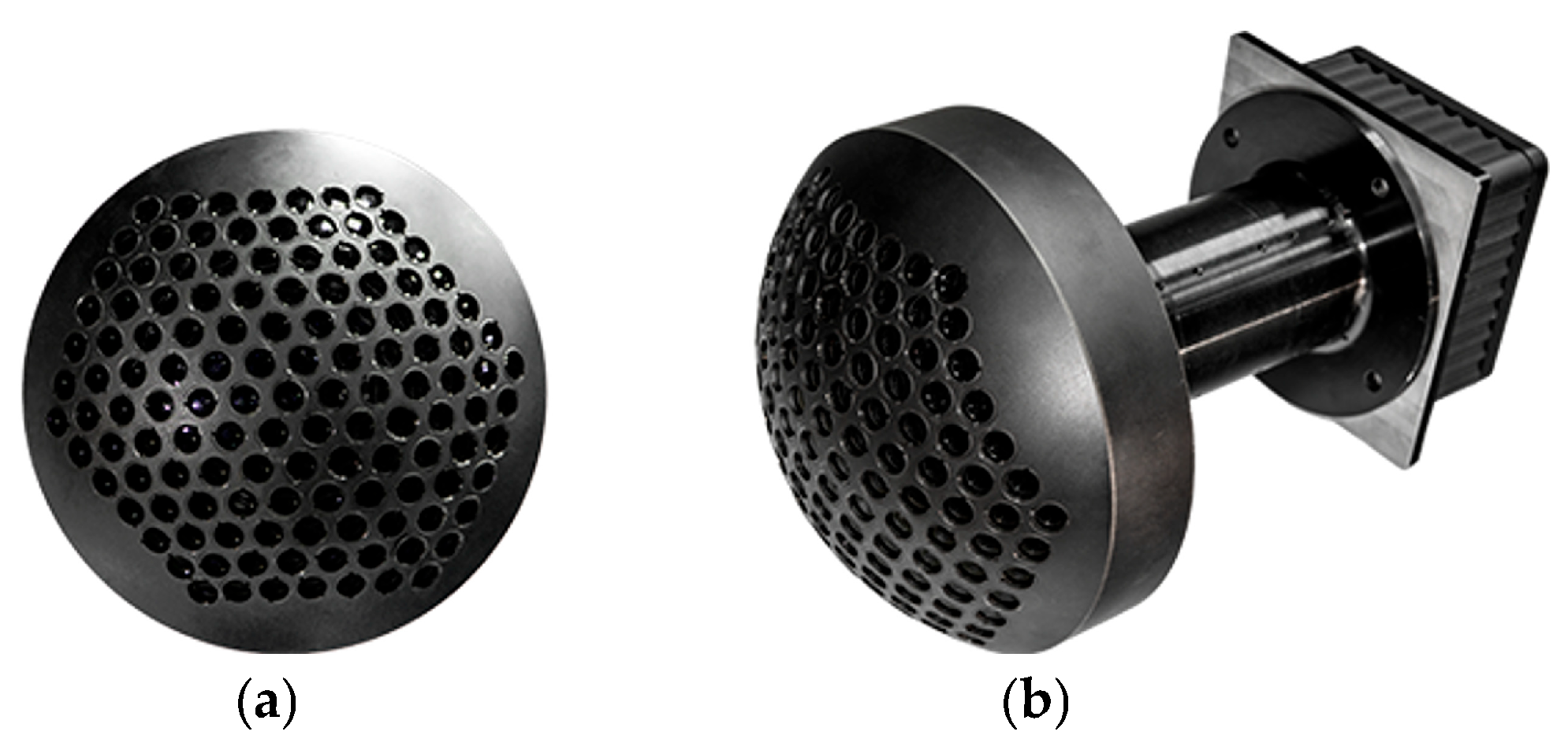
2.3. Assembly of the BCCEIS
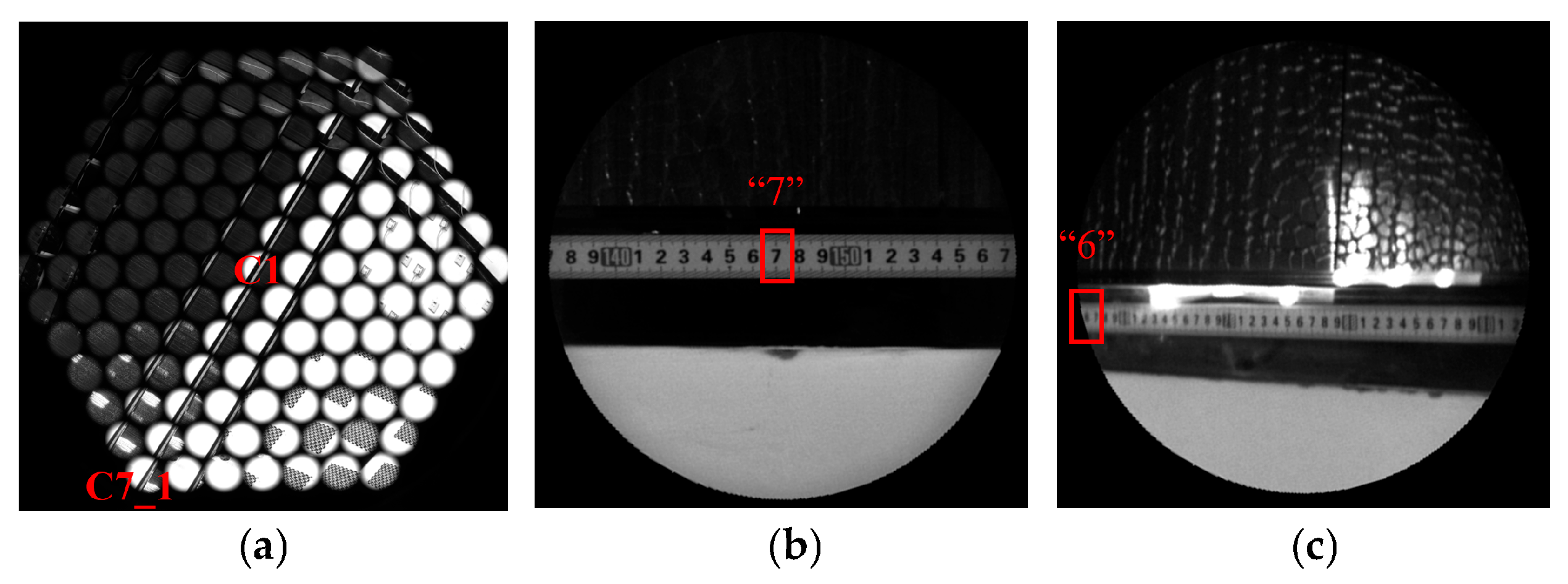
3. Results and Discussion
4. Conclusions
Author Contributions
Funding
Institutional Review Board Statement
Informed Consent Statement
Data Availability Statement
Conflicts of Interest
References
- Li, L.; Yi, A.-Y. Design and fabrication of a freedom microlens array for a compact large-field-of-view compound-eye camera. Appl. Opt. 2012, 51, 1843–1852. [Google Scholar] [CrossRef] [Scilit]
- Li, Y.; Zhang, J.; Zhu, S.; Dong, H.; Jia, F.; Wang, Z.; Sun, Z.; Zhang, L.; Li, Y.; Li, H.; et al. Biomimetic surface for high-performance optics. Adv. Mater. 2009, 21, 4731–4734. [Google Scholar] [CrossRef] [Scilit]
- Yang, T.; Liu, Y.; Mu, Q.; Zhu, M.; Pu, D.; Chen, L.; Huang, W. Compact compound-eye imaging module based on the phase diffractive microlens array for biometric fingerprint capturing. Opt. Express 2019, 27, 7513–7521. [Google Scholar] [CrossRef] [Scilit]
- Zhang, H.; Zou, C.; Song, L.; Zhang, X.; Fang, F.; Jia, D.; Zhang, Y. Curved compound eye imaging system with a large field of view based on a plano-concave substrate. In 6th International Symposium on Advanced Optical Manufacturing and Testing Technologies: Design, Manufacturing, and Testing of Smart Structures, Micro-and Nano-Optical Devices, and Systems; SPIE: Bellingham, WA, USA, 2012; Volume 841805. [Google Scholar] [CrossRef] [Scilit]
- Zhang, H.; Li, L.; Mccray, D.-L.; Scheiding, S.; Naples, N.-J.; Gebhardt, A.; Risse, S.; Eberhardt, R.; Tunnermann, A.; Yi, A.-Y. Development of a low cost high precision three-layer 3D artificial compound eye. Opt. Express 2013, 21, 22232–22245. [Google Scholar] [CrossRef] [Scilit]
- Croon, G.; Dupeyroux, J.; Fuller, S.; Marshall, J. Insect-inspired AI for autonomous robots. Sci. Robot. 2022, 7, eabl6334. [Google Scholar] [CrossRef] [Scilit]
- Zhao, Z.; Liu, J.; Zhang, Z.; Xu, L. Bionic-compound-eye structure for realizing compact integral imaging 3D display in cellphone with enhanced performance. Opt. Lett. 2020, 45, 1491–1494. [Google Scholar] [CrossRef] [Scilit] [PubMed]
- Kawano, H.; Okamoto, T.; Nakajima, H.; Takushima, S.; Toyada, Y.; Yamanaka, S.; Funakura, T.; Yamagata, K.; Matsuzawa, T.; Kunieda, T. Practical design for compact image scanner with large depth of field by compound eye system. Opt. Express 2014, 22, 18010–18019. [Google Scholar] [CrossRef] [Scilit] [PubMed]
- Tanida, J.; Kumagai, T.; Yamada, K.; Miyatake, S.; Ishida, K.; Morimoto, T.; Kondou, N.; Miyazaki, D.; Ichioka, Y. Thin observation module by bound optics (TOMBO): Concept and Experimental Verification. Appl. Opt. 2001, 40, 1806–1813. [Google Scholar] [CrossRef] [Scilit] [PubMed]
- Duparre, J.; Dannberg, P.; Schreiber, P.; Brauer, A.; Tunnermann, A. Thin compound-eye camera. Appl. Opt. 2005, 44, 2949–2956. [Google Scholar] [CrossRef] [Scilit]
- Hamanaka, K.; Koshi, H. An Artificial Compound Eye Using a Microlens Array and Its Application to Scale-Invariant Processing. Opt. Rev. 1996, 3, 264–268. [Google Scholar] [CrossRef] [Scilit]
- Stollberg, K.; Bruckner, A.; Duparre, J.; Dannberg, P.; Brauer, A.; Tunnermann, A. The Gabor superlens as an alternative wafer-level camera approach inspired by superposition compound eyes of nocturnal insects. Opt. Express 2009, 17, 15747–15759. [Google Scholar] [CrossRef] [Scilit] [PubMed]
- Duparré, J.; Schreiber, P.; Matthes, A.; Ekaterina, P.-S.; Brauer, A.; Tunnermann, A. Microoptical telescope compound eye. Opt. Express 2005, 13, 889–903. [Google Scholar] [CrossRef] [Scilit] [PubMed]
- Jeong, K.-H.; Kim, J.; Lee, L.-P. Biologically Inspired Artificial Compound Eyes. Science 2006, 312, 557–561. [Google Scholar] [CrossRef] [Scilit] [PubMed]
- Floreano, D.; Pericet-Camara, R.; Viollet, S.; Ruffier, F.; Brückner, A.; Leitel, R.; Buss, W.; Menouni, M.; Expert, F.; Juston, R.; et al. Miniature curved artificial compound eyes. Proc. Natl. Acad. Sci. USA 2013, 110, 9267–9272. [Google Scholar] [CrossRef] [Scilit]
- Ueno, R.; Suzuki, K.; Kobayashi, M.; Kwon, H.; Honda, H.; Funaki, H. Compound-Eye Camera Module as Small as 8.5 × 8.5 × 6.0 mm for 26 k-Resolution Depth Map and 2-Mpix 2D Imaging. IEEE Photonics J. 2013, 5, 6801212. [Google Scholar] [CrossRef] [Scilit]
- Zheng, Y.; Song, L.; Huang, J.; Zhang, H.; Fang, F. Detection of the three-dimensional trajectory of an object based on a curved bionic compound eye. Opt. Lett. 2019, 44, 4143–4146. [Google Scholar] [CrossRef] [Scilit]
- Ma, M.; Li, H.; Gao, X.; Si, W.; Deng, H.; Zhang, J.; Zhong, X.; Wang, K. Target orientation detection based on a neural network with a bionic bee-like compound eye. Opt. Express 2020, 28, 10794–10805. [Google Scholar] [CrossRef] [Scilit]
- Liu, Q.; Wang, X.; Xue, J.; Lv, S.; Wei, R. MFBCE: A Multi-Focal Bionic Compound Eye for Distance Measurement. Sensors 2025, 25, 2708. [Google Scholar] [CrossRef] [Scilit]
- Hu, Z.; Zhang, Y.; Pan, C.; Dou, J.; Li, Z.; Tian, Z.; Mao, J.; Chen, Q.; Sun, H. Miniature optoelectronic compound eye camera. Nat. Commun. 2022, 13, 5634. [Google Scholar] [CrossRef] [Scilit]
- Wu, J.; Guo, Y.; Deng, C.; Zhang, A.; Qiao, H.; Lu, Z.; Xie, J.; Fang, L.; Dai, Q. An integrated imaging sensor for aberration-corrected 3D photography. Nature 2022, 612, 62–71. [Google Scholar] [CrossRef] [Scilit]
- Hirschmüller, H. Stereo Processing by Semiglobal Matching and Mutual Information. IEEE Trans. Pattern Anal. Mach. Intell. 2008, 30, 328–340. [Google Scholar] [CrossRef] [Scilit]



| Tolerance Type | Lens | Optical Relay Subsystem |
|---|---|---|
| Surface decenter (TSDX, TSDY) | ±25 μm | ±20 μm |
| Surface tilt (TSTX, TSTY) | ±1 mrad | ±0.35 mrad |
| Element decenter (TEDX, TEDY) | ±25 μm | ±20 μm |
| Element tilt (TETX, TETY) | ±2 mrad | ±0.35 mrad |
| Thickness (TTHI) | ±50 μm | ±50 μm |
| Tolerance Type | Tolerance Value | Affected Surface | Worst MTF Value Drop (@111 Cycles/mm) |
|---|---|---|---|
| TSDY | ±20 μm | 13 | −0.018 |
| TEDY | ±20 μm | 10–11 | −0.015 |
| TSDX | ±20 μm | 13 | −0.012 |
| TSDY | ±20 μm | 7 | −0.011 |
| TSDY | ±20 μm | 10 | −0.010 |
| TEDY | ±20 μm | 6–7 | −0.009 |
| TSDY | ±20 μm | 13 | −0.008 |
| TSDY | ±20 μm | 5 | −0.007 |
| TEDY | ±20 μm | 4–5 | −0.006 |
| TSTX | ±0.35 mrad | 8 | −0.006 |
| TEDX | ±20 μm | 12–14 | −0.005 |
| Parameter | Value |
|---|---|
| Working waveband | Visible |
| f-number F/# | 3.5 |
| Number of Ommatidia N | 127 |
| Total FOV ω | 97.4° |
| Acceptance angle of each ommatidium Δφ | 14° |
| Inter-optical-axis angle ΔΦ | 7° |
| Radius of the hemispherical shell R | 68 mm |
| Diameter of lens in lens array D | 7.4 mm |
| Angle Resolution r | 2.5 mrad |
| MTF at 111 cycles/mm | >0.4 |
| Distortion per channel | <1.5% |
| Overall dimensions | Φ123 mm × 195 mm (Diameter × Length) |
| Whole weight W | 1.2 kg |
| Power P | 6.5 W |
Disclaimer/Publisher’s Note: The statements, opinions and data contained in all publications are solely those of the individual author(s) and contributor(s) and not of MDPI and/or the editor(s). MDPI and/or the editor(s) disclaim responsibility for any injury to people or property resulting from any ideas, methods, instructions or products referred to in the content. |
© 2026 by the authors. Licensee MDPI, Basel, Switzerland. This article is an open access article distributed under the terms and conditions of the Creative Commons Attribution (CC BY) license.
Share and Cite
Zhang, S.; Zhang, X.; Zhao, Y.; Ren, X.; Yu, W.; Xu, H. Toward Wide-Field, Extended-Range 3D Vision: A Biomimetic Curved Compound-Eye Imaging System. Sensors 2026, 26, 901. https://doi.org/10.3390/s26030901
Zhang S, Zhang X, Zhao Y, Ren X, Yu W, Xu H. Toward Wide-Field, Extended-Range 3D Vision: A Biomimetic Curved Compound-Eye Imaging System. Sensors. 2026; 26(3):901. https://doi.org/10.3390/s26030901
Chicago/Turabian StyleZhang, Songchang, Xibin Zhang, Yingsong Zhao, Xiangbo Ren, Weixing Yu, and Huangrong Xu. 2026. "Toward Wide-Field, Extended-Range 3D Vision: A Biomimetic Curved Compound-Eye Imaging System" Sensors 26, no. 3: 901. https://doi.org/10.3390/s26030901
APA StyleZhang, S., Zhang, X., Zhao, Y., Ren, X., Yu, W., & Xu, H. (2026). Toward Wide-Field, Extended-Range 3D Vision: A Biomimetic Curved Compound-Eye Imaging System. Sensors, 26(3), 901. https://doi.org/10.3390/s26030901