
Landslide Susceptibility Evaluation Integrating Machine Learning and SBAS-InSAR-Derived Deformation Characteristics: A Case Study of Yining County, Xinjiang



Abstract
1. Introduction
2. Materials and Methods
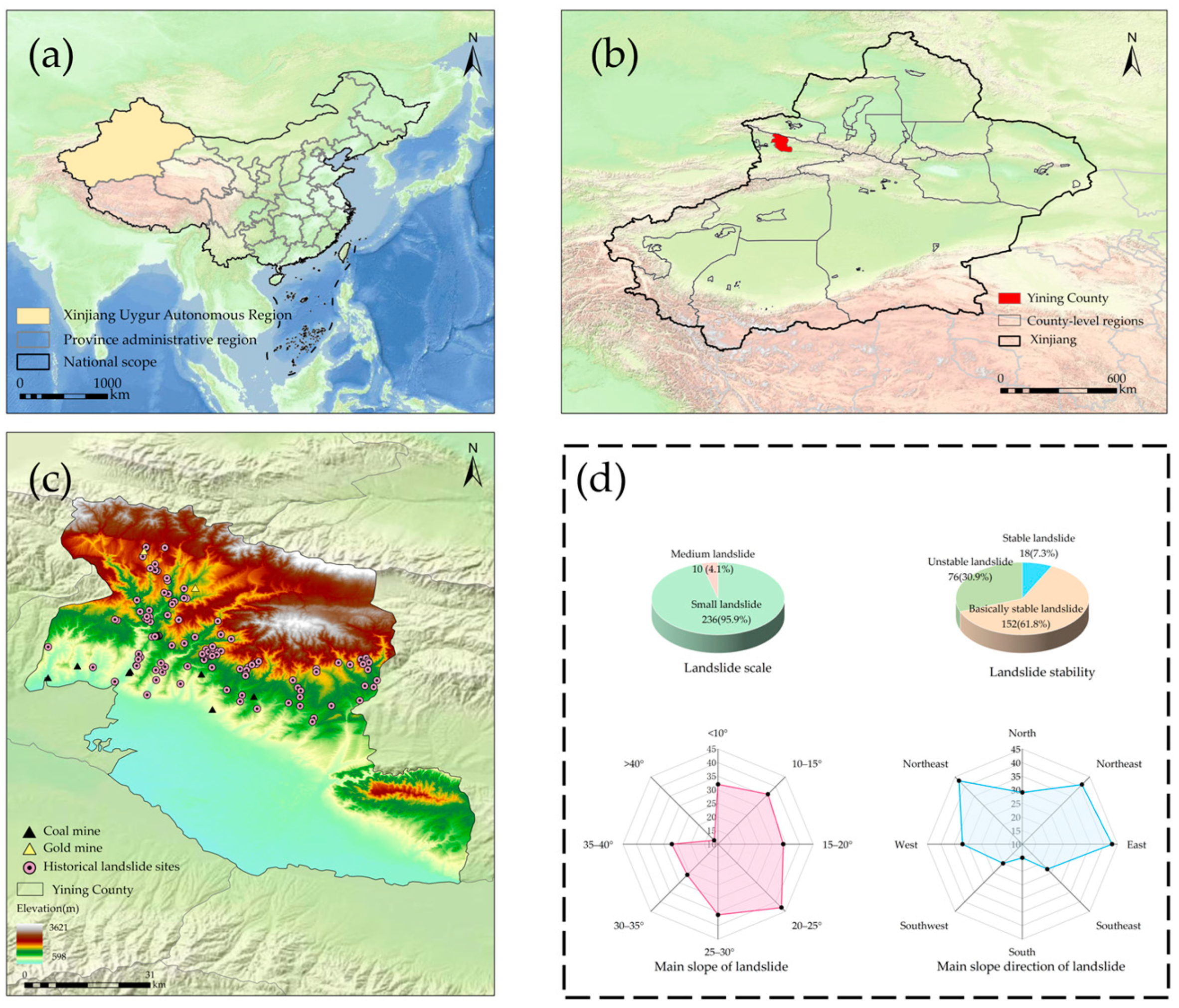
2.1. Study Area
2.2. Data
2.2.1. Landslide Driving Factor Data
2.2.2. SAR Image Data
2.3. Method
2.3.1. Selection of Landslide Evaluation Factors
2.3.2. Discretization of Landslide Evaluation Factors
2.3.3. Landslide Susceptibility Evaluation Model Based on Machine Learning
2.3.4. SBAS-InSAR Interferometric Processing
2.3.5. Landslide Susceptibility Transfer Matrix
3. Results
3.1. Construction of Landslide Susceptibility Evaluation System
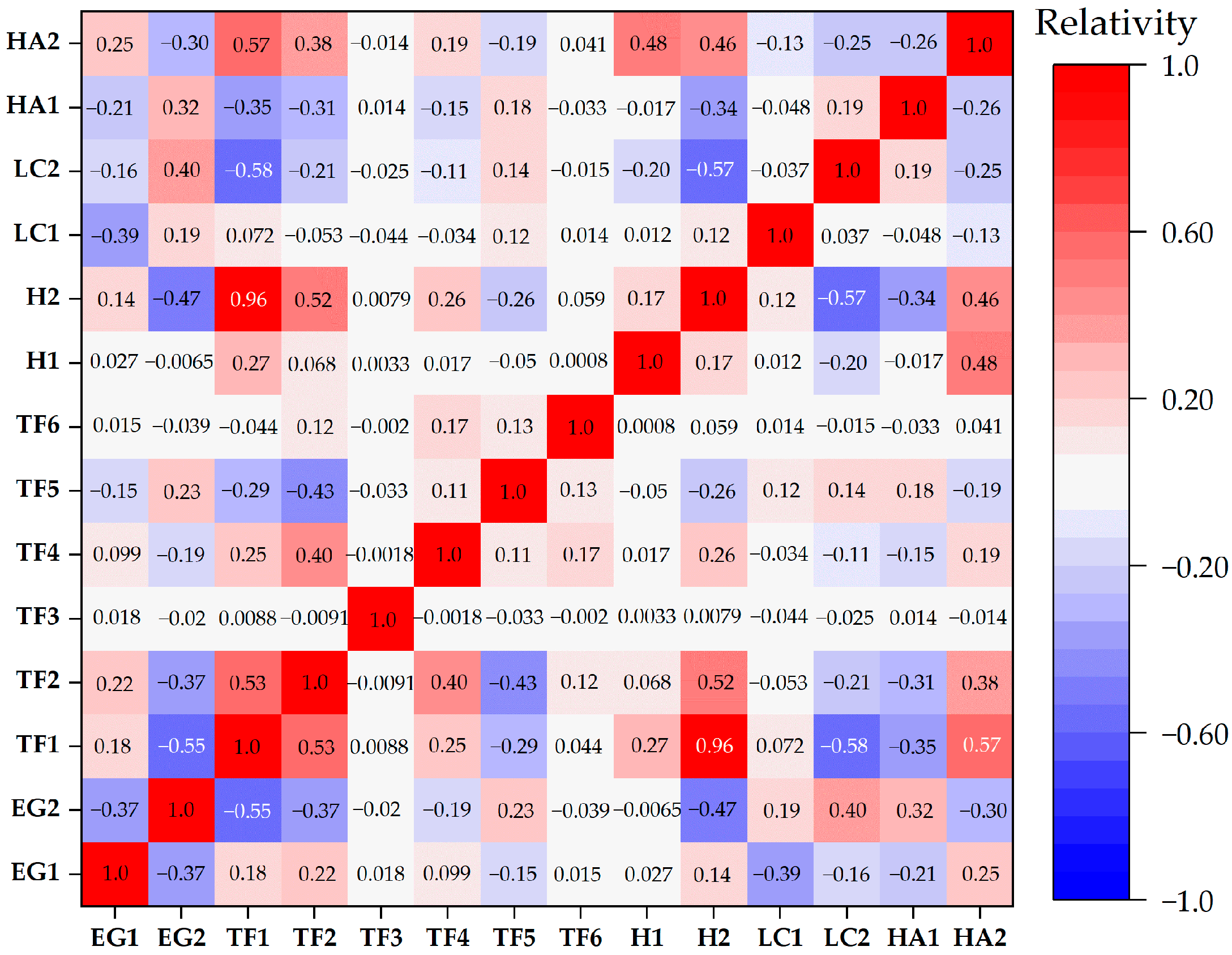
3.1.1. Pearson Correlation Coefficient
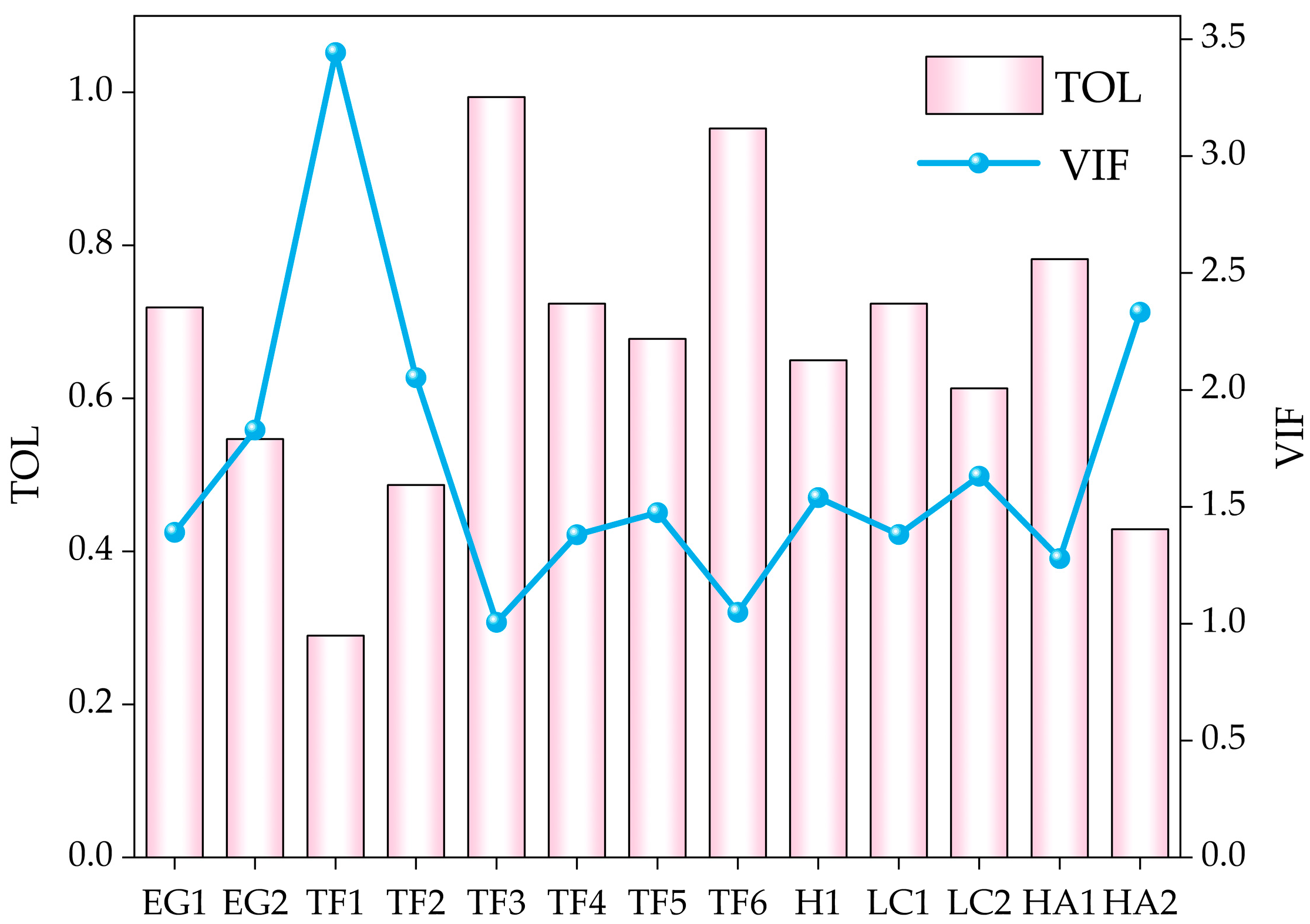
3.1.2. Multicollinearity Test
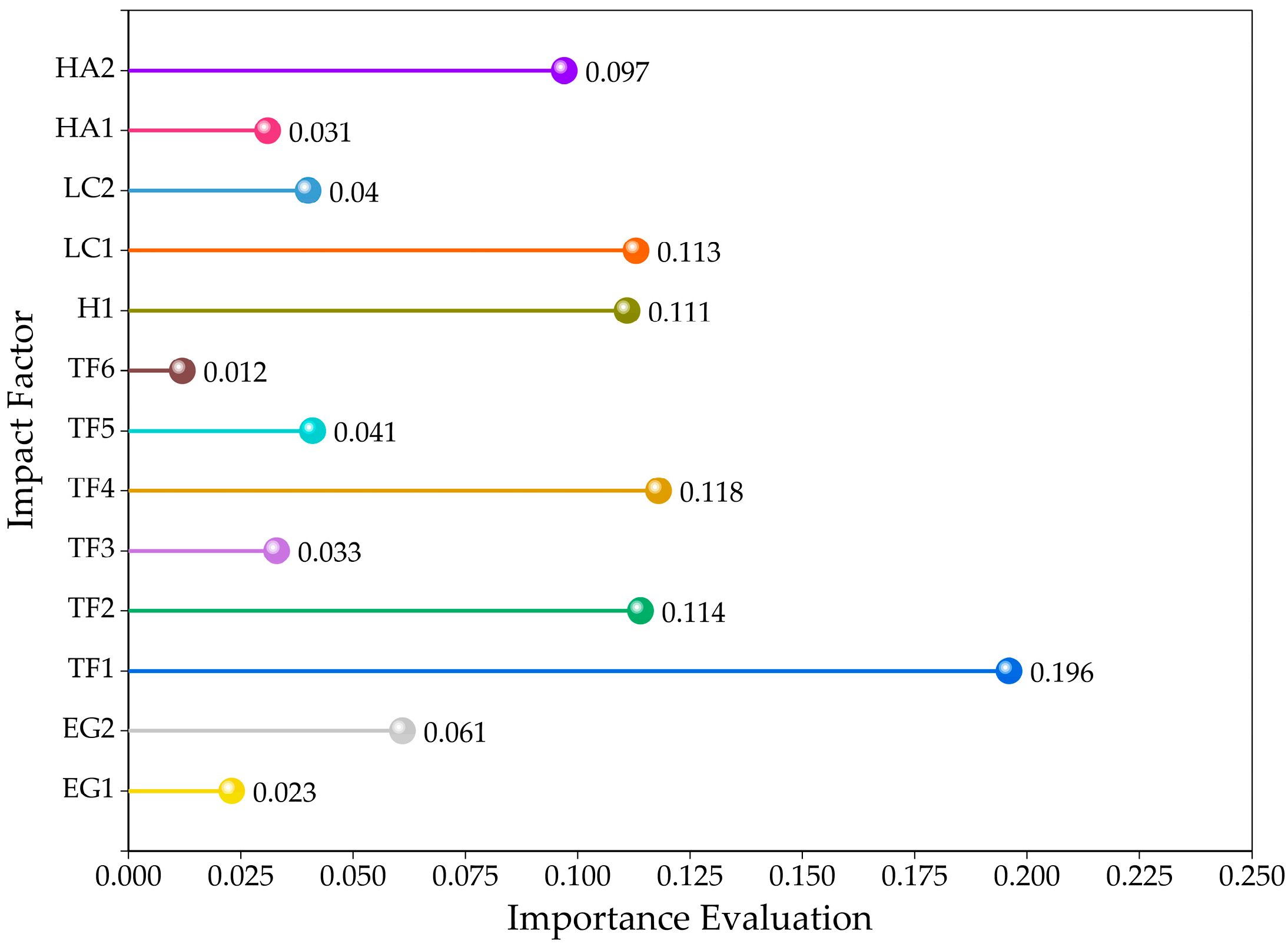
3.1.3. Importance Analysis of Evaluation Factors Based on RF
3.2. Discretization of Landslide Susceptibility Evaluation Factor
3.2.1. Discretization of Continuity Factor
3.2.2. Discretization of Linear Factor
3.3. Landslide Susceptibility Assessment Based on Machine Learning
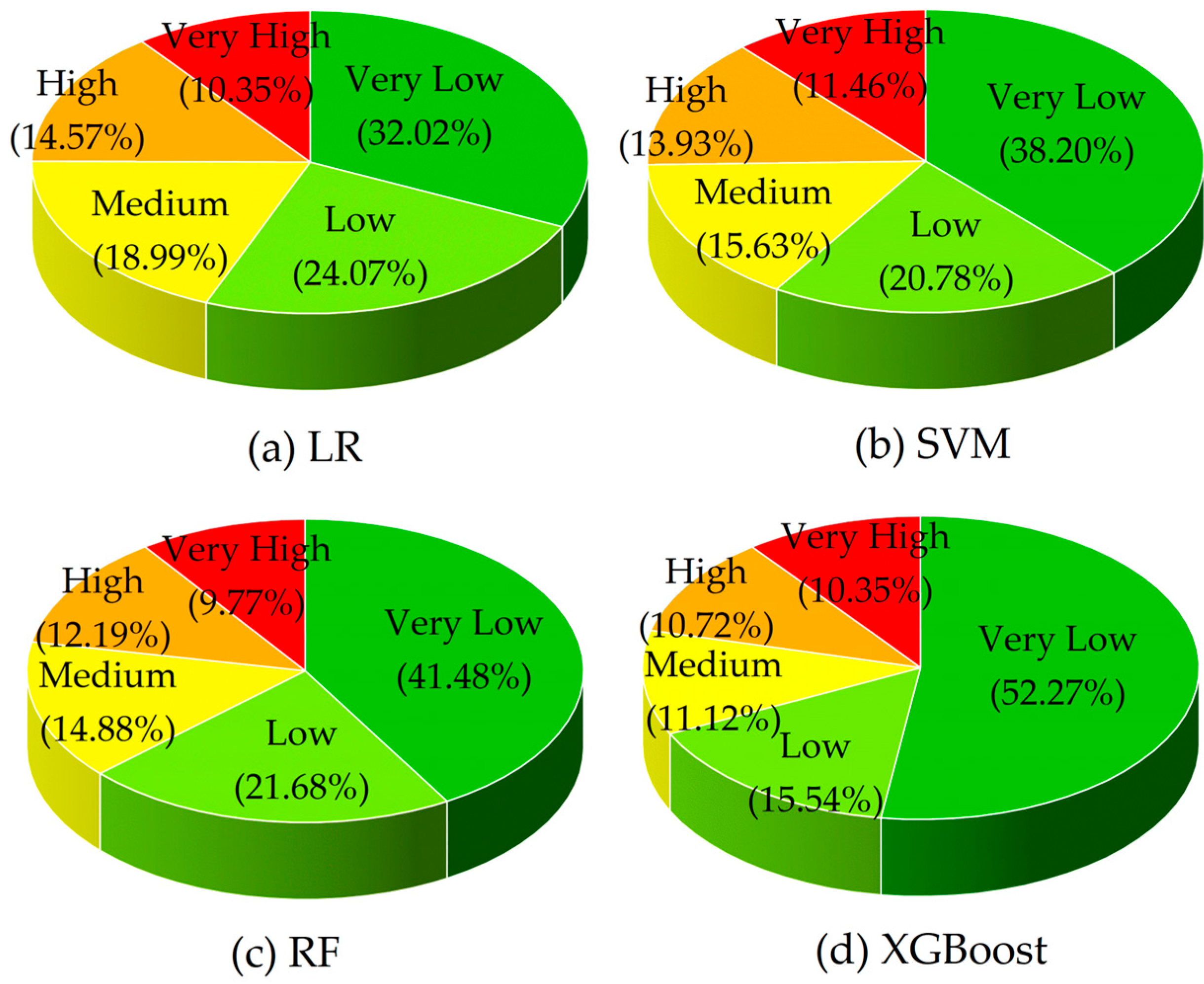
3.3.1. Landslide Susceptibility Assessment Results
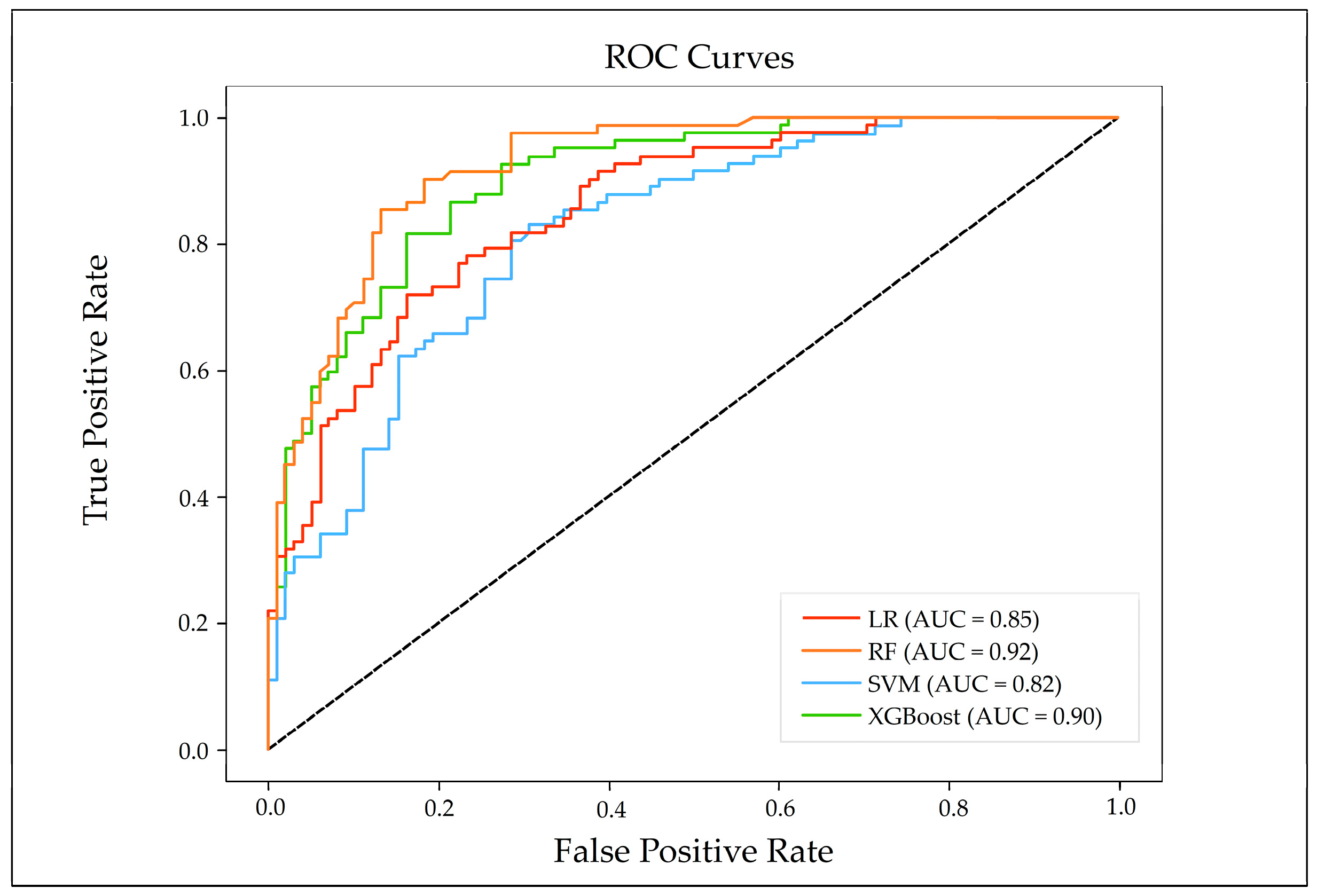
3.3.2. Model Accuracy Evaluation
3.4. Landslide Susceptibility Assessment Incorporating SBAS-InSAR Deformation Characteristics
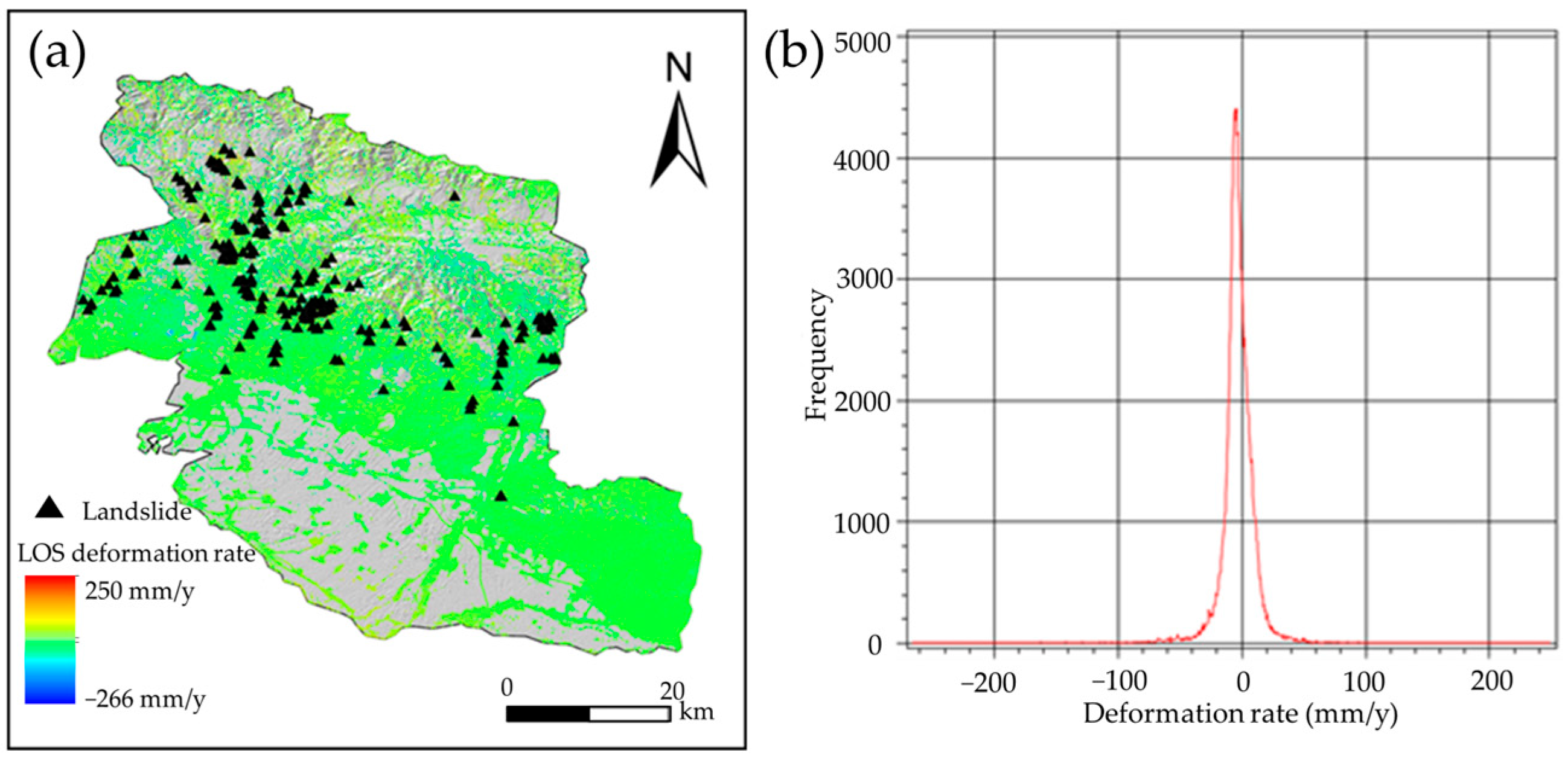
3.4.1. SBAS-InSAR Land Deformation Results
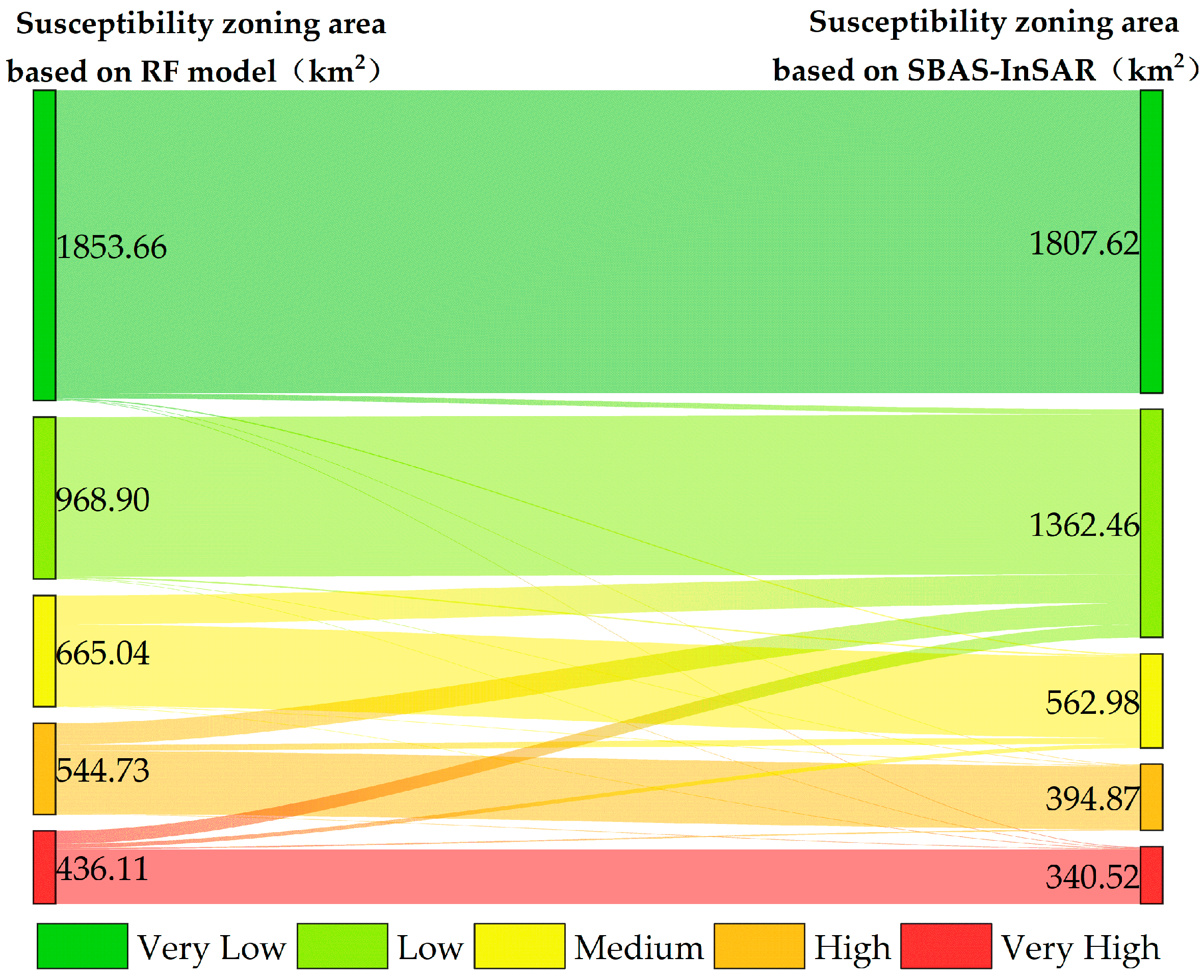
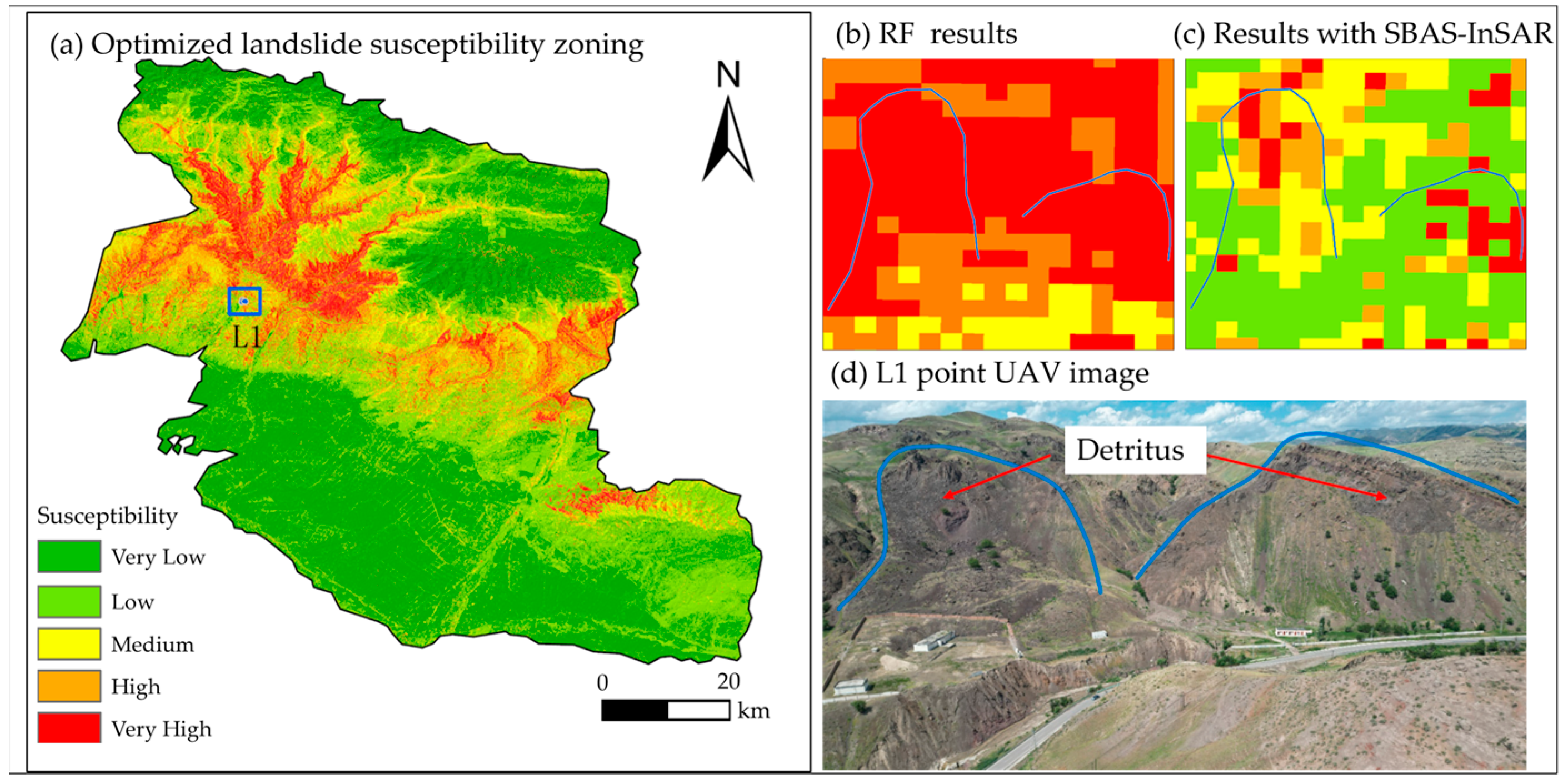
3.4.2. Landslide Susceptibility Assessment Combined with SBAS-InSAR Results
4. Discussion
4.1. Landslide Analysis Based on Administrative Divisions
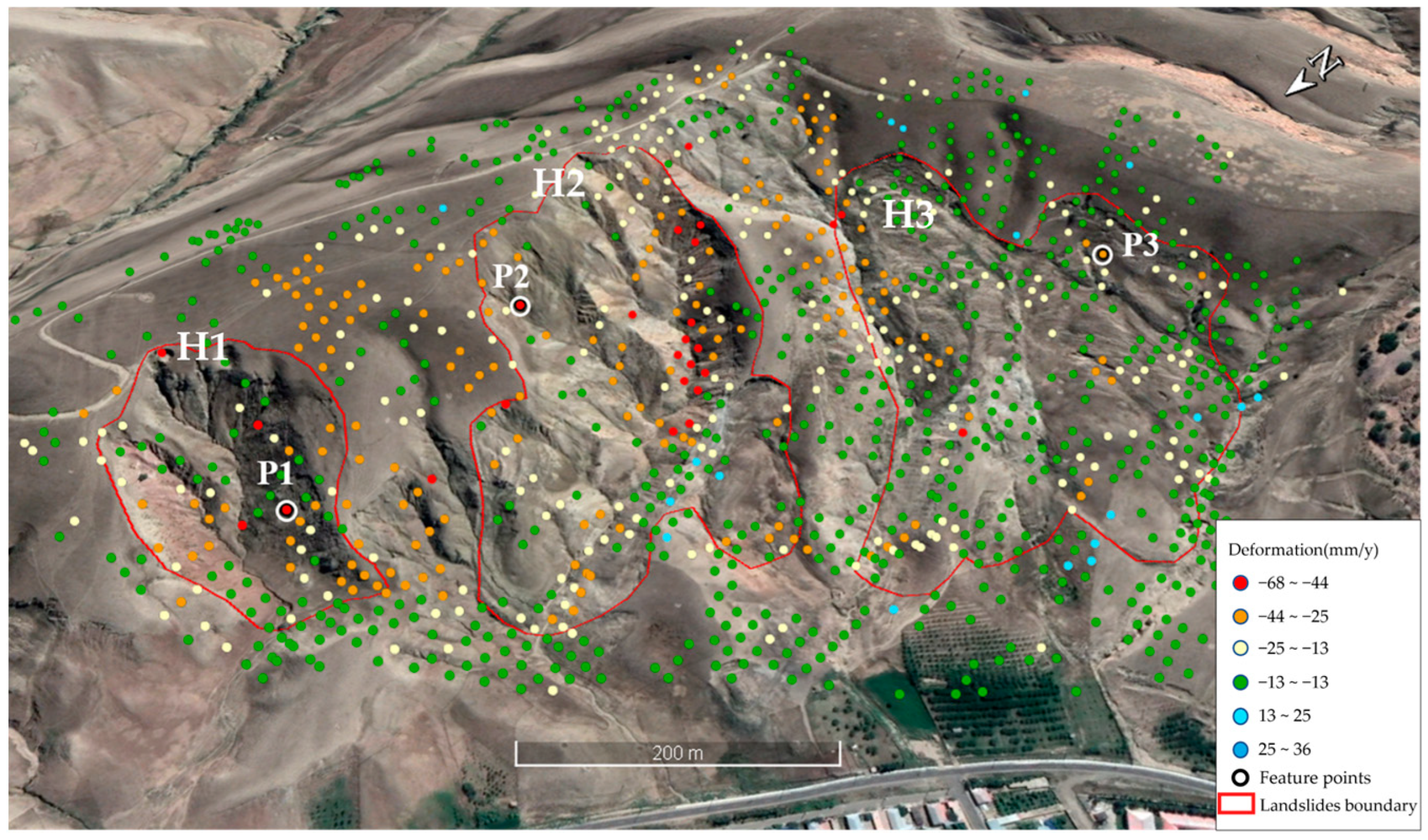
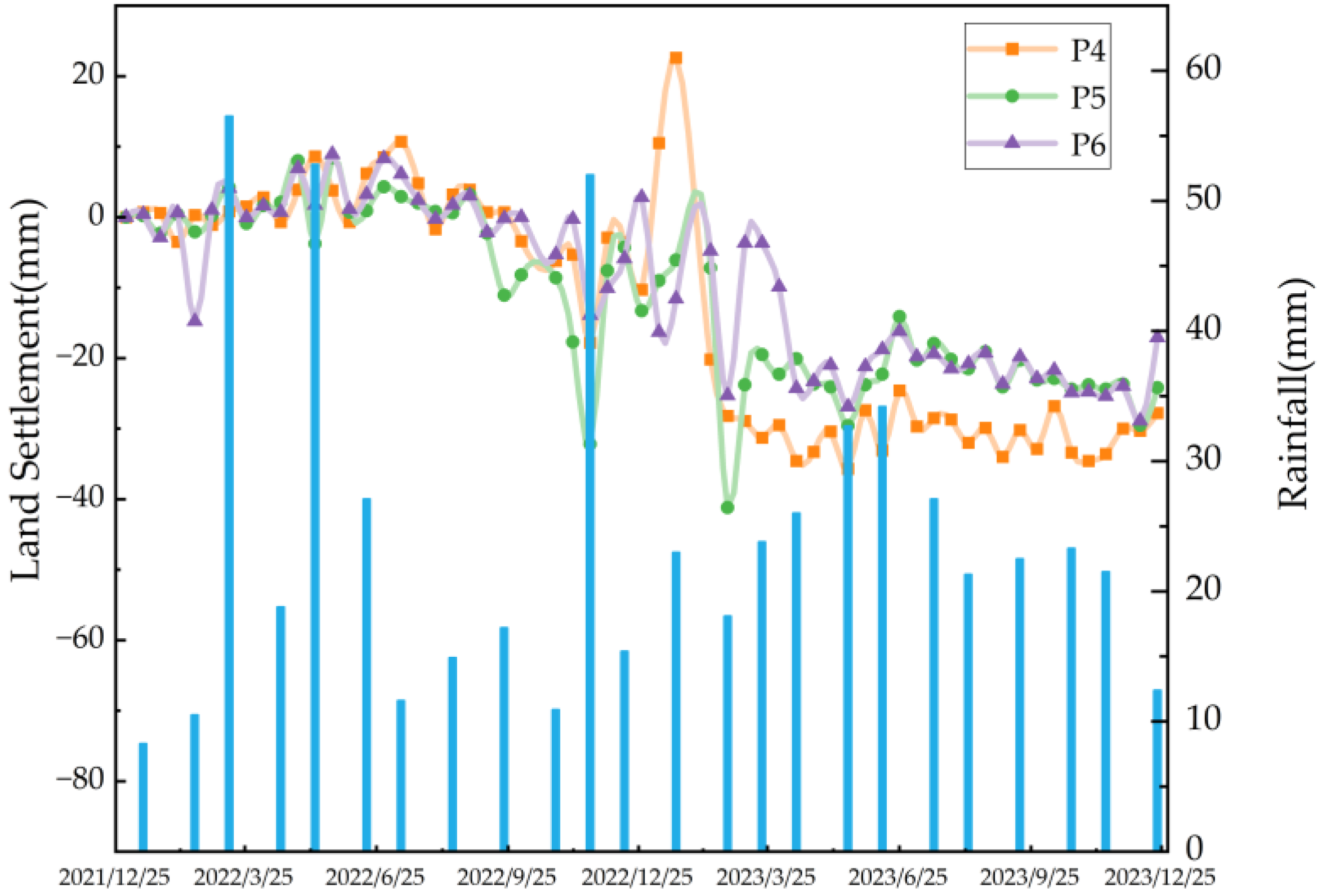
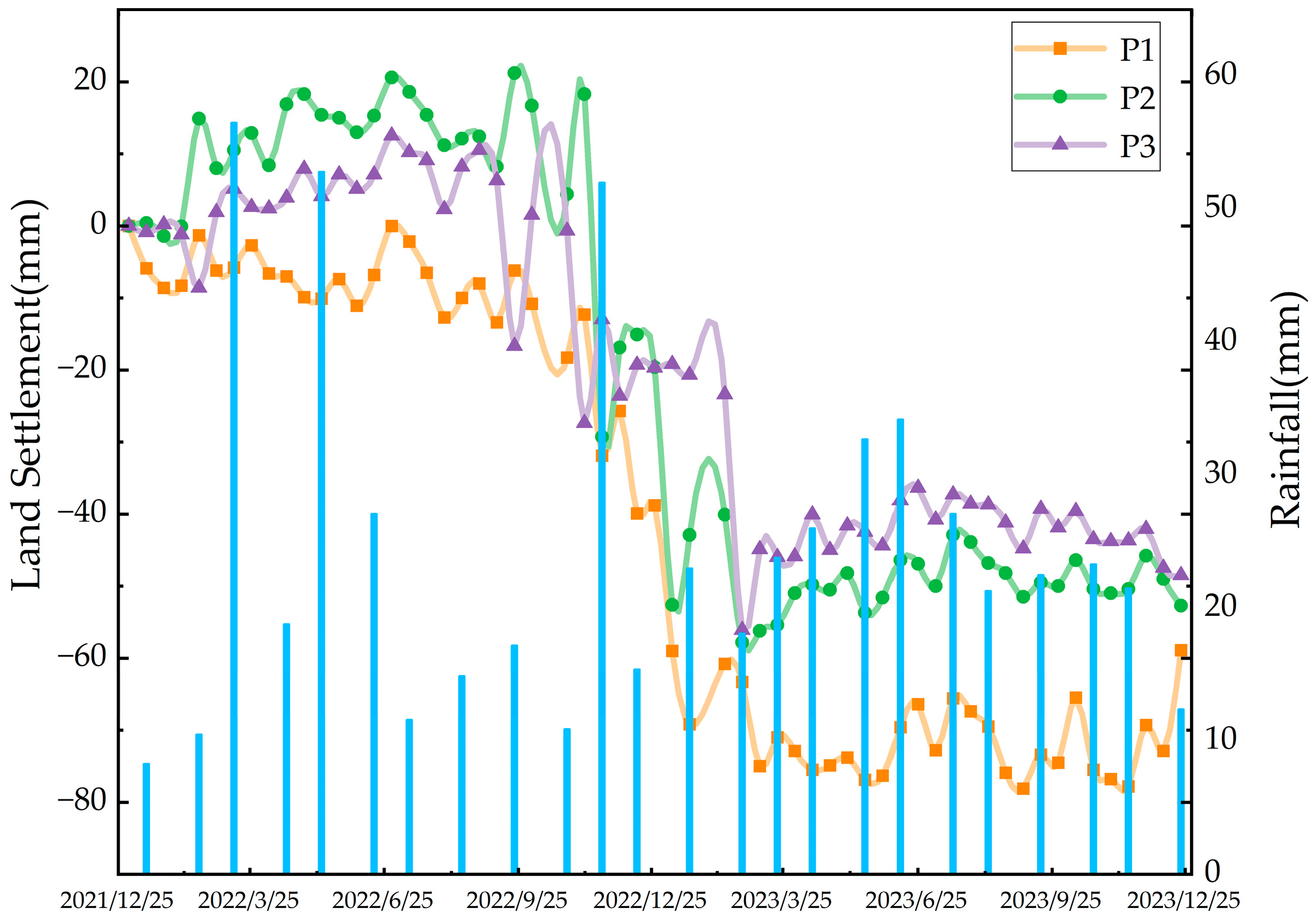
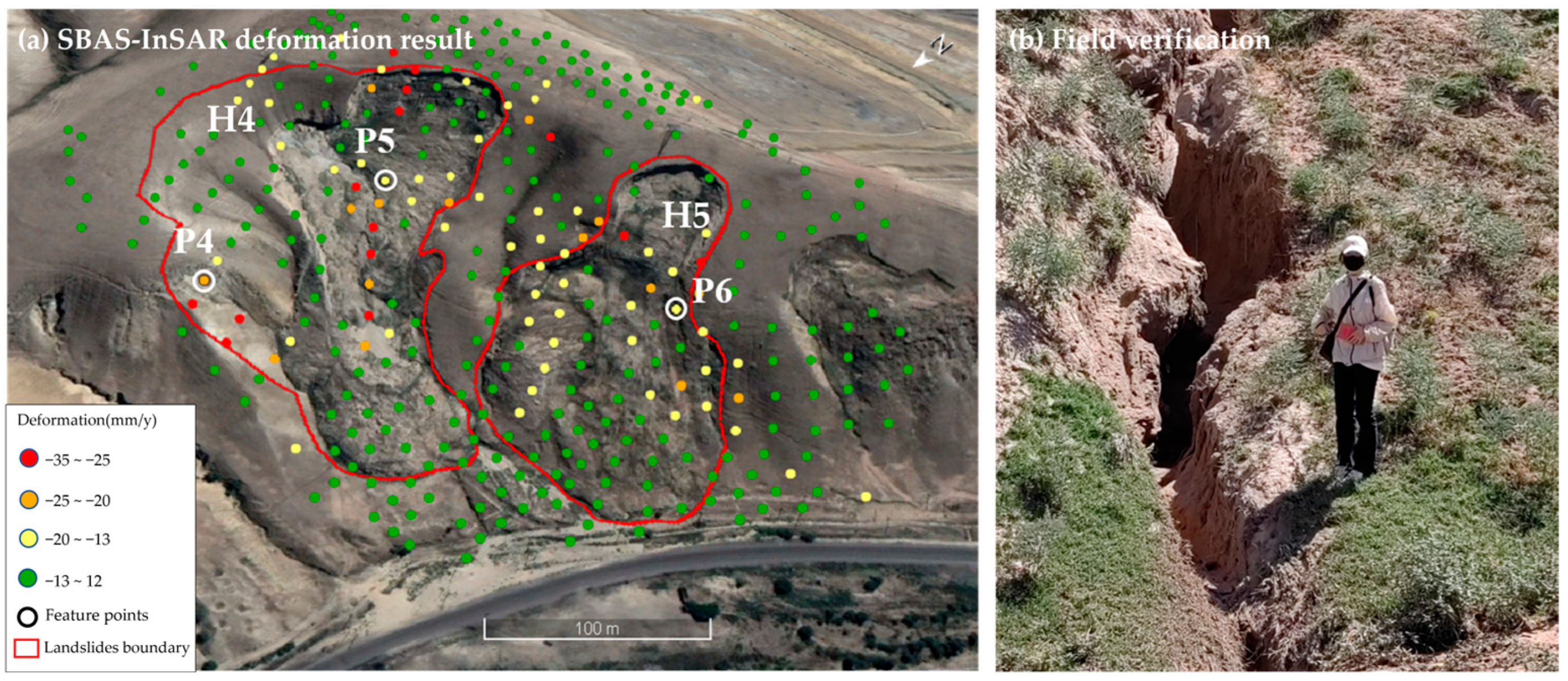
4.2. Analysis of Deformation Characteristics of Typical Historical Landslides
4.2.1. Panjinbulake Group 6 Landslide Cluster
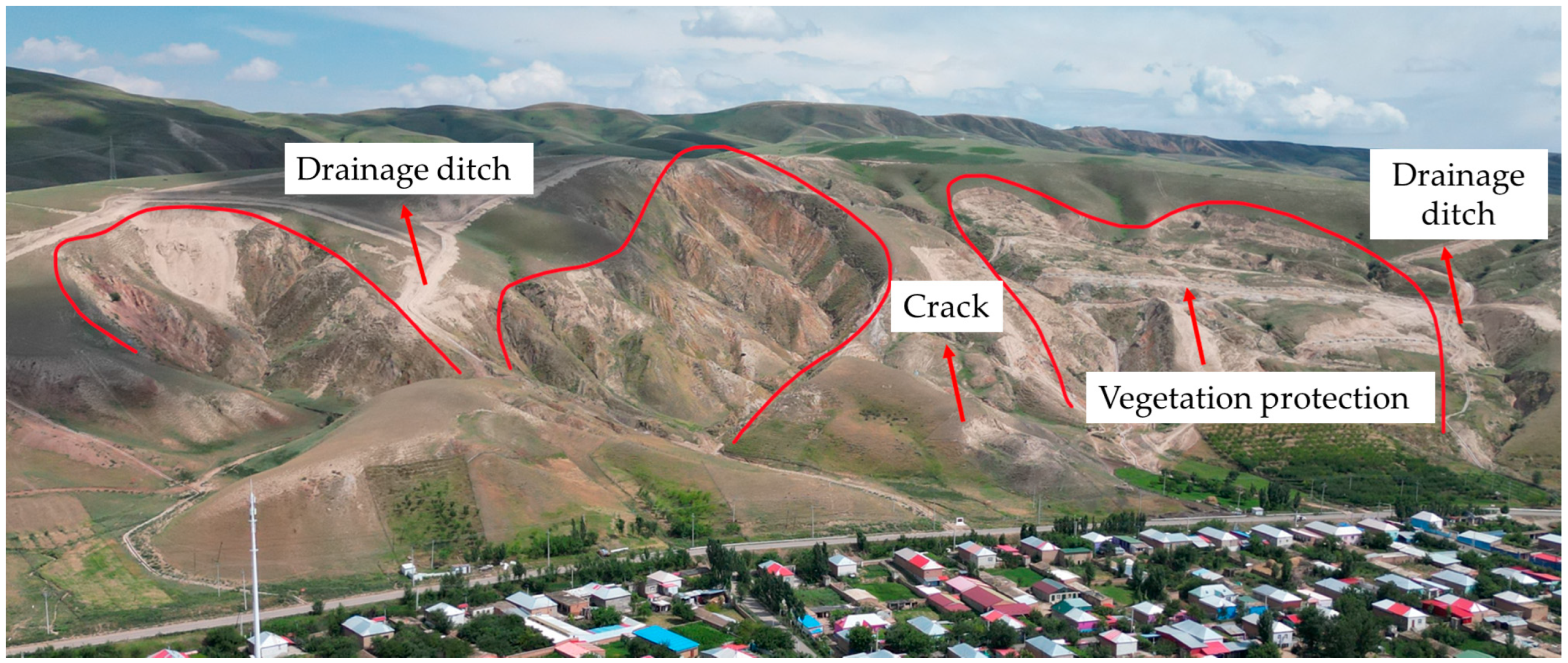
4.2.2. Landslide Cluster North of Qinghua Coal Mine in Karayagqi Township
4.3. Coupling Mechanism Between Machine Learning and SBAS-InSAR
5. Conclusions
Author Contributions
Funding
Data Availability Statement
Conflicts of Interest
References
- Hussain, S.; Pan, B.; Afzal, Z.; Ali, M.; Zhang, X.L.; Shi, X.J. Landslide detection and inventory updating using the time-series InSAR approach along the Karakoram Highway, Northern Pakistan. Sci. Rep. 2023, 13, 7485. [Google Scholar] [CrossRef]
- Chen, W.; Shahabi, H.; Shirzadi, A.; Hong, H.Y.; Akgun, A.; Tian, Y.Y.; Liu, J.Z.; Zhu, A.X.; Li, S.J. Novel hybrid artificial intelligence approach of bivariate statistical-methods-based kernel logistic regression classifier for landslide susceptibility modeling. Bull. Eng. Geol. Environ. 2019, 78, 4397–4419. [Google Scholar] [CrossRef]
- Nanda, A.M.; Lone, F.A.; Ahmed, P. Prediction of rainfall-induced landslide using machine learning models along highway Bandipora to Gurez road, India. Nat. Hazards 2024, 120, 6169–6197. [Google Scholar] [CrossRef]
- Pei, Y.Q.; Qiu, H.J.; Yang, D.D.; Liu, Z.J.; Ma, S.Y.; Li, J.Y.; Cao, M.M.; Wufuer, W. Increasing landslide activity in the Taxkorgan River Basin (eastern Pamirs Plateau, China) driven by climate change. CATENA 2023, 223, 106911. [Google Scholar] [CrossRef]
- Xiao, S.H.; Zhang, L.M.; He, J.; Peng, M.; Jiang, R.C.; Lu, W.J. Hypermobility of a Catastrophic Earthquake-Induced Loess Landslide. Eng. Geol. 2024, 343, 107777. [Google Scholar] [CrossRef]
- Korup, O.; Seidemann, J.; Mohr, C.H. Increased landslide activity on forested hillslopes following two recent volcanic eruptions in Chile. Nat. Geosci. 2019, 12, 284–289. [Google Scholar] [CrossRef]
- Tang, X.G.; Wang, L.J.; Wang, H.Y.; Yuan, Y.D.; Huang, D.; Zhang, J.C. Predicted Climate Change will Increase Landslide Risk in Hanjiang River Basin, China. J. Earth Sci. 2024, 35, 1334–1354. [Google Scholar] [CrossRef]
- Ullah, K.; Wang, Y.; Li, P.L.; Fang, Z.C.; Rahaman, M.; Ullah, S.; Hamed, M.M. Spatiotemporal dynamics of landslide susceptibility under future climate change and land use scenarios. Environ. Res. Lett. 2024, 19, 124016. [Google Scholar] [CrossRef]
- Xiong, C.; Wu, Q.; Cui, F.P.; Luo, W.; Li, H.W.; Chen, H.Z. Damage features and dynamic triggering mechanism of the Jianshanying landslide induced by underground mining in Shuicheng County, Guizhou Province, China. Geomat. Nat. Hazards Risk 2024, 15, 2301606. [Google Scholar] [CrossRef]
- Aristizábal, E.; Sánchez, O. Spatial and temporal patterns and the socioeconomic impacts of landslides in the tropical and mountainous Colombian Andes. Disasters 2020, 44, 596–618. [Google Scholar] [CrossRef] [PubMed]
- Fall, M.; Azzam, R.; Noubactep, C. A multi-method approach to study the stability of natural slopes and landslide susceptibility mapping. Eng. Geol. 2006, 82, 241–263. [Google Scholar] [CrossRef]
- Gómez, D.; García, E.F.; Aristizábal, E. Spatial and temporal landslide distributions using global and open landslide databases. Nat. Hazards 2023, 117, 25–55. [Google Scholar] [CrossRef]
- Lin, Q.; Wang, Y.; Liu, T.; Zhu, Y.; Sui, Q. The Vulnerability of People to Landslides: A Case Study on the Relationship between the Casualties and Volume of Landslides in China. Int. J. Environ. Res. Public Health 2017, 14, 212. [Google Scholar] [CrossRef]
- Xu, Q.; Zhao, B.; Dai, K.R.; Dong, X.J.; Li, W.L.; Zhu, X.; Yang, Y.H.; Xiao, X.X.; Wang, X.; Huang, J.; et al. Remote sensing for landslide investigations: A progress report from China. Eng. Geol. 2023, 321, 107156. [Google Scholar] [CrossRef]
- Liang, X.; Segoni, S.; Yin, K.; Du, J.; Chai, B.; Tofani, V.; Casagli, N. Characteristics of landslides and debris flows triggered by extreme rainfall in Daoshi Town during the 2019 Typhoon Lekima, Zhejiang Province, China. Landslides 2022, 19, 1735–1749. [Google Scholar] [CrossRef]
- Goetz, J.N.; Brenning, A.; Petschko, H.; Leopold, P. Evaluating machine learning and statistical prediction techniques for landslide susceptibility modeling. Comput. Geosci. 2015, 81, 1–11. [Google Scholar] [CrossRef]
- Huang, J.; Shi, M.; Ma, Y.; Huang, C.; Qian, W.; Sun, F.; Zuo, X. Integration of SBAS-InSAR and RFE-RF-XGBoost for Landslide Vulnerability Assessment: A Case Study in Zhaotong City, Yongshan County. Sensors 2025, 25, 7215. [Google Scholar] [CrossRef] [PubMed]
- Nsengiyumva, J.B.; Luo, G.P.; Nahayo, L.; Huang, X.T.; Cai, P. Landslide Susceptibility Assessment Using Spatial Multi-Criteria Evaluation Model in Rwanda. Int. J. Environ. Res. Public Health 2018, 15, 243. [Google Scholar] [CrossRef] [PubMed]
- Riaz, M.T.; Basharat, M.; Brunetti, M.T. Assessing the effectiveness of alternative landslide partitioning in machine learning methods for landslide prediction in the complex Himalayan terrain. Progress Phys. Geogr. Earth Environ. 2023, 47, 315–347. [Google Scholar] [CrossRef]
- Karaman, M.O.; Çabuk, S.N.; Pekkan, E. Utilization of frequency ratio method for the production of landslide susceptibility maps: Karaburun Peninsula case, Turkey. Environ. Sci. Pollut. Res. 2022, 29, 91285–91305. [Google Scholar] [CrossRef]
- Yu, L.B.; Wang, Y.; Pradhan, B. Enhancing landslide susceptibility mapping incorporating landslide typology via stacking ensemble machine learning in Three Gorges Reservoir, China. Geosci. Front. 2024, 15, 101802. [Google Scholar] [CrossRef]
- Liu, S.L.; Wang, L.Q.; Zhang, W.A.; He, Y.W.; Pijush, S. A comprehensive review of machine learning-based methods in landslide susceptibility mapping. Geol. J. 2023, 58, 2283–2301. [Google Scholar] [CrossRef]
- Xing, X.; Wu, C.; Li, J.; Li, X.; Zhang, L.; He, R. Susceptibility assessment for rainfall-induced landslides using a revised logistic regression method. Nat. Hazards 2021, 106, 97–117. [Google Scholar] [CrossRef]
- Huang, Y.; Zhao, L. Review on landslide susceptibility mapping using support vector machines. CATENA 2018, 165, 520–529. [Google Scholar] [CrossRef]
- Zhang, W.A.; He, Y.W.; Wang, L.Q.; Liu, S.L.; Meng, X.Y. Landslide Susceptibility mapping using random forest and extreme gradient boosting: A case study of Fengjie, Chongqing. Geol. J. 2023, 58, 2372–2387. [Google Scholar] [CrossRef]
- Wang, J.N.; Wang, Y.Q.; Li, C.; Li, Y.M.; Qi, H.M. Landslide susceptibility evaluation based on landslide classification and ANN-NFR modelling in the Three Gorges Reservoir area, China. Ecol. Indic. 2024, 160, 111920. [Google Scholar] [CrossRef]
- Ali, N.; Chen, J.; Fu, X.D.; Ali, R.; Hussain, M.A.; Daud, H.; Hussain, J.; Altalbe, A. Integrating Machine Learning Ensembles for Landslide Susceptibility Mapping in Northern Pakistan. Remote Sens. 2024, 16, 988. [Google Scholar] [CrossRef]
- Youssef, A.M.; Pourghasemi, H.R. Landslide susceptibility mapping using machine learning algorithms and comparison of their performance at Abha Basin, Asir Region, Saudi Arabia. Geosci. Front. 2021, 12, 639–655. [Google Scholar] [CrossRef]
- Xiao, X.; Zou, Y.; Huang, J.C.; Luo, X.; Yang, L.Y.; Li, M.; Yang, P.W.; Ji, X.; Li, Y.G. An interpretable model for landslide susceptibility assessment based on Optuna hyperparameter optimization and Random Forest. Geomat. Nat. Hazards Risk 2024, 15, 2347421. [Google Scholar] [CrossRef]
- Huang, F.M.; Cao, Z.S.; Guo, J.F.; Jiang, S.H.; Li, S.; Guo, Z.Z. Comparisons of heuristic, general statistical and machine learning models for landslide susceptibility prediction and mapping. CATENA 2020, 191, 104580. [Google Scholar] [CrossRef]
- Dou, J.; Yunus, A.P.; Tien Bui, D.; Sahana, M.; Chen, C.W.; Zhu, Z.F.; Wang, W.D.; Pham, B.T. Evaluating GIS-Based Multiple Statistical Models and Data Mining for Earthquake and Rainfall-Induced Landslide Susceptibility Using the LiDAR DEM. Remote Sens. 2019, 11, 638. [Google Scholar] [CrossRef]
- Zhang, Y.Y.; Ci, H.; Yang, H.; Wang, R.; Yan, Z.J. Rainfall-Induced Geological Hazard Susceptibility Assessment in the Henan Section of the Yellow River Basin: Multi-Model Approaches Supporting Disaster Mitigation and Sustainable Development. Sustainability 2025, 17, 4348. [Google Scholar] [CrossRef]
- Shen, S.H.; Deng, L.S.; Tang, D.; Chen, J.L.; Fang, R.K.; Du, P.; Liang, X. Landslide Hazard Assessment Based on Ensemble Learning Model and Bayesian Probability Statistics: Inference from Shaanxi Province, China. Sustainability 2025, 17, 1973. [Google Scholar] [CrossRef]
- Aslam, B.; Zafar, A.; Khalil, U. Comparative analysis of multiple conventional neural networks for landslide susceptibility mapping. Nat. Hazards 2023, 115, 673–707. [Google Scholar] [CrossRef]
- Yu, L.B.; Zhou, C.; Wang, Y.; Cao, Y.; Peres, D.J. Coupling Data- and Knowledge-Driven Methods for Landslide Susceptibility Mapping in Human-Modified Environments: A Case Study from Wanzhou County, Three Gorges Reservoir Area, China. Remote Sens. 2022, 14, 774. [Google Scholar] [CrossRef]
- Xie, Y.X.; Bagan, H.; Tan, L.W.; Te, T.; Damdinsuren, A.; Wang, Q.X. Time-Series Analysis of Mining-Induced Subsidence in the Arid Region of Mongolia Based on SBAS-InSAR. Remote Sens. 2024, 16, 2166. [Google Scholar] [CrossRef]
- Shan, Y.F.; Xu, Z.; Zhou, S.S.; Lu, H.Y.; Yu, W.L.; Li, Z.G.; Cao, X.; Li, P.F.; Li, W.L. Landslide Hazard Assessment Combined with InSAR Deformation: A Case Study in the Zagunao River Basin, Sichuan Province, Southwestern China. Remote Sens. 2024, 16, 99. [Google Scholar] [CrossRef]
- Zhou, C.; Cao, Y.; Yin, K.L.; Wang, Y.; Shi, X.G.; Catani, F.; Ahmed, B. Landslide Characterization Applying Sentinel-1 Images and InSAR Technique: The Muyubao Landslide in the Three Gorges Reservoir Area, China. Remote Sens. 2020, 12, 3385. [Google Scholar] [CrossRef]
- Ye, K.; Wang, Z.; Wang, T.; Luo, Y.; Chen, Y.; Zhang, J.; Cai, J. Deformation Monitoring and Analysis of Baige Landslide (China) Based on the Fusion Monitoring of Multi-Orbit Time-Series InSAR Technology. Sensors 2024, 24, 6760. [Google Scholar] [CrossRef]
- Zhou, C.; Cao, Y.; Gan, L.L.; Wang, Y.; Motagh, M.; Roessner, S.; Hu, X.; Yin, K.L. A novel framework for landslide displacement prediction using MT-InSAR and machine learning techniques. Eng. Geol. 2024, 334, 107497. [Google Scholar] [CrossRef]
- Hussain, M.A.; Chen, Z.L.; Wang, R.; Shoaib, M. PS-InSAR-Based Validated Landslide Susceptibility Mapping along Karakorum Highway, Pakistan. Remote Sens. 2021, 13, 4129. [Google Scholar] [CrossRef]
- Yan, L.X.; Xiong, Q.J.; Li, D.Y.; Cheon, E.; She, X.J.; Yang, S. InSAR-Driven Dynamic Landslide Hazard Mapping in Highly Vegetated Area. Remote Sens. 2024, 16, 3229. [Google Scholar] [CrossRef]
- Wei, Y.D.; Qiu, H.J.; Liu, Z.J.; Huangfu, W.C.; Zhu, Y.R.; Liu, Y.; Yang, D.D.; Kamp, U. Refined and dynamic susceptibility assessment of landslides using InSAR and machine learning models. Geosci. Front. 2024, 15, 101890. [Google Scholar] [CrossRef]
- Zhou, C.; Gan, L.L.; Cao, Y.; Wang, Y.; Segoni, S.; Shi, X.G.; Motagh, M.; Singhc, R.P. Landslide susceptibility assessment of the Wanzhou district: Merging landslide susceptibility modelling (LSM) with InSAR-derived ground deformation map. Int. J. Appl. Earth Obs. 2025, 136, 104365. [Google Scholar] [CrossRef]
- Qing, L.; Xu, L.; Huang, J.; Fu, X.; Chen, J. Intelligent Prediction and Numerical Simulation of Landslide Prediction in Open-Pit Mines Based on Multi-Source Data Fusion and Machine Learning. Sensors 2025, 25, 3131. [Google Scholar] [CrossRef]
- Reichenbach, P.; Rossi, M.; Malamud, B.D.; Mihir, M.; Guzzetti, F. A review of statistically-based landslide susceptibility models. Earth Sci. Rev. 2018, 180, 60–91. [Google Scholar] [CrossRef]
- Goyes-Peñafiel, P.; Hernandez-Rojas, A. Landslide susceptibility index based on the integration of logistic regression and weights of evidence: A case study in Popayan, Colombia. Eng. Geol. 2021, 280, 105958. [Google Scholar] [CrossRef]
- Chang, Z.L.; Du, Z.; Zhang, F.; Huang, F.M.; Chen, J.W.; Li, W.B.; Guo, Z.Z. Landslide Susceptibility Prediction Based on Remote Sensing Images and GIS: Comparisons of Supervised and Unsupervised Machine Learning Models. Remote Sens. 2020, 12, 502. [Google Scholar] [CrossRef]
- Nowicki Jessee, M.A.; Hamburger, M.W.; Ferrara, M.R.; McLean, A.; FitzGerald, C. A global dataset and model of earthquake-induced landslide fatalities. Landslides 2020, 17, 1363–1376. [Google Scholar] [CrossRef]
- Al-Najjar, H.A.H.; Pradhan, B. Spatial landslide susceptibility assessment using machine learning techniques assisted by additional data created with generative adversarial networks. Geosci. Front. 2021, 12, 625–637. [Google Scholar] [CrossRef]
- Chen, W.; Li, Y. GIS-based evaluation of landslide susceptibility using hybrid computational intelligence models. CATENA 2020, 195, 104777. [Google Scholar] [CrossRef]
- Roy, J.; Saha, S.; Arabameri, A.; Blaschke, T.; Bui, D.T. A Novel Ensemble Approach for Landslide Susceptibility Mapping (LSM) in Darjeeling and Kalimpong Districts, West Bengal, India. Remote Sens. 2019, 11, 2866. [Google Scholar] [CrossRef]
- de Oliveira, G.G.; Ruiz, L.F.C.; Guasselli, L.A.; Haetinger, C. Random forest and artificial neural networks in landslide susceptibility modeling: A case study of the Fão River Basin, Southern Brazil. Nat. Hazards 2019, 99, 1049–1073. [Google Scholar] [CrossRef]
- Talukdar, S.; Ghose, B.; Shahfahad; Salam, R.; Mahato, S.; Pham, Q.B.; Linh, N.T.T.; Costache, R.; Avand, M. Flood susceptibility modeling in Teesta River basin, Bangladesh using novel ensembles of bagging algorithms. Stoch. Environ. Res. Risk Assess. 2020, 34, 2277–2300. [Google Scholar] [CrossRef]
- Samodra, G.; Chen, G.; Sartohadi, J.; Kasama, K. Comparing data-driven landslide susceptibility models based on participatory landslide inventory mapping in Purwosari area, Yogyakarta, Java. Environ. Earth Sci. 2017, 76, 184. [Google Scholar] [CrossRef]
- Huang, F.M.; Yao, C.; Liu, W.P.; Li, Y.J.; Liu, X.W. Landslide susceptibility assessment in the Nantian area of China: A comparison of frequency ratio model and support vector machine. Geomat. Nat. Hazards Risk 2018, 9, 919–938. [Google Scholar] [CrossRef]
- Wen, H.J.; Yan, F.Y.; Huang, J.H.; Li, Y.J. Interpretable machine learning models and decision-making mechanisms for landslide hazard assessment under different rainfall conditions. Expert Syst. Appl. 2025, 270, 126582. [Google Scholar] [CrossRef]
- Gonzalez-Ollauri, A.; Mickovski, S.B. Hydrological effect of vegetation against rainfall-induced landslides. J. Hydrol. 2017, 549, 374–387. [Google Scholar] [CrossRef]
- Sahana, M.; Patel, P.P. A comparison of frequency ratio and fuzzy logic models for flood susceptibility assessment of the lower Kosi River Basin in India. Environ. Earth Sci. 2019, 78, 289. [Google Scholar] [CrossRef]
- Ouyang, L.; Zhao, Z.F.; Zhou, D.Y.; Cao, J.Y.; Qin, J.Y.; Cao, Y.F.; He, Y. Study on the Relationship between Groundwater and Land Subsidence in Bangladesh Combining GRACE and InSAR. Remote Sens. 2024, 16, 3715. [Google Scholar] [CrossRef]
- Huang, W.B.A.; Ding, M.T.; Li, Z.H.; Zhuang, J.Q.; Yang, J.; Li, X.L.; Meng, L.E.; Zhang, H.Y.; Dong, Y. An Efficient User-Friendly Integration Tool for Landslide Susceptibility Mapping Based on Support Vector Machines: SVM-LSM Toolbox. Remote Sens. 2022, 14, 3408. [Google Scholar] [CrossRef]
- Fang, Z.C.; Wang, Y.; Peng, L.; Hong, H.Y. A comparative study of heterogeneous ensemble-learning techniques for landslide susceptibility mapping. Int. J. Geogr. Inf. Sci. 2021, 35, 321–347. [Google Scholar] [CrossRef]
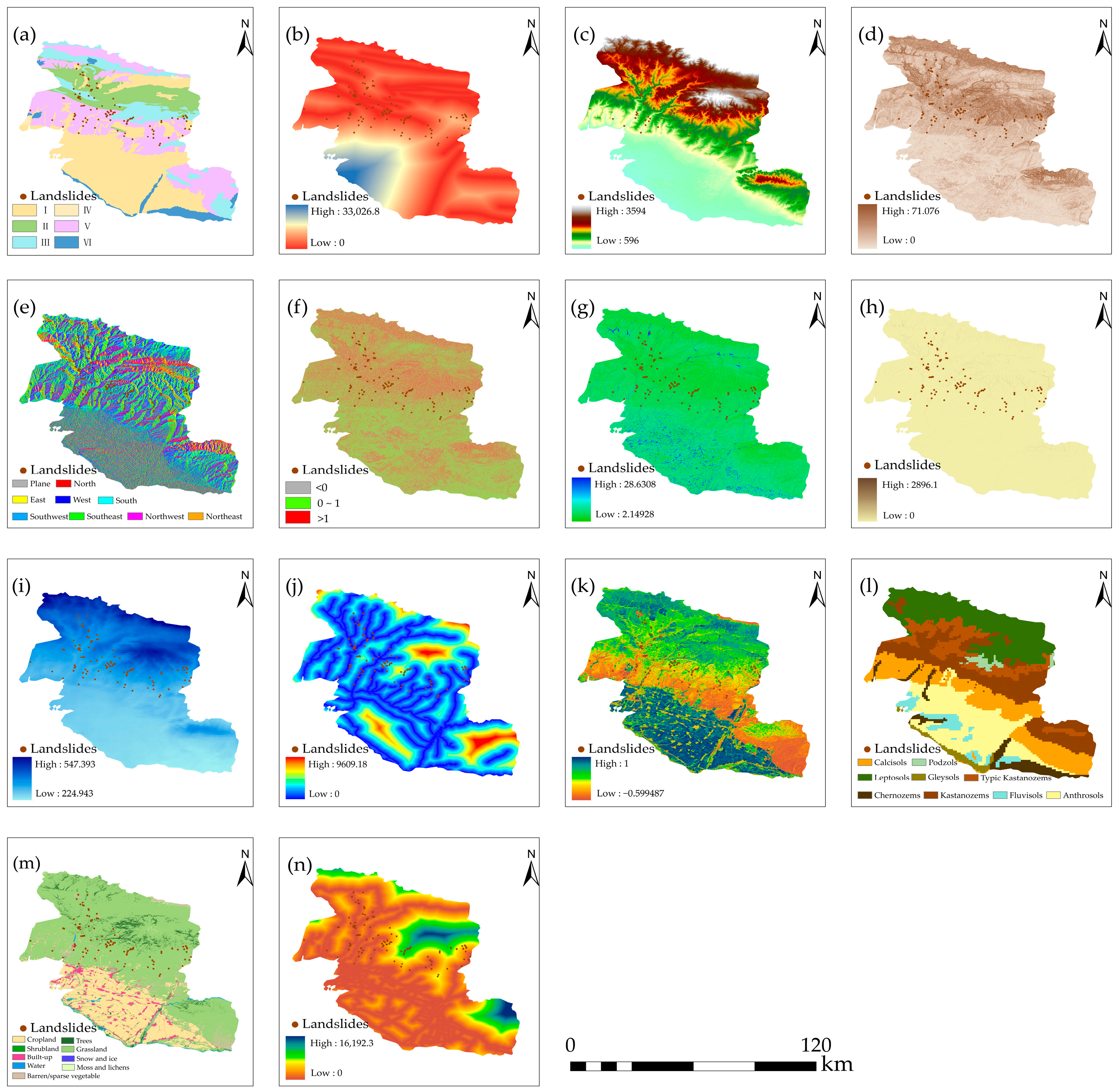
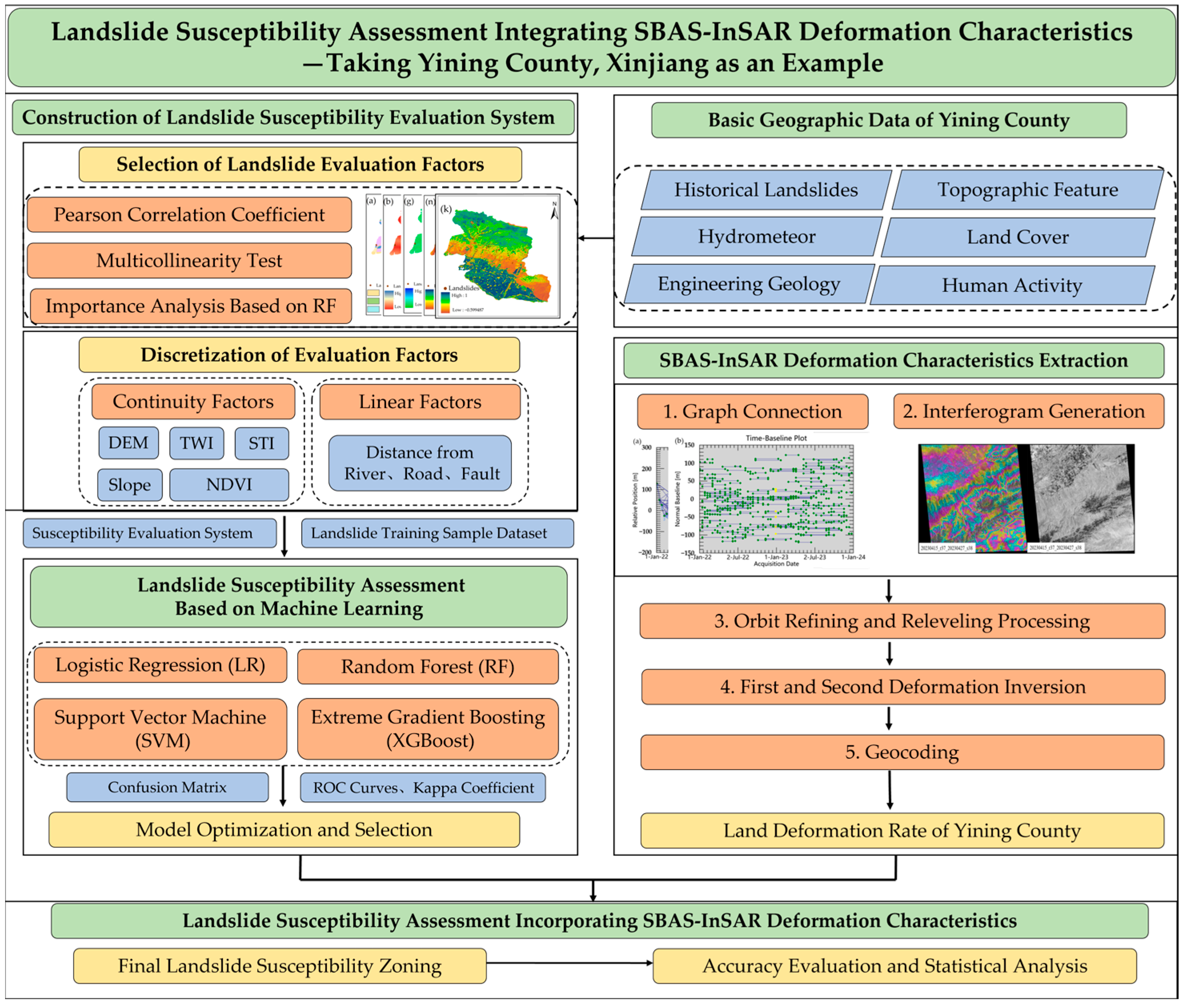
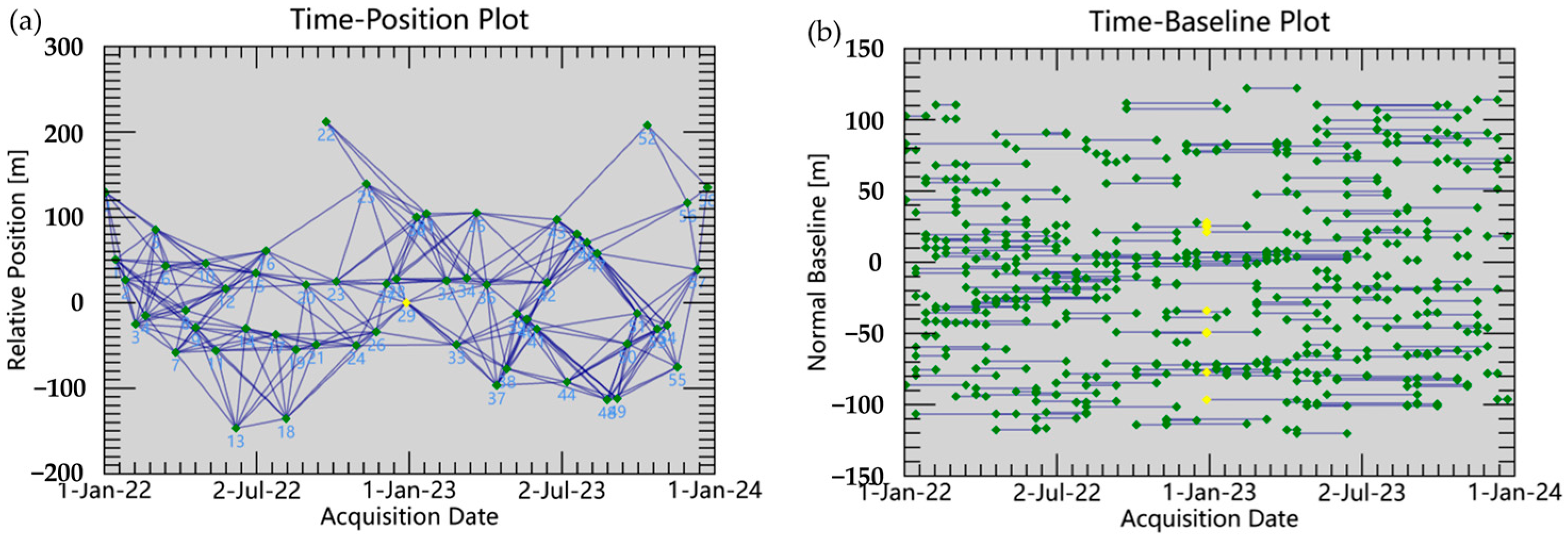


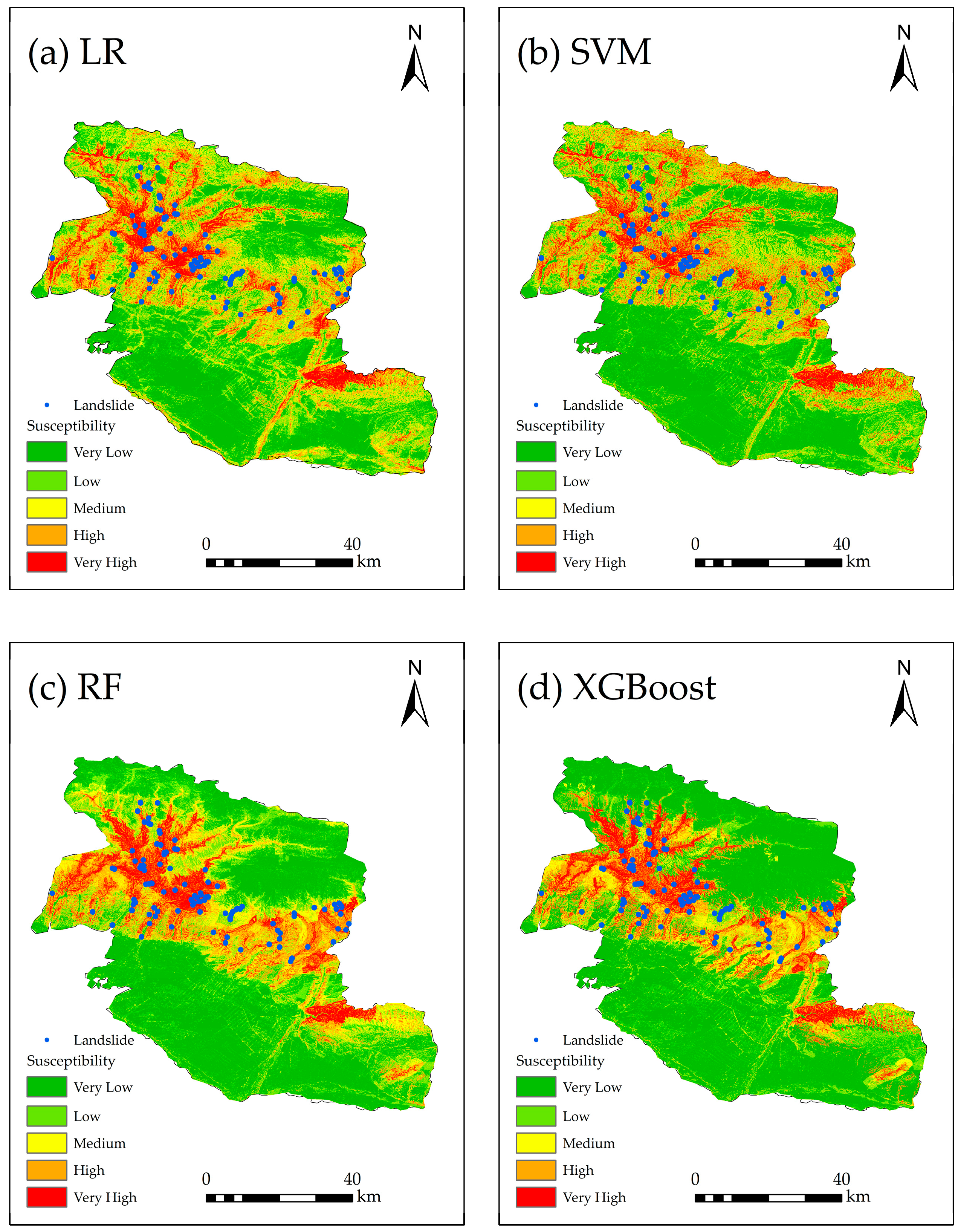





| Data Type | Data | Data Source | Resolution (m) | Abbreviation |
|---|---|---|---|---|
| Engineering Geology | Lithology | https://www.ngac.cn/125cms/c/qggnew/index.htm (accessed on 20 July 2025) | 30 | EG1 |
| Distance from Fault | 30 | EG2 | ||
| Topographic Features | DEM | https://www.gscloud.cn/home (accessed on 20 July 2025) | 30 | TF1 |
| Slope | 30 | TF2 | ||
| Aspect | 30 | TF3 | ||
| Sediment Transport Index | 30 | TF4 | ||
| Topographic Wetness Index | 30 | TF5 | ||
| Profile Curvature | 30 | TF6 | ||
| Hydrometeor | Distance from River | https://www.openstreetmap.org (accessed on 20 July 2025) | 30 | H1 |
| Annual Average Precipitation | https://nnu.geodata.cn/index.html (accessed on 20 July 2025) | 1000 | H2 | |
| Land Cover | NDVI | GEE | 10 | LC1 |
| Soil Type | https://www.fao.org (accessed on 1 September 2025) | 30 | LC2 | |
| Human Activity | Land Use | https://www.esa.int/ (accessed on 1 September 2025) | 10 | HA1 |
| Distance from Road | https://www.openstreetmap.org (accessed on 1 September 2025) | 30 | HA2 |
| Continuity Factor | Freedom Degree | Interval Division Results | Section Area (km2) | Landslide Density (Piece/km2) | |
|---|---|---|---|---|---|
| TF1 | 235.9 | 5 | 596–908 | 1506.89 | 0.01 |
| 908–1183 | 796.17 | 0.06 | |||
| 1183–1716 | 897.79 | 0.19 | |||
| 1716–1964 | 403.06 | 0.04 | |||
| 1964–2493 | 639.74 | 0.002 | |||
| 2493–3594 | 224.84 | 0 | |||
| TF2 | 123.869 | 4 | 0–7.53 | 1590.59 | 0.01 |
| 7.53–14.32 | 1164.89 | 0.039 | |||
| 14.32–23.41 | 865.73 | 0.07 | |||
| 23.41–33.45 | 551.61 | 0.14 | |||
| 33.45–71.08 | 285.05 | 0.17 | |||
| TF4 | 126.717 | 3 | 0–2.424 | 1408.91 | 0.01 |
| 2.424–7.682 | 1295.86 | 0.03 | |||
| 7.682–13.647 | 712.48 | 0.08 | |||
| 13.647–2896.1 | 1040.62 | 0.13 | |||
| TF5 | 36.64 | 3 | 2.149–4.315 | 595.63 | 0.13 |
| 4.315–5.354 | 1206.92 | 0.06 | |||
| 5.354–8.505 | 1946.53 | 0.04 | |||
| 8.505–28.63 | 708.79 | 0.03 | |||
| LC1 | 121.376 | 3 | −0.6–0.224 | 851.89 | 0.07 |
| 0.224–0.583 | 1341.12 | 0.11 | |||
| 0.583–0.779 | 887.98 | 0.04 | |||
| 0.779–1 | 1386.32 | 0.01 |
| Continuity Factor | Freedom Degree | Interval Division Results | Section Area (km2) | Landslide Density (Piece/km2) | |
|---|---|---|---|---|---|
| EG2 | 60.605 | 4 | 0–1026 | 910.44 | 0.09 |
| 1026–2037 | 680.33 | 0.07 | |||
| 2037–2778 | 383.01 | 0.06 | |||
| 2778–9652 | 1594.20 | 0.05 | |||
| 9652–33,023 | 900.52 | 0 | |||
| H1 | 77.556 | 3 | 0–248 | 425.94 | 0.19 |
| 248–1429 | 1654.68 | 0.05 | |||
| 1429–3730 | 1616.51 | 0.04 | |||
| 3730–9609 | 771.35 | 0.01 | |||
| HA2 | 83.337 | 4 | 0–553 | 1181.39 | 0.06 |
| 553–1320 | 887.91 | 0.04 | |||
| 1320–3543 | 1178.45 | 0.08 | |||
| 3543–6115 | 546.82 | 0.06 | |||
| 6115–16,192 | 673.91 | 0.01 |
| Model | Precision (%) | Recall (%) | F1-Score (%) | OA (%) | Kappa (%) |
|---|---|---|---|---|---|
| LR | 76.52 | 75.56 | 75.58 | 75.66 | 51.40 |
| SVM | 75.72 | 72.22 | 71.86 | 72.22 | 45.63 |
| RF | 85.48 | 85.00 | 85.03 | 85 | 70.03 |
| XGBoost | 82.34 | 81.67 | 81.70 | 81.67 | 63.44 |
| Landslide Susceptibility | Surface Deformation Rate (mm/y) | ||||
|---|---|---|---|---|---|
| [−13, 13) | [−25, −13)[13, 25) | [−35, −13)[25, 35) | [−45, −35)[35, 45) | [−266, −45)[45, 250) | |
| Very Low | 0 | +1 | +2 | +3 | +4 |
| Low | 0 | 0 | +1 | +2 | +3 |
| Medium | −1 | 0 | 0 | +1 | +2 |
| High | −2 | −1 | 0 | 0 | +1 |
| Very High | −3 | −2 | −1 | 0 | 0 |
| Township | Precipitation/(mm/y) | Proportion of Susceptibility Zone Types by Area/(%) | ||||
|---|---|---|---|---|---|---|
| Very High | High | Medium | Low | Very Low | ||
| Jiliyuzi Town | 312.71 | 5.18 | 5.87 | 12.16 | 30.86 | 45.93 |
| Dunmazha Town | 266.94 | 0.11 | 0.50 | 6.05 | 40.41 | 52.93 |
| Hudiyayuzi Town | 348.70 | 2.34 | 2.25 | 5.94 | 21.04 | 68.43 |
| Tulufanyuzi Township | 321.48 | 2.54 | 4.26 | 10.07 | 32.60 | 50.53 |
| Kalayagqi Township | 369.82 | 20.12 | 18.03 | 20.06 | 26.91 | 14.88 |
| Yuqunweng Hui Ethnic Township | 310.455 | 2.28 | 5.18 | 8.92 | 19.36 | 64.26 |
| Wugong Township | 327.65 | 1.65 | 3.92 | 9.72 | 26.31 | 58.38 |
| Yingtamu Town | 283.12 | 1.66 | 2.95 | 5.21 | 13.22 | 76.97 |
| Bayituohai Town | 271.68 | 0.10 | 0.59 | 3.27 | 19.52 | 76.53 |
| Uygur Yüqiwen Town | 256.06 | 0.05 | 0.54 | 5.20 | 28.27 | 65.92 |
| Samuyuzi Town | 282.28 | 1.08 | 1.80 | 4.78 | 38.52 | 53.83 |
| Kashi Town | 283.31 | 2.24 | 2.24 | 5.45 | 43.07 | 46.99 |
| Mazha Township | 345.89 | 8.30 | 11.61 | 16.02 | 38.11 | 25.97 |
| Wenyar Town | 296.13 | 0.83 | 0.85 | 4.34 | 25.61 | 68.38 |
| Awuliya Township | 355.36 | 5.45 | 12.26 | 18.41 | 33.21 | 30.67 |
| Quluhai Township | 307.25 | 2.30 | 6.20 | 15.77 | 36.61 | 39.11 |
| Arewusitang Town | 294.49 | 0.31 | 1.23 | 4.88 | 22.65 | 70.93 |
| Sadikeyuzi Township | 317.98 | 0.66 | 0.97 | 3.34 | 20.76 | 74.27 |
Disclaimer/Publisher’s Note: The statements, opinions and data contained in all publications are solely those of the individual author(s) and contributor(s) and not of MDPI and/or the editor(s). MDPI and/or the editor(s) disclaim responsibility for any injury to people or property resulting from any ideas, methods, instructions or products referred to in the content. |
© 2026 by the authors. Licensee MDPI, Basel, Switzerland. This article is an open access article distributed under the terms and conditions of the Creative Commons Attribution (CC BY) license.
Share and Cite
Ma, T.; Yi, X.; Ci, H.; Wang, R.; Yang, H.; Yan, Z. Landslide Susceptibility Evaluation Integrating Machine Learning and SBAS-InSAR-Derived Deformation Characteristics: A Case Study of Yining County, Xinjiang. Sensors 2026, 26, 707. https://doi.org/10.3390/s26020707
Ma T, Yi X, Ci H, Wang R, Yang H, Yan Z. Landslide Susceptibility Evaluation Integrating Machine Learning and SBAS-InSAR-Derived Deformation Characteristics: A Case Study of Yining County, Xinjiang. Sensors. 2026; 26(2):707. https://doi.org/10.3390/s26020707
Chicago/Turabian StyleMa, Tingting, Xiaoqiang Yi, Hui Ci, Ran Wang, Hui Yang, and Zhaojin Yan. 2026. "Landslide Susceptibility Evaluation Integrating Machine Learning and SBAS-InSAR-Derived Deformation Characteristics: A Case Study of Yining County, Xinjiang" Sensors 26, no. 2: 707. https://doi.org/10.3390/s26020707
APA StyleMa, T., Yi, X., Ci, H., Wang, R., Yang, H., & Yan, Z. (2026). Landslide Susceptibility Evaluation Integrating Machine Learning and SBAS-InSAR-Derived Deformation Characteristics: A Case Study of Yining County, Xinjiang. Sensors, 26(2), 707. https://doi.org/10.3390/s26020707