Secure Hierarchical Asynchronous Federated Learning with Shuffle Model and Mask–DP

Abstract
1. Introduction
- SHAFL proposes a decentralized mask exchange protocol that uses eliminable noise to prevent the gateway from compromising the privacy of the training node and to reduce the impact of noise on global model performance. Based on HE, it prevents collusion attacks among training nodes.
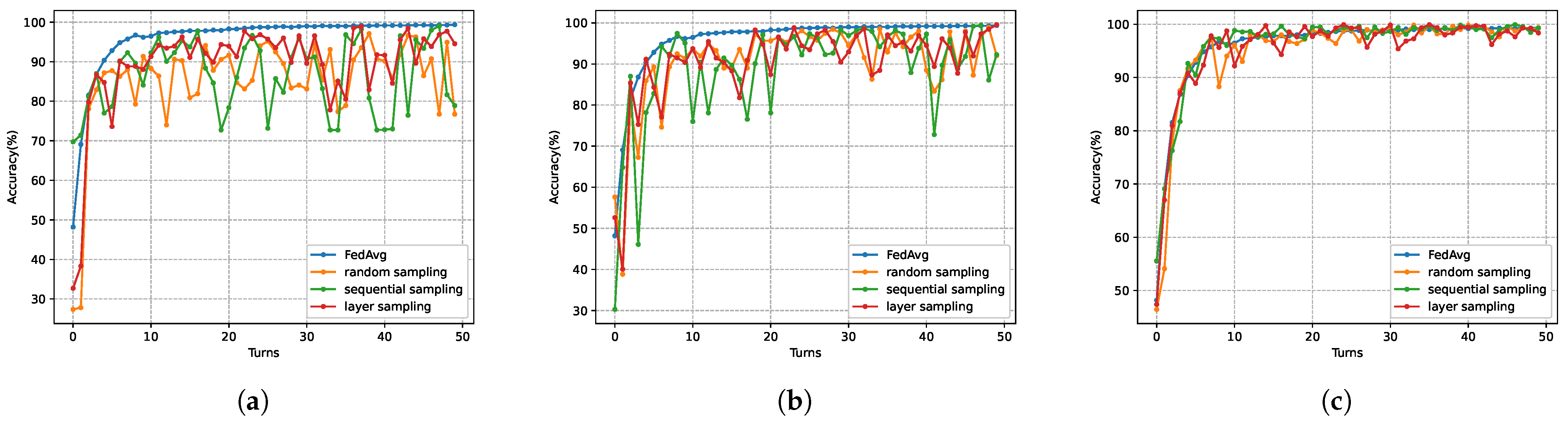
- The SHAFL scheme introduces a novel mechanism for continuous layer subsampling and dummy-layer padding. Combining continuous-layer subsampling, dummy-layer padding, and a shuffle model, SHAFL enhances the privacy-preserving capability of local models during the server aggregation phase.
- SHAFL designs a secure aggregation scheme that leverages the upload model’s test accuracy to mitigate the impact of malicious nodes on system robustness.
- With an eliminable noise, SHAFL reduces the damage to system robustness caused by node offline before model shuffling in groups.
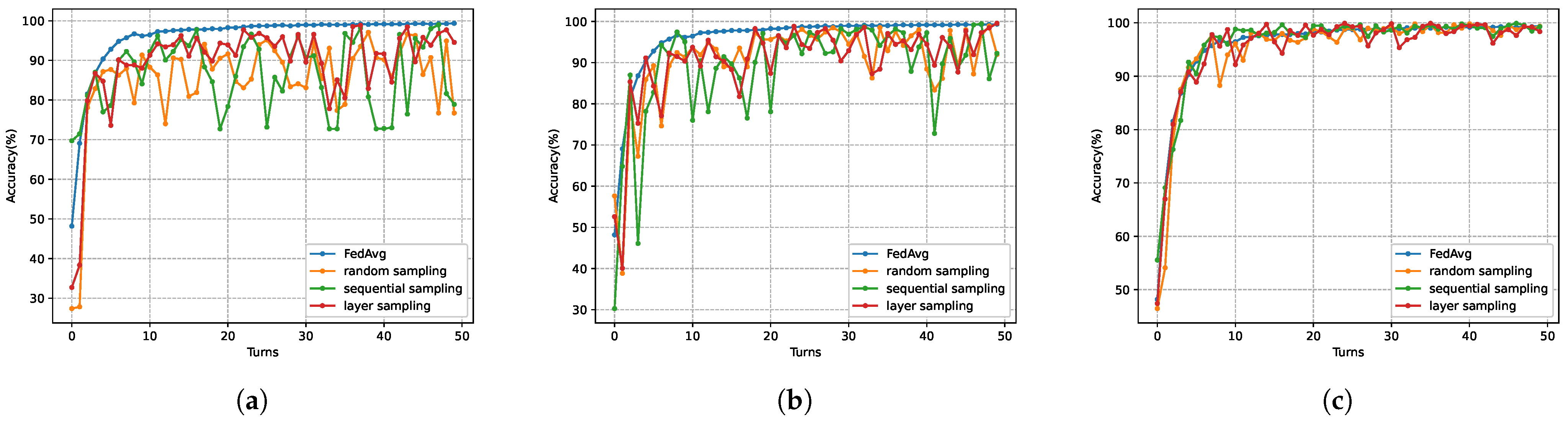
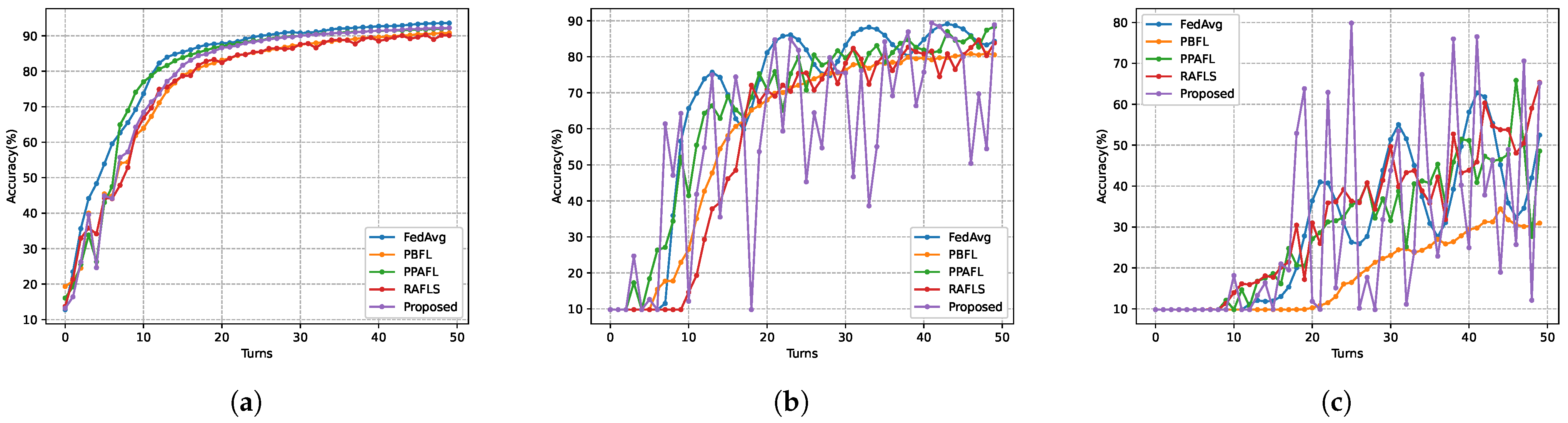
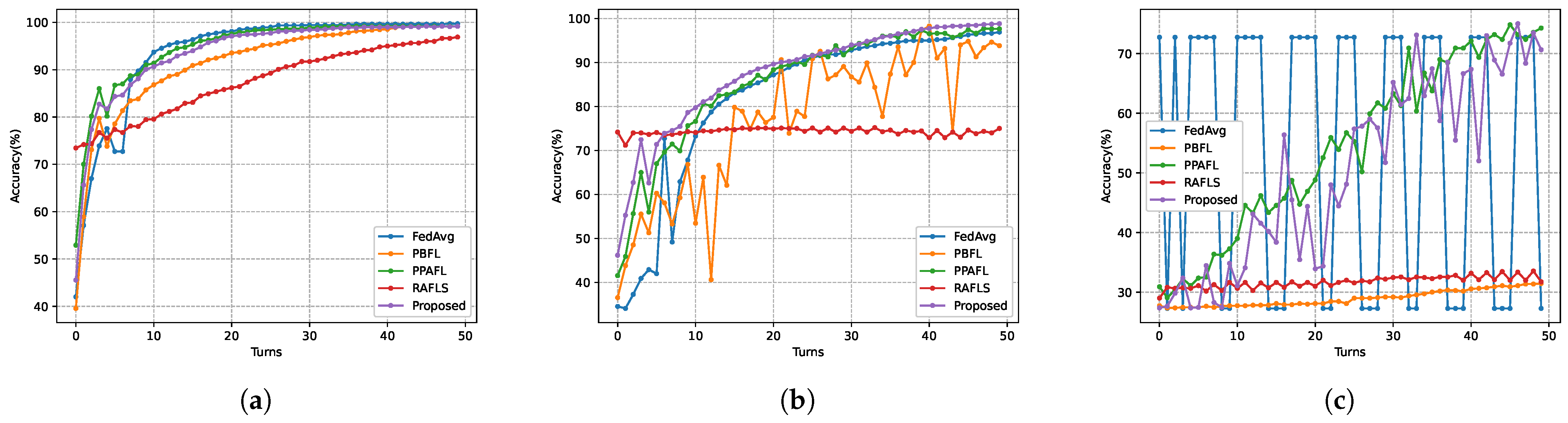
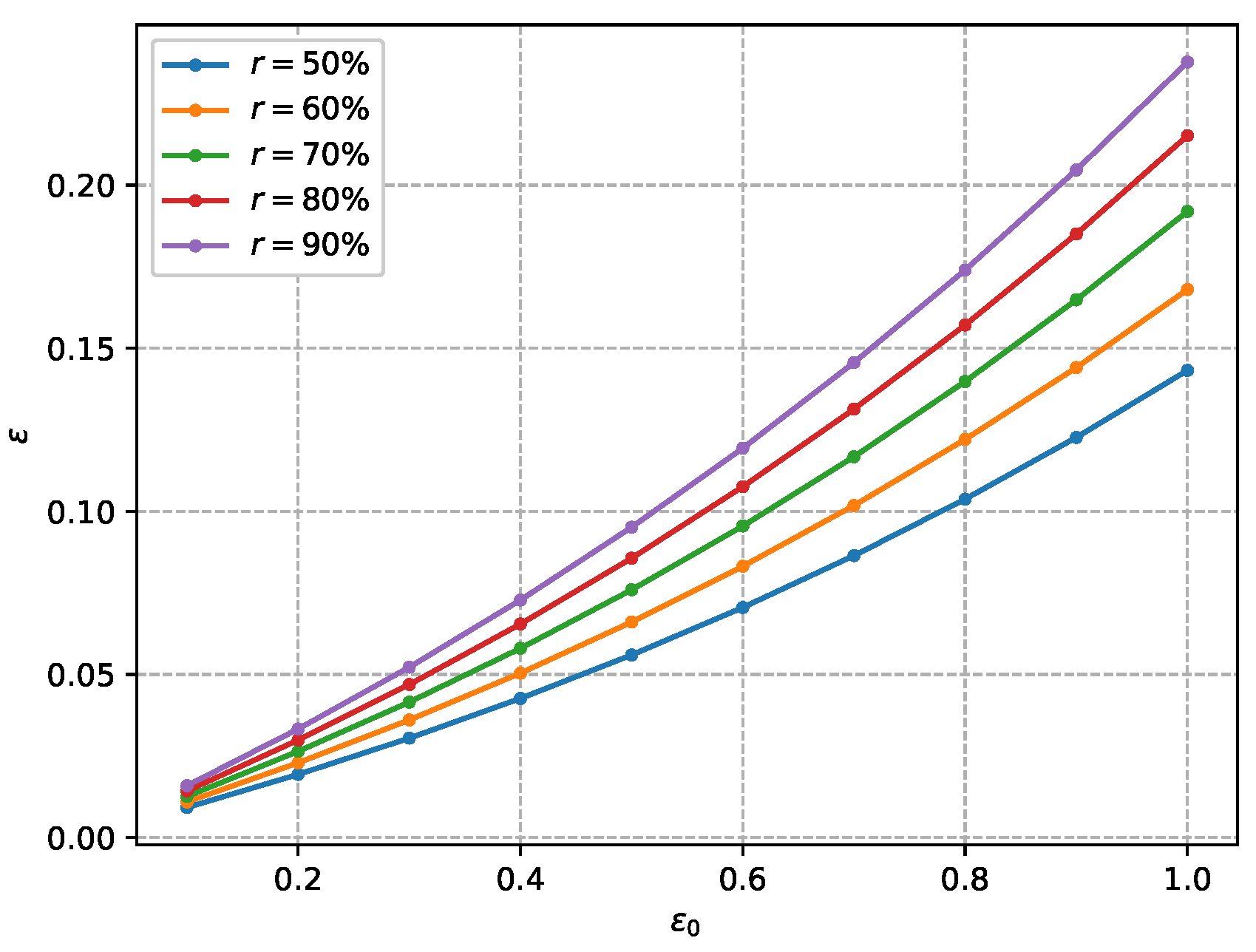
- Experiments on the MNIST, CIFAR-10, and Heart Disease datasets validate the privacy, convergence, and robustness of the proposed SHAFL.
2. Related Work
3. System Model
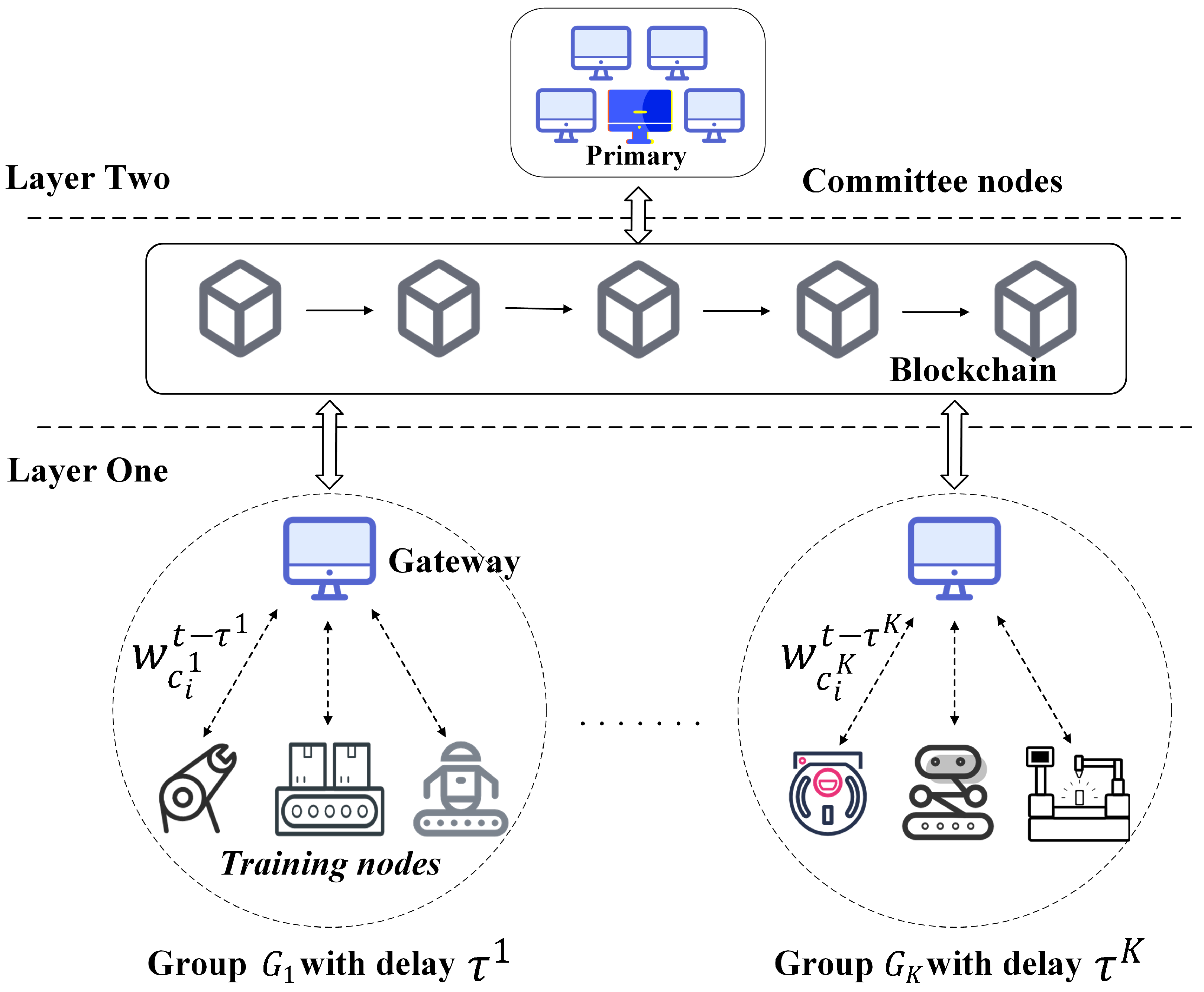
3.1. Blockchain-Based Hierarchical Asynchronous Federated Learning
3.2. Threat Model
- Training nodes: They try to extract other training nodes’ local data as much as possible from local updates, via launching inference attacks [13,14] and data reconstruction attacks [63,64,65]. Malicious training clients may engage in data poisoning or upload maliciously crafted local updates [66], which can lead to a degradation of the global model’s accuracy.
- Gateways: They follow predefined protocols and submit correct intermediate results. However, they are curious about the sensitive information contained in training nodes and may attempt to infer the training nodes’ private data, resulting in data leakage.
- Committee nodes: Malicious committee nodes may discard local updates from gateways or release a malicious global model, thus compromising the robustness of the system.
- collusion attacks: Malicious training nodes may collude to obtain the private model of the target node, such as attempting to remove the noise added to the target model. Furthermore, malicious training nodes could collude with gateways, or gateways could collude with malicious committee nodes to attack the training nodes’ privacy.
3.3. Privacy Preserving Mechanism
3.3.1. LDP Mechanism
3.3.2. LDP-Based Shuffle Model
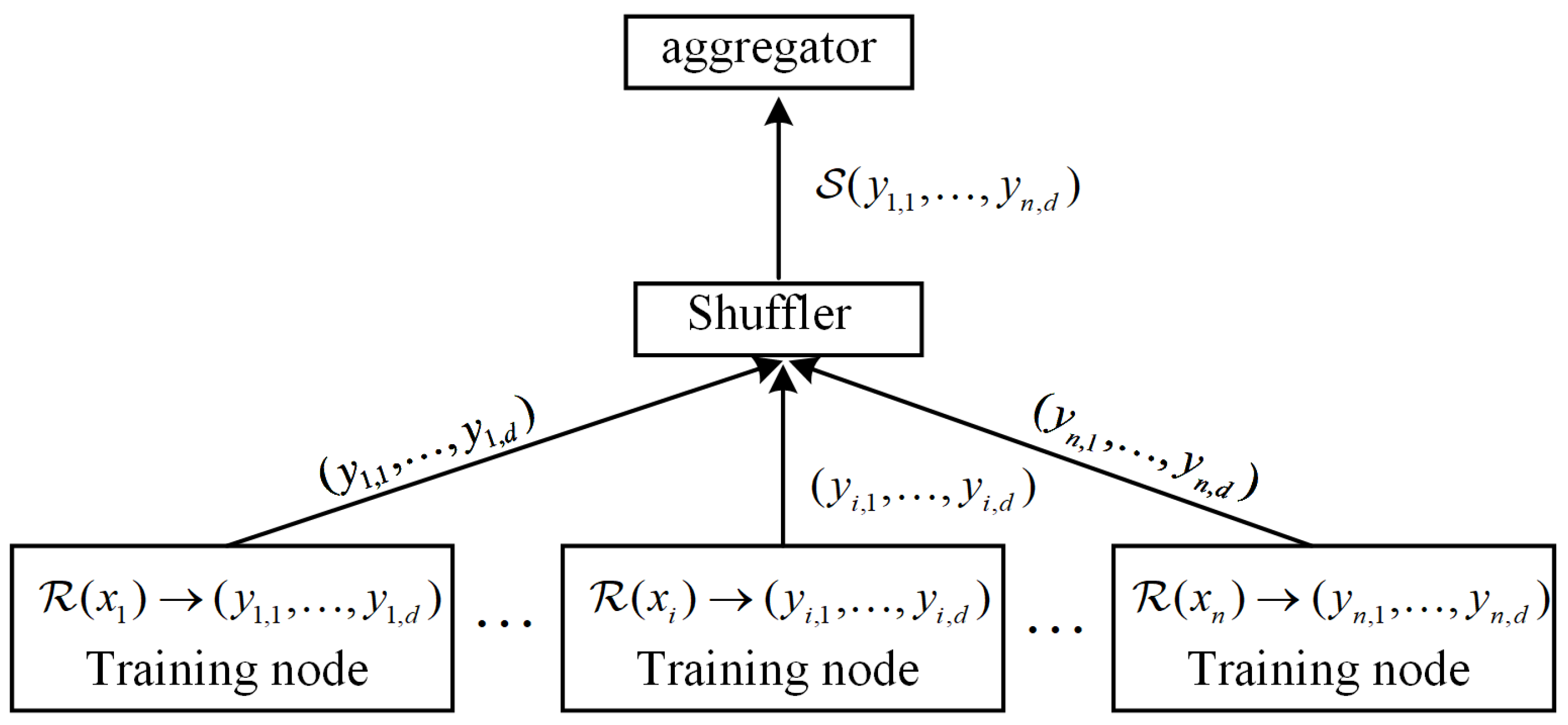
- Encoder is a randomized algorithm that runs on the training nodes’ side and converts local data into d messages.
- Shuffler collects the messages uploaded by n training nodes and processes the messages into a random permutation.
- Aggregator aggregates the random permutation uploaded by training nodes to generate a model.
3.3.3. Mask–DP Exchange Protocol
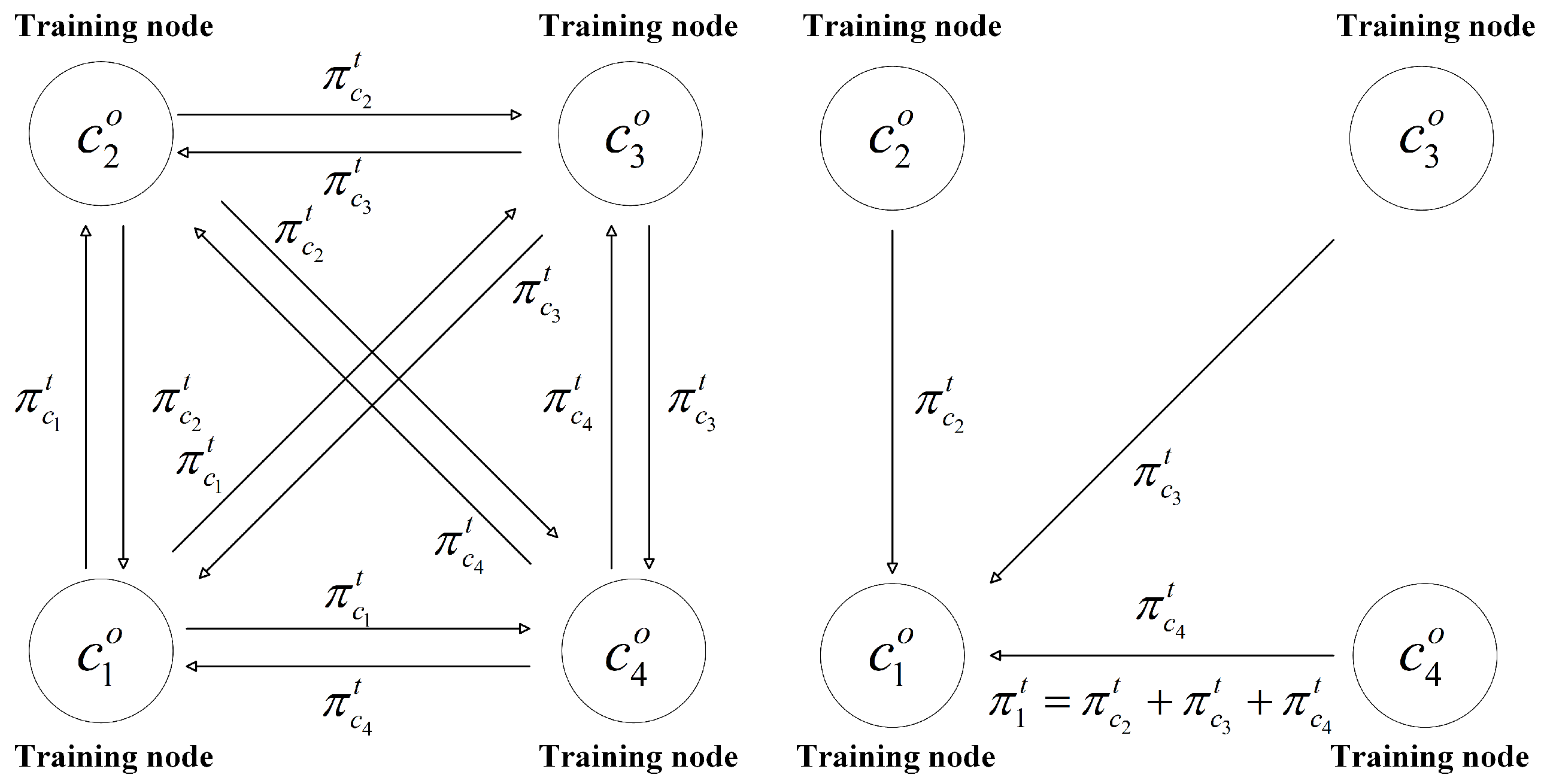
- Input the number of training nodes n, the number of exchange noises , and a set of privacy budgets .
- Each generates mask based on and receives mask from .
- After the exchange step, each aggregate received masks .
- Each training node generates m multi-masks as follows:
- Each sends m multi-masks to gateways.
3.3.4. Paillier Homomorphic Encryption
- Key Generation: Select two large prime numbers, p and q. Calculate and ; denotes the least common multiple. Randomly select satisfying ; denotes the greatest common divisor, . Calculate . Output the public key and keep the private key .
- Encryption: Input a plain text and select a random number . Output the cipher text .
- Decryption: Input a cipher text . Output the plain text .
4. Proposed Framework
4.1. Design Goals
- Prevent malicious training nodes, gateways, and committee nodes from compromising the local data privacy of training nodes.
- Solve the problem of collusion attacks among training nodes.
- Eliminate the impact of noise on global model performance.
- Prevent malicious training and committee nodes from compromising system robustness and global model performance.
4.2. Framework
| Algorithm 1 Algorithm of SHAFL |
| Input: Output:
|
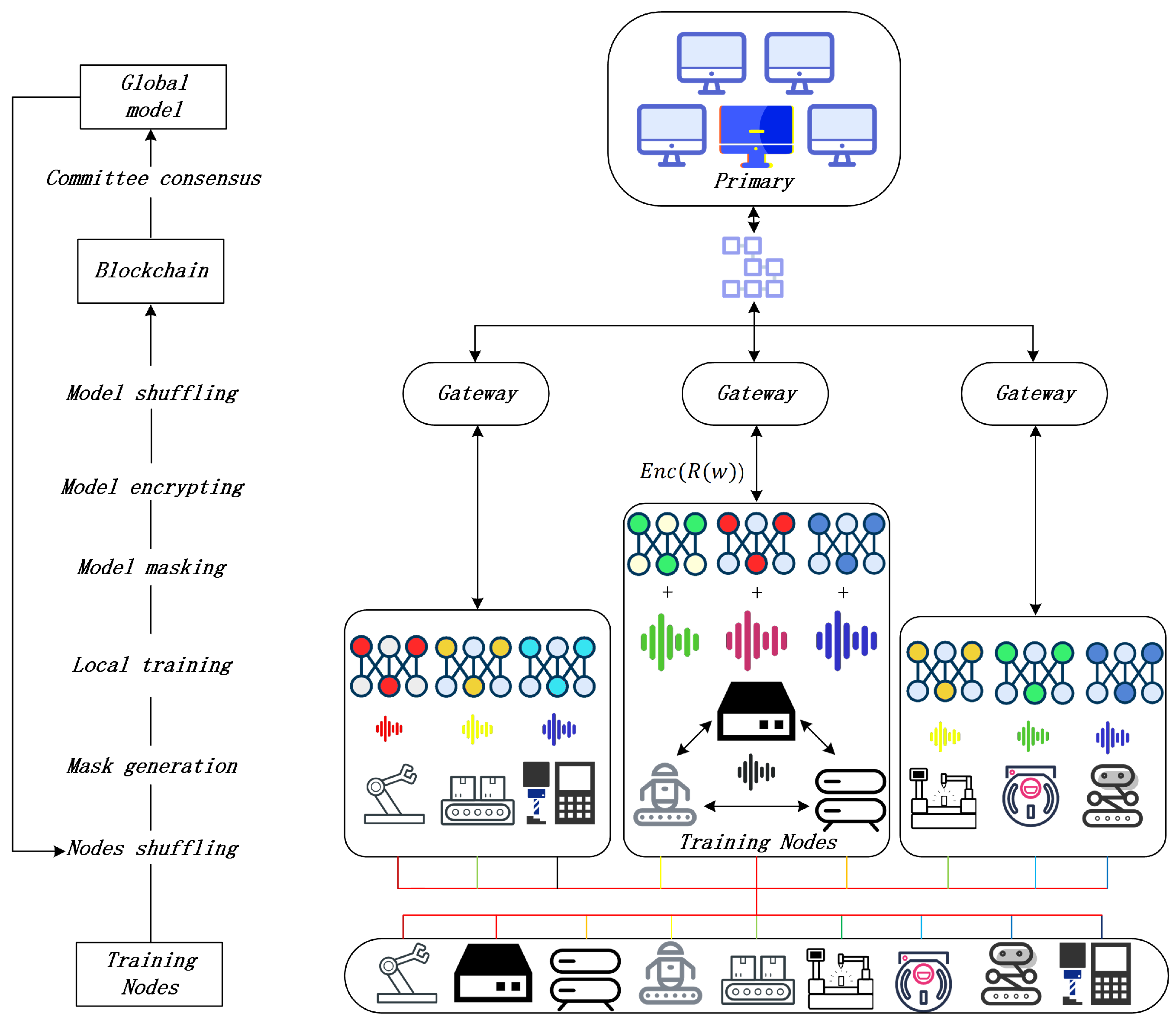
- Node shuffling: In turn t, each training node randomly selects a gateway as its shuffler. Training nodes under the same gateway form a group .
- Mask generating: Training nodes process mask–DP exchange protocol. According to the differential privacy parameter and the Gaussian mechanism, calculates noise scale based on Equation (8) and generates masks based on Gaussian distribution . Then, exchanges masks with other training nodes within a group .
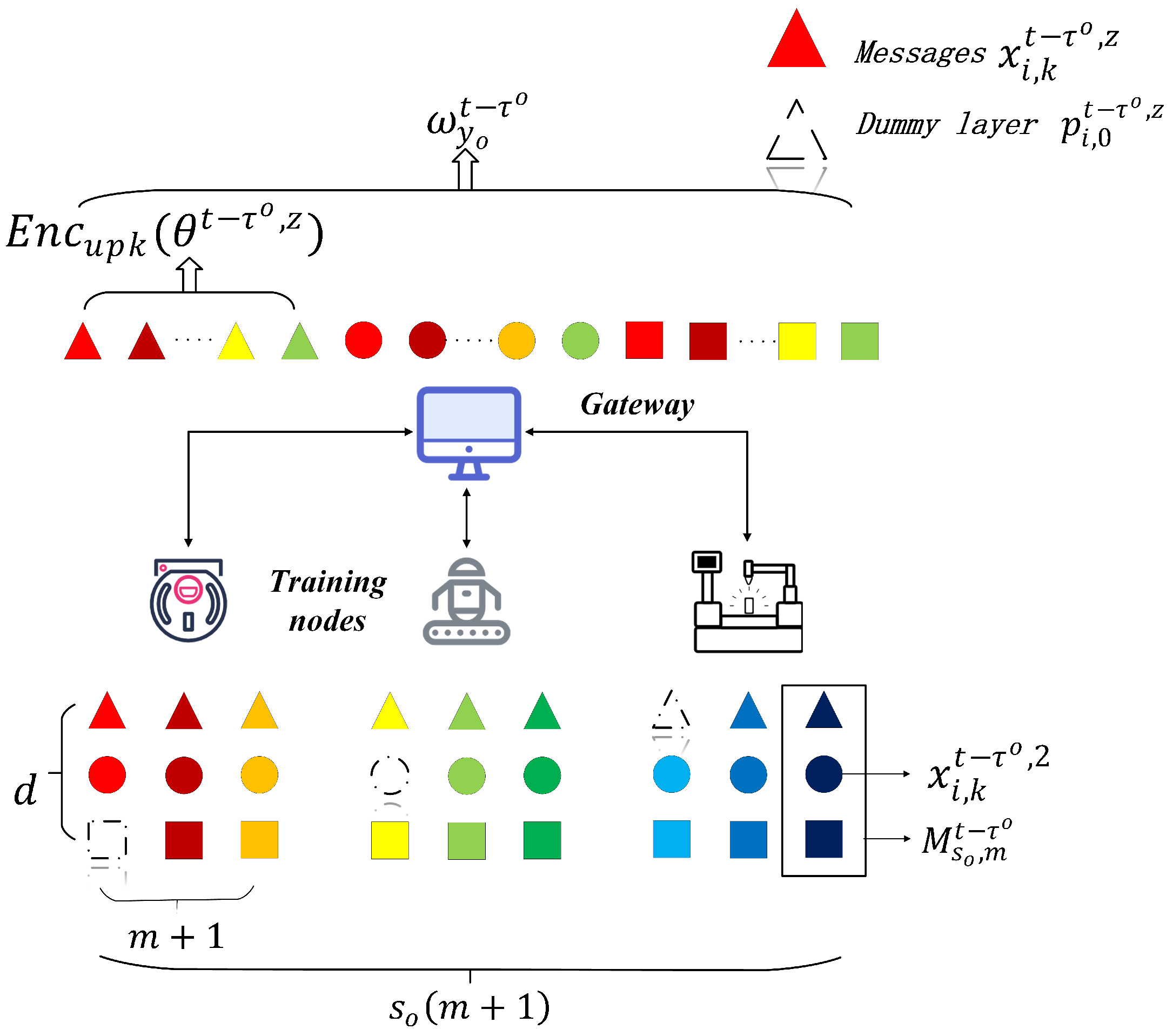
- Model masking: Training node subsamples its local update and performs dummy layer filling on the sampled model to restore the original model shape. Using the filled model , masks and , and the training node generates m multi-masks messages according to Equation (10). m multi-masks are further divided into d-layer vectors , according to the shape of the global model. Then, training node encrypts these messages with the primary committee node’s public key and sends the encrypted messages to the gateway . The subsample, dummy-layer filling, and model masking are proposed in Algorithm 2. It is worth noting that the masks are additive Gaussian noises; the encrypted model has the same shape and location information as the global model.
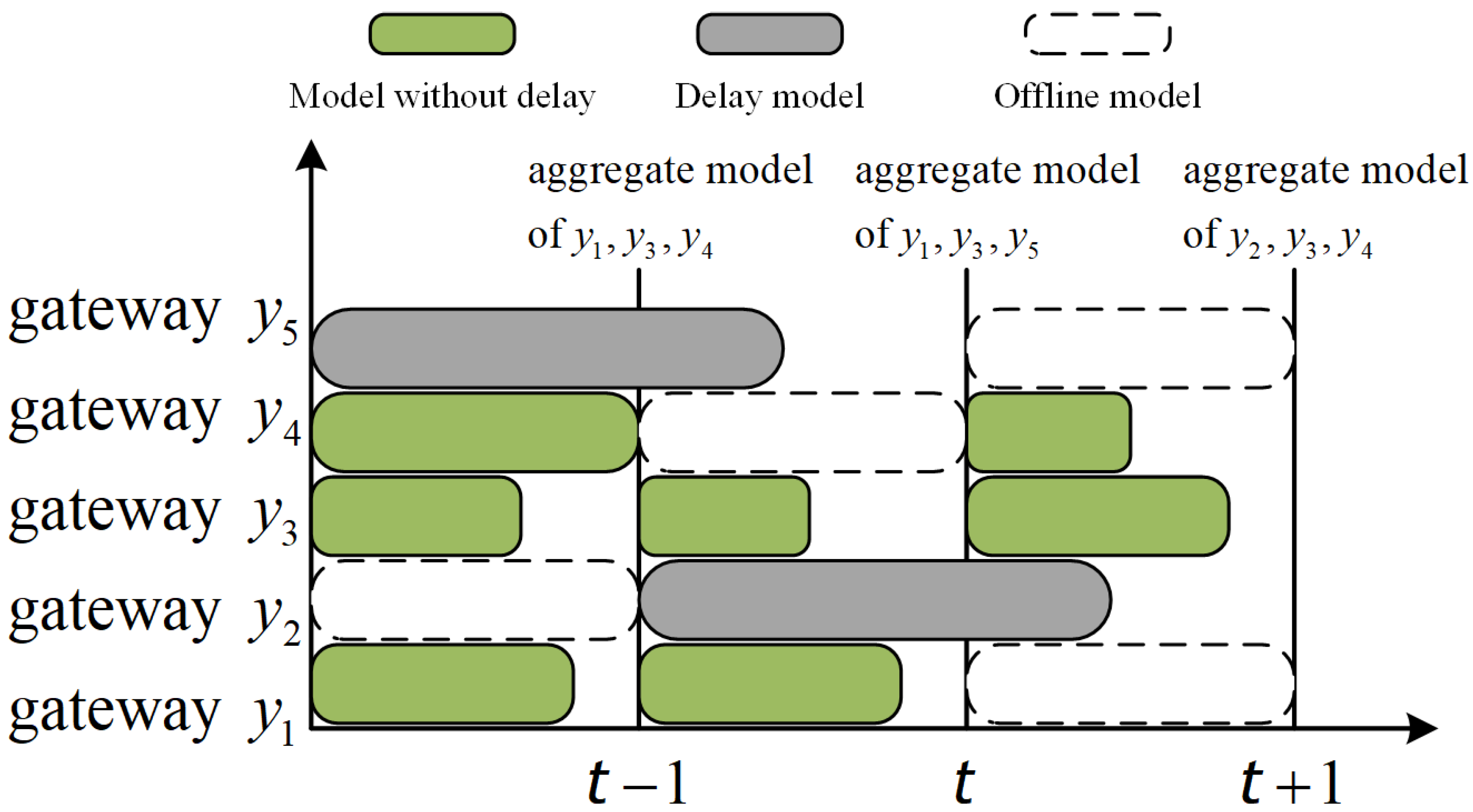
- Model shuffling: After the gateway receives all messages from the training nodes, the gateway shuffles encrypted messages using Equation (9), and retains the location information of the layer. Then, the gateway generates a new model and sends it to the Blockchain with a delay asynchronously. If , stale models are discarded.
- Committee consensus: Committee nodes U select a primary node . Primary committee node downloads local updates from the Blockchain and decrypts them to obtain . Then, scores the model and signs and broadcasts the scores to other committee nodes. Other committee nodes then re-score the models and reach a consensus on scores . Once a consensus is reached, primary aggregates the local updates aswhere denotes the hyperparameter of secure aggregation, and is the number of local updates uploaded by gateways in turn t. Primary committee node encrypts and uploads the new global model to the Blockchain for the next turn .
| Algorithm 2 Model masking |
| Input: Output:
|
4.3. Multi-Shuffle with Subsample and Dummy Layers
| Algorithm 3 Model shuffling |
| Input: Output:
|
4.4. Committee Consensus
| Algorithm 4 Committee consensus |
| Input: Output:
|
5. Convergence Analysis
6. Security Analysis
6.1. Privacy-Preserving Analysis
- Iffor any , it has
6.2. System Robustness Analysis
6.3. Model Security Analysis
7. Experiments
7.1. Experimental Setting
7.1.1. Benchmarks
- FedAvg [62], as the canonical synchronous federated learning framework, was adopted as the baseline comparative scheme in our experiments. This implementation deliberately excludes privacy-preserving mechanisms and Byzantine fault tolerance capabilities.
- DP–FedAvg [71] is a privacy-preserving federated learning framework based on LDP. By injecting noise into their local models, training nodes ensure that the uploaded local models satisfy LDP requirements, thereby defending against inference attacks from the server.
- FedSDP [24] is a synchronous privacy-preserving federated learning framework designed for the Internet of Vehicles (IoV), which enhances privacy and improves data utility through a tripartite mechanism that combines Top-k gradient subsampling, virtual point padding, and shuffle-based anonymization.
- MSFL [61] is a privacy-preserving federated learning framework that synergistically integrates multi-stage shuffling mechanisms and Byzantine-resilient consensus algorithms. It enhances privacy by shuffling training nodes and local updates.
- PBFL [27] is a synchronous, centralized privacy-preserving federated learning framework that achieves privacy-preserving through HE and ensures Byzantine fault tolerance via cosine similarity-based gradient validation.
- PPAFL [18] is an asynchronous privacy-preserving federated learning framework that implements LDP via the Laplace mechanism.
- RAFLS [34] is an RDP-based adaptive FL scheme. It uses the sensitivity of different layers’ weights to determine the amount of noise injected into the model, adopts a model-parameter shuffling mechanism to achieve local model anonymity, and proposes a fine-grained model-weight aggregation scheme.
7.1.2. Datasets and Models
7.1.3. Experimental Parameters
7.2. Experimental Result
7.2.1. Performance Analysis
7.2.2. Impact of Sampling Strategies on Model Accuracy
7.2.3. Analysis of Byzantine Attack Resistance
7.2.4. Privacy Enhancement Analysis
8. Conclusions
Author Contributions
Funding
Institutional Review Board Statement
Informed Consent Statement
Data Availability Statement
Conflicts of Interest
References
- Wang, Z.; Xu, H.; Liu, J.; Huang, H.; Qiao, C.; Zhao, Y. Resource-efficient federated learning with hierarchical aggregation in edge computing. In Proceedings of the IEEE INFOCOM 2021-IEEE Conference on Computer Communications, Vancouver, BC, Canada, 10–13 May 2021; IEEE: Piscataway, NJ, USA, 2021; pp. 1–10. [Google Scholar]
- Xu, C.; Qu, Y.; Xiang, Y.; Gao, L. Asynchronous federated learning on heterogeneous devices: A survey. Comput. Sci. Rev. 2023, 50, 100595. [Google Scholar] [CrossRef]
- Jiang, X.; Sun, A.; Sun, Y.; Luo, H.; Guizani, M. A Trust-Based Hierarchical Consensus Mechanism for Consortium Blockchain in Smart Grid. Tsinghua Sci. Technol. 2023, 28, 69–81. [Google Scholar] [CrossRef]
- Zhou, H.; Zheng, Y.; Huang, H.; Shu, J.; Jia, X. Toward Robust Hierarchical Federated Learning in Internet of Vehicles. IEEE Trans. Intell. Transp. Syst. 2023, 24, 5600–5614. [Google Scholar] [CrossRef]
- Huang, X.; Wu, Y.; Liang, C.; Chen, Q.; Zhang, J. Distance-aware hierarchical federated learning in blockchain-enabled edge computing network. IEEE Internet Things J. 2023, 10, 19163–19176. [Google Scholar] [CrossRef]
- Tan, H.; Wang, M.; Shen, J.; Vijayakumar, P.; Moh, S.; Wu, Q. Blockchain-Assisted Conditional Anonymous Authentication and Adaptive Tree-Based Group Key Agreement for VANETs. IEEE Trans. Dependable Secur. Comput 2025, 1–16. [Google Scholar] [CrossRef]
- Wang, B.; Tian, Z.; Tang, F.; Pan, H.; She, W.; Liu, W. Blockchain-empowered asynchronous federated reinforcement learning for IoT-based traffic trajectory prediction. IEEE Internet Things J. 2025, 12, 17095–17109. [Google Scholar] [CrossRef]
- Pan, Y.; Su, Z.; Wang, Y.; Zhou, J.; Mahmoud, M. Privacy-Preserving Byzantine-Robust Federated Learning via Deep Reinforcement Learning in Vehicular Networks. IEEE Trans. Veh. Technol. 2025, 74, 9461–9475. [Google Scholar] [CrossRef]
- Jin, X.; Wei, Y.; Han, Z. A Collaborative Sharding Consensus Mechanism for Blockchain-Based Federated Learning in IoT. IEEE Internet Things J. 2025, 12, 36422–36435. [Google Scholar] [CrossRef]
- Khan, M.S.; Hongsong, C. Hybrid transformer deep neural architectures for enhanced misinformation detection on social media. Expert Syst. Appl. 2025, 300, 130470. [Google Scholar] [CrossRef]
- Ma, H.; Yang, K.; Jiao, Y. Cellular Traffic Prediction via Byzantine-robust Asynchronous Federated Learning. IEEE Trans. Netw. Sci. Eng. 2025, 12, 2402–2414. [Google Scholar] [CrossRef]
- Liu, J.; Wu, Y.; Du, W.; Sun, R.; Xu, G.; Liu, L.; Wu, C. Byzantine-Robust Hierarchical Aggregation for Cross-Device Federated Learning in Consumer IoT. IEEE Trans. Consum. Electron. 2024, 71, 6359–6370. [Google Scholar] [CrossRef]
- Shokri, R.; Stronati, M.; Song, C.; Shmatikov, V. Membership inference attacks against machine learning models. In Proceedings of the 2017 IEEE Symposium on Security and Privacy (SP), San Jose, CA, USA, 22–26 May 2017; IEEE: Piscataway, NJ, USA, 2017; pp. 3–18. [Google Scholar]
- Fredrikson, M.; Jha, S.; Ristenpart, T. Model inversion attacks that exploit confidence information and basic countermeasures. In Proceedings of the 22nd ACM SIGSAC Conference on Computer and Communications Security, Denver, CO, USA, 12–16 October 2015; pp. 1322–1333. [Google Scholar]
- Sun, G.; Cong, Y.; Dong, J.; Wang, Q.; Lyu, L.; Liu, J. Data poisoning attacks on federated machine learning. IEEE Internet Things J. 2021, 9, 11365–11375. [Google Scholar] [CrossRef]
- Tolpegin, V.; Truex, S.; Gursoy, M.E.; Liu, L. Data poisoning attacks against federated learning systems. In Proceedings of the Computer Security–ESORICs 2020: 25th European Symposium on Research in Computer Security, ESORICs 2020, Guildford, UK, 14–18 September 2020; Springer: Berlin/Heidelberg, Germany, 2020; pp. 480–501. [Google Scholar]
- Qu, Y.; Gao, L.; Luan, T.H.; Xiang, Y.; Yu, S.; Li, B.; Zheng, G. Decentralized privacy using blockchain-enabled federated learning in fog computing. IEEE Internet Things J. 2020, 7, 5171–5183. [Google Scholar] [CrossRef]
- Yan, X.; Miao, Y.; Li, X.; Choo, K.K.R.; Meng, X.; Deng, R.H. Privacy-Preserving Asynchronous Federated Learning Framework in Distributed IoT. IEEE Internet Things J. 2023, 10, 13281–13291. [Google Scholar] [CrossRef]
- Tian, L.; Lin, F.; Gan, J.; Jia, R.; Zheng, Z.; Li, M. Pefl: Privacy-preserved and efficient federated learning with blockchain. IEEE Internet Things J. 2024, 12, 3305–3317. [Google Scholar] [CrossRef]
- Xie, Y.; Chen, B.; Zhang, J.; Li, W. ALGANs: Enhancing membership inference attacks in federated learning with GANs and active learning. In Proceedings of the 2022 IEEE International Symposium on Product Compliance Engineering-Asia (ISPCE-ASIA), Guangzhou, China, 4–6 November 2022; IEEE: Piscataway, NJ, USA, 2022; pp. 1–6. [Google Scholar]
- Fang, M.; Cao, X.; Jia, J.; Gong, N. Local model poisoning attacks to Byzantine-Robust federated learning. In Proceedings of the 29th USENIX Security Symposium (USENIX Security 20), Virtual, 12–14 August 2020; pp. 1605–1622. [Google Scholar]
- Baruch, G.; Baruch, M.; Goldberg, Y. A little is enough: Circumventing defenses for distributed learning. In Proceedings of the NIPS’19: 33rd International Conference on Neural Information, Vancouver, BC, Canada, 8–14 December 2019; Volume 32, pp. 8635–8645. [Google Scholar] [CrossRef]
- Zhang, T.; Xu, D.; Hu, Y.; Vijayakumar, P.; Zhu, Y.; Tolba, A. Deep Fingerprinting Data Learning Based on Federated Differential Privacy for Resource-Constrained Intelligent IoT Systems. IEEE Internet Things J. 2024, 11, 25744–25756. [Google Scholar] [CrossRef]
- Sun, K.; Xu, H.; Hua, K.; Lin, X.; Li, G.; Jiang, T.; Li, J. Joint Top-K Sparsification and Shuffle Model for Communication-Privacy-Accuracy Tradeoffs in Federated-Learning-Based IoV. IEEE Internet Things J. 2024, 11, 19721–19735. [Google Scholar] [CrossRef]
- Liu, X.; Zhou, Y.; Wu, D.; Hu, M.; Hui Wang, J.; Guizani, M. FedDP-SA: Boosting Differentially Private Federated Learning via Local Data Set Splitting. IEEE Internet Things J. 2024, 11, 31687–31698. [Google Scholar] [CrossRef]
- Yang, R.; Zhao, T.; Yu, F.R.; Li, M.; Zhang, D.; Zhao, X. Blockchain-based federated learning with enhanced privacy and security using homomorphic encryption and reputation. IEEE Internet Things J. 2024, 11, 21674–21688. [Google Scholar] [CrossRef]
- Miao, Y.; Liu, Z.; Li, H.; Choo, K.K.R.; Deng, R.H. Privacy-Preserving Byzantine-Robust Federated Learning via Blockchain Systems. IEEE Trans. Inf. Forensics Secur. 2022, 17, 2848–2861. [Google Scholar] [CrossRef]
- Hijazi, N.M.; Aloqaily, M.; Guizani, M.; Ouni, B.; Karray, F. Secure Federated Learning with Fully Homomorphic Encryption for IoT Communications. IEEE Internet Things J. 2024, 11, 4289–4300. [Google Scholar] [CrossRef]
- Feng, C.; Liu, B.; Yu, K.; Goudos, S.K.; Wan, S. Blockchain-empowered decentralized horizontal federated learning for 5G-enabled UAVs. IEEE Trans. Ind. Inform. 2021, 18, 3582–3592. [Google Scholar] [CrossRef]
- Masuda, H.; Kita, K.; Koizumi, Y.; Takemasa, J.; Hasegawa, T. Model Fragmentation, Shuffle and Aggregation to Mitigate Model Inversion in Federated Learning. In Proceedings of the 2021 IEEE International Symposium on Local and Metropolitan Area Networks (LANMAN), Boston, MA, USA, 12–14 July 2021; pp. 1–6. [Google Scholar] [CrossRef]
- Shen, M.; Wang, J.; Zhang, J.; Zhao, Q.; Peng, B.; Wu, T.; Zhu, L.; Xu, K. Secure decentralized aggregation to prevent membership privacy leakage in edge-based federated learning. IEEE Trans. Netw. Sci. Eng. 2024, 11, 3105–3119. [Google Scholar] [CrossRef]
- Dwork, C.; Roth, A. The algorithmic foundations of differential privacy. Found. Trends® Theor. Comput. Sci. 2014, 9, 211–407. [Google Scholar] [CrossRef]
- Wang, T.; Chen, J.Q.; Zhang, Z.; Su, D.; Cheng, Y.; Li, Z.; Li, N.; Jha, S. Continuous release of data streams under both centralized and local differential privacy. In Proceedings of the 2021 ACM SIGSAC Conference on Computer and Communications Security, Virtual, 15–19 November 2021; pp. 1237–1253. [Google Scholar]
- Wang, S.; Gai, K.; Yu, J.; Zhu, L.; Wu, H.; Wei, C.; Yan, Y.; Zhang, H.; Choo, K.K.R. Rafls: Rdp-based adaptive federated learning with shuffle model. IEEE Trans. Dependable Secur. Comput. 2024, 22, 1181–1194. [Google Scholar] [CrossRef]
- Yuan, X.; Ni, W.; Ding, M.; Wei, K.; Li, J.; Poor, H.V. Amplitude-varying perturbation for balancing privacy and utility in federated learning. IEEE Trans. Inf. Forensics Secur. 2023, 18, 1884–1897. [Google Scholar] [CrossRef]
- Li, S.; Ngai, E.; Voigt, T. Byzantine-robust aggregation in federated learning empowered industrial iot. IEEE Trans. Ind. Inform. 2021, 19, 1165–1175. [Google Scholar] [CrossRef]
- Li, T.; Hu, S.; Beirami, A.; Smith, V. Ditto: Fair and robust federated learning through personalization. In Proceedings of the International Conference on Machine Learning, Virtual, 18–24 July 2021; pp. 6357–6368. [Google Scholar]
- Xie, C.; Koyejo, O.; Gupta, I. Fall of empires: Breaking byzantine-tolerant sgd by inner product manipulation. In Proceedings of the Uncertainty in Artificial Intelligence, Tel Aviv, Israel, 22–25 July 2020; pp. 261–270. [Google Scholar]
- Li, L.; Xu, W.; Chen, T.; Giannakis, G.B.; Ling, Q. RSA: Byzantine-robust stochastic aggregation methods for distributed learning from heterogeneous datasets. In Proceedings of the AAAI Conference on Artificial Intelligence, Honolulu, HI, USA, 7 January–1 February 2019; Volume 33, pp. 1544–1551. [Google Scholar]
- Karimireddy, S.P.; He, L.; Jaggi, M. Learning from history for byzantine robust optimization. In Proceedings of the International Conference on Machine Learning, Virtual, 18–24 July 2021; pp. 5311–5319. [Google Scholar]
- Jere, M.S.; Farnan, T.; Koushanfar, F. A taxonomy of attacks on federated learning. IEEE Secur. Priv. 2020, 19, 20–28. [Google Scholar] [CrossRef]
- Blanchard, P.; El Mhamdi, E.M.; Guerraoui, R.; Stainer, J. Machine learning with adversaries: Byzantine tolerant gradient descent. In Proceedings of the NIPS’17: Proceedings of the 31st International Conference on Neural Information Processing Systems, Long Beach, CA, USA, 4–9 December 2017; Volume 30, pp. 118–128. [Google Scholar] [CrossRef]
- Chen, Y.; Su, L.; Xu, J. Distributed statistical machine learning in adversarial settings: Byzantine gradient descent. Proc. ACM Meas. Anal. Comput. Syst. 2017, 1, 1–25. [Google Scholar] [CrossRef]
- Pillutla, K.; Kakade, S.M.; Harchaoui, Z. Robust aggregation for federated learning. IEEE Trans. Signal Process. 2022, 70, 1142–1154. [Google Scholar] [CrossRef]
- Li, S.; Ngai, E.C.H.; Voigt, T. An experimental study of byzantine-robust aggregation schemes in federated learning. IEEE Trans. Big Data 2023, 10, 975–988. [Google Scholar] [CrossRef]
- Sattler, F.; Müller, K.R.; Wiegand, T.; Samek, W. On the Byzantine Robustness of Clustered Federated Learning. In Proceedings of the ICASSP 2020-2020 IEEE International Conference on Acoustics, Speech and Signal Processing (ICASSP), Barcelona, Spain, 4–8 May 2020; pp. 8861–8865. [Google Scholar] [CrossRef]
- Li, Z.; Liu, L.; Zhang, J.; Liu, J. Byzantine-robust federated learning through spatial-temporal analysis of local model updates. In Proceedings of the 2021 IEEE 27th International Conference on Parallel and Distributed Systems (ICPADS), Beijing, China, 14–16 December 2021; IEEE: Piscataway, NJ, USA, 2021; pp. 372–379. [Google Scholar]
- Yin, D.; Chen, Y.; Kannan, R.; Bartlett, P. Byzantine-robust distributed learning: Towards optimal statistical rates. In Proceedings of the International Conference on Machine Learning, Stockholm, Sweden, 10–15 July 2018; pp. 5650–5659. [Google Scholar]
- Xie, C.; Koyejo, S.; Gupta, I. Asynchronous federated optimization. arXiv 2019, arXiv:1903.03934. [Google Scholar]
- Miao, Y.; Liu, Z.; Li, X.; Li, M.; Li, H.; Choo, K.K.R.; Deng, R.H. Robust asynchronous federated learning with time-weighted and stale model aggregation. IEEE Trans. Dependable Secur. Comput. 2023, 21, 2361–2375. [Google Scholar] [CrossRef]
- Wu, M.; Boban, M.; Dressler, F. Flexible training and uploading strategy for asynchronous federated learning in dynamic environments. IEEE Trans. Mob. Comput. 2024, 23, 12907–12921. [Google Scholar] [CrossRef]
- Chen, Z.; Yi, W.; Shin, H.; Nallanathan, A. Adaptive semi-asynchronous federated learning over wireless networks. IEEE Trans. Commun. 2024, 73, 394–409. [Google Scholar] [CrossRef]
- Wei, K.; Li, J.; Ding, M.; Ma, C.; Yang, H.H.; Farokhi, F.; Jin, S.; Quek, T.Q.; Poor, H.V. Federated learning with differential privacy: Algorithms and performance analysis. IEEE Trans. Inf. Forensics Secur. 2020, 15, 3454–3469. [Google Scholar] [CrossRef]
- Jiang, B.; Li, J.; Wang, H.; Song, H. Privacy-preserving federated learning for industrial edge computing via hybrid differential privacy and adaptive compression. IEEE Trans. Ind. Inform. 2021, 19, 1136–1144. [Google Scholar] [CrossRef]
- Guo, H.; Wang, H.; Song, T.; Hua, Y.; Ma, R.; Jin, X.; Xue, Z.; Guan, H. Siren+: Robust Federated Learning With Proactive Alarming and Differential Privacy. IEEE Trans. Dependable Secur. Comput. 2024, 21, 4843–4860. [Google Scholar] [CrossRef]
- Zhang, C.; Weng, J.; Weng, J.; Zhong, Y.; Liu, J.N.; Deng, C. Robust and Secure Federated Learning with Verifiable Differential Privacy. IEEE Trans. Dependable Secur. Comput. 2025, 22, 5713–5729. [Google Scholar] [CrossRef]
- Xu, C.; Ge, J.; Deng, Y.; Gao, L.; Zhang, M.; Li, Y.; Zhou, W.; Zheng, X. BASS: A blockchain-based asynchronous SignSGD architecture for efficient and secure federated learning. IEEE Trans. Dependable Secur. Comput. 2024, 21, 5388–5402. [Google Scholar] [CrossRef]
- Balle, B.; Bell, J.; Gascón, A.; Nissim, K. The privacy blanket of the shuffle model. In Proceedings of the Advances in Cryptology–CRYPTO 2019: 39th Annual International Cryptology Conference, Santa Barbara, CA, USA, 18–22 August 2019; Springer: Berlin/Heidelberg, Germany, 2019; pp. 638–667. [Google Scholar]
- Girgis, A.; Data, D.; Diggavi, S.; Kairouz, P.; Suresh, A.T. Shuffled model of differential privacy in federated learning. In Proceedings of the International Conference on Artificial Intelligence and Statistics, Virtual, 13–15 April 2021; pp. 2521–2529. [Google Scholar]
- Balle, B.; Barthe, G.; Gaboardi, M. Privacy amplification by subsampling: Tight analyses via couplings and divergences. In Proceedings of the NIPS’18: Proceedings of the 32nd International Conference on Neural Information Processing Systems, Montréal, Canada, 3–8 December 2018; Volume 31, pp. 6280–6290. [Google Scholar] [CrossRef]
- Zhou, Z.; Xu, C.; Wang, M.; Kuang, X.; Zhuang, Y.; Yu, S. A Multi-Shuffler Framework to Establish Mutual Confidence for Secure Federated Learning. IEEE Trans. Dependable Secur. Comput. 2023, 20, 4230–4244. [Google Scholar] [CrossRef]
- McMahan, H.B.; Moore, E.; Ramage, D.; y Arcas, B.A. Federated learning of deep networks using model averaging. arXiv 2016, arXiv:1602.05629. [Google Scholar]
- Zhao, Z.; Luo, M.; Ding, W. Deep leakage from model in federated learning. arXiv 2022, arXiv:2206.04887. [Google Scholar] [CrossRef]
- Yin, H.; Mallya, A.; Vahdat, A.; Alvarez, J.M.; Kautz, J.; Molchanov, P. See through gradients: Image batch recovery via gradinversion. In Proceedings of the IEEE/CVF Conference on Computer Vision and Pattern Recognition, Nashville, TN, USA, 20–25 June 2021; pp. 16337–16346. [Google Scholar]
- Zhao, J.C.; Sharma, A.; Elkordy, A.R.; Ezzeldin, Y.H.; Avestimehr, S.; Bagchi, S. Loki: Large-scale data reconstruction attack against federated learning through model manipulation. In Proceedings of the 2024 IEEE Symposium on Security and Privacy (SP), San Francisco, CA, USA, 19–23 May 2024; IEEE: Piscataway, NJ, USA, 2024; pp. 1287–1305. [Google Scholar]
- Lyu, L.; Yu, H.; Ma, X.; Chen, C.; Sun, L.; Zhao, J.; Yang, Q.; Yu, P.S. Privacy and Robustness in Federated Learning: Attacks and Defenses. IEEE Trans. Neural Netw. Learn. Syst. 2022, 35, 8726–8746. [Google Scholar] [CrossRef]
- Wang, S.; Luo, X.; Qian, Y.; Zhu, Y.; Chen, K.; Chen, Q.; Xin, B.; Yang, W. Shuffle differential private data aggregation for random population. IEEE Trans. Parallel Distrib. Syst. 2023, 34, 1667–1681. [Google Scholar] [CrossRef]
- Zeng, Z.; Liu, Y.; Chang, L. A robust and optional privacy data aggregation scheme for fog-enhanced IoT network. IEEE Syst. J. 2022, 17, 1110–1120. [Google Scholar] [CrossRef]
- Paillier, P. Public-key cryptosystems based on composite degree residuosity classes. In Proceedings of the International Conference on the Theory and Applications of Cryptographic Techniques; Springer: Berlin/Heidelberg, Germany, 1999; pp. 223–238. [Google Scholar]
- Chen, Y.; Yan, L.; Ai, D. An Robust Secure Blockchain-based Hierarchical Asynchronous Federated Learning Scheme for Internet of Things. IEEE Access 2024, 12, 165280–165297. [Google Scholar] [CrossRef]
- Geyer, R.C.; Klein, T.; Nabi, M. Differentially private federated learning: A client level perspective. arXiv 2017, arXiv:1712.07557. [Google Scholar]
- LeCun, Y.; Bottou, L.; Bengio, Y.; Haffner, P. Gradient-based learning applied to document recognition. Proc. IEEE 1998, 86, 2278–2324. [Google Scholar] [CrossRef]
- Krizhevsky, A.; Hinton, G. Learning Multiple Layers of Features from Tiny Images. 2009. Available online: https://www.cs.toronto.edu/~kriz/index.html (accessed on 9 January 2026).
- Dutta, A.; Batabyal, T.; Basu, M.; Acton, S.T. An efficient convolutional neural network for coronary heart disease prediction. Expert Syst. Appl. 2020, 159, 113408. [Google Scholar] [CrossRef]
- Wang, L.; Polato, M.; Brighente, A.; Conti, M.; Zhang, L.; Xu, L. PriVeriFL: Privacy-preserving and aggregation-verifiable federated learning. IEEE Trans. Serv. Comput. 2024, 18, 998–1011. [Google Scholar] [CrossRef]



| Notation | Description | Notation | Description |
|---|---|---|---|
| F | global loss | , | i-th trainer; i-th trainer in |
| weights | gateway of | ||
| f | loss function | o-th group | |
| w | model & model parameters | h | h-th iteration |
| global model for t-th turn | t | t-th turn | |
| local update for c in h-th iteration t-th turn | sample of dataset | ||
| local update for group | delay of group | ||
| m-multi-masks | score of model generated by | ||
| vector of layer of mask | number of | ||
| primary committee node | committee nodes | ||
| global datasets | size of group | ||
| local dataset for | C | set of training nodes | |
| hyperparameters of aggregation | U | set of committees | |
| learning rate of training node | N | number of training nodes | |
| number of collected in t-th turn | M | number of committee nodes | |
| variance of noise | m | number of exchange noises | |
| mask generated by | K | number of groups | |
| O | set of groups | Y | set of gateways |
| layer of model | dummy layer of model | ||
| minimum training iteration | maximum training iteration |
| Scheme | Local Train | Aggregation | Privacy Preserving |
|---|---|---|---|
| FedAvg [62] | − | ||
| DP-FedAvg [71] | |||
| FedSDP [24] | |||
| MSFL [61] | |||
| PBFL [27] | |||
| PPAFL [18] | |||
| RAFLS [34] | |||
| Proposed |
| Param | Value | Param | Value |
|---|---|---|---|
| 20 | 10 | ||
| H | 20 | batchsize | 64 |
| {0, 0.2, 0.4} | 0.1 | ||
| 50 | 0.08 | ||
| 0.3 | {0.5, 0.8, 1} | ||
| 3 |
| Param | Value | Param | Value |
|---|---|---|---|
| 20 | 10 | ||
| H | 20 | batchsize | 32 |
| {0, 0.2, 0.4} | 0.03 | ||
| 50 | 0.001 | ||
| 0.85 | {0.5, 0.8, 1} | ||
| 3 |
| Param | Value | Param | Value |
|---|---|---|---|
| 20 | 10 | ||
| H | 20 | batchsize | 500 |
| {0, 0.2, 0.4} | 0.03 | ||
| 50 | 0.01 | ||
| 0.85 | {0.5, 0.8, 1} | ||
| 3 |
| , , , subsampling rate = 90% | ||||||
| Dataset | FedAvg | DP-FedAvg | FedSDP | MSFL | RAFLS | Proposed |
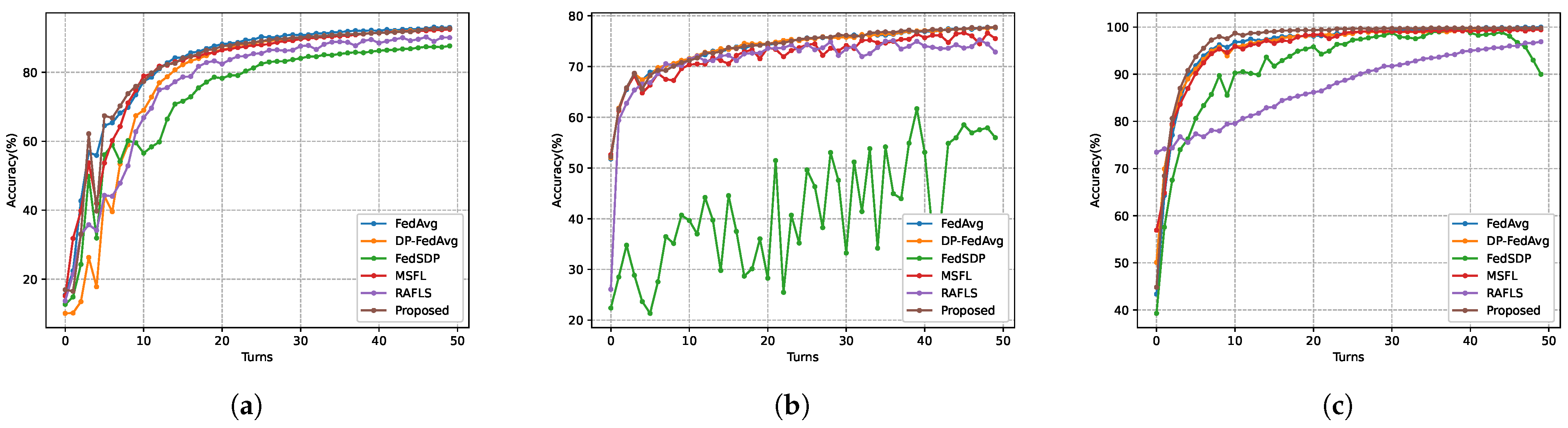
| MNIST | 93.01 | 92.46 | 87.66 | 92.46 | 90.07 | 92.77 |
| CIFAR-10 | 77.61 | 77.70 | 55.98 | 75.51 | 75.25 | 77.75 |
| Heart Disease Dataset | 100 | 99.63 | 90.00 | 99.45 | 97.99 | 99.82 |
Disclaimer/Publisher’s Note: The statements, opinions and data contained in all publications are solely those of the individual author(s) and contributor(s) and not of MDPI and/or the editor(s). MDPI and/or the editor(s) disclaim responsibility for any injury to people or property resulting from any ideas, methods, instructions or products referred to in the content. |
© 2026 by the authors. Licensee MDPI, Basel, Switzerland. This article is an open access article distributed under the terms and conditions of the Creative Commons Attribution (CC BY) license.
Share and Cite
Chen, Y.; Ai, D.; Yan, L. Secure Hierarchical Asynchronous Federated Learning with Shuffle Model and Mask–DP. Sensors 2026, 26, 617. https://doi.org/10.3390/s26020617
Chen Y, Ai D, Yan L. Secure Hierarchical Asynchronous Federated Learning with Shuffle Model and Mask–DP. Sensors. 2026; 26(2):617. https://doi.org/10.3390/s26020617
Chicago/Turabian StyleChen, Yonghui, Daxiang Ai, and Linglong Yan. 2026. "Secure Hierarchical Asynchronous Federated Learning with Shuffle Model and Mask–DP" Sensors 26, no. 2: 617. https://doi.org/10.3390/s26020617
APA StyleChen, Y., Ai, D., & Yan, L. (2026). Secure Hierarchical Asynchronous Federated Learning with Shuffle Model and Mask–DP. Sensors, 26(2), 617. https://doi.org/10.3390/s26020617