Delineating the Central Anatolia Transition Zone (CATZ): Constraints from Integrated Geodetic (GNSS/InSAR) and Seismic Data


Abstract
1. Introduction
2. Seismotectonic Setting

2.1. Major Active Tectonic Zones
2.2. Central Anatolia: The Transitional Domain
2.3. Geodynamic Evolution
2.4. Implications for Remote Sensing and Geodesy
3. Methodology
3.1. LiCSAR-Derived Velocity Fields

3.2. Stress Tensor Inversion Analysis
4. Result
4.1. LiCSAR-Derived Surface Deformation Patterns
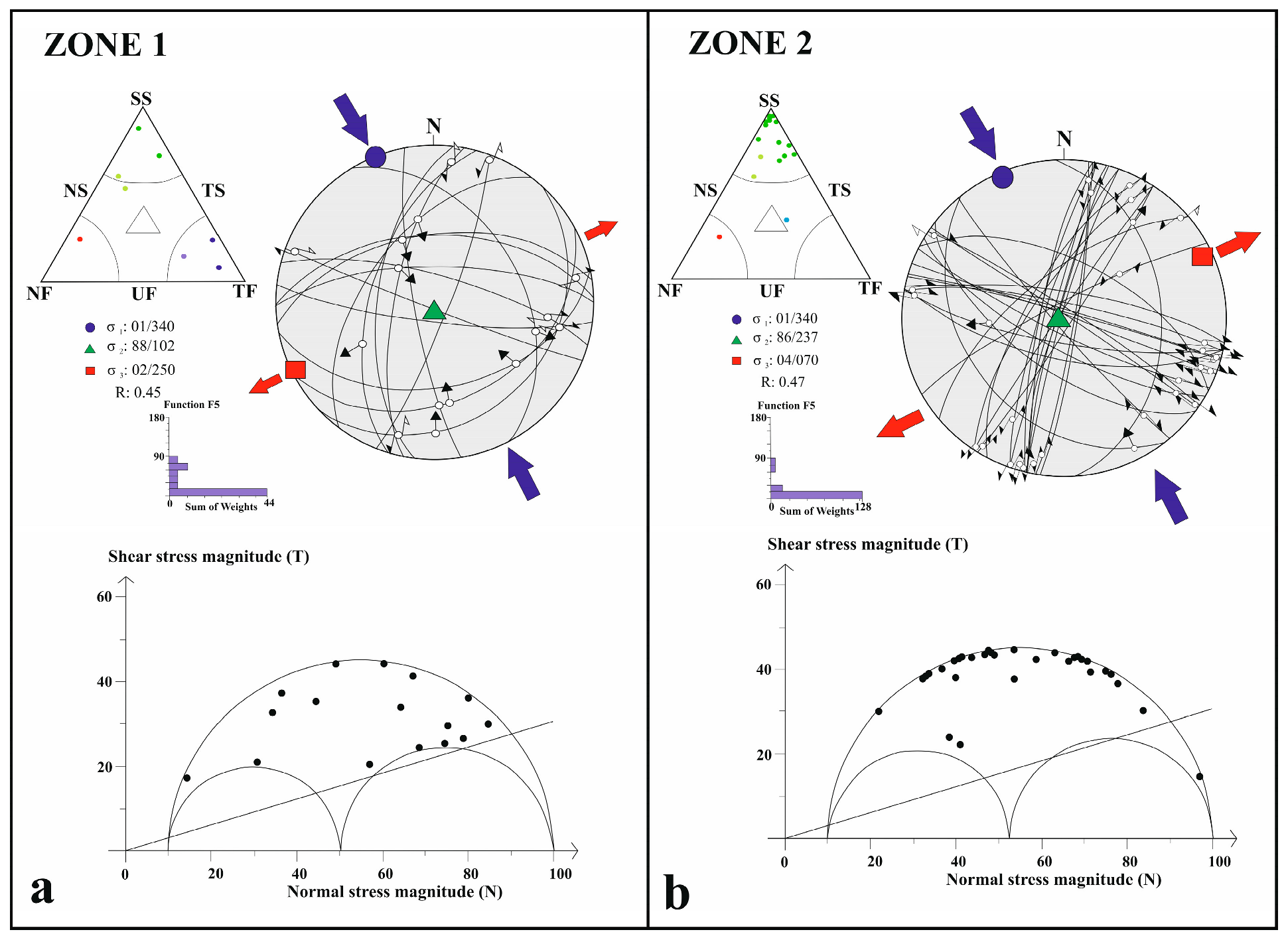
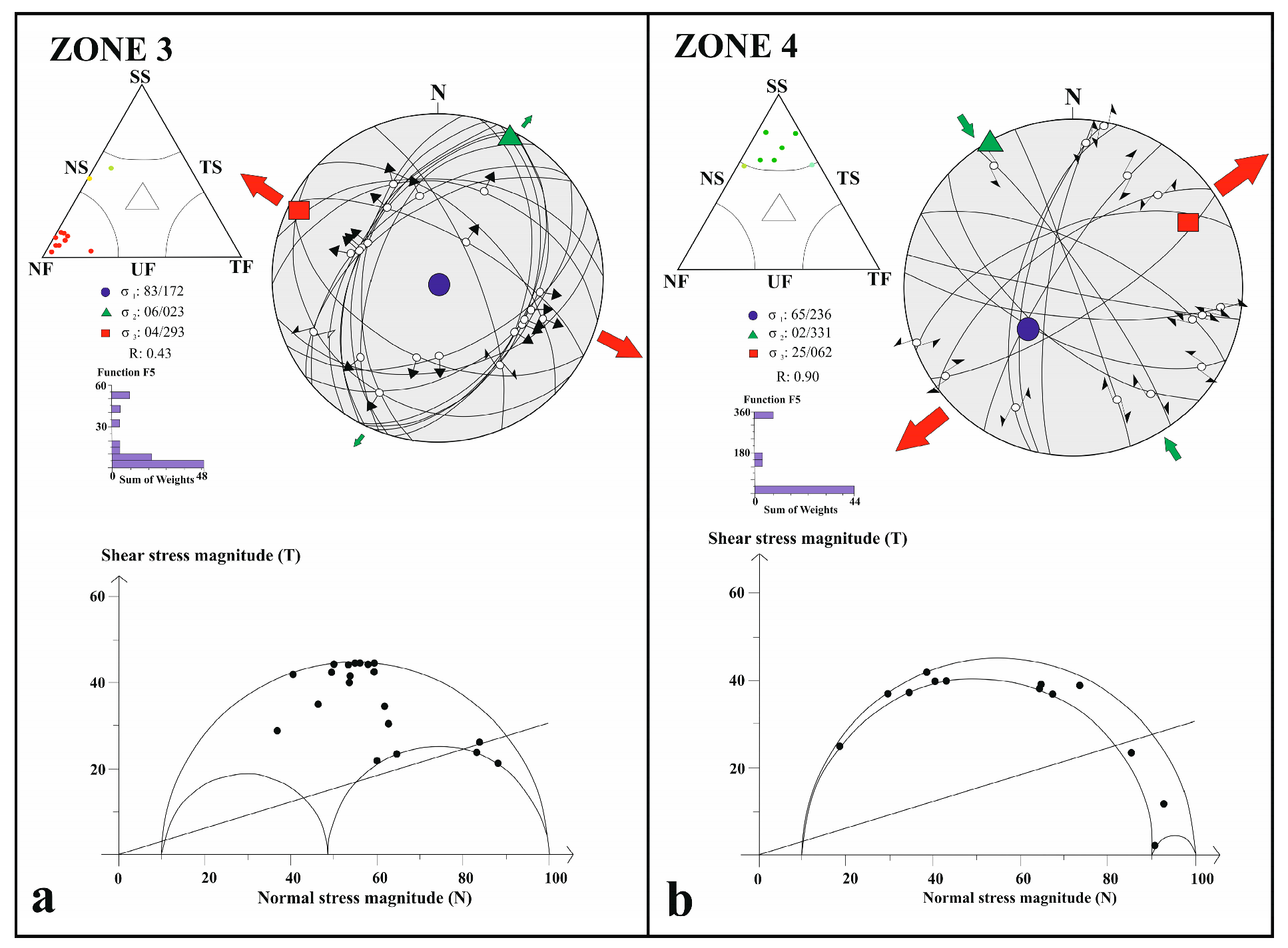
4.2. Stress Tensor Inversion Results
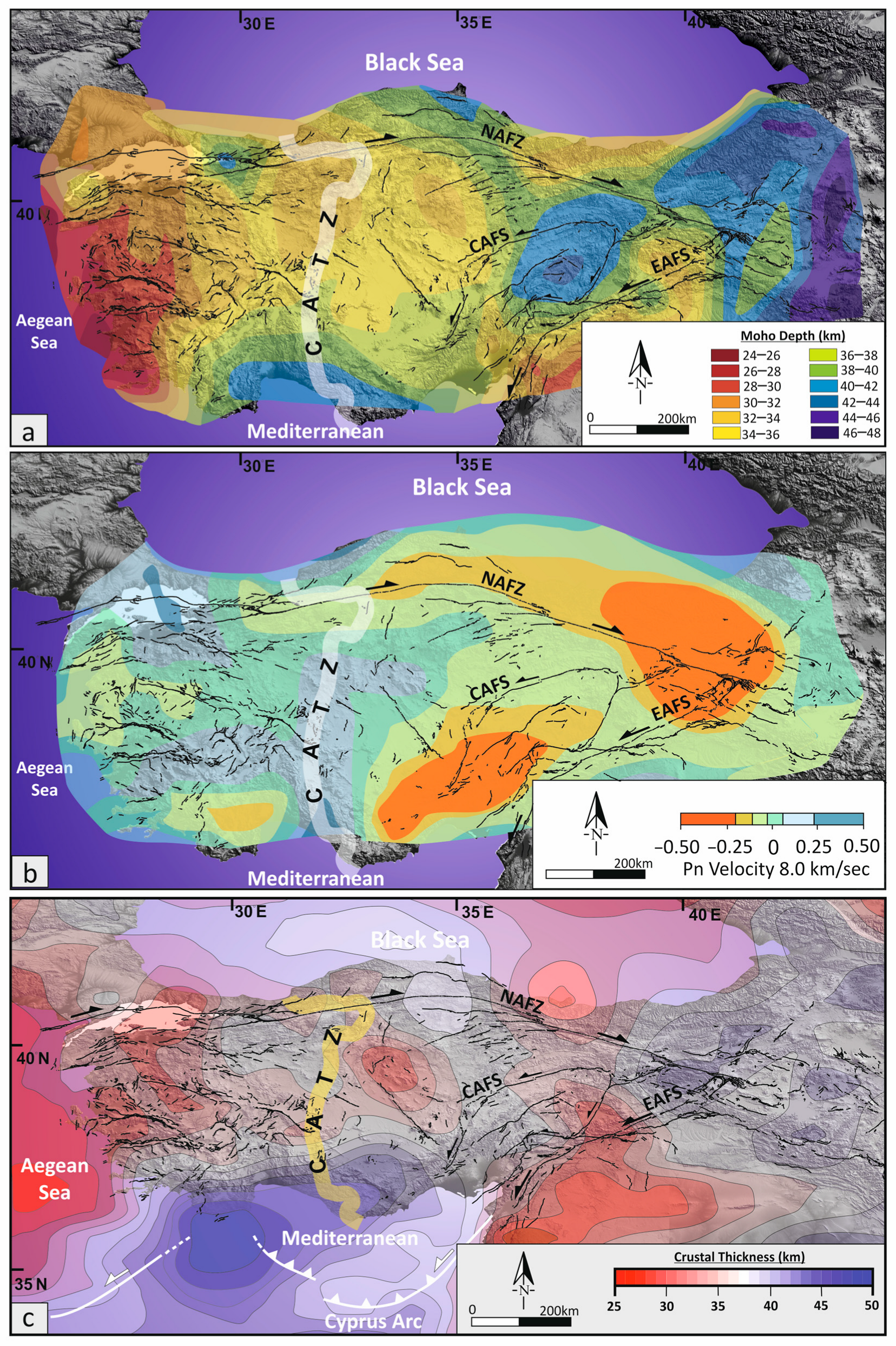
5. Discussion
6. Concluding Remarks and Conclusions
Supplementary Materials
Author Contributions
Funding
Institutional Review Board Statement
Informed Consent Statement
Data Availability Statement
Acknowledgments
Conflicts of Interest
References
- McKenzie, D.P. Plate tectonics of the Mediterranean region. Nature 1970, 226, 239–243. [Google Scholar] [CrossRef] [PubMed]
- Dewey, J.F.; Şengör, A.C. Aegean and surrounding regions: Complex multiplate and continuum tectonics in a convergent zone. Geol. Soc. Am. Bull. 1979, 90, 84–92. [Google Scholar] [CrossRef]
- Şengör, A.M.C.; Yilmaz, Y. Tethyan evolution of Turkey: A plate tectonic approach. Tectonophysics 1981, 75, 181–241. [Google Scholar] [CrossRef]
- Şengör, A.M.C.; Görür, N.; Şaroğlu, F. Strike-slip faulting and related basin formation in zones of tectonic escape: Turkey as a case study. Soc. Econ. Paleontol. Mineral. Spec. Publ. 1985, 37, 227–264. [Google Scholar]
- Barka, A.; Reilinger, R. Active tectonics of the Eastern Mediterranean region: Deduced from GPS, neotectonic and seismicity data. Ann. Geophys. 1997, 40, 587–610. [Google Scholar] [CrossRef]
- Şengör, A.M.C.; Yazıcı, M. The aetiology of the neotectonic evolution of Turkey. Mediterr. Geosci. Rev. 2020, 2, 327–339. [Google Scholar] [CrossRef]
- Softa, M. Determining the surface fault-rupture hazard zone for the Pazarcık segment of the East Anatolian fault zone through comprehensive analysis of surface rupture from the 6 February 2023, Earthquake (Mw 7.7). J. Mon. Sci. 2024, 21, 2646–2663. [Google Scholar] [CrossRef]
- Softa, M.; Koçbulut, F.; Akgün, E.; Aksoy, E.; Sözbilir, H.; Tatar, O.; Karabacak, V.; Özkaymak, Ç.; Utku, M.; Özdağ, Ö.C.; et al. Surface rupture during the 6th of February 2023 Mw 7.6 Elbistan Ekinözü (Kahramanmaraş) earthquake: Implications for fault rupture dynamics along the northern branch of East Anatolian Fault Zone. Turk. J. Earth Sci. 2024, 33, 1–21. [Google Scholar] [CrossRef]
- Aktuğ, B.; Tiryakioğlu, İ.; Sözbilir, H.; Özener, H.; Özkaymak, Ç.; Yiğit, C.Ö.; Solak, H.I.; Eyübagil, E.E.; Gelin, B.; Tatar, O.; et al. GPS derived finite source mechanism of the 30 October 2020 Samos earthquake, Mw =6.9, in the Aegean extensional region. Turk. J. Earth Sci. 2021, 30, 718–737. [Google Scholar] [CrossRef]
- Burc Oral, M.; Reilinger, R.E.; Nafi Toksöz, M.; King, R.W.; Barka, A.A.; Kinik, I.; Lenk, O. Global positioning system offers evidence of plate motions in eastern Mediterranean. EOS Trans. Am. Geophys. Union 1995, 76, 9–11. [Google Scholar] [CrossRef]
- Kahle, H.G.; Müller, M.V.; Veis, G. Trajectories of crustal deformation of western Greece from GPS observations 1989–1994. Geophys. Res. Lett. 1996, 23, 677–680. [Google Scholar] [CrossRef]
- Reilinger, R.E.; McClusky, S.C.; Oral, M.B.; King, R.W.; Toksoz, M.N.; Barka, A.A.; Kinik, I.; Lenk, O.; Sanli, I. Global Positioning System measurements of present-day crustal movements in the Arabia-Africa-Eurasia plate collision zone. J. Geophys. Res. Solid Earth 1997, 102, 9983–9999. [Google Scholar] [CrossRef]
- McClusky, S.; Balassanian, S.; Barka, A.; Demir, C.; Ergintav, S.; Georgiev, I.; Gurkan, O.; Hamburger, M.; Hurst, K.; Kahle, H.; et al. Global Positioning System constraints on plate kinematics and dynamics in the eastern Mediterranean and Caucasus. J. Geophys. Res. Solid Earth 2000, 105, 5695–5719. [Google Scholar] [CrossRef]
- Ayhan, M.E.; Demir, C.; Lenk, O.; Kiliçoglu, A.; Altiner, Y.; Barka, A.A.; Ergintav, S.; Özener, H. Interseismic strain accumulation in the Marmara Sea region. Bull. Seismol. Soc. Am. 2002, 92, 216–229. [Google Scholar] [CrossRef]
- Özdemir, S.; Karslıoğlu, M.O. Soft Clustering of GPS Velocities from a Homogeneous Permanent Network in Turkey. J. Geod. 2019, 93, 1171–1195. [Google Scholar] [CrossRef]
- Ergintav, S.; Floyd, M.; Paradissis, D.; Karabulut, H.; Vernant, P.; Masson, F.; Georgiev, I.; Konca, A.Ö.; Doğan, U.; King, R.; et al. New Geodetic Constraints on the Role of Faults and Blocks vs. Distribute Strain in the Nubia-Arabia-Eurasia Zone of Active Plate Interactions. Turk. J. Earth Sci. 2023, 32, 248–261. [Google Scholar] [CrossRef]
- Kurt, A.İ.; Özbakir, A.D.; Cingoz, A.; Ergintav, S.; Doğan, U.; Özarpaci, S. Contemporary Velocity Field for Turkey Inferred from Combination of a Dense Network of Long Term GNSS Observations. Turk. J. Earth Sci. 2023, 32, 275–293. [Google Scholar] [CrossRef]
- Meng, J.; Kusky, T.M.; Bozkurt, E.; Deng, H.; Sinoplu, O. Partitioning Anatolian Kinematics into Tectonic Escape and Slab Rollback Dominated Domains. J. Earth Sci. 2024, 35, 758–768. [Google Scholar] [CrossRef]
- Özarpacı, S.; Kılıç, B.; Bayrak, O.C.; Taşkıran, M.; Doğan, U.; Floyd, M. Machine learning approach for GNSS geodetic velocity estimation. GPS Solut. 2024, 28, 65. [Google Scholar] [CrossRef]
- Lazecký, M.; Spaans, K.; González, P.J.; Maghsoudi, Y.; Morishita, Y.; Albino, F.; Elliott, J.; Greenall, N.; Hatton, E.L.; Hooper, A.; et al. LiCSAR: An automatic InSAR tool for measuring and monitoring tectonic and volcanic activity. Remote Sens. 2020, 12, 2430. [Google Scholar] [CrossRef]
- Şengör, A.M.C.; Yılmaz, Y.; Sungurlu, O. Tectonics of the Mediterranean Cimmerides: Nature and evolution of the western termination of Palaeo-Tethys. Geol. Soc. Lond. Spec. Publ. 1984, 17, 77–112. [Google Scholar] [CrossRef]
- Royden, L.H. Evolution of Retreating Subduction Boundaries Formed during Continental Collision. Tectonics 1993, 12, 629–638. [Google Scholar] [CrossRef]
- Sosson, M.; Stephenson, R.; Sheremet, Y.; Rolland, Y.; Adamia, S.; Melkonian, R.; Kangarli, T.; Yegorova, T.; Avagyan, A.; Galoyan, G.; et al. The eastern Black Sea-Caucasus region during the Cretaceous: New evidence to constrain its tectonic evolution. C. R. Geosci. 2016, 348, 23–32. [Google Scholar] [CrossRef]
- Hässig, M.; Rolland, Y.; Sosson, M. From sea-floor spreading to obduction: Jurassic-Cretaceous evolution of the northern branch of the Neotethys in north-eastern Anatolian and Lesser Caucasus regions. Geol. Soc. Lond. Spec. Publ. 2016, 428, 41–60. [Google Scholar] [CrossRef]
- Reilinger, R.; McClusky, S.; Vernant, P.; Lawrence, S.; Ergintav, S.; Cakmak, R.; Ozener, H.; Kadirov, F.; Guliev, I.; Stepanyan, R.; et al. GPS constraints on continental deformation in the Africa-Arabia-Eurasia continental collision zone and implications for the dynamics of plate interactions. J. Geophys. Res.-Solid Earth 2006, 111, 52. [Google Scholar] [CrossRef]
- Duman, T.Y.; Çan, T.; Emre, Ö.; Kadirioğlu, F.T.; Başarır Baştürk, N.; Kılıç, T.; Arslan, S.; Özalp, S.; Kartal, R.F.; Kalafat, D.; et al. Seismotectonics database of Turkey. Bull. Earthq. Eng. 2018, 16, 3277–3316. [Google Scholar] [CrossRef]
- Emre, Ö.; Duman, T.Y.; Özalp, S.; Şaroğlu, F.; Olgun, Ş.; Elmacı, H.; Çan, T. Active fault database of Turkey. Bull. Earthq. Eng. 2018, 16, 3229–3275. [Google Scholar] [CrossRef]
- Yılmaz, Y.; Tüysüz, O.; Yiǧitbaş, E.; Genç, Ş.C.; Şengör, A.M.C.; Robinson, A.G. Geology of tectonic evolution of the Pontides Regional and Petroleum Geology of the Black Sea and Surrounding Region. In Association of American Petroleum Geologists Memoirs; American Association of Petroleum Geologists: Tulsa, OK, USA, 1997; Volume 68, pp. 183–226. [Google Scholar]
- Bozkurt, E. Neotectonics of Turkey—A synthesis. Geodin. Acta 2001, 14, 3–30. [Google Scholar] [CrossRef]
- Ketin, İ. Kuzey Anadolu Fayı hakkında. Min. Res. Explor. Inst. Bull. 1969, 72, 1–27. [Google Scholar]
- Le Pichon, X.; Sengör, A.M.C.; Demirbag, E.; Rangin, C.; Imren, C.; Armijo, R.; Görür, N.; Çağatay, N.; De Lepinay, B.M.; Meyer, B.; et al. The active Main Marmara Fault. Earth Planet. Sci. Lett. 2001, 192, 595–616. [Google Scholar] [CrossRef]
- Ergintav, S.; Reilinger, R.E.; Çakmak, R.; Floyd, M.; Çakır, Z.; Doğan, U.; King, R.W.; King, R.W.; McClusky, S.; Özener, H. Istanbul’s earthquake hot spots: Geodetic constraints on strain accumulation along faults in the Marmara seismic gap. Geophys. Res. Lett. 2014, 41, 5693–6062. [Google Scholar] [CrossRef]
- Koçyiğit, A.; Yılmaz, A.; Adamia, S.; Kuloshvili, S. Neotectonics of East Anatolian Plateau (Turkey) and Lesser Caucasus: Implication for transition from thrusting to strike-slip faulting. Geodin. Acta 2001, 14, 177–195. [Google Scholar] [CrossRef]
- Softa, M.; Emre, T.; Sözbilir, H.; Spencer, J.Q.; Turan, M. Geomorphic evidence for active tectonic deformation in the coastal part of Eastern Black Sea, Eastern Pontides, Turkey. Geodyn. Acta 2018, 30, 249–264. [Google Scholar] [CrossRef]
- Softa, M.; Turan, M.; Sözbilir, H. Evidence for Historical Earthquake-Related Deformation in the Light of the Geological, Archaeoseismological and Archaeological Data at Ancient City of Myra, SW Anatolia. Geol. Bull. Turk. 2018, 61, 51–73. [Google Scholar] [CrossRef]
- Softa, M.; Spencer, J.Q.G.; Sözbilir, H.; Huot, S.; Emre, T. Luminescence dating of Quaternary marine terraces from the coastal part of Eastern Black Sea and their tectonic implications for the Eastern Pontides Türkiye. Turk. J. Earth Sci. 2021, 30, 359–378. [Google Scholar] [CrossRef]
- Arpat, E.; Şaroğlu, F. Doğu Anadolu Fayı ile ilgili bazı gözlem ve düşünceler. MTA Bült. 1972, 73, 1–9. (In Turkish) [Google Scholar]
- Jackson, J.; McKenzie, D. Active Tectonics of the Alpine-Himalayan Belt between Western Turkey and Pakistan. Geophys. J. Int. 1984, 77, 185–264. [Google Scholar] [CrossRef]
- Duman, T.Y.; Emre, Ö. The East Anatolian Fault: Geometry, segmentation and jog characteristics. Geol. Soc. Lond. Spec. Publ. 2013, 372, 495–529. [Google Scholar] [CrossRef]
- Koçyiǧit, A.; Beyhan, A. A new intracontinental transcurrent structure: The Central Anatolian fault zone, Turkey. Tectonophysics 1998, 284, 317–336. [Google Scholar] [CrossRef]
- Aktuğ, B.; Nocquet, J.M.; Cingöz, A.; Parsons, B.; Erkan, Y.; England, P.; Lenk, O.; Gürdal, M.A.; Kilicoglu, A.; Akdeniz, H.; et al. Deformation of Western Turkey from a Combination of Permanent and Campaign GPS Data: Limits to Block-Like Behavior. J. Geophys. Res. Solid Earth 2009, 114, B10404. [Google Scholar] [CrossRef]
- Aktuğ, B.; Parmaksız, E.; Kurt, M.; Lenk, O.; Kılıçoğlu, A.; Gürdal, M.A.; Özdemir, S. Deformation of Central Anatolia: GPS Implications. J. Geodyn. 2013, 67, 78–96. [Google Scholar] [CrossRef]
- Jackson, J.A.; McKenzie, D. The relationship between plate motions seismic moment tensors, and the rates of active deformations in the Mediterranean and Middle East. Geophys. J. Int. 1988, 93, 185–264. [Google Scholar] [CrossRef]
- Uzel, B.; Sözbilir, H.; Özkaymak, Ç.; Kaymakçı, N.; Langeris, C. Structural evidence for strike-slip deformation in the Izmir–Balıkesir transfer zone and consequences for late Cenozoic evolution of western Anatolia (Turkey). J. Geodyn. 2013, 65, 94–116. [Google Scholar] [CrossRef]
- Sözbilir, H.; Sarı, B.; Uzel, B.; Sümer, Ö.; Akkiraz, M.S. Tectonic implications of transtensional supradetachment basin development in an extension-parallel transfer zone: The Kocaçay Basin, western Anatolia, Turkey. Basin Res. 2011, 23, 423–448. [Google Scholar] [CrossRef]
- Özkaymak, Ç.; Sözbilir, H.; Uzel, B. Neogene-Quaternary evolution of the Manisa Basin: Evidence for variation in the stress pattern of the Izmir-Balikesir Transfer Zone, Western Anatolia. J. Geodyn. 2013, 65, 117–135. [Google Scholar] [CrossRef]
- Softa, M. Morphometric and kinematic analysis of southern margin of the Küçük Menderes Graben and its tectonic implications in western Anatolia. Arab. J. Geosci. 2022, 15, 131. [Google Scholar] [CrossRef]
- Softa, M.; Şahiner, E.; Sözbilir, H.; Spencer, J.Q.G.; Utku, M.; Büyüktopçu, M.F. The first application of the luminescence surface exposure dating method on active fault scarps in the Western Anatolia extensional province: The Manisa Fault as an example. Turk. J. Earth Sci. 2023, 32, 163–180. [Google Scholar] [CrossRef]
- Topal, S.; Softa, M. Geomorphic signature of active tectonics in Simav Graben: An evaluation of indicator relative tectonic activity of Simav Fault and its seismotectonic implications for Western Anatolia. J. Earth Syst. Sci. 2023, 132, 95. [Google Scholar] [CrossRef]
- Jackson, J. Active Tectonics of the Aegean Region. Annu. Rev. Earth Planet. Sci. 2003, 22, 239–271. [Google Scholar] [CrossRef]
- Le Pichon, X.; Kreemer, C. The Miocene-to-present kinematic evolution of the eastern Mediterranean and Middle East and its implications for dynamics. Annu. Rev. Earth Planet. Sci. 2010, 38, 323–351. [Google Scholar] [CrossRef]
- Şengör, A.M.C. Türkiye’nin neotektoniğinin esasları. In Türkiye Jeoloji Kurumu Yayını; Türkiye Jeoloji Kurumu: Ankara, Türkiye, 1980; 40p, Available online: https://www.jmo.org.tr/kutuphane/yayin_goster.php?yayinkod=15967 (accessed on 19 November 2025).
- Şaroğlu, F.; Emre, Ö.; Boray, A. Türkiye’nin diri Fayları ve Depremselliği; MTA Rapor No: 8174; 1987. Available online: https://eticaret.mta.gov.tr/index.php?route=product/product&product_id=8174 (accessed on 19 November 2025).
- Seyitoğlu, G.; Aktuğ, B.; Karadenizli, L.; Kaypak, B.; Şen, Ş.; Kazancı, N.; Işık, V.; Esat, K.; Parlak, O.; Varol, B.; et al. Late Pliocene—Quaternary pinched crustal wedge in NW central Anatolia, Turkey: A neotectonic structure accommodating the internal deformation of the Anatolian Plate. Geol. Bull. Turk. 2009, 52, 121–154. [Google Scholar]
- Özbey, V.; Şengör, A.M.C.; Özeren, M.S. Tectonics in a very slowly deforming region in an orogenic belt. Tectonophysics 2022, 827, 229272. [Google Scholar] [CrossRef]
- Seyitoğlu, G.; Tunçel, E.; Kaypak, B.; Korhan, E.; Gökkaya, E. The Anatolian Diagonal: A broad left-lateral shear zone between the North Anatolian Fault Zone and the Aegean/Cyprus arcs. Geol. Bull. Turk. 2022, 65, 93–116. [Google Scholar] [CrossRef]
- Okay, A.I.; Nikishin, A.M. Tectonic evolution of the southern margin of Laurasia in the Black Sea region. Int. Geol. Rev. 2015, 57, 1051–1076. [Google Scholar] [CrossRef]
- van Hinsbergen, D.J.; Torsvik, T.H.; Schmid, S.M.; Maţenco, L.C.; Maffione, M.; Vissers, R.L.; Gürer, D.; Spakman, W. Orogenic architecture of the Mediterranean region and kinematic reconstruction of its tectonic evolution since the Triassic. Gondwana Res. 2020, 81, 79–229. [Google Scholar] [CrossRef]
- Portner, D.E.; Delph, J.R.; Biryol, C.B.; Beck, S.L.; Zandt, G.; Özacar, A.A.; Sandvol, E.; Türkelli, N. Subduction termination through progressive slab deformation across Eastern Mediterranean subduction zones from updated P-wave tomography beneath Anatolia. Geosphere 2018, 14, 907–925. [Google Scholar] [CrossRef]
- Kounoudis, R.; Bastow, I.D.; Ogden, C.S.; Goes, S.; Jenkins, J.; Grant, B.; Braham, C. Seismic Tomographic Imaging of the Eastern Mediterranean Mantle: Implications for Terminal-Stage Subduction, the Uplift of Anatolia, and the Development of the North Anatolian Fault. AGU Geochem. Geophys. Geosyst. 2020, 21, 7. [Google Scholar] [CrossRef]
- Piromallo, C.; Morelli, A. P wave tomography of the mantle under the Alpine-Mediterranean area. J. Geophys. Res.-Solid Earth 2003, 108, 2065. [Google Scholar] [CrossRef]
- Govers, R.; Fichtner, A. Signature of slab fragmentation beneath Anatolia from full-waveform tomography. Earth Planet. Sci. Lett. 2016, 450, 10–19. [Google Scholar] [CrossRef]
- Weiss, J.R.; Walters, R.J.; Morishita, Y.; Wright, T.J.; Lazecky, M.; Wang, H.; Hussain, E.; Hooper, A.J.; Elliott, J.R.; Rollins, C.; et al. High-resolution surface velocities and strain for Anatolia from Sentinel-1 InSAR and GNSS data. Geophys. Res. Lett. 2020, 47, e2020GL087376. [Google Scholar] [CrossRef]
- Morishita, Y.; Lazecky, M.; Wright, T.J.; Weiss, J.R.; Elliott, J.R.; Hooper, A. LiCSBAS: An open-source InSAR time series analysis package integrated with the LiCSAR automated Sentinel-1 InSAR processor. Remote Sens. 2020, 12, 424. [Google Scholar] [CrossRef]
- Aktuğ, B.; Ozener, H.; Dogru, A.; Sabuncu, A.; Turgut, B.; Halicioglu, K.; Yilmaz, O.; Havazli, E. Slip Rates and Seismic Potential on the East Anatolian Fault System Using an Improved GPS Velocity Field. J. Geodyn. 2016, 94–95, 1–12. [Google Scholar] [CrossRef]
- Angelier, J. Détermination du tenseur des contraintes par inversion de mécanismes au foyer de séismes sans choix de plans nodaux. C. R. Geosci. 2002, 334, 73–80. [Google Scholar] [CrossRef]
- Delvaux, D.; Sperner, B. Stress tensor inversion from fault kinematic indicators and focal mechanism data: The TENSOR program, Nieuwland (Doctoral dissertation, D. (ed.), New Insights into Structural Interpretation and Modelling. Geol. Soc. Lond. Spec. Publ. 2003, 212, 75–100. [Google Scholar]
- Heidbach, O.; Reinecker, J.; Tingay, M.; Müller, B.; Sperner, B.; Fuchs, K.; Wenzel, F. Plate boundary forces are not enough: Second-and third-order stress patterns highlighted in the World Stress Map database. Tectonics 2007, 26. [Google Scholar] [CrossRef]
- Wallace, R.E. Geometry of shearing stress and relation to faulting. J. Geol. 1951, 59, 118–130. [Google Scholar] [CrossRef]
- Bott, M.H.P. The mechanics of oblique slip faulting. Geol. Mag. 1959, 96, 109–117. [Google Scholar] [CrossRef]
- Delvaux, D.; Barth, A. African stress pattern from formal inversion of focal mechanism data. Tectonophysics 2010, 482, 105–128. [Google Scholar] [CrossRef]
- Frohlich, C. Triangle diagrams: Ternary graphs to display similarity and diversity of earthquake focal mechanisms. Phys. Earth Planet. Inter. 1992, 75, 193–198. [Google Scholar] [CrossRef]
- Emre, O.; Duman, T.Y.; Doğan, A.; Özalp, S.; Tokay, F.; Kuşçu, I. Surface faulting associated with the Sultandagı earthquake (Mw 6.5) of 3 February 2002, Southwestern Turkey. Seismol. Res. Lett. 2003, 74, 382–392. [Google Scholar] [CrossRef]
- Kious, W.J.; Tilling, R.I. This Dynamic Earth: The Story of Plate Tectonics; DIANE Publishing: Pennsylvania, NJ, USA, 1996. [Google Scholar]
- Reid, H.F. On mass-movements in tectonic earthquakes. In The California Earthquake of 18 April 1906: Report of the State Earthquake Investigation Commission; Carnegie Institution of Washington: Washington, DC, USA, 1910; p. 192. [Google Scholar]
- Bilham, R.; Suszek, N.; Pinkney, S. California creepmeters. Seismol. Res. Lett. 2004, 75, 481–492. [Google Scholar] [CrossRef]
- Thatcher, W. Geodetic measurement of active tectonic processes. In Active Tectonics Studies in Geophysics; National Academy Press: Washington, DC, USA, 1986; pp. 155–163. [Google Scholar]
- Feigl, K.L.; Thatcher, W. Geodetic observations of post-seismic transients in the context of the earthquake deformation cycle. C. R. Geosci. 2006, 338, 1012–1028. [Google Scholar] [CrossRef]
- Reddy, C.D.; Arora, S.K.; Sunil, P.S.; Prajapati, S.K. Earthquake related deformation cycle: Perspectives from 2004 Sumatra and 2010 Chile mega-earthquakes. Disaster Adv. 2011, 4, 13–21. [Google Scholar]
- Fayon, A.K.; Whitney, D.L. Interpretation of tectonic versus magmatic processes for resetting apatite fission track ages in the Niǧde Massif, Turkey. Tectonophysics 2007, 434, 1–13. [Google Scholar] [CrossRef]
- Higgins, M.; Schoenbohm, L.M.; Brocard, G.; Kaymakcı, N.; Gosse, J.C.; Cosca, M.A. New kinematic and geochronologic evidence for the Quaternary evolution of the Central Anatolian fault zone (CAFZ). Tectonics 2015, 34, 2118–2141. [Google Scholar] [CrossRef]
- Tezel, T.; Shibutani, T.; Kaypak, B. Crustal thickness of Turkey determined by receiver function. J. Asian Earth Sci. 2013, 75, 36–44. [Google Scholar] [CrossRef]
- Mutlu, A.K.; Karabulut, H. Anisotropic Pn tomography of Turkey and adjacent regions. Geophys. J. Int. 2011, 187, 1743–1758. [Google Scholar] [CrossRef]
- Faccenna, C.; Bellier, O.; Martinod, J.; Piromallo, C.; Regard, V. Slab detachment beneath eastern Anatolia: A possible cause for the formation of the North Anatolian fault. Earth Planet. Sci. Lett. 2006, 242, 85–97. [Google Scholar] [CrossRef]
- Biryol, C.B.; Beck, S.L.; Zandt, G.; Özacar, A.A. Segmented African lithosphere beneath the Anatolian region inferred from teleseismic P-wave tomography. Geophys. J. Int. 2011, 184, 1037–1057. [Google Scholar] [CrossRef]
- England, P.; Houseman, G.; Nocquet, J.M. Constraints from GPS measurements on the dynamics of deformation in Anatolia andthe Aegean. J. Geophys. Res. Solid Earth 2016, 121, 8888–8916. [Google Scholar] [CrossRef]
- McPhee, P.J.; Altıner, D.; Van Hinsbergen, D.J. First Balanced Cross Section Across the Taurides Fold-Thrust Belt: Geological Constraints on the Subduction History of the Antalya Slab in Southern Anatolia. Tectonics 2018, 37, 3738–3759. [Google Scholar] [CrossRef]
- Wortel, M.; Spakman, W. Subduction and Slab Detachment in the Mediterranean-Carpathian Region. Science 2001, 291, 1910–1917. [Google Scholar] [CrossRef]
- Gans, C.R.; Beck, S.L.; Zandt, G.; Berk, C.B.; Özacar, A.A. Detecting the limit of slab break-off in central Turkey: New high-resolution Pn tomography results. Geophys. J. Int. 2009, 179, 1566–1572. [Google Scholar] [CrossRef]
- Özacar, A.A.; Zandt, G.; Gilbert, H.; Beck, S.L. Seismic images of crustal variations beneath the East Anatolian Plateau (Turkey) from teleseismic receiver functions. Geol. Soc. Lond. Spec. Publ. 2010, 340, 485–496. [Google Scholar] [CrossRef]



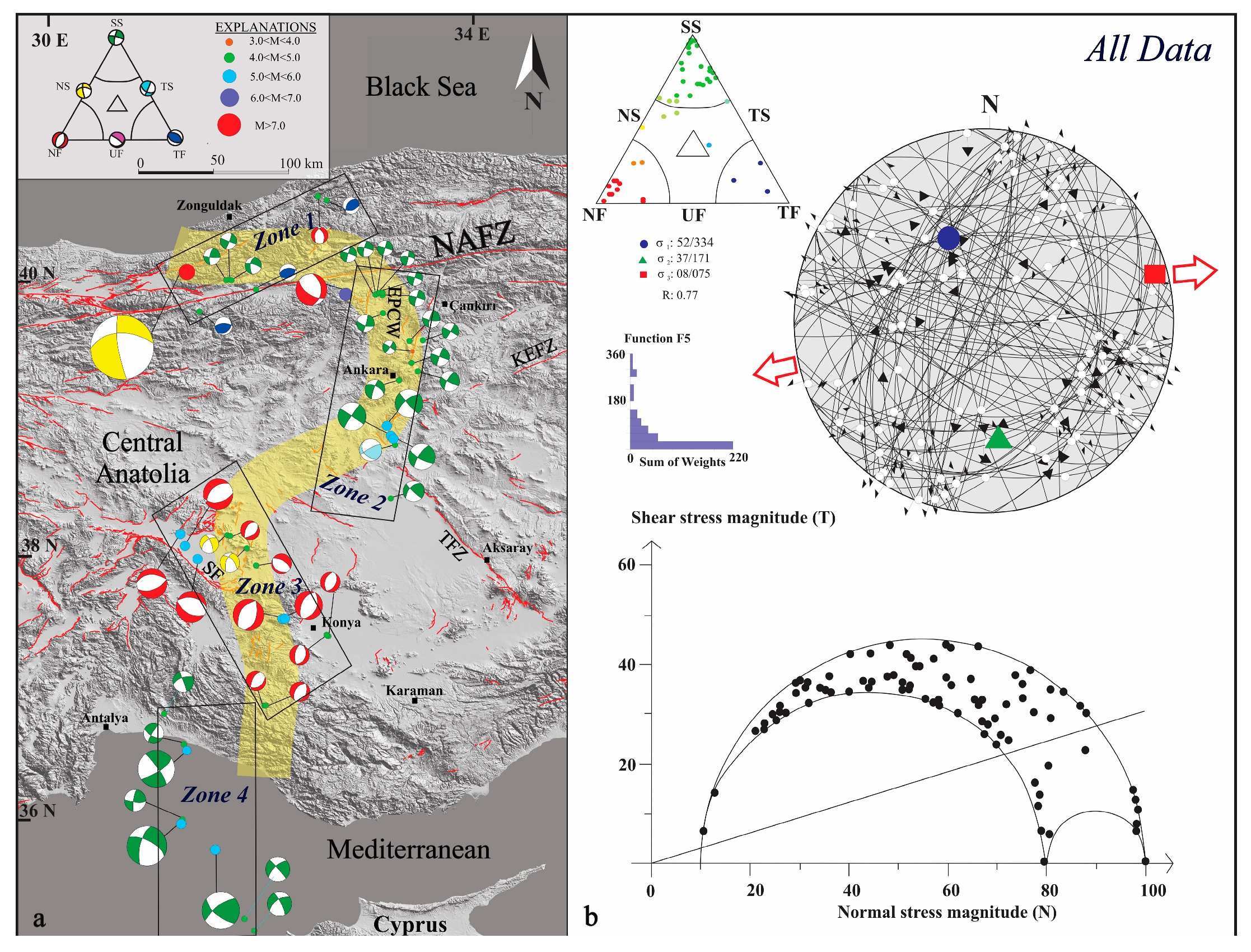
| Zone | Data | Used Data | σ1 | σ2 | σ3 | R’ | Tectonic Regime | SHmax | St. Dev. | α | QRfm |
|---|---|---|---|---|---|---|---|---|---|---|---|
| All | 86 | 86 | 52/334 | 37/171 | 08/075 | 0.77 | TT | 164 | 7.5 | 35 | C |
| Zone 1 | 16 | 16 | 01/340 | 88/102 | 02/250 | 1.55 | PS | 159 | 9.3 | 20.3 | C |
| Zone 2 | 36 | 36 | 01/340 | 86/237 | 04/070 | 1.53 | PS | 160 | 12.5 | 12.5 | B |
| Zone 3 | 22 | 22 | 83/172 | 06/023 | 04/293 | 0.43 | PE | 022 | 19.5 | 13.9 | B |
| Zone 4 | 14 | 14 | 65/236 | 02/331 | 25/062 | 0.90 | TT | 152 | 7.4 | 43 | C |
Disclaimer/Publisher’s Note: The statements, opinions and data contained in all publications are solely those of the individual author(s) and contributor(s) and not of MDPI and/or the editor(s). MDPI and/or the editor(s) disclaim responsibility for any injury to people or property resulting from any ideas, methods, instructions or products referred to in the content. |
© 2026 by the authors. Licensee MDPI, Basel, Switzerland. This article is an open access article distributed under the terms and conditions of the Creative Commons Attribution (CC BY) license.
Share and Cite
Kutoğlu, Ş.H.; Akgün, E.; Softa, M. Delineating the Central Anatolia Transition Zone (CATZ): Constraints from Integrated Geodetic (GNSS/InSAR) and Seismic Data. Sensors 2026, 26, 505. https://doi.org/10.3390/s26020505
Kutoğlu ŞH, Akgün E, Softa M. Delineating the Central Anatolia Transition Zone (CATZ): Constraints from Integrated Geodetic (GNSS/InSAR) and Seismic Data. Sensors. 2026; 26(2):505. https://doi.org/10.3390/s26020505
Chicago/Turabian StyleKutoğlu, Şenol Hakan, Elif Akgün, and Mustafa Softa. 2026. "Delineating the Central Anatolia Transition Zone (CATZ): Constraints from Integrated Geodetic (GNSS/InSAR) and Seismic Data" Sensors 26, no. 2: 505. https://doi.org/10.3390/s26020505
APA StyleKutoğlu, Ş. H., Akgün, E., & Softa, M. (2026). Delineating the Central Anatolia Transition Zone (CATZ): Constraints from Integrated Geodetic (GNSS/InSAR) and Seismic Data. Sensors, 26(2), 505. https://doi.org/10.3390/s26020505