


Highlights
What are the main findings?
- Heterostructures of Ti0.2V1.8C MXenes with metal oxides have been synthesized.
- Ti0.2V1.8C MXene/metal oxide composites have been tested as chemiresistive elements.
What are the implications of the main findings?
- The synthesis protocol for Ti0.2V1.8C MXene/metal oxide composites could be further scaled when developing sensor prototype units.
- The Ti0.2V1.8C MXene/metal oxide composites are shown as promising, versatile materials for designing multisensor arrays.
Abstract
Two-dimensional carbide crystals (MXenes) are emerging as a promising platform for the development of novel gas sensors, offering advantages in energy efficiency and tunable analyte selectivity. One of the most effective strategies to enhance and tailor their functional performance involves forming hetero-structured composites with metal oxides. In this work, we explore a chemiresistive effect in double-metal MXene of Ti0.2V1.8C and its composites with 2 mol. % SnO2 and Co3O4 nanocrystalline oxides toward feasibility tests with alcohol and ammonia vapor probes. The materials were characterized by simultaneous thermal analysis, X-ray diffraction analysis, Raman spectroscopy, and scanning/transmission electron microscopy. Gas-sensing experiments were carried out on composite layers deposited on multi-electrode substrates to be exposed to the test gases, 200–2000 ppm concentrations, at an operating temperature of 370 °C. The developed sensor array demonstrated clear analyte discrimination. The distinct sensor responses enabled a selective identification of vapors through linear discriminant analysis, demonstrating the further potential of MXene-based materials for integrated electronic nose applications.
Keywords:
MXene; chemiresistor; SnO2; Co3O4; V2O5; metal oxide; nanocomposite; synthesis; gas sensor; multisensor array 1. Introduction
The growing societal need to have on-site knowledge of environmental conditions, essential for human well-being, is driving intensive study efforts toward the development of portable electronic devices that are capable of sensing and processing such information [1]. One of the major challenges in this field is providing users with real-time insights into the surrounding gas compositions and concentrations of specific target analytes [2]. To address the task, gas sensors have become critical components, prompting extensive research and development activities in numerous laboratories [3,4,5].
Among various sensing technologies, chemiresistive gas sensors, primarily introduced in the 1950s, are recognized for their simplicity and efficiency across a wide range of applications [6,7]. Presently, commercially available chemiresistors typically utilize polycrystalline metal oxides as the active sensing material [8,9]. However, recent advances in materials science, especially through the emergence of nanotechnology, have enabled the design of materials with one-, two-, and three-dimensional ordered architectures [10,11,12]. These nano-engineered materials offer significant potential for sensor applications. Notably, structures with at least one nanoscale dimension, comparable to the Debye length, ensure efficient interaction with the surrounding atmosphere and enable effective transduction of surface charge variations into measurable changes in electrical resistance [13,14].
Within a family of low-dimensional nanostructures, (quasi)-two-dimensional (2D) sheets are especially promising for integration into microelectronic platforms, which are predominantly planar and suitable for mass-scale production [15]. The first discovery of graphene layers sparked considerable interest, demonstrating chemiresistive behavior with the remarkable sensitivity to detect even single-molecule adsorption events under vacuum conditions [16]. Inspired by graphene, a new class of 2D materials, known as MXenes, carbide or nitride planar crystals, was introduced in 2011 [17]. These materials feature a layered structure consisting of metal and carbon/nitrogen sheets, and their inherent structural versatility and surface functionalization capabilities make them highly attractive for various applications, particularly in energy storage, catalysis [18,19,20], and gas sensing [21,22].
To further tailor the functional properties of MXenes in line with established trends in semiconductor technologies, these structures are doped with other materials to manufacture complex composites with enhanced performance characteristics [23]. As highlighted in recent reviews [24,25], MXene-based composites often outperform their pristine counterparts. Notably, the secondary phase in these composites typically consists of wide-bandgap oxides, which may form either through the natural oxidation of MXenes during thermal treatment or by deliberate addition during synthesis [26]. Tin dioxide (SnO2), an n-type semiconductor widely used in commercial gas sensors, is among the most common additives to such heterostructures [27,28,29]. However, p-type oxides such as cobalt ones (Co3O4) have also emerged as promising candidates for further exploration [30]. Herein, we consider even a more complex structure derived by employing a double-metal MXene of Ti0.2V1.8C [31] to test its composite via combining with these distinctive oxide semiconductors, SnO2 and Co3O4, as a functional layer for gas sensors of chemiresistive type and on-chip multisensor array. The tin and cobalt oxide content of 2 mol.% was chosen based on the formation of corresponding composites, where these compounds would develop a thin layer of nanoparticles on the surface of the base material while retaining their electrical conductivity.
2. Materials and Methods
2.1. Synthesis and Characterization of Materials Under Study
For the synthesis of the initial reagents and composite of Ti0.2V1.8C MXene samples modified with 2 mol.% SnO2 and Co3O4, titanium powders (>99%, LLC Snabtekhmet, Moscow, Russia), vanadium (99.9%, 0.5–100 μm, LLC RusKhim, Russia), aluminum (≥98%, LLC RusKhim, Moscow, Russia), graphite (>99.99%, LLC Osobo chistye veshchestva, Russia), KBr (>99%, LLC RusKhim, Russia), hydrofluoric acid (50%, chemically pure, Micropur ULSI, Switzerland), hydrochloric acid HCl (>99%, LLC RusKhim, Russia), 1-butanol (>98%, LLC TD Khimmed, Russia), cobalt(II) nitrate hexahydrate Co(NO3)2·6H2O (>99%, LLC TD Khimmed, Russia), and urea CH4N2O (>99%, LLC TD Khimmed, Russia) were used.
The synthesis of Ti0.2V1.8C MXene follows the protocol that was described earlier [31]. In brief, the corresponding Ti0.2V1.8AlC MAX phase was obtained as the starting reagent by synthesis in a salt melt, n(Ti):n(V):n(Al):n(C) = 0.2:1.8:1.2:0.8, >99% purity at 1100 °C. The Ti0.2V1.8C sample was obtained by selective etching of aluminum from the Ti0.2V1.8AlC MAX phase using a mixture of concentrated hydrofluoric and hydrochloric acids in a 3:2 volumetric ratio for 90 h at a temperature of 90 ± 3 °C. The product was then washed with distilled water to a pH of 5–6, separated by centrifugation at 3500 rpm, and vacuum-dried at 80 °C.
The Ti0.2V1.8C sample was modified with nano-dispersed SnO2 according to the previously described algorithm [32,33] during the hydrothermal synthesis of tin dioxide in the presence of dispersed multilayered MXene. In general, hydrothermal conditions facilitate the formation of anisotropic nanostructures and develop the surface of the material, which is especially important when designing resistive-type gas sensors. By meeting the required parameters of the applied procedures, we could ensure that the electrical characteristics of the composite materials were in good agreement with the literature [34]. Specifically, a Ti0.2V1.8C dispersion in ethanol with a concentration of 10 g/L was introduced into the calculated volume of a SnCl2 solution diluted with hydrochloric acid, to which a 5% aqueous solution of NH3·H2O was then added until the pH reached 9. Hydrothermal synthesis was carried out in a 5 mL steel autoclave with a Teflon liner at a temperature of 120 °C for 1 h. The resulting solid product, Ti0.2V1.8C/SnO2, was separated by centrifugation, washed with distilled water to a pH of 5–6, and then washed once with ethanol.
The preparation of the Ti0.2V1.8C/Co3O4 composite is similar to that described for the decoration of Ti2C MXene, as reported elsewhere [35]. For this purpose, a Ti0.2V1.8C dispersion of 10 mg in 1 mL 1-butanol was introduced into the calculated volume of a 0.05 M solution of cobalt(II) nitrate and 0.25 M urea in ethanol. The resulting system was transferred to a 5 mL steel autoclave with a Teflon insert and hydrothermally treated at 160 °C for 1 h. The solid phase was separated by centrifugation and washed twice with ethyl alcohol.
The resulting composite powders of Ti0.2V1.8C/SnO2 and Ti0.2V1.8C/Co3O4 were dispersed in 1 mL of 1-butanol in an ultrasonic bath for 30 min. The derived dispersions were used as functional inks to obtain a receptor layer by microplotter printing. Sample drying was performed under vacuum conditions at a temperature of 80 °C.
The thermal behavior of the materials was studied using an SDT Q600 thermal analyzer (TA Instruments, New Castle, DE, USA) over a temperature range of 25–600 °C in an air flow of 250 mL/min with a heating rate of 10 degrees/min. In this case, during heating, the change in heat flow (differential scanning calorimetry analysis, DSC) and the mass of the analyzed sample (thermogravimetric analysis, TGA) were synchronously registered.
X-ray diffraction (XRD) analysis of the films, based on the materials under study, was performed with a D8-Advance diffractometer (Bruker, Billerica, MA, USA), CuKα radiation of 1.5418 Å wavelength, upon applying the Ni filter with the following parameters: E = 40 kV, I = 40 mA, signal accumulation time of 1.0 s/point, resolution of 0.06°, and 2θ range of 5–70°.
The microstructure was investigated using transmission electron microscopy (TEM; Jeol JEM-1011 microscope (Jeol Ltd., Tokyo, Japan) equipped with an Orius SC1000W digital camera) and scanning electron microscopy (SEM; Tescan Amber microscope, Tescan, s.r.o., Brno, Czech Republic). The chemical composition of the materials obtained after synthesis and heat treatment was analyzed using energy-dispersive X-ray spectroscopy (EDS, Ultim MAX EDS detector with an active crystal area of 100 mm2, Oxford Instruments Group, Oxfordshire, UK).
Raman spectra were recorded using a Confotec NR500 confocal Raman microscope (SOL Instruments, Augsburg, Germany) with a laser excitation wavelength of 532 nm, diffraction grating of 600 lines/mm, ×20 objective, and NA = 0.50.
2.2. Gas-Sensing Characterization of On-Chip Sensor Elements
To assess the chemiresistive performance of MXene/metal oxide heterostructures, suspensions of the active materials (5 wt.%) were printed onto Si/SiO2 substrates equipped with multiple co-planar strip Pt electrodes [36] of a 50 μm width and 1 μm thickness using a microplotter. The materials under study were deposited to ensure the presence of percolation tracks of the nanosheet particles in the layer between the electrodes. The fabricated structures included pure Ti0.2V1.8C as a reference and its composites containing 2 mol.% of either SnO2 or Co3O4. The chips, 9 × 10 × 0.38 mm3, also featured the integrated meander-type Pt heaters and thermoresistors.
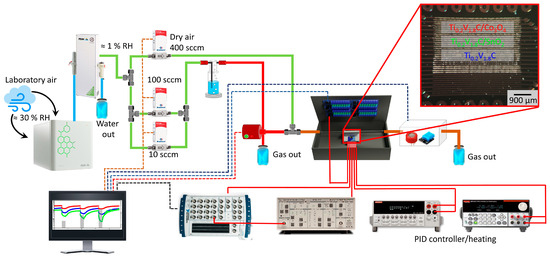
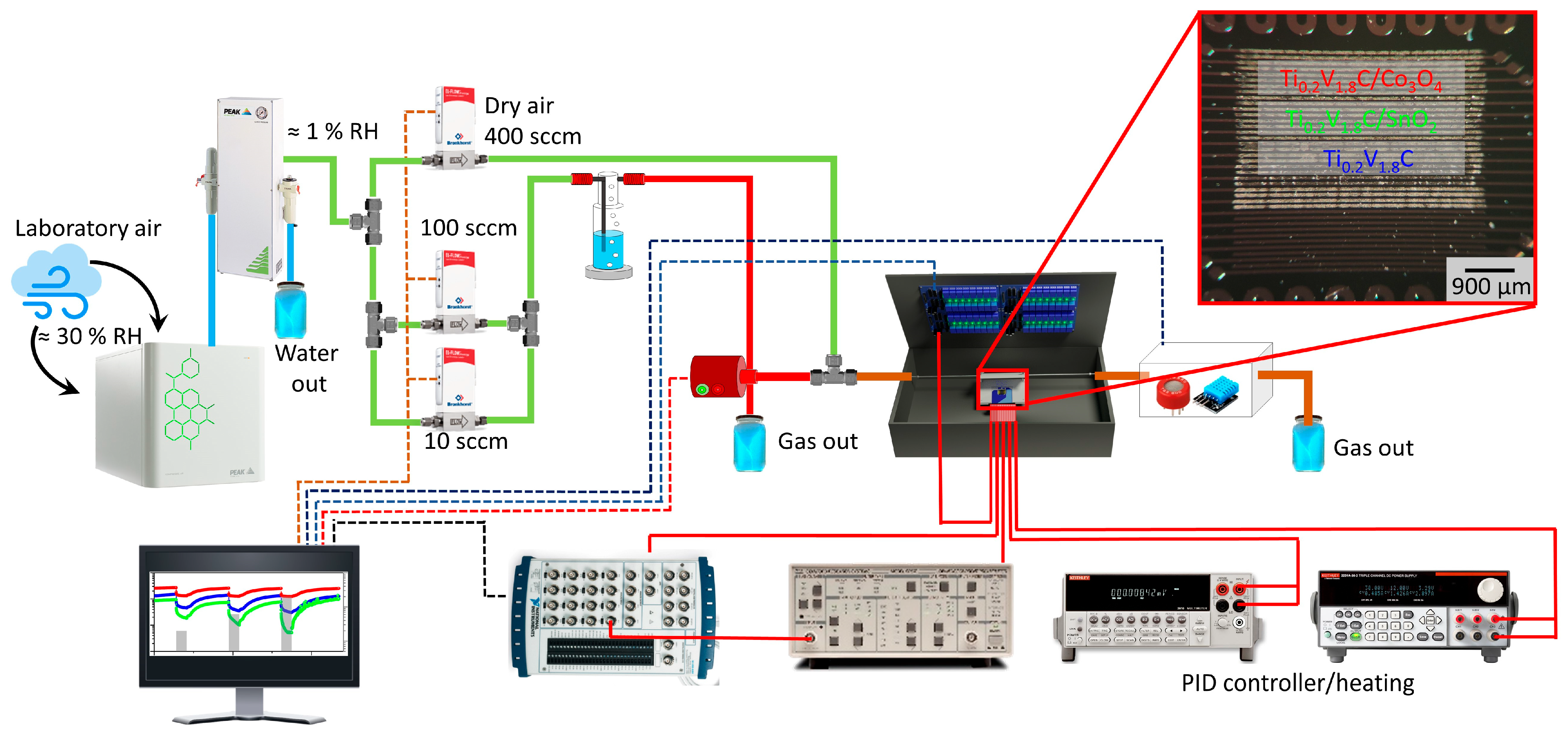
The assembled sensor chips were mounted within a sealed stainless steel chamber designed for dynamic gas-flow experiments. The scheme of the entire experimental setup is shown in Figure 1. Dried laboratory air, with a humidity level below 200 ppm, was supplied at a rate of 400 sccm using a dry-air generator (Peak Purge PG14L, Peak Scientific Instruments, Glasgow, UK) and an air compressor (Precision Compressed Air 230B, Peak Scientific Instruments, Glasgow, UK). This flow was split into two paths: one directed through bubblers containing aqueous solutions of the target analytes—methanol, ethanol, butanol, and 20% aqueous ammonia —and the other serving as a dilution reference. Analyte concentrations of the volatile organic compounds (VOCs) were precisely regulated at a 200–2000 ppm range using mass-flow controllers (Bronkhorst, Ruurlo, The Netherlands). Gas composition was validated by an auxiliary commercial sensor (MQ-3, Shenzhen, China) and a hygrometer (DHT AM2302, Shenzhen, China) at the gas exit to confirm the presence/intensity of VOC and humidity levels, respectively.
Figure 1.
The experimental setup to measure the chemiresistive effect in MXene/metal oxide composite-based sensor chips. The dashed and solid red/blue lines indicate electrical connections between the units.
Electrical measurements were performed under a constant 5 V of d.c. bias using a custom-built acquisition system. I–V characteristics were recorded in the range of [−5, +5] V in 0.5 V increments. On-chip sensor elements were sequentially addressed using an analog multiplexer (SRD-05VDC-SL-C, Songle Relay®, Yuyao City, China), and current responses were amplified and digitized via a preamplifier (SRS570, Stanford Research System, Sunnyvale, CA, USA) wired to the input/output multi-pin module (NI-DAQ USB-6259, National Instruments, Austin, TX, USA) to measure the resistance of the on-chip material between each pair of electrodes. The temperature was maintained up to 370 °C using Keithley instruments (2230-30-1 current source, 2000 multimeter, Solon, OH, USA) with 2.4 W of maximum power consumption. The entire equipment was controlled by a personal computer under LabView@ software (LabView Full Development System with Application builder, ver. 2020 SP1, National Instruments Co., Austin, TX, USA).
3. Results and Discussion
3.1. Results of Physical Characterization of the Materials
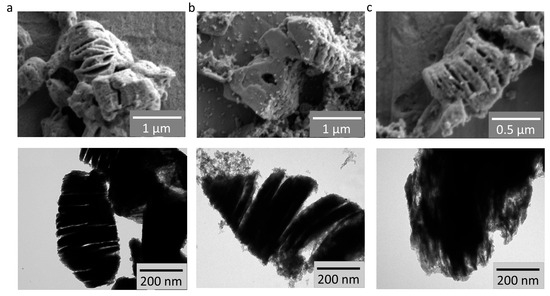
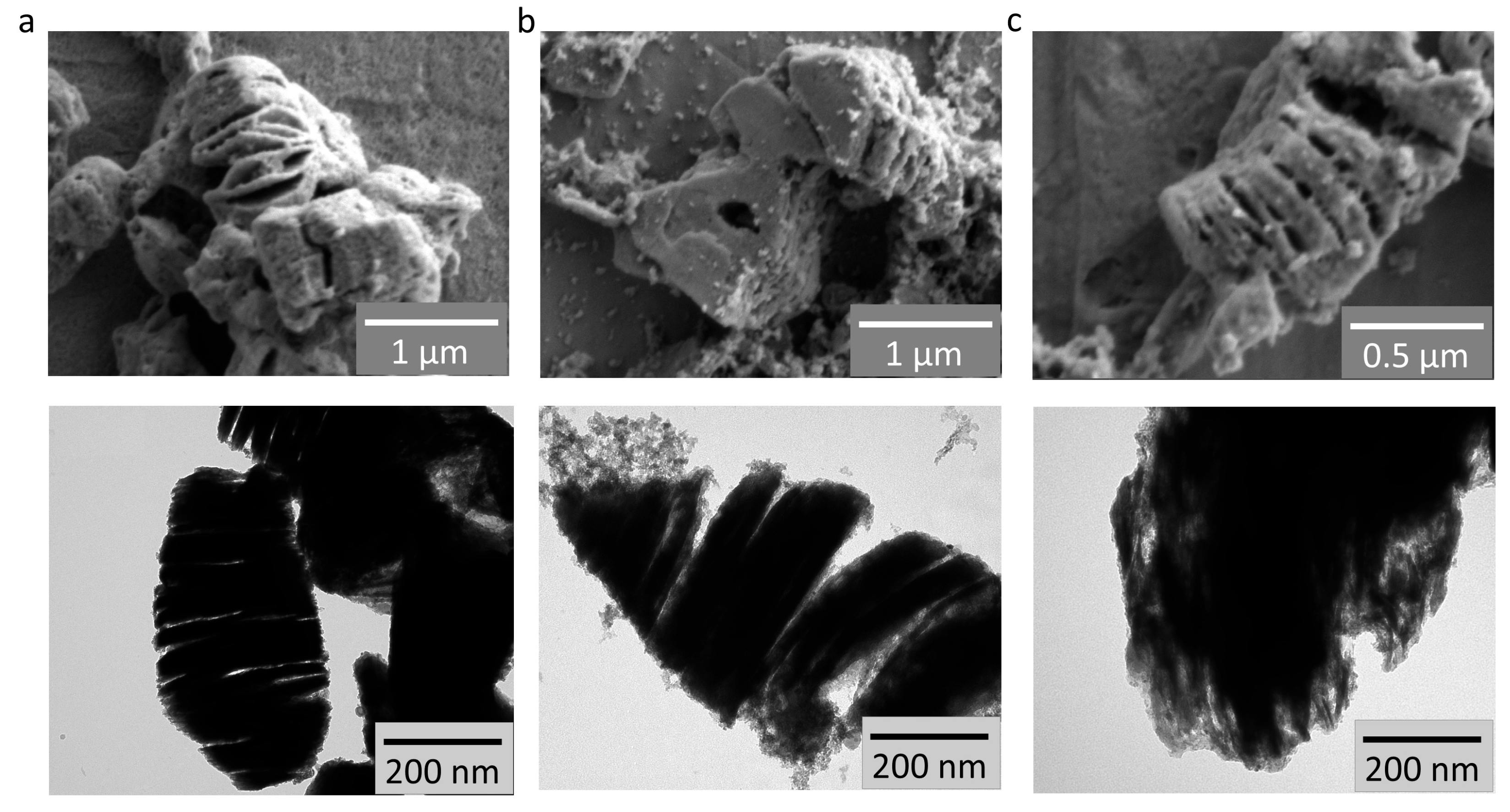
For further evaluation, identical films based on the materials under study were formed on glass substrates, which were subsequently heat-treated at 370 °C for 2 h under an air environment. SEM and TEM images for all samples confirmed the layered structure inherited from Ti0.2V1.8C MXene (Figure 2). Additionally, the formation of smaller particles related to the corresponding dopants in Ti0.2V1.8C/SnO2 and Ti0.2V1.8C/Co3O4 composites was observed on the surface of quasi-two-dimensional structures.
Figure 2.
The scanning and transmission of electronic images taken from three samples of Ti0.2V1.8C (a), Ti0.2V1.8C/SnO2 (b), and Ti0.2V1.8C/Co3O4 composites (c).
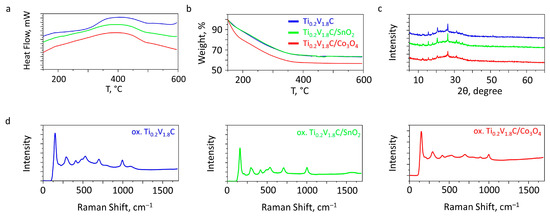
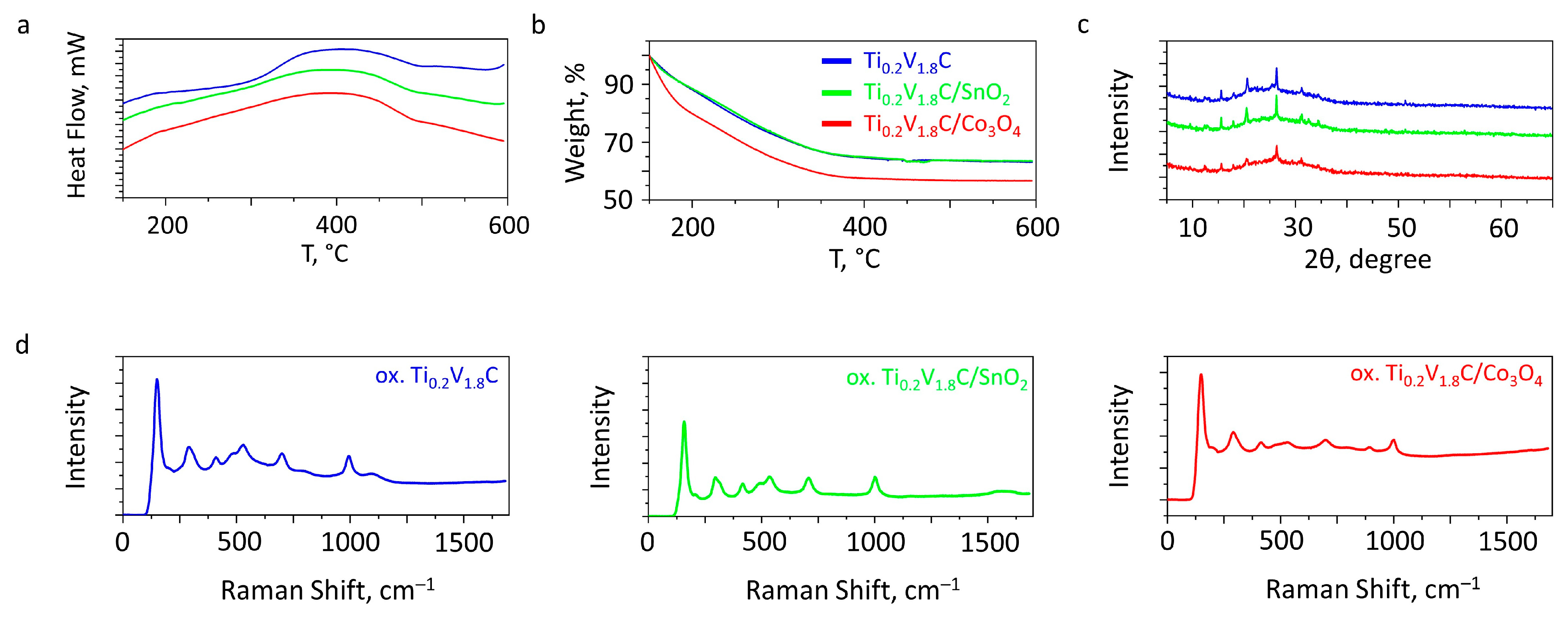
Synchronous thermal analysis data indicate that the oxidation process, characterized by an energy release (Figure 3a) and mass loss (Figure 3b), is nearly complete when the materials are heated in air up to 370 °C. The results of the XRD analysis (Figure 3c) and Raman spectroscopy (Figure 3d) of the materials after heat treatment at 370 °C indicate the formation of vanadium (V) oxide as the major component, in good agreement with the thermal analysis data. Thus, a set of reflections located near 15.6°, 20.6°, 26.3°, and 31.2°, corresponding to the {200}, {001}, {110}, and {301} crystallographic planes, respectively, can be observed in the X-ray diffractograms. This diffraction pattern is characteristic of the presence of orthorhombic-structured V2O5 [37]. A low-intensity signal near 12.5° can be associated with the presence of a minor Ti0.2V1.8AlC MAX phase impurity [38]. In all cases, the Raman spectra exhibit modes at around 149, 202, 291, 414, 489, 529, 698, and 1001 cm−1, which are related to the bending and stretching vibration of the vanadium (V) oxide bonds. The presence of an additional signal at around 891 cm−1 may be due to the existence of the amorphous V2O5 phase in the material composition [39].
Figure 3.
The physical characterization of three layers of Ti0.2V1.8C, Ti0.2V1.8C/SnO2, and Ti0.2V1.8C/Co3O4: (a) DSC, (b) TGA, (c) XRD analysis, and (d) Raman spectroscopy.
3.2. Results of Gas-Sensing Characterization of On-Chip Sensor Elements
The initial measurements at room temperature revealed a negligible chemiresistive response of all three MXene composite structures to VOC analytes, prompting heating up to 370 °C, which is known to properly activate metal oxides for observing a chemiresistive effect [40].
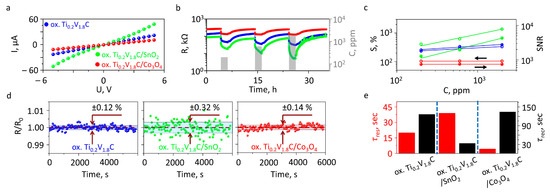
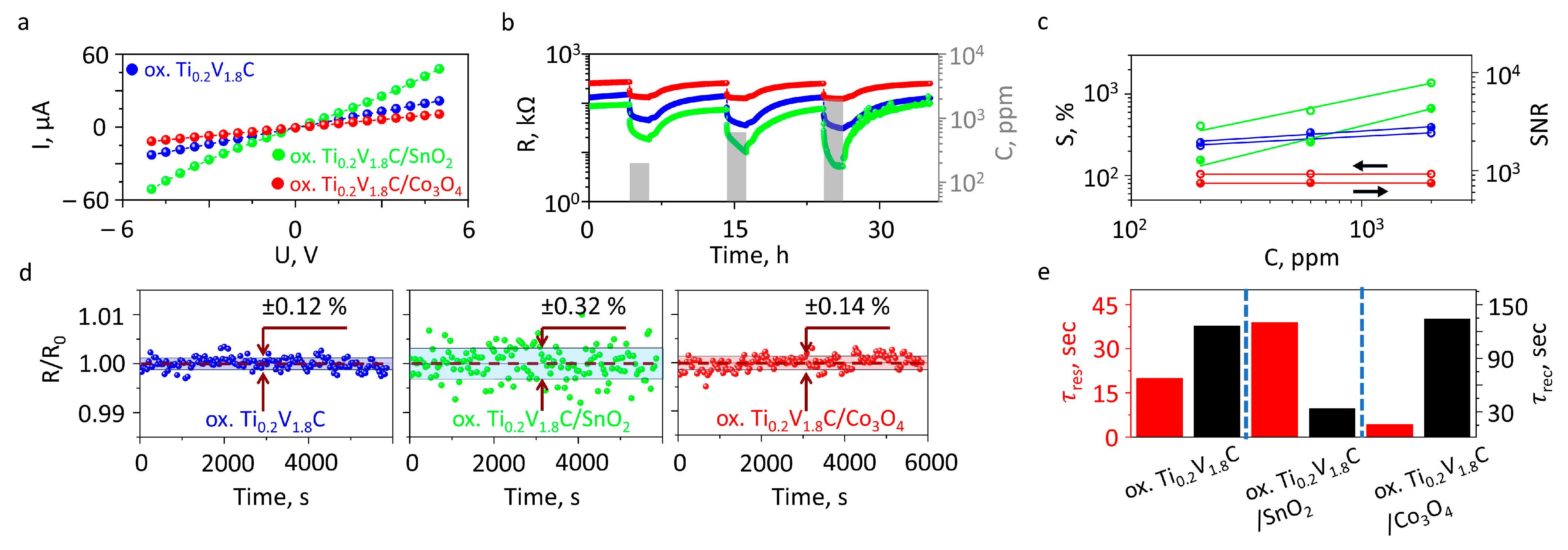
Under these conditions, partial oxidation of Ti0.2V1.8C into Ti0.2V1.8C/V2O5 was confirmed according to the results given in Section 3.1 in accordance with previous findings [41]. The I–V curves for all the materials displayed Ohmic behavior, with a power law , where exponents b were equal to 1.04 (ox. Ti0.2V1.8C), 1.07 (Ti0.2V1.8C/Co3O4), and 1.20 (Ti0.2V1.8C /SnO2), indicating minimal potential barriers at the electrode interfaces.
During gas exposure tests, resistance changes were monitored over a 2 h exposure period followed by an 8 h air purging of the tubes/camera. The resistance of all the sensor elements in the on-chip array varied in the range of hundreds of kOhm to suit ordinary electronic reading schemes in accordance with the I–V measurements. The typical R(t) transients recorded upon interaction with ethanol vapors are drawn in Figure 4b.
Figure 4.
Electrical/chemiresistive characterization of three layers of oxidized Ti0.2V1.8C, Ti0.2V1.8C/SnO2, and Ti0.2V1.8C/Co3O4 as a part of multi-electrode chip: (a) I–V curves; (b) R(t) transients recorded upon exposure to ethanol vapors, of various concentrations; (c) chemiresistive response and signal-to-noise ratio (SNR) versus ethanol concentration; (d) resistive noise; (e) characteristic response/recovery times.
As one can see, the low-noise resistance reproducibly changes following the adsorption of analyte molecules. It is worth noting here that the alcohol VOCs forced the resistance of all three hetero materials to go down, while ammonia resulted in increasing resistance. The observed differences are attributed to the complex nature of the composites under study, where all the elements synergistically contribute to the integral chemiresistive effect [42,43,44]. The higher concentration of the analytes leads to a greater chemiresistive response that is calculated as a relative change of resistance:
where Ggas and Gair are the sensor conductance recorded upon exposure to gas analytes and background air, respectively. The derived empirical dependencies of S versus analyte concentration recorded for all three composite samples followed a power law, , to be consistent with the Freundlich isotherm.
The coefficients of n, characterizing the interaction between the hetero materials under study and analytes, are collected and shown in Table 1. As one can see, these values vary in a wide range, demonstrating significant variations among the MXene composites. These variations clearly arise from the formation of heterojunctions between the MXene structure and the oxides, which can be primarily attributed to the differences in the work functions of the interfaced materials [45,46,47].
Table 1.
The power law index, n, extracted from the dependence the dependence of the chemiresistive response of three composite materials versus an analyte concentration in the 200–2000 ppm range.
The nature of the junctions, potential barrier magnitude, and induced charge transfer that occurred in these contacts require further thorough fundamental study. However, from a practice viewpoint, the observed variations are crucial when considering the layers to constitute a multisensor array for selective gas recognition, as we discuss further.
Another sensor characteristic, necessary for any practice application, is a signal-to-noise ratio (SNR), which is calculated as
where S is a chemiresistive response, is the standard deviation of resistance R, and Rmed is the median resistance value taken in a stabilized R(t) curve.
We have estimated the resistive noise in the sensor elements of the three MXene/metal oxide composites, primarily in the dry-air conditions. These data are given in Figure 4d. The lowest noise is observed in oxidized Ti0.2V1.8C MXene, where the resistance variation is ca. 0.12% relative to a median resistance, and the addition of cobalt oxide, 2 mol. %, into this MXene resulted in a slight enhancing of the noise to reach ca. 0.14%. In contrast, tin dioxide introduced a more significant increase in the noise—up to values of ca. 0.32%—which possibly reflects larger barriers appearing in MXene/metal oxide heterojunctions due to the differences in work functions of these materials. Interestingly, these observations correlate with the I–V behavior of these materials (Figure 4a), where the most significant curve bending is for the MXene/SnO2 composite.
Accounting for the noise data, we extracted SNR values, which were plotted in Figure 4c. In the measured concentration range of analytes, 200–2000 ppm, SNR data characterizing all the test gases significantly exceeded 3 un., which is considered to be minimum for the practical use of sensors. In addition, the graph shows that a lower noise yields the oxidized MXene of Ti0.2V1.8C to have a higher SNR, although its chemiresistive response is lower when compared to the Ti0.2V1.8C/SnO2 composite.
Furthermore, we have analyzed the response and recovery times as
where G0 and G(t) are the conductivity of the sensor element in the background atmosphere and the presence of analyte vapors, respectively, and tres and trec are the response and recovery times.
These derived values for the three samples under study are plotted in Figure 4e to lie in a minute range. We may note that the sample of Ti0.2V1.8C/SnO2 is characterized by an increased response time and reduced recovery time when compared to the oxidized Ti0.2V1.8C MXene structures. At the same time, the Ti0.2V1.8C/Co3O4 sample has the lowest response time, of ca. 3.8 s, but the highest recovery time. These features require a further thorough investigation to possibly derive them from variations in the adsorption energy of various analytes over the hetero-structured composites under study.
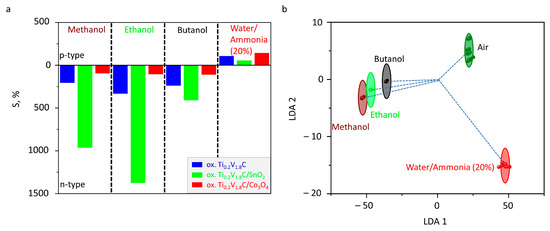
Comparing the chemiresistive responses of these three composite structures toward test analytes (Figure 5a), we should note that oxide additives significantly affect the selectivity. An addition of SnO2 enhances the composite response to alcohols but surpasses it to ammonia vapors, whereas Co3O4 promotes an opposite behavior, advancing a response to ammonia and lowering it to alcohols. Accounting for observed noise data, the latter one indicates an improvement in sensitivity and a limit of detection in the Ti0.2V1.8C/Co3O4 sample. These complementary behaviors support utilizing the sensor array to be composed of layers derived from various composites to broaden detection capabilities.
Figure 5.
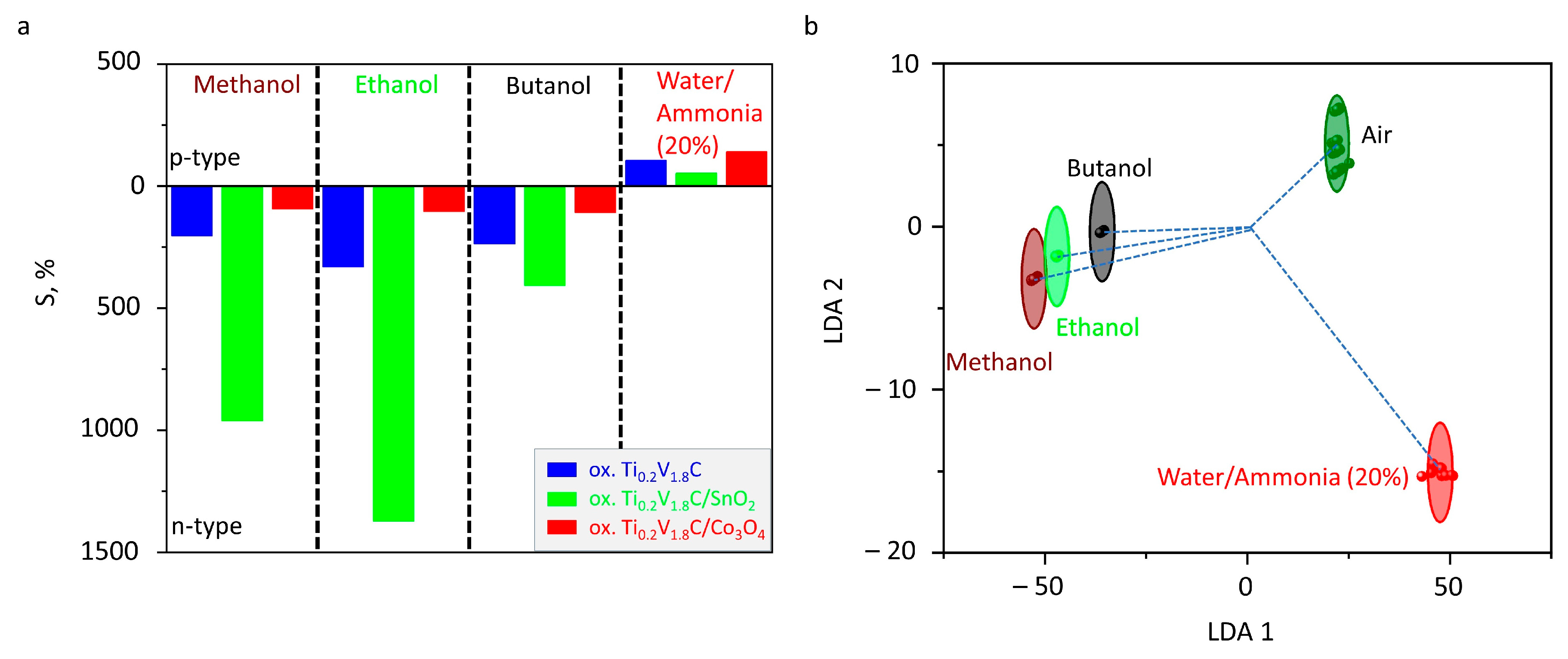
Gas selectivity performance of three layers of oxidized Ti0.2V1.8C, Ti0.2V1.8C/SnO2, and Ti0.2V1.8C/Co3O4 to alcohols and NH3 (2000 ppm concentration) as a part of a multi-electrode chip: (a) chemiresistive response and (b) the results of linear discriminant analysis; points are empirical vector responses, and ellipses frame the scatter of in-class data under a Gaussian distribution with a 0.9 confidence level.
Altogether, the variations in selectivity observed throughout various composite layers in the on-chip sensor elements yield one option to employ it in the framework of multisensor array analysis according to the electronic nose concept [48]. With this purpose, we have applied linear discriminant analysis (LDA) to process the on-chip array response to test analytes. This technique transfers the original multidimensional data to the (N-1)-dimensional space, where N is the number of analytes to recognize [49].
The analyte distinction features extracted by the method are placed along axes called LDA components. Figure 5b shows the 2D projection of the entire 4D LDA space built following processing of the MXene/metal oxide composite-based on-chip multisensor array. As one can see, the vector responses to various analytes (2000 ppm concentration) are clustered in distinguished spots of the LDA space so as to be distanced from each other and the center of the coordinate system. We have circled these areas around gravity centers under a Gaussian distribution of in-class data with a 0.9 confidence level [50]. It allows one to selectively identify the test gas by eye or via conventional machine learning algorithms.
4. Conclusions
This work demonstrates the potential of Ti0.2V1.8C-based MXene composites with SnO2 and Co3O4 for the selective detection of VOCs and ammonia, as exemplary analytes, via chemiresistive sensing. An elevated temperature operation of about 370 °C enables the activation of oxide components and oxidation of MXene to V2O5-rich structures, enhancing the gas response. While SnO2 increases sensitivity to alcohols, Co3O4 favors ammonia detection; both modifications impact the noise characteristics and kinetics of sensor response. Integration of these materials into a single chip enables analyte discrimination using linear discriminant analysis, confirming their applicability in electronic nose systems for environmental monitoring, industrial safety, or medical diagnostics. However, further research is required (i) to advance protocols for depositing composite materials over commercially available chip-based platforms in frames of state-of-art mass-scaled microelectronic technologies, (ii) clarify the number of analyte gases that are capable of detection with the help of materials beyond ones that are probed in this feasibility study, and (iii) test the long-term stability of the material’s response under normal and harsh air conditions in order to ascertain their constraints when compared to other known sensor-based materials.
Author Contributions
Conceptualization, I.A.P., N.P.S. and V.V.S.; methodology, I.A.P., N.P.S. and N.T.K.; formal analysis, I.A.P., N.P.S., E.P.S. and N.T.K.; investigation, I.A.P., N.P.S., T.L.S., A.S.V. and M.A.S.; writing—original draft preparation, I.A.P., N.P.S. and V.V.S.; writing—review and editing, I.A.P., N.P.S. and V.V.S. All authors have read and agreed to the published version of the manuscript.
Funding
This research received no external funding.
Institutional Review Board Statement
Not applicable.
Informed Consent Statement
Not applicable.
Data Availability Statement
The raw data supporting the conclusions of this article will be made available by the authors upon request.
Conflicts of Interest
The authors declare no conflicts of interest.
References
- Lewis, A.; Edwards, P. Validate personal air-pollution sensors. Nature 2016, 535, 29–31. [Google Scholar] [CrossRef] [Scilit] [PubMed]
- Silva-Neto, H.A.; da Silva Sousa, D.; Duarte, L.C.; da Silveira Petruci, J.F.; Coltro, W.K.T. Recent developments on aerial lab-on-a-drone platforms for remote environmental monitoring: A review. Anal. Chim. Acta 2025, 1337, 343544. [Google Scholar] [CrossRef] [Scilit] [PubMed]
- Soroka, T.; Ravia, A.; Snitz, K.; Honigstein, D.; Weissbrod, A.; Gorodisky, L.; Weiss, T.; Perl, O.; Sobel, N. Humans have nasal respiratory fingerprints. Curr. Biol. 2025, 35, 3011–3021. [Google Scholar] [CrossRef] [Scilit] [PubMed]
- Cho, Y.-H.; Kim, D.-S.; Seo, J.H.; Chung, J.H.; Park, Z.; Kwon, K.C.; Ko, J.-K.; Ha, T.W.; Lee, J.-O.; Kim, G.-L.; et al. Artificial olfactory system enabled by ultralow chemical sensing variations of 1D SnO2 nanoarchitectures. Adv. Sci. 2025, 12, 2501293. [Google Scholar] [CrossRef] [Scilit]
- Khorramifar, A.; Karami, H.; Lvova, L.; Kolouri, A.; Łazuka, E.; Piłat-Rożek, M.; Łagód, G.; Ramos, J.; Lozano, J.; Kaveh, M.; et al. Environmental engineering applications of electronic nose systems based on MOX gas sensors. Sensors 2023, 2312, 5716. [Google Scholar] [CrossRef] [Scilit]
- Dutta, T.; Noushin, T.; Tabassum, S.; Mishra, S.K. Road map of semiconductor metal-oxide-based sensors: A review. Sensors 2023, 23, 6849. [Google Scholar] [CrossRef] [Scilit]
- Turlybekuly, A.; Shynybekov, Y.; Soltabayev, B.; Yergaliuly, G.; Mentbayeva, A. The Cross-sensitivity of chemiresistive gas sensors: Nature, methods, and peculiarities: A systematic review. ACS Sens. 2024, 9, 6358–6371. [Google Scholar] [CrossRef] [Scilit]
- Korotcenkov, G. II–VI Semiconductor-based conductometric gas sensors: Is there a future for these sensors? Sensors 2024, 24, 3861. [Google Scholar] [CrossRef] [Scilit]
- Kumar, A.; Mazumder, J.T.; Joyen, K.; Favier, F.; Mirzaei, A.; Kim, J.-Y.; Kwoka, M.; Bechelany, M.; Jha, R.K.; Kumar, M.; et al. Defect engineering approaches for metal oxide semiconductor-based chemiresistive gas sensing. Coord. Chem. Rev. 2025, 541, 216836. [Google Scholar] [CrossRef] [Scilit]
- Qu, L.; Xu, Y.; Cui, W.; Wu, L.; Feng, Y.; Gu, Y.; Pan, H. Trends in conductive MOFs for sensing: A review. Anal. Chim. Acta 2025, 1336, 343307. [Google Scholar] [CrossRef] [Scilit]
- Kumar, S.; Mehdi, S.M.Z.; Seo, Y. 1D MXenes: Synthesis, properties, and applications. Small 2024, 20, 2405576. [Google Scholar] [CrossRef] [Scilit]
- Ding, G.; Li, H.; Zhao, J.; Zhou, K.; Zhai, Y.; Lv, Z.; Zhang, M.; Yan, Y.; Han, S.-T.; Zhou, Y. Nanomaterials for flexible neuromorphics. Chem. Rev. 2024, 124, 12738–12843. [Google Scholar] [CrossRef] [Scilit]
- Kissine, V.V.; Sysoev, V.V.; Voroshilov, S.A. Conductivity of SnO2 thin films in the presence of surface adsorbed species. Sens. Actuators B 2001, 79, 163–170. [Google Scholar] [CrossRef] [Scilit]
- Mirzaei, A.; Kim, J.-H.; Kim, H.W.; Kim, S.S. How shell thickness can affect the gas sensing properties of nanostructured materials: Survey of literature. Sens. Actuators B 2018, 258, 270–294. [Google Scholar] [CrossRef] [Scilit]
- Mas-Ballesté, R.; Gómez-Navarro, C.; Gómez-Herrero, J.; Zamora, F. 2D materials: To graphene and beyond. Nanoscale 2011, 3, 20–30. [Google Scholar] [CrossRef] [Scilit]
- Schedin, F.; Geim, A.K.; Morozov, S.V.; Hill, E.W.; Blake, P.; Katsnelson, M.I.; Novoselov, K.S. Detection of individual gas molecules adsorbed on graphene. Nat. Mater. 2007, 6, 652–655. [Google Scholar] [CrossRef] [Scilit] [PubMed]
- Naguib, M.; Mochalin, V.N.; Barsoum, M.W.; Gogotsi, Y. 25th anniversary article: MXenes: A new family of two-dimensional materials. Adv. Mater. 2014, 26, 992–1005. [Google Scholar] [CrossRef] [Scilit] [PubMed]
- Ali, R.; Islam, M.; Shafi, M.; Ali, S.; Wang, H.-E. Developments and prospects of MXenes for energy storage and environmental sustainability. Coord. Chem. Rev. 2025, 540, 216797. [Google Scholar] [CrossRef] [Scilit]
- Bi, W.; Gao, G.; Li, C.; Wu, G.; Cao, G. Synthesis, properties, and applications of MXenes and their composites for electrical energy storage. Prog. Mater. Sci. 2024, 142, 101227. [Google Scholar] [CrossRef] [Scilit]
- Liu, X.; Xu, F.; Li, Z.; Liu, Z.; Yang, W.; Zhang, Y.; Fan, H.; Yang, H.Y. Design strategy for MXene and metal chalcogenides/oxides hybrids for supercapacitors, secondary batteries and electro/photocatalysis. Coord. Chem. Rev. 2022, 464, 214544. [Google Scholar] [CrossRef] [Scilit]
- Simonenko, E.P.; Simonenko, N.P.; Mokrushin, A.S.; Simonenko, T.L.; Gorobtsov, P.Y.; Nagornov, I.A.; Korotcenkov, G.; Sysoev, V.V.; Kuznetsov, N.T. Application of titanium carbide MXenes in chemiresistive gas sensors. Nanomaterials 2023, 13, 850. [Google Scholar] [CrossRef] [Scilit]
- Kumar, P.; Raza, W.; Suganthi, S.; Khan, M.Q.; Ahmad, K.; Oh, T.H. Recent progress in MXenes-based materials for gas sensors and photodetectors. Chemosensors 2024, 12, 147. [Google Scholar] [CrossRef] [Scilit]
- Dananjaya, V.; Hansika, N.; Marimuthu, S.; Chevali, V.; Mishra, Y.K.; Grace, A.N.; Salim, N.; Abeykoon, C. MXenes and its composite structures: Synthesis, properties, applications, 3D/4D printing, and artificial intelligence; machine learning integration. Prog. Mater. Sci. 2025, 152, 101433. [Google Scholar] [CrossRef] [Scilit]
- Ahmad, N.; Rasheed, S.; Mohyuddin, A.; Fatima, B.; Nabeel, M.I.; Riaz, M.T.; Najam-ul-Haq, M.; Hussain, D. 2D MXenes and their composites; design, synthesis, and environmental sensing applications. Chemosphere 2024, 352, 141280. [Google Scholar] [CrossRef] [Scilit]
- Xu, J.; Li, Y.; Yan, F. Constructed MXene matrix composites as sensing material and applications thereof: A review. Anal. Chim. Acta 2024, 1288, 342027. [Google Scholar] [CrossRef] [Scilit] [PubMed]
- Wang, Y.; Wang, Y.; Jian, M.; Jiang, Q.; Li, X. MXene key composites: A new arena for gas sensors. Nano-Micro Lett. 2024, 16, 209. [Google Scholar] [CrossRef] [Scilit]
- Ding, Y.; Luo, Y.; Huang, C.; Gu, S.; Du, B.; Dong, Y.; Shi, Y.; Liu, H.; Horprathum, M.; Hu, W.; et al. MOF-derived NiO-SnO2/Ti3C2Tx composite materials for detection of ppb-Level NO2 at room temperature. ACS Appl. Nano Mater. 2025, 8, 8927–8936. [Google Scholar] [CrossRef] [Scilit]
- Mei, Z.; Song, Y.; Jiang, G.; Wu, D.; Li, G. SnO2/ZnO/Ti3C2Tx MXene nanocomposites for highly sensitive and stable ethanol sensing at low temperature. Sens. Actuators B 2024, 419, 136390. [Google Scholar] [CrossRef] [Scilit]
- Zhu, X.; Li, J.; Chang, X.; Gao, W.; Chen, X.; Niu, S.; Sun, S. Room temperature gas sensors for NH3 detection based on SnO2 films and lamellar-structured Ti3C2Tx MXene heterojunction nanocomposites. Appl. Surf. Sci. 2024, 660, 159976. [Google Scholar] [CrossRef] [Scilit]
- Sun, B.; Qin, F.; Jiang, L.; Gao, J.; Liu, Z.; Wang, J.; Zhang, Y.; Fan, J.; Kan, K.; Shi, K. Room-temperature gas sensors based on three-dimensional Co3O4/Al2O3@Ti3C2Tx MXene nanocomposite for highly sensitive NOx detection. Sens. Actuators B 2022, 368, 132206. [Google Scholar] [CrossRef] [Scilit]
- Simonenko, N.P.; Glukhova, O.E.; Plugin, I.A.; Kolosov, D.A.; Nagornov, I.A.; Simonenko, T.L.; Varezhnikov, A.S.; Simonenko, E.P.; Sysoev, V.V.; Kuznetsov, N.T. The Ti0.2V1.8C MXene ink-prepared chemiresistor: From theory to tests with humidity versus VOCs. Chemosensors 2023, 11, 7. [Google Scholar] [CrossRef] [Scilit]
- Simonenko, E.P.; Mokrushin, A.S.; Nagornov, I.A.; Dmitrieva, S.A.; Simonenko, T.L.; Simonenko, N.P.; Kuznetsov, N.T. Preparation and chemosensory properties of composite material Ti2CTx–10 mol % SnO2. Russ. J. Inorg. Chem. 2024, 69, 1587–1595. [Google Scholar] [CrossRef] [Scilit]
- Simonenko, E.P.; Mokrushin, A.S.; Nagornov, I.A.; Gorban, Y.M.; Simonenko, T.L.; Simonenko, N.P.; Kuznetsov, N.T. Chemosensory properties of nanocomposite Ti0.2V1.8CTx–V2O5–SnO2. Russ. J. Inorg. Chem. 2024, 69, 1454–1462. [Google Scholar] [CrossRef] [Scilit]
- Cai, Z.; Kim, H. Recent advances in MXene gas sensors: Synthesis, composites, and mechanisms. npj 2D Mater. Appl. 2025, 9, 66. [Google Scholar] [CrossRef] [Scilit]
- Simonenko, E.P.; Mokrushin, A.S.; Nagornov, I.A.; Dmitrieva, S.A.; Simonenko, T.L.; Simonenko, N.P.; Kuznetsov, N.T. Preparation and chemosensory properties of nanocomposite obtained by hydrothermal modification of Ti2CTx with hierarchically organized Co(CO3)0.5(OH)⋅0.11H2O. Russ. J. Inorg. Chem. 2024, 69, 1291–1300. [Google Scholar] [CrossRef] [Scilit]
- Rabchinskii, M.K.; Sysoev, V.V.; Varezhnikov, A.S.; Solomatin, M.A.; Struchkov, N.S.; Stolyarova, D.Y.; Ryzhkov, S.A.; Antonov, G.A.; Gabrelian, V.S.; Cherviakova, P.D.; et al. Toward On-Chip Multisensor Arrays for Selective Methanol and Ethanol Detection at Room Temperature: Capitalizing the Graphene Carbonylation. ACS Appl. Mater. Interfaces 2023, 15, 28370–28386. [Google Scholar] [CrossRef] [Scilit]
- Xiao, Y.; Pan, M.; Zou, J.; Guo, R.; Zeng, X.; Ding, W. Surfactant induced formation of flower-like V2O5 microspheres as cathode materials for rechargeable magnesium batteries. Ionics 2019, 25, 5889–5897. [Google Scholar] [CrossRef] [Scilit]
- Liu, F.; Zhou, A.; Chen, J.; Zhang, H.; Cao, J.; Wang, L.; Hu, Q. Preparation and methane adsorption of two-dimensional carbide Ti2C. Adsorption 2016, 22, 915–922. [Google Scholar] [CrossRef] [Scilit]
- Londoño-Calderón, C.L.; Vargas-Hernández, C.; Jurado, J.F. Desorption influence of water on structural, electrical properties and molecular order of vanadium pentoxide xerogel films. Rev. Mex. De Fis. 2010, 56, 411–415. [Google Scholar]
- Korotcenkov, G.; Tolstoy, V.P. Current trends in nanomaterials for metal oxide-based conductometric gas sensors: Advantages and limitations—Part 2: Porous 2D nanomaterials. Nanomaterials 2023, 13, 237. [Google Scholar] [CrossRef] [Scilit]
- Pazniak, H.; Plugin, I.A.; Sheverdyaeva, P.M.; Rapenne, L.; Varezhnikov, A.S.; Agresti, A.; Pescetelli, S.; Moras, P.; Kostin, K.B.; Gorokhovsky, A.V.; et al. Alcohol vapor sensor based on quasi-2D Nb2O5 derived from oxidized Nb2CTz MXenes. Sensors 2024, 24, 38. [Google Scholar] [CrossRef] [Scilit]
- Uma, S.; Shobana, M.K. Band structure and mechanism of semiconductor metal oxide heterojunction gas sensor. Inorg. Chem. Commun. 2024, 160, 111941. [Google Scholar] [CrossRef] [Scilit]
- Qian, L.; Rahmati, F.; Li, F.; Zhang, T.; Wang, T.; Zhang, H.; Yan, S.; Zheng, Y. Recent advances in 2D MXene-based heterostructures for gas sensing: Mechanisms and applications in environmental and biomedical fields. Nanoscale 2025, 17, 8975–8998. [Google Scholar] [CrossRef] [Scilit] [PubMed]
- Yang, X.; Chang, X.; Liu, X.; Zheng, W.; Zhang, J. Atomic surface engineering of MXene for stable hydrogen sensing at low temperature. Small 2025, 21, e10304. [Google Scholar] [CrossRef] [Scilit]
- Liu, Z.; Li, Z.; Han, R.; Wu, Z.; Liu, Y.; Tan, X.; Meng, S.; Wang, Y.; Peng, S. Enhanced gas sensing performance of ethanol gas by the construction of dual Co3O4/ N-MX heterojunction structures. J. Alloys Compd. 2025, 1041, 183614. [Google Scholar] [CrossRef] [Scilit]
- Xie, Y.; Sun, F.; Yang, Y.; Li, X.; Wang, H.; Sang, L.; Zhao, W.; Wang, T.; Jia, F.; Zhou, T.; et al. Gas-sensing mechanism and performances of Ti3C2Tx/CuO for H2S at room temperature. Chem. Eng. J. 2025, 519, 165339. [Google Scholar] [CrossRef] [Scilit]
- Yao, Y.; Xin, J.; Wang, W.; Yang, Y.; Shi, Q.; Wang, X.; Xie, L.; Kurajica, S.; Zhu, Z. Construction of 0D-2D heterostructure driven by MOF-derived Co3O4 and Ti3C2Tx MXene for ultra-sensitive hexanal detection. J. Alloys Compd. 2025, 1037, 182579. [Google Scholar] [CrossRef] [Scilit]
- Persaud, K.; Dodd, G. Analysis of discrimination mechanisms in the mammalian olfactory system using a model nose. Nature 1982, 299, 352–355. [Google Scholar] [CrossRef] [Scilit]
- Hierlemann, A.; Gutierrez-Osuna, R. Higher-order chemical sensing. Chem. Rev. 2008, 108, 563–613. [Google Scholar] [CrossRef] [Scilit]
- Goschnick, J.; Haeringer, D.; Kiselev, I. Multicomponent quantification with a novel method applied to gradient gas sensor microarray signal patterns. Sens. Actuators B 2007, 127, 237–241. [Google Scholar] [CrossRef] [Scilit]

Disclaimer/Publisher’s Note: The statements, opinions and data contained in all publications are solely those of the individual author(s) and contributor(s) and not of MDPI and/or the editor(s). MDPI and/or the editor(s) disclaim responsibility for any injury to people or property resulting from any ideas, methods, instructions or products referred to in the content. |
© 2026 by the authors. Licensee MDPI, Basel, Switzerland. This article is an open access article distributed under the terms and conditions of the Creative Commons Attribution (CC BY) license.