Next-Generation Biomedical Microwave Antennas: Metamaterial Design and Advanced Printing Manufacturing Techniques


Highlights
- Additive manufacturing and printed conductive processes (inkjet, aerosol jet, and screen printing) now enable conformal, biocompatible antennas on textiles, elastomers, and biodegradable substrates for wearable and implantable biomedical systems.
- Metamaterial and metasurface techniques significantly improve miniaturization, electromagnetic coupling, gain, and tissue isolation, supporting optimized operation under realistic body-loading conditions.
- These technologies support biomedical antennas that are more compact, adaptive, and mechanically compliant, allowing seamless integration with the human body.
- The resulting devices enable higher performance in continuous monitoring, diagnostics, wireless power transfer, and therapeutic applications, accelerating the development of next-generation healthcare systems.
Abstract
1. Introduction
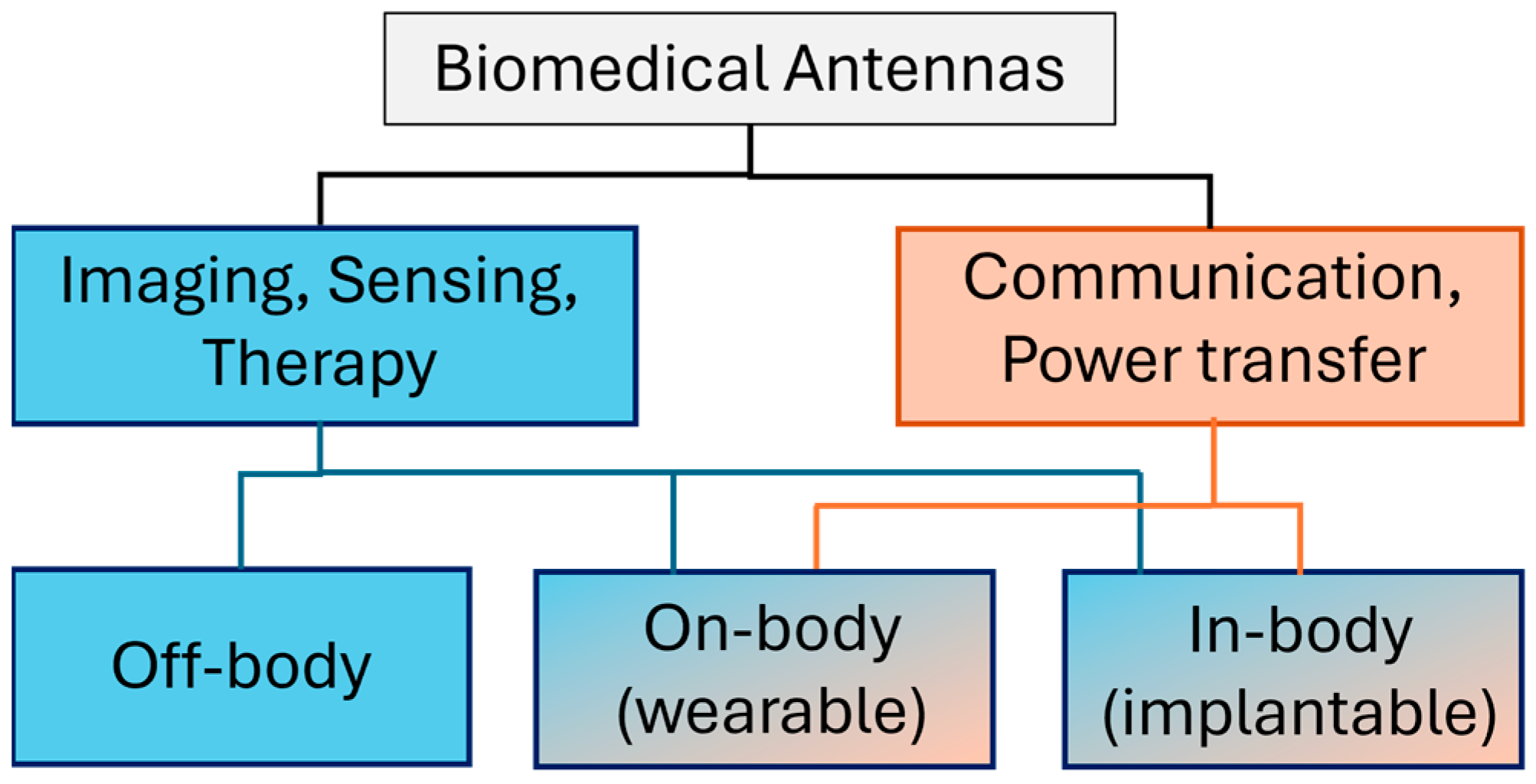
2. Biomedical Antennas Characteristics
2.1. Antennas for Sensing and Imaging
2.2. Biomedical Antennas for Communication and Power Transfer
2.3. Design Challenges and Considerations
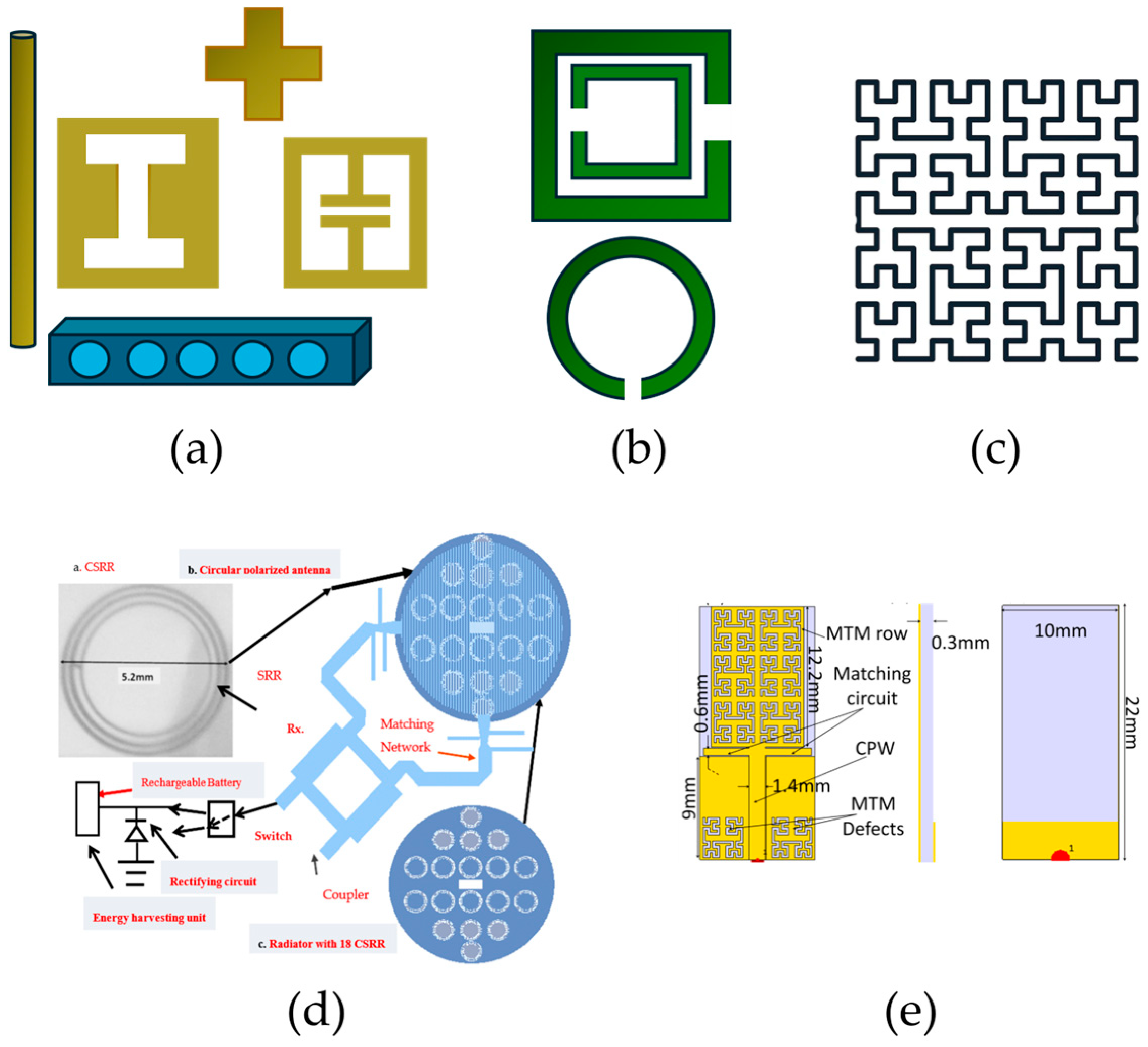
3. Metamaterial Antennas for Biomedical Applications
3.1. Miniaturization
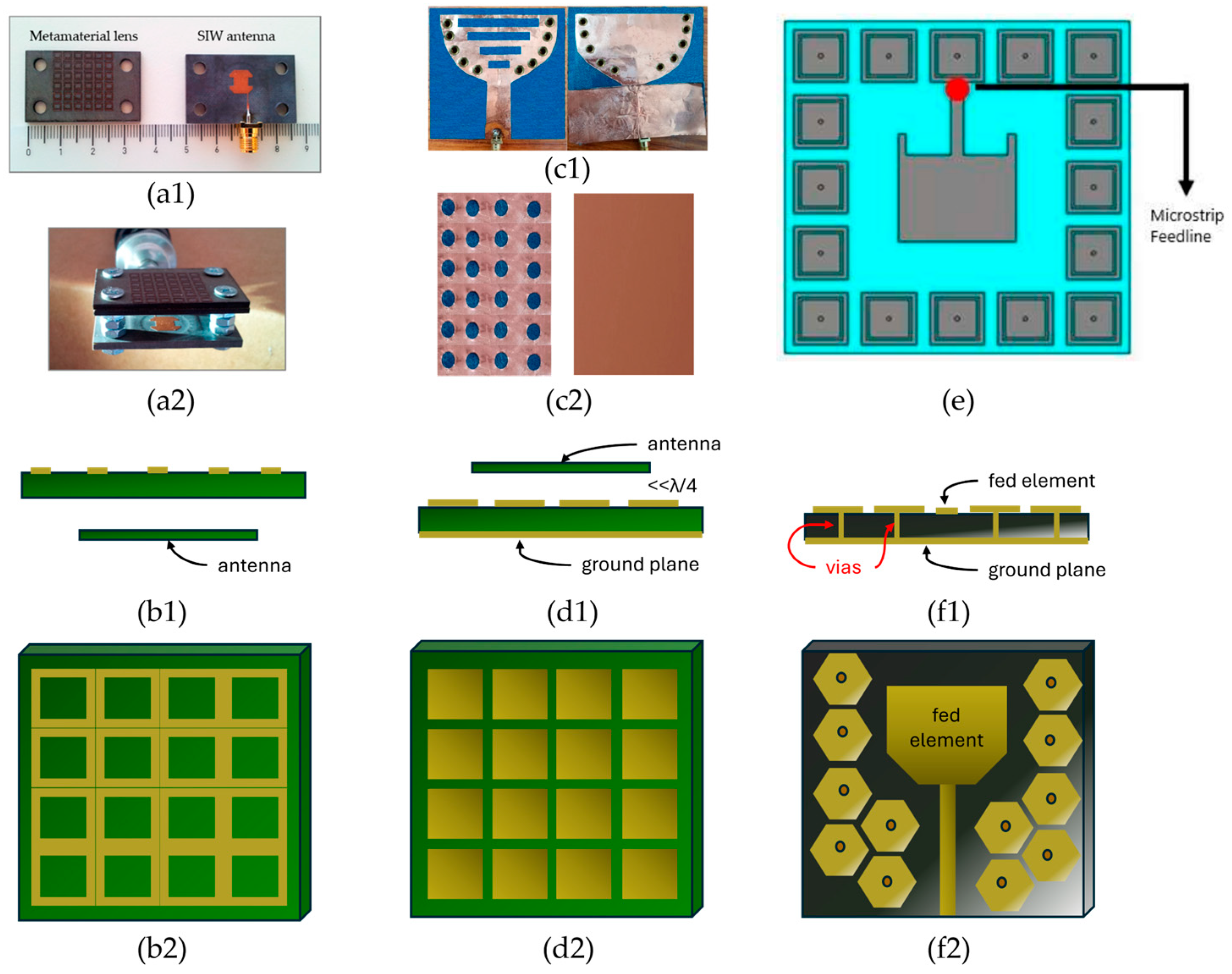
3.2. Coupling and Gain Enhancement
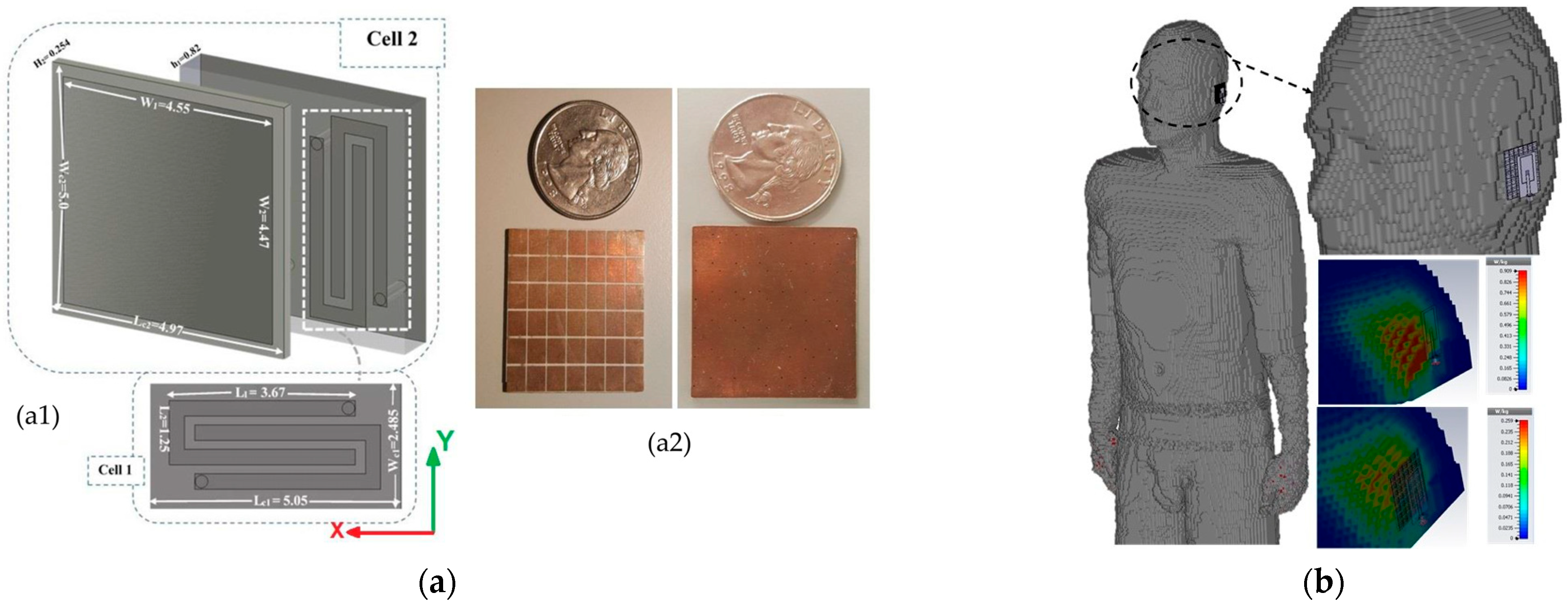
3.3. Tissue Isolation and SAR Reduction


4. Antennas Developed with Advanced Printing Techniques
4.1. Common and Novel 3D Printing Techniques for Antenna Fabrication
4.1.1. Fused Deposition Modeling (FDM)
4.1.2. Stereolithography (SLA)
4.1.3. Selective Laser Sintering (SLS)
4.1.4. Charge Programmed Deposition (CPD)
4.2. Novel 2D Printing Techniques for Antenna Fabrication
4.2.1. Inkjet Printing for Antenna Development
4.2.2. AJP for Epidermal and Conformal Antennas
4.2.3. Screen Printing for Textile and Stretchable Wearable Antennas
4.3. 3D and 2D Printing Techniques for Biomedical Antennas

| 3D Printing Technique | Advantages | Disadvantages | Common Substrates | Common Conductive Materials | Accuracy * | Post Processing | Biomedical Antenna Application and Reference |
|---|---|---|---|---|---|---|---|
| FDM | Low-cost, simple operation, widely available, rapid prototyping | Limited resolution, rough surface finish | Biocompatible polymers, Thermoplastics (PLA, ABS, PETG, TPU, etc.) | Conductive filaments (e.g., graphene/metal composites) | Moderate (100–200 µm) | Surface polishing, conductive path enhancement, thermal annealing | Wearables [99], sensing [103], prototyping [105] |
| SLA | High resolution, smooth surfaces, complex 3D geometries | High cost, limited material selection, slow process | Photopolymers, biocompatible resins | Metal coating, post-processing | High (25–50 µm) | UV post-curing, cleaning of resin residues, metal coating | Sensing [102], |
| SLS | Complex 3D structures, no support structures, good mechanical strength | Surface roughness, expensive, limited material choice | Nylon (PA12), biocompatible polymers | Post-deposited metal layers or conductive pastes | Moderate–high (50–150 µm) | Surface smoothing, metallization, thermal stabilization | Complex geometries, liquid antennas ** |
| CPD | Scalable, printing on 3D structures, multi-axis synchronized nozzle system | Lower conductivity, limited thickness, slow process | Ceramic, Flexible substrates | Conductive inks or filaments | Moderate (50–200 µm) | Thermal curing, sintering of conductive tracks | Monolithic development of antennas, Customized wearables [97] |
| 2D Printing Technique | Advantages | Disadvantages | Common Substrates | Common Conductive Materials | Accuracy * | Post Processing | Biomedical Application |
|---|---|---|---|---|---|---|---|
| Inkjet Printing | Material-efficient, high resolution | Limited viscosity of inks, slow for large areas | Flexible polymers, textiles | Silver nanoparticle inks, CNT inks | High (10–50 µm) | Thermal or photonic sintering, curing | Wearable antenna, epidermal sensors [85,86] |
| AJP | High resolution, 3D deposition | Expensive, complex setup | Polymers, glass, flexible substrates | Silver, gold, graphene nanoparticle inks | Very high (5–20 µm) | Thermal or laser sintering, encapsulation | Biomedical devices [88] |
| Screen Printing on Textiles | Low-cost, scalable | Lower resolution, thickness control limited | Textile substrates | Conductive inks (Ag, Cu) | Moderate (100–200 µm) | Thermal curing, mechanical fixation, encapsulation | Textile wearable antennas [94,96] |
| Ref. | Antenna Type | Technique/3D Printed Part | Material of Dielectric Part | Material of Conductive Part | Operating Band | Biomedical Application | Key Objective |
|---|---|---|---|---|---|---|---|
| [102] | Slot waveguide antenna | SLA/Antenna structure | FormLabs flexible resin (FLGR02) | Copper sputtered on titanium thin layer | 11–13 GHz | Wearable Microfluidics Sensor | Customization and prototyping |
| [106] | RFID antenna | FDM/ RFID tag | Cotton (fabric) | Graphene Ink, stretchable silver conductor (DuPont PE872) | 0.95 GHz | On-body wearable sensors | Prototyping and printing directly on stretchable textiles |
| [105] | EGRH antenna | FDM/Antenna structure | PLA | Copper plating | 0.5–1.3 GHz | Microwave bodyscope | Compact custom design, and dielectric high-K filling for matching |
| [107] | Planar bow-tie | FDM/substrate | PLA, PLA/copper, PLA/carbon | Copper sheet | Resonances in the 0–3 GHz spectrum | Generic biomedical application | Low-cost and material investigation |
| [99] | Circularly polarized UHF RFID antenna | FDM/Substrate | PLA | Adhesive copper tape | 865–868 MHz | Wearable antenna | To control substrate dielectric permittivity through different printing infill percentages |
| [108] | Planar monopole | FDM/curved substrate | PLA | Copper tape | 3–12 GHz | Generic biomedical application | Intricate 3D structure |
| [103] | PDRH antenna | FDM/Antenna structure | Polyethylene (PE) | Silver conductive paint | 1.5–7 GHz | Abdominal Fat Measurement | Compact custom design, and dielectric high-K filling (TiO2) for matching |
| [97] | Dipole antenna | CDP/FDM for the mold for the conforming substrate | PLA for the mold, ECOFLEX for the substrate | Silver paste | 915 MHz and 2.45 GHz | Wearable antenna | Custom design conforming to tissue |
| Ref. | Antenna Type | 2D Printing Technique | Substrate | Conductive Material | Operating Band | Application | Key Objective |
|---|---|---|---|---|---|---|---|
| [34] | Coplanar waveguide antenna with meander | Inkjet printing | Flexible polyimide | Silver nanoparticle ink | 2.5 GHz | Wearable biomedical sensing | Prototype on flexible substrate |
| [84] | RFID antenna | Inkjet printing | Textile fabric (cotton/polyester blend) | Silver nanoparticle ink | UHF RFID (~860–960 MHz) | Near-field communication. | Performance and durability of textile RFID antenna under humidity |
| [86] | Flexible inkjet-printed antenna | Inkjet printing | Flexible polymer film | Conductive Ag nanoparticle ink | 2.5 GHz | Wearable electronics | Mechanical robustness and stable RF performance under bending deformation |
| [85] | Smart bandage with cicruit integrated loop antenna | Inkjet printing | Flexible medical dressing/polymer | Silver nanoparticle ink | 2.4 GHz | Wireless wound monitoring | Low-cost antenna integrated into a medical bandage for healthcare monitoring |
| [87] | Dipole antenna | APJ (femptosecond laser) | Polyacrylamide hydrogel | Liquid metal injected into laser-ablated microchannels | Sub-GHz (~0.9 GHz) | Epidermal/wearable biomedical sensing | Miniaturized, stretch-tunable antenna using hydrogel permittivity and laser-defined microstructures |
| [95] | Rectangular patch with bandpass filter | Screen printing | Textile substrate | Silver nanoparticle ink | 2.5–4.6 GHz | Wearable wireless communication | Integrated filtering and radiation in a single inkjet-printed textile antenna |
| [94] | Planar inverted cone antenna/loop antennas | Screen printing | Textile fabric | Carbon nanotube ink | 3.5–11.5 GHz/2.4 GHz | Smart wearable sensing | Development of textile antennas with mechanical flexibility and washability evaluation |
| [96] | Coplanar keyhole antenna/RFID tag | Screen printing | Textile fabric | Commercial silver-based ink | 5.8 GHz/915 MHz | Wearable wireless communication | Development of textile wearable antennas |

4.4. Flexible Hybrid Electronics for Implantable and Multi-Layer Antenna Systems
5. Future Trends and Open Research Opportunities
6. Conclusions
Author Contributions
Funding
Institutional Review Board Statement
Informed Consent Statement
Data Availability Statement
Conflicts of Interest
References
- Venkatachalam, D.; Jagadeesan, V.; Ismail, K.B.M.; Arun Kumar, M.; Mahalingam, S.; Kim, J. Compact Flexible Planar Antennas for Biomedical Applications: Insight into Materials and Systems Design. Bioengineering 2023, 10, 1137. [Google Scholar] [CrossRef]
- Ali Khan, M.U.; Raad, R.; Tubbal, F.; Theoharis, P.I.; Liu, S.; Foroughi, J. Bending Analysis of Polymer-Based Flexible Antennas for Wearable, General IoT Applications: A Review. Polymers 2021, 13, 357. [Google Scholar] [CrossRef]
- Salleh, S.M.; Ain, M.F.; Ahmad, Z.; Abidin, I.S.Z.; Che Isa, C.M.N. Development of Stretchable and Bendable Polymer Wearable Antenna for 5G Applications. Express Polym. Lett. 2022, 16, 1267–1279. [Google Scholar] [CrossRef]
- Matekovits, L.; Mir, F.; Dassano, G.; Peter, I. Deeply Implanted Conformal Antenna for Real-Time Bio-Telemetry Applications. Sensors 2024, 24, 1170. [Google Scholar] [CrossRef] [PubMed]
- Ali, U.; Ullah, S.; Kamal, B.; Matekovits, L.; Altaf, A. Design, Analysis and Applications of Wearable Antennas: A Review. IEEE Access 2023, 11, 14458–14486. [Google Scholar] [CrossRef]
- Mohan, A.; Kumar, N. Implantable Antennas for Biomedical Applications: A Systematic Review. Biomed. Eng. Online 2024, 23, 87. [Google Scholar] [CrossRef] [PubMed]
- Saha, S.; Cano-Garcia, H.; Sotiriou, I.; Lipscombe, O.; Gouzouasis, I.; Koutsoupidou, M.; Palikaras, G.; Mackenzie, R.; Reeve, T.; Kosmas, P.; et al. A Glucose Sensing System Based on Transmission Measurements at Millimetre Waves Using Micro Strip Patch Antennas. Sci. Rep. 2017, 7, 6855. [Google Scholar] [CrossRef]
- Hasan, M.N.; Tamanna, S.; Singh, P.; Nadeem, M.D.; Rudramuni, M. Cylindrical Dielectric Resonator Antenna Sensor for Non-Invasive Glucose Sensing Application. In Proceedings of the 2019 6th International Conference on Signal Processing and Integrated Networks (SPIN), Noida, India, 7–8 March 2019; pp. 961–964. [Google Scholar]
- Song, Z.; Li, M. Ultra-Wideband Circular Polarized Implantable Patch Antenna for Implantable Blood Glucose Detection System Applications. Sensors 2024, 24, 5292. [Google Scholar] [CrossRef]
- Fatani, F.; Rauf, S.; Banerjee, A.; Shamim, A. Breaking the Specificity Barrier in Microwave Sensing: Highly Specific Lactate Microwave Biosensor for Fitness and Exercise Optimization. ACS Sens. 2025, 10, 3658–3668. [Google Scholar] [CrossRef] [PubMed]
- Garrett, D.C.; Fear, E.C. Feasibility Study of Hydration Monitoring Using Microwaves–Part 1: A Model of Microwave Property Changes with Dehydration. IEEE J. Electromagn. RF Microw. Med. Biol. 2019, 3, 292–299. [Google Scholar] [CrossRef]
- Groumpas, E.; Koutsoupidou, M.; Karanasiou, I.S.; Papageorgiou, C.; Uzunoglu, N. Real-Time Passive Brain Monitoring System Using near-Field Microwave Radiometry. IEEE Trans. Biomed. Eng. 2019, 67, 158–165. [Google Scholar] [CrossRef]
- Rodrigues, D.B.; Stauffer, P.R.; Pereira, P.J.; Maccarini, P.F. Microwave Radiometry for Noninvasive Monitoring of Brain Temperature. In Emerging Electromagnetic Technologies for Brain Diseases Diagnostics, Monitoring and Therapy; Springer: Berlin/Heidelberg, Germany, 2018; pp. 87–127. [Google Scholar]
- El Misilmani, H.M.; Naous, T.; Al Khatib, S.K.; Kabalan, K.Y. A Survey on Antenna Designs for Breast Cancer Detection Using Microwave Imaging. IEEE Access 2020, 8, 102570–102594. [Google Scholar] [CrossRef]
- Razzicchia, E.; Lu, P.; Guo, W.; Karadima, O.; Sotiriou, I.; Ghavami, N.; Kallos, E.; Palikaras, G.; Kosmas, P. Metasurface-Enhanced Antennas for Microwave Brain Imaging. Diagnostics 2021, 11, 424. [Google Scholar] [CrossRef] [PubMed]
- Martínez-Lozano, A.; Gutierrez, R.; Juan, C.G.; Blanco-Angulo, C.; García-Martínez, H.; Torregrosa, G.; Sabater-Navarro, J.M.; Ávila-Navarro, E. Microwave Imaging System Based on Signal Analysis in a Planar Environment for Detection of Abdominal Aortic Aneurysms. Biosensors 2024, 14, 149. [Google Scholar] [CrossRef] [PubMed]
- Li, Y.; Yang, L.; Duan, W.; Zhao, X. An Implantable Antenna Design for an Intelligent Health Monitoring System Considering the Relative Permittivity and Conductivity of the Human Body. IEEE Access 2019, 7, 38236–38244. [Google Scholar] [CrossRef]
- Preethichandra, D.; Piyathilaka, L.; Izhar, U.; Samarasinghe, R.; De Silva, L.C. Wireless Body Area Networks and Their Applications—A Review. IEEE Access 2023, 11, 9202–9220. [Google Scholar] [CrossRef]
- Soliman, M.M.; Chowdhury, M.E.; Khandakar, A.; Islam, M.T.; Qiblawey, Y.; Musharavati, F.; Zal Nezhad, E. Review on Medical Implantable Antenna Technology and Imminent Research Challenges. Sensors 2021, 21, 3163. [Google Scholar] [CrossRef]
- Chu, H.; Wang, P.-J.; Zhu, X.-H.; Hong, H. Antenna-in-Package Design and Robust Test for the Link between Wireless Ingestible Capsule and Smart Phone. IEEE Access 2019, 7, 35231–35241. [Google Scholar] [CrossRef]
- Guo, Y.; Feng, Y.; Liu, C. Antennas and Wireless Power Transfer Methods for Biomedical Applications; John Wiley & Sons: Hoboken, NJ, USA, 2024. [Google Scholar]
- Tzarouchis, D.C.; Koutsoupidou, M.; Sotiriou, I.; Dovelos, K.; Rompolas, D.; Kosmas, P. Electromagnetic Metamaterials for Biomedical Applications: Short Review and Trends. EPJ Appl. Metamater. 2024, 11, 7. [Google Scholar] [CrossRef]
- Nikolayev, D.; Zhadobov, M.; Sauleau, R. Impact of Tissue Electromagnetic Properties on Radiation Performance of In-Body Antennas. IEEE Antennas Wirel. Propag. Lett. 2018, 17, 1440–1444. [Google Scholar] [CrossRef]
- Aliqab, K.; Nadeem, I.; Khan, S.R. A Comprehensive Review of In-Body Biomedical Antennas: Design, Challenges and Applications. Micromachines 2023, 14, 1472. [Google Scholar] [CrossRef]
- Abbas, N.; Basir, A.; Ali Shah, I.; Rizqi Iman, U.; Yoo, H. Development of an Efficient Mid-Field Wireless Power Transmission System for Biotelemetric IoT Medical Devices. Sci. Rep. 2025, 15, 14889. [Google Scholar] [CrossRef] [PubMed]
- Koutsoupidou, M.; Groumpas, E.; Karanasiou, I.S.; Christopoulou, M.; Nikita, K.; Uzunoglu, N. The Effect of Using a Dielectric Matching Medium in Focused Microwave Radiometry: An Anatomically Detailed Head Model Study. Med. Biol. Eng. Comput. 2018, 56, 809–816. [Google Scholar] [CrossRef] [PubMed]
- Damaj, A.W.; El Misilmani, H.M.; Abou Chahine, S. Implantable Antennas for Biomedical Applications: An Overview on Alternative Antenna Design Methods and Challenges. In Proceedings of the 2018 International Conference on High Performance Computing & Simulation (HPCS), Orléans, France, 16–20 July 2018; pp. 31–37. [Google Scholar]
- Bocan, K.N.; Mickle, M.H.; Sejdić, E. Tissue Variability and Antennas for Power Transfer to Wireless Implantable Medical Devices. IEEE J. Transl. Eng. Health Med. 2017, 5, 1–11. [Google Scholar] [CrossRef] [PubMed]
- Zada, M.; Shah, I.A.; Yoo, H. Metamaterial-Loaded Compact High-Gain Dual-Band Circularly Polarized Implantable Antenna System for Multiple Biomedical Applications. IEEE Trans. Antennas Propag. 2019, 68, 1140–1144. [Google Scholar] [CrossRef]
- Saidi, A.; Nouri, K.; Bouazza, B.S.; Becharef, K.; Cherifi, A.; Abes, T. E-Shape Metamaterials Embedded Implantable Antenna for ISM-Band Biomedical Applications. Res. Biomed. Eng. 2022, 38, 351–368. [Google Scholar] [CrossRef]
- Sabban, A. Wearable Circular Polarized Antennas for Health Care, 5G, Energy Harvesting, and IoT Systems. Electronics 2022, 11, 427. [Google Scholar] [CrossRef]
- Pokharel, R.K.; Barakat, A.; Alshhawy, S.; Yoshitomi, K.; Sarris, C. Wireless Power Transfer System Rigid to Tissue Characteristics Using Metamaterial Inspired Geometry for Biomedical Implant Applications. Sci. Rep. 2021, 11, 5868. [Google Scholar] [CrossRef]
- Islam, M.S.; Islam, M.T.; Hoque, A.; Islam, M.T.; Amin, N.; Chowdhury, M.E. A Portable Electromagnetic Head Imaging System Using Metamaterial Loaded Compact Directional 3D Antenna. IEEE Access 2021, 9, 50893–50906. [Google Scholar] [CrossRef]
- Al-Adhami, A.; Ercelebi, E. A Flexible Metamaterial Based Printed Antenna for Wearable Biomedical Applications. Sensors 2021, 21, 7960. [Google Scholar] [CrossRef]
- Alrayes, N.; Hussein, M.I. Metamaterial-Based Sensor Design Using Split Ring Resonator and Hilbert Fractal for Biomedical Application. Sens. Bio-Sens. Res. 2021, 31, 100395. [Google Scholar] [CrossRef]
- Karad, K.V.; Agnihotri, S.P.; Rajput, J.L.; Bakale, R.; Kadam, V.; Narawade, V.; Londhe, G.; Gunjal, M.; Gawande, J. A Shri Yantra-Shaped Fractal Flexible SWB Antenna for Wearable Healthcare Applications in 5G. EURASIP J. Wirel. Commun. Netw. 2025, 2025, 81. [Google Scholar] [CrossRef]
- Yin, B.; Gu, J.; Feng, X.; Wang, B.; Yu, Y.; Ruan, W. A Low SAR Value Wearable Antenna for Wireless Body Area Network Based on AMC Structure. Prog. Electromagn. Res. C 2019, 95, 119–129. [Google Scholar] [CrossRef]
- Karimian, R.; Ardakani, M.D.; Ahmadi, S.; Zaghloul, M. Human Body Specific Absorption Rate Reduction Employing a Compact Magneto-Dielectric AMC Structure for 5G Massive-MIMO Applications. Eng 2021, 2, 501–511. [Google Scholar] [CrossRef]
- Hussin, E.F.N.M.; Soh, P.J.; Jamlos, M.F.; Lago, H.; Al-Hadi, A.A.; Rahiman, M.H.F. A Wideband Textile Antenna with a Ring-Slotted AMC Plane. Appl. Phys. A 2017, 123, 46. [Google Scholar] [CrossRef]
- Joshi, R.; Hussin, E.F.N.M.; Soh, P.J.; Jamlos, M.F.; Lago, H.; Al-Hadi, A.A.; Podilchak, S.K. Dual-Band, Dual-Sense Textile Antenna with AMC Backing for Localization Using GPS and WBAN/WLAN. IEEE Access 2020, 8, 89468–89478. [Google Scholar] [CrossRef]
- Qin, Y.; Jiang, D.; Yang, Y.; Wang, C.; Fu, Y.; Ding, F.; Yang, H. A High Gain Low SAR Wearable Antenna Based on AMC in Wireless Body Area Network. IEEE Antennas Wirel. Propag. Lett. 2025, 24, 1362–1366. [Google Scholar] [CrossRef]
- Ashyap, A.Y.; Abidin, Z.Z.; Dahlan, S.H.; Majid, H.A.; Kamarudin, M.R.; Alomainy, A.; Abd-Alhameed, R.A.; Kosha, J.S.; Noras, J.M. Highly Efficient Wearable CPW Antenna Enabled by EBG-FSS Structure for Medical Body Area Network Applications. IEEE Access 2018, 6, 77529–77541. [Google Scholar] [CrossRef]
- Jain, S.; Purohit, G.; Ghosh, S.; Saha, C. Design and Analysis of 4 × 4 EBG Backed Miniaturized Disc-Shaped Wearable RFID Tag Antenna for Biomedical Communications. In Proceedings of the 2024 IEEE Space, Aerospace and Defence Conference (SPACE), Bangalore, India, 22–23 July 2024; pp. 618–621. [Google Scholar]
- Shaw, T.; Mandal, B.; Mitra, D.; Rangaiah, P.K.; Perez, M.D.; Augustine, R. Metamaterial Integrated Highly Efficient Wireless Power Transfer System for Implantable Medical Devices. AEU-Int. J. Electron. Commun. 2024, 173, 155010. [Google Scholar] [CrossRef]
- Portosi, V.; Loconsole, A.M.; Prudenzano, F. A Split Ring Resonator-Based Metamaterial for Microwave Impedance Matching with Biological Tissue. Appl. Sci. 2020, 10, 6740. [Google Scholar] [CrossRef]
- Aishwarya, T.; Das, P. A FSS Integrated Wearable Modified Bow-Tie Antenna for Biomedical Applications. Results Eng. 2025, 26, 104894. [Google Scholar] [CrossRef]
- Islam, M.T.; Islam, M.T.; Samsuzzaman, M.; Arshad, H.; Rmili, H. Metamaterial Loaded Nine High Gain Vivaldi Antennas Array for Microwave Breast Imaging Application. IEEE Access 2020, 8, 227678–227689. [Google Scholar] [CrossRef]
- Koutsoupidou, M.; Uzunoglu, N.; Karanasiou, I.S. Antennas on Metamaterial Substrates as Emitting Components for THz Biomedical Imaging. In Proceedings of the 2012 IEEE 12th International Conference on Bioinformatics & Bioengineering (BIBE), Larnaca, Cyprus, 11–13 November 2012; pp. 319–322. [Google Scholar]
- Razzicchia, E.; Koutsoupidou, M.; Cano-Garcia, H.; Sotiriou, I.; Kallos, E.; Palikaras, G.; Kosmas, P. Metamaterial Designs to Enhance Microwave Imaging Applications. In Proceedings of the 2019 International Conference on Electromagnetics in Advanced Applications (ICEAA), Granada, Spain, 9–13 September 2019; pp. 0147–0150. [Google Scholar]
- Alibakhshikenari, M.; Virdee, B.S.; Shukla, P.; Parchin, N.O.; Azpilicueta, L.; See, C.H.; Abd-Alhameed, R.A.; Falcone, F.; Huynen, I.; Denidni, T.A.; et al. Metamaterial-Inspired Antenna Array for Application in Microwave Breast Imaging Systems for Tumor Detection. IEEE Access 2020, 8, 174667–174678. [Google Scholar] [CrossRef]
- Koutsoupidou, M.; Tzarouchis, D.C.; Rompolas, D.; Sotiriou, I.; Palikaras, G.; Kosmas, P. Wearable Pad for Enhancing EM Coupling with Biological Tissues. IEEE Trans. Antennas Propag. 2024, 73, 1725–1731. [Google Scholar] [CrossRef]
- Negi, D.; Bansal, A. Compact Conformal UWB Antenna Design with Enhanced Gain Characteristics Using Double-Negative (DNG) Metamaterial Structure for Biomedical Applications. J. Inst. Eng. Ser. B 2023, 104, 1273–1283. [Google Scholar] [CrossRef]
- Ashyap, A.; Raad, R.; Tubbal, F.; Khan, W.A.; Abulgasem, S. Highly Bendable AMC-Based Antenna for Wearable Applications. IEEE Access 2024, 12, 154195–154211. [Google Scholar] [CrossRef]
- Grover, P.; Singh, H.S.; Sahu, S.K. Design and Analysis of Metamaterial Superstrate and FSS Reflector Loaded UWB Antenna for the Detection and Localization of Breast Tumors. Biomed. Eng./Biomed. Tech. 2025, 70, 523–537. [Google Scholar] [CrossRef]
- Thangavelu, Y.; Thangaraju, B.; Maheswar, R. Design and SAR Analysis of an AMC-Integrated Wearable Cavity-Backed SIW Antenna. Micromachines 2024, 15, 1530. [Google Scholar] [CrossRef] [PubMed]
- Wajid, A.; Ahmad, A.; Ullah, S.; Choi, D.; Islam, F.U. Performance Analysis of Wearable Dual-Band Patch Antenna Based on EBG and SRR Surfaces. Sensors 2022, 22, 5208. [Google Scholar] [CrossRef] [PubMed]
- Koul, S.K.; Swapna, S.; Karthikeya, G. Additive Manufacturing in Antenna Development. In Antenna Systems for Modern Wireless Devices; Springer: Berlin/Heidelberg, Germany, 2024; pp. 283–319. [Google Scholar]
- Helena, D.; Ramos, A.; Varum, T.; Matos, J.N. Antenna Design Using Modern Additive Manufacturing Technology: A Review. IEEE Access 2020, 8, 177064–177083. [Google Scholar] [CrossRef]
- Prakash, C.; Senthil, P.; Sathies, T. Fused Deposition Modeling Fabricated PLA Dielectric Substrate for Microstrip Patch Antenna. Mater. Today Proc. 2021, 39, 533–537. [Google Scholar] [CrossRef]
- Biernacki, B.; Zhang, S.; Whittow, W. 3D Printed Substrates with Graded Dielectric Properties and Their Application to Patch Antennas. In Proceedings of the 2016 Loughborough Antennas & Propagation Conference (LAPC), Loughborough, UK, 14–15 November 2016; pp. 1–5. [Google Scholar]
- Hu, H.; Sinha, S.; Meisel, N.; Bilén, S.G. Permittivity of 3D-Printed Nylon Substrates with Different Infill Patterns and Densities for Design of Microwave Components. Designs 2020, 4, 39. [Google Scholar] [CrossRef]
- Rathore, A.; Saini, G.; Dhaliwal, B.S. Design of a Stacked Antenna Using Different 3D Printed Substrates for ISM Band Applications. In Proceedings of the 2025 IEEE International Conference on Computer, Electronics, Electrical Engineering & their Applications (IC2E3), Srinagar Garhwal, India, 15–16 May 2025; pp. 1–6. [Google Scholar]
- Ramadan, M.; Dahle, R. Characterization of 3-D Printed Flexible Heterogeneous Substrate Designs for Wearable Antennas. IEEE Trans. Antennas Propag. 2019, 67, 2896–2903. [Google Scholar] [CrossRef]
- Mitra, D.; Roy, S.; Striker, R.; Burczek, E.; Aqueeb, A.; Wolf, H.; Kabir, K.S.; Ye, S.; Braaten, B.D. Conductive Electrifi and Nonconductive NinjaFlex Filaments Based Flexible Microstrip Antenna for Changing Conformal Surface Applications. Electronics 2021, 10, 821. [Google Scholar] [CrossRef]
- Teniente, J.; Iriarte, J.C.; Caballero, R.; Valcázar, D.; Goñi, M.; Martínez, A. 3-D Printed Horn Antennas and Components Performance for Space and Telecommunications. IEEE Antennas Wirel. Propag. Lett. 2018, 17, 2070–2074. [Google Scholar] [CrossRef]
- Yao, H.; Sharma, S.; Henderson, R.; Ashrafi, S.; MacFarlane, D. Ka Band 3D Printed Horn Antennas. In Proceedings of the 2017 Texas Symposium on Wireless and Microwave Circuits and Systems (WMCS), Waco, TX, USA, 30–31 March 2017; pp. 1–4. [Google Scholar]
- Ghazali, M.I.M.; Karuppuswami, S.; Kaur, A.; Chahal, P. 3D Printed High Functional Density Packaging Compatible Out-of-Plane Antennas. Addit. Manuf. 2019, 30, 100863. [Google Scholar] [CrossRef]
- Ghosh, P.; Harackiewicz, F.J. Analysis and Fabrication of Conductive Strip and Paint-Based Hemispherical Helical Antennas on 3D Printed Structure. Prog. Electromagn. Res. C 2023, 135, 1–11. [Google Scholar] [CrossRef]
- Olivová, J.; Popela, M.; Richterová, M.; Štefl, E. Use of 3D Printing for Horn Antenna Manufacturing. Electronics 2022, 11, 1539. [Google Scholar] [CrossRef]
- Carvalho, S.S.; Heleno, S.M.; Reis, J.R.; Caldeirinha, R.F. Assessing the Feasibility of Metallic-Type FDM 3D Printed Antennas at K-Band. In Proceedings of the 2024 4th URSI Atlantic Radio Science Meeting (AT-RASC), Gran Canaria, Spain, 19–24 May 2024; pp. 1–4. [Google Scholar]
- Avşar Aydın, E. 3D-Printed Graphene-Based Bow-Tie Microstrip Antenna Design and Analysis for Ultra-Wideband Applications. Polymers 2021, 13, 3724. [Google Scholar] [CrossRef] [PubMed]
- Colella, R.; Chietera, F.P.; Michel, A.; Muntoni, G.; Casula, G.; Montisci, G.; Catarinucci, L. Electromagnetic Characterisation of Conductive 3D-Printable Filaments for Designing Fully 3D-Printed Antennas. IET Microw. Antennas Propag. 2022, 16, 687–698. [Google Scholar] [CrossRef]
- Silva, J.S.; Garcia-Vigueras, M.; Debogović, T.; Costa, J.R.; Fernandes, C.A.; Mosig, J.R. Stereolithography-Based Antennas for Satellite Communications in Ka-Band. Proc. IEEE 2017, 105, 655–667. [Google Scholar] [CrossRef]
- Basile, V.; Grande, M.; Marrocco, V.; Laneve, D.; Petrignani, S.; Prudenzano, F.; Fassi, I. Design and Manufacturing of Super-Shaped Dielectric Resonator Antennas for 5G Applications Using Stereolithography. IEEE Access 2020, 8, 82929–82937. [Google Scholar] [CrossRef]
- McGhee, J.R.; Whittaker, T.; Moriarty, J.; Northedge, J.; Zhang, S.; Cadman, D.; Whittow, W.; Vardaxoglou, J.Y. Fabrication of Artificial Dielectrics via Stereolithography Based 3D-Printing. In Proceedings of the 2020 14th European Conference on Antennas and Propagation (EuCAP), Copenhagen, Denmark, 15–20 March 2020; pp. 1–5. [Google Scholar]
- Talpur, H.; Myrzakhan, U.; Vasquez-Peralvo, J.A.; Zhang, S.; Chatzinotas, S. Additive Manufacturing of Antennas and RF Components for SATCOM: A Review. IEEE Open J. Antennas Propag. 2025, 6, 943–977. [Google Scholar] [CrossRef]
- Ferrando-Rocher, M.; Herranz-Herruzo, J.I.; Valero-Nogueira, A.; Bernardo-Clemente, B. Selective Laser Sintering Manufacturing as a Low Cost Alternative for Flat-Panel Antennas in Millimeter-Wave Bands. IEEE Access 2021, 9, 45721–45729. [Google Scholar] [CrossRef]
- Chio, T.-H.; Huang, G.-L.; Zhou, S.-G. Application of Direct Metal Laser Sintering to Waveguide-Based Passive Microwave Components, Antennas, and Antenna Arrays. Proc. IEEE 2016, 105, 632–644. [Google Scholar] [CrossRef]
- Wang, J.; Xu, Z.; Wang, Z.; Hensleigh, R.; Zheng, X.; Rahmat-Samii, Y. An Overview of Novel Antennas Manufactured via Charge-Programmed Multi-Material 3D Printing. In Proceedings of the 2023 IEEE International Symposium on Antennas and Propagation and USNC-URSI Radio Science Meeting (USNC-URSI), Portland, OR, USA, 23–28 July 2023; pp. 943–944. [Google Scholar]
- Wang, Z.; Hensleigh, R.; Xu, Z.; Wang, J.; Park, J.J.; Papathanasopoulos, A.; Rahmat-Samii, Y.; Zheng, X. Ultra-Light Antennas via Charge Programmed Deposition Additive Manufacturing. Nat. Commun. 2025, 16, 427. [Google Scholar] [CrossRef]
- Wang, J.; Xu, Z.; Wang, Z.; Zheng, X.; Rahmat-Samii, Y. Development of a Low-Cost Lightweight Advanced K-Band Horn Antenna with Charge-Programmed Deposition 3-D Printing. IEEE Antennas Wirel. Propag. Lett. 2023, 22, 1917–1921. [Google Scholar] [CrossRef]
- Muhammad, B.A.; Mahmud, M.N.; Mohammed, A.S.; Girigiri, A.; Ain, M.F. A Review of Printable Antenna Design and Fabrication for Future Wireless Applications. Preprints 2023, 2023050335. [Google Scholar]
- Rafiq, M.; Imran, A.; Rasheed, A.; Zaman, S. A Review on the Manufacturing Techniques for Textile Based Antennas. J. Eng. Fibers Fabr. 2024, 19, 15589250241226585. [Google Scholar] [CrossRef]
- Lundquist, J.; Linkous, L.; Piper, M.E.; Sickey, Z.; Zimmet, K.; Mendoza, I.; Suresh, S.; Topsakal, E. Textile-Based Inkjet-Printed RFIDs: Exploring Wearable Antennas in the Real World [Bioelectromagnetics]. IEEE Antennas Propag. Mag. 2024, 66, 50–62. [Google Scholar] [CrossRef]
- Farooqui, M.F.; Shamim, A. Low Cost Inkjet Printed Smart Bandage for Wireless Monitoring of Chronic Wounds. Sci. Rep. 2016, 6, 28949. [Google Scholar] [CrossRef]
- Yu, H.; Zhang, X.; Zheng, H.; Li, D.; Pu, Z. An Inkjet-Printed Bendable Antenna for Wearable Electronics. Int. J. Bioprinting 2023, 9, 722. [Google Scholar] [CrossRef] [PubMed]
- Zhao, P.; Chen, T.; Si, J.; Shi, H.; Hou, X. Fabrication of a Flexible Stretchable Hydrogel-Based Antenna Using a Femtosecond Laser for Miniaturization. Opt. Express 2023, 31, 32704–32716. [Google Scholar] [CrossRef] [PubMed]
- Hobbie, H.A.; Doherty, J.L.; Smith, B.N.; Maccarini, P.; Franklin, A.D. Conformal Printed Electronics on Flexible Substrates and Inflatable Catheters Using Lathe-Based Aerosol Jet Printing. Npj Flex. Electron. 2024, 8, 54. [Google Scholar] [CrossRef]
- Marterer, V.; Radouchová, M.; Soukup, R.; Hipp, S.; Blecha, T. Wearable Textile Antennas: Investigation on Material Variants, Fabrication Methods, Design and Application. Fash. Text. 2024, 11, 9. [Google Scholar] [CrossRef]
- Tsolis, A.; Bakogianni, S.; Angelaki, C.; Alexandridis, A.A. A Review of Clothing Components in the Development of Wearable Textile Antennas: Design and Experimental Procedure. Sensors 2023, 23, 3289. [Google Scholar] [CrossRef]
- Bonefačić, D.; Bartolić, J. Embroidered Textile Antennas: Influence of Moisture in Communication and Sensor Applications. Sensors 2021, 21, 3988. [Google Scholar] [CrossRef]
- Bulathsinghala, R.L. Investigation on Material Variants and Fabrication Methods for Microstrip Textile Antennas: A Review Based on Conventional and Novel Concepts of Weaving, Knitting and Embroidery. Cogent Eng. 2022, 9, 2025681. [Google Scholar] [CrossRef]
- Dang, Q.H.; Chen, S.J.; Zhu, B.; Fumeaux, C. Shorting Strategies for Wearable Textile Antennas: A Review of Four Shorting Methods. IEEE Antennas Propag. Mag. 2021, 64, 84–98. [Google Scholar] [CrossRef]
- Ibanez Labiano, I.; Arslan, D.; Ozden Yenigun, E.; Asadi, A.; Cebeci, H.; Alomainy, A. Screen Printing Carbon Nanotubes Textiles Antennas for Smart Wearables. Sensors 2021, 21, 4934. [Google Scholar] [CrossRef]
- Kao, H.-L.; Chuang, C.-H.; Cho, C.-L. Inkjet-Printed Filtering Antenna on a Textile for Wearable Applications. In Proceedings of the 2019 IEEE 69th Electronic Components and Technology Conference (ECTC), Las Vegas, NV, USA, 28–31 May 2019; pp. 258–263. [Google Scholar]
- Hasni, U.; Piper, M.E.; Lundquist, J.; Topsakal, E. Screen-Printed Fabric Antennas for Wearable Applications. IEEE Open J. Antennas Propag. 2021, 2, 591–598. [Google Scholar] [CrossRef]
- Zhu, Q.; Zhang, W.; Zhu, W.; Wu, C.; Shi, J. Flexible Receiver Antenna Prepared Based on Conformal Printing and Its Wearable System. Sensors 2025, 25, 4488. [Google Scholar] [CrossRef]
- Yin, X.; Stuart, T.; Chen, S.J.; Farley, M.; Gutruf, P.; Fumeaux, C. Biosymbiotic 3-D-Printed Planar Inverted-F Antenna. IEEE Trans. Antennas Propag. 2023, 72, 412–423. [Google Scholar] [CrossRef]
- Colella, R.; Catarinucci, L.; Michel, A. Circularly Polarized Antenna in 3d Printing Technology to Feed a Wearable Fully-Integrated WiFi-RFID Reader for Biomedical Applications. In Proceedings of the 2020 International Workshop on Antenna Technology (iWAT), Bucharest, Romania, 25–28 February 2020; pp. 1–4. [Google Scholar]
- Amrita; Manoj, A.; Panda, R.C. Biodegradable Filament for 3D Printing Process: A Review. Eng. Sci. 2022, 18, 11–19. [Google Scholar]
- Constantin, C.P.; Aflori, M.; Damian, R.F.; Rusu, R.D. Biocompatibility of Polyimides: A Mini-Review. Materials 2019, 12, 3166. [Google Scholar] [CrossRef]
- Su, W.; Wu, Z.; Fang, Y.; Bahr, R.; Raj, P.M.; Tummala, R.; Tentzeris, M.M. 3d Printed Wearable Flexible SIW and Microfluidics Sensors for Internet of Things and Smart Health Applications. In Proceedings of the 2017 IEEE MTT-S International Microwave Symposium (IMS), Honolulu, HI, USA, 4–9 June 2017; pp. 544–547. [Google Scholar]
- Sarjoghian, S.; Alfadhl, Y.; Chen, X.; Parini, C.G. A 3-D-Printed High-Dielectric Materials-Filled Pyramidal Double-Ridged Horn Antenna for Abdominal Fat Measurement System. IEEE Trans. Antennas Propag. 2020, 69, 64–73. [Google Scholar] [CrossRef]
- Moulod, M.; Dontha, B.; Balbaugh, S.; Li, J.; Miranda, F.; Kiourti, A.; Hoelzle, D.J. Highly Conductive Biomaterial for the Safe Printing of Wireless Biosensors and Antennas Inside the Body. ACS Appl. Mater. Interfaces 2025, 17, 29424–29436. [Google Scholar] [CrossRef]
- Rashid, S.; Jofre, L.; Garrido, A.; Gonzalez, G.; Ding, Y.; Aguasca, A.; O’Callaghan, J.; Romeu, J. 3-D Printed UWB Microwave Bodyscope for Biomedical Measurements. IEEE Antennas Wirel. Propag. Lett. 2019, 18, 626–630. [Google Scholar] [CrossRef]
- He, H.; Akbari, M.; Sydänheimo, L.; Ukkonen, L.; Virkki, J. 3D-Printed Graphene and Stretchable Antennas for Wearable RFID Applications. In Proceedings of the 2017 International Symposium on Antennas and Propagation (ISAP), Phuket, Thailand, 31 October–2 November 2017; pp. 1–2. [Google Scholar]
- Avşar Aydın, E.; Torun, A.R. 3D Printed PLA/Copper Bowtie Antenna for Biomedical Imaging Applications. Phys. Eng. Sci. Med. 2020, 43, 1183–1193. [Google Scholar] [CrossRef]
- Bicer, M.B.; Aydin, E.A. A Novel 3D Printed Curved Monopole Microstrip Antenna Design for Biomedical Applications. Phys. Eng. Sci. Med. 2021, 44, 1175–1186. [Google Scholar] [CrossRef]
- Li, P.; Fleischer, J.; Quinn, E.; Park, D. Fabrication of an Optically Transparent Planar Inverted-F Antenna Using PEDOT-Based Silver Nanowire Clear Ink with Aerosol-Jet Printing Method towards Effective Antennas. J. Manuf. Mater. Process. 2024, 8, 39. [Google Scholar] [CrossRef]
- Deffenbaugh, P.I.; Rumpf, R.C.; Church, K.H. Broadband Microwave Frequency Characterization of 3-D Printed Materials. IEEE Trans. Compon. Packag. Manuf. Technol. 2013, 3, 2147–2155. [Google Scholar] [CrossRef]
- Kattel, B.; Hutchcraft, W.; Gordon, R. Experimental Verification of Simulation Model for Permittivity of 3D-Printed Slabs with Various Infill Densities. Authorea Prepr. 2023. [Google Scholar]
- Moscato, S.; Bahr, R.; Le, T.; Pasian, M.; Bozzi, M.; Perregrini, L.; Tentzeris, M.M. Infill-Dependent 3-D-Printed Material Based on NinjaFlex Filament for Antenna Applications. IEEE Antennas Wirel. Propag. Lett. 2016, 15, 1506–1509. [Google Scholar] [CrossRef]
- Merilampi, S.L.; Björninen, T.; Vuorimäki, A.; Ukkonen, L.; Ruuskanen, P.; Sydänheimo, L. The Effect of Conductive Ink Layer Thickness on the Functioning of Printed UHF RFID Antennas. Proc. IEEE 2010, 98, 1610–1619. [Google Scholar] [CrossRef]
- Dejene, B.K. Inkjet Printing of Conductive Nanomaterials on Textiles for Wearable Electronics: Advancements, Challenges, and Future Prospects. Mater. Today Adv. 2025, 28, 100629. [Google Scholar] [CrossRef]
- Suhaimi, M.I.; Nordin, A.N.; Ralib, A.A.M.; Voiculescu, I.; Mak, W.C.; Ming, L.L.; Samsudin, Z. Mechanical Durability of Screen-Printed Flexible Silver Traces for Wearable Devices. Sens. Bio-Sens. Res. 2022, 38, 100537. [Google Scholar] [CrossRef]
- Kang, K.S.; Jeong, S.Y.; Jeon, Y.; Kwon, J.H.; Choi, K.C. Enhancing Flexibility and Reliability in Wearable OLEDs through Silbione-Blended Hybrimer-Based Encapsulation. Npj Flex. Electron. 2025, 9, 49. [Google Scholar] [CrossRef]
- Li, L.; Bai, Y.; Li, L.; Wang, S.; Zhang, T. A Superhydrophobic Smart Coating for Flexible and Wearable Sensing Electronics. Adv. Mater. 2017, 29, 1702517. [Google Scholar] [CrossRef]
- Ali, S.M.; Sovuthy, C.; Imran, M.A.; Socheatra, S.; Abbasi, Q.H.; Abidin, Z.Z. Recent Advances of Wearable Antennas in Materials, Fabrication Methods, Designs, and Their Applications: State-of-the-Art. Micromachines 2020, 11, 888. [Google Scholar] [CrossRef]
- Khan, Y.; Thielens, A.; Muin, S.; Ting, J.; Baumbauer, C.; Arias, A.C. A New Frontier of Printed Electronics: Flexible Hybrid Electronics. Adv. Mater. 2020, 32, 1905279. [Google Scholar] [CrossRef]
- Herbert, R.; Kim, J.-H.; Kim, Y.S.; Lee, H.M.; Yeo, W.-H. Soft Material-Enabled, Flexible Hybrid Electronics for Medicine, Healthcare, and Human-Machine Interfaces. Materials 2018, 11, 187. [Google Scholar] [CrossRef] [PubMed]
- Jung, D.; Ju, H.; Cho, S.; Lee, T.; Hong, C.; Lee, J. Multilayer Stretchable Electronics with Designs Enabling a Compact Lateral Form. Npj Flex. Electron. 2024, 8, 13. [Google Scholar] [CrossRef]
- Rocha-Flores, P.E.; Guerrero, E.; Rodriguez-Lopez, O.; Chitrakar, C.; Parikh, A.R.; Pancrazio, J.J.; Cogan, S.F.; Ecker, M.; Voit, W.E. Softening and Flexible Hybrid Electronics Integration for Biomedical Applications. MRS Commun. 2023, 13, 892–900. [Google Scholar] [CrossRef]
- Jang, D.; Ryu, H.; Maeng, I.; Lee, S.; Seo, M.; Oh, S.J.; Lee, S.-H. 3D-Printed Terahertz Metamaterial Lens. In Proceedings of the Optica Imaging Congress (3D, COSI, DH, FLatOptics, IS, pcAOP), Boston, MA, USA, 14–17 August 2023; p. JTu4A.5. [Google Scholar]
- Wei, Z.; Xue, Z.; Guo, Q. Recent Progress on Bioresorbable Passive Electronic Devices and Systems. Micromachines 2021, 12, 600. [Google Scholar] [CrossRef] [PubMed]
- Odiamenhi, M.; Jahanbakhsh Basherlou, H.; Hwang See, C.; Ojaroudi Parchin, N.; Goh, K.; Yu, H. Advancements and Challenges in Antenna Design and Rectifying Circuits for Radio Frequency Energy Harvesting. Sensors 2024, 24, 6804. [Google Scholar] [CrossRef]
- Islam, S.M.M. Radar-Based Remote Physiological Sensing: Progress, Challenges, and Opportunities. Front. Physiol. 2022, 13, 955208. [Google Scholar] [CrossRef]


| Application | Antenna Placement | Antenna Characteristics and Specifications | |||
|---|---|---|---|---|---|
| Size (Miniaturization) | Frequency Bandwidth | Tissue Coupling | Materials | ||
| Communication Power Transfer | On-body (wearable) | May be required | Narrow-band and/or multiband: high Q antennas are significantly affected by different tissue properties | Undesired (for linking with external base-free space propagation) Required (for linking with in-body device-tissue propagation) | Biocompatible, including textile |
| In-body (implantable) | Required | Required | Biocompatible, coating | ||
| Imaging Sensing Therapy | Off-body (near-field/far-field application) | Not required | Depending on the specific application, usually antennas are designed with respect to the targeted tissue | Required | Irrelevant |
| On-body (wearable) | May be required | Required | Biocompatible, including textile | ||
| In-body (implantable) | Required | Required | Biocompatible, coating | ||
| Metamaterial Category | Elements/Structures | Core Function in Antennas | Advantages | Limitations | Selected Recent References |
|---|---|---|---|---|---|
| Dielectric Metamaterials and Electric LCs (ELCs) | Rods, crosses, high-permittivity spheres, dielectric resonators, planar LCs | Impedance matching, tissue matching, miniaturization, resonance tuning | Low loss, compact, easy integration in implantable/wearable antennas | Limited bandwidth, ohmic and/or dielectric losses | [29,30] |
| Magnetic Metamaterials | Split Ring Resonators (SRRs), Omega structures, Loops | Directivity enhancement, miniaturization, artificial magnetism | Strong resonance, compact | Narrow bandwidth, ohmic losses, complex fabrication | [31,32,33] |
| Fractal/Space-Filling Structures | Hilbert fractal, Minkowski fractal, Koch fractal, etc. | Miniaturization, multi-band operation, impedance matching | Compact, broadband or multi-band, planar integration | Fabrication complexity, sometimes increased ohmic losses at higher frequencies | [34,35,36] |
| Artificial Magnetic Conductors (AMCs) | Mushroom structures, high-impedance surfaces, planar AMC tiles | Reduce back radiation, surface wave suppression, gain enhancement | Low-profile, directional radiation, improves efficiency | Narrowband, fabrication complexity | [37,38,39,40,41] |
| Electromagnetic Band-Gaps (EBGs) | Periodic patches, vias, mushroom EBGs, uniplanar compact EBGs | Surface wave suppression, mutual coupling reduction, gain enhancement | Reduces interference, improves radiation efficiency | Complex design, can increase antenna footprint | [42,43] |
| Frequency Selective Surfaces (FSSs) | Metallic grids, patch arrays, slot arrays, cross-dipole arrays | Shielding, filtering, control of specific frequency propagation, gain enhancement | Wide frequency control can improve directivity | Ohmic losses, limited bandwidth | [44,45,46] |
Disclaimer/Publisher’s Note: The statements, opinions and data contained in all publications are solely those of the individual author(s) and contributor(s) and not of MDPI and/or the editor(s). MDPI and/or the editor(s) disclaim responsibility for any injury to people or property resulting from any ideas, methods, instructions or products referred to in the content. |
© 2026 by the authors. Licensee MDPI, Basel, Switzerland. This article is an open access article distributed under the terms and conditions of the Creative Commons Attribution (CC BY) license.
Share and Cite
Koutsoupidou, M.; Karanasiou, I.S. Next-Generation Biomedical Microwave Antennas: Metamaterial Design and Advanced Printing Manufacturing Techniques. Sensors 2026, 26, 440. https://doi.org/10.3390/s26020440
Koutsoupidou M, Karanasiou IS. Next-Generation Biomedical Microwave Antennas: Metamaterial Design and Advanced Printing Manufacturing Techniques. Sensors. 2026; 26(2):440. https://doi.org/10.3390/s26020440
Chicago/Turabian StyleKoutsoupidou, Maria, and Irene S. Karanasiou. 2026. "Next-Generation Biomedical Microwave Antennas: Metamaterial Design and Advanced Printing Manufacturing Techniques" Sensors 26, no. 2: 440. https://doi.org/10.3390/s26020440
APA StyleKoutsoupidou, M., & Karanasiou, I. S. (2026). Next-Generation Biomedical Microwave Antennas: Metamaterial Design and Advanced Printing Manufacturing Techniques. Sensors, 26(2), 440. https://doi.org/10.3390/s26020440