This section provides a thorough evaluation of the proposed reliable WiFi-based indoor positioning system. We begin by introducing the real-world datasets used in our study, followed by a detailed investigation of the empirical experimental results.
5.1. Experimental Setup and Data Collection
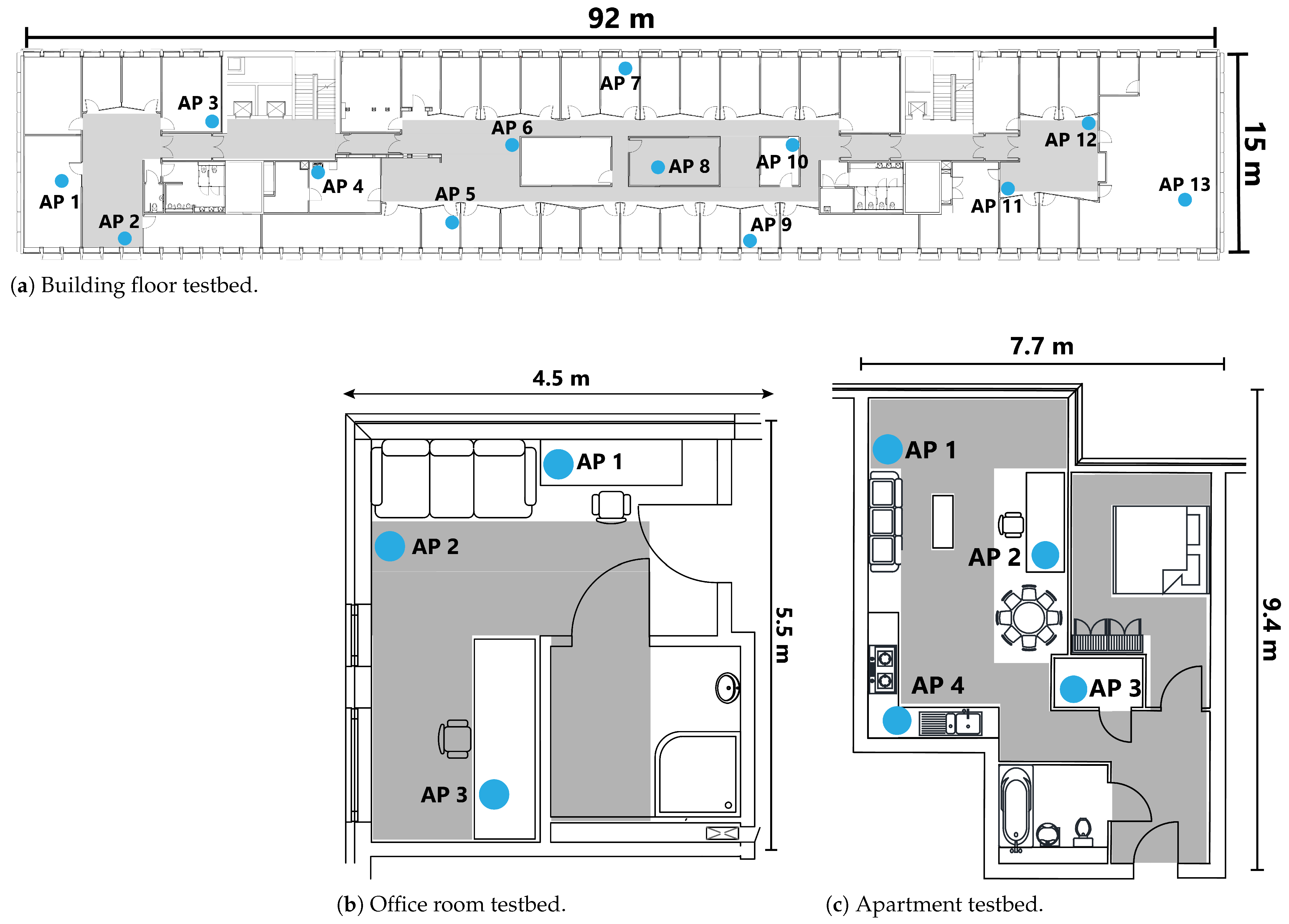
To evaluate the performance of the proposed reliable WiFi-based indoor positioning system, examine the robustness across devices and time and demonstrate the generalisation of the results, we conducted experiments in three representative and challenging real-world environments: a full floor of a campus building, an office room, and a residential apartment (see
Figure 3) [
26]. This dataset includes WiFi RTT and RSS measurements, along with line-of-sight (LoS) annotations for every reference point. These three datasets were collected over different time period in real-world complex scenarios that contain distinguishing LoS conditions. Each reference point comprises more than 120 WiFi scans, as shown in
Table 1. A desktop PC equipped with an Intel Core i9-12900K processor (Intel Corporation, Santa Clara, CA, USA) and 32 GB DDR4 4000 MHz memory (G.SKILL International Enterprise Co., Ltd., Taipei, Taiwan) was used to analyse the results. On the largest building floor dataset, the model training time was 1.6 s, and the average generation time for each
q-value was 0.2 s. These low computational requirements indicate that the proposed approach is lightweight and amenable to practical deployment.
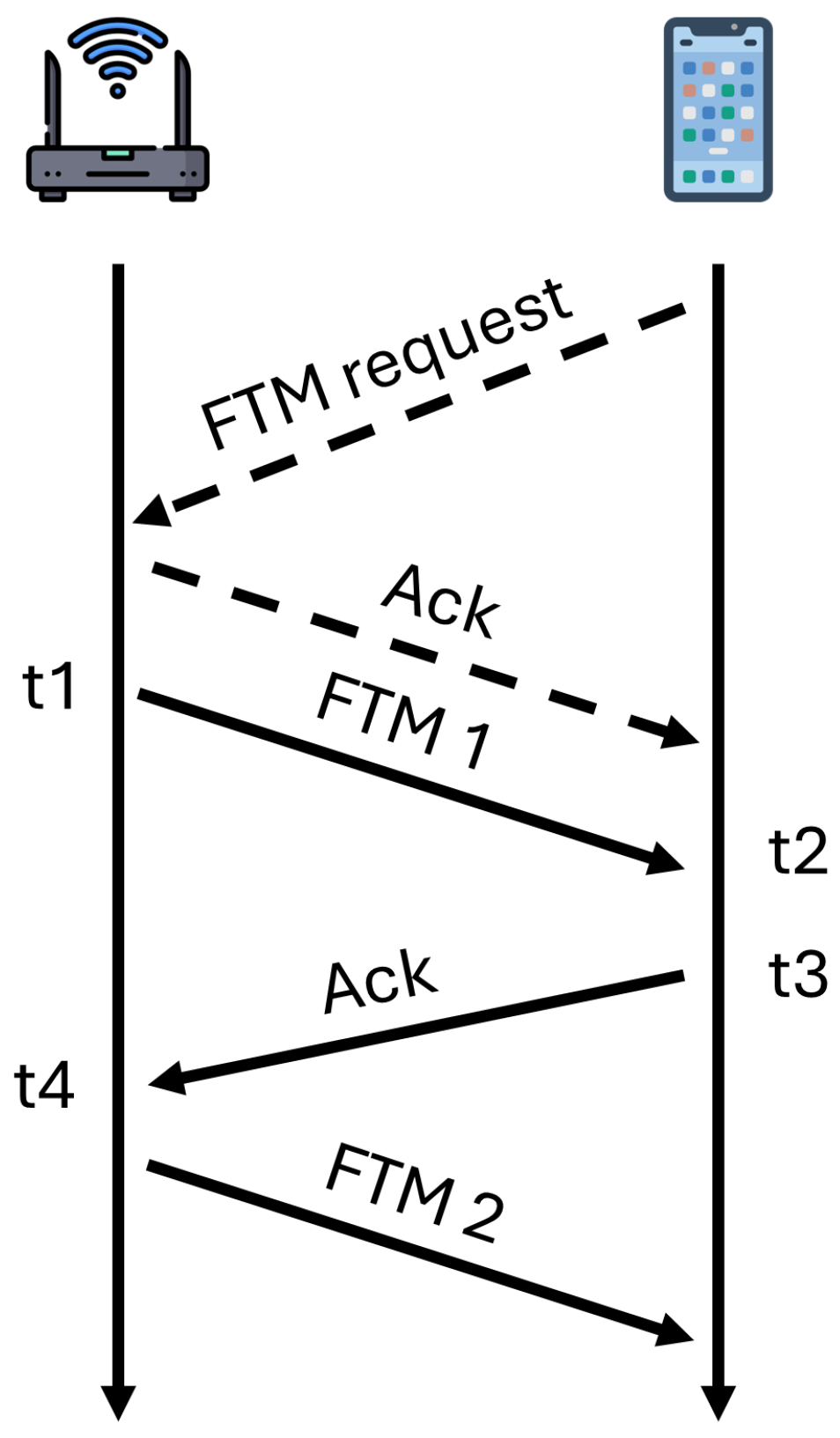
In the Building Floor dataset, 13 RTT-enabled Google WiFi points (Google LLC, Mountain View, CA, USA) (see
Table 2) were deployed to mirror their real-world positions within the building. WiFi data were collected using an LG G8X ThinQ smartphone (LG Electronics Inc., Seoul, Republic of Korea) (see
Table 3). Please note that no human subjects were involved in the data collection. The smartphone was mounted on a tripod during all measurements at human chest height, and therefore no ethics approval or informed consent was required. Other WiFi RTT-enabled access points include the Google Nest WiFi Pro (Google LLC, Mountain View, CA, USA), Cisco 9164 (Cisco Systems, Inc., San Jose, CA, USA) and Aruba AP755 (HPE Aruba Networking, Santa Clara, CA, USA), among others. WiFi RTT-enabled smartphones include the Google Pixel 9, Samsung SM-S918B (Samsung Galaxy S23 Ultra) (Samsung Electronics Co., Ltd., Suwon, Republic of Korea) and Xiaomi Mi 10 Pro (Xiaomi Corporation, Beijing, China). A full list is available at
https://developer.android.com/develop/connectivity/wifi/wifi-rtt#supported-aps (accessed on 29 December 2025).
Table 4 provides a snapshot of the dataset. Columns ’AP1 RSS’ to ’AP13 RSS’ contain the received signal strength from each AP, with −200 dBm denoting that the AP is not detected at the reference point. Columns X and Y give the ground-truth coordinates, and the LoS APs column specifies which APs have direct LoS.
Table 4b illustrates the corresponding RTT data, where a value of 100,000 mm indicates the RTT measurement from unheard APs. For performance assessment, we ensured no overlap between training and testing locations.
5.3. Conformal Prediction for WiFi-Based Indoor Positioning
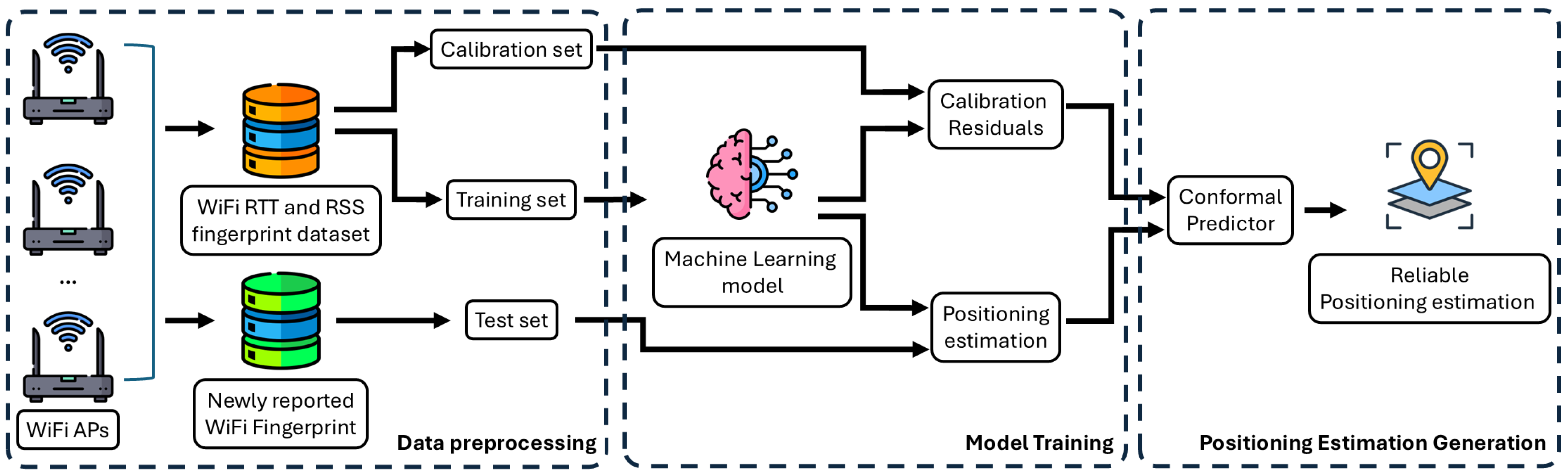
Traditional machine learning models, including the Random Forest predictor employed above, provide location estimations without confidence measures, making it difficult to assess the reliability of individual predictions or to identify when the system may be operating under challenging conditions. To address this gap, we apply CP on the three complicated real-world datasets to generate prediction intervals and regions with guaranteed coverage rates, providing quantifiable uncertainty estimates for location predictions.
Three distinct q-values for different aspects of location prediction are produced. The first is the half-width of the x-coordinate prediction interval and ensures that the true x-coordinate falls within with probability . Similarly, guarantees that the true y-coordinate falls within with the same coverage level. The third value , is designed for direct 2D positioning and generates a circular prediction region.
These three
q-values produce two fundamentally different types of 2D prediction regions. The first type, derived from
and
, creates a rectangular region defined as
The second type, derived from
, produces a circular region defined as
This dual approach allows us to examine how different geometric representations of uncertainty perform in practice. The choice of circular and rectangular prediction regions is motivated by the conformal prediction framework: circular regions arise naturally from the Euclidean distance nonconformity measure , whilst rectangular regions result from independent marginal predictions for x and y coordinates, aligning with Cartesian building layouts. Both geometries support efficient real-time implementation and provide the necessary comparison to reveal the fundamental trade-off between coverage reliability and region size.
To evaluate the performance of conformal prediction within the indoor positioning framework, we assess two key aspects: Coverage Rate and Efficiency.
Coverage Rate
Coverage rate measures the empirical proportion of test instances in which their true values lie within the predicted intervals or regions. For a target confidence level of
, CP guarantees that the coverage rate
is at least
under the assumption of exchangeability with
k being the number of test samples, where
is an indicator function that takes the value of 1 if
. In our experiments, four coverage metrics are reported:
Coverage: proportion of test instances where the true x-coordinate lies within , where represents the half-width of the prediction interval.
Coverage: proportion of test instances where the true y-coordinate lies within , where represents the half-width of the prediction interval.
2D Coverage: proportion of test instances lying inside the rectangular region
Coverage: proportion of test instances lying within the circular region
Efficiency
Efficiency quantifies the tightness or size of the prediction regions. Under identical coverage rates, smaller regions indicate more efficient predictions, meaning that the CP model provides more precise and confident estimates while still satisfying the required coverage guarantee.
As shown in
Table 6 and
Table 7, across all three testbeds and all signal types, the proposed methods successfully achieve the target coverage rates for individual coordinates and circular regions (
Coverage). The
Coverage,
Coverage, and
Coverage metrics consistently meet or slightly exceed their target levels (90% or 95%), confirming that CP’s validity guarantee holds in practice for this application domain. As shown in
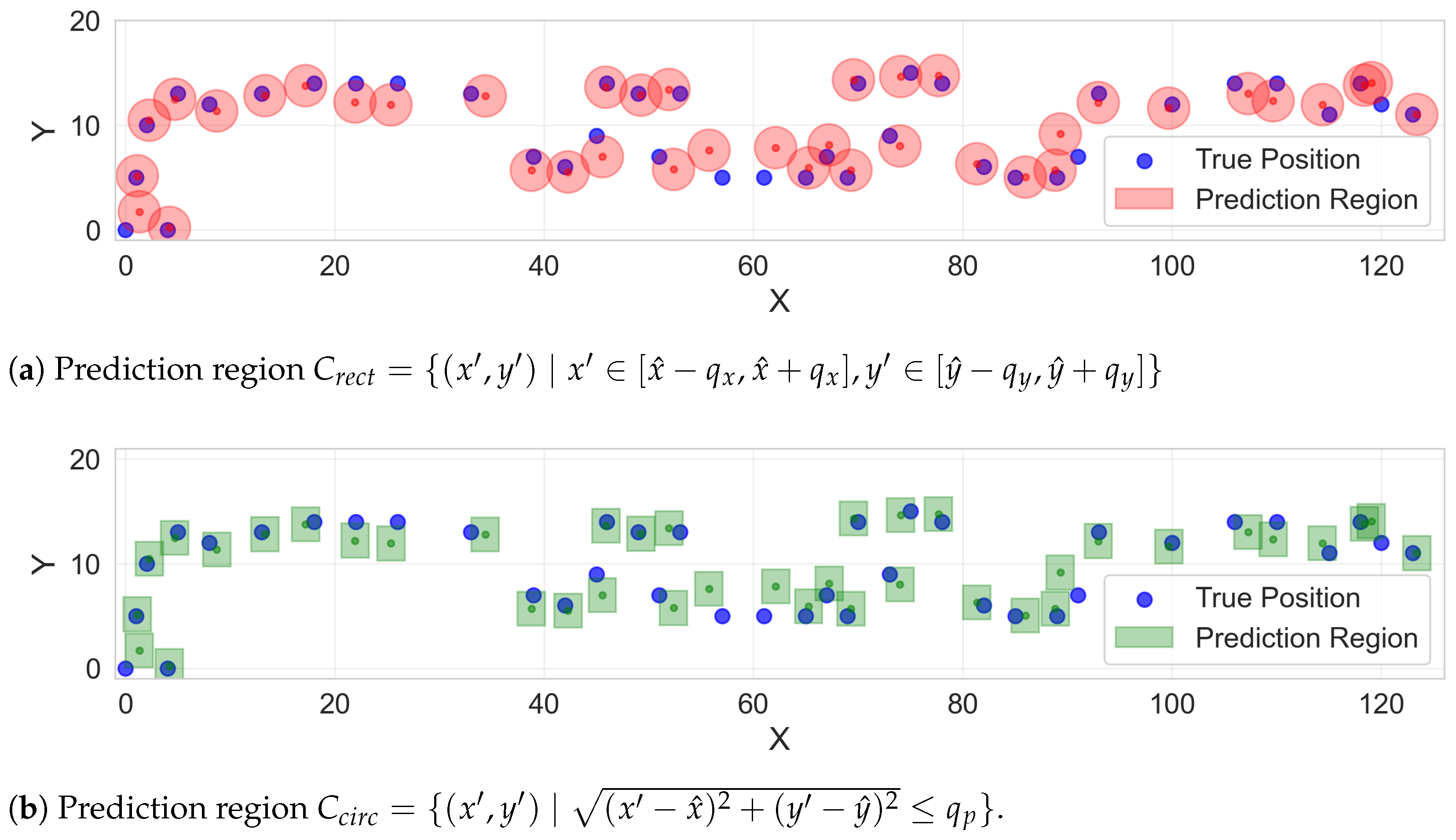
Figure 5, the conformal prediction approach generates tight uncertainty regions (pink circles and green rectangles) around the true positions (blue dots), providing reliable coverage guarantees for indoor localisation.
However, while the circular regions ( Coverage) successfully meets the target coverage rate, a systematic pattern emerges when examining the rectangular regions (2D coverage rates). These consistently fall below the target coverage levels, typically achieving 80–86% coverage when targeting 90%, and 90–94% coverage when targeting 95%. This phenomenon occurs because the rectangular region requires both x and y coordinates to simultaneously fall within their respective intervals. This occurs because the 2D rectangular region requires both x and y to fall within their respective intervals simultaneously, so the joint coverage becomes the product of the two marginal coverages. This finding highlights an important consideration when choosing between rectangular and circular prediction regions for 2D positioning applications.
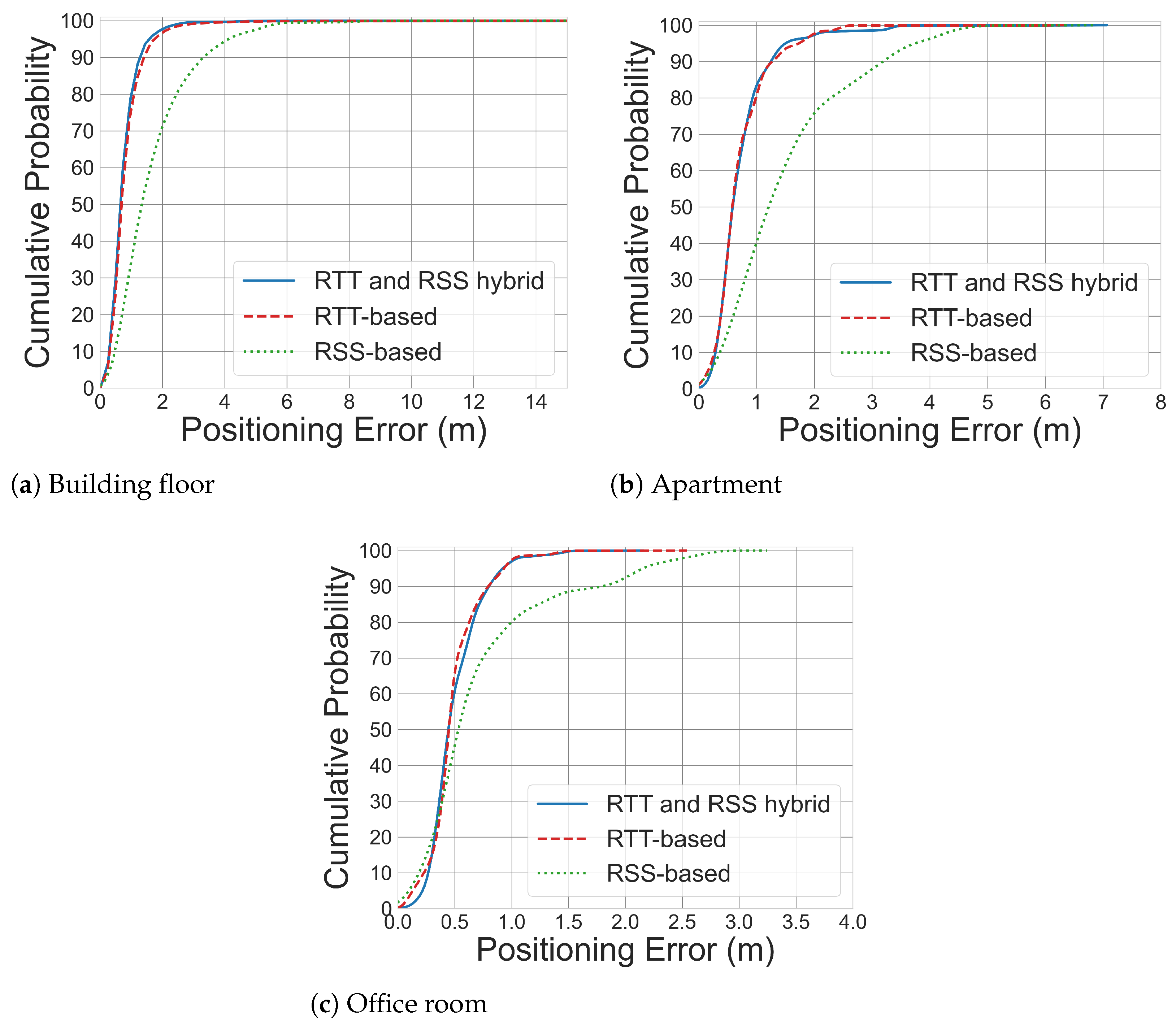
The comparison across different WiFi signal types reveals a clear performance hierarchy that remains consistent across all three testbeds. The RTT + RSS hybrid approach demonstrates the best efficiency, producing the smallest q-value and thus the tightest prediction regions. For example, in the Building Floor testbed at 90% confidence, the hybrid approach achieves m. The RTT Only approach performs at a moderate level, producing regions 4–50% larger depending on the testbed. The RSS Only approach consistently produces the largest q-values, indicating substantially more uncertainty, with predictions 100–200% larger than the hybrid approach. This clear ordering demonstrates that combining RTT measurements with RSS provides complementary information that significantly improves both accuracy and certainty in position predictions.
The three testbeds exhibit distinct characteristics that reflect their physical environments. The smallest Office Room testbed consistently shows the tightest prediction regions across most methods, with the RTT+RSS hybrid approach at 90% confidence achieving m and m at 95%. The Apartment testbed demonstrates comparable performance, with m at 90% and m at 95% for the hybrid approach. The Building Floor testbed shows moderately larger prediction regions, with the hybrid approach achieving m at 90% and m at 95%. Considering that the Building Floor dataset is a complex, large-scale testbed containing both LOS and NLOS conditions, these results remain promising, as the predictor is still able to provide reasonably tight uncertainty bounds despite the challenging signal propagation environment.
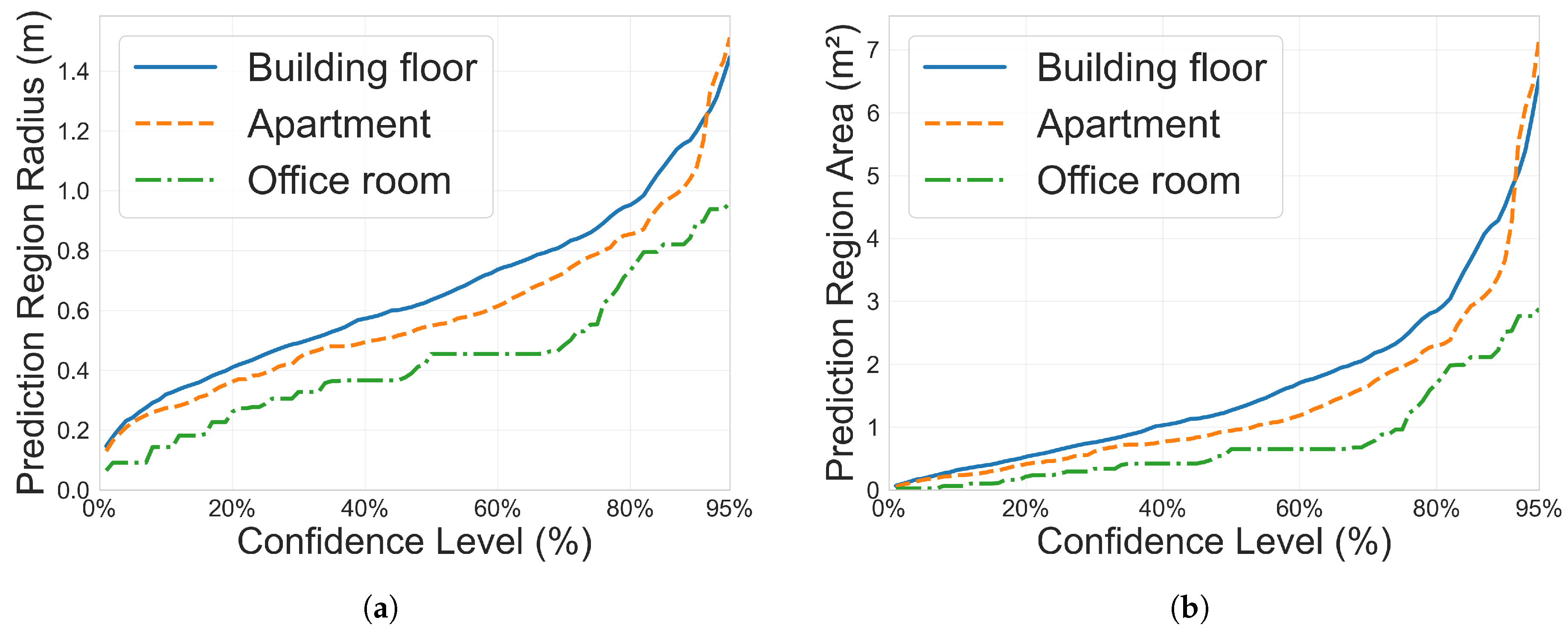
Finally, the relationship between confidence level and prediction region size reveals the fundamental trade-off in uncertainty quantification, as shown in
Figure 6 and
Table 8. When increasing confidence from 90% to 95%, rectangular prediction regions grow substantially: for the hybrid approach, areas expand from 3.10 m
2 to 4.78 m
2 (Building Floor), 2.82 m
2 to 5.06 m
2 (Apartment), and 1.36 m
2 to 2.69 m
2 (Office Room), with similar growth patterns observed for circular regions and other signal types. More critically, a consistent trade-off emerges between region size and coverage reliability across all conditions. Rectangular regions consistently achieve smaller areas than circular regions. For example, at 90% confidence in the Building Floor testbed, the hybrid approach yields 3.10 m
2 (rectangular) versus 4.52 m
2 (circular). This efficiency advantage, representing 30–45% reduction in area, persists across different signal measures and testbeds. However, this spatial efficiency comes at the cost of coverage reliability. It is observed that rectangular regions systematically achieve 2D coverage rates 8–10 percentage points below target levels (e.g., 81.75% actual versus 90% nominal), while circular regions consistently meet or slightly exceed their specified confidence levels (e.g., 90.01% for 90% target). This pattern holds across all three testbeds and signal types, though the area differential is most pronounced for RSS Only measurements. This trade-off between spatial efficiency and coverage guarantee reflects an inherent characteristic of uncertainty quantification frameworks and should be carefully considered when selecting confidence levels and region geometries for practical deployment.