1. Introduction
With the continuous advancement of science and technology, intelligent development has become a primary driving force in the global civil aviation industry [
1]. The cooperative operation of automated and manually driven special-purpose vehicles within airport movement areas has emerged as a key trend in modern airport infrastructure development, thereby imposing increasingly stringent requirements on operational safety. Consequently, achieving high-precision, real-time tracking and localization of maneuvering targets in the airside area has become critically important.
As the fundamental component of autonomous driving systems, target tracking and localization are required to ensure continuity, real-time capability, and high accuracy. However, maneuvering targets within airport movement areas are characterized by large spatial coverage, highly diverse motion states, and significant prediction uncertainty. Under such conditions, single-model tracking algorithms exhibit inherent limitations and are unable to satisfy the demands of real-world operations [
2,
3]. The Interacting Multiple Model (IMM) approach, originally proposed for Systems with Markovian switching coefficients [
4], provides an effective solution and has since been widely applied in various complex scenarios, including exo-atmospheric ballistic tracking, high-maneuver fighter tracking, near-space hypersonic target tracking, underwater vehicles, and airborne surveillance systems [
5,
6,
7,
8,
9,
10]. In modern target tracking research, maneuver modeling and model switching are widely regarded as effective means for improving tracking performance in complex motion scenarios. Reference [
11] proposes a Bayesian framework for inferring dynamically evolving group leadership structures from noisy observations, by developing a destination-driven leader–follower model and employing sequential Monte Carlo methods to jointly enhance leadership identification and tracking accuracy. Reference [
12] proposes a Bayesian framework based on α-stable Lévy state-space models for maneuvering object tracking and intent prediction, achieving noticeable performance improvements over conventional Gaussian dynamic models.
The optimization of IMM-based algorithms in existing research can be broadly classified into three categories: model-set selection, filtering algorithm enhancement, and transition probability adaptation. Reference [
13] adopts the Current Statistical (CS) model and exploits its advantages to enhance the robustness of maneuvering-target tracking under mixed line-of-sight and non-line-of-sight conditions. Reference [
14] employs a model set comprising the Constant Velocity (CV) model, a three-dimensional fixed-center Constant Speed and Constant Turn Rate (CSCTR) model with adaptive turn-rate adjustment, and the CS model. Reference [
15] introduces an improved CS-Jerk model as one of the sub-models, thereby increasing the consistency between the assumed motion models and the true target dynamics. Reference [
16] utilizes an autoregressive (AR) predictive model to characterize the motion state and updates the motion equations online, enabling a more accurate description of target dynamics and improving overall algorithmic robustness. Reference [
17] designs an IMM set based on the Clohessy–Wiltshire (C–W) equation, an augmented C–W model, and a fading-memory C–W model, effectively accommodating various maneuvering modes of space targets and improving the matching fidelity to the real system with relatively low computational complexity. Reference [
18] models vehicle dynamics using the Constant Velocity–Coordinated Turn (CV–CT), Constant Velocity–Constant Acceleration (CV–CA), and Constant Acceleration–Coordinated Turn (CA–CT) motion models. However, these model-selection strategies are generally more suitable for open-space or highly maneuvering targets rather than the constrained airport surface environment. This limitation arises from an application-scenario mismatch, as airport operations must strictly adhere to specific safety regulations and operational constraints.
Extended Kalman filtering (EKF) and unscented Kalman filtering (UKF) are widely used for state estimation in highly nonlinear systems [
19]. However, EKF relies on the accurate computation of Jacobian matrices and therefore exhibits insufficient robustness when the system dynamics are strongly nonlinear or subject to model uncertainties. In contrast, UKF employs the Unscented Transformation (UT) [
20,
21,
22,
23,
24], which propagates a carefully selected set of sigma points through nonlinear functions to more effectively capture the mean and covariance evolution. As a result, UKF typically achieves superior filtering performance in nonlinear estimation tasks. To further improve filtering performance, several enhanced approaches have been proposed. In reference [
25], an improved adaptive Sage–Husa algorithm is integrated with UKF to ensure the positive definiteness of the estimated measurement-noise covariance; however, its effectiveness in mitigating prediction errors during model-switching transients and at the onset of target maneuvers remains limited. Reference [
26] introduces a dimension-mismatched interacting IMM-UKF framework that groups multiple motion models into two composite filters, enabling parallel three-dimensional filtering; nevertheless, the non-equal-dimensional state mapping may introduce additional numerical uncertainty in practical implementations. In reference [
27], adaptive UKF and robust UKF are fused by probabilistically weighting their estimation outputs, thereby enhancing the adaptability and robustness of the overall filter; however, the parallel operation of two filters leads to a significant increase in computational complexity.
Transition-probability adaptation represents an effective pathway for enhancing IMM-based algorithms. Reference [
28] proposes an end-to-end learning-based adaptive IMM algorithm, in which a neural network estimates the transition probability matrices (TPMs) in real time. A generalized recurrent neural network is trained directly on tracking tasks using an end-to-end strategy, reducing dependence on large datasets and improving model generalization; however, its performance remains highly dependent on the availability and quality of training data. In refs. [
29,
30,
31], adaptive adjustment strategies based on the definition of error compression ratios or compression ratio ratios are proposed, in which posterior information is exploited to correct the prior model information. Specifically, reference [
30] overcomes the limitation in reference [
29] that only two models can interact by redefining the error-compression ratio to support three-model interaction; however, the tracking error increases when the system does not undergo mode switching. In reference [
31], the compression-ratio definition is further refined, and the adaptive adjustment conditions originally applicable only to two-model cases are extended to multi-model scenarios. Nevertheless, compression-ratio-based approaches are highly sensitive to measurement noise and transient variations, which may result in spike errors during model-switching instants. Reference [
32] proposes a measurement-driven adaptive correction strategy for model transition probabilities, which enhances the influence of the matched model while suppressing that of the mismatched ones, yet exhibits reduced tracking accuracy during model transitions. However, when the target undergoes significant maneuvers, relatively large tracking errors are observed in both position and velocity estimates. In refs. [
33,
34,
35], model transition probabilities are adaptively modified based on model likelihood values. Specifically, Reference [
34] further refines the correction parameters proposed in [
33], effectively mitigating singularity issues in the transition matrix. Building upon reference [
34], reference [
35] introduces an additional correction step using a decision window, enabling a two-stage refinement of the Markov transition matrix and more effective exploitation of posterior information. Nevertheless, likelihood-based correction approaches inherently rely on the numerical stability of the likelihood function values, which may lead to difficulties in regulating correction strength and insufficient steady-state stability of the model probabilities.
Airport surface target tracking exhibits pronounced application-specific characteristics. Target motion is subject to strict spatial constraints imposed by runways, taxiways, and aprons; maneuvering behaviors are relatively limited, whereas motion-state transitions occur frequently. Moreover, this scenario is safety-critical, imposing higher requirements on the stability and feasibility of tracking results. Consequently, methods that rely solely on historical statistical information or complex probability correction mechanisms struggle to simultaneously achieve rapid responsiveness and steady-state stability in such environments. Although the aforementioned algorithms improve model probability accuracy and overall tracking performance, their position and velocity root-mean-square errors (RMSEs) remain insufficient to meet the high-precision requirements of complex airport operational environments. In addition, reliance on historical model information in these approaches tends to slow down model switching, leading to response lag during motion-state transitions.
To address the aforementioned practical engineering challenges, this study proposes an application-oriented AIMM-STUKF target tracking framework that jointly considers model-switching responsiveness, tracking accuracy, and operational suitability for airport scenarios. The proposed framework is characterized by system-level integration of a standard STUKF formulation within an adaptive interacting multiple model architecture, in conjunction with an adaptive model-probability correction mechanism and airport map–based constraints. The standard STUKF is embedded into the overall framework to adaptively balance the weighting between historical information and current measurements. Meanwhile, unlike approaches that rely on error-compression ratios or likelihood-function-based tuning, the Markov transition probability matrix is adaptively and exponentially adjusted according to posterior model-probability differences. In addition, airport map information is incorporated to impose constraints on the position components of the filtered state estimates, thereby further improving tracking accuracy and ensuring that the estimation results remain consistent with airport-surface operational requirements.
2. System Tracking Model Establishment
The state model and measurement model describe the dynamic behavior of the system. Specifically, the system input is characterized by the state equation, which consists of a deterministic time function and stochastic process noise, whereas the system output is described by the measurement equation, which is a function of the state vector and is corrupted by measurement noise. For a target governed by multiple motion models, the corresponding state-transition equation is formulated as shown in Equation (1):
The measurement equation is given as Equation (2):
In Equations (1) and (2),
denotes the sampling instant;
represents the state vector, which contains the true state information of the target at time
; The state transition matrix at time
is denoted by
;
denotes the process noise, which reflects the environmental disturbances affecting the motion of the moving target, with covariance
;
is the measurement vector, representing the observed range and bearing of the target at time
;
denotes the measurement noise, which is related to the monitoring equipment and sensors, with covariance
;
and
are mutually uncorrelated two-dimensional zero-mean Gaussian white noise processes;
is the Kronecker delta function, leading to Equation (3):
In the IMM-UKF framework, the construction of the model set must comprise multiple motion models that collectively characterize all possible system behaviors, and its formulation must comply with the Bayesian principles of completeness and independence [
36]. Moreover, the tracking accuracy of the algorithm is closely related to the target’s motion model—the more consistent the assumed motion model is with the actual motion of the target, the higher the tracking accuracy achieved.
The motion states of moving targets in airport movement areas are generally characterized by three types of motion: uniform linear motion and uniformly accelerated motion on taxiways and runways, as well as coordinated turn motion at intersections between taxiways or between taxiways and runways. These three motion states are, respectively, described by the constant velocity (CV) model, the constant acceleration (CA) model, and the coordinated turn (CT) model.
The motion characteristics of the moving target are represented by its position coordinates
and
, velocity components
and
, acceleration components
and
, and the angular velocity
during turning. At a given sampling instant
, the motion state under the constant velocity model is expressed by Equation (4); the motion state under the constant acceleration model is defined by Equation (5); and the motion state under the coordinated turn model is represented by Equation (6).
3. IMM-UKF Algorithm
3.1. UKF Algorithm
The sigma point set is calculated as shown in Equation (8), where a total of sampling points are generated:
Calculation of the corresponding weights of the sigma points:
In Equations (8) and (9), denotes the scaling parameter, defined as , which is used to reduce the overall prediction error; is a scaling factor, typically chosen as a small positive number; and is the secondary scaling factor, selected as a non-negative number.
The one-step predicted values of the sigma points are then computed. Based on these predictions, the system state estimate and the predicted state covariance are obtained:
Based on the estimated state and covariance, a new set of sigma points is generated using the unscented transformation (UT). These sigma points are then propagated through the measurement equation to obtain the predicted measurement values:
Computation of the predicted mean and covariance:
The Kalman gain calculation, system state update, and covariance update are given by the following equations:
3.2. IMM-UKF Algorithm
The standard IMM-UKF algorithm consists of four main components: model interaction, filtering, model probability update, and state estimate fusion.
In the model interaction step, the conditional initialization and reinitialization are performed for each model, and the interacting inputs for each filter are computed using the model transition probabilities. During the filtering step, each motion model is processed through a UKF, where the interacting inputs and measurement values are used to compute the state estimate at the current time step. Next, the model probabilities are updated based on the filtering results, reflecting the likelihood that each motion model matches the current target dynamics. Finally, in the state estimate fusion step, the individual model estimates are weighted and combined according to the updated model probabilities to produce the overall fused estimate.
Based on Bayesian inference, the recursive process of the IMM-UKF algorithm from time step to consists of four steps, as follows:
The result of each iteration cycle determines the initialization state for the subsequent cycle. The result from the previous time step is used to initialize the current state estimate and its corresponding covariance matrix. Let
denote the interaction probability from model
to model
at time
;
represent the state estimate; and
represent the corresponding covariance estimate, with
. After interaction computation,
the initial conditions for the
filter input at the current time
step are given by:
The mixed state estimate and its corresponding covariance at time , obtained through the interaction computation, are used as the filtering
inputs for mode . Each motion model employs a UKF to perform state estimation based on
its respective dynamic characteristics. Consequently, the filtering outputs at
time are the updated state estimate and the estimated covariance .
- (3)
Model Probability Update
Model probabilities are updated using likelihood functions, where each model’s likelihood represents the degree of consistency between the target motion state and the corresponding motion model.
Assume that, at time
, the innovation
and its covariance
obtained from the filter follows a Gaussian distribution. Then, the
likelihood function
for model
and the updated model probability
are expressed as follows:
- (4)
State Estimation Fusion
The state estimates and covariance matrices obtained from each sub-model filter at time
are combined through weighted summation, where the weight of each model is determined by its updated model probability. Consequently, the final fused state estimate
and covariance estimate
are given by:
4. Proposed AIMM-STUKF Algorithm
In practical applications, the Unscented Kalman Filter (UKF) may suffer from enlarged estimation errors, slow convergence, or even divergence. In the standard IMM-UKF framework, the Markov transition matrix is typically predetermined based on prior knowledge or manually specified fixed probabilities, which fails to accurately represent the true switching behavior among the target’s motion models and consequently degrades tracking accuracy and responsiveness. Moreover, maneuvering targets operating within airport environments are subject to highly complex and dynamic conditions; when real-world observations and contextual information are not sufficiently incorporated, the algorithm may suffer from model-matching inconsistencies and degraded localization performance during field deployment.
To address the above issues, this study integrates strong tracking theory with the UKF by employing an STUKF in the filtering stage. A fading factor is introduced to dynamically adjust the Kalman gain, enabling the filter to respond more rapidly to new measurements and enhancing estimation stability under abrupt state variations. Additionally, a correction factor is introduced to modify the model probability transition matrix, enhancing the robustness and sensitivity of the algorithm in complex or dynamic environments. Furthermore, the dynamic information of moving targets obtained from airport surveillance systems is fused with airport map data within the algorithm, improving its adaptability to airport-specific operational conditions.
4.1. STUKF Algorithm
The strong tracking filter (STF) is characterized by two sufficient conditions: minimization of the state estimation covariance and mutual orthogonality of the residual sequences at all time steps. These conditions can be expressed as follows:
When the system state evolves smoothly and the assumed motion model accurately matches the true target dynamics, the filter can satisfy both conditions simultaneously. However, in practical maneuvering target state estimation scenarios, frequent changes in the target motion pattern may lead to model mismatch, making it difficult to maintain the orthogonality of the residual sequence at all time steps. Therefore, a fading factor is introduced into the predicted covariance to adaptively adjust the Kalman gain in real time, thereby enforcing the orthogonality of the residual sequence.
The computation of the fading factor is given as follows:
In Equations (32)–(34), denotes the weakening parameter, whose value typically lies within . represents the innovation covariance matrix, and is the forgetting factor, with its value generally within .
The incorporation of the fading factor into the covariance matrix is given as follows:
Based on the state vector updated after incorporating the fading factor
, the Kalman gain is computed, and the state estimate and covariance matrix are updated as follows:
4.2. Definition of the Correction Factor
The correction factor is defined as the exponential function of the difference between model probabilities:
The model probability transition matrix is adaptively adjusted based on the correction factor. When the target motion state changes, the probability difference between the matched model and mismatched models increases. The proposed correction factor nonlinearly amplifies this difference, thereby adaptively enhancing the transition probability toward the matched model while suppressing transitions to mismatched models. The resulting rapid convergence of model probabilities effectively shortens the duration during which mismatched models dominate the state fusion process, reduces transient errors caused by model mismatch, and consequently improves tracking accuracy and stability. Let
denote the tuning parameter, with
. The corresponding correction procedure is formulated as follows:
Since the sum of transition probabilities from one model to another at time
must equal 1, i.e., each row of the Markov transition matrix is required to sum to unity, a normalization operation must be applied to the corrected transition matrix. The corresponding normalization procedure is given as follows:
The magnitude of the diagonal elements of the transition probability matrix directly affects the stability and switching behavior of the model probabilities. Diagonal elements that are too small may cause fluctuations in the model probabilities during steady-state operation, whereas excessively large diagonal elements may suppress the model switching speed and reduce the responsiveness to changes in the true motion state. From the perspective of Markov chain stability, when the transition probability matrix satisfies the diagonal dominance property, the model probabilities are more likely to converge toward and remain stable around the matched model. Therefore, to ensure diagonal dominance of the Markov matrix while enabling adaptive probability adjustment, and to balance model switching sensitivity with steady-state stability, a lower-bound threshold is imposed on the diagonal elements, which is set to
. If any diagonal element of the normalized matrix falls outside the specified threshold range, it is modified accordingly. The adjustment process is expressed as follows:
4.3. Proposed AIMM-STUKF Algorithm
To ensure that the estimated target trajectories conform to the airport operational framework, this study introduces the Airport Map Database (AMDB) as a spatial constraint within the STUKF filtering stage, enabling the correction of state estimates that violate airport operational areas. The utilization of map information is realized through map registration, by which the airport map database is constructed, and the AMDB is subsequently employed to constrain post-filtering position estimates that fall outside the admissible operational domain.
In this work, the CAD map of a selected airport is first simplified, and the key airport surface elements are delineated in accordance with the requirements of the DO-272B standard. These elements are then imported into ArcMap, where map registration is performed using ground control points (GCPs) obtained from in situ GNSS measurements. Upon completion of the registration process, the airport surface operational areas are represented as polygonal regions. Together with their associated semantic information, an AMDB is constructed to describe the admissible operational space as a set of polygons defined within a unified coordinate system.
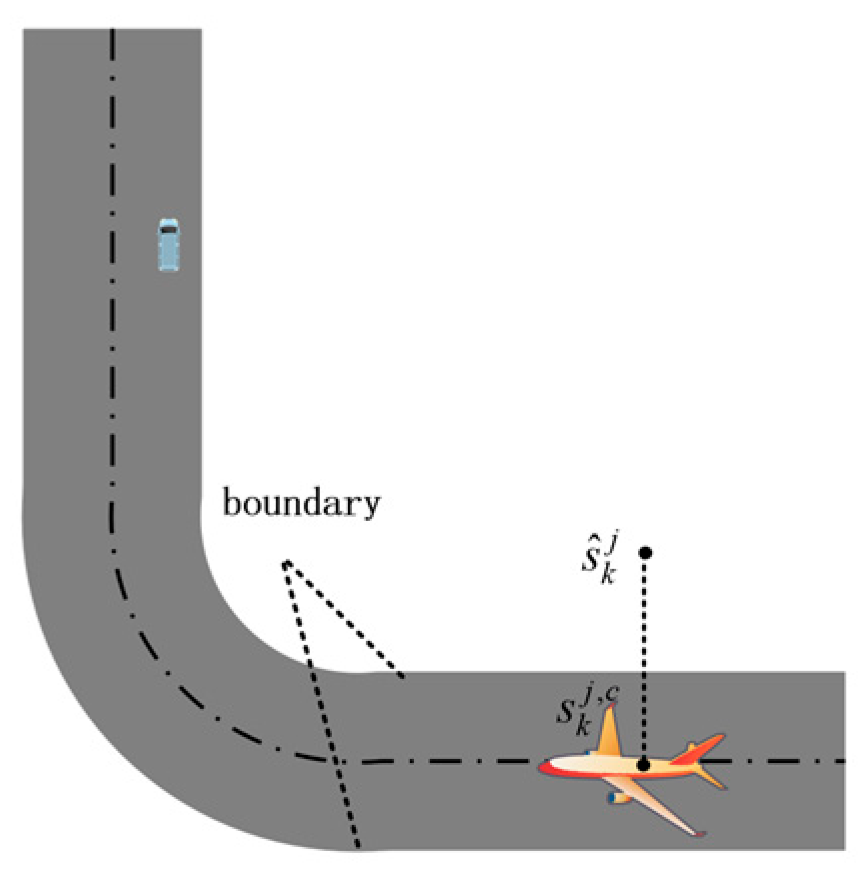
The map information is employed to impose constraints on the position components of the post-filtering state estimates, which mainly involves feasibility checking of whether the estimated position lies within the admissible operational domain, as well as position correction, as illustrated in
Figure 1.
Let the STUKF-based updated state estimate corresponding to mode
at time
be denoted as
, and its position component can be expressed as:
In Equation (39), represents a position selection matrix that extracts the positional components from the state vector.
The feasible airport surface operational area is represented as the union of multiple polygonal regions, as defined in Equation (40). A standard point-in-polygon (PIP) test is applied to examine the estimated position
. Based on the test result, a decision is made as to whether map-constrained position correction should be applied. The detailed correction procedure is given in (41).
A geometric projection approach is adopted to map the deviated position onto the nearest feasible region. The corrected position can be expressed as:
The corrected position is subsequently incorporated into the state vector, while the remaining state components are kept unchanged, yielding the map-constrained state estimate as follows:
Since the map-constrained correction constitutes a deterministic geometric operation rather than a stochastic measurement update, the state covariance matrix remains unchanged. The corrected state estimate is subsequently utilized for state fusion and final output, whereas the original STUKF estimate is retained for model probability updating within the IMM framework.
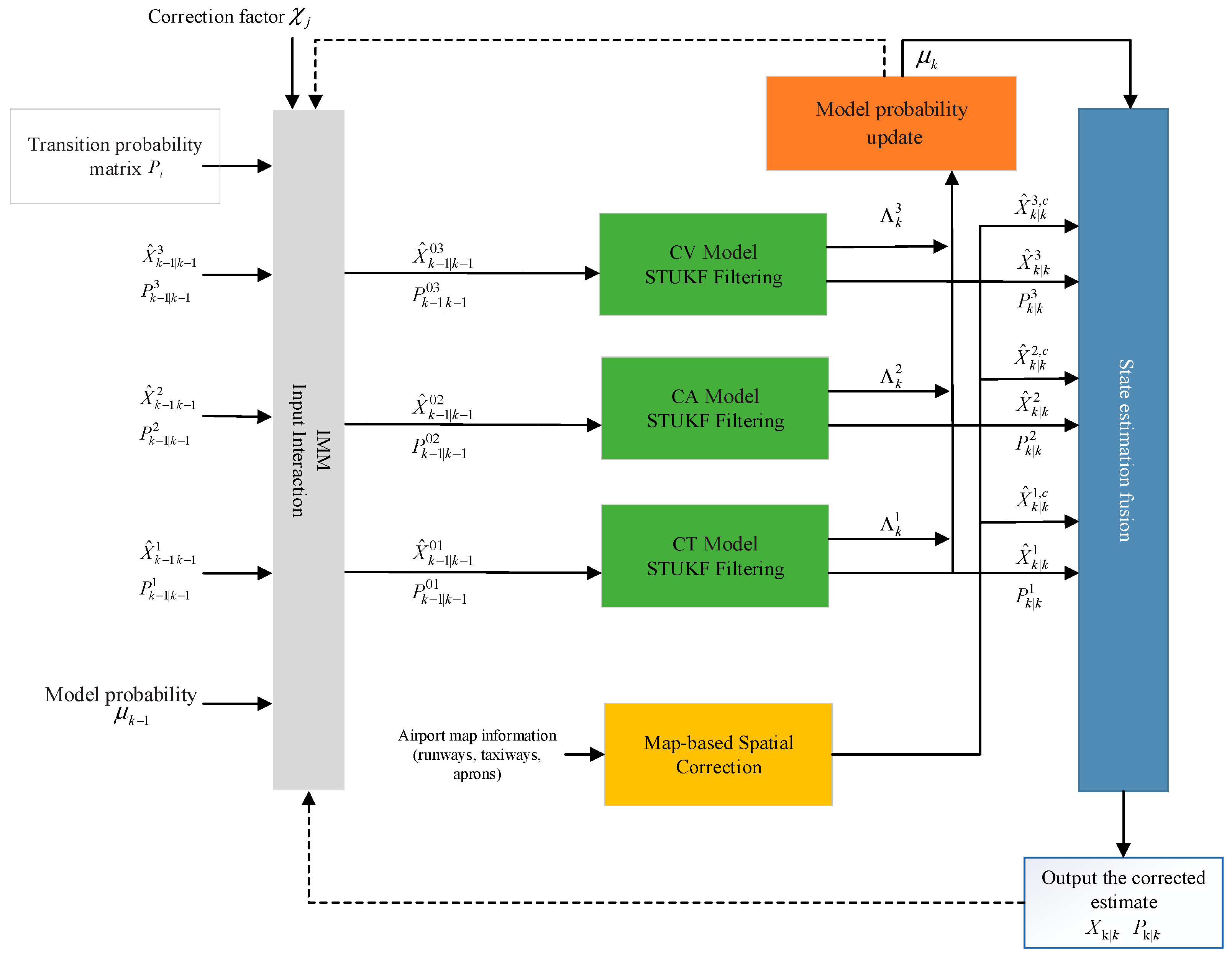
Based on the exponential of the model probabilities and the airport map information, the flowchart of the corrected AIMM-STUKF algorithm is illustrated in
Figure 2. The detailed steps of the algorithm are as follows:
- (1)
Based on the operational regulations of airports and the fundamental motion characteristics of ground targets in the movement area, a motion model set is constructed to represent the system’s possible motion patterns. The selection of specific models is determined according to the target’s motion region and behavior. In the airport movement area, ground vehicles and aircraft primarily exhibit constant acceleration and constant velocity motion along runways and taxiways, as well as constant-turn motion when transitioning through taxiway-to-taxiway or taxiway-to-runway intersections. Therefore, considering the motion characteristics of the maneuvering target, the proposed motion model set in this study consists of the Constant Velocity (CV) model, the Constant Acceleration (CA) model, and the Coordinated Turn (CT) model.
- (2)
In the interaction step, suppose that the target is associated with model at time and with model at time . The model probability prediction is updated using the exponential correction factor defined by the model probability subtraction in (35). The corresponding mixing weights are then computed according to (44). Subsequently, the mixed state estimate and mixed covariance obtained from (20) are used as the initial conditions for the filtering step.
- (3)
In the filtering update stage, each motion model employs its corresponding STUKF filter to perform state estimation. The Kalman gain is computed according to (7)–(19) and (25)–(34), followed by the state and covariance updates under each respective model.
- (4)
In the map-constrained processing stage, the position component of the post-STUKF state estimate is evaluated according to (39)–(43). Based on the evaluation result, map-based constraints are imposed when necessary. It should be noted that the constrained state estimate is only used for subsequent state fusion and final output, and therefore does not affect the update of the state covariance matrix or model probability computation within the IMM framework.
- (5)
The likelihood function and the corresponding model probabilities are subsequently derived from the innovation sequence obtained via the STUKF, along with its associated innovation covariance, as expressed in:
- (6)
Fused output estimation:
- (7)
The state estimates and associated covariance parameters obtained at the current time step are used as the initial inputs for the next time step. This procedure is then repeated iteratively until the end of the tracking cycle.