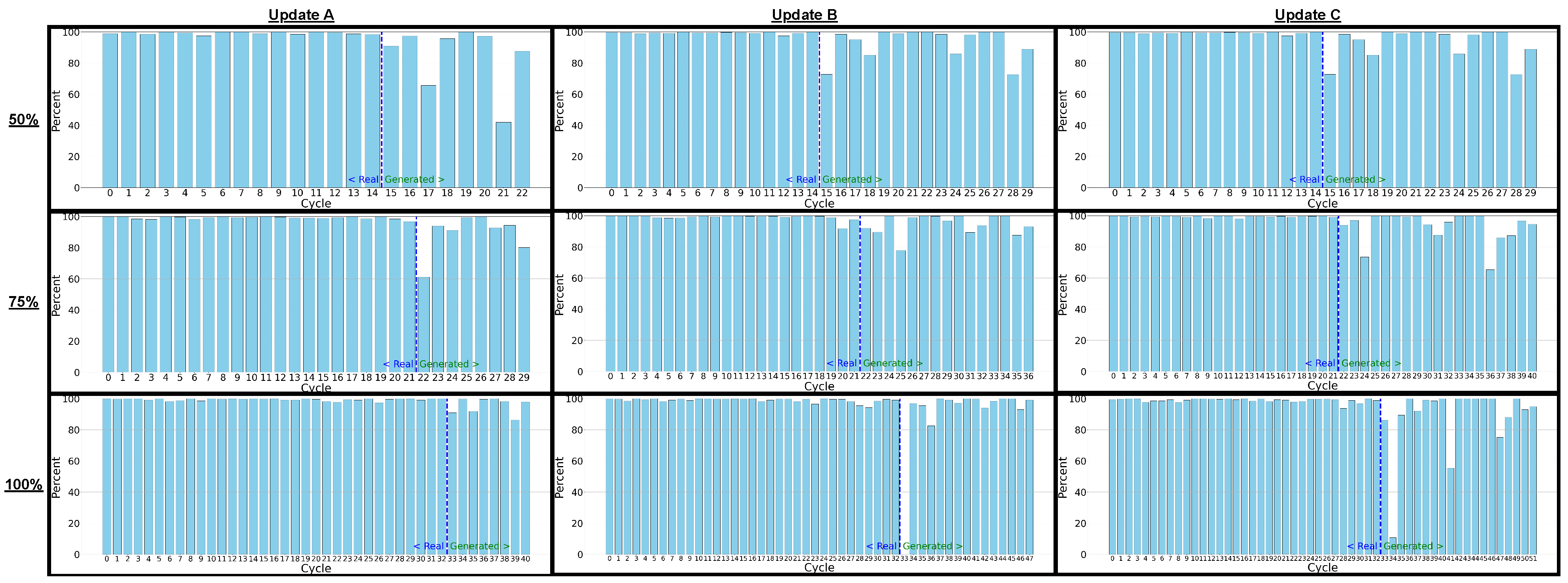
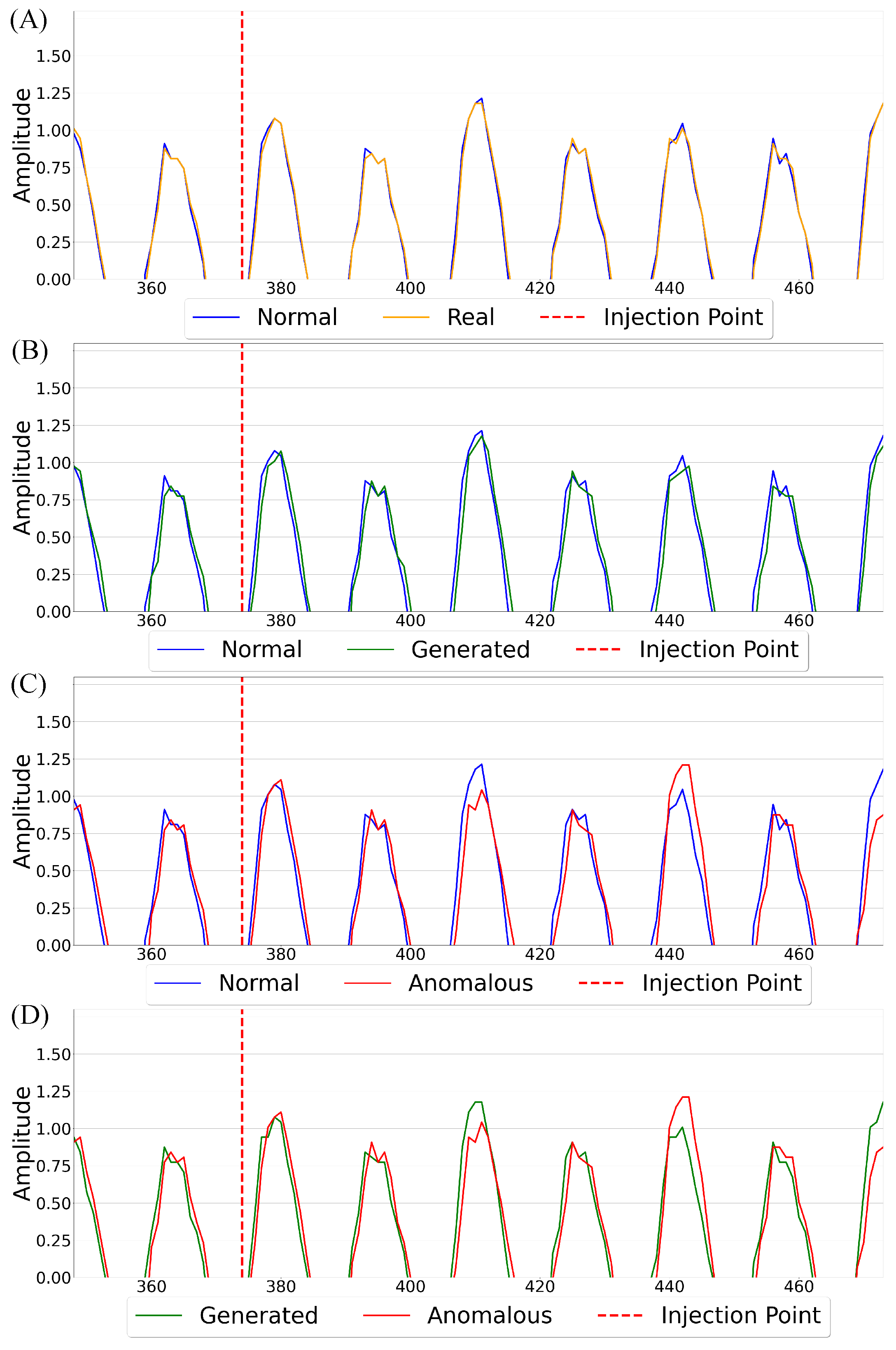
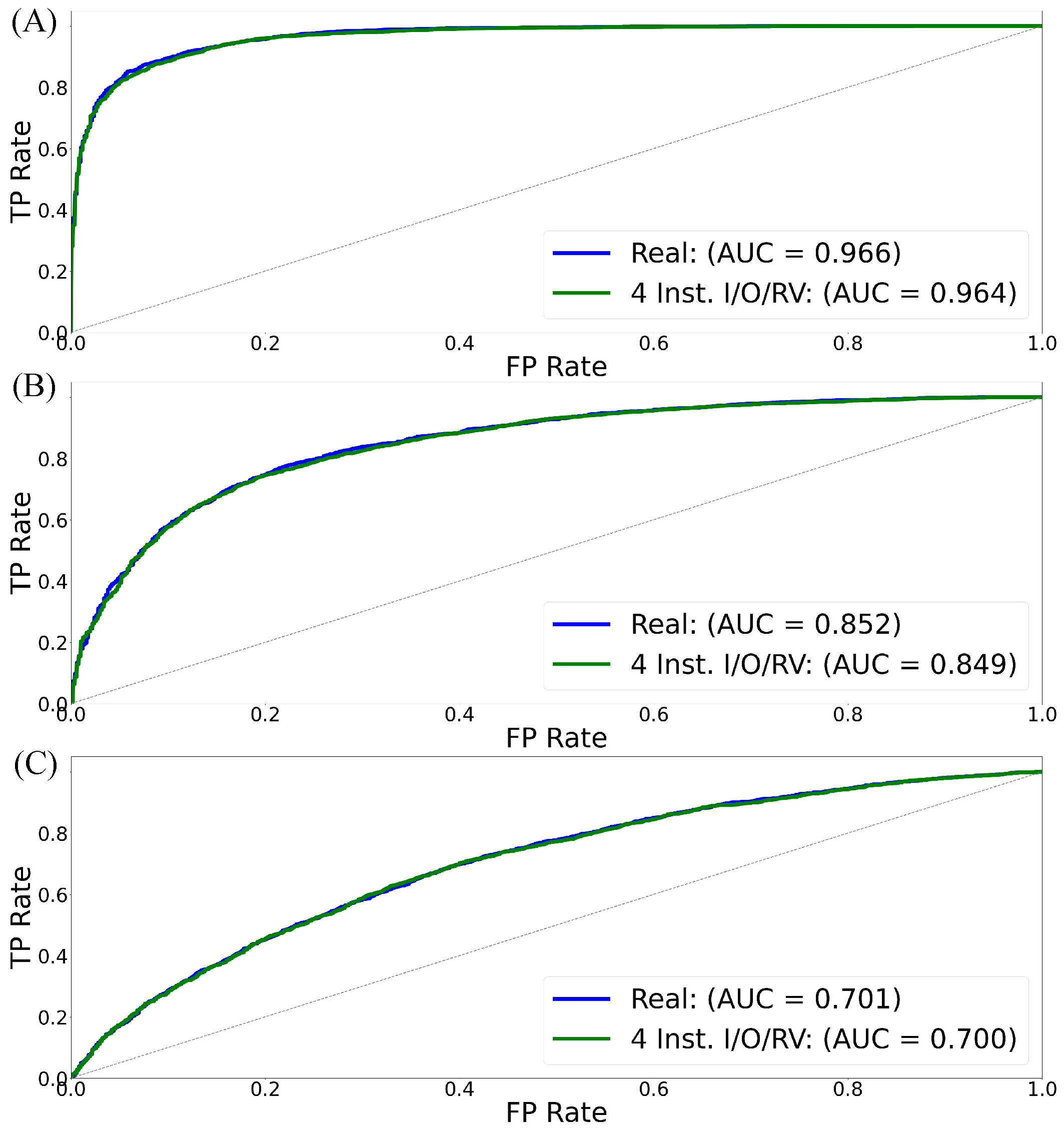
From Capture–Recapture to No Recapture: Efficient SCAD Even After Software Updates




Abstract
1. Introduction
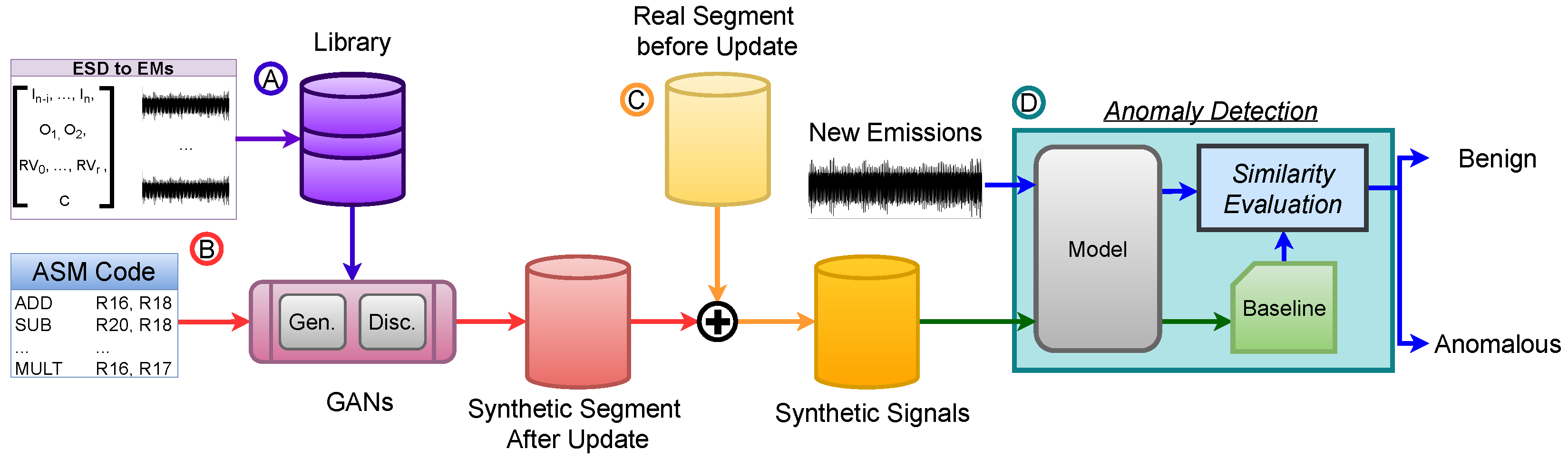
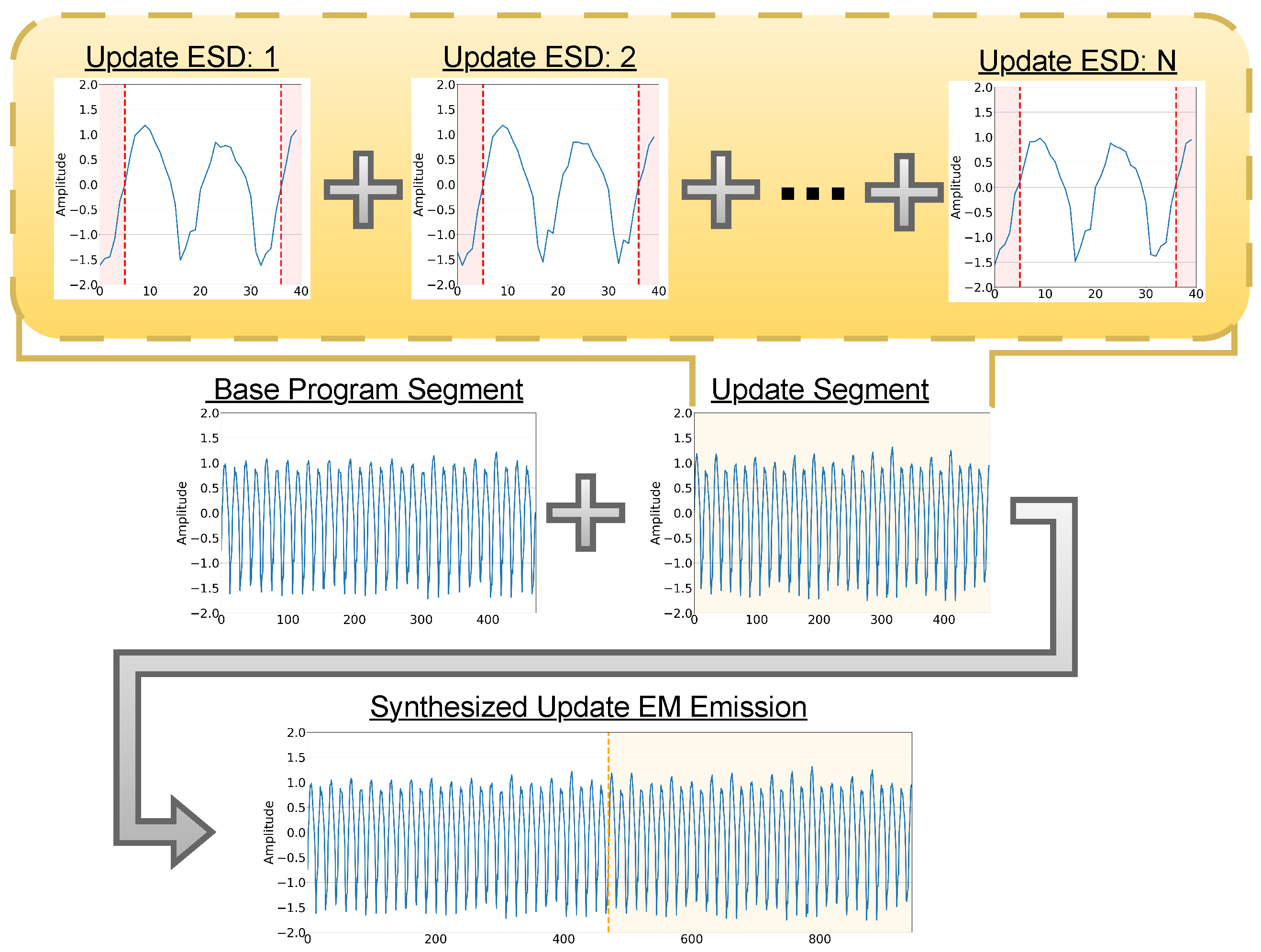
- It proposes a novel generative approach to eliminate the need for re-capturing EM emissions after software updates, addressing one of the key bottlenecks in SCAD deployment by enabling synthetic signal generation for newly introduced or modified execution paths without requiring physical data re-collection.
- It introduces Execution State Descriptors (ESDs) as a novel conditioning mechanism that incorporates prior instructions, operands, and register values, improving the fidelity and contextual accuracy of synthesized EM signals.
- It presents a 1D-CNN-based CWGAN-GP (1DCNNGAN) architecture that achieves higher per-instruction fidelity compared with the state-of-the-art ResGAN model while reducing training time by approximately five times and memory usage by an order of magnitude.
- It validates our approach using per-instruction fidelity evaluation and anomaly detection comparisons, showing that synthetic EM emissions achieve 82–92% similarity to real signals captured from an Atmel ATmega2560 CPU and yield anomaly detection AUCs nearly equivalent to real-data-trained models.
2. Technical Background
2.1. Generative Adversarial Network (GAN)
2.2. Conditional Wasserstein GAN with Gradient Penalty (CWGAN-GP)
2.3. Tokenizer
3. Assumptions and Threat Model
3.1. Operational Context
3.2. IIoT Microcontroller/Embedded CPU Assumptions
3.3. Practicality of Synthesizing Only the Updated/Modified Segments
3.4. Assembly (ASM) as the Chosen Input Representation
3.5. Attacker Capabilities and the Experimental Threat Model
4. Proposed Framework
4.1. Library
4.1.1. The Impact of Preceding Instructions
4.1.2. Accounting for State Transitions

4.2. CWGAN-GP Architecture
4.2.1. 1DCNNGAN
4.2.2. ResGAN
4.3. GAN Training
4.4. Synthesizing EM Emissions
4.5. Detection Model
5. Experimental Setup
5.1. Testbed
5.2. Base Program
| Listing 1: Base program’s assembly code. |
 |
5.3. Update Programs
| Listing 2: Update A’s assembly code. Calculates after a point in the base program’s code. |
 |
| Listing 3: Update B’s assembly code. Calculates Z = (C × D) − (A × B) after a point in the base program’s code. |
 |
| Listing 4: Update C’s assembly code. Checks if to calculate Z = (C × D) − (A2 × B2) after a point in the base program’s code. |
 |
5.4. Training Programs
| Listing 5: Example of a segment code from a Train Program’s assembly code. |
 |
5.5. Preprocessing
6. Experimental Evaluation
6.1. Synthetic EM Fidelity
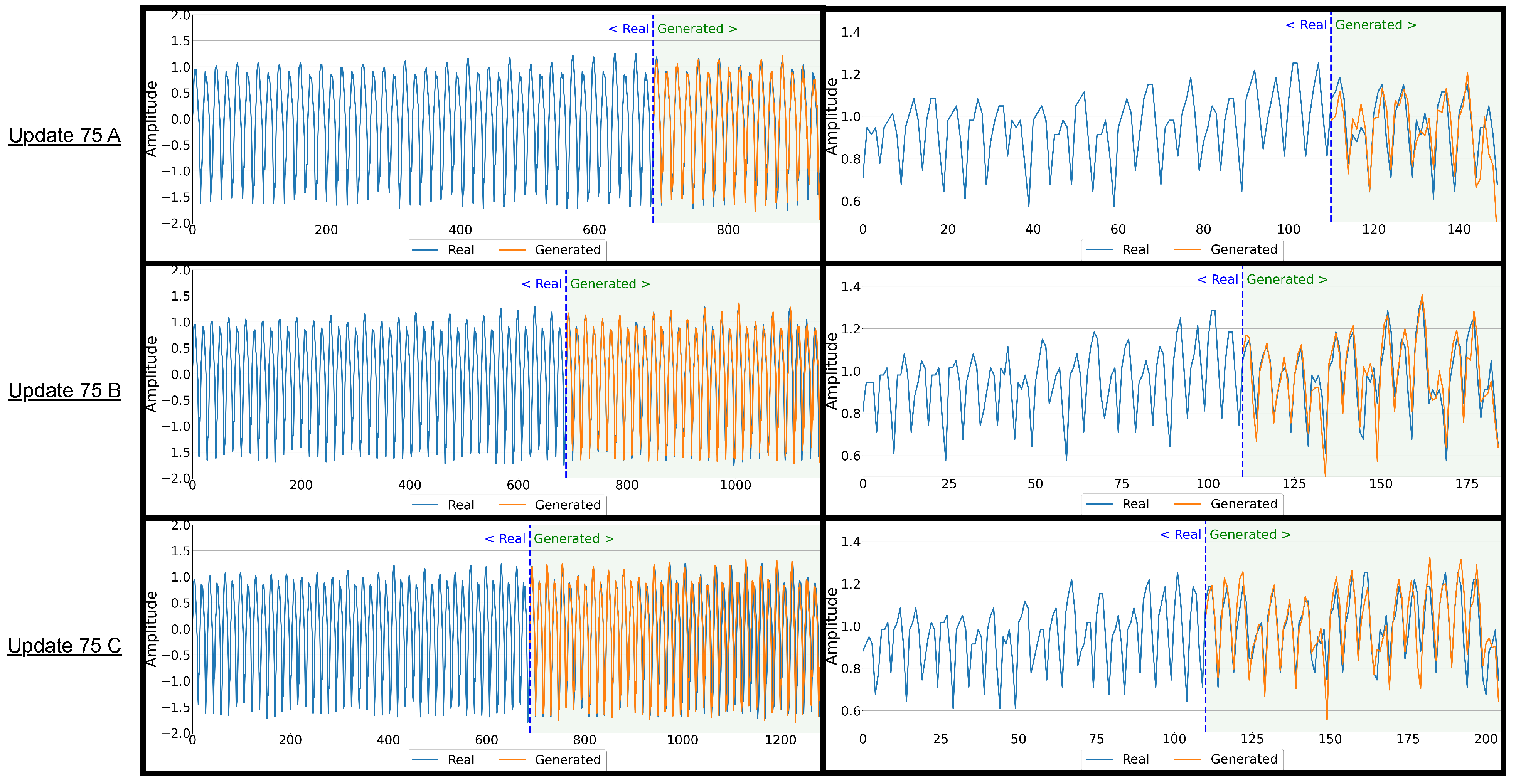
6.1.1. Full-Signal Fidelity Evaluation
6.1.2. Cycle-Level Fidelity Evaluation
6.2. Model Efficiency
6.2.1. Memory Footprint
6.2.2. Time to Train
6.3. Anomaly Detection
6.3.1. kNN and Real EM Signals
6.3.2. kNN and Synthetic EM Signals (ESD: 4 Instruction Sequence and State)
6.3.3. kNN and Synthetic EM Signals (1DCNNGAN vs. ResGAN)
7. Discussion and Future Directions
Author Contributions
Funding
Institutional Review Board Statement
Informed Consent Statement
Data Availability Statement
Conflicts of Interest
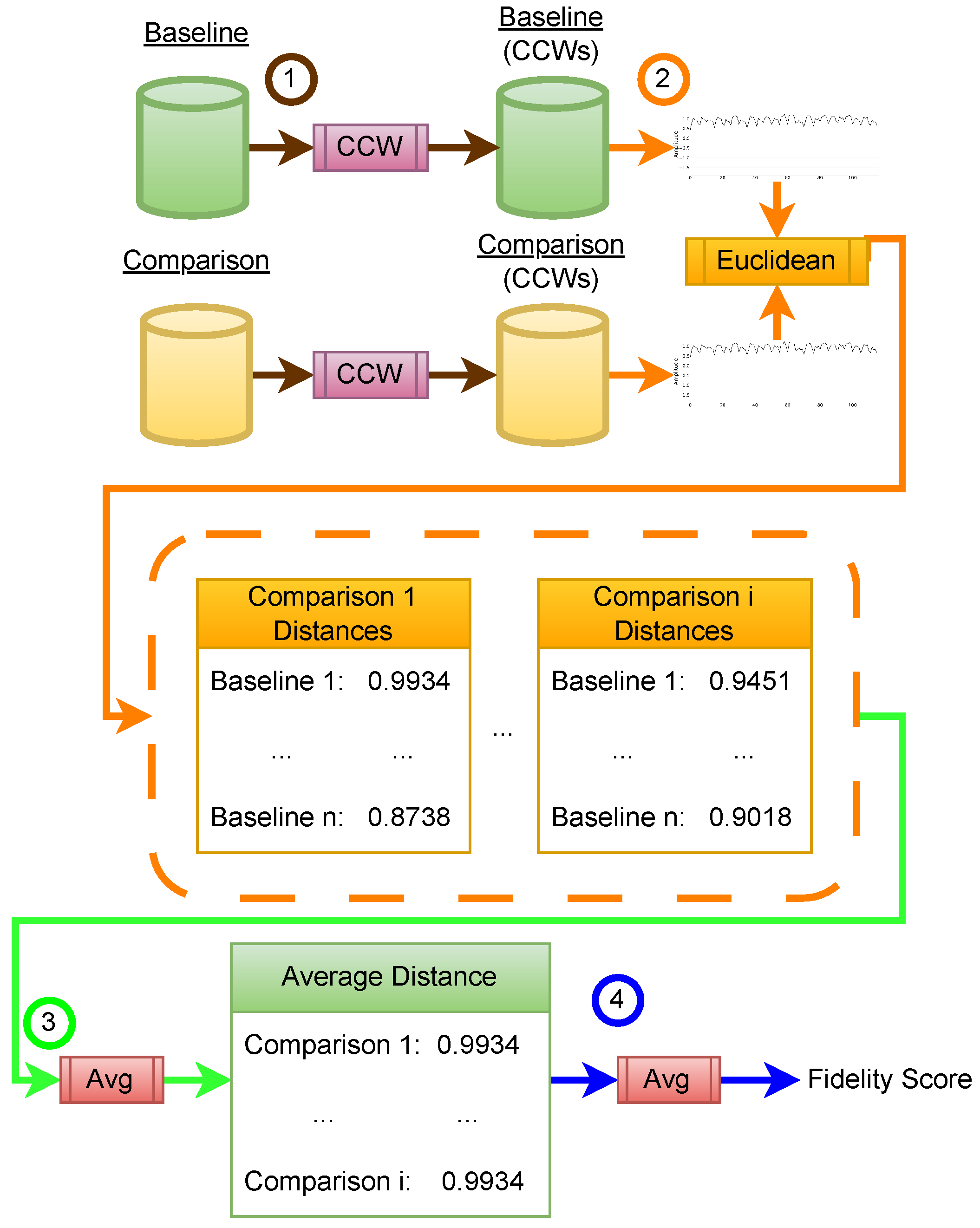
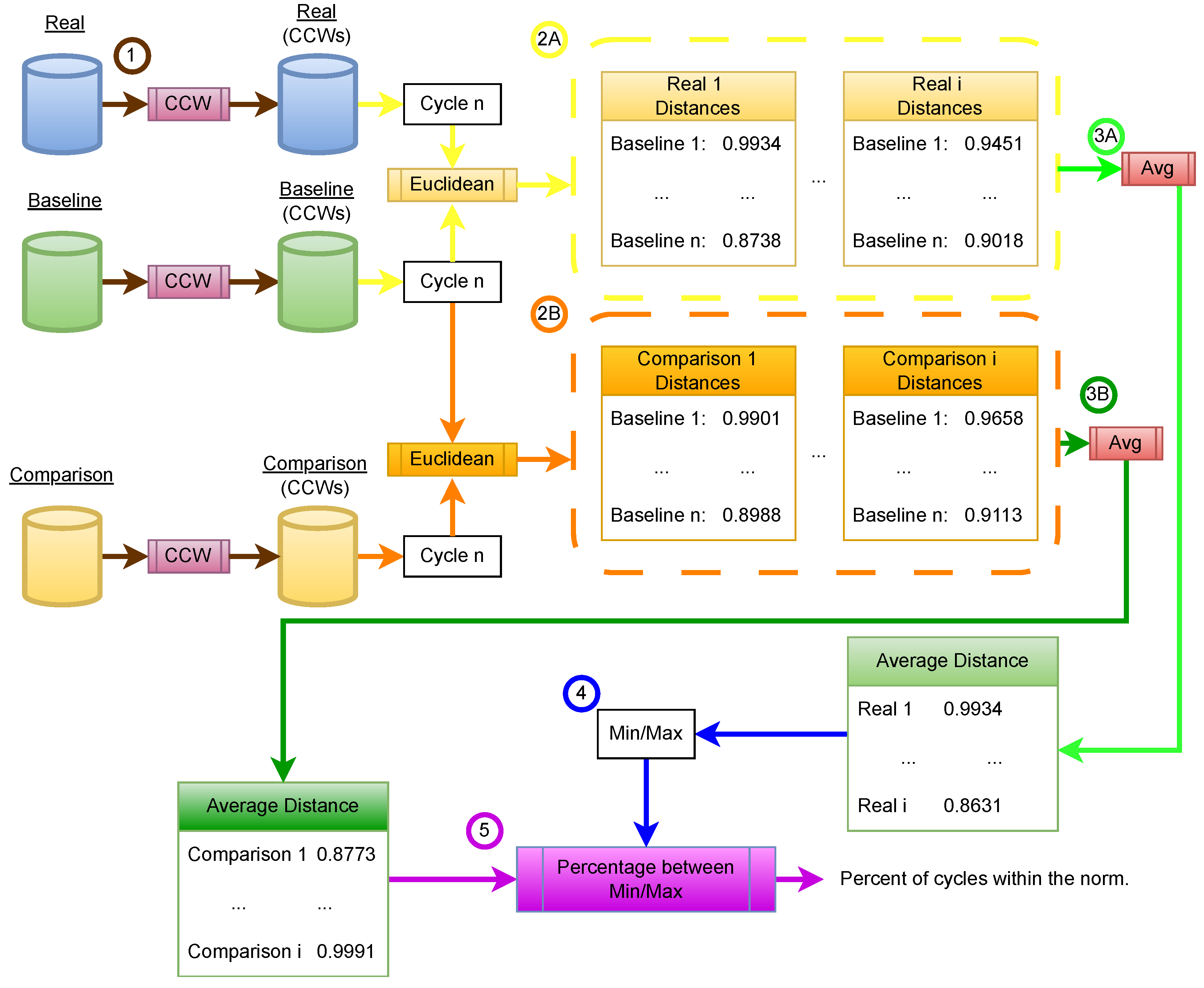
Appendix A. Fidelity Algorithms
| Algorithm A1 Fidelity calculation across signals |
|
| Algorithm A2 Percent of cycles within the norm |
|
Appendix B. Detailed Network Architectures
Appendix B.1. 1DCNNGAN Architecture
| Listing A1: Summary of 1DCNNGAN generator. |
 |
| Listing A2: Summary of 1DCNNGAN discriminator. |
 |
Appendix B.2. ResGAN Architecture
| Listing A3: Summary of ResGAN generator. |
 |
| Listing A4: Summary of ResGAN discriminator. |
 |
References
- Han, Y.; Etigowni, S.; Liu, H.; Zonouz, S.; Petropulu, A. Watch me, but don’t touch me! contactless control flow monitoring via electromagnetic emanations. In Proceedings of the 2017 ACM SIGSAC Conference on Computer and Communications Security, Dallas, TX, USA, 30 October–3 November 2017; pp. 1095–1108. [Google Scholar]
- Nazari, A.; Sehatbakhsh, N.; Alam, M.; Zajic, A.; Prvulovic, M. Eddie: Em-based detection of deviations in program execution. In Proceedings of the 44th Annual International Symposium on Computer Architecture, Toronto, ON, Canada, 24–28 June 2017; pp. 333–346. [Google Scholar]
- Zhang, Z.; Zhan, Z.; Balasubramanian, D.; Li, B.; Volgyesi, P.; Koutsoukos, X. Leveraging em side-channel information to detect rowhammer attacks. In Proceedings of the 2020 IEEE Symposium on Security and Privacy (SP), San Francisco, CA, USA, 18–21 May 2020; IEEE: Piscataway, NJ, USA, 2020; pp. 729–746. [Google Scholar]
- Khan, H.A.; Sehatbakhsh, N.; Nguyen, L.N.; Callan, R.L.; Yeredor, A.; Prvulovic, M.; Zajić, A. IDEA: Intrusion detection through electromagnetic-signal analysis for critical embedded and cyber-physical systems. IEEE Trans. Dependable Secur. Comput. 2019, 18, 1150–1163. [Google Scholar] [CrossRef]
- Sehatbakhsh, N.; Alam, M.; Nazari, A.; Zajic, A.; Prvulovic, M. Syndrome: Spectral analysis for anomaly detection on medical iot and embedded devices. In Proceedings of the 2018 IEEE International Symposium on Hardware Oriented Security and Trust (HOST), Washington, DC, USA, 30 April–4 May 2018; IEEE: Piscataway, NJ, USA, 2018; pp. 1–8. [Google Scholar]
- Nguyen, L.N.; Cheng, C.L.; Werner, F.T.; Prvulovic, M.; Zajic, A. A comparison of backscattering, EM, and power side-channels and their performance in detecting software and hardware intrusions. J. Hardw. Syst. Secur. 2020, 4, 150–165. [Google Scholar] [CrossRef]
- Liu, S.; Su, D.; Yu, D. Diffgan-tts: High-fidelity and efficient text-to-speech with denoising diffusion gans. arXiv 2022, arXiv:2201.11972. [Google Scholar]
- Lu, Y.; Wu, S.; Tai, Y.W.; Tang, C.K. Image generation from sketch constraint using contextual gan. In Proceedings of the European Conference on Computer Vision (ECCV), Munich, Germany, 8–14 September 2018; pp. 205–220. [Google Scholar]
- Sehatbakhsh, N.; Nazari, A.; Khan, H.; Zajic, A.; Prvulovic, M. Emma: Hardware/software attestation framework for embedded systems using electromagnetic signals. In Proceedings of the 52nd Annual IEEE/ACM International Symposium on Microarchitecture, Columbus, OH, USA, 12–16 October 2019; pp. 983–995. [Google Scholar]
- Kolias, C.; Barbará, D.; Rieger, C.; Ulrich, J. Em fingerprints: Towards identifying unauthorized hardware substitutions in the supply chain jungle. In Proceedings of the 2020 IEEE Security and Privacy Workshops (SPW), San Francisco, CA, USA, 21 May 2020; IEEE: Piscataway, NJ, USA, 2020; pp. 144–151. [Google Scholar]
- Chawla, N.; Singh, A.; Kar, M.; Mukhopadhyay, S. Application inference using machine learning based side channel analysis. In Proceedings of the 2019 International Joint Conference on Neural Networks (IJCNN), Budapest, Hungary, 14–19 July 2019; IEEE: Piscataway, NJ, USA, 2019; pp. 1–8. [Google Scholar]
- Shi, Z.; Mamun, A.A.; Kan, C.; Tian, W.; Liu, C. An LSTM-autoencoder based online side channel monitoring approach for cyber-physical attack detection in additive manufacturing. J. Intell. Manuf. 2023, 34, 1815–1831. [Google Scholar] [CrossRef]
- Nguyen, L.N.; Cheng, C.L.; Prvulovic, M.; Zajić, A. Creating a backscattering side channel to enable detection of dormant hardware trojans. IEEE Trans. Very Large Scale Integr. (VLSI) Syst. 2019, 27, 1561–1574. [Google Scholar] [CrossRef]
- Goodfellow, I.; Pouget-Abadie, J.; Mirza, M.; Xu, B.; Warde-Farley, D.; Ozair, S.; Courville, A.; Bengio, Y. Generative adversarial networks. Commun. ACM 2020, 63, 139–144. [Google Scholar] [CrossRef]
- Donahue, C.; McAuley, J.; Puckette, M. Adversarial audio synthesis. arXiv 2018, arXiv:1802.04208. [Google Scholar]
- Vedros, K.A.; Kolias, C.; Barbara, D.; Ivans, R.C. From Code to EM Signals: A Generative Approach to Side Channel Analysis-based Anomaly Detection. In Proceedings of the 19th International Conference on Availability, Reliability and Security, Vienna, Austria, 30 July–2 August 2024; pp. 1–10. [Google Scholar]
- Ning, Z.; Zhang, F. Ninja: Towards Transparent Tracing and Debugging on ARM. In Proceedings of the 26th USENIX Security Symposium (USENIX Security 17), Vancouver, BC, Canada, 16–18 August 2017; pp. 33–49. [Google Scholar]
- Zeinolabedin, S.M.A.; Partzsch, J.; Mayr, C. Analyzing arm coresight etmv4. x data trace stream with a real-time hardware accelerator. In Proceedings of the 2021 Design, Automation & Test in Europe Conference & Exhibition (DATE), Virtually, 1–5 February 2021; IEEE: Piscataway, NJ, USA, 2021; pp. 1606–1609. [Google Scholar]
- Fabbri, C. Conditional Wasserstein Generative Adversarial Networks; University of Minnesota: Minneapolis, MN, USA, 2018; pp. 1–11. [Google Scholar]
- Sinn, M.; Rawat, A. Non-parametric estimation of jensen-shannon divergence in generative adversarial network training. In Proceedings of the International Conference on Artificial Intelligence and Statistics, Playa Blanca, Lanzarote, 9–11 April 2018; PMLR: Birmingham, UK, 2018; pp. 642–651. [Google Scholar]
- Arjovsky, M.; Chintala, S.; Bottou, L. Wasserstein GAN. arXiv 2017, arXiv:1701.07875. [Google Scholar] [PubMed]
- Gulrajani, I.; Ahmed, F.; Arjovsky, M.; Dumoulin, V.; Courville, A.C. Improved training of wasserstein gans. Adv. Neural Inf. Process. Syst. 2017, 30. [Google Scholar]
- Petzka, H.; Fischer, A.; Lukovnicov, D. On the regularization of wasserstein gans. arXiv 2017, arXiv:1709.08894. [Google Scholar] [CrossRef]
- McKeever, S.; Walia, M.S. Synthesising Tabular Datasets Using Wasserstein Conditional GANS with Gradient Penalty (WCGAN-GP); Technological University Dublin: Dublin, Ireland, 2020. [Google Scholar]
- Coleman, J.S. Introducing Speech and Language Processing; Cambridge University Press: Cambridge, UK, 2005. [Google Scholar]
- Pak, A.; Ziyaden, A.; Saparov, T.; Akhmetov, I.; Gelbukh, A. Word embeddings: A comprehensive survey. Computación y Sist. 2024, 28, 2005–2029. [Google Scholar] [CrossRef]
- Liu, Q.; Kusner, M.J.; Blunsom, P. A survey on contextual embeddings. arXiv 2020, arXiv:2003.07278. [Google Scholar] [CrossRef]
- Wolf, M. Computers as Components: Principles of Embedded Computing System Design; Elsevier: Amsterdam, The Netherlands, 2012. [Google Scholar]
- Lee, E.A.; Seshia, S.A. Introduction to Embedded Systems: A Cyber-Physical Systems Approach; MIT Press: Cambridge, MA, USA, 2017. [Google Scholar]
- Sehatbakhsh, N.; Yilmaz, B.B.; Zajic, A.; Prvulovic, M. EMSim: A Microarchitecture-Level Simulation Tool for Modeling Electromagnetic Side-Channel Signals. In Proceedings of the 2020 IEEE International Symposium on High Performance Computer Architecture (HPCA), San Diego, CA, USA, 22–26 February 2020; pp. 71–85. [Google Scholar] [CrossRef]
- Vedros, K.A.; Kolias, C.; Ivans, R.C. Do Programs Dream of Electromagnetic Signals? Towards GAN-based Code-to-Signal Synthesis. In Proceedings of the MILCOM 2023–2023 IEEE Military Communications Conference (MILCOM), Boston, MA, USA, 30 October–3 November 2023; IEEE: Piscataway, NJ, USA, 2023; pp. 716–721. [Google Scholar]
- Hell, M.; Westman, O. Electromagnetic side-channel attack on AES using low-end equipment. ECTI Trans. Comput. Inf. Technol. (ECTI-CIT) 2020, 14, 139–148. [Google Scholar] [CrossRef]
- Yilmaz, B.B.; Prvulovic, M.; Zajić, A. Electromagnetic side channel information leakage created by execution of series of instructions in a computer processor. IEEE Trans. Inf. Forensics Secur. 2019, 15, 776–789. [Google Scholar] [CrossRef]
- Butts, J.A.; Sohi, G.S. A static power model for architects. In Proceedings of the 33rd annual ACM/IEEE international symposium on Microarchitecture, Monterey, CA, USA, 10–13 December 2000; pp. 191–201. [Google Scholar]
- Moradi, A. Side-channel leakage through static power: Should we care about in practice? In Proceedings of the Cryptographic Hardware and Embedded Systems–CHES 2014: 16th International Workshop, Busan, Republic of Korea, 23–26 September 2014; Proceedings 16. Springer: Berlin/Heidelberg, Germany, 2014; pp. 562–579. [Google Scholar]
- Bringmann, K.; Fischer, N.; van der Hoog, I.; Kipouridis, E.; Kociumaka, T.; Rotenberg, E. Dynamic dynamic time warping. In Proceedings of the 2024 Annual ACM-SIAM Symposium on Discrete Algorithms (SODA), Alexandria, VA, USA, 7–10 January 2024; SIAM: Philadelphia, PA, USA, 2024; pp. 208–242. [Google Scholar]
- Gu, S.; Luo, Z.; Chu, Y.; Xu, Y.; Jiang, Y.; Guo, J. Trace alignment preprocessing in side-channel analysis using the adaptive filter. IEEE Trans. Inf. Forensics Secur. 2023, 18, 5580–5591. [Google Scholar] [CrossRef]
- Chen, H.; Mehra, A.; Kimball, J.; Rossi, R.A. Measuring time-series dataset similarity using wasserstein distance. arXiv 2025, arXiv:2507.22189. [Google Scholar] [CrossRef]
- Vedros, K.A. From Capture–Recapture to No-Recapture: Code and Notebooks. 2025. GitHub Repository. Available online: https://github.com/KurtAnVedros/From-Capture-Recapture-to-No-Recapture (accessed on 6 November 2025).



| Acronym | Definition |
|---|---|
| ACC | Accuracy |
| AUC | Area Under the Curve |
| AVR | Alf-Egil Bogen and Vegard Wollan RISC architecture (Microchip) |
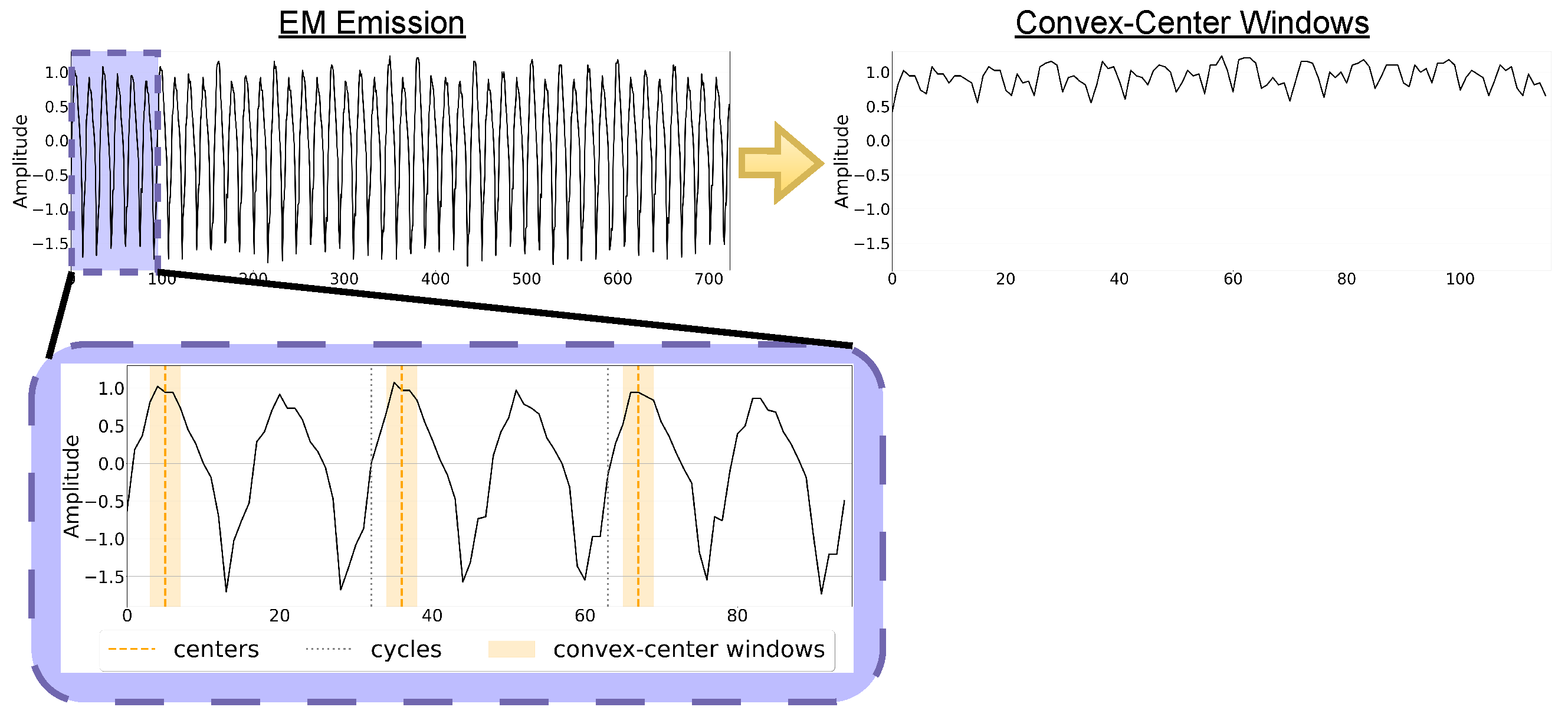
| CCW | Convex-centered window |
| CNN | Convolutional Neural Network |
| CPU | Central Processing Unit |
| CWGAN-GP | Conditional Wasserstein GAN with Gradient Penalty |
| dB | Decibels |
| DTW | Dynamic Time Warping |
| EM | Electromagnetic |
| ESD | Execution State Descriptor |
| GAN | Generative Adversarial Network |
| GM | Generative model |
| I | Instructions |
| MB | Megabits |
| MCU | Microcontroller unit |
| O | Operator |
| PCA | Principal Component Analysis |
| PREC | Precision |
| REC | Recall |
| ROC | Receiver Operating Characteristic |
| RV | Register value |
| SCAD | Side-Channel-based Anomaly Detection |
| SNR | Signal-to-Noise Ratio |
| WGN | White Gaussian Noise |
| Model | Parallel | Efficient | Low-Data | Stable | Conditional | High Fidelity |
|---|---|---|---|---|---|---|
| Autoregressive | No | No | Partial | Yes | Yes | Yes |
| Diffusion | No | No | Partial | Yes | Yes | Yes |
| Transformer | Partial | No | Partial | Partial | Yes | Yes |
| VAE | Yes | Yes | Yes | Yes | Partial | No |
| CWGAN-GP | Yes | Yes | Yes | Yes | Yes | Yes |
| ResGAN | 1DCNNGAN | Real | |||||||
|---|---|---|---|---|---|---|---|---|---|
| 1 Inst. | 2 Inst. | 3 Inst. | 4 Inst. | 1 Inst. | 2 Inst. | 3 Inst. | 4 Inst. | N/A | |
| I | 13.882 | 12.459 | 12.354 | 12.164 | 248.967 | 25.560 | 12.103 | 11.772 | 8.745 |
| I/O/RV | 11.325 | 11.031 | 10.989 | 10.216 | 10.853 | 11.929 | 11.730 | 10.203 | 8.745 |
| ResGAN | 1DCNNGAN | |||||||
|---|---|---|---|---|---|---|---|---|
| 1 Inst. | 2 Inst. | 3 Inst. | 4 Inst. | 1 Inst. | 2 Inst. | 3 Inst. | 4 Inst. | |
| I | 99.812 | 99.814 | 99.816 | 99.818 | 3.760 | 3.887 | 4.014 | 4.141 |
| I/O/RV | 99.877 | 99.883 | 99.889 | 99.894 | 8.075 | 8.456 | 8.836 | 9.217 |
| ResGAN | 1DCNNGAN | |||||||
|---|---|---|---|---|---|---|---|---|
| 1 Inst. | 2 Inst. | 3 Inst. | 4 Inst. | 1 Inst. | 2 Inst. | 3 Inst. | 4 Inst. | |
| I | 3 | 12 | 22 | 34 | 15 | 16 | 17 | 23 |
| I/O/RV | 78 | 240 | 246 | 254 | 51 | 54 | 56 | 57 |
| Real | 1DCNNGAN | ResGAN | |||||||||||
|---|---|---|---|---|---|---|---|---|---|---|---|---|---|
| N/A | Synth EMs. 4 Inst. I | Synth EMs. 4 Inst. I/O/RV | Synth EMs. 4 Inst. I/O/RV | ||||||||||
| Program | Metric | SNR | SNR | SNR | SNR | ||||||||
| 20 | 15 | 10 | 20 | 15 | 10 | 20 | 15 | 10 | 20 | 15 | 10 | ||
| 50 A | AUC | 0.8713 | 0.7385 | 0.6380 | 0.9263 | 0.7897 | 0.6715 | 0.9284 | 0.7932 | 0.6773 | 0.9228 | 0.7976 | 0.6856 |
| ACC | 0.7950 | 0.6872 | 0.6058 | 0.8510 | 0.7248 | 0.6294 | 0.8532 | 0.7296 | 0.6378 | 0.8490 | 0.7330 | 0.6424 | |
| F1 | 0.8026 | 0.7167 | 0.6776 | 0.8528 | 0.7450 | 0.6865 | 0.8547 | 0.7473 | 0.6878 | 0.8510 | 0.7518 | 0.6947 | |
| PREC | 0.7939 | 0.6691 | 0.6143 | 0.8679 | 0.7220 | 0.6372 | 0.8603 | 0.7236 | 0.6574 | 0.8494 | 0.7229 | 0.6561 | |
| REC | 0.8144 | 0.7516 | 0.5760 | 0.8472 | 0.7568 | 0.6292 | 0.8488 | 0.7664 | 0.6092 | 0.8528 | 0.7644 | 0.6632 | |
| 50 B | AUC | 0.9961 | 0.9293 | 0.7757 | 0.9944 | 0.9190 | 0.7656 | 0.9970 | 0.9330 | 0.7809 | 0.9947 | 0.9299 | 0.7842 |
| ACC | 0.9706 | 0.8548 | 0.7364 | 0.9660 | 0.8440 | 0.7072 | 0.9756 | 0.8610 | 0.7182 | 0.9676 | 0.8604 | 0.7172 | |
| F1 | 0.9706 | 0.8556 | 0.7364 | 0.9663 | 0.8465 | 0.7295 | 0.9756 | 0.8623 | 0.7369 | 0.9679 | 0.8605 | 0.7385 | |
| PREC | 0.9723 | 0.8684 | 0.7152 | 0.9642 | 0.8388 | 0.7121 | 0.9757 | 0.8863 | 0.7300 | 0.9635 | 0.8662 | 0.7259 | |
| REC | 0.9716 | 0.8516 | 0.7332 | 0.9740 | 0.8592 | 0.7012 | 0.9764 | 0.8584 | 0.7200 | 0.9768 | 0.8536 | 0.7172 | |
| 50 C | AUC | 0.9904 | 0.9068 | 0.7597 | 0.9896 | 0.9072 | 0.7628 | 0.9907 | 0.9077 | 0.7622 | 0.9868 | 0.8965 | 0.7541 |
| ACC | 0.9524 | 0.8332 | 0.7006 | 0.9508 | 0.8348 | 0.7016 | 0.9536 | 0.8344 | 0.7040 | 0.9430 | 0.8238 | 0.6994 | |
| F1 | 0.9526 | 0.8361 | 0.7243 | 0.9509 | 0.8367 | 0.7258 | 0.9536 | 0.8373 | 0.7253 | 0.9434 | 0.8263 | 0.7203 | |
| PREC | 0.9507 | 0.8350 | 0.6844 | 0.9523 | 0.8446 | 0.6980 | 0.9604 | 0.8472 | 0.7111 | 0.9539 | 0.8337 | 0.7119 | |
| REC | 0.9576 | 0.8408 | 0.7528 | 0.9532 | 0.8216 | 0.7164 | 0.9524 | 0.8356 | 0.6908 | 0.9424 | 0.8208 | 0.6784 | |
| 75 A | AUC | 0.9658 | 0.8516 | 0.7009 | 0.9453 | 0.8217 | 0.6820 | 0.9636 | 0.8485 | 0.6996 | 0.9605 | 0.8520 | 0.7045 |
| ACC | 0.9012 | 0.7808 | 0.6554 | 0.8764 | 0.7524 | 0.6426 | 0.8996 | 0.7752 | 0.6560 | 0.8960 | 0.7792 | 0.6570 | |
| F1 | 0.9009 | 0.7874 | 0.7017 | 0.8784 | 0.7637 | 0.6934 | 0.9019 | 0.7822 | 0.7007 | 0.8975 | 0.7858 | 0.7037 | |
| PREC | 0.9197 | 0.7803 | 0.6598 | 0.8711 | 0.7567 | 0.6385 | 0.8927 | 0.7834 | 0.6552 | 0.9093 | 0.7903 | 0.6721 | |
| REC | 0.8920 | 0.7856 | 0.6688 | 0.8888 | 0.7472 | 0.6668 | 0.9132 | 0.7668 | 0.6948 | 0.8988 | 0.7720 | 0.6524 | |
| 75 B | AUC | 0.9995 | 0.9643 | 0.8215 | 0.9994 | 0.9645 | 0.8196 | 0.9995 | 0.9652 | 0.8221 | 0.9989 | 0.9641 | 0.8230 |
| ACC | 0.9914 | 0.9052 | 0.7492 | 0.9892 | 0.9046 | 0.7484 | 0.9906 | 0.9066 | 0.7510 | 0.9876 | 0.9040 | 0.7528 | |
| F1 | 0.9914 | 0.9066 | 0.7641 | 0.9893 | 0.9059 | 0.7611 | 0.9906 | 0.9075 | 0.7629 | 0.9876 | 0.9048 | 0.7652 | |
| PREC | 0.9936 | 0.8990 | 0.7654 | 0.9861 | 0.9111 | 0.7510 | 0.9900 | 0.9126 | 0.7603 | 0.9892 | 0.9061 | 0.7532 | |
| REC | 0.9928 | 0.9184 | 0.7452 | 0.9944 | 0.9020 | 0.7560 | 0.9924 | 0.9164 | 0.7468 | 0.9864 | 0.9060 | 0.7560 | |
| 75 C | AUC | 0.9804 | 0.8741 | 0.7227 | 0.9883 | 0.9007 | 0.7487 | 0.9884 | 0.9017 | 0.7491 | 0.9788 | 0.8826 | 0.7363 |
| ACC | 0.9300 | 0.7990 | 0.6692 | 0.9524 | 0.8258 | 0.6876 | 0.9512 | 0.8274 | 0.6902 | 0.9318 | 0.8108 | 0.6818 | |
| F1 | 0.9301 | 0.8088 | 0.7023 | 0.9526 | 0.8294 | 0.7174 | 0.9519 | 0.8326 | 0.7158 | 0.9326 | 0.8134 | 0.7090 | |
| PREC | 0.9357 | 0.7998 | 0.6844 | 0.9549 | 0.8450 | 0.7198 | 0.9410 | 0.8228 | 0.7081 | 0.9227 | 0.8276 | 0.6959 | |
| REC | 0.9308 | 0.8216 | 0.6844 | 0.9568 | 0.8016 | 0.6332 | 0.9664 | 0.8444 | 0.6740 | 0.9436 | 0.7956 | 0.6552 | |
| 100 A | AUC | 0.9863 | 0.8776 | 0.7311 | 0.9880 | 0.8819 | 0.7356 | 0.9887 | 0.8847 | 0.7379 | 0.9843 | 0.8758 | 0.7347 |
| ACC | 0.9470 | 0.8002 | 0.6790 | 0.9530 | 0.8040 | 0.6828 | 0.9528 | 0.8080 | 0.6820 | 0.9414 | 0.7996 | 0.6776 | |
| F1 | 0.9472 | 0.8069 | 0.7110 | 0.9535 | 0.8117 | 0.7141 | 0.9533 | 0.8125 | 0.7149 | 0.9420 | 0.8072 | 0.7108 | |
| PREC | 0.9456 | 0.8035 | 0.6708 | 0.9473 | 0.7960 | 0.6727 | 0.9459 | 0.8072 | 0.6845 | 0.9343 | 0.8073 | 0.6828 | |
| REC | 0.9508 | 0.8040 | 0.7256 | 0.9636 | 0.8320 | 0.7172 | 0.9624 | 0.8176 | 0.6880 | 0.9512 | 0.7888 | 0.7004 | |
| 100 B | AUC | 0.9995 | 0.9639 | 0.8423 | 0.9988 | 0.9561 | 0.8315 | 0.9995 | 0.9682 | 0.8535 | 0.9984 | 0.9539 | 0.8308 |
| ACC | 0.9922 | 0.9066 | 0.7690 | 0.9880 | 0.8918 | 0.7578 | 0.9926 | 0.9164 | 0.7782 | 0.9852 | 0.8940 | 0.7556 | |
| F1 | 0.9922 | 0.9080 | 0.7849 | 0.9880 | 0.8936 | 0.7765 | 0.9926 | 0.9164 | 0.7920 | 0.9852 | 0.8957 | 0.7726 | |
| PREC | 0.9901 | 0.8984 | 0.7628 | 0.9888 | 0.8898 | 0.7436 | 0.9916 | 0.9194 | 0.7627 | 0.9857 | 0.8838 | 0.7572 | |
| REC | 0.9952 | 0.9220 | 0.7872 | 0.9916 | 0.9076 | 0.7940 | 0.9956 | 0.9156 | 0.8108 | 0.9868 | 0.9084 | 0.7704 | |
| 100 C | AUC | 0.9986 | 0.9538 | 0.8174 | 0.9976 | 0.9456 | 0.8036 | 0.9977 | 0.9459 | 0.8039 | 0.9979 | 0.9475 | 0.8127 |
| ACC | 0.9850 | 0.8888 | 0.7524 | 0.9808 | 0.8794 | 0.7396 | 0.9810 | 0.8790 | 0.7398 | 0.9796 | 0.8820 | 0.7466 | |
| F1 | 0.9850 | 0.8895 | 0.7636 | 0.9809 | 0.8799 | 0.7537 | 0.9811 | 0.8814 | 0.7534 | 0.9796 | 0.8848 | 0.7559 | |
| PREC | 0.9892 | 0.8944 | 0.7627 | 0.9786 | 0.8855 | 0.7291 | 0.9794 | 0.8819 | 0.7241 | 0.9831 | 0.8714 | 0.7445 | |
| REC | 0.9864 | 0.8888 | 0.7616 | 0.9856 | 0.8744 | 0.7640 | 0.9844 | 0.8788 | 0.7852 | 0.9772 | 0.9060 | 0.7564 | |
Disclaimer/Publisher’s Note: The statements, opinions and data contained in all publications are solely those of the individual author(s) and contributor(s) and not of MDPI and/or the editor(s). MDPI and/or the editor(s) disclaim responsibility for any injury to people or property resulting from any ideas, methods, instructions or products referred to in the content. |
© 2025 by the authors. Licensee MDPI, Basel, Switzerland. This article is an open access article distributed under the terms and conditions of the Creative Commons Attribution (CC BY) license.
Share and Cite
Vedros, K.A.; Vakanski, A.; Forte, D.J.; Kolias, C. From Capture–Recapture to No Recapture: Efficient SCAD Even After Software Updates. Sensors 2026, 26, 118. https://doi.org/10.3390/s26010118
Vedros KA, Vakanski A, Forte DJ, Kolias C. From Capture–Recapture to No Recapture: Efficient SCAD Even After Software Updates. Sensors. 2026; 26(1):118. https://doi.org/10.3390/s26010118
Chicago/Turabian StyleVedros, Kurt A., Aleksandar Vakanski, Domenic J. Forte, and Constantinos Kolias. 2026. "From Capture–Recapture to No Recapture: Efficient SCAD Even After Software Updates" Sensors 26, no. 1: 118. https://doi.org/10.3390/s26010118
APA StyleVedros, K. A., Vakanski, A., Forte, D. J., & Kolias, C. (2026). From Capture–Recapture to No Recapture: Efficient SCAD Even After Software Updates. Sensors, 26(1), 118. https://doi.org/10.3390/s26010118