
Advanced Clustering for Mobile Network Optimization: A Systematic Literature Review


Abstract
1. Introduction
1.1. Background
1.2. Research Gaps
1.3. Objectives
- (i.)
- Classification of clustering methods and their applications in mobile networking;
- (ii.)
- Review of algorithmic parameters and performance metrics;
- (iii.)
- Exploration of integration with deep learning, edge computing, and federated learning;
- (iv.)
- Identification of open challenges and research direction; and
- (v.)
- Consolidated reference for practitioners and researchers exploring clustering for adaptive QoS in 5G/6G mobile networks
2. Research Methodology
2.1. Research Question and Framework
- What are the major categories of clustering techniques and how do they align with mobile network use cases?
- How do algorithmic parameters and evaluation metrics influence clustering performance?
- In what ways are clustering approaches integrated with deep learning, edge computing, and machine learning to support intelligent, real-time, and scalable network optimization?
2.2. Review Protocol
2.2.1. Search Strategy and Eligibility Criteria
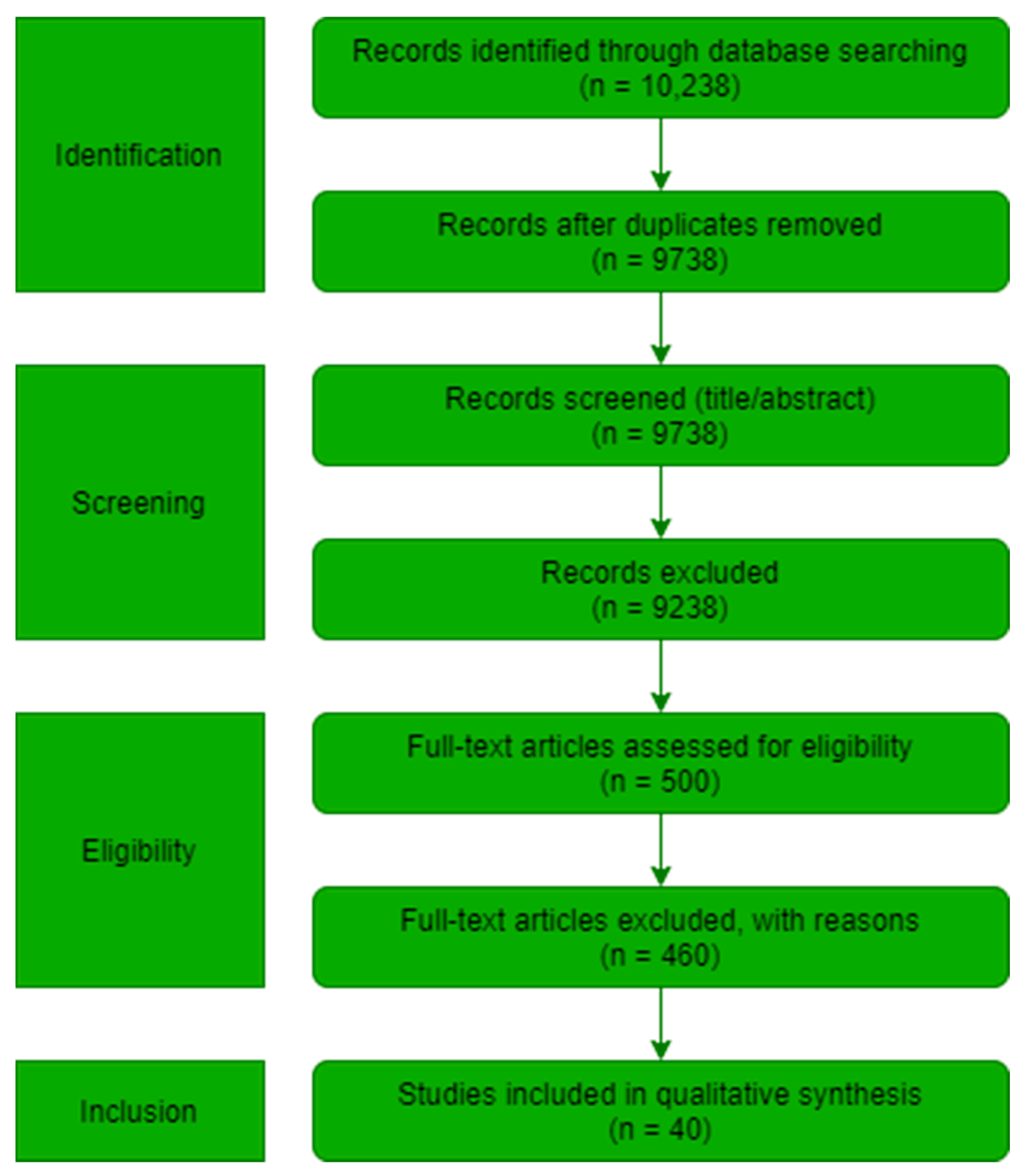
2.2.2. Study Selection Process
2.2.3. Data Extraction and Management
2.2.4. Risk of Bias and Quality Assessment
- (a)
- explicitly noted non-applicability and documented the reason, and
- (b)
- replaced or supplemented those items with engineering-relevant checks (e.g., whether datasets, code, or experimental settings were reported, whether performance metrics and computational costs were provided).
2.2.5. Data Synthesis
2.2.6. Protocol Registration
3. Results and Thematic Analyses
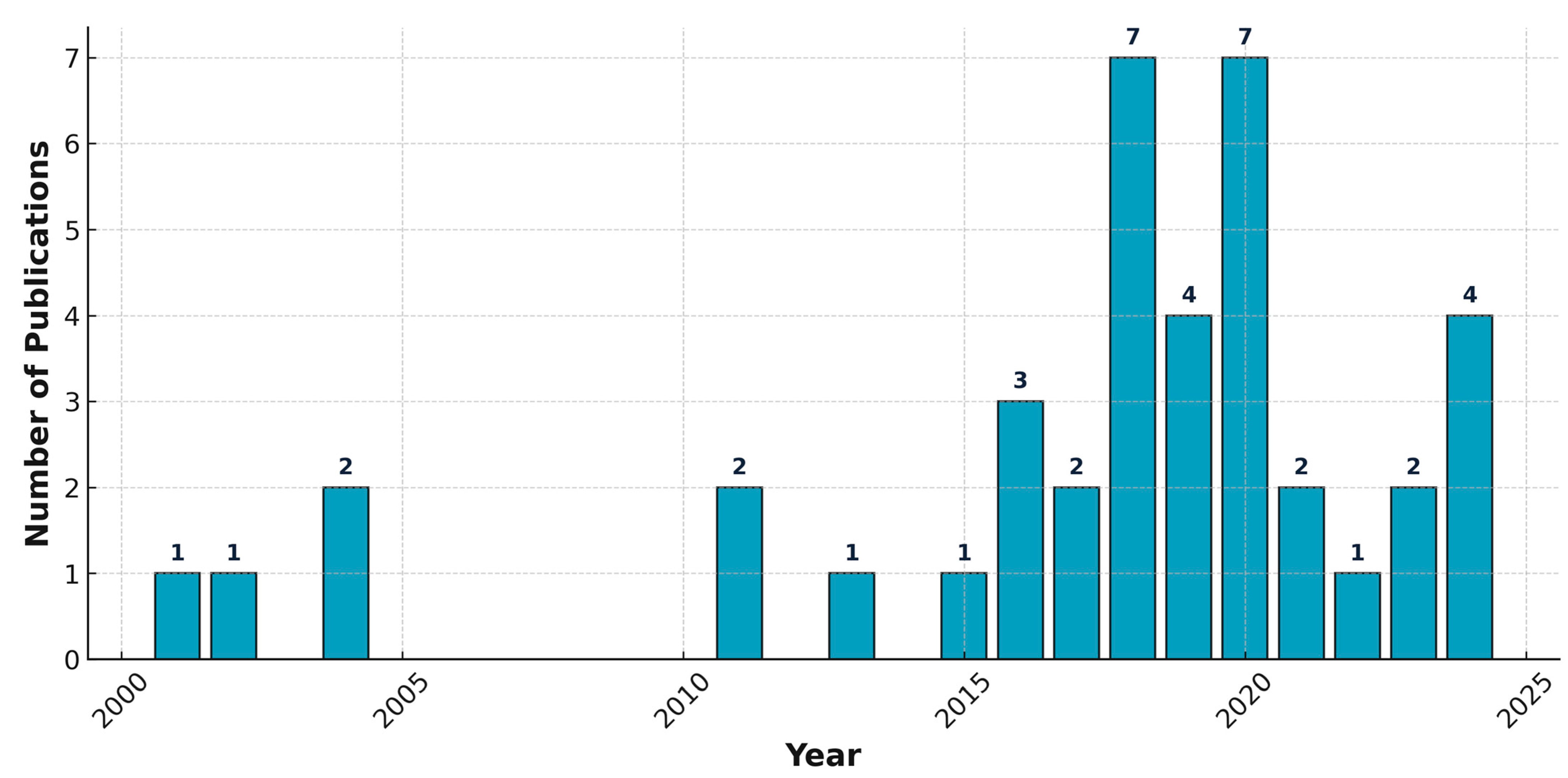
3.1. Quantitative Results
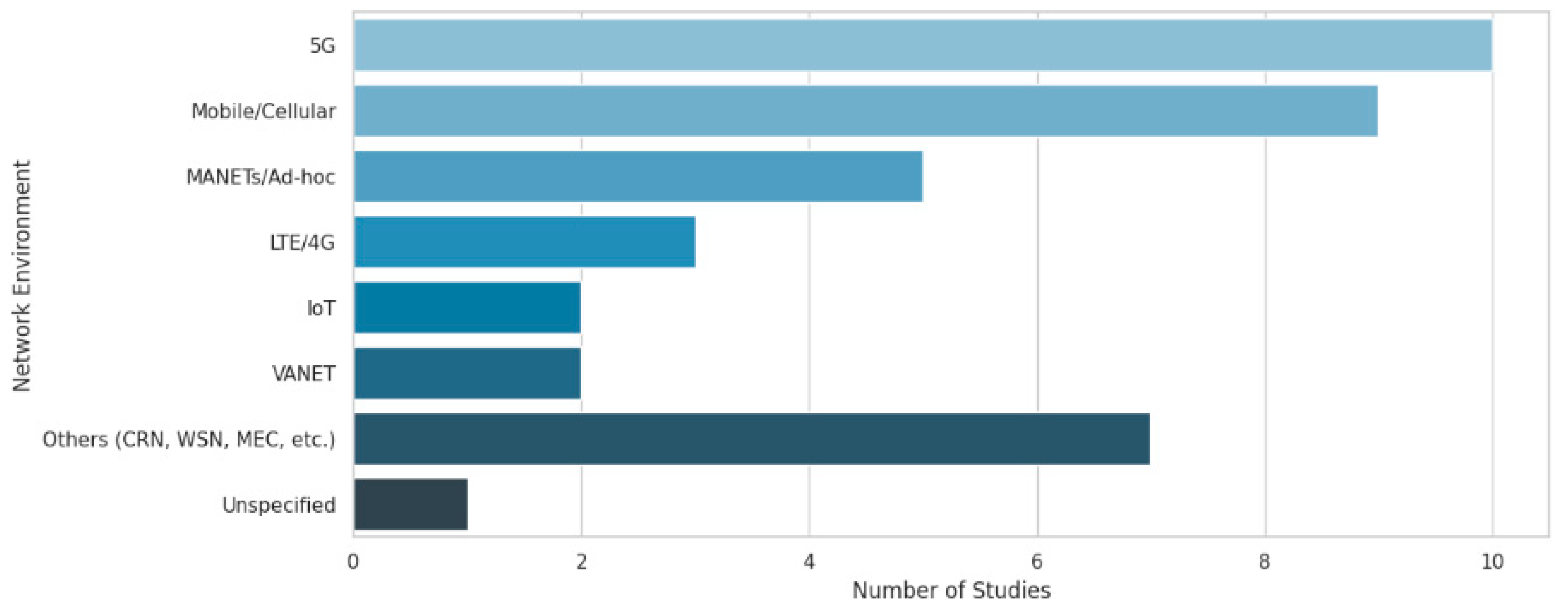
3.1.1. Network Environment Studied
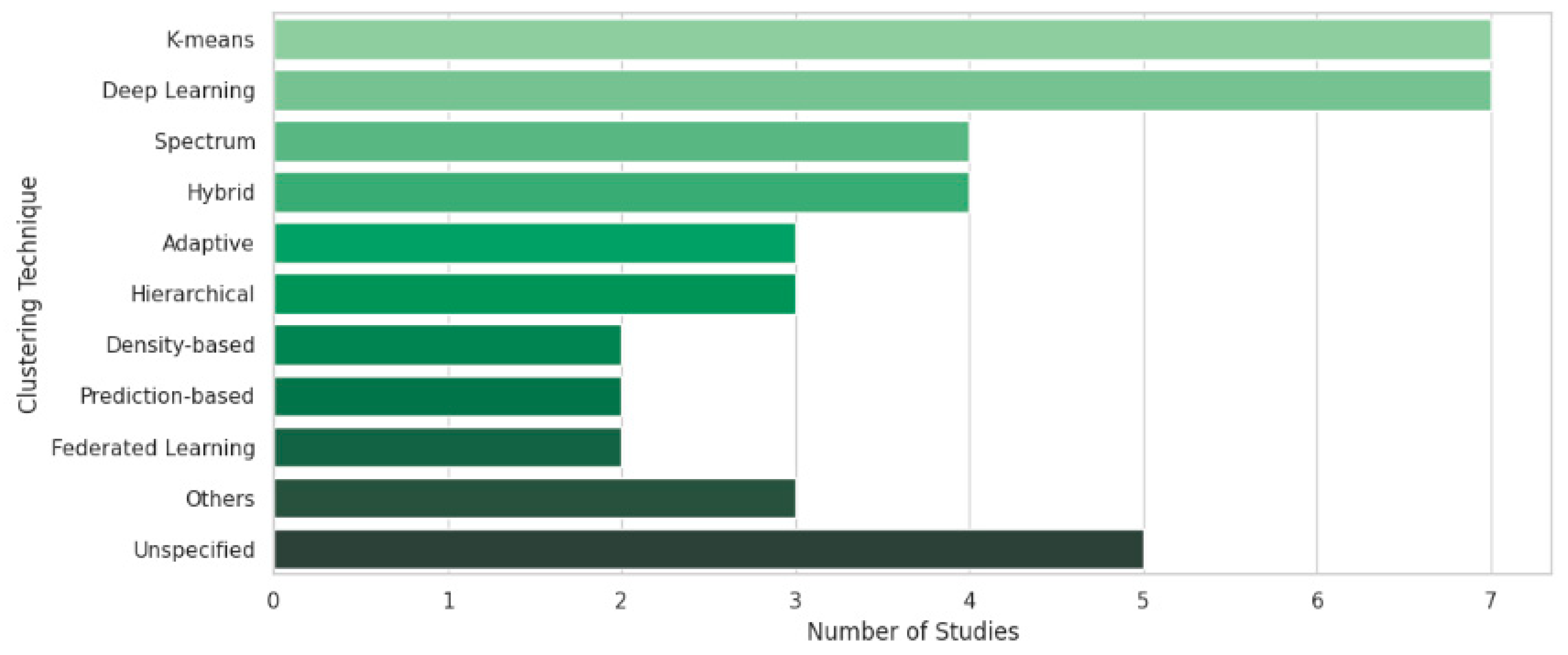
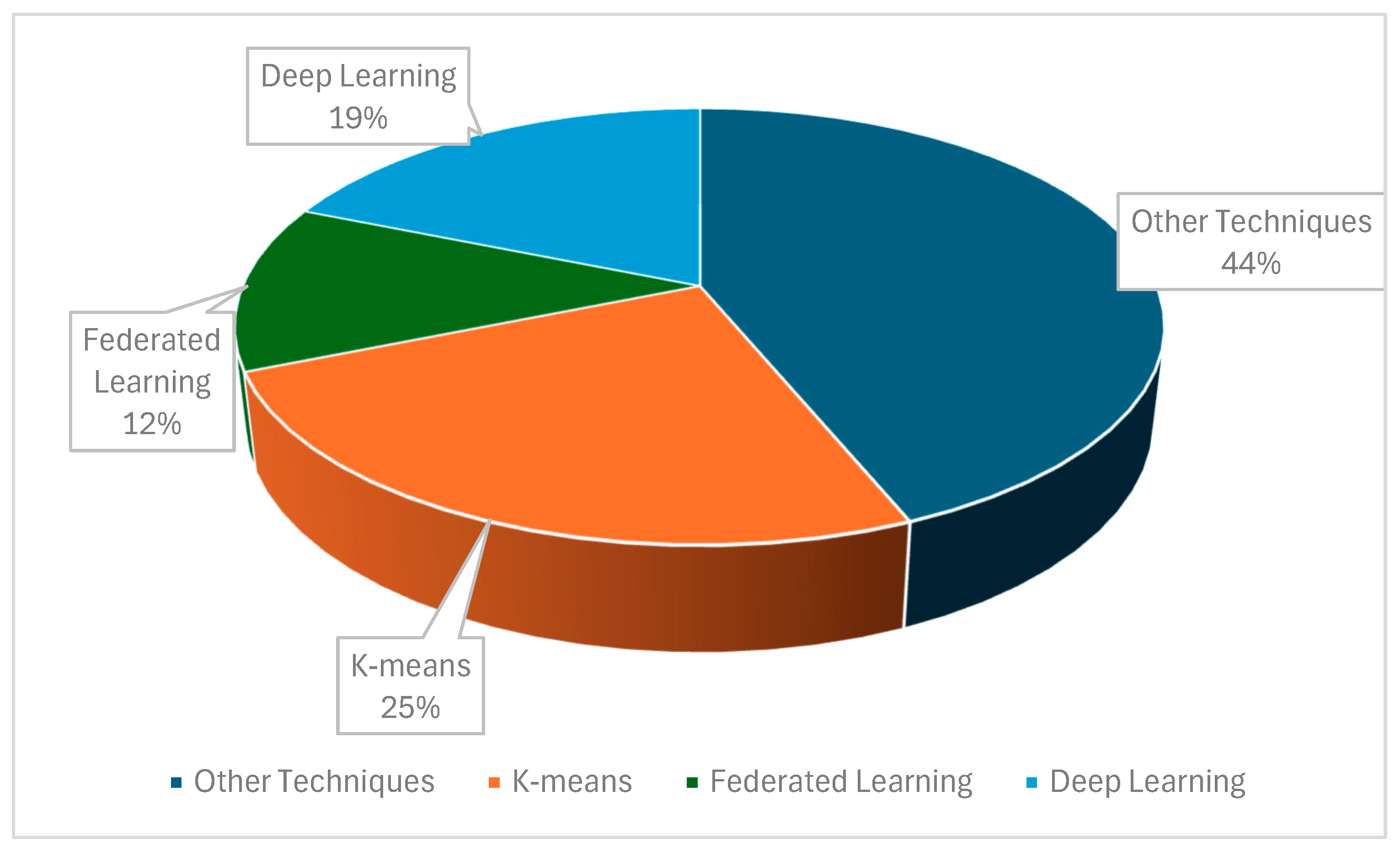
3.1.2. Clustering Techniques Used
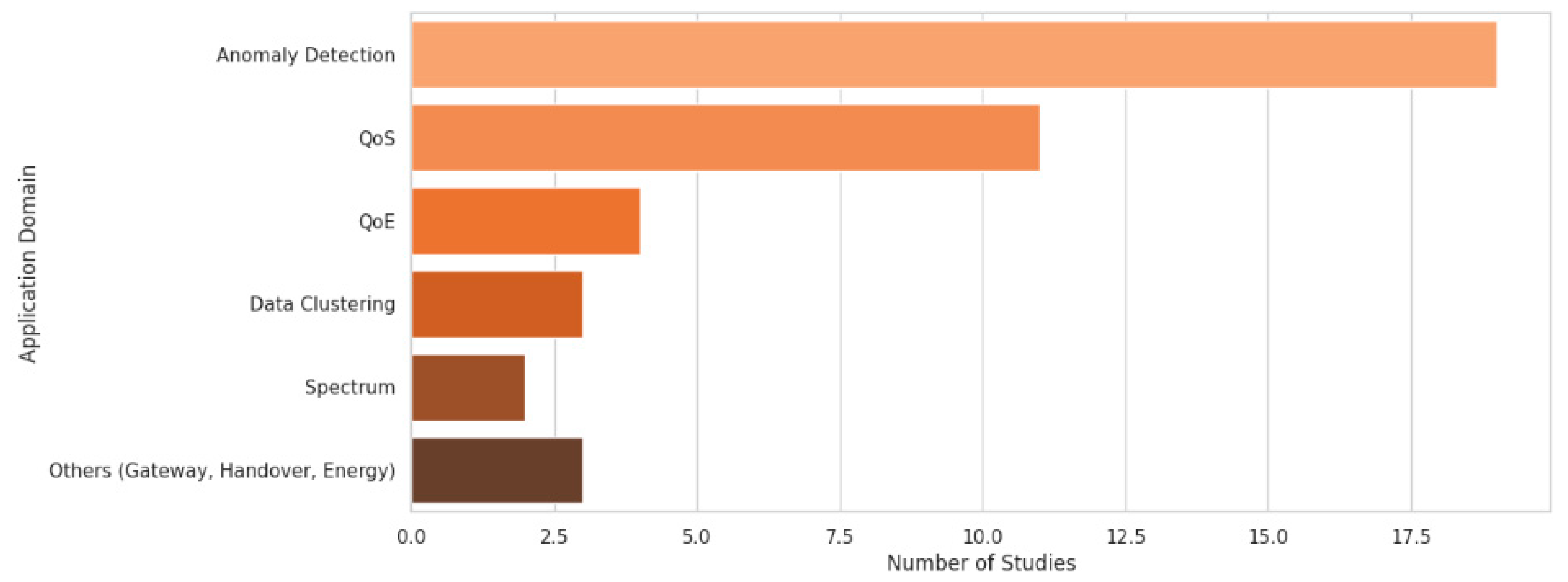
3.1.3. Application Domains
3.2. Thematic Analysis
3.2.1. Clustering Techniques and Their Applications
- -
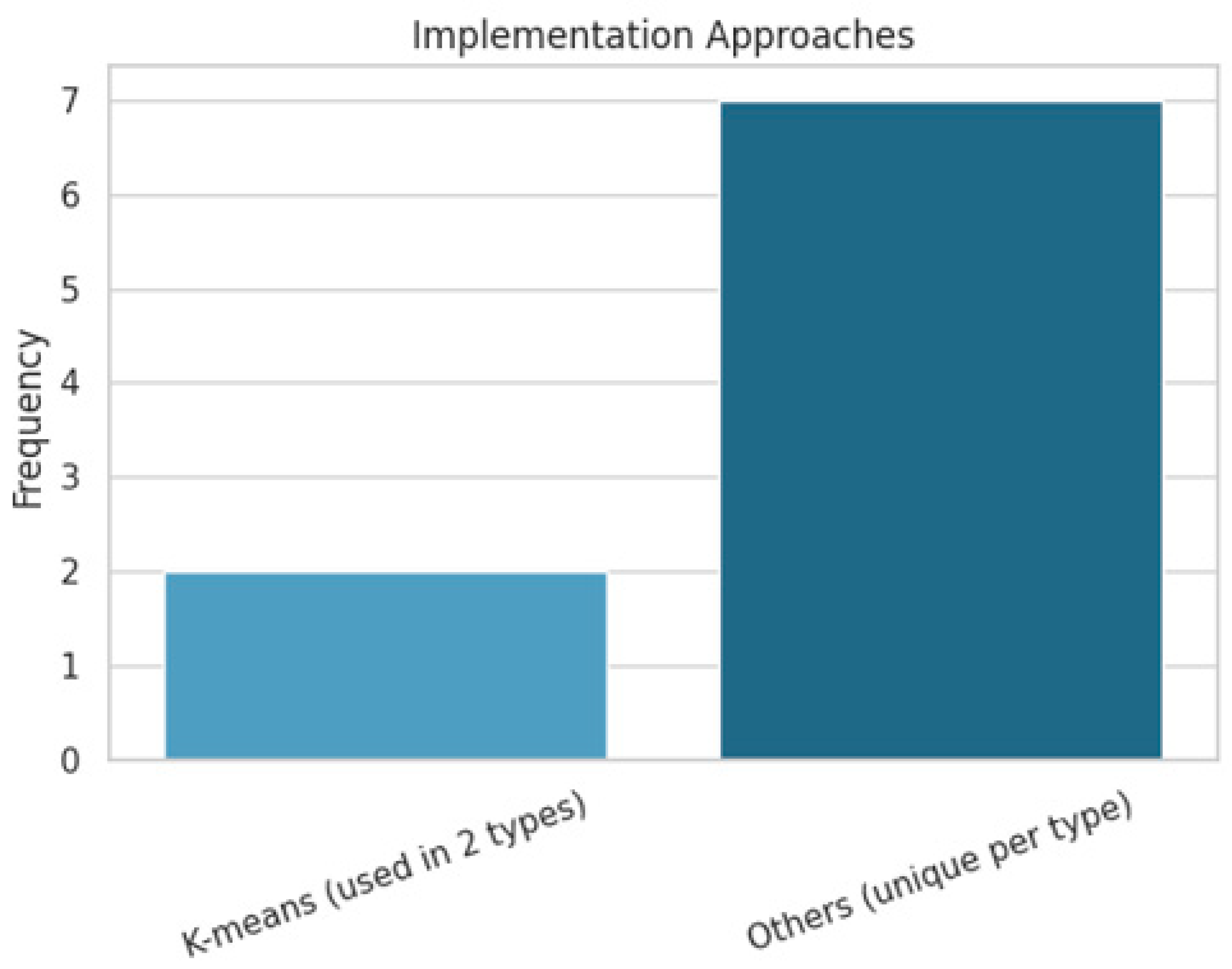
- Implementation approaches
- -
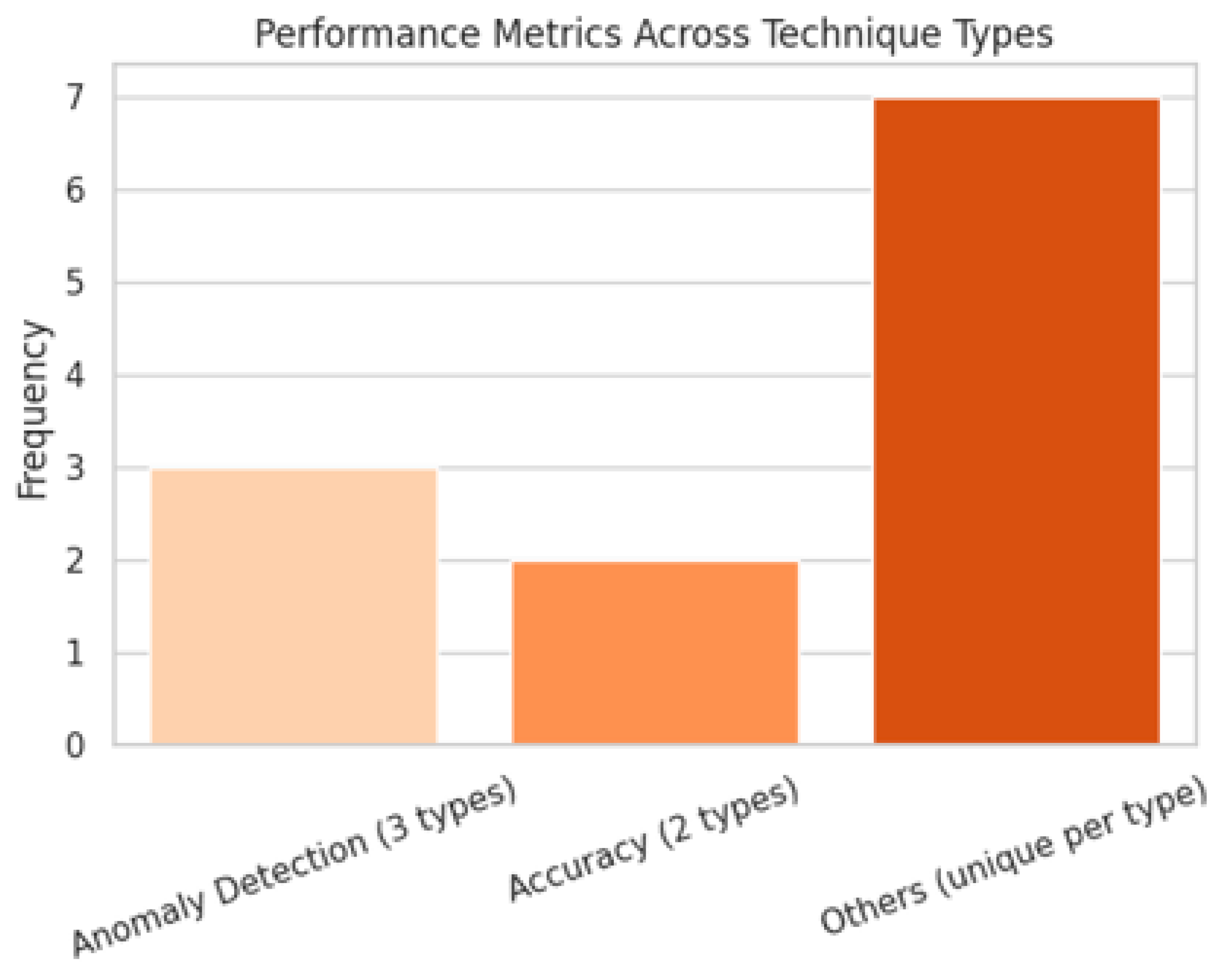
- Performance metrics
- -
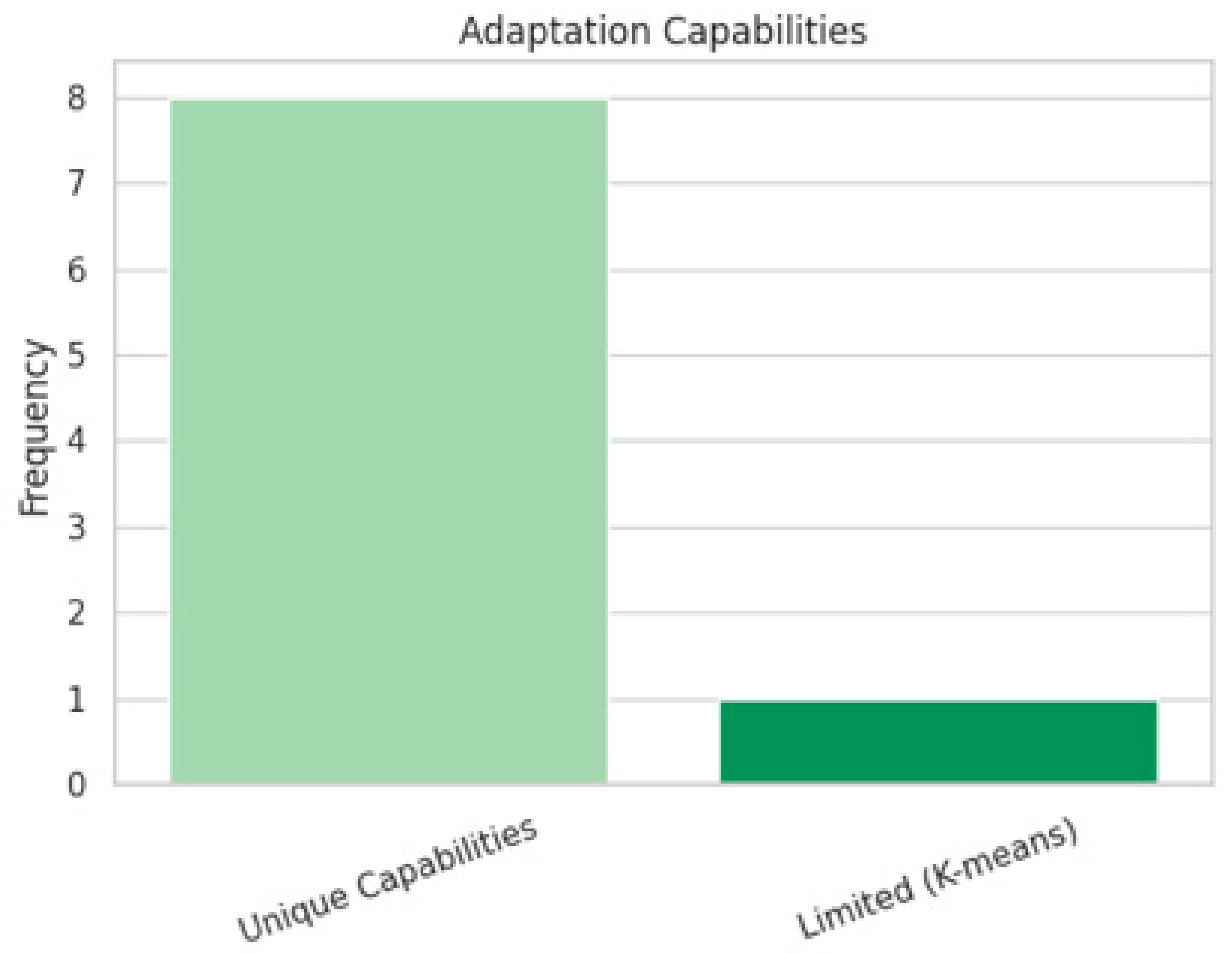
- Adaptation capabilities
3.2.2. Network Performance Enhancement
3.2.3. Adaptive Mechanisms and Dynamic Response
3.2.4. Integration Challenges and Solutions
4. Conclusions
Author Contributions
Funding
Data Availability Statement
Acknowledgments
Conflicts of Interest
References
- Tariq, F.; Khandaker, M.R.A.; Wong, K.; Imran, M.; Bennis, M.; Debbah, M. A speculative study on 6G. IEEE Wirel. Commun. 2020, 27, 118–125. [Google Scholar] [CrossRef]
- ITU-T Focus Group on Network 2030. Framework and Overall Objectives of the Future Network-Network 2030; International Telecommunication Union: Geneva, Switzerland, 2020. [Google Scholar]
- Chowdary, A.; Bazzi, A.; Chafii, M. On hybrid radar fusion for integrated sensing and communication. IEEE Trans. Wirel. Commun. 2024, 23, 8984–9000. [Google Scholar] [CrossRef]
- Liu, F.; Zhou, L.; Masouros, C.; Li, A.; Luo, W.; Petropulu, A. Toward dual-functional radar-communication systems: Optimal waveform design. IEEE Trans. Signal Process. 2020, 68, 3878–3891. [Google Scholar] [CrossRef]
- Bazzi, A.; Chafii, M. Secure full duplex integrated sensing and communications. IEEE Trans. Inf. Forensics Secur. 2024, 19, 2082–2097. [Google Scholar] [CrossRef]
- Zhang, J.; Lu, W.; Xing, C.; Zhao, N.; Al-Dhahir, N.; Karagiannidis, G.K.; Yang, X. Integrated sensing and communication: A survey. Sci. China Inf. Sci. 2025, 68, 131301. [Google Scholar] [CrossRef]
- ITU-R. Framework and Overall Objectives of the Future Development of IMT for 2030 and Beyond; Recommendation ITU-R M.2083-1; International Telecommunication Union: Geneva, Switzerland, 2021. [Google Scholar]
- World Economic Forum. The Impact of 5G: Creating New Value Across Industries and Society; World Economic Forum: Geneva, Switzerland, 2020. [Google Scholar]
- MarketsandMarkets. Mobile Network Analytics Market by Component-Global Forecast to 2027; MarketsandMarkets: Pune, India, 2024. [Google Scholar]
- Khan, R.; Taj, S.; Ma, X.; Noor, A.; Zhu, H.; Khan, J.; Khan, Z.U.; Khan, S.U. Advanced federated ensemble internet of learning approach for cloud-based medical healthcare monitoring system. Sci. Rep. 2024, 14, 26068. [Google Scholar] [CrossRef]
- Jour, T.Y.; Zhang, A.U.; Jiaheng, X. Improving predictive accuracy of customer churn models through data cleaning in the telecommunications industry. Adv. Econ. Manag. Political Sci. 2025, 154, 58–61. [Google Scholar] [CrossRef]
- Abdullah, R.M.; Zukarnain, Z.A. Enhanced handover decision algorithm in heterogeneous wireless networks. Sensors 2017, 17, 1626. [Google Scholar] [CrossRef]
- Parums, D.V. Review articles, systematic reviews, meta-analysis, and updated preferred reporting items for systematic reviews and meta-analyses (PRISMA) 2020 guidelines. Med. Sci. Monit. 2021, 27, e934475-1. [Google Scholar] [CrossRef]
- Page, M.J.; Moher, D.; Bossuyt, P.M.; Boutron, I.; Hoffmann, T.C.; Mulrow, C.D.; Shamseer, L.; Tetzlaff, J.M.; Akl, E.A.; Brennan, S.E.; et al. PRISMA 2020 explanation and elaboration: Updated guidance and exemplars for reporting systematic reviews. BMJ 2021, 372, n160. [Google Scholar] [CrossRef]
- Ali, A.; Yaqoob, I.; Ahmed, E.; Imran, M.; Kwak, K.; Ahmad, A.; Hussain, S.; Ali, Z. Channel clustering and QoS level identification scheme for multi-channel cognitive radio networks. IEEE Commun. Mag. 2018, 56, 162–168. [Google Scholar] [CrossRef]
- Gajic, B.; Nováczki, S.; Mwanje, S.S. Improved anomaly detection in mobile networks using incremental time-aware clustering. In Proceedings of the IFIP/IEEE Symposium on Integrated Network Management, Ottawa, ON, Canada, 11–15 May 2015; pp. 948–953. [Google Scholar]
- Sivavakeesar, G.; Pavlou, G.; Bohoris, C.; Liotta, A. Effective management through prediction-based clustering approach in next-generation ad hoc networks. In Proceedings of the IEEE International Conference on Communications (ICC), Paris, France, 20–24 June 2004; pp. 4085–4090. [Google Scholar]
- Nivitha, K.; Solaiappan, A.; Pabitha, P. Robust service selection through intelligent clustering in an uncertain environment. In Proceedings of the International Conference on Emerging Trends in Information Technology and Engineering (ic-ETITE), Vellore, India, 24–25 February 2020; pp. 1–6. [Google Scholar]
- Fernández Maimó, L.; Huertas Celdrán, A.; Gil Pérez, M.; García Clemente, F.J.; Martínez Pérez, G. Dynamic management of a deep-learning-based anomaly detection system for 5G networks. J. Ambient Intell. Humaniz. Comput. 2018, 9, 1691–1701. [Google Scholar] [CrossRef]
- Kaleibar, F.J.; St-Hilaire, M. An adaptive clustering approach for dynamic service provisioning in vehicular cloud networks. In Proceedings of the IEEE World Forum on Internet of Things (WF-IoT), Aveiro, Portugal, 10–13 October 2024; pp. 1–6. [Google Scholar]
- Fernández Maimó, L.; Perales Gómez, Á.L.; García Clemente, F.J.; Gil Pérez, M.; Martínez Pérez, G. A self-adaptive deep learning-based system for anomaly detection in 5G networks. IEEE Access 2018, 6, 7700–7712. [Google Scholar] [CrossRef]
- Sun, J.; Wang, J.; Chen, J.; Ding, G.; Lin, F. Clustering analysis for Internet of spectrum devices: Real-world data analytics and applications. IEEE Internet Things J. 2020, 7, 4128–4141. [Google Scholar] [CrossRef]
- Yin, Y.; Cao, Z.; Xu, Y.; Gao, H.; Li, R.; Mai, Z. QoS prediction for service recommendation with feature learning in mobile edge computing environment. IEEE Trans. Cogn. Commun. Netw. 2020, 6, 1159–1173. [Google Scholar] [CrossRef]
- Caleb, J.; Thangaraj, J. Anomaly detection in self-organizing mobile networks motivated by quality of experience. In Proceedings of the IEEE International Conference on Electrical, Computer and Communication Technologies (ICECCT), Coimbatore, India, 15–17 February 2023; pp. 1–6. [Google Scholar]
- Elsayed, M.H.M.; Erol-Kantarci, M. Radio resource and beam management in 5G mmWave systems: Clustering and deep reinforcement learning. In Proceedings of the IEEE Global Communications Conference (GLOBECOM), Taipei, Taiwan, 7–11 December 2020; pp. 1–6. [Google Scholar]
- Ren, Y.; Xu, R. An adaptive clustering scheme based on modified density-based spatial clustering of applications with noise algorithm in ultra-dense networks. In Proceedings of the IEEE Vehicular Technology Conference (VTC), Kuala Lumpur, Malaysia, 28 April–1 May 2019; pp. 1–5. [Google Scholar]
- Kim, Y.; Al Hakim, E.; Haraldson, J.; Eriksson, H.; Da Silva, J.M.B.; Fischione, C. Dynamic clustering in federated learning. In Proceedings of the IEEE International Conference on Communications (ICC), Montreal, QC, Canada, 14–18 June 2021; pp. 1–6. [Google Scholar]
- Kassan, S.; Hadj-Kacem, I.; Ben Jemaa, S.; Allio, S. Robustness analysis of hybrid machine learning model for anomaly forecasting in radio access networks. In Proceedings of the International Symposium on Computers and Communications (ISCC), Tunis, Tunisia, 10–13 July 2023; pp. 220–225. [Google Scholar]
- Benslimane, A.; Taleb, T.; Sivaraj, R. Dynamic clustering-based adaptive mobile gateway management in integrated VANET/3G heterogeneous wireless networks. IEEE J. Sel. Areas Commun. 2011, 29, 559–570. [Google Scholar] [CrossRef]
- Xu, L.; Collier, R.W.; O’Hare, G.M.P. A survey of clustering techniques in WSNs and consideration of the challenges of applying such methods to 5G IoT scenarios. IEEE Internet Things J. 2017, 4, 1229–1249. [Google Scholar] [CrossRef]
- Stenhammar, O.; Fodor, G.; Fischione, C. Clustered predictive quality of service for connected vehicles using federated learning. In Proceedings of the IEEE International Conference on Communications Workshops (ICC Workshops), Denver, CO, USA, 9–13 June 2024; pp. 1–6. [Google Scholar]
- Padmanabhan, K.; Jeyasubramanian, I.; Pandian, J.S.; Rajendran, J.V. Improving QoS in VANET using dynamic clustering technique. In Proceedings of the IEEE International Conference on Advanced Computing (ICoAC), Chennai, India, 19–21 December 2016; pp. 313–318. [Google Scholar]
- Ali, A.A.; Hussein, M.K.; Subhi, M. A classifier-driven deep learning clustering approach to enhance data collection in MANETs. Mesopotamian J. Cybersecur. 2024, 3, 44–52. [Google Scholar] [CrossRef]
- Aljadhai, A.R.; Znati, T. Predictive mobility support for QoS provisioning in mobile wireless environments. IEEE J. Sel. Areas Commun. 2001, 19, 1882–1895. [Google Scholar] [CrossRef]
- Almobaideen, W.A.; Hushaidan, K.; Sleit, A.; Qatawneh, M. A cluster-based approach for supporting QoS in mobile ad hoc networks. Int. J. Comput. Sci. Netw. Secur. 2011, 11, 1–8. [Google Scholar]
- Aziz, Z.; Bestak, R. Insight into anomaly detection and prediction and mobile network security enhancement leveraging K-means clustering on call detail records. In Proceedings of the Italian National Conference on Sensors (SENSORS), Rome, Italy, 12–14 March 2024; pp. 88–94. [Google Scholar]
- Balakrishnan, N.; Rajendran, A.; Unk, A.P. Deep embedded median clustering for routing misbehaviour and attack detection in ad-hoc networks. Ad Hoc Netw. 2021, 119, 102524. [Google Scholar]
- Casas, P.; Fiadino, P.; D’Alconzo, A. When smartphones become the enemy: Unveiling mobile apps anomalies using clustering techniques. In Proceedings of the Workshop on All Things Cellular: Operations, Applications, and Challenges (ATC@MobiCom), Paris, France, 7–11 September 2016; pp. 19–24. [Google Scholar]
- Cretu-Ciocarlie, G.F.; Lindqvist, U.; Nováczki, S.; Sanneck, H. Detecting anomalies in cellular networks using an ensemble method. In Proceedings of the IEEE Conference on Network and Service Management (CNSM), Zurich, Switzerland, 14–18 October 2013; pp. 77–84. [Google Scholar]
- Hussain, B.; Du, Q.; Zhang, S.; Imran, A.; Imran, M. Mobile edge computing-based data-driven deep learning framework for anomaly detection. IEEE Access 2019, 7, 77521–77533. [Google Scholar] [CrossRef]
- Kajo, M.; Schnellbach, J.; Mwanje, S.; Carle, G. Decorrelating Adversarial Nets for Clustering Mobile Network Data. arXiv 2021, arXiv:2103.08348. [Google Scholar] [CrossRef]
- Kajo, M.; Schnellbach, J.; Mwanje, S.S.; Carle, G. Clustering Mobile Network Data with Decorrelating Adversarial Nets. In Proceedings of the IEEE/IFIP Network Operations and Management Symposium, Budapest, Hungary, 25–29 April 2022. [Google Scholar]
- Moulay, M.; Leiva, R.G.; Rojo Maroni, P.J.; Lazaro, J.; Mancuso, V.; Fernández, A. A Novel Methodology for the Automated Detection and Classification of Networking Anomalies. In Proceedings of the IEEE Conference on Computer Communications Workshops (INFOCOM Workshops), Toronto, ON, Canada, 6–9 July 2020. [Google Scholar]
- Moysen, J.; Giupponi, L.; Mangues-Bafalluy, J. On the Potential of Ensemble Regression Techniques for Future Mobile Network Planning. In Proceedings of the International Symposium on Computers and Communications, Messina, Italy, 27–30 June 2016. [Google Scholar]
- Moysen, J.; Ahmed, F.; García-Lozano, M.; Niemelä, J. Unsupervised Learning for Detection of Mobility Related Anomalies in Commercial LTE Networks. In Proceedings of the European Conference on Networks and Communications, Dubrovnik, Croatia, 15–18 June 2020. [Google Scholar]
- Murudkar, C.V.; Gitlin, R. Machine Learning for QoE prediction and anomaly detection in self-organizing mobile networking systems. Int. J. Wirel. Mob. Netw. 2019, 11. [Google Scholar] [CrossRef]
- Murudkar, C.V.; Gitlin, G.D. QoE-Driven Anomaly Detection in Self-Organizing Mobile Networks Using Machine Learning. In Proceedings of the Wireless Telecommunications Symposium, New York, NY, USA, 9–12 April 2019. [Google Scholar]
- Oldmeadow, J.; Ravinutala, S.; Leckie, C. Adaptive Clustering for Network Intrusion Detection. In Proceedings of the Pacific-Asia Conference on Knowledge Discovery and Data Mining, Sydney, Australia, 26–28 May 2004. [Google Scholar]



| Algorithm | Idea | Objective Function |
|---|---|---|
| DBSCAN | Clusters are defined as dense regions separated by low-density regions. No need to specify number of clusters. Outliers are naturally detected. Form clusters by density reachability. | Nε(p) = {q∈D ∣ ‖p − q‖ ≤ ε}, Where:
|
| K-Means | Partition the dataset into k clusters such that each point belongs to the cluster with the nearest centroid. Measures how compact the clusters are. K-Means minimizes this value to find the best partitioning |
|
| Bayesian Non-Parametric (DPMM) | Unlike K-Means (fixed k) or DBSCAN (density threshold ε), Bayesian non-parametric models (like Dirichlet Process Mixtures) let the number of clusters be determined by the data itself. Clusters are not pre-set. | Generative (stick/measure) view: Assignment (CRP) view: Posterior (complete form): |
| = Prior over what a single cluster looks like (e.g., Gaussian mean/covariance) | ||
| = Controls number of clusters (small → few clusters, large → many) | ||
| = Random mixture of cluster components drawn from CRP = Distribution over how data are assigned to clusters | ||
| DPMM = Infinite mixture model where the number of clusters grows with the data | ||
| DEMC | Learn a nonlinear mapping that embeds data into a latent space where clustering structure is more separable. Incorporates manifold learning with deep networks. | L = Lrec + λLcluster Where:
|
| Spectral clustering | Multi-way normalized cut objective: Relaxation → generalized eigenproblem (symmetric normalized Laplacian): and the rows of the matrix formed by the first eigenvectors are clustered using k-means in the embedding space. |
| SPICE Element | Description |
|---|---|
| Setting (S) | Heterogeneous and dynamic mobile/5G network environments and beyond |
| Perspective (P) | Network engineers, researchers, and system designers. |
| Intervention (I) | Application of advanced clustering techniques (spectrum-based, density-based, deep representation-based). |
| Comparison (C) | Traditional clustering approaches (e.g., K-means, PSO) or baseline methods |
| Evaluation (E) | Improvements in feature discovery, anomaly detection (e.g., accuracy, precision, recall), and adaptive Quality-of-Service (QoS) metrics (e.g., throughput, latency, handover success rate, resource utilization efficiency). |
| PRISMA Stage | Figure Element/Description | Count (n) |
|---|---|---|
| Identification | Records identified, duplicates removed | 10,238 → 9738 |
| Screening | Title/abstract screened, excluded | 9738 → 9238 |
| Eligibility | Full text assessed, excluded with reasons | 500 → 460 |
| Inclusion | Final included studies (qualitative synthesis) | 40 |
| Exclusion Reason | Count (n) |
|---|---|
| Not focused on clustering in mobile networks | 210 |
| No empirical/quantitative evaluation | 120 |
| Outside date range/out of scope | 85 |
| Non-peer-reviewed/not accessible | 30 |
| Duplicate/data error | 15 |
| Total excluded | 460 |
| AMSTAR Question | Yes/No | Comments |
|---|---|---|
| Was an ‘a prior’ design provided | Yes | Screening and extraction criteria were stated upfront |
| Was there duplicate study chosen and data extraction? | No | No explicit mention of duplicate/independent screening |
| Was a complete literature search implemented? | Yes | Searched semantic Schoolar through 126 million papers |
| Was the status of the publication used as an inclusion criterion? | No | No restriction based on the publication status mentioned. |
| Was a list of studies (included and excluded) provided? | No | Only characteristics of included studies were summarized. |
| Were the characteristics of the included studies provided? | Yes | Table of computational method, domain, etc. included. |
| Was the scientific quality of the studies included assessed? | Yes | Bias and resource requirement evaluations mentioned. |
| Was the scientific quality used appropriately in formulating conclusions? | Yes | Conclusions carefully considered study quality and limitations. |
| Were the methods used to combine findings appropriate? | Yes | Grouped by computational method, domain, and performance. |
| Was the likelihood of publication bias assessed? | No | No formal assessment of publication bias performed. |
| Was conflict of interest included? | No | No conflicts of interest were mentioned in the report. |
| Study Reference | Study | Network Environment | Clustering Technique | Application Focus | Key Findings | Full Text Retrieved |
|---|---|---|---|---|---|---|
| [15] | Ali et al., 2018 | Multi-channel cognitive radio networks (MCRNs) | Spectral clustering (Bayesian non-parametric) | Quality of Service (QoS) level identification | Effective in identifying QoS levels supported over available licensed channels | No |
| [16] | Gajic et al., 2015 | Mobile networks | Incremental time-aware clustering | Anomaly detection | Improved → detection of different types of anomalies in cell functionality | No |
| [17] | Sivavakeesar and Pavlou, 2004 | Multihop mobile ad hoc networks | Prediction-based clustering | QoS support | Proposed (p, t, → d)-clustering model for consistent network view | No |
| [18] | Nivitha et al., 2020 | Cellular networks | Dynamic clustering in Federated | Handover prediction | Improved forecasting performance by 3% | Yes |
| [19] | Fernández Maimó et al., 2018b | 5G mobile networks | Deep learning-based | Anomaly detection | Self-adaptive system for real-time anomaly detection | No |
| [20] | Kaleibar and St-Hilaire, 2024 | Vehicular Cloud Networks (VCNs) | Adaptive clustering | Dynamic service provisioning | Achieved more stable clusters and lower overhead | No |
| [21] | Fernández Maimó et al., 2018a | 5G | Deep learning-based | Anomaly detection | High precision and recall for known botnets, reasonable generalization for unknown botnets | Yes |
| [22] | Sun et al., 2020 | Internet of Spectrum Devices (IoSD) | Spectral clustering (K-means and hierarchical) | Spectrum prediction | Improved → inference performance on accuracy and runtime overhead | No |
| [23] | Yin et al., 2020 | Mobile edge computing | Hybrid (denoising auto-encoder with fuzzy clustering) | QoS prediction | Improved performance and reduced overfitting problem | No |
| [24] | Caleb and Thangaraj, 2023 | Future ultra-dense mobile networks | No mention found | Quality of Experience (QoE)-motivated anomaly detection | Proposed a user-centric approach for anomaly detection | No |
| [25] | Elsayed and Erol-Kantarci, 2020 | 5G mmWare | Density-based (DBSCAN) | Resource allocation | Improved latency, reliability, and rate for URLLC and eMBB users | Yes |
| [26] | Ren and Xu, 2019 | 5G ultra-dense networks | Density-based (DBSCAN) and PSO | Clustering for CoMP | Achieved → higher system throughput compared to modified K-means scheme | No |
| [27] | Kim et al., 2021 | Internet of Things (IoT) | Hybrid (clustering and reinforcement learning) | Anomaly detection | Proposedframework for automated learning of anomaly detection | No |
| [28] | Kassan et al., 2023 | LTE networks | Hybrid (co-clustering and logistic regression) | Anomaly forecasting | Compared performance with LSTM and TCN approaches | No |
| [29] | Benslimane et al., 2011 | Integrated VANET-UMTS | Hybrid (direction, RSS, distance) | Gateway management | Improved data packet delivery ratios, throughput, and reduced delay | Yes |
| [30] | Xu et al., 2017 | Wireless Sensor Networks (WSNs) and IoT in 5G | Survey of various techniques | Energy efficiency, QoS, and QoE | Identified challenges in applying clustering to IoT in 5G environments | No |
| [31] | Stenhammar et al., 2024 | Cellular networks | Geographical segment clustering with Federated Learning | Predictive QoS for connected vehicles | Outperformed common predictive approach with a single global model | No |
| [32] | Padmanabhan et al., 2016 | Vehicular Ad-hoc Network (VANET) | Dynamic multi-clustering | QoS improvement | Improved packet delay, throughput, and packet loss ratio | |
| [33] | Ali et al., 2024 | Mobile Ad Hoc Networks (MANETs) | Deep Representation based clustering | Adaptive clustering for data collection | Improved delivery rate (up to 89.4%) and reduced packet drop rates (>70%) | Yes |
| [34] | Aljadhai and Znati, 2001 | Wireless (picoand micro-cellular) | No mention found | QoS provisioning | Integrated mobility model with service model for efficient resource utilization | No |
| [35] | Almobaideen et al., 2011 | Mobile Ad Hoc Networks (MANET) | No mention found | QoS support | Improved overall network throughput and decreased end-to-end delay | No |
| [36] | Aziz and Bestak, 2024 | 5G | Spectrum clustering (K-means) | Anomaly detection and prediction | Achieved 96% No accuracy in anomaly detection using CDR data | No |
| [37] | Balakrishnan et al., 2021 | Ad-hoc networks | Deep representation-based clustering (Deep Ensemble Model for Clustering, DEMC) | Routing misbehavior detection | Proposed DEMC for better anomaly detection in resource-constrained environments | No |
| [38] | Casas et al., 2016 | Cellular networks | K-means clustering | Mobile apps anomaly detection | Achieved ~70% detection rate without false alarms, ~85% | Yes |
| [39] | Cretu-Ciocarlie et al., 2013 | Cellular networks | Ensemble method | Cell anomaly detection | Improved detection quality over univariate and multivariate methods | No |
| [40] | Hussain et al., 2019 | 5G | Deep learning-based | Anomaly detection | Achieved 98.8% accuracy with 0.44% false positive rate | No |
| [41] | Kajó et al., 2021 | Mobile networks | representation-based (Deep Attentive Neural Clustering of Embeddings, DANCE) | Clustering mobile network data | Outperformed state-of-the-art deep clustering algorithms | No |
| [42] | Kajó et al., 2022 | Mobile networks | Deep representation-based (DANCE) | Clustering mobile network data | Improved performance in mobile user behavior clustering task | No |
| [43] | Moulay et al., 2020 | Commercial mobile networks | Learning K-means clustering | Networking anomaly detection | Achieved 85% accuracy in decision tree for anomaly identification | Yes |
| [44] | Moysen et al., 2016 | 4G and 5G | Ensemble regression | QoS prediction | Proposed approach for improving QoS-based network planning | No |
| [45] | Moysen et al., 2020 | LTE (4G) | Unsupervised learning | Mobility-related anomaly detection | Effective in identifying cells With mobility-related performance degradation | No |
| [46] | Murudkar and Gitlin, 2019a | 5G and beyond, Self-Organizing Networks (SONs) | No mention found | QoE prediction and anomaly detection | Achieved accuracy score greater than 99% | No |
| [47] | Murudkar and Gitlin, 2019b | LTE (4G), potentially 5G | No mention found | QoE-driven anomaly detection | Proposed a user-centric approach for anomaly detection | No |
| [48] | Oldmeadow et al., 2004 | No mention found | Adaptive clustering | Network intrusion detection | Developed time-varying modification of standard clustering technique | No |
| Technique Type | Implementation Approach | Performance Metrics | Adaptation Capability |
|---|---|---|---|
| Spectral clustering | Bayesian non-parametric, K-means | QoS level identification accuracy, Anomaly detection accuracy (96%) | Adaptive to channel conditions |
| Density-based Clustering | DBSCAN | Latency improvement, Reliability (PLR), Data rate | Online clustering for dynamic environments |
| Deep Representation-based Clustering | Deep Ensemble Model for Clustering (DEMC), Deep Attentive Neural Clustering of Embeddings (DANCE), Various Deep Learning architectures | Anomaly detection accuracy, Clustering performance improvement | Self-adaptive to traffic fluctuations |
| Hybrid Approaches | Clustering + Reinforcement Learning, Co-clustering + Logistic Regression | Accuracy, False Positive Rate | Adaptive to changing network conditions |
| K-means Clustering | Standard K-means | Detection rate, Accuracy | Limited adaptation, often combined with other techniques |
| Ensemble Methods | Multiple learners, Ensemble regression | Improved detection quality | Adaptive through ensemble diversity |
| Federated Learning-based | Clustered Federated Learning, Dynamic clustering in Federated Learning | Prediction accuracy improvement (43%) | Adaptive to local data characteristics |
| Time-aware Clustering | Incremental approach | Anomaly detection performance | Adaptive to temporal network changes |
| Prediction-based Clustering | Mobility prediction | QoS support metrics | Adaptive to node mobility patterns |
| Enhancement Area | Implementation Method | Observed Benefits | Limitations |
|---|---|---|---|
| QoS Prediction | Ensemble regression, Deep Learning, Federated Learning | Better PRB/MB prediction, Generalization | Lack of standard QoS metrics |
| Anomaly Detection | K-means, Deep Learning, Hybrid Approaches | High accuracy (98.8%), Low false positive rates | Real-time detection challenges |
| Resource Allocation | DBSCAN & LSTM-DRL, Adaptive clustering | Improved latency and reliability, more stable clusters | Complexity in handling heterogeneous network resources |
| Energy Efficiency | Survey of various techniques | Potential for improved network longevity | Trade-off between energy efficiency and other performance metrics |
| Handover Prediction | Dynamic clustering in Federated Learning | 43% improvement in prediction accuracy | Privacy concerns in distributed learning environments |
| Spectrum Management | Bayesian non-parametric clustering, K-means and hierarchical clustering | Effective QoS level Identification, Improved spectrum prediction | Challenges in real-time adaptation to spectrum dynamics |
| Network Security | NetWalk, Ensemble Methods | Real-time anomaly detection, Improved detection quality | Balancing detection accuracy with false positive rates |
| QoE Optimization | QoE-driven clustering | User-centric optimization, High accuracy in QoE prediction | Complexity in quantifying and predicting subjective QoE metrics |
| Mobility Management | Prediction-based clustering | Improved QoS support in mobile environments | Challenges in accurate mobility prediction in complex scenarios |
| Traffic Prediction | ARIMA + Clustering | Improved prediction accuracy with anomaly-free data | Sensitivity to anomalies |
| Identified Gaps | Recommendations |
|---|---|
| High variation in implementation strategies, performance metrics, and experimental settings | Develop standardized benchmarking frameworks, including common datasets and unified evaluation protocols, to ensure comparability and reproducibility |
| Limited focus on scalability, real-time processing, and energy efficiency | Design clustering models optimized for real-time performance, scalability, and energy efficiency, especially in edge and resource-constrained environments |
| Predominant use of traditional clustering methods without significant methodological innovation | Encourage research into adaptive, hybrid, and deep representation-based clustering methods suited for complex and dynamic mobile network conditions |
| Poor generalizability and external validity due to context-specific evaluations | Validate models across diverse network settings (e.g., IoT, vehicular, and 5G environments) to improve external validity and generalizability |
| Lack of interpretability and transparency in deep learning-based clustering approaches | Prioritize the development of explainable and interpretable clustering models to support trust and usability in critical real-time applications |
| Insufficient empirical testing in real-world scenarios | Increase the use of real-world deployments or realistic testbeds to assess the practical effectiveness of proposed clustering techniques |
Disclaimer/Publisher’s Note: The statements, opinions and data contained in all publications are solely those of the individual author(s) and contributor(s) and not of MDPI and/or the editor(s). MDPI and/or the editor(s) disclaim responsibility for any injury to people or property resulting from any ideas, methods, instructions or products referred to in the content. |
© 2025 by the authors. Licensee MDPI, Basel, Switzerland. This article is an open access article distributed under the terms and conditions of the Creative Commons Attribution (CC BY) license (https://creativecommons.org/licenses/by/4.0/).
Share and Cite
Nawej, C.M.; Owolawi, P.A.; Walingo, T.M. Advanced Clustering for Mobile Network Optimization: A Systematic Literature Review. Sensors 2025, 25, 7370. https://doi.org/10.3390/s25237370
Nawej CM, Owolawi PA, Walingo TM. Advanced Clustering for Mobile Network Optimization: A Systematic Literature Review. Sensors. 2025; 25(23):7370. https://doi.org/10.3390/s25237370
Chicago/Turabian StyleNawej, Claude Mukatshung, Pius Adewale Owolawi, and Tom Mmbasu Walingo. 2025. "Advanced Clustering for Mobile Network Optimization: A Systematic Literature Review" Sensors 25, no. 23: 7370. https://doi.org/10.3390/s25237370
APA StyleNawej, C. M., Owolawi, P. A., & Walingo, T. M. (2025). Advanced Clustering for Mobile Network Optimization: A Systematic Literature Review. Sensors, 25(23), 7370. https://doi.org/10.3390/s25237370