Enhanced Automatic Span Segmentation of Airborne LiDAR Powerline Point Clouds: Mitigating Adjacent Powerline Interference



Abstract
1. Introduction
- The introduction of the Point Count Grid (PCGrid) to significantly accelerate density-based clustering of large-scale point clouds.
- A pylon verification and connection validation strategy that robustly distinguishes main-line pylons from interference pylons.
- A fully automated span segmentation framework that directly outputs span-level powerline point clouds, laying a reliable foundation for accurate 3D catenary reconstruction.
2. Methods
2.1. Automatic Span Segmentation of Powerlines
2.1.1. Experimental Data and Preprocessing
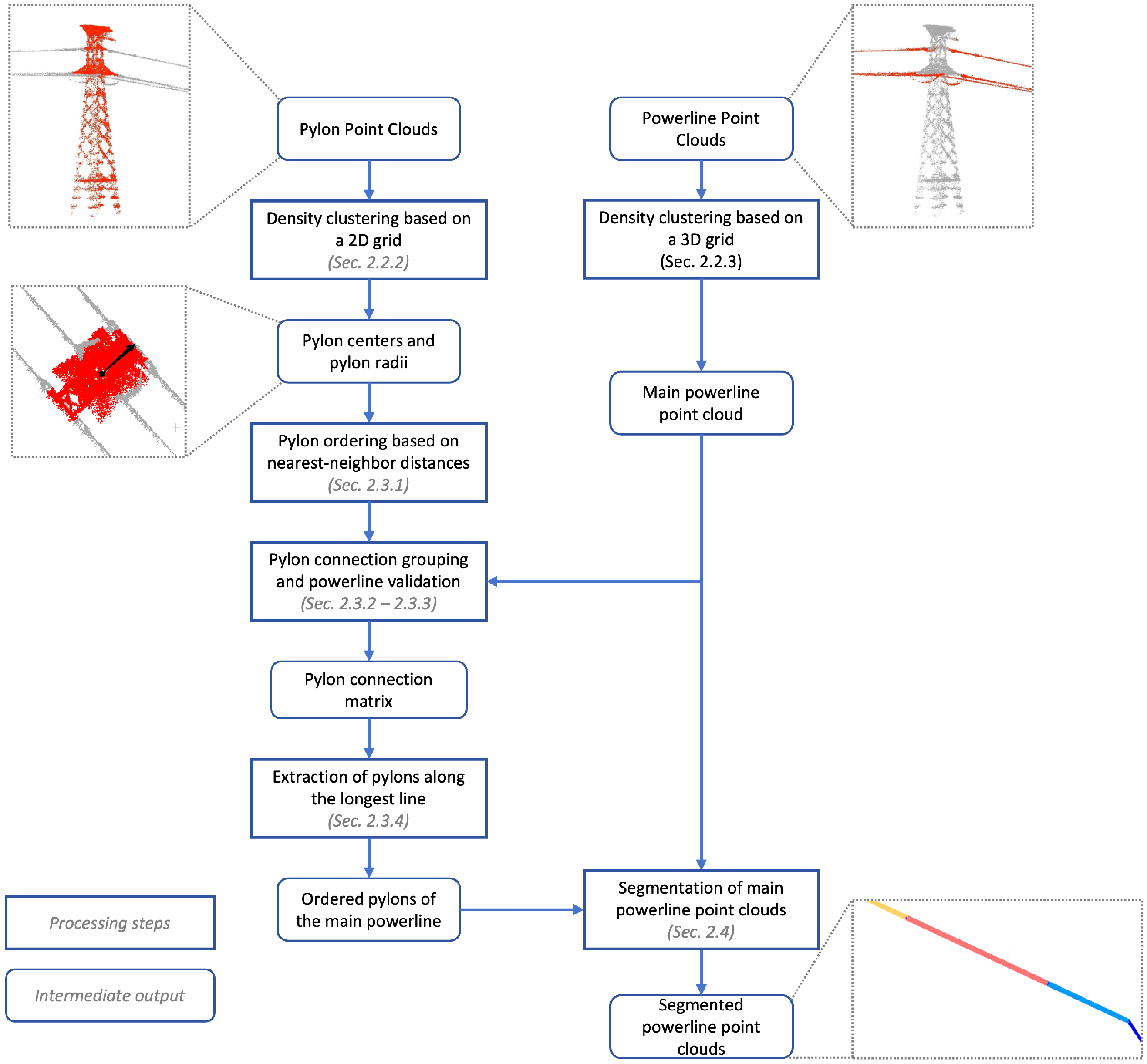
2.1.2. Overall Processing Workflow
2.2. Density Clustering of Pylons and Powerlines Based on the Point Count Grid
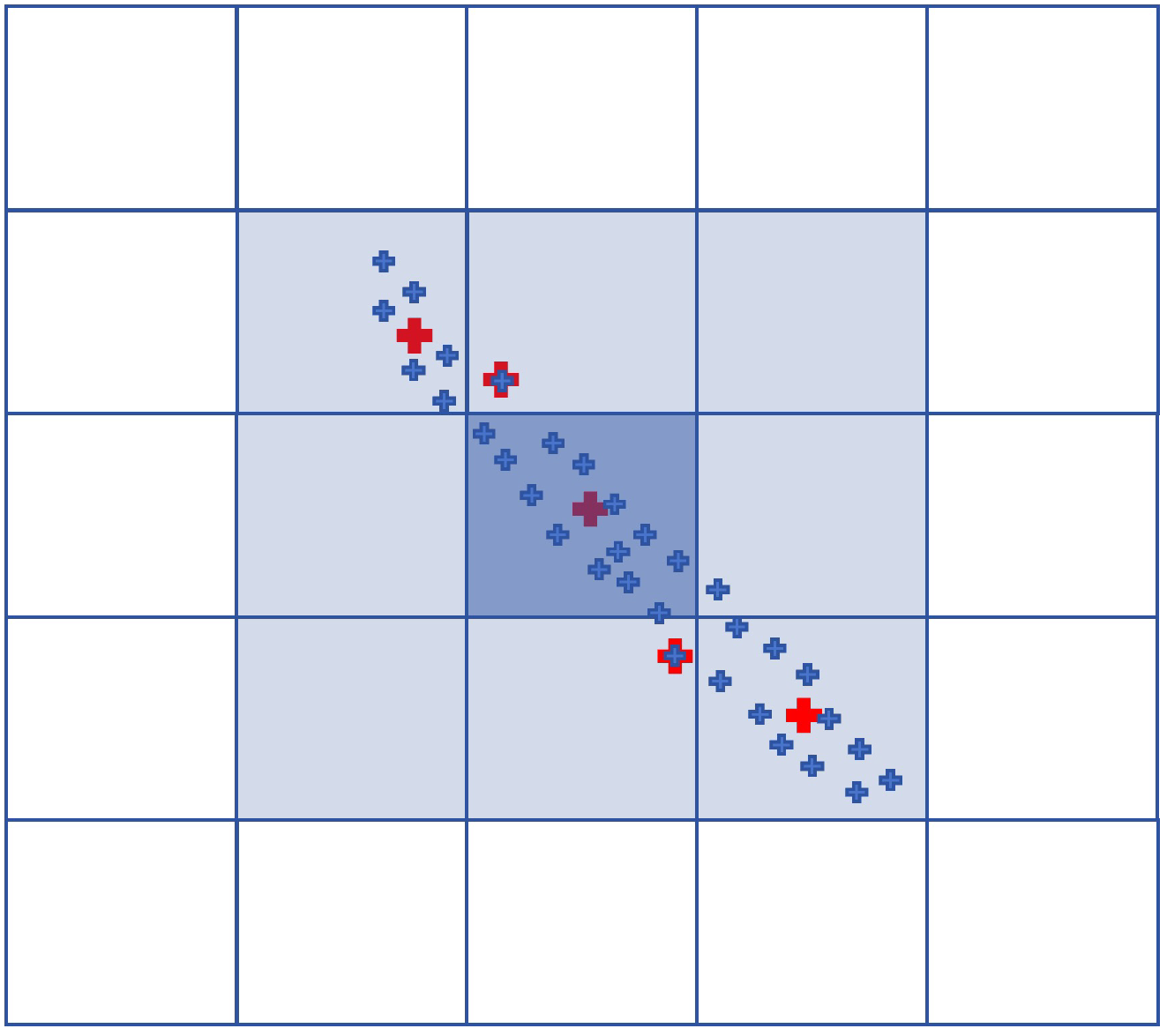
2.2.1. Point Count Grid (PCGrid)
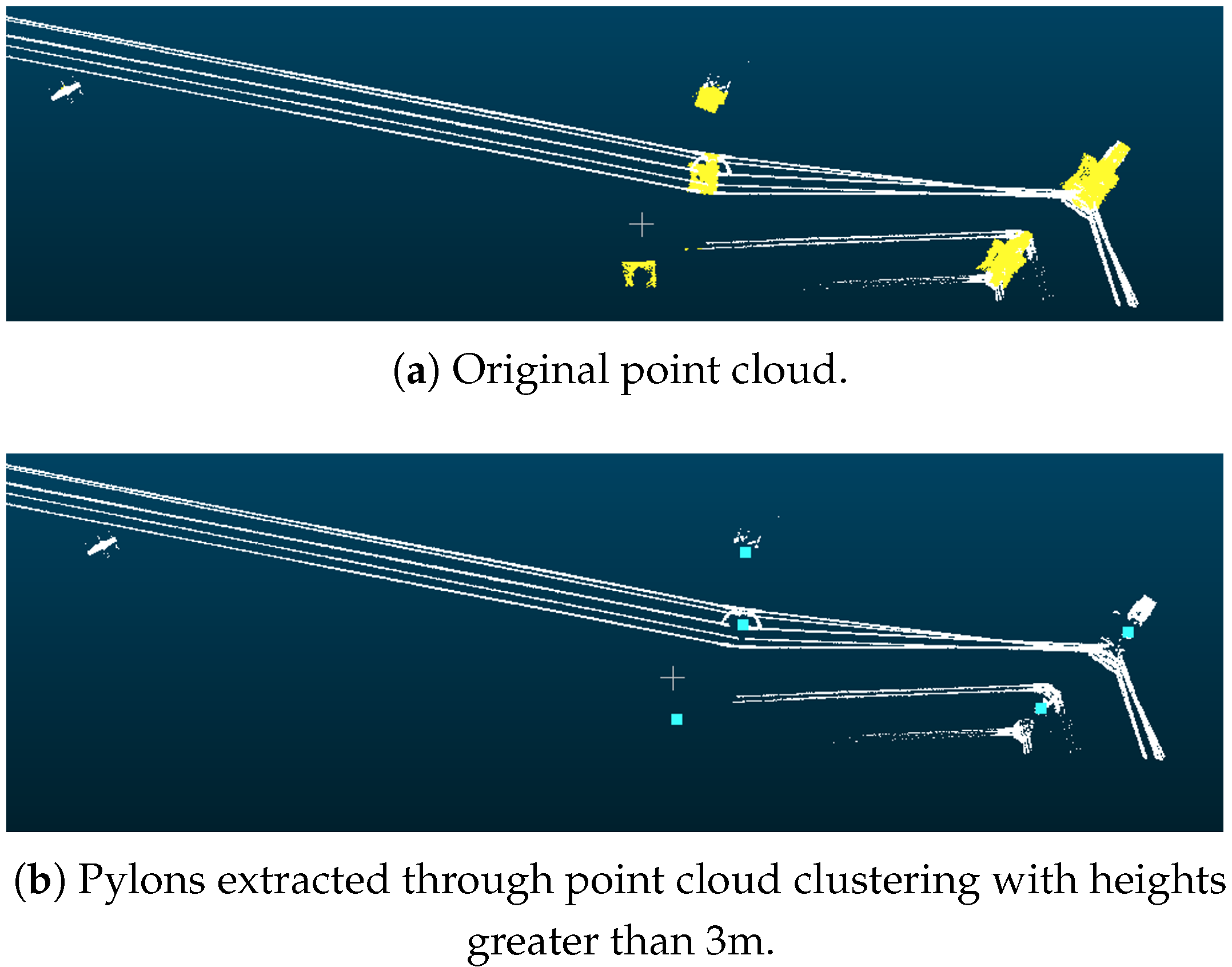
2.2.2. Pylon Point Cloud Clustering and Center Extraction Based on 2D PCGrid DBSCAN
- All non-empty grid cells containing point clouds are sorted based on their point counts;
- DBSCAN clustering is performed in descending order of the number of points within each grid cell;
- Unlike the standard DBSCAN algorithm, the minimum number of points criterion is applied solely based on the points contained within each individual grid cell in the two-dimensional PCGrid_2D.
2.2.3. Extraction of Main-Line Powerline Point Clouds Based on 3D Point Count Grid DBSCAN
2.3. Extraction of Main-Line Pylons Based on the Relationship Between Pylons and Powerlines
2.3.1. Initial Pylon Ordering Based on Nearest Distance
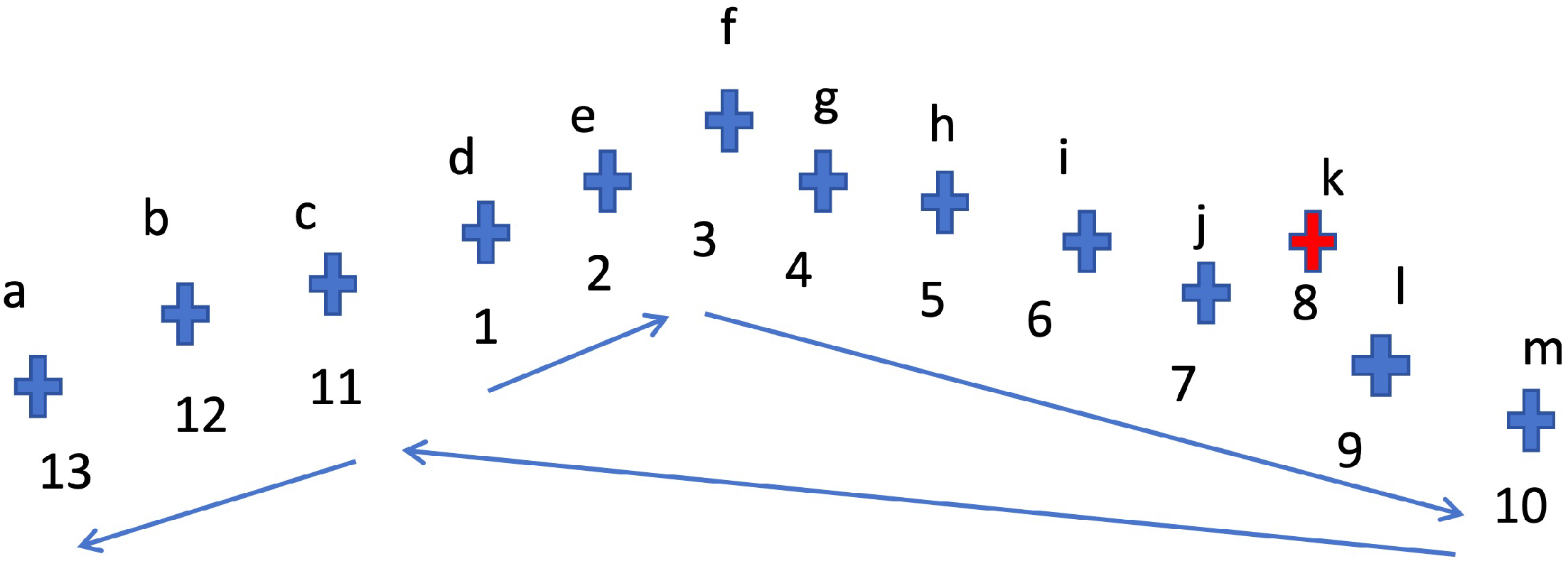
- Select a virtual starting point and identify the pylon closest to this point as the first pylon;
- From the remaining pylons, find the pylon nearest to the current pylon;
- Swap the nearest pylon to the position immediately following the current pylon, then update this pylon as the current pylon;
- Repeat step (2) until all the pylons have been processed;
- Starting from the last pylon in the ordered list, compare each pylon sequentially with the first pylon;
- If the distance between a pylon and the first pylon is less than the distance between this pylon and its preceding pylon, relocate this pylon and all subsequent pylons to precede the first pylon;
- Output the reordered list of pylons.
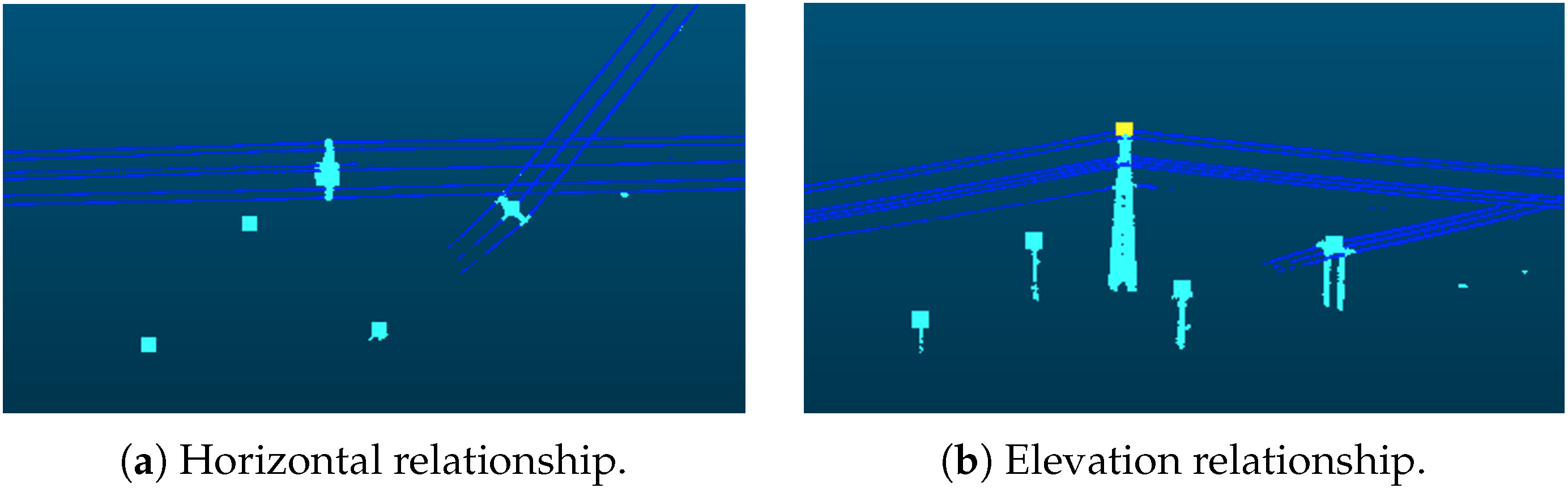
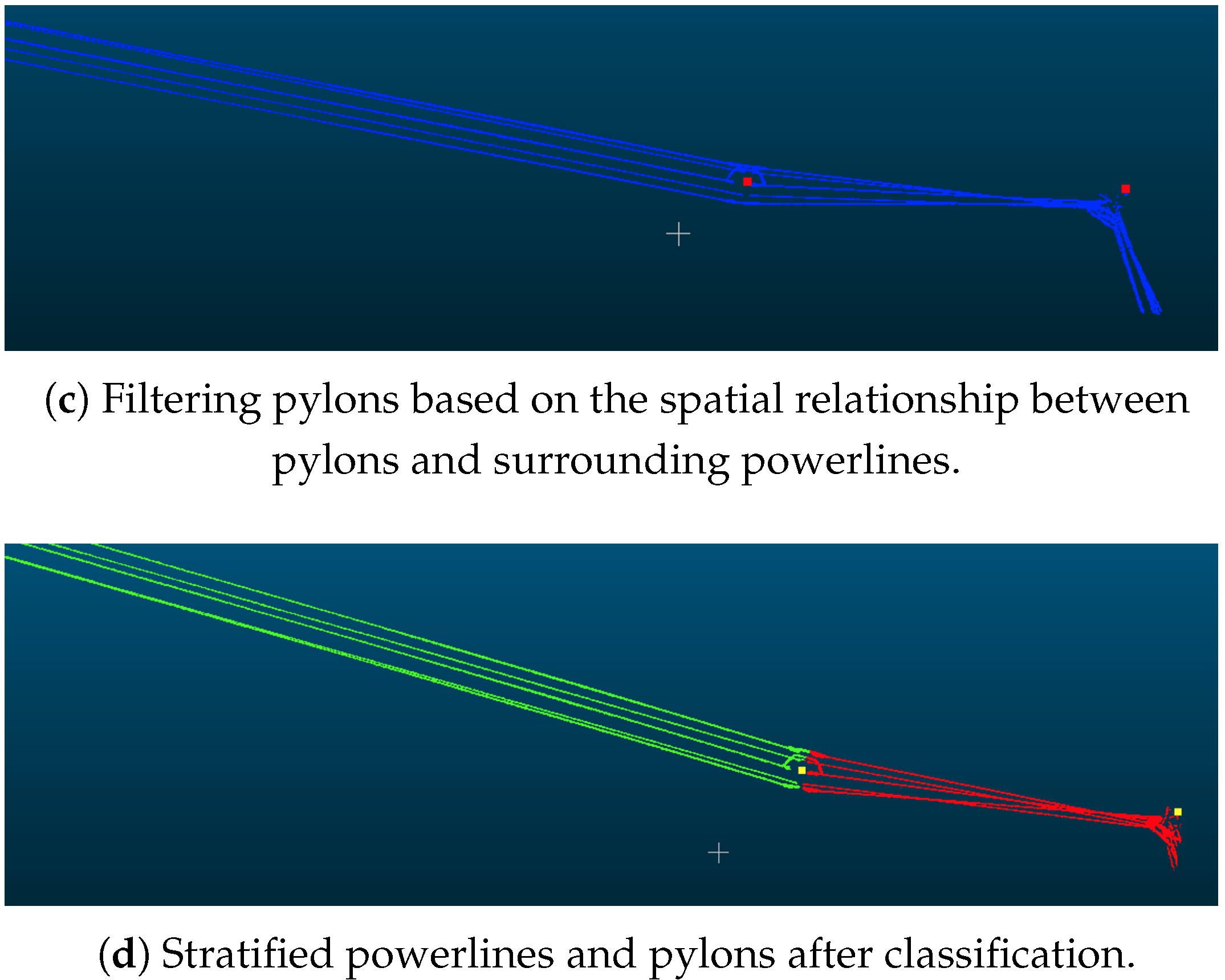
2.3.2. Pylon Filtering Based on the Relationship Between Pylons and Surrounding Powerlines
- Construct a horizontal grid PCGrid_2D with a 1-m interval based on the spatial extent of the powerline point cloud, and register the powerline points into this grid;
- Retrieve the centroid coordinates of grids containing powerline points and insert them into a kd-tree to build a two-dimensional spatial index;
- For each pylon, use its center point as the reference and query the kd-tree within a specified radius to obtain neighboring grid points and their corresponding original LiDAR points;
- Perform principal component analysis (PCA) on the neighboring LiDAR points to extract the centroid, eigenvalues, eigenvectors, and the lengths of the major and minor axes;
- Compute the projection of the pylon center onto the eigenvectors;
- If the distance between the pylon center and the centroid of the powerline point cloud exceeds the length of the minor axis, the pylon is classified as either an outlier pylon or noise outside the main-line powerline.
2.3.3. Validity Assessment of Pylon Connections Based on Powerline Point Clouds
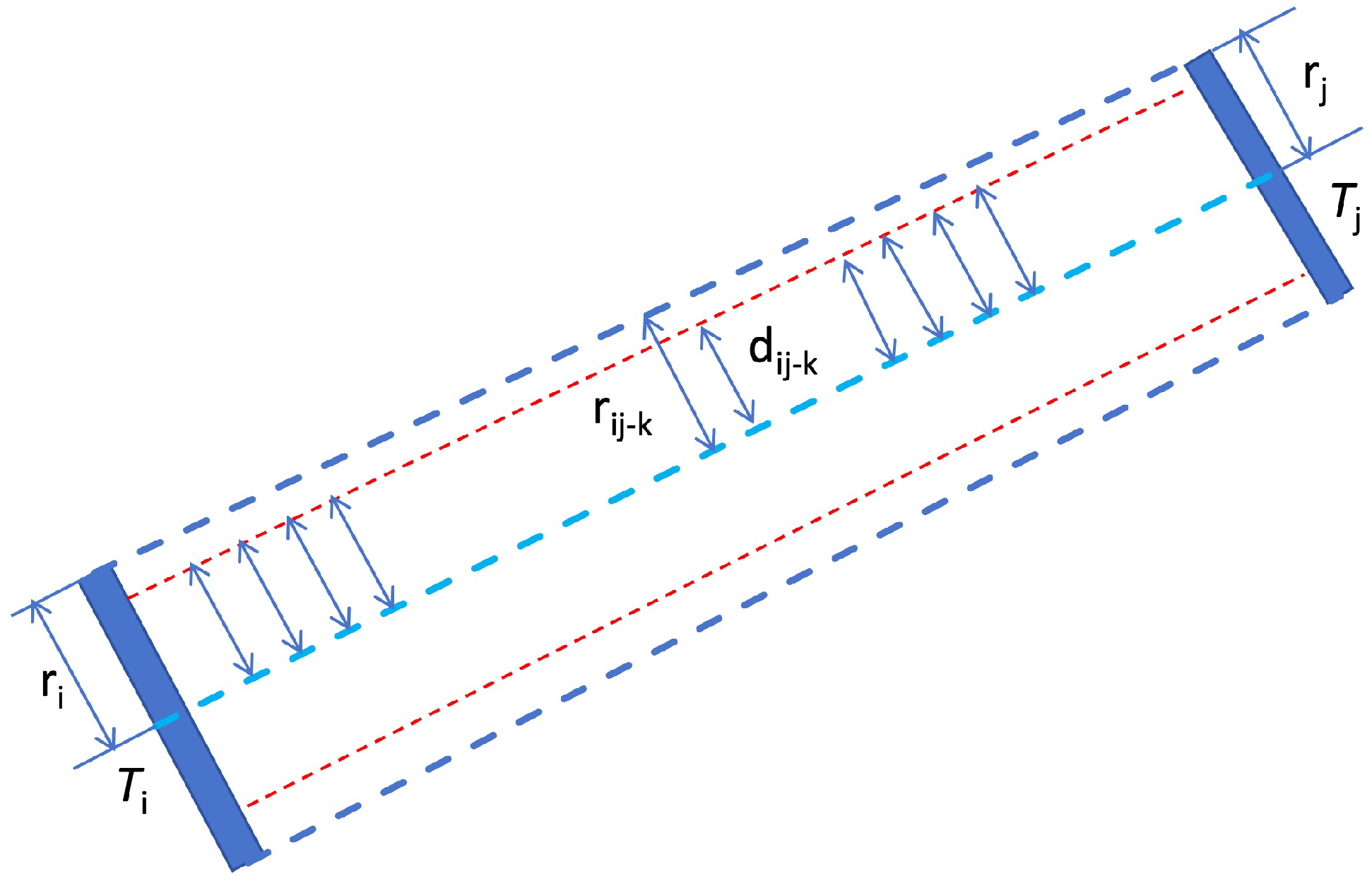
- Construct a 2D point counting grid (PCGrid_2D) with a grid interval of 3 m;
- Extract the grid centroids and build a kd-tree for these centroid points;
- Sample points along the powerline segment at the grid interval, and interpolate the radius ;
- For each sampled point, search for the nearest point in the kd-tree;
- If the distance from the sampled point to the nearest grid centroid is less than , and the powerline point cloud at this position is not higher than the connecting line of adjacent pylons, mark this sampled point as valid;
- Repeat steps (3) to (5) until all sampled points are processed;
- If the proportion of valid sampled points exceeds 90%, the pylon connection is deemed valid and likely represents a real pylon linkage.
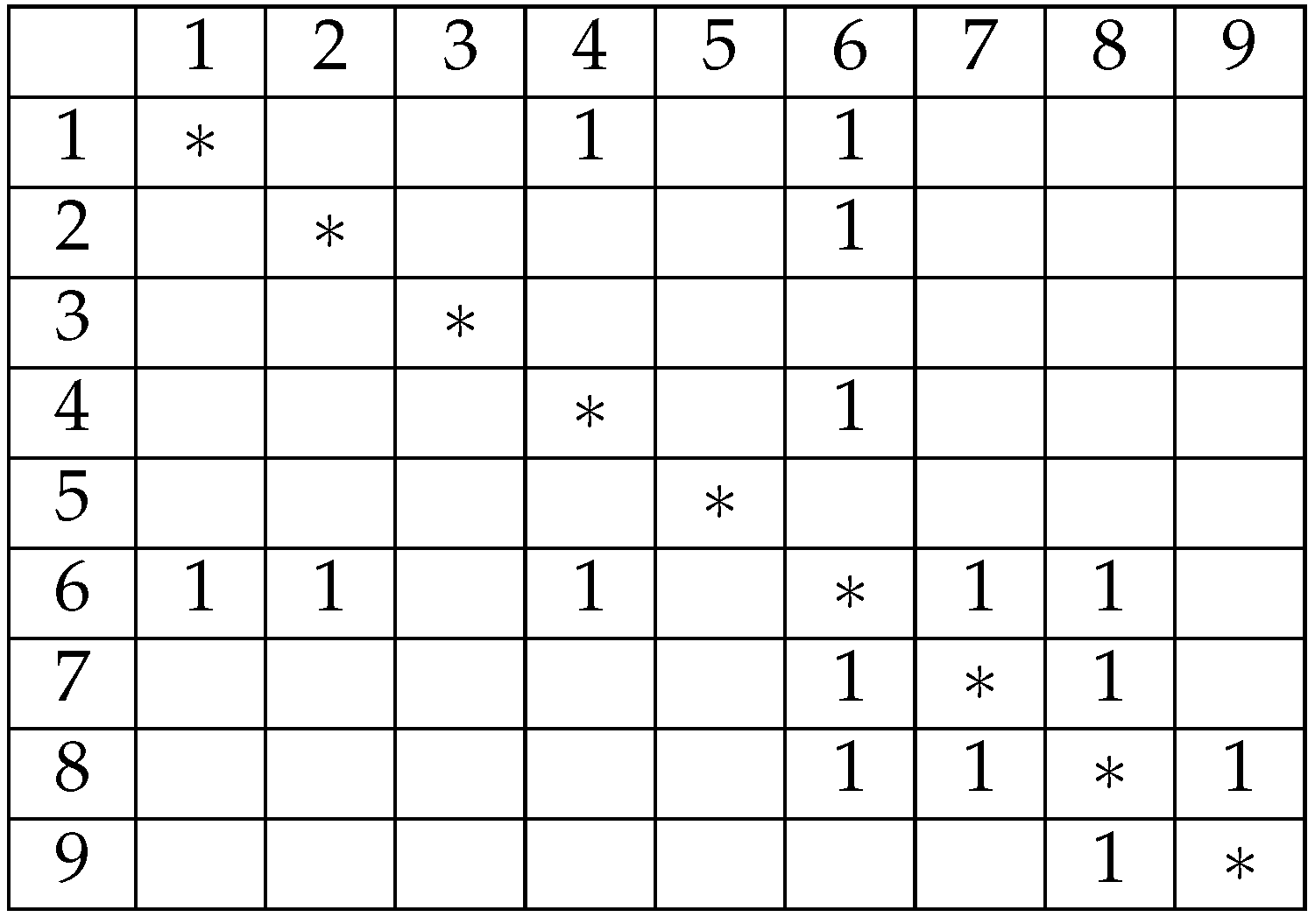
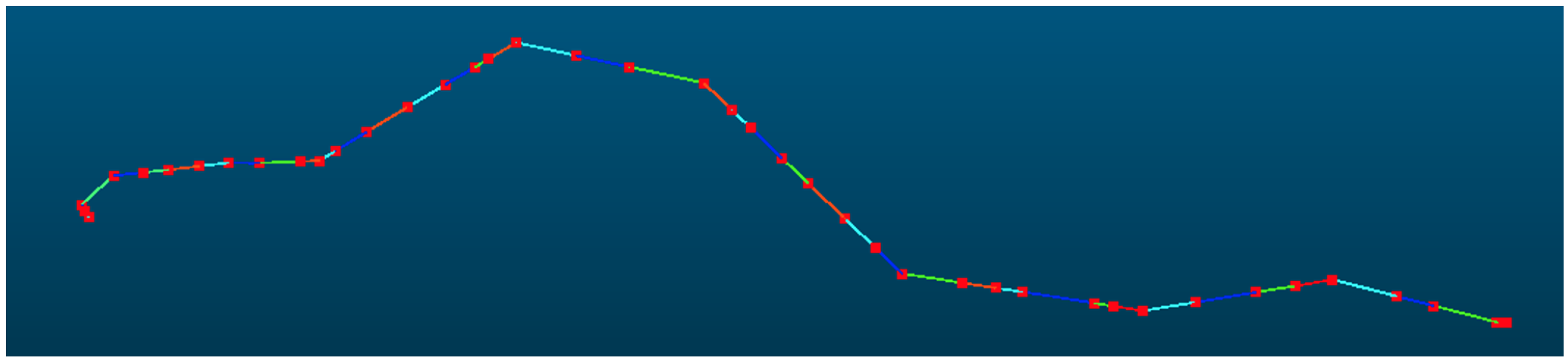
2.3.4. Extraction of the Main-Line Powerline Based on the Pylon Connection Matrix
2.4. Fine Segmentation of Powerline Point Clouds
- Construct a 2D kd-tree index for the pylon centers;
- For each powerline point, query the nearest pylon i using the 2D kd-tree;
- If the point lies between the line segment connecting pylons and i, assign the point to the segment ;
- Otherwise, if the point lies between the line segment connecting pylons i and , assign the point to the segment ;
- Repeat steps (2) to (4) until all points have been processed.
3. Experiments and Results
3.1. 220 kV Powerline
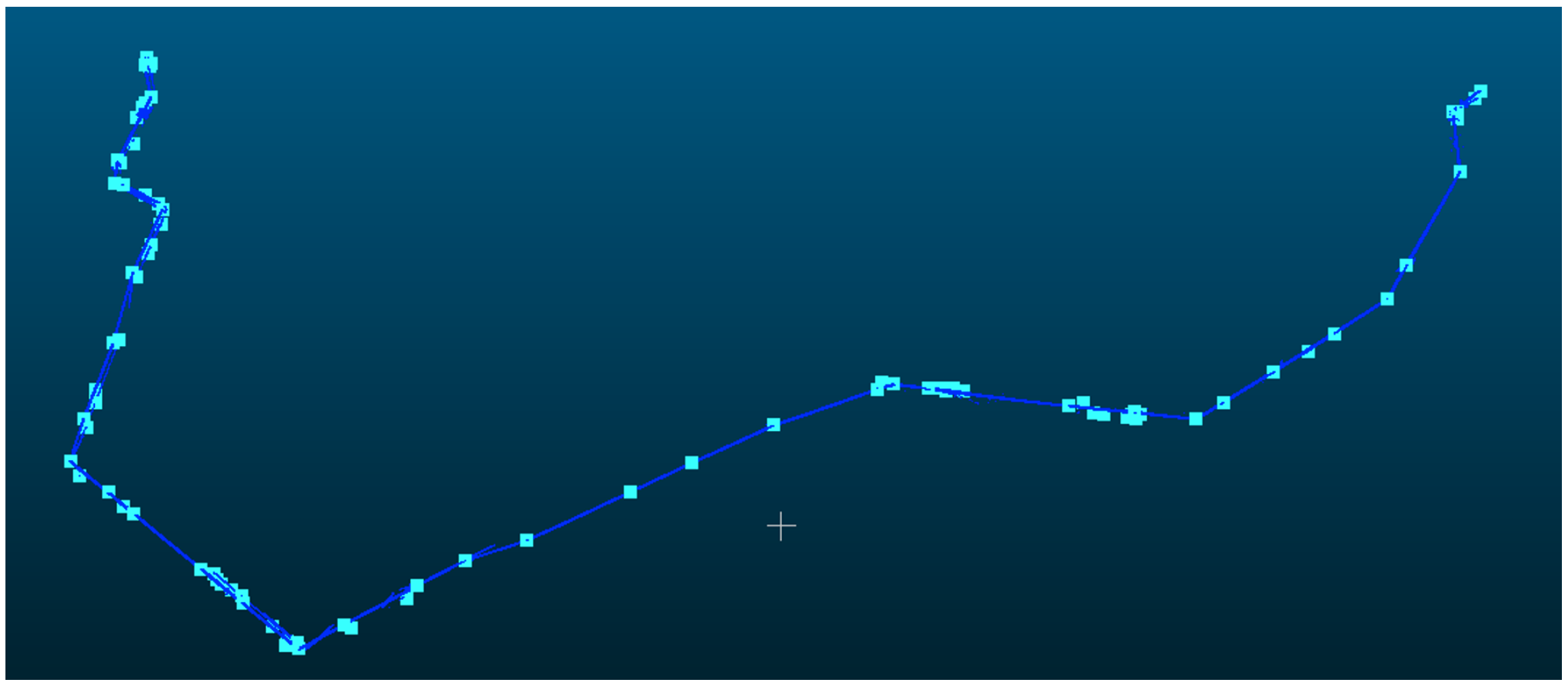
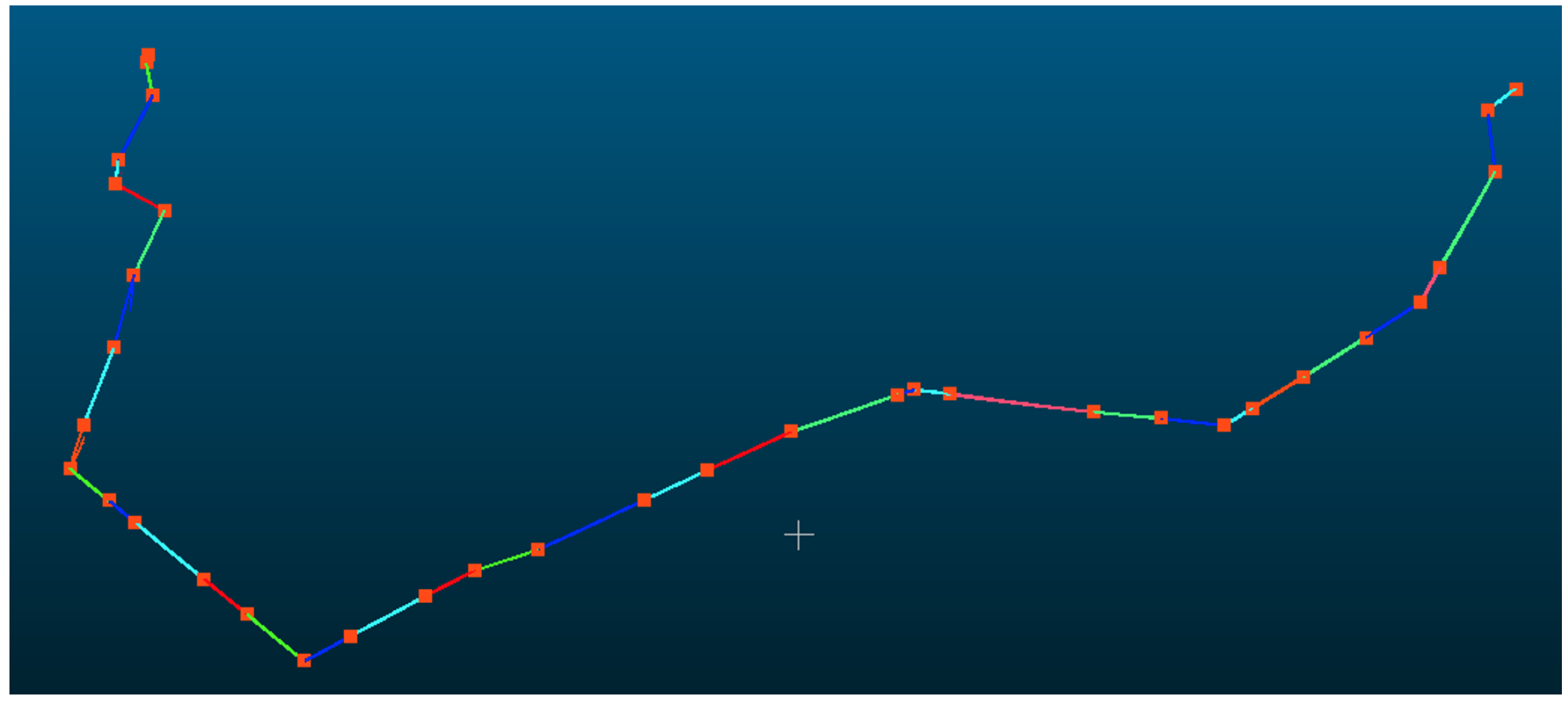
3.1.1. Interference from Adjacent Lines
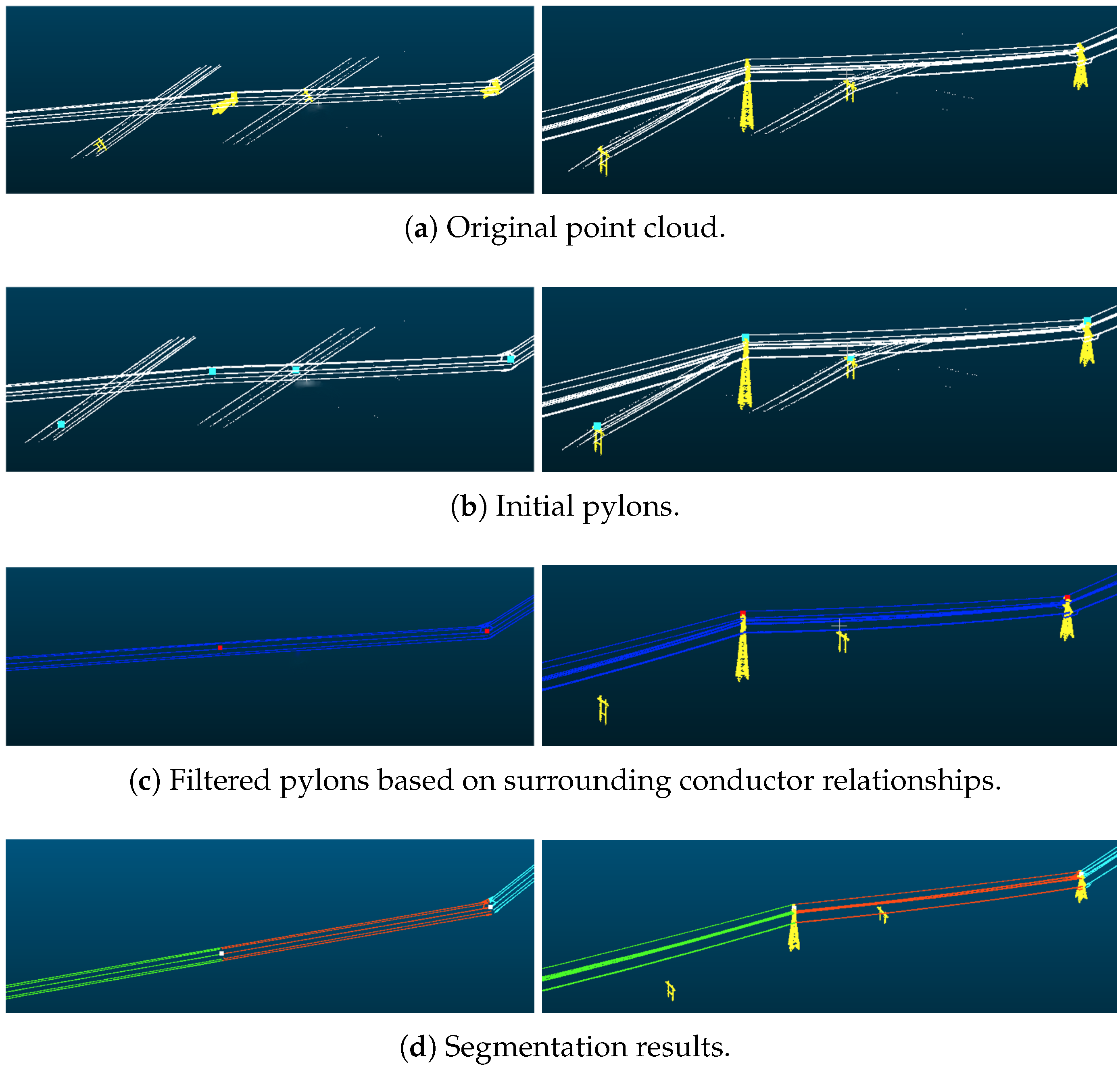
3.1.2. Interference from Crossing Lines
3.2. 110 kV Powerline
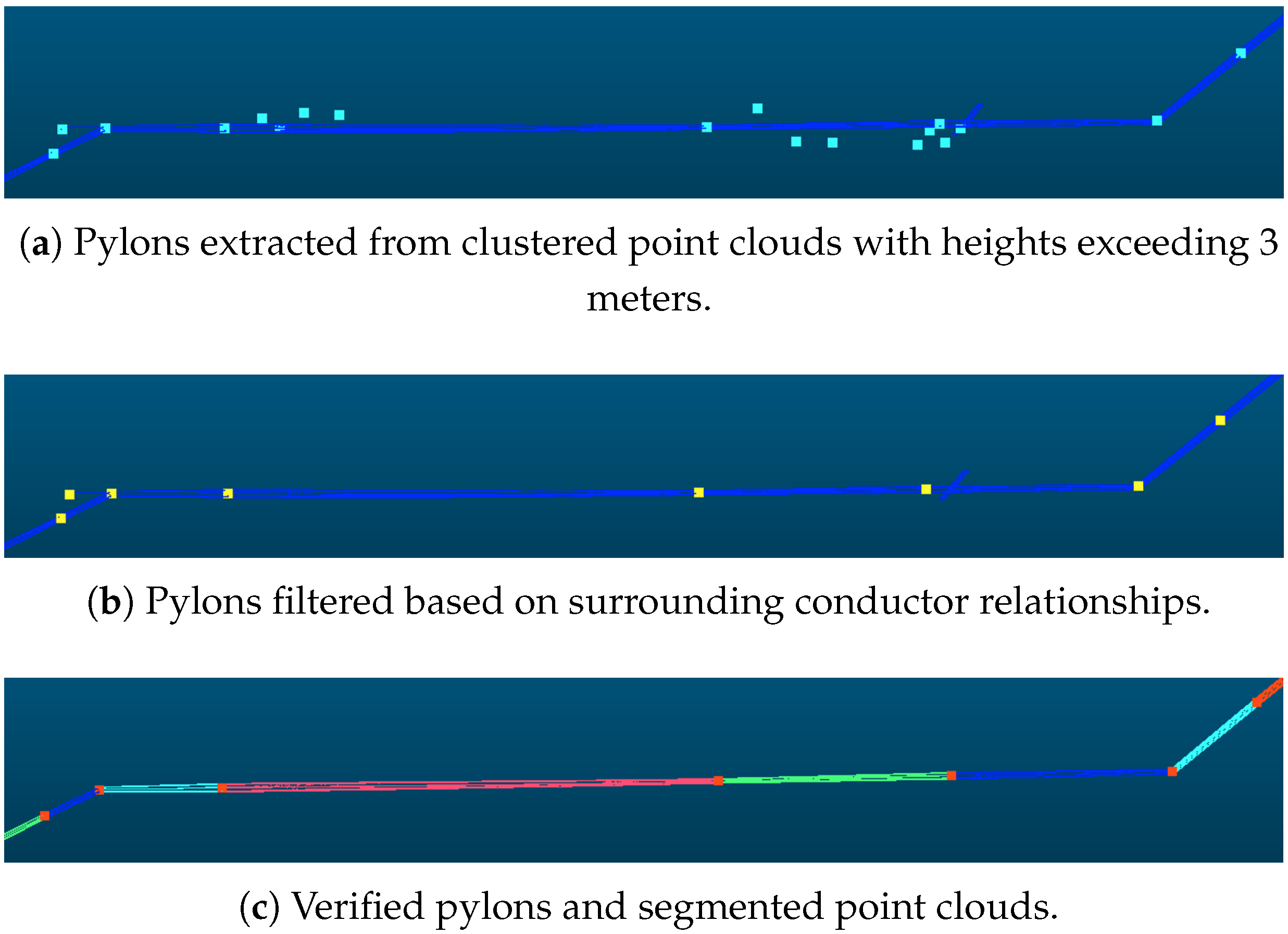
Local Analysis
3.3. 35 kV Powerline
3.4. Efficiency Analysis
3.5. Robustness Analysis
4. Conclusions
5. Future Work
Author Contributions
Funding
Data Availability Statement
Conflicts of Interest
References
- Ahmad, J.; Malik, A.S.; Xia, L.; Ashikin, N. Vegetation Encroachment Monitoring for Transmission Lines Right-of-ways: A survey. Electr. Power Syst. Res. 2013, 95, 339–352. [Google Scholar] [CrossRef]
- Sohn, G.; Jwa, Y.; Kim, H.B. Automatic Powerline Scene Classification and Reconstruction Using Airborne Lidar Data. ISPRS Ann. Photogramm. Remote Sens. Spat. Inf. Sci. 2012, 1, 167–172. [Google Scholar] [CrossRef]
- Savva, A.; Kyrkou, C.; Kolios, P.; Theocharides, T. Advances in Remote Sensing and Artificial Intelligence for Vegetation Monitoring in Power Line Corridors: A review and future directions. IEEE Geosci. Remote Sens. Mag. 2025, 13, 415–439. [Google Scholar] [CrossRef]
- Azevedo, F.; Dias, A.; Almeida, J.; Oliveira, A.; Ferreira, A.; Santos, T.; Martins, A.; Silva, E. Lidar-based Real-time Detection and Modeling of Power Lines for Unmanned Aerial Vehicles. Sensors 2019, 19, 1812. [Google Scholar] [CrossRef]
- Lohani, B.; Ghosh, S. Airborne LiDAR Technology: A Review of Data Collection and Processing Systems. Proc. Natl. Acad. Sci. India Sect. A Phys. Sci. 2017, 87, 567–579. [Google Scholar]
- Xiang, B.; Wielgosz, M.; Kontogianni, T.; Peters, T.; Puliti, S.; Astrup, R.; Schindler, K. Automated Forest Inventory: Analysis of High-density Airborne LiDAR Point Clouds with 3D Deep Learning. Remote Sens. Environ. 2024, 305, 114078. [Google Scholar]
- Guo, B.; Huang, X.; Zhang, F.; Sohn, G. Classification of Airborne Laser Scanning Data Using JointBoost. ISPRS J. Photogramm. Remote Sens. 2015, 100, 71–83. [Google Scholar] [CrossRef]
- Zhou, R.; Jiang, W.; Jiang, S. A Novel Method for High-Voltage Bundle Conductor Reconstruction from Airborne LiDAR Data. Remote Sens. 2018, 10, 2051. [Google Scholar]
- Liang, J.; Zhang, J.; Deng, K.; Liu, Z.; Shi, Q. A New Power-line Extraction Method Based on Airborne LiDAR Point Cloud Data. In Proceedings of the IEEE 2011 International Symposium on Image and Data Fusion (ISIDF), Tengchong, China, 9–11 August 2011; pp. 1–4. [Google Scholar]
- Jwa, Y.; Sohn, G. A Piecewise Catenary Curve Model Growing for 3D Power Line Reconstruction. Photogramm. Eng. Remote Sens. 2012, 78, 1227–1240. [Google Scholar]
- Ortega, S.; Trujillo, A.; Santana, J.M.; Suárez, J.P.; Santana, J. Characterization and Modeling of Power Line Corridor Elements from LiDAR Point Clouds. ISPRS J. Photogramm. Remote Sens. 2019, 152, 24–33. [Google Scholar] [CrossRef]
- Munir, N.; Awrangjeb, M.; Stantic, B. Automatic Extraction of High-Voltage Bundle Subconductors Using Airborne LiDAR Data. Remote Sens. 2020, 12, 3078. [Google Scholar] [CrossRef]
- Yan, W.; Ma, W.; Wu, X.; Wang, C.; Zhang, J.; Deng, Y. Filtering-Assisted Airborne Point Cloud Semantic Segmentation for Transmission Lines. Sens. 2024, 24, 7028. [Google Scholar] [CrossRef]
- Kim, H.B.; Sohn, G. Point-based Classification of Power Line Corridor Scene Using Random Forests. Photogramm. Eng. Remote Sens. 2013, 79, 821–833. [Google Scholar] [CrossRef]
- Chen, C.; Yang, B.; Song, S.; Peng, X.; Huang, R. Automatic Clearance Anomaly Detection for Transmission Line Corridors Utilizing UAV-Borne LIDAR data. Remote Sens. 2018, 10, 613. [Google Scholar] [CrossRef]
- Yermo, M.; Laso, R.; Lorenzo, O.G.; Pena, T.F.; Cabaleiro, J.C.; Rivera, F.F.; Vilariño, D.L. Powerline Detection and Characterization in General-Purpose Airborne LiDAR Surveys. IEEE J. Sel. Top. Appl. Earth Obs. Remote Sens. 2024, 17, 10137–10157. [Google Scholar] [CrossRef]
- Cao, D.; Wang, C.; Liu, H.; Zhang, S.; Du, M.; Wang, P.; Nie, S.; Cheng, S. An Automatic Method for Powerline Extraction from ALS Point Cloud of Powerline Corridors. IEEE J. Sel. Top. Appl. Earth Obs. 2025, 18, 10803–10829. [Google Scholar] [CrossRef]
- Zhou, Y.; Feng, Z.; Chen, C.; Yu, F. Bilinear Distance Feature Network for Semantic Segmentation in PowerLine Corridor Point Clouds. Sensors 2024, 24, 5021. [Google Scholar] [CrossRef] [PubMed]
- Liu, X.; Shuang, F.; Li, Y.; Zhang, L.; Huang, X.; Qin, J. SS-IPLE: Semantic Segmentation of Electric Power Corridor Scene and Individual Power Line Extraction from UAV-based Lidar Point Cloud. IEEE J. Sel. Top. Appl. Earth Obs. Remote Sens. 2023, 16, 38–50. [Google Scholar] [CrossRef]
- Hu, Q.; Yang, B.; Xie, L.; Rosa, S.; Guo, Y.; Wang, Z.; Trigoni, N.; Markham, A. Randla-net: Efficient Semantic Segmentation of Large-scale Point Clouds. In Proceedings of the IEEE/CVF Conference on Computer Vision and Pattern Recognition (CVPR), Washington, DC, USA, 13–19 June 2020; pp. 11108–11117. [Google Scholar]
- Kumar, V.; Nandy, A.; Soni, V.; Lohani, B. Powerline Extraction from Aerial and Mobile LiDAR Data Using Deep Learning. Earth Sci. Inform. 2024, 17, 2819–2833. [Google Scholar] [CrossRef]
- Guo, B.; Li, Q.; Huang, X.; Wang, C. An Improved Method for Power-line Reconstruction from Point Cloud Data. Remote Sens. 2016, 8, 36. [Google Scholar] [CrossRef]
- Wang, Y.; Chen, Q.; Liu, L.; Li, K. A Hierarchical Unsupervised Method for Power Line Classification from Airborne LiDAR Data. Int. J. Digit. Earth 2019, 12, 1406–1422. [Google Scholar] [CrossRef]
- Jung, J.; Che, E.; Olsen, M.J.; Shafer, K.C. Automated and Efficient Powerline Extraction from Laser Scanning Data Using a Voxel-based Subsampling with Hierarchical Approach. ISPRS J. Photogramm. Remote Sens. 2020, 163, 343–361. [Google Scholar] [CrossRef]
- Guan, H.; Yu, Y.; Li, J.; Ji, Z.; Zhang, Q. Extraction of Power-transmission Lines from Vehicle-borne Lidar Data. Int. J. Remote Sens. 2016, 37, 229–247. [Google Scholar] [CrossRef]
- Wang, Y.; Chen, Q.; Liu, L.; Zheng, D.; Li, C.; Li, K. Supervised classification of power lines from airborne LiDAR data in urban areas. Remote Sens. 2017, 9, 771. [Google Scholar] [CrossRef]
- Peng, S.; Xi, X.; Wang, C.; Dong, P.; Wang, P.; Nie, S. Systematic Comparison of Power Corridor Classification Methods from ALS Point Clouds. Remote Sens. 2019, 11, 1961. [Google Scholar] [CrossRef]




| Pylon Points | kd-tree Acceleration (s) | PCGrid Number | PCGrid Acceleration (s) | Acceleration Ratio | |
|---|---|---|---|---|---|
| 220 kV | 1,922,359 | 287.3 | 139 | 0.42 | 684.0 |
| 110 kV | 8,861,405 | 2251.6 | 345 | 2.57 | 876.1 |
| Original Data | w/5% Random Deletion | w/10% Random Deletion | |
|---|---|---|---|
| 220 kV line | 42 | 42 | 42 |
| 110 kV line | 36 | 36 | 36 |
Disclaimer/Publisher’s Note: The statements, opinions and data contained in all publications are solely those of the individual author(s) and contributor(s) and not of MDPI and/or the editor(s). MDPI and/or the editor(s) disclaim responsibility for any injury to people or property resulting from any ideas, methods, instructions or products referred to in the content. |
© 2025 by the authors. Licensee MDPI, Basel, Switzerland. This article is an open access article distributed under the terms and conditions of the Creative Commons Attribution (CC BY) license (https://creativecommons.org/licenses/by/4.0/).
Share and Cite
Ma, Y.; Wang, G.; Liu, T.; Wang, Y.; Geng, H.; Jiang, W. Enhanced Automatic Span Segmentation of Airborne LiDAR Powerline Point Clouds: Mitigating Adjacent Powerline Interference. Sensors 2025, 25, 6448. https://doi.org/10.3390/s25206448
Ma Y, Wang G, Liu T, Wang Y, Geng H, Jiang W. Enhanced Automatic Span Segmentation of Airborne LiDAR Powerline Point Clouds: Mitigating Adjacent Powerline Interference. Sensors. 2025; 25(20):6448. https://doi.org/10.3390/s25206448
Chicago/Turabian StyleMa, Yi, Guofang Wang, Tianle Liu, Yifan Wang, Hao Geng, and Wanshou Jiang. 2025. "Enhanced Automatic Span Segmentation of Airborne LiDAR Powerline Point Clouds: Mitigating Adjacent Powerline Interference" Sensors 25, no. 20: 6448. https://doi.org/10.3390/s25206448
APA StyleMa, Y., Wang, G., Liu, T., Wang, Y., Geng, H., & Jiang, W. (2025). Enhanced Automatic Span Segmentation of Airborne LiDAR Powerline Point Clouds: Mitigating Adjacent Powerline Interference. Sensors, 25(20), 6448. https://doi.org/10.3390/s25206448