You are currently viewing a new version of our website. To view the old version click .
Sensors
  • Article
  • Open Access

21 March 2024

Multi-IRS-Assisted mmWave UAV-BS Network for Coverage Extension

,
and
1
Department of Electrical and Electronic Engineering, School of Engineering, Tokyo Institute of Technology, 2-12-1 Ookayama, Meguro-ku, Tokyo 152-8552, Japan
2
Graduate School of Information Science and Technology, The University of Tokyo, 7-3-1 Hongo, Bunkyo-ku, Tokyo 113-8654, Japan
*
Author to whom correspondence should be addressed.
This article belongs to the Special Issue Advancements and Applications of UAV Communications with RF, Microwave, and mmWave Techniques

Abstract

In the era of Industry 5.0, advanced technologies like artificial intelligence (AI), robotics, big data, and the Internet of Things (IoT) offer promising avenues for economic growth and solutions to societal challenges. Digital twin technology is important for real-time three-dimensional space reproduction in this transition, and unmanned aerial vehicles (UAVs) can support it. While recent studies have explored the potential applications of UAVs in nonterrestrial networks (NTNs), bandwidth limitations have restricted their utility. This paper addresses these constraints by integrating millimeter wave (mmWave) technology into UAV networks for high-definition video transmission. Specifically, we focus on coordinating intelligent reflective surfaces (IRSs) and UAV networks to extend coverage while maintaining virtual line-of-sight (LoS) conditions essential for mmWave communication. We present a novel approach for integrating IRS into Beyond 5G/6G networks to enhance high-speed communication coverage. Our proposed IRS selection method ensures optimal communication paths between UAVs and user equipment (UE). We perform numerical analysis in a realistically modeled 3D urban environment to validate our approach. Our results demonstrate significant improvements in the received SNR for multiple UEs upon the introduction of IRSs, and they confirm the feasibility of coverage extension in mmWave UAV networks.

1. Introduction

Recently, Industry 5.0 has been envisioned by the European Commission as a road map for the future, thereby aiming to cultivate a prosperous society through the strategic use of advanced technologies such as artificial intelligence (AI), robotics, big data, and the Internet of Things (IoT) [1]. These technologies find practical applications in digital twins (DTs), which serve as the conduit between the real and virtual worlds [2]. On the other hand, in recent years, with the improvement of hovering position accuracy and the update of control functions considering safety [3], unmanned aerial vehicles (UAVs) are planned to be deployed in various fields such as agriculture, defense, delivery, and surveying, which will facilitate the realization of Industry 5.0 [4,5,6,7]. Furthermore, current research has shed light on the capabilities of nonterrestrial networks (NTNs) to equip UAVs and low Earth orbit satellites with robust communication systems. These networks are particularly valuable when terrestrial infrastructure compromises natural disasters such as earthquakes, lightning, and typhoons [8]. Among the promising solutions in this arena are UAV base stations (UAV-BS) [9]. Thanks to this feature, we can build temporary networks as wide as required and when we need them, thus making them not costly. These stations are increasingly seen as vital for enhancing communication performance in areas experiencing sudden spikes in data traffic or regions affected by disasters [10].
Research on UAV-BS began in the mid-2010s, and nowadays, UAV relay and base station demonstrations are being conducted by companies, albeit in limited scenarios. However, it has not yet reached the stage of practical operation. The main reason is that we are still exploring unique issues and solutions for airborne base stations, which differ from existing base station designs. In addition, telecommunication organizations should standardize dissemination to many people, and governments should establish laws.
As in previous UAV network studies, Rahman et al. [11] proposed a centralized algorithm for positioning UAVs to maximize the throughput. Shen et al. [12] optimized the UAV’s moving trajectory for a UAV-enabled mobile relaying system. Vishnoi et al. [13] improved the energy efficiency of an entire intelligent reflective surface (IRS)-mounted UAV network. However, many studies on UAV networks employ microwaves, which limit the range of possible applications due to bandwidth constraints. There is also a pressing concern about frequency resource depletion, thereby necessitating new exploration into frequency sharing and developing higher frequency bands. To further the capabilities of UAV networks, especially for applications requiring high-speed and high-definition video transmission, we propose the utilization of the millimeter wave (mmWave) [14]. Using mmWaves also allows array antennas to be deployed on a UAV by making individual antenna sizes smaller. Therefore, the beam shape can be changed to suit the situation. Unlike traditional ground base stations, UAV-BS can be flexibly positioned in three dimensions, thus ensuring line-of-sight (LoS) communication, which is crucial for mmWave frequencies. This flexibility reduces signal attenuation caused by obstacles such as buildings. However, maintaining LoS paths to all user equipment (UE) for high-speed communication remains challenging in densely constructed urban environments.
On the other hand, NTT DOCOMO released the white paper for the 6th generation (6G) mobile communication system and stated a new radio network topology that increases the number of connection paths to the network [15]. It says that the IRS is an important technology. According to [16,17], the IRS is composed of a large number of elements that scatter electromagnetic waves, and it often uses metamaterial/metasurface technology that enables the design and control of the distribution of scattering properties over an area. Metasurfaces are thin sheets that can be fabricated as flexible sheets depending on the choice of base material, thus allowing them to be installed along the structure. This allows for control of radio waves’ scattering properties while maintaining the structure’s existing geometry. In general, the IRS is expected to adaptively control the radio environment by periodically repeating the following two actions. The first action is estimating the radio channel state information necessary to determine the IRS operation. The second one is controlling the scattering intensity and phase distribution on the IRS surface based on the estimated information to obtain the desired propagation channel.
This is the first paper to integrate the IRS into UAV-BS networks for coverage extension. Specifically, it applies realistic space–time UE distributions extracted from field data and reproduces existing building structures into our simulation environment for strictly judging blocking conditions between the transmitter and receiver for the sake of enhancing reality. The contributions of this paper are as follows:
  • We propose a system model for multi-IRS-assisted UAV-BS networks to extend the coverage of mmWave communications.
  • We construct a three-dimensional environment based on actual field data and evaluate the proposed system through numerical analysis.
The rest of this paper is structured as follows. Section 2 introduces previous research on the IRS. Section 3 states the overall architecture of the proposed system and the system model. Section 4 describes the proposed IRS selection algorithm with the actual environment. Section 5 presents numerical analysis results and discussions. Finally, Section 6 summarizes this paper and mentions future works.

3. Architecture and System Model

This section introduces the architecture overview of our research and the access link system model focused in this paper.

3.1. Architecture

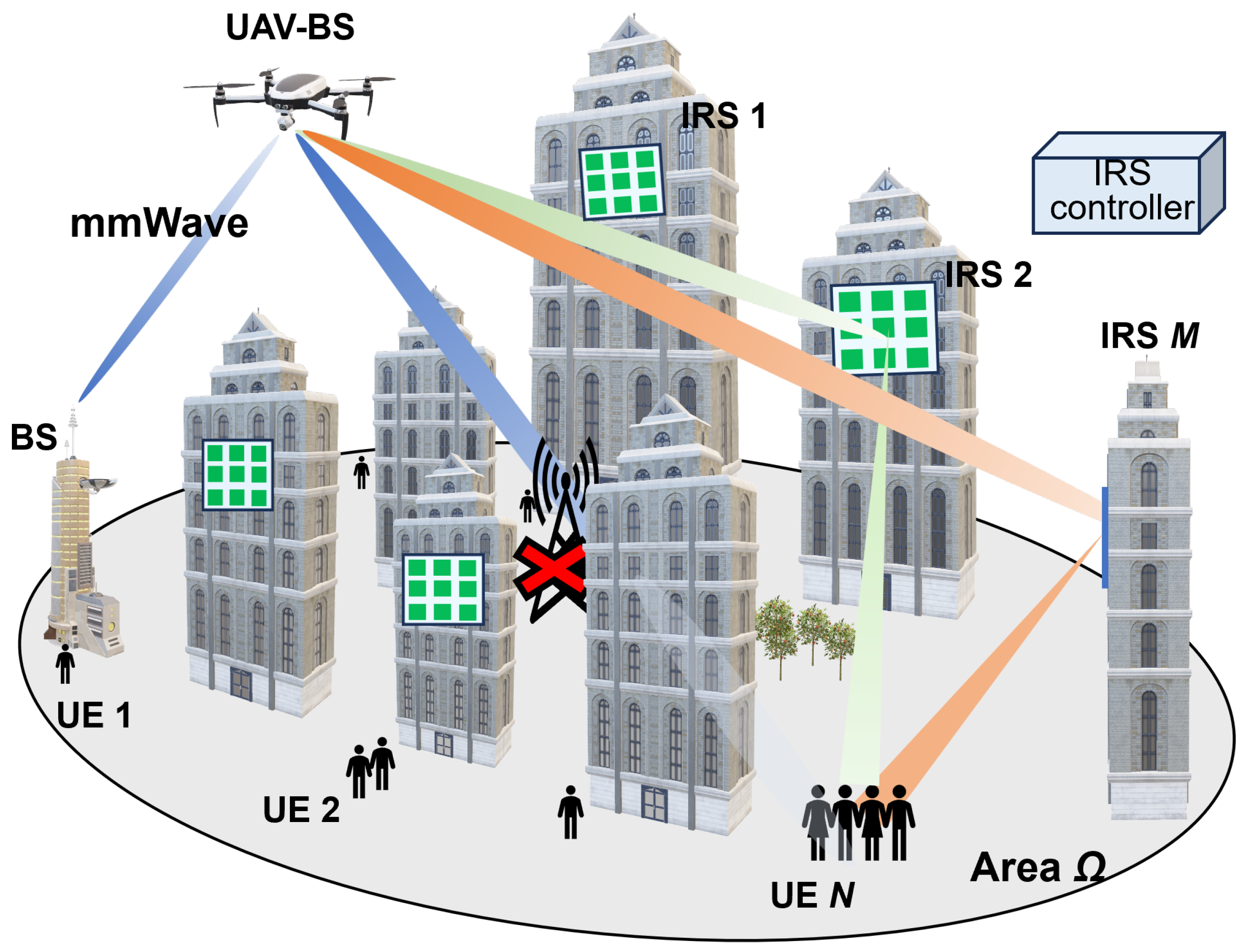
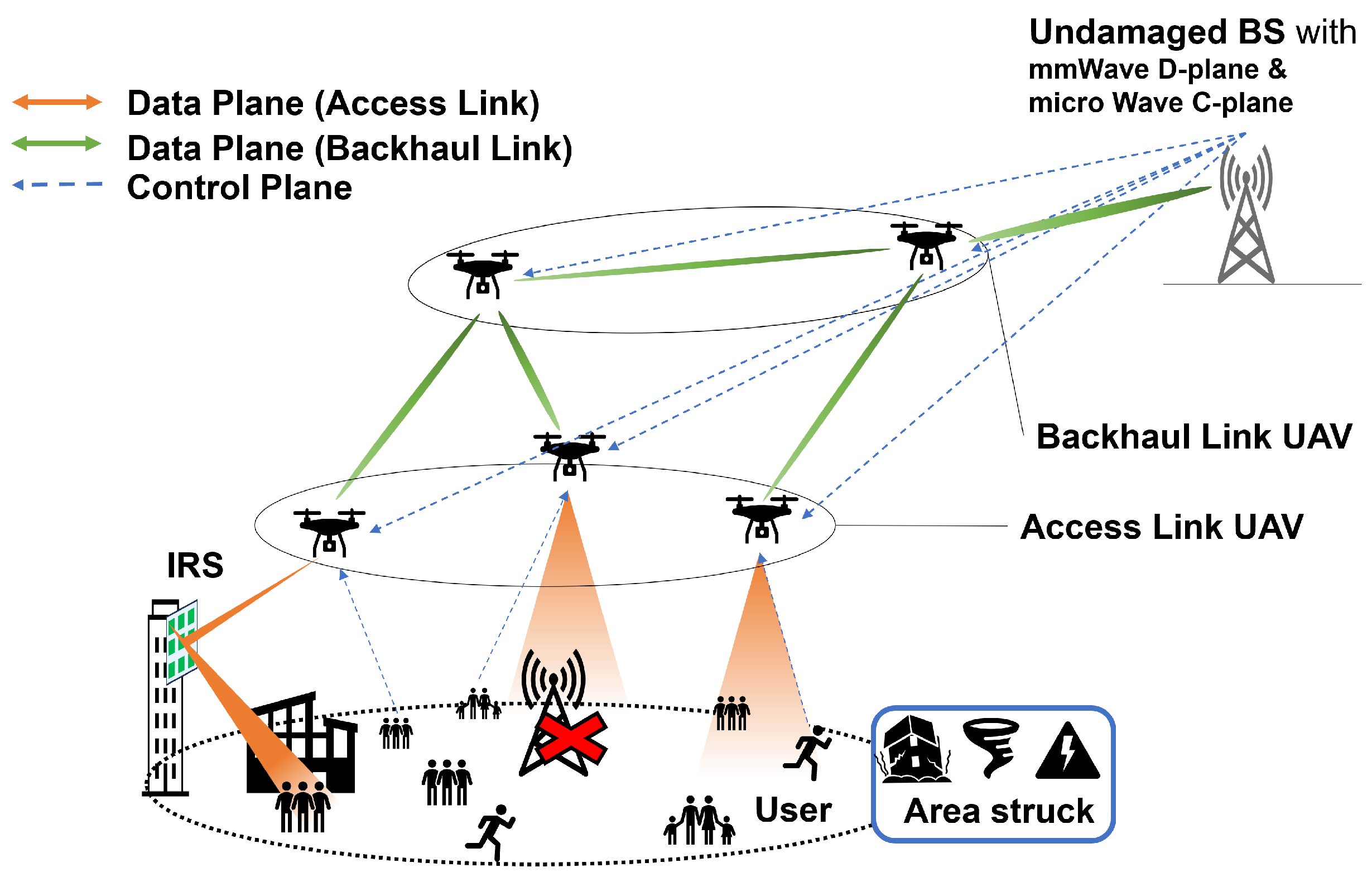
Figure 1 presents the overall system architecture this paper aims to develop. The depicted scenario assumes that all BSs in a cell are nonoperational due to a disaster such as an earthquake, hurricane, or lightning, thus necessitating the establishment of temporary communication areas. As discussed in the previous section, UAVs offer a readily deployable solution. However, using UAVs merely as access points for end-users would limit their utility to the communication range of the BS. To overcome this limitation, the role of UAVs as relay stations becomes essential.
Figure 1. Proposed architecture overview.
The figure illustrates two types of UAVs: access link UAVs, which provide an access link for end-user UEs, and backhaul link UAVs, which play as relay stations and facilitate backhaul connections between the access UAVs and neighboring undamaged BS. When access and backhaul UAVs operate autonomously, challenges arise, such as managing radio interference, ensuring adequate throughput, and avoiding redundancy of relay stations. To address these issues, coordinated operations of multiple UAVs become critical and require meticulous management and control. This is achieved by connecting all UAVs to the BS via a control plane. Small amounts of data, such as where the UEs are now, are also shared by using this control plane.
Our primary goal is extending the access UAV coverage area. To transmit detailed damage information to victims and rescue workers, access UAVs should be capable of high-capacity communications to all the UEs in the disaster area. mmWave has the potential for high-capacity communication due to its wide bandwidth but suffers from severe propagation attenuation due to blocking. Therefore, in this paper, we consider reflecting and delivering radio waves using the IRS existing in the city. We create a virtual LoS from the access UAV through the IRS to improve the received SNR even for UEs with Non-LoS (NLoS). In particular, we discuss the creation of UE distributions based on real-world data, thus constructing a simulation environment modeled after a real city, determining communication paths using IRS, and optimizing the UAV three-dimensional location. Finally, the effectiveness of the proposed method is verified by numerical analysis.

3.2. System Model

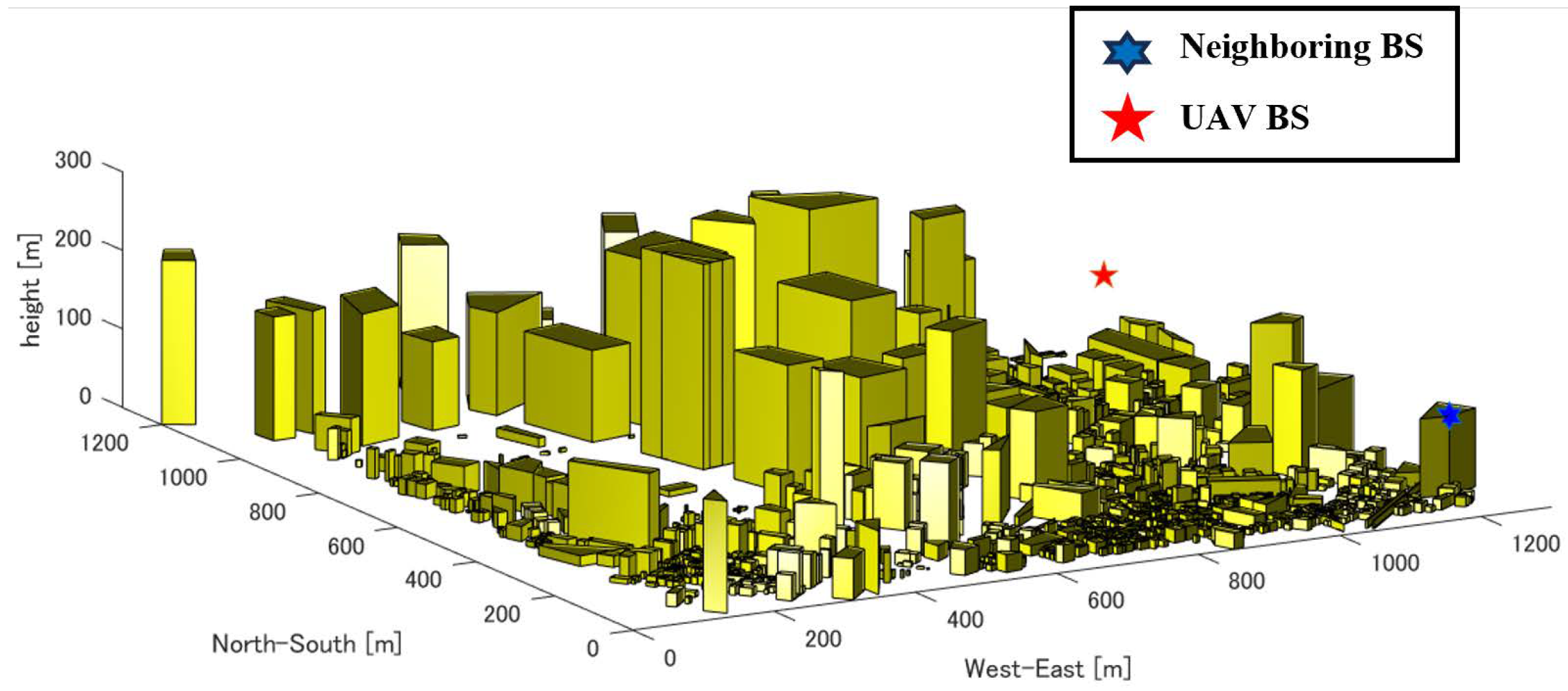
Figure 2 presents the system model, thus illustrating how the access UAV extends coverage by selectively pairing one IRS with one UE from among multiple IRSs installed on structures such as buildings. This is how the UAV-BS creates a virtual LoS via an IRS for users located behind buildings who cannot obtain the LoS with a UAV. In this figure, ground BS is not available, and there are several possible routes for supplying radio waves from the UAV-BS. N denotes the total number of UEs in the specified area Ω , and M denotes the total number of IRSs. The position of neighboring BSs, UAVs, UEs, IRSs are respectively represented by the 3-dimensional coordinates P BS R 1 × 3 , P UAV R 1 × 3 , P UE R N × 3 , and P IRS R M × 3 . The horizontal positions of the UEs are located outdoors within the specified area Ω .
Figure 2. System model of IRS-assisted UAV networks.
We use real-based population data, that is, mobile spatial statistics [37], which are population statistics generated using the NTT DOCOMO cell phone network mechanism. A compartment is approximately 250 m × 250 m and can capture the total population. Within a compartment, UEs are set with the sum of hot spots and uniform distribution. The location, radius, number of hotspots, and number of UEs to be accommodated are set randomly.

Path Loss Model and Calculation of UE Received SNR

The path loss model between the UAV in the sky and the UE on the ground is computed as the sum of the free space radio wave propagation loss and additional loss, which varies depending on whether the connection is LoS or NLoS by blocking [38]. Atmospheric absorption losses are not considered because they are negligible [39]. In our simulation, the path length from the UAV to the UE is up to 3.4 km. Atmospheric absorption will be maximally 3.4 dB [39] and included in the additional loss.
L LoS / NLoS [ dB ] = L free + η LoS / NLoS
where L free denotes free space radio wave propagation loss, which is calculated by
L free [ dB ] = 20 log d + 20 log f + 20 log 4 π c
where d denotes the communication path length between the UAV and UE, f denotes the carrier frequency, and c stands for the speed of light. Based on the Friis transmission formula [40], the received power P r at the UE is calculated by
P r [ dBm ] = P t + G t + G r L
where P t denotes the transmit power from the UAV antenna, G t denotes the gain of the UAV transmitting antenna, and G r signifies the gain of the UE receiving antenna. From the obtained received power P r , the SNR γ is calculated by
γ = P r P n
where P n denotes the noise power, which is calculated by
P n = σ n 2 B
where σ n 2 denotes the noise power density, and B denotes the system bandwidth.

5. Simulation Results and Discussion

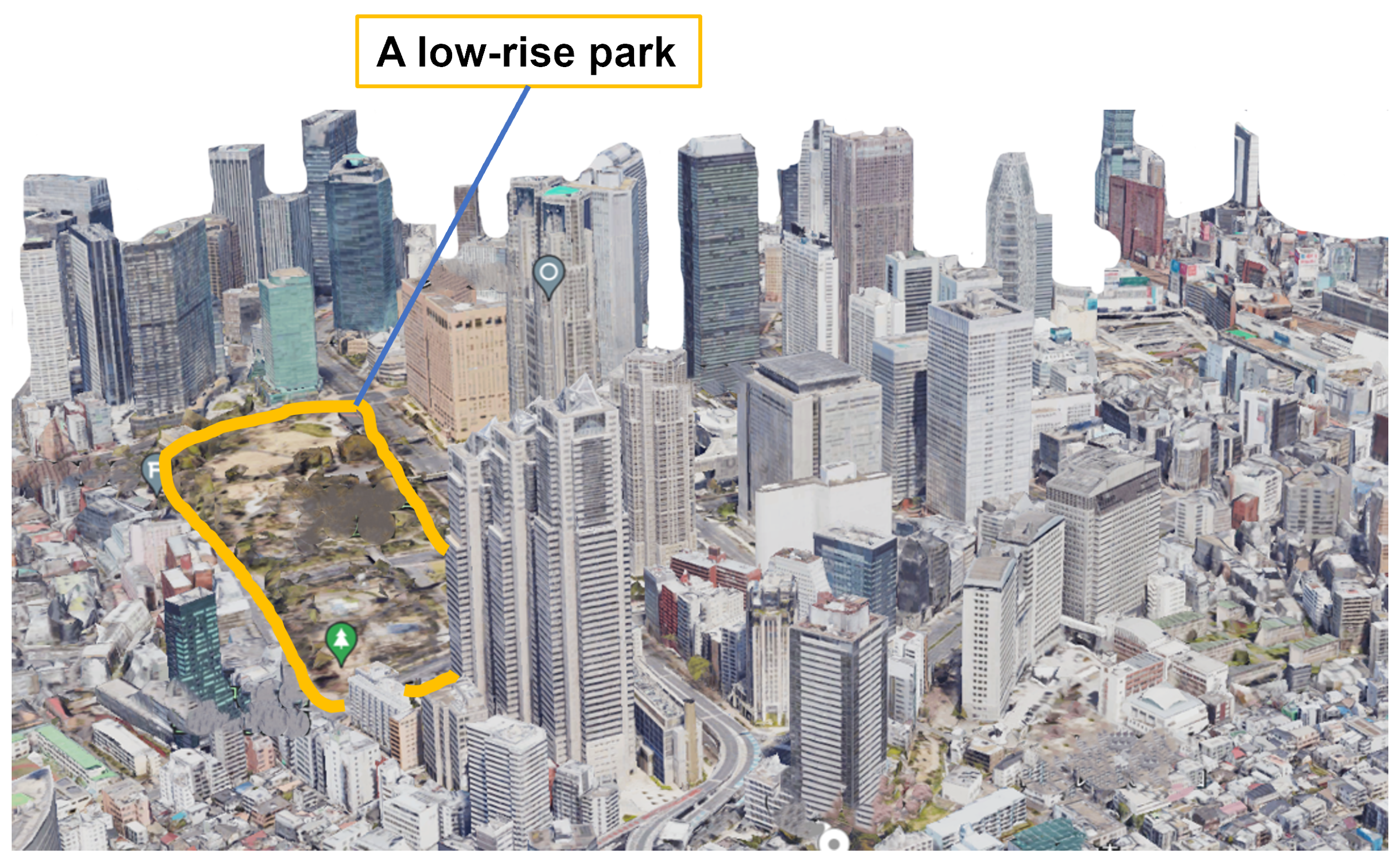
A simulation environment was constructed using a real city as a model, and numerical analysis was performed in MATLAB. The parameters are shown in Table 2. We executed downlink communication from one access UAV to multiple UEs, and we considered a mmWave UAV–BS network in an environment where multiple IRSs were deployed, thus aiming at coverage expansion. The communication path between the transmitter and receiver at those higher frequencies in 5G is easily blocked due to the existence of obstacles or blockages [42]. In that case, IRSs are introduced to artificially create communication paths to avoid blocking. A nearby undamaged ground BS was installed at 139.68676° E, 35.69350° N on the roof of a 209-meter-high building located in the upper left corner of the environment, which simulates the Shinjuku Metropolitan Government Office area in Tokyo. This BS established a wireless backhaul link with the access UAV, which provided signals to all UEs scattered in the area Ω , thereby utilizing the appropriate IRS according to Algorithm 1. IRSs were deployed on all four sides of a building that met the specified height criteria κ for a total of M IRSs. We assumed that the power reflection by the IRS occurred only once and that the IRS had a passive BF and could arbitrarily change the direction of the reflected wave. Glass and wood typically have low reflectivity. Concrete and metal have high reflectivity, but for mmWaves, most of them are rough surfaces, so diffuse reflections occur, and the energy appears to be dispersed in multiple directions. Therefore, we assumed a reflection coefficient of 1 at the IRS, and there was no reflection assumed outside of the IRS. The UAV knows the area map and the position of the IRS in advance. In contrast, the position of the UE is communicated to the UAV via the uplink control plane and shared from the UAV to the IRS with the UAV position information. Time division multiaccess (TDMA) was employed for multiplexing multiple UEs, and one IRS was used for one UE in a given time slot. The numerical analysis program consisted of three main phases: tentative placement of buildings, the IRS and UEs, an overlap check between buildings and UEs, and an SNR calculation for each UE. Let L denote the number of buildings in the target area Ω and P denote the number of candidate UAV placement points. A UE is repositioned and checked q times until the overlap with all buildings is eliminated. q varies from UE to UE. For phase 3, we tried to connect all UEs to all IRSs and select the ones that matched the criteria according to Algorithm 1, which requires approximately N × M × P steps of computation. Overall, the computational complexity of this numerical analysis is on the order of ( L + M + N ) + N × M q + N × M × P . The computation on our computer—whose specs are a 12th Gen. CPU, an i7-12700 intel core, 2.1 GHz, and 16 GB RAM—took over 20 h.
Table 2. Simulation parameters.
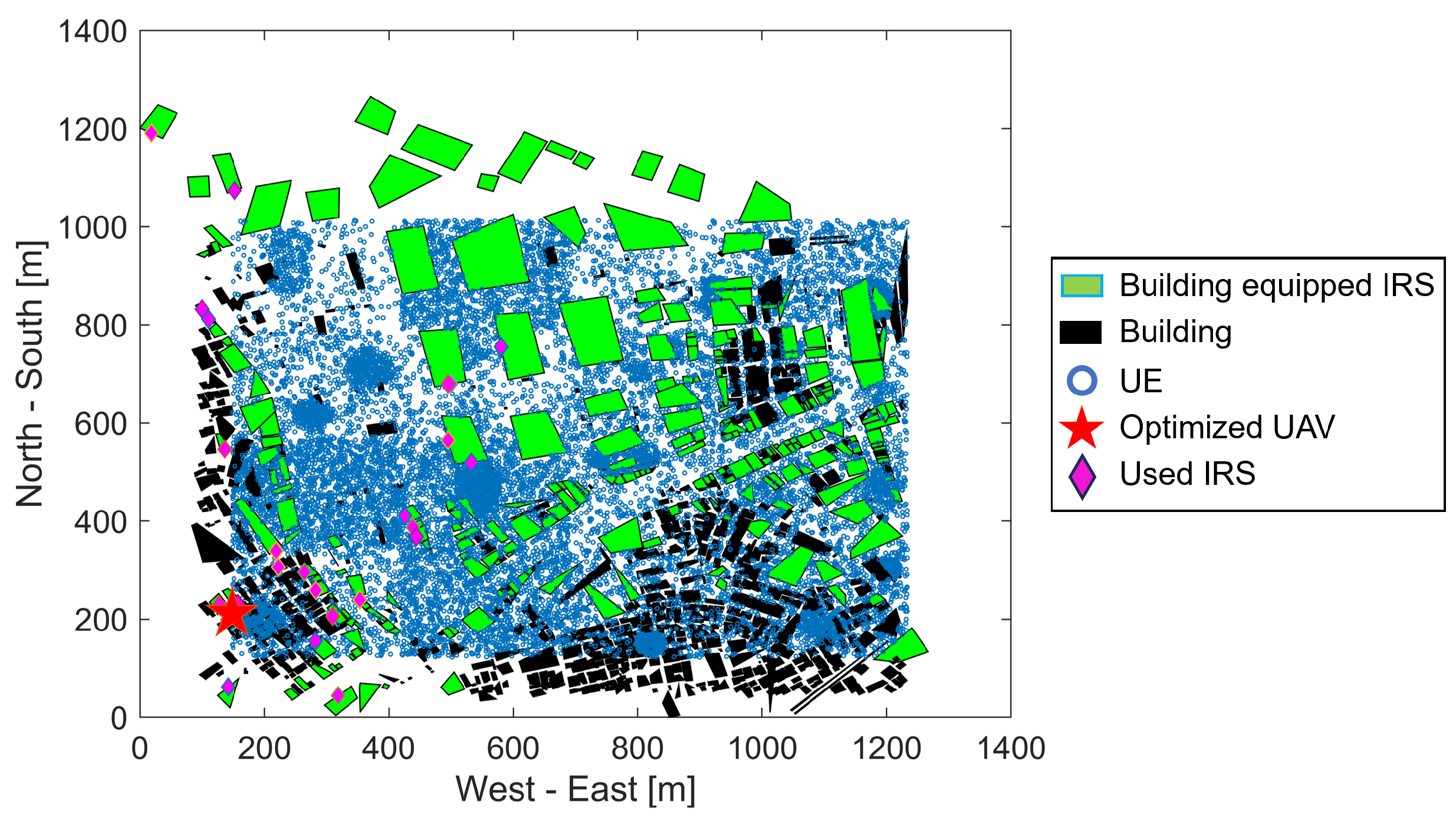
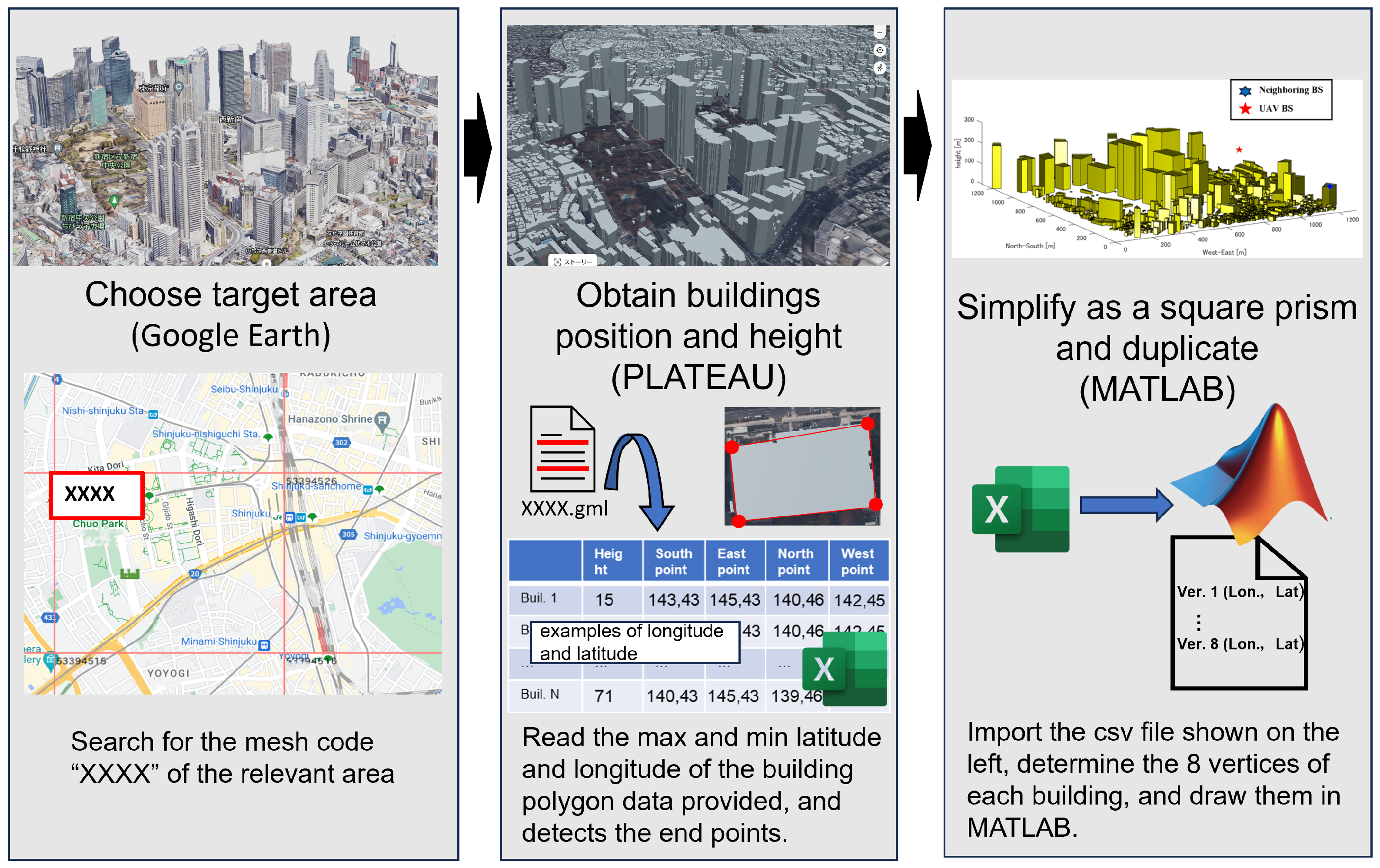
Figure 6 shows a two-dimensional plane illustrating the UAV placement and the IRSs used for path improvement for certain UE distributions. The horizontal axis represents the east–west distance in meters, while the vertical axis similarly indicates the north–south distance. Filled rectangles represent buildings, with those taller than κ and with an IRS-installed color-coded green, while all others were colored black. UEs depicted as blue circles are positioned so as not to overlap with buildings, and the red star indicates the optimal horizontal position of the UAV that maximizes the minimum reception SNR among all these UEs. IRSs that were used at least once to improve reception SNR are indicated with pink diamonds.
Figure 6. Position of UEs, buildings, IRSs, and UAV.
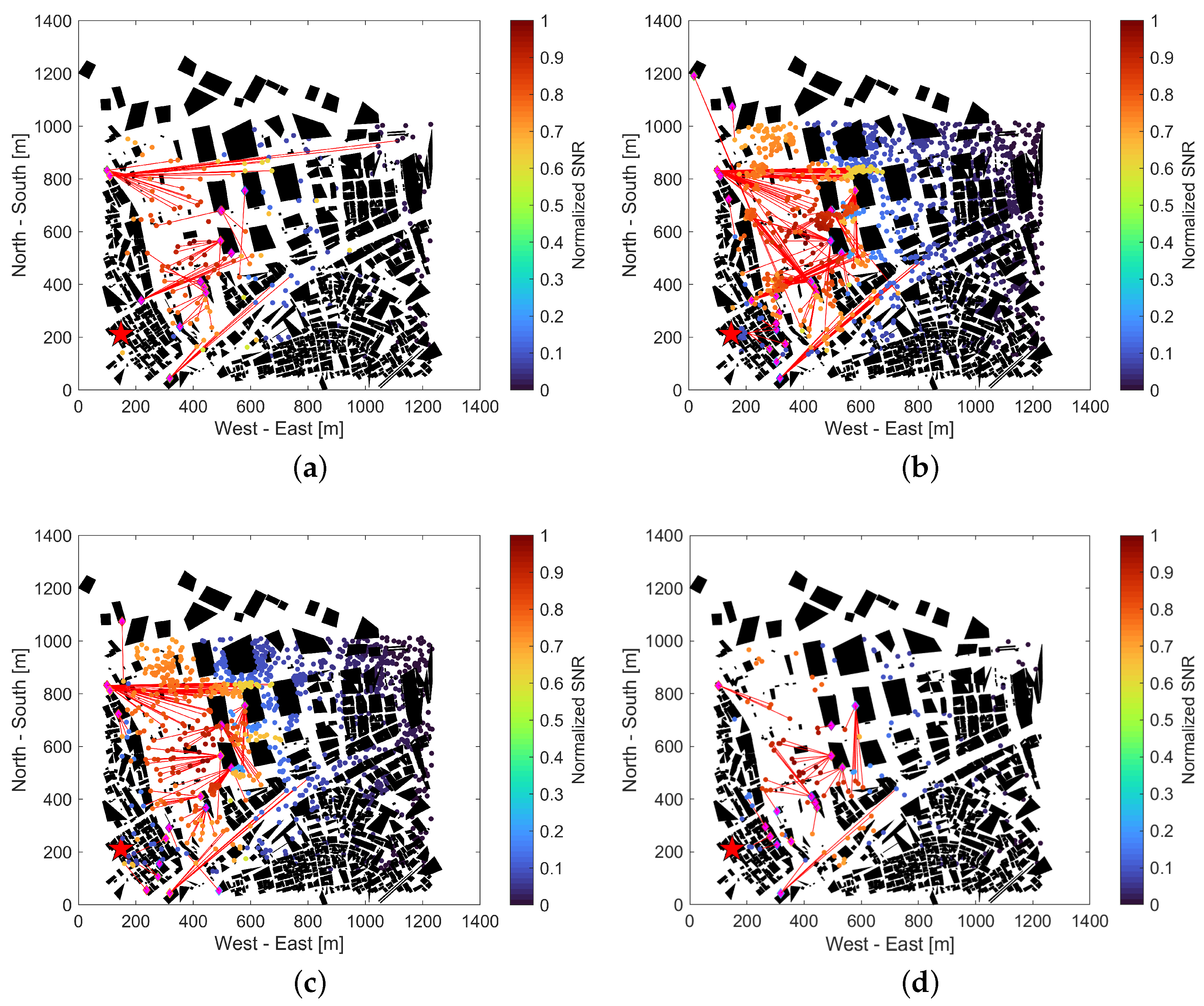
Figure 7 shows the pairs of IRSs and UEs used for route improvement connected by red lines for the distribution of UEs at 6:00, 12:00, 18:00, and 0:00 on a weekday in July 2024. The shown number of UEs is reduced to 1% of the true number of UEs in this figure just for the sake of visibility. Because the target area is a business area where the Tokyo Metropolitan Government and many companies set up their offices, the result indicates that the population is small in the early morning and late at night and increases during the daytime. It can also be confirmed that the number of IRSs utilized increases or decreases according to the population and distribution.
Figure 7. UE distribution and pairing with IRS on July 2024 weekday. (a) 6:00; (b) 12:00; (c) 18:00; (d) 0:00.
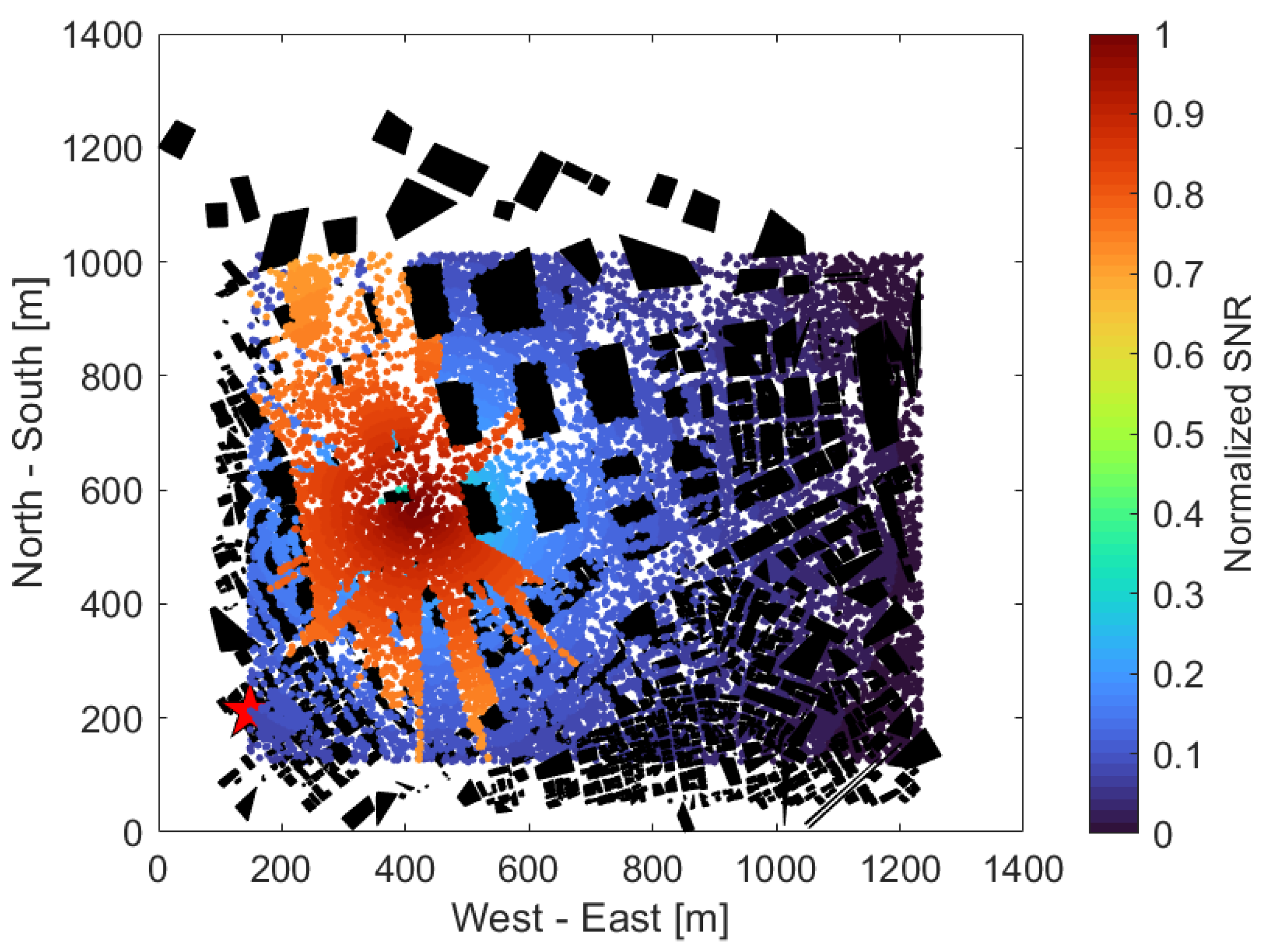
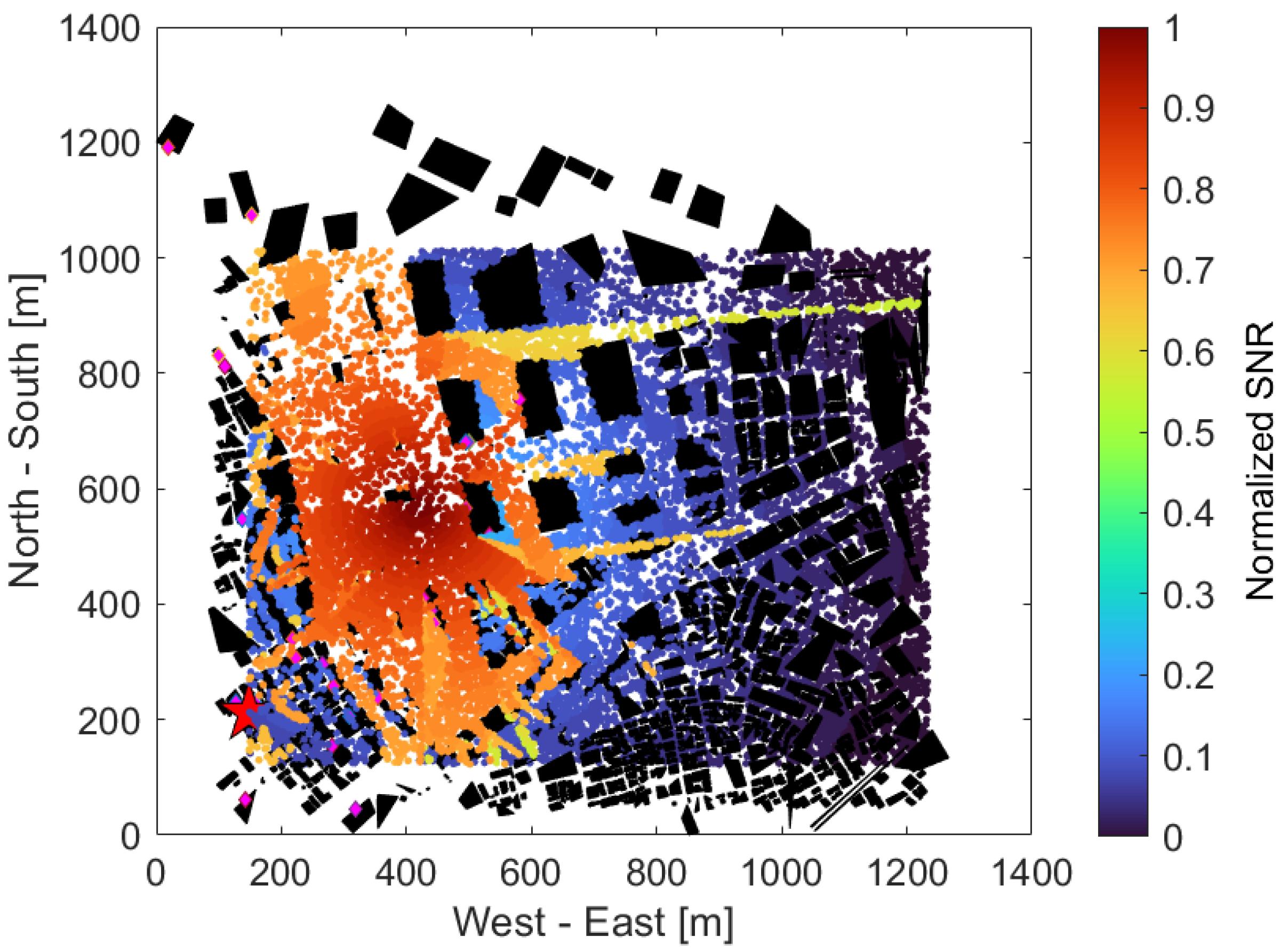
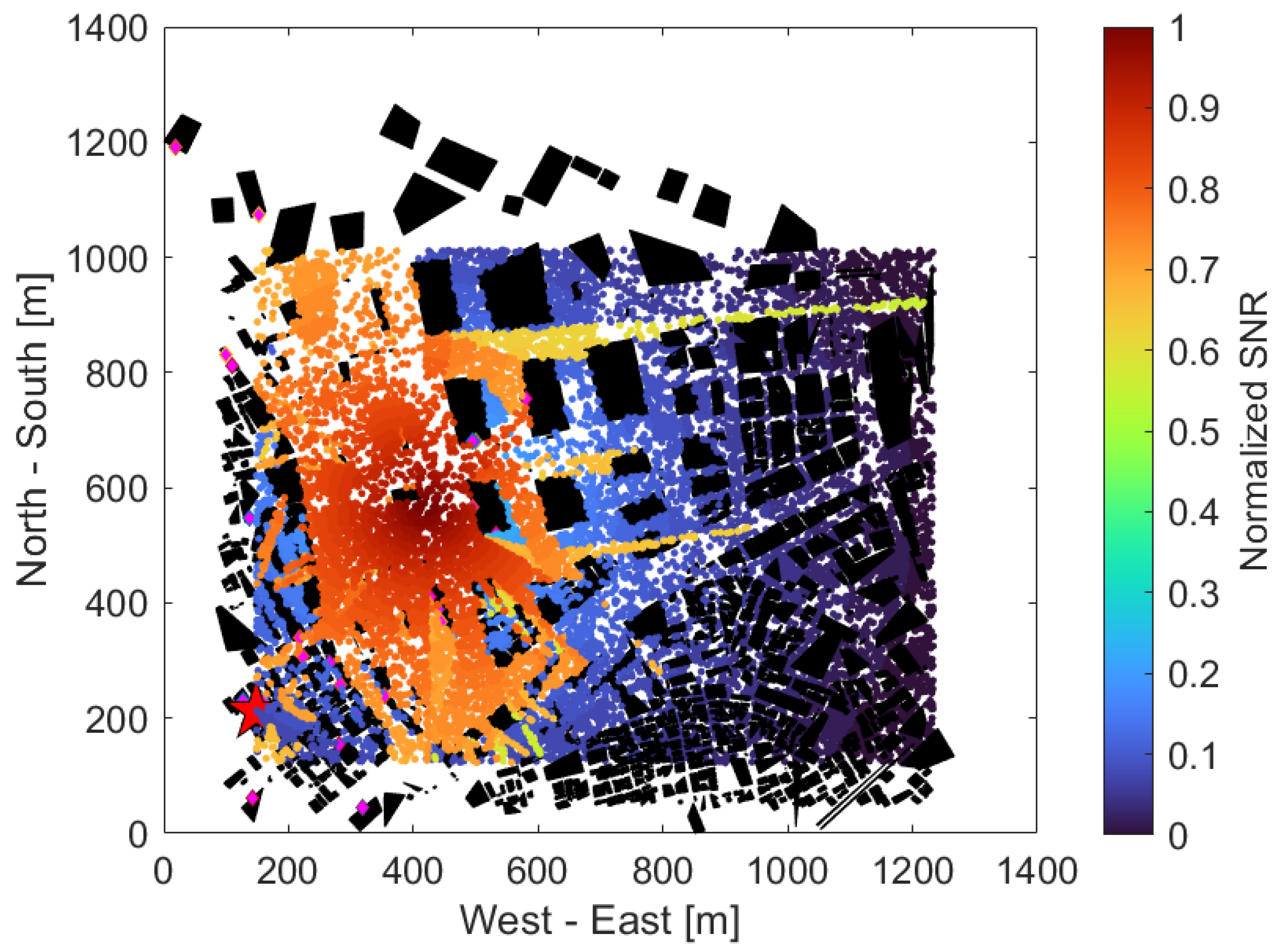
Figure 8 shows the received SNR of each UE without the use of an IRS, with the same UE distribution as in Figure 6. The horizontal and vertical axes are the same as in Figure 6. The color map on the right represents the normalized SNR, which has been normalized to a maximum value of 1 and a minimum value of 0 throughout all scenarios, regardless of the use of an IRS or adjacent BSs, with higher SNRs in red and lower SNRs in blue. From Figure 8, we can see that the SNR tended to be very high in the western part of the area near the UAV, that is, the part surrounded by (300, 300), (600, 400), (400, 1000), (200, 1000), and low in almost all other areas. The reason for this is a large park and a few tall buildings in the western part of the area, thus making it easier to create the LoS from the UAVs. On the other hand, the central area, for x axis values at approximately 600 to 800 and for y axis values at 500 to 1000, was lined with high-rise buildings, and the southeast and southwest areas surrounded by three points (600, 100), (1200, 600), (1200, 100) or (100, 100), (400, 100) (100, 800) were densely populated with small buildings, which may have prevented a clear LoS from the UAV and caused significant radio wave attenuation due to obstacles.
Figure 8. UE received SNR when not using IRS.
Figure 9 shows the received SNR of each UE when using the IRS, with the same UE distribution as in Figure 6. Compared to Figure 8, the area with a higher SNR is spread over the southern and eastern parts of the park. The UEs located near the area’s northeastern edge (1200, 900) also provided a high SNR. This is thought to be because multiple IRSs around (300, 200), (400, 400), (500, 600), (100, 800) and so on were used to reflect the radio waves according to Figure 6 and establish a virtual LoS in the area that was shielded in Figure 8.
Figure 9. UE received SNR when using IRS.
Figure 10 shows the received SNR of each UE in the situation shown in Figure 9, when it further utilized its neighboring BSs. Even if an UE could not establish an LoS with any IRS, it can establish a communication path by establishing an LoS with its neighboring BSs. As a result, it can be confirmed that the SNR was slightly improved around (x, y) = (200, 600) in the southwest part of the area compared to Figure 9.
Figure 10. UE received SNR when using IRS & neighboring BS.
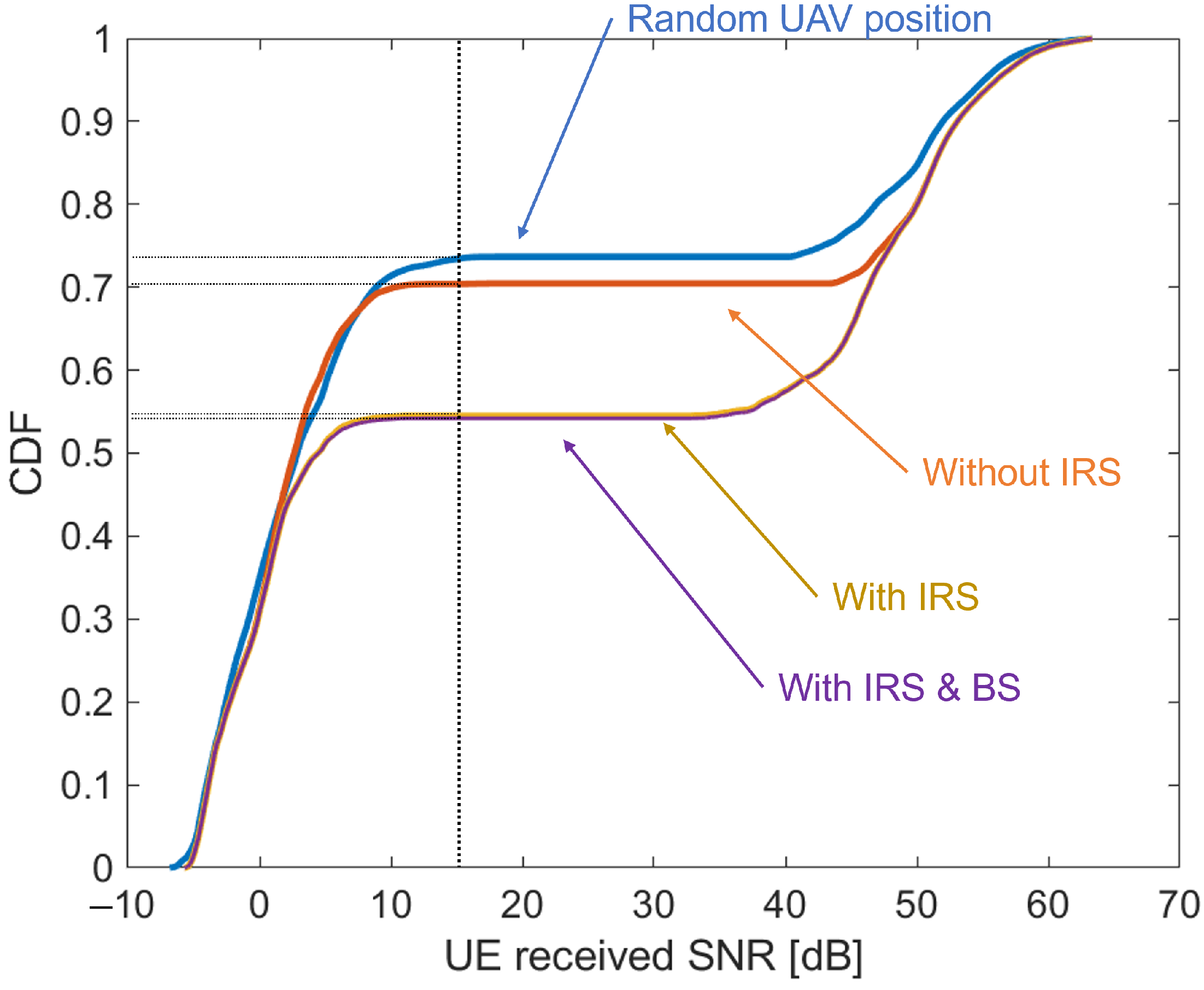
Figure 11 shows the cumulative density function (CDF) of the change in UE received SNR as visually confirmed in Figure 8, Figure 9 and Figure 10. The UE distribution was varied 10 times, and the results were tabulated. The horizontal axis represents the magnitude of the UE received SNR, and the vertical axis represents the CDF. The blue line indicates the case where the UAV position was randomly selected, the orange line indicates the case where the UAV position was optimized but an IRS was not used, the yellow line indicates the case where the UAV position was optimized and an IRS was used, and the purple line indicates the case where the UAV position was optimized and both an IRS and nearby BS were used. From Figure 11, the graphs changed significantly around SNR = 15 dB, which is considered to be the borderline between the NLoS and LoS in this simulation. Compared to the case where the access UAVs were placed randomly (blue line), the percentage of UEs that were NLoS decreased from 73.41% to 70.40% when deployed at the optimal location (orange line). In other words, 3% of the UEs were changed to the LoS, and the communication quality was improved. In addition, 16% of the UEs improved their communication quality by reflecting the radio waves through the IRS. Finally, for UEs that could not create a virtual LoS even with the IRS, we confirmed that providing radio waves from adjacent BSs improved the communication quality for 0.3% of the UEs. Although this value may seem small at first glance, it is expected to have a large impact depending on the simulation environment, since the adjacent BS was set to a specific location.
Figure 11. CDF of UE received SNR.
Figure 12 shows how many IRSs were used and how many UEs were improved for coverage extension at different times of 6:00, 12:00, 18:00, and 0:00. The bar chart shows how many IRSs were used at each time, thereby referring to the value on the left vertical axis. The line graph shows the percentage of UEs whose SNR was improved by the IRS relative to the total UEs in the area, and this refers to the value on the right vertical axis. To reduce computation time, the total population at each time was multiplied by a uniform constant. The results were averaged over seven simulations. The percentage of UEs with improved characteristics exceeded 33%, although the number of IRSs utilized in the late night and early morning hours when manpower is scarce was small. On the other hand, during the daytime and evening, when there is a large flow of people, a large number of IRSs were utilized in response to the increase in population, but the percentage of UEs with improved characteristics was 25~28%. It can be seen that there is a limit to the number of UEs whose characteristics can be improved from the limit of the number of IRSs installed in the area.
Figure 12. Time vs. Number of IRS used/SNR-improved UE ratio.

6. Conclusions and Future Work

This paper explored the potential for extending the coverage area of millimeter wave UAV-BS wireless networks by incorporating IRSs. We initially set forth distinct criteria for selecting the appropriate IRS and UE associations in an environment abundant with IRS installations. Subsequently, we proposed an algorithm to optimize the communication path between UAVs and UEs. Utilizing real-world field data as a basis, we modeled a three-dimensional environment in MATLAB and conducted numerical analysis to evaluate the effectiveness of our proposed algorithm. The results affirm that our algorithm, when used to integrate IRSs into UAV networks, enhances the received SNR for multiple UEs, thereby contributing to an expansion in a coverage area. Although the SNR at the physical layer was used as an evaluation index in this paper, throughput and other parameters at the upper layers can be calculated by introducing the network simulator ns3 [45]. Also, it will be possible to realize more complex and advanced simulations by setting up multiple access UAVs and designing multiplexing schemes, resource control, and cell partitioning among them.
As for future research, we aim to assess the quantitative effectiveness of our proposed algorithm in varied environments, including suburban and rural areas. Since this paper focused only on an ideal IRS functionality of being able to reflect radio waves in any direction, more practical IRS settings remain as our future works. It is also necessary to consider simulation with random nonfunctioning IRSs to imitate such scenarios when disaster occurs. Furthermore, incorporating different optimization methods for UAV positioning is expected to reduce computation time and help to determine the optimal location of the UAV more exactly.

Author Contributions

Conceptualization, G.K.T.; Formal analysis, S.Y., J.N. and G.K.T.; Funding acquisition, G.K.T.; Investigation, S.Y.; Methodology, S.Y. and J.N.; Project administration, G.K.T.; Resources, G.K.T.; Software, S.Y.; Supervision, G.K.T.; Validation, S.Y.; Writing—original draft, S.Y.; Writing—review and editing, J.N. and G.K.T. All authors have read and agreed to the published version of the manuscript.

Funding

This research was supported by the Strategic Information and Communications R&D Promotion Programme (SCOPE) through the Ministry of Internal Affairs and Communications of Japan (receipt number JP235003015). The authors are sincerely grateful to DOCOMO InsightMarketing, INC. for their technical support on this work.

Institutional Review Board Statement

Not applicable.

Data Availability Statement

Data are contained within the article.

Conflicts of Interest

The authors declare no conflicts of interest. The founders had no role in the design of the study; in the collection, analysis, or interpretation of data; in the writing of the manuscript, or in the decision to publish the results.

Abbreviations

The following abbreviations are used in this manuscript:
AIArtificial Intelligence
UAVUnmanned Aerial Vehicle
NTNNonterrestrial Network
mmWaveMillimeter Wave
IRSIntelligent Reflective Surface
LoSLine-of-Sight
UEUser Equipment
IoTInternet of Things
BSBase Station
AFAmplified-and-Forward
DFDecode-and-Forward
SNRSignal to Noise Ratio
NLoSNon-Line-of-Sight
BFBeamforming
TDMATime Division Multiaccess
EIRPEquivalent Isotropic Radiation Power

References

  1. Jagatheesaperumal, S.K.; Rahouti, M. Building Digital Twins of Cyber Physical Systems with Metaverse for Industry 5.0 and Beyond. IT Prof. 2022, 24, 34–40. [Google Scholar] [CrossRef]
  2. Inokuchi, K.; Nakazato, J.; Tsukada, M.; Esaki, H. Semantic digital twin for interoperability and Comprehensive Management of Data Assets. In Proceedings of the 2023 IEEE International Conference on Metaverse Computing, Networking and Applications (MetaCom), Kyoto, Japan, 26–28 June 2023; pp. 217–225. [Google Scholar] [CrossRef]
  3. DJI Comparison of Consumer Drones. Available online: https://www.dji.com/jp/products/comparison-consumer-drones (accessed on 20 March 2024).
  4. Utsav, A.; Abhishek, A.; Suraj, P.; Badhai, R.K. An IoT Based UAV Network For Military Applications. In Proceedings of the 2021 Sixth International Conference on Wireless Communications, Signal Processing and Networking (WiSPNET), Chennai, India, 25–27 March 2021; pp. 122–125. [Google Scholar] [CrossRef]
  5. Cheng, N.; Wu, S.; Wang, X.; Yin, Z.; Li, C.; Chen, W.; Chen, F. AI for UAV-Assisted IoT Applications: A Comprehensive Review. IEEE Internet Things J. 2023, 10, 14438–14461. [Google Scholar] [CrossRef]
  6. Rejeb, A.; Abdollahi, A.; Rejeb, K.; Treiblmaier, H. Drones in agriculture: A review and bibliometric analysis. Comput. Electron. Agric. 2022, 198, 107017. [Google Scholar] [CrossRef]
  7. Paikrao, P.; Routray, S.; Mukherjee, A.; Khan, A.R.; Vohnout, R. Consumer Personalized Gesture Recognition in UAV Based Industry 5.0 Applications. IEEE Trans. Consum. Electron. 2023, 69, 842–849. [Google Scholar] [CrossRef]
  8. Azari, M.M.; Solanki, S.; Chatzinotas, S.; Kodheli, O.; Sallouha, H.; Colpaert, A.; Mendoza Montoya, J.F.; Pollin, S.; Haqiqatnejad, A.; Mostaani, A.; et al. Evolution of Non-Terrestrial Networks From 5G to 6G: A Survey. IEEE Commun. Surv. Tutor. 2022, 24, 2633–2672. [Google Scholar] [CrossRef]
  9. Tran, G.K.; Ozasa, M.; Nakazato, J. NFV/SDN as an Enabler for Dynamic Placement Method of mmWave Embedded UAV Access Base Stations. Network 2022, 2, 479–499. [Google Scholar] [CrossRef]
  10. Turgut, E.; Gursoy, M.C. Downlink Analysis in Unmanned Aerial Vehicle (UAV) Assisted Cellular Networks with Clustered Users. IEEE Access 2018, 6, 36313–36324. [Google Scholar] [CrossRef]
  11. ur Rahman, S.; Kim, G.H.; Cho, Y.Z.; Khan, A. Positioning of UAVs for throughput maximization in software-defined disaster area UAV communication networks. J. Commun. Netw. 2018, 20, 452–463. [Google Scholar] [CrossRef]
  12. Shen, L.; Wang, N.; Mu, X. Iterative UAV Trajectory Optimization for Physical Layer Secure Mobile Relaying. In Proceedings of the 2018 International Conference on Cyber-Enabled Distributed Computing and Knowledge Discovery (CyberC), Zhengzhou, China, 18–20 October 2018; pp. 19–194. [Google Scholar] [CrossRef]
  13. Vishnoi, V.; Consul, P.; Budhiraja, I.; Gupta, S.; Kumar, N. Deep Reinforcement Learning Based Energy Consumption Minimization for Intelligent Reflecting Surfaces Assisted D2D Users Underlaying UAV Network. In Proceedings of the IEEE INFOCOM 2023—IEEE Conference on Computer Communications Workshops (INFOCOM WKSHPS), Hoboken, NJ, USA, 20–20 May 2023; pp. 1–6. [Google Scholar] [CrossRef]
  14. Tran, G.K.; Okada, T. Design of Antenna Polarization Plane for Concurrent Uplink/Downlink Drone Networks. Electronics 2023, 12, 3045. [Google Scholar] [CrossRef]
  15. DOCOMO 6G White Paper. Available online: https://www.docomo.ne.jp/english/corporate/technology/whitepaper_6g/ (accessed on 20 March 2024).
  16. NTT DOCOMO Technical Journal Vol. 29 No. 2 5G Evolution & Research on Transparent RIS Technology for 6G (July 2021). Available online: https://www.docomo.ne.jp/binary/pdf/corporate/technology/rd/technical_journal/bn/vol29_2/vol29_2_004jp.pdf (accessed on 20 March 2024).
  17. Hashida, H.; Kawamoto, Y.; Kato, N. Intelligent Reflecting Surface Placement Optimization in Air-Ground Communication Networks Toward 6G. IEEE Wirel. Commun. 2020, 27, 146–151. [Google Scholar] [CrossRef]
  18. Amri, M.M. Recent Trends in the Reconfigurable Intelligent Surfaces (RIS): Active RIS to Brain-controlled RIS. In Proceedings of the 2022 IEEE International Conference on Communication, Networks and Satellite (COMNETSAT), Solo, Indonesia, 3–5 November 2022; pp. 299–304. [Google Scholar] [CrossRef]
  19. Liu, Y.; Liu, X.; Mu, X.; Hou, T.; Xu, J.; Di Renzo, M.; Al-Dhahir, N. Reconfigurable Intelligent Surfaces: Principles and Opportunities. IEEE Commun. Surv. Tutorials 2021, 23, 1546–1577. [Google Scholar] [CrossRef]
  20. Alamzadeh, I.; Alexandropoulos, G.C.; Shlezinger, N.; Imani, M.F. A reconfigurable intelligent surface with integrated sensing capability. Sci. Rep. 2021, 11, 1546–1577. [Google Scholar] [CrossRef] [PubMed]
  21. Liu, S.; Liu, R.; Li, M.; Liu, Y.; Liu, Q. Joint BS-RIS-User Association and Beamforming Design for RIS-Assisted Cellular Networks. IEEE Trans. Veh. Technol. 2023, 72, 6113–6128. [Google Scholar] [CrossRef]
  22. TMYTEK Redistribution of Radio Waves by XRifle RIS. Available online: https://www.tmytek.com/jp/solutions/mmW-Coverage (accessed on 20 March 2024).
  23. Rahmatov, N.; Baek, H. RIS-carried UAV communication: Current research, challenges, and future trends. ICT Express 2023, 9, 961–973. [Google Scholar] [CrossRef]
  24. Park, H.; Nguyen, T.H.; Park, L. Federated Deep Learning for RIS-assisted UAV-enabled Wireless Communications. In Proceedings of the 2022 13th International Conference on Information and Communication Technology Convergence (ICTC), Jeju Island, Republic of Korea, 19–21 October 2022; pp. 831–833. [Google Scholar] [CrossRef]
  25. Guo, K.; Wu, M.; Li, X.; Song, H.; Kumar, N. Deep Reinforcement Learning and NOMA-Based Multi-Objective RIS-Assisted IS-UAV-TNs: Trajectory Optimization and Beamforming Design. IEEE Trans. Intell. Transp. Syst. 2023, 24, 10197–10210. [Google Scholar] [CrossRef]
  26. Wang, W.; Ni, W.; Tian, H.; Eldar, Y.C.; Niyato, D. UAV-Mounted Multi-Functional RIS for Combating Eavesdropping in Wireless Networks. IEEE Wirel. Commun. Lett. 2023, 12, 1667–1671. [Google Scholar] [CrossRef]
  27. Liu, X.; Yu, Y.; Li, F.; Durrani, T.S. Throughput Maximization for RIS-UAV Relaying Communications. IEEE Trans. Intell. Transp. Syst. 2022, 23, 19569–19574. [Google Scholar] [CrossRef]
  28. Bansal, A.; Agrawal, N.; Singh, K.; Li, C.P.; Mumtaz, S. RIS Selection Scheme for UAV-Based Multi-RIS-Aided Multiuser Downlink Network with Imperfect and Outdated CSI. IEEE Trans. Commun. 2023, 71, 4650–4664. [Google Scholar] [CrossRef]
  29. Abualhayja’a, M.; Centeno, A.; Mohjazi, L.; Butt, M.M.; Sehier, P.; Imran, M.A. Exploiting Multi-Hop RIS-Assisted UAV Communications: Performance Analysis. IEEE Commun. Lett. 2024, 28, 133–137. [Google Scholar] [CrossRef]
  30. Yang, L.; Meng, F.; Zhang, J.; Hasna, M.O.; Renzo, M.D. On the Performance of RIS-Assisted Dual-Hop UAV Communication Systems. IEEE Trans. Veh. Technol. 2020, 69, 10385–10390. [Google Scholar] [CrossRef]
  31. Al-Hilo, A.; Samir, M.; Elhattab, M.; Assi, C.; Sharafeddine, S. RIS-Assisted UAV for Timely Data Collection in IoT Networks. IEEE Syst. J. 2023, 17, 431–442. [Google Scholar] [CrossRef]
  32. Nguyen, K.K.; Masaracchia, A.; Sharma, V.; Poor, H.V.; Duong, T.Q. RIS-Assisted UAV Communications for IoT with Wireless Power Transfer Using Deep Reinforcement Learning. IEEE J. Sel. Top. Signal Process. 2022, 16, 1086–1096. [Google Scholar] [CrossRef]
  33. Guo, K.; An, K. On the Performance of RIS-Assisted Integrated Satellite-UAV-Terrestrial Networks with Hardware Impairments and Interference. IEEE Wirel. Commun. Lett. 2022, 11, 131–135. [Google Scholar] [CrossRef]
  34. Feng, W.; Tang, J.; Wu, Q.; Fu, Y.; Zhang, X.; So, D.K.C.; Wong, K.K. Resource Allocation for Power Minimization in RIS-Assisted Multi-UAV Networks with NOMA. IEEE Trans. Commun. 2023, 71, 6662–6676. [Google Scholar] [CrossRef]
  35. Qin, X.; Song, Z.; Hou, T.; Yu, W.; Wang, J.; Sun, X. Joint Optimization of Resource Allocation, Phase Shift, and UAV Trajectory for Energy-Efficient RIS-Assisted UAV-Enabled MEC Systems. IEEE Trans. Green Commun. Netw. 2023, 7, 1778–1792. [Google Scholar] [CrossRef]
  36. Adam, A.B.M.; Wan, X.; Elhassan, M.A.M.; Muthanna, M.S.A.; Muthanna, A.; Kumar, N.; Guizani, M. Intelligent and Robust UAV-Aided Multiuser RIS Communication Technique with Jittering UAV and Imperfect Hardware Constraints. IEEE Trans. Veh. Technol. 2023, 72, 10737–10753. [Google Scholar] [CrossRef]
  37. Mobile Spatial Statistics. Available online: https://mobaku.jp/ (accessed on 20 March 2024).
  38. Al-Hourani, A.; Kandeepan, S.; Jamalipour, A. Modeling air-to-ground path loss for low altitude platforms in urban environments. In Proceedings of the 2014 IEEE Global Communications Conference, Austin, TX, USA, 8–12 December 2014; pp. 2898–2904. [Google Scholar] [CrossRef]
  39. Rappaport, T.S.; Sun, S.; Mayzus, R.; Zhao, H.; Azar, Y.; Wang, K.; Wong, G.N.; Schulz, J.K.; Samimi, M.; Gutierrez, F. Millimeter Wave Mobile Communications for 5G Cellular: It Will Work! IEEE Access 2013, 1, 335–349. [Google Scholar] [CrossRef]
  40. Karasawa, Y. Fundamentals of Wave Propagation for Digital Mobile Communications; Corona Publishing Co., Ltd.: Tokyo, Japan, 2016. [Google Scholar]
  41. PLATEU. Available online: https://www.mlit.go.jp/plateau/ (accessed on 20 March 2024).
  42. Geraci, G.; Garcia-Rodriguez, A.; Azari, M.M.; Lozano, A.; Mezzavilla, M.; Chatzinotas, S.; Chen, Y.; Rangan, S.; Renzo, M.D. What Will the Future of UAV Cellular Communications Be? A Flight from 5G to 6G. IEEE Commun. Surv. Tutorials 2022, 24, 1304–1335. [Google Scholar] [CrossRef]
  43. 3GPP TS 38.101-2 V15.10.0 (2020-06). Available online: https://www.etsi.org/deliver/etsi_tr/138900_138999/138900/14.02.00_60/tr_138900v140200p.pdf (accessed on 20 March 2024).
  44. Ministry of Internal Affairs and Communications, Consideration of Frequency Sharing Related to 5G Introduction in 3.7 GHz Band, 4.5 GHz Band, and 28 GHz Band. Available online: https://www.soumu.go.jp/main_content/000527890.pdf (accessed on 20 March 2024).
  45. Toshihiro, S.; Gia Khanh, T. Study on the construction of mmWave based IAB-UAV networks. In Proceedings of the Asian Internet Engineering Conference (AINTEC), Hiroshima, Japan, 19–21 December 2022. [Google Scholar]
Disclaimer/Publisher’s Note: The statements, opinions and data contained in all publications are solely those of the individual author(s) and contributor(s) and not of MDPI and/or the editor(s). MDPI and/or the editor(s) disclaim responsibility for any injury to people or property resulting from any ideas, methods, instructions or products referred to in the content.

Article Metrics

Citations

Article Access Statistics

Multiple requests from the same IP address are counted as one view.