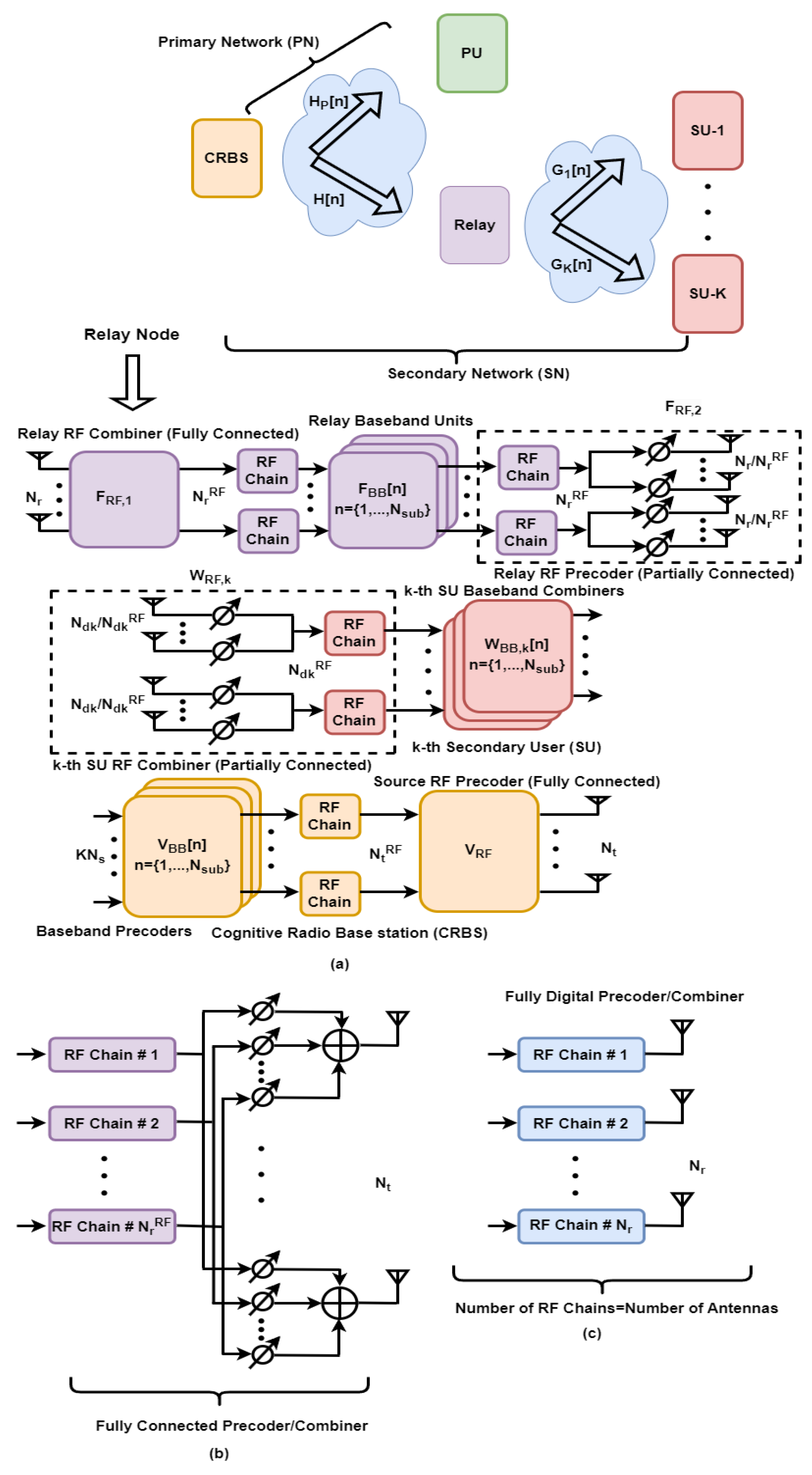
Figure 1.
(a) System block diagram of a mixed-structure cognitive radio hybrid wideband transceiver in mm-wave relay-assisted MU-MIMO networks, (b) Fully Connected Structure, (c) Fully Digital system.
Figure 1.
(a) System block diagram of a mixed-structure cognitive radio hybrid wideband transceiver in mm-wave relay-assisted MU-MIMO networks, (b) Fully Connected Structure, (c) Fully Digital system.
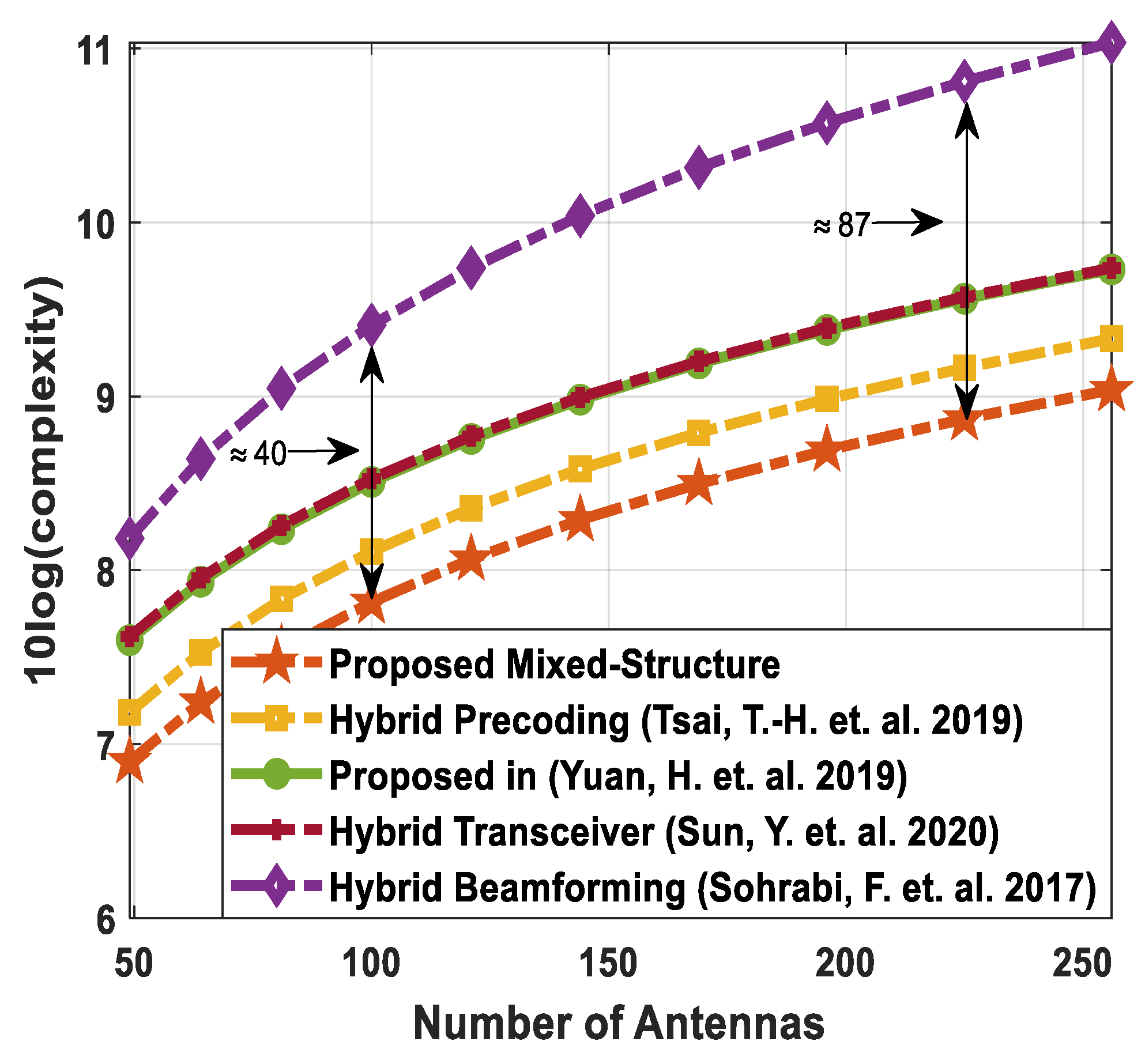
Figure 2.
Complexity vs. number of antennas when
,
,
,
, and
: Comparison of the proposed technique with other exiting hybrid precoding algorithms [
41,
43,
47,
50].
Figure 2.
Complexity vs. number of antennas when
,
,
,
, and
: Comparison of the proposed technique with other exiting hybrid precoding algorithms [
41,
43,
47,
50].
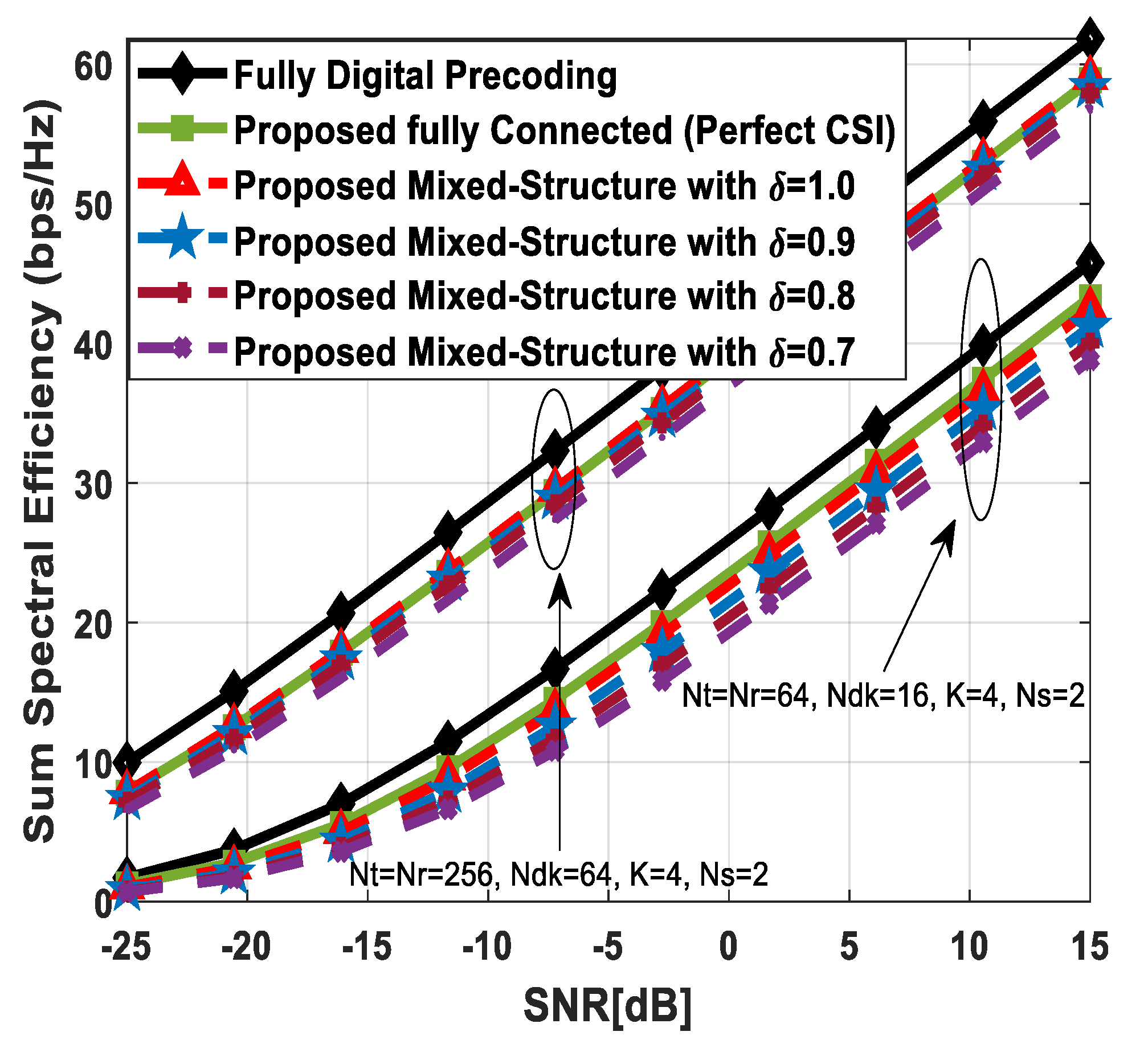
Figure 3.
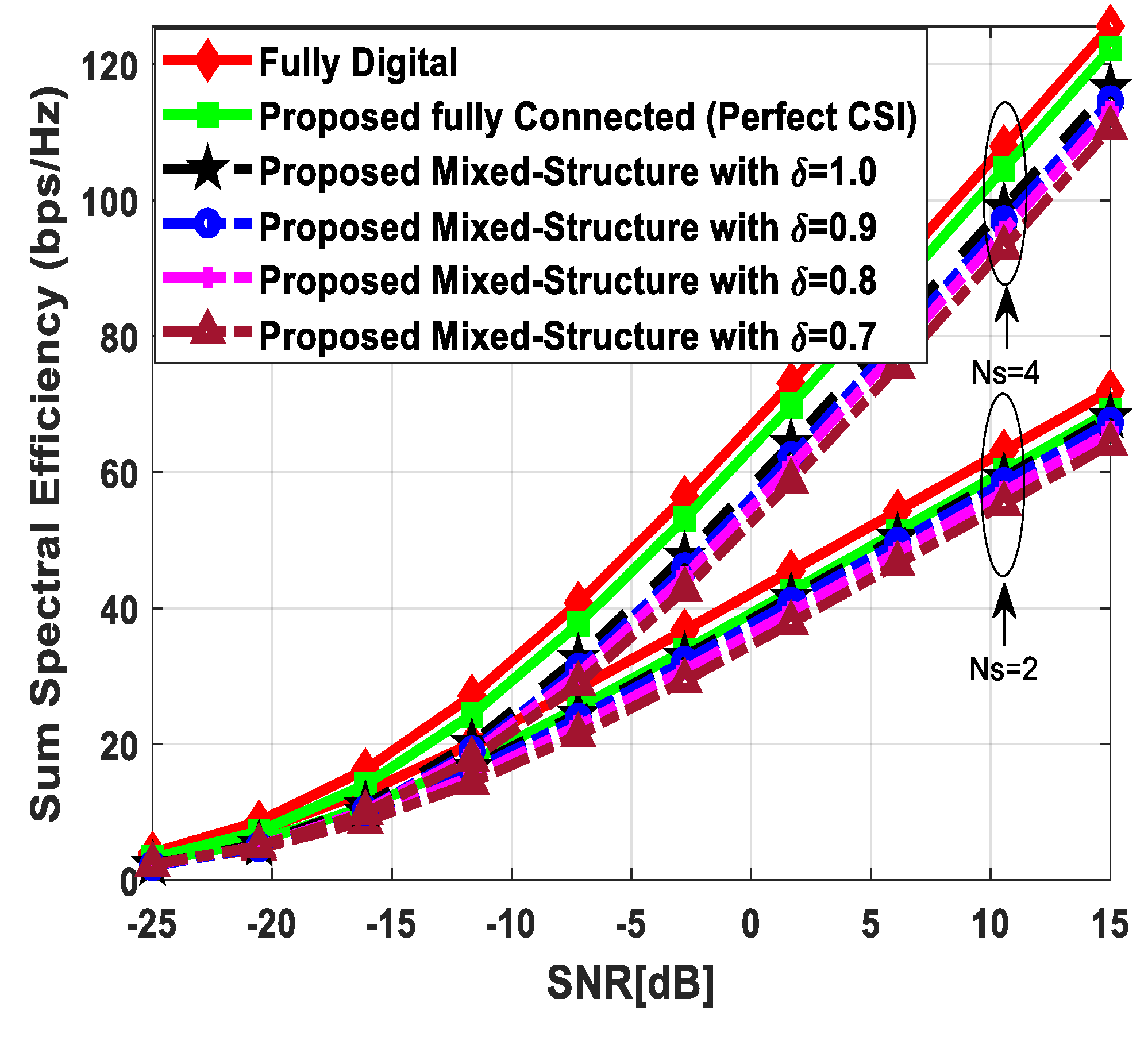
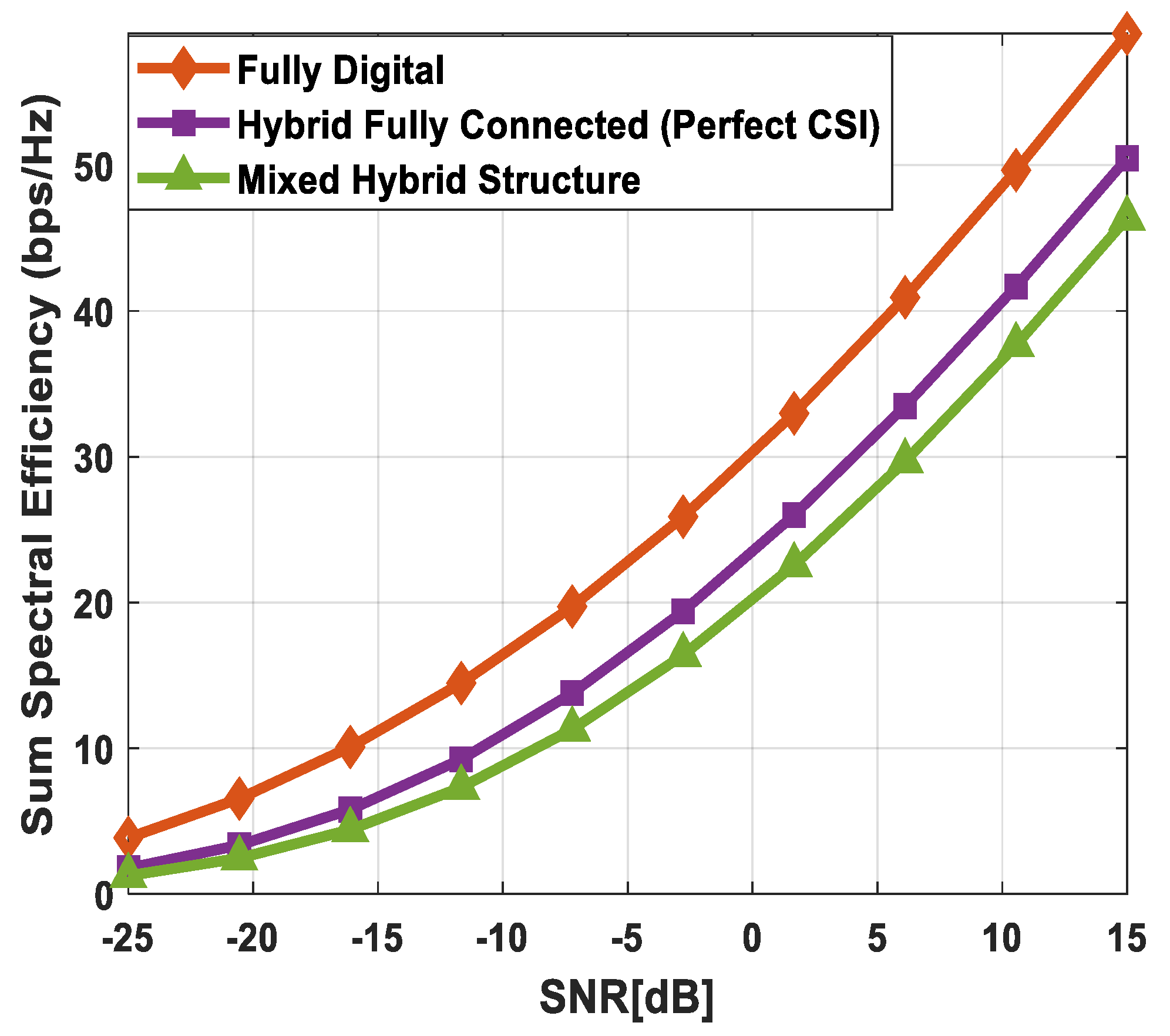
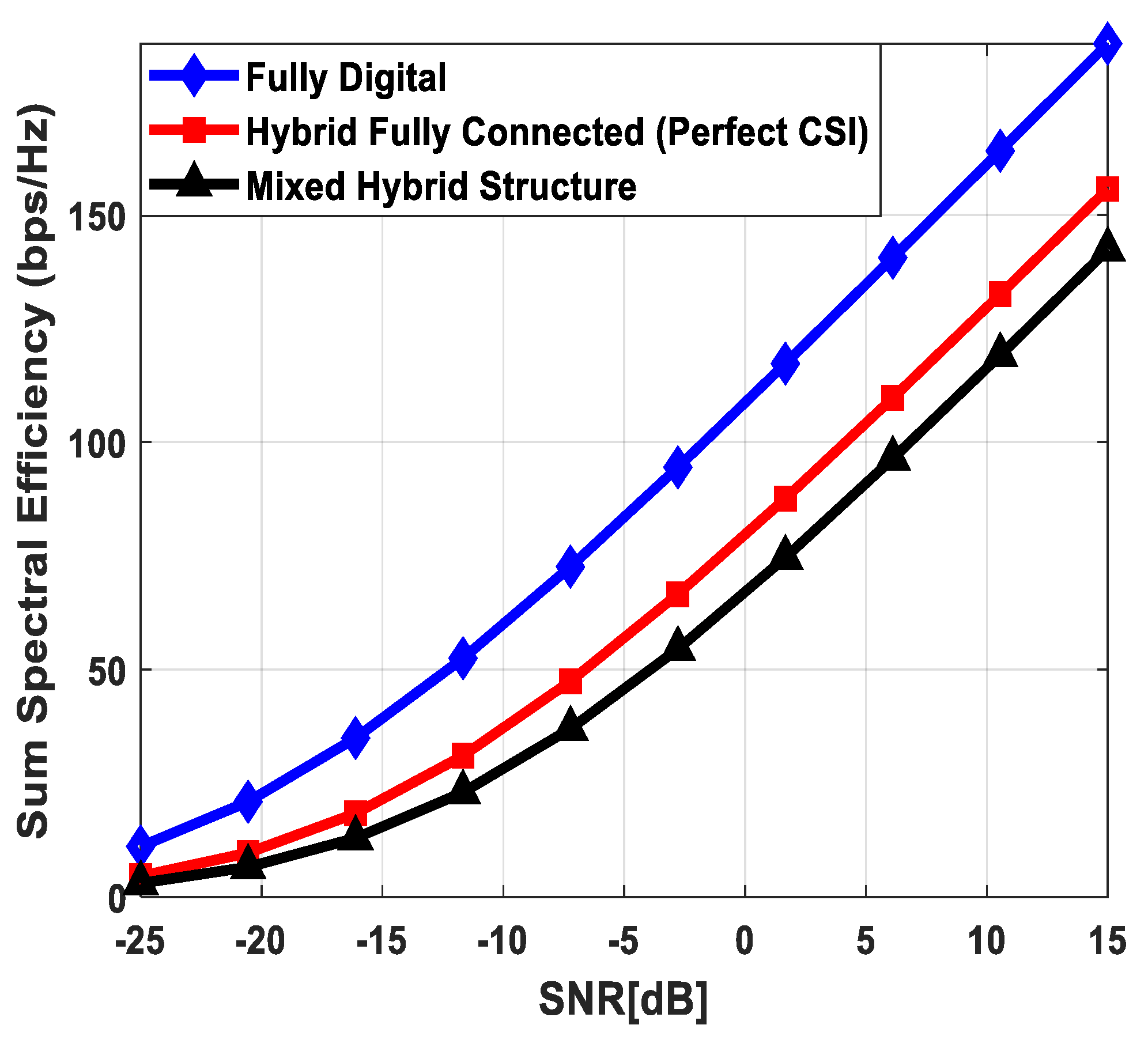
Sum spectral efficiency comparison of fully digital precoding, the proposed fully connected hybrid structure, and mixed hybrid architecture considering channel estimation error. The system parameters are set as , , , , and .
Figure 3.
Sum spectral efficiency comparison of fully digital precoding, the proposed fully connected hybrid structure, and mixed hybrid architecture considering channel estimation error. The system parameters are set as , , , , and .
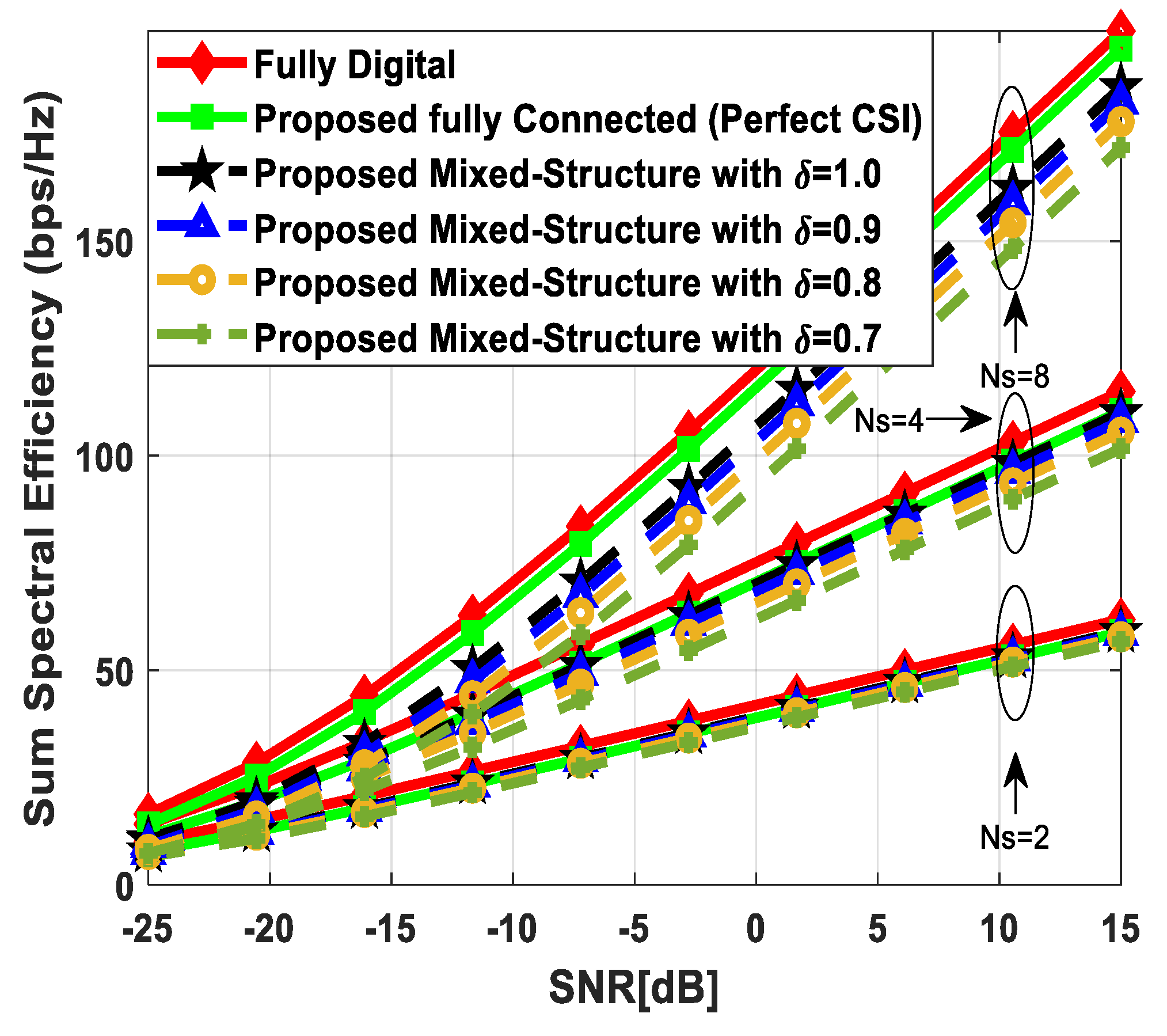
Figure 4.
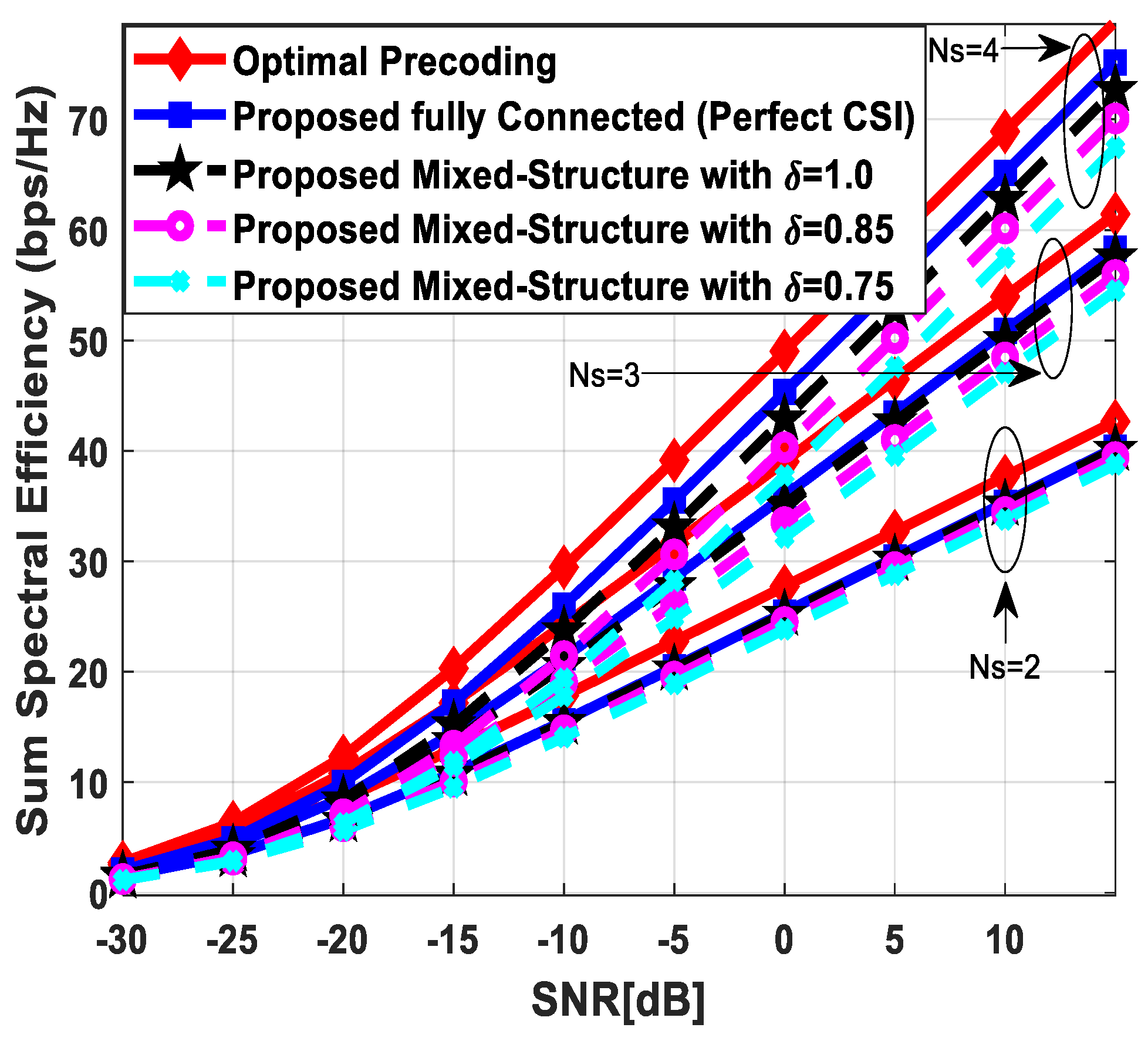
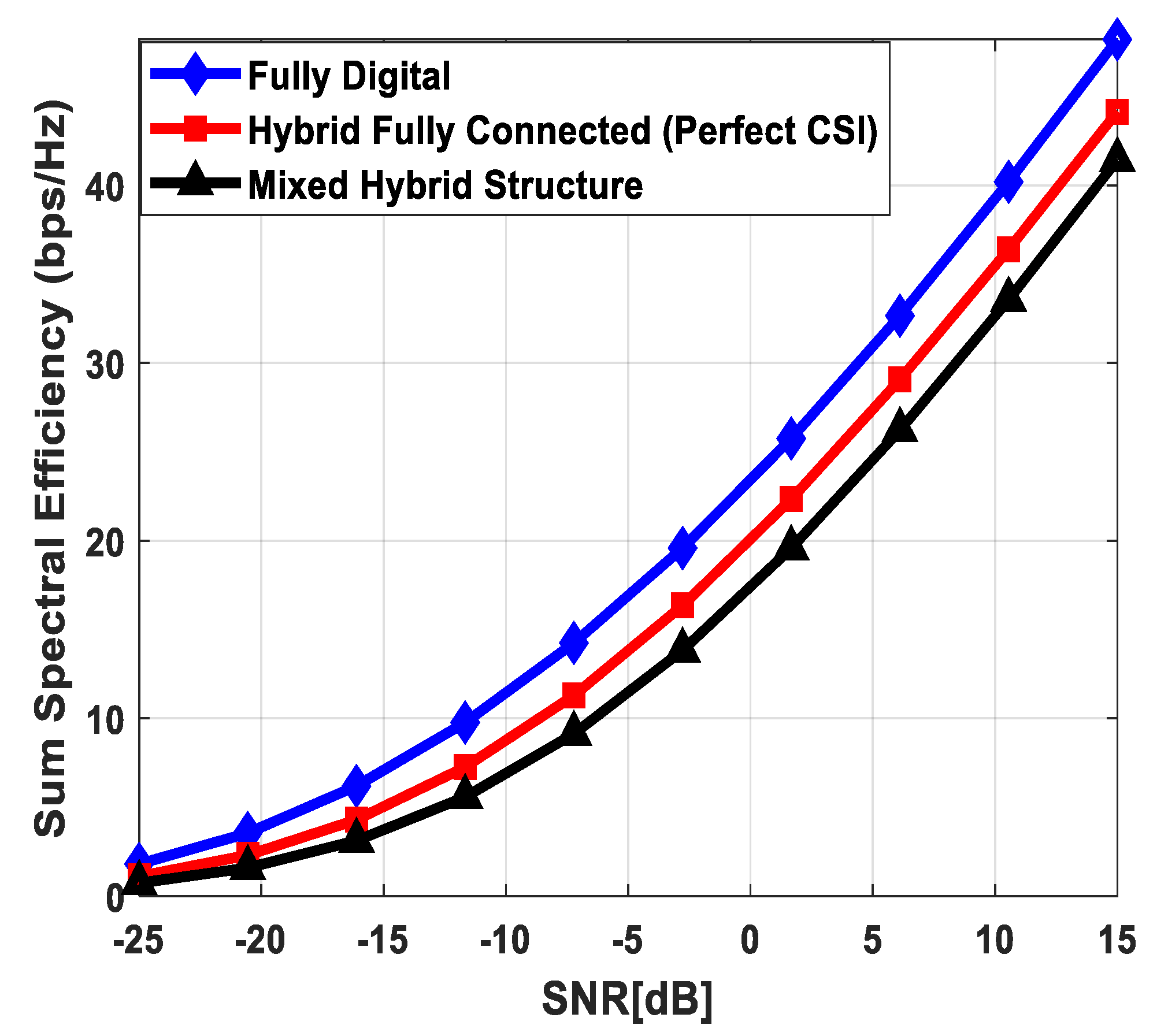
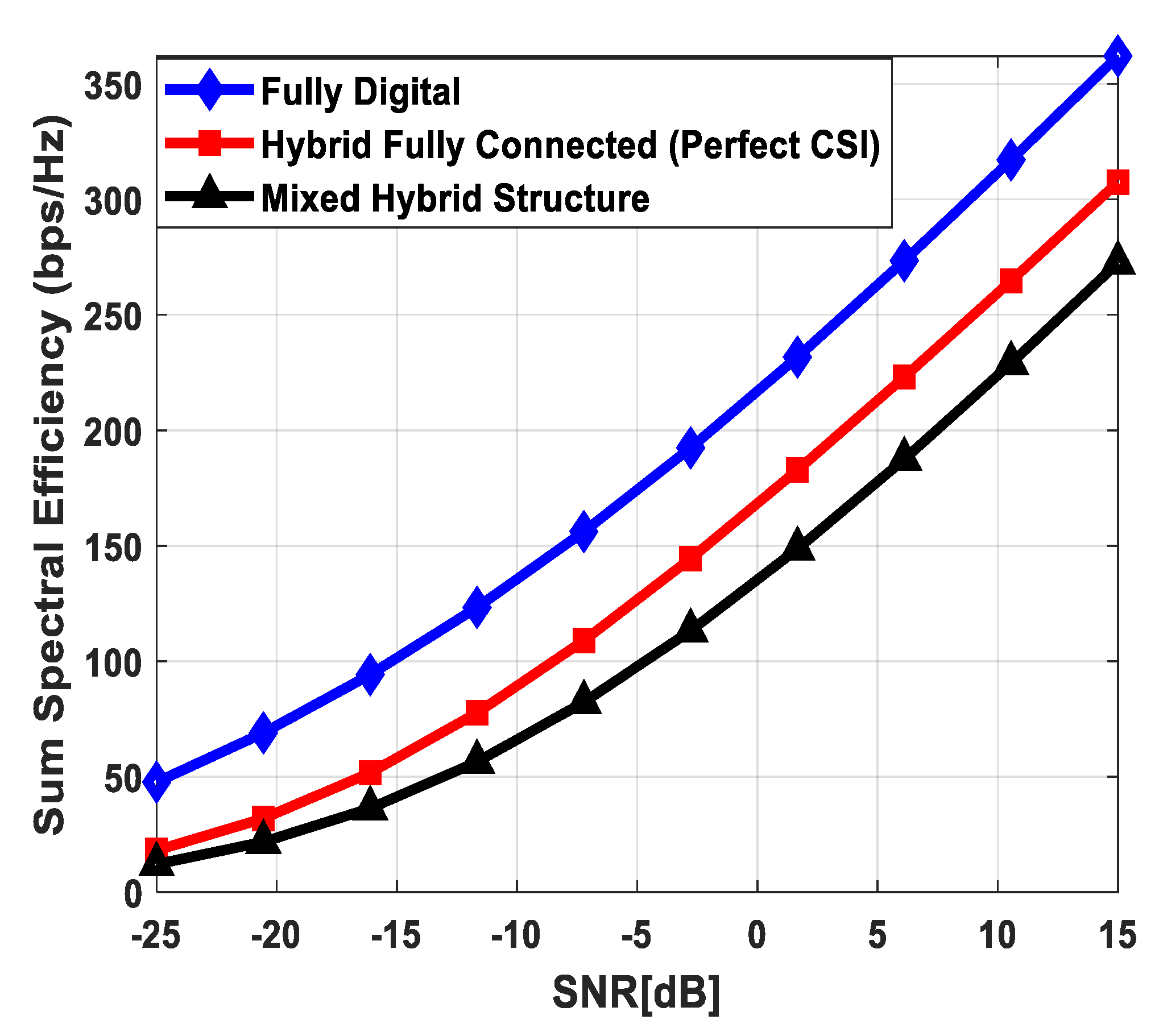
Sum spectral efficiency vs. SNR: Comparison of full-complexity digital precoding, the proposed fully connected hybrid architecture, and the mixed hybrid structure considering an imperfect channel with . The system parameters are set as , , , , and for conducting computer simulations.
Figure 4.
Sum spectral efficiency vs. SNR: Comparison of full-complexity digital precoding, the proposed fully connected hybrid architecture, and the mixed hybrid structure considering an imperfect channel with . The system parameters are set as , , , , and for conducting computer simulations.
Figure 5.
Sum spectral efficiency vs. SNR when , , K = 6, , and . The estimated channel matrix is generated at .
Figure 5.
Sum spectral efficiency vs. SNR when , , K = 6, , and . The estimated channel matrix is generated at .
Figure 6.
Achievable rate vs. SNR, considering URA: , , , , and . The estimated channel matrix is generated at .
Figure 6.
Achievable rate vs. SNR, considering URA: , , , , and . The estimated channel matrix is generated at .
Figure 7.
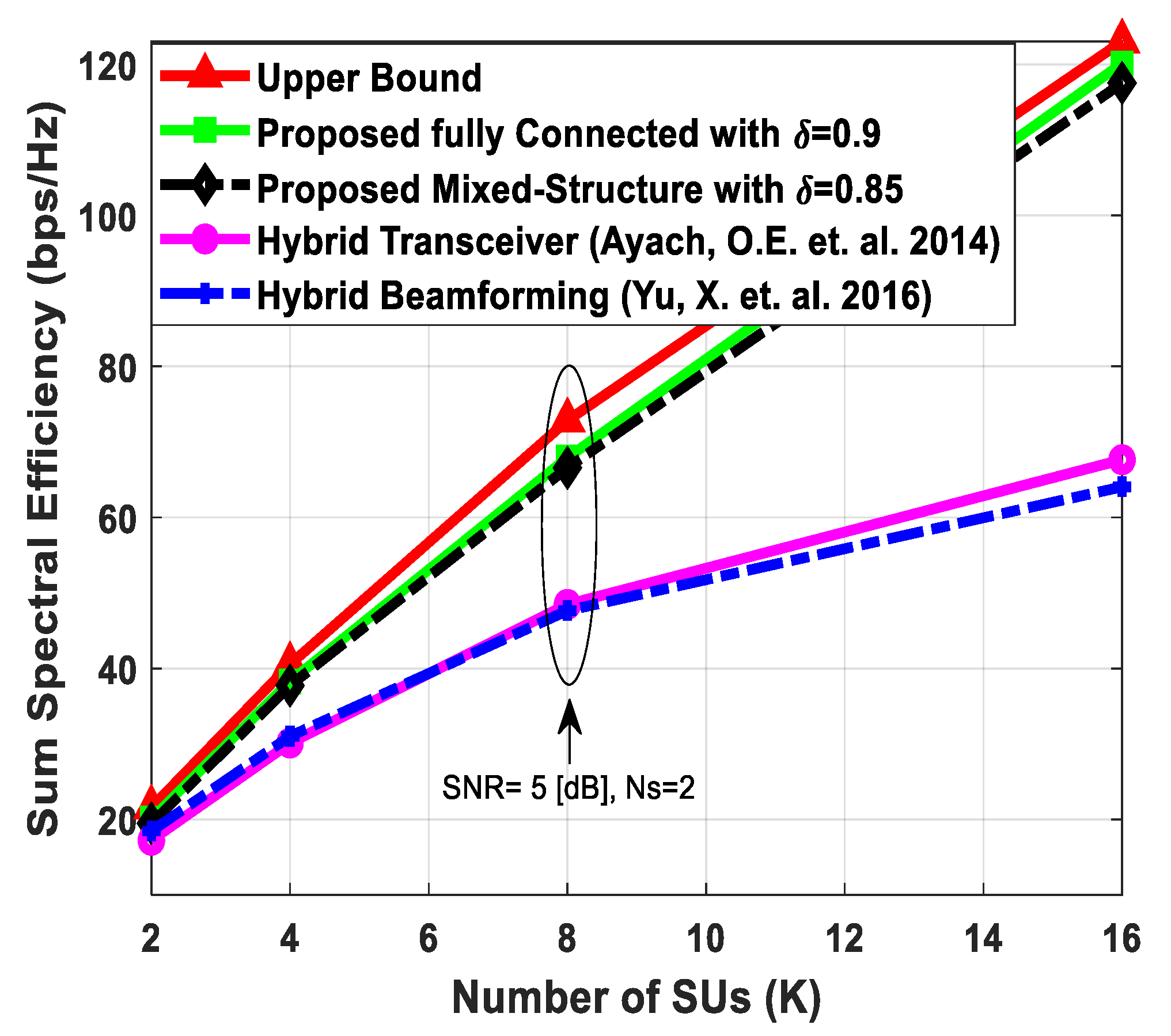
Sum spectral efficiency vs. number of SUs: Comparison of the proposed method with other hybrid precoding techniques. The system parameters are set as
,
,
, and
. Impact on the rate of change of spectral efficiency as a function of the number of Sus [
51,
52].
Figure 7.
Sum spectral efficiency vs. number of SUs: Comparison of the proposed method with other hybrid precoding techniques. The system parameters are set as
,
,
, and
. Impact on the rate of change of spectral efficiency as a function of the number of Sus [
51,
52].
Figure 8.
Sum spectral efficiency vs. SNR when the number of antennas at the source, relay node, and SUs is changed simultaneously, such as , . The constant parameters are set as , , and . Comparison of the proposed algorithm under perfect CSI and imperfect CSI at with full-complexity digital precoding.
Figure 8.
Sum spectral efficiency vs. SNR when the number of antennas at the source, relay node, and SUs is changed simultaneously, such as , . The constant parameters are set as , , and . Comparison of the proposed algorithm under perfect CSI and imperfect CSI at with full-complexity digital precoding.
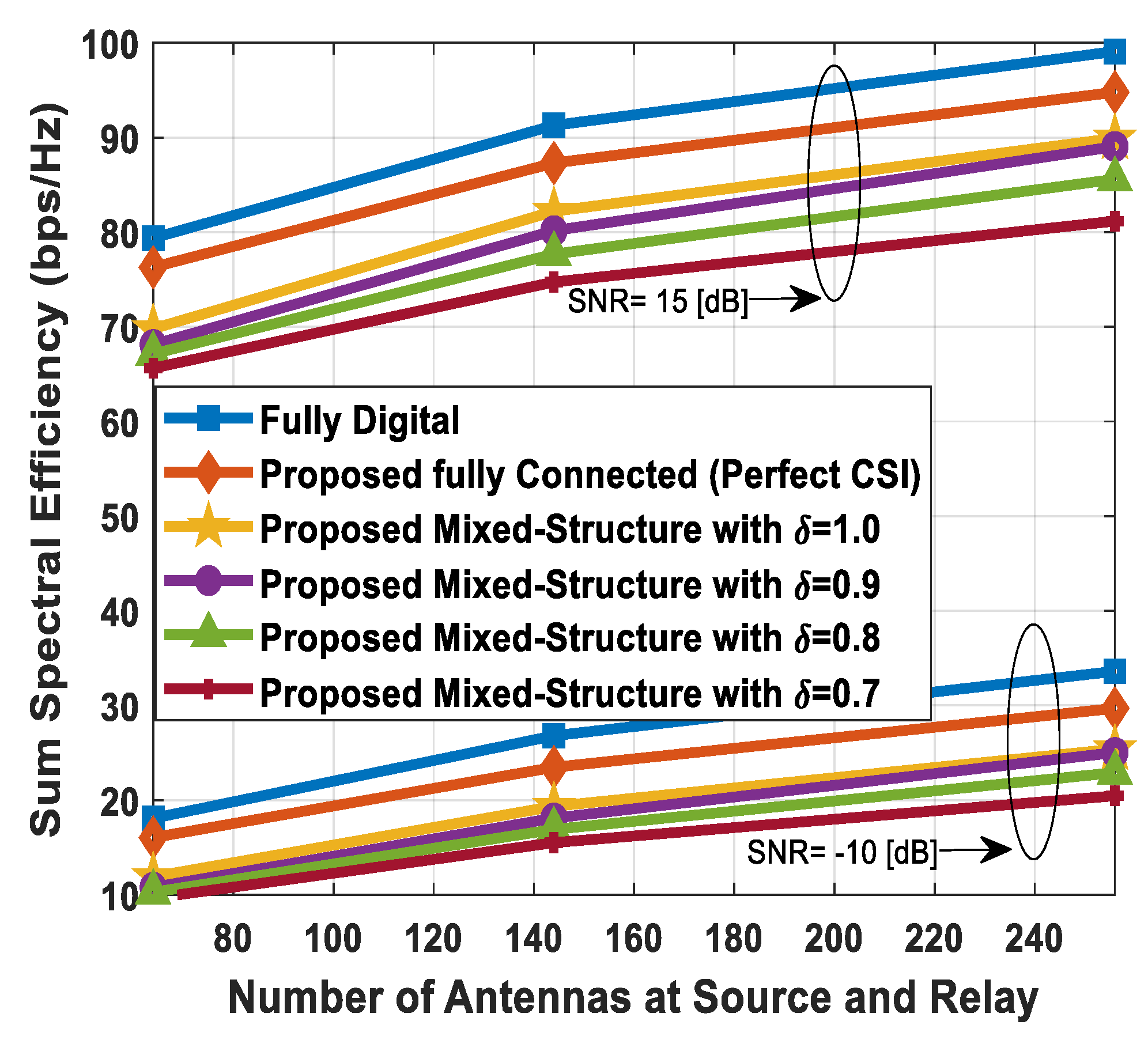
Figure 9.
Sum spectral efficiency vs. number of antennas at the source and relay node when SNR= −10, 15 [dB], , , , , and . Comparison of the proposed technique with fully digital beamforming.
Figure 9.
Sum spectral efficiency vs. number of antennas at the source and relay node when SNR= −10, 15 [dB], , , , , and . Comparison of the proposed technique with fully digital beamforming.
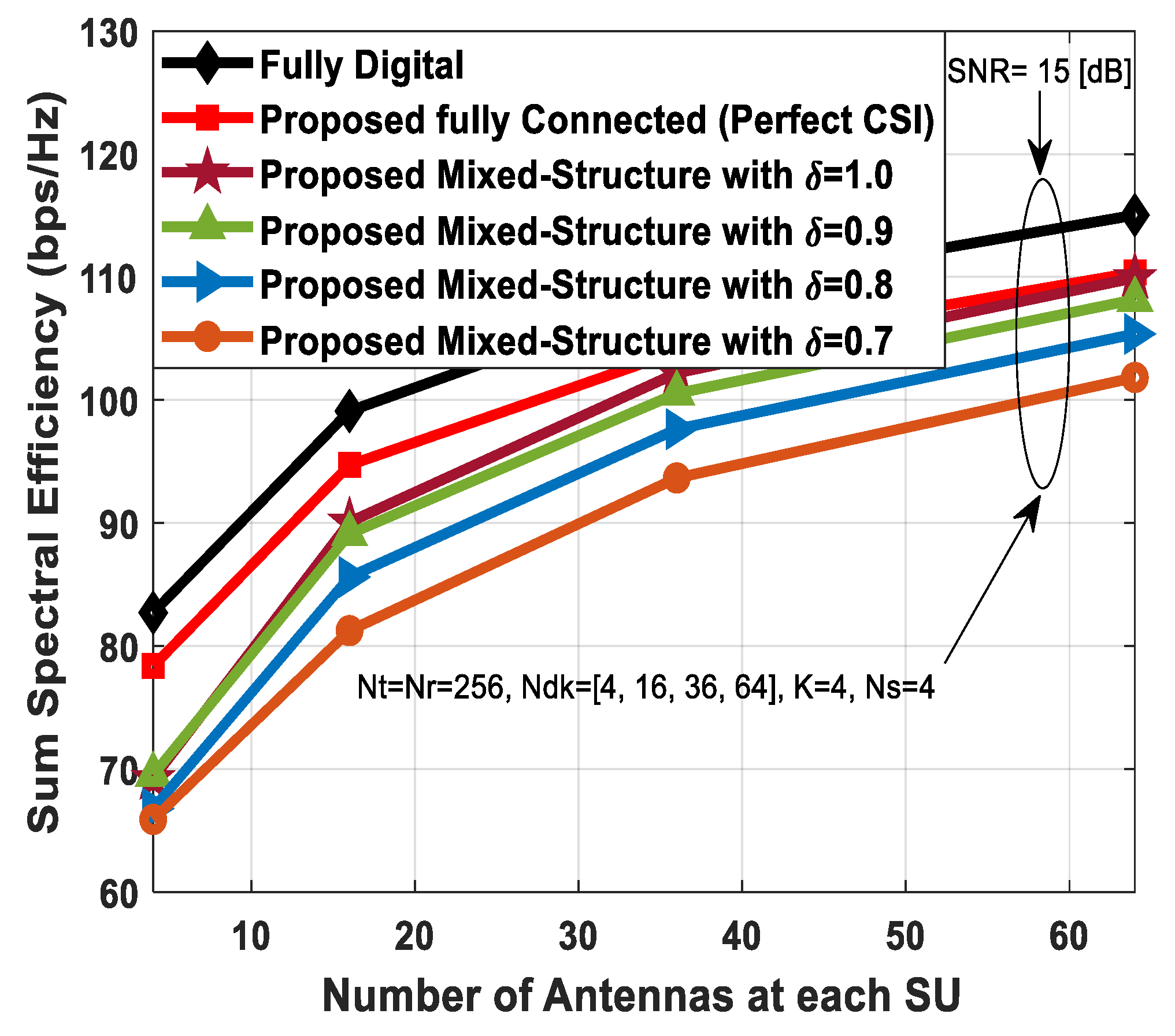
Figure 10.
Sum spectral efficiency vs. number of antennas at the SUs when SNR = 15 [dB], , , , , and . Comparison of the proposed scheme under perfect CSI and imperfect CSI at with full-complexity precoding.
Figure 10.
Sum spectral efficiency vs. number of antennas at the SUs when SNR = 15 [dB], , , , , and . Comparison of the proposed scheme under perfect CSI and imperfect CSI at with full-complexity precoding.
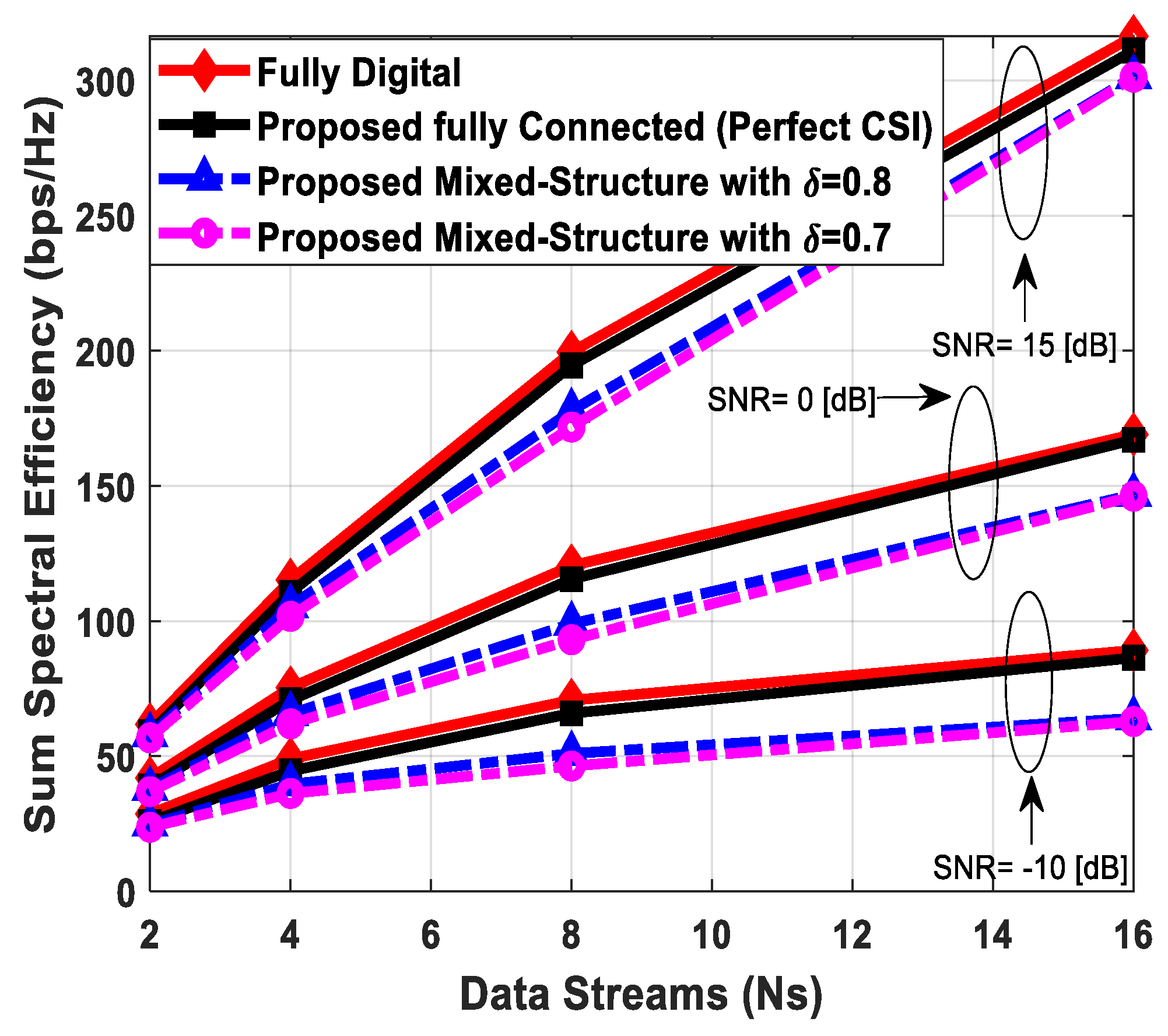
Figure 11.
Sum spectral efficiency vs. number of data streams at SNR = −10, 0, 15 [dB]: Comparison of the proposed method with unconstrained fully digital precoding. The system parameters are set as follows: , , , and .
Figure 11.
Sum spectral efficiency vs. number of data streams at SNR = −10, 0, 15 [dB]: Comparison of the proposed method with unconstrained fully digital precoding. The system parameters are set as follows: , , , and .
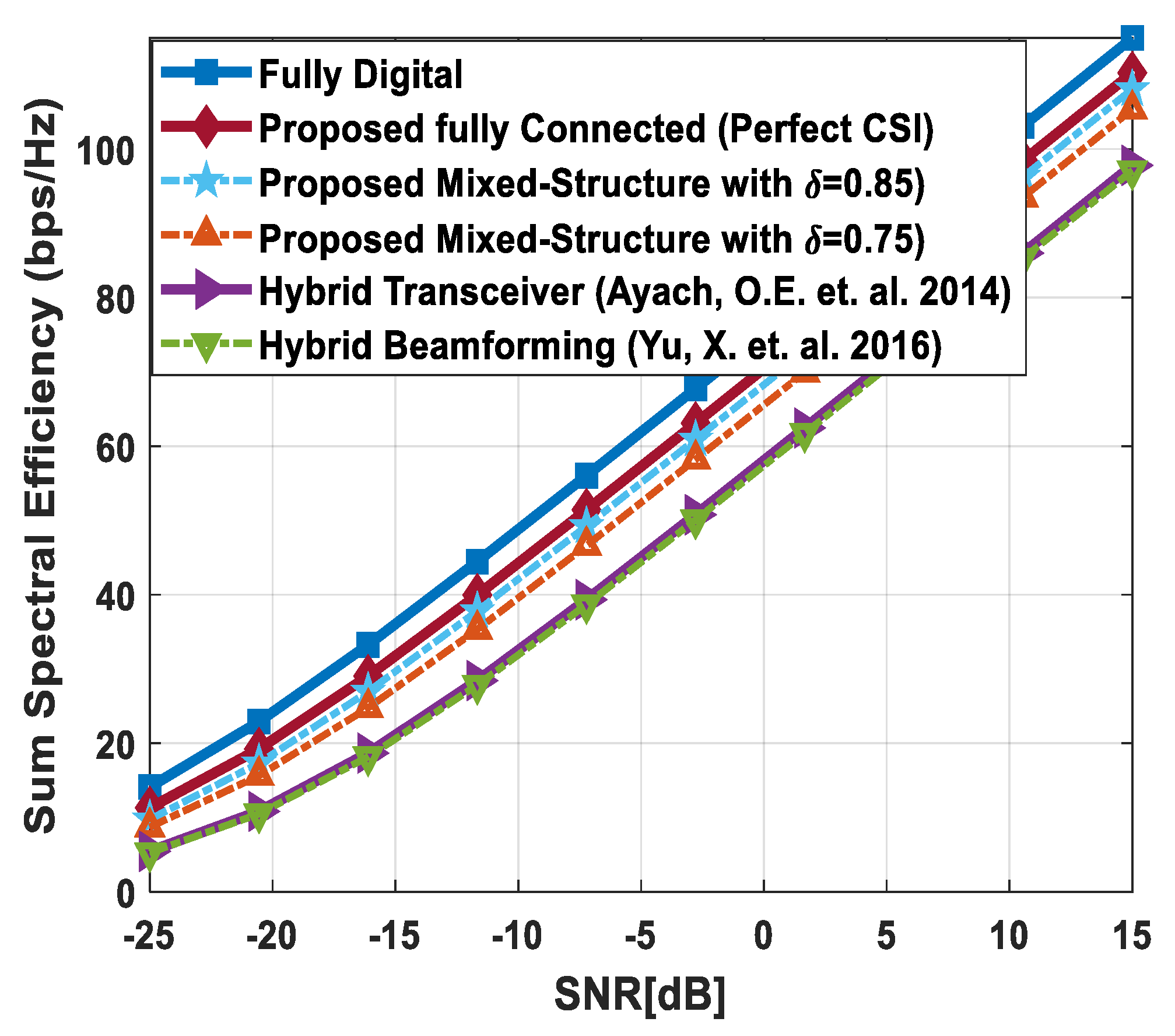
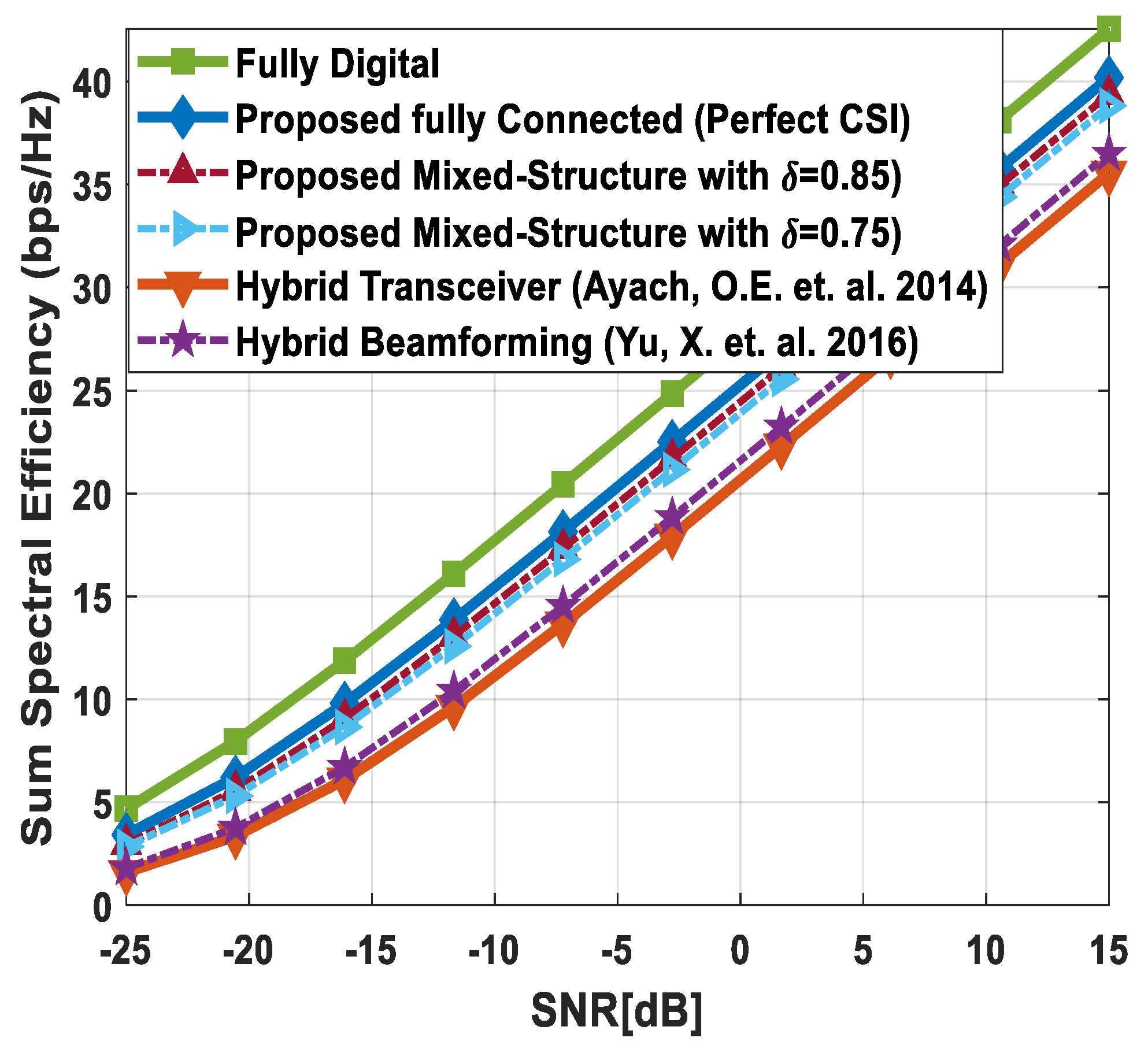
Figure 12.
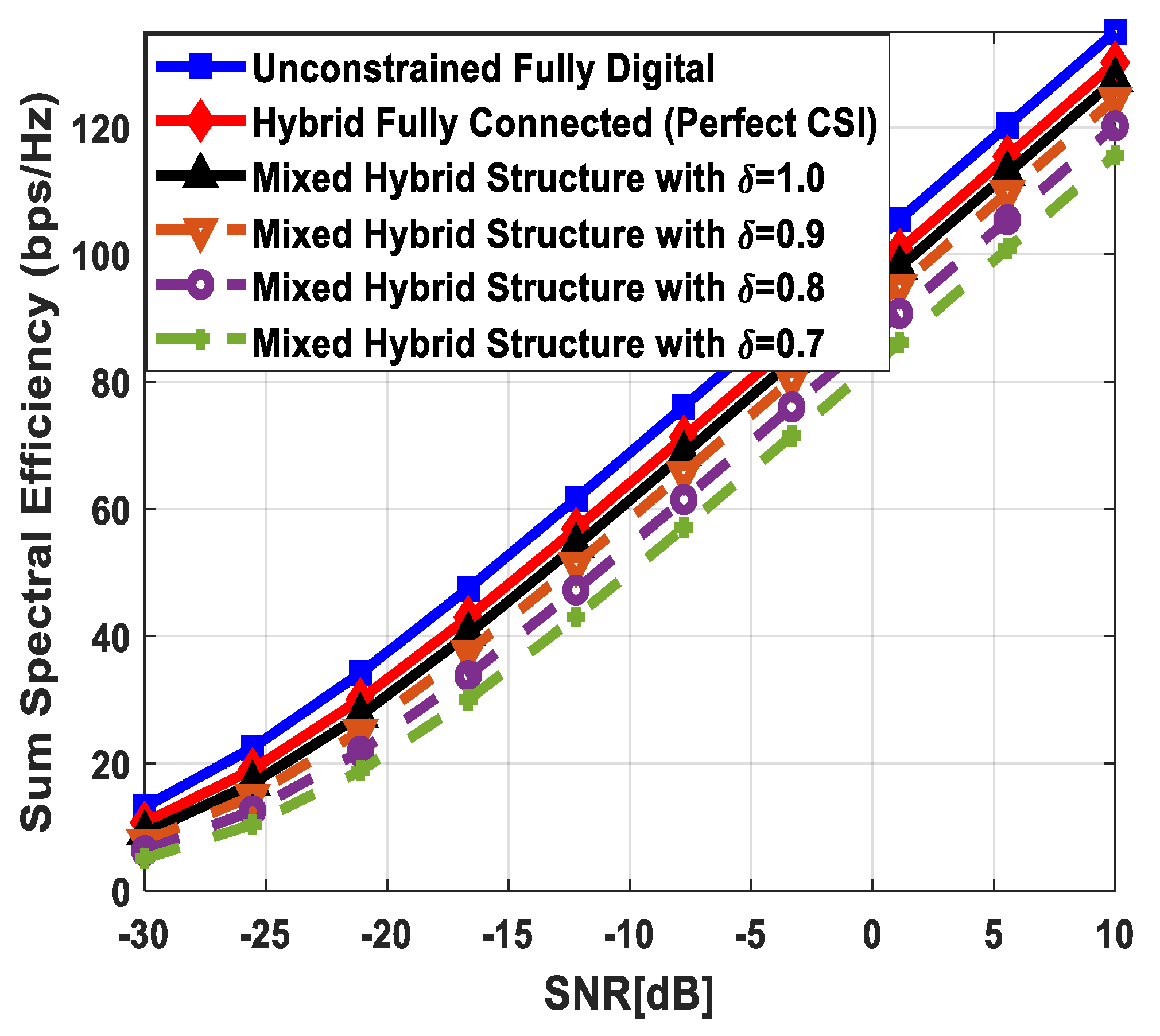
Sum spectral efficiency vs. SNR: Comparison of the proposed scheme with well-known hybrid processing techniques suggested in [
51,
52]. Numerical results are obtained by employing system parameters
,
,
,
, and
.
Figure 12.
Sum spectral efficiency vs. SNR: Comparison of the proposed scheme with well-known hybrid processing techniques suggested in [
51,
52]. Numerical results are obtained by employing system parameters
,
,
,
, and
.
Figure 13.
Sum spectral efficiency vs. SNR: Comparison between the proposed algorithm and hybrid precoding designs given in [
51,
52]. Simulation results are obtained using system parameters
,
,
,
, and
.
Figure 13.
Sum spectral efficiency vs. SNR: Comparison between the proposed algorithm and hybrid precoding designs given in [
51,
52]. Simulation results are obtained using system parameters
,
,
,
, and
.
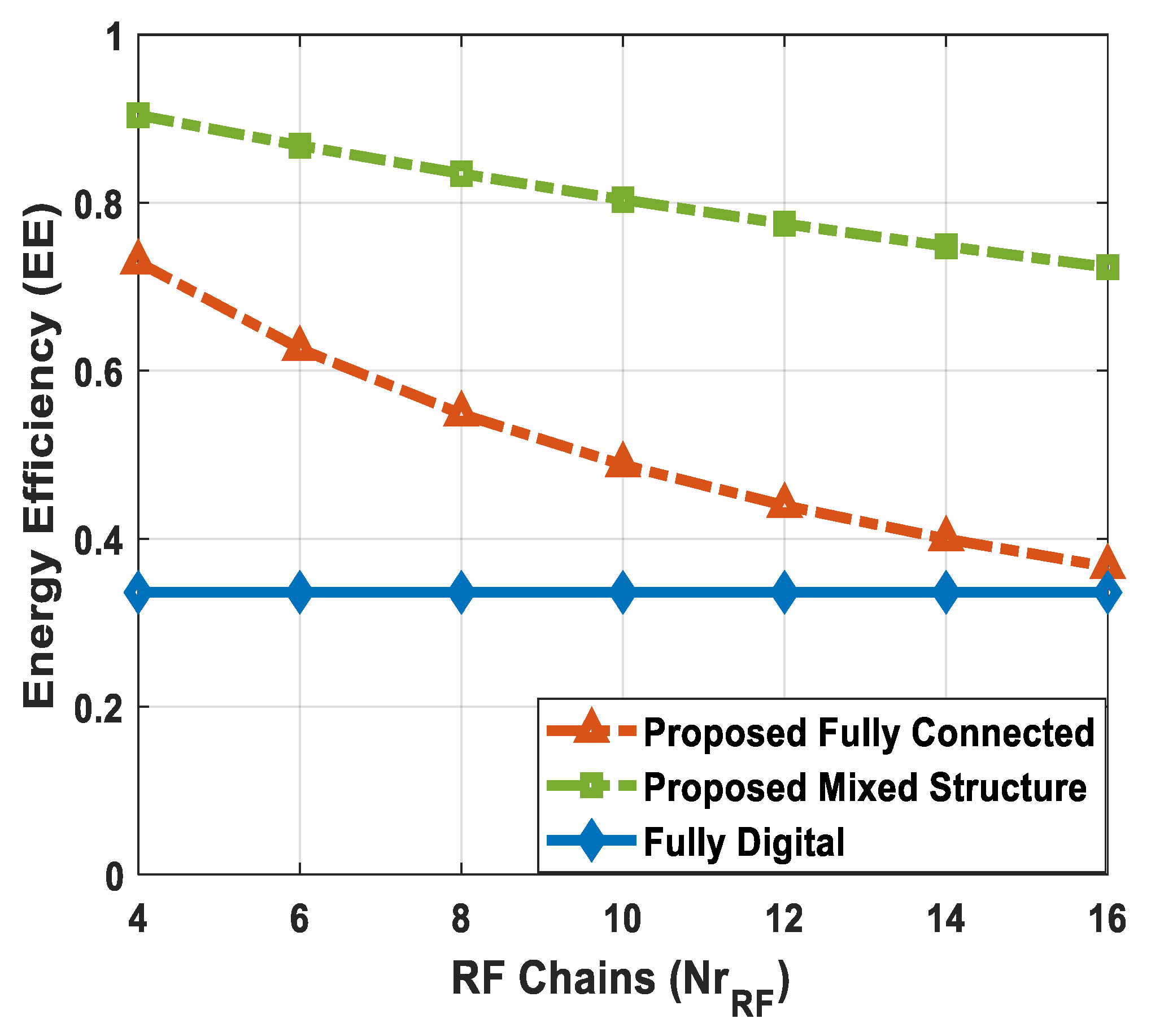
Figure 14.
EE vs. number of RF chains at the relay node: Energy efficiency comparison of the proposed fully connected structure, mixed-structure, and full-complexity digital precoding. The system parameters are set as , , , Ns = 1, , and .
Figure 14.
EE vs. number of RF chains at the relay node: Energy efficiency comparison of the proposed fully connected structure, mixed-structure, and full-complexity digital precoding. The system parameters are set as , , , Ns = 1, , and .
Figure 15.
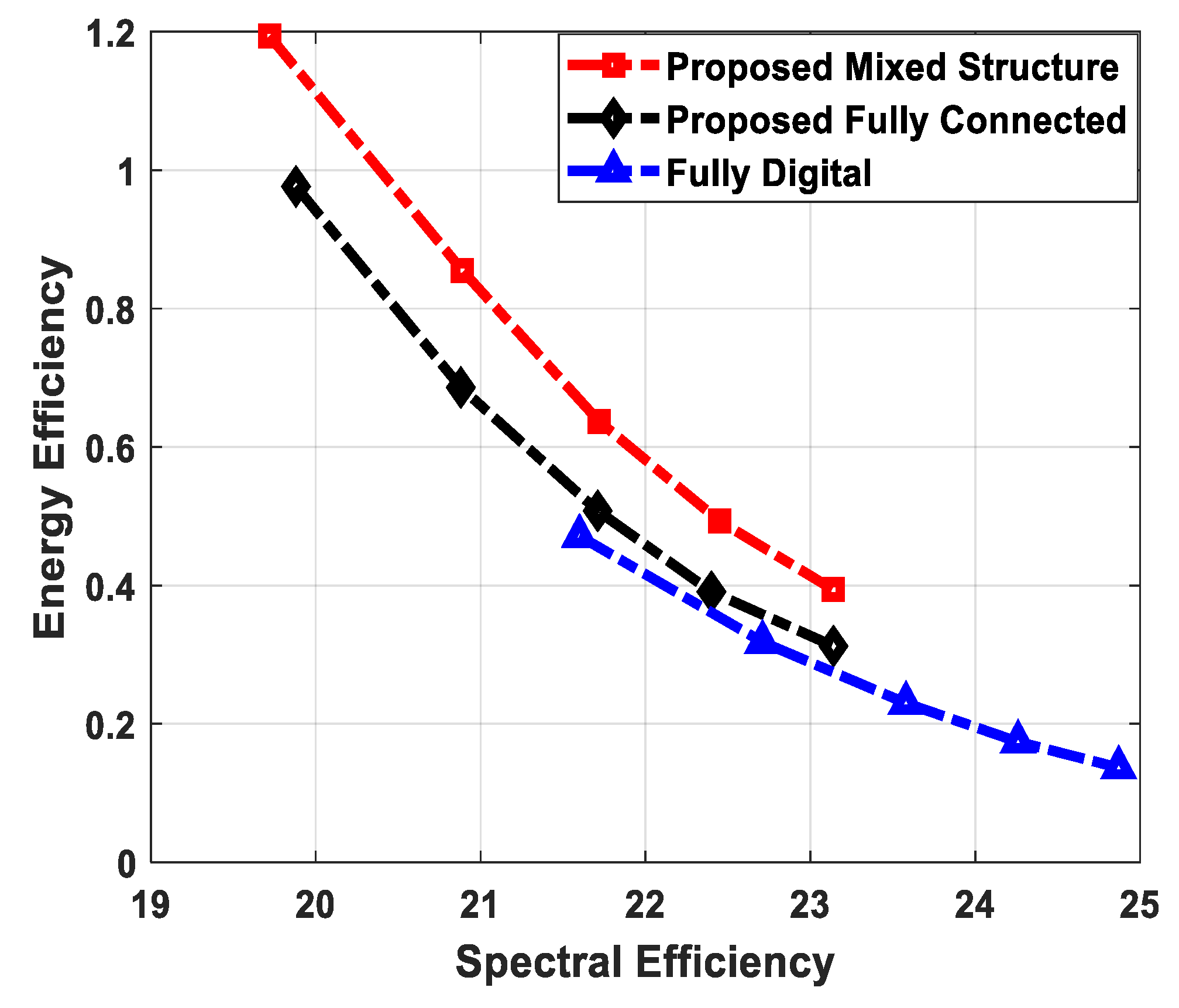
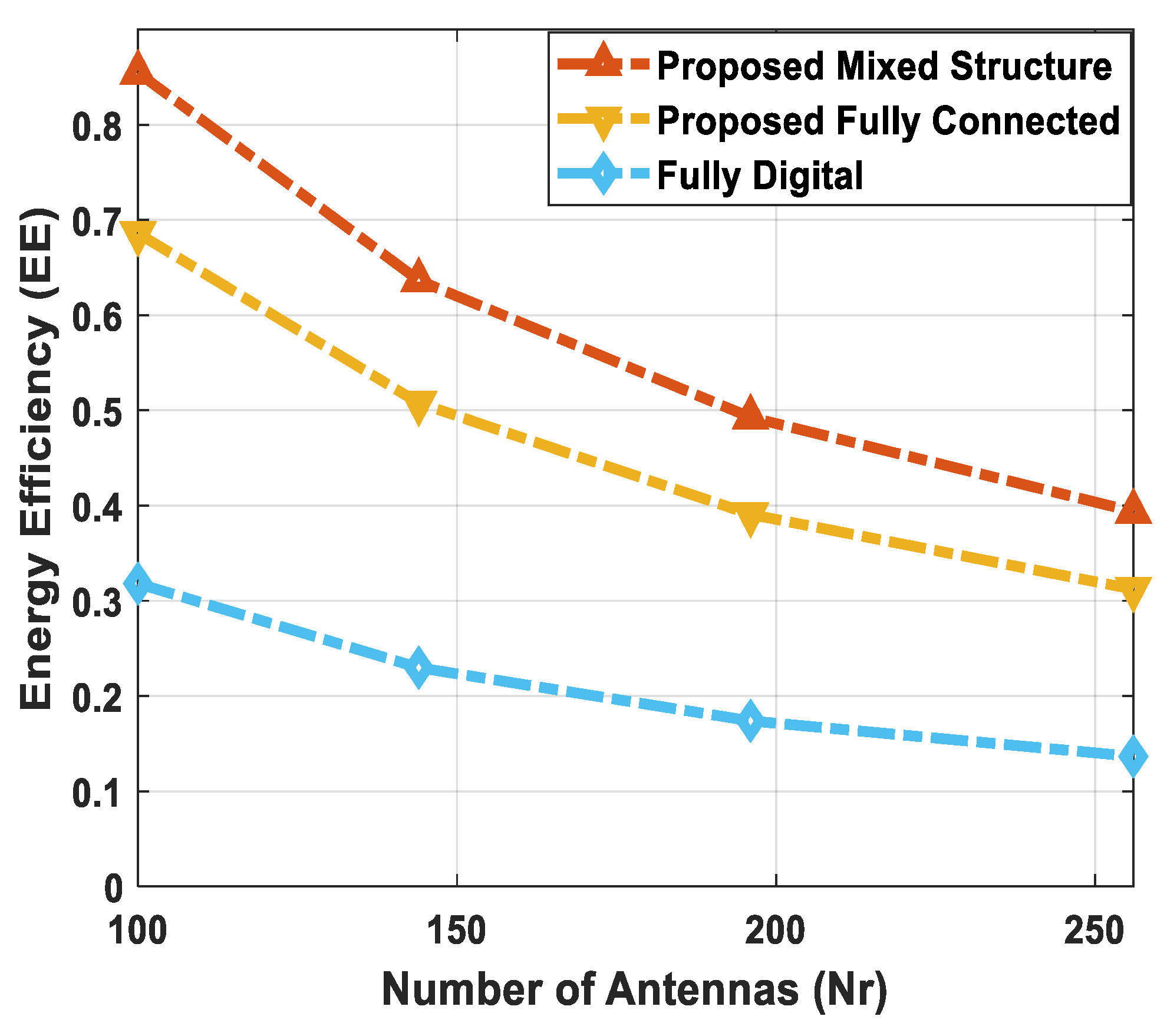
EE vs. number of antennas at the relay station: Comparison among the proposed fully connected architecture, mixed-structure, and fully digital beamforming. The system parameters are set as follows: , , , , , and .
Figure 15.
EE vs. number of antennas at the relay station: Comparison among the proposed fully connected architecture, mixed-structure, and fully digital beamforming. The system parameters are set as follows: , , , , , and .
Figure 16.
Sum spectral efficiency vs. EE with varying numbers of transmit antennas at the relay node when , , , , and Nsub = 64.
Figure 16.
Sum spectral efficiency vs. EE with varying numbers of transmit antennas at the relay node when , , , , and Nsub = 64.
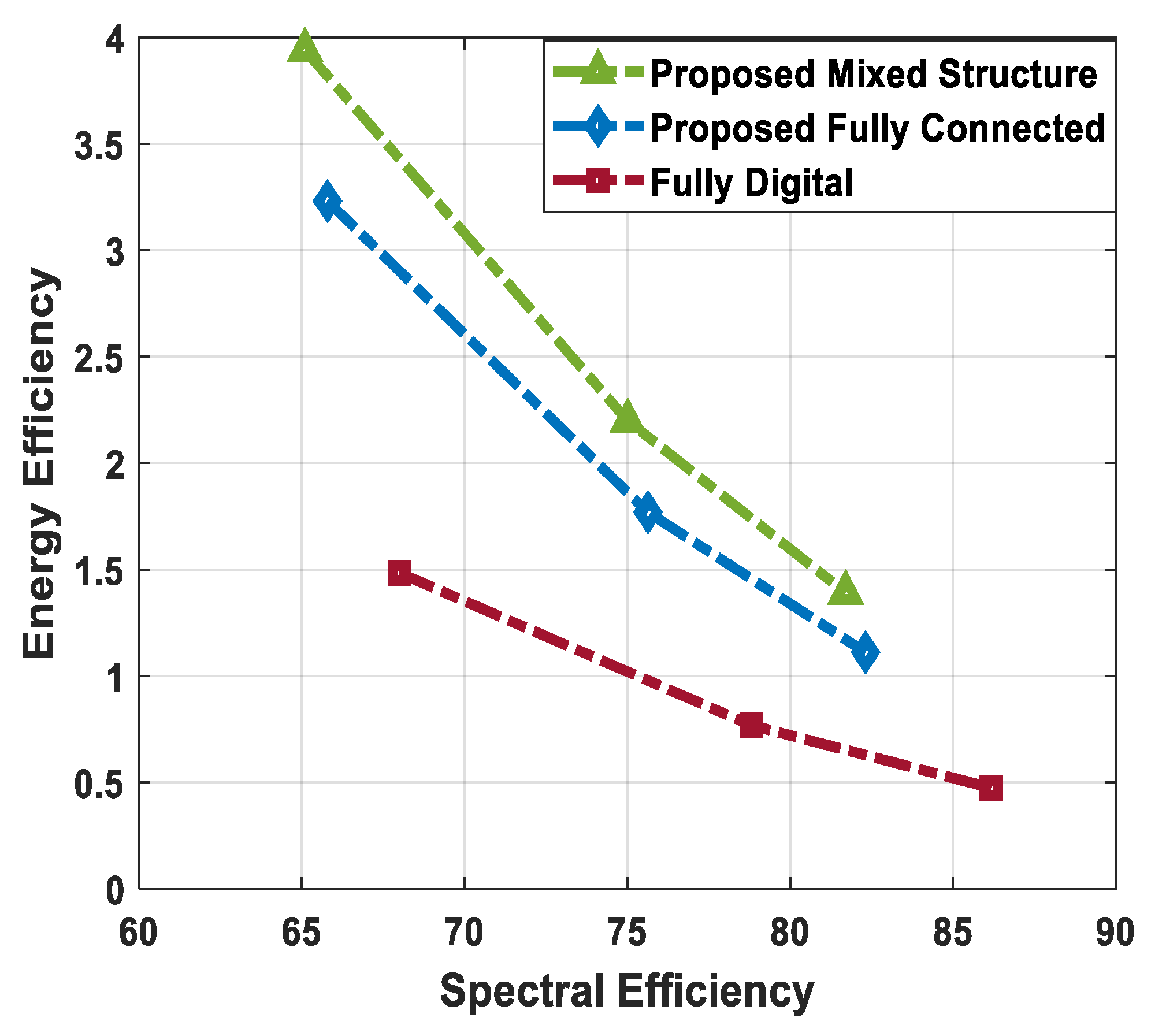
Figure 17.
Sum spectral efficiency vs. EE by changing the number of transmit antennas at the relay station when , , , , and .
Figure 17.
Sum spectral efficiency vs. EE by changing the number of transmit antennas at the relay station when , , , , and .
Figure 18.
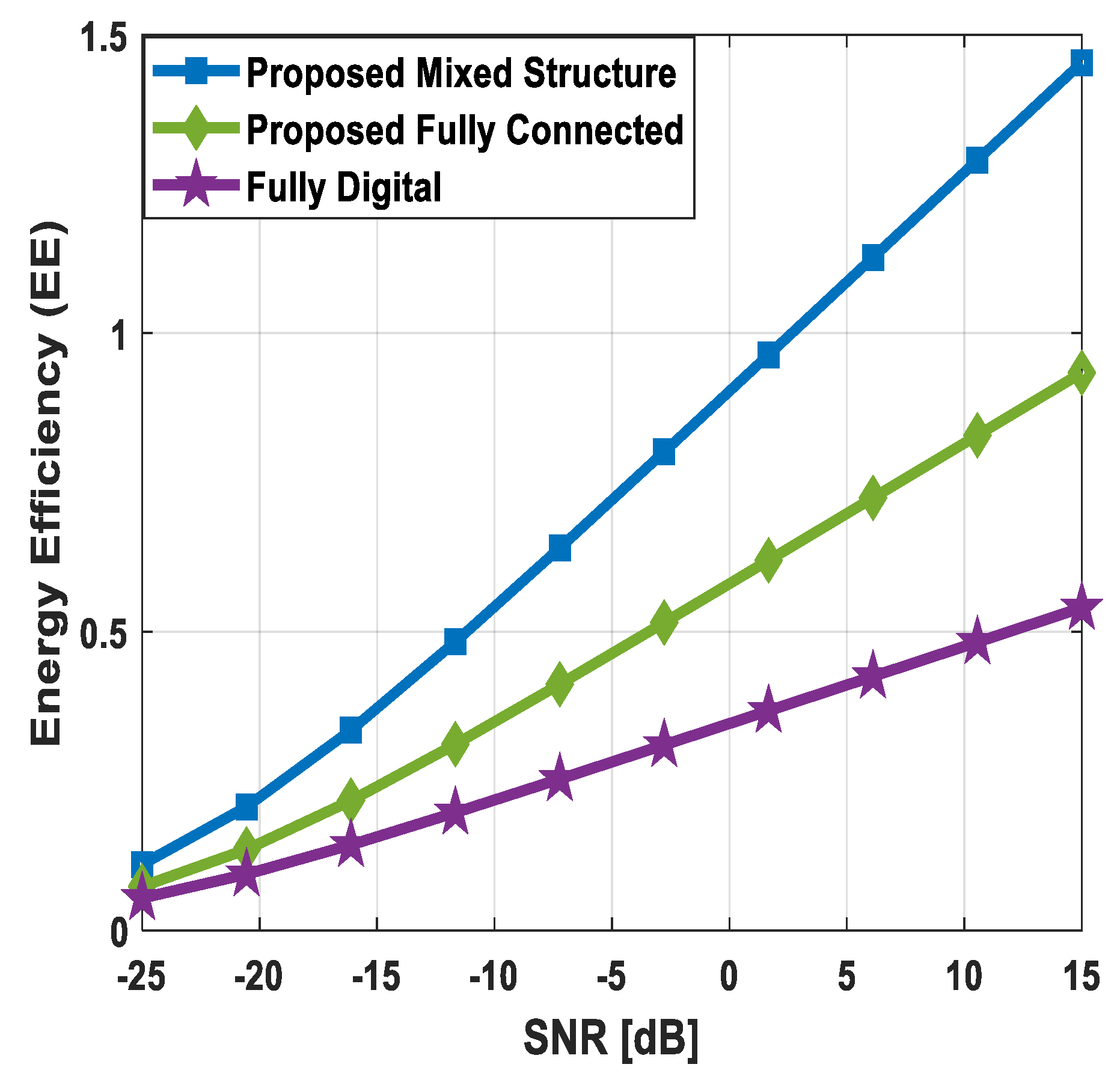
EE vs. SNR when , , , , and .
Figure 18.
EE vs. SNR when , , , , and .
Figure 19.
Rate vs. SNR considering spatial wideband effect: , , , , and .
Figure 19.
Rate vs. SNR considering spatial wideband effect: , , , , and .
Figure 20.
Rate vs. SNR considering spatial wideband effect: , , , , and .
Figure 20.
Rate vs. SNR considering spatial wideband effect: , , , , and .
Figure 21.
Rate vs. SNR considering the impact of UCA: , , , , and .
Figure 21.
Rate vs. SNR considering the impact of UCA: , , , , and .
Figure 22.
Rate vs. SNR considering the impact of UCA: , , , , and .
Figure 22.
Rate vs. SNR considering the impact of UCA: , , , , and .
Table 1.
Contrasting the proposed scheme with the existing relay-based hybrid beamforming for mm-wave MU-MIMO networks.
Table 1.
Contrasting the proposed scheme with the existing relay-based hybrid beamforming for mm-wave MU-MIMO networks.
| | [54] | [66] | [67] | [68] | [69] | [70] | Proposed |
|---|
| Relay-assisted mm-wave MU-MIMO system | ✓ | ✓ | ✓ | ✓ | ✓ | ✓ | ✓ |
| Frequency-selective channel | ✕ | ✕ | ✕ | ✕ | ✕ | ✓ | ✓ |
| Multiple data streams per user | ✓ | ✓ | ✓ | ✓ | ✓ | ✓ | ✓ |
| Minimum number of RF chains | ✕ | ✕ | ✕ | ✕ | ✕ | ✓ | ✓ |
| Support of CR technology | ✕ | ✕ | ✕ | ✕ | ✕ | ✓ | ✓ |
| Mixed hybrid structure | ✕ | ✕ | ✕ | ✓ | ✕ | ✕ | ✓ |
| Numerical results with imperfect CSI | ✕ | ✕ | ✕ | ✕ | ✕ | ✓ | ✓ |
Table 2.
Symbolic representation.
Table 2.
Symbolic representation.
| Symbol | Definition |
|---|
| Number of antennas at the source/relay node/-th SU |
| Number of RF chains at the source/relay node/-th SU |
| Number of data streams transmitted to the -th SU/K SUs |
| Source-transmitted signal after hybrid precoding |
| Common analog RF beamformer/frequency-selective digital baseband precoder at the source |
| Maximum allowable power at the source |
| Signal received at the relay node |
| Interference experienced by the PU due to the source-transmitted signal |
| Baseband signal received at the output of relay hybrid combiner |
| Common RF combiner/precoder at the relay station |
| Frequency-dependent baseband combiner/precoder at the relay |
| Relay hybrid combiner/precoder |
| Relay hybrid filter/combined baseband processing component at the relay |
| Relay transmitted signal after hybrid beamforming |
| Interference experienced by the PU due to the relay-transmitted signal |
| Channel matrix from the source to the relay in frequency-domain/source to the PU/relay to the -th SU |
| Noise vector at the relay/-th SU |
| Signal received at the -th SU without hybrid processing/with hybrid processing |
| Frequency-independent RF combiner/frequency-dependent baseband combiner at the -th SU |
| Baseband equivalent channel from the source to the relay |
| Baseband equivalent channel from the relay to the -th SU |
| Capacity of the k-th SU at the n-th sub-carrier/average over carriers |
| Relay hybrid precoder corresponding to the -th SU |
Table 3.
Complexity of the proposed design and the other hybrid beamforming algorithms.
Table 3.
Complexity of the proposed design and the other hybrid beamforming algorithms.
| Algorithms | Complexity |
|---|
| Proposed, [70] | |
| Hybrid Precoding [43] | |
| Hybrid Beamforming [47] | |
| Hybrid Transceiver [41] | |
| Algorithm [50] | |
Table 4.
System parameters to generate numerical results.
Table 4.
System parameters to generate numerical results.
| Parameters | Values |
|---|
| Number of data streams | |
| Number of RF chains | |
| Number of antennas | |
| Number of data transmission paths | |
| Number of frequency sub-carriers | |
| Carrier frequency | |
| Number of secondary users | |
Table 5.
Energy consumption of different precoding techniques.
Table 5.
Energy consumption of different precoding techniques.
| Architecture | Energy Consumption at the Relay Node |
|---|
| |
| |
| |
Table 6.
Simulation parameters for spatial wideband effect.
Table 6.
Simulation parameters for spatial wideband effect.
| Parameters | Values |
|---|
| Number of data streams | |
|
Number of SUs | |
|
Number of sub-carriers | |
|
Number of antennas at the source, relay node, and each SU | |
|
Number of clusters; number of rays/cluster | |
|
Maximum time delay | |
|
Central frequency | |
|
Bandwidth | |
Table 7.
Simulation parameters for the impact of UCA.
Table 7.
Simulation parameters for the impact of UCA.
| Parameters | Values |
|---|
| Number of data streams | |
| Number of SUs | |
| Number of sub-carriers | |
| Number of antennas at the source, relay node, and each SU | , |
| Number of propagation paths | |
| Maximum time delay | |
| Central frequency | |
| Bandwidth | |




 ,
,