Survey on Energy Harvesting for Biomedical Devices: Applications, Challenges and Future Prospects for African Countries
Abstract
1. Introduction and Theoretical Background
- ▪
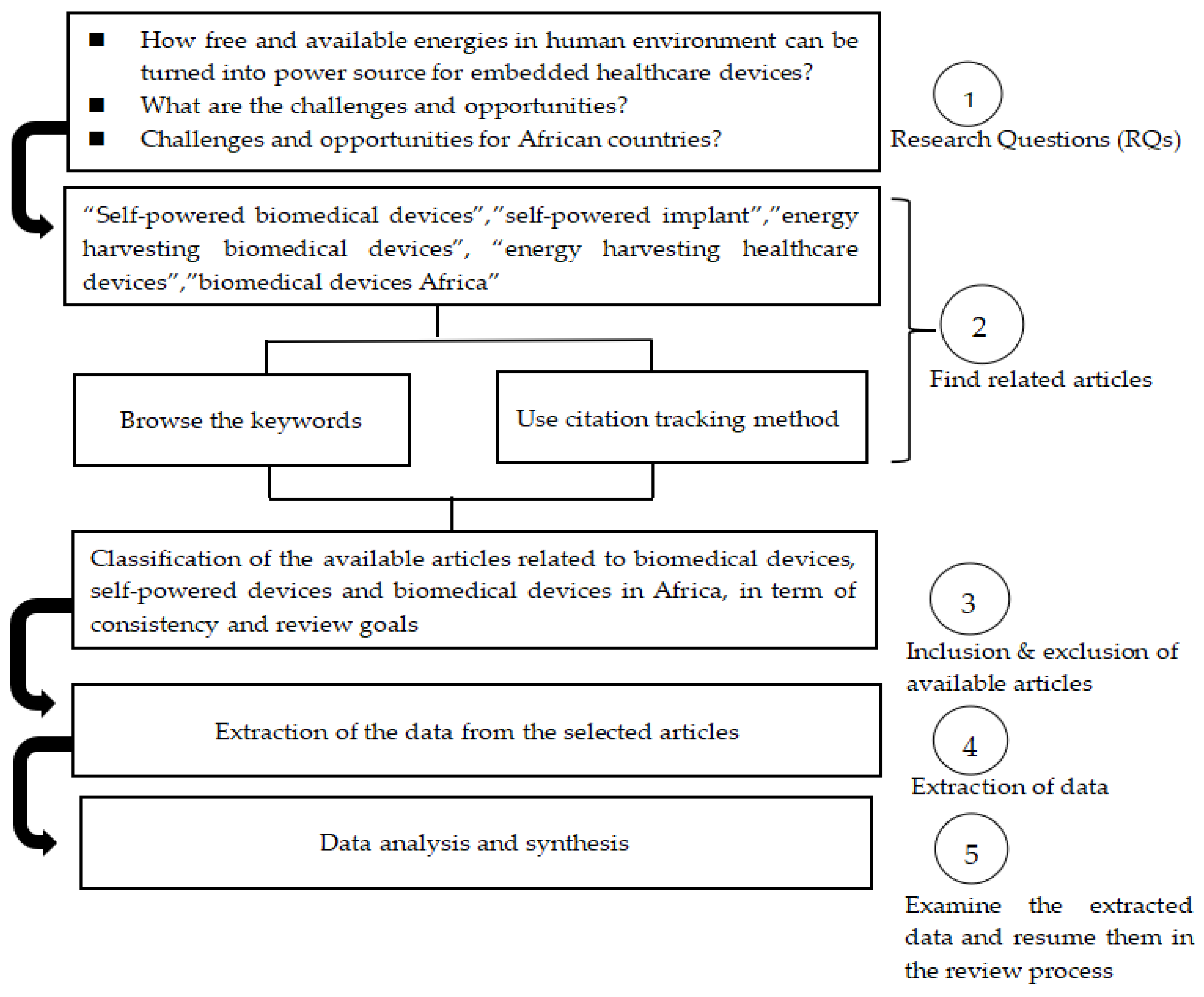
- How can free and available energies in the human environment be turned into a power source for embedded healthcare devices?
- ▪
- What are the challenges and opportunities?
- ▪
- Are African countries ready for facing the challenges, or are there any findings in developing countries in similar topics for local healthcare?
2. Review Methodology
2.1. Systematic Literature Review (SLR)
2.1.1. Purpose of the Literature Review
2.1.2. Protocol and Training
2.1.3. Screening of the Existing Literature
2.1.4. Extraction and Appraisal of Data Quality
- ▪
- Articles written in English and published within eight recent years (2015–2023);
- ▪
- Applied research and technology development articles;
- ▪
- Articles related to biomedical energy harvesting and healthcare devices.
2.1.5. Study Synthesis
- ▪
- Invasive self-powered biomedical devices.
- ▪
- Non-invasive self-powered biomedical devices.
- ▪
- Comparison of biomedical devices powered by nanogenerators
3. Challenges, Opportunities, Status and Capability of Self-Powered Biomedical Devices
3.1. Challenges of Self-Powered Biomedical Devices
- ▪
- Challenge of miniaturization: The design aims to miniaturize the size and achieve the highest output power performance, which are contradictory;
- ▪
- Flexibility: In vivo self-powered systems need the highest flexibility in order to not harm patients;
- ▪
- Biocompatibility: Biomedical devices must meet the appropriate biological requirements for a biomaterials;
- ▪
- Long-term stability: Biomedical devices must be able to operate for a long period, especially for in vivo applications, in order to avoid regular surgery.
- ▪
- Insufficient Digital literacy training and infrastructures.
- ▪
- Data sets and government support.
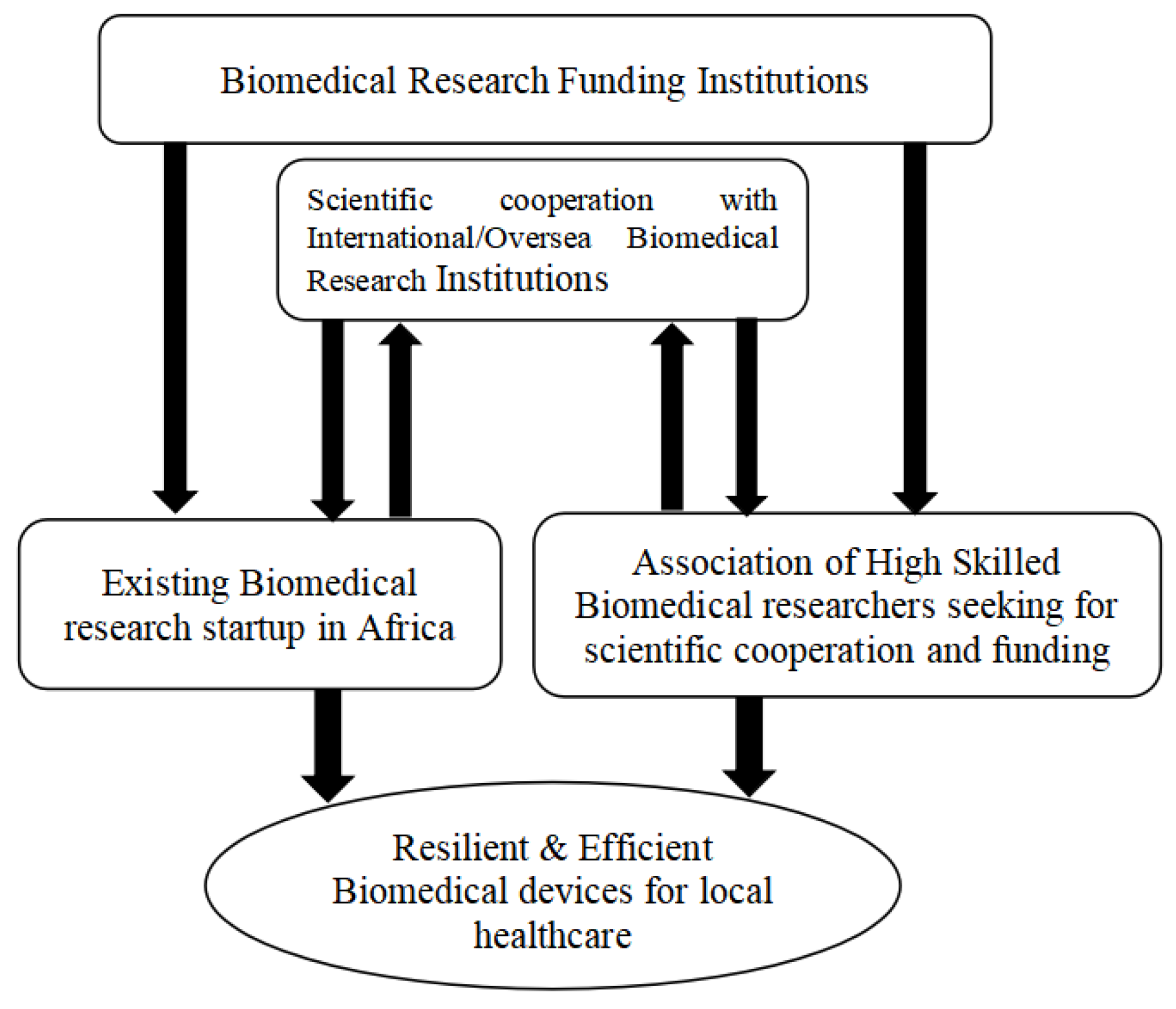
3.2. Opportunities for African Countries
3.3. Status of Self-Powered Biomedical Devices in Africa
4. Conclusions
Author Contributions
Funding
Acknowledgments
Conflicts of Interest
References
- Global Data. Fitness Watches May Soon Be Able to Monitor much More Than Weight and Heart Health, as Global Data Identifies 160 Ongoing Clinical Trials for Medical Wearables. Available online: https://www.globaldata.com/media/medical-devices/fitness-watches-may-soon-able-monitor-much-weight-heart-health-globaldata-identifies-160-ongoing-clinical-trials-medical-wearables/ (accessed on 6 July 2023).
- Cambridge University & Press Assessment. Self-Powered. 2023. Available online: https://dictionary.cambridge.org/us/dictionary/english/self-powered (accessed on 8 July 2023).
- Force Technology. ASIC Power Management for Self-Powered IoT Sensors. Available online: https://forcetechnology.com/en/articles/asic-power-management-self-powered-iot-sensors (accessed on 8 July 2023).
- Owens, B.B.; Salkind, A.J. Key Events in the Evolution of Implantable Pacemaker Batteries. In Batteries for Implantable Biomedical Devices; Owens, B.B., Ed.; Springer: Boston, MA, USA, 1986. [Google Scholar] [CrossRef] [Scilit]
- Barnhart, P.W.; Fischell, R.E.; Lewis, K.B.; Radford, W.E. A fixed-rate rechargeable cardiac pacemaker. Appl. Phys. Lab. Techn. Dig. 1970, 9, 2. [Google Scholar]
- Bock, D.C.; Marschilok, A.C.; Takeuchi, K.J.; Takeuchi, E.S. Batteries used to Power Implantable Biomedical Devices. Electrochim. Acta 2012, 84, 155–164. [Google Scholar] [CrossRef] [Scilit] [PubMed]
- Holleck, G.L. Rechargeable Electrochemical Cells as Implantable Power Sources. In Batteries for Implantable Biomedical Devices; Owens, B.B., Ed.; Springer: Boston, MA, USA, 1986. [Google Scholar]
- Reid, R.C.; Mahbub, I. Wearable self-powered biosensors. Curr. Opin. Electrochem. 2020, 19, 55–62. [Google Scholar] [CrossRef] [Scilit]
- Karamia, M.A.; Inman, D.J. Powering Pacemakers from Heartbeat Vibrations using Linear and Non-linear Energy Harvesters. Appl. Phys. Lett. 2012, 100, 042901. [Google Scholar] [CrossRef] [Scilit]
- Ryu, H.; Park, H.; Kim, M.K.; Kim, B.; Myoung, H.S.; Kim, T.Y.; Yoon, H.-J.; Kwak, S.S.; Kim, J.; Hwang, T.H.; et al. Self-rechargeable cardiac pacemaker system with triboelectric nanogenerators. Nat. Commun. 2021, 12, 4374. [Google Scholar] [CrossRef] [Scilit]
- Fisher, J.S.; Kazam, J.J.; Fufa, D.; Bartolotta, R.J. Radiologic evaluation of fracture healing. Skeletal Radiol. 2019, 48, 349–361. [Google Scholar] [CrossRef] [Scilit]
- Havard Health Publishing. Radiation Risk from Medical Imaging. Available online: https://www.health.harvard.edu/cancer/radiation-risk-from-medical-imaging (accessed on 26 July 2023).
- Barri, K.; Zhang, Q.; Swink, I.; Aucie, Y.; Holmberg, K.; Sauber, R.; Altman, D.T.; Cheng, B.C.; Wang, Z.L.; Alavi, A.H. Patient-Specific Self-Powered Metamaterial Implants for Detecting Bone Healing Progress. Adv. Funct. Mater. 2022, 32, 2203533. [Google Scholar]
- Himore Medical. Cardio Pad Kit. Available online: https://himore-medical.com (accessed on 29 August 2023).
- Pascalin, T.K.; Mohamadou, Y.; Momo, F.; Jauspin, D.K.; Francois de paul, M.K. A multi-function neonatal incubator for low-income countries: Implementation and ab initio social impact. Med. Eng. Phys. 2020, 77, 114–117. [Google Scholar]
- Zubair, A.R.; Adebayo, C.O.; Ebere-Dinnie, E.U.; Coker, A.O. Development of Biomedical Devices in Africa for Africa: A Blood Glucose Meter. Int. J. Electr. Electron. Sci. 2015, 2, 102–108. [Google Scholar]
- Daniyan, I.; Ikuponiyi, S.; Daniyan, L.; Uchegbu, I.D.; Mpofu, K. Development of a Smart Glucose Monitoring Device. Procedia CIRP 2022, 110, 253–258. [Google Scholar] [CrossRef] [Scilit]
- Sinapi Biomedical. Freeplay Fetal Heart Rate Monitor. Available online: https://designobserver.com/feature/freeplay-fetal-heart-rate-monitor/10927 (accessed on 29 August 2023).
- SINAPI Biomedical/Chest Drainage. Available online: https://sinapibiomedical.com/products/chest-drainage/ (accessed on 29 August 2023).
- Anjum, M.U.; Fida, A.; Ahmad, I.; Iftikhar, A. A broadband electromagnetic type energy harvester for smart sensor devices in biomedical applications. Sens. Actuators A 2018, 277, 52–59. [Google Scholar] [CrossRef] [Scilit]
- Niroomand, M.; Foroughi, H.R. A rotary electromagnetic microgenerator for energy harvesting from human motions. J. Appl. Res. Technol. 2016, 14, 259–267. [Google Scholar] [CrossRef] [Scilit]
- Faizan, A.A. Piezoelectric energy harvesters for biomedical applications. Nano Energy 2019, 57, 879–902. [Google Scholar]
- Zhou, H.; Zhang, Y.; Qiu, Y.; Wu, H.; Qin, W.; Liao, Y.; Yu, Q.; Cheng, H. Stretchable piezoelectric energy harvesters and self-powered sensors for wearable and implantable devices. Biosens. Bioelectron. 2020, 168, 112569. [Google Scholar] [CrossRef] [Scilit] [PubMed]
- Okoli, C. A Guide to Conducting a Standalone Systematic Literature Review. Commun. Assoc. Inf. Syst. 2015, 37, 43. [Google Scholar] [CrossRef] [Scilit]
- Song, K.; Han, J.H.; Yang, H.C.; Nam, K.I.; Lee, J. Generation of electrical power under human skin by subdermal solar cell arrays for implantable bioelectronic devices. Biosens. Bioelectron. 2017, 92, 364–371. [Google Scholar] [CrossRef] [Scilit]
- Kim, D.H.; Shin, H.J.; Lee, H.; Jeong, C.K.; Park, H.; Hwang, G.T.; Lee, H.-Y.; Joe, D.J.; Han, J.H.; Lee, S.H.; et al. In Vivo Sel-powered Wireless Transmission Using Biocompatible Flexible Energy Harvesters. Adv. Funct. Mater 2017, 27, 1700341. [Google Scholar] [CrossRef] [Scilit]
- Carta, R.; Thone, J.; Gosset, G.; Cogels, G.; Flandre, D.; Puers, R. A Self-Tuning Inductive Powering System for Biomedical Implants. Procedia Eng. 2011, 25, 1585–1588. [Google Scholar] [CrossRef] [Scilit]
- Azimi, S.; Golabchi, A.; Nekookar, A.; Rabbani, S.; Amiri, M.H.; Asadi, K.; Abolhasani, M.M. Self-powered cardiac pacemaker by piezoelectric polymer nanogenerator implant. Nano Energy 2021, 83, 105781. [Google Scholar] [CrossRef] [Scilit]
- Cheng, X.; Xue, X.; Ma, Y.; Han, M.; Zhang, W.; Xu, Y.; Zhang, H.; Zhang, H.-X. Implantable and self-powered blood pressure monitoring based on a piezoelectric thinfilm: Simulated, in vitro and in vivo studies. Nano Energy 2016, 22, 453–460. [Google Scholar] [CrossRef] [Scilit]
- Zheng, Q.; Zhang, H.; Shi, B.; Xue, X.; Liu, Z.; Jin, Y.; Ma, Y.; Zou, Y.; Wang, X.; An, Z.; et al. In Vivo Self-powered Cardiac Monitoring via Implantable Triboelectric Nanogenerator. ACS Nano 2016, 10, 6510–6518. [Google Scholar] [CrossRef] [Scilit] [PubMed]
- Ollmar, S.; Schrunder, A.F.; Birgersson, U.; Kristoffersson, T.; Rusu, A.; Thorsson, E.; Hedenqvist, P.; Manell, E.; Rydén, A.; Jensen-Waern, M.; et al. A battery-less implantable glucose sensor based on electrical impedance spectroscopy. Sci. Rep. 2023, 13, 18122. [Google Scholar] [CrossRef] [Scilit] [PubMed]
- Lee, K.H.; Zhang, Y.Z.; Jiang, Q.; Kim, H.; Alkenawi, A.A.; Alshareef, H.N. Ultrasound-Driven Two-Dimentional Ti3C2Tx MXene Hydrogel Generator. ACS Nano 2020, 14, 3199–3207. [Google Scholar] [CrossRef] [Scilit] [PubMed]
- Hwang, G.-T.; Kim, Y.; Lee, J.-H.; Oh, S.; Jeong, C.K.; Park, D.Y.; Ryu, J.; Kwon, H.; Lee, S.-G.; Joung, B.; et al. Self-powered deep brain stimulation via flexible point energy harvester. Energy Environ. Sci. 2015, 8, 2677–2684. [Google Scholar]
- Tian, J.; Shi, R.; Liu, Z.; Ouyang, H.; Yu, M.; Zhao, C.; Zou, Y.; Jiang, D.; Zhang, J.; Li, Z. Self-powered implantable electrical stimulator for osteoblasts’ proliferation and differentiation. Nano Energy 2019, 59, 705–714. [Google Scholar] [CrossRef] [Scilit]
- Li, H.; Lu, J.; Myjak, M.J.; Liss, S.A.; Brown, R.S.; Tian, C.; Deng, Z.D. An Implantable Biomedical Energy Harvester for Animal Monitoring Devices. Nano Energy 2022, 98, 108505. [Google Scholar] [CrossRef] [Scilit]
- Chang, Y.-H.; Chang, C.-C.; Chang, L.-Y.; Wang, P.-C.; Kanokpaka, P.; Yeh, M.-H. Self-powered triboelectric sensor with N-doped graphene quantum dots decorated polyaniline layer for non-invasive glucose monitoring in human sweat. Nano Energy 2023, 112, 108505. [Google Scholar] [CrossRef] [Scilit]
- Lee, J.; Ji, J.; Hyun, K.; Lee, H.; Kwon, Y. Flexible, disposable, and portable self-powered glucose biosensors visible to the naked eye. Sens. Actuators B Chem. 2022, 372, 132647. [Google Scholar] [CrossRef] [Scilit]
- Hartel, M.C.; Lee, D.; Weiss, P.S.; Wang, J.; Kim, J. Resettable sweat-powered wearable electrochromic biosensor. Biosens. Bioelectron. 2022, 215, 114565. [Google Scholar] [CrossRef] [Scilit]
- Santiago-Malag’on, S.; Río-Colín, D.; Azizkhani, H.; Aller-Pellitero, M.; Guirado, G.; Javier del Campo, F. A self-powered skin-patch electrochromic biosensor. Biosens. Bioelectron. 2021, 175, 112879. [Google Scholar] [CrossRef] [Scilit]
- Aller-Pellitero, M.; Santiago-Malagon, S.; Ruiz, J.; Alonso, Y.; Lankard, B.; Hihn, J.-Y.; Guirado, G.; Campo, F.J.D. Fully-printed and silicon free self-powered electrochromic biosensors: Towards naked eye quantification. Sens. Actuators B Chem. 2020, 306, 127535. [Google Scholar] [CrossRef] [Scilit]
- Song, Y.; Min, J.; Yu, Y.; Wang, H.; Yang, Y.; Zhang, H.; Gao, W. Wireless battery-free wearable sweat sensor powered by human motion. Sci. Adv. 2020, 6, eaay9842. [Google Scholar] [CrossRef] [Scilit] [PubMed]
- Shi, B.; Liu, Z.; Zheng, Q.; Meng, J.; Ouyang, H.; Zou, Y.; Jiang, D.; Qu, X.; Yu, M.; Zhao, L.; et al. Body-Integrated Self-Powered System for Wearable and Implantable Applications. ACS Nano 2019, 13, 6017–6024. [Google Scholar] [CrossRef] [Scilit] [PubMed]
- UVAToday. New Microchip Improves Future of Self-Powered Wearable Technology. Available online: https://news.virginia.edu/content/new-microchip-improves-future-self-powered-wearable-technology (accessed on 5 December 2023).
- Vaquer, A.; Barón, E.; de la Rica, R. Detection of low glucose levels in sweat with colorimetric wearable sensors. Analyst 2021, 146, 3273. [Google Scholar] [CrossRef] [Scilit] [PubMed]
- Zhang, L.; Ji, H.; Huang, H.; Yi, N.; Shi, X.; Xie, S.; Li, Y.; Ye, Z.; Feng, P.; Lin, T.; et al. Wearable Circuits Sintered at 3/4 Room Temperature Directly on the Skin Surface for Health Monitoring. ACS Appl. Mater. Interfaces 2020, 12, 45504–45515. [Google Scholar] [CrossRef] [Scilit] [PubMed]
- Zhang, C.; Zhixiang, P.; Chunlei, H.; Zhang, B.; Chao, X.; Cheng, H.; Jun, W.; Tang, S. High-energy all-in-one stretchable micro-supercapacitor arrays based on 3D laser-induced graphene foams decorated with mesoporous ZnP nanosheets for self-powered stretchable systems. Nano Energy 2020, 81, 105609. [Google Scholar] [CrossRef] [Scilit]
- Onakpoya, U.U.; Ojo, O.; Eyekpegha, O.J.; Oguns, A.; Akintomide, A.O. Early experience with permanent pacemaker implantation at a tertiary hospital in Nigeria. Pan Afr. Med. J. 2020, 36, 177. [Google Scholar] [CrossRef] [Scilit] [PubMed]
- Nwafor, C.E. Cardiac Pacemaker Insertion in the South-South Region of Nigeria: Prospects and Challenges. Niger. Health J. 2015, 15, 125–130. [Google Scholar]
- Nakandi, B.T.; Muhimbise, O.; Djuhadi, A.; Mulerwa, M.; McGrath, J.; Makobore, P.N.; Rollins, A.M.; Ssekitoleko, R.T. Experiences of medical device innovators as they navigate the regulatory system in Uganda. Front. Med. Technol. 2023, 5, 1162174. [Google Scholar] [CrossRef] [Scilit]
- World Health Organization. Rigional Office for Africa. MamaOpe Medical. Available online: https//innov.afro.who.int/global-innovation/mamaope-medicals-3891 (accessed on 29 August 2023).
- Wekebere. Pregnacy monitor. Available online: https://wekebere.org (accessed on 29 August 2023).
- Makobore, P.N.; Mulerwa, M. An Electronically Controlled Gravity Feed Infusion Set for Intravenous Fluids. In Biomedical Enginering for Africa; University of Captown Libraries: Cape Town, South Africa, 2019; Chapter 15. [Google Scholar]
- Noubiap, J.J.N.; Jingi, A.M.; Kengne, A.P. Local innovation for improving primary care cardiology in resource-limited African settings: An insight on the Cardio Pad project in Cameroon. Cardiovasc. Diagn. Ther. 2014, 4, 397–400. [Google Scholar]
- Dzudie, A.; Ouankou, C.N.; Nganhyim, L.; Mouliom, S.; Ba, H.; Kamdem, F.; Ndjebet, J.; Nzali, A.; Tantchou, C.; Nkoke, C.; et al. Long-term prognosis of patients with permanent cardiac pacemaker indication in three referral cardiac centers in Cameroon: Insights from the National pacemaker registryPronostic à long terme des patients avec indication d’un stimulateur cardiaque permanent dans trois centres cardiaques de référence au Cameroun: Aperçu du registre national des stimulateurs cardiaques. Ann. Cardiol. D’angeiologie 2021, 70, 18–24. [Google Scholar]
- Kuate, G.C.G.; Fotsin, H.B. On the noninear dynamics of a cardiac electrical conduction system model: Theoretical and experimental study. Phys. Scripta 2022, 97, 045205. [Google Scholar] [CrossRef] [Scilit]
- Armand, T.P.T. Developing a Low-Cost IoT-Based Remote Cardiovascular Patient Monitoring System in Cameroon. Healthcare 2023, 11, 199. [Google Scholar] [CrossRef] [Scilit] [PubMed]
- Quan, T.; Wang, X.; Wang, Z.L.; Yang, Y. Hybridized Electromagnetic-Triboelectric Nanogenerator for a Self-Powered Electronic Watch. Am. Chem. Soc. Nano 2015, 9, 12301–12310. [Google Scholar] [CrossRef] [Scilit] [PubMed]
- Song, E.; Xie, Z.; Bai, W.; Luan, H.; Ji, B.; Ning, X.; Xia, Y.; Baek, J.W.; Lee, Y.; Yao, K.; et al. Miniaturized electromechanical devices for the characterization of the biomechanics of deep tissue. Nat. Biomed. Eng. 2021, 5, 759–771. [Google Scholar] [CrossRef] [Scilit]
- Zhang, K.; Wang, X.; Wang, Z.L.; Yang, Y. Hybridized Electromagnetic-Triboelectric Nanogenerator for Scavenging Biomechanical Energy for Sustainably Powering Wearable Electronics. Am. Chem. Soc. Nano 2015, 9, 3521–3529. [Google Scholar] [CrossRef] [Scilit]
- Franzina, N.; Zurbuchen, A.; Zumbrunnen, A.; Niederhauser, T.; Reichlin, T.; Burger, J.; Haeberlin, A. A miniaturized endocardial electromagnetic energy harvester for leadless cardiac pacemakers. Plos ONE 2020, 15, e0239667. [Google Scholar] [CrossRef] [Scilit]
- Selvarajan, S.; Alluri, N.R.; Chandrasekhar, A.; Kim, S.-J. Unconventional active biosensor made of piezoelectric BaTiO3 nanoparticles for biomolecule detection. Sens. Actuators B 2017, 253, 1180–1187. [Google Scholar] [CrossRef] [Scilit]
- Zhao, J.; You, Z. A Shoe-Embedded Piezoelectric Energy Harvester for Wearable Sensors. Sensors 2014, 14, 12497–12510. [Google Scholar] [CrossRef] [Scilit]
- Xie, F.; Qian, X.; Li, N.; Cui, D.; Zhang, H.; Xu, Z. An experimental study on a piezoelectric vibration energy harvester for self-powered cardiac pacemakers. Ann. Transl. Med. 2021, 9, 880. [Google Scholar] [CrossRef] [Scilit]
- Han, Y.; Han, Y.; Zhang, X.; Li, L.; Zhang, C.; Liu, J.; Lu, G.; Yu, H.-D.; Huang, W. Fish Gelatin Based Triboelectric Nanogenerator for Harvesting Biomechanical Energy and Self-Powered Sensing of Human Physiological Signals. ACS Appl. Mater. Interfaces 2020, 12, 16442–16450. [Google Scholar] [CrossRef] [Scilit] [PubMed]
- Wang, Z.; Yao, S.; Wang, S.; Liu, Z.; Wan, X.; Hu, Q.; Zhao, Y.; Xiong, C.; Li, L. Self-powered energy harvesting and implantable storage system based on hydrogel-enabled all-solid-state supercapacitor and triboelectric nanogenerator. Chem. Eng. J. 2023, 463, 142427. [Google Scholar] [CrossRef] [Scilit]
- Xia, K.; Zhu, Z.; Zhang, H.; Xu, Z. A triboelectric nanogenerator as self-powered temperature sensor based on PVDF and PTFE. Appl. Phys. A 2018, 124, 520. [Google Scholar] [CrossRef] [Scilit]
- Yun, Y.; Moon, S.; Kim, S.; Lee, J. Flexible fabric-based GaAs thin-film solar cell for wearable energy harvesting applications. Sol. Energy Mater. Sol. Cells 2022, 246, 111930. [Google Scholar] [CrossRef] [Scilit]
- Zhao, J.; Ghannam, R.; Law, M.-K.; Imran, M.A.; Heidari, H. Photovoltaic power harvesting technologies in biomedical implantable devices considering the optimal location. IEEE J. Electromagn. RF Microw. Med. Biol. 2020, 4, 148–155. [Google Scholar] [CrossRef] [Scilit]
- Brogan, Q.; O’Connor, T.; Ha, D.S. Solar and Thermal Energy Harvesting with a Wearable Jacket. IEEE Xplore 2014, 978, 1412–1415. [Google Scholar]
- Bereuter, L.; Williner, S.; Pianezzi, F.; Bissig, B.; Buecheler, S.; Burger, J.; Vogel, R.; Zurbuchen, A.; Haeberlin, A. Energy Harvesting by Subcutaneous Solar Cells: A Long-Term Study on Achievable Energy Output. Ann. Biomed. Eng. 2017, 45, 1172–1180. [Google Scholar] [CrossRef] [Scilit]
- Hannan, M.A.; Abbas, S.M.; Samad, S.A.; Hussain, A. Modulation Techniques for Biomedical Implanted Devices and Their Challenges. Sensors 2012, 12, 297–319. [Google Scholar] [CrossRef] [Scilit]
- University of California San Francisco. Pacemaker. Available online: https://www.ucsfhealth.org/treatments/pacemaker (accessed on 5 December 2023).
- Ma, Y.; Zheng, Q.; Liu, Y.; Shi, B.; Xue, X.; Ji, W.; Liu, Z.; Jin, Y.; Zou, Y.; An, Z.; et al. Self-powered, One-Stop, and Multifunctional Implantable Triboelectric Active Sensor for Real-Time Biomedical Monitoring. Nano Lett. 2016, 16, 6042–6051. [Google Scholar] [CrossRef] [Scilit]
- Luo, Y.H.-L.; da Cruz, L. Retrinal Prothesis System. Prog. Retin. Eye Res. 2016, 50, 89–107. [Google Scholar] [CrossRef] [Scilit]
- Yao, G.; Kang, L.; Li, J.; Long, Y.; Wei, H.; Ferreira, C.A.; Jeffery, J.J.; Lin, Y.; Cai, W.; Wang, X. Effective weight control via an implanted selfpowered vagus nerve stimulation device. Nat. Commun. 2018, 9, 5349. [Google Scholar] [CrossRef] [Scilit] [PubMed]
- Latif, R.; Noor, M.M.; Yunas, J.; Hamzah, A.A. Mechanical Energy Sensing and Harvesting in Micromachined Polymer-Based Piezoelectric Transducers for Fully Implanted Hearing Systems: A Review. Polymers 2021, 13, 2276. [Google Scholar] [CrossRef] [Scilit] [PubMed]
- Wearable TechnologiesInsights. Harvesting energy from Radio Waves to Power Wearables Devices. Available online: https://cn.bing.com/images/search?view=detailV2&ccid=yPxlk5HU&id=A5FEDCA212F46490AE316A483210ADE4836B3ABA&thid=OIP-C.yPxlk5HUaAa3Atqc8s_aHwHaF9&mediaurl=https%3A%2F%2Fidtxs3.imgix.net%2Fsi%2F40000%2F80%2F5C.png%3Fw%3D800&exph=644&expw=800&q=radio+waves+energy+harvesting.img&simid=607996790824375608&form=IRPRST&ck=CB9D40AD660B3B17773ABF15446562D7&selectedindex=20&itb=0&qpvt=radio+waves+energy+harvesting.img&ajaxhist=0&ajaxserp=0&vt=0&sim=11 (accessed on 5 December 2023).
- Liu, G.; Nie, J.; Han, C.; Jiang, T.; Yang, Z.; Pang, Y.; Xu, L.; Guo, T.; Bu, T.; Zhang, C.; et al. Self powered Electrostatic Adsorption face mask based on a triboelectric nanogenerator. ACS Appl. Mater. Interfaces 2018, 10, 7126–7133. [Google Scholar] [CrossRef] [Scilit] [PubMed]
- Cai, M.; Wang, J.; Liao, W.-H. Self-powered smart watch and wristband enabled by embedded generator. Appl. Energy 2020, 263, 114682. [Google Scholar] [CrossRef] [Scilit]
- The World Bank. Access to Electricity (% of Population Sub-Saharan Africa). Available online: https://data.worldbank.org/country/ZG (accessed on 6 December 2023).
- Oxfordinsights. Government AI Readiness Index 2023. Available online: https://oxfordinsights.com/ai-readiness/ (accessed on 6 December 2023).
- World Health Organization. Cardiovascular Deseases/Key Facts. Available online: https://www.who.int/news-room/fact-sheets/detail/cardiovascular-diseases-(cvds) (accessed on 7 December 2023).
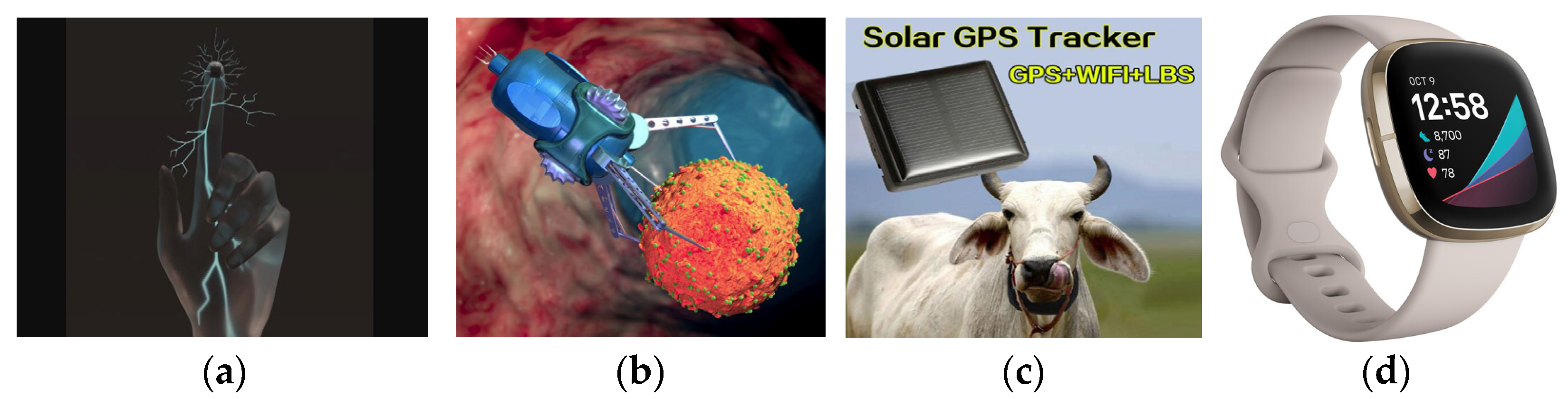
- Innovation Toronto. Technology That Restores the Sense of Touch in Nerves as Result of Injury. Available online: http://innovationtoronto.com/2021/07/technology-that-restores-the-sense-of-touch-in-nerves-damaged-as-a-result-of-injury/ (accessed on 7 December 2023).
- Yaabot. Nanorobots: The Future of Medical Innovation. Available online: https://yaabot.com/23051/nanorobots-in-medicine/ (accessed on 7 December 2023).
- Raybaca IOT Technology Co., Ltd. Solar GPS Tracker. Available online: https://rfidlivestocktags.sell.everychina.com/p-108898870-mini-solar-animal-gps-tracker-real-time-animal-tracking-device-for-cattle-horse-camel.html (accessed on 7 December 2023).
- bhphotovideo, Fitbit Sense GPS Smart Watch. Available online: https://www.bhphotovideo.com/c/product/1590668-REG/fitbit_fb512glwt_sense_gps_smartwatch_lunar.html (accessed on 7 December 2023).



| Organizations | Definitions |
|---|---|
| Cambridge dictionary | Describes machines, etc., that do not need an outside energy supply to work as they have their own source of energy [2]. |
| FORCE TECHNOLOGY | A self-powered system that charges itself with energy from its surroundings; it is a service-free solution. Depending on the surroundings, energy can be harvested from various sources, such as light, movement, heat, and magnetic and electrical fields [3]. |
| Included Articles | Problem Being Solved | Solution | Research Question Answered | |
|---|---|---|---|---|
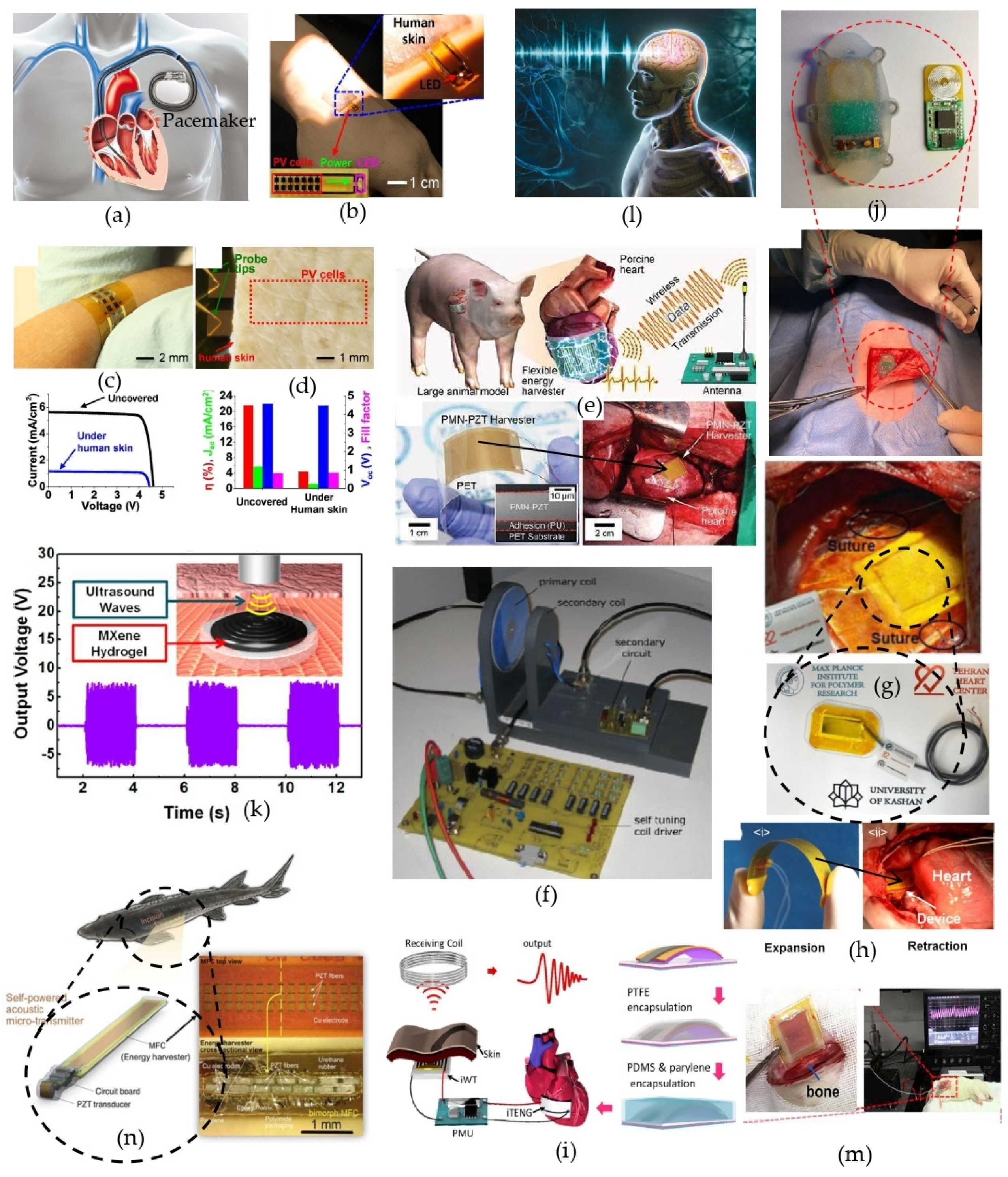
| [25] | Limited lifetime of battery technology for implantable devices, regular surgery for battery replacement for implants | Sub-dermal solar cell area under human skin for harvesting solar energy for powering wearable electronics | Applications of self-powered biomedical devices for healthcare | Implantable biomedical devices |
| [26] | Surgery is required for replacing the batteries of biomedical implants; late detection of cardiovascular diseases | Self-powered in vivo heartbeat rate monitoring device and real time transmission through Wi-Fi | ||
| [27] | Limited lifetime of battery technology for implantable devices | A self-tuning inductive powering system | ||
| [28] | Limited lifetime of battery technology for implants; lead-based ceramic piezoelectric nanogenerators are toxic and susceptible to fatigue cracking. | Self-powered cardiac pacemaker by a piezoelectric polymer nanogenerator implant | ||
| [29] | Limited lifetime of battery technology for implants; hypertension disease requires continuous and accurate measurement of blood pressure. | Implantable and self-powered blood pressure monitoring based on a piezoelectric thin film | ||
| [30] | Limited lifetime of battery technology for implants; many people suffer from CADs worldwide. | In vivo self-powered wireless cardiac monitoring via an implantable triboelectric nanogenerator | ||
| [31] | Power requirement for biomedical devices; non-communicable diseases such as diabetes and CADs affect the majority of the population. | A battery-less implantable glucose sensor based on electrical impedance spectroscopy | ||
| [32] | Biomedical devices are not compatible with living tissues and organs; power requirement for biomedical devices. | Biocompatible battery for medical implant charging via ultrasound | ||
| [33] | Energy-harvesting systems cannot supply enough power to deep brain stimulation devices; damaged nerves do not allow the rest of the body to communicate with the brain. | Self-powered deep brain stimulation via a flexible PIMNT energy harvester, which harvests energy from cyclic deformations from heart, lungs, muscle, joints for stimulating brain and inducing behavioral changes. | ||
| [34] | Many people worldwide suffer from osteoporosis and osteoporosis-related fractures; electrical stimulation requires external power, making it hard to miniaturize the device and improve portability | Self-powered implantable electrical stimulator for osteoblast proliferation and differentiation | ||
| [35] | Power requirement for long-term animal monitoring devices | An implantable biomedical energy harvester for animal monitoring devices | ||
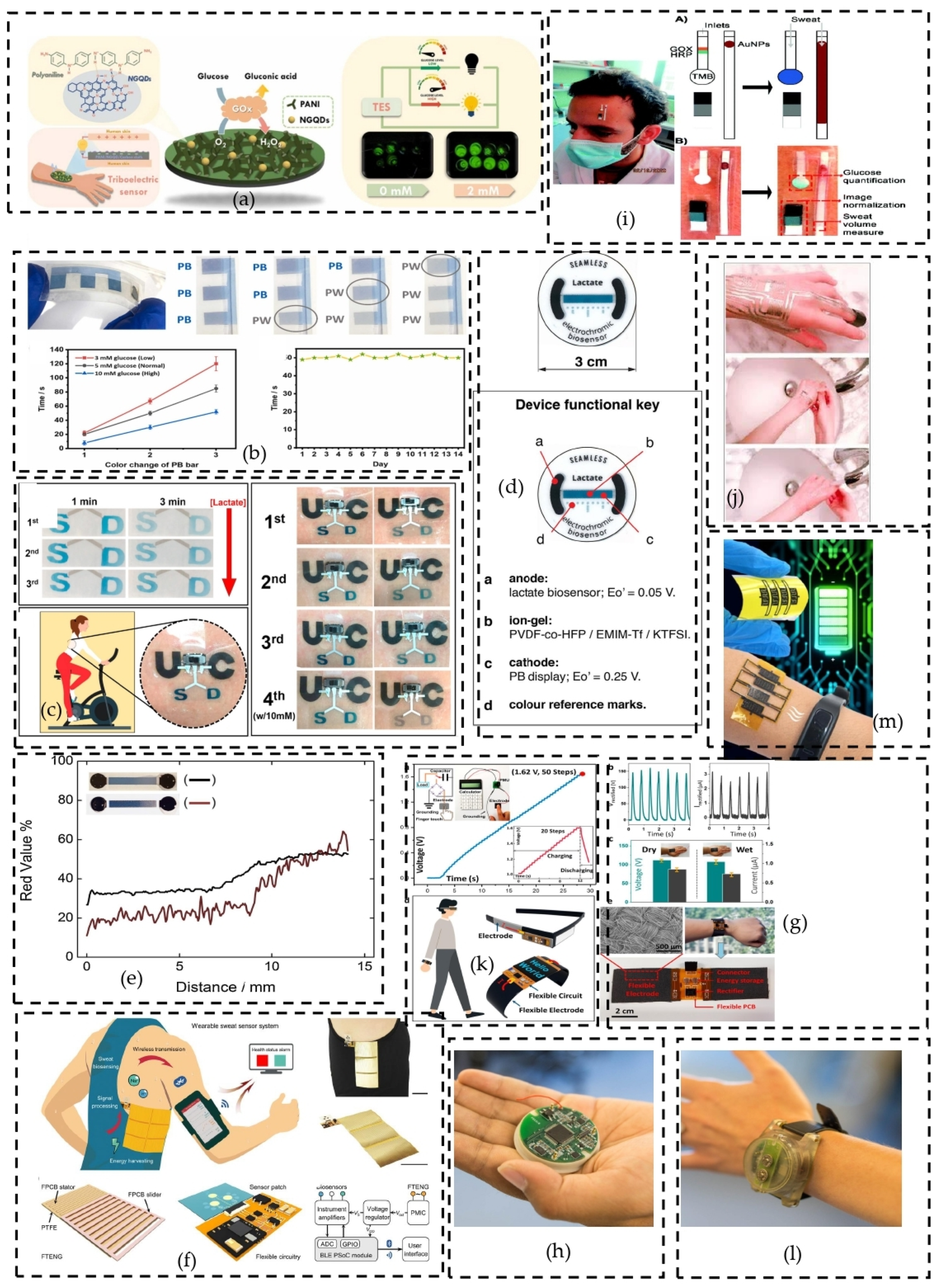
| [36] | Existing non-invasive glucose detectors have the common problems of low portability, wearability and integrability | Self-powered triboelectric sensor for non-invasive glucose monitoring in human sweat | Non-invasive biomedical devices | |
| [37] | Typical glucose sensors require an additional power supply and equipment for assessing glucose concentration | Flexible, disposable and portable self-powered glucose biosensors visible to the naked eye | ||
| [38] | The energy generated by wearable bio-fuel cells is insufficient for powering read-out systems and communication protocols | Resettable sweat-powered wearable biosensor | ||
| [39] | Many skin-path wearable sensors are limited by their dependence on silicon-based electronics, which increases the complexity and unit cost | Self-powered skin-path electrochromic biosensor | ||
| [40] | Mass manufacture of electrochromic materials is limited by the need for transparent electrodes and liquid electrode systems | Fully printed and silicon-free self-powered electrochromic biosensors | ||
| [41] | Limited lifetime of battery technology for biomedical devices, most wearable energy harvesters suffer from complex fabrication procedures, low power density, which make them unsuitable for biosensing | Wireless free-battery wearable sweat sensor powered by human motion, which extracts energy from a flexible printed circuit board (FPCB) based on a freestanding triboelectric generation process | ||
| [42] | Biomechanical energy harvesting devices such as electromagnetic, piezoelectric and triboelectric energy harvesters have complicated structures, high production/maintenance costs and wearability and implantable site limitations. | Body-integrated self-powered system for wearable and implantable applications, which harvests energy through an electrode attached to skin for powering biomedical devices | ||
| [43] | Issues in real-time detection of imbalances for patients requiring an immediate decision | Behavioral and environmental sensing and intervention (BESI), a sensor detecting extreme agitation in people with dementia | ||
| [44] | Low glucose levels can lead to hypoglycemia, which has grave consequences for diabetics. Limited lifetimes of battery technology for biomedical devices | Detection of low glucose levels in sweat with colorimetric wearable sensors, which use a wearable colorimetric biosensor measuring glucose levels in sweat. The camera of a smart phone is then used for signal reading. | ||
| [45] | Design and manufacturing of a soft body area sensor network relies on sophisticated approaches such as lithography or direct printing on carrier substrate before attaching to the body | Wearable circuits sintered at 3/4 room temperature directly on the skin surface for health monitoring, metal nanoparticles are printed on paper (fabric for flexible printed circuit boards), and sintered at room temperature and directly on human skin for on-body sensor with a novel sintering aid layer. Surface roughness is reduced and electromechanical performances are enhanced. | ||
| [42] | Limited lifetime of battery technology for biomedical devices | Flexible wearable self-powered electronics based on a body integrated self-powered system (BISS), which uses behavioral and environmental sensing intervention for detecting early agitation of patients with Parkinson’s disease and sclerosis hyperplasia. | ||
| [43] | Late detection of cerebral palsy, Parkinsons and multiple sclerosis diseases | Technology-Enabled Medical Precision Observation (TEMPO), which detects and records motion and provides healthcare with more accurate data for treating elderly patients and those with cerebral palsy, Parkinson’s and multiple sclerosis. | ||
| [46] | Micro-super capacitors are promising alternatives for replacing lithium-ion batteries in wearable electronics, but they have a limited power density and a limited mechanical stretchability | High-energy all-in-one stretchable micro-supercapacitor arrays based on 3D laser-induced graphene foams decorated with mesoporous ZnP nanosheets for self-powered stretchable systems, which exhibit excellent ionic and electrical conductivity and impressive gravimetric capacitance and long-term stability. | ||
| [16] | Diabetes management is expensive, and there is a need for self-monitoring of glucose levels at an affordable price with locally available materials in Africa | A blood glucose meter in Africa for Africans, which has an audio-visual output and a computer interface. It is made of microcontroller PIC16F877A for interfacing between a glucose sensor and an audio-visual unit (LCD and audio speaker). The glucose sensor is an electrochemical diagnostic strip, which uses glucose oxidase enzymes in conjunction with three electronically conductive electrodes. The chemical reaction produces a voltage. The voltage is processed by microcontroller using analog–digital conversion. Digital data are used to assess glucose levels and the results are sent to an audio-visual unit | Other biomedical device achievements in Africa | Nigeria |
| [47] | Permanent pacemaker implants encounter immediate post-procedure complications, including pneumothorax, hemothorax, air embolism, cardiac perforation etc. | Early experience with permanent pacemaker implantation at a tertiary hospital in Nigeria | ||
| [48] | Cardiovascular disease affects the large majority of the population in the world and South Nigeria has an increased demand for invasive cardiac procedures, which are largely unavailable | Cardiac pacemaker insertion in the South of Nigeria: Prospects and challenges | ||
| [17] | Prevalence of diabetes increases in middle- and low-income countries | Low-cost, non-invasive smart glucose monitoring device made in South Africa, which consist of three main parts: a transmitter (light source), a receiver (photo diode) and a processor (PIC16F877A), along with a data display section. Near-infrared is applied on the ear lobe, and the receiver receives the attenuated signal. The attenuated signal is used for assessing glucose level and is displayed on an LCD screen. | South Africa | |
| [18] | A child is 500 times more likely to die during the first day of life than at one month of age in the developing world. Newborn mortality accounts for nearly 60 percent of infant deaths; biomedical devices designed for use in controlled sanitary conditions of first world hospitals do not stand a chance in rural Africa due to the harsh user environment and lack of proper training. | Free play fetal heart rate monitor, which measures the infant’s heart rate during birth and determines if the child is getting enough oxygen in the mother’s placenta. A low fetal heartbeat rate lowers the need for oxygen. | ||
| [19] | Difficulties for evacuation of liquids and air from the chest, difficult patient management during mobility loss | SINAPI chest drain, which is custom-made, used post-cardiac surgery patients and fitted with a tube roller and a high gravity vent. The tube roller facilitates stripping of the tubing to remove clots, maintaining potency. | ||
| [49] | Safety and effectiveness concerns over biomedical devices developed in Uganda | Formalize and establish a regulatory framework in Uganda for biomedical device developers | Uganda | |
| [50] | 27,000 children in Uganda die every year due to pneumonia; incorrect pneumonia diagnosis can be fatal | Biomedical smart jacket (Mama-Ope), which gives hope to mothers. It is a jacket measuring body temperature, heart rate and lung conditions. The jacket stretches across the whole chest and side of a patient. It monitors specific points on the lungs for symptoms of pneumonia. The jacket is connected to a smart phone via Bluetooth, which sends, records and analyzes the medical data, enabling healthcare professionals to make an informed diagnosis. | ||
| [51] | Difficulty in diagnosis of fetal vital signs | Vital sign monitor for expectant mothers | ||
| [52] | Many diseases require intravenous (IV) infusion therapy, but uncontrolled infusion rates and incorrect dosing can lead to severe complications or even death | Electronically controlled gravity feed infusion device, which monitors and controls drops with an accuracy of +/−10%. It has four main parts: -A microprocessor/logical unit, which receives inputs from peripherals, processes them and sends commands to actuators; -A drop rate detector module, which has a light source and a photocell signal for drop rate detection and transmits data to a micro-processor; -A user interface for human–machine interaction | ||
| [14] | Unavailability of experienced scientists in rural areas for heart rate monitoring and medical advice | CARDIOPAD device for assessing heart rate and forwarding data to remote scientist through wireless communication | Cameroon | |
| [53] | Cardiovascular diseases are emerging threats for the health of the population in Africa; 60% of the population in Africa live in rural areas and have no accessibility to appropriate healthcare | CARDIOPAD device, which is a small tablet for recording heartbeat rates and forwarding data by email to a remote scientist or cardiology hospital. The device can also directly generate a PDF file or send the data via Bluetooth transmission | ||
| [15] | Over 8 million babies die prematurely in low-income countries | Multi-function neonatal incubator for low-income countries | ||
| [54] | Cardiovascular diseases are constantly increasing worldwide, especially in low-income countries | Long-term prognosis of patients with permanent cardiac pacemakers in three cardiac centers in Cameroon | ||
| [55] | The study of heart electrical conduction systems is limited only to mathematical modeling | Theoretical and experimental study of non-linear dynamics of a cardiac electrical conduction system | ||
| [56] | Citizens with cardiovascular-related diseases are exposed to poor health service; the cost of acquiring healthcare-related technologies is high | Low-cost IoT-based remote cardiovascular patient monitoring system in Cameroon | ||
| Non-Invasive Biomedical Devices | In Vivo Biomedical Devices | |||||||
|---|---|---|---|---|---|---|---|---|
| Source Type | Typical Application | Authors | Size | Harvesting Performance | Typical Application | Authors | Size | Harvesting Performance (Voltage, Power) |
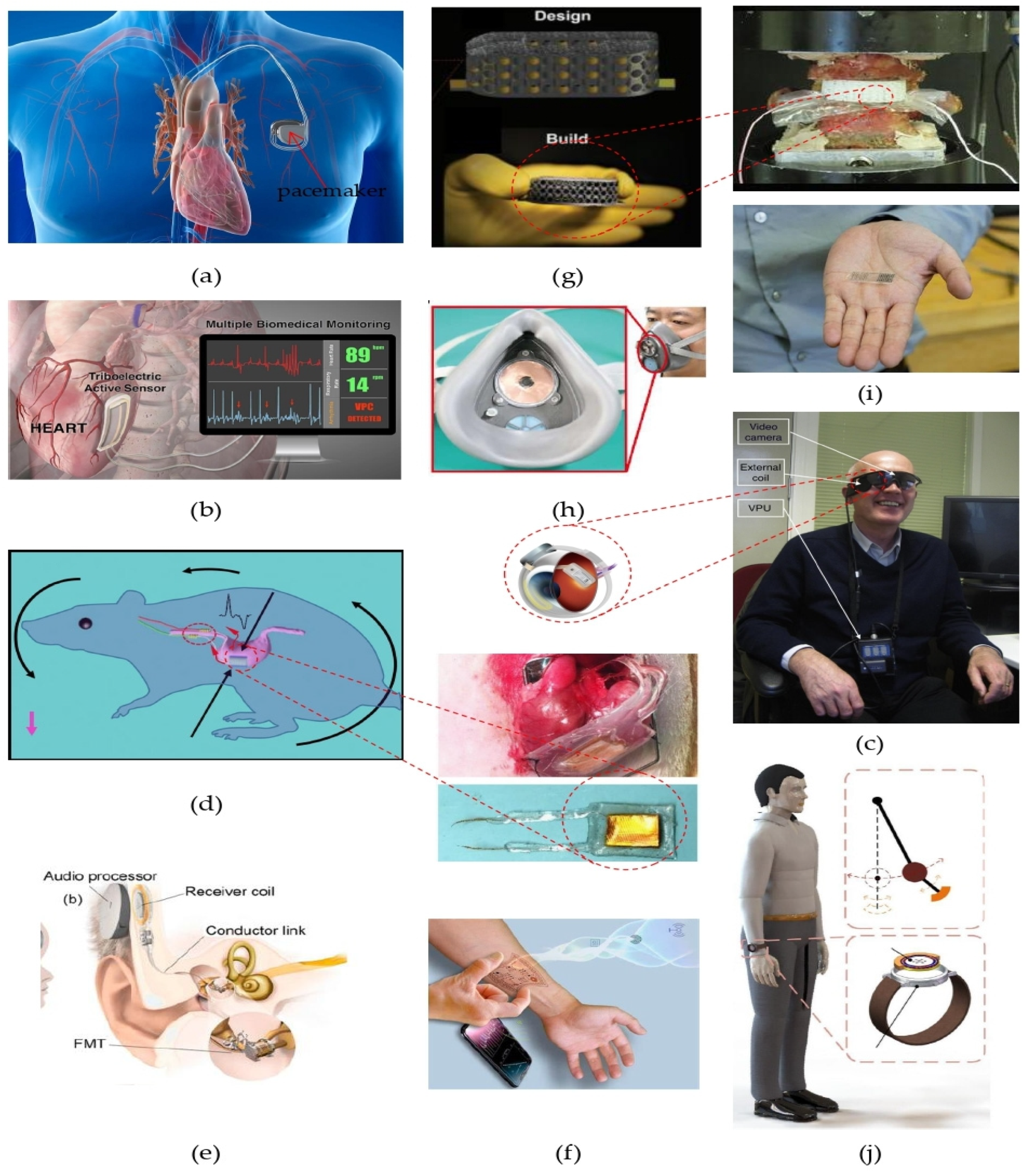
| Electromagnetic energy generation/hybrid energy generation | Self-powered e-watch based on an electromagnetic triboelectric energy harvester | Teng Quan et al., Reproduced with permission from [57] | 3.6 × 3.6 × 3 cm2 | 1.1 V 6.1 mW 0.35 mA | Miniaturized electromechanical devices for the characterization of the biomechanics of deep tissue | Enming Song et al. [58] | 18 × 18 × 2.5 mm2 | (50 Hz, 5 V) |
| Electromagnetic triboelectric harvester for wearable electronics | Kewei Zhang et al. [59] | 5 × 5 × 2.5 cm3 60 g | 4.9 mW and 3.5 mW 5.1 W/m2 4.3 V 1.3 mA | Miniaturized EMEH for leadless cardiac pacemaker | Nicolas Franzina et al. [60] | Length 30 mm, Diameter 7 mm, Volume 1.15 cm3, mass 8.01 g | 7.2 µW 200 mV | |
| Working Mechanism, Advantages and Limitations | Mechanism: Electromagnetic energy results from the motion of a coil through a stationary field Advantages: Suitable for harvesting energy from translational or rotational motions. Limitations: Hard to achieve design miniaturization; low power density compared to piezoelectric, triboelectric and photovoltaic energy generation. | |||||||
| Piezoelectric energy generation | Piezoelectric BaTiO3 nanoparticles for biomolecule detection | Sophia Selvar ajan et al. [61] | 7.5 × 1.5 × 1.6 cm3 | 60 mV 0.4 nW 0.022 nW cm−3 | Piezoelectric nanogenerator for pace makers | Azimi et al. [28] | 6.5 mm × 3.5 mm × 150 µm | 6.06 V 143 µW/cm3 |
| A Shoe-Embedded Piezoelectric Energy Harvester for Wearable Sensors | Jingjing Zhao and Zheng You [62] | 80 mm × 50 mm | 3.6 V 4 mW | Experimental study on a piezoelectric vibration energy harvester for self-powered cardiac pacemakers | Feng Xie et al. [63] | 6 × 2 × 0.1 mm3 | 3.5 mV 60 nA | |
| Working Mechanism, Advantages and Limitations | Mechanism: Piezoelectricity is generated by applying mechanical stress to a piezoelectric material. Advantages: Suitable for harvesting strain or pressure energy, higher power density compared to electromagnetic energy harvesting, possibility to miniaturize the design, suitable for in vivo biomedical applications. Limitations: Low power density compared to compared to triboelectric and photovoltaic energy generation. | |||||||
| Triboelectric energy generation | Triboelectric nanogenerators for self-powered sensing | Yaojie Han et al. [64] | 5 × 5 cm2 | 0.35 µA 130 V 45.8 µW cm−2 | Self-powered energy harvesting and implantable storage system based on hydrogel-enabled all-solid-state supercapacitor and triboelectric nanogenerator | Zhuo Wang et al. [65] | 2 × 4 cm2 | 95.04 V 1.38 µA 9.03 µW cm−2 |
| A triboelectric nanogenerator as a self-powered temperature sensor based on PVDF and PTFE | Kequan Xia et al. [66] | 60 cm × 3 cm × 1 mm | 49 V 240 µW | Self-rechargeable cardiac pacemaker system with triboelectric nanogenerators | Hanjun Ryu et al. [10] | Radius 1.5 cm Height 2.4 mm | 4 V 4.9 µW cm3 | |
| Working Mechanism, Advantages and Limitations | Mechanism: Triboelectric energy results from friction between two different triboelectric materials. Advantages: Higher power density compared to electromagnetic and piezoelectric energy harvesting, possibility to miniaturize the design, suitable for friction energy harvesting, suitable for in vivo biomedical applications. Limitations: The structure of triboelectric nanogenerator needs to retain a small gap for contact separation, so further efforts are needed for miniaturizing the design. Miniaturizing the design affects the output performance. Finding the balance between size and power performance is challenging for biomedical applications. | |||||||
| Photovoltaic energy generation | Flexible-fabric-based GaAs thin-film solar cell for wearable energy harvesting applications | Yeojun Yun et al. [67] | 0.2 cm2 | 0.972 V 100 mW/cm2 22.59 mA/cm2 | Photovoltaic Power Harvesting Technologies in Biomedical Implantable Devices Considering the Optimal Location | Jinwei Zhao et al. [68] | P+ Layer 1 × 1020 cm−3 Layer 4.6 × 1015 cm−3 Layer 1 × 1016 cm−3 | 0.675 V 17.20 mW 100 mW/cm2 31.42 mA/cm2 |
| Solar and Thermal Energy Harvesting with a Wearable Jacket | Quinn Brogan et al. [69] | 31 × 31 × 3.0 (L × W × D) mm | Open circuit voltage: 2.2 V per cell Peak voltage: 1.2 V per cell 475–500 mW | Energy Harvesting by Subcutaneous Solar Cells: A Long-Term Study on Achievable Energy Output | L. BEREUTER et al. [70] | 3.6 cm2 | s 67 µW (=19 µW cm−2) | |
| Working Mechanism, Advantages and Limitations | Mechanism: Sunlight hits solar cells and electrons in the cells are energized, start moving and then flow out of the junction between cells layers, creating electric current. Advantages: Highest power density compared to electromagnetic, piezoelectric and triboelectric energy generation. Limitations: Not applicable for in vivo biomedical energy harvesting since solar cells need to be exposed to sunlight. | |||||||
Disclaimer/Publisher’s Note: The statements, opinions and data contained in all publications are solely those of the individual author(s) and contributor(s) and not of MDPI and/or the editor(s). MDPI and/or the editor(s) disclaim responsibility for any injury to people or property resulting from any ideas, methods, instructions or products referred to in the content. |
© 2023 by the authors. Licensee MDPI, Basel, Switzerland. This article is an open access article distributed under the terms and conditions of the Creative Commons Attribution (CC BY) license (https://creativecommons.org/licenses/by/4.0/).
Share and Cite
Olivier, D.N.; Wang, W.; Liu, C.; Wang, Z.; Ding, B. Survey on Energy Harvesting for Biomedical Devices: Applications, Challenges and Future Prospects for African Countries. Sensors 2024, 24, 163. https://doi.org/10.3390/s24010163
Olivier DN, Wang W, Liu C, Wang Z, Ding B. Survey on Energy Harvesting for Biomedical Devices: Applications, Challenges and Future Prospects for African Countries. Sensors. 2024; 24(1):163. https://doi.org/10.3390/s24010163
Chicago/Turabian StyleOlivier, Djakou Nekui, Wei Wang, Cheng Liu, Zhixia Wang, and Bei Ding. 2024. "Survey on Energy Harvesting for Biomedical Devices: Applications, Challenges and Future Prospects for African Countries" Sensors 24, no. 1: 163. https://doi.org/10.3390/s24010163
APA StyleOlivier, D. N., Wang, W., Liu, C., Wang, Z., & Ding, B. (2024). Survey on Energy Harvesting for Biomedical Devices: Applications, Challenges and Future Prospects for African Countries. Sensors, 24(1), 163. https://doi.org/10.3390/s24010163