Comparison of Named Data Networking Mobility Methodology in a Merged Cloud Internet of Things and Artificial Intelligence Environment

 , ,
, ,  and
and 
Abstract
:1. Introduction
2. Background
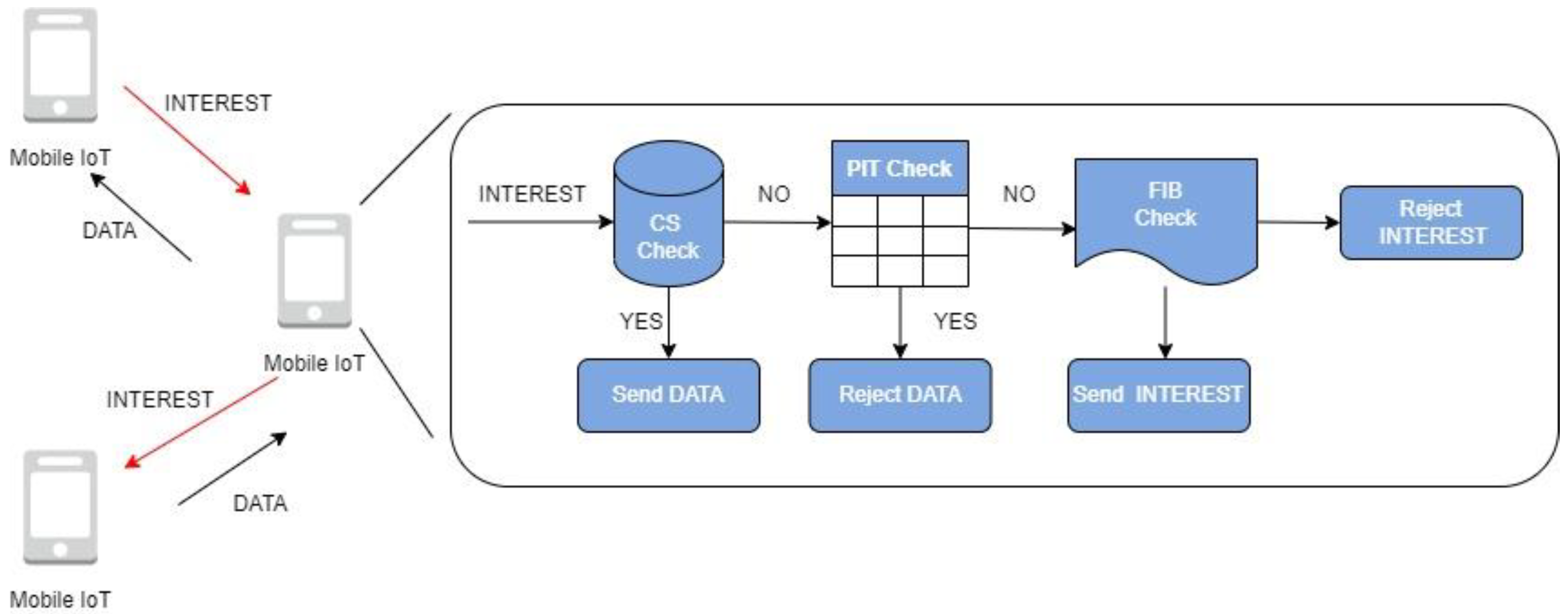
2.1. Named Data Networking
2.2. Named Data Networking and Artificial Intelligence
2.3. Named Data Networking and Cloud Internet of Things
3. Mobility Methodology
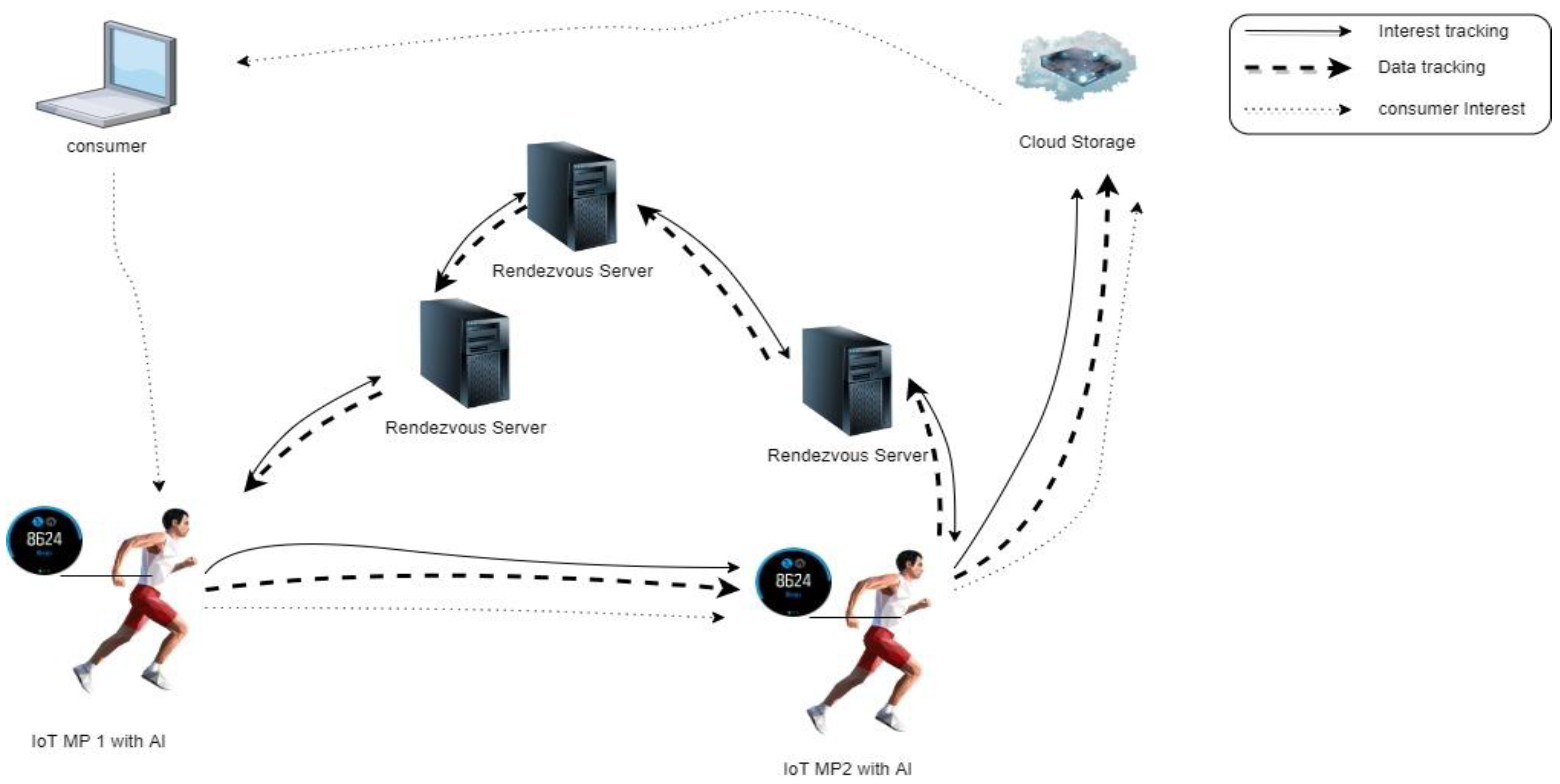
3.1. KITE of NDN with C-IoT and AI
3.2. The PMSS of NDN with C-IoT and AI
3.3. Hybrid of NDN with C-IoT and AI
4. Performance Comparison
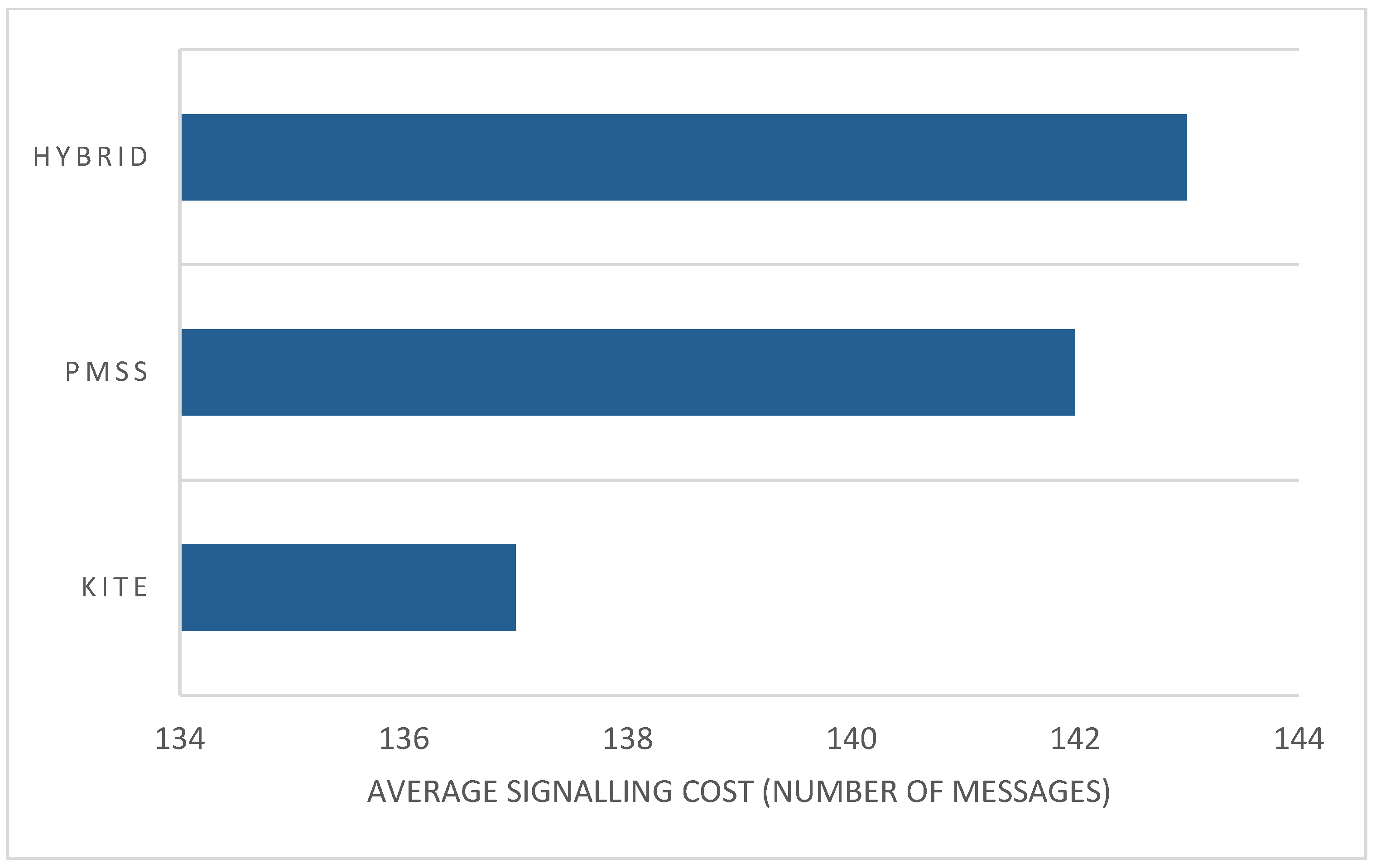
4.1. Signaling Cost
- Signaling cost for KITE operation
= SInterest/data × (2a + 2c) + SInterest × (2a + 2c)
- Signaling cost for PMSS operation
= SmobilityInterest × (a + 2c) + SInterest × (a + c)
- Signaling cost for hybrid NeMO operation
= SmobilityInterest × (a + c) + SInterest × (a + c)
- Average signaling cost for each mobility operation
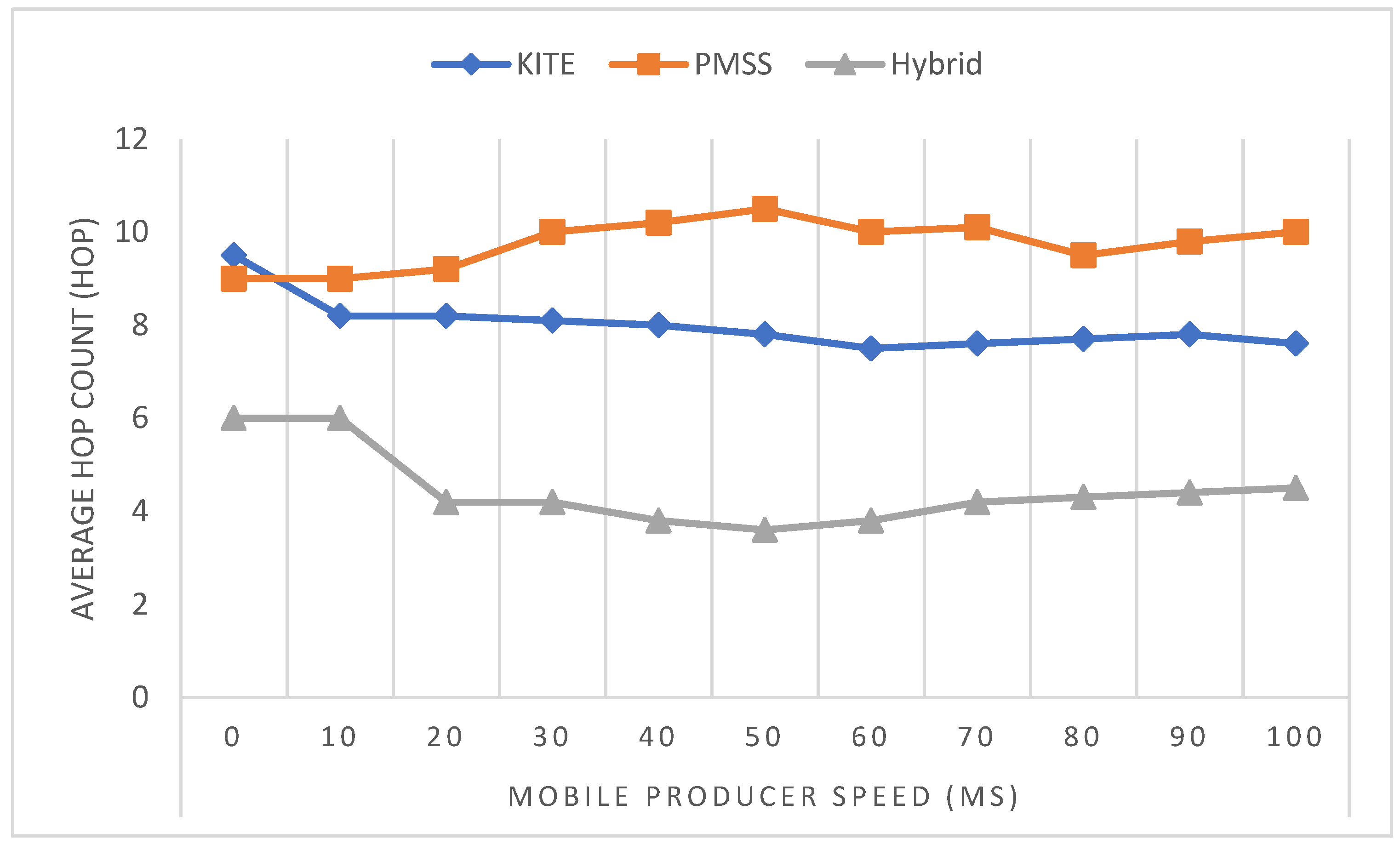
4.2. Handover Latency
- Handover latency equation for KITE operation
- Handover latency equation for PMSS operation
- Handover latency equation for hybrid NeMO operation
- Average handover latency equation for each mobility operation
5. Discussion and Analysis
5.1. Signaling Cost
5.2. Handover Latency
6. Conclusions
Author Contributions
Funding
Institutional Review Board Statement
Informed Consent Statement
Data Availability Statement
Acknowledgments
Conflicts of Interest
References
- Hou, S.; Hu, Y.; Tian, L. A Survey on Geographic location routing and forwarding strategies of VANET and WSN based on NDN. J. Phys. Conf. Ser. 2021, 1738, 012040. [Google Scholar] [CrossRef]
- Hao, B.; Wang, G.; Zhang, M.; Zhu, J.; Xing, L.; Wu, Q. Stochastic Adaptive Forwarding Strategy Based on Deep Reinforcement Learning for Secure Mobile Video Communications in NDN. Secur. Commun. Netw. 2021, 2021, 6630717. [Google Scholar] [CrossRef]
- Gündoğan, C.; Kietzmann, P.; Schmidt, T.C.; Wählisch, M. A mobility-compliant publish–subscribe system for an information-centric Internet of Things. Comput. Netw. 2022, 203, 108656. [Google Scholar] [CrossRef]
- Mohd Aman, A.H.; Yadegaridehkordi, E.; Attarbashi, Z.S.; Hassan, R.; Park, Y.J. A Survey on Trend and Classification of Internet of Things Reviews. IEEE Access 2020, 8, 111763–111782. [Google Scholar] [CrossRef]
- Fu, J.; Liao, Z.; Liu, J.; Smith, S.C.; Wang, J. Memristor-Based Variation-Enabled Differentially Private Learning Systems for Edge Computing in IoT. IEEE Internet Things J. 2021, 8, 9672–9692. [Google Scholar] [CrossRef]
- Karim, F.A.; Mohd Aman, A.H.; Hassan, R.; Nisar, K. A Survey on Information-Centric Networking with Cloud Internet of Things and Artificial Intelligence. Wirel. Commun. Mob. Comput. 2022, 2022, 7818712. [Google Scholar] [CrossRef]
- Karim, F.A.; Mohd Aman, A.H.; Hassan, R.; Nisar, K.; Uddin, M. Named Data Networking: A Survey on Routing Strategies. IEEE Access 2022, 10, 90254–90270. [Google Scholar] [CrossRef]
- Azamuddin, W.M.H.; Aman, A.H.M.; Hassan, R.; Abdali, T.A.N. Named Data Networking Mobility: A Survey. In Emerging Technology Trends in Internet of Things and Computing. TIOTC 2021. Communications in Computer and Information Science; Liatsis, P., Hussain, A., Mostafa, S.A., Al-Jumeily, D., Eds.; Springer: Cham, Switzerland, 2022; Volume 1548. [Google Scholar] [CrossRef]
- Zhang, Y.; Xia, Z.; Mastorakis, S.; Zhang, L. KITE. In Proceedings of the 5th ACM Conference on Information-Centric Networking, Boston, MA, USA, 21–23 September 2018; pp. 125–136. [Google Scholar] [CrossRef]
- Hussaini, M.; Nor, S.A.; Ahmad, A. PMSS: Producer Mobility Support Scheme Optimization with RWP Mobility Model in Named Data Networking. Int. J. Commun. Netw. Inf. Secur. 2018, 10, 329–339. Available online: https://www.scopus.com/inward/record.uri?eid=2-s2.0-85051811566&partnerID=40&md5=2e294ec148f4d3dff72c8096c425022e (accessed on 1 March 2022). [CrossRef]
- Yan, Z.; Park, Y.; Leau, Y.; Ren-Ting, L.; Hassan, R. Hybrid Network Mobility Support in Named Data Networking. In Proceedings of the 2020 International Conference on Information Networking (ICOIN), Barcelona, Spain, 7–10 January 2020; pp. 16–19. [Google Scholar] [CrossRef]
- Saxena, D.; Raychoudhury, V.; Suri, N.; Becker, C.; Cao, J. Named Data Networking: A survey. Comput. Sci. Rev. 2016, 19, 15–55. [Google Scholar] [CrossRef]
- Sinky, H.; Khalfi, B.; Hamdaoui, B.; Rayes, A. Responsive Content-Centric Delivery in Large Urban Communication Networks: A LinkNYC Use-Case. IEEE Trans. Wirel. Commun. 2018, 17, 1688–1699. [Google Scholar] [CrossRef]
- Zhu, Z.; Afanasyev, A.; Zhang, L. A New Perspective on Mobility Support. NDN Tech. Rep. 2013, 13, 1–6. Available online: http://new.named-data.net/wp-content/uploads/TRmobility.pdf (accessed on 12 January 2022).
- Detti, A.; Bracciale, L.; Loreti, P.; Rossi, G.; Blefari Melazzi, N. A cluster-based scalable router for information centric networks. Comput. Netw. 2018, 142, 24–32. [Google Scholar] [CrossRef]
- Farahat, H. Proactive Caching to Support Mobility in Named Data Networks. Ph.D. Thesis, Queen’s University, Kingston, ON, Canada, June 2017. [Google Scholar]
- Torres, J.V.; Alvarenga, I.D.; Boutaba, R.; Duarte, O.C.M.B. Evaluating CRoS-NDN: A comparative performance analysis of a controller-based routing scheme for named-data networking. J. Internet Serv. Appl. 2019, 10, 20. [Google Scholar] [CrossRef]
- Carofiglio, G. Mobile Video Delivery with Hybrid ICN IP-Integrated ICN Solution for 5G. Available online: https://www.cisco.com/c/dam/en/us/solutions/collateral/service-provider/ultra-services-platform/mwc17-hicn-video-wp.pdf (accessed on 15 January 2022).
- Hu, N.; Tian, Z.; Sun, Y.; Yin, L.; Zhao, B.; Du, X.; Guizani, N. Building Agile and Resilient UAV Networks Based on SDN and Blockchain. IEEE Netw. 2021, 35, 57–63. [Google Scholar] [CrossRef]
- Choi, J.H.; Cha, J.H.; Han, Y.H.; Min, S.G. A dual-connectivity mobility link service for producer mobility in the named data networking. Sensors 2020, 20, 4859. [Google Scholar] [CrossRef]
- Rehman, M.A.U.; Ullah, R.; Kim, B.S. NINQ: Name-integrated query framework for named-data networking of things. Sensors 2019, 19, 2906. [Google Scholar] [CrossRef]
- Fu, X.; Yang, Y. Modeling and analyzing cascading failures for Internet of Things. Inf. Sci. 2021, 545, 753–770. [Google Scholar] [CrossRef]
- Zheng, Y.; Han, M.; He, L.; Li, Y.; Xing, G.; Hou, R. A QoS-supported Multi-constrained Routing Strategy Based on Ant-Colony Optimization for Named Data Networking. In Proceedings of the 2018 1st IEEE International Conference on Hot Information-Centric Networking (HotICN), Shenzhen, China, 15–17 August 2018; pp. 18–23. [Google Scholar] [CrossRef]
- Zhang, Y.; Wang, J.; Gong, L.; Yuan, J.; Lei, K. A quantified forwarding strategy in NDN by integrating ant colony optimization into MADM. In Proceedings of the 2017 IEEE International Symposium on Parallel and Distributed Processing with Applications and 2017 IEEE International Conference on Ubiquitous Computing and Communications (ISPA/IUCC), Guangzhou, China, 12–15 December 2017; pp. 214–220. [Google Scholar] [CrossRef]
- Rotinsulu, M.R.; Susilo, B.; Presekal, A.; Pramono, E.; Sari, R.F. Measuring Quality of Services (QoS) of several forwarding strategies on Named Data Networking(NDN) using ndnSIM. In Proceedings of the 2017 IEEE International Conference on Cybernetics and Computational Intelligence (CyberneticsCom), Phuket, Thailand, 20–22 November 2017; pp. 45–49. [Google Scholar] [CrossRef]
- Martins, V.F.; Tomczyk, Ł.; Amato, C.; Eliseo, M.A.; Oyelere, S.S.; Akyar, Ö.Y.; Motz, R.; Barros, G.; Sarmiento, S.M.A.; Silveira, I.F. A Smart Ecosystem for Learning and Inclusion: An Architectural Overview; LNCS; Springer International Publishing: Berlin/Heidelberg, Germany, 2020; Volume 12249, ISBN 9783030587987. [Google Scholar]
- Sun, X. Advances in Artificial Intelligence and Security. In Proceedings of the 7th International Conference, Dublin, Ireland, 19–23 July 2021. [Google Scholar]
- Islam, S.; Abdalla, A.H.; Hasan, M.K. Novel multihoming-based flow mobility scheme for proxy NEMO environment: A numerical approach to analyse handoff performance. ScienceAsia 2017, 43, 27–34. [Google Scholar] [CrossRef]
- Rahman, M.S.; Bouidel, O.; Atiquzzaman, M.; Ivancic, W. Performance comparison between nemo bsp and sinemo. In Proceedings of the 2008 IEEE Global Telecommunications Conference, New Orleans, LA, USA, 30 November–4 December 2008; pp. 1–5. [Google Scholar] [CrossRef]
- Alfredo, L.; Gennaro, G.; Piro, G.; Jararweh, Y.; Eds, C.C.; Goos, G. Ad-Hoc, Mobile, and Wireless Networks; Springer: Berlin/Heidelberg, Germany, 2020. [Google Scholar]
- Mohd Aman, A.H.; Hassan, W.H.; Sameen, S.; Attarbashi, Z.S.; Alizadeh, M.; Latiff, L.A. IoMT amid COVID-19 pandemic: Application, architecture, technology, and security. J. Netw. Comput. Appl. 2021, 174, 102886. [Google Scholar] [CrossRef]
- Ali, E.S.; Hasan, M.K.; Hassan, R.; Saeed, R.A.; Hassan, M.B.; Islam, S.; Nafi, N.S.; Bevinakoppa, S. Machine Learning Technologies for Secure Vehicular Communication in Internet of Vehicles: Recent Advances and Applications. Secur. Commun. Netw. 2021, 2021, 8868355. [Google Scholar] [CrossRef]
- Zhang, Y. Artificial Intelligence and Cognitive Computing for Communications and Networks. IEEE Access 2018, 8, 144105–144111. [Google Scholar] [CrossRef]
- Langa, C.; Tarwireyi, P.; Adigun, M. Evaluating Named Data Networking forwarding strategies in different loT topologies. In Proceedings of the 2020 International Conference on Artificial Intelligence, Big Data, Computing and Data Communication Systems (icABCD), Durban, South Africa, 6–7 August 2020. [Google Scholar] [CrossRef]
- Cui, W.; Li, Y.; Zhang, Y.; Liu, C.; Zhan, M. An ant colony algorithm based content poisoning mitigation in named data networking. In Proceedings of the 2019 18th IEEE International Conference On Trust, Security And Privacy In Computing And Communications/13th IEEE International Conference On Big Data Science And Engineering (TrustCom/BigDataSE), Rotorua, New Zealand, 5–8 August 2019; pp. 176–183. [Google Scholar] [CrossRef]
- Compagno, A.; Conti, M.; Losiouk, E.; Tsudik, G.; Valle, S. A Proactive Cache Privacy Attack on NDN. In Proceedings of the NOMS 2020–2020 IEEE/IFIP Network Operations and Management Symposium, Budapest, Hungary, 20–24 April 2020. [Google Scholar] [CrossRef]
- Aboodi, A.; Wan, T.C.; Sodhy, G.C. Survey on the Incorporation of NDN/CCN in IoT. IEEE Access 2019, 7, 71827–71858. [Google Scholar] [CrossRef]
- Ahed, K.; Benamar, M.; El Ouazzani, R. Content delivery in named data networking based internet of things. In Proceedings of the 2019 15th International Wireless Communications & Mobile Computing Conference (IWCMC), Tangier, Morocco, 24–28 June 2019; pp. 1397–1402. [Google Scholar] [CrossRef]
- Khan, M.T.R.; Saad, M.M.; Tariq, M.A.; Akram, J.; Kim, D. SPICE-IT: Smart COVID-19 pandemic controlled eradication over NDN-IoT. Inf. Fusion 2021, 74, 50–64. [Google Scholar] [CrossRef]
- Kar, P.; Dong, Y.; Li, Y.; Ma, X.; Ding, X.; Wang, Y. NDN Based Plug-n-Play and Secure Remote Health Monitoring System. In Proceedings of the ICC 2021-IEEE International Conference on Communications, Montreal, QC, Canada, 14–23 June 2021. [Google Scholar] [CrossRef]
- Hasan, M.K.; Islam, S.; Sulaiman, R.; Khan, S.; Hashim, A.H.A.; Habib, S.; Islam, M.; Alyahya, S.; Ahmed, M.M.; Kamil, S.; et al. Lightweight Encryption Technique to Enhance Medical Image Security on Internet of Medical Things Applications. IEEE Access 2021, 9, 47731–47742. [Google Scholar] [CrossRef]
- Tran, M.N.; Kim, Y. Named data networking based disaster response support system over edge computing infrastructure. Electronics 2021, 10, 335. [Google Scholar] [CrossRef]
- Okamoto, K.; Mochida, T.; Nozaki, D.; Wen, Z.; Qi, X.; Sato, T. Content-Oriented Surveillance System Based on ICN in Disaster Scenarios. In Proceedings of the 2018 21st International Symposium on Wireless Personal Multimedia Communications (WPMC), Chiang Rai, Thailand, 25–28 November 2018; pp. 484–489. [Google Scholar] [CrossRef]
- Hu, N.; Tian, Z.; Lu, H.; Du, X.; Guizani, M. A multiple-kernel clustering based intrusion detection scheme for 5G and IoT networks. Int. J. Mach. Learn. Cybern. 2021, 12, 3129–3144. [Google Scholar] [CrossRef]
- Hu, N.; Tian, Z.; Du, X.; Guizani, M. An Energy-Efficient In-Network Computing. IEEE Trans. Green Commun. Netw. 2021, 5, 1722–1733. [Google Scholar] [CrossRef]
- Liu, S.; Patil, V.; Yu, T.; Afanasyev, A.; Feltus, F.A.; Shannigrahi, S.; Zhang, L. Designing hydra with centralized versus decentralized control: A comparative study. In Proceedings of the Interdisciplinary Workshop on (de) Centralization in the Internet, Virtual Event, Germany, 7 December 2021; pp. 4–10. [Google Scholar] [CrossRef]
- Ma, X.; Zhang, L. GitSync: Distributed version control system on NDN. In Proceedings of the 8th ACM Conference on Information-Centric Networking, Paris, France, 22–24 September 2021; pp. 121–123. [Google Scholar] [CrossRef]
- Rawat, D.B.; Doku, R.; Adebayo, A.; Bajracharya, C.; Kamhoua, C. Blockchain Enabled Named Data Networking for Secure Vehicle-to-Everything Communications. IEEE Netw. 2020, 34, 185–189. [Google Scholar] [CrossRef]
- Baldoni, G.; Loudet, J.; Cominardi, L.; Corsaro, A.; He, Y. Facilitating distributed data-flow programming with Eclipse Zenoh: The ERDOS case. In Proceedings of the 1st Workshop on Serverless mobile networking for 6G Communications, WI, USA, 25 June 2021; pp. 13–14. [Google Scholar] [CrossRef]
- Wang, X.; Cai, S. Named Data Networking-Based Macrovehicular Cloud Framework. IEEE Syst. J. 2021, 15, 5646–5653. [Google Scholar] [CrossRef]
- Ogle, C.; Reddick, D.; McKnight, C.; Biggs, T.; Pauly, R.; Ficklin, S.P.; Feltus, F.A.; Shannigrahi, S. Named Data Networking for Genomics Data Management and Integrated Workflows. Front. Big Data 2021, 4, 1–16. [Google Scholar] [CrossRef]
- Wang, X.; Wang, X.; Wang, D. Cost-efficient data retrieval based on integration of VC and NDN. IEEE Trans. Veh. Technol. 2021, 70, 967–976. [Google Scholar] [CrossRef]
- Neto, R.C.J.; Merindol, P.; Theoleyre, F. Transformation Based Routing Overlay for Privacy and Reusability in Multi-Domain IoT. In Proceedings of the 2020 IEEE 19th International Symposium on Network Computing and Applications (NCA), Cambridge, MA, USA, 24–27 November 2020. [Google Scholar] [CrossRef]
- Wilhelm, G.; Fouchal, H.; Ayaida, M. Vehicular Context Cloud Networking for Intelligent Transport Systems. In Proceedings of the ICC 2020-2020 IEEE International Conference on Communications (ICC), Dublin, Ireland, 7–11 June 2020; Volume 2020. [Google Scholar] [CrossRef]
- Wang, X.; Cai, S. Secure healthcare monitoring framework integrating NDN-based IoT with edge cloud. Futur. Gener. Comput. Syst. 2020, 112, 320–329. [Google Scholar] [CrossRef]
- Ajmi, N.; Helali, A.; Hafnaoui, T.; Mghaieth, R. A virtual sensor network for (WSNs): Architecture and routing. In Proceedings of the 2020 IEEE International Conference on Design & Test of Integrated Micro & Nano-Systems (DTS), Hammamet, Tunisia, 7–10 June 2020. [Google Scholar] [CrossRef]
- Shannigrahi, S.; Mastorakis, S.; Ortega, F.R. Next-generation networking and edge computing for mixed reality real-time interactive systems. In Proceedings of the 2020 IEEE International Conference on Communications Workshops (ICC Workshops), Dublin, Ireland, 7–11 June 2020; pp. 1–6. [Google Scholar] [CrossRef]
- Park, M.; Kim, J.; Kim, Y.; Cho, E.; Park, S.; Sohn, S.; Kang, M.; Kwon, T.T. An SGX-Based Key Management Framework for Data Centric Networking. IEEE Access 2020, 8, 45198–45210. [Google Scholar] [CrossRef]
- Chaudhary, R.; Sethi, S.; Keshari, R.; Goel, S. A study of comparison of Network Simulator -3 and Network Simulator -2. Int. J. Comput. Sci. Inf. Technol. 2012, 3, 3085–3092. [Google Scholar]
- Afanasyev, A.; Moiseenko, I.; Zhang, L. ndnSIM: NDN simulator for NS-3. In NDN, Tech. Rep. NDN-0005; Revision 2, October 2012; pp. 1–7. Available online: http://named-data.net/techreport/TR005-ndnsim.pdf (accessed on 1 March 2022).
- Varga, A. HURRAY-TR-070903. In REMPLI Discrete Event Simulation System; Version 0, 20 September 2007; pp. 1–15. Available online: http://cister-labs.pt/docs/rempli_discrete_event_simulation_system/401/view.pdf (accessed on 7 April 2022).
- Dinesh, S. Goyal Sonal Qualnet simulator. Int. J. Inf. Comput. Technol. 2014, 4, 1349–1354. [Google Scholar]
- Iii, L.B.; Barnett, B.L. (TR-92-2). In NetSim: A Network Performance Simulator Netsim: A Network Performance Simulator; Math and Computer Science Technical Report Series; June 1992; pp. 1–11. Available online: https://core.ac.uk/download/pdf/232768405.pdf (accessed on 14 April 2022).
- Ching, T.W. Performance Analysis of Internet of Things Routing Protocol: Energy, Overhead and Paket Delivery. In Proceedings of the 2021 3rd International Cyber Resilience Conference (CRC), Langkawi Island, Malaysia, 9–31 January 2021. [Google Scholar]
- Sadr, S.; Adve, R.S. Handoff rate and coverage analysis in multi-tier heterogeneous networks. IEEE Trans. Wirel. Commun. 2015, 14, 2626–2638. [Google Scholar] [CrossRef]
- Yan, Z.; Zeadally, S.; Zhang, S.; Guo, R.; Park, Y.-J. Distributed mobility management in named data networking. Wirel. Commun. Mob. Comput. 2016, 16, 1773–1783. [Google Scholar] [CrossRef]





| Reference | Method | Description |
|---|---|---|
| [49] | ERDOS | Integration of edge-native data flow and edge computing. |
| [50] | NDN-based aVC framework (NVCF) | Improve aVC data gathering success rates and lower the cost of aVC data retrieval. |
| [51] | NDN Genomics | With in-network caching of widely used datasets, NDN for genomic information operations improves data insights, accelerates extraction leveraging ubiquitous resources, and enables society to create architecture. |
| [52] | VC NDN | By using the NDN’s benefits, it provides cost-effective and value-based data retrieval. |
| [53] | NDN Routing overlay | In addition to reducing network and cache burden, NDN CSs that offer data aggregation and transformation also enforce privacy naturally. |
| [54] | VCCN | Vehicle networks have the potential to spread new data via multi-hop. |
| [55] | NDN IoT Edge | Cipher texts and signatures are used to ensure the security of medical data transport and the advantages of NDN. |
| [56] | VSN on NDN | Routing data between virtual sensors is a solution to the current paradigm. |
| [57] | NDN Mixed Reality Real-Time | Based on NDN, an AR/VR computational architecture that potentially addresses these issues is developed by utilizing a hybrid edge-cloud model. |
| [58] | NDN SGX-Based | Data access control keys are distributed and maintained efficiently and flexibly. |
| Flow of Transmission | Process Status | Description |
|---|---|---|
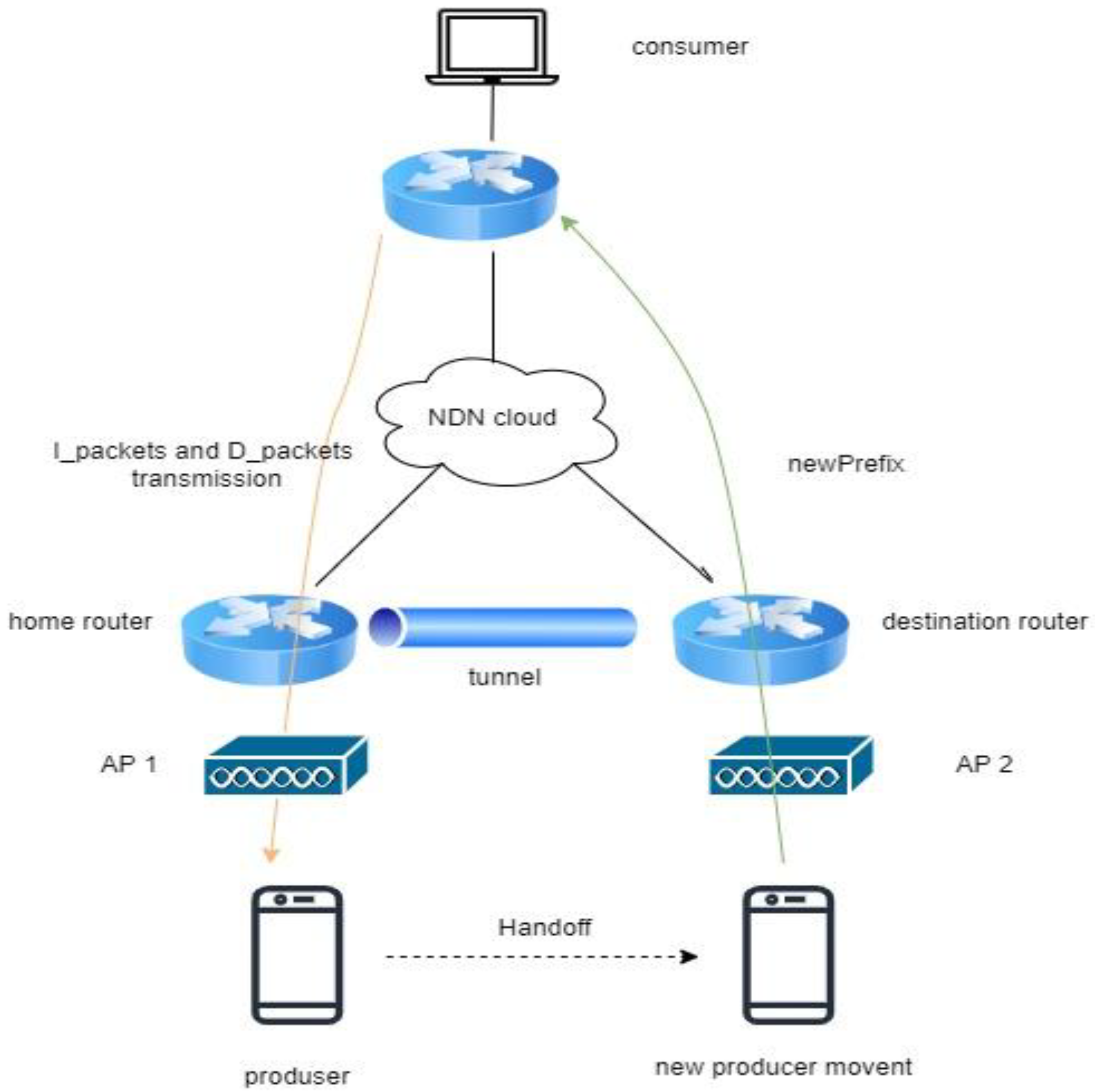
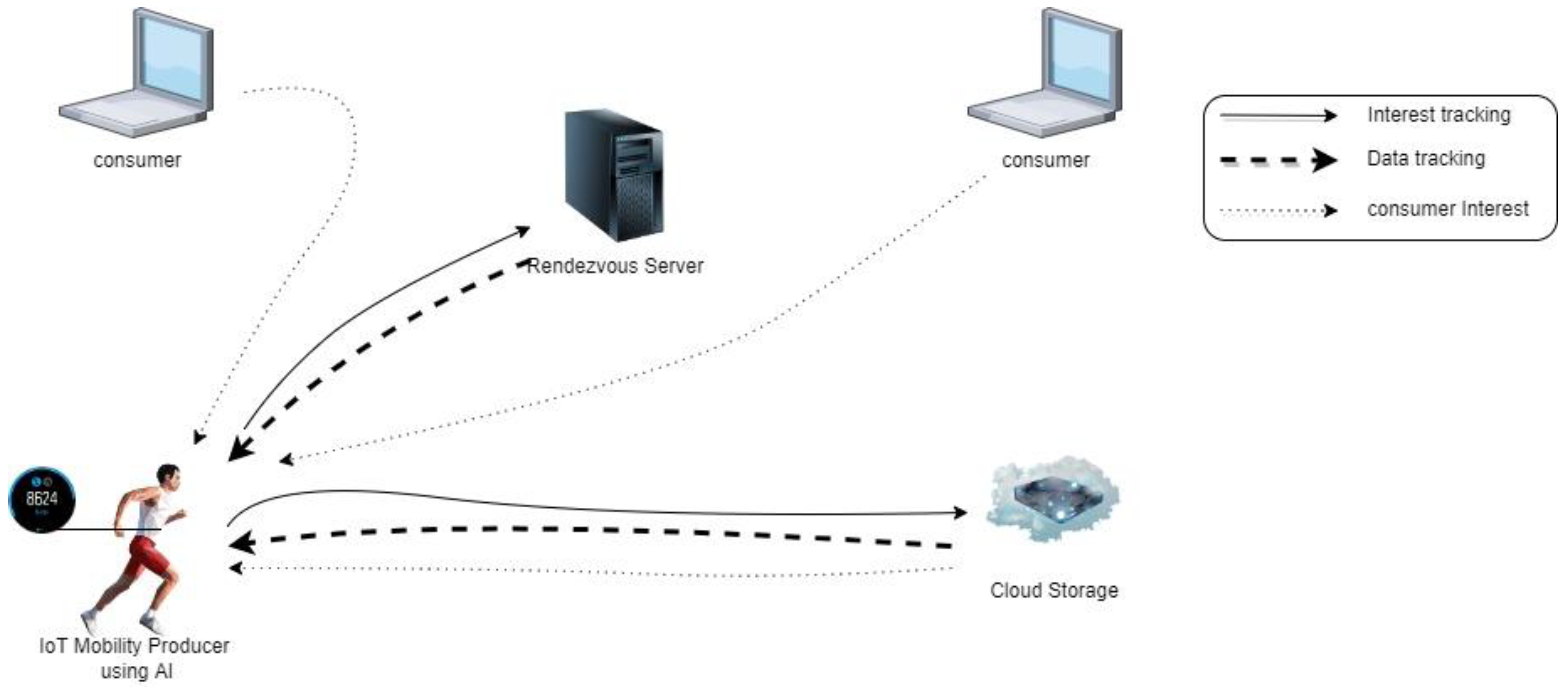
| Process 1 | Before handoff | Typically, a consumer sends an I_packet over an NDN router to the network to request data. The NDN router then determines if the material is available; if not, then it sends an I_packet to the NDN network. |
| Process 2 | Initiate connection with a content router | The I_packet’s prefix data name traverses NDN routers to reach the location of the producer. If the data are cached by any router in the network, then the router reacts promptly with the cached data. If not, then the routers, along with the path, store the interest information as entries in the PIT and FIB tables, then forward it until it reaches the producer. The producer then provides the data in breadcrumb format to the consumer. |
| Process 3 | Handoff started | The producer abruptly decides to switch from the old PoA to the new PoA. After the connection, a new content name prefix is generated, and the producer prepares to notify the anchor router of the new name. |
| Process 4 | Update RS | The producer overwhelms the network with trace I_packets destined for the immobile anchor router or the RS to notify it of the new name prefix. |
| Process 5 | Establish data trace from producer to NDN router | Through intermediate routers, the anchor router or RS responds with trace data packets and establishes a trace between the mobile producer and the anchor router or RS. |
| Process 6 | Store PIT in RS | The consumer saves PIT in the NDN router or RS. |
| Process 7 | After the handoff operation | The NDN router forwards the consumer I_packet through data tracking at the mobile producer. |
| Process 8 | Producer acknowledges | The mobile producer replies to the D_packet to the consumer through the NDN router. |
| Flow of Transmission | Process Status | Description |
|---|---|---|
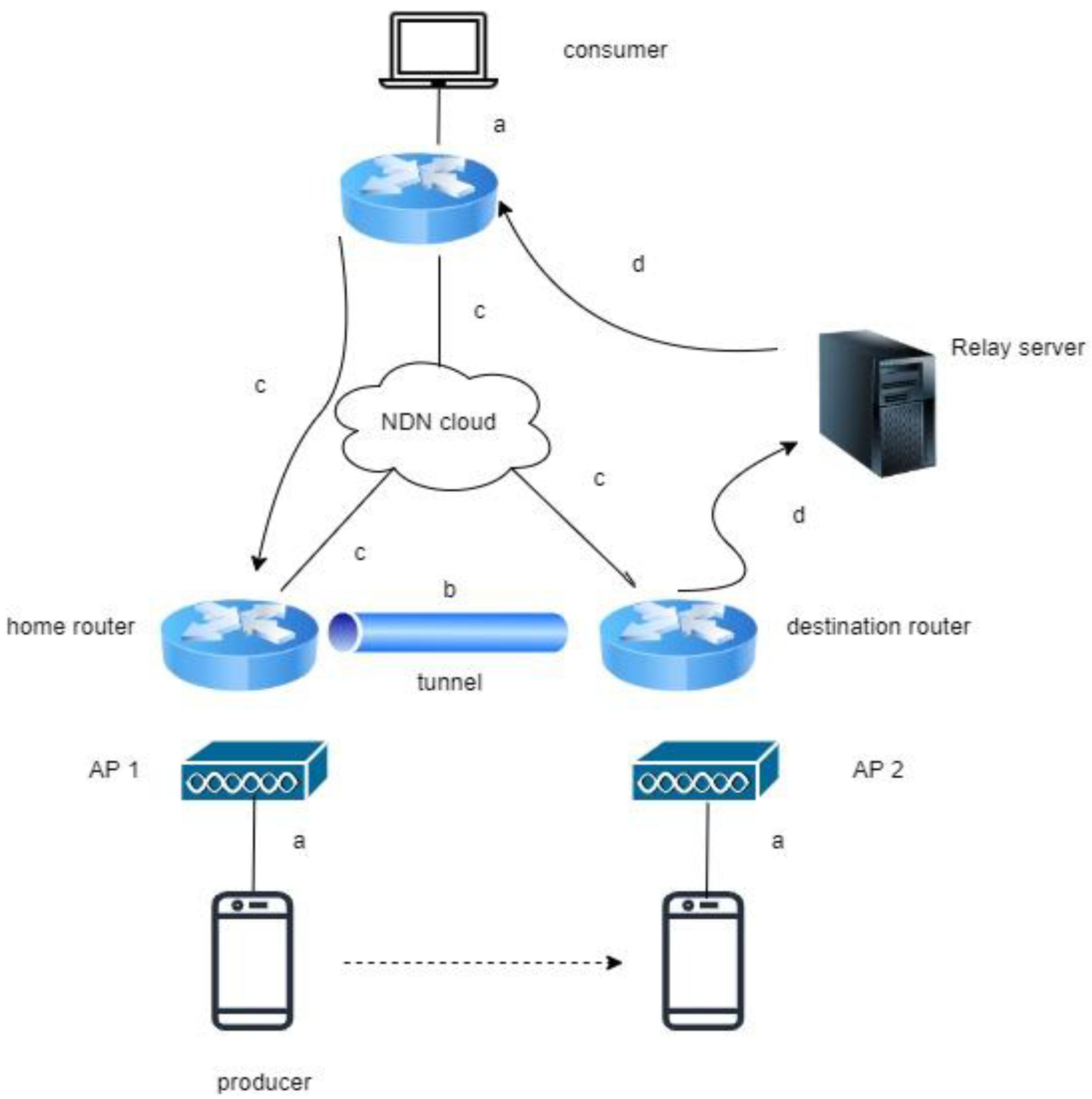
| Process 1 | Before transmission | Before handover transmission between the producer and the consumer, consumers transmit I_packets for requesting data to the mobile producer. The mobile producer checks the available content with SR1. If the content is not available, then it searches with other SRs in their neighborhood. |
| Process 2 | Broadcast | Interest packet time is the time to retrieve the requested content and the time it takes to send it from the source to the destination. |
| Process 3 | Processing data | The I_packet goes through the nearby RS until the mobile producer is reached. Processing data from the consumer to the mobile producer is similar to the processing of data in KITE operation behavior. While the handover process starts, the mobile producer cuts off the connection with RS1 and tries to find a greater signal with another RS from another zone. From the RS, a new naming prefix and a new mobile interest packet are created while reaching a new RS. |
| Process 4 | FIB update | The next step is to broadcast the information to update the FIB that contains the routing information of the I_packet. Routing information is important to control the broadcast domain to make sure that no collision of I_packets occurs between the domain. |
| Process 5 | Producer update | After this process is completed, the consumer resends a new interest packet to obtain new information from the producer. To maintain connectivity, NDN uses the best route strategy to reduce collision and forward the I_packet to the mobile producer’s new location. |
| Process 6 | Cloud update | Cloud storage is used to update all transmission information and to store it in case the current connection is interrupted or fails. Thus, its advantage is that transmission is maintained and not disrupted. |
| Flow of Transmission | Process Status | Description |
|---|---|---|
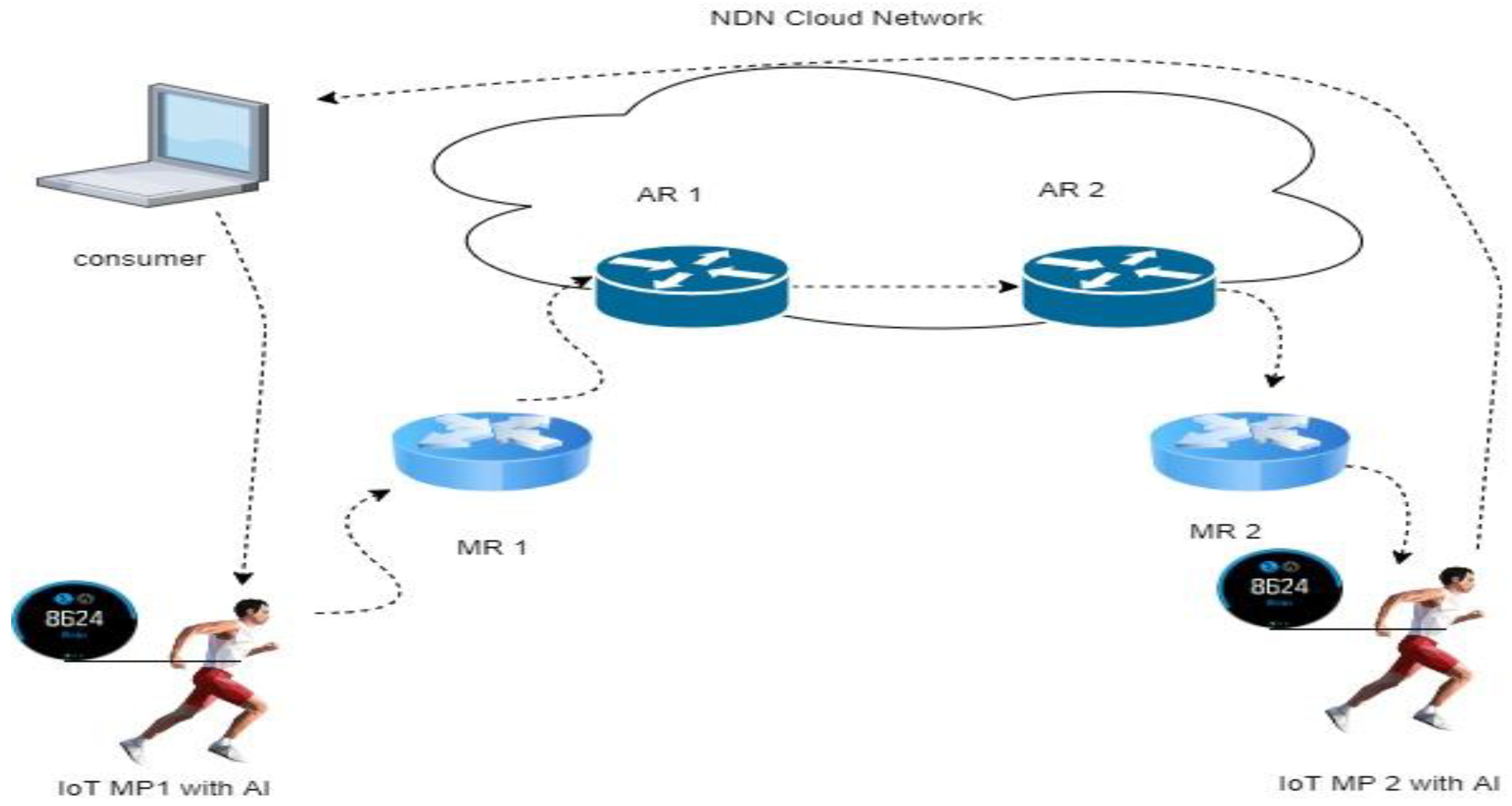
| Process 1 | Exchanging information | Movement occurs from MR 1 to MR 2, and content is stored at MR2. |
| Process 2 | Forwarding | MR 2 sends a signaling packet to AR 2 when AR 1 sends an alert on movement. |
| Process 3 | Creating BIT | AR 2 and MR 2 create BIT for each entry of I_packets. BIT consists of information on consumer nodes, PoA, and face numbers. |
| Process 4 | Matching BIT | BIT has a similar function to FIB, with I_packets searching for FIB to create a movement from the producer to the consumer. |
| Process 5 | Forwarding I_packets | If the I_packet matches the information request by the consumer, then the content is directed without referring back to FIB. |
| Mobility Technique | Network Size (m2) | Distance Router NDN from AP | Mobile Producer Quantity | Mobility Speed (m/s) | Interest Range (ms) | Segment Size (bytes) | Mobility Model | Simulation Software | Benchmark Comparison |
|---|---|---|---|---|---|---|---|---|---|
| KITE | 400 × 400 | 11 nodes/100 m | 1 | 2 | 100 | 1024 | Random waypoint mobility model | ndnSIM | KITE |
| PMSS | 400 × 400 | 100 m | 2 | 50, 200, 350 ms | 100, 200, 300 | 1024 | Random waypoint mobility model | ndnSIM | MBMA, CDBMA, CDBMA, IBMA |
| Hybrid NeMO | 400 × 400 | 100 m | 5 | 100 ms | 100, 200 | 1024 | Random waypoint mobility model | ndnSIM | KITE |
| Parameter | Units | Description | Parameter/Value |
|---|---|---|---|
| Sdata | bytes | Size data packet | 2000 bytes |
| SInterest | bytes | Size Interest packet | 40 bytes |
| SInterest/SmobilityInterest | bytes | Size Interest packet | 40 bytes |
| a | bytes | Packet transmission latency and cost between consumer and producer | 1 |
| c | bytes | Packet transmission latency and cost between the old NDN router and the new NDN router | 5 |
| Tp | ms | Paused time | 0 ms, 100 ms |
| a | bytes | Packet transmission latency and cost between the consumer and the producer | 1 |
| Lw | ms | Wired link delay | 2 ms |
| d | bytes | Packet transmission latency and cost between the consumer and the producer and the server | 9 |
Publisher’s Note: MDPI stays neutral with regard to jurisdictional claims in published maps and institutional affiliations. |
© 2022 by the authors. Licensee MDPI, Basel, Switzerland. This article is an open access article distributed under the terms and conditions of the Creative Commons Attribution (CC BY) license (https://creativecommons.org/licenses/by/4.0/).
Share and Cite
Azamuddin, W.M.H.; Aman, A.H.M.; Hassan, R.; Mansor, N. Comparison of Named Data Networking Mobility Methodology in a Merged Cloud Internet of Things and Artificial Intelligence Environment. Sensors 2022, 22, 6668. https://doi.org/10.3390/s22176668
Azamuddin WMH, Aman AHM, Hassan R, Mansor N. Comparison of Named Data Networking Mobility Methodology in a Merged Cloud Internet of Things and Artificial Intelligence Environment. Sensors. 2022; 22(17):6668. https://doi.org/10.3390/s22176668
Chicago/Turabian StyleAzamuddin, Wan Muhd Hazwan, Azana Hafizah Mohd Aman, Rosilah Hassan, and Norhisham Mansor. 2022. "Comparison of Named Data Networking Mobility Methodology in a Merged Cloud Internet of Things and Artificial Intelligence Environment" Sensors 22, no. 17: 6668. https://doi.org/10.3390/s22176668
APA StyleAzamuddin, W. M. H., Aman, A. H. M., Hassan, R., & Mansor, N. (2022). Comparison of Named Data Networking Mobility Methodology in a Merged Cloud Internet of Things and Artificial Intelligence Environment. Sensors, 22(17), 6668. https://doi.org/10.3390/s22176668