You are currently viewing a new version of our website. To view the old version click .
Sensors
  • Article
  • Open Access

31 March 2019

Prediction of Marine Pycnocline Based on Kernel Support Vector Machine and Convex Optimization Technology

,
,
,
,
and
1
School of Electrical and Information Engineering, Tianjin University, 92 Weijin Road, Tianjin 300072, China
2
Department of Electrical, Computer, Software and Systems Engineering, Embry-Riddle Aeronautical University, Daytona Beach, FL 32114, USA
*
Author to whom correspondence should be addressed.
This article belongs to the Collection Smart Ocean: Emerging Research Advances, Prospects and Challenges

Abstract

With the explosive growth of ocean data, it is of great significance to use ocean observation data to analyze ocean pycnocline data in military field. However, due to natural factors, most of the time the ocean hydrological data is not complete. In this case, predicting the ocean hydrological data by partial data has become a hot spot in marine science. In this paper, based on the traditional statistical analysis literature, we propose a machine-learning ocean hydrological data processing process under big data. At the same time, based on the traditional pycnocline gradient determination method, the open Argo data set is analyzed, and the local characteristics of pycnocline are verified from several aspects combined with the current research about pycnocline. Most importantly, in this paper, the combination of kernel function and support vector machine(SVM) is extended to nonlinear learning by using the idea of machine learning and convex optimization technology. Based on this, the known pycnocline training set is trained, and an accurate model is obtained to predict the pycnocline in unknown domains. In the specific steps, this paper combines the classification problem with the regression problem, and determines the proportion of training set and test formula set by polynomial regression. Subsequently, the feature scaling of the input data accelerated the gradient convergence, and a grid search algorithm with variable step size was proposed to determine the super parameter c and gamma of the SVM model. The prediction results not only used the confusion matrix to analyze the accuracy of GridSearch-SVM with variable step size, but also compared the traditional SVM and the similar algorithm. At the end of the experiment, two features which have the greatest influence on the Marine density thermocline are found out by the feature ranking algorithm based on learning.

1. Introduction

Pycnocline has always been one of the focuses of physical oceanography. The characteristics of pycnocline relate to water masses, circulation, and internal waves in the ocean [1]. At the same time, the characteristics of pycnocline have an effect on underwater acoustic communication, detection, monitoring, submarine warfare and so on in the military field [2]. Therefore, the study of marine pycnocline is of great value in the field of marine hydrology and military affairs.
The formation of pycnocline is mainly affected by seawater temperature and salinity. Usually, when the wind is calm, the water temperature decreases as the depth increases. When there is a large wind wave, the sea water is mixed up and down, the upper water temperature is gradually uniform, and the temperature of the lower ocean current, which can not be affected by the wind wave, is still decreasing. As a result, the sea water temperature between the upper and lower layers changes dramatically, resulting in the formation of pycnocline. Besides temperature, salinity also plays an important role in the formation of marine pycnocline [3]. For example, where a warm current flows through, the solubility of salt is higher and the salinity is higher, the density of the area will increase [4]. As a general rule, in the vicinity of rivers entering the sea, fresh water desalinating the sea water, which reduces the salinity of the sea water, it also leads to the sudden change of sea water density, thus it is easy to form pycnocline at the boundary between fresh water and sea water [5].
In order to study ocean pycnocline, we need to get a lot of accurate ocean data. However, due to the breadth of the ocean area and the unpredictable nature of the deep sea, it is very difficult for human beings to detect in the sea water [6]. The data obtained by traditional underwater sensors only involve scalar data such as temperature, pressure, depth and so on. For practical applications, the types of observation data fall far short of the requirements [7]. So it’s becoming more and more necessary to analyze existing hydrological data and get new unknown data [8,9]. Through the prediction and analysis of ocean data, we can also improve the existing model and improve the accuracy of data analysis [10,11,12].
On the other hand, with the increasing scale and complexity of ocean hydrological data, the traditional physical statistical model is not robust. Jiang’s article on “A Machine Learning Approach to Argo Data Analysis in a Thermocline” gives a good example of combining the statistical model with the prediction model, which analyses the historical data of the thermocline [13]. The machine learning algorithm is used to find out the most important factors affecting thermocline. This suggests that we can maximize the relationship between ocean hydrological elements (water speed, temperature, salinity, depth, density) under a limited sample training set using the machine learning correlation algorithm [14]. This is of great significance for predicting the distribution characteristics of ocean pycnocline.
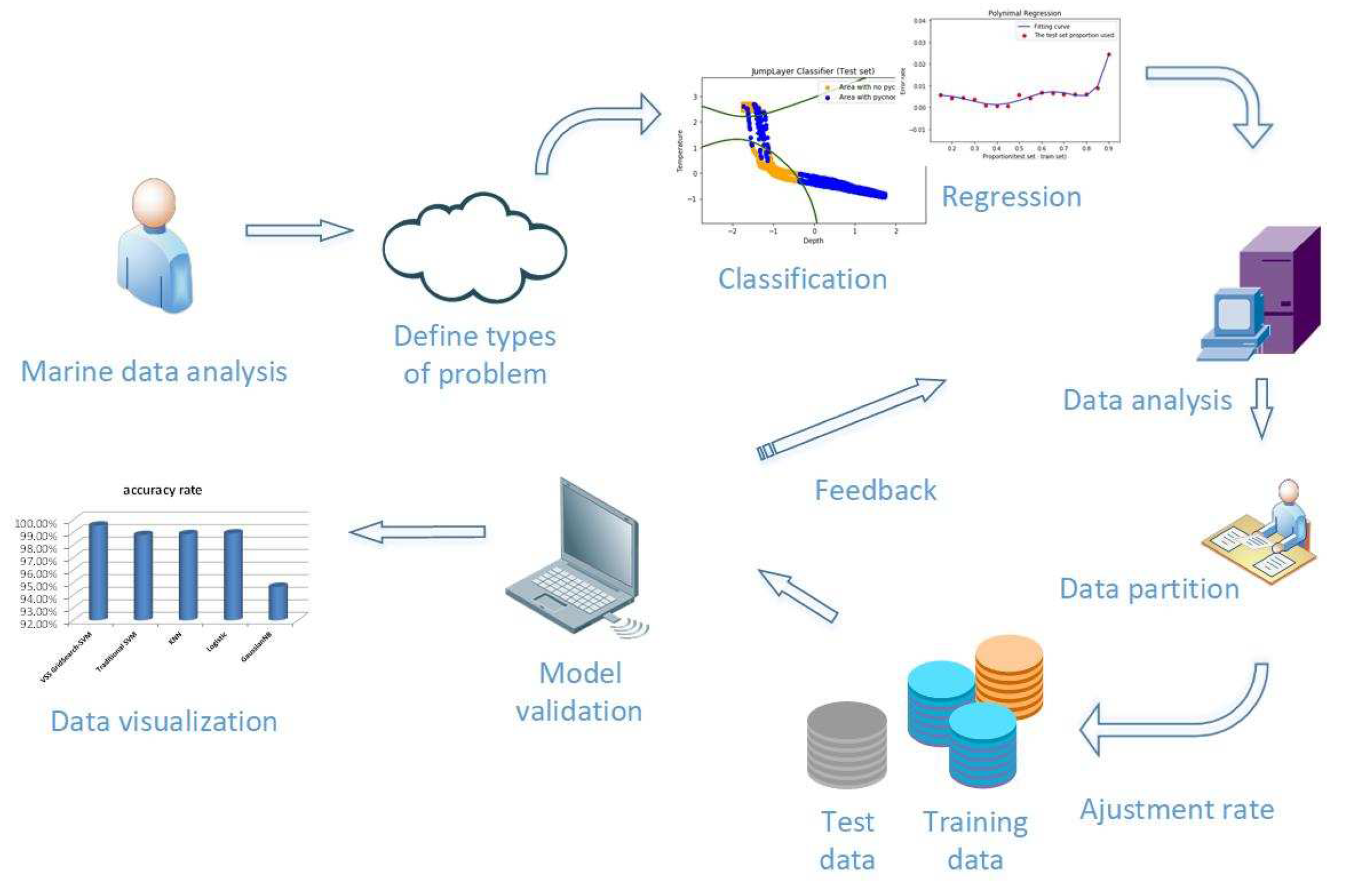
The prediction of ocean hydrological data based on machine learning algorithm is different from the general physical statistical model. The following Figure 1 shows the ocean hydrological data process based on machine learning:
Figure 1. Ocean hydrological data processing model based on machine learning.
The innovations of this article are as follows: 1, We use the ocean density algorithm to calculate the density of the original temperature and salt data, and extract the features of the original open source Argo data structure. Feature extraction is to reduce the dimension, thus reducing the computational complexity. Then we structured the data set after feature extraction and stored it. 2, On the basis of traditional statistical analysis, this paper also analyzes the pycnocline distribution characteristics after calculation, and verifies the characteristics of pycnocline under the influence of time, space, pressure, temperature, salinity and so on. 3, In the experimental part of machine learning, the proportion of the training set is selected by polynomial regression, so as to ensure that the prediction model will not be overfitted to the maximum extent. 4, Subsequently, the feature scaling of the input data accelerated the gradient convergence, and a grid search algorithm with variable step size was proposed to determine the super parameter c and gamma of the SVM model. 5, The prediction results not only used the confusion matrix to analyze the accuracy of GridSearch-SVM with variable step size, but also compared the traditional SVM and the similar algorithm. 6, At the end of the experiment, two features which have the greatest influence on the Marine density thermocline are found out by the feature ranking algorithm based on learning.
The next part is divided into the following parts: in the second part, the related knowledge and characteristics of pycnocline are briefly described. What’s more, the distribution characteristics of pycnocline are analyzed by using the data collected by the open Argo buoy, and the ocean density algorithm is introduced. At the same time, the paper explains why it is necessary to use kernel support vector machine algorithm to predict marine pycnocline. In the third part, the existing ocean data is used to model, and the prediction model of pycnocline is obtained.

3. Experimental Evaluation

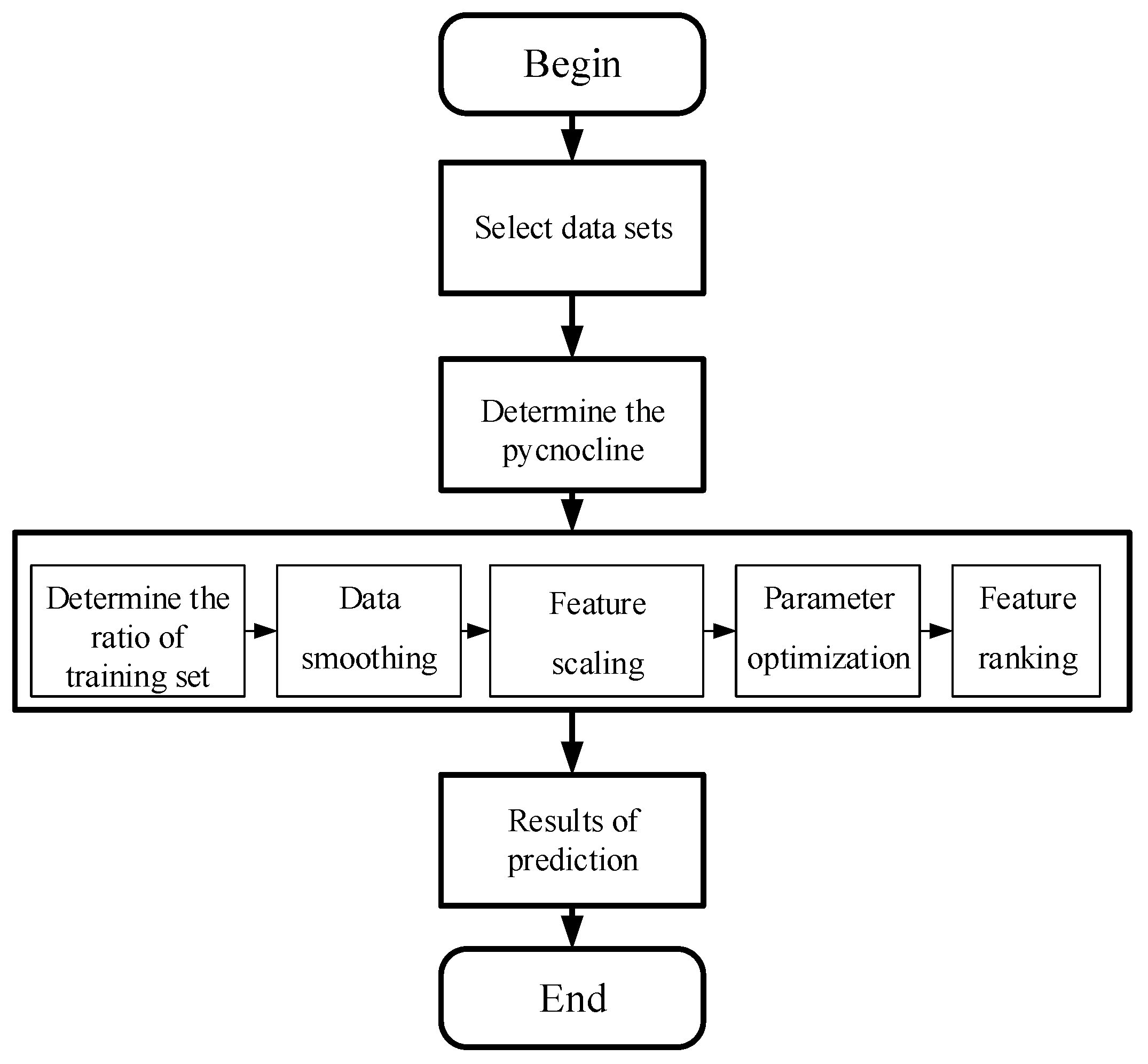
According to the science and technology in recent years, the oceanographic data obtained by the survey ship cannot contain the density in an unknown area of the ocean. Therefore using the known data set to establish a reliable model of pycnocline prediction is the main problem to be solved in this chapter. Since this experiment’s type is supervising learning, the establishment of the prediction model will not include the density data. Finally, the reliability of the prediction model is evaluated by the comparing of the predicted value with the real density data, and the feasibility of the classification algorithm in the prediction of marine data is analyzed. Figure 2 shows the whole process of the experiment.
Figure 2. The flow chart of the experiment.

3.1. Selection of Data Sets

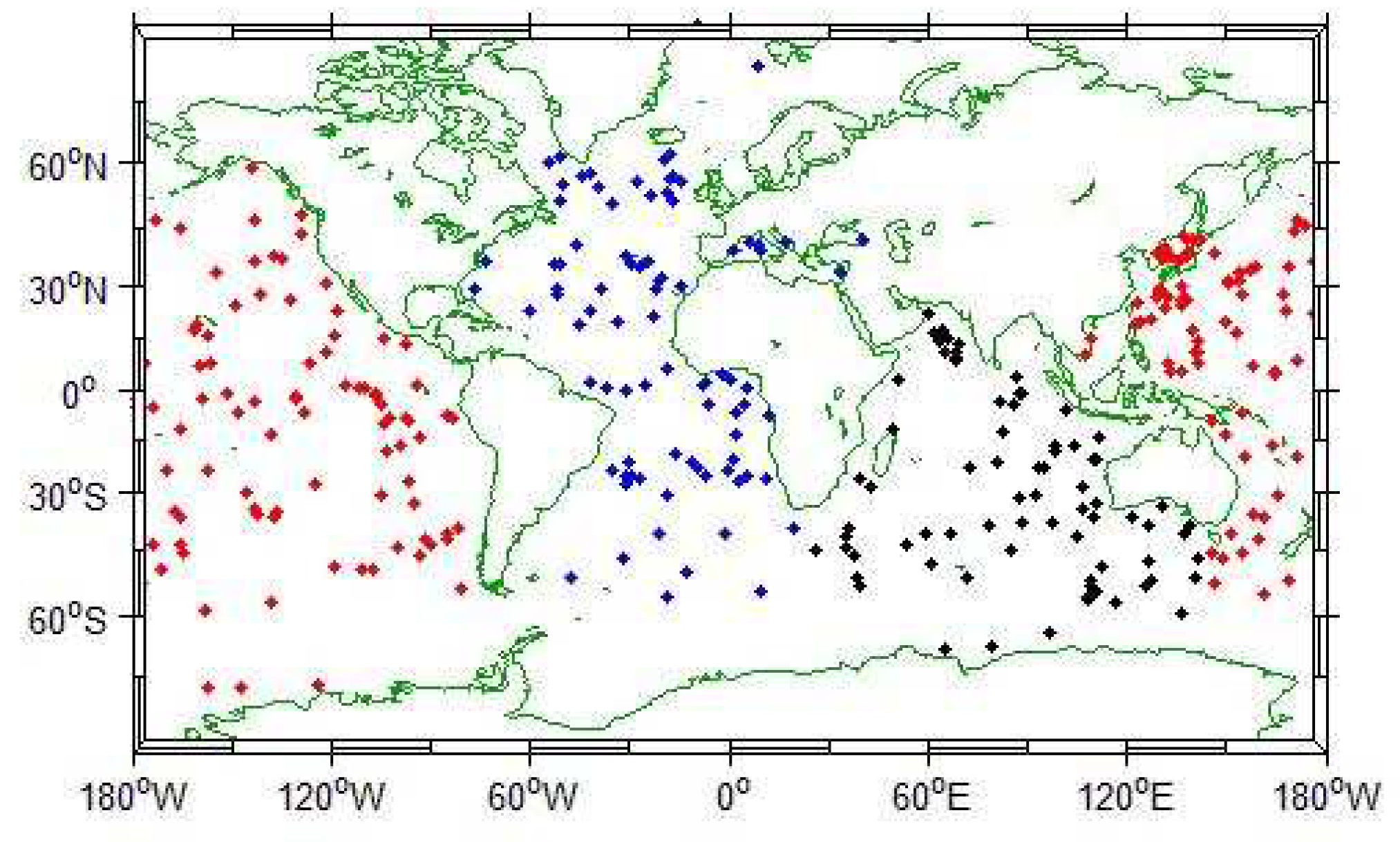
In this section, we use data from the global Argo profile data set, whose Argo distribution is shown in the following figure (Figure 3):
Figure 3. Global Argo collection point distribution.
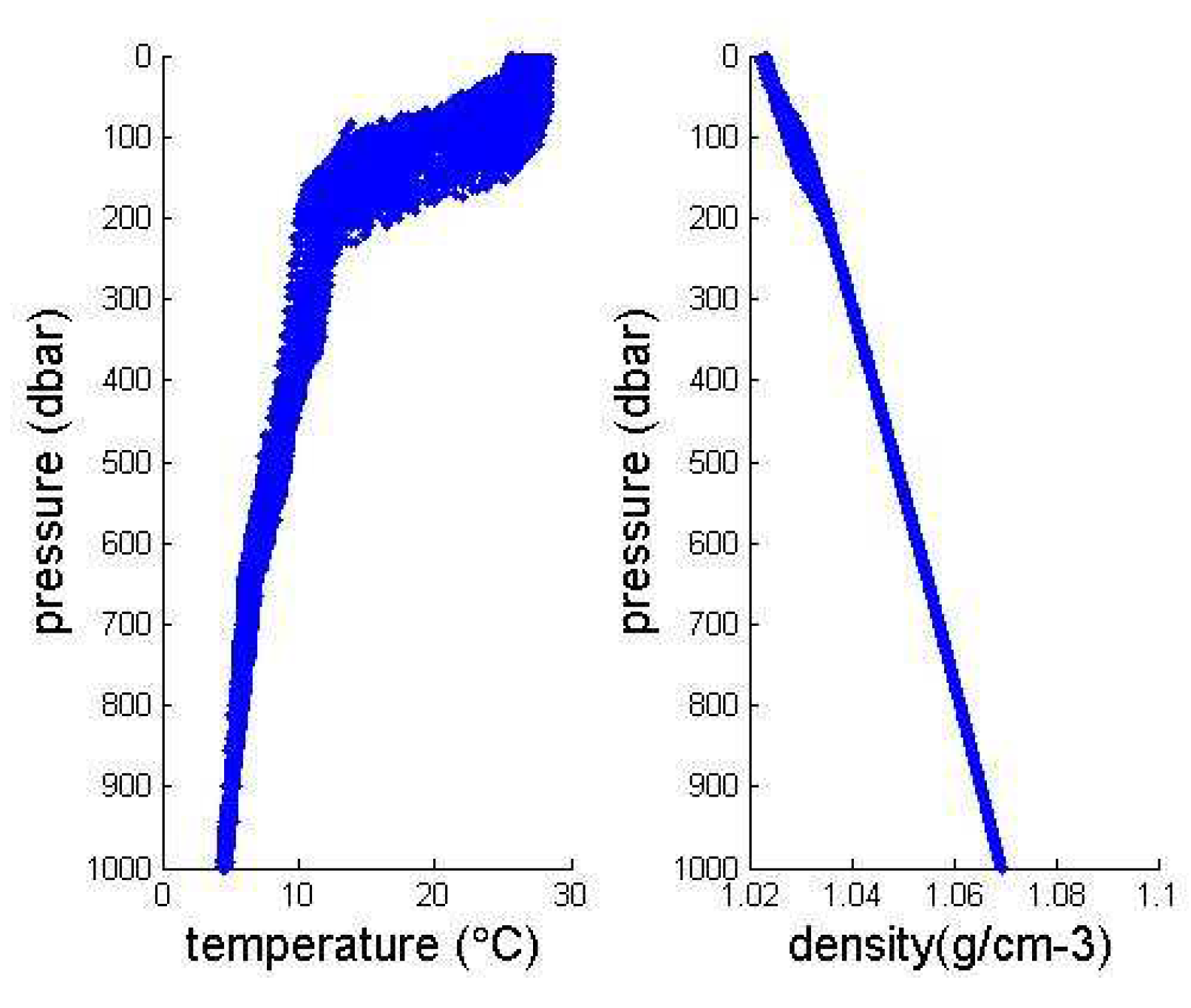
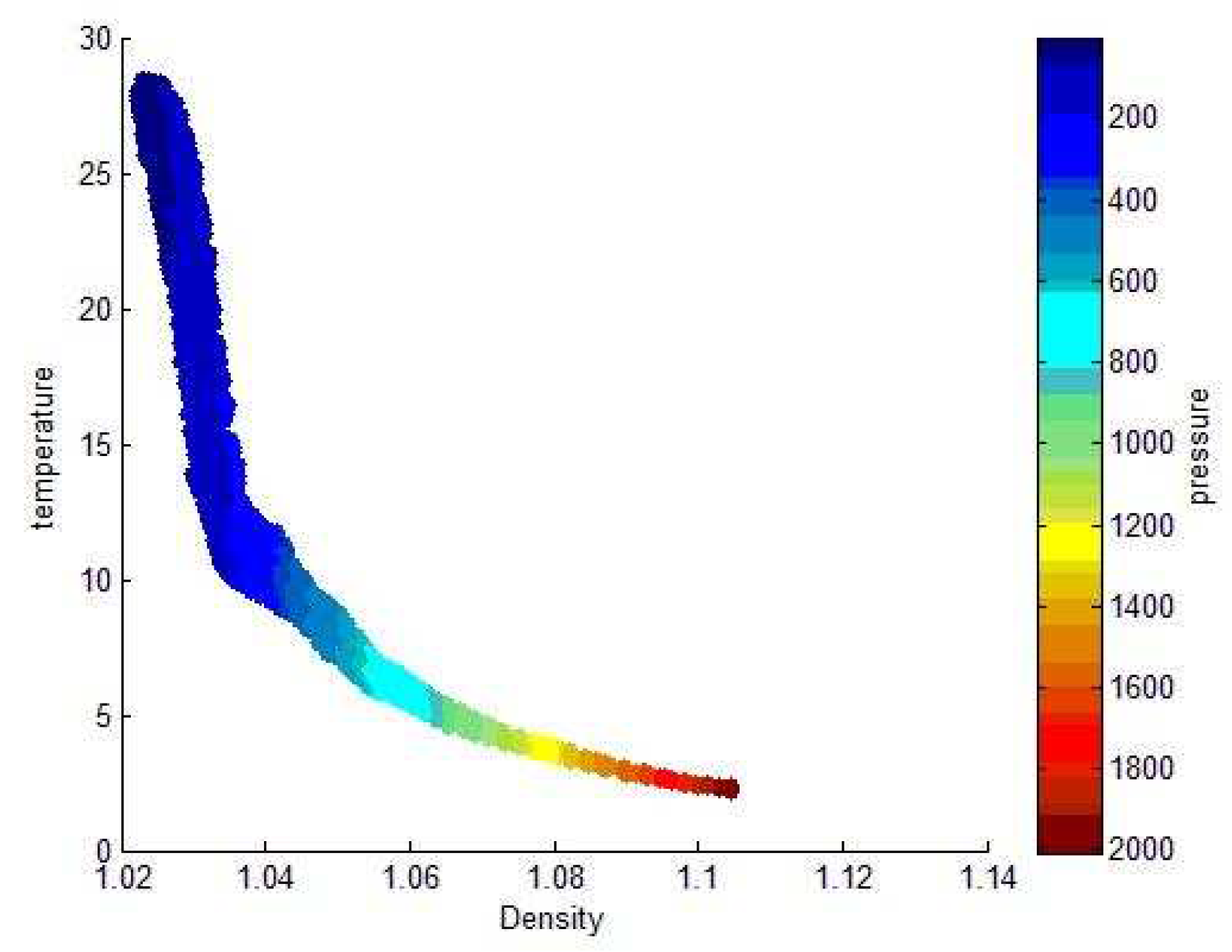
Because of the large data set, we intercept the Argo 3D grid data set published by China Argo Real time data Center from 2004 to 2010, which can be used to predict machine learning. In order to further narrow the range of feature extraction, we need to study the depth range (pressure range) that has the greatest influence on ocean pycnocline. Then we plotted the relationship between density and temperature with depth in the range of 0–1000 m and 0–2000 m, as shown in the following Figure 4 and Figure 5:
Figure 4. Temperature and density variations with depth over the Pacific.
Figure 5. Relationship between density, temperature and depth within the ocean depth range 0–2000 m.
It can be seen from the image that the density of the data with a depth of less than 400 m and a temperature above 7 is usually below 1.04. The depth of 1200–2000 m and the temperature below 3 usually correspond to density above 1.08. We can conclude that the shallow temperature in the ocean is high, the density is small and the data is large. But low temperature, high density and low data volume in deep oceans. Based on the distribution characteristics of density data points, the distribution of density data points in the upper ocean indicates that the density difference is large, the distribution is uneven, and the possibility of existing pycnocline is higher than that of discrete data points. Therefore, we select the data from 0–500 depth range as training set and test set, thus simplifying the experimental data.
Then, we need to preprocess the raw data before making prediction of machine learning. Since the original data only include temperature, salinity and pressure, we need to calculate the required density data according to the density calculation formula described in the previous chapters. The format after data processing is consistent with the right side of Table 1.
In the end, according to the introduction of the second chapter, we list the selection of the density gradient, based on the following Table 2:
Table 2. Selection of density gradient.

3.2. The Prediction of Pycnocline was Realized Based on Python

3.2.1. The Ratio of Training Set Was Determined by Polynomial Regression

Before using Kernel-SVM algorithm to fit the data set, we should divide the data set into training set and test set according to a certain proportion. However, how to determine the ratio is related to the accuracy of the final prediction.
In order to determine the ratio between the training set and the test set, we compare the experimental data with different proportions and obtain the prediction accuracy corresponding to different proportions. Here, we introduce the concept of confusion matrix (error matrix to represent the decision error and accuracy. Confusion matrix expresses the relationship between total data and error data by matrix. Each column of confusion matrix represents the forecast category, and the total number of each column represents the number of data predicted as that category; each row represents the true home category of the data, and the total data of each row represents the number of data instances of the class. In this step, we do not study the influence of super parameters on data in detail. In order to obtain the ratio between training set and test set, we do not set the super parameters of the model in polynomial regression analysis. Then, the obfuscation matrix of the data was inquired in the proportion of different training sets and test sets, and the following Table 3 of prediction accuracy was obtained:
Table 3. Prediction accuracy of test set to training set.
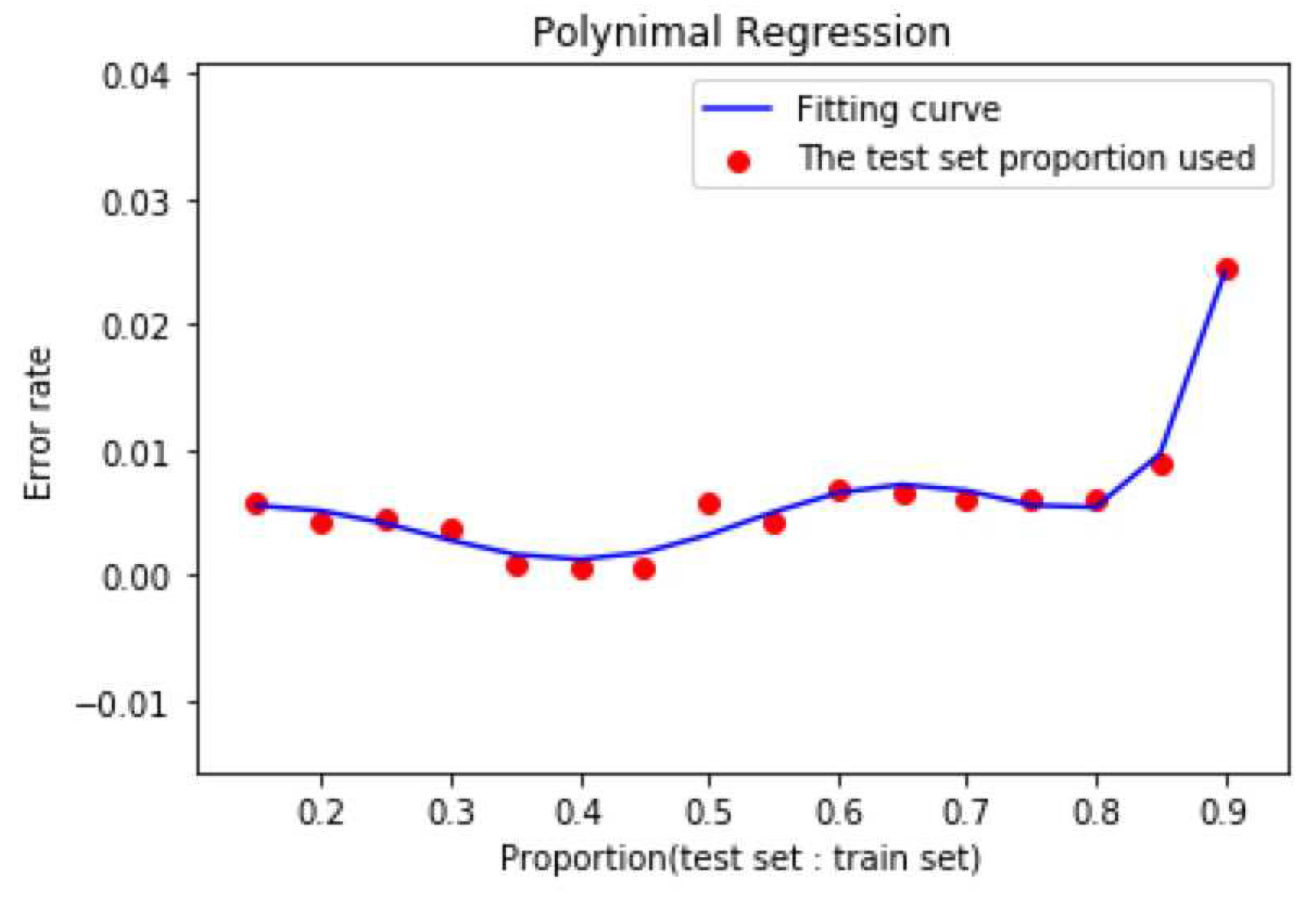
It can be seen that the precision is increasing basically before the ratio is less than 0.45, and the precision decreases after the ratio is greater than 0.45. This shows that the training set is not as simple as the support vector machine algorithm. In order to select a suitable ratio, we select the ratio between test set and training set as independent variable X and the accuracy of polynomial regression for dependent variable y. In order to be more accurate and avoiding overfitting, the polynomial regression curve like the following figure (Figure 6) is obtained by using the power 7 as the best proportion.
Figure 6. Polynomial regression curve related to the ratio of test set to training set and error rate.
It can be clearly seen from the curve that the error rate is between 0.3/0.4/0.45 and 0.45. From the actual measurement, when the ratio is 0.45, the error rate is the smallest and the pycnocline predicted is the most accurate. Considering that the accuracy does not increase monotonously with the scale, this reflects the characteristics of the Kernel-SVM algorithm from the side: we can use less training set data to fit the curve, and we can get very accurate results. If the ratio is too high, the prediction effect is not necessarily better, and the curve will show the phenomenon of fitting. Based on this, we set the ratio of training set to test set to 0.45, that is, 1925 random points out of 3500 points as training set and 1575 points as test set.

3.2.2. Data Smoothing by Spline Interpolation

The basic form of SVM is a hard-spaced classifier, which requires all samples to satisfy the hard-spaced constraint. So when there are noise points in the data set, in order to divide the noise points correctly, the hyperplane will approach the sample of another class, which makes the geometric spacing of dividing the hyperplane smaller and reduces the generalization performance of the model. The data of temperature, salinity used in our experiment are not smooth, which is very likely to increase the error rate of prediction, so in this section we smoothed the data of temperature and salinity.
Firstly, the 0–500 m are divided into 4000 copies, but the 4000 data used in our experiment are not necessarily uniformly distributed. Then we used Python’s spline interpolation function to get a smooth curve. Specifically, we need to find a trinomial polynomial approximating the curve between each pair of data points. The cubic spline function f(x) is a piecewise cubic polynomial.
f ( x ) = f 1 ( x ) x 1 < x < x 2 f 2 ( x ) x 2 < x < x 3 . . . f 3999 ( x ) x 3999 < x < x 4000
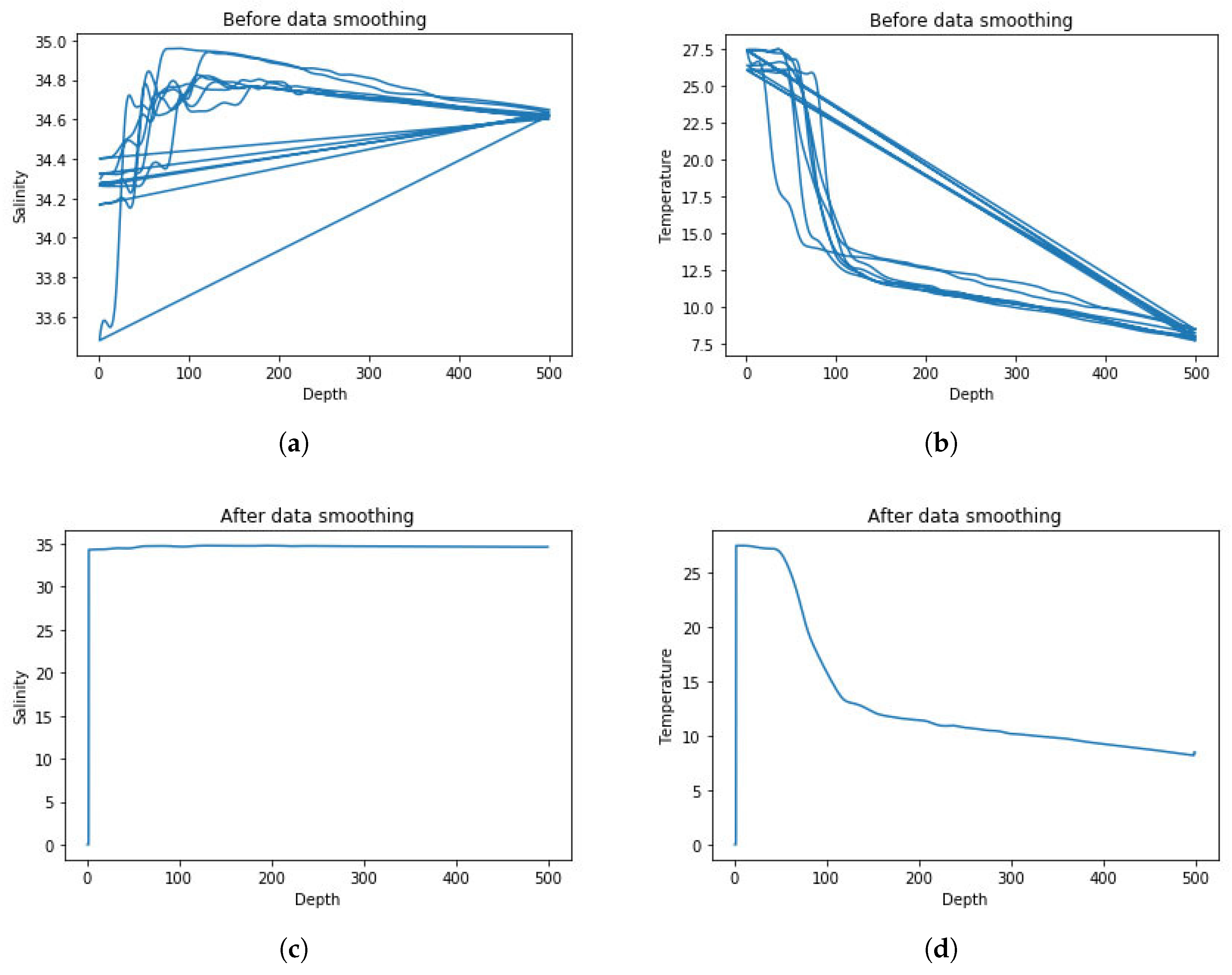
Figure 7 shows a comparison of temperature and salinity data before and after data smoothing. From the graph before data smoothing, we can conclude that the original data has duplicate values, most likely incorrect values and outliers. We use data smoothing method based on spline interpolation to pre-process the data in the first step, discard these noise points, and improve the accuracy of prediction results.
Figure 7. (a) salinity data before smoothing. (b) temperature data before smoothing. (c) salinity data after smoothing. (d) temperature data after smoothing.

3.2.3. Use Feature Scaling (FS) to Speed up Gradient Retracting

In the process of training, we find that the depth of the column is of order of 0–500, while the other column data is only 0–50. So in the process of training and fitting, the large eigenvalue will affect the length of the Euclidean distance, which leads to the long running time of the program and the slow convergence process of the gradient. To solve this problem, we preprocess the data set, and use the transform function in the StandardScaler function library of python to scale the features of the data used [33,34]. The following formulas are used to find the center and scale most of the data between −3 and 3, which speeds up the convergence of the gradient.
X n = X n μ n δ
In the above expression (Equation (22)), X n denotes the nth feature, that is, the nth dimension of the characteristic variable X. μ n denotes the mean value of the feature, that is, the average value of the nth feature of all eigenvector sets, and δ denotes the standard deviation.
We take the depth and density gradient as independent variables and the pycnocline marker as dependent variables. Left side of Table 4 is the test set data that does not use feature scaling. The right side is the test set data that used feature scaling:
Table 4. Use feature scaling(FS) to normalized test set.

3.2.4. Parameter Optimization Process Based on Variable Step Size Grid Search Algorithm

When the SVM classifier is used to establish the prediction model, if the super parameter is not optimized, the default penalty factors are C = 10 and gamma = (1/feature number). However, different penalty factors and kernel function coefficients have great details for the experimental classification results, which even determines whether the classifier is suitable for predicting the data of marine types from the very beginning.Therefore, it is necessary to determine the super parameter C and gamma of the SVM algorithm before establishing the prediction model. At present, the commonly hyperparametric search methods are: grid search, random search and Bayesian optimization. Among all of them, grid search and Bayesian optimization are widely used. Common grid search consumes computing resources, especially when there are many hyperparameters. In 2012, Jack applies Bayesian optimization to machine learning.Bayesian optimization updates the posterior distribution of the objective function by adding sample points to the given objective function. The number of iterations in Bayesian optimization is small, So it saves time. However it is difficult for us to choose Kernel Matrix of Gauss Process. In this paper, we propose an improved grid search to improve the search speed while reducing the computational burden. In the experiment, we used the Bayesian optimization method in [35] to optimize the super-parameters, and compared with the improved grid algorithm. We find that Bayesian optimization is fast,it takes about 71.3315336 seconds. And it iterates 30 times. The improved grid search takes 192.8725636 seconds, and the total number of iterations is 3. But the SVM accuracy rate of Bayesian optimization:98.9% is lower than that of the improved grid search: 99.3%. So we draw a conclusion that the grid search method for complex ocean data variable step size is more suitable for application.
The main idea of the grid search algorithm is to divide the parameters to be optimized (C and gamma) into grids according to equal step size within a fixed range. By traversing the values of all parameters and using K-CV (k-fold Cross validation, we set K as 10 in the experiment, that is, the algorithm of 10 fold). Cross validation is used to obtain the accuracy of the training set under this group of parameters. Finally, the group of parameters with the highest cross-validation accuracy of the training set is selected as the corresponding optimal solution. In order not to fall into the misunderstanding of local optimal solution, we usually increase the optimization range of parameters and reduce the search step infinitely, which will greatly increase the operation and time consumption of optimization. For this reason, a grid search algorithm with variable step size was used to determine the super parameter C and gamma. Based on the traditional grid search algorithm, the optimization process was divided into two steps: coarse search and fine search. First, a preliminary search is carried out by setting a large search step. The optimal solution under the rough search step will obtain the super parameter C and gamma satisfying the local optimal solution. However, if something unexpected happens, such as having different C values and gamma values at the same time, so that the final accuracy rate remains the same, we will choose the group with the larger C value without changing the gamma value too much. Since C (penalty factor) represents the tolerance of the model to the loss caused by outliers, a higher value of C ensures that the accuracy of the prediction model will not be reduced due to the neglect of individual outliers. Starting from the second search, we set the starting point of the search as the optimal solution obtained last time, and the step size as 20 percent of the last step size. The search range changes to the new local optimal solution C and gamma within the range of 5 adjacent steps. Keep going this way until you find the super parameters C and gamma that satisfy the global optimal solution.
In the variable step size grid search, we integrated the standardized operation and classifier SVM in the pipeline. We know that the value range of C and gamma is usually between 10 5 to 10 5 , so at the beginning, we defined the rough search range to be between 10 5 to 10 5 with a step size of 10. By using the grid search method with variable step size, after the first rough search, the local optimal solution was obtained: C = 1000, gamma = 0.0001. Starting from the second step, the step size changed to 10 × 0.2 . Since the values of C and gamma were different, we extended the range to 5 adjacent steps of C and gamma, that is, from 11 points at the beginning to 16 points. In this way, the global optimal super parameter information can be obtained. The local optimal solution of each step is shown in the following Table 5:
Table 5. The process of obtaining hyperparameters.
Thus, the optimal solution obtained by the fifth time is the same as that obtained by the fourth time, which means that the local optimal solution is also the global optimal solution (C = 512, gamma = 0.02097152).

3.2.5. Feature Ranking Based on Learning Model

When the density cannot be obtained, it is of great military significance to use other marine data to predict the density thermocline. However, due to the adverse environment on the ocean or the tight time for preparation, we cannot obtain a variety of marine data types in some situations. We should at least first obtain the data that has the largest impact on the density thermocline. For this reason, it is necessary to carry out characteristic weight analysis on characteristic variables [36]. Our specific approach is to build a prediction model based on the super parameters obtained by combining each individual feature and response variable, and then make model analysis for each feature and response variable respectively and obtain the error rate.Finally, the scores of each feature are sorted. The sequence of the obtained characteristic scores is shown in the following Table 6:
Table 6. Feature ranking based on score.
Thus, in the case of unknown density, depth (pressure) and temperature are the characteristic variables most closely related to the density thermocline.

3.2.6. The Experimental Results

In this section, we applied the classifier fitted by the training set to the test set and obtained the predicted results of the SVM classifier under the condition that the input was 10 characteristic variables (without density data) and the super parameter was gamma = 2.088, C = 6.833. By comparing the density data obtained by the real calculation with the density skip data obtained by the gradient determination method, we obtain the accuracy rate based on the variable step size GridSearch-SVM model. Finally, we compared this model with the traditional 5VM method (C = 1, gamma = 1/10) and some other related machine learning algorithms. As shown in the following Table 7:
Table 7. Accuracy comparison of different algorithms.
The comparison results of different model in Table 7 shows that the variable step size GridSearch- SVM has the highest accuracy. NuSVC takes the longest computing time and logical regression takes the shortest time. The variable step size GridSearch-SVM ’s calculation time is not particularly short but it guarantees high accuracy. So we think it can be used to predict the location of pycnocline.
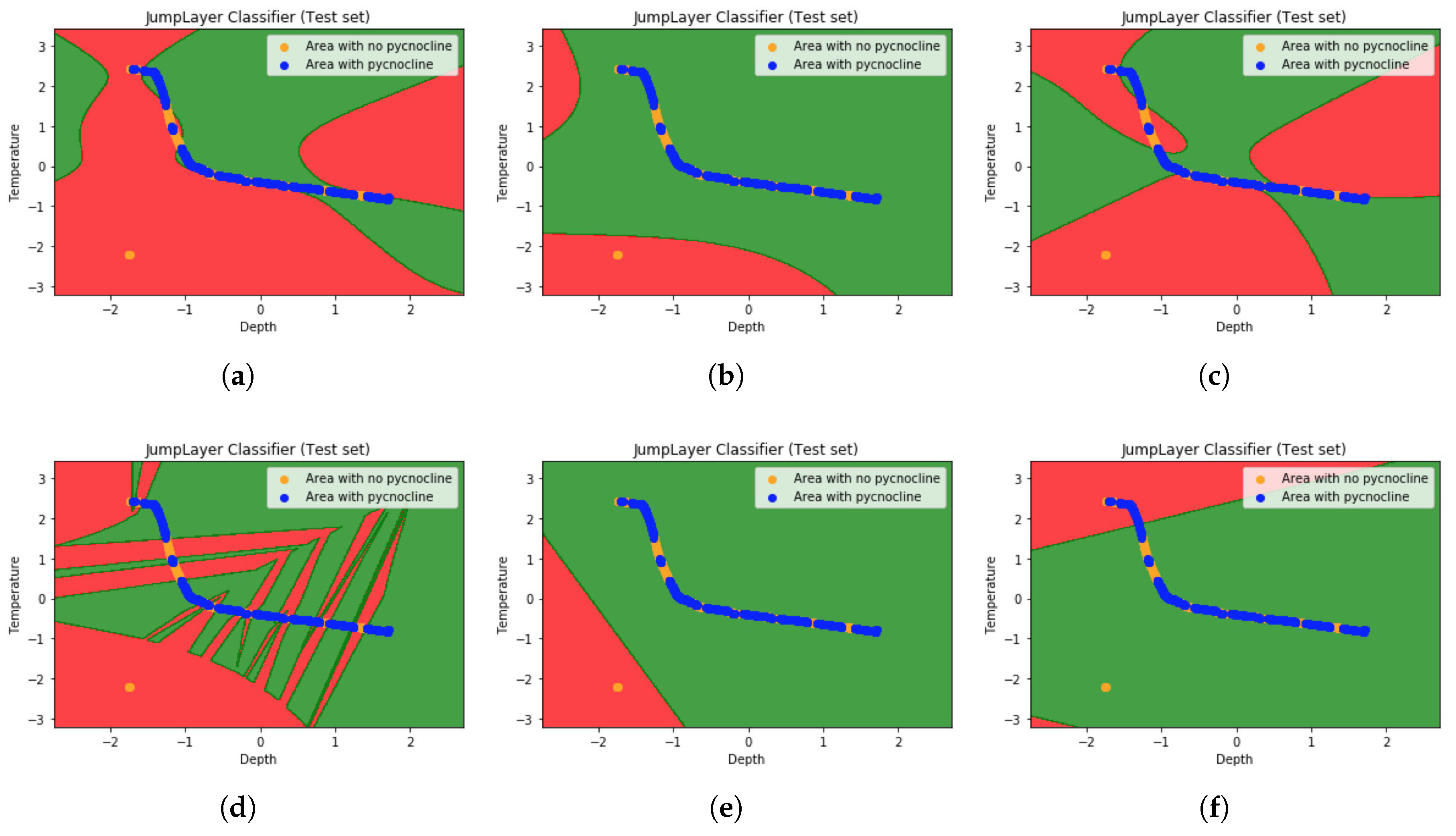
Since the multidimensional features cannot be shown by the diagram, we selected the maximum depth and temperature of the density shadow as the input features. As shown in the figure below (1, variable step size GridSearch-SVM classification image. 2, Traditional-SVM classification image. 3, NuSVC classification image. 4, KNN classification image. 5, Logistic regression classification image. 6, Naive bayes(GaussianNB) classification image):
We can see from the Figure 8 that the red region is marked as an area where there is no pycnocline. Green region is the region where pycnocline is predicted. The orange and blue dots represent the density data points, where the orange dots indicate that the layer in which the density data is located does not contain pycnocline. And blue indicates that the layer in which the density data is located contains pycnocline. It is not difficult to find that, when some blue data goes to the red area, it means that there is an error between the predicted data and the actual data.
Figure 8. The predicted pycnocline classification image by: (a) variable step size GridSearch-SVM method. (b) Traditional-SVM method. (c) NuSVC method. (d) KNN method. (e) Logistic regression method. (f) Naive bayes (GaussianNB) method.
It can be seen from the graph that the accuracy of the variable step size GridSearch-SVM algorithm is higher than other machine learning algorithms when the input is 2 features. We can also draw a conclusion that the location of pycnocline can be predicted in a better way based on the variable step size GridSearch-SVM algorithm when the density data is unknown. In addition to density and depth data, temperature is also an important factor to predict the density thermocline.

4. Conclusions and Future Work

In this paper, the characteristics of ocean density varying with longitude and latitude, depth, temperature, salinity, season and so on are summarized, and the distribution characteristics of ocean density are verified from images by matlab. Secondly, combined with the polynomial regression model of machine learning and Kernel-SVM algorithm, the ocean hydrological data is trained and predicted, and good accuracy is obtained. Compared with the traditional choice of pycnocline, using machine learning method can use less known data (such as only known depth and density gradient) to predict pycnocline. We know that in many cases, ocean hydrological data measurements are not easy and some polar regions or regions with bad weather are more difficult to detect oceanic hydrological data. If we can get the classified data with very high prediction rate, we can reduce the dependence on unknown data when we judge the existence of pycnocline. To some extent, it is convenient for marine underwater research and marine military activities.
In the future, with the explosive growth of marine big data, making efficient use of oceanic big data is still an important research direction. We will continue to explore faster, more accurate and more complex prediction models for ocean hydrological data with a combination of in-depth learning and integrated learning.


Author Contributions

J.Y., G.L. and L.Z. contributed to the experiment. In addition, they wrote and revised the paper. Z.S., L.L., and H.S. contributed to the statistical analysis of data.

Funding

This work was partially supported by National Natural Science Foundation of China (No. 61871283), Foundation of Pre-Research on Equipment of China (No. 61403120103) and Major Civil-Military Integration Project in Tianjin, China (No. 18ZXJMTG00170).

Conflicts of Interest

The authors declare no conflict of interest.

References

  1. Slevellec, F.; Huck, T. Theoretical Investigation of the Atlantic Multidecadal Oscillation. J. Phys. Oceanogr. 2017, 45, 150413133522004. [Google Scholar]
  2. Zhu, J.; Zhu, Z.; Lin, J.; Wu, H.; Zhang, J. Distribution of hypoxia and pycnocline off the Changjiang Estuary, China. J. Mar. Syst. 2016, 154, 28–40. [Google Scholar] [CrossRef]
  3. Krivosheya, V.G.; Moskalenko, L.V.; Melnikov, V.A.; Skirta, A.Y. Effects of the wind and thermal conditions variability on the structure and dynamics of the seawater in the Northeastern Black Sea. Oceanology 2012, 52, 453–466. [Google Scholar] [CrossRef]
  4. Nguyen, A.T.; Kwok, R.; Menemenlis, D. Source and Pathway of the Western Arctic Upper Halocline in a DataConstrained Coupled Ocean and Sea Ice Model. J. Phys. Oceanogr. 2012, 42, 802–823. [Google Scholar] [CrossRef]
  5. Howarth, M.J.; Balfour, C.A.; Player, R.J.J.; Polton, J.A. Assessment of coastal density gradients near a macro-tidal estuary: Application to the Mersey and Liverpool Bay. Cont. Shelf Res. 2014, 87, 73–83. [Google Scholar] [CrossRef]
  6. Ofan, A.; Ahmad, I.; Greene, J.P.; Paul, M.; Pellin, M.J.; Savina, M.R. A Search for Live 244Pu in Deep-Sea Sediments: Development of an Efficient Detection Method. In Proceedings of the Annual Lunar and Planetary Science Conference, League City, TX, USA, 13–17 March 2006. [Google Scholar]
  7. Suga, T.; Aoki, Y.; Saito, H.; Hanawa, K. Ventilation of the North Pacific subtropical pycnocline and mode water formation. Prog. Oceanogr. 2008, 77, 285–297. [Google Scholar] [CrossRef]
  8. Dias, G.M.; Bellalta, B.; Oechsner, S. On the importance and feasibility of forecasting data in sensors. arXiv, 2016; arXiv:1604.01275. [Google Scholar]
  9. Wu, C.L.; Chau, K.W.; Fan, C. Prediction of rainfall time series using modular artificial neural networks coupled with datapreprocessing techniques. J. Hydrol. 2010, 389, 146–167. [Google Scholar] [CrossRef]
  10. Shi, J.; Lee, W.J.; Liu, Y.; Yang, Y.; Wang, P. Forecasting Power Output of Photovoltaic Systems Based on Weather Classification and Support Vector Machines. IEEE Trans. Ind. Appl. 2015, 48, 1064–1069. [Google Scholar] [CrossRef]
  11. GutierrezCorea, F.V.; MansoCallejo, M.A.; MorenoRegidor, M.P.; ManriqueSancho, M.T. Forecasting shortterm solar irradiance based on artificial neural networks and data from neighboring meteorological stations. Sol. Energy 2016, 134, 119–131. [Google Scholar] [CrossRef]
  12. Atlas, R.; Hoffman, R.N.; Leidner, S.M.; Sienkiewicz, J.; Yu, T.W.; Bloom, S.C.; Brin, E.; Ardizzone, J.; Terry, J.; Bungato, D. The Effects of Marine Winds from Scatterometer Data on Weather Analysis and Forecasting. Bull. Am. Meteorol. Soc. 2010, 82, 1965–1990. [Google Scholar] [CrossRef]
  13. Jiang, Y.; Gou, Y.; Zhang, T.; Wang, K.; Hu, C. A Machine Learning Approach to Argo Data Analysis in a Thermocline. Sensors 2017, 17, 2225. [Google Scholar] [CrossRef]
  14. Vapnik, V.; Chapelle, O. Bounds on Error Expectation for Support Vector Machines. Neural Comput. 2000, 12, 2013–2036. [Google Scholar] [CrossRef] [PubMed]
  15. Millero; Frank, J.; Alain; Chen, C.T.; Bradshaw; Alvin, L.; Schleicher. Background papers and supporting data on the International Equation of State of Seawater 1980. Vet. Immunol. Immunopathol. 1981, 62, 281–296. [Google Scholar]
  16. Laurel, B.J.; Copeman, L.A.; Hurst, T.P.; Parrish, C.C. The ecological significance of lipid/fatty acid synthesis in developing eggs and newly hatched larvae of Pacific cod (Gadus macrocephalus). Mar. Biol. 2010, 157, 1713–1724. [Google Scholar] [CrossRef]
  17. Bekkby, T.; Angeltveit, G.; Gundersen, H.; Tveiten, L.; Norderhaug, K.M. Red sea urchins (Echinus esculentus) and water flow influence epiphytic macroalgae density. Mar. Biol. Res. 2015, 11, 375–384. [Google Scholar] [CrossRef]
  18. Yoshimura, G.I.; Shintaku, S.; Iwaki, N.; Takayama, T. A Method of Deciding the Point of the Maximum Curvature on the LoadElongation Curve of Covered Yarn. Sen I Kikai Gakkaishi 2009, 25, T90–T95. [Google Scholar] [CrossRef]
  19. Sprintall, J.; Tomczak, M. Evidence of the barrier layer in the surface layer of the tropics. J. Geophys. Res. Ocean. 1992, 97, 7305–7316. [Google Scholar] [CrossRef]
  20. Thomson, R.E.; Fine, I.V. A Diagnostic Model for Mixed Layer Depth Estimation with Application to Ocean Station P in the Northeast Pacific. J. Phys. Oceanogr. 2010, 39, 1399–1415. [Google Scholar] [CrossRef]
  21. Barongo, J.O. Method for depth estimation on aeromagnetic vertical gradient anomalies. Geophysics 2012, 50, 963–968. [Google Scholar] [CrossRef]
  22. Franc, J.; Šedivy, L.; Belas, E.; Bugr, M.; Zázvorka, J.; Pekárek, J.; Uxa, Š.; Höschl, P.; Fesh, R. Melt growth and postgrown annealing of semiinsulating (CdZn)Te by vertical gradient freeze method. Cryst. Res. Technol. 2013, 48, 214–220. [Google Scholar] [CrossRef]
  23. Hardoon, D.R.; Szedmak, S.; ShaweTaylor, J. Canonical Correlation Analysis: An Overview with Application to Learning Methods. Neural Comput. 2014, 16, 2639–2664. [Google Scholar] [CrossRef]
  24. Noble, W.S. What is a support vector machine? Nat. Biotechnol. 2006, 24, 1565–1567. [Google Scholar] [CrossRef] [PubMed]
  25. Wu, Y.C.; Lee, Y.S.; Yang, J.C. Robust and efficient multiclass SVM models for phrase pattern recognition. Pattern Recognit. 2008, 41, 2874–2889. [Google Scholar] [CrossRef]
  26. Hou, C.; Nie, F.; Zhang, C.; Yi, D.; Wu, Y. Multiple rank multilinear SVM for matrix data classification. Pattern Recognit. 2014, 47, 454–469. [Google Scholar] [CrossRef]
  27. Devos, O.; Downey, G.; Duponchel, L. Simultaneous data preprocessing and SVM classification model selection based on a parallel genetic algorithm applied to spectroscopic data of olive oils. Food Chem. 2014, 148, 124–130. [Google Scholar] [CrossRef] [PubMed]
  28. Heddam, S.; Kisi, O. Modelling Daily Dissolved Oxygen Concentration Using Least Square Support Vector Machine, Multivariate Adaptive Regression Splines and M5 model Tree. J. Hydrol. 2018, 559, 499–509. [Google Scholar] [CrossRef]
  29. Zhao, Y.; Pinilla, C.; Valmori, D.; Martin, R.; Simon, R. Application of support vector machines for Tcell epitopes prediction. Bioinformatics 2017, 19, 1978–1984. [Google Scholar] [CrossRef]
  30. Das, S.P.; Achary, N.S.; Padhy, S. Novel hybrid SVMTLBO forecasting model incorporating dimensionality reduction techniques. Appl. Intell. 2016, 45, 1–18. [Google Scholar] [CrossRef]
  31. Chapelle, O.; Vapnik, V.; Bousquet, O.; Mukerjhee, S. Choosing multiple parameters for SVM. Mach. Learn. 2002, 46, 131–159. [Google Scholar] [CrossRef]
  32. Janik, P.; Lobos, T. Automated classification of powerquality disturbances using SVM and RBF networks. IEEE Trans. Power Deliv. 2006, 21, 1663–1669. [Google Scholar] [CrossRef]
  33. Polat, K.; Kırmacı, V. Application of the output dependent feature scaling in modeling and prediction of performance of counter flow vortex tube having various nozzles numbers at different inlet pressures of air, oxygen, nitrogen and argon. Int. J. Refrig. 2011, 34, 1387–1397. [Google Scholar] [CrossRef]
  34. Liang, Z.; Liu, N. Efficient Feature Scaling for Support Vector Machines with a Quadratic Kernel. Neural Process. Lett. 2014, 39, 235–246. [Google Scholar] [CrossRef]
  35. Su, J.; Liu, C.; Coombes, M. Wheat yellow rust monitoring by learning from multispectral UAV aerial imagery. Comput. Electron. Agric. 2018, 155, 157. [Google Scholar] [CrossRef]
  36. Su, J.; Yi, D.; Liu, C.; Guo, L.; Chen, W.H. Dimension Reduction Aided Hyperspectral Image Classification with a Small-sized Training Dataset: Experimental Comparisons. Sensors 2017, 17, 2726. [Google Scholar] [CrossRef] [PubMed]

Article Metrics

Citations

Article Access Statistics

Multiple requests from the same IP address are counted as one view.