Article

Development of a Double-Gauss Lens Based Setup for Optoacoustic Applications
1
Department of Medical IT Convergence Engineering, Kumoh National Institute of Technology, Gumi 39253, Korea
2
Department of Optical System Engineering, Kumoh National Institute of Technology, Gumi 39253, Korea
3
School of Biomedical Engineering, Korea University, Seoul 02841, Korea
*
Authors to whom correspondence should be addressed.
Sensors 2017, 17(3), 496; https://doi.org/10.3390/s17030496
Submission received: 19 November 2016 / Revised: 23 January 2017 / Accepted: 10 February 2017 / Published: 3 March 2017
(This article belongs to the Special Issue Acoustic Sensing and Ultrasonic Drug Delivery)

Abstract

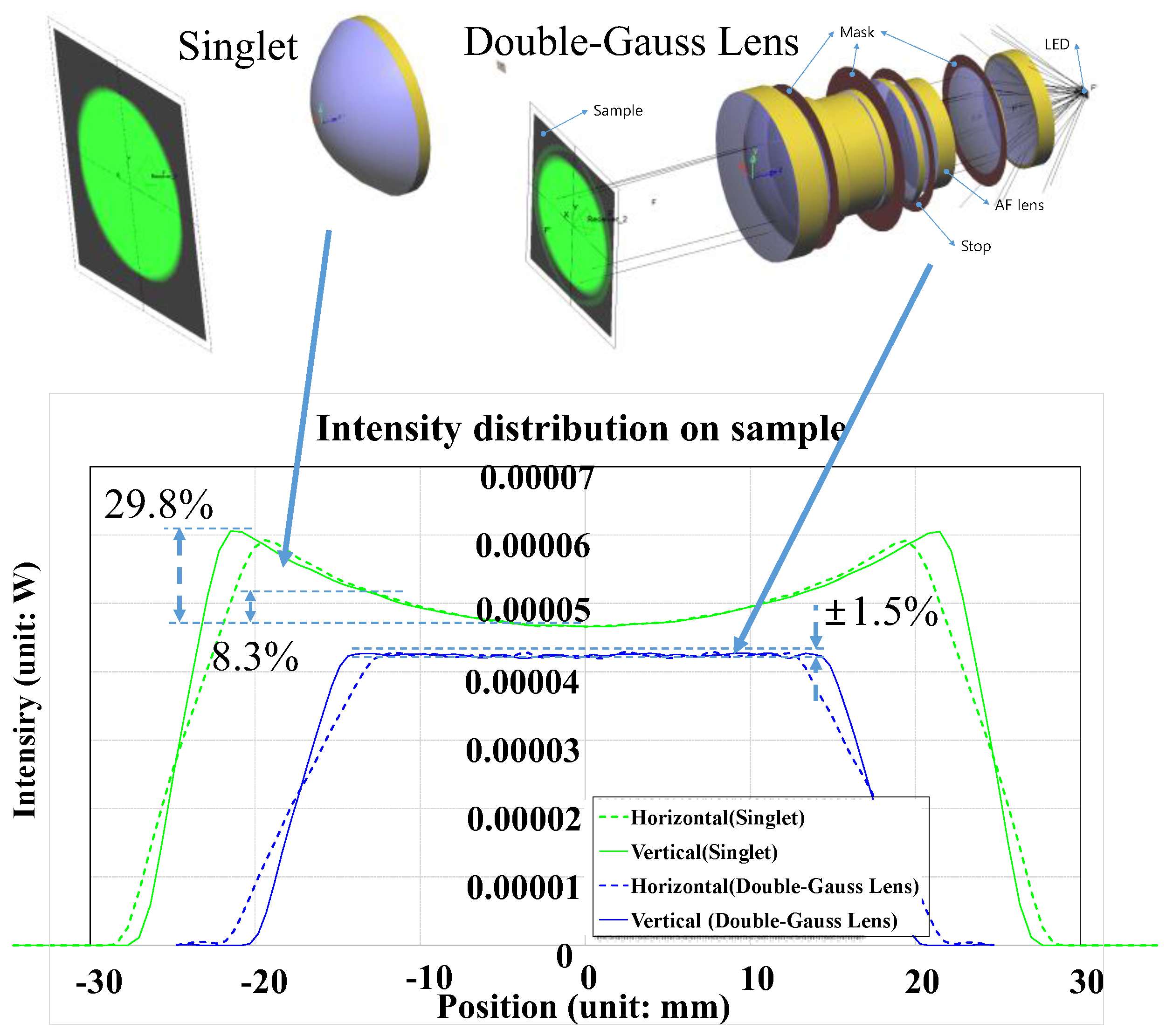
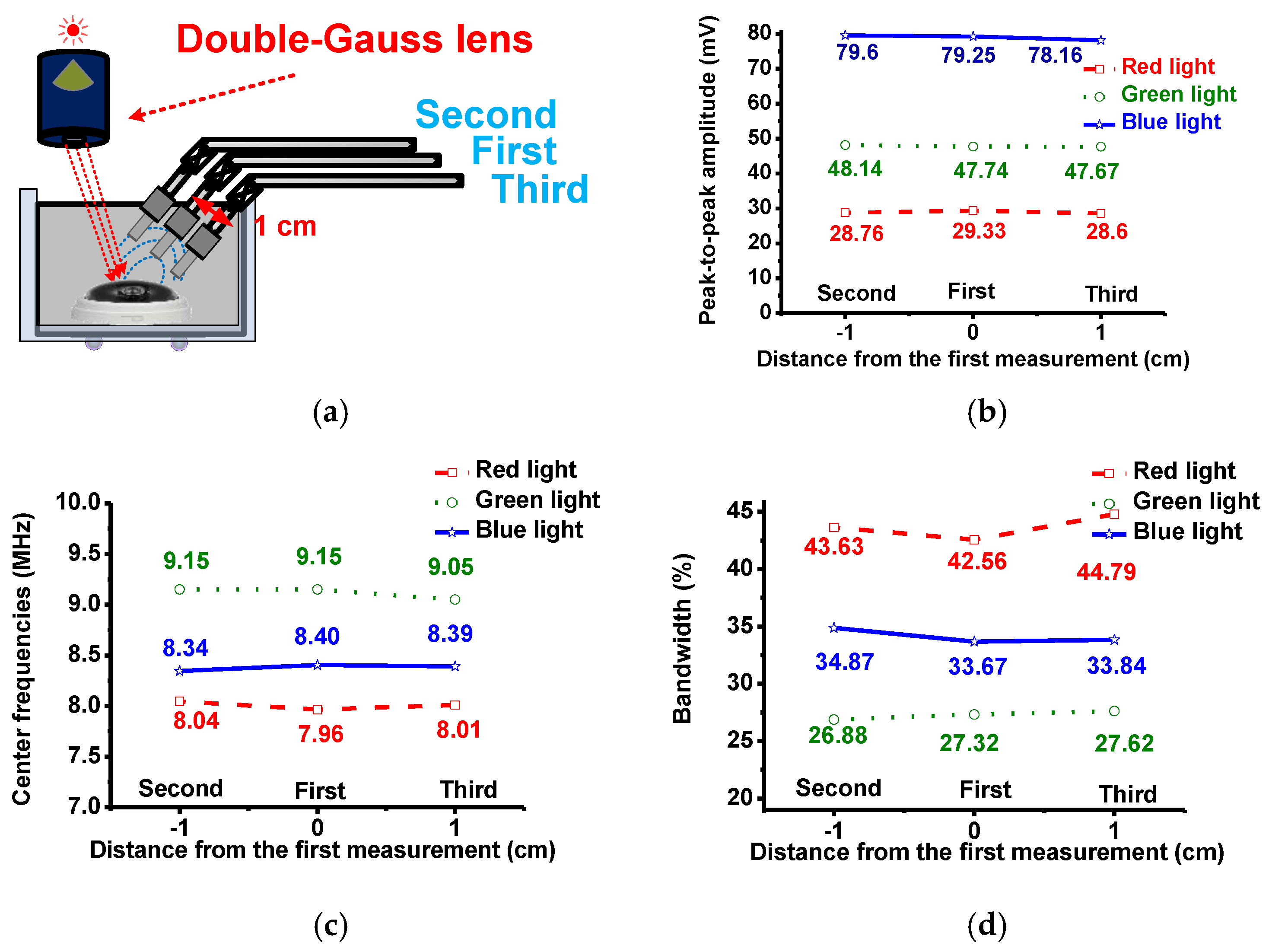
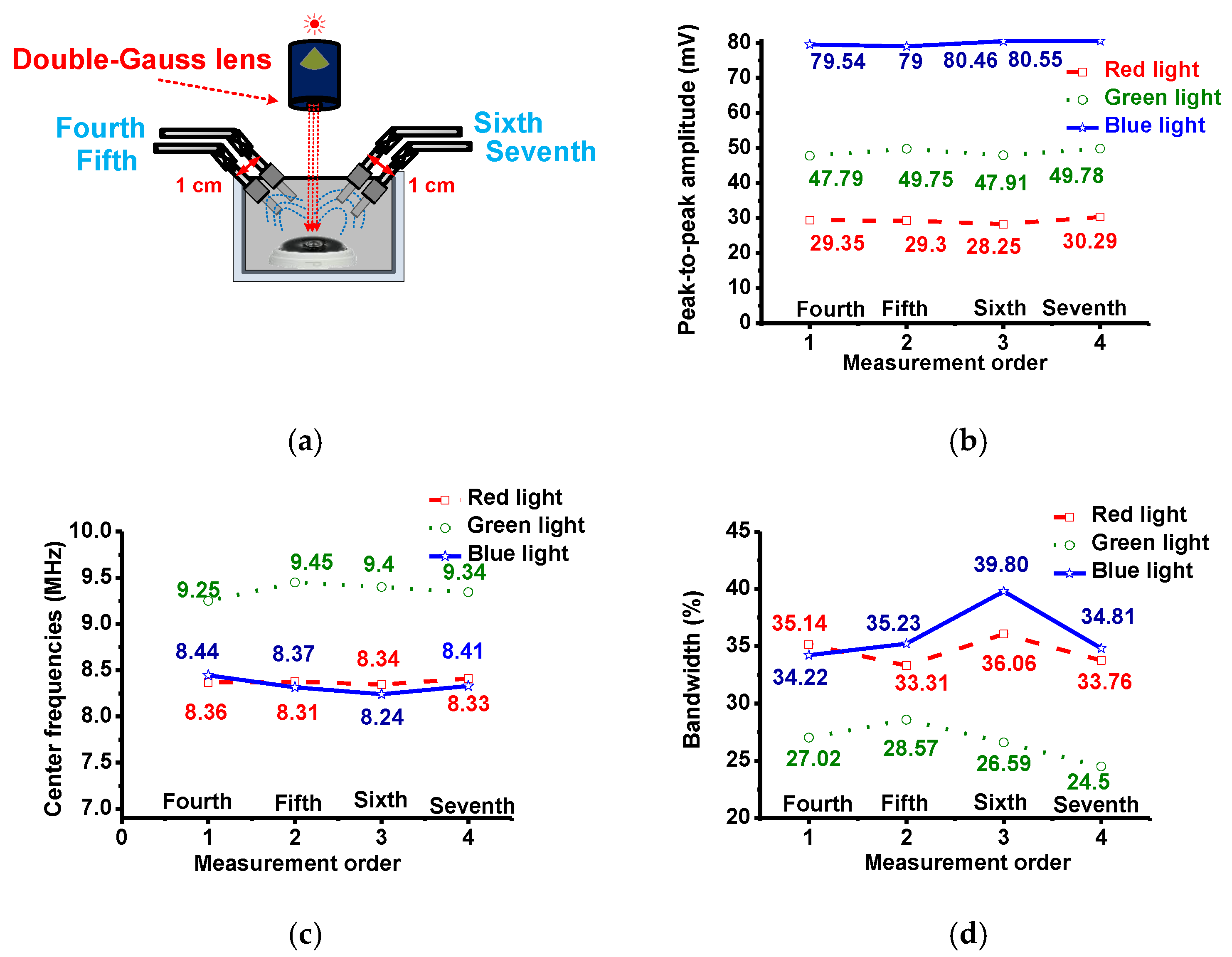
In optoacoustic (photoacoustic) systems, different echo signal intensities such as amplitudes, center frequencies, and bandwidths need to be compensated by utilizing variable gain or time-gain compensation amplifiers. However, such electronic components can increase system complexities and signal noise levels. In this paper, we introduce a double-Gauss lens to generate a large field of view with uniform light intensity due to the low chromatic aberrations of the lens, thus obtaining uniform echo signal intensities across the field of view of the optoacoustic system. In order to validate the uniformity of the echo signal intensities in the system, an in-house transducer was placed at various positions above a tissue sample and echo signals were measured and compared with each other. The custom designed double-Gauss lens demonstrated negligible light intensity variation (±1.5%) across the illumination field of view (~2 cm diameter). When the transducer was used to measure echo signal from an eye of a bigeye tuna within a range of ±1 cm, the peak-to-peak amplitude, center frequency, and their −6 dB bandwidth variations were less than 2 mV, 1 MHz, and 6%, respectively. The custom designed double-Gauss lens can provide uniform light beam across a wide area while generating insignificant echo signal variations, and thus can lower the burden of the receiving electronics or signal processing in the optoacoustic system.
Keywords: optoacoustic applications; double-Gauss lens; transducer optoacoustic applications; double-Gauss lens; transducer