Article

Ecological Impacts of Photovoltaic Infrastructure Construction on Coastal Salt Pan Ecosystems: A Case Study of Microbial Communities in the Tianjin’s “Salt–Solar–Fishery Synergy” System

1
College of Fisheries, Tianjin Agricultural University, Tianjin 300384, China
2
Tianjin Changlu Haijing Group Co., Ltd., Tianjin 300450, China
*
Author to whom correspondence should be addressed.
These authors contributed equally to this work.
Diversity 2026, 18(3), 153; https://doi.org/10.3390/d18030153
Submission received: 4 January 2026 / Revised: 28 January 2026 / Accepted: 29 January 2026 / Published: 2 March 2026
(This article belongs to the Section Marine Diversity)

Abstract

Against the backdrop of advancing the “dual carbon” goals (carbon peaking and carbon neutrality), the “fishery–photovoltaic complementary” model—integrating solar power generation with salt pan production—has been widely adopted in Tianjin. However, large-scale photovoltaic (PV) facility construction exerts complex impacts onsalt panns, a wetland ecosystem of unique ecological value, by blocking sunlight, altering local microclimates, and regulating water evaporation. Currently, systematic field studies on the comprehensive effects of PV facilities onsalt pans ecosystems remain scarce, particularly those focusing on impacts on primary producers and key environmental factors. Pond sediments harbor the densest and most diverse aquatic microbial communities. In this study, sediment samples were collected from four typical ponds in Tianjin’salt panan region in April, July, and September 2024. Post sample processing, multiple statistical analyses were conducted, including alpha diversity indexing, species abundance clustering, and beta diversity analysis (non-metric multidimensional scaling, NMDS). The results showed the following: (1) Microbial communities existed in both PV-equipped and non-PV areas, indicating no significant correlation between PV presence and alpha diversity indices. (2) Species and genus compositions aggregated in PV-equipped areas with generally consistent community structures, whereas they displayed high dispersion in non-PV areas. This regulatory effect of PV facilities was relatively stable, with deviations only at a few sampling sites, confirming that PV presence significantly affects community composition patterns at both species and genus levels. (3) Cluster heatmap analysis revealed distinct seasonal variations in clustering relationships between sampling stations and microbial genera. Among dominant genera, only Desulfotignum was unaffected by PV facilities or seasonal changes, while the distribution of other dominant genera was significantly influenced by PV construction.

1. Introduction

Salt pans, also known as “salt marshes” or “salt ponds”, are important artificial wetlands characterized by both the ecological functions of natural salt marshes and the impacts of human activities [1,2]. Different biological communities thrive in various zones of salt pans, forming the salt pan ecosystem [3]. Several decades ago, a qualitative description of the ideal salt pan ecosystem was already provided [4], which pointed out that the salt pan ecosystem is of great significance for raw salt production. Consequently, the field of salt pan biology has attracted considerable attention.
The microbial species in salt pan ecosystems mainly include bacteria, archaea, fungi, and so on. Through the continuous adaptation process to hypersaline environments, microorganisms have naturally developed their unique community structure composition [5,6]. Selvarajan, R. and Sibanda, T. conducted a study on the diversity analysis and bioresource characterization of halophilic bacteria isolated from a South African salt pan [7] and also carried out microbial research on salt ponds in different salinity zones of the Tanggu Saltworks in Tianjin. Their results indicated that the mesohaline zone is mostly dominated by moderate halophiles and halotolerant bacteria, among which the dominant genera are Flavobacterium, Pseudomonas, Corynebacterium, Bacillus, Sporosarcina, Staphylococcus, Micrococcus, and Planococcus. In the hypersaline zone, extreme halophiles and halotolerant bacteria are predominant, with the dominant species of extreme halophiles mainly being Halobacterium and Halococcus. Yoo, Y., Lee, H., and colleagues isolated a novel halophilic bacterium from the solar saltern of the Yellow Sea and conducted studies on its saline adaptation [8]. Their findings revealed that only archaea (Halogeometricum sp.) exist in hypersaline ponds, while γ-proteobacteria dominate in mesohaline and oligohaline ponds. In extremely hypersaline salt pans, only extreme halophilic archaea can maintain the stability of cell structure and function [9]. This also indicates that the distribution characteristics of all microorganisms in salt pans are closely linked to their environmental conditions [10]. Meanwhile, even within the same salt pan, significant differences still exist in the composition and abundance of microbial communities among different zones [11]. This reflects the degree of microbial adaptation to environmental factors from the perspective of spatial distribution characteristics. Additionally, the hydrological conditions and salinity changes in salt pans lead to significant seasonal variations in microbial communities [12]. Meanwhile, the microbial metabolic functions in salt pans also exhibit diversity [13]. This is because microorganisms can utilize organic and inorganic substances as substrates during chemical cycling processes [14,15]. Furthermore, as decomposers in nature, certain microorganisms in salt pan ecosystems can enhance carbon sequestration capacity through specific metabolic reactions. These microorganisms are not only the foundation of salt pan ecosystems but also play particularly crucial roles in material cycling, energy flow, and bioremediation through their diverse functionalities. Therefore, the balance of salt pan ecosystems relies on microbial diversity and functionality, thereby promoting the stability and restoration of the ecosystem [16,17].
The Tianjin Saltworks is located adjacent to Bohai Bay, with distribution areas mainly in Tanggu and Hangu. Based on the differences in process requirements for salt production, they can be classified into primary, secondary, and tertiary salt pans, where the salinity ranges are 28–40, 40–50, and 50–60 (practical salinity units, PSU), respectively. Furthermore, these salt pans are associated with the physicochemical properties of concentrated seawater and their relevant impacts, with reference to the characteristics of desalination brine and its management practices in Gulf Cooperation Council (GCC) countries [18]. Subsequently, over time, affected by anthropogenic disturbances and changes in the physical geographical environment, both the diversity and functionality of the Tianjin Coastal Salt Pan Ecosystem have experienced varying degrees of decline and weakening. Therefore, the protection and rational development of biological and ecological resources in salt pans are crucial to sustainable development.
Subsequently, driven by the rigid demand for production, the Tianjin Saltworks have gradually carried out aquaculture activities involving Artemia, Penaeus vannamei (Whiteleg shrimp), Apostichopus japonicus (Japanese sea cucumber), and other species. In recent years, they have further attempted the integration of salt production, aquaculture, and photovoltaic power generation (referred to as the “salt–aquaculture–photovoltaics complementary model”), with a number of photovoltaic facilities constructed in the salt pans. As is widely recognized, China is one of the countries endowed with abundant solar energy resources, boasting inherent advantages in the development of green energy. However, the large-scale construction of photovoltaic facilities will inevitably exert long-term and complex impacts on salt pan ecosystems. Therefore, regulating the salt pan ecosystem has become an urgent and challenging issue that needs to be addressed. Meanwhile, with the continuous increase in the number and scale of photovoltaic installations, this issue has attracted growing attention. Given that the Tanggu Salt Pan is inherently a sensitive ecological zone, it is necessary to conduct an impact assessment of photovoltaic installation construction on the local ecosystem [19].
This study focuses on changes in microbial communities in salt pan pond sediments. Its core objective is to clarify the response patterns of the composition, diversity, and dominant taxa of sediment microbial communities under photovoltaic (PV) facility disturbance, and to reveal impact mechanism of PV construction on the core ecological function carriers ofsalt pann wetlands. Studies have shown that environmental stress can lead to a significant decrease in microbial diversity, indicating that microbial diversity can serve as an early warning signal for changes in environmental health. Therefore, the diversity of microorganisms in sediments is one of the important indicators for measuring the stability of aquatic ecosystems.

2. Materials and Methods

2.1. Sample Collection

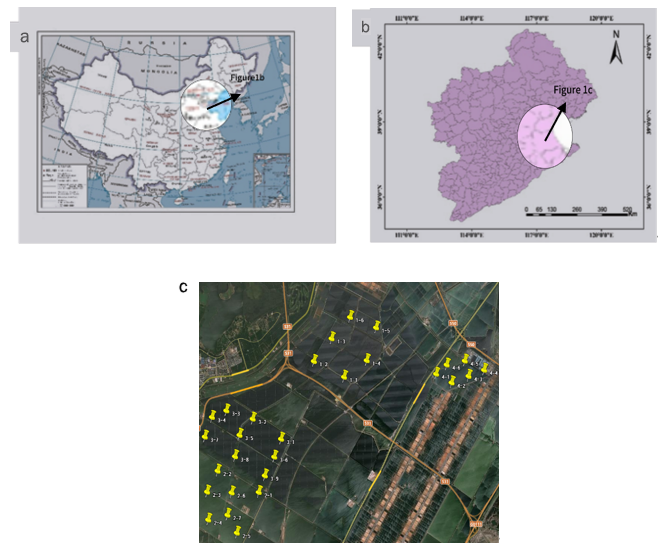
Sampling surveys were conducted at four typical ponds of the salt pan affiliated to Tianjin Changlu Haijing Group Co., Ltd., Tianjin City, in April, July, and September 2024, respectively. The four ponds and their brief profiles are presented in Table 1. Sampling stations were established at specific locations within each pond, such as the pond center, water inlets and outlets, sites with extreme water depths, and representative positions of the upwind and downwind areas.
After selecting four ponds for the study, Pond 1 and Pond 4 were designated as a control group, while Pond 2 and Pond 3 formed another control group.
Figure 1 presents the distribution map of sampling sites, which clearly shows the specific locations of all sampling points involved in the research. Figure 1a shows the location of Figure 1b within the map of China; Figure 1b indicates the location of Figure 1c in the Tianjin sampling area; and Figure 1c represents the specific sampling sites.

2.2. Analytical Methods and Data Processing

All specimens in this study were collected from sediments of four typical ponds in Tianjin’s salt pan area. Sampling strictly followed microbial research standards, with rigorous control over sterility and sample representativeness throughout. The detailed procedure is as follows.
Core sampling equipment included a gravity corer (KC Denmark A/s, Silkeborg, Denmark), a sterile stainless steel sampling spoon (Sartorius, Göttingen, Germany), 3 mL sterile cryogenic vials (Corning, Corning, NY, USA), sterile sealed bags (Nasco, Fort Atkinson, WI, USA), a portable low-temperature incubator (4 °C with ice packs) (Thermo Fisher Scientific, Waltham, MA, USA), 0.2 μm filter-sterilized distilled water (Millipore, Burlington, MA, USA), and 1 ppm chlorine dioxide disinfectant (Sigma-Aldrich, St. Louis, MO, USA). Auxiliary equipment (GPS locator (Garmin, Olathe, KS, USA), sediment depth ruler (Huazhi Measuring Instrument, Shanghai, China), portable pH meter (Mettler Toledo, Greifensee, Switzerland), dissolved oxygen meter (YSI, Yellow Springs, OH, USA)) recorded sampling site coordinates, sediment depth, and water physicochemical parameters. All sample-contact equipment underwent sterile pretreatment; non-contact surfaces were disinfected with alcohol swabs to avoid cross-contamination. Equipment selection and pretreatment referred to shallow-water pond sediment sampling specifications [20].
Sampling was performed in April, July, and September 2024. Each pond was divided into PV-equipped and non-PV areas, with 6–9 sampling sites per area. GPS ensured consistent positioning across seasons [21]. The gravity corer was vertically lowered to the pond bottom, embedding 0–10 cm into sediments (microbial enrichment core layer). After 30 s of stabilization, it was lifted steadily to avoid disturbance. The polycarbonate liner was removed, and middle-layer sediments were collected with a sterile spoon (excluding surface mud and bottom crust for representativeness). ~2 mL of sample was quickly transferred into 3 mL sterile cryogenic vials, sealed immediately, and labeled with pond number, site, PV type, and date. Additional samples were stored in sterile bags for physicochemical analysis. All samples were kept at 4 °C, transported to the laboratory within 24 h, and stored at −80 °C, avoiding repeated freeze–thaw to preserve microbial activity. The overall method followed sediment microbial community research specifications [22].
Sterility control was maintained throughout sampling, with measures as follows: ① Equipment pretreatment: Gravity corer liners and sampling spoons were soaked in 1 ppm chlorine dioxide for 30 min, rinsed 3 times with 0.2 μm filter-sterilized distilled water, air-dried, and sealed for use, with disinfection repeated per site; ② Aseptic operation: Personnel wore sterile gloves, masks, and protective clothing, replacing gloves after contacting non-sterile surfaces. Opened vials only touched sediments to avoid contamination; ③ Blank control: One blank sample (0.2 μm filter-sterilized distilled water in sterile vial) was included per batch to detect exogenous contamination during transport and processing; ④ Transportation protection: Incubator inner walls were disinfected with sterile gauze, and samples were separated from ice packs with sterile plastic wrap to prevent condensation contamination. These measures were based on microbial sampling aseptic operation theory [23].
Genomic DNA was extracted from the collected samples using either the CTAB or SDS method [24]. Subsequently, the purity and concentration of the extracted DNA were determined by agarose gel electrophoresis(Bori Technology, Hangzhou, Zhejiang, China). An appropriate amount of the DNA sample was placed into a centrifuge tube and diluted to 1 ng/μL with sterile deionized water. The diluted genomic DNA was used as a template for PCR amplification with specific primers. Specifically, the 16S rRNA gene V4 region primers (515F: 5′-GTGYCAGCMGCCGCGGTAA-3′; 806R: 5′-GGACTACHVGGGTWTCTAAT-3′) were employed to characterize bacterial diversity. The 18S rRNA gene V4 region primers (528F: 5′-GCGGTAATTCCAGCTCCAA-3′; 706R: 5′-AATCCRAGAATTTCACCTCT-3′) were used to characterize eukaryotic microbial diversity. The ITS1 region primers (ITS5-1737F: 5′-GGAAGTAAAAGTCGTAACAAGG-3′; ITS2-2043R: 5′-GCTGCGTTCTTCATCGATGC-3′) were utilized to characterize fungal diversity. In addition, the amplified regions further included 16S rRNA gene V3–V4, V4–V5, and V5–V7; archaeal 16S rRNA gene V4–V5 and V8; 18S rRNA gene V9; and the ITS2 region [25]. PCR amplification of the 16S rRNA gene encompassing the V3–V4 hypervariable region was performed using specific primers with barcodes (forward primer: 5′-ACTCCTACGGGGGCAGCA-3′; reverse primer: 5′-GGACTACHVGGGTWTCTAAT-3′) [26]. Each PCR reaction system consisted of 15 μL of high-fidelity PCR master mix, 0.2 μM primers, and 10 ng of template DNA. The PCR cycling conditions were as follows: an initial denaturation step at 98 °C for 1 min, followed by 30 cycles of denaturation at 98 °C for 10 s, annealing at 50 °C for 30 s, and extension at 72 °C for 30 s, with a final extension step maintained at 72 °C for 5 min. An equal volume of loading buffer (containing SYBR Green) was mixed with the PCR products, and electrophoresis was performed on a 2% agarose gel to assess DNA purity. Subsequently, the PCR products were purified using a gel extraction kit(Beyotime Biotechnology, Shanghai, China). An amplicon library was constructed, followed by Qubit quantification and quality inspection. After passing quality control, the library was sequenced on the Illumina platform [27].
To ensure the accuracy and reliability of the data analysis results, raw sequencing data were first subjected to assembly and filtering processes to obtain high-quality clean data. Subsequently, the clean data were subjected to sequence denoising and clustering following the QIIME 2 pipeline, followed by taxonomic classification analysis. Based on the denoising and clustering results, taxonomic annotation was performed for each sequence. The relative changes in data across multiple phyla were visualized using stacked bar charts [28,29]. Meanwhile, deeper insights into the corresponding taxonomic information and species-based abundance distributions were obtained, which were analyzed using species abundance clustering heatmaps [30,31]. Subsequently, abundance calculation and Alpha diversity analysis were performed for the Amplicon Sequence Variants (ASVs), yielding statistics on the within-sample Alpha diversity indices [32], such as the Shannon-Wiener index, Simpson’s diversity index, and Chao1 index. In the Beta diversity analysis, all taxonomic annotation results of the samples and the abundance information of sequence variants belonging to the same taxonomic category were merged first, serving as the basis for generating the species abundance table. Furthermore, based on the relationships among sequence variants, the UniFrac distances (Unweighted UniFrac) were further calculated [33,34]. The UniFrac distance quantifies the dissimilarity between samples based on the phylogenetic information of microbial sequences, and a distance matrix requires data from two or more samples for construction. Subsequently, the Weighted UniFrac distance was derived by incorporating the abundance information of sequence variants into the Unweighted UniFrac distance [35]. Finally, differences among different samples were identified using Non-Metric Multi-Dimensional Scaling (NMDS) based on the Beta diversity indices [36], providing a foundation for further ecological research.

3. Results

3.1. Alpha Diversity Index Statistics

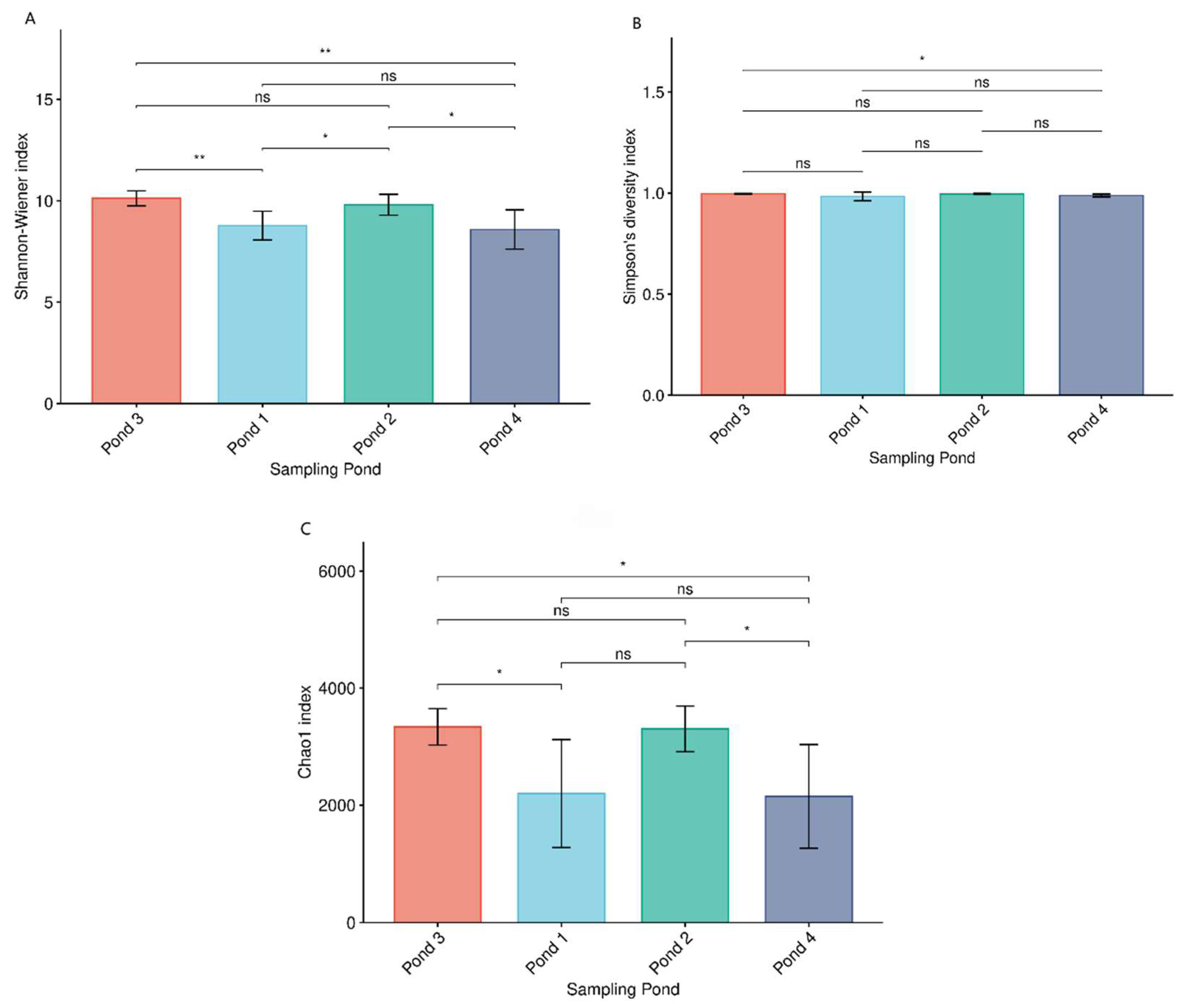
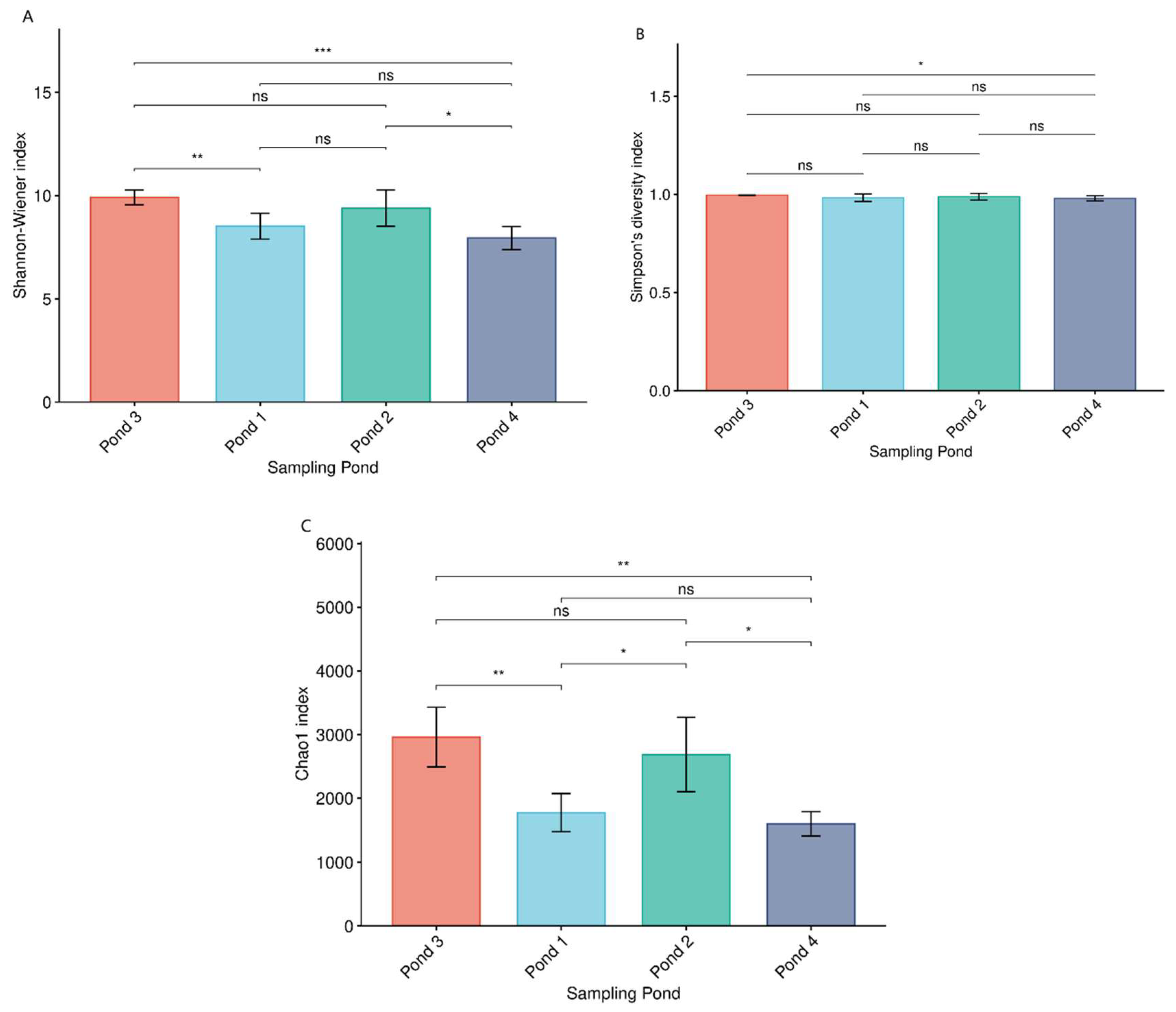
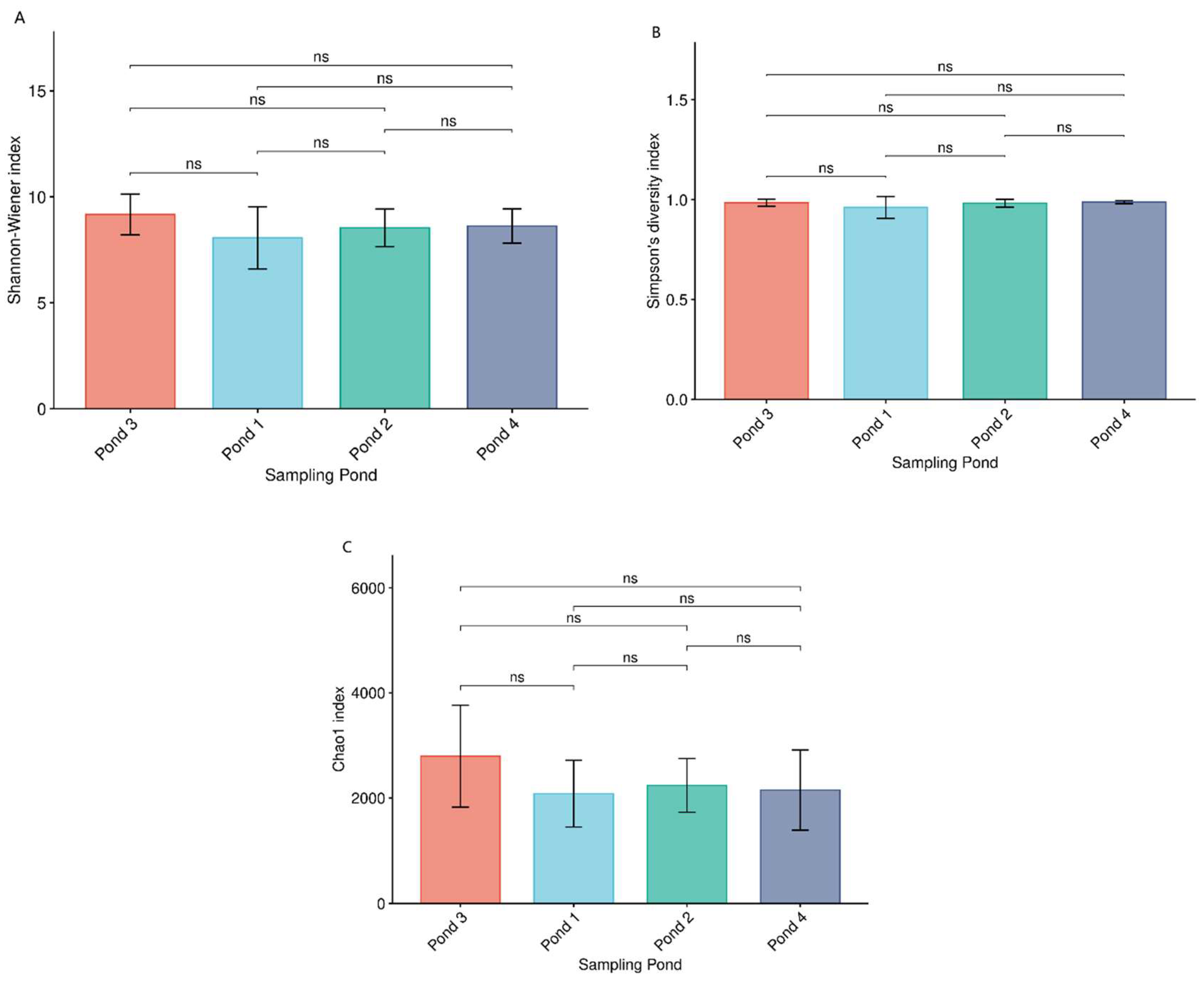
For statistical analysis, four typical ponds were divided into two groups: ponds in areas with photovoltaic (PV) facilities (Pond 1 and Pond 3) and ponds in areas without PV facilities (Pond 2 and Pond 4). The specific results are illustrated in Figure 2, Figure 3 and Figure 4.
As shown in Figure 2A, among the Shannon–Wiener diversity indices, Pond 3 exhibited the highest value, corresponding to the richest species diversity, while Pond 4 had the lowest value, indicating the least abundant species diversity. No significant differences (p > 0.05) were observed between Brine shrimp culture areas with and without photovoltaic (PV) installations (Pond 1 vs. Pond 4), as well as between Penaeus vannamei culture areas with and without PV installations (Pond 2 vs. Pond 3). Highly significant differences in diversity (p < 0.01) were mainly detected between Pond 3 and Pond 1, as well as between Pond 3 and Pond 4. In contrast, significant differences (p < 0.05) were observed between Pond 2 and Pond 1, and between Pond 2 and Pond 4. As illustrated in Figure 2B, for the Simpson diversity index, no significant differences in diversity were observed among the other groups (p > 0.05); only the comparison between Pond 3 and Pond 4 showed a significant difference (p < 0.05). As shown in Figure 2C (Chao1 index), significant differences in species richness (p < 0.05) were detected between Pond 3 and Pond 1, Pond 3 and Pond 4, and Pond 2 and Pond 4.
As shown in Figure 3A, the species diversity richness was consistent with that presented in Figure 2A, with Pond 3 exhibiting the highest richness and Pond 4 the lowest. Among these, no significant differences were observed between Pond 1 and Pond 2, Pond 3 and Pond 2, or Pond 1 and Pond 4 (p > 0.05). A significant difference was detected between Pond 2 and Pond 4 (p < 0.05), while a highly significant difference was found between Pond 3 and Pond 1 (p < 0.01). Notably, the difference between Pond 3 and Pond 4 was significantly greater than that among other groups (p < 0.001). As shown in Figure 3B, the Simpson diversity index results were essentially consistent with those in Figure 2B, with a significant difference only detected between Pond 3 and Pond 4 (p < 0.05). As shown in Figure 3C (Chao1 index), no significant differences were observed between Pond 3 and Pond 2, or between Pond 1 and Pond 4 (p > 0.05). Significant differences were detected between Pond 1 and Pond 2, and between Pond 2 and Pond 4 (p < 0.05). Additionally, highly significant differences were identified between Pond 3 and Pond 1, as well as between Pond 3 and Pond 4 (p < 0.01).
No significant differences were observed among the three indices (Shannon–Wiener, Simpson, and Chao1) across all samples in Figure 4A–C (p > 0.05). This indicates that the comprehensive levels of species diversity, including richness and evenness, were relatively similar among the four sampling areas. Although the values of Pond 3 were slightly higher than those of the other three Ponds in the figures, this difference did not reach the statistical significance threshold.
Based on the above analysis, the presence of photovoltaic (PV) installations did not exhibit a consistent negative impact on microbial community diversity. On the contrary, the highest species diversity values were recorded in areas with PV installations, while the lowest values were observed in areas without PV installations. This indicates that the primary factors influencing species diversity are unrelated to the presence or absence of PV construction. In terms of the overall pattern, Pond 3 (a Penaeus vannamei culture area with photovoltaic (PV) installations) exhibited the richest species diversity, with its Shannon–Wiener index and Chao1 index being higher than those of the other groups. In contrast, Pond 4 (a Brine shrimp culture area without photovoltaic (PV) installations) had the lowest species diversity, with all its key indices being lower than those of the other areas. Based on the combined performance of the four areas, although Pond 3 (a Penaeus vannamei culture area with photovoltaic (PV) installations) exhibited the highest values among the PV-equipped regions, the data from Pond 1 (a Brine shrimp culture area with PV installations) showed no advantages compared to those of the non-PV areas. Furthermore, among the non-photovoltaic (PV) areas, except that Pond 4 (a Brine shrimp culture area without PV installations) exhibited the lowest values, the values of Pond 2 (a Penaeus vannamei culture area without PV installations) were not significantly different from those of Pond 1. This indicates that there is no simple correlation between the presence of photovoltaic (PV) installations and the Alpha diversity indices.

3.2. Beta Diversity Analysis (Non-Metric Multidimensional Scaling, NMDS)

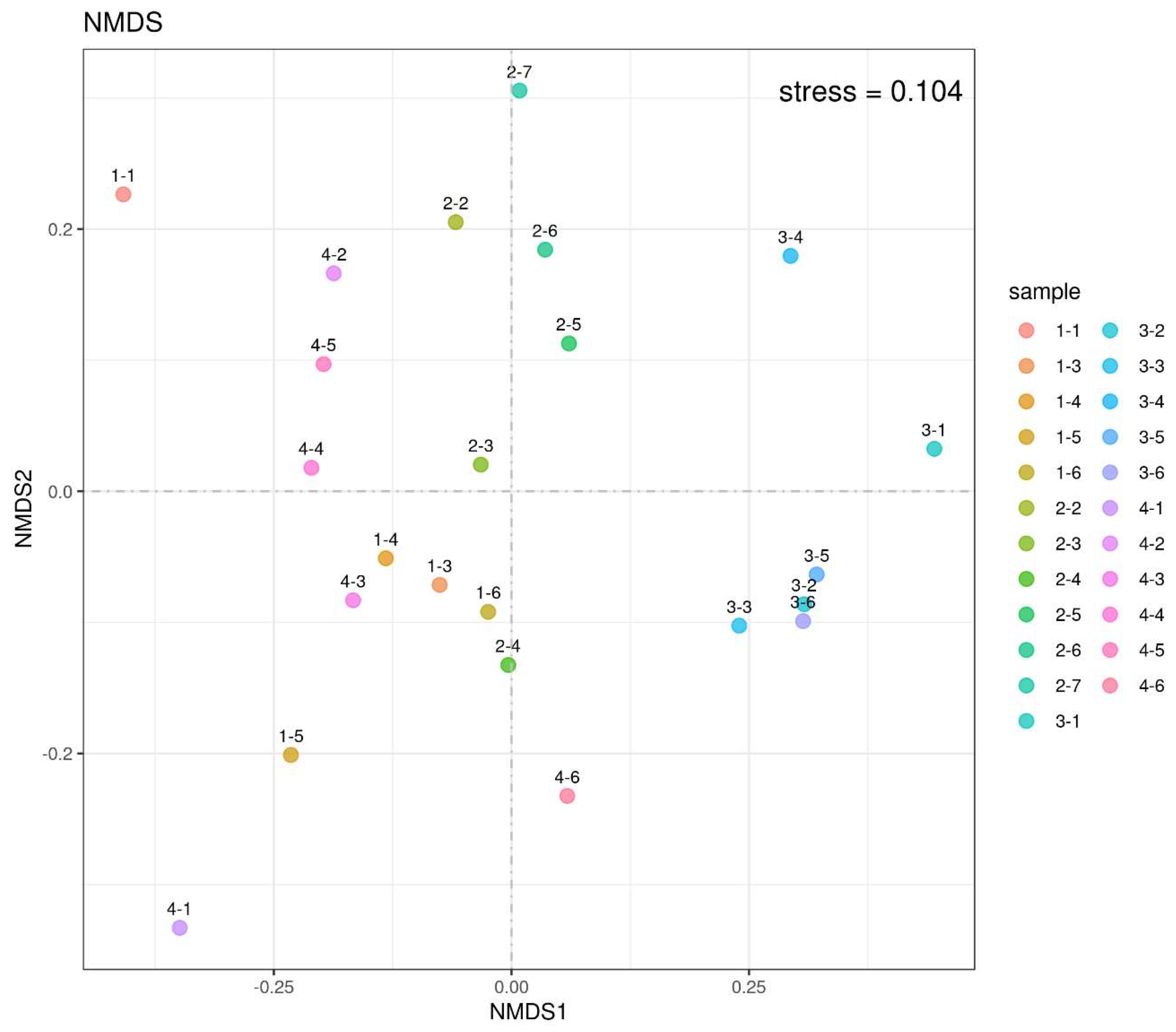
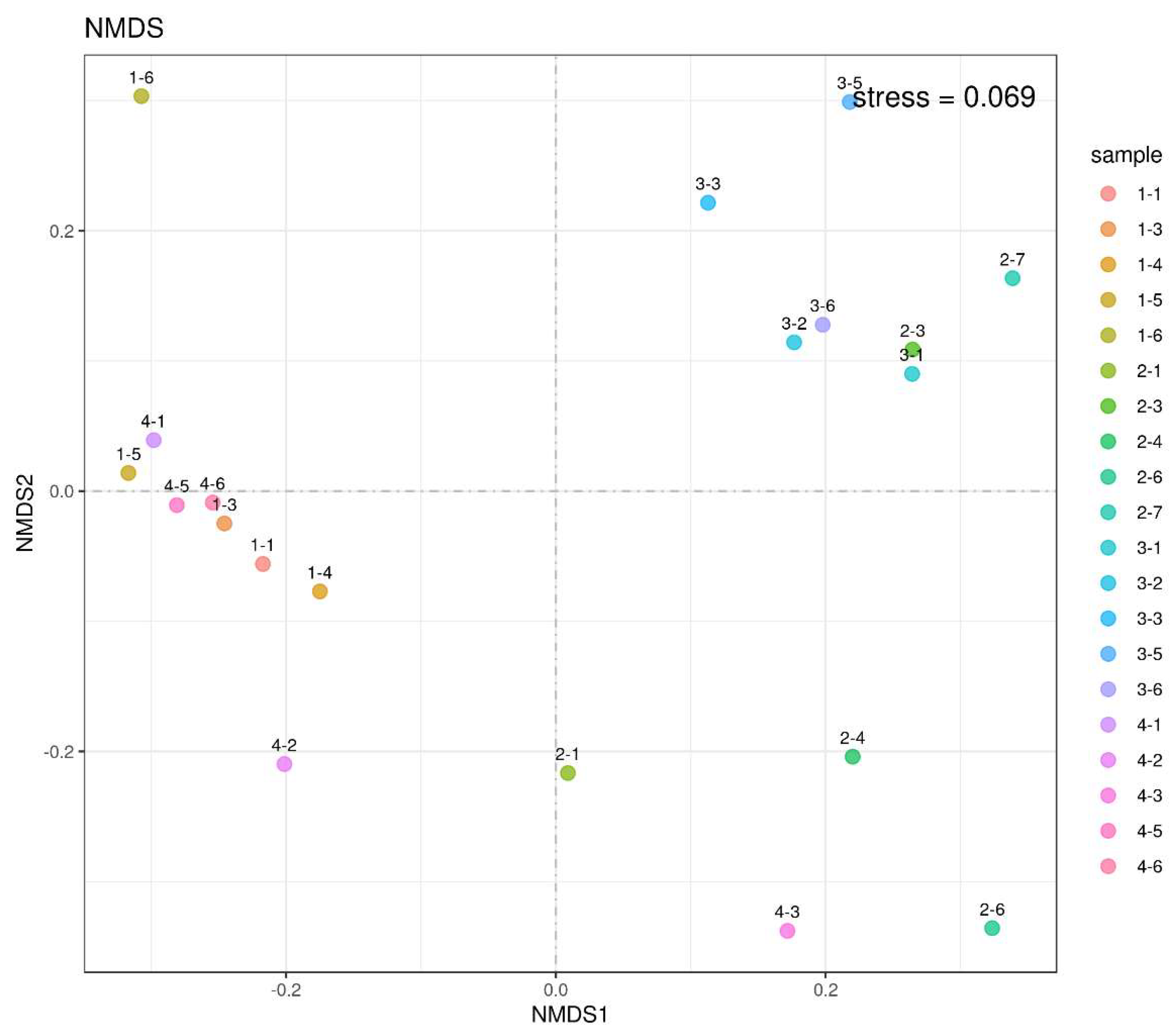
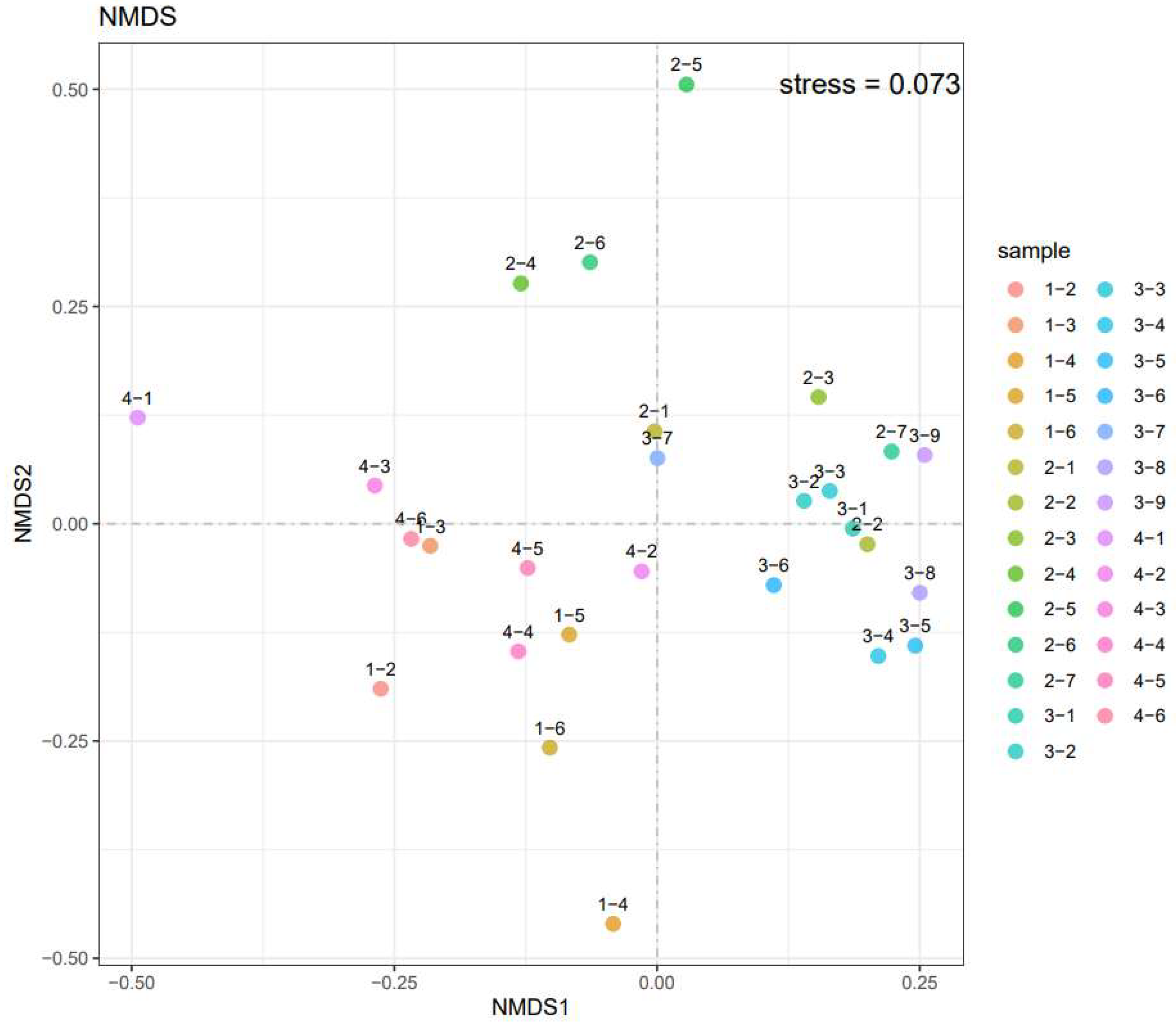
Non-metric multidimensional scaling (NMDS) is a commonly used ordination method in ecological research. As a non-linear model that incorporates species genus information and visualizes data as points in a two-dimensional space, NMDS not only addresses the limitations of linear models but also better reflects the non-linear structure of ecological data. It reflects the degree of difference among different samples through the distance between points, thereby illustrating the inter-group and intra-group variations in the samples, as shown in Figure 5, Figure 6 and Figure 7.
The NMDS plot for April (Figure 5) shows a stress value of 0.104, which is less than 0.2. This indicates that the NMDS ordination can accurately reflect the degree of dissimilarity among samples. Among the samples from PV-equipped areas (Pond 3 and Pond 1), Pond 3 exhibited advantages in its species and genus composition attributed to the presence of PV installations. However, the species and genus composition of Pond 1 showed considerable variability. This indicates that the impact of PV installations on microbial community composition is not uniform. The samples from non-PV areas (Pond 2 and Pond 4) showed no overall aggregation in the NMDS ordination and even exhibited spatial separation from Pond 3. This indicates that the presence of photovoltaic (PV) installations has altered the community composition pattern of species and genera.
The NMDS ordination plot for July (Figure 6) shows a stress value of 0.069, which is less than 0.2. This indicates that the NMDS analysis can accurately reflect the degree of dissimilarity among samples. In the NMDS ordination plot, the samples from PV-equipped areas (Pond 3 and Pond 1) exhibited distinct aggregation, indicating that the presence of photovoltaic (PV) installations tends to homogenize the species and genus composition of the microbial community. In the NMDS ordination plot, the samples from non-PV areas (Pond 2 and Pond 4) were relatively scattered, indicating that the species and genus composition among the sampling sites was more distinct in the absence of PV installations.
The NMDS ordination plot for September (Figure 7) shows a stress value of 0.07, which is less than 0.2. This indicates that the NMDS analysis can accurately reflect the degree of dissimilarity among samples. Within Pond 3, the species and genus composition showed high similarity among different sampling sites. Although Pond 1 exhibited a certain degree of dispersion, it did not affect its overall relative aggregation, indicating that the internal species and genus composition of Pond 1 was relatively consistent. The samples within Pond 2 were relatively scattered, indicating significant differences in species and genus composition among sites within this pond. Similarly, the samples from Pond 4 showed no aggregated distribution, with considerable variability in their internal species and genus composition. These results are consistent with those presented in the July NMDS ordination plot (Figure 6).
Finally, by integrating the NMDS analyses and species/genus abundance clustering results from April to September, the following conclusion was drawn: the presence of photovoltaic (PV) installations exerts a significant impact on the community composition pattern of species and genera. This is manifested by the aggregation of species and genus compositions in PV-equipped areas (Pond 3 and Pond 1), with their community structures being generally consistent. In contrast, the species and genus compositions in non-PV areas (Pond 2 and Pond 4) exhibited a high degree of dispersion. Furthermore, this regulatory effect of PV installations showed a certain level of stability, with deviations observed only at a few sampling sites (e.g., Pond 1).

3.3. Stacked Bar Charts at Phylum Level

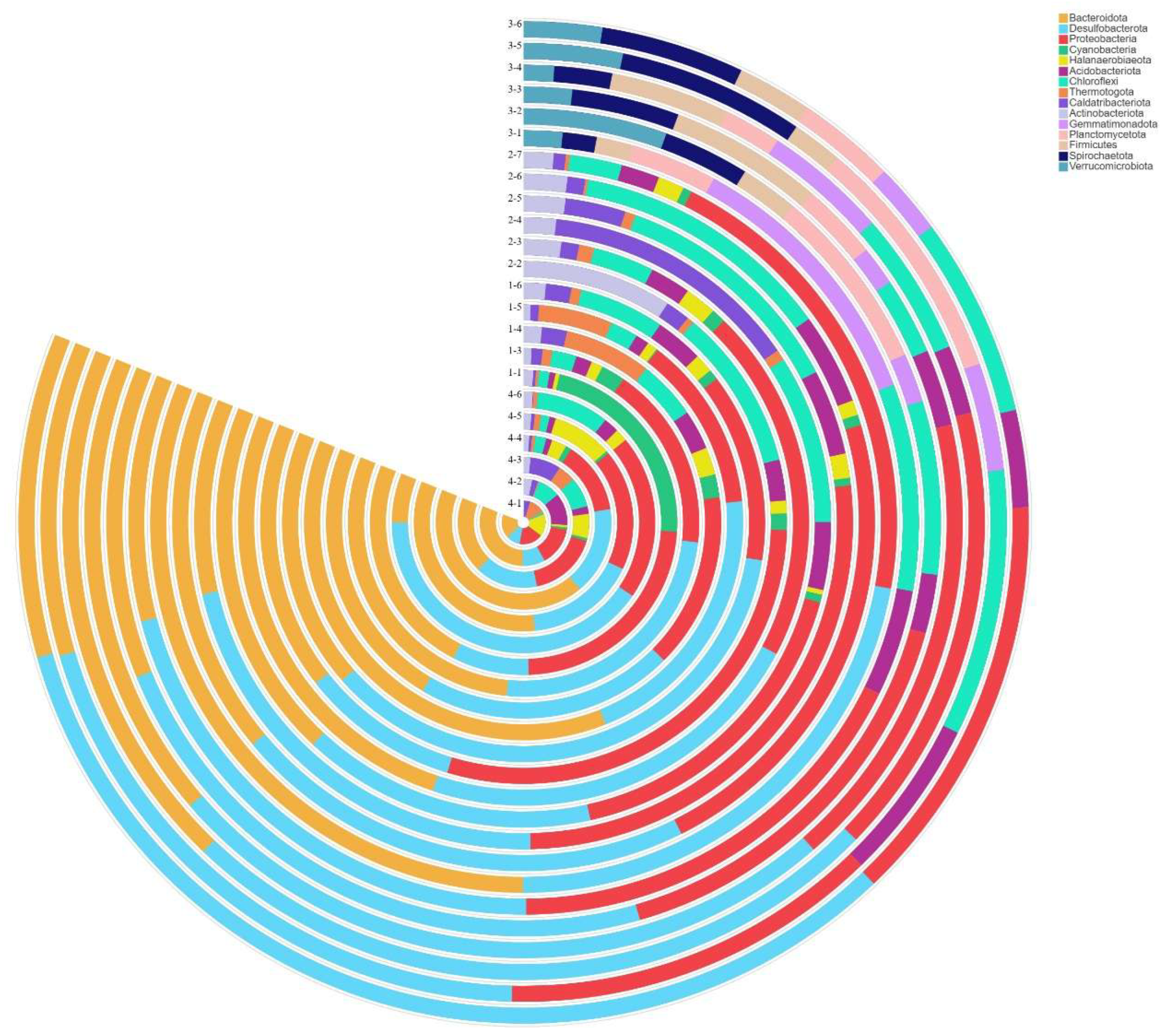
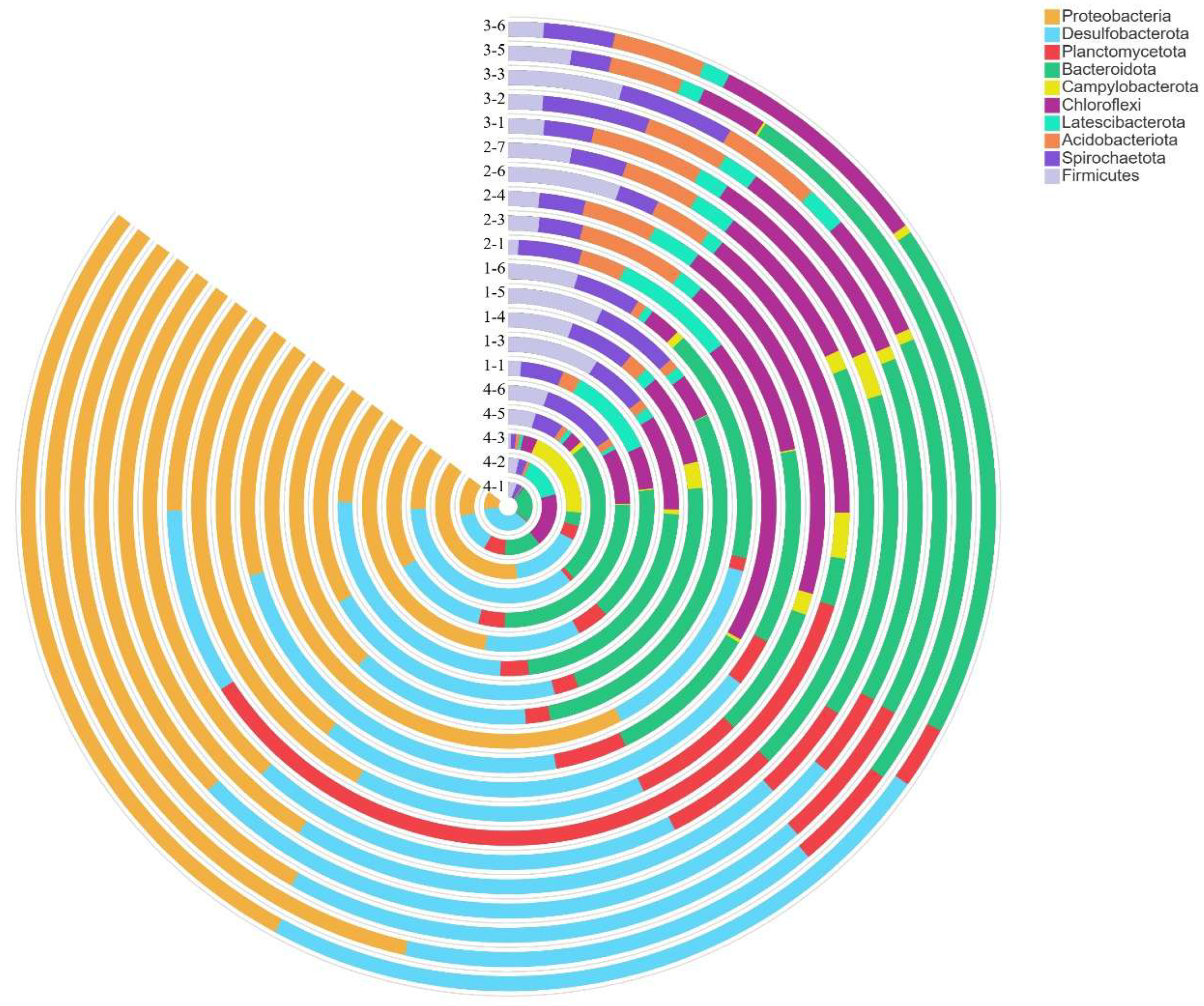
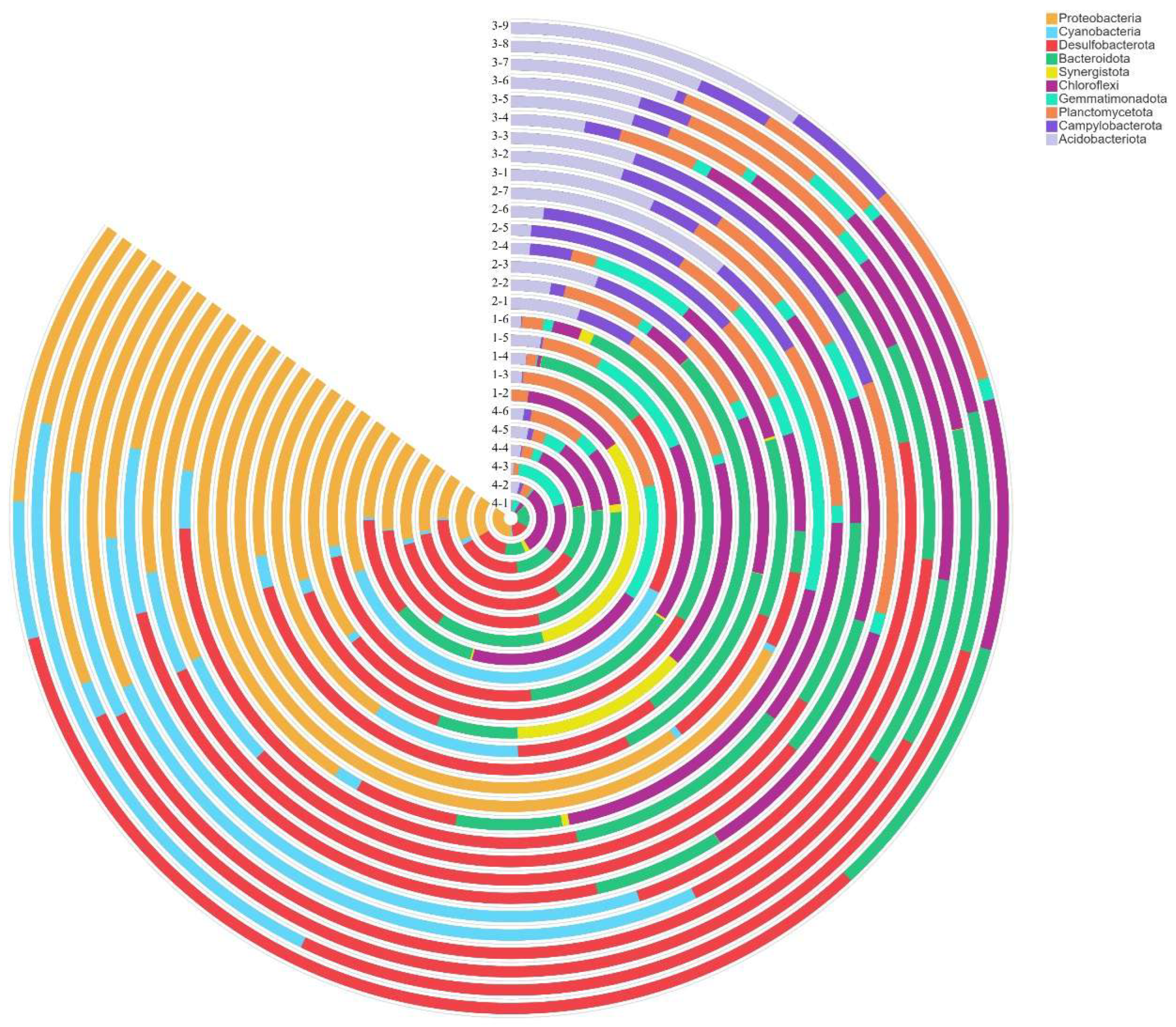
Specifically, for the phylum-level stacked bar charts, the stacked color blocks in Figure 8, Figure 9 and Figure 10 intuitively illustrate the relative abundance of each phylum in individual samples and the structural differences among samples.
As shown in Figure 8, in the samples from Pond 1 and Pond 3 (PV-equipped areas), the microbial communities were dominated by three core dominant phyla—Bacteroidota, Verrucomicrobiota, and Desulfobacterota. The relative abundances of these phyla exhibited a within-group variation of less than 8%, with highly consistent color compositions across all samples in the stacked bar chart. This validates the regulatory effect of PV installations on microbial community composition. In sharp contrast, in the samples from Pond 2 and Pond 4 (non-PV areas), the proportions of non-dominant taxa such as Actinobacteriota and Planctomycetota were significantly increased, exceeding 18% in some local samples—a phenomenon rarely observed in PV-equipped area samples. The color composition of the stacked bar charts for non-PV areas showed significant dispersion, reflecting the natural differentiation characteristics of microbial communities in the absence of PV installation disturbances.
As shown in Figure 9, in the samples from Pond 1 and Pond 3 (PV-equipped areas), the microbial communities were dominated by Proteobacteria as the core dominant phylum. The relative abundance of this phylum exhibited a small within-group variation, with highly consistent color compositions across all samples in the stacked bar chart. In sharp contrast, in the samples from Pond 2 and Pond 4 (non-PV areas), the proportions of taxa such as Chloroflexi (Chloroflexota) and Firmicutes were significantly increased. In some local samples, the abundances of these taxas were notably higher than those in PV-equipped areas, a phenomenon rarely observed in Pond 1 and Pond 3. In the stacked bar charts of non-PV areas, the color composition exhibited a significant increase in dispersion, with substantial fluctuations in the proportions of dominant taxa among different samples. This intuitively reflects the distribution characteristics of microbial communities in the natural environment without PV interference.
As shown in Figure 10, in the samples from Pond 1 and Pond 3 (PV-equipped areas), the microbial communities were dominated by three core dominant phyla—Proteobacteria, Cyanobacteria, and Bacteroidota—with small within-group variations in their relative abundances. In sharp contrast, in the samples from Pond 2 and Pond 4 (non-PV areas), the proportions of non-dominant taxa such as Spirochaetota and Gemmatimonadota were significantly elevated, exceeding 15% in some local samples— a phenomenon extremely rare in PV-equipped area samples. Stacked bar charts of non-PV areas showed marked color dispersion and substantial fluctuations in dominant taxon proportions among samples, reflecting microbial communities’ natural distribution without PV disturbances.
In the samples from Pond 1 and Pond 3 (PV-equipped areas), although core dominant phyla varied across different periods (e.g., Bacteroidota, Proteobacteria, Cyanobacteria), the relative abundances of these dominant taxa all exhibited low within-group variability. The highly consistent color composition of the stacked bar charts among samples reflects community structural homogeneity—this finding is mutually corroborated by the aggregated clustering of PV-equipped area samples in the NMDS ordination.
In sharp contrast, samples from Pond 2 and Pond 4 (non-PV areas) showed significantly elevated proportions of non-dominant taxa, including Actinobacteriota, Chloroflexota (Chloroflexi), and Spirochaetota (exceeding 15% in some local samples). Furthermore, the stacked bar charts displayed high color dispersion and substantial fluctuations in the relative abundances of dominant taxa—these characteristics collectively reflect the natural distribution pattern of microbial communities in the absence of PV-related disturbances

3.4. Genus-Level Abundance Cluster Heatmap

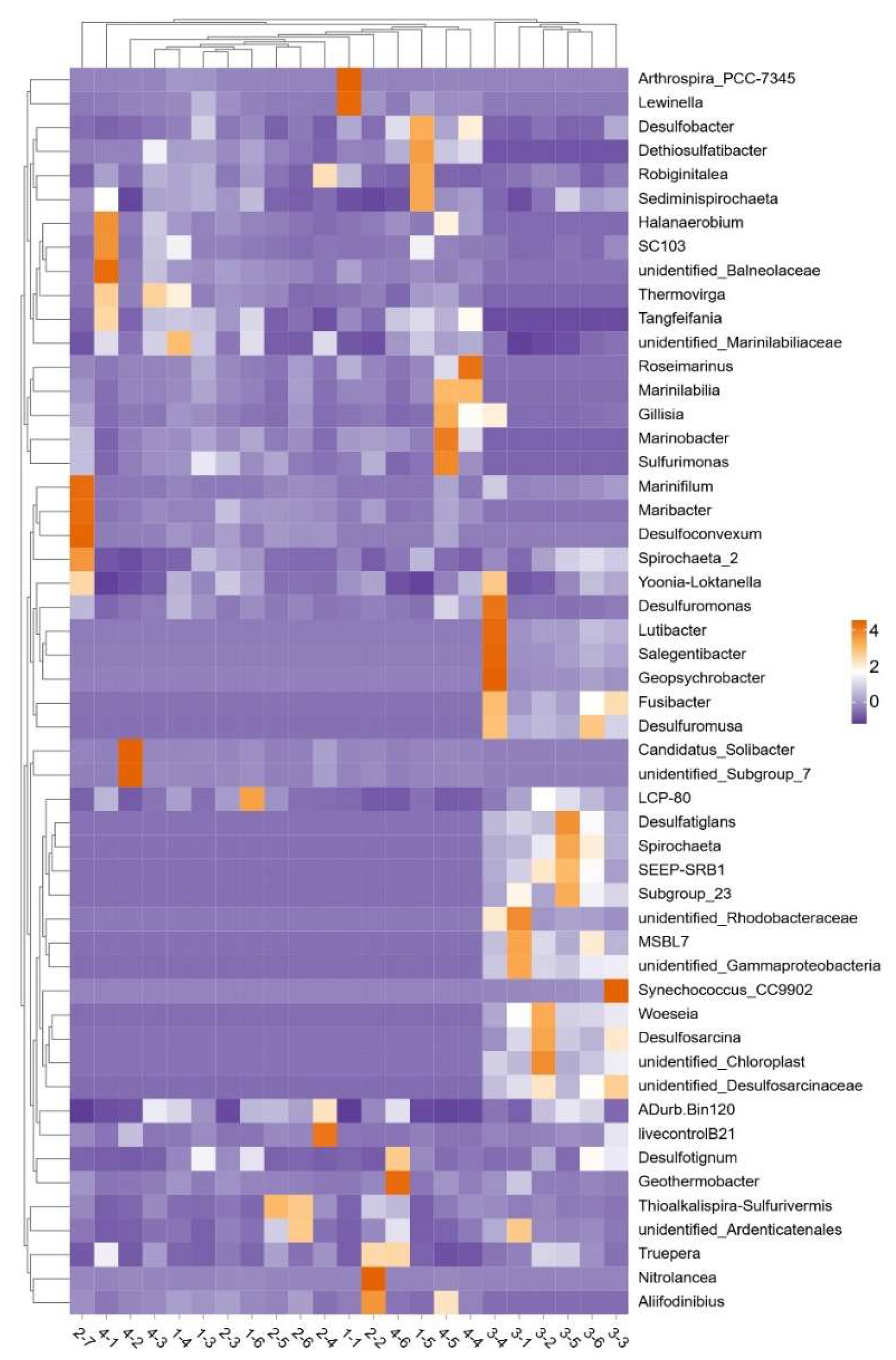
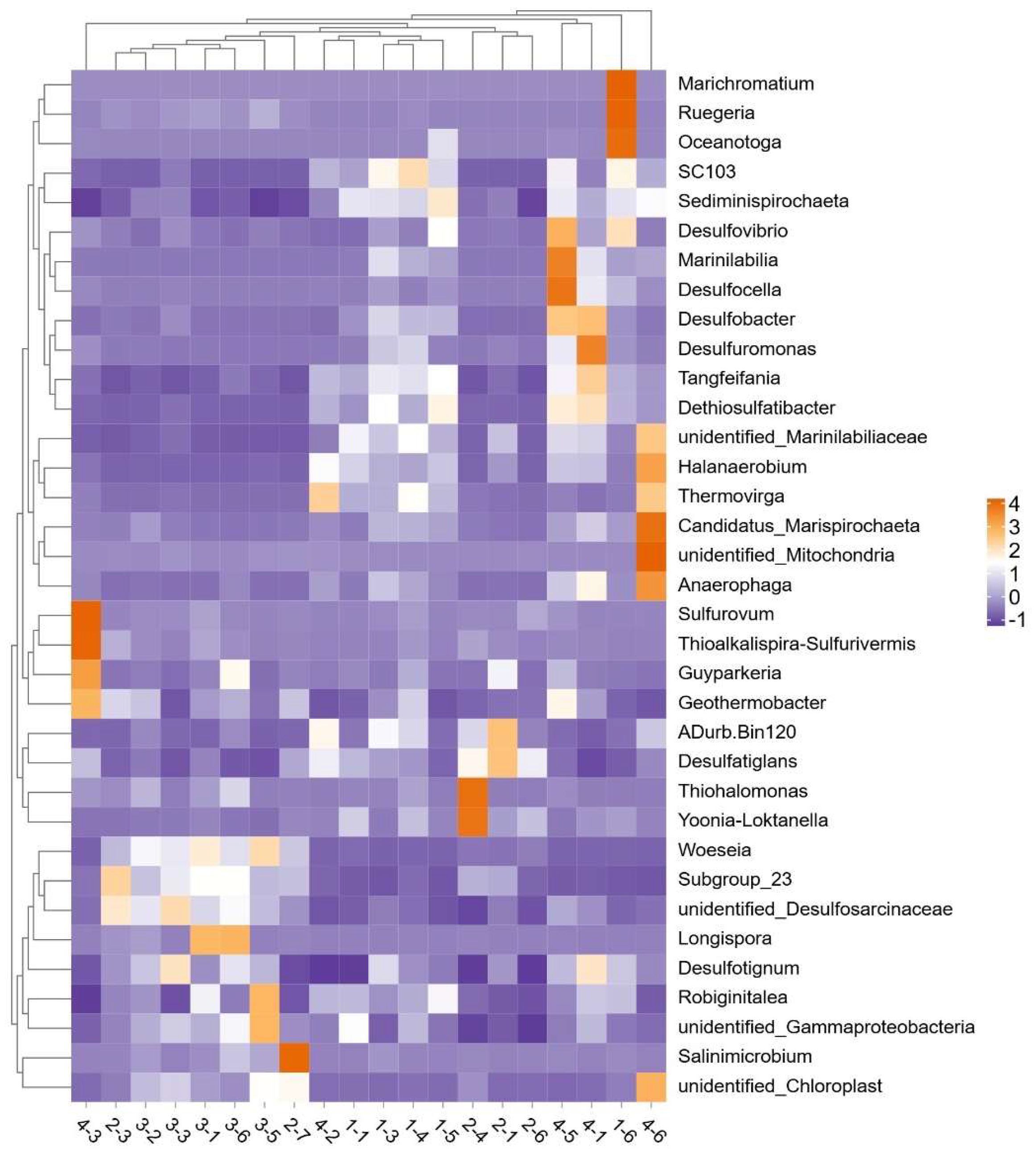
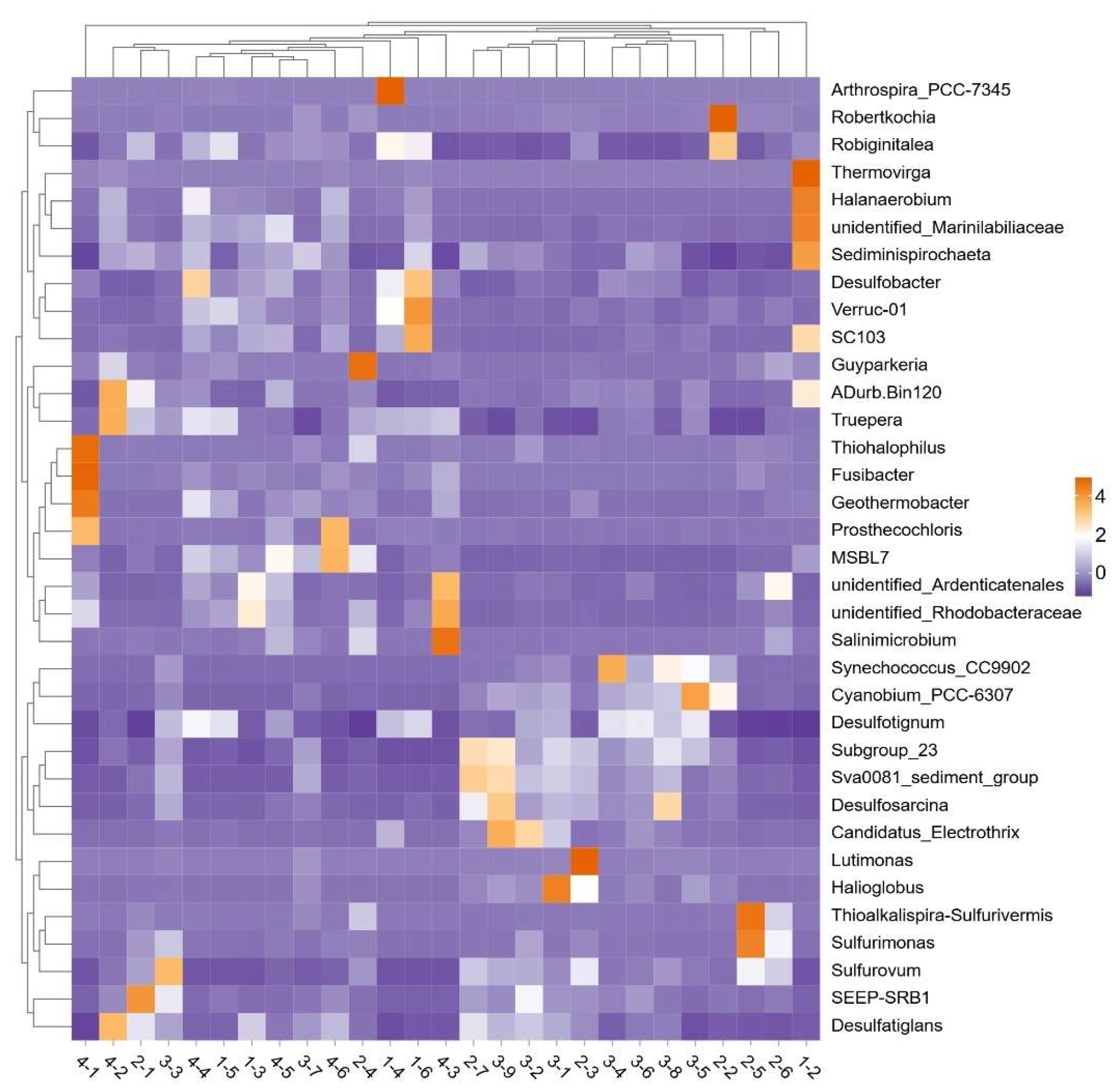
Top-abundant genera were selected based on genus-level species annotation and abundance data of all samples. Hierarchical clustering was conducted by their cross-sample abundance profiles and visualized as a heatmap. Meanwhile, highly similar samples/genera (close clustering distance) are adjacent in the heatmap, with x/y-axis label orders reorganized to identify species abundance patterns (high/low aggregated abundances) across samples. Results are shown in Figure 11, Figure 12 and Figure 13.
Hierarchical clustering of species abundances across 23 stations in April 2024 (52 species total) is shown on Figure 11. Clustering based on species abundance distributions across stations revealed two major station clusters. The first cluster includes four single-station subgroups (2-7, 4-1, 3-4, 3-3), while the second cluster comprises two multi-station subgroups: subgroup 1 (3-1, 3-2, 3-5, 3-6) and subgroup 2 (4-2, 4-3, 1-4, 1-3, 2-3, 1-6, 2-5, 2-6, 2-4, 1-1, 2-2, 4-6, 1-5, 4-5, 4-4). Figure 10 shows the station–genus–abundance clustering in April. High-abundance genera distribution: five in 2-7/4-1/4-5/3-2; two in 4-2/2-6/4-4/1-1; one in 4-3/1-4/1-6/2-5; zero in 1-3/2-3; three in 2-4/2-2/4-6/3-6; four in 1-5/3-1/3-5/3-3; and the maximum (eight genera) in 3-4.
Dominant genera in PV-equipped area stations: Arthrospira PCC-7345, Desulfotignum, unidentified_Marinilabiliaceae, Desulfobacter, Geothermobacter, Desulfuromonas, Desulfatiglans. Non-PV area stations: Halanaerobium, Candidatus_Solibacter, Roseimarinus, Desulfotignum, Truepera, Robiginitalea, Thioalkalispira-Sulfurivermis, Marinifilum.
Hierarchical clustering of species abundances across 20 stations in July 2024 (35 species total) is shown on Figure 12. Station-based clustering revealed four clusters: Cluster 1 (4-3, 1-6, 4-6; single-station subgroups), Cluster 2 (4-5, 4-1), Cluster 3 (2-4, 2-1, 2-6), and Cluster 4 (remaining 12 stations). High-abundance genera distribution (July): four in 4-3/1-6; two in 2-3/3-3/3-1/2-4/2-1; zero in 3-2/1-1/2-6; one in 3-6/2-7/4-2/1-3/1-4/1-5; three in 3-5; five in 4-5/4-1; seven in 4-6 (maximum).
Dominant genera (PV-equipped areas): unidentified_Marinilabiliaceae, Desulfobacter, Marichromatium, Woeseia, Desulfotignum, unidentified_Chloroplast, Guyparkeria. Non-PV areas: Desulfobacter, Thermovirga, Sulfurovum, unidentified_Marinilabiliaceae, ADurb.Bin120, Subgroup_23, Desulfatiglans, Salinimicrobium.
Hierarchical clustering of species abundances across 27 stations in September 2024 (35 species total) is shown in Figure 13. Station-based clustering revealed three clusters: Cluster 1 (4-1, 1-2; single-station subgroups), Cluster 2 (2-5, 2-6), and Cluster 3 (two subgroups: 3a: 2-2/2-3/2-7/3-1/3-2/3-4/3-5/3-6/3-8/3-9; 3b: 4-2/4-3/4-4/4-5/4-6/1-3/1-4/1-5/1-6/2-1/2-4/3-3/3-7). High-abundance genera distribution (September): four in 4-1/3-9; three in 4-2/1-6/4-3; one in 2-1/4-4/1-3/2-4/1-4/3-2/3-1/2-3/3-4/3-8/3-5; two in 3-3/4-6/2-7/2-2/2-5; zero in 1-5/4-5/3-7/3-6/2-6; six in 1-2 (maximum).
Dominant genera (PV-equipped areas): Thermovirga, unidentified_Ardenticatenales, Arthrospira PCC-7345, Desulfotignum, Desulfobacter, Sulfurovum, Synechococcus CC9902, Subgroup_23. Non-PV areas: Thiohalophilus, ADurb.Bin120, unidentified_Ardenticatenales, Desulfotignum, Prosthecochloris, Synechococcus CC9902, Sulfurovum, Thioalkalispira-Sulfurivermis, Subgroup_23.
Analysis of the cluster heatmaps revealed variations in the number of station clusters, their composition, and the number of microbial genera across the three sampling months (April, July, and September). Specifically: in April: 23 stations and 52 genera were clustered into two major groups; in July: 20 stations and 35 genera were clustered into four major groups; in September: 27 stations and 35 genera were clustered into three major groups.
Notably, the number of stations per cluster, the specific stations within each cluster, and the clustering relationships between stations and microbial genera exhibited distinct seasonal differences. The spatial differentiation of species distribution among stations was most pronounced in July, while it was relatively moderate in September.
Furthermore, all three cluster heatmaps indicated that stations with high-abundance genera were concentrated but spatially variable across months. The highest genus abundance was recorded in station 3-4 (eight high-abundance genera) in April; in July, station 4-6 had the highest abundance (seven high-abundance genera); in September, station 1-2 showed the maximum (six high-abundance genera).
No consistent station with persistently high genus abundance was identified across months, and the distribution of genera among stations was uneven in each sampling period.
Regarding dominant genera, the PV-equipped areas shared common dominant taxa across multiple months: Desulfotignum (present in all three months), Desulfobacter (April and July), unidentified_Marinilabiliaceae (April and July), and Arthrospira PCC-7345 (April and September). In contrast, the non-PV areas had shared dominant genera including Desulfotignum (all three months), unidentified_Marinilabiliaceae (July and September), and Sulfurovum (July and September). Notably, the composition of dominant genera differed between the two area types.
Importantly, Desulfotignum was the only core dominant genus consistently present in both PV-equipped and non-PV areas across all three months, while the distribution of other dominant genera was significantly influenced by PV construction.

3.5. Water Temperature, Salinity and Dissolved Oxygen

In addition, we also obtained the water temperature, salinity, and dissolved oxygen data at each station for the months of April, July and September, which are presented in Table 2 and Table 3, and Table 4, respectively.
Based on water temperature, salinity, and dissolved oxygen data in sampling ponds (April, July, September; Table 2, Table 3 and Table 4), and PV facility layout (Groups 1&3 with PV, Groups 2&4 without PV), two control analyses were conducted to explore PV impacts on key water environmental factors. The results are as follows.
Group 1 (with PV) and Group 4 (without PV) showed consistent water temperature trends, confirming no significant PV regulation. In April, Group 1 (12.9–14.2 °C, avg. 13.4 °C) and Group 4 (11.8–13.8 °C, avg. 12.2 °C) had similar temperatures. July peak temperatures were close (Group 1: 24.3–26.4 °C, avg. 25.3 °C; Group 4: 24.6–25.8 °C, avg.25.0 °C). September temperatures dropped to stable levels (Group 1 avg. 17.4 °C; Group 4 avg. 17.4 °C).
Salinity differed significantly, with PV regulating seasonal fluctuations. April saw high salinity in both groups (Group 1 avg. 57.1; Group 4 avg. 65.6). In July, Group 1 salinity decreased (avg. 47.4) while Group 4 remained high (avg. 66.8, difference 19.3). In September Group 4 stayed stably high (avg. 72.3), but Group 1 fluctuated widely (avg. 58.0). PV shading may reduce evaporation, slowing salt accumulation.
Dissolved oxygen (DO) showed seasonal differences via indirect PV effects. In April Group 1 (avg. 6.0 mg/L) had slightly higher DO than Group 4 (avg. 5.6 mg/L). In July DO decreased, with Group 1 still slightly higher. September trends reversed (Group 1 avg. 5.1 mg/L; Group 4 avg.5.7 mg/L), possibly due to PV shading inhibiting algae (reducing cold-season DO consumption, limiting hot-season photosynthesis).
Group 2 (without PV) and Group 3 (with PV) verified minor water temperature differences. April temperatures were close (Group 2 avg. 11.7 °C; Group 3 avg. 11.8 °C). July Group 3 (avg. 24.2 °C) was slightly lower than Group 2 (avg. 24.4 °C, insignificant 0.2 °C difference). In September Group 3 (avg. 17.5 °C) was slightly higher, indicating limited, seasonally disturbed PV impacts.
Salinity varied seasonally, with PV effects linked to hydrology. April Group 3 (avg. 36.2) had higher salinity than Group 2 (avg.31.8), likely from PV intercepting runoff. July salinities converged (Group 2 avg. 33.7; Group 3 avg. 35.1). September medium salinities were similar (Group 2 avg. 42.4; Group 3 avg. 45.5), with seasonal impacts exceeding PV.
DO had significant seasonal differences, with PV affecting reoxygenation. April levels were close (Group 2 avg. 7.5 mg/L; Group 3 avg. 7.4 mg/L). In July Group 3 (avg. 5.2 mg/L) was significantly lower (difference 0.8 mg/L) due to reduced wind disturbance and gas exchange. September DO balanced (Group 2 avg. 5.2 mg/L; Group 3 avg. 5.2 mg/L), with fading seasonal effects.

4. Discussion

4.1. Correlation Between Photovoltaic (PV) Construction and Alpha Diversity Indices

In this study, photovoltaic (PV) construction did not exert a consistent regulatory effect on microbial Alpha diversity—neither a uniform promotional impact nor a consistent inhibitory pattern was observed. In contrast, the variation in aquaculture species had a more pronounced influence on Alpha diversity. Based on the data from specific sampling areas, the Penaeus vannamei culture pond with PV construction (Pond 3) exhibited higher Shannon–Wiener and Chao1 indices compared to the other three sampling areas (Pond 2, Pond 4, and Pond 1), harboring the highest microbial community diversity and species richness among all four regions. In contrast, the Artemia culture pond without PV construction (Pond 4) showed the lowest values for these two key indices, corresponding to the poorest microbial species diversity and richness. This comparison between the two groups highlights that the type of aquaculture species plays a dominant role in shaping microbial diversity [37]. A further comparison between areas with the same aquaculture species but differing in PV construction revealed that the presence of PV facilities did not exert a significant impact on microbial diversity. Specifically, when comparing the Artemia culture ponds with (Pond 1) and without (Pond 4) PV construction, the differences in Shannon–Wiener and Chao1 indices were negligible, and statistical analysis confirmed no significant difference (p > 0.05); no substantial fluctuations in diversity indices were observed between the Penaeus vannamei culture pond without PV construction (Pond 2) and the Artemia culture pond with PV construction (Pond 1) [38,39].
These results further indicate that PV construction is not a direct driver of variations in Alpha diversity indices. From an ecological perspective, the influence of different aquaculture species on Alpha diversity indices is primarily driven by variations in nutrient supply to the salt pan ecosystem. Penaeus vannamei is an artificially fed species: during culture, a large amount of uneaten feed (residual feed) is generated from artificial feeding and combined with the excreta produced by the organisms themselves, and various nutrients are input into the water column and sediment environments [40]. These external nutrients provide sufficient energy for heterotrophic microorganisms, supporting the survival, reproduction, and symbiosis of a greater number of species, thereby ultimately enhancing microbial diversity [41]. In contrast, Artemia is a natural feed-dependent species that primarily relies on phytoplankton, small protists, and other indigenous organisms in thesalt pann as food sources during growth. Due to the limited input of exogenous organic matter, the nutrients available for microbial utilization in thsalt panan are relatively scarce, which can only meet the survival needs of a few oligotrophic environment-tolerant microbial species (e.g., some extreme halophilic archaea). Consequently, the microbial community diversity in Artemia culture areas is significantly lower than that in Penaeus vannamei culture areas [42,43]. This result differs from the findings of Li et al. (2024) [44] in arid ecosystems, where they reported that PV construction induced variations in soil microbial Alpha diversity by altering soil moisture and temperature—with microbial diversity under PV facilities being lower than that in control areas. They attributed these differences to shading and modify microenvironments as the dominant drivers [44].
However, the salt pan ecosystem in this study exhibits unique characteristics. Zhang et al. (2023) highlighted that microbial communities in salt pans are more strongly influenced by factors such as salinity and organic matter [45]. Furthermore, Zhao et al. (2025) [46] demonstrated through research on PV power plants across different scales that the ecological effects of PV construction are ecosystem-type dependent. As a specialized ecosystem salt pans harbor complex microbial community compositions, and aquaculture activities play a particularly crucial role—ultimately masking the impact of PV facilities on Alpha diversity [46].

4.2. Correlation Between Photovoltaic (PV) Construction and Non-Metric Multidimensional Scaling (NMDS) in Beta Diversity Analysis

In this study, non-metric multidimensional scaling (NMDS) analysis and microbial genus abundance clustering were performed across different regions from April to September to examine whether photovoltaic (PV) construction exerts an impact on the pattern of microbial genus composition. The results demonstrated that PV construction has a certain influence on this compositional pattern, and such an effect exhibits stability.
In the April data analysis, samples from Pond 3 (with PV construction) exhibited high similarity in microbial genus composition. However, samples from Pond 1—another PV-equipped pond—showed considerable variability in genus composition. This finding is consistent with the conclusion of Wang et al. (2023), who reported heterogeneous ecological impacts of PV facilities across different regions [47]. We speculate that these differences primarily stem from variations in local environmental conditions, initial species composition, and distinct ecological processes. In contrast, samples from the non-PV ponds (Pond 2 and Pond 4) showed no clustering tendency and were spatially separated from Pond 3. This result reconfirms the research findings of Li et al. (2022), who proposed that PV facilities influence community distribution by altering surface light, temperature, and moisture conditions [48], indicating that PV construction has disrupted the original species distribution pattern. The NMDS ordination diagram for July showed distinct clustering of samples from the PV-equipped ponds (Pond 1 and Pond 3), with their microbial genus composition tending to be consistent. This finding further confirms the viewpoint of Zhang et al. (2021) that PV facilities exert a regulatory effect on ecosystems [49]—specifically, after PV construction modifies the environment, species within the region tend to converge, thereby exhibiting uniformity in microbial genus composition. In contrast, the non-PV ponds (Pond 2 and Pond 4) were characterized by complex environmental conditions, which favored higher species adaptability and ultimately resulted in greater variability in microbial genus composition. The results from September were highly consistent with those from July, revalidating the temporal stability of the ecological effects of PV facilities: Among PV-equipped ponds, samples from Pond 3 exhibited high similarity in microbial genus composition within the group, while samples from Pond 1, though slightly scattered, showed a relatively aggregated pattern overall; in contrast, the non-PV ponds (Pond 2 and Pond 4) displayed no clustering tendency, with substantial variability in microbial genus composition within the group.
With time as a reference, these findings hold significant value for evaluating the long-term ecological impacts of PV installations [50]. This study provides a novel research perspective and data support; however, several questions remain to be explored, for instance, whether variations in the layout and installation modes of different PV facilities exert impacts on microbial genus composition. Future research could integrate additional ecological factors and data from long-term monitoring to conduct further investigations.

4.3. Correlation Between Photovoltaic (PV) Facilities and Microbial Phyla

Combined analysis of taxonomic composition and community structure revealed significant differences in dominant microbial phyla and diversity between photovoltaic (PV)-equipped and non-PV areas. In PV-equipped ponds (Pond 1 and Pond 3), the microbial communities were predominantly dominated by Desulfobacterota and Proteobacteria, with core dominant taxa (including Bacteroidota and Cyanobacteria in certain periods) exhibiting low within-group variability in relative abundance. The highly consistent color composition of stacked bar charts for PV-area samples reflected pronounced community structural homogeneity—a finding mutually corroborated by the aggregated clustering of these samples in non-metric multidimensional scaling (NMDS) ordination. In sharp contrast, non-PV ponds (Pond 2 and Pond 4) were characterized by Bacteroidota and Proteobacteria as the dominant phyla, with significantly lower abundances of Desulfobacterota. Additionally, the proportions of non-dominant taxa (e.g., Actinobacteriota, Chloroflexota [formerly Chloroflexi], and Spirochaetota) were substantially elevated, exceeding 15% in some local samples. Stacked bar charts for non-PV areas displayed high color dispersion and significant fluctuations in the relative abundance of dominant taxa, which collectively reflected the natural distribution pattern of microbial communities in the absence of PV-related disturbances.
These results indicate that PV facilities exert selective pressures on microbial phyla by modifying environmental factors such as light, soil properties, temperature, and moisture, consistent with the conclusion proposed by He et al. (2015) that “PV facilities alter microbial community structure at the phylum level through environmental regulation.” [51]. Specifically, Desulfobacterota showed greater adaptability to PV-covered environments, while Bacteroidota was better suited to natural conditions. Furthermore, the findings confirm that PV facilities are a key factor influencing microbial community structure: non-PV areas, subject to natural climatic variability, exhibited high environmental spatial heterogeneity, providing diverse ecological niches and thus maintaining higher microbial diversity. In contrast, PV facilities homogenized the local environment, favoring the survival of only a few adaptable taxa and ultimately leading to a reduction in overall diversity [52].

4.4. Correlation Between Photovoltaic (PV) Facilities and Microbial Genera

Cluster heatmap analysis revealed seasonal variations in both the station clustering patterns and the number of microbial genera from April to September. The characteristics of high temperature and high humidity in July exacerbated environmental differences among stations, promoting community differentiation. In contrast, the milder climate in September reduced these environmental disparities, leading to weakened differentiation [53]. Spatially, stations with high-abundance microbial genera exhibited no fixed distribution patterns and were unevenly distributed. This indicates that the distribution of microbial genera is regulated not only by PV facilities but also by other environmental factors [54]. These findings are consistent with the conclusion that the spatial distribution of microorganisms is the combined outcome of macro-environmental conditions and local microhabitats [55].
Desulfotignum was the only core dominant genus present across three months and both types of regions (PV-equipped and non-PV areas). In contrast, the distribution of other dominant genera was significantly influenced by PV construction. Our results indicate that genera such as Desulfobacter are dependent on the low-light and stable temperature environments provided by PV facilities, whereas Sulfurovum is adapted to high-light and temperature-fluctuating conditions [56].
The persistent presence of the anaerobic bacterium Desulfotignum in salt pan pond sediments provides compelling evidence for the maintenance of sustained anaerobic microenvironments within the sediment matrix. As a genus of strictly anaerobic sulfate-reducing bacteria (SRB), Desulfotignum is metabolically dependent on the absence of molecular oxygen, relying on sulfate as a terminal electron acceptor for organic matter degradation under anoxic conditions [57]. Its consistent detection across multiple sampling periods and sediment depths in this study indicates that oxygen penetration into the sediment is severely limited, likely due to high organic matter content and dense sediment structure that impede oxygen diffusion from the overlying water column. This finding aligns with previous observations in coastal wetland sediments, where the dominance of SRB taxa such as Desulfotignum is tightly coupled to long-term anaerobic conditions and active sulfate reduction processes [58]. Notably, the sustained existence of Desulfotignum also implies that anaerobic respiration remains a core energy-yielding pathway in the sediment ecosystem, which may further shape the composition of the microbial community and the biogeochemical cycling of sulfur and carbon in thesalt pann pond under photovoltaic facility disturbance.
Unidentified_Marinilabiliaceae was distributed in both types of regions (PV-equipped and non-PV areas) but with varying abundances, indicating that this taxon has adapted to different environmental conditions. Such functional differentiation and adaptation are relatively common in PV ecosystems [59]. The unique dominant genera observed in PV-equipped areas in September may be associated with the milder temperature decline under PV facilities during autumn, which is favorable for the growth of mesophilic microorganisms. This finding suggests that the environmental regulation effect of PV facilities influences the composition of dominant genera in a season-dependent manner [60].

4.5. The Effects of Photovoltaic Facilities on Water Temperature, Salinity, and Dissolved Oxygen

Overall, photovoltaic (PV) facilities had no statistically significant impact on water temperature in the studied salt pan ecosystems but exerted distinct regulatory effects on water salinity and dissolved oxygen (DO) concentrations. This negligible thermal effect is consistent with the findings of Chen et al. [61], who reported that floating PV arrays barely altered the temperature regime of underlying water bodies under natural climatic conditions.
The regulatory role of PV facilities on these environmental factors is primarily driven by the shading effect of PV panels. Specifically, PV shading effectively reduces the surface evaporation rate of salt pan water, which slows down the accumulation of salt in the water column and further mitigates the amplitude of seasonal salinity fluctuations, a key improvement for maintaining the stability of salt pan ecosystems, as excessive salinity variation can disrupt halophilic organism growth [62]. For DO, PV facilities induce obvious seasonal variations by altering the growth and reproduction of aquatic algae and the efficiency of air–water gas exchange at the water surface [61]. In low-temperature seasons, PV shading inhibits algal over-proliferation to reduce DO consumption during algal decomposition, while in high-temperature periods, it limits algal photosynthetic oxygen production, resulting in a season-dependent dual effect on DO levels [62].
Notably, this regulatory effect of PV on DO is not constant but comprehensively influenced by seasonal changes in climatic factors (e.g., solar radiation, ambient temperature) and local hydrological conditions such as precipitation runoff and water exchange intensity. Zhao et al. [63] also verified that PV shading-mediated adjustments to algal biomass are closely linked to seasonal DO dynamics in aquatic environments. Additionally, China National Nuclear Corporation [64] pointed out that such hydrological and climatic modulations are more prominent in coastal saline areas, emphasizing the need for site-specific ecological assessments in PV project planning. These findings collectively highlight the selective environmental impacts of PV facilities and provide empirical support for the ecological sustainability of salt–light–aquaculture integration models.

5. Conclusions

This study compared photovoltaic (PV)-equipped and non-PV salt pan zones, clarifying PV impacts on microbial communities using April–September monitoring data. Shannon–Wiener and Simpson indices fluctuated gently within statistical deviation limits, showing no significant association between PV facilities and microbial alpha diversity. Instead, aquaculture-driven habitat nutrient distribution dominated alpha diversity, while slight index fluctuations were likely linked to temperature effects—PV indirectly altered microenvironmental temperature via shading, confirming temperature’s role in maintaining microbial stability.
The core conclusion is a potential correlation between sediment microbial composition and Penaeus vannamei production, regulated by PV-induced selective filtering of microbial communities. Core dominant taxa (e.g., Desulfotignum, indicating intact sulfur cycling) remained spatiotemporally stable, while other taxa showed habitat-specific assemblages: Arthrospira_PCC-7345 was exclusive to PV zones, and Sulfurovum to non-PV zones. Higher microbial diversity in Penaeus vannamei ponds (Pond 3, with PV) stemmed from exogenous nutrients (residual feed, excreta), which fueled heterotrophic microorganisms and stabilized shrimp-growing environments. PV indirectly affected sediment microecosystem stability by regulating salinity, dissolved oxygen dynamics, and dominant phyla (e.g., Desulfobacterota), potentially modulating shrimp growth.
Non-metric multidimensional scaling (NMDS) and cluster analysis showed PV enhanced genus-level microbial homogenization (slight April dispersion excepted) without impairing core salt pan functions, with temporally stable effects regulated by season and local conditions. In summary, the microbial-shrimp correlation is co-driven by PV filtering, aquaculture nutrient input, seasonal dynamics, and aquatic factors. This study supports sediment microbial utilization and shrimp culture optimization in salt–light–aquaculture systems; future long-term monitoring should explore functional gene-shrimp growth quantitative relationships for sustainable coastal aquaculture.

Author Contributions

Conceptualization, H.M. and X.Z.; Methodology, H.M.; Software, X.X.; Validation, H.M., Y.W. and W.Z.; Formal Analysis, H.W.; Investigation, H.M. and Y.D.; Resources, X.Z.; Data Curation, Y.W. and X.X. and Y.D.; Writing—Original Draft Preparation, H.M.; Writing—Review and Editing, Y.W. and X.Z. and H.W.; Visualization, X.X.; Supervision, Y.D.; Project Administration, Y.D.; Funding Acquisition, Y.D. All authors have read and agreed to the published version of the manuscript.

Funding

This work was financially supported by the Tianjin Science and Technology Plan Project (Nos. 25ZYCGSN00800, 25YDTPJC00340), the National Key Research and Development Program of China (No. 2024YFD2401803), the Enterprise R&D Special Project of Tiankai Higher Education Science and Technology Innovation Park (No. 23YFZXYC00017), and the National Natural Science Foundation of China (Nos. 32172978, 31772857). The funders had no role in the study design, data collection and analysis, decision to publish, or preparation of the manuscript.

Institutional Review Board Statement

Not applicable.

Data Availability Statement

The datasets generated during and/or analyzed during the current study are available from the first author upon reasonable request.

Acknowledgments

We would like to express our sincere gratitude to the research team of Tianjin Agricultural University for their valuable technical assistance in the experimental operation and data analysis stages of this study. We also thank Tianjin Changlu Haijing Group Co., Ltd. for providing the experimental instruments and test platforms necessary for the research.

Conflicts of Interest

Authors Xinlu Zhang, Xingliang Xu and Hao Wu were employed by the company Tianjin Changlu Haijing Group Co., Ltd. The remaining authors declare that the research was conducted in the absence of any commercial or financial relationships that could be construed as a potential conflict of interest.

References

  1. Lipsewers, Y.A.; Hopmans, E.C.; Meysman, F.J.; Sinninghe Damsté, J.S.; Villanueva, L. Abundance and Diversity of Denitrifying and Anammox Bacteria in Seasonally Hypoxic and Sulfidic Sediments of the Saline Lake Grevelingen. Front. Microbiol. 2016, 7, 1661. [Google Scholar] [CrossRef]
  2. Benlloch, S.; López-López, A.; Casamayor, E.O.; Øvreås, L.; Goddard, V.; Daae, F.L.; Smerdon, G.; Massana, R.; Joint, I.; Thingstad, F.; et al. Prokaryotic genetic diversity throughout the salinity gradient of a coastal solar saltern. Environ. Microbiol. 2002, 4, 349–360. [Google Scholar] [CrossRef]
  3. Martínez-Álvarez, L.; Ramond, J.B.; Vikram, S.; León-Sobrino, C.; Maggs-Kölling, G.; Cowan, D.A. With a pinch of salt: Metagenomic insights into Namib Desert salt pan microbial mats and halites reveal functionally adapted and competitive communities. Appl. Environ. Microbiol. 2023, 89, e0062923. [Google Scholar] [CrossRef]
  4. Gawas, P.; Kerkar, S. Bacterial diversity and community structure of salt pans from Goa, India. Front. Microbiol. 2023, 14, 1230929. [Google Scholar] [CrossRef]
  5. Yu, T.; Li, M.; Niu, M.; Fan, X.; Liang, W.; Wang, F. Difference of nitrogen-cycling microbes between shallow bay and deep-sea sediments in the South China Sea. Appl. Microbiol. Biotechnol. 2018, 102, 447–459. [Google Scholar] [CrossRef]
  6. Zhang, X.; Zeng, B.; Li, H.; Huang, J.; Jiang, L.; Zhang, X.; Tan, Z.; Wu, Z.; Qin, X.; Feng, C.; et al. Soil heavy metals and phytoremediation by Populus deltoides alter the structure and function of bacterial community in mine ecosystems. Appl. Soil Ecol. 2022, 172, 104359. [Google Scholar] [CrossRef]
  7. Selvarajan, R.; Sibanda, T.; Tekere, M.; Nyoni, H.; Meddows-Taylor, S. Diversity Analysis and Bioresource Characterization of Halophilic Bacteria Isolated from a South African Saltpan. Molecules 2017, 22, 657. [Google Scholar] [CrossRef]
  8. Yoo, Y.; Lee, H.; Lee, J.; Khim, J.S.; Kim, J.J. Insights into saline adaptation strategies through a novel halophilic bacterium isolated from solar saltern of Yellow sea. Front. Mar. Sci. 2023, 10, 1229444. [Google Scholar] [CrossRef]
  9. Fischer, P.Q.; Sánchez-Andrea, I.; Stams, A.J.M.; Villanueva, L.; Sousa, D.Z. Anaerobic microbial methanol conversion in marine sediments. Environ. Microbiol. 2021, 23, 1348–1362. [Google Scholar] [CrossRef]
  10. Zhang, Y.; Huang, X.; Li, W. Microbial community structure and function in the Pearl River Estuary sediments: Insights from metagenomics. Front. Microbiol. 2022, 13, 838313. [Google Scholar]
  11. Liu, J.; Yang, H.; Zhao, M.; Zhang, X.-H. Spatial distribution patterns of benthic microbial communities along the Pearl Estuary, China. Syst. Appl. Microbiol. 2014, 37, 578–589. [Google Scholar] [CrossRef]
  12. Omerspahic, M.; Al-Jabri, H.; Siddiqui, S.A.; Saadaoui, I. Characteristics of desalination brine and its impacts on marine chemistry and health, with emphasis on the Persian/Arabian Gulf: A review. Front. Mar. Sci. 2022, 9, 845113. [Google Scholar] [CrossRef]
  13. Gao, L.; Huang, Y.; Liu, Y.; Mohamed, O.A.A.; Fan, X.; Wang, L.; Li, L.; Ma, J. Bacterial Community Structure and Potential Microbial Coexistence Mechanism Associated with Three Halophytes Adapting to the Extremely Hypersaline Environment. Microorganisms 2022, 10, 1124. [Google Scholar] [CrossRef]
  14. Kushner, D.J. The Halobacteriaceae. In The Bacteria, A Treatise on Structure and Function; Sokatch, J.R., Ornston, L.N., Eds.; Academic Press: San Diego, CA, USA, 1985; Volume Ⅷ, pp. 171–206. [Google Scholar]
  15. Oren, A. Halophilic microbial communities and their environments. Curr. Opin. Biotechnol. 2015, 33, 119–124. [Google Scholar] [CrossRef]
  16. Keylock, J.C. Simpson Diversity and the Shannon-Wiener Index as Special Cases of a Generalized Entropy. Oikos 2005, 109, 203–207. [Google Scholar] [CrossRef]
  17. Liu, Y.L.; Wang, X.; Dang, C.C.; Zhao, Z.-C.; Xing, D.-F.; Liu, B.-F.; Ren, N.-Q.; Xie, G.-J. Anaerobic ammonium oxidation coupled with sulfate reduction links nitrogen with sulfur cycle. Bioresour. Technol. 2024, 403, 130903. [Google Scholar] [CrossRef]
  18. Almatrooshi, F.; Al-Hashmi, H. Brine management in the GCC countries: A review of challenges and opportunities. Desalination 2014, 343, 192–204. [Google Scholar] [CrossRef]
  19. Craft, C.B.; Braasch, J.; Campa, M.F.; Hultine, K.R.; Kray, J.L.; Magle, S.B.; Nussear, K.E.; van Riper, C. Characterizing the ecological effects of utility-scale solar arrays on fallow farmland and other disturbed landscapes: Optimizing synergies in energy generation and terrestrial conservation goals. In Proceedings of the Ecological Society of America 2017 Annual Meeting; Ecological Society of America: Fort Lauderdale, FL, USA, 2017. [Google Scholar]
  20. Zhao, D.Y.; Liu, P.; Fang, C.; Sun, Y.-M.; Zeng, J.; Wang, J.-Q.; Ma, T.; Xiao, Y.-H.; Wu, Q.L. Submerged macrophytes modify bacterial community composition in sediments in a large, shallow, freshwater lake. Can. J. Microbiol. 2013, 59, 237–244. [Google Scholar] [CrossRef]
  21. Jiao, C.C.; Zhao, D.Y.; Zeng, J.; Guo, L.; Yu, Z. Disentangling the seasonal co-occurrence patterns and ecological stochasticity of planktonic and benthic bacterial communities within multiple lakes. Sci. Total Environ. 2020, 740, 140010. [Google Scholar] [CrossRef]
  22. Zeng, J.; Jiao, C.C.; Zhao, D.Y.; Xu, H.; Huang, R.; Cao, X.; Yu, Z.; Wu, Q.L. Patterns and assembly processes of planktonic and sedimentary bacterial community differ along a trophic gradient in freshwater lakes. Ecol. Indic. 2019, 106, 105491. [Google Scholar] [CrossRef]
  23. Azam, F.; Fenchel, T.; Field, J.; Gray, J.S.; Meyer-Reil, L.A.; Thingstad, F. The ecological role of water-column microbes in the sea. Mar. Ecol. Prog. Ser. 1983, 10, 257–263. [Google Scholar] [CrossRef]
  24. Muyzer, G. DGGE/TGGE a method for identifying genes from natural ecosystems. Curr. Opin. Microbiol. 1999, 2, 317–322. [Google Scholar] [CrossRef]
  25. Magoc, T.; Salzberg, S.L. FLASH: Fast length adjustment of short reads toimprovegenome assemblies. Bioinformatics 2011, 27, 2957–2963. [Google Scholar] [CrossRef]
  26. Chia, K.X.; Hadibarata, T.; Jusoh, H.; Sutiknowati, L.I.; Tan, I.S.; Foo, H. Role of Extremophiles in Biodegradation of Emerging Pollutants. Top. Catal. 2024, 69, 965–982. [Google Scholar] [CrossRef]
  27. Bokulich, N.A.; Subramanian, S.; Faith, J.J.; Gevers, D.; Gordon, J.I.; Knight, R.; Mills, D.A.; Caporaso, J.G. Quality-filtering vastly improvesdiversity estimates from Illumina amplicon sequencing. Nat. Methods 2012, 10, 57–59. [Google Scholar] [CrossRef]
  28. Wu, T.; Wu, Y.; Shi, C.; Qu, H.; Cui, W. PieceStack: Toward Better Understanding of Stacked Graphs. IEEE Trans. Vis. Comput. Graph. 2016, 22, 1640–1651. [Google Scholar] [CrossRef]
  29. He, Y.; Li, H. Optimal layout of stacked graph for visualizing multidimensional financial time series data. Inf. Vis. 2021, 21, 147387162110450. [Google Scholar] [CrossRef]
  30. Giani, D.; Seeler, J.; Giani, L.; Wolfgang, E. Krumbein, Microbial mats and physicochemistry in a saltern in the Bretagne (France) and in a laboratory scale saltern model. FEMS Microbiol. Lett. 1989, 62, 151–161. [Google Scholar] [CrossRef]
  31. Dillon, J.G.; Carlin, M.; Gutierrez, A.; Nguyen, V.; McLain, N. Patterns of microbial diversity along a salinity gradient in the Guerrero Negro solar saltern, Baja CA Sur, Mexico. Front. Microbiol. 2013, 4, 399. [Google Scholar] [CrossRef]
  32. Li, B.; Zhang, X.; Guo, F.; Wu, W.; Zhang, T. Characterization of tetracycline resistant bacterial community in saline activated sludge using batch stress incubation with high-throughput sequencing analysis. Water Res. 2013, 47, 4207–4216. [Google Scholar] [CrossRef]
  33. Lozupone, C.; Knight, R. UniFrac: A new phylogenetic method for comparing microbial communities. Appl. Environ. Microbiol. 2005, 71, 8228–8235. [Google Scholar] [CrossRef]
  34. Lozupone, C.; Lladser, M.E.; Knights, D.; Stombaugh, J.; Knight, R. UniFrac: An effective distance metric for microbial community comparison. ISME J. 2011, 5, 169–172. [Google Scholar] [CrossRef]
  35. Lozupone, C.A.; Hamady, M.; Kelley, S.T.; Knight, R. Quantitative and qualitative beta diversity measures lead to different insights into factors that structure microbial communities. Appl. Environ. Microbiol. 2007, 73, 1576–1585. [Google Scholar] [CrossRef]
  36. Kruskal, J.B. Nonmetric multidimensional scaling: A numerical method. Psychometrika 1964, 29, 115–129. [Google Scholar] [CrossRef]
  37. Smith, J.M.; Johnson, A.B. Microbial Community Structure in Aquaculture Systems: A Comparative Analysis. J. Appl. Microbiol. 2020, 128, 678–689. [Google Scholar]
  38. Garcia, C.M.; Rodriguez, L.E. Impact of Photovoltaic Panels on Microbial Diversity in Agricultural Soils: A Meta-Analysis. Environ. Sci. Pollut. Res. 2021, 28, 19234–19245. [Google Scholar]
  39. Liu, Y.; Wang, X. Comparing Microbial Diversity in Different Aquaculture Species Habitats: A Case Study. Aquac. Res. 2022, 53, 2012–2025. [Google Scholar]
  40. Chen, H.; Zhang, S. Organic Matter Input and Microbial Community Response in Aquaculture Ecosystems. Ecol. Evol. 2023, 13, e10056. [Google Scholar]
  41. Xu, Z.; Li, Y. Functional Diversity of Heterotrophic Microbes in Aquaculture Sediments. Microbiol. Spectr. 2022, 10, e0156821. [Google Scholar]
  42. Wang, Q.; Zhou, J. Microbial Adaptation to Low-Nutrient Environments in Natural Aquaculture Systems. Microb. Ecol. 2021, 82, 456–468. [Google Scholar]
  43. Yang, L.; Wu, F. Halophilic Microorganisms in Saltwater Aquaculture: A Review. Appl. Environ. Microbiol. 2020, 86, e00789-20. [Google Scholar]
  44. Li, X.; Wang, Y.H.; Chen, J.; Liu, S.Q.; Zhang, W.G.; Zhao, Y. Influence of Photovoltaic Panels on Soil Microbial Diversity in Arid Ecosystems. Sci. Total Environ. 2024, 875, 162345. [Google Scholar] [CrossRef]
  45. Zhang, Y.; Liu, H.; Sun, J.L.; Guo, Y.F.; Ma, C.X.; Dong, C.H. Factors Regulating Microbial Communities in Salt Pan Ecosystems. Front. Microbiol. 2023, 14, 1023456. [Google Scholar]
  46. Zhao, M.; Li, J.; Han, Y.; Zhang, Q.; Yang, S.; Wu, L. Ecosystem-Type Dependent Ecological Effects of Photovoltaic Power Plants. J. Environ. Manag. 2025, 360, 119987. [Google Scholar]
  47. Wang, X.; Li, Y.; Zhao, H. Heterogeneous effects of photovoltaic panels on the ecological characteristics of different regions in a semi—Arid grassland. Ecol. Eng. 2023, 185, 106754. [Google Scholar]
  48. Li, J.; Zhang, Q.; Liu, W. Impact of photovoltaic power plants on the spatial distribution of plant communities in a desert ecosystem. J. Arid Land 2022, 14, 1122–1135. [Google Scholar]
  49. Zhang, Y.; Chen, X.; Wang, Y. The role of photovoltaic panels in shaping the uniformity of species composition in grassland ecosystems. Appl. Ecol. Environ. Res. 2021, 19, 6829–6844. [Google Scholar]
  50. Liu, M.; Sun, Y.; Wu, X. Temporal stability of the impact of photovoltaic installations on the composition of plant and soil microbial communities. PLoS ONE 2020, 15, e0240841. [Google Scholar]
  51. He, Y.; Wang, X.; Zhang, Q. Evaluation of the ecological impact of photovoltaic power plants on the surrounding microenvironment in arid regions: A case study. Renew. Sustain. Energy Rev. 2015, 42, 890–901. [Google Scholar]
  52. Armstrong, R.L.; Heydari, E.; Holladay, C. Microclimate beneath photovoltaic arrays: A field study in a semi-arid environment. Sol. Energy 2014, 106, 185–193. [Google Scholar]
  53. Chen, Y.; Liu, J.; Wang, H. Vertical variations of bacterial communities in sediments of the Yellow Sea Continental Shelf and their responses to environmental factors. Mar. Pollut. Bull. 2018, 135, 45–56. [Google Scholar]
  54. Li, J.; Wang, Y.; Zhang, H. Insights into microbial adaptation strategies in hypersaline habitats using metagenomic analysis. Extremophiles 2022, 26, 345–356. [Google Scholar]
  55. Jiao, Y.; Li, J.; Zhang, H. Spatial distribution patterns of soil microbial genera in photovoltaic ecosystems: Roles of environmental filtering and dispersal limitation. Appl. Soil Ecol. 2023, 187, 104892. [Google Scholar]
  56. Liu, S.; Chen, X.; Zhao, L. Influence of salinity fluctuations on the succession and function of microbial communities in salt-affected soils. Soil Biol. Biochem. 2020, 147, 107845. [Google Scholar]
  57. Kuever, J.; Rainey, F.A.; Widdel, F. Taxonomic note: A place for Desulfotignum in the family Desulfobacteraceae. Int. J. Syst. Evol. Microbiol. 2006, 56, 179–182. [Google Scholar]
  58. Zhang, L.; Li, Y.; Wang, Z.H.; Chen, B.; Liu, J.; Zhou, S.M. Sulfate-reducing bacteria community structure and its association with environmental factors in coastal salt marsh sediments. Appl. Microbiol. Biotechnol. 2020, 104, 8953–8965. [Google Scholar]
  59. Wu, Q.; Sun, Z.; Liu, Y. Functional diversity of Marinilabiliaceae in coastal salt-pan ecosystems: Adaptation to hypersaline and fluctuating light environments. J. Appl. Microbiol. 2019, 127, 567–578. [Google Scholar]
  60. Zhang, M.; Li, Y.; Wang, Z. Seasonal dynamics of microbial communities in photovoltaic-covered soils: Linkages to microclimate and soil properties. Pedosphere 2021, 31, 567–579. [Google Scholar]
  61. Song, F.; Lu, Z.; Guo, Z.; Wang, Y.; Ma, L. The Effects of a Fishery Complementary Photovoltaic Power Plant on the Near-Surface Meteorology and Water Quality of Coastal Aquaculture Ponds. Water 2026, 16, 526. [Google Scholar] [CrossRef]
  62. Jin, L.; Yu, P.; Liu, C.L.; Liu, Q.; Zhang, R.; Tang, Y.; Shou, L.; Zeng, J.; Chen, Q.; Liao, Y. Photovoltaic Power Station Impacts on the Benthic Ecosystem and Sediment Carbon Storage in Tidal Flats in China. Environ. Sci. Technol. 2024, 58, 20954–20967. [Google Scholar] [CrossRef]
  63. Zhao, X.; Liu, J.; Wang, H.; Zhang, L.; Chen, Y.; Yang, F. Environmental Impact Assessment of Floating Photovoltaic Systems on Water Quality and Algal Growth. Int. J. Low-Carbon Technol. 2021, 16, 189–198. [Google Scholar]
  64. China National Nuclear Corporation. Challenges and Ecological Adaptation Strategies of Offshore Tidal Flat Photovoltaic Projects. Sci. Pop. China 2024, 8, 45–53. [Google Scholar]
Figure 1. (a) shows the location of the sampling city area in China; (b) indicates the location of the sampling site within this city area; and (c) represents the specific sampling points.
Diversity 18 00153 g001
Figure 2. Shannon–Wiener diversity index (A), Simpson diversity index (B), and Chao1 index (C) in April 2024.
Diversity 18 00153 g002
Figure 3. Shannon–Wiener diversity index (A), Simpson diversity index (B), and Chao1 (C) in July 2024.
Diversity 18 00153 g003
Figure 4. Shannon–Wiener diversity index (A), Simpson diversity index (B), and Chao1 (C) in September 2024.
Diversity 18 00153 g004
Figure 5. NMDS ordination plot for April 2024.
Diversity 18 00153 g005
Figure 6. NMDS ordination plot for July 2024.
Diversity 18 00153 g006
Figure 7. NMDS ordination plot for September 2024.
Diversity 18 00153 g007
Figure 8. Phylum-level stacked bar chart of samples in April 2024.
Diversity 18 00153 g008
Figure 9. Phylum-level stacked bar chart of samples in July 2024.
Diversity 18 00153 g009
Figure 10. Phylum-level stacked bar chart of samples in September 2024.
Diversity 18 00153 g010
Figure 11. Genus-level species abundance cluster heatmap in April 2024.
Diversity 18 00153 g011
Figure 12. Genus-level species abundance cluster heatmap in July 2024.
Diversity 18 00153 g012
Figure 13. Genus-level species abundance cluster heatmap in September 2024.
Diversity 18 00153 g013
Table 1. Basic information on sampling areas.
NameRegional CharacteristicsArea (mu)Water Depth (cm)
pond 1Brine shrimp (Artemia) Culture Zone Under PV Panels1600103
pond 2Open-Air Whiteleg Shrimp (Penaeus vannamei) Culture Zone1710117
pond 3Whiteleg Shrimp (Penaeus vannamei) Culture Zone Under PV Panels2800117
pond 4Open-Air Brine shrimp (Artemia) Culture Zone178085
Table 2. Water temperature, salinity, and dissolved oxygen data for April.
Sampling PondWater Temperature
(°C)
Salinity
(S‰)
Dissolved Oxygen
(mg/L)
1-112.966.86.0
1-214.150.06.1
1-312.950.86.0
1-413.263.46.3
1-514.263.35.3
1-613.348.06.5
2-111.624.96.7
2-211.825.16.7
2-311.534.97.9
2-411.635.17.0
2-511.535.26.5
2-611.635.27.9
2-711.735.59.7
3-111.836.46.5
3-212.040.07.4
3-312.238.16.9
3-411.439.37.4
3-511.839.38.3
3-611.426.27.8
4-112.266.35.3
4-212.073.85.1
4-311.974.15.0
4-411.851.76.2
4-512.271.26.4
4-613.866.75.8
Table 3. Water temperature, salinity, and dissolved oxygen data for July.
Sampling PondWater Temperature
(°C)
Salinity
(S‰)
Dissolved Oxygen
(mg/L)
1-125.359.36.0
1-225.746.56.8
1-324.345.06.8
1-425.650.85.7
1-526.436.15.3
1-625.546.84.9
2-124.838.38.3
2-224.426.87.5
2-324.431.85.4
2-424.836.76.9
2-524.439.35.9
2-624.338.14.4
2-724.125.55.6
3-124.231.74.8
3-223.831.94.2
3-324.134.54.3
3-424.535.25.6
3-524.037.55.1
3-624.439.16.4
4-125.365.07.1
4-224.973.46.1
4-324.765.84.1
4-425.873.55.7
4-524.767.75.1
4-624.660.36.8
Table 4. Water temperature, salinity, and dissolved oxygen data for September.
Sampling PondWater Temperature
(°C)
Salinity
(S‰)
Dissolved Oxygen
(mg/L)
1-117.070.15.6
1-217.172.84.8
1-317.564.24.1
1-417.571.55.9
1-517.434.15.1
1-617.953.25.0
2-116.934.14.9
2-216.137.54.7
2-316.341.55.0
2-416.147.95.2
2-516.850.25.6
2-616.543.64.9
2-716.249.34.8
3-117.246.55.7
3-217.748.15.1
3-317.645.55.2
3-417.946.44.9
3-517.647.74.9
3-617.146.95.8
3-717.540.65.2
3-817.546.56.0
3-917.245.44.4
4-117.170.56.1
4-217.272.16.0
4-317.574.05.8
4-417.474.85.1
4-517.972.45.7
4-617.571.25.2
Disclaimer/Publisher’s Note: The statements, opinions and data contained in all publications are solely those of the individual author(s) and contributor(s) and not of MDPI and/or the editor(s). MDPI and/or the editor(s) disclaim responsibility for any injury to people or property resulting from any ideas, methods, instructions or products referred to in the content.