Interesting Images

Predation of a Scolopendrid Prey by the Scorpion Tityus pugilator Pocock, 1898, in a Horticultural Landscape of Quito, Ecuador


by
Amalia Espinoza-Regalado
1,*,
Diego R. Quirola
2,
David Salazar-Valenzuela
3 and
Tim Lüddecke
1,4,*
1
Animal Venomics Lab, Fraunhofer Institute for Molecular Biology and Applied Ecology, Ohlebersgweg 12, 35392 Gießen, Germany
2
Department of Biological Sciences, Clemson University, 190 Collings St., Clemson, SC 29634, USA
3
Ecuadorian-German Integrative Biodiversity Research Center, Facultad de Ciencias Exactas, Naturales y Ambientales, Pontificia Universidad Católica del Ecuador, Quito 170525, Ecuador
4
Institute for Insect Biotechnology, Justus Liebig University of Gießen, Heinrich-Buff Ring 26-32, 35392 Gießen, Germany
*
Authors to whom correspondence should be addressed.
Diversity 2025, 17(10), 684; https://doi.org/10.3390/d17100684
Submission received: 24 August 2025 / Revised: 11 September 2025 / Accepted: 27 September 2025 / Published: 30 September 2025
(This article belongs to the Section Animal Diversity)

Abstract

Scorpions of the genus Tityus are a diverse and medically important group, but many aspects of their natural history, particularly feeding ecology, are poorly documented. A coherent understanding of their natural prey is crucial for interpreting the evolution of their potent venoms. During fieldwork in Quito, Ecuador, we recorded a predation event involving a specimen of Tityus pugilator Pocock, 1898, subduing a scolopendromorph centipede, Otostigmus sp. The centipede was still moving when found, indicating a recent envenomation. This observation adds to the limited knowledge of the genus’s feeding habits both locally and regionally, demonstrating that Tityus can prey on large and dangerous arthropods. This trophic relationship is worth noting as scorpions of this genus have evolved highly potent venoms. Further in-field observations are needed to fully explore this connection between diet and venom evolution in Tityus scorpions.

Scorpions (class Arachnida) are ancient predatory arthropods that have evolved highly complex venoms [1,2]. This chemical secretion in scorpions is delivered through the stinger located in the telson, situated at the distal end of the metasoma, which facilitates prey capture and defense [2,3]. These venoms are key ecological innovations, essential for the scorpion’s survival, and they are also of importance for humans due to their role as a public health burden [4] and a potential source of novel drug leads [5].
Scorpions are easily recognizable animals whose taxonomy, evolution, and toxinology have received noteworthy attention. Nevertheless, many aspects of their natural history are either yet unknown or poorly documented, especially for species inhabiting biodiversity hotspots. This knowledge gap is mainly due to their cryptic nature and nocturnal activity [3]. A significant aspect of scorpion natural history is their feeding ecology, as trophic niche is often associated with venom evolution [6]. Venoms and the prey of venomous animals are often engaged in evolutionary arms races where both exert reciprocal selective pressures against each other [6]. As a result, prey selection emerged as the primary evolutionary driver of venoms in many lineages, and venom functions (i.e., mode of action and potency) are shaped by the trophic niche of a venomous organism [7,8,9]. Therefore, a coherent understanding of prey spectra is important for interpreting toxinological data in an ecological context [10]. It is widely acknowledged that scorpions are primarily predators of other arthropods, including insects and other scorpions [2]. However, the complete prey spectrum targeted for many species remains unknown, and more field observations are needed to draw a conclusive picture. Hence, we herein report an instance of a scolopendromorph centipede that was preyed upon by the scorpion T. pugilator Pocock, 1898, which belongs to the subgenus Tityus Koch, 1836, within the family Buthidae C. L. Koch, 1837.
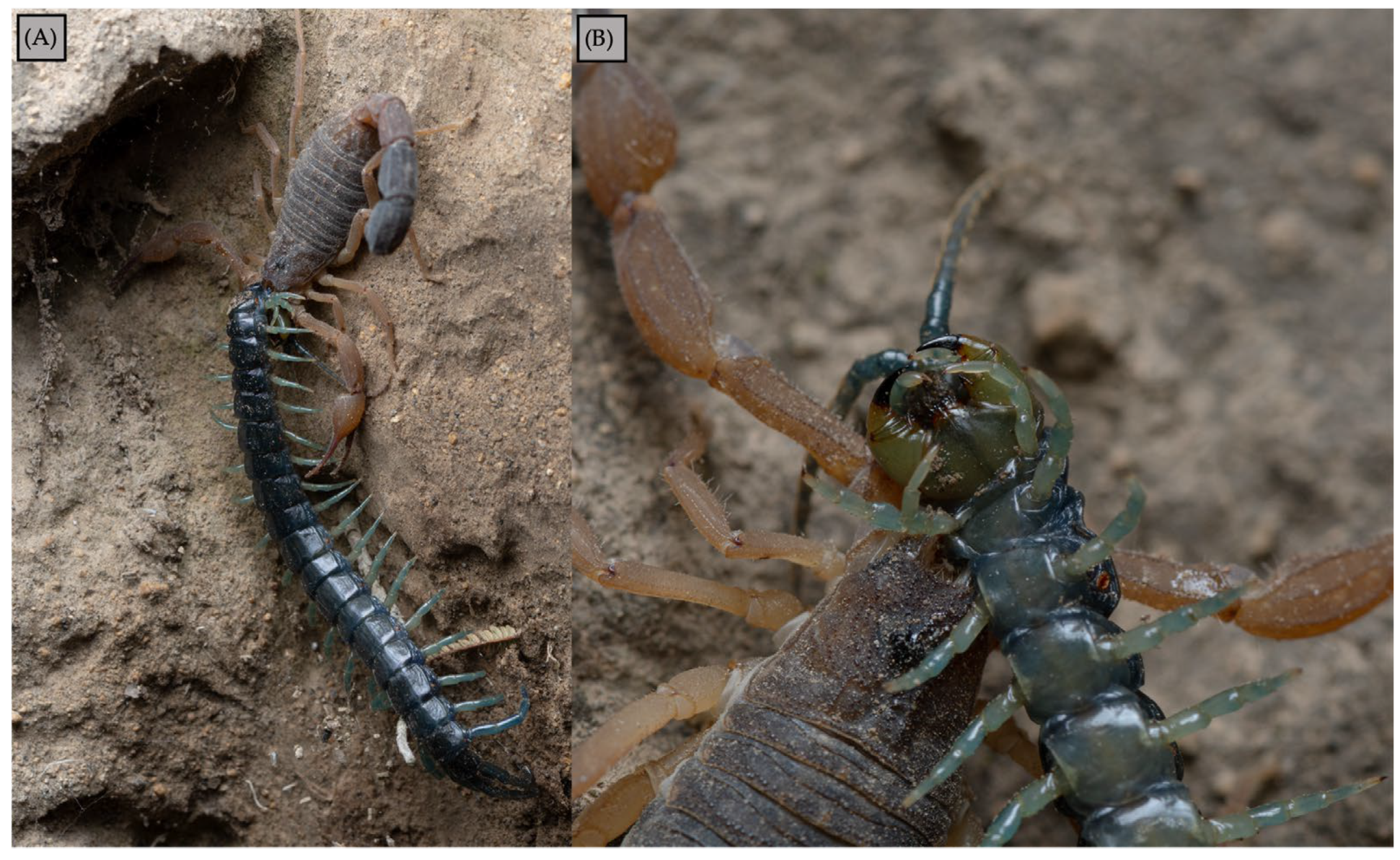
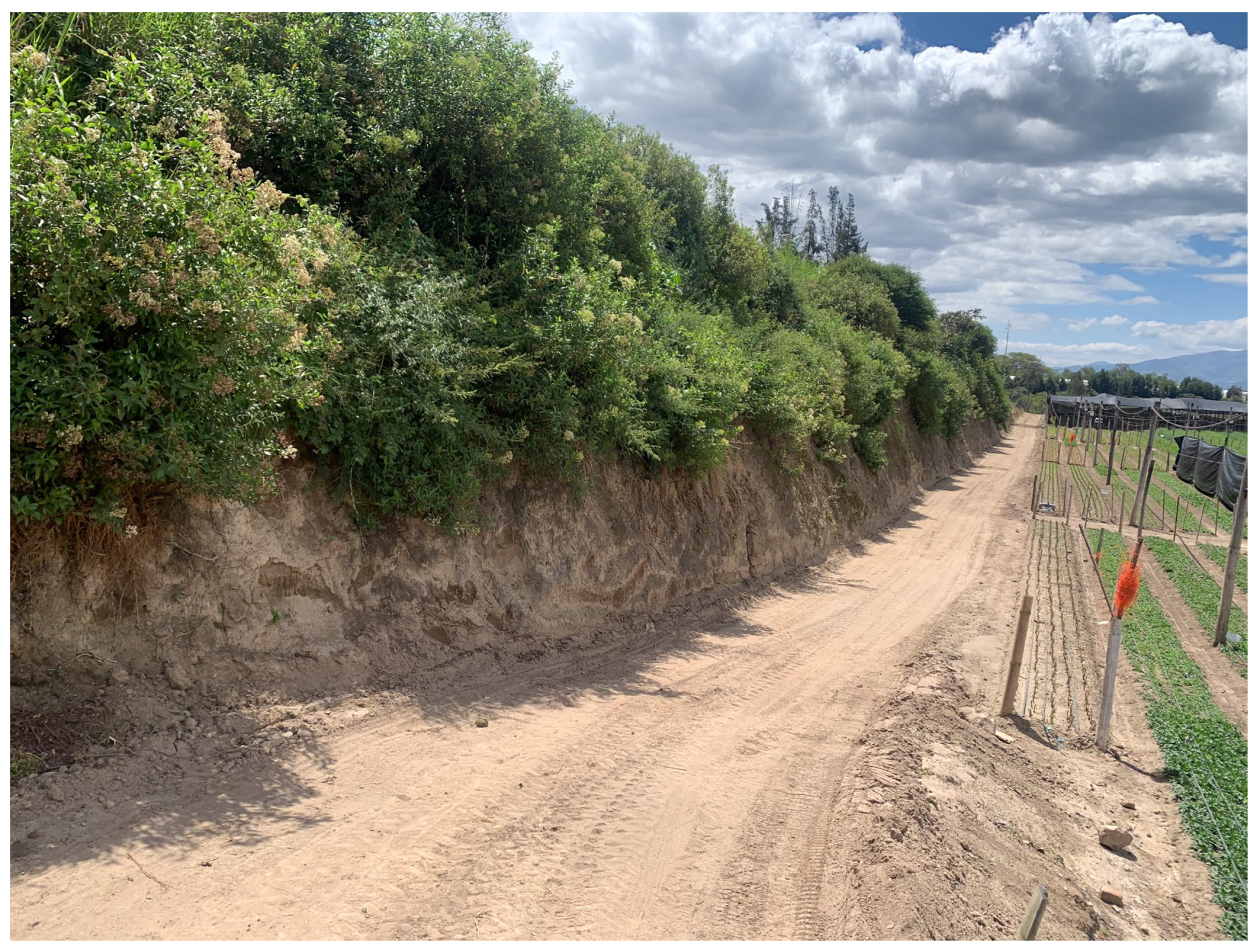
On 5th of May 2023, the authors performed fieldwork in the area of Puembo Parish (a valley close to the capital city of Ecuador, Quito) to monitor fauna diversity, focusing on venomous animals within the horticultural area of the local floriculture company EXPOFLOR CIA. LTDA (Figure 1). The coordinates were −0.157256–78.372989, at 2380 m above sea level. The environmental conditions were dry on a clear night. At 21:14, an adult specimen of T. pugilator was observed carrying a large, still moving, individual of a scolopendrid centipede (genus Otostigmus, undetermined species) in its chelicerae (Figure 2, Supplementary Video S1). Animals were identified based on diagnostic external morphological traits and by confirming their occurrence within the known species distribution. Specimens were not collected. The authors observed the interaction until the centipede stopped moving and the scorpion began to carry it away and to seek shelter, supposedly to feed. Although the authors did not observe the hunting itself, the fact that the centipede was still moving during the encounter and only subsequently became fully immobilized suggests it had previously been stung and envenomated by the scorpion. Therefore, it appears that specimens of T. pugilator occasionally prey on sympatric scolopendromorph centipedes.
Our report adds to the current, quite limited, understanding revolving around Tityus feeding ecology. Members of this genus are known to be quite generalist predators of arthropods, especially insects [2]. There are some reports of predation events by Tityus on Eleutherodactylus frogs (E. coqui, E. patriciae) [11] and some spiders (araneomorphs and mygalomorphs) [12,13]. It has also been reported that they also regularly engage in cannibalism and prey on their conspecifics and congenerics [14]. In laboratory settings, it has further been shown that members of Tityus also prey on araneomorph spiders (Selenops sp., Lycosa sp., L. thorelli, L. carbonelli, Schizocosa malitiosa, Metaltella sp., M. simoni, Dysdera crocata, Ancylometes rufus), various orthoptera, termites, cockroaches (Blaptica dubia, Periplaneta americana, Pycnoscelus sp.), mealworm larvae (Tenebrio sp., T. molitor), and diptera (Drosophila sp., Musca sp.) [15,16,17,18,19].
Here, we add a report of a predation event of T. pugilator targeting a large centipede of the genus Otostigmus. On the one hand, this increases the known prey spectrum for members of the genus Tityus. On the other hand, it could also help to better understand the species’ toxin arsenal. Interestingly, scolopendromorph centipedes are fierce predators that use their powerful venomous bite to hunt arthropods [20]. With that, it appears that members of Tityus may be well accustomed to prey upon other, dangerous and well-defended arthropods. Investigating this further, through more natural history observations and gathering venomic data, may help to better understand their toxinology and ecological role.

Supplementary Materials

The following supporting information can be downloaded at: https://www.mdpi.com/article/10.3390/d17100684/s1, Video S1: T. pugilator preying upon a scolopendromorph centipede (Otostigmus sp.).

Author Contributions

Conceptualization, T.L. and A.E.-R.; writing—original draft preparation, T.L., A.E.-R., D.S.-V. and D.R.Q.; writing—review and editing, T.L. and A.E.-R. All authors have read and agreed to the published version of the manuscript.

Funding

This research received no external funding.

Institutional Review Board Statement

Not applicable.

Data Availability Statement

No data were generated in the present work.

Acknowledgments

We thank EXPOFLOR CIA. LTDA. and Silvana Vega for supporting the venomous fauna survey and granting the needed permission.

Conflicts of Interest

The authors declare no conflicts of interest.

References

  1. Brownell, P.; Polis, G. Scorpion Biology and Research; Oxford University Press: New York, NY, USA, 2001. [Google Scholar]
  2. Polis, G.A. The Biology of Scorpions; Stanford University Press: Stanford, CA, USA, 1990. [Google Scholar]
  3. Lourenço, W.R. The Evolution and Distribution of Noxious Species of Scorpions (Arachnida: Scorpiones). J. Venom. Anim. Toxins Trop. Dis. 2018, 24, 1. [Google Scholar] [CrossRef] [PubMed]
  4. Chippaux, J.-P.; Goyffon, M. Epidemiology of Scorpionism: A Global Appraisal. Acta Trop. 2008, 107, 71–79. [Google Scholar] [CrossRef] [PubMed]
  5. Ghosh, A.; Roy, R.; Nandi, M.; Mukhopadhyay, A. Scorpion Venom–Toxins That Aid in Drug Development: A Review. Int. J. Pept. Res. Ther. 2019, 25, 27–37. [Google Scholar] [CrossRef] [PubMed]
  6. Casewell, N.R.; Wüster, W.; Vonk, F.J.; Harrison, R.A.; Fry, B.G. Complex Cocktails: The Evolutionary Novelty of Venoms. Trends Ecol. Evol. 2013, 28, 219–229. [Google Scholar] [CrossRef] [PubMed]
  7. Lyons, K.; Dugon, M.M.; Healy, K. Diet Breadth Mediates the Prey Specificity of Venom Potency in Snakes. Toxins 2020, 12, 74. [Google Scholar] [CrossRef]
  8. Lüddecke, T.; Herzig, V.; von Reumont, B.M.; Vilcinskas, A. The Biology and Evolution of Spider Venoms. Biol. Rev. Camb. Philos. Soc. 2022, 97, 163–178. [Google Scholar] [CrossRef] [PubMed]
  9. Koch, T.L.; Robinson, S.D.; Salcedo, P.F.; Chase, K.; Biggs, J.; Fedosov, A.E.; Yandell, M.; Olivera, B.M.; Safavi-Hemami, H. Prey Shifts Drive Venom Evolution in Cone Snails. Mol. Biol. Evol. 2024, 41, msae120. [Google Scholar] [CrossRef] [PubMed]
  10. Lüddecke, T. A Documented Case of Ichthyophagy in the Malayan Krait (Bungarus Candidus) and Its Implications for Toxinology. Diversity 2025, 17, 326. [Google Scholar] [CrossRef]
  11. Armas, L.F. Frogs and Lizards as Prey of Some Greater Antillean Arachnids. Rev. Ibérica Aracnol. 2001, 3, 87–88. [Google Scholar]
  12. Aparecido Da Silva, A.; Rohde, C.; Felipe De Araujo Lira, A. Record of Mygalomorph Spider (Araneae: Theraphosidae) Predation by a Scorpion (Scorpiones: Buthidae) in a Brazilian Seasonally Dry Tropical Forest. Arachnology 2021, 18, 1068–1069. [Google Scholar] [CrossRef]
  13. Toscano-Gadea, C.A.; Costa, F.G. Is Tityus Uruguayensis (Buthidae) an Araneophagic Scorpion? An Experimental Analysis of Its Predatory Behaviour on Spiders and Insects. Bull. Br. Arachnol. Soc. 2006, 13, 256–264. [Google Scholar]
  14. Martins, J.G.; Almeida, M.R.N.; Procópio, R.E.L.; Lira, A.F.A. Cannibalism in Tityus Metuendus Pocock, 1897 (Scorpiones: Buthidae) from the Brazilian Amazon. Rev. Chil. Entomol. 2024, 50, 57–61. [Google Scholar] [CrossRef]
  15. Battirola, L.D.; Rodrigues, D.d.J.; Batistella, D.A.; da Silva, A.d.P.S.; Brescovit, A.D. A Case of Predation on Ancylometes rufus (Walckenaer, 1837) (Araneae, Ctenidae) by Tityus strandi (Werner, 1939) (Scorpiones, Buthidae) in Southern Amazonia. Acta Biol. Par. 2015, 44, 145–151. [Google Scholar] [CrossRef]
  16. Candido, D.M.; Lucas, S. Maintenance of Scorpions of the Genus Tityus Koch (Scorpiones, Buthidae) for Venom Obtention at Instituto Butantan, São Paulo, Brazil. J. Venom. Anim. Toxins Trop. Dis. 2004, 10, 86–97. [Google Scholar] [CrossRef]
  17. Lourenço, W.R.; Cuellar, O. A New All-Female Scorpion and the First Probable Case of Arrhenotoky in Scorpions. J. Arachnol. 1999, 27, 149–153. [Google Scholar]
  18. Toscano-Gadea, C.A. Is Tityus Uruguayensis Borelli, 1901 Really Parthenogenetic? In Scorpions 2001: In Memoriam Gary A. Polis; British Arachnological Society: Burnham Beeches, UK, 2001; pp. 359–364. [Google Scholar]
  19. Zolessi, C.d.L. La Partenogénesis En El Escorpión Amarillo Tityus uruguayensis. Revta Fac. Hum. Cienc. 1985, 1, 25–32. [Google Scholar]
  20. Undheim, E.A.B.; King, G.F. On the Venom System of Centipedes (Chilopoda), a Neglected Group of Venomous Animals. Toxicon 2011, 57, 512–524. [Google Scholar] [CrossRef] [PubMed]
Figure 1. Horticultural landscape in Puembo, Quito (Ecuador), where the observation was made. Photo by Diego R. Quirola.
Diversity 17 00684 g001
Figure 2. Tityus pugilator preying upon a scolopendromorph centipede (Otostigmus sp.): (A) The image shows the scorpion carrying the immobilized centipede within its chelicerae before it started to seek shelter; (B) Close-up of the scorpion holding the centipede. Photos by Diego R. Quirola.
Diversity 17 00684 g002
Disclaimer/Publisher’s Note: The statements, opinions and data contained in all publications are solely those of the individual author(s) and contributor(s) and not of MDPI and/or the editor(s). MDPI and/or the editor(s) disclaim responsibility for any injury to people or property resulting from any ideas, methods, instructions or products referred to in the content.