Communication

Synthesis of 3,5-Diamino-Substituted Dithieno[3,2-b:2′,3′-d]thiophene Derivatives


Postovsky Institute of Organic Synthesis, Ural Division, Russian Academy of Sciences, S. Kovalevskoy Str., 22, Ekaterinburg 620990, Russia
*
Author to whom correspondence should be addressed.
Molbank 2025, 2025(4), M2109; https://doi.org/10.3390/M2109 (registering DOI)
Submission received: 18 November 2025 / Revised: 3 December 2025 / Accepted: 9 December 2025 / Published: 10 December 2025
(This article belongs to the Section Organic Synthesis and Biosynthesis)

Abstract

We report the first synthesis of 3,5-diamino-substituted dithieno[3,2-b:2′,3′-d]thiophene derivatives, bearing alkoxycarbonyl or acetyl groups at C-2 and C-6 positions. The target compounds were prepared via the reaction of 3,4-dibromothiophene-2,5-dicarbonitrile with alkyl thioglycolates or mercaptoacetone in the presence of DBU and isolated in 67–87% yield. The key dinitrile was synthesized in 76% yield from 3,4-dibromothiophene-2,5-dicarbaldehyde. In turn, this dialdehyde was prepared on a multigram scale from commercially available 2,5-dimethylthiophene in three steps. The resulting dithieno[3,2-b:2′,3′-d]thiophenes serve as valuable building blocks for materials chemistry, offering multiple reactive sites for further structural elaboration and property tuning.

1. Introduction

Thiophene-based π-conjugated molecules have played a central role in the development of organic semiconductors owing to their structural rigidity, tunable electronic properties, and chemical stability [1,2,3]. Such compounds form the basis of a wide variety of organic electronic materials, where their extended conjugation and planarity promote efficient charge transport. They have been successfully applied in organic field-effect transistors [4,5,6], organic photovoltaics [7,8,9,10], and organic light-emitting diodes [6], and have also been explored as fluorescent probes and sensing elements in chemical biology [11].
The thienoacene family represents a key class of organic semiconductors derived from the thiophene core, notable for their structural planarity and extended conjugation [12,13,14]. Among these, dithieno[3,2-b:2′,3′-d]thiophenes (DTTs) have gained particular attention as privileged scaffolds owing to their stability, electron-rich character, and ability to promote efficient intermolecular interactions [15,16]. These properties have secured DTT derivatives as core building blocks in organic materials design [17,18,19,20] (Figure 1).
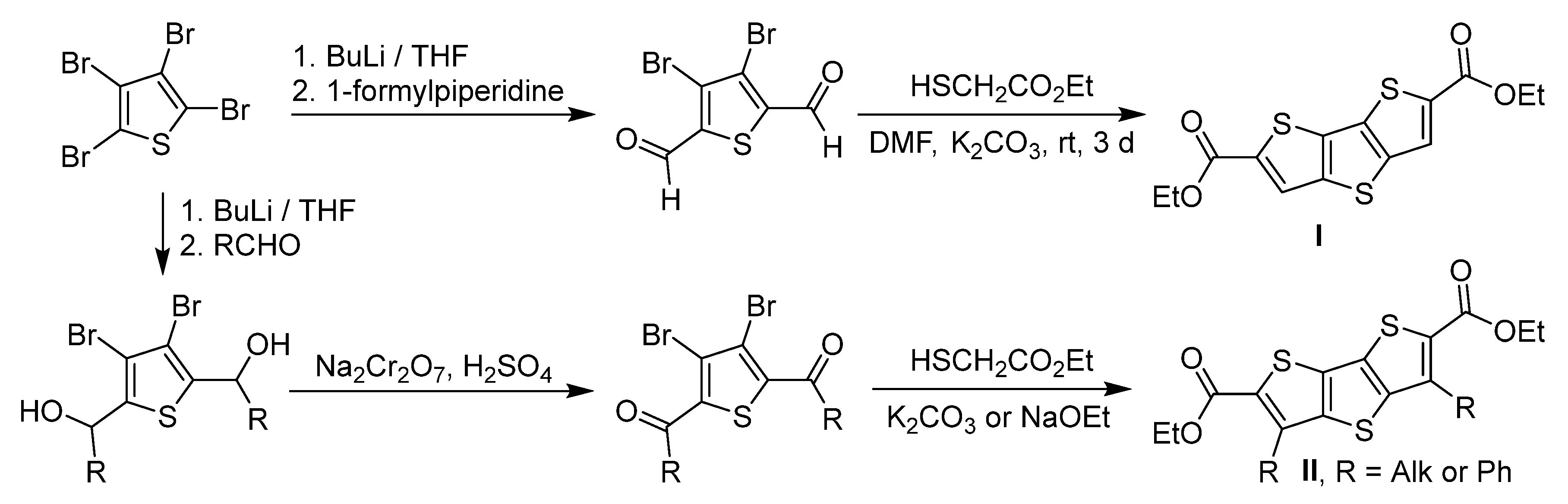
Given their advantageous structural features and broad utility in organic electronics, the DTT framework has become an important synthetic objective for organic chemistry. A breakthrough in its preparation was achieved with the Holmes approach, which showed that 3,4-dibromothiophene-2,5-dicarbaldehyde, obtained from tetrabromothiophene via 2,5-dilithiation with n-butyllithium and trapping with 1-formylpiperidine, could undergo annulation with ethyl thioglycolate under mild conditions (K2CO3, DMF, 25 °C, 3 d) to afford DTT derivative I [21] (Scheme 1). This strategy was subsequently extended to 2,5-diacyl-3,4-dibromothiophenes, also prepared from tetrabromothiophene by 2,5-dilithiation, reaction with aldehydes, and oxidation of the resulting diols to diketones. These carbonyl precursors, upon cyclization with thioglycolates in the presence of K2CO3 or NaOEt, afforded a range of 3,5-disubstituted DTT derivatives II [22,23,24,25]. A 3,5-diphenyl DTT derivative was further used for the synthesis of DTT-containing bisindenoacenes [26] (Scheme 1).
It should be noted that 3-halogen-substituted thiophene-2-carbonitriles have previously demonstrated their ability to serve as substrates for annulation of 3-aminothiophene-2-carboxylate fragments when reacted with thioglycolates. Thus, in our previous work, 3-chlorobenzo[b]thieno[2,3-d]thiophene-2-carbonitriles were shown to react with methyl thioglycolate in the presence of DBU in a solution of THF-MeOH to form 3-aminobenzo[4′,5′]thieno[2′,3′:4,5]thieno[3,2-b]thiophene-2-carboxylates in 53–60% yield [27]. Similarly, the reaction of 3,4-dibromothiophene-2-carbonitrile with ethyl thioglycolate in a K2CO3/18-crown-6 system in DMF at 60 °C afforded ethyl 3-amino-6-bromothieno[3,2-b]thiophene-2-carboxylate in 74% yield [28]. These examples confirm the fundamental feasibility of using nitrile-containing halides in nucleophilic substitution reactions followed by cyclization.
Despite these precedents, only carbonyl-containing 3,4-dibromothiophenes had been employed as precursors for DTT synthesis. Herein, we expand the scope of the Holmes protocol by introducing 3,4-dibromothiophene-2,5-dicarbonitrile as a novel building block for the construction of the DTT framework. Building on this strategy, we have prepared the first examples of 3,5-diamino-substituted DTTs.

2. Results and Discussion

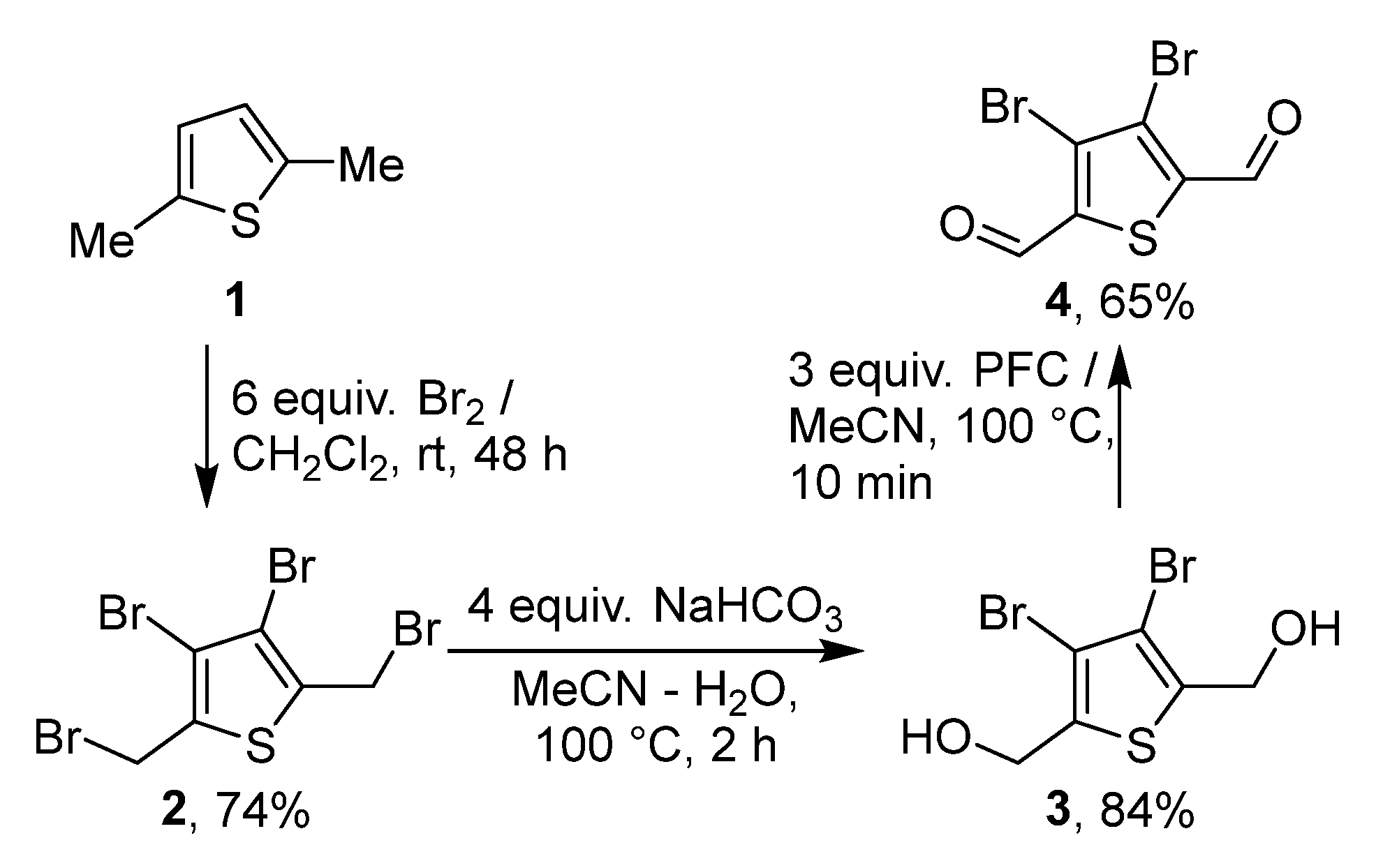
Our initial attempt to synthesize tetrabromide 2 according to a reported method [29] resulted in numerous byproducts and a modest yield of only 55%. Optimization by reducing the bromine equivalents, extending the reaction time, and improving the crystallization conditions increased the yield to 74% and provided material of high purity.
Hydrolysis of the bromomethyl groups in substrate 2 with sodium bicarbonate in aqueous acetonitrile produced diol 3 in 95% crude yield, and after recrystallization, pure product was isolated in 84% yield. Oxidation with pyridinium fluorochromate (PFC) in acetonitrile afforded dialdehyde 4 in 65% yield. This three-step sequence from 2,5-dimethylthiophene represents an efficient route to 3,4-dibromothiophene-2,5-dicarbaldehyde (4) (Scheme 2). Because it avoids the use of n-butyllithium, strictly anhydrous solvents, or an inert atmosphere, and is easily scaled up.
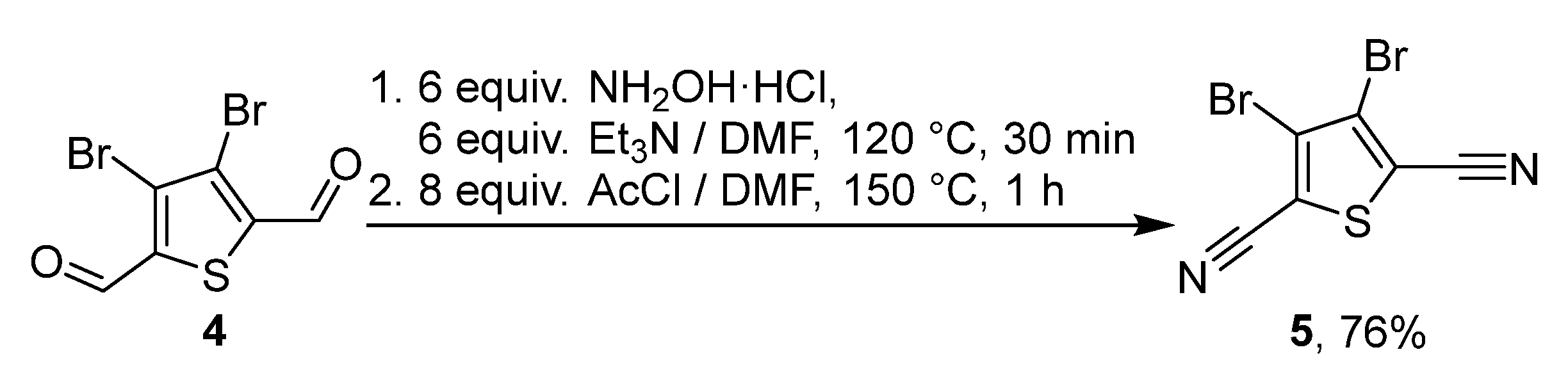
Dialdehyde 4 was converted to 3,4-dibromothiophene-2,5-dicarbonitrile (5) via a one-pot transformation involving reaction with hydroxylamine hydrochloride in the presence of Et3N in DMF at 120 °C to form the dioxime intermediate, followed by its dehydration with acetyl chloride. After careful dilution of the reaction mixture with water, dinitrile 5 precipitated directly in 76% yield (see Supplementary Materials to obtain the copies of NMR spectra and HRMS of this compound). Thus, compound 5 represents an accessible precursor for subsequent heteroaromatic syntheses (Scheme 3).
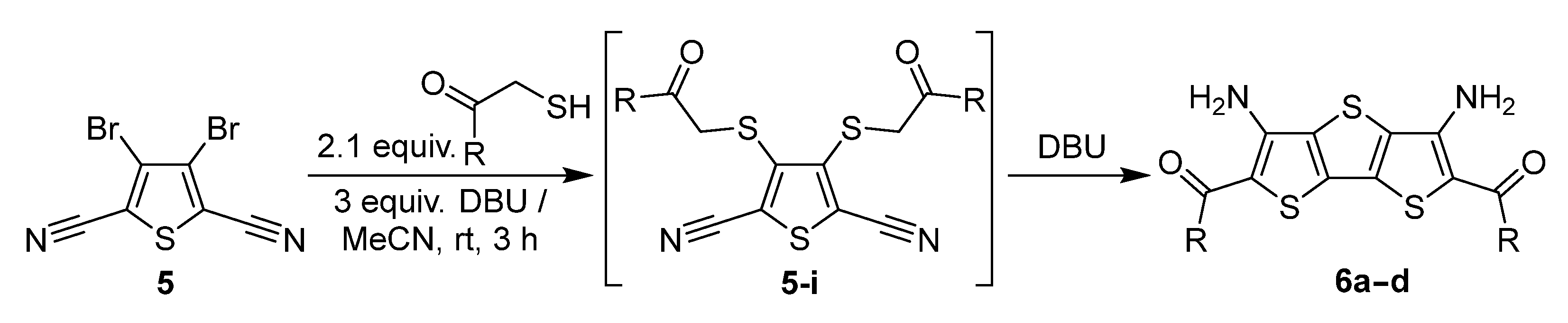
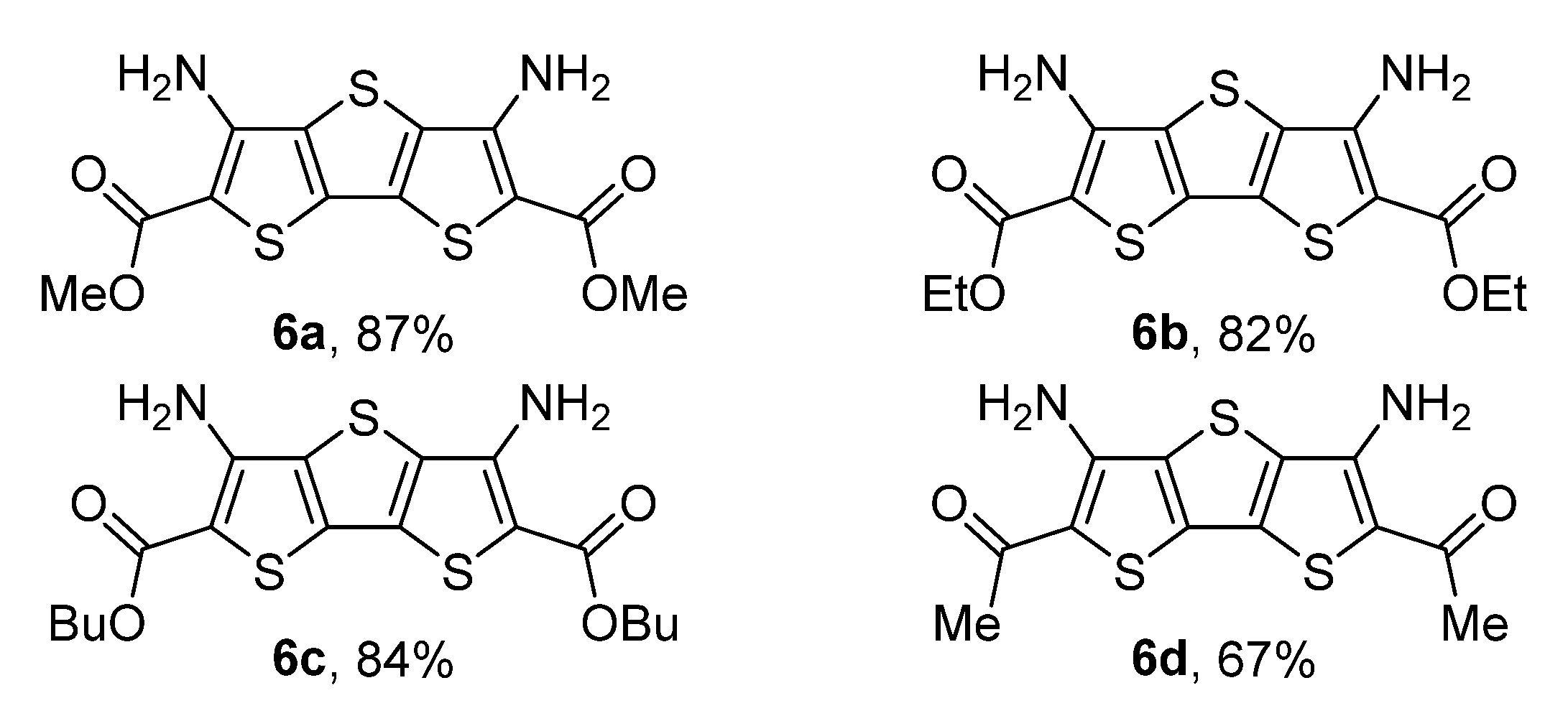
The reaction of dinitrile 5 with alkyl thioglycolates or mercaptoacetone proceeded efficiently at room temperature using DBU as a base, affording the target DTT derivatives within 3 h. Precipitation began within 30 min, and simple isolation gave products 6a–d in 67–87% yields (Scheme 4, Figure 2) (see Supplementary Materials to obtain the copies of NMR spectra and HRMS of these compounds). The use of DBU, a strong non-nucleophilic base, facilitates the generation of thiolates under ambient conditions, initiating a twofold nucleophilic aromatic substitution of the bromine atoms in molecule 5, which is followed by base-promoted cyclization of the intermediate 5-i to form the DTT framework.
This work thus establishes dinitrile 5 as a natural extension of the Holmes approach towards DTTs. While previous studies relied exclusively on 2,5-diformyl- and 2,5-diacyl-3,4-dibromothiophenes as precursors for the synthesis of DTT compounds, the present study demonstrates that the cyano groups can also serve as effective electrophilic partners for twofold annulation of the thiophen ring.

3. Materials and Methods

Elemental analysis was carried on an automated CHNS Euro EA 3000 analyzer (Eurovector Instruments, Pavia, Italy). 1H and 13C NMR spectra were recorded on Bruker DRX-400 (400 MHz) (Bruker BioSpin, Ettlingen, Germany) and Bruker AVANCE-500 (500 MHz) (Bruker BioSpin, Ettlingen, Germany), in CDCl3 or DMSO-d6 with SiMe4 as an internal standard. High-resolution mass spectra were obtained on a Bruker maXis Impact HD spectrometer (Bruker BioSpin, Ettlingen, Germany). Unless otherwise stated, all reagents were purchased from commercial sources and used without further purification. Melting points were determined on combined heating stages and are uncorrected.
Synthesis of 3,4-dibromo-2,5-bis(bromomethyl)thiophene (2)
To a solution of 2,5-dimethylthiophene (12 mL, 0.105 mol) in dichloromethane (200 mL), Br2 (102 g, 0.637 mol) was added dropwise at 0 °C with vigorous stirring. The mixture was stirred for 48 h at room temperature. The reaction was quenched by pouring into ice water (500 mL) and treated with Na2S2O5 (15.1 g, 0.156 mol) until the solution became pale yellow. The organic layer was separated, washed with water (100 mL), dried with crushed CaCl2 and evaporated under reduced pressure. The residue was crystallized from isopropanol–THF (9:1, v/v) to give pure product 2.
3,4-Dibromo-2,5-bis(bromomethyl)thiophene (2): White crystals, yield 33.4 g (74%), m.p. 101-102 °C. 1H NMR (400 MHz, CDCl3) δ 4.65 (s, 4H). The analytical data for compound 2 are identical to those previously published [29].
Synthesis of (3,4-dibromothiophene-2,5-diyl)dimethanol (3)
A mixture of compound 2 (10 g, 0.023 mol) and NaHCO3 (7.8 g, 0.093 mol) in acetonitrile (90 mL) and water (20 mL) was heated at reflux (100 °C) for 2 h. The dark yellow solution was decanted from a small amount of dark gum and filtered hot. The filtrate was diluted with water (200 mL) and extracted with ethyl acetate. The combined organic layers were dried and concentrated to give crude product in 95% yield. Recrystallization from methanol afforded analytically pure diol 3.
(3,4-Dibromothiophene-2,5-diyl)dimethanol (3): White solid, yield 5.86 g (84%), m.p. 166-167 °C. 1H NMR (400 MHz, DMSO-d6) δ 5.80 (t, J = 5.7 Hz, 2H), 4.59 (d, J = 5.7 Hz, 4H). 13C NMR (126 MHz, DMSO-d6) δ 140.48, 107.90, 58.71. HRMS (ESI) calcd for C6H6Br2O2NaS m/z 322.8347 [M + Na]+, found m/z 322.8347 [M + Na]+. Anal. Calcd for C6H6Br2O2S: C, 23.86; H, 2.00. Found: C, 24.09; H, 2.04.
Synthesis of 3,4-dibromothiophene-2,5-dicarbaldehyde (4)
To a solution of diol 3 (3.6 g, 0.012 mol) in acetonitrile (80 mL) was added pyridinium fluorochromate (7.2 g, 0.036 mol) in four portions with vigorous stirring. An exothermic reaction occurred with formation of a dark precipitate. The mixture was heated to reflux (100 °C) briefly about 10 min, and the liquid phase was decanted and diluted with water (100 mL). The precipitated product was filtered, washed with water, and dried at 100 °C.
3,4-Dibromothiophene-2,5-dicarbaldehyde (4): Yellowish powder, yield 2.34 g (65%), m.p. 226–227 °C. 1H NMR (400 MHz, DMSO-d6) δ 9.96 (s, 1H). 13C NMR (126 MHz, DMSO-d6) δ 184.3, 141.6, 123.7. HRMS (ESI) calcd for C6H2Br2O2NaS m/z 318.8034 [M + Na]+, found m/z 318.8033 [M + H]+. Anal. Calcd for C6H2Br2O2S: C, 24.19; H, 0.68. Found: C, 24.34; H, 0.70.
Synthesis of 3,4-dibromothiophene-2,5-dicarbonitrile (5)
A mixture of dialdehyde 4 (2.12 g, 0.007 mol), hydroxylamine hydrochloride (2.9 g, 0.043 mol), and triethylamine (5.95 mL, 0.043 mol) in DMF (30 mL) was heated at 120 °C for 0.5 h. After cooling, acetyl chloride (3.8 mL, 0.057 mol) was added, and the mixture was refluxed (150 °C) for 1 h. The reaction mixture was cooled to room temperature, diluted with water (40 mL), and the precipitate was collected by filtration, washed with water (20 mL) and methanol (10 mL), dried at 100 °C to give compound 5 in analytically pure form.
3,4-Dibromothiophene-2,5-dicarbonitrile (5): White solid, yield 1.55 g (76%), m.p. 142–143 °C. 13C NMR (126 MHz, CDCl3) δ 126.0, 114.1, 110.5. HRMS (ESI) calcd for C6HBr2N2S m/z 290.8222 [M + H]+, found m/z 290.8222 [M + H]+. Anal. Calcd for C6Br2N2S: C, 24.68; N, 9.60. Found: C, 24.64; N, 9.49.
General procedure for synthesis of 3,5-diamino-DTT compounds (6a–d)
Dinitrile 5 (1 mmol, 292 mg) and the corresponding thiol component (3 mmol of an alkyl thioglycolate or 1.5 mmol of mercaptoacetone dimer) were dissolved in acetonitrile (10 mL). DBU (0.45 mL, 3 mmol) was added, and the mixture was stirred at room temperature for 3 h. A precipitate formed within 0.5 h. After completion, methanol (10 mL) was added, and the solid was filtered, washed with methanol (2 × 5 mL), and dried at 100 °C to afford analytically pure products 6a–d without further purification.
Dimethyl 3,5-diaminodithieno[3,2-b:2′,3′-d]thiophene-2,6-dicarboxylate (6a): Orange plates, yield 298 mg (87%). 1H NMR (500 MHz, DMSO-d6) δ 7.21 (s, 4H), 3.78 (s, 6H). 13C NMR (126 MHz, DMSO-d6) δ 164.3, 148.1, 133.6, 132.1, 98.6, 51,3. HRMS (ESI) calcd for C12H11N2O4S3 m/z 342.9875 [M + H]+, found m/z 342.9875 [M + H]+. Anal. Calcd for C12H10N2O4S3: C, 42.09; H, 2.94; N, 8.18; S, 28.09. Found: C, 41.92; H, 3.01; N, 8.05; S, 28.15.
Diethyl 3,5-diaminodithieno[3,2-b:2′,3′-d]thiophene-2,6-dicarboxylate (6b): Yellowish plates, yield 303 mg (82%). 1H NMR (400 MHz, CDCl3) δ 5.64 (s, 4H), 4.35 (d, J = 7.1 Hz, 4H), 1.39 (t, J = 7.1 Hz, 6H). 13C NMR (126 MHz, CDCl3) δ 164.8, 146.6, 133.5, 132.4, 103.5, 60.6, 14.5. HRMS (ESI) calcd for C14H15N2O4S3 m/z 371.0188 [M + H]+, found m/z 371.0188 [M + H]+. Anal. Calcd for C14H14N2O4S3: C, 45.39; H, 3.81; N, 7.56; S, 25.96. Found: C, 45.25; H, 3.88; N, 7.42; S, 26.10.
Dibutyl 3,5-diaminodithieno[3,2-b:2′,3′-d]thiophene-2,6-dicarboxylate (6c): Yellowish plates, yield 360 mg (84%). 1H NMR (400 MHz, CDCl3) δ 5.63 (s, 4H), 4.30 (t, J = 6.6 Hz, 4H), 1.84–1.64 (m, 4H), 1.54–1.38 (m, 4H), 0.98 (t, J = 7.4 Hz, 6H). 13C NMR (126 MHz, CDCl3) δ 164.9, 146.6, 133.4, 132.4, 103.4, 64.4, 30.9, 19.2, 13.8. HRMS (ESI) calcd for C18H23N2O4S3 m/z 427.0814 [M + H]+, found m/z 427.0814 [M + H]+. Anal. Calcd for C18H22N2O4S3: C, 50.68; H, 5.20; N, 6.57; S, 22.55. Found: C, 50.51; H, 5.32; N, 6.48; S, 22.62.
1,1′-(3,5-Diaminodithieno[3,2-b:2′,3′-d]thiophene-2,6-diyl)bis(ethan-1-one) (6d): Yellow microcrystals, yield 208 mg (67%). 1H NMR (500 MHz, DMSO-d6) δ 7.85 (s, 4H), 2.34 (s, 6H). 13C NMR (126 MHz, DMSO-d6) δ 190.5, 148.0, 134.1, 132.1, 125.3, 27.9. HRMS (ESI) calcd for C12H11N2O4S3 m/z 310.9977 [M + H]+, found m/z 310.9977 [M + H]+. Anal. Calcd for C12H10N2O2S3: C, 46.43; H, 3.25; N, 9.03; S, 30.99. Found: C, 46.30; H, 3.34; N, 8.91; S, 31.12.

4. Conclusions

In this study, we have broadened the scope of DTT chemistry by accomplishing the first synthesis of 3,5-diamino-substituted DTT derivatives. The obtained DTT scaffold thus represents a versatile platform for further functionalization and materials development. The presence of two amino groups at positions C-3 and C-5, along with ester or acetyl functionalities at positions C-2 and C-6, enables numerous post-synthetic modifications. The amino groups allow for acylation, reductive amination, and formation of imine linkages, while the ester/acetyl groups can be further modified through hydrolysis, aminolysis, or reduction. Furthermore, the close proximity of these amino donors and carbonyl acceptors opens the possibility for annulation reactions, leading to π-extended fused-ring systems based on the DTT core. This multifunctional architecture paves the way for designing tailored organic semiconductors and advanced π-conjugated materials.

Supplementary Materials

The following supporting information are available. Figure S1. 1H NMR (400 MHz) spectrum of 3,4-dibromo-2,5-bis(bromomethyl)thiophene (2) in CDCl3; Figure S2. 1H NMR (400 MHz) spectrum of (3,4-dibromothiophene-2,5-diyl)dimethanol (3) in DMSO-d6; Figure S3. 13C NMR (126 MHz) spectrum of (3,4-dibromothiophene-2,5-diyl)dimethanol (3) in DMSO-d6; Figure S4. 1H NMR (400 MHz) spectrum of 3,4-dibromothiophene-2,5-dicarbaldehyde (4) in DMSO-d6; Figure S5. 13C NMR (126 MHz) spectrum of 3,4-dibromothiophene-2,5-dicarbaldehyde (4) in DMSO-d6;Figure S6. 13C NMR (126 MHz) spectrum of 3,4-dibromothiophene-2,5-dicarbonitrile (5) in CDCl3; Figure S7. 1H NMR (500 MHz) spectrum of dimethyl 3,5-diaminodithieno[3,2-b:2′,3′-d]thiophene-2,6-dicarboxylate (6a) in DMSO-d6; Figure S8. 13C NMR (126 MHz) spectrum of dimethyl 3,5-diaminodithieno[3,2-b:2′,3′-d]thiophene-2,6-dicarboxylate (6a) in DMSO-d6; Figure S9. 1H NMR (400 MHz) spectrum of diethyl 3,5-diaminodithieno[3,2-b:2′,3′-d]thiophene-2,6-dicarboxylate (6b) in CDCl3; Figure S10. 13C NMR (126 MHz) spectrum of diethyl 3,5-diaminodithieno[3,2-b:2′,3′-d]thiophene-2,6-dicarboxylate (6b) in CDCl3; Figure S11. 1H NMR (400 MHz) spectrum of dibutyl 3,5-diaminodithieno[3,2-b:2′,3′-d]thiophene-2,6-dicarboxylate (6c) in CDCl3; Figure S12. 13C NMR (126 MHz) spectrum of dibutyl 3,5-diaminodithieno[3,2-b:2′,3′-d]thiophene-2,6-dicarboxylate (6c) in CDCl3; Figure S13. 1H NMR (500 MHz) spectrum of 1,1′-(3,5-diaminodithieno[3,2-b:2′,3′-d]thiophene-2,6-diyl)bis(ethan-1-one) (6d) in DMSO-d6; Figure S14. 13C NMR (126 MHz) spectrum of 1,1′-(3,5-diaminodithieno[3,2-b:2′,3′-d]thiophene-2,6-diyl)bis(ethan-1-one) (6d) in DMSO-d6; Figure S15. High-resolution mass spectrum of (3,4-dibromothiophene-2,5-diyl)dimethanol (3); Figure S16. High-resolution mass spectrum of 3,4-dibromothiophene-2,5-dicarbaldehyde (4); Figure S17. High-resolution mass spectrum of 3,4-dibromothiophene-2,5-dicarbonitrile (5); Figure S18. High-resolution mass spectrum of dimethyl 3,5-diaminodithieno[3,2-b:2′,3′-d]thiophene-2,6-dicarboxylate (6a); Figure S19. High-resolution mass spectrum of diethyl 3,5-diaminodithieno[3,2-b:2′,3′-d]thiophene-2,6-dicarboxylate (6b); Figure S20. High-resolution mass spectrum of dibutyl 3,5-diaminodithieno[3,2-b:2′,3′-d]thiophene-2,6-dicarboxylate (6c); Figure S21. High-resolution mass spectrum of 1,1′-(3,5-diaminodithieno[3,2-b:2′,3′-d]thiophene-2,6-diyl)bis(ethan-1-one) (6d).

Author Contributions

R.A.I. writing—original draft preparation, conceptualization, writing—review and editing, project administration, funding acquisition, supervision; N.A.K. data curation, formal analysis, methodology, investigation, validation, resources. All authors have read and agreed to the published version of the manuscript.

Funding

The work was carried out with the financial support of the Ministry of Education and Science of the Russian Federation within the framework of the state assignment (subject no. state. reg. 124020100137-7).

Data Availability Statement

The original contributions presented in this study are included in the article/Supplementary Materials. Further inquiries can be directed to the corresponding author.

Acknowledgments

Analytical studies were carried out using equipment of the Center for Joint Use “Spectroscopy and Analysis of Organic Compounds” at the Postovsky Institute of Organic Synthesis of the Russian Academy of Sciences (Ural Division).

Conflicts of Interest

The authors declare no conflicts of interest.

References

  1. Turkoglu, G.; Cinar, M.E.; Ozturk, T. Thiophene-Based Organic Semiconductors. In Topics in Current Chemistry; Springer: Cham, Switzerland, 2019; Volume 375, pp. 79–123. ISBN 978-3-030-25598-5. [Google Scholar]
  2. Wang, C.; Dong, H.; Hu, W.; Liu, Y.; Zhu, D. Semiconducting π-conjugated systems in field-effect transistors: A material odyssey of organic electronics. Chem. Rev. 2012, 112, 2208–2267. [Google Scholar] [CrossRef]
  3. Cinar, M.E.; Ozturk, T. Thienothiophenes, Dithienothiophenes, and Thienoacenes: Syntheses, Oligomers, Polymers, and Properties. Chem. Rev. 2015, 115, 3036–3140. [Google Scholar] [CrossRef]
  4. Larik, F.A.; Faisal, M.; Saeed, A.; Abbas, Q.; Kazi, M.A.; Abbas, N.; Thebo, A.A.; Khan, D.M.; Channar, P.A. Thiophene-based molecular and polymeric semiconductors for organic field effect transistors and organic thin film transistors. J. Mater. Sci. Mater. Electron. 2018, 29, 17975–18010. [Google Scholar] [CrossRef]
  5. Vegiraju, S.; Luo, X.L.; Li, L.H.; Afraj, S.N.; Lee, C.; Zheng, D.; Hsieh, H.C.; Lin, C.C.; Hong, S.H.; Tsai, H.C.; et al. Solution Processable Pseudo n-Thienoacenes via Intramolecular S···S Lock for High Performance Organic Field Effect Transistors. Chem. Mater. 2020, 32, 1422–1429. [Google Scholar] [CrossRef]
  6. Borshchev, O.V.; Skorotetcky, M.S.; Trukhanov, V.A.; Fedorenko, R.S.; Surin, N.M.; Svidchenko, E.A.; Sosorev, A.Y.; Kazantsev, M.S.; Paraschuk, D.Y.; Ponomarenko, S.A. Synthesis, characterization and organic field-effect transistors applications of novel tetrathienoacene derivatives. Dye. Pigment. 2021, 185, 108911. [Google Scholar] [CrossRef]
  7. Cheng, X.; Liang, M.; Sun, S.; Shi, Y.; Ma, Z.; Sun, Z.; Xue, S. Synthesis and photovoltaic properties of organic sensitizers containing electron-deficient and electron-rich fused thiophene for dye-sensitized solar cells. Tetrahedron 2012, 68, 5375–5385. [Google Scholar] [CrossRef]
  8. Kumaresan, P.; Vegiraju, S.; Ezhumalai, Y.; Yau, S.; Kim, C.; Lee, W.-H.; Chen, M.-C.; Kumaresan, P.; Vegiraju, S.; Ezhumalai, Y.; et al. Fused-Thiophene Based Materials for Organic Photovoltaics and Dye-Sensitized Solar Cells. Polymers 2014, 6, 2645–2669. [Google Scholar] [CrossRef]
  9. Eom, Y.K.; Kang, S.H.; Choi, I.T.; Kim, E.; Kim, J.; Ju, M.J.; Kim, H.K. New thieno[3,2-b][1]benzothiophene-based organic sensitizers containing π-extended thiophene spacers for efficient dye-sensitized solar cells. RSC Adv. 2015, 5, 80859–80870. [Google Scholar] [CrossRef]
  10. Li, J.; Zhang, C.; Sun, X.; Wang, H.; Hu, H.; Wang, K.; Xiao, M. Small molecule donor third component incorporating thieno[3,2-b]thiophene unit enables 19.18% efficiency ternary organic solar cells with improved operational stability. Nano Energy 2024, 125, 109542. [Google Scholar] [CrossRef]
  11. Palamà, I.; Di Maria, F.; Viola, I.; Fabiano, E.; Gigli, G.; Bettini, C.; Barbarella, G. Live-Cell-Permeant Thiophene Fluorophores and Cell-Mediated Formation of Fluorescent Fibrils. J. Am. Chem. Soc. 2011, 133, 17777–17785. [Google Scholar] [CrossRef] [PubMed]
  12. Takimiya, K.; Nakano, M.; Kang, M.J.; Miyazaki, E.; Osaka, I. Thienannulation: Efficient Synthesis of π-Extended Thienoacenes Applicable to Organic Semiconductors. Eur. J. Org. Chem. 2013, 2013, 217–227. [Google Scholar] [CrossRef]
  13. Niebel, C.; Kim, Y.; Ruzié, C.; Karpinska, J.; Chattopadhyay, B.; Schweicher, G.; Richard, A.; Lemaur, V.; Olivier, Y.; Cornil, J.; et al. Thienoacene dimers based on the thieno[3,2-b]thiophene moiety: Synthesis, characterization and electronic properties. J. Mater. Chem. C 2014, 3, 674–685. [Google Scholar] [CrossRef]
  14. Zheng, T.; Cai, Z.; Ho-Wu, R.; Yau, S.H.; Shaparov, V.; Goodson, T.; Yu, L. Synthesis of Ladder-Type Thienoacenes and Their Electronic and Optical Properties. J. Am. Chem. Soc. 2016, 138, 868–875. [Google Scholar] [CrossRef]
  15. Ali, R.; Siddiqui, R. Dithieno[3,2-b:2′,3′-d]thiophene (DTT): An emerging heterocyclic building block for future organic electronic materials & functional supramolecular chemistry. RSC Adv. 2022, 12, 36073–36102. [Google Scholar] [CrossRef] [PubMed]
  16. Strakova, K.; Assies, L.; Goujon, A.; Piazzolla, F.; Humeniuk, H.V.; Matile, S. Dithienothiophenes at Work: Access to Mechanosensitive Fluorescent Probes, Chalcogen-Bonding Catalysis, and Beyond. Chem. Rev. 2019, 119, 10977–11005. [Google Scholar] [CrossRef] [PubMed]
  17. Chen, M.C.; Chiang, Y.J.; Kim, C.; Guo, Y.J.; Chen, S.Y.; Liang, Y.J.; Huang, Y.W.; Hu, T.S.; Lee, G.H.; Facchetti, A.; et al. One-pot [1+1+1] synthesis of dithieno[2,3-b:3′,2′-d]thiophene (DTT) and their functionalized derivatives for organic thin-film transistors. Chem. Commun. 2009, 1846–1848. [Google Scholar] [CrossRef]
  18. Kwon, J.; Kim, T.M.; Oh, H.S.; Kim, J.J.; Hong, J.I. Vacuum processable donor material based on dithieno[3,2-b:2′,3′-d]thiophene and pyrene for efficient organic solar cells. RSC Adv. 2014, 4, 24453–24457. [Google Scholar] [CrossRef]
  19. Ho, D.; Jeon, M.; Kim, H.; Gidron, O.; Kim, C.; Seo, S.Y. Solution-processable dithieno[3,2-b:2′,3′-d]thiophene derivatives for organic thin-film transistors and complementary-like inverters. Org. Electron. 2018, 52, 356–363. [Google Scholar] [CrossRef]
  20. Park, J.-H.; Kim, U.-Y.; Kim, B.-M.; Kim, W.-H.; Roh, D.-H.; Kim, J.S.; Kwon, T.-H. Molecular Design Strategy toward Robust Organic Dyes in Thin-Film Photoanodes. ACS Appl. Energy Mater. 2019, 2, 4674–4682. [Google Scholar] [CrossRef]
  21. Frey, J.; Bond, A.D.; Holmes, A.B. Improved synthesis of dithieno[3,2-b:2’,3’-d]thiophene (DTT) and derivatives for cross coupling. Chem. Commun. 2002, 2, 2424–2425. [Google Scholar] [CrossRef]
  22. He, M.; Zhang, F. Synthesis and structure of alkyl-substituted fused thiophenes containing up to seven rings. J. Org. Chem. 2007, 72, 442–451. [Google Scholar] [CrossRef]
  23. Benz, S.; Macchione, M.; Verolet, Q.; Mareda, J.; Sakai, N.; Matile, S. Anion Transport with Chalcogen Bonds. J. Am. Chem. Soc. 2016, 138, 9093–9096. [Google Scholar] [CrossRef]
  24. Macchione, M.; Tsemperouli, M.; Goujon, A.; Mallia, A.R.; Sakai, N.; Sugihara, K.; Matile, S. Mechanosensitive Oligodithienothiophenes: Transmembrane Anion Transport Along Chalcogen-Bonding Cascades. Helv. Chim. Acta 2018, 101, e1800014. [Google Scholar] [CrossRef]
  25. Strakova, K.; Poblador-Bahamonde, A.I.; Sakai, N.; Matile, S.; Poblador-Bahamonde, A.I.; Sakai, N.; Matile, S.; Poblador-Bahamonde, A.I.; Sakai, N.; Matile, S. Fluorescent Flipper Probes: Comprehensive Twist Coverage. Chem. A Eur. J. 2019, 25, 14935–14942. [Google Scholar] [CrossRef] [PubMed]
  26. Shi, X.; Burrezo, P.M.; Lee, S.; Zhang, W.; Zheng, B.; Dai, G.; Chang, J.; López Navarrete, J.T.; Huang, K.W.; Kim, D.; et al. Antiaromatic bisindeno-[n]thienoacenes with small singlet biradical characters: Syntheses, structures and chain length dependent physical properties. Chem. Sci. 2014, 5, 4490–4503. [Google Scholar] [CrossRef]
  27. Demina, N.S.; Bayankina, P.E.; Irgashev, R.A.; Kazin, N.A.; Rusinov, G.L. An Effective Route to Dithieno[3,2-b:2′,3′-d]thiophene-Based Hexaheteroacenes. Synlett 2021, 32, 1009–1013. [Google Scholar] [CrossRef]
  28. Deng, H.; Hu, J.; Hu, H.; He, M.; Fang, Y. Thieno[3,2-b]thiophene-2-carboxylic acid derivatives as GPR35 agonists. Bioorg. Med. Chem. Lett. 2012, 22, 4148–4152. [Google Scholar] [CrossRef]
  29. Liu, Z.; Yasseri, A.A.; Loewe, R.S.; Lysenko, A.B.; Malinovskii, V.L.; Zhao, Q.; Surthi, S.; Li, Q.; Misra, V.; Lindsey, J.S.; et al. Synthesis of Porphyrins Bearing Hydrocarbon Tethers and Facile Covalent Attachment to Si(100). J. Org. Chem. 2004, 69, 5568–5577. [Google Scholar] [CrossRef]
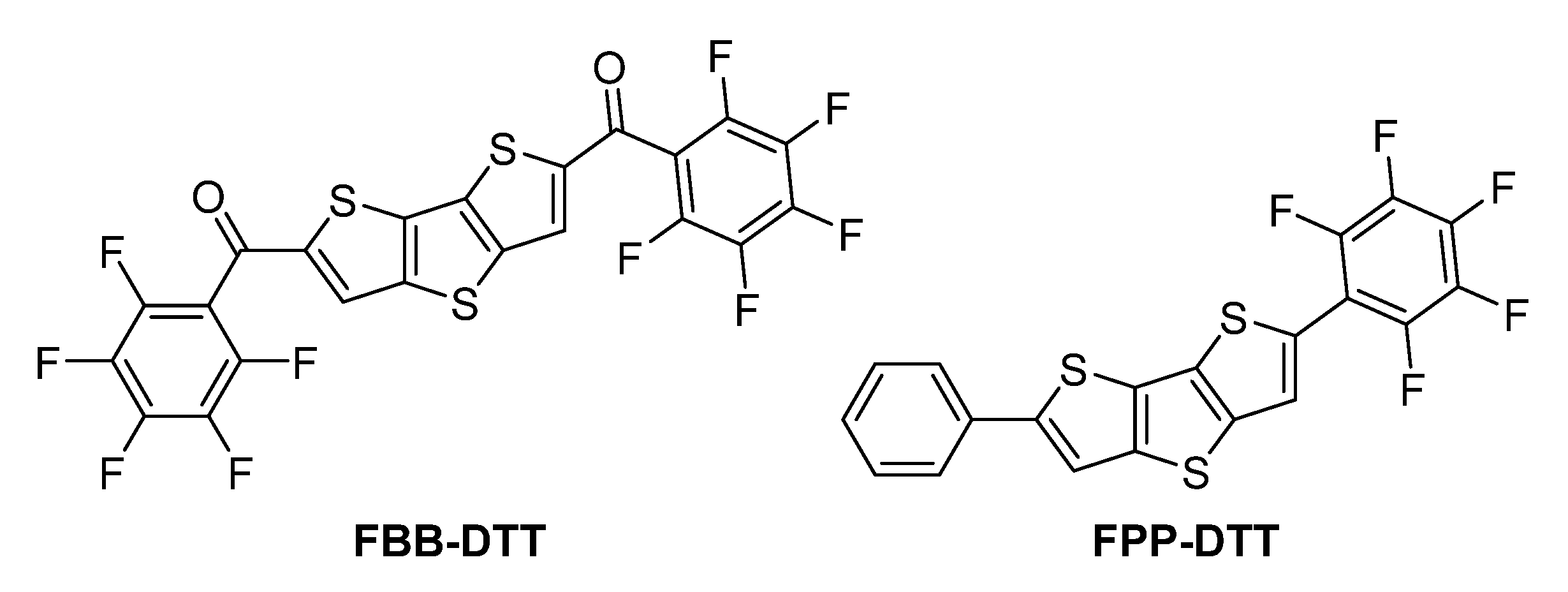
Figure 1. The examples of DTT-based organic semiconductors.
Molbank 2025 m2109 g001
Scheme 1. Synthesis of DTT derivatives from 3,4-dibromothiophene substrates.
Molbank 2025 m2109 sch001
Scheme 2. Three-step synthesis of 3,4-dibromothiophene-2,5-dicarbaldehyde (4).
Molbank 2025 m2109 sch002
Scheme 3. Synthesis of 3,4-dibromothiophene-2,5-dicarbonitrile (5).
Molbank 2025 m2109 sch003
Scheme 4. Synthesis of 3,5-diamino DTT compounds 6a–d.
Molbank 2025 m2109 sch004
Figure 2. The scope and yields of products 6a–d.
Molbank 2025 m2109 g002
Disclaimer/Publisher’s Note: The statements, opinions and data contained in all publications are solely those of the individual author(s) and contributor(s) and not of MDPI and/or the editor(s). MDPI and/or the editor(s) disclaim responsibility for any injury to people or property resulting from any ideas, methods, instructions or products referred to in the content.