

You are currently viewing a new version of our website. To view the old version click .
Molbank
  • Short Note
  • Open Access

24 August 2008

3-(1-Phenyl-1H-pyrazol-4-yl)-1,2-benzisoxazole 2-oxide

Laboratory of Organic Chemistry, Department of Chemical Engineering, College of Engineering, University of Thessaloniki, Thessaloniki 54006, Greece
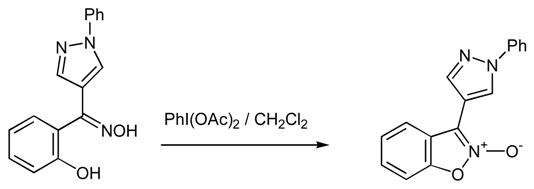
It is well known that both isoxazole ring as well as pyrazole ring possess various biological activities and they both show interesting antimicrobial activity [1,2,3]. Therefore, it is not unreasonable to believe that a molecule bearing both moieties would possible show combined activity. Having this in mind we designed the synthesis of 3-(1-phenyl-1H-pyrazol-4-yl)-1,2-benzisoxazole 2-oxide as shown below. Nitrogen derivatives of o-hydroxyaryl ketones have been proved valuable starting materials in organic synthesis[4]. Thus, we synthesised (2-hydroxyphenyl)(1-phenyl-1H-pyrazol-4-yl)methanone oxime and we subsequently oxidized it with diacetoxy iodobenzene (DIB). The reaction led to the formation of the oxidative cyclisation product, giving the desired 3-(1-phenyl-1H-pyrazol-4-yl)-1,2-benzisoxazole 2-oxide, in 61% yield.
Molbank 2008 m573 i001
(2-Hydroxyphenyl)(1-phenyl-1H-pyrazol-4-yl)methanone oxime was prepared according to the literature methods by refluxing (2-hydroxyphenyl)(1-phenyl-1H-pyrazol-4-yl)methanone and hydrochloric hydroxylamine in ethanol in the presence of pyridine whereas commercially available diacetoxy iodobenzene were supplied by Aldrich.

Oxidation of (2-hydroxyphenyl)(1-phenyl-1H-pyrazol-4-yl)methanone oxime

0.58 g (1.79 mmol) of DIB are added to a suspension of 0.5 g (1.79 mmol) of (2-hydroxyphenyl)(1-phenyl-1H-pyrazol-4-yl)methanone oxime in 20 ml CH2Cl2 in an ice-bath. The mixture was then magnetically stirred for 3 hrs. Evaporation of the solvent gave an oil which was then subjected to column chromatography (silica gel 70-230 mesh). Elution with a mixture of petroleum ether / ethylacetate 3:1 afforded the desired 3-(1-phenyl-1H-pyrazol-4-yl)-1,2-benzisoxazole 2-oxide as white crystals (0.30 g, 61 %). The product was identified by its 1H NMR, 13C NMR and MS and elemental analysis.
M.p. 179-180 °C.
1H NMR (400 MHz, DMSO-d6): 7.44-7.52 (m, 3H), 7.58-7.70 (m, 3H), 8.04-8.07(m, 2H), 8.32-8.34(d, J=8.0Hz, 1H), 8.67(s, 1H), 9.36(s, 1H).
13C NMR (100 MHz, DMSO-d6): 107.7, 109.5, 118.9, 119.9, 120.1, 121.6, 125.1, 127.3, 127.7, 128.1, 129.6, 130.2, 139.5, 139.7, 149.1, 150.5.
MS m/z (ES+): 300 [M+Na]+, 277 [M]+, 261, 247.
Anal. Calc. for C16H11N3O2: C 69.31, H 4.00, N 15.15; found: C 69.22, H 3.88, N, 15.10

Supplementary materials

Supplementary File 1Supplementary File 2Supplementary File 3

References

  1. Priya, B.S.; Bassappa, S.; Nanjunda, S.; Rangappa, S. Biorganic and Med. Chem. 2005, 13, 2623. [CrossRef]
  2. Menozzi, G.; Merello, L.; Fossa, P.; Schenome, S.; Ranise, A.; Mosti, L.; Bondavalli, F.; Loddo, R.; Murgioni, C.; Mascia, V.; La Colla, P.; Tamburini, E. Bioorg. Med. Chem. 2004, 12(20), 5465. [CrossRef] [PubMed]
  3. Bekhit, A.A.; Ashour, H.M.; Guemei, A.A. Arch Pharm (Weinheim) 2005, 338(4), 167. [PubMed]
  4. Kotali, A.; Harris, P.A. Org. Prep. Proc. Int. 1994, 26(2), 155.

Article Metrics

Citations

Article Access Statistics

Multiple requests from the same IP address are counted as one view.
