Cystic Fibrosis of the Pancreas: In Vitro Duct Models for CFTR-Targeted Translational Research



Abstract
1. Introduction
2. Pancreatic Disease in Cystic Fibrosis
3. Therapeutic Approaches to Pancreatic Disease in Cystic Fibrosis
3.1. Exocrine Pancreatic Insufficiency
3.2. Pancreatic Inflammation and Pancreatitis
3.3. Endocrine Involvement and CFRD
3.4. CFTR Modulators and Pancreatic Outcomes
4. In Vitro Models of Pancreatic Ducts as Experimental Systems for CFTR-Directed Studies
4.1. Intact Micro-Dissected Interlobular Ducts
4.2. Primary Pancreatic Ductal Epithelial Cells (PDECs) in Culture
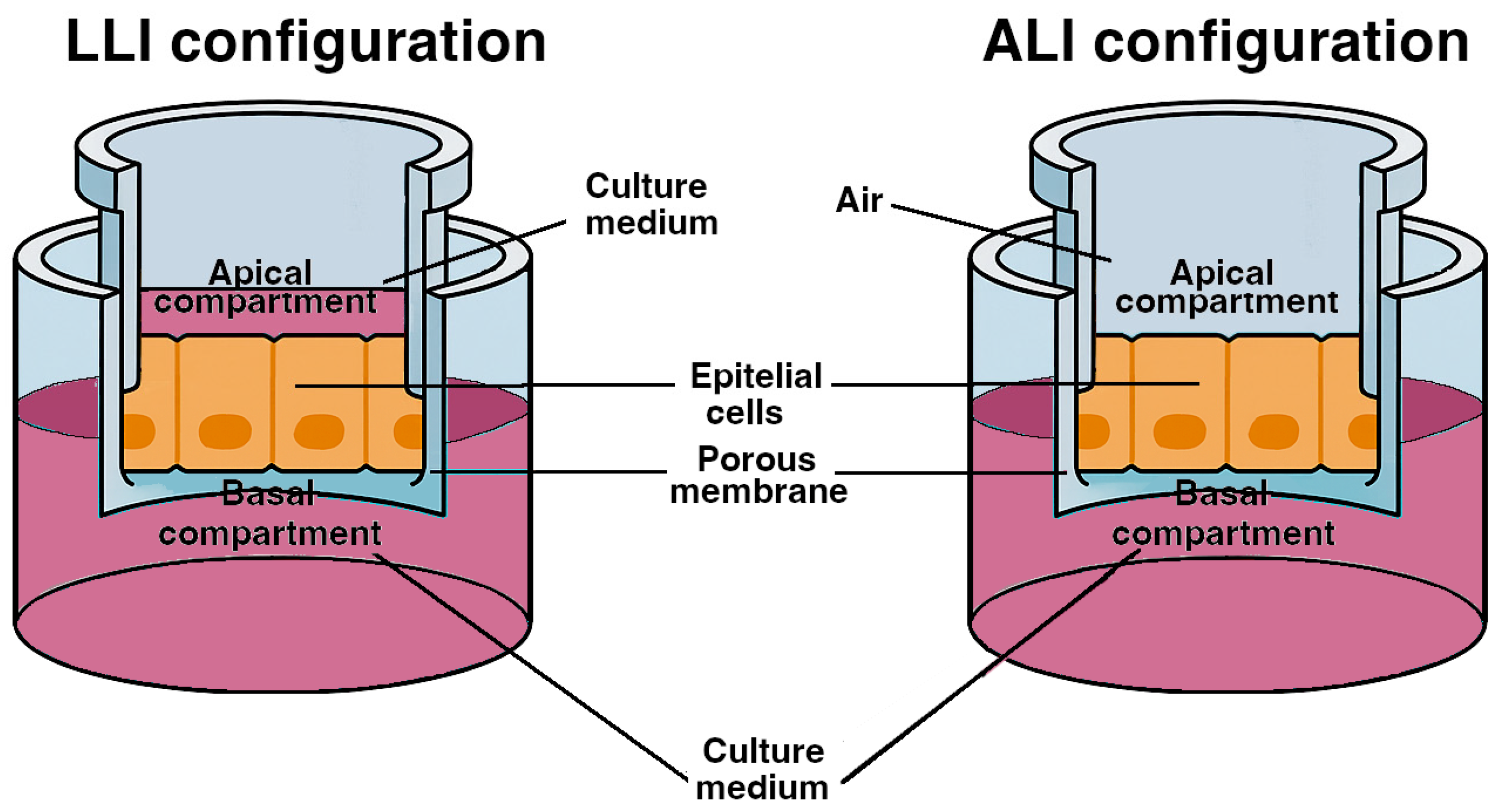
4.3. Immortalised Pancreatic Ductal Epithelial Cell Lines and Epithelial Assay Models
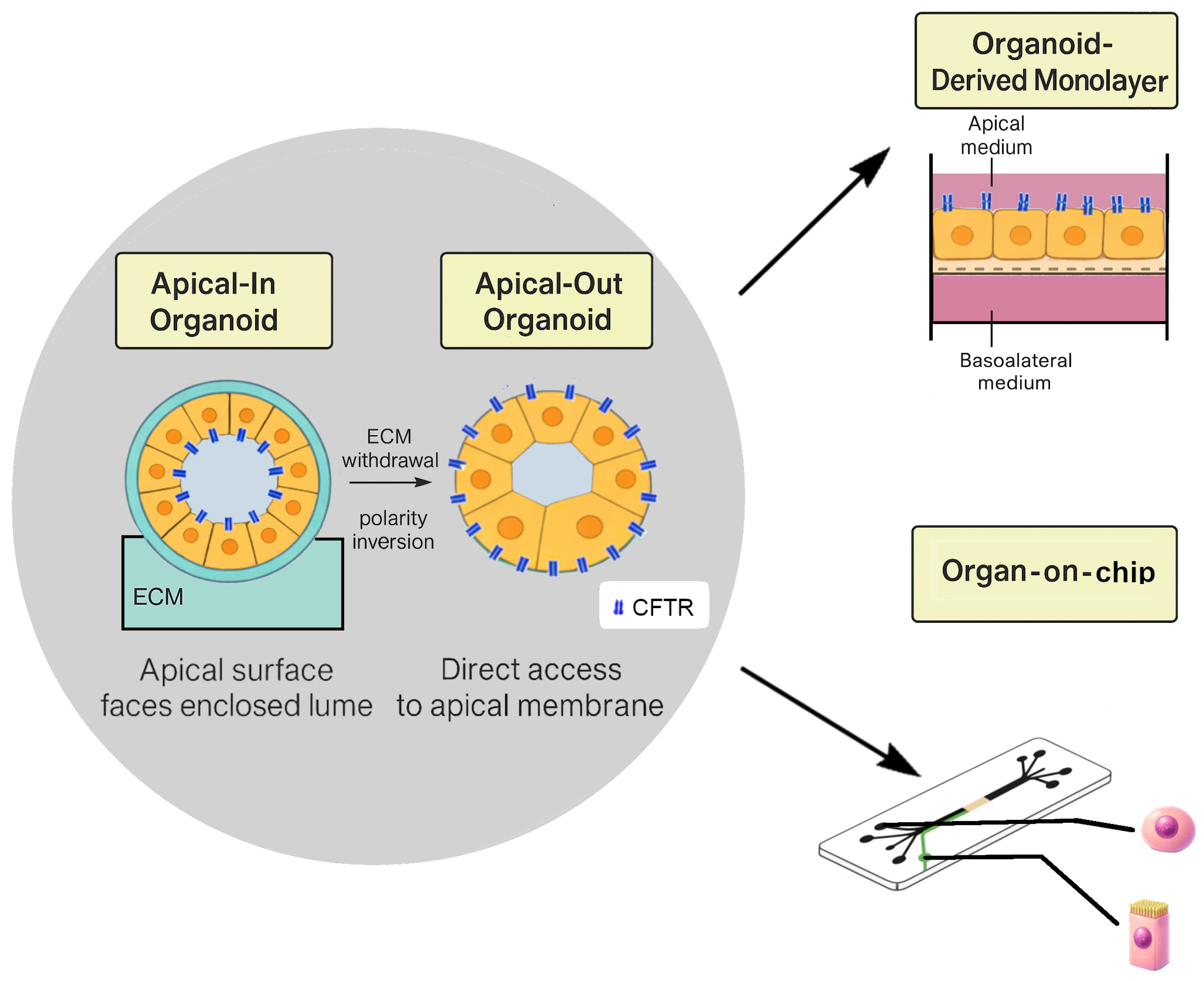
4.4. Pancreatic Ductal Organoids (3D)
4.5. Co-Colture and Organ-on-Chip Systems of Pancreatic Duct Epithelium (2D and 3D)
5. Conclusions and Perspectives
Author Contributions
Funding
Data Availability Statement
Conflicts of Interest
References
- Bobadilla, J.L.; Macek, M., Jr.; Fine, J.P.; Farrell, P.M. Cystic fibrosis: A worldwide analysis of CFTR mutations, correlation with incidence data and application to screening. Hum. Mutat. 2002, 19, 575–606. [Google Scholar] [CrossRef]
- Farrell, P.M. The prevalence of cystic fibrosis in the European Union. J. Cyst. Fibros. 2008, 7, 450–453. [Google Scholar] [CrossRef]
- Castellani, C.; Massie, J.; Sontag, M.; Southern, K.W. Newborn screening for cystic fibrosis. Lancet Respir. Med. 2016, 4, 653–661. [Google Scholar] [CrossRef]
- Elborn, J.S. Cystic fibrosis. Lancet 2016, 388, 2519–2531. [Google Scholar] [CrossRef]
- Ratjen, F.; Bell, S.C.; Rowe, S.M.; Goss, C.H.; Quittner, A.L.; Bush, A. Cystic fibrosis. Nat. Rev. Dis. Primers 2015, 1, 15010. [Google Scholar] [CrossRef]
- Riordan, J.R.; Rommens, J.M.; Kerem, B.; Alon, N.; Rozmahel, R.; Grzelczak, Z.; Zielenski, J.; Lok, S.; Plavsic, N.; Chou, J.L.; et al. Identification of the cystic fibrosis gene, cloning and characterization of complementary DNA. Science 1989, 245, 1066–1073, Erratum in Science 1989, 245, 1437. [Google Scholar] [CrossRef] [PubMed]
- Sheppard, D.N.; Welsh, M.J. Structure and function of the CFTR chloride channel. Physiol. Rev. 1999, 79, S23–S45. [Google Scholar] [CrossRef] [PubMed]
- Saint-Criq, V.; Gray, M.A. Role of CFTR in epithelial physiology. Cell. Mol. Life Sci. 2017, 74, 93–115. [Google Scholar] [CrossRef] [PubMed]
- Ishiguro, H.; Steward, M.C.; Naruse, S.; Ko, S.B.; Goto, H.; Case, R.M.; Kondo, T.; Yamamoto, A. CFTR functions as a bicarbonate channel in pancreatic duct cells. J. Gen. Physiol. 2009, 133, 315–326. [Google Scholar] [CrossRef]
- Cystic Fibrosis Mutation Database. Hospital for Sick Children. Available online: http://www.genet.sickkids.on.ca (accessed on 1 December 2025).
- De Boeck, K.; Amaral, M.D. Classification of CFTR mutation classes, authors’ reply. Lancet Respir. Med. 2016, 4, e39. [Google Scholar] [CrossRef]
- De Boeck, K.; Zolin, A.; Cuppens, H.; Olesen, H.V.; Viviani, L. The relative frequency of CFTR mutation classes in European patients with cystic fibrosis. J. Cyst. Fibros. 2014, 13, 403–409. [Google Scholar] [CrossRef]
- Fanen, P.; Wohlhuter-Haddad, A.; Hinzpeter, A. Genetics of cystic fibrosis, CFTR mutation classifications toward genotype-based CF therapies. Int. J. Biochem. Cell Biol. 2014, 52, 94–102. [Google Scholar] [CrossRef]
- Tewkesbury, D.H.; Robey, R.C.; Barry, P.J. Progress in precision medicine in cystic fibrosis, a focus on CFTR modulator therapy. Breathe 2021, 17, 210112. [Google Scholar] [CrossRef]
- Kireeva, T.N.; Zhigalina, D.I.; Skryabin, N.A. Cystic fibrosis therapy, from symptoms to the cause of the disease. Vavilovskii Zhurnal Genet. Selektsii. 2025, 29, 279–289. [Google Scholar] [CrossRef] [PubMed]
- Lopes-Pacheco, M. CFTR modulators, the changing face of cystic fibrosis in the era of precision medicine. Front. Pharmacol. 2020, 10, 1662. [Google Scholar] [CrossRef] [PubMed]
- Du, K.; Sharma, M.; Lukacs, G.L. The ΔF508 cystic fibrosis mutation impairs domain-domain interactions and arrests post-translational folding of CFTR. Nat. Struct. Mol. Biol. 2005, 12, 17–25. [Google Scholar] [CrossRef] [PubMed]
- Cabrini, G.; Rimessi, A.; Borgatti, M.; Pinton, P.; Gambari, R. Overview of CF lung pathophysiology. Curr. Opin. Pharmacol. 2022, 64, 102214. [Google Scholar] [CrossRef]
- Madácsy, T.; Pallagi, P.; Maléth, J. Cystic fibrosis of the pancreas, the role of CFTR channel in intracellular Ca2+ signaling and mitochondrial function in the exocrine pancreas. Front. Physiol. 2018, 9, 1585. [Google Scholar] [CrossRef]
- Gibson-Corley, K.N.; Meyerholz, D.K.; Engelhardt, J.F. Pancreatic pathophysiology in cystic fibrosis. J. Pathol. 2016, 238, 311–320. [Google Scholar] [CrossRef]
- Milano, R.V.; Morneault-Gill, K.; Kamal, H.Y.; Barkin, J.A.; Chadwick, C.B. Pancreatitis in cystic fibrosis, presentation, medical and surgical management, and the impact of modulator therapies. Pediatr. Pulmonol. 2024, 59, S53–S60. [Google Scholar] [CrossRef]
- Malik, S.S.; Padmanabhan, D.; Hull-Meichle, R.L. Pancreas and islet morphology in cystic fibrosis, clues to the etiology of cystic fibrosis-related diabetes. Front. Endocrinol. 2023, 14, 1269139. [Google Scholar] [CrossRef]
- Moran, A.; Diem, P.; Klein, D.J.; Levitt, M.D.; Robertson, R.P. Pancreatic endocrine function in cystic fibrosis. J. Pediatr. 1991, 118, 715–723. [Google Scholar] [CrossRef]
- Lewis, C.; Blackman, S.M.; Nelson, A.; Oberdorfer, E.; Wells, D.; Dunitz, J.; Thomas, W.; Moran, A. Diabetes-related mortality in adults with cystic fibrosis, role of genotype and sex. Am. J. Respir. Crit. Care Med. 2015, 191, 194–200. [Google Scholar] [CrossRef]
- Kopelman, H.; Corey, M.; Gaskin, K.; Durie, P.; Weizman, Z.; Forstner, G. Impaired chloride secretion, as well as bicarbonate secretion, underlies the fluid secretory defect in the cystic fibrosis pancreas. Gastroenterology 1988, 95, 349–355. [Google Scholar] [CrossRef]
- Kopelman, H.; Durie, P.; Gaskin, K.; Weizman, Z.; Forstner, G. Pancreatic fluid secretion and protein hyperconcentration in cystic fibrosis. N. Engl. J. Med. 1985, 312, 329–334. [Google Scholar] [CrossRef] [PubMed]
- Angyal, D.; Bijvelds, M.J.C.; Bruno, M.J.; Peppelenbosch, M.P.; de Jonge, H.R. Bicarbonate transport in cystic fibrosis and pancreatitis. Cells 2021, 11, 54. [Google Scholar] [CrossRef]
- Ramsey, M.L.; Li, S.S.; Lara, L.F.; Gokun, Y.; Akshintala, V.S.; Conwell, D.L.; Heintz, J.; Kirkby, S.E.; McCoy, K.S.; Papachristou, G.I.; et al. CFTR modulators and the exocrine pancreas, a scoping review. J. Cyst. Fibros. 2023, 22, 193–200. [Google Scholar] [CrossRef] [PubMed]
- LaRusch, J.; Lozano-Leon, A.; Stello, K.; Moore, A.; Muddana, V.; O’Connell, M.; Diergaarde, B.; Yadav, D.; Whitcomb, D.C. The common CTRC variant G60G increases risk of chronic pancreatitis but not recurrent acute pancreatitis. Clin. Transl. Gastroenterol. 2015, 6, e68. [Google Scholar] [CrossRef] [PubMed]
- Rosendahl, J.; Landt, O.; Bernadova, J.; Kovacs, P.; Teich, N.; Bödeker, H.; Keim, V.; Ruffert, C.; Mössner, J.; Kage, A.; et al. CFTR, SPINK1, CTRC and PRSS1 variants in chronic pancreatitis, is the role of mutated CFTR overestimated? Gut 2013, 62, 582–592. [Google Scholar] [CrossRef]
- Andersen, D.H. Cystic fibrosis of the pancreas and its relation to celiac disease, a clinical and pathologic study. Am. J. Dis. Child. 1938, 56, 344–399. [Google Scholar] [CrossRef]
- Kim, D.; Steward, M.C. The role of CFTR in bicarbonate secretion by pancreatic duct and airway epithelia. J. Med. Investig. 2009, 56, 336–342. [Google Scholar] [CrossRef][Green Version]
- Park, H.W.; Nam, J.H.; Kim, J.Y.; Namkung, W.; Yoon, J.S.; Lee, J.S.; Kim, K.S.; Venglovecz, V.; Gray, M.A.; Kim, K.H.; et al. Dynamic regulation of CFTR bicarbonate permeability by intracellular chloride and its role in pancreatic bicarbonate secretion. Gastroenterology 2010, 139, 620–631. [Google Scholar] [CrossRef] [PubMed]
- Behrendorff, N.; Floetenmeyer, M.; Schwiening, C.; Thorn, P. Protons released during pancreatic acinar cell secretion acidify the lumen and contribute to pancreatitis in mice. Gastroenterology 2010, 139, 1711–1720.e5. [Google Scholar] [CrossRef]
- Pallagi, P.; Hegyi, P.; Rakonczay, Z., Jr. The physiology and pathophysiology of pancreatic ductal secretion, the background for clinicians. Pancreas 2015, 44, 1211–1233. [Google Scholar] [CrossRef] [PubMed]
- Balázs, A.; Balla, Z.; Kui, B.; Maléth, J.; Rakonczay, Z., Jr.; Duerr, J.; Zhou-Suckow, Z.; Schatterny, J.; Sendler, M.; Mayerle, J.; et al. Ductal mucus obstruction and reduced fluid secretion are early defects in chronic pancreatitis. Front. Physiol. 2018, 9, 632. [Google Scholar] [CrossRef]
- Wilschanski, M.; Novak, I. The cystic fibrosis of the exocrine pancreas. Cold Spring Harb. Perspect. Med. 2013, 3, a009746. [Google Scholar] [CrossRef]
- Durie, P.R. Pathophysiology of the pancreas in cystic fibrosis. Neth. J. Med. 1992, 41, 97–100. [Google Scholar]
- Ooi, C.Y.; Durie, P.R. Cystic fibrosis from the gastroenterologist’s perspective. Nat. Rev. Gastroenterol. Hepatol. 2016, 13, 175–185. [Google Scholar] [CrossRef]
- Cohn, J.A.; Friedman, K.J.; Noone, P.G.; Knowles, M.R.; Silverman, L.M.; Jowell, P.S. Relation between mutations of the cystic fibrosis gene and idiopathic pancreatitis. N. Engl. J. Med. 1998, 339, 653–658. [Google Scholar] [CrossRef] [PubMed]
- LaRusch, J.; Whitcomb, D.C. Genetics of pancreatitis. Curr. Opin. Gastroenterol. 2011, 27, 467–474. [Google Scholar] [CrossRef]
- Hegyi, P.; Wilschanski, M.; Muallem, S.; Lukacs, G.L.; Sahin-Tóth, M.; Uc, A.; Gray, M.A.; Rakonczay, Z., Jr.; Maléth, J. CFTR, a new horizon in the pathomechanism and treatment of pancreatitis. Rev. Physiol. Biochem. Pharmacol. 2016, 170, 37–66. [Google Scholar] [CrossRef]
- Steiner, B.; Rosendahl, J.; Witt, H.; Teich, N.; Keim, V.; Schulz, H.U.; Pfützer, R.; Löhr, M.; Gress, T.M.; Nickel, R.; et al. Common CFTR haplotypes and susceptibility to chronic pancreatitis and congenital bilateral absence of the vas deferens. Hum. Mutat. 2011, 32, 912–920. [Google Scholar] [CrossRef]
- Moran, A.; Dunitz, J.; Nathan, B.; Saeed, A.; Holme, B.; Thomas, W. Cystic fibrosis–related diabetes, current trends in prevalence, incidence, and mortality. Diabetes Care 2009, 32, 1626–1631. [Google Scholar] [CrossRef]
- Bogdani, M.; Blackman, S.M.; Ridaura, C.; Bellocq, J.P.; Powers, A.C.; Aguilar-Bryan, L. Structural abnormalities in islets from very young children with cystic fibrosis may contribute to cystic fibrosis-related diabetes. Sci. Rep. 2017, 7, 17231. [Google Scholar] [CrossRef]
- Hart, N.J.; Aramandla, R.; Poffenberger, G.; Fayolle, C.; Thames, A.H.; Bautista, A.; Spigelman, A.F.; Babon, J.A.B.; DeNicola, M.E.; Dadi, P.K.; et al. Cystic fibrosis–related diabetes is caused by islet loss and inflammation. JCI Insight 2018, 3, e98240. [Google Scholar] [CrossRef]
- Kelly, A.; Moran, A. Update on cystic fibrosis-related diabetes. J. Cyst. Fibros. 2013, 12, 318–331, Corrigendum in J. Cyst. Fibros. 2014, 13, 119. [Google Scholar] [CrossRef] [PubMed]
- Prentice, B.J.; Jaffe, A.; Hameed, S.; Verge, C.F.; Waters, S.; Widger, J. Cystic fibrosis-related diabetes and lung disease, an update. Eur. Respir. Rev. 2021, 30, 200293. [Google Scholar] [CrossRef]
- Gaskin, K.; Gurwitz, D.; Durie, P.; Corey, M.; Levison, H.; Forstner, G. Improved respiratory prognosis in patients with cystic fibrosis with normal fat absorption. J. Pediatr. 1982, 100, 857–862. [Google Scholar] [CrossRef] [PubMed]
- Sanders, D.B.; Fink, A.; Mayer-Hamblett, N.; Schechter, M.S.; Sawicki, G.S.; Rosenfeld, M.; Flume, P.A.; Morgan, W.J. Early life growth trajectories in cystic fibrosis are associated with pulmonary function at age 6 years. J. Pediatr. 2015, 167, 1081–1088.e1. [Google Scholar] [CrossRef]
- Wilschanski, M.; Munck, A.; Carrion, E.; Cipolli, M.; Collins, S.; Colombo, C.; Declercq, D.; Hatziagorou, E.; Hulst, J.; Kalnins, D.; et al. ESPEN-ESPGHAN-ECFS guideline on nutrition care for cystic fibrosis. Clin. Nutr. 2024, 43, 413–445. [Google Scholar] [CrossRef] [PubMed]
- Borowitz, D.; Baker, S.S.; Duffy, L.; Baker, R.D.; Fitzpatrick, L.; Gyamfi, J.; Jarembek, K. Use of fecal elastase-1 to classify pancreatic status in patients with cystic fibrosis. J. Pediatr. 2004, 145, 322–326. [Google Scholar] [CrossRef]
- Barben, J.; Rueegg, C.S.; Jurca, M.; Spalinger, J.; Kuehni, C.E.; Swiss Cystic Fibrosis Screening Group. Measurement of fecal elastase improves performance of newborn screening for cystic fibrosis. J. Cyst. Fibros. 2016, 15, 313–317. [Google Scholar] [CrossRef]
- Gillespie, C.D.; O’Reilly, M.K.; Allen, G.N.; McDermott, S.; Chan, V.O.; Ridge, C.A. Imaging the abdominal manifestations of cystic fibrosis. Int. J. Hepatol. 2017, 2017, 5128760. [Google Scholar] [CrossRef]
- Durie, P.R.; Forstner, G.G.; Gaskin, K.J.; Moore, D.J.; Cleghorn, G.J.; Wong, S.S.; Corey, M.L. Age-related alterations of immunoreactive pancreatic cationic trypsinogen in sera from cystic fibrosis patients with and without pancreatic insufficiency. Pediatr. Res. 1986, 20, 209–213. [Google Scholar] [CrossRef]
- Freswick, P.N.; Reid, E.K.; Mascarenhas, M.R. Pancreatic enzyme replacement therapy in cystic fibrosis. Nutrients 2022, 14, 1341. [Google Scholar] [CrossRef] [PubMed]
- Ng, C.; Major, G.; Smyth, A.R. Timing of pancreatic enzyme replacement therapy in cystic fibrosis. Cochrane Database Syst. Rev. 2021, 8, CD013488. [Google Scholar] [CrossRef]
- Mariotti Zani, E.; Grandinetti, R.; Cunico, D.; Torelli, L.; Fainardi, V.; Pisi, G.; Esposito, S. Nutritional care in children with cystic fibrosis. Nutrients 2023, 15, 479. [Google Scholar] [CrossRef] [PubMed]
- Ooi, C.Y.; Dorfman, R.; Cipolli, M.; Gonska, T.; Castellani, C.; Keenan, K.; Freedman, S.D.; Zielenski, J.; Berthiaume, Y.; Corey, M.; et al. Type of CFTR mutation determines risk of pancreatitis in patients with cystic fibrosis. Gastroenterology 2011, 140, 153–161. [Google Scholar] [CrossRef] [PubMed]
- Durno, C.; Corey, M.; Zielenski, J.; Tullis, E.; Tsui, L.C.; Durie, P. Genotype and phenotype correlations in patients with cystic fibrosis and pancreatitis. Gastroenterology 2002, 123, 1857–1864. [Google Scholar] [CrossRef]
- Phadke, M.Y.; Sellers, Z.M. Current clinical opinion on CFTR dysfunction and patient risk of pancreatitis: Diagnostic and therapeutic considerations. Expert Rev. Gastroenterol. Hepatol. 2022, 16, 499–509. [Google Scholar] [CrossRef]
- Carrion, A.; Borowitz, D.S.; Freedman, S.D.; Siracusa, C.M.; Goralski, J.L.; Hadjiliadis, D.; Srinivasan, S.; Stokes, D.C. Reduction of recurrence risk of pancreatitis in cystic fibrosis with ivacaftor: Case series. J. Pediatr. Gastroenterol. Nutr. 2018, 66, 451–454. [Google Scholar] [CrossRef]
- Sadras, I.; Cohen-Cymberknoh, M.; Kerem, E.; Koplewitz, B.Z.; Simanovsky, N.; Wilschanski, M.; Birimberg-Schwartz, L.; Breuer, O. Acute pancreatitis in pancreatic-insufficient cystic fibrosis patients treated with CFTR modulators. J. Cyst. Fibros. 2023, 22, 777–779. [Google Scholar] [CrossRef]
- Petersen, M.C.; Begnel, L.; Wallendorf, M.; Litvin, M. Effect of elexacaftor–tezacaftor–ivacaftor on body weight and metabolic parameters in adults with cystic fibrosis. J. Cyst. Fibros. 2022, 21, 265–271. [Google Scholar] [CrossRef]
- Petrocheilou, A.; Kaditis, A.G.; Loukou, I. Pancreatitis in a patient with cystic fibrosis taking ivacaftor. Children 2020, 7, 6. [Google Scholar] [CrossRef]
- Redman, A.W.; Yoo, M.; Freswick, P.; Thompson, K. Acute pancreatitis in a previously exocrine pancreatic-insufficient cystic fibrosis patient with improved pancreatic function after lumacaftor/ivacaftor therapy. JPGN Rep. 2021, 2, e096. [Google Scholar] [CrossRef]
- Rosenfeld, M.; Cunningham, S.; Harris, W.T.; Lapey, A.; Regelmann, W.E.; Sawicki, G.S.; Southern, K.W.; Chilvers, M.; Higgins, M.; Tian, S.; et al. An open-label extension study of ivacaftor in children with CF and a CFTR gating mutation initiating treatment at age 2–5 years (KLIMB). J. Cyst. Fibros. 2019, 18, 838–843. [Google Scholar] [CrossRef]
- Moran, A.; Brunzell, C.; Cohen, R.C.; Katz, M.; Marshall, B.C.; Onady, G.; Robinson, K.A.; Sabadosa, K.A.; Stecenko, A.; Slovis, B. Clinical care guidelines for cystic fibrosis-related diabetes: A position statement of the American Diabetes Association and a clinical practice guideline of the Cystic Fibrosis Foundation. Diabetes Care 2010, 33, 2697–2708. [Google Scholar] [CrossRef] [PubMed]
- Ode, K.L.; Ballman, M.; Battezzati, A.; Brennan, A.; Chan, C.L.; Hameed, S.; Ismail, H.M.; Kelly, A.; Moran, A.M.; Rabasa-Lhoret, R.; et al. ISPAD Clinical Practice Consensus Guidelines 2022: Management of cystic fibrosis-related diabetes in children and adolescents. Pediatr. Diabetes 2022, 23, 1212–1228. [Google Scholar] [CrossRef] [PubMed]
- Rosenfeld, M.; Wainwright, C.E.; Higgins, M.; Wang, L.T.; McKee, C.; Campbell, D.; Tian, S.; Schneider, J.; Cunningham, S.; Davies, J.C. Ivacaftor treatment of cystic fibrosis in children aged 12 to <24 months with a CFTR gating mutation (ARRIVAL): A phase 3 single-arm study. Lancet Respir. Med. 2018, 6, 545–553, Correction in Lancet Respir. Med. 2018, 6, e35. [Google Scholar] [CrossRef]
- Reasoner, S.A.; Bernard, R.; Waalkes, A.; Penewit, K.; Lewis, J.; Sokolow, A.G.; Brown, R.F.; Edwards, K.M.; Salipante, S.J.; Hadjifrangiskou, M.; et al. Longitudinal profiling of the intestinal microbiome in children with cystic fibrosis treated with elexacaftor-tezacaftor-ivacaftor. mBio 2024, 15, e01935-23. [Google Scholar] [CrossRef] [PubMed]
- Stephenson, K.G.; Lingle, A.J.; Baumberger, K.A.; Dellon, E.P.; Esther, C.R., Jr.; Meier, E.M.; Oermann, C.M.; Shenoy, V.K.; Smith, N.R.; Wimmer, N.S.; et al. Changes in fecal elastase-1 following initiation of CFTR modulator therapy in pediatric patients with cystic fibrosis. J. Cyst. Fibros. 2023, 22, 996–1001. [Google Scholar] [CrossRef]
- Coughlin, M.P.; Sankararaman, S.; Roesch, E.A.; Certo, E.D.; Brej, B.L.; Konstan, M.W. Case report: A delicate equilibrium of exocrine pancreatic recovery and hepatotoxicity with elexacaftor/tezacaftor/ivacaftor therapy in a pediatric patient with cystic fibrosis. Front. Pediatr. 2024, 12, 1457517. [Google Scholar] [CrossRef] [PubMed]
- Sergeev, V.; Chou, F.Y.; Lam, G.Y.; Hamilton, C.M.; Wilcox, P.G.; Quon, B.S. The extrapulmonary effects of cystic fibrosis transmembrane conductance regulator modulators in cystic fibrosis. Ann. Am. Thorac. Soc. 2020, 17, 147–154. [Google Scholar] [CrossRef]
- Gould, M.J.; Smith, H.; Rayment, J.H.; Machida, H.; Gonska, T.; Galante, G.J. CFTR modulators increase risk of acute pancreatitis in pancreatic-insufficient patients with cystic fibrosis. J. Cyst. Fibros. 2022, 21, 600–602. [Google Scholar] [CrossRef]
- McKay, I.R.; Ooi, C.Y. The exocrine pancreas in cystic fibrosis in the era of CFTR modulation: A mini review. Front. Pediatr. 2022, 10, 914790. [Google Scholar] [CrossRef] [PubMed]
- Kounis, I.; Lévy, P.; Rebours, V. Ivacaftor CFTR potentiator therapy is efficient for pancreatic manifestations in cystic fibrosis. Am. J. Gastroenterol. 2018, 113, 1058–1059. [Google Scholar] [CrossRef] [PubMed]
- Giordano, P.; Leonetti, G.; Granberg, V.; Casolino, R.M.P.; Lassandro, G.; Delvecchio, M.; Linguiti, G. Effect of CFTR modulators on glucose homeostasis in children and young adults with cystic fibrosis-related diabetes: A systematic review. Front. Endocrinol. 2025, 16, 1623654. [Google Scholar] [CrossRef]
- Merjaneh, L.; Hasan, S.; Kasim, N.; Ode, K.L. The role of modulators in cystic fibrosis-related diabetes. J. Clin. Transl. Endocrinol. 2021, 27, 100286. [Google Scholar] [CrossRef]
- Trautmann, B.; Schlitt, H.J.; Hahn, E.G.; Löhr, M. Isolation, culture, and characterization of human pancreatic duct cells. Pancreas 1993, 8, 248–254. [Google Scholar] [CrossRef]
- Githens, S., 3rd; Holmquist, D.R.; Whelan, J.F.; Ruby, J.R. Characterization of ducts isolated from the pancreas of the rat. J. Cell Biol. 1980, 85, 122–135. [Google Scholar] [CrossRef]
- Yuan, S.; Metrakos, P.; Duguid, W.P.; Rosenberg, L. Isolation and culture of intralobular ducts from the hamster pancreas. In Vitr. Cell. Dev. Biol. Anim. 1995, 31, 77–80. [Google Scholar] [CrossRef]
- Lawson, T.; Ouellette, M.; Kolar, C.; Hollingsworth, M. Culture and immortalization of pancreatic ductal epithelial cells. Methods Mol. Med. 2005, 103, 113–122. [Google Scholar] [CrossRef]
- Cotton, C.U.; Al-Nakkash, L. Isolation and culture of bovine pancreatic duct epithelial cells. Am. J. Physiol. Gastrointest. Liver Physiol. 1997, 272, G1328–G1337. [Google Scholar] [CrossRef]
- Hootman, S.R.; Logsdon, C.D. Isolation and monolayer culture of guinea pig pancreatic duct epithelial cells. In Vitr. Cell Dev. Biol. 1988, 24, 566–574. [Google Scholar] [CrossRef] [PubMed]
- Oda, D.; Savard, C.E.; Nguyen, T.D.; Swenson, E.R.; Lee, S.P. Culture of human main pancreatic duct epithelial cells. In Vitr. Cell Dev. Biol. Anim. 1998, 34, 211–216. [Google Scholar] [CrossRef] [PubMed]
- Githens, S., III; Holmquist, D.R.; Whelan, J.F.; Ruby, J.R. Morphologic and biochemical characteristics of isolated and cultured pancreatic ducts. Cancer 1981, 47, 1505–1512. [Google Scholar] [CrossRef]
- Argent, B.E.; Gray, M.A. Pancreatic ducts: Isolation, culture and bicarbonate transport. In Epithelia; Jones, C.J., Ed.; Springer: Dordrecht, The Netherlands, 1990. [Google Scholar] [CrossRef]
- Ashton, N.; Argent, B.E.; Green, R. Characteristics of fluid secretion from isolated rat pancreatic ducts stimulated with secretin and bombesin. J. Physiol. 1991, 435, 533–546. [Google Scholar] [CrossRef] [PubMed]
- Marino, C.R.; Matovcik, L.M.; Gorelick, F.S.; Cohn, J.A. Localization of the cystic fibrosis transmembrane conductance regulator in pancreas. J. Clin. Investig. 1991, 88, 712–716. [Google Scholar] [CrossRef]
- Matos, C.; Metens, T.; Devière, J.; Nicaise, N.; Braudé, P.; Van Yperen, G.; Cremer, M.; Struyven, J. Pancreatic duct: Morphologic and functional evaluation with dynamic MR pancreatography after secretin stimulation. Radiology 1997, 203, 435–441. [Google Scholar] [CrossRef]
- Ishiguro, H.; Steward, M.; Yamamoto, A. Microperfusion and micropuncture analysis of ductal secretion. Medicine 2011. [Google Scholar] [CrossRef]
- Guo, P.; Xiao, X.; El-Gohary, Y.; Criscimanna, A.; Prasadan, K.; Rymer, C.; Shiota, C.; Wiersch, J.; Gaffar, I.; Esni, F.; et al. Specific transduction and labeling of pancreatic ducts by targeted recombinant viral infusion into mouse pancreatic ducts. Lab. Investig. 2013, 93, 1241–1253. [Google Scholar] [CrossRef][Green Version]
- Park, H.W.; Lee, M.G. Transepithelial bicarbonate secretion: Lessons from the pancreas. Cold Spring Harb. Perspect. Med. 2012, 2, a009571. [Google Scholar] [CrossRef]
- Ishiguro, H.; Steward, M.C.; Sohma, Y.; Kubota, T.; Kitagawa, M.; Kondo, T.; Case, R.M.; Hayakawa, T.; Naruse, S. Membrane potential and bicarbonate secretion in isolated interlobular ducts from guinea-pig pancreas. J. Gen. Physiol. 2002, 120, 617–628. [Google Scholar] [CrossRef]
- Ishiguro, H.; Naruse, S.; Kitagawa, M.; Mabuchi, T.; Kondo, T.; Hayakawa, T.; Case, R.M.; Steward, M.C. Chloride transport in microperfused interlobular ducts isolated from guinea-pig pancreas. J. Physiol. 2002, 539, 175–189. [Google Scholar] [CrossRef] [PubMed]
- Stewart, A.K.; Yamamoto, A.; Nakakuki, M.; Kondo, T.; Alper, S.L.; Ishiguro, H. Functional coupling of apical Cl−/HCO3− exchange with CFTR in stimulated HCO3− secretion by guinea pig interlobular pancreatic duct. Am. J. Physiol. Gastrointest. Liver Physiol. 2009, 296, G1307–G1317. [Google Scholar] [CrossRef]
- Ishiguro, H.; Steward, M.C.; Naruse, S. Cystic fibrosis transmembrane conductance regulator and SLC26 transporters in HCO3− secretion by pancreatic duct cells. Sheng Li Xue Bao 2007, 59, 465–476. [Google Scholar]
- Andharia, N.; Hayashi, M.; Matsuda, H. Electrophysiological properties of anion exchangers in the luminal membrane of guinea pig pancreatic duct cells. Pflugers Arch. 2018, 470, 897–907. [Google Scholar] [CrossRef]
- Wang, Y.; Soyombo, A.A.; Shcheynikov, N.; Zeng, W.; Dorwart, M.; Marino, C.R.; Thomas, P.J.; Muallem, S. Slc26a6 regulates CFTR activity in vivo to determine pancreatic duct HCO3− secretion: Relevance to cystic fibrosis. EMBO J. 2006, 25, 5049–5057. [Google Scholar] [CrossRef] [PubMed]
- Pallagi, P.; Venglovecz, V.; Rakonczay, Z., Jr.; Borka, K.; Korompay, A.; Ozsvári, B.; Judák, L.; Sahin-Tóth, M.; Geisz, A.; Schnúr, A.; et al. Trypsin reduces pancreatic ductal bicarbonate secretion by inhibiting CFTR Cl− channels and luminal anion exchangers. Gastroenterology 2011, 141, 2228–2239.e6. [Google Scholar] [CrossRef] [PubMed]
- Fűr, G.; Bálint, E.R.; Orján, E.M.; Balla, Z.; Kormányos, E.S.; Czira, B.; Szűcs, A.; Kovács, D.P.; Pallagi, P.; Maléth, J.; et al. Mislocalization of CFTR expression in acute pancreatitis and the beneficial effect of VX-661 + VX-770 treatment on disease severity. J. Physiol. 2021, 599, 4955–4971. [Google Scholar] [CrossRef]
- Gmyr, V.; Kerr-Conte, J.; Vandewalle, B.; Proye, C.; Lefebvre, J.; Pattou, F. Human pancreatic ductal cells: Large-scale isolation and expansion. Cell Transplant. 2001, 10, 109–121. [Google Scholar] [CrossRef]
- Dorrell, C.; Grompe, M.T.; Pan, F.C.; Zhong, Y.; Canaday, P.S.; Shultz, L.D.; Greiner, D.L.; Wright, C.V.; Streeter, P.R.; Grompe, M. Isolation of mouse pancreatic alpha, beta, duct and acinar populations with cell surface markers. Mol. Cell. Endocrinol. 2011, 339, 144–150. [Google Scholar] [CrossRef] [PubMed]
- O’Malley, Y.; Rotti, P.G.; Thornell, I.M.; Vanegas Calderón, O.G.; Febres-Aldana, C.; Durham, K.; Yao, J.; Li, X.; Zhu, Z.; Norris, A.W.; et al. Development of a polarized pancreatic ductular cell epithelium for physiological studies. J. Appl. Physiol. 2018, 125, 97–106. [Google Scholar] [CrossRef]
- Judák, L.; Hegyi, P.; Rakonczay, Z., Jr.; Maléth, J.; Gray, M.A.; Venglovecz, V. Ethanol and its non-oxidative metabolites profoundly inhibit CFTR function in pancreatic epithelial cells, which is prevented by ATP supplementation. Pflugers Arch. 2014, 466, 549–562. [Google Scholar] [CrossRef]
- Oshima, Y.; Suzuki, A.; Kawashimo, K.; Ishikawa, M.; Ohkohchi, N.; Taniguchi, H. Isolation of mouse pancreatic ductal progenitor cells expressing CD133 and c-Met by flow cytometric cell sorting. Gastroenterology 2007, 132, 720–732. [Google Scholar] [CrossRef]
- Chen, K.L.; Zheng, X.L.; Li, Y.; Yang, L.; Zhou, Z.G.; Zhou, X.Y.; Zhou, B.; Wang, R.; Jiang, J.J.; Chen, L.H.; et al. An improved primary culture system of pancreatic duct epithelial cells from Wistar rats. Cytotechnology 2009, 60, 23. [Google Scholar] [CrossRef][Green Version]
- Chang, R.; Qin, H.; Liang, Z.; Qin, M.; Wang, H.; Wei, Y.; Fu, H.; Huang, H.; Tang, G. An improved method for the isolation and culture of rat pancreatic ductal epithelial cells. Ann. Transl. Med. 2020, 8, 320. [Google Scholar] [CrossRef] [PubMed]
- Reichert, M.; Takano, S.; Heeg, S.; Bakir, B.; Botta, G.P.; Rustgi, A.K. Isolation, culture and genetic manipulation of mouse pancreatic ductal cells. Nat. Protoc. 2013, 8, 1354–1365. [Google Scholar] [CrossRef] [PubMed]
- Seeberger, K.; Eshpeter, A.; Rajotte, R.; Korbutt, G.S. Epithelial cells within the human pancreas do not coexpress mesenchymal antigens: Epithelial–mesenchymal transition is an artifact of cell culture. Lab. Investig. 2009, 89, 110–121. [Google Scholar] [CrossRef]
- Kobayashi, H.; Spilde, T.L.; Li, Z.; Marosky, J.K.; Bhatia, A.M.; Hembree, M.J.; Prasadan, K.; Preuett, B.L.; Gittes, G.K. Lectin as a marker for staining and purification of embryonic pancreatic epithelium. Biochem. Biophys. Res. Commun. 2002, 293, 691–697. [Google Scholar] [CrossRef]
- Qadir, M.M.F.; Álvarez-Cubela, S.; Klein, D.; van Dijk, J.; Muñiz-Anquela, R.; Moreno-Hernández, Y.B.; Lanzoni, G.; Sadiq, S.; Navarro-Rubio, B.; García, M.T.; et al. Single-cell resolution analysis of the human pancreatic ductal progenitor cell niche. Proc. Natl. Acad. Sci. USA 2020, 117, 10876–10887, Correction in Proc. Natl. Acad. Sci. USA 2021, 118, e2025819118. [Google Scholar] [CrossRef] [PubMed]
- Park, A.K.; Yi, Y.; Sun, X.; Sui, H.; Liang, B.; Hu, S.; Xie, W.; Fisher, J.T.; Keiser, N.W.; Lei, D.; et al. Abnormal endocrine pancreas function at birth in cystic fibrosis ferrets. J. Clin. Investig. 2012, 122, 3755–3768. [Google Scholar] [CrossRef] [PubMed]
- Yang, K.; Spitzer, H.; Sterr, M.; Hrovatin, K.; de la, O.S.; Zhang, X.; Setyono, E.S.A.; Ud-Dean, M.; Walzthoeni, T.; Flisikowski, K.; et al. A multimodal cross-species comparison of pancreas development. Nat. Commun. 2025, 16, 9355. [Google Scholar] [CrossRef]
- Yan, Z.; Stewart, Z.A.; Sinn, P.L.; Olsen, J.C.; Hu, J.; McCray, P.B., Jr.; Engelhardt, J.F. Ferret and pig models of cystic fibrosis: Prospects and promise for gene therapy. Hum. Gene Ther. Clin. Dev. 2015, 26, 38–49. [Google Scholar] [CrossRef]
- Vila, M.R.; Lloreta, J.; Real, F.X. Normal human pancreas cultures display functional ductal characteristics. Lab. Investig. 1994, 71, 423–431. [Google Scholar]
- Srinivasan, B.; Kolli, A.R.; Esch, M.B.; Abaci, H.E.; Shuler, M.L.; Hickman, J.J. TEER measurement techniques for in vitro barrier model systems. J. Lab. Autom. 2015, 20, 107–126. [Google Scholar] [CrossRef]
- Novak, I.; Wang, J.; Henriksen, K.L.; Haanes, K.A.; Krabbe, S.; Nitschke, R.; Hede, S.E. Pancreatic bicarbonate secretion involves two proton pumps. J. Biol. Chem. 2011, 286, 280–289. [Google Scholar] [CrossRef]
- Hegyi, P.; Rakonczay, Z., Jr. The inhibitory pathways of pancreatic ductal bicarbonate secretion. Int. J. Biochem. Cell Biol. 2007, 39, 25–30. [Google Scholar] [CrossRef]
- Hegyi, P.; Rakonczay, Z., Jr.; Gray, M.A.; Argent, B.E. Measurement of intracellular pH in pancreatic duct cells: A new method for calibrating the fluorescence data. Pancreas 2004, 28, 427–434. [Google Scholar] [CrossRef]
- Venglovecz, V.; Rakonczay, Z., Jr.; Ozsvári, B.; Takács, T.; Lonovics, J.; Varró, A.; Gray, M.A.; Argent, B.E.; Hegyi, P. Effects of bile acids on pancreatic ductal bicarbonate secretion in guinea pig. Gut 2008, 57, 1102–1112. [Google Scholar] [CrossRef] [PubMed]
- Alvarez, C.; Nelms, C.; D’Addio, V.; Bass, B.L. The pancreatic duct epithelium in vitro: Bile acid injury and the effect of epidermal growth factor. Surgery 1997, 122, 476–484. [Google Scholar] [CrossRef]
- Furukawa, T.; Duguid, W.P.; Rosenberg, L.; Viallet, J.; Galloway, D.A.; Tsao, M.S. Long-term culture and immortalization of epithelial cells from normal adult human pancreatic ducts transfected by the E6E7 gene of human papilloma virus 16. Am. J. Pathol. 1996, 148, 1763–1770. [Google Scholar] [PubMed]
- Liu, N.; Furukawa, T.; Kobari, M.; Tsao, M.S. Comparative phenotypic studies of duct epithelial cell lines derived from normal human pancreas and pancreatic carcinoma. Am. J. Pathol. 1998, 153, 263–269. [Google Scholar] [CrossRef] [PubMed]
- Schoumacher, R.A.; Ram, J.; Iannuzzi, M.C.; Bradbury, N.A.; Wallace, R.W.; Hon, C.T.; Kelly, D.R.; Schmid, S.M.; Gelder, F.B.; Rado, T.A.; et al. A cystic fibrosis pancreatic adenocarcinoma cell line. Proc. Natl. Acad. Sci. USA 1990, 87, 4012–4016. [Google Scholar] [CrossRef]
- Marsey, L.L.; Winpenny, J.P. Bestrophin expression and function in the human pancreatic duct cell line CFPAC-1. J. Physiol. 2009, 587, 2211–2224. [Google Scholar] [CrossRef] [PubMed]
- Kyriazis, A.P.; Kyriazis, A.A.; Scarpelli, D.G.; Fogh, J.; Rao, M.S.; Lepera, R. Human pancreatic adenocarcinoma line CAPAN-1 in tissue culture and the nude mouse. Am. J. Pathol. 1982, 106, 250–260. [Google Scholar]
- Ouyang, H.; Mou, L.J.; Luk, C.; Liu, N.; Karaskova, J.; Squire, J.; Tsao, M.S. Immortal human pancreatic duct epithelial cell lines with near normal genotype and phenotype. Am. J. Pathol. 2000, 157, 1623–1631. [Google Scholar] [CrossRef]
- Deer, E.L.; González-Hernández, J.; Coursen, J.D.; Shea, J.E.; Ngatia, J.; Scaife, C.L.; Firpo, M.A.; Mulvihill, S.J. Phenotype and genotype of pancreatic cancer cell lines. Pancreas 2010, 39, 425–435, Erratum in Pancreas 2018, 47, e37. [Google Scholar] [CrossRef]
- Khurana, N.; Dodhiawala, P.B.; Bulle, A.; Lim, K.H. Deciphering the role of innate immune NF-κB pathway in pancreatic cancer. Cancers 2020, 12, 2675. [Google Scholar] [CrossRef]
- Bai, J.; Sui, J.; Demirjian, A.; Vollmer, C.M., Jr.; Marasco, W.; Callery, M.P. Predominant Bcl-XL knockdown disables antiapoptotic mechanisms. Cancer Res. 2005, 65, 2344–2352. [Google Scholar] [CrossRef]
- Lohi, H.; Kujala, M.; Kerkelä, E.; Saarialho-Kere, U.; Kestilä, M.; Kere, J. Mapping of five new putative anion transporter genes in human and characterization of SLC26A6, a candidate gene for pancreatic anion exchanger. Genomics 2000, 70, 102–112. [Google Scholar] [CrossRef]
- Blanchard, J.A.; Barve, S.; Joshi-Barve, S.; Talwalker, R.; Gates, L.K., Jr. Cytokine production by CAPAN-1 and CAPAN-2 cell lines. Dig. Dis. Sci. 2000, 45, 927–932. [Google Scholar] [CrossRef]
- Wigmore, S.J.; Fearon, K.C.; Sangster, K.; Maingay, J.P.; Garden, O.J.; Ross, J.A. Cytokine regulation of constitutive production of interleukin-8 and -6 by human pancreatic cancer cell lines and serum cytokine concentrations in patients with pancreatic cancer. Int. J. Oncol. 2002, 21, 881–886. [Google Scholar] [CrossRef] [PubMed]
- Angyal, D.; Groeneweg, T.A.; Leung, A.; Desain, M.; Dulla, K.; de Jonge, H.R.; Bijvelds, M.J.C. Pro-inflammatory cytokines stimulate CFTR-dependent anion secretion in pancreatic ductal epithelium. Cell. Mol. Biol. Lett. 2024, 29, 18. [Google Scholar] [CrossRef] [PubMed]
- Namkung, W.; Lee, J.A.; Ahn, W.; Han, W.; Kwon, S.W.; Ahn, D.S.; Kim, K.H.; Lee, M.G. Ca2+ activates CFTR- and Cl−-dependent HCO3− transport in pancreatic duct cells. J. Biol. Chem. 2003, 278, 200–207. [Google Scholar] [CrossRef]
- Ludovico, A.; Baroni, D. CFTR modulators counteract F508del CFTR functional defects in a pancreatic epithelial model of cystic fibrosis. Life 2025, 15, 1315. [Google Scholar] [CrossRef]
- Molnár, R.; Madácsy, T.; Varga, Á.; Németh, M.; Katona, X.; Görög, M.; Molnár, B.; Fanczal, J.; Rakonczay, Z., Jr.; Hegyi, P.; et al. Mouse pancreatic ductal organoid culture as a relevant model to study exocrine pancreatic ion secretion. Lab. Investig. 2020, 100, 84–97. [Google Scholar] [CrossRef]
- Varga, Á.; Madácsy, T.; Görög, M.; Kiss, A.; Susánszki, P.; Szabó, V.; Jójárt, B.; Dudás, K.; Farkas, G., Jr.; Szederkényi, E.; et al. Human pancreatic ductal organoids with controlled polarity provide a novel ex vivo tool to study epithelial cell physiology. Cell. Mol. Life Sci. 2023, 80, 192. [Google Scholar] [CrossRef] [PubMed]
- Boj, S.F.; Hwang, C.I.; Baker, L.A.; Chio, I.I.; Engle, D.D.; Corbo, V.; Jager, M.; Ponz-Sarvise, M.; Tiriac, H.; Spector, M.S.; et al. Organoid models of human and mouse ductal pancreatic cancer. Cell. 2015, 160, 324–338. [Google Scholar] [CrossRef]
- Cherubini, A.; Rusconi, F.; Piras, R.; Wächtershäuser, K.N.; Dossena, M.; Barilani, M.; Mei, C.; Hof, L.; Sordi, V.; Pampaloni, F.; et al. Exploring human pancreatic organoid modelling through single-cell RNA sequencing analysis. Commun. Biol. 2024, 7, 1527. [Google Scholar] [CrossRef]
- Broutier, L.; Andersson-Rolf, A.; Hindley, C.J.; Boj, S.F.; Clevers, H.; Koo, B.K.; Huch, M. Culture and establishment of self-renewing human and mouse adult liver and pancreas 3D organoids and their genetic manipulation. Nat. Protoc. 2016, 11, 1724–1743. [Google Scholar] [CrossRef]
- Huch, M.; Bonfanti, P.; Boj, S.F.; Sato, T.; Loomans, C.J.; van de Wetering, M.; Sojoodi, M.; Li, V.S.; Schuijers, J.; Gracanin, A.; et al. Unlimited in vitro expansion of adult bi-potent pancreas progenitors through the Lgr5/R-spondin axis. EMBO J. 2013, 32, 2708–2721. [Google Scholar] [CrossRef] [PubMed]
- Balak, J.R.A.; Juksar, J.; Carlotti, F.; Lo Nigro, A.; de Koning, E.J.P. Organoids from the human fetal and adult pancreas. Curr. Diab. Rep. 2019, 19, 160. [Google Scholar] [CrossRef]
- Hohwieler, M.; Illing, A.; Hermann, P.C.; Mayer, T.; Stockmann, M.; Perkhofer, L.; Eiseler, T.; Antony, J.S.; Müller, M.; Renz, S.; et al. Human pluripotent stem cell-derived acinar/ductal organoids generate human pancreas upon orthotopic transplantation and allow disease modelling. Gut 2017, 66, 473–486. [Google Scholar] [CrossRef] [PubMed]
- O’Malley, Y.; Zarei, K.; Vanegas, O.G.C.; Singh, P.; Apak, T.I.; Coleman, M.; Thornell, I.M.; Uc, A. Pancreatic duct organoid swelling is chloride-dependent. J. Cyst. Fibros. 2024, 23, 169–171. [Google Scholar] [CrossRef]
- van Mourik, P.; Beekman, J.M.; van der Ent, C.K. Intestinal organoids to model cystic fibrosis. Eur. Respir. J. 2019, 54, 1802379. [Google Scholar] [CrossRef] [PubMed]
- Bierlaagh, M.C.; Ramalho, A.S.; Silva, I.A.L.; Vonk, A.M.; van den Bor, R.M.; van Mourik, P.; Pott, J.; Suen, S.W.F.; Boj, S.F.; Vries, R.G.J.; et al. Repeatability and reproducibility of the forskolin-induced swelling assay on intestinal organoids from people with cystic fibrosis. J. Cyst. Fibros. 2024, 23, 693–702. [Google Scholar] [CrossRef]
- de Winter-de Groot, K.M.; Berkers, G.; Marck-van der Wilt, R.E.P.; van der Meer, R.; Vonk, A.; Dekkers, J.F.; Geerdink, M.; Michel, S.; Kruisselbrink, E.; Vries, R.; et al. Forskolin-induced swelling of intestinal organoids correlates with disease severity in adults with cystic fibrosis and homozygous F508del mutations. J. Cyst. Fibros. 2020, 19, 614–619. [Google Scholar] [CrossRef]
- de Winter-de Groot, K.M.; Janssens, H.M.; van Uum, R.T.; Dekkers, J.F.; Berkers, G.; Vonk, A.; Kruisselbrink, E.; Oppelaar, H.; Vries, R.; Clevers, H.; et al. Stratifying infants with cystic fibrosis for disease severity using intestinal organoid swelling as a biomarker of CFTR function. Eur. Respir. J. 2018, 52, 1702529. [Google Scholar] [CrossRef]
- Jiang, S.; Deng, T.; Cheng, H.; Liu, W.; Shi, D.; Yuan, J.; He, Z.; Wang, W.; Chen, B.; Ma, L.; et al. Macrophage–organoid co-culture model for identifying treatment strategies against macrophage-related gemcitabine resistance. J. Exp. Clin. Cancer. Res. 2023, 42, 199. [Google Scholar] [CrossRef]
- Papp, D.; Korcsmaros, T.; Hautefort, I. Revolutionizing immune research with organoid-based co-culture and chip systems. Clin. Exp. Immunol. 2024, 218, 40–54. [Google Scholar] [CrossRef]
- Liu, J.; Zhang, B.; Cui, Y.; Song, H.; Shang, D. In vitro co-culture models for studying organoid–macrophage interaction. Am. J. Cancer Res. 2024, 14, 3222–3240. [Google Scholar] [CrossRef] [PubMed]
- Yin, J.; Meng, H.; Lin, J.; Ji, W.; Xu, T.; Liu, H. Pancreatic islet organoids-on-a-chip: How far have we gone? J. Nanobiotechnol. 2022, 20, 308. [Google Scholar] [CrossRef] [PubMed]
- Shik Mun, K.; Arora, K.; Huang, Y.; Yang, F.; Yarlagadda, S.; Ramananda, Y.; Abu-El-Haija, M.; Palermo, J.J.; Appakalai, B.N.; Nathan, J.D.; et al. Patient-derived pancreas-on-a-chip to model cystic fibrosis-related disorders. Nat. Commun. 2019, 10, 3124. [Google Scholar] [CrossRef] [PubMed]



| Experimental Model | Strengths | Limitations | Questions Addressed |
|---|---|---|---|
| Interlobular ducts | Native architecture; direct assessment of bicarbonate-rich secretion | Very limited availability; low throughput; short experimental window | Physiological validation; benchmarking of epithelial models |
| PDECs | Preserved epithelial polarity; physiologically regulatory coupling; bicarbonate-aware transport | Limited tissue access; finite lifespan; donor variability | Mechanistic confirmation; genotype-informed functional analysis |
| Pancreatic duct epithelial cell lines | Reproducible; scalable; compatible with quantitative CFTR assays | Limited physiological relevance; oncogenic background in some lines | Early mechanistic studies; dose–response analysis; acute versus chronic modulation assessment |
| PDO and PDO-derived monolayers | High physiological relevance; preservation of patient genotype; multiple functional readouts | ECM variability; limited throughput; polarity-dependent accessibility | Genotype-specific profiling; precision pharmacology; bicarbonate-relevant validation |
| Organ-on-chip systems | Controlled flow and gradients; dynamic mechanical cues | Technical complexity; limited accessibility; specialised infrastructure | System-level validation under defined flow and shear conditions |
| Co-culture systems | Inclusion of immune, stromal or endocrine components | Increased complexity; reduced standardisation; lower throughput | CFTR rescue under inflammatory, stromal or paracrine stress |
Disclaimer/Publisher’s Note: The statements, opinions and data contained in all publications are solely those of the individual author(s) and contributor(s) and not of MDPI and/or the editor(s). MDPI and/or the editor(s) disclaim responsibility for any injury to people or property resulting from any ideas, methods, instructions or products referred to in the content. |
© 2026 by the authors. Licensee MDPI, Basel, Switzerland. This article is an open access article distributed under the terms and conditions of the Creative Commons Attribution (CC BY) license.
Share and Cite
Ludovico, A.; Battistini, M.; Baroni, D. Cystic Fibrosis of the Pancreas: In Vitro Duct Models for CFTR-Targeted Translational Research. Int. J. Mol. Sci. 2026, 27, 1279. https://doi.org/10.3390/ijms27031279
Ludovico A, Battistini M, Baroni D. Cystic Fibrosis of the Pancreas: In Vitro Duct Models for CFTR-Targeted Translational Research. International Journal of Molecular Sciences. 2026; 27(3):1279. https://doi.org/10.3390/ijms27031279
Chicago/Turabian StyleLudovico, Alessandra, Martina Battistini, and Debora Baroni. 2026. "Cystic Fibrosis of the Pancreas: In Vitro Duct Models for CFTR-Targeted Translational Research" International Journal of Molecular Sciences 27, no. 3: 1279. https://doi.org/10.3390/ijms27031279
APA StyleLudovico, A., Battistini, M., & Baroni, D. (2026). Cystic Fibrosis of the Pancreas: In Vitro Duct Models for CFTR-Targeted Translational Research. International Journal of Molecular Sciences, 27(3), 1279. https://doi.org/10.3390/ijms27031279