Impact of Goji Berry Juice on Redox Status in Wistar Rats: A Subchronic Toxicity Assessment
 ,
,
Abstract
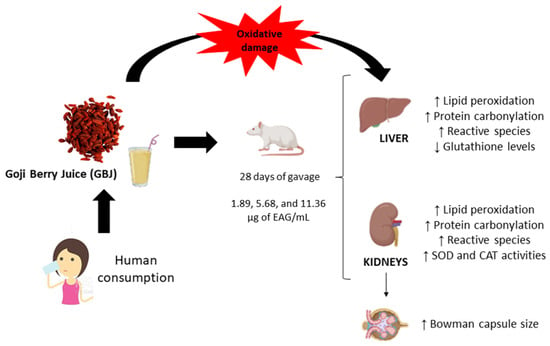
1. Introduction
2. Results and Discussion
3. Materials and Methods
3.1. Goji Berry Juice
3.2. Experimental Animals and Subchronic Toxicity Study
3.3. Serum Biochemical Analysis
3.4. Tissue Preparation and Oxidative Stress Analyses
3.5. Antioxidant Enzyme Measurements
3.6. Histopathological Analysis
3.7. Statistical Analysis
4. Conclusions
Author Contributions
Funding
Institutional Review Board Statement
Informed Consent Statement
Data Availability Statement
Acknowledgments
Conflicts of Interest
References
- Hasler, C.M. Functional Foods: Benefits, Concerns and Challenges—A Position Paper from the American Council on Science and Health. J. Nutr. 2002, 132, 3772–3781. [Google Scholar] [CrossRef] [PubMed]
- Potterat, O. Goji (Lycium barbarum and L. chinense): Phytochemistry, pharmacology and safety in the perspective of traditional uses and recent popularity. Planta Med. 2010, 76, 7–19. [Google Scholar] [CrossRef] [PubMed]
- Kulczyński, B.; Gramza-Michałowska, A. Goji Berry (Lycium barbarum): Composition and Health Effects—A Review. Pol. J. Food Nutr. Sci. 2016, 66, 67–75. [Google Scholar] [CrossRef]
- Jiang, Y.; Fang, Z.; Leonard, W.; Zhang, P. Phenolic compounds in Lycium berry: Composition, health benefits and industrial applications. J. Funct. Foods 2021, 77, 104340. [Google Scholar] [CrossRef]
- Amagase, H.; Farnsworth, N.R. A review of botanical characteristics, phytochemistry, clinical relevance in efficacy and safety of Lycium barbarum fruit (Goji). Food Res. Int. 2011, 44, 1702–1717. [Google Scholar] [CrossRef]
- Zhang, Q.; Chen, W.; Zhao, J.; Xi, W. Functional constituents and antioxidant activities of eight Chinese native goji genotypes. Food Chem. 2016, 200, 230–236. [Google Scholar] [CrossRef]
- Masci, A.; Carradori, S.; Casadei, M.A.; Paolicelli, P.; Petralito, S.; Ragno, R.; Cesa, S. Lycium barbarum polysaccharides: Extraction, purification, structural characterisation and evidence about hypoglycaemic and hypolipidaemic effects: A review. Food Chem. 2018, 254, 377–389. [Google Scholar] [CrossRef]
- Donno, D.; Beccaro, G.L.; Mellano, M.G.; Cerutti, A.K.; Bounous, G. Goji berry fruit (Lycium spp.): Antioxidant compound fingerprint and bioactivity evaluation. J. Funct. Foods 2015, 18, 1070–1085. [Google Scholar] [CrossRef]
- Ma, Z.F.; Zhang, H.; Teh, S.S.; Wang, C.W.; Zhang, Y.; Hayford, F.; Wang, L.; Ma, T.; Dong, Z.; Zhang, Y.; et al. Goji berries as a potential natural antioxidant medicine: An insight into their molecular mechanisms of action. Oxid. Med. Cell Longev. 2019, 2019, 2437397. [Google Scholar] [CrossRef]
- Rivera, C.A.; Ferro, C.L.; Bursua, A.J.; Gerber, B.S. Probable Interaction Between Lycium barbarum (Goji) and Warfarin. Pharmacother. J. Hum. Pharmacol. Drug Ther. 2012, 32, e50–e53. [Google Scholar] [CrossRef]
- Arroyo-Martinez, Q.; Sáenz, M.J.; Arias, F.A.; Acosta, M.S.J. Lycium barbarum: A new hepatotoxic “natural” agent? Dig. Liver Dis. 2011, 43, 749. [Google Scholar] [CrossRef] [PubMed]
- Gómez-Bernal, S.; Rodríguez-Pazos, L.; García Martínez, F.J.; Ginarte, M.; Rodríguez-Granados, M.T.; Toribio, J. Systemic photosensitivity due to Goji berries. Photodermatol. Photoimmunol. Photomed. 2011, 27, 245–247. [Google Scholar] [CrossRef] [PubMed]
- Monzón Ballarín, S.; López-Matas, M.A.; Sáenz Abad, D.; Pérez-Cinto, N.; Carnés, J. Anaphylaxis associated with the ingestion of Goji berries (Lycium barbarum). J. Investig. Allergol. Clin. Immunol. 2011, 21, 567–570. [Google Scholar]
- Amagase, H.; Nance, D.M. A randomized, double-blind, placebo-controlled, clinical study of the general effects of a standardized Lycium barbarum (goji) juice, GoChiTM. J. Altern. Complement. Med. 2008, 14, 403–412. [Google Scholar] [CrossRef]
- Olas, B. Berry phenolic antioxidants—Implications for human health? Front. Pharmacol. 2018, 9, 78. [Google Scholar] [CrossRef]
- Decker, A. Phenolics: Prooxidants or Antioxidants? Nutr. Rev. 2009, 55, 396–398. [Google Scholar] [CrossRef]
- Carocho, M.; Ferreira, I.C.F.R. A review on antioxidants, prooxidants and related controversy: Natural and synthetic compounds, screening and analysis methodologies and future perspectives. Food Chem. Toxicol. 2013, 51, 15–25. [Google Scholar] [CrossRef]
- Rodrigues, C.d.F.; Boldori, J.R.; Soares, M.V.; Somacal, S.; Emanuelli, T.; Izaguirry, A.; Cibin, F.W.S.; Augusti, P.R.; Denardin, C.C. Goji berry (Lycium barbarum L.) juice reduces lifespan and premature aging of Caenorhabditis elegans: Is it safe to consume it? Food Res. Int. 2021, 144, 110297. [Google Scholar] [CrossRef]
- OECD. Revised Guidance Document 150 on Standardised Test Guidelines for Evaluating Chemicals for Endocrine Disruption; OECD: Paris, France, 2018. [Google Scholar] [CrossRef]
- Vidal, K.; Benyacoub, J.; Sanchez-Garcia, J.; Foata, F.; Segura-Roggero, I.; Serrant, P.; Moser, M.; Blum, S. Intake of a Milk-Based Wolfberry Formulation Enhances the Immune Response of Young-Adult and Aged Mice. Rejuvenation Res. 2010, 13, 47–53. [Google Scholar] [CrossRef]
- Wang, C.; Zhu, C.; Shao, L.; Ye, J.; Shen, Y.; Ren, Y. Role of Bile Acids in Dysbiosis and Treatment of Nonalcoholic Fatty Liver Disease. Mediat. Inflamm. 2019, 2019, 7659509. [Google Scholar] [CrossRef]
- McKenzie, C.V.; Colonne, C.K.; Yeo, J.H.; Fraser, S.T. Splenomegaly: Pathophysiological bases and therapeutic options. Int. J. Biochem. Cell Biol. 2018, 94, 40–43. [Google Scholar] [CrossRef] [PubMed]
- Petroianu, A. Drug-induced splenic enlargement. Expert Opin. Drug Saf. 2007, 6, 199–206. [Google Scholar] [CrossRef] [PubMed]
- Lees, J.G.; White, D.; Keating, B.A.; Barkl-Luke, M.E.; Makker, P.G.S.; Goldstein, D.; Moalem-Taylor, G.; Palaniyandi, S. Oxaliplatin-induced haematological toxicity and splenomegaly in mice. PLoS ONE 2020, 15, e0238164. [Google Scholar] [CrossRef]
- Pozo, A.L.; Godfrey, E.M.; Bowles, K.M. Splenomegaly: Investigation, diagnosis and management. Blood Rev. 2009, 23, 105–111. [Google Scholar] [CrossRef]
- Wang, J.; Wang, G.; Ansari, G.A.S.; Khan, M.F. Activation of oxidative stress-responsive signaling pathways in early splenotoxic response of aniline. Toxicol. Appl. Pharmacol. 2008, 230, 227–234. [Google Scholar] [CrossRef]
- Cui, B.; Liu, S.; Lin, X.; Wang, J.; Li, S.; Wang, Q.; Li, S. Effects of lycium barbarum aqueous and ethanol extracts on high-fat-diet induced oxidative stress in rat liver tissue. Molecules 2011, 16, 9116–9128. [Google Scholar] [CrossRef]
- El-Bakry, H.A.; El-Sherif, G.; Rostom, R.M. Therapeutic dose of green tea extract provokes liver damage and exacerbates paracetamol-induced hepatotoxicity in rats through oxidative stress and caspase 3-dependent apoptosis. Biomed. Pharmacother. 2017, 96, 798–811. [Google Scholar] [CrossRef]
- Sanchez-Valle, V.; Chavez-Tapia, N.C.; Uribe, M.; Mendez-Sanchez, N. Role of Oxidative Stress and Molecular Changes in Liver Fibrosis: A Review. Curr. Med. Chem. 2012, 19, 4850–4860. [Google Scholar] [CrossRef]
- Aba, P.E.; Amadi, A.U. Evaluation of the possible hepatotoxic and nephrotoxic potentials of the Averrhoa carambola juice extract in female albino rats. J. Basic Clin. Physiol. Pharmacol. 2019, 31, 20190042. [Google Scholar] [CrossRef]
- Coppolino, G.; Leonardi, G.; Andreucci, M.; Bolignano, D. Oxidative Stress and Kidney Function: A Brief Update. Curr. Pharm. Des. 2019, 24, 4794–4799. [Google Scholar] [CrossRef]
- Sotler, R.; Poljšak, B.; Dahmane, R.; Jukić, T.; Pavan Jukić, D.; Rotim, C.; Trebše, P.; Starc, A. Prooxidant Activities of Antioxidants and Their Impact on Health. Acta Clin. Croat. 2019, 58, 726–736. [Google Scholar] [CrossRef] [PubMed]
- Sakihama, Y. Plant phenolic antioxidant and prooxidant activities: Phenolics-induced oxidative damage mediated by metals in plants. Toxicology 2002, 177, 67–80. [Google Scholar] [CrossRef] [PubMed]
- Young, A.J.; Lowe, G.M. Antioxidant and Prooxidant Properties of Carotenoids. Arch. Biochem. Biophys. 2001, 385, 20–27. [Google Scholar] [CrossRef]
- Blaine, J.; Chonchol, M.; Levi, M. Renal Control of Calcium, Phosphate, and Magnesium Homeostasis. Clin. J. Am. Soc. Nephrol. 2015, 10, 1257–1272. [Google Scholar] [CrossRef] [PubMed]
- Kotyk, T.; Dey, N.; Ashour, A.S.; Balas-Timar, D.; Chakraborty, S.; Ashour, A.S.; Tavares, J.M.R.S. Measurement of glomerulus diameter and Bowman’s space width of renal albino rats. Comput. Methods Programs Biomed. 2016, 126, 143–153. [Google Scholar] [CrossRef]
- Sasaki, D.; Yamada, A.; Umeno, H.; Kurihara, H.; Nakatsuji, S.; Fujihira, S.; Tsubota, K.; Ono, M.; Moriguchi, A.; Watanabe, K.; et al. Comparison of the course of biomarker changes and kidney injury in a rat model of drug-induced acute kidney injury. Biomarkers 2011, 16, 553–566. [Google Scholar] [CrossRef]
- Swain, T.; Hillis, W.E. The phenolic constituents of Prunus domestica. I.—The quantitative analysis of phenolic constituents. J. Sci. Food Agric. 1959, 10, 63–68. [Google Scholar] [CrossRef]
- Wang, H.; Joseph, J.A. Quantifying cellular oxidative stress by dichlorofluorescein assay using microplate reader. Free Radic Biol. Med. 1999, 27, 612–616. [Google Scholar] [CrossRef] [PubMed]
- Ellman, G.L. Tissue sulfhydryl groups. Arch. Biochem. Biophys. 1959, 82, 70–77. [Google Scholar] [CrossRef]
- Ohkawa, H.; Ohishi, N.; Yagi, K. Assay for lipid peroxides in animal tissues by thiobarbituric acid reaction. Anal. Biochem. 1979, 95, 351–358. [Google Scholar] [CrossRef]
- Levine, R.L.; Garland, D.; Oliver, C.N.; Amici, A.; Climent, I.; Lenz, A.G.; Ahn, B.W.; Shaltiel, S.; Stadtman, E.R. Determination of carbonyl content in oxidatively modified proteins. Methods Enzymol. 1990, 186, 464–478. [Google Scholar] [CrossRef] [PubMed]
- Lowry, O.H.; Rosebrough, N.J.; Farr, A.L.; Randall, R.J. Protein measurement with the folin phenol reagent. J. Biol. Chem. 1951, 193, 265–275. [Google Scholar] [CrossRef] [PubMed]
- Misra, H.P.; Fridovich, I. The role of superoxide anion in the autoxidation of epinephrine and a simple assay for superoxide dismutase. J. Biol. Chem. 1972, 247, 3170–3175. [Google Scholar] [CrossRef] [PubMed]
- Aebi, H. Catalase in vitro. Methods Enzymol. 1984, 105, 121–126. [Google Scholar] [CrossRef]



| Control | 1.89 µg EAG/g | 5.68 µg EAG/g | 11.36 µg EAG/g | |
|---|---|---|---|---|
| Initial weight (g) | 222.72 ± 9.50 | 211.90 ± 14.47 | 212.50 ± 13.90 | 211.00 ± 13.59 |
| Final weight (g) | 256.90 ± 11.84 | 251.70 ± 13.44 | 250.20 ± 20.34 | 250.00 ± 16.26 |
| Weight gain (g) | 34.17 ± 11.33 | 39.89 ± 10.30 | 37.70 ± 7.83 | 39.00 ± 7.23 |
| Food consumption (g/day) | 18.64 ± 1.94 | 18.99 ± 0.96 | 20.30 ± 1.69 * | 19.20 ± 1.27 |
| Liver weight (g) | 7.84 ± 0.93 | 7.48 ± 0.51 | 7.30 ± 0.93 | 7.36 ± 0.70 |
| Kidney weight (g) | 1.74 ± 0.09 | 1.71 ± 0.18 | 1.70 ± 0.25 | 1.69 ± 0.12 |
| Spleen weight (g) | 0.72 ± 0.06 | 0.82 ± 0.10 * | 0.70 ± 0.09 | 0.72 ± 0.06 |
| Retroperitoneal fat weight (g) | 2.69 ± 0.76 | 2.17 ± 0.58 | 2.51 ± 0.53 | 2.73 ± 0.58 |
| Glucose levels (mg/dL) | 103.50 ± 34.83 | 104.20 ± 49.25 | 91.30 ± 42.21 | 99.50 ± 27.41 |
| Cholesterol levels (mg/dL) | 110.80 ± 15.14 | 108.50 ± 19.58 | 113.50 ± 19.76 | 99.94 ± 15.75 |
| Triglycerides levels (mg/dL) | 220.10 ± 37.13 | 185.40 ± 40.96 | 177.40 ± 35.26 | 177.30 ± 58.15 |
| Albumin levels (g/dL) | 8.98 ± 2.52 | 9.34 ± 2.98 | 9.21 ± 2.38 | 9.02 ± 2.89 |
| Creatinine levels (mg/dL) | 0.59 ± 0.14 | 0.41 ± 0.31 | 0.48 ± 0.27 | 0.53 ± 0.15 |
| Bilirubin levels (mg/dL) | 4.30 ± 1.41 | 3.92 ± 1.16 | 4.72 ± 1.38 | 4.58 ± 1.83 |
| Alkaline phosphatase levels (U/L) | 105.00 ± 39.51 | 73.74 ± 28.88 | 88.74 ± 30.44 | 100.90 ± 35.94 |
| Aspartate aminotransferase (AST) levels (U/L) | 152.20 ± 21.81 | 287.10 ± 126.00 ** | 197.10 ± 82.24 | 252.00 ± 85.15 ** |
| Alanine Aminotransferase (ALT) levels (U/L) | 43.32 ± 7.87 | 69.38 ± 22.95 ** | 135.00 ± 51.83 *** | 78.97 ± 50.22 |
Disclaimer/Publisher’s Note: The statements, opinions and data contained in all publications are solely those of the individual author(s) and contributor(s) and not of MDPI and/or the editor(s). MDPI and/or the editor(s) disclaim responsibility for any injury to people or property resulting from any ideas, methods, instructions or products referred to in the content. |
© 2026 by the authors. Licensee MDPI, Basel, Switzerland. This article is an open access article distributed under the terms and conditions of the Creative Commons Attribution (CC BY) license.
Share and Cite
Rodrigues, C.d.F.; Boldori, J.R.; Munieweg, F.R.; Soares, M.V.; Rabuske, B.P.; Pinheiro, T.R.; Denardin, C.C. Impact of Goji Berry Juice on Redox Status in Wistar Rats: A Subchronic Toxicity Assessment. Int. J. Mol. Sci. 2026, 27, 631. https://doi.org/10.3390/ijms27020631
Rodrigues CdF, Boldori JR, Munieweg FR, Soares MV, Rabuske BP, Pinheiro TR, Denardin CC. Impact of Goji Berry Juice on Redox Status in Wistar Rats: A Subchronic Toxicity Assessment. International Journal of Molecular Sciences. 2026; 27(2):631. https://doi.org/10.3390/ijms27020631
Chicago/Turabian StyleRodrigues, Cristiane de Freitas, Jean Ramos Boldori, Félix Roman Munieweg, Marcell Valandro Soares, Bibiana Pistoia Rabuske, Thais Ribeiro Pinheiro, and Cristiane Casagrande Denardin. 2026. "Impact of Goji Berry Juice on Redox Status in Wistar Rats: A Subchronic Toxicity Assessment" International Journal of Molecular Sciences 27, no. 2: 631. https://doi.org/10.3390/ijms27020631
APA StyleRodrigues, C. d. F., Boldori, J. R., Munieweg, F. R., Soares, M. V., Rabuske, B. P., Pinheiro, T. R., & Denardin, C. C. (2026). Impact of Goji Berry Juice on Redox Status in Wistar Rats: A Subchronic Toxicity Assessment. International Journal of Molecular Sciences, 27(2), 631. https://doi.org/10.3390/ijms27020631