Molecular Mechanisms of Chondrocyte Hypertrophy Mediated by Physical Cues and Therapeutic Strategies in Osteoarthritis

Abstract
1. Introduction
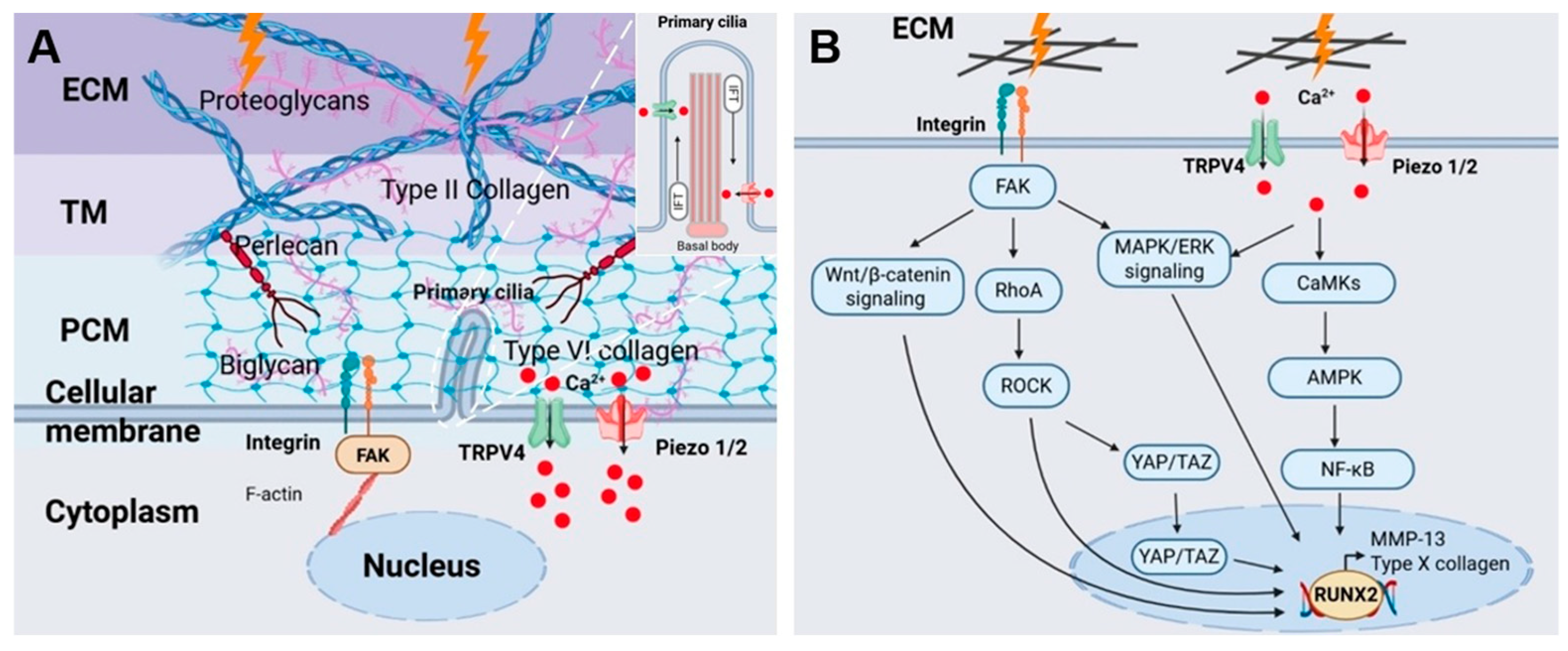
2. Pericellular Matrix and Cell Membrane Mechanosensors in Chondrocyte Mechanotransduction
2.1. The PCM as a Mechanical Buffer and Signal Modulator
2.2. Integrin-Mediated Mechanotransduction and YAP/TAZ Signaling in Chondrocyte Fate Regulation
2.3. Mechanosensitive Calcium Channels in Chondrocyte Inflammation and Matrix Remodeling
2.4. Primary Cilia as Integrative Mechanosensors in Chondrocyte Homeostasis and OA
3. ECM Biophysical Cues as Regulators of Chondrocyte Hypertrophy in OA
3.1. Mechanical Cues in the Osteoarthritic Cartilage Microenvironment
3.1.1. Stiffness
3.1.2. Viscoelasticity
3.2. Structural Cues and Microenvironmental Remodeling
3.2.1. Porosity and Pore Size
3.2.2. Topography
3.3. Surface Cues and Cell Matrix Interactions
3.3.1. Roughness
3.3.2. Charge Distribution
3.4. Integrative Summary of Mechanotransduction in OA Chondrocytes
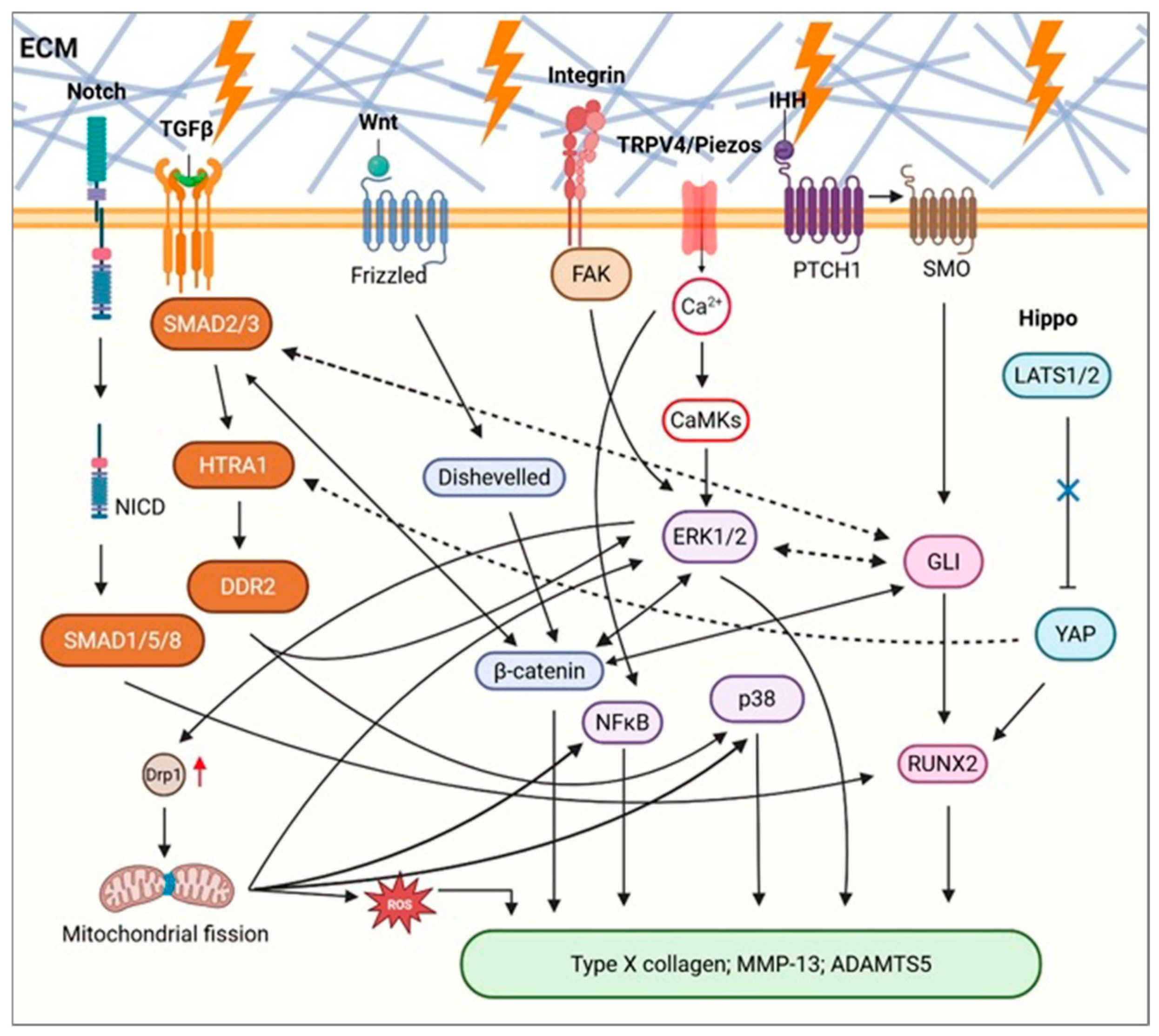
4. Mechanotransduction Pathways Driving Hypertrophy Under Physical Cues
4.1. IHH Pathway
4.2. Wnt/β-Catenin Pathway
4.3. MAPK–ERK Pathway
4.4. TGF-β Pathway
4.5. Hippo–YAP Pathway
4.6. Notch Pathway
4.7. Other Pathways
4.7.1. Interplay Between Mitochondrial Dynamics and Mechanical Signaling
4.7.2. Extracellular Vesicle-Mediated Intercellular Mechanotransduction
4.7.3. Adrenergic Receptor-Mediated cGMP–SLPI–RUNX2 Axis
4.7.4. Dynamic Regulation of Epigenetic Modifications
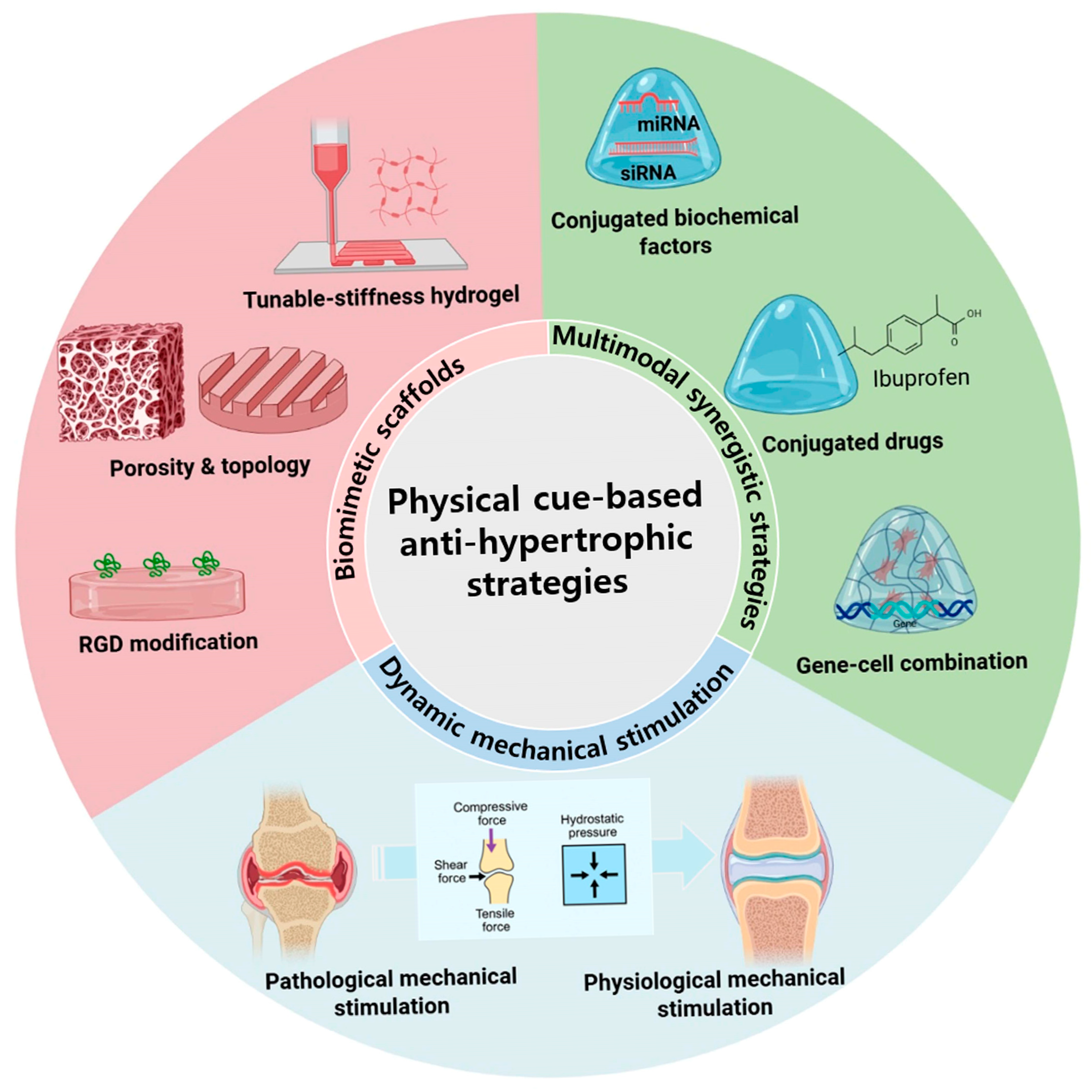
5. Anti-Hypertrophic Strategies via Physical Microenvironment Modulation
5.1. Physical Microenvironment Modulation in Regenerative Cartilage Repair
5.2. Dynamic Mechanical Stimulation as a Modulator of Hypertrophy
5.3. Integrated Multimodal Strategies and Translational Considerations
6. Future Perspectives in OA Therapy
7. Conclusions
Funding
Institutional Review Board Statement
Informed Consent Statement
Data Availability Statement
Conflicts of Interest
Abbreviations
| α-AR | α-adrenergic receptor |
| ADAMTS5 | A disintegrin and metalloproteinase with thrombospondin motifs 5 |
| ALP | Alkaline phosphatase |
| CaMKs | Ca2+/calmodulin-dependent protein kinases |
| CDKN1B | Cyclin-dependent kinase inhibitor 1B |
| C/EBPβ | CCAAT/enhancer-binding protein-β |
| cGMP | Cyclic guanosine monophosphate |
| circRNA-MSR | Mechanical stress-related circRNA |
| CTGF | Connective tissue growth factor |
| CITED2 | CBP/p300-interacting transactivator with ED-rich tail 2 |
| Drp1 | Dynamin-related protein 1 |
| ECM | Extracellular matrix |
| EVs | Extracellular vesicles |
| FAK | Focal adhesion kinase |
| FGF2 | Fibroblast growth factor 2 |
| GAGs | Glycosaminoglycans |
| GTPase | Guanosine triphosphatase |
| HDACs | Histone deacetylases |
| HTRA1 | High-temperature requirement A serine peptidase 1 |
| IFT | Intraflagellar transport |
| IHH | Indian hedgehog |
| IL-1β | Interleukin-1β |
| ILK | Integrin-linked kinase |
| LAP | Latency-associated peptide |
| LTBP | Latent TGF-β binding protein |
| MAPK | Mitogen-activated protein kinase |
| ERK | Extracellular signal-regulated kinase |
| Mfn2 | Mitofusin 2 |
| miRNAs | MicroRNAs |
| MMPs | Matrix metalloproteinases |
| MSCs | Mesenchymal stem cells |
| NF-κB | Nuclear factor-κB |
| NICD | Notch intracellular domain |
| OA | Osteoarthritis |
| PCM | Pericellular matrix |
| PLCγ1 | Phospholipase C γ1 |
| PLK1 | Polo-like kinase 1 |
| PP2A | Protein phosphatase type 2A |
| RhoA/ROCK | RhoA/Rho-associated coiled-coil kinase |
| ROS | Reactive oxygen species |
| RUNX2 | Runt-related transcription factor 2 |
| SLPI | Secretory leukocyte protease inhibitor |
| SOX9 | Sex determining region Y box protein 9 |
| TGF-β | Transforming growth factor-β |
| TGFBR1/2 | Transforming growth factor-β receptors I/II |
| TIMP-3 | Tissue inhibitor of metalloproteinases 3 |
| TM | Territorial matrix |
| TNF-α | Tumor necrosis factor-α |
| TRPV4 | Transient receptor potential vanilloid subtype 4 |
| YAP/TAZ | Yes-associated protein/transcriptional coactivator with PDZ-binding motif |
References
- Goldring, M.B.; Marcu, K.B. Cartilage homeostasis in health and rheumatic diseases. Arthritis Res. Ther. 2009, 11, 224. [Google Scholar] [CrossRef] [Scilit]
- Carballo, C.B.; Nakagawa, Y.; Sekiya, I.; Rodeo, S.A. Basic Science of Articular Cartilage. Clin. Sports Med. 2017, 36, 413–425. [Google Scholar] [CrossRef] [Scilit]
- Chawla, S.; Mainardi, A.; Majumder, N.; Dönges, L.; Kumar, B.; Occhetta, P.; Martin, I.; Egloff, C.; Ghosh, S.; Bandyopadhyay, A.; et al. Chondrocyte Hypertrophy in Osteoarthritis: Mechanistic Studies and Models for the Identification of New Therapeutic Strategies. Cells 2022, 11, 4034. [Google Scholar] [CrossRef] [Scilit]
- Kronenberg, H.M. Developmental regulation of the growth plate. Nature 2003, 423, 332–336. [Google Scholar] [CrossRef] [Scilit] [PubMed]
- Huang, C.; Zeng, B.; Zhou, B.; Chen, G.; Zhang, Q.; Hou, W.; Xiao, G.; Duan, L.; Hong, N.; Jin, W. Single-cell transcriptomic analysis of chondrocytes in cartilage and pathogenesis of osteoarthritis. Genes Dis. 2024, 12, 101241. [Google Scholar] [CrossRef] [Scilit] [PubMed]
- van der Kraan, P.M.; van den Berg, W.B. Chondrocyte hypertrophy and osteoarthritis: Role in initiation and progression of cartilage degeneration? Osteoarthr. Cartil. 2012, 20, 223–232. [Google Scholar] [CrossRef] [Scilit] [PubMed]
- Guilak, F.; Fermor, B.; Keefe, F.J.; Kraus, V.B.; Olson, S.A.; Pisetsky, D.S.; Setton, L.A.; Weinberg, J.B. The role of biomechanics and inflammation in cartilage injury and repair. Clin. Orthop. Relat. Res. 2004, 423, 17–26. [Google Scholar] [CrossRef] [Scilit]
- DuFort, C.C.; Paszek, M.J.; Weaver, V.M. Balancing forces: Architectural control of mechanotransduction. Nat. Rev. Mol. Cell Biol. 2011, 12, 308–319. [Google Scholar] [CrossRef] [Scilit]
- Stolz, M.; Raiteri, R.; Daniels, A.U.; VanLandingham, M.R.; Baschong, W.; Aebi, U. Dynamic elastic modulus of porcine articular cartilage determined at two different levels of tissue organization by indentation-type atomic force microscopy. Biophys. J. 2004, 86, 3269–3283. [Google Scholar] [CrossRef] [Scilit]
- Fu, B.; Shen, J.; Zou, X.; Sun, N.; Zhang, Z.; Liu, Z.; Zeng, C.; Liu, H.; Huang, W. Matrix stiffening promotes chondrocyte senescence and the osteoarthritis development through downregulating HDAC3. Bone Res. 2024, 12, 32. [Google Scholar] [CrossRef] [Scilit]
- Gilbert, S.J.; Bonnet, C.S.; Blain, E.J. Mechanical Cues: Bidirectional Reciprocity in the Extracellular Matrix Drives Mechano-Signalling in Articular Cartilage. Int. J. Mol. Sci. 2021, 22, 13595. [Google Scholar] [CrossRef] [Scilit]
- Humphrey, J.D.; Dufresne, E.R.; Schwartz, M.A. Mechanotransduction and extracellular matrix homeostasis. Nat. Rev. Mol. Cell Biol. 2014, 15, 802–812. [Google Scholar] [CrossRef] [Scilit] [PubMed]
- Wang, N.; Lu, Y.; Rothrauff, B.B.; Zheng, A.; Lamb, A.; Yan, Y.; Lipa, K.E.; Lei, G.; Lin, H. Mechanotransduction pathways in articular chondrocytes and the emerging role of estrogen receptor-α. Bone Res. 2023, 11, 13. [Google Scholar] [CrossRef] [Scilit] [PubMed]
- Millward-Sadler, S.J.; Salter, D.M. Integrin-dependent signal cascades in chondrocyte mechanotransduction. Ann. Biomed. Eng. 2004, 32, 435–446. [Google Scholar] [CrossRef] [Scilit] [PubMed]
- Onuora, S. Osteoarthritis: Cartilage matrix stiffness regulates chondrocyte metabolism and OA pathogenesis. Nat. Rev. Rheumatol. 2015, 11, 504. [Google Scholar]
- Choi, M.C.; Jo, J.; Park, J.; Kang, H.K.; Park, Y. NF-κB Signaling Pathways in Osteoarthritic Cartilage Destruction. Cells 2019, 8, 734. [Google Scholar] [CrossRef] [Scilit]
- Guilak, F.; Hayes, A.J.; Melrose, J. Perlecan in Pericellular Mechanosensory Cell-Matrix Communication, Extracellular Matrix Stabilisation and Mechanoregulation of Load-Bearing Connective Tissues. Int. J. Mol. Sci. 2021, 22, 2716. [Google Scholar] [CrossRef] [Scilit]
- Wilusz, R.E.; Sanchez-Adams, J.; Guilak, F. The structure and function of the pericellular matrix of articular cartilage. Matrix Biol. 2014, 39, 25–32. [Google Scholar] [CrossRef] [Scilit]
- Sanchez-Adams, J.; Wilusz, R.E.; Guilak, F. Atomic force microscopy reveals regional variations in the micromechanical properties of the pericellular and extracellular matrices of the meniscus. J. Orthop. Res. 2013, 31, 1218–1225. [Google Scholar] [CrossRef] [Scilit]
- Jaalouk, D.E.; Lammerding, J. Mechanotransduction gone awry. Nat. Rev. Mol. Cell Biol. 2009, 10, 63–73. [Google Scholar] [CrossRef] [Scilit]
- Dupont, S.; Morsut, L.; Aragona, M.; Enzo, E.; Giulitti, S.; Cordenonsi, M.; Zanconato, F.; Le Digabel, J.; Forcato, M.; Bicciato, S.; et al. Role of YAP/TAZ in mechanotransduction. Nature 2011, 474, 179–183. [Google Scholar] [CrossRef] [Scilit]
- Deng, Y.; Wu, A.; Li, P.; Li, G.; Qin, L.; Song, H.; Mak, K.K. Yap1 Regulates Multiple Steps of Chondrocyte Differentiation during Skeletal Development and Bone Repair. Cell Rep. 2016, 14, 2224–2237. [Google Scholar] [CrossRef] [Scilit]
- Li, Y.; Yang, S.; Qin, L.; Yang, S. TAZ is required for chondrogenesis and skeletal development. Cell Discov. 2021, 7, 26. [Google Scholar] [CrossRef] [Scilit] [PubMed]
- Han, J.; Zhang, J.; Zhang, X.; Luo, W.; Liu, L.; Zhu, Y.; Liu, Q.; Zhang, X.A. Emerging role and function of Hippo-YAP/TAZ signaling pathway in musculoskeletal disorders. Stem Cell Res. Ther. 2024, 15, 386. [Google Scholar] [CrossRef] [Scilit]
- Kim, E.; Riehl, B.D.; Bouzid, T.; Yang, R.; Duan, B.; Donahue, H.J.; Lim, J.Y. YAP mechanotransduction under cyclic mechanical stretch loading for mesenchymal stem cell osteogenesis is regulated by ROCK. Front. Bioeng. Biotechnol. 2024, 11, 1306002. [Google Scholar] [CrossRef] [Scilit] [PubMed]
- Zanconato, F.; Cordenonsi, M.; Piccolo, S. YAP/TAZ at the Roots of Cancer. Cancer Cell 2016, 29, 783–803. [Google Scholar] [CrossRef] [Scilit]
- Katoh, K. Integrin and Its Associated Proteins as a Mediator for Mechano-Signal Transduction. Biomolecules 2025, 15, 166. [Google Scholar] [CrossRef] [Scilit]
- Zarka, M.; Haÿ, E.; Cohen-Solal, M. YAP/TAZ in Bone and Cartilage Biology. Front. Cell Dev. Biol. 2022, 9, 788773. [Google Scholar] [CrossRef] [Scilit]
- Hallström, G.F.; Jones, D.L.; Locke, R.C.; Bonnevie, E.D.; Kim, S.Y.; Laforest, L.; Garcia, D.C.; Mauck, R.L. Microenvironmental mechanoactivation through Yap/Taz suppresses chondrogenic gene expression. Mol. Biol. Cell 2023, 34, ar73. [Google Scholar] [CrossRef] [Scilit]
- Du, J.; Zu, Y.; Li, J.; Du, S.; Xu, Y.; Zhang, L.; Jiang, L.; Wang, Z.; Chien, S.; Yang, C. Extracellular matrix stiffness dictates Wnt expression through integrin pathway. Sci. Rep. 2016, 6, 20395. [Google Scholar] [CrossRef] [Scilit]
- Selig, M.; Lauer, J.C.; Hart, M.L.; Rolauffs, B. Mechanotransduction and Stiffness-Sensing: Mechanisms and Opportunities to Control Multiple Molecular Aspects of Cell Phenotype as a Design Cornerstone of Cell-Instructive Biomaterials for Articular Cartilage Repair. Int. J. Mol. Sci. 2020, 21, 5399. [Google Scholar] [CrossRef] [Scilit]
- O’Conor, C.J.; Leddy, H.A.; Benefield, H.C.; Liedtke, W.B.; Guilak, F. TRPV4-mediated mechanotransduction regulates the metabolic response of chondrocytes to dynamic loading. Proc. Natl. Acad. Sci. USA 2014, 111, 1316–1321. [Google Scholar] [CrossRef] [Scilit]
- Lee, W.; Nims, R.J.; Savadipour, A.; Zhang, Q.; Leddy, H.A.; Liu, F.; McNulty, A.L.; Chen, Y.; Guilak, F.; Liedtke, W.B. In-flammatory signaling sensitizes Piezo1 mechanotransduction in articular chondrocytes as a pathogenic feed-forward mechanism in osteoarthritis. Proc. Natl. Acad. Sci. USA 2021, 118, e2001611118. [Google Scholar] [CrossRef] [Scilit]
- Yuan, G.; Xiong, Z.; Ke, X.; Wang, G.; Liu, X.; Li, Z. Exploring the Multifactorial Regulation of PIEZO1 in Chondrocytes: Mechanisms and Implications. Int. J. Med. Sci. 2025, 22, 3393–3411. [Google Scholar] [CrossRef] [Scilit] [PubMed]
- Guan, S.; Mei, Y. Editorial: The role of Piezo 1 in osteoarthritis: Implications for pathogenesis and therapy. Int. J. Rheum. Dis. 2024, 27, e15348. [Google Scholar] [CrossRef] [Scilit] [PubMed]
- Lee, W.; Leddy, H.A.; Chen, Y.; Lee, S.H.; Zelenski, N.A.; McNulty, A.L.; Wu, J.; Beicker, K.N.; Coles, J.; Zauscher, S.; et al. Synergy between Piezo1 and Piezo2 channels confers high-strain mechanosensitivity to articular cartilage. Proc. Natl. Acad. Sci. USA 2014, 111, E5114–E5122. [Google Scholar] [CrossRef] [Scilit]
- Hattori, K.; Takahashi, N.; Terabe, K.; Ohashi, Y.; Kishimoto, K.; Yokota, Y.; Suzuki, M.; Kojima, T.; Imagama, S. Activation of transient receptor potential vanilloid 4 protects articular cartilage against inflammatory responses via CaMKK/AMPK/NF-κB signaling pathway. Sci. Rep. 2021, 11, 15508. [Google Scholar] [CrossRef] [Scilit] [PubMed]
- Fu, S.; Meng, H.; Inamdar, S.; Das, B.; Gupta, H.; Wang, W.; Thompson, C.L.; Knight, M.M. Activation of TRPV4 by mechanical, osmotic or pharmaceutical stimulation is anti-inflammatory blocking IL-1β mediated articular cartilage matrix destruction. Osteoarthr. Cartil. 2021, 29, 89–99. [Google Scholar] [CrossRef] [Scilit]
- Chen, C.; Yang, F.; Chen, R.; Yang, C.; Xiao, H.; Geng, B.; Xia, Y. TRPV Channels in Osteoarthritis: A Comprehensive Review. Biomolecules 2024, 14, 292. [Google Scholar] [CrossRef] [Scilit]
- Steinecker-Frohnwieser, B.; Lohberger, B.; Toegel, S.; Windhager, R.; Glanz, V.; Kratschmann, C.; Leithner, A.; Weigl, L. Activation of the Mechanosensitive Ion Channels Piezo1 and TRPV4 in Primary Human Healthy and Osteoarthritic Chondrocytes Exhibits Ion Channel Crosstalk and Modulates Gene Expression. Int. J. Mol. Sci. 2023, 24, 7868. [Google Scholar] [CrossRef] [Scilit]
- Zhang, Y.; Zhuang, H.; Ren, X.; Zhou, P. Implications of mechanosensitive ion channels in the pathogenesis of osteoarthritis: A comprehensive review. Front. Cell Dev. Biol. 2025, 13, 1549812. [Google Scholar] [CrossRef] [Scilit]
- Zhou, R.; Fu, W.; Vasylyev, D.; Waxman, S.G.; Liu, C.J. Ion channels in osteoarthritis: Emerging roles and potential targets. Nat. Rev. Rheumatol. 2024, 20, 545–564. [Google Scholar] [CrossRef] [Scilit]
- Lu, S.; Xiao, X.; Cheng, M. Matrine inhibits IL-1β-induced expression of matrix metalloproteinases by suppressing the acti-vation of MAPK and NF-κB in human chondrocytes in vitro. Int. J. Clin. Exp. Pathol. 2015, 8, 4764–4772. [Google Scholar]
- Forsyth, C.B.; Pulai, J.; Loeser, R.F. Fibronectin fragments and blocking antibodies to alpha2beta1 and alpha5beta1 integrins stimulate mitogen-activated protein kinase signaling and increase collagenase 3 (matrix metalloproteinase 13) production by human articular chondrocytes. Arthritis Rheum. 2002, 46, 2368–2376. [Google Scholar] [CrossRef] [Scilit]
- Yu, L.; Su, Z.; Tian, D.; Liu, S.; Zhang, L.; Wang, Z.; Guo, S.; Zhu, W.; Wang, P.; Zhang, N. Piezo1 induces mitochondrial autophagy dysfunction leading to cartilage injury in knee osteoarthritis. Mol. Med. 2025, 31, 272. [Google Scholar] [CrossRef] [Scilit]
- Zhao, Z.; Li, Y.; Wang, M.; Zhao, S.; Zhao, Z.; Fang, J. Mechanotransduction pathways in the regulation of cartilage chondrocyte homoeostasis. J. Cell. Mol. Med. 2020, 24, 5408–5419. [Google Scholar] [CrossRef] [Scilit] [PubMed]
- Ti, H.; Zhang, Z.; Yan, X.; Hu, H.; Zhang, K.; Shi, S.; Wu, J.; Nie, H.; Yuan, Z.; Chen, Y.; et al. Primary cilia as mechanosensors in musculoskeletal homeostasis and disease. Pharmacol. Res. 2025, 219, 107887. [Google Scholar] [CrossRef] [Scilit] [PubMed]
- Mow, V.C.; Guo, X.E. Mechano-electrochemical properties of articular cartilage: Their inhomogeneities and anisotropies. Annu. Rev. Biomed. Eng. 2002, 4, 175–209. [Google Scholar] [CrossRef] [Scilit] [PubMed]
- Sophia Fox, A.J.; Bedi, A.; Rodeo, S.A. The basic science of articular cartilage: Structure, composition, and function. Sports Health 2009, 1, 461–468. [Google Scholar] [CrossRef] [Scilit]
- Alexopoulos, L.G.; Setton, L.A.; Guilak, F. The biomechanical role of the chondrocyte pericellular matrix in articular cartilage. Acta Biomater. 2005, 1, 317–325. [Google Scholar] [CrossRef] [Scilit]
- Wilusz, R.E.; DeFrate, L.E.; Guilak, F. A biomechanical role for perlecan in the pericellular matrix of articular cartilage. Matrix Biol. 2012, 31, 320–327. [Google Scholar] [CrossRef] [Scilit] [PubMed]
- Darling, E.M.; Zauscher, S.; Guilak, F. Viscoelastic properties of zonal articular chondrocytes measured by atomic force microscopy. Osteoarthr. Cartil. 2006, 14, 571–579. [Google Scholar] [CrossRef] [Scilit]
- Kim, J.H.; Lee, G.; Won, Y.; Lee, M.; Kwak, J.S.; Chun, C.H.; Chun, J.S. Matrix cross-linking-mediated mechanotransduction promotes posttraumatic osteoarthritis. Proc. Natl. Acad. Sci. USA 2015, 112, 9424–9429. [Google Scholar] [CrossRef] [Scilit] [PubMed]
- Verzijl, N.; DeGroot, J.; Ben, Z.C.; Brau-Benjamin, O.; Maroudas, A.; Bank, R.A.; Mizrahi, J.; Schalkwijk, C.G.; Thorpe, S.R.; Baynes, J.W.; et al. Crosslinking by advanced glycation end products increases the stiffness of the collagen network in human articular cartilage: A possible mechanism through which age is a risk factor for osteoarthritis. Arthritis Rheum. 2002, 46, 114–123. [Google Scholar] [CrossRef] [Scilit]
- Jung, Y.K.; Park, H.R.; Cho, H.J.; Jang, J.A.; Lee, E.J.; Han, M.S.; Kim, G.W.; Han, S. Degrading products of chondroitin sulfate can induce hypertrophy-like changes and MMP-13/ADAMTS5 production in chondrocytes. Sci. Rep. 2019, 9, 15846. [Google Scholar] [CrossRef] [Scilit] [PubMed]
- Nguyen, M.; Battistoni, C.M.; Babiak, P.M.; Liu, J.C.; Panitch, A. Chondroitin Sulfate/Hyaluronic Acid-Blended Hydrogels Suppress Chondrocyte Inflammation under Pro-Inflammatory Conditions. ACS Biomater. Sci. Eng. 2024, 10, 3242–3254. [Google Scholar] [CrossRef] [Scilit]
- Pathak, M.M.; Nourse, J.L.; Tran, T.; Hwe, J.; Arulmoli, J.; Le, D.T.; Bernardis, E.; Flanagan, L.A.; Tombola, F. Stretch-activated ion channel Piezo1 directs lineage choice in human neural stem cells. Proc. Natl. Acad. Sci. USA 2014, 111, 16148–16153. [Google Scholar] [CrossRef] [Scilit]
- Roy, H.S.; Murugesan, P.; Kulkarni, C.; Arora, M.; Nagar, G.K.; Guha, R.; Chattopadhyay, N.; Ghosh, D. On-demand release of a selective MMP-13 blocker from an enzyme-responsive injectable hydrogel protects cartilage from degenerative progression in osteoarthritis. J. Mater. Chem. B 2024, 12, 5325–5338. [Google Scholar] [CrossRef] [Scilit]
- Gao, Z.; Yang, X.; Jones, E.; Bingham, P.A.; Scrimshire, A.; Thornton, P.D.; Tronci, G. An injectable, self-healing and MMP-inhibiting hyaluronic acid gel via iron coordination. Int. J. Biol. Macromol. 2020, 165, 2022–2029. [Google Scholar] [CrossRef] [Scilit]
- Sun, Y.; Luo, Z.; Fu, Y.; Ngo, T.; Wang, W.; Wang, Y.; Kong, Y. Primary cilia and inflammatory response: Unveiling new mechanisms in osteoarthritis progression. Exp. Biol. Med. 2025, 250, 10490. [Google Scholar] [CrossRef] [Scilit]
- Ling, H.; Wu, S.; Luo, Z.; Sun, Y.; Shen, H.; Zhou, H.; Fu, Y.; Wang, W.; Ngo, T.N.; Kong, Y. Mechanism by which mechanical stimulation regulates chondrocyte apoptosis and matrix metabolism via primary cilia to delay osteoarthritis progression. Zhong Nan Da Xue Xue Bao Yi Xue Ban 2025, 50, 864–875. [Google Scholar] [PubMed]
- Maroudas, A.I. Balance between swelling pressure and collagen tension in normal and degenerate cartilage. Nature 1976, 260, 808–809. [Google Scholar] [CrossRef] [Scilit] [PubMed]
- Meng, H.; Quan, Q.; Yuan, X.; Zheng, Y.; Peng, J.; Guo, Q.; Wang, A. Diffusion of neutral solutes within human osteoarthritic cartilage: Effect of loading patterns. J. Orthop. Translat. 2019, 22, 58–66. [Google Scholar] [CrossRef] [Scilit]
- Hwang, J.; Bae, W.C.; Shieu, W.; Lewis, C.W.; Bugbee, W.D.; Sah, R.L. Increased hydraulic conductance of human articular cartilage and subchondral bone plate with progression of osteoarthritis. Arthritis Rheum. 2008, 58, 3831–3842. [Google Scholar] [CrossRef] [Scilit] [PubMed]
- Fermor, B.; Gurumurthy, A.; Diekman, B.O. Hypoxia, RONS and energy metabolism in articular cartilage. Osteoarthr. Cartil. 2010, 18, 1167–1173. [Google Scholar] [CrossRef] [Scilit]
- Bouaziz, W.; Sigaux, J.; Modrowski, D.; Devignes, C.S.; Funck-Brentano, T.; Richette, P.; Ea, H.K.; Provot, S.; Cohen-Solal, M.; Haÿ, E. Interaction of HIF1α and β-catenin inhibits matrix metalloproteinase 13 expression and prevents cartilage damage in mice. Proc. Natl. Acad. Sci. USA 2016, 113, 5453–5458. [Google Scholar] [CrossRef] [Scilit]
- Zeng, C.Y.; Wang, X.F.; Hua, F.Z. HIF-1α in Osteoarthritis: From Pathogenesis to Therapeutic Implications. Front. Pharmacol. 2022, 13, 927126. [Google Scholar] [CrossRef] [Scilit]
- Wang, X.; Manner, P.A.; Horner, A.; Shum, L.; Tuan, R.S.; Nuckolls, G.H. Regulation of MMP-13 expression by RUNX2 and FGF2 in osteoarthritic cartilage. Osteoarthr. Cartil. 2004, 12, 963–973. [Google Scholar] [CrossRef] [Scilit]
- Hirata, M.; Kugimiya, F.; Fukai, A.; Saito, T.; Yano, F.; Ikeda, T.; Mabuchi, A.; Sapkota, B.R.; Akune, T.; Nishida, N.; et al. C/EBPβ and RUNX2 cooperate to degrade cartilage with MMP-13 as the target and HIF-2α as the inducer in chondrocytes. Hum. Mol. Genet. 2012, 21, 1111–1123. [Google Scholar] [CrossRef] [Scilit]
- Naseri, N.; Poirier, J.M.; Girandon, L.; Fröhlich, M.; Oksman, K.; Mathew, A.P. 3-Dimensional porous nanocomposite scaffolds based on cellulose nanofibers for cartilage tissue engineering: Tailoring of porosity and mechanical performance. RSC Adv. 2016, 6, 5999–6007. [Google Scholar] [CrossRef] [Scilit]
- Intini, C.; Lemoine, M.; Hodgkinson, T.; Casey, S.; Gleeson, J.P.; O’Brien, F.J. A highly porous type II collagen containing scaffold for the treatment of cartilage defects enhances MSC chondrogenesis and early cartilaginous matrix deposition. Biomater. Sci. 2022, 10, 970–983. [Google Scholar] [CrossRef] [Scilit]
- Zhang, Q.; Lu, H.; Kawazoe, N.; Chen, G. Pore size effect of collagen scaffolds on cartilage regeneration. Acta Biomater. 2014, 10, 2005–2013. [Google Scholar] [CrossRef] [Scilit]
- Li, H.; Chen, R.; Jia, Z.; Wang, C.; Xu, Y.; Li, C.; Xia, H.; Meng, D. Porous fish collagen for cartilage tissue engineering. Am. J. Transl. Res. 2020, 12, 6107–6121. [Google Scholar]
- Huang, J.; Chen, Y.; Tang, C.; Fei, Y.; Wu, H.; Ruan, D.; Paul, M.E.; Chen, X.; Yin, Z.; Heng, B.C.; et al. The relationship between substrate topography and stem cell differentiation in the musculoskeletal system. Cell. Mol. Life Sci. 2019, 76, 505–521. [Google Scholar] [CrossRef] [Scilit] [PubMed]
- Fischer, R.S.; Sun, X.; Baird, M.A.; Hourwitz, M.J.; Seo, B.R.; Pasapera, A.M.; Mehta, S.B.; Losert, W.; Fischbach, C.; Fourkas, J.T.; et al. Contractility, focal adhesion orientation, and stress fiber orientation drive cancer cell polarity and mi-gration along wavy ECM substrates. Proc. Natl. Acad. Sci. USA 2021, 118, e2021135118. [Google Scholar] [CrossRef] [Scilit] [PubMed]
- Lee, N.M.; Erisken, C.; Iskratsch, T.; Sheetz, M.; Levine, W.N.; Lu, H.H. Polymer fiber-based models of connective tissue re-pair and healing. Biomaterials 2017, 112, 303–312. [Google Scholar] [CrossRef] [Scilit]
- Hoon, J.L.; Tan, M.H.; Koh, C.G. The Regulation of Cellular Responses to Mechanical Cues by Rho GTPases. Cells 2016, 5, 17. [Google Scholar] [CrossRef] [Scilit]
- Deng, Z.; Jia, Y.; Liu, H.; He, M.; Yang, Y.; Xiao, W.; Li, Y. RhoA/ROCK pathway: Implication in osteoarthritis and therapeu-tic targets. Am. J. Transl. Res. 2019, 11, 5324–5331. [Google Scholar]
- Niu, H.; Lin, D.; Tang, W.; Ma, Y.; Duan, B.; Yuan, Y.; Liu, C. Surface Topography Regulates Osteogenic Differentiation of MSCs via Crosstalk between FAK/MAPK and ILK/β-Catenin Pathways in a Hierarchically Porous Environment. ACS Biomater. Sci. Eng. 2017, 3, 3161–3175. [Google Scholar] [CrossRef] [Scilit]
- Dehghan-Baniani, D.; Mehrjou, B.; Chu, P.K.; Wu, H. A Biomimetic Nano-Engineered Platform for Functional Tissue Engineering of Cartilage Superficial Zone. Adv. Healthc. Mater. 2021, 10, e2001018. [Google Scholar] [CrossRef] [Scilit]
- Song, F.; Mao, X.; Dai, J.; Shan, B.; Zhou, Z.; Kang, Y. Integrin αVβ3 Signaling in the Progression of Osteoarthritis Induced by Excessive Mechanical Stress. Inflammation 2023, 46, 739–751. [Google Scholar] [CrossRef] [Scilit]
- Buschmann, M.D.; Grodzinsky, A.J. A molecular model of proteoglycan-associated electrostatic forces in cartilage mechanics. J. Biomech. Eng. 1995, 117, 179–192. [Google Scholar] [CrossRef] [Scilit]
- Chahine, N.O.; Chen, F.H.; Hung, C.T.; Ateshian, G.A. Direct measurement of osmotic pressure of glycosaminoglycan solutions by membrane osmometry at room temperature. Biophys. J. 2005, 89, 1543–1550. [Google Scholar] [CrossRef] [Scilit]
- Han, E.H.; Chen, S.S.; Klisch, S.M.; Sah, R.L. Contribution of proteoglycan osmotic swelling pressure to the compressive properties of articular cartilage. Biophys. J. 2011, 101, 916–924. [Google Scholar] [CrossRef] [Scilit]
- Du, G.; Li, L.; Zhang, X.; Liu, J.; Hao, J.; Zhu, J.; Wu, H.; Chen, W.; Zhang, Q. Roles of TRPV4 and piezo channels in stretch-evoked Ca2+ response in chondrocytes. Exp. Biol. Med. 2020, 245, 180–189. [Google Scholar] [CrossRef] [Scilit]
- Gao, W.; Hasan, H.; Anderson, D.E.; Lee, W. The Role of Mechanically-Activated Ion Channels Piezo1, Piezo2, and TRPV4 in Chondrocyte Mechanotransduction and Mechano-Therapeutics for Osteoarthritis. Front. Cell Dev. Biol. 2022, 10, 885224. [Google Scholar] [CrossRef] [Scilit] [PubMed]
- Yasuda, T.; Shimizu, K.; Nakagawa, Y.; Yamamoto, S.; Niibayashi, H.; Yamamuro, T. m-calpain in rat growth plate chondrocyte cultures: Its involvement in the matrix mineralization process. Dev. Biol. 1995, 170, 159–168. [Google Scholar] [CrossRef] [Scilit] [PubMed]
- Amano, K.; Densmore, M.; Nishimura, R.; Lanske, B. Indian hedgehog signaling regulates transcription and expression of collagen type X via Runx2/Smads interactions. J. Biol. Chem. 2014, 289, 24898–24910. [Google Scholar] [CrossRef] [Scilit] [PubMed]
- Wei, F.; Zhou, J.; Wei, X.; Zhang, J.; Fleming, B.C.; Terek, R.; Pei, M.; Chen, Q.; Liu, T.; Wei, L. Activation of Indian hedgehog promotes chondrocyte hypertrophy and upregulation of MMP-13 in human osteoarthritic cartilage. Osteoarthr. Cartil. 2012, 20, 755–763. [Google Scholar] [CrossRef] [Scilit]
- Yoshida, C.A.; Yamamoto, H.; Fujita, T.; Furuichi, T.; Ito, K.; Inoue, K.; Yamana, K.; Zanma, A.; Takada, K.; Ito, Y.; et al. Runx2 and Runx3 are essential for chondrocyte maturation, and Runx2 regulates limb growth through induction of Indian hedgehog. Genes Dev. 2004, 18, 952–963. [Google Scholar] [CrossRef] [Scilit]
- Zhou, J.; Chen, Q.; Lanske, B.; Fleming, B.C.; Terek, R.; Wei, X.; Zhang, G.; Wang, S.; Li, K.; Wei, L. Disrupting the Indian hedgehog signaling pathway in vivo attenuates surgically induced osteoarthritis progression in Col2a1-CreERT2; Ihhfl/fl mice. Arthritis Res. Ther. 2014, 16, R11. [Google Scholar] [CrossRef] [Scilit]
- Thompson, C.L.; Chapple, J.P.; Knight, M.M. Primary cilia disassembly down-regulates mechanosensitive hedgehog signalling: A feedback mechanism controlling ADAMTS-5 expression in chondrocytes. Osteoarthr. Cartil. 2014, 22, 490–498. [Google Scholar] [CrossRef] [Scilit]
- Pugacheva, E.N.; Jablonski, S.A.; Hartman, T.R.; Henske, E.P.; Golemis, E.A. HEF1-dependent Aurora A activation induces disassembly of the primary cilium. Cell 2007, 129, 1351–1363. [Google Scholar] [CrossRef] [Scilit]
- Thompson, C.L.; Plant, J.C.; Wann, A.K.; Bishop, C.L.; Novak, P.; Mitchison, H.M.; Beales, P.L.; Chapple, J.P.; Knight, M.M. Chondrocyte expansion is associated with loss of primary cilia and disrupted hedgehog signalling. ECells Mater. J. 2017, 34, 128–141. [Google Scholar] [CrossRef] [Scilit]
- McGlashan, S.R.; Cluett, E.C.; Jensen, C.G.; Poole, C.A. Primary cilia in osteoarthritic chondrocytes: From chondrons to clusters. Dev. Dyn. 2008, 237, 2013–2020. [Google Scholar] [CrossRef] [Scilit] [PubMed]
- Chang, C.F.; Ramaswamy, G.; Serra, R. Depletion of primary cilia in articular chondrocytes results in reduced Gli3 repressor to activator ratio, increased Hedgehog signaling, and symptoms of early osteoarthritis. Osteoarthr. Cartil. 2012, 20, 152–161. [Google Scholar] [CrossRef] [Scilit] [PubMed]
- Thompson, C.L.; Wiles, A.; Poole, C.A.; Knight, M.M. Lithium chloride modulates chondrocyte primary cilia and inhibits Hedgehog signaling. FASEB J. 2016, 30, 716–726. [Google Scholar] [CrossRef] [Scilit] [PubMed]
- Koyama, E.; Young, B.; Nagayama, M.; Shibukawa, Y.; Enomoto-Iwamoto, M.; Iwamoto, M.; Maeda, Y.; Lanske, B.; Song, B.; Serra, R.; et al. Conditional Kif3a ablation causes abnormal hedgehog signaling topography, growth plate dysfunction, and excessive bone and cartilage formation during mouse skeletogenesis. Development 2007, 134, 2159–2169. [Google Scholar] [CrossRef] [Scilit]
- Zhang, Y.; Tawiah, G.K.; Wu, X.; Zhang, Y.; Wang, X.; Wei, X.; Qiao, X.; Zhang, Q. Primary cilium-mediated mechanotransduction in cartilage chondrocytes. Exp. Biol. Med. 2023, 248, 1279–1287. [Google Scholar] [CrossRef] [Scilit]
- Lancaster, M.A.; Gleeson, J.G. The primary cilium as a cellular signaling center: Lessons from disease. Curr. Opin. Genet. Dev. 2009, 19, 220–229. [Google Scholar] [CrossRef] [Scilit]
- Haycraft, C.J.; Zhang, Q.; Song, B.; Jackson, W.S.; Detloff, P.J.; Serra, R.; Yoder, B.K. Intraflagellar transport is essential for endochondral bone formation. Development 2007, 134, 307–316. [Google Scholar] [CrossRef] [Scilit]
- Papathanasiou, I.; Malizos, K.N.; Tsezou, A. Bone morphogenetic protein-2-induced Wnt/β-catenin signaling pathway activation through enhanced low-density-lipoprotein receptor-related protein 5 catabolic activity contributes to hypertrophy in osteoarthritic chondrocytes. Arthritis Res. Ther. 2012, 14, R82. [Google Scholar] [CrossRef] [Scilit]
- Hao, X.; Wu, X. SP1-mediated ADAMTS5 transcription promotes IL-1β-induced chondrocyte injury via Wnt/β-catenin pathway in osteoarthritis. Mol. Med. Rep. 2024, 30, 149. [Google Scholar] [CrossRef] [Scilit]
- Zhu, M.; Tang, D.; Wu, Q.; Hao, S.; Chen, M.; Xie, C.; Rosier, R.N.; O’Keefe, R.J.; Zuscik, M.; Chen, D. Activation of beta-catenin signaling in articular chondrocytes leads to osteoarthritis-like phenotype in adult beta-catenin conditional activation mice. J. Bone Miner. Res. 2009, 24, 12–21. [Google Scholar] [CrossRef] [Scilit] [PubMed]
- Day, T.F.; Guo, X.; Garrett-Beal, L.; Yang, Y. Wnt/beta-catenin signaling in mesenchymal progenitors controls osteoblast and chondrocyte differentiation during vertebrate skeletogenesis. Dev. Cell 2005, 8, 739–750. [Google Scholar] [CrossRef] [Scilit] [PubMed]
- Rhee, J.; Ryu, J.H.; Kim, J.H.; Chun, C.H.; Chun, J.S. α-Catenin inhibits β-catenin-T-cell factor/lymphoid enhancing factor transcriptional activity and collagen type II expression in articular chondrocytes through formation of Gli3R.α-catenin.β-catenin ternary complex. J. Biol. Chem. 2012, 287, 11751–11760. [Google Scholar] [CrossRef] [Scilit]
- Kobayashi, T.; Soegiarto, D.W.; Yang, Y.; Lanske, B.; Schipani, E.; McMahon, A.P.; Kronenberg, H.M. Indian hedgehog stimulates periarticular chondrocyte differentiation to regulate growth plate length independently of PTHrP. J. Clin. Investig. 2005, 115, 1734–1742. [Google Scholar] [CrossRef] [Scilit] [PubMed]
- Johnson, G.L.; Lapadat, R. Mitogen-activated protein kinase pathways mediated by ERK, JNK, and p38 protein kinases. Science 2002, 298, 1911–1912. [Google Scholar] [CrossRef] [Scilit] [PubMed]
- Fitzgerald, J.B.; Jin, M.; Chai, D.H.; Siparsky, P.; Fanning, P.; Grodzinsky, A.J. Shear- and compression-induced chondrocyte transcription requires MAPK activation in cartilage explants. J. Biol. Chem. 2008, 283, 6735–6743. [Google Scholar] [CrossRef] [Scilit]
- Phan, M.N.; Leddy, H.A.; Votta, B.J.; Kumar, S.; Levy, D.S.; Lipshutz, D.B.; Lee, S.H.; Liedtke, W.; Guilak, F. Functional characterization of TRPV4 as an osmotically sensitive ion channel in porcine articular chondrocytes. Arthritis Rheum. 2009, 60, 3028–3037. [Google Scholar] [CrossRef] [Scilit]
- Ahn, M.S.; Eom, Y.W.; Oh, J.E.; Cha, S.K.; Park, K.S.; Son, J.W.; Lee, J.W.; Youn, Y.J.; Ahn, S.G.; Kim, J.Y.; et al. Transient receptor potential channel TRPV4 mediates TGF-β1-induced differentiation of human ventricular fibroblasts. Cardiol. J. 2020, 27, 162–170. [Google Scholar] [CrossRef] [Scilit]
- Wang, Q.; Ji, C.; Ali, A.; Ding, I.; Wang, Y.; McCulloch, C.A. TRPV4 mediates IL-1-induced Ca2+ signaling, ERK activation and MMP expression. FASEB J. 2024, 38, e23731. [Google Scholar] [CrossRef] [Scilit] [PubMed]
- Adapala, R.K.; Katari, V.; Teegala, L.R.; Thodeti, S.; Paruchuri, S.; Thodeti, C.K. TRPV4 Mechanotransduction in Fibrosis. Cells 2021, 10, 3053. [Google Scholar] [CrossRef] [Scilit] [PubMed]
- Jiang, D.; Guo, R.; Dai, R.; Knoedler, S.; Tao, J.; Machens, H.G.; Rinkevich, Y. The Multifaceted Functions of TRPV4 and Calcium Oscillations in Tissue Repair. Int. J. Mol. Sci. 2024, 25, 1179. [Google Scholar] [CrossRef] [Scilit]
- He, Z.; Leong, D.J.; Zhuo, Z.; Majeska, R.J.; Cardoso, L.; Spray, D.C.; Goldring, M.B.; Cobelli, N.J.; Sun, H.B. Strain-induced mechanotransduction through primary cilia, extracellular ATP, purinergic calcium signaling, and ERK1/2 transactivates CITED2 and downregulates MMP-1 and MMP-13 gene expression in chondrocytes. Osteoarthr. Cartil. 2016, 24, 892–901. [Google Scholar] [CrossRef] [Scilit]
- Wann, A.K.; Zuo, N.; Haycraft, C.J.; Jensen, C.G.; Poole, C.A.; McGlashan, S.R.; Knight, M.M. Primary cilia mediate mechanotransduction through control of ATP-induced Ca2+ signaling in compressed chondrocytes. FASEB J. 2012, 26, 1663–1671. [Google Scholar] [CrossRef] [Scilit]
- Subramanian, A.; Budhiraja, G.; Sahu, N. Chondrocyte primary cilium is mechanosensitive and responds to low-intensity-ultrasound by altering its length and orientation. Int. J. Biochem. Cell Biol. 2017, 91, 60–64. [Google Scholar] [CrossRef] [Scilit]
- Lee, H.S.; Millward-Sadler, S.J.; Wright, M.O.; Nuki, G.; Salter, D.M. Integrin and mechanosensitive ion channel-dependent tyrosine phosphorylation of focal adhesion proteins and beta-catenin in human articular chondrocytes after mechanical stimulation. J. Bone Miner. Res. 2000, 15, 1501–1509. [Google Scholar] [CrossRef] [Scilit] [PubMed]
- Salter, D.M.; Millward-Sadler, S.J.; Nuki, G.; Wright, M.O. Integrin-interleukin-4 mechanotransduction pathways in human chondrocytes. Clin. Orthop. Relat. Res. 2001, 391, S49–S60. [Google Scholar] [CrossRef] [Scilit] [PubMed]
- Liang, W.; Li, Z.; Wang, Z.; Zhou, J.; Song, H.; Xu, S.; Cui, W.; Wang, Q.; Chen, Z.; Liu, F.; et al. Periodic Mechanical Stress INDUCES Chondrocyte Proliferation and Matrix Synthesis via CaMKII-Mediated Pyk2 Signaling. Cell. Physiol. Biochem. 2017, 42, 383–396. [Google Scholar] [CrossRef] [Scilit]
- Anderson, D.E.; Johnstone, B. Dynamic Mechanical Compression of Chondrocytes for Tissue Engineering: A Critical Review. Front. Bioeng. Biotechnol. 2017, 5, 76. [Google Scholar] [CrossRef] [Scilit]
- Loeser, R.F. Integrins and chondrocyte-matrix interactions in articular cartilage. Matrix Biol. 2014, 39, 11–16. [Google Scholar] [CrossRef] [Scilit]
- Prasadam, I.; Crawford, R.; Xiao, Y. Aggravation of ADAMTS and matrix metalloproteinase production and role of ERK1/2 pathway in the interaction of osteoarthritic subchondral bone osteoblasts and articular cartilage chondrocytes -- possible pathogenic role in osteoarthritis. J. Rheumatol. 2012, 39, 621–634. [Google Scholar] [CrossRef] [Scilit] [PubMed]
- Sun, H.B. CITED2 mechanoregulation of matrix metalloproteinases. Ann. N. Y. Acad. Sci. 2010, 1192, 429–436. [Google Scholar] [CrossRef] [Scilit] [PubMed]
- Bardwell, A.J.; Wu, B.; Sarin, K.Y.; Waterman, M.L.; Atwood, S.X.; Bardwell, L. ERK2 MAP kinase regulates SUFU binding by multisite phosphorylation of GLI1. Life Sci. Alliance 2022, 5, e202101353. [Google Scholar] [CrossRef] [Scilit]
- Seto, M.; Ohta, M.; Asaoka, Y.; Ikenoue, T.; Tada, M.; Miyabayashi, K.; Mohri, D.; Tanaka, Y.; Ijichi, H.; Tateishi, K.; et al. Regulation of the hedgehog signaling by the mitogen-activated protein kinase cascade in gastric cancer. Mol. Carcinog. 2009, 48, 703–712. [Google Scholar] [CrossRef] [Scilit] [PubMed]
- Neill, G.W.; Harrison, W.J.; Ikram, M.S.; Williams, T.D.; Bianchi, L.S.; Nadendla, S.K.; Green, J.L.; Ghali, L.; Frischauf, A.M.; O’Toole, E.A.; et al. GLI1 repression of ERK activity correlates with colony formation and impaired migration in human epidermal keratinocytes. Carcinogenesis 2008, 29, 738–746. [Google Scholar] [CrossRef] [Scilit]
- Mangelberger, D.; Kern, D.; Loipetzberger, A.; Eberl, M.; Aberger, F. Cooperative Hedgehog-EGFR signaling. Front. Biosci. 2012, 17, 90–99. [Google Scholar] [CrossRef] [Scilit]
- Nalesso, G.; Sherwood, J.; Bertrand, J.; Pap, T.; Ramachandran, M.; De Bari, C.; Pitzalis, C.; Dell’accio, F. WNT-3A modulates articular chondrocyte phenotype by activating both canonical and noncanonical pathways. J. Cell Biol. 2011, 193, 551–564. [Google Scholar] [CrossRef] [Scilit]
- Ibarra, B.A.; Machen, C.; Atit, R.P. Wnt-Dependent Activation of ERK Mediates Repression of Chondrocyte Fate during Calvarial Development. J. Dev. Biol. 2021, 9, 23. [Google Scholar] [CrossRef] [Scilit]
- Červenka, I.; Wolf, J.; Mašek, J.; Krejci, P.; Wilcox, W.R.; Kozubík, A.; Schulte, G.; Gutkind, J.S.; Bryja, V. Mitogen-activated protein kinases promote WNT/beta-catenin signaling via phosphorylation of LRP6. Mol. Cell. Biol. 2011, 31, 179–189. [Google Scholar] [CrossRef] [Scilit]
- Feng, J.; Zhang, Q.; Pu, F.; Zhu, Z.; Lu, K.; Lu, W.W.; Tong, L.; Yu, H.; Chen, D. Signalling interaction between β-catenin and other signalling molecules during osteoarthritis development. Cell Prolif. 2024, 57, e13600. [Google Scholar] [CrossRef] [Scilit]
- Massagué, J. TGFβ signalling in context. Nat. Rev. Mol. Cell Biol. 2012, 13, 616–630. [Google Scholar] [CrossRef] [Scilit]
- Zhen, G.; Guo, Q.; Li, Y.; Wu, C.; Zhu, S.; Wang, R.; Guo, X.E.; Kim, B.C.; Huang, J.; Hu, Y.; et al. Mechanical stress determines the configuration of TGFβ activation in articular cartilage. Nat. Commun. 2021, 12, 1706. [Google Scholar] [CrossRef] [Scilit] [PubMed]
- van der Kraan, P.M.; Blaney Davidson, E.N.; Blom, A.; van den Berg, W.B. TGF-beta signaling in chondrocyte terminal differentiation and osteoarthritis: Modulation and integration of signaling pathways through receptor-Smads. Osteoarthr. Cartil. 2009, 17, 1539–1545. [Google Scholar] [CrossRef] [Scilit]
- Yang, X.; Chen, L.; Xu, X.; Li, C.; Huang, C.; Deng, C.X. TGF-beta/Smad3 signals repress chondrocyte hypertrophic differentiation and are required for maintaining articular cartilage. J. Cell Biol. 2001, 153, 35–46. [Google Scholar] [CrossRef] [Scilit]
- Chen, C.G.; Thuillier, D.; Chin, E.N.; Alliston, T. Chondrocyte-intrinsic Smad3 represses Runx2-inducible matrix metalloproteinase 13 expression to maintain articular cartilage and prevent osteoarthritis. Arthritis Rheum. 2012, 64, 3278–3289. [Google Scholar] [CrossRef] [Scilit] [PubMed]
- Cherifi, C.; Monteagudo, S.; Lories, R.J. Promising targets for therapy of osteoarthritis: A review on the Wnt and TGF-β signalling pathways. Ther. Adv. Musculoskelet. Dis. 2021, 13, 1759720X211006959. [Google Scholar] [CrossRef] [Scilit]
- Polur, I.; Lee, P.L.; Servais, J.M.; Xu, L.; Li, Y. Role of HTRA1, a serine protease, in the progression of articular cartilage degeneration. Histol. Histopathol. 2010, 25, 599–608. [Google Scholar]
- Salazar, A.; Polur, I.; Servais, J.M.; Li, Y.; Xu, L. Delayed progression of condylar cartilage degeneration, by reduction of the discoidin domain receptor 2, in the temporomandibular joints of osteoarthritic mouse models. J. Oral Pathol. Med. 2014, 43, 317–321. [Google Scholar] [CrossRef] [Scilit] [PubMed]
- Nye, M.D.; Almada, L.L.; Fernandez-Barrena, M.G.; Marks, D.L.; Elsawa, S.F.; Vrabel, A.; Tolosa, E.J.; Ellenrieder, V.; Fernandez-Zapico, M.E. The transcription factor GLI1 interacts with SMAD proteins to modulate transforming growth factor β-induced gene expression in a p300/CREB-binding protein-associated factor (PCAF)-dependent manner. J. Biol. Chem. 2014, 289, 15495–15506. [Google Scholar] [CrossRef] [Scilit]
- Dennler, S.; André, J.; Alexaki, I.; Li, A.; Magnaldo, T.; ten Dijke, P.; Wang, X.J.; Verrecchia, F.; Mauviel, A. Induction of sonic hedgehog mediators by transforming growth factor-beta: Smad3-dependent activation of Gli2 and Gli1 expression in vitro and in vivo. Cancer Res. 2007, 67, 6981–6986. [Google Scholar] [CrossRef] [Scilit] [PubMed]
- Aragona, M.; Panciera, T.; Manfrin, A.; Giulitti, S.; Michielin, F.; Elvassore, N.; Dupont, S.; Piccolo, S. A mechanical checkpoint controls multicellular growth through YAP/TAZ regulation by actin-processing factors. Cell 2013, 154, 1047–1059. [Google Scholar] [CrossRef] [Scilit]
- Guilak, F.; Alexopoulos, L.G.; Upton, M.L.; Youn, I.; Choi, J.B.; Cao, L.; Setton, L.A.; Haider, M.A. The pericellular matrix as a transducer of biomechanical and biochemical signals in articular cartilage. Ann. N. Y. Acad. Sci. 2006, 1068, 498–512. [Google Scholar] [CrossRef] [Scilit] [PubMed]
- Zaidi, S.K.; Sullivan, A.J.; Medina, R.; Ito, Y.; van Wijnen, A.J.; Stein, J.L.; Lian, J.B.; Stein, G.S. Tyrosine phosphorylation controls Runx2-mediated subnuclear targeting of YAP to repress transcription. EMBO J. 2004, 23, 790–799. [Google Scholar] [CrossRef] [Scilit]
- Deng, J.; Gu, J.; Gong, X.; Tang, H.; Cai, Y.; Yang, Y.; Dong, S.; Zhao, C. IL-19 suppresses Hippo signaling via modulating YAP1 phosphorylation in osteoarthritis. Front. Immunol. 2025, 16, 1630253. [Google Scholar] [CrossRef] [Scilit] [PubMed]
- Zhang, X.; Cai, D.; Zhou, F.; Yu, J.; Wu, X.; Yu, D.; Zou, Y.; Hong, Y.; Yuan, C.; Chen, Y.; et al. Targeting downstream subcellular YAP activity as a function of matrix stiffness with Verteporfin-encapsulated chitosan microsphere attenuates osteoarthritis. Biomaterials 2020, 232, 119724. [Google Scholar] [CrossRef] [Scilit]
- Huang, K.; Cai, H. Matrix stiffness in osteoarthritis: From mechanism introduction to biomaterial-based therapies. Front. Endocrinol. 2025, 16, 1571502. [Google Scholar] [CrossRef] [Scilit]
- Cui, Y.; Miao, M.Z.; Wang, M.; Su, Q.P.; Qiu, K.; Arbeeva, L.; Chubinskaya, S.; Diekman, B.O.; Loeser, R.F. Yes-associated protein nuclear translocation promotes anabolic activity in human articular chondrocytes. Osteoarthr. Cartil. 2023, 31, 1078–1090. [Google Scholar] [CrossRef] [Scilit]
- Gao, Y.; Wei, H.; Peng, X.; Wang, C.; Zhu, H.; Yin, J. ER stress-induced YAP upregulation leads to chondrocyte phenotype loss in age-related osteoarthritis. Front. Pharmacol. 2024, 15, 1476255. [Google Scholar] [CrossRef] [Scilit]
- Park, H.W.; Guan, K.L. Regulation of the Hippo pathway and implications for anticancer drug development. Trends Pharmacol. Sci. 2013, 34, 581–589. [Google Scholar] [CrossRef] [Scilit]
- Azzolin, L.; Panciera, T.; Soligo, S.; Enzo, E.; Bicciato, S.; Dupont, S.; Bresolin, S.; Frasson, C.; Basso, G.; Guzzardo, V.; et al. YAP/TAZ incorporation in the β-catenin destruction complex orchestrates the Wnt response. Cell 2014, 158, 157–170. [Google Scholar] [CrossRef] [Scilit]
- Panciera, T.; Azzolin, L.; Cordenonsi, M.; Piccolo, S. Mechanobiology of YAP and TAZ in physiology and disease. Nat. Rev. Mol. Cell Biol. 2017, 18, 758–770. [Google Scholar] [CrossRef] [Scilit]
- Grannas, K.; Arngården, L.; Lönn, P.; Mazurkiewicz, M.; Blokzijl, A.; Zieba, A.; Söderberg, O. Crosstalk between Hippo and TGFβ: Subcellular Localization of YAP/TAZ/Smad Complexes. J. Mol. Biol. 2015, 427, 3407–3415. [Google Scholar] [CrossRef] [Scilit] [PubMed]
- Qin, Z.; Xia, W.; Fisher, G.J.; Voorhees, J.J.; Quan, T. YAP/TAZ regulates TGF-β/Smad3 signaling by induction of Smad7 via AP-1 in human skin dermal fibroblasts. Cell Commun. Signal. 2018, 16, 18. [Google Scholar] [CrossRef] [Scilit]
- Chen, W.; Lu, Y.; Zhang, Y.; Wu, J.; McVicar, A.; Chen, Y.; Zhu, S.; Zhu, G.; Lu, Y.; Zhang, J.; et al. Cbfβ regulates Wnt/β-catenin, Hippo/Yap, and Tgfβ signaling pathways in articular cartilage homeostasis and protects from ACLT surgery-induced osteoarthritis. Elife 2024, 13, e95640. [Google Scholar] [CrossRef] [Scilit] [PubMed]
- Kim, N.G.; Gumbiner, B.M. Adhesion to fibronectin regulates Hippo signaling via the FAK-Src-PI3K pathway. J. Cell Biol. 2015, 210, 503–515. [Google Scholar] [CrossRef] [Scilit] [PubMed]
- Hosaka, Y.; Saito, T.; Sugita, S.; Hikata, T.; Kobayashi, H.; Fukai, A.; Taniguchi, Y.; Hirata, M.; Akiyama, H.; Chung, U.I.; et al. Notch signaling in chondrocytes modulates endochondral ossification and osteoarthritis development. Proc. Natl. Acad. Sci. USA 2013, 110, 1875–1880. [Google Scholar] [CrossRef] [Scilit]
- Zieba, J.T.; Chen, Y.T.; Lee, B.H.; Bae, Y. Notch Signaling in Skeletal Development, Homeostasis and Pathogenesis. Biomolecules 2020, 10, 332. [Google Scholar] [CrossRef] [Scilit]
- Xiao, D.; Bi, R.; Liu, X.; Mei, J.; Jiang, N.; Zhu, S. Notch Signaling Regulates MMP-13 Expression via Runx2 in Chondrocytes. Sci. Rep. 2019, 9, 15596. [Google Scholar] [CrossRef] [Scilit]
- Minguzzi, M.; Panichi, V.; D’Adamo, S.; Cetrullo, S.; Cattini, L.; Flamigni, F.; Mariani, E.; Borzì, R.M. Pleiotropic Roles of NOTCH1 Signaling in the Loss of Maturational Arrest of Human Osteoarthritic Chondrocytes. Int. J. Mol. Sci. 2021, 22, 12012. [Google Scholar] [CrossRef] [Scilit]
- Totaro, A.; Castellan, M.; Di Biagio, D.; Piccolo, S. Crosstalk between YAP/TAZ and Notch Signaling. Trends Cell Biol. 2018, 28, 560–573. [Google Scholar] [CrossRef] [Scilit]
- Manderfield, L.J.; Aghajanian, H.; Engleka, K.A.; Lim, L.Y.; Liu, F.; Jain, R.; Li, L.; Olson, E.N.; Epstein, J.A. Hippo signaling is required for Notch-dependent smooth muscle differentiation of neural crest. Development 2015, 142, 2962–2971. [Google Scholar] [CrossRef] [Scilit]
- Hu, S.; Molina, L.; Tao, J.; Liu, S.; Hassan, M.; Singh, S.; Poddar, M.; Bell, A.; Sia, D.; Oertel, M.; et al. NOTCH-YAP1/TEAD-DNMT1 Axis Drives Hepatocyte Reprogramming Into Intrahepatic Cholangiocarcinoma. Gastroenterology 2022, 163, 449–465. [Google Scholar] [CrossRef] [Scilit]
- Shang, X.; Wang, J.; Luo, Z.; Wang, Y.; Morandi, M.M.; Marymont, J.V.; Hilton, M.J.; Dong, Y. Notch signaling indirectly promotes chondrocyte hypertrophy via regulation of BMP signaling and cell cycle arrest. Sci. Rep. 2016, 6, 25594. [Google Scholar] [CrossRef] [Scilit]
- Horváth, E.; Sólyom, Á.; Székely, J.; Nagy, E.E.; Popoviciu, H. Inflammatory and Metabolic Signaling Interfaces of the Hy-pertrophic and Senescent Chondrocyte Phenotypes Associated with Osteoarthritis. Int. J. Mol. Sci. 2023, 24, 16468. [Google Scholar] [CrossRef] [Scilit]
- Youle, R.J.; van der Bliek, A.M. Mitochondrial fission, fusion, and stress. Science 2012, 337, 1062–1065. [Google Scholar] [CrossRef] [Scilit] [PubMed]
- Wai, T.; Langer, T. Mitochondrial Dynamics and Metabolic Regulation. Trends Endocrinol. Metab. 2016, 27, 105–117. [Google Scholar] [CrossRef] [Scilit] [PubMed]
- Kashatus, J.A.; Nascimento, A.; Myers, L.J.; Sher, A.; Byrne, F.L.; Hoehn, K.L.; Counter, C.M.; Kashatus, D.F. Erk2 phosphorylation of Drp1 promotes mitochondrial fission and MAPK-driven tumor growth. Mol. Cell 2015, 57, 537–551. [Google Scholar] [CrossRef] [Scilit]
- Helle, S.C.J.; Feng, Q.; Aebersold, M.J.; Hirt, L.; Grüter, R.R.; Vahid, A.; Sirianni, A.; Mostowy, S.; Snedeker, J.G.; Šarić, A.; et al. Mechanical force induces mitochondrial fission. Elife 2017, 6, e30292. [Google Scholar] [CrossRef] [Scilit] [PubMed]
- Hu, C.; Huang, Y.; Li, L. Drp1-Dependent Mitochondrial Fission Plays Critical Roles in Physiological and Pathological Progresses in Mammals. Int. J. Mol. Sci. 2017, 18, 144. [Google Scholar] [CrossRef] [Scilit]
- Tang, S.; Fuß, A.; Fattahi, Z.; Culmsee, C. Drp1 depletion protects against ferroptotic cell death by preserving mitochondrial integrity and redox homeostasis. Cell Death Dis. 2024, 15, 626. [Google Scholar] [CrossRef] [Scilit]
- Blanco, F.J.; Rego-Pérez, I. Mitochondria and mitophagy: Biosensors for cartilage degradation and osteoarthritis. Osteoarthr. Cartil. 2018, 26, 989–991. [Google Scholar] [CrossRef] [Scilit]
- Khan, N.M.; Ahmad, I.; Haqqi, T.M. Nrf2/ARE pathway attenuates oxidative and apoptotic response in human osteoarthritis chondrocytes by activating ERK1/2/ELK1-P70S6K-P90RSK signaling axis. Free Radic. Biol. Med. 2018, 116, 159–171. [Google Scholar] [CrossRef] [Scilit]
- Ansari, M.Y.; Novak, K.; Haqqi, T.M. ERK1/2-mediated activation of DRP1 regulates mitochondrial dynamics and apoptosis in chondrocytes. Osteoarthr. Cartil. 2022, 30, 315–328. [Google Scholar] [CrossRef] [Scilit]
- Chandhok, G.; Lazarou, M.; Neumann, B. Structure, function, and regulation of mitofusin-2 in health and disease. Biol. Rev. Camb. Philos. Soc. 2018, 93, 933–949. [Google Scholar] [CrossRef] [Scilit]
- Mendelsohn, D.H.; Walter, N.; Cheung, W.H.; Wong, R.M.Y.; Schönmehl, R.; Winter, L.; El Khassawna, T.; Heiss, C.; Brochhausen, C.; Rupp, M. Targeting mitochondria in bone and cartilage diseases: A narrative review. Redox Biol. 2025, 83, 103667. [Google Scholar] [CrossRef] [Scilit] [PubMed]
- Filadi, R.; Pendin, D.; Pizzo, P. Mitofusin 2: From functions to disease. Cell Death Dis. 2018, 9, 330. [Google Scholar] [CrossRef] [Scilit] [PubMed]
- Li, M.; Zhang, F.J.; Bai, R.J. The Hippo-YAP Signaling Pathway in Osteoarthritis and Rheumatoid Arthritis. J. Inflamm. Res. 2024, 17, 1105–1120. [Google Scholar] [CrossRef] [Scilit]
- Shang, X.; Böker, K.O.; Taheri, S.; Lehmann, W.; Schilling, A.F. Extracellular Vesicles Allow Epigenetic Mechanotransduction between Chondrocytes and Osteoblasts. Int. J. Mol. Sci. 2021, 22, 13282. [Google Scholar] [CrossRef] [Scilit] [PubMed]
- Wang, F.; Li, S.; Kong, L.; Feng, K.; Zuo, R.; Zhang, H.; Yu, Y.; Zhang, K.; Cao, Y.; Chai, Y.; et al. Tensile Stress-Activated and Exosome-Transferred YAP/TAZ-Notch Circuit Specifies Type H Endothelial Cell for Segmental Bone Regeneration. Adv. Sci. 2024, 11, e2309133. [Google Scholar] [CrossRef] [Scilit]
- Zhao, M.; Ma, Q.; Zhao, Z.; Guan, X.; Bai, Y. Periodontal ligament fibroblast-derived exosomes induced by compressive force promote macrophage M1 polarization via Yes-associated protein. Arch. Oral Biol. 2021, 132, 105263. [Google Scholar] [CrossRef] [Scilit]
- Zhang, W.; Jiang, H.; Kong, Y. Exosomes derived from platelet-rich plasma activate YAP and promote the fibrogenic activity of Müller cells via the PI3K/Akt pathway. Exp. Eye Res. 2020, 193, 107973. [Google Scholar] [CrossRef] [Scilit]
- Liu, N.; Ma, Y.; Gong, W.; Shao, X.; Shi, T.; Li, L.; Wu, W.; Chen, X.; Shi, Y.; Zhang, P.; et al. Osteocyte-derived extracellular vesicles mediate the bone-to-cartilage crosstalk and promote osteoarthritis progression. Nat. Commun. 2025, 16, 4746. [Google Scholar] [CrossRef] [Scilit]
- Ni, Z.; Zhou, S.; Li, S.; Kuang, L.; Chen, H.; Luo, X.; Ouyang, J.; He, M.; Du, X.; Chen, L. Exosomes: Roles and therapeutic potential in osteoarthritis. Bone Res. 2020, 8, 25. [Google Scholar] [CrossRef] [Scilit]
- José Alcaraz, M. Control of articular degeneration by extracellular vesicles from stem/stromal cells as a potential strategy for the treatment of osteoarthritis. Biochem. Pharmacol. 2024, 228, 116226. [Google Scholar] [CrossRef] [Scilit]
- Wei, X.; Qiu, J.; Lai, R.; Wei, T.; Lin, Z.; Huang, S.; Jiang, Y.; Kuang, Z.; Zeng, H.; Gong, Y.; et al. A human organoid drug screen identifies α2-adrenergic receptor signaling as a therapeutic target for cartilage regeneration. Cell Stem Cell 2024, 31, 1813–1830.e8. [Google Scholar] [CrossRef] [Scilit] [PubMed]
- Shefa, M.S.; Kim, W. The Role of SLPI Gene-Mediated Inflammation in Osteoarthritis. Biomolecules 2025, 15, 909. [Google Scholar] [CrossRef] [Scilit]
- Chen, C.; Wei, X.; Lv, Z.; Sun, X.; Wang, S.; Zhang, Y.; Jiao, Q.; Wang, X.; Li, Y.; Wei, L. Cyclic Equibiaxial Tensile Strain Alters Gene Expression of Chondrocytes via Histone Deacetylase 4 Shuttling. PLoS ONE 2016, 11, e0154951. [Google Scholar] [CrossRef] [Scilit] [PubMed]
- Chen, D.; Kim, D.J.; Shen, J.; Zou, Z.; O’Keefe, R.J. Runx2 plays a central role in Osteoarthritis development. J. Orthop. Transl. 2019, 23, 132–139. [Google Scholar] [CrossRef] [Scilit] [PubMed]
- Qin, X.; Jiang, Q.; Nagano, K.; Moriishi, T.; Miyazaki, T.; Komori, H.; Ito, K.; Mark, K.V.; Sakane, C.; Kaneko, H.; et al. Runx2 is essential for the transdifferentiation of chondrocytes into osteoblasts. PLoS Genet. 2020, 16, e1009169. [Google Scholar] [CrossRef] [Scilit] [PubMed]
- Chen, C.; Wei, X.; Wang, S.; Jiao, Q.; Zhang, Y.; Du, G.; Wang, X.; Wei, F.; Zhang, J.; Wei, L. Compression regulates gene expression of chondrocytes through HDAC4 nuclear relocation via PP2A-dependent HDAC4 dephosphorylation. Biochim. Biophys. Acta (BBA)-Mol. Cell Res. 2016, 1863, 1633–1642. [Google Scholar] [CrossRef] [Scilit]
- Gu, X.; Li, F.; Gao, Y.; Che, X.; Li, P. HDAC4 mutant represses chondrocyte hypertrophy by locating in the nucleus and attenuates disease progression of posttraumatic osteoarthritis. BMC Musculoskelet. Disord. 2022, 23, 8. [Google Scholar] [CrossRef] [Scilit] [PubMed]
- Shen, Z.; Ji, K.; Cai, Z.; Huang, C.; He, X.; Xu, H.; Chen, G. Inhibition of HDAC6 by Tubastatin A reduces chondrocyte oxidative stress in chondrocytes and ameliorates mouse osteoarthritis by activating autophagy. Aging 2021, 13, 9820–9837. [Google Scholar] [CrossRef] [Scilit]
- Zheng, Y.; Chen, Y.; Lu, X.; Weng, Q.; Dai, G.; Yu, Y.; Yu, K.; Gao, W. Inhibition of Histone Deacetylase 6 by Tubastatin A Attenuates the Progress of Osteoarthritis via Improving Mitochondrial Function. Am. J. Pathol. 2020, 190, 2376–2386. [Google Scholar] [CrossRef] [Scilit]
- Liu, Q.; Zhang, X.; Hu, X.; Yuan, L.; Cheng, J.; Jiang, Y.; Ao, Y. Emerging Roles of circRNA Related to the Mechanical Stress in Human Cartilage Degradation of Osteoarthritis. Mol. Ther. Nucleic Acids 2017, 7, 223–230. [Google Scholar] [CrossRef] [Scilit]
- Dong, D.L.; Jin, G.Z. Substrate Stiffness Modulates Hypertrophic Chondrocyte Reversion and Chondrogenic Phenotype Restoration. Cells 2025, 14, 1291. [Google Scholar] [CrossRef] [Scilit]
- Zhou, C.; Wang, C.; Xu, K.; Niu, Z.; Zou, S.; Zhang, D.; Qian, Z.; Liao, J.; Xie, J. Hydrogel platform with tunable stiffness based on magnetic nanoparticles cross-linked GelMA for cartilage regeneration and its intrinsic biomechanism. Bioact. Mater. 2022, 25, 615–628. [Google Scholar] [CrossRef] [Scilit]
- Huang, D.; Li, Y.; Ma, Z.; Lin, H.; Zhu, X.; Xiao, Y.; Zhang, X. Collagen hydrogel viscoelasticity regulates MSC chondrogenesis in a ROCK-dependent manner. Sci. Adv. 2023, 9, eade9497. [Google Scholar] [CrossRef] [Scilit] [PubMed]
- Liu, Q.; Wang, J.; Chen, Y.; Zhang, Z.; Saunders, L.; Schipani, E.; Chen, Q.; Ma, P.X. Suppressing mesenchymal stem cell hypertrophy and endochondral ossification in 3D cartilage regeneration with nanofibrous poly(l-lactic acid) scaffold and matrilin-3. Acta Biomater. 2018, 76, 29–38. [Google Scholar] [CrossRef] [Scilit]
- Kılıç, M.A.; Akyürek, M.; Abidnejad, R.; Karakoç, A. Evaluation of triply periodic minimal surface geometries in 3D-printed PLA scaffolds for chondrogenic differentiation. Biotechnol. Prog. 2025, 41, e70062. [Google Scholar] [CrossRef] [Scilit]
- Aszodi, A.; Hunziker, E.B.; Brakebusch, C.; Fässler, R. β1 integrins regulate chondrocyte rotation, G1 progression, and cytokinesis. Genes Dev. 2003, 17, 2465–2479. [Google Scholar] [CrossRef] [Scilit]
- Lian, C.; Wang, X.; Qiu, X.; Wu, Z.; Gao, B.; Liu, L.; Liang, G.; Zhou, H.; Yang, X.; Peng, Y.; et al. Collagen type II suppresses articular chondrocyte hypertrophy and osteoarthritis progression by promoting integrin β1-SMAD1 interaction. Bone Res. 2019, 7, 8. [Google Scholar] [CrossRef] [Scilit]
- Huang, Y.; Sun, M.; Lu, Z.; Zhong, Q.; Tan, M.; Wei, Q.; Zheng, L. Role of integrin β1 and tenascin C mediate TGF-SMAD2/3 signaling in chondrogenic differentiation of BMSCs induced by type I collagen hydrogel. Regen. Biomater. 2024, 11, rbae017. [Google Scholar] [CrossRef] [Scilit] [PubMed]
- Aisenbrey, E.A.; Bryant, S.J. Mechanical loading inhibits hypertrophy in chondrogenically differentiating hMSCs within a biomimetic hydrogel. J. Mater. Chem. B 2016, 4, 3562–3574. [Google Scholar] [CrossRef] [Scilit] [PubMed]
- Bian, L.; Zhai, D.Y.; Zhang, E.C.; Mauck, R.L.; Burdick, J.A. Dynamic compressive loading enhances cartilage matrix synthesis and distribution and suppresses hypertrophy in hMSC-laden hyaluronic acid hydrogels. Tissue Eng. Part A 2012, 18, 715–724. [Google Scholar] [CrossRef] [Scilit]
- Ge, Y.; Li, Y.; Wang, Z.; Li, L.; Teng, H.; Jiang, Q. Effects of Mechanical Compression on Chondrogenesis of Human Synovium-Derived Mesenchymal Stem Cells in Agarose Hydrogel. Front. Bioeng. Biotechnol. 2021, 9, 697281. [Google Scholar] [CrossRef] [Scilit]
- Maki, K.; Nava, M.M.; Villeneuve, C.; Chang, M.; Furukawa, K.S.; Ushida, T.; Wickström, S.A. Hydrostatic pressure prevents chondrocyte differentiation through heterochromatin remodeling. J. Cell Sci. 2021, 134, jcs247643. [Google Scholar] [CrossRef] [Scilit]
- Schätti, O.; Grad, S.; Goldhahn, J.; Salzmann, G.; Li, Z.; Alini, M.; Stoddart, M.J. A combination of shear and dynamic compression leads to mechanically induced chondrogenesis of human mesenchymal stem cells. Eur. Cell Mater. 2011, 22, 214–225. [Google Scholar] [CrossRef] [Scilit] [PubMed]
- Wang, H.; Wu, X.; Chen, L.; Tong, H.; Hu, X.; He, A.; Li, C.; Guo, X.; Fu, Y.; Zhang, T. Dynamic Col-HZ Hydrogel with efficient delivery of bioactivator promotes ECM deposition and cartilage formation. Mater. Today Bio 2025, 31, 101623. [Google Scholar] [CrossRef] [Scilit]
- Statham, P.; Jones, E.; Jennings, L.M.; Fermor, H.L. Reproducing the Biomechanical Environment of the Chondrocyte for Cartilage Tissue Engineering. Tissue Eng. Part. B Rev. 2022, 28, 405–420. [Google Scholar] [CrossRef] [Scilit]
- Peredo, A.P.; Jo, Y.K.; Duan, G.; Dodge, G.R.; Lee, D.; Mauck, R.L. Mechano-activated biomolecule release in regenerating load-bearing tissue microenvironments. Biomaterials 2021, 265, 120255. [Google Scholar] [CrossRef] [Scilit]
- Joshi, N.; Yan, J.; Dang, M.; Slaughter, K.; Wang, Y.; Wu, D.; Ung, T.; Bhingaradiya, N.; Pandya, V.; Chen, M.X.; et al. A mechanically resilient soft hydrogel improves drug delivery for treating post-traumatic osteoarthritis in physically active joints. Proc. Natl. Acad. Sci. USA 2025, 122, e2409729122. [Google Scholar] [CrossRef] [Scilit] [PubMed]
- Ma, P.; Lai, X.; Luo, Z.; Chen, Y.; Loh, X.J.; Ye, E.; Li, Z.; Wu, C.; Wu, Y.L. Recent advances in mechanical force-responsive drug delivery systems. Nanoscale Adv. 2022, 4, 3462–3478. [Google Scholar] [CrossRef] [Scilit]
- Gao, Y.; Li, Q.; Du, Z.; Yao, Q.; Jiang, G.; Huang, W.; Gao, X.; Li, J.; Dou, T.; Chen, F.; et al. HAMA-SBMA hydrogel with anti-inflammatory properties delivers cartilage organoids, boosting cartilage regeneration. J. Nanobiotechnol. 2025, 23, 401. [Google Scholar] [CrossRef] [Scilit] [PubMed]
- Lin, S.; Lee, W.Y.W.; Feng, Q.; Xu, L.; Wang, B.; Man, G.C.W.; Chen, Y.; Jiang, X.; Bian, L.; Cui, L.; et al. Synergistic effects on mesenchymal stem cell-based cartilage regeneration by chondrogenic preconditioning and mechanical stimulation. Stem Cell Res. Ther. 2017, 8, 221. [Google Scholar] [CrossRef] [Scilit] [PubMed]
- Madry, H.; Venkatesan, J.K.; Carballo-Pedrares, N.; Rey-Rico, A.; Cucchiarini, M. Scaffold-Mediated Gene Delivery for Osteochondral Repair. Pharmaceutics 2020, 12, 930. [Google Scholar] [CrossRef] [Scilit]
- Daly, A.C.; Freeman, F.E.; Gonzalez-Fernandez, T.; Critchley, S.E.; Nulty, J.; Kelly, D.J. 3D Bioprinting for Cartilage and Osteochondral Tissue Engineering. Adv. Healthc. Mater. 2017, 6, 1700298. [Google Scholar] [CrossRef] [Scilit]
- Wang, Y.W.; Du, M.Z.; Wu, T.; Su, T.; Ai, L.Y.; Jiang, D. The application of ECM-derived biomaterials in cartilage tissue engineering. Mechanobiol. Med. 2023, 1, 100007. [Google Scholar] [CrossRef] [Scilit]
- Sbirkov, Y.; Redzheb, M.; Forraz, N.; McGuckin, C.; Sarafian, V. High Hopes for the Biofabrication of Articular Cartilage-What Lies beyond the Horizon of Tissue Engineering and 3D Bioprinting? Biomedicines 2024, 12, 665. [Google Scholar] [CrossRef] [Scilit]
- Abdal Dayem, A.; Prince, A.; Gabr, A.M.M. Chondrogenic Differentiation of Stem Cells for Cartilage Regeneration: Advances and Future Perspectives. Tissue Eng. Regen. Med. 2025, 23, 21–84. [Google Scholar] [CrossRef] [Scilit]
- Jess, R.; Ling, T.; Xiong, Y.; Wright, C.J.; Zhao, F. Mechanical environment for in vitro cartilage tissue engineering assisted by in silico models. Biomater. Transl. 2023, 4, 18–26. [Google Scholar]
- Tao, S.C.; Yuan, T.; Zhang, Y.L.; Yin, W.J.; Guo, S.C.; Zhang, C.Q. Exosomes derived from miR-140-5p-overexpressing human synovial mesenchymal stem cells enhance cartilage tissue regeneration and prevent osteoarthritis of the knee in a rat model. Theranostics 2017, 7, 180–195. [Google Scholar] [CrossRef] [Scilit]
- Zhang, Y.; Wang, Z.; Sun, Q.; Li, Q.; Li, S.; Li, X. Dynamic Hydrogels with Viscoelasticity and Tunable Stiffness for the Regulation of Cell Behavior and Fate. Materials 2023, 16, 5161. [Google Scholar] [CrossRef] [Scilit]
- Hafezi, M.; Nouri Khorasani, S.; Zare, M.; Esmaeely Neisiany, R.; Davoodi, P. Advanced Hydrogels for Cartilage Tissue Engineering: Recent Progress and Future Directions. Polymers 2021, 13, 4199. [Google Scholar] [CrossRef] [Scilit] [PubMed]
- Zhang, M.; Ye, Q.; Zhu, Z.; Shi, S.; Xu, C.; Xie, R.; Li, Y. Hyaluronic Acid-Based Dynamic Hydrogels for Cartilage Repair and Regeneration. Gels 2024, 10, 703. [Google Scholar] [CrossRef] [Scilit] [PubMed]
- Yick, H.T.V.; Ping Keung Chan, P.K.C.; Wen, C.; Fung, W.C.; Yan, C.H.; Chiu, K.Y. Artificial intelligence reshapes current understanding and management of osteoarthritis: A narrative review. J. Orthop. Trauma. Rehabil. 2022, 29, 1–8. [Google Scholar] [CrossRef] [Scilit]
- Binvignat, M.; Pedoia, V.; Butte, A.J.; Louati, K.; Klatzmann, D.; Berenbaum, F.; Mariotti-Ferrandiz, E.; Sellam, J. Use of machine learning in osteoarthritis research: A systematic literature review. RMD Open 2022, 8, e001998. [Google Scholar] [CrossRef] [Scilit] [PubMed]
- Ou, J.; Zhang, J.; Alswadeh, M.; Zhu, Z.; Tang, J.; Sang, H.; Lu, K. Advancing osteoarthritis research: The role of AI in clinical, imaging and omics fields. Bone Res. 2025, 13, 48. [Google Scholar] [CrossRef] [Scilit]
- Sun, Y.; He, W.; Jiang, C.; Li, J.; Liu, J.; Liu, M. Wearable Biodevices Based on Two-Dimensional Materials: From Flexible Sensors to Smart Integrated Systems. Nanomicro Lett. 2025, 17, 109. [Google Scholar] [CrossRef] [Scilit]
- Xue, Z.; Gai, Y.; Wu, Y.; Liu, Z.; Li, Z. Wearable mechanical and electrochemical sensors for real-time health monitoring. Commun. Mater. 2024, 5, 211. [Google Scholar] [CrossRef] [Scilit]
- Rajashekar, D.; Boyer, A.; Larkin-Kaiser, K.A.; Dukelow, S.P. Technological Advances in Stroke Rehabilitation: Robotics and Virtual Reality. Phys. Med. Rehabil. Clin. N. Am. 2024, 35, 383–398. [Google Scholar] [CrossRef] [Scilit] [PubMed]
- Wei, W.; Tang, H.; Luo, Y.; Yan, S.; Ji, Q.; Liu, Z.; Li, H.; Wu, F.; Yang, S.; Yang, X. Efficacy of virtual reality exercise in knee osteoarthritis rehabilitation: A systematic review and meta-analysis. Front. Physiol. 2024, 15, 1424815. [Google Scholar] [CrossRef] [Scilit] [PubMed]



| Physical Cue (Zone/Stage/Scale Context) | Mechanosensor/Interface | Key Downstream Node(s) | Major Hypertrophy/Catabolic Outputs | Evidence Strength/Translational Note | References |
|---|---|---|---|---|---|
| ECM stiffness (PCM vs. bulk; superficial early OA vs. deep late OA) | Integrins/FAK/cytoskeleton–nucleus | RhoA/ROCK, YAP/TAZ | Type X collagen, MMP-13 | In vitro, small animal; human cartilage explants—context-dependent, caution: local micromechanics vs. bulk tissue | [15,21,48,49,50,51,52,53,54] |
| ECM viscoelasticity (zone-dependent; altered in OA) | Integrins, Piezo1/TRPV4, primary cilia | NF-κB, Ca2+ signaling, YAP/TAZ | MMP-13, ADAMTS5, hypertrophy | In vitro hydrogels, human cells—translational limitation: tissue depth, loading conditions | [32,55,56,57,58,59,60,61] |
| Shear/interstitial fluid flow (localized pericellular flow; superficial zones) | Primary cilia, integrins | Ca2+ influx, MAPK, NF-κB | Type X collagen, MMP-13 | In vitro, ex vivo cartilage explants—mainly mechanistic | [60,61] |
| ECM porosity/pore size (nano-to-micro, gradient by zone) | Primary cilia, integrins | HIF-1α/HIF-2α, RUNX2 | Hypertrophy, MMP-13 | In vitro, scaffold constructs—tunable pore size; varies by tissue engineering application | [48,50,58,59,62,63,64,65,66,67,68,69,70,71,72,73,74] |
| ECM topography (superficial vs. middle vs. deep zones) | Integrins/focal adhesions | RhoA/ROCK, Rac1/Cdc42 | Type X collagen, MMP-13 | In vitro—mechanistic; translation to 3D tissue requires scaffold mimicry | [74,75,76,77,78] |
| Surface roughness (nano/micro; OA fissures vs. engineered surfaces) | Integrins/FAK/ERK/ILK | MAPK, β-catenin | Type X collagen, MMP-13 | In vitro—biomaterials studies; in vivo relevance under investigation | [79,80,81] |
| Charge distribution/GAG content (fixed negative charge loss in OA; superficial > deep) | Piezo/TRPV4, integrins | Ca2+ signaling, calpains | ECM degradation, MMP-13 | In vitro—ionic microenvironment affects mechanosensitive channels; in vivo relevance under investigation | [33,40,82,83,84,85,86,87] |
| Osmotic/swelling cues (zone-dependent; hypoxic gradients) | Primary cilia, integrins | HIF-1α/HIF-2α, NF-κB | Hypertrophic markers, MMP-13 | In vitro, tissue explants—translation limited by oxygen/nutrient gradients in whole-joint | [60,61,66,67,68,69] |
Disclaimer/Publisher’s Note: The statements, opinions and data contained in all publications are solely those of the individual author(s) and contributor(s) and not of MDPI and/or the editor(s). MDPI and/or the editor(s) disclaim responsibility for any injury to people or property resulting from any ideas, methods, instructions or products referred to in the content. |
© 2026 by the author. Licensee MDPI, Basel, Switzerland. This article is an open access article distributed under the terms and conditions of the Creative Commons Attribution (CC BY) license.
Share and Cite
Jin, G.-Z. Molecular Mechanisms of Chondrocyte Hypertrophy Mediated by Physical Cues and Therapeutic Strategies in Osteoarthritis. Int. J. Mol. Sci. 2026, 27, 624. https://doi.org/10.3390/ijms27020624
Jin G-Z. Molecular Mechanisms of Chondrocyte Hypertrophy Mediated by Physical Cues and Therapeutic Strategies in Osteoarthritis. International Journal of Molecular Sciences. 2026; 27(2):624. https://doi.org/10.3390/ijms27020624
Chicago/Turabian StyleJin, Guang-Zhen. 2026. "Molecular Mechanisms of Chondrocyte Hypertrophy Mediated by Physical Cues and Therapeutic Strategies in Osteoarthritis" International Journal of Molecular Sciences 27, no. 2: 624. https://doi.org/10.3390/ijms27020624
APA StyleJin, G.-Z. (2026). Molecular Mechanisms of Chondrocyte Hypertrophy Mediated by Physical Cues and Therapeutic Strategies in Osteoarthritis. International Journal of Molecular Sciences, 27(2), 624. https://doi.org/10.3390/ijms27020624