Article

From Bacterial Diversity to Zoonotic Risk: Characterization of Snake-Associated Salmonella Isolated in Poland with a Focus on Rare O-Ag of LPS, Antimicrobial Resistance and Survival in Human Serum


by
Michał Małaszczuk
1,2,
Aleksandra Pawlak
2,*,
Stanisław Bury
3,4,
Aleksandra Kolanek
4,5,
Klaudia Błach
6,
Bartłomiej Zając
3,
Anna Wzorek
7,
Gabriela Cieniuch-Speruda
7,
Agnieszka Korzeniowska-Kowal
7,
Andrzej Gamian
7 and
Gabriela Bugla-Płoskońska
2,*
1
Department of Microbiology, Faculty of Medicine, Wroclaw Medical University, 50-368 Wroclaw, Poland
2
Department of Microbiology, Faculty of Biological Sciences, University of Wrocław, 50-137 Wroclaw, Poland
3
Department of Comparative Anatomy, Institute of Zoology and Biomedical Research, Faculty of Biology, Jagiellonian University, 30-387 Krakow, Poland
4
NATRIX Herpetological Association, 52-010 Wroclaw, Poland
5
Department of Geoinformatics and Cartography, Institute of Geography and Regional Development, Faculty of Earth Sciences and Environmental Management, University of Wrocław, 50-137 Wroclaw, Poland
6
Department of Laboratory Diagnostics, University Clinical Hospital, Borowska 213, 50-556 Wroclaw, Poland
7
Department of Immunology of Infectious Diseases, Hirszfeld Institute of Immunology and Experimental Therapy, Polish Academy of Sciences, 53-114 Wroclaw, Poland
*
Authors to whom correspondence should be addressed.
Int. J. Mol. Sci. 2025, 26(24), 12018; https://doi.org/10.3390/ijms262412018 (registering DOI)
Submission received: 4 November 2025 / Revised: 10 December 2025 / Accepted: 11 December 2025 / Published: 13 December 2025

Abstract

The One Health approach emphasizes the importance of zoonoses due to their pandemic potential, highlighting the need to characterize emerging bacterial pathogens across animal reservoirs. Non-typhoidal Salmonella (NTS) species are among the most common zoonotic agents and can be transmitted by various reservoirs, including reptiles. Both direct and indirect contact with reptiles may result in Reptile-Associated Salmonellosis (RAS), which mainly affects children, immunocompromised individuals, pregnant women, and the elderly. This study aimed to isolate and characterize the Gram-negative intestinal microbiota from free-living snakes in Poland (Natrix natrix, Natrix tessellata, Coronella austriaca, Zamenis longissimus, and Elaphe dione) and to determine the prevalence and virulence potential of Salmonella. Using MALDI-TOF Mass Spectrometry, 432 isolates were identified. Serological analysis of 62 Salmonella isolates revealed 10 distinct O-antigen groups, and rare serovars O:38, O:48, O:57 and others were confirmed. Salmonella isolates were tested for antibiotic susceptibility and resistance to Human Serum; most isolates survived exposure to serum while remaining susceptible to antibiotics. One isolate was classified as multidrug-resistant (MDR), showing resistance to amoxicillin/clavulanic acid, ampicillin, cefuroxime, cephalexin, tigecycline, and fosfomycin. These findings demonstrate that wild snakes in Poland can act as reservoirs of pathogenic and zoonotic Salmonella, emphasizing their epidemiological significance in natural ecosystems.

1. Introduction

One Health is a multidisciplinary approach that aims to sustainably balance and optimize the health of people, animals and ecosystems. It focuses on human infectious diseases, zoonoses, multidrug resistance, foodborne diseases, and biodiversity [1]. It prioritizes zoonoses as diseases of greatest concern because of their pandemic potential, as humanity has painfully learned during pandemics such as COVID-19, H1N1 avian influenza, the Ebola epidemic or foodborne outbreaks of Escherichia coli. Zoonoses constitute 75% of all emerging diseases discovered in the last 20 years, and their transmission is affected by global environmental changes and increasing human pressure on natural ecosystems. The temperature rise caused by global change is affecting entire ecosystems, which in turn leads to changes in the transmission of pathogens among animals, plants, and humans [2]. Therefore, it is crucial to expand knowledge about zoonotic pathogens in order to control them and to identify opportunities to prevent further outbreaks or reduce their negative effects on humans, animals and ecosystems. For that reason, the European Union imposes on member countries the obligation to monitor and report zoonoses under Directive 2003/99/EC. According to it, member countries are obliged to provide information on zoonoses, with a focus on zoonotic agents, drug resistance of pathogens and foodborne outbreaks (FBOs). The 8 most concerning zoonotic agents are specified in the List A Annex of the above-mentioned directive and are as follows: Salmonella, Campylobacter, Listeria monocytogenes, Shiga toxin-producing E. coli (STEC), Mycobacterium bovis, Brucella, Trichinella and Echinococcus [3]. As expected, according to The European Union One Health 2023 Zoonoses Report, the number of zoonoses in the EU is increasing [4]. Among zoonotic agents mentioned above in the EU, Salmonella rods are one of the most common—in 2023 there were 77,486 cases (an increase of 16.9% compared to 2022) recorded, followed by 148,181 cases (an increase of 4.3% compared to 2022) due to campylobacteriosis and 10,217 cases (an increase of 30.0% compared to 2022) due to STEC infections. Salmonella can be transmitted by a variety of reservoirs, humans, animals, plants and whole ecosystems, but most reports mainly monitor only poultry and eggs for the presence of these bacteria, since these are the most common sources of salmonellosis associated with the food chain [5]. However, salmonellosis is increasingly reported as a result of eating vegetables and fruit contaminated by animal microbiota. It is noticeable that in recent years, people are increasingly changing their eating habits, eating more vegetables and fruits and limiting processed and meat products. It is worth noting that for most food pathogens, including Salmonella, thermal processing of contaminated food is a factor limiting infection [6]. However, most vegetables and fruits are eaten raw, which carries a high risk of foodborne infections [7]. Given this, in the case of salmonellosis, monitoring of critical points in the food chain should be expanded. Particularly in the production of prepackaged leafy green vegetables, contamination by small wild vertebrates found in ready-to-eat packages in supermarkets is becoming increasingly common [8]. What is important in this context is the fact that, ectotherms animals, mainly reptiles and amphibians, are an important reservoir of Salmonella spp. Scientific literature indicates that Salmonella rods are often a component of the natural intestinal microbiota of these animals, without causing any disease symptoms [9]. However, many factors such as stress, change in food, presence of parasites, bacterial or viral infections can lead to the manifestation of symptoms of salmonellosis in reptiles and amphibians [10,11,12,13,14]. Importantly, both direct and indirect contact with reptiles can lead to infections in humans that have been described since the 1970s as Reptile Associated Salmonellosis (RAS). It mainly concerns small children, people with immune deficiencies, pregnant women and the elderly. What is important, RAS are more serious than other non-typhoidal salmonellosis (NTS) and may lead to sepsis and systemic infections, which are potentially fatal. Therefore, in some countries, such as the USA and China, RAS monitoring is carried out. Mean, while in European countries there are no such regulations, that’s why we pay attention to the need for change. The first case of RAS was documented in 1940s, and outbreaks of RAS have been regularly reported since then. Knowledge about the virulence factors of Salmonella is increasing, but still full of gaps, particularly in terms of RAS. Salmonella serovars can be divided according to mammalian and bird hosts specificity into: broad-host-range or generalist, host-adapted, and host-restricted serovars. The interesting fact is that the host-restricted and host-adapted serovars relate to systemic infections much more often than to gastroenteritis. It relates to changes in the Salmonella virulence plasmid (pSV), accumulation of pseudogenes and chromosome rearrangements [13]. In the literature review, most Salmonella serovars isolated from reptiles belong to subspecies: I (70.3%), IIIb (29.7%) and II (19.6%). Among free-living reptiles, Salmonella spp. are most often isolated from snakes [15]. The data varies depending on many factors, e.g., geographical region, ambient temperature, research methods, and the year of obtaining the research results. It should be emphasized that reptiles, especially snakes, are among the most difficult vertebrates to study—they are secretive, usually occur in low densities and are difficult to find and catch. Additionally, global changes, human impact on the natural environment, changes in eating habits, and increased migration of animals and people can have a huge impact on spread and severity of RAS. Most salmonellosis in humans occurs in summer. The change in room temperature caused by global warming accelerates the growth of Salmonella. An average increase of 1 degree Celsius in the maximum weekly ambient temperature causes an increase in the weekly number of salmonellosis by 8.8% [16]. Therefore, it is necessary to assess current prevalence and virulence factors of Salmonella and cohabiting microbiota to get insight into potential risk factors of future RAS outbreaks. Here, we employed a multidisciplinary approach to intestinal infections, including RAS. Obtaining new data from different regions of the EU and combining them with data from other areas in the context of the One Health approach may contribute to the implementation of better methods of monitoring and preventing salmonellosis.
The aim of this study was to isolate and characterize Gram-negative intestinal microbiota from free-living snakes in Poland, with particular emphasis on determining the prevalence and virulence traits of Salmonella serovars. Snakes are widespread across various habitats and play an important ecological role as potential vectors of zoonotic microorganisms. Understanding their microbiota is therefore essential for evaluating the circulation of pathogens in natural ecosystems. Our results concern four free-living snake species—Coronella austriaca, Zamenis longissimus, Natrix natrix and Natrix tessellata, and two kept species—Nerodia fasciata and Elaphe dione for which no data, or limited data, on intestinal microbiota composition or Salmonella occurrence have been reported. Additionally, the study examined antibiotic resistance, reflecting environmental selective pressure, and susceptibility to the human complement system, which indicates the potential ability of these bacteria to survive and proliferate in human serum during systemic infection.

2. Results

2.1. Sample Collections

A total of 78 swab samples were collected from wild snakes, from which 420 bacterial isolates were obtained. Of these, 156 isolates (37%) originated from N. natrix (NN), 114 (27%) from C. austriaca (CA), 95 (23%) from N. tessellata (NT), and 55 (13%) from Z. longissimus (ZL). Additionally, 12 bacterial isolates were obtained from three swabs collected from breeding individuals of E. dione.

2.2. Matrix-Assisted Laser Desorption/Ionization—Time of Flight Mass Spectrometry Identification (MALDI TOF MS)

Among all 432 isolated obtained from wild and kept snakes, the majority (n = 417, 96.5%) were identified and classified by MALDI-TOF MS (Matrix-Assisted Laser Desorption/Ionization—Time of Flight Mass Spectrometry) into eight taxonomic orders: Enterobacterales (n = 319 isolates), Lactobacillales (n = 45), Pseudomonadales (n = 23), Aeromonadales (n = 13), Bacillales (n = 7), Burkholderales (n = 7), Micrococcales (n = 2), and Carynophanales (n = 1). Representatives of Enterobacterales, Lactobacillales, and Pseudomonadales were detected in all examined species of free-living snakes (Figure 1). Bacteria of the order Bacillales were found in N. natrix, N. tessellata, and C. austriaca, while Burkholderales were identified exclusively in N. natrix. Members of the orders Micrococcales and Carynophanales were isolated only from C. austriaca.
A total of 28 different bacterial genera, including both Gram-negative and Gram-positive bacteria, were identified from samples collected from wild snakes. The highest genus-level diversity was observed in C. austriaca, from which 22 bacterial genera were isolated. Both examined Natrix species exhibited a comparable number of identified genera, with 18 genera isolated from N. natrix and 17 from N. tessellata. In samples collected from Z. longissimus, 12 bacterial genera were detected. The majority of the identified bacteria were Gram-negative. The most frequently isolated bacteria were Citrobacter sp. (n = 66 isolates), Morganella sp. (n = 45), Proteus sp. (n = 40), Hafnia sp. (n = 37), Klebsiella sp. (n = 32), Salmonella sp. (n = 27), Enterococcus sp. (n = 25), and Raoultella sp. (n = 22). These genera, along with the less commonly isolated Aeromonas sp. (n = 13) and Acinetobacter sp. (n = 11), were detected in all snake species included in the study. Certain bacterial genera were recovered only from Natrix species, although this may reflect limitations of culture-based methods. These included Gram-positive Vagococcus sp. (n = 13) and Staphylococcus sp. (n = 5), which were isolated from both Natrix; Plesiomonas sp. (n = 2) and Lysinibacillus sp. (n = 1), found only in N. tessellata; and Lactococcus sp. (n = 2), isolated exclusively from N. natrix. Among all genera identified by MALDI-TOF MS, ten were detected exclusively in a single snake species. These included Lelliottia sp., Bacillus sp., Arthrobacter sp., Brevibacillus sp., Micrococcus sp., Advenella sp., all restricted to C. austriaca, and Enterobacter sp., found only in Z. longissimus. From samples collected from captive E. dione, only four species were isolated, including Salmonella enterica (n = 6), Pseudomonas aeruginosa (n = 2), Morganella morganii (n = 2) and Enterococcus faecalis (n = 2). The complete list of identified bacterial species is presented in Table 1.

2.3. Detection of Salmonella spp. in Snakes

Identification of bacterial isolates using MALDI-TOF MS confirmed the presence of Salmonella sp. in all examined species of both wild and captive snakes. Salmonella was detected in free-living individuals from four of the eight surveyed field locations, accounting for 50% of all sites included in the study. Notably, in the remaining locations where Salmonella spp. was not detected, cloacal samples were collected from only single individuals, which likely reduced the probability of bacterial detection. In total, 32 Salmonella spp. isolates were recovered: 14 from N. tessellata (from 7 individuals, 37% of all sampled individuals of this species), 6 from C. austriaca (3; 13%), 4 from N. natrix (3; 12%), and 2 from Z. longissimus (2; 22%). An additional 6 isolates were obtained from captive E. dione (100% of the individuals of this species included in the study).

O Antigen Serotyping of Salmonella Isolates

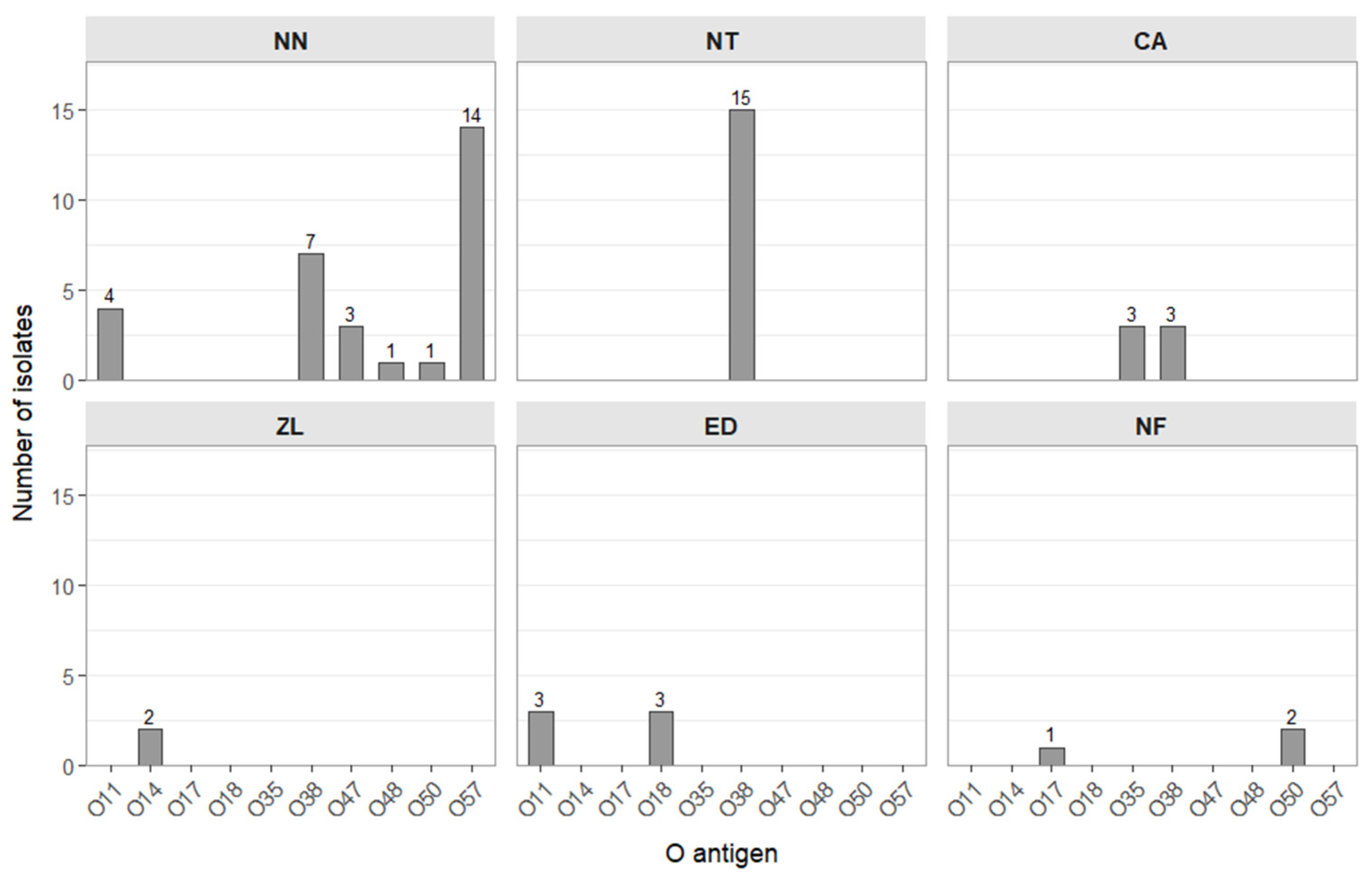
All isolates (100%) were assigned to an O antigen variant (n = 62). As none reacted with the group-specific sera O:4 (O:B), O:6,7 (C:O); O:9,46 (D:O); O:3,10,15 (E:O), only rarely isolated serovars were present in the studied population. The majority of isolates belonged to antigen groups O:38 (n = 26) and O:57 (n = 14), which represented 63% of the isolates (Figure 2). In addition, O:11 antigen was detected in seven isolates, while other antigen variants were observed in no more than three isolates each. The occurrence of three O antigen variants (O:11, O:38, and O:50) was confirmed in Salmonella isolated from more than one snake species. Among them, O:38 was the most prevalent, being detected in isolates from three wild snake species (N. tessellata, N. natrix, and C. austriaca). Antigens O:11 and O:50 were present in isolates from both wild and captive snakes: O:11 was identified in isolates from N. natrix (n = 4) and E. dione (n = 3), whereas O:50 was detected in isolates from N. fasciata (n = 2) and in one isolate from N. natrix. Antigen O:38 was the only O antigen type confirmed in isolates from N. tessellata, while O:14 was exclusively detected in isolates from Z. longissimus. In the remaining snake species, more than one O antigen variant was identified. In one free-living N. natrix individual, the presence of Salmonella O:48 was confirmed (isolate NN 26.5)
The coexistence of more than one Salmonella serovar within a single snake individual was confirmed. This phenomenon was observed in both tested species of captive snakes, N. fasciata and E. dione. From individual NF9, three Salmonella isolates were obtained, which were classified into two O antigen groups: O:50 and O:17. In the case of E. dione, Salmonella were isolated from three individuals; in two of them, the coexistence of types O:11 and O:18 was confirmed. No coexistence of more than one Salmonella O-antigen group was observed in any of the analyzed wild snake species.

2.4. Resistance to Antimicrobials

Susceptibility of Salmonella spp. isolates from both free living and captive reptiles (n = 32) were assessed against 25 antibiotics and chemotherapeutics. The effectiveness of each antimicrobial was evaluated based on the minimal inhibitory concentration (MIC) values and the results are presented in Table S1. The majority of Salmonella spp. were susceptible to all tested antimicrobials (21 isolates; 66%). Resistance to the antimicrobial activity of tigecycline (TIG) was the most frequently observed among all testes Salmonella spp. strains. The MICTIG of all resistant strains was 1 mg/L whereas the MICTIG of the susceptible strains was ≤0.5 mg/L. Resistant isolates were obtained from both wild snakes—N. tessellata (NT 1.8, NT 10.1, NT 18.4) and C. austriaca (CA 10.5)—as well as from captive E. dione snakes (ED 1.1, ED 1.3, ED 2.3, ED 3.1, ED 3.2). Resistance to amoxicillin/clavulanic acid (AMC), ampicillin (AMP), cephalexin (CF), cefuroxime (CXM), cefixime (CFM), and fosfomycin (FOS) was observed in individual Salmonella spp. isolates (Table 2). The MICAMC for three amoxicillin/clavulanic acid resistant isolates (NT 18.4, CA 10.5, and ZL 1.3) were >32/2 mg/L, whereas MICAMC of the susceptible was ≤2/2 mg/L. Single cases of resistance to first-, second-, and third generation cephalosporins were also detected with MICCF > 16 mg/L, MICCXM > 8 mg/L and MICCFM of 2 mg/L. One isolate showed resistance to fosfomycin with an MICFOS of 64 mg/L.
Based on MIC interpretation, five different resistance patterns (RP1 to RP5) were distinguished. List of the RP is presented in Table 2. The most common was RP1, with isolates susceptible to all tested antimicrobials (n = 21; 66%). Among isolates showing resistance to at least one antimicrobial, the most frequent was RP2 (n = 8; 25%), characterized by resistance to tigecycline. Each of the remaining patterns (RP3, RP4, and RP5) was represented by a single isolate (3%). Analysis of resistance patterns allowed the characterization of isolate NT 18.4 as multidrug-resistant (MDR). This isolate exhibited pattern RP5 and showed resistance to antibiotics from multiple classes, including penicillin, cephalosporins, tigecycline, and fosfomycin.

2.5. Resistance to Bactericidal Activity of Human Serum

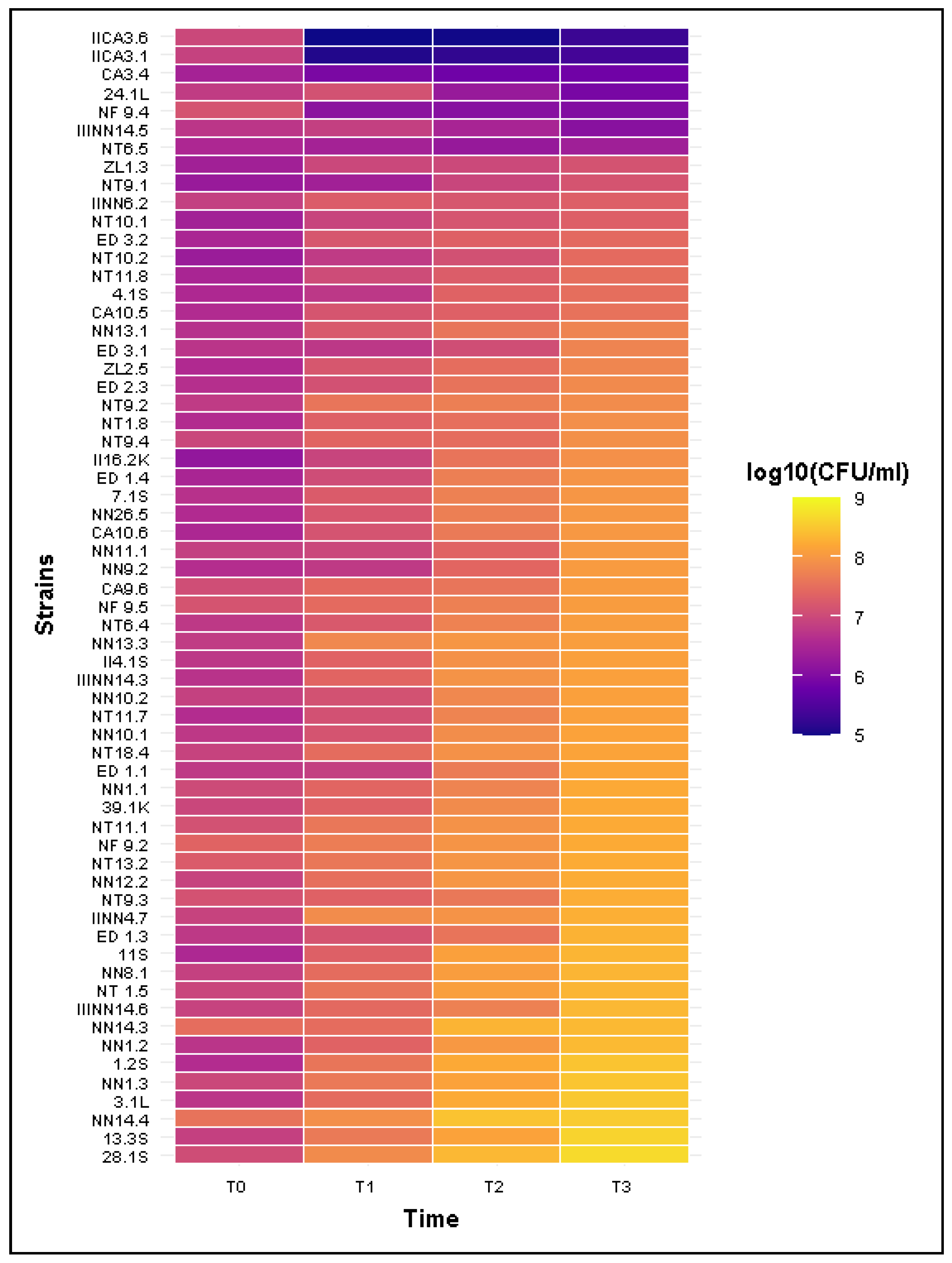
The survival of Salmonella isolates in commercial product of human serum (HS) was evaluated after 3 h of incubation at 37 °C in 50% HS. All isolates were able to grow in the presence of 50% heat-inactivated human serum (IHS), with viable counts exceeding 1.0 × 10⁸ CFU/mL (colony forming units per milliliter). In contrast, when exposed to non-inactivated HS, considerable variation in susceptibility to the bactericidal activity was observed among the tested isolates. The mean number of viable cells was 7.28 × 10⁵ CFU/mL in serum-sensitive strains, 2.35 × 10⁶ CFU/mL in intermediate strains, and 1.47 × 10⁸ CFU/mL in serum-resistant strains at the end of exposure. Most strains (56 isolates) exhibited high serum resistance (R), markedly increasing their viable cell counts during the incubation. In these isolates, the CFU/mL increased from the start of exposure (T0) to the end of incubation (T3), with survival rates exceeding 1500% relative to the initial inoculum. In contrast, serum-sensitive (S) strains showed a substantial decrease in viability, with survival rates reduced to approximately 12% (n = 5). Only one isolate (NT 6.4) represented the intermediate (I) phenotype, maintaining survival rate at around 67% of the starting CFU/mL.
The serum-resistant isolates exhibited continuous proliferation throughout the entire incubation period. The estimated number of bacterial divisions was determined at each time point, showing a gradual increase with prolonged exposure to serum. On average, resistant strains divided approximately 1.68; 3.11 and 4.15 times after 1 h (T1), 2 h (T2), and 3 h (T3) of incubation, respectively. In contrast, sensitive strains showed a consistent decline in viable cell numbers throughout the incubation period. The single intermediate strain exhibited a decrease in CFU/mL after 1 h and 2 h, followed by a slight increase after 3 h of incubation. Detailed mean growth and survival values for all phenotypes are shown in Table 3.
Among the five sensitive strains, three were isolated from a single individual of C. austriaca (CA 3.4. IICA 3.1. IICA 3.6, all belonging to serogroup O:38) two from N. natrix (24.1 L, O:50 and IIINN 14.5, O:38), and one from N. fasciata (NF 9.5, O:50). Thus, the sensitive phenotype was observed in isolates obtained from both wild and captive snakes. After 3 h of incubation in serum the final viable cell counts of these isolates ranged from 2.00 × 10⁵ to 1.27 × 10⁶ CFU/mL. The single intermediate isolate was isolated from N. tessellata (NT 6.5, O:38) and reached 2.35 × 10⁶ CFU/mL after incubation. All remaining isolates displayed a serum-resistant phenotype. These resistant strains originated from all snake species included in the study representing both wild-caught and captive individuals. Among them, 36 isolates exceeded final viable counts of 1.03 × 10⁸ CFU/mL, which corresponded to the mean value observed for the O:48 isolate (NN 26.5). Notably, within the ten isolates showing the highest CFU/mL values, all were derived from wild snakes; nine from N. natrix and one from N. tessellata. Their final CFU/mL counts exceeded 2.23 × 10⁸, confirming the strong proliferative potential of these strains in the presence of human serum (Figure 3).

3. Discussion

Reptiles are frequent carriers of bacteria that are potentially dangerous to humans, especially Salmonella. For many years, these animals were not widely recognized as a significant source of pathogens in Europe. In recent years, increased interest has been observed in several European countries, including Spain, Portugal, Italy, and Poland. However, despite the growing awareness of the role of reptiles in the epidemiological chain of zoonoses, most studies still focus on lizards rather than snakes [17]. Notably, most analyses in Europe focus on samples collected from captive individuals [18]. In contrast, the situation is different on other continents, where a much higher proportion of samples is collected from wild animals. Outside Europe, studies are conducted in selected countries of North and South America (mainly the USA and Brazil), as well as in Asia (primarily China and Japan) and Oceania. In all of these regions, samples from wild individuals constitute more than half of all material, with the highest proportions recorded in Australia. Research from Africa is limited, but here as well most studies are based on wild reptiles. Europe is the only continent where samples from captive reptiles clearly predominate over those from wild populations [18].
In our study, the use of the proteomic MALDI TOF MS method to identify bacteria obtained from swabs taken from snakes in Poland allowed us to determine the affiliation of isolates to 28 genera of Gram-negative and Gram-positive bacteria. The most frequently isolated were Gram-negative rods belonging to the genera Citrobacter, Morganella, Proteus, Hafnia, Klebsiella, Salmonella and Gram-positive streptococci from the genus Enterococcus (Table 1). The presence of Salmonella was confirmed in all analyzed snake species, including 19% of the free-living individuals examined. The highest frequency of isolates identified as Salmonella was found in kept E. dione (Salmonella present in 100% of the examined individuals, 3/3) and free-living N. tessellata (37%, 7/19) and Z. longissimus (22%, 2/9). The lowest frequency was found in N. natrix (12%, 3/26) and C. austriaca (13%, 3/24). In recent years, only a few studies have addressed the prevalence of Salmonella or other bacteria in free-living snakes in Europe [10,19,20]. Up to date, we believe that the results presented in this publication concern the largest group of free-living snakes studied in Europe. In the literature, there are individual studies with very different results. The reason is certainly the different research methodology regarding the type of material collected, the method of sampling, or the technique of identifying the types of bacteria. Comparing our results with those of Schmidt et al. conducted on N. natrix (n = 12) and Vipera berus (n = 23) living freely in Germany, we find no correlation [20]. Salmonella was not detected in N. natrix. while in V. berus it constituted 34.8% of the isolated microbiota. Considering the lower number of individuals studied and the use of different methods, it is difficult to compare these results with those obtained by our team. It should be highlighted, that free-living snakes are a particularly difficult group to study. They are rare, secretive, migratory animals, often inhabiting areas difficult to access by humans. Therefore, the research model has numerous limitations, and repeatability of methods and the number of individuals is difficult to achieve. Each field trip is time-consuming and results in finding a different number of individuals. Due to the speed and movement of these animals, not every snake encountered is successfully captured. The microbiological studies we presented were performed in conjunction with expert herpetological examinations and were dependent on them. There is no gold standard for reptile microbiota testing. Test material also varies, for example, cloacal swabs or fecal samples. Some studies focus on culturing methods and isolating as many bacterial species as possible, others only examine the number of Gram-negative species, and still others solely isolate Salmonella according to ISO standards. In each case, different microbiological media will be used, selective for specific microbial groups, so the results of such tests cannot be compared. Also, completely different results will be obtained when molecular biology methods are used instead of culturing methods. For this reason, research on the reptile microbiota should be continued and expanded, as each result obtained significantly enriches knowledge [18,21].
Among the bacteria colonizing reptiles, Salmonella rods are of major clinical relevance, and the subject of research in most scientific publications, as they are responsible for RAS in humans. These infections mainly affect immunocompromised patients and are frequently associated with extraintestinal diseases which require hospitalization, such as sepsis or meningitis [22,23]. In 2023, Bruning et al. described a case of reptile-associated urinary tract infection in an 18-year-old woman caused by Salmonella Oranienburg, while in 2021, Otake et al. reported a case of testicular necrosis due to Salmonella Saintpaul following contact with a snake [24,25]. Despite limited RAS surveillance in Europe, such cases are nevertheless diagnosed. For instance, a case report from Austria documented an infection with Salmonella enterica subsp. enterica ser. Monschaui (O:35) in a three-week-old infant [26]. Unlike Europe, North American countries, such as the USA and Canada, conduct RAS monitoring. Important outbreaks are reported by relevant authorities, including the Centers for Disease Control and Prevention (CDC). Although less frequent, other bacteria have also been implicated in snake-associated human infections. Among the most frequently documented non-RAS cases are wound infections resulting from snake bites, caused by Morganella, Enterobacter, Klebsiella, Aeromonas hydrophila, and various other Gram-positive and Gram-negative bacteria [27,28]. These examples highlight the underappreciated zoonotic potential of snake-associated microbiota and underscore the importance of a One Health perspective in recognizing and managing such infections [21,29,30].
Salmonella are highly diverse with respect to surface antigenic variants, and more than 2600 serovars have currently been distinguished on this basis. Serological variability directly contributes to differences in the pathogenicity of these bacteria [31]. In our study, Salmonella isolates were assigned to the O-antigen serotypes O:11, O:14, O:17, O:18, O:30, O:35, O:38, O:47, O:48, O:50 and O:57. The most frequently identified were O:38, present in all isolates from N. tessellata and in three isolates from C. austriaca, and O:57, which was exclusively confirmed in N. natrix. All of these variants are considered reptile-associated. At the same time, these O groups are rarely reported from patients in Poland and Europe, where the majority of salmonellosis are caused by serovars O:9,46 (S. Enteritidis), O:4 (S. Typhimurium, S. Derby), and O:6,7 (S. Infantis, S. Virchow, S. Newport [4,32,33]. Rare serovars are isolated in approximately 1–2% of diagnosed salmonellosis cases in Poland, depending on the reporting year [32]. This low frequency may be partly explained by distinct biochemical features, particularly the ability of Salmonella enterica subsp. diarizonae to ferment lactose, a feature characteristic of reptile-derived isolates, which we also confirmed in our previous [34]. Clinical isolates belonging to these rare O groups remain poorly studied, and in our view, there is an urgent need for their further characterization. Detailed molecular descriptions of these O antigens are limited; among the few characterized variants is O:48. In the present study, we confirmed the presence of Salmonella O:48 in one isolate from N. natrix. Flagellar antigen serotyping suggested that this strain may belong to serovar 48:k:z57 or a closely related variant (unpublished data). Salmonella 48:k:z57 has previously been identified in human cases in Poland [31]. Structural analyses of the lipopolysaccharide (LPS) of Salmonella O:48, conducted by Gamian et al., revealed its unique composition, characterized by the presence of sialic acid residues within its structure [35]. Pawlak et al. demonstrated that elongation of the O:48 antigen following serial passage in human serum correlated with increased resistance to its bactericidal activity [36]. Such a structural feature may enhance the clinical importance of these variants, as it can contribute to post-infectious complications through molecular mimicry [37]. Data on the occurrence of Salmonella in the snake species examined in our study are mainly limited to N. natrix, and there is a lack of information on potential RAS cases associated with these species [11,19,33]. However, useful supplementary evidence can be found in EnteroBase [38]. Individual records confirm the presence of Salmonella Newport in kept Zamenis situla in Poland. No records refer to individuals of wild species. Furthermore, EnteroBase data confirm that several Salmonella serogroups detected in our study are also frequently isolated from human clinical cases. For instance, numerous human isolates belonging to Salmonella O:38 have been reported, including variants such as 38:r:z and 38:k:z35. Human isolates representing serogroup O:50, such as 50:k:z and 50:r:z, and those belonging to serogroup O:57, including 57:c:z and the monophasic variant 57:z4,z32:-, have also been documented. The data also confirm the isolation of Salmonella O:48, which we detected in free-living N. natrix. Reported human isolates include serovars such as 48:i:z, 48:d:z6, 48:l,v:1,5 and 48:k:z53, with the latter documented also in Poland [31,38]. Overall, the serogroups identified in our study align with those periodically isolated from human cases, indicating that the strains carried by these snakes may contribute to the broader pool of Salmonella circulating in the environment and occasionally affecting humans. In addition to identifying serologic groups that have previously been reported in Europe, it is equally important from an epidemiological perspective to characterize their antimicrobial-resistance profiles. Such resistance is one of the key determinants of pathogenic potential of individual strains and influences their role in the transmission chain of zoonotic infections. This aspect becomes particularly important given that antimicrobial resistance among Enterobacterales, including Salmonella, represents a major global public health challenge.
The problem has been recognized by the World Health Organization (WHO), which considers the increasing prevalence of resistance to be a serious threat. In the 2024 WHO bacterial priority pathogens list (BPPL), both typhoidal and non-typhoidal Salmonella resistant to fluoroquinolones were classified as pathogens of the high-priority group [39]. Wet markets have been identified as one of the sources of resistant strains. Alarmingly, data from South Asia indicate a high proportion of MDR Salmonella isolates recovered from wet market samples in Bangladesh [40]. In our study, the majority of isolates (66%) were susceptible to all tested antimicrobials. Among all isolates, five different resistance patterns (RP1–RP5) were identified. One isolate (NT 18.4) from N. tessellata exhibited the RP5 profile and was classified as MDR, showing resistance to β-lactams (penicillins: amoxicillin–clavulanic acid and penicillin; first- and second-generation cephalosporins: cephalexin and cefuroxime), as well as to tigecycline and fosfomycin. We also observed that 28% of isolates were resistant to tigecycline (RP2 and RP5 patterns). Tigecycline-resistant strains were isolated from both wild (N. tessellata. C. austriaca) and captive snakes (E. dione). This finding confirms our previous results, where tigecycline resistance was detected in five isolates from N. natrix and one from N. fasciata (20% of tested isolates), further highlighting the occurrence of this resistance phenotype in Salmonella from both wild and captive snake populations [34]. Bertelloni et al. reported a high percentage (93.1%) of tigecycline non-sensitive Salmonella strains isolated from reptiles [41]. Efflux activity and the presence of genetic determinants have been identified as the main mechanisms underlying reduced tigecycline susceptibility in Salmonella. In particular, the AcrAB–TolC efflux pump system and the plasmid-mediated tigecycline resistance gene tet(X4) have been associated with this phenotype [42,43]. In a recent study, El-Aziz et al. correlated elevated MIC values for both tigecycline and ciprofloxacin with increased efflux pump activity, further highlighting the central role of efflux in multidrug resistance [44]. In our isolates, the tolC gene was detected in all strains; for half of them, these results have already been reported in our previous publication [34]. The presence of tolC may contribute to the observed resistance profiles within snake-associated Salmonella populations, as this gene encodes an essential component of multidrug efflux systems. Confirmation of tolC expression and characterization of the activity of the corresponding efflux pump under different environmental conditions constitute one of our forthcoming research objectives.
Various environments play an important role as reservoirs of antibiotic-resistant bacteria. Aquatic habitats are frequently highlighted as important reservoirs, and the role of wildlife in the transmission of antimicrobial-resistance genes has also been emphasized [45,46]. Although reptiles are rarely discussed in this context, the presence of resistant strains in wildlife is documented [47]. Snakes as animals that interact with aquatic environments and feed on small vertebrates and invertebrates, reptiles may represent a potential link in the trophic transmission of antimicrobial-resistance determinants [48]. As indicated, the presence of antibiotic-resistant, reptile-associated Salmonella strains has already been confirmed in the literature [49,50]. This process may be further enhanced by the fact that many resistance genes in Salmonella are plasmid-encoded, facilitating their horizontal transfer [51].
Most of the tested strains were resistant to bactericidal action of 50% HS. Studies by Dudek et al. and Nishio et al. confirmed that the serum-resistant phenotype of Salmonella is associated with the composition of outer membrane proteins (OMPs), including PagC and OmpA [52,53]. In addition to OMP composition, numerous studies have demonstrated that lipopolysaccharide (LPS) structure strongly influences complement resistance, and this effect appears to be common to both non-typhoidal and typhoidal Salmonella [54,55]. In addition, Pawlak et al. showed, using Salmonella O:48 as an example, that resistance to human serum correlates with LPS chain elongation [36]. The serum resistance phenotype may also be associated with the presence of specific plasmids [56]. Given the complex and multifactorial nature of human serum resistance, further studies on reptile-associated Salmonella are warranted, particularly considering their potential zoonotic significance.

4. Materials and Methods

4.1. Collection of the Cloacal Swabs from Snakes

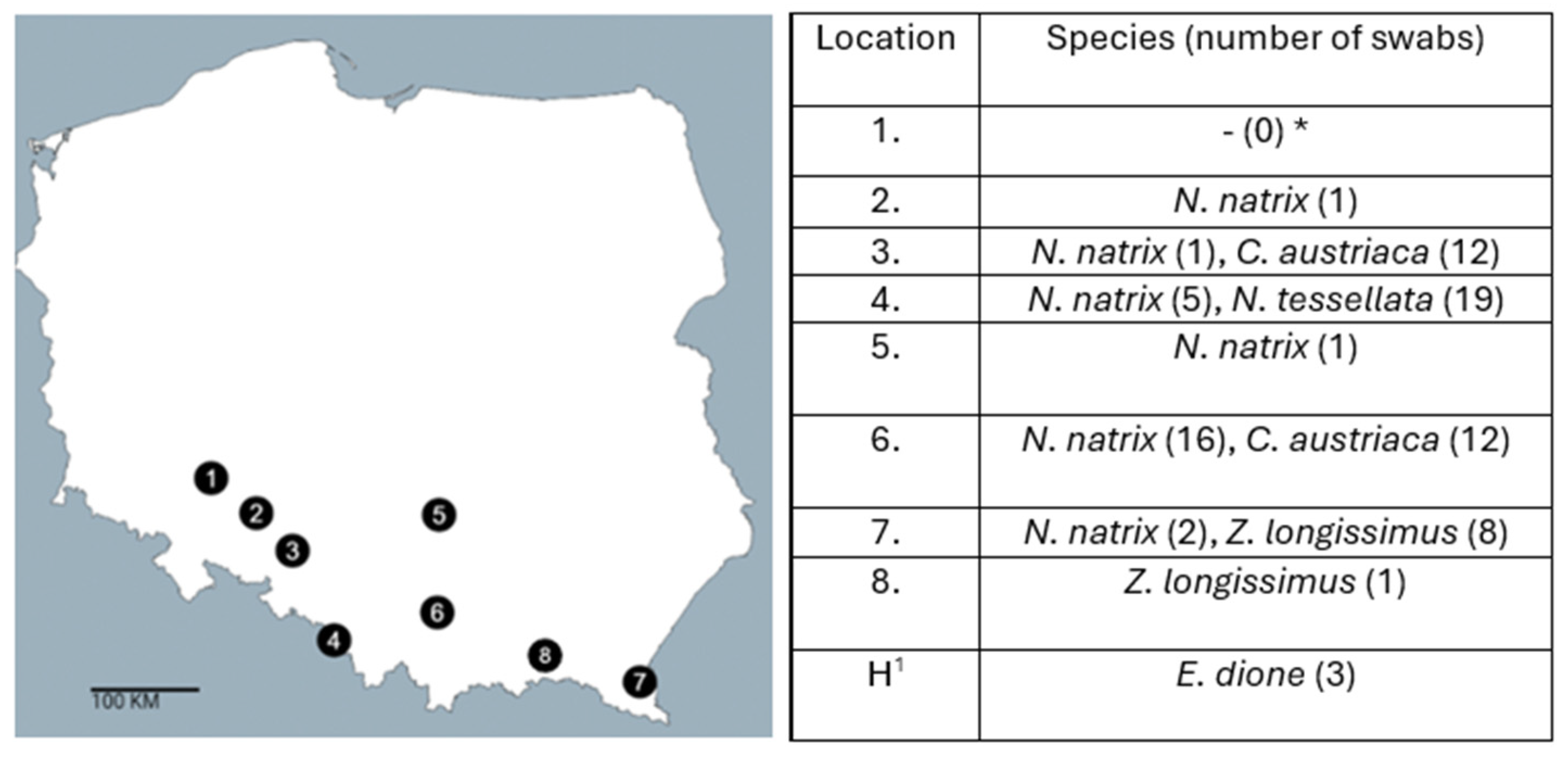
Snakes were captured in eight different regions in Poland as shown on Figure 4. The fieldwork was designed as an exploratory study. Bacteriological swabbing was added as an additional component, and the sampling depended on collaboration with field experts. Moreover, higher snake densities in southern Poland further influenced the spatial distribution of sampling. Field surveys were conducted from 2021 to 2024 during the active season of these animals, which is mainly April to October. However, bacteriological swabs were successfully collected only in 2021, 2022, and 2023, with 24, 25, and 19 samples obtained in those years, respectively. Because snakes are typically secretive and occur at low densities, sampling is challenging. For this reason, all encountered individuals were swabbed except for newly hatched ones. No additional exclusion criteria were applied. In total, 78 cloacal swabs from free-living snakes, including 26 N. natrix, 24 C. austriaca, 19 N. tessellata and 9 Z. longissimus were collected. Each individual was sampled once, except for the C. austriaca individual designated CA 3 which was captured and swabbed twice during two independent field surveys. Additionally, swabs from 3 breeding E. dione were collected. Prior to conducting the study, the necessary permits were obtained consents from the Regional Directorates for Environmental Protection in Wrocław, Kraków, Katowice and Opole (decisions no. WPN.6401.61.2021.AP, no. WPN.6401.140.2021.AR, no. WPN.6401.270.2019.ZB, no. OP.6401.77.2021.KW), as well as from the General Directorate for Environmental Protection in Warsaw (decision no. DZP-WG.6401.91.2020.TŁ, DZP-WG.6401.80.2023.TŁ.2). Swabs were collected in a non-invasive manner, during other measurement-related work carried out in the field. Due to the non-invasive character of the sampling, and in accordance with the Act of 15 January 2015 on the Protection of Animals Used for Scientific or Educational Purpose, approval from local ethics committee was not required [57]. To prevent pathogen transmission, particularly of snake fungal disease (SFD), strict biosafety measures were followed during sample collection. Cloacal swabs were collected by inserting the swab into the cloaca and rotating it 360° three times to collect microbiological material. Swabs were then placed in Amies transport medium, stored at room temperature and transported to the Department of Microbiology, University of Wroclaw for bacteriological examination.

4.2. Bacteriological Examination

Swabs collected from snakes were first enriched in Buffered Peptone Water (Biomaxima, Lublin, Poland) and incubated at 37 °C for 18 h with shaking at 160 rpm to promote bacterial growth. Following incubation, bacteria were streaked onto non-selective (Nutrient Agar), and selective (MacConkey) solid media (Biomaxima, Lublin, Poland). Individual bacterial colonies were selected based on distinct morphological characteristics and lactose fermentation profiles on MacConkey Agar, ensuring the isolation of diverse bacterial strains. The isolated colonies were then suspended in LB medium (Biomaxima, Lublin, Poland) supplemented with 25% (v/v) glycerol and stored at −70 °C until further identification.

4.3. MALDI-TOF MS Identification

The proteomic method MALDI TOF MS was used to identification of the collected bacterial strains (n = 432). Ribosomal proteins of each tested strain were extracted with ethanol and formic acid for protein detection and identification. Two to five colonies were harvested from Nutrient Agar (Biomaxima, Lublin, Poland) plates after 24 h of incubation at 37 °C and suspended in 300 µL of distilled water. Then, 900 µL of pure ethanol was added and the samples were homogenized using vortex mixer for 60 s followed by centrifugation at 13,000× g for 2 min. After removing the supernatant, the bacterial pellet was air-dried at room temperature to ensure complete evaporation of residual ethanol. The dried pellet was then resuspended in 25 µL of a 70% formic acid solution and 25 µL of acetonitrile (Sigma-Aldrich, St. Louis, MO, USA), mixed thoroughly, and centrifuged (2 min, 13,000× g) to extract ribosomal proteins. For protein identification, 1 µL of the supernatant from each sample was transferred onto a steel MSP 96-target polished plate and air-dried at room temperature. Then, 1 µL of HCCA matrix (α-Cyano-4-hydroxycinnamic acid, (Sigma-Aldrich, St. Louis, MO, USA) was added to an each sample spot and dried again. The plates were analyzed using MALDI Biotyper Sirius mass spectrometer (Brucker, Bremen, Germany) and the mass spectra of extracted proteins were obtained with flexControl Version 3.4 software. Mass spectral identification was performed using the MBT Compass 4.1 and MALDI Biotyper Compass Explorer 4.1 software were used. Identification scores were assigned by comparing the mass spectral profiles of the analyzed samples with reference spectra from a curated database. The MBT Compass Library Revision K (2022) database (Bruker Daltonics GmbH & Co. KG, Bremen, Germany) containing 4274 species were used. Identification results were classified according to the manufacturer’s guidelines as follows:
Score: 2.300–3.000: Highly probable species identification
Score: 2.000–2.999: Secure genus identification, probable species identification
Score: 1.700–1.999: Probable genus identification
Score: 0.000–1.699: No identification
Although bacterial identification was performed for all isolates, only Salmonella spp. were selected for further analysis due to their established role in RAS and potential for zoonotic transmission. All isolates identified in this work as Salmonella (n = 32) were included in the subsequent analyses, together with 30 isolates previously obtained from NN and NF, resulting in a total of n = 62 [34]. Antibiotic resistance testing was conducted exclusively for the isolates described in the present study, as data for the previously published isolates have been reported [34].

4.4. Determination of O Antigen in Salmonella spp. Isolates

All isolates previously identified as Salmonella sp. by MALDI-TOF MS (n = 62) were subjected to O antigen serotyping with slide agglutination method according to ISO/TR 6579-3: Microbiology of the food chain—Horizontal method for the detection, enumeration and serotyping of Salmonella—Part 3: Guidelines for serotyping of Salmonella spp. and the Kaufmann–White–Le Minor scheme [58,59]. Fresh colonies grown for 18 ± 2 h at 37 °C on non-selective Nutrient Agar were used for serological testing. Rough strains were identified by suspending colonies in 0.9% NaCl and autoagglutination-positive isolates were discarded. The remaining isolates were confirmed with polyvalent HM serum, specific for all Salmonella serovars. Polyvalent and monovalent antisera from different manufacturers were used, including OMC, OME, OMF, OMG (BioRad, Marnes-la-Coquette, France); OMD, O:4 (formerly B:O), O:6,7 (C:O); O:9,46 (D:O); O:3,10,15 (E:O); O:11, O:14, O:21 (Immunolab, Gdansk, Poland); O:6, O:14, O:16, O:17, O:18, O:28, O:35, O:38, O:47, O:50, O:51, O:52, O:53, O:56, O:57, O:58, O:59, O:61 (Sifin, Berlin, Germany) and O:48 (SSI Diagnostica, Hillerød, Denmark). For each agglutination reaction, a small Salmonella spp. inoculum consisting of 2–3 colonies was suspended in a drop of the respective serum placed on a glass slide and spread until a homogeneous suspension without visible clumps was obtained, as clumping could lead to false-positive results. The suspension was then gently tilted back and forth on the slide for approximately 5–60 s, with the exact time adjusted according to the manufacturer’s instructions for the specific serum. Agglutination results were read under indirect light against a dark background. A positive reaction was defined as the visible formation of antigen–antibody aggregates within the drop, whereas a negative reaction was indicated by a homogenous, milky appearance of the suspension.

4.5. Antimicrobial Susceptibility Testing (AST)

The BD PhoenixTM M50 (Becton Dickinson, Sparks, MD, USA) automated system was used for antimicrobial susceptibility testing (AST). All isolates classified as Salmonella sp. based on the MALDI-TOF MS and slide agglutination procedures were subjected to AST (n = 32). Antimicrobial susceptibility results for the remaining 30 isolates from N. natrix and N. fasciata were reported in our previous work [34]. The NMIC-502 panel was selected to determine the minimum inhibitory concentration (MIC) of the following 26 antimicrobial agents (concentration ranges in mg/L): amoxicillin/clavulanic acid (2–32); ampicillin (2–8); piperacillin (4–64); piperacillin/tazobactam (4–64); temocillin (4–32); cephalexin (4–16); cefepime (1–16); cefixime (0.5–2); ceftazidime (0.5–8); ceftazidime/avibactam (0.25/4–8/4); ceftriaxone (0.5–4); cefuroxime (2–8); ertapenem (0.25–1); imipenem (0.25–8); meropenem (0.125–8); ciprofloxacin (0.06–1); levofloxacin (0.5–2); amikacin (4–16); gentamicin (1–4); tobramycin (1–4); tigecycline (0.5–2); aztreonam (1–16); fosfomycin (16–128); colistin (0.5–2); nitrofurantoin (16–64); trimethoprim-sulfamethoxazole (1–4). According to the manufacturer’s specifications, the NMIC-502 panel is designed for the determination of susceptibility profiles across a broad range of antibiotics relevant to Gram-negative bacteria, including both fermentative and non-fermentative species. The BD Phoenix™ M50 system utilizes a broth microdilution assay for AST. Each panel includes a wide range of two-fold serial dilutions of multiple antimicrobial agents, allowing for precise MIC determination. Bacterial growth was continuously monitored by detecting redox indicator changes and variations in turbidity, ensuring reliable assessment of antimicrobial susceptibility. A 24 h culture of each Salmonella strain on a Nutrient Agar was used for the testing. The inoculum was prepared by suspending several colonies in a sterile saline solution (ID test tube) to obtain a 0.5 McFarland standard, corresponding to approximately 1.5 × 10⁸ CFU/mL. The turbidity of the suspension was measured using a densitometer. A drop of AST Indicator Solution and 25 µL of the bacterial suspension were transferred to an AST broth test tube. The inoculated AST broth was then dispensed into the selected NMIC-502 panel, which was subsequently placed into the instrument and incubated at 35–37 °C for 16–18 h. The obtained MIC values for each tested antibiotic were interpreted according to the current EUCAST guidelines (European Committee on Antimicrobial Susceptibility Testing) [60]. Strains were classified as “S” (Susceptible, standard dosing regimen), “I” (Susceptible, increased exposure), or “R” (Resistant).

4.6. Sensitivity to Bactericidal Activity of HS

The ability of the tested Salmonella strains to resist the bactericidal activity of HS was assessed by quantifying bacterial survival following exposure to 50% HS. A commercial human serum preparation was used (Sigma-Aldrich, Product No. P2918, St. Louis, MO, USA). To ensure consistency of results and preserve maximum serum activity, the serum was aliquoted into 1 mL portions and stored at −70 °C. Each aliquot was defrosted only once immediately before use. HS activity was verified using the reference strain Salmonella enterica subsp. enterica serovar Typhimurium ATCC 14028, whose sensitivity to the bactericidal effect of human serum had been confirmed in our previous experiments (unpublished data).
A total of 62 Salmonella isolates were tested in the HS assay. Bacterial cultures were prepared as previously described by Pawlak et al., and the survival was quantified by the Miles and Misra drop plate technique [34,61]. Briefly, each tested Salmonella spp. strain was subcultured on Nutrient Agar for 24 h at 37 °C before testing. Single colonies were then inoculated into 5 mL of LB broth and incubated at 37 °C for 18 h with shaking at 160 rpm. Then, 100 µL of the overnight bacterial culture was transferred into 5 mL of fresh LB broth and incubated again (37 °C, 160 rpm) until reaching 0.5 McFarland standard, corresponding to approximately 1.5 × 10⁸ CFU/mL. The fresh bacterial culture was then centrifuged at 4000 rpm for 20 min at 4 °C. The bacterial pellet was resuspended in 5 mL of sterile physiological saline. From this suspension, 1 mL was further diluted in 3 mL of physiological saline.
For the bactericidal activity testing, 125 µL of the bacterial inoculum was mixed with an equal volume of human serum, achieving a final serum concentration of 50% (v/v). The mixture was incubated at 37 °C for 3 h. To monitor bacterial survival over incubation time, serial dilutions were plated at 0 min (T0), 60 min (T1), 120 min (T2), and 180 min (T3). At each time point, 10-fold serial dilutions (from 10−1 to 10−6) were prepared in sterile physiological saline. After overnight incubation at 37 °C, the CFU/mL were enumerated to determine bacterial viability. Each strain was tested in three independent biological replicates, with each biological replicate analyzed in triplicate technical spots. Bacterial survival at T3 (180 min) was determined by comparing CFU/mL counts at T3 to the initial CFU/mL counts at T0 (0 min), providing a measure of serum resistance. A control experiment was conducted for each strain using heat-inactivated serum (56 °C for 30 min), prepared under the same conditions.

5. Conclusions

This study demonstrated that wild snakes in Poland constitute a reservoir of Salmonella. These are the first confirmed findings of Salmonella occurrence in C. austriaca, Z. longissimus, and N. tessellata living in the wild. The isolates represented rare serovars belonging to distant serological groups and showed the ability to multiply in human serum, indicating their potential to survive and proliferate in the presence of immune system components.

Supplementary Materials

The following supporting information can be downloaded at https://www.mdpi.com/article/10.3390/ijms262412018/s1.

Author Contributions

Conceptualization, M.M., A.P., and G.B.-P.; methodology, M.M., A.P., and G.B.-P.; investigation and sample collection from animals, M.M., A.K., B.Z., and S.B.; isolation of the bacteria, M.M.; MALDI-TOF MS identification, M.M., G.C.-S., and A.W.; MALDI-TOF MS supervision, A.K.-K.; serotyping, M.M.; antibiotic susceptibility testing, M.M. and K.B.; serum resistance assays, M.M.; data curation, M.M.; data visualization, M.M.; writing—original draft preparation, M.M. and A.P.; writing—review and editing, M.M., A.P., G.B.-P., B.Z., S.B., and A.G.; funding acquisition, M.M. and A.G.; supervision, A.P. and G.B.-P. All authors have read and agreed to the published version of the manuscript.

Funding

This research was funded in part by National Science Center, Poland Grant number 2023/49/N/NZ6/03411. For the purpose of Open Access, the author has applied a CC-BY public copyright license to any Author Accepted Manuscript (AAM) version arising from this submission. The Article Processing Charge (APC) was partially funded by statutory funds of the Ludwik Hirszfeld Institute of Immunology and Experimental Therapy, Polish Academy of Sciences, Wrocław, Poland.

Institutional Review Board Statement

The study was conducted in accordance with the applicable national and institutional regulations regarding the handling of wild animals. Sampling of snakes was performed under official permits issued by the Regional Directorates for Environmental Protection Wrocław, Kraków, Katowice and Opole (decisions no. WPN.6401.61.2021.AP, dated 18 May 2021; no. WPN.6401.140.2021.AR, 25 May 2021; no. WPN.6401.270.2019.ZB, 10 April 2019; no. OP.6401.77.2021.KW, 16 April 2021), as well as from the General Directorate for Environmental Protection in Warsaw (decision no. DZP-WG.6401.91.2020.TŁ, dated 10 April 2020 and no. DZP-WG.6401.80.2023.TŁ.2, 22 May 2023).

Informed Consent Statement

Not applicable.

Data Availability Statement

Data on antibiotic susceptibility (MIC values) are provided in the Supplementary Materials. MALDI-TOF MS identification results and BD PhoenixTM M50 antimicrobial susceptibility reports are available from the corresponding author upon reasonable request.

Acknowledgments

The authors thank Ewa Lewczyk for enabling the determination of antibiotic susceptibility of Salmonella isolates.

Conflicts of Interest

The authors declare no conflicts of interest.

Abbreviations

The following abbreviations are used in this manuscript:
NNNatrix natrix
NTNatrix tessellata
CACoronella austriaca
ZLZamenis longissimus
EDElaphe dione
NFNerodia fasciata
HSHuman serum
CDCCenters for Disease Control and Prevention
NTSNon-typhoidal salmonellosis
pSVSalmonella virulence plasmid

References

  1. Centers for Disease Control and Prevention (CDC). About One Health. Available online: https://www.cdc.gov/one-health/about/index.html (accessed on 28 October 2025).
  2. Horefti, E. The Importance of the One Health Concept in Combating Zoonoses. Pathogens 2023, 12, 977. [Google Scholar] [CrossRef]
  3. European Parliament and Council. Directive 2003/99/EC of the European Parliament and of the Council of 17 November 2003 on the Monitoring of Zoonoses and Zoonotic Agents, Amending Council Decision 90/424/EEC and Repealing Council Directive 92/117/EEC. Off. J. Eur. Union 2023, 2001, 65–71. Available online: https://eur-lex.europa.eu/legal-content/pl/TXT/?uri=CELEX%3A32003L0099 (accessed on 10 December 2025).
  4. European Food Safety Authority (EFSA); European Centre for Disease Prevention and Control (ECDC). The European Union One Health 2023 Zoonoses report. EFSA J 2024, 22, e9106. [Google Scholar] [CrossRef]
  5. Galán-Relaño, Á.; Valero Díaz, A.; Huerta Lorenzo, B.; Gómez-Gascón, L.; Mena Rodríguez, M.Á.; Carrasco Jiménez, E.; Pérez Rodríguez, F.; Astorga Márquez, R.J. Salmonella and Salmonellosis: An Update on Public Health Implications and Control Strategies. Animals 2023, 13, 3666. [Google Scholar] [CrossRef]
  6. Musa, L.; Toppi, V.; Stefanetti, V.; Spata, N.; Rapi, M.C.; Grilli, G.; Addis, M.F.; Di Giacinto, G.; Franciosini, M.P.; Casagrande Proietti, P. High Biofilm-Forming Multidrug-Resistant Salmonella Infantis Strains from the Poultry Production Chain. Antibiotics 2024, 13, 595. [Google Scholar] [CrossRef]
  7. Kowalska, B. Fresh vegetables and fruit as a source of Salmonella bacteria. Ann. Agric. Environ. Med. 2023, 30, 9–14. [Google Scholar] [CrossRef]
  8. Hughes, D.F.; Green, M.L.; Warner, J.K.; Davidson, P.C. There’s a Frog in My Salad! A Review of Online Media Coverage for Wild Vertebrates Found in Prepackaged Produce in the United States. Sci. Total Environ. 2019, 675, 1–12. [Google Scholar] [CrossRef]
  9. Merkevičienė, L.; Butrimaitė-Ambrozevičienė, Č.; Paškevičius, G.; Pikūnienė, A.; Virgailis, M.; Dailidavičienė, J.; Daukšienė, A.; Šiugždinienė, R.; Ruzauskas, M. Serological Variety and Antimicrobial Resistance in Salmonella Isolated from Reptiles. Biology 2022, 11, 836. [Google Scholar] [CrossRef] [PubMed]
  10. Dróżdż, M.; Małaszczuk, M.; Paluch, E.; Pawlak, A. Zoonotic potential and prevalence of Salmonella serovars isolated from pets. Infect. Ecol. Epidemiol. 2021, 11, 1975530. [Google Scholar] [CrossRef]
  11. Marin, C.; Lorenzo-Rebenaque, L.; Laso, O.; Villora-Gonzalez, J.; Vega, S. Pet Reptiles: A Potential Source of Transmission of Multidrug Resistant Salmonella. Front. Veter Sci. 2021, 7, 613718. [Google Scholar] [CrossRef]
  12. Pawlak, A.; Morka, K.; Bury, S.; Antoniewicz, Z.; Wzorek, A.; Cieniuch, G.; Korzeniowska-Kowal, A.; Cichoń, M.; Bugla-Płoskońska, G. Cloacal Gram-Negative Microbiota in Free-Living Grass Snake Natrix natrix from Poland. Curr. Microbiol. 2020, 77, 2166–2171. [Google Scholar] [CrossRef]
  13. Pees, M.; Rabsch, W.; Plenz, B.; Fruth, A.; Prager, R.; Simon, S.; Schmidt, V.; Munch, S.; Braun, P. Evidence for the transmission of Salmonella from reptiles to children in Germany, July 2010 to October 2011. Euro Surveill. 2013, 18, 20634. [Google Scholar] [CrossRef]
  14. Silva, C.; Calva, E.; Maloy, S. One Health and Food-Borne Disease: Salmonella Transmission between Humans, Animals, and Plants. Microb. Spectr. 2014, 2, 137–148. [Google Scholar] [CrossRef]
  15. Pees, M.; Brockmann, M.; Steiner, N.; Marschang, R.E. Salmonella in reptiles: A review of occurrence, interactions, shedding and risk factors for human infections. Front. Cell Dev. Biol. 2023, 11, 1251036. [Google Scholar] [CrossRef]
  16. Dietrich, J.; Hammerl, J.A.; Johne, A.; Kappenstein, O.; Loeffler, C.; Nöckler, K.; Rosner, B.; Spielmeyer, A.; Szabo, I.; Richter, M.H. Impact of climate change on foodborne infections and intoxications. J. Health Monit. 2023, 8, 78–92. [Google Scholar] [CrossRef] [PubMed]
  17. Di Nicola, M.R.; Rubiola, S.; Cerullo, A.; Basciu, A.; Massone, C.; Zabbia, T.; Dorne, J.L.C.; Acutis, P.L.; Marini, D. Microorganisms in wild European reptiles: Bridging gaps in neglected conditions to inform disease ecology research. Int. J. Parasitol. Parasites Wildl. 2025, 27, 101113. [Google Scholar] [CrossRef] [PubMed]
  18. Muslin, C.; Salas-Brito, P.; Coello, D.; Morales-Jadán, D.; Viteri-Dávila, C.; Coral-Almeida, M. Salmonella prevalence and serovar distribution in reptiles: A systematic review and meta-analysis. Gut Pathog. 2025, 17, 52. [Google Scholar] [CrossRef]
  19. De Bene, A.F.; Russini, V.; Corradini, C.; Vita, S.; Pecchi, S.; De Marchis, M.L.; Terracciano, G.; Focardi, C.; Montemaggiori, A.; Zuffi, M.A.L.; et al. An extremely rare serovar of Salmonella enterica (Yopougon) discovered in a Western Whip Snake (Hierophis viridiflavus) from Montecristo Island, Italy: Case report and review. Arch. Microbiol. 2024, 206, 49. [Google Scholar] [CrossRef] [PubMed]
  20. Schmidt, V.; Mock, R.; Burgkhardt, E.; Junghanns, A.; Ortlieb, F.; Szabo, I.; Marschang, R.; Blindow, I.; Krautwald-Junghanns, M.E. Cloacal aerobic bacterial flora and absence of viruses in free-living slow worms (Anguis fragilis), grass snakes (Natrix natrix) and European Adders (Vipera berus) from Germany. EcoHealth 2014, 11, 571–580. [Google Scholar] [CrossRef]
  21. Waltenburg, M.A.; Perez, A.; Salah, Z.; Karp, B.E.; Whichard, J.; Tolar, B.; Gollarza, L.; Koski, L.; Blackstock, A.; Basler, C.; et al. Multistate Reptile- and Amphibian-Associated Salmonellosis Outbreaks in Humans, United States, 2009–2018. Zoonoses Public Health 2022, 69, 925–937. [Google Scholar] [CrossRef]
  22. Ricard, C.; Mellentin, J.; Ben Abdallah Chabchoub, R.; Kingbede, P.; Heuclin, P.; Ramdame, A.; Bouquet, A.; Couttenier, F.; Hendricx, F. Méningite à Salmonelle chez un nourrisson due à une tortue domestique. Arch. Pédiatr 2015, 22, 605–607. [Google Scholar] [CrossRef] [PubMed]
  23. Jafari, M.; Forsberg, J.; Gilcher, R.O.; Smith, J.W.; Crutcher, J.M.; McDermott, M.; Brown, B.R.; George, J.N. Salmonella sepsis caused by a platelet transfusion from a donor with a pet snake. N. Eng. J. Med. 2002, 347, 1075–1078. [Google Scholar] [CrossRef] [PubMed]
  24. Otake, S.; Ajiki, J.; Yoshida, M.; Koriyama, T.; Kasai, M. Contact with a snake leading to testicular necrosis due to Salmonella Saintpaul infection. Pediatr. Int. 2021, 63, 119–121. [Google Scholar] [CrossRef]
  25. Bruning, A.H.L.; Beld, M.V.D.; Laverge, J.; Welkers, M.R.A.; Kuil, S.D.; Bruisten, S.M.; van Dam, A.P.; Stam, A.J. Reptile-associated Salmonella urinary tract infection: A case report. Diagn. Microbiol. Infect. Dis. 2023, 105, 115889. [Google Scholar] [CrossRef] [PubMed]
  26. Bernar, B.; Gande, N.; Bernar, A.; Müller, T.; Schönlaub, J. Case Report: Non-typhoidal Salmonella infections transmitted by reptiles and amphibians. Front. Pediatr. 2023, 11, 1278910. [Google Scholar] [CrossRef]
  27. Brenes-Chacón, H.; Ulloa-Gutierrez, R.; Soriano-Fallas, A.; Camacho-Badilla, K.; Valverde-Muñoz, K.; Ávila-Agüero, M.L. Bacterial Infections Associated with Viperidae Snakebites in Children: A 14-Year Experience at the Hospital Nacional de Niños de Costa Rica. Am. J. Trop. Med. Hyg. 2019, 100, 1227–1229. [Google Scholar] [CrossRef]
  28. Huang, W.-H.; Kao, C.-C.; Mao, Y.-C.; Lai, C.-S.; Lai, K.-L.; Lai, C.-H.; Tseng, C.-H.; Huang, Y.-T.; Liu, P.-Y. Shewanella algae and Morganella morganii Coinfection in Cobra-Bite Wounds: A Genomic Analysis. Life 2021, 11, 329. [Google Scholar] [CrossRef] [PubMed]
  29. Centers for Disease Control and Prevention. Surveillance for Outbreaks of Enteric Disease Associated with Animal Contact: Summary for 2017. 2020. Available online: https://www.cdc.gov/acoss/pdf/2017-acoss-summary-h.pdf (accessed on 10 December 2025).
  30. Paphitis, K.; Reid, A.; Golightly, H.R.; Adams, J.A.; Corbeil, A.; Majury, A.; Murphy, A.; McClinchey, H. Reptile Exposure in Human Salmonellosis Cases and Salmonella Serotypes Isolated from Reptiles, Ontario, Canada, 2015–2022. Emerg. Infect. Dis. 2025, 31, 1912–1921. [Google Scholar] [CrossRef]
  31. Issenhuth-Jeanjean, S.; Roggentin, P.; Mikoleit, M.; Guibourdenche, M.; de Pinna, E.; Nair, S.; Fields, P.I.; Weill, F.X. Supplement 2008–2010 (no. 48) to the White-Kauffmann-Le Minor scheme. Res. Microbiol. 2014, 165, 526–530. [Google Scholar] [CrossRef]
  32. National Institute of Public Health NIH—National Research Institute, Department of Epidemiology and Surveillance of Infectious Diseases. Infectious Diseases and Poisonings in Poland in 2023; National Institute of Public Health: Warsaw, Poland, 2024.
  33. European Food Safety Authority (EFSA); European Centre for Disease Prevention and Control (ECDC). The European Union One Health 2020 Zoonoses Report. EFSA J. 2021, 19, 6971. [Google Scholar] [CrossRef]
  34. Pawlak, A.; Małaszczuk, M.; Dróżdż, M.; Bury, S.; Kuczkowski, M.; Morka, K.; Cieniuch, G.; Korzeniowska-Kowal, A.; Wzorek, A.; Korzekwa, K.; et al. Virulence factors of Salmonella spp. isolated from free-living grass snakes Natrix natrix. Environ. Microbiol. Rep. 2024, 16, e13287. [Google Scholar] [CrossRef] [PubMed]
  35. Gamian, A.; Jones, C.; Lipiński, T.; Korzeniowska-Kowal, A.; Ravenscroft, N. Structure of the sialic acid-containing O-specific polysaccharide from Salmonella enterica serovar Toucra O48 lipopolysaccharide. Eur. J. Biochem. 2002, 267, 3160–3167. [Google Scholar] [CrossRef]
  36. Pawlak, A.; Rybka, J.; Dudek, B.; Krzyżewska, E.; Rybka, W.; Kędziora, A.; Klausa, E.; Bugla-Płoskońska, G. Salmonella O48 Serum Resistance is Connected with the Elongation of the Lipopolysaccharide O-Antigen Containing Sialic Acid. Int. J. Mol. Sci. 2017, 18, 2022. [Google Scholar] [CrossRef]
  37. Bugla-Płoskońska, G.; Rybka, J.; Futoma-Kołoch, B.; Cisowska, A.; Gamian, A.; Doroszkiewicz, W. Sialic acid-containing lipopolysaccharides of Salmonella O48 strains-potential role in camouflage and susceptibility to the bactericidal effect of normal human serum. Microb. Ecol. 2010, 59, 601–613. [Google Scholar] [CrossRef]
  38. Dyer, N.P.; Päuker, B.; Baxter, L.; Gupta, A.; Bunk, B.; Overmann, J.; Diricks, M.; Dreyer, V.; Niemann, S.; Holt, K.E.; et al. EnteroBase in 2025: Exploring the Genomic Epidemiology of Bacterial Pathogens. Nucleic Acids Res. 2025, 53, D757–D762. [Google Scholar] [CrossRef]
  39. WHO. Bacterial Priority Pathogens List, 2024: Bacterial Pathogens of Public Health Importance to Guide Research, Development and Strategies to Prevent and Control Antimicrobial Resistance; World Health Organization: Geneva, Switzerland, 2024. [Google Scholar]
  40. Siddiky, N.A.; Sarker, M.S.; Khan, M.S.R.; Begum, R.; Kabir, M.E.; Karim, M.R.; Rahman, M.T.; Mahmud, A.; Samad, M.A. Virulence and Antimicrobial Resistance Profiles of Salmonella enterica Serovars Isolated from Chicken at Wet Markets in Dhaka, Bangladesh. Microorganisms 2021, 9, 952. [Google Scholar] [CrossRef]
  41. Bertelloni, F.; Chemaly, M.; Cerri, D.; Gall, F.L.; Ebani, V.V. Salmonella infection in healthy pet reptiles: Bacteriological isolation and study of some pathogenic characters. Acta Microbiol. Immunol. Hung. 2016, 63, 203–216. [Google Scholar] [CrossRef] [PubMed]
  42. Zhang, X.; Liu, B.; Ding, X.; Bin, P.; Yang, Y.; Zhu, G. Regulatory Mechanisms between Quorum Sensing and Virulence in Salmonella. Microorganisms 2022, 10, 2211. [Google Scholar] [CrossRef] [PubMed]
  43. Chetri, S.; Bhowmik, D.; Paul, D.; Pandey, P.; Chanda, D.D.; Chakravarty, A.; Bora, D.; Bhattacharjee, A. AcrAB-TolC efflux pump system plays a role in carbapenem non-susceptibility in Escherichia coli. BMC Microbiol. 2019, 19, 210. [Google Scholar] [CrossRef]
  44. Abd El-Aziz, N.K.; Tartor, Y.H.; Gharieb, R.M.A.; Erfan, A.M.; Khalifa, E.; Said, M.A.; Ammar, A.M.; Samir, M. Extensive Drug-Resistant Salmonella enterica Isolated from Poultry and Humans: Prevalence and Molecular Determinants Behind the Co-resistance to Ciprofloxacin and Tigecycline. Front. Microbiol. 2021, 12, 738784. [Google Scholar] [CrossRef]
  45. Marti, E.; Variatza, E.; Balcazar, J.L. The role of aquatic ecosystems as reservoirs of antibiotic resistance. Trends Microbiol. 2014, 22, 36–41. [Google Scholar] [CrossRef] [PubMed]
  46. Laborda, P.; Sanz-García, F.; Ochoa-Sánchez, L.E.; Gil-Gil, T.; Hernando-Amado, S.; Martínez, J.L. Wildlife and Antibiotic Resistance. Front. Cell. Infect. Microbiol. 2022, 12, 873989. [Google Scholar] [CrossRef] [PubMed]
  47. Garcês, A.; Pires, I. European Wild Carnivores and Antibiotic Resistant Bacteria: A Review. Antibiotics 2023, 12, 1725. [Google Scholar] [CrossRef] [PubMed]
  48. Gao, X.; Pan, Q.; He, M. Transmission Dynamics of Resistant Bacteria in a Predator–Prey System. Comput. Math. Methods Med. 2015, 2015, 638074. [Google Scholar] [CrossRef]
  49. Dégi, J.; Herman, V.; Radulov, I.; Morariu, F.; Florea, T.; Imre, K. Surveys on Pet-Reptile-Associated Multi-Drug-Resistant Salmonella spp. in the Timișoara Metropolitan Region—Western Romania. Antibiotics 2023, 12, 1203. [Google Scholar] [CrossRef]
  50. Song, D.; He, X.; Chi, Y.; Zhang, Z.; Shuai, J.; Wang, H.; Li, Q.; Du, M. Cytotoxicity and Antimicrobial Resistance of Salmonella enterica Subspecies Isolated from Raised Reptiles in Beijing, China. Animals 2023, 13, 315. [Google Scholar] [CrossRef]
  51. Punchihewage-Don, A.J.; Ranaweera, P.N.; Parveen, S. Defense Mechanisms of Salmonella against Antibiotics: A Review. Front. Antibiot. 2024, 3, 1448796. [Google Scholar] [CrossRef]
  52. Dudek, B.; Krzyżewska, E.; Kapczyńska, K.; Rybka, J.; Pawlak, A.; Korzekwa, K.; Klausa, E.; Bugla-Płoskońska, G. Proteomic Analysis of Outer Membrane Proteins from Salmonella Enteritidis Strains with Different Sensitivity to Human Serum. PLoS ONE 2016, 11, e0164069. [Google Scholar] [CrossRef]
  53. Nishio, M.; Okada, N.; Miki, T.; Haneda, T.; Danbara, H. Identification of the outer-membrane protein PagC required for the serum resistance phenotype in Salmonella enterica serovar Choleraesuis. Microbiology 2005, 151, 863–873. [Google Scholar] [CrossRef]
  54. Kintz, E.; Heiss, C.; Black, I.; Donohue, N.; Brown, N.; Davies, M.; Azadi, P.; Baker, S.; Kaye, P.; Van der Woude, M. Salmonella Typhi Lipopolysaccharide O-antigen Modifications Impact on Serum Resistance and Antibody Recognition. Infect. Immun. 2017, 85, 10-1128. [Google Scholar] [CrossRef]
  55. Marshall, J.M.; Gunn, J.S. The O-Antigen Capsule of Salmonella enterica Serovar Typhimurium Facilitates Serum Resistance and Surface Expression of FliC. Infect. Immun. 2015, 83, 3946–3959. [Google Scholar] [CrossRef] [PubMed]
  56. Sukupolvi, S.; Riikonen, P.; Taira, S.; Saarilahti, H.; Rhen, M. Plasmid-mediated serum resistance in Salmonella enterica. Microb Pathogen 1992, 12, 219–225. [Google Scholar] [CrossRef] [PubMed]
  57. Act of 15 January 2015 on the Protection of Animals Used for Scientific or Educational Purposes. Journal of Laws 2015, Item 266. Available online: https://isap.sejm.gov.pl/isap.nsf/DocDetails.xsp?id=WDU20150000266 (accessed on 22 November 2025).
  58. ISO/TR 6579-3; Microbiology of Food and Animal Feed—Horizontal Method for the Detection, Enumeration and Serotyping of Salmonella—Part 3 Guidelines for Serotyping of Salmonella spp. International Organization for Standardization: Geneva, Switzerland, 2014; Volume 4, pp. 1–31.
  59. Grimont, P.; Weill, F.X. Antigenic Formulae of the Salmonella serovars, 9th ed.; WHO Collaborating Centre for Reference and Research on Salmonella: Paris, France, 2007; pp. 1–166. [Google Scholar]
  60. European Committee on Antimicrobial Susceptibility Testing (EUCAST). Breakpoint-Tabelle 15.0. 2025. Available online: https://www.eucast.org/clinical_breakpoints (accessed on 28 October 2025).
  61. Miles, A.A.; Misra, S.S.; Irwin, J.O. The estimation of the bactericidal power of the blood. J. Hyg. 1938, 38, 732–749. [Google Scholar] [CrossRef] [PubMed]
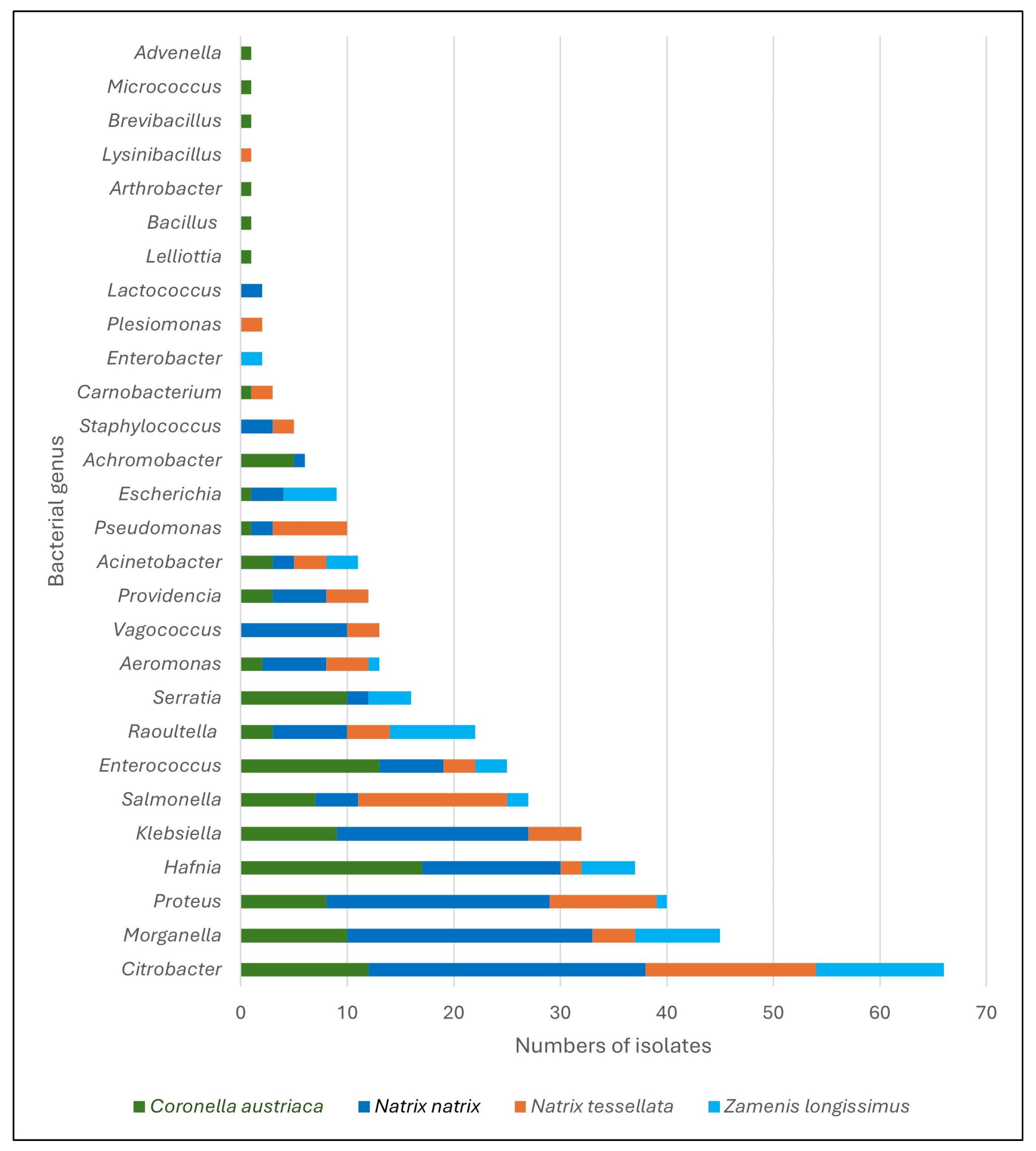
Figure 1. Genera of bacteria from cloacal swabs from wild snakes identified using MALDI-TOF MS (Matrix-Assisted Laser Desorption/Ionization—Time of Flight Mass Spectrometry).
Ijms 26 12018 g001
Figure 2. Distribution of O Antigens (O-Ag) in tested Salmonella from snakes; NN—N. natrix; NT—N. tessellata; CA—C. austriaca; ZL—Z. longissimus; ED—E. dione; NF—N. fasciata.
Ijms 26 12018 g002
Figure 3. Heatmap of log10 CFU/mL values for Salmonella isolates incubated in human serum over time.
Ijms 26 12018 g003
Figure 4. Locations of sampling and numbers of samples collected from each species. Locations near to cities: Wroclaw—location 1, Gogolin—3, Cieszyn—4, Włoszczowa—5, Kraków—6, Teleśnica Oszwarowa—7, Dukla—8 and Babi Loch Lake—2; (*) No snakes were found at location 1 during sampling; (1) H—Swabs collected from captive snakes (private breeders) in Kraków (location no. 6).
Ijms 26 12018 g004
Table 1. Bacterial microbiota from cloacal swabs of tested snakes in Poland identified using MALDI-TOF MS.
Bacterial Species 1Free-Living Snakes
(n = 405)
Kept Snakes
(n = 12)
NNNTCAZLED
Achromobacter xylooxidans1-5--
Acinetobacter calcoaceticus2133-
A. courvalinii--1--
A. lactuace-2---
Advenella inecata--1--
Aeromonas eucrenophila1----
A. hydrophila43---
A. jandaei--1--
A. media---1-
A. veronii111--
Arthrobacter sp.--1--
Bacillus sp.--1--
Brevibacillus sp.--1--
Carnobacterium sp.-1---
C. maltaromaticum-11--
Citrobacter sp.-1-2-
C. braakii10594-
C. freundii151035-
C. gillenii1--1-
Escherichia coli3-15-
Enterobacter cloacae---1-
E. ludwugu---1-
Enterococcus sp.111--
E. faecalis521232
Hafnia alvei132175-
Klebsiella aerogenes1----
K. oxytoca1759--
Lactococcus garviae2----
Lelliottia amnigena--1--
Lysinibacillus fusiformis-1---
Micrococcus luteus--1--
Morganella morgannii2341082
Plesiomonas shigelloides-2---
Proteus sp.-11--
P. vulgaris21681-
P. hauserii-3---
Providencia sp.3-1--
P. rettgerii142--
P. vermicola1----
Pseudomonas aeruginosa171-2
P. mendocina1----
Raoultella ornithinolytica6233-
R. planticola12-4-
R. terrigena---1-
Salmonella enterica 2315626
Serratia fonticola1----
S. liquefaciens1-24-
S. marcescens--7--
Staphylococcus sp.1----
S. sciuri12---
S. warneri1----
Vagococcus fluvialis103---
1 Isolates with scores between 2.000 and 3.000 were considered reliably identified to the species level and are listed accordingly. For scores in the range of 1.700 to 1.999, only genus-level identification was accepted, and species names are not provided in the table; 2 All Salmonella isolates were identified with scores 2.000 or higher; however, due to limitations of the MALDI-TOF MS, all results are reported at the genus level (Salmonella sp.). Our further analyses confirmed that all Salmonella isolated belong to Salmonella enterica (unpublished data); NN—N. natrix; NT—N. tessellata; CA—Coronella austriaca; ZL—Z. longissimus; ED—E. dione.
Table 2. Resistance patterns (RP) of tested Salmonella isolates.
n%SusceptibleResistanceResistant Pattern
2166%AMP-AMC-PIP-TZP-TMO-FEP-CFM-CAZ-CZA-CRO-CXM-CF-ERT-IMP-MER-AZE-CIP-LEV-AK-GEN-TOB-TIG-C-SXT-FOS-NF-RP1
825%AMP-AMC-PIP-TZP-TMO-FEP-CFM-CAZ-CZA-CRO-CXM-CF-ERT-IMP-MER-AZE-CIP-LEV-AK-GEN-TOB-C-SXT-FOS-NFTIGRP2
13%PIP-TZP-TMO-FEP-CFM-CAZ-CZA-CRO-CXM-CF-ERT-IMP-MER-AZE-CIP-LEV-AK-GEN-TOB-TIG-C-SXT-FOS-NFAMC-AMPRP3
13%AMP -PIP-TZP-TMO-FEP-CAZ-CZA-CRO-CXM-CF-ERT-IMP-MER-AZE-CIP-LEV-AK-GEN-TOB-TIG-C-SXT-FOS-NFAMC-CFMRP4
13%PIP-TZP-TMO-FEP-CFM-CAZ-CZA-CRO-ERT-IMP-MER-AZE-CIP-LEV-AK-GEN-TOB-C-SXT-NFAMC-AMP CXM-CF-TIG-FOSRP5
AMP—ampicillin; AMC—amoxicillin/clavulanic acid; PIP—piperacillin, TZP piperacillin/tazobactam; AZE—aztreonam; FEP—cefepime; CFM—cefixime; CAZ—ceftazidime; CZA—ceftazidime/avibactam; CRO—ceftriaxone; CXM—cefuroxime; CF—cephalexin; IMP—imipenem; ERT—ertapenem; MEM—meropenem; TMO—temocillin; AK—amikacin; GEN—gentamicin; TOB—tobramycin; CIP—ciprofloxacin; LEV—levofloxacin; C—colistin; TGC—tigecycline; SXT—trimetoprim/sulfamethoxazole; FOS—fosfomycin; NF—nitrofurantoin.
Table 3. Growth and survival parameters of Salmonella phenotypes in human serum after different incubation time.
PhenotypeParameterT1T2T3
Sensitive(n = 5)Mean CFU/mL ± SD3.94 × 106 ± 5.48 × 1061.18 × 106 ± 1.13 × 1067.28 × 105 ± 4.33 × 10⁵
Median CFU/mL1.14 × 1069.56 × 1057.86 × 105
Mean Survival Rate (%)63.45 ± 84.11%19.81 ± 20.56%12.31 ± 10.09%
Mean number of
Estimated divisions
−3.42 ± 2.27−3.58 ± 1.51−3.42 ± 2.27
Intermediate (n = 1)CFU/mL ± SD2.70 × 1061.82 × 1062.35 × 106
Survival Rate (%)77.14%51.90%67.14%
Number of Estimated divisions−0.37−0.95−0.57
Resistant
(n = 56)
Mean CFU/mL ± SD2.55 × 107 ± 1.80 × 1077.37 × 107 ± 5.97 × 1071.47 × 108 ± 1.02 × 10⁸
Median CFU/mL2.19 × 1075.56 × 1071.33 × 108
Mean Survival Rate (%)>100%>1000%>1500%
Number of Estimated divisions1.68 ± 0.773.11 ± 0.974.15 ± 0.97
CFU/mL—colony forming units per milliliter; SD—standard deviation.
Disclaimer/Publisher’s Note: The statements, opinions and data contained in all publications are solely those of the individual author(s) and contributor(s) and not of MDPI and/or the editor(s). MDPI and/or the editor(s) disclaim responsibility for any injury to people or property resulting from any ideas, methods, instructions or products referred to in the content.