Article

Structural and Proteomic Analysis of the Mouse Cathepsin B-DARPin 4m3 Complex Reveals Species-Specific Binding Determinants


1
Molecular and Structural Biology, Department of Biochemistry, Jožef Stefan Institute, SI-1000 Ljubljana, Slovenia
2
Jožef Stefan International Postgraduate School, SI-1000 Ljubljana, Slovenia
3
Centre of Excellence for Integrating Approaches in Chemistry and Biology of Proteins CIPKeBiP, SI-1000 Ljubljana, Slovenia
4
CytomX Therapeutics, Inc., South San Francisco, CA 94080, USA
5
VIB-UGent Center for Medical Biotechnology, UGent Department of Biomolecular Medicine, 9052 Ghent, Belgium
6
Faculty of Chemistry and Chemical Engineering, University of Ljubljana, SI-1000 Ljubljana, Slovenia
*
Author to whom correspondence should be addressed.
Current address: Biologics Research Center, Novartis Pharmaceutical Manufacturing LLC, SI-1234 Mengeš, Slovenia.
Int. J. Mol. Sci. 2025, 26(24), 11910; https://doi.org/10.3390/ijms262411910
Submission received: 16 October 2025 / Revised: 2 December 2025 / Accepted: 4 December 2025 / Published: 10 December 2025
(This article belongs to the Special Issue Advances in Protein Structure-Function and Drug Discovery)

Abstract

Cathepsin B (CatB) is a lysosomal cysteine protease that plays a major role in various pathologies and is therefore considered a valuable therapeutic target. To address species-specific inhibitor challenges, we characterized the selective binding of designed ankyrin repeat protein (DARPin) 4m3 toward mouse cathepsin B (mCatB) over human CatB (hCatB). The mCatB–DARPin 4m3 complex was validated by size-exclusion chromatography (SEC), nano-differential scanning fluorimetry (nano-DSF), and surface plasmon resonance (SPR), revealing high affinity binding (KD = 65.7 nM) and potent inhibition (Ki = 26.7 nM; mixed competitive/noncompetitive). DARPin 4m3 showed no binding/inhibition toward hCatB. The 1.67 Å crystal structure of the complex—the first for mCatB—identified key interaction residues (e.g., I65/Q66 in mCatB vs. S65/M66 in hCatB) conferring selectivity. Proteomic analysis of endogenous substrates using a support vector machine (SVM) revealed greater similarity between mCatB and hCatB cleavages (Area Under the Curve (AUC) = 0.733) than between mCatB and other human cathepsins (AUC = 0.939–0.965). Clustering and SVM methods offer broadly applicable tools for protease specificity profiling in drug discovery. This study demonstrates the utility of DARPins for species-selective targeting and highlights the importance of integrated structural and proteomic approaches for dissecting protein–protein interactions.

1. Introduction

Cathepsin B (CatB), a lysosomal papain-like cysteine protease, regulates protein turnover and antigen processing. In pathological conditions, such as cancer, arthritis, lung disorders, cardiovascular diseases, pancreatitis and hepatitis, CatB is secreted into the extracellular milieu, where it drives disease progression. Critically, CatB inhibition—through genetic ablation or small-molecule inhibitors—significantly impairs disease progression and severity, establishing it as a high-value therapeutic target, including in cancer and acute pancreatitis [1,2,3,4]. Moreover, an inhibitor against cathepsin B was evaluated in Phase I clinical trials for chronic hepatitis [2], although no results were disclosed.
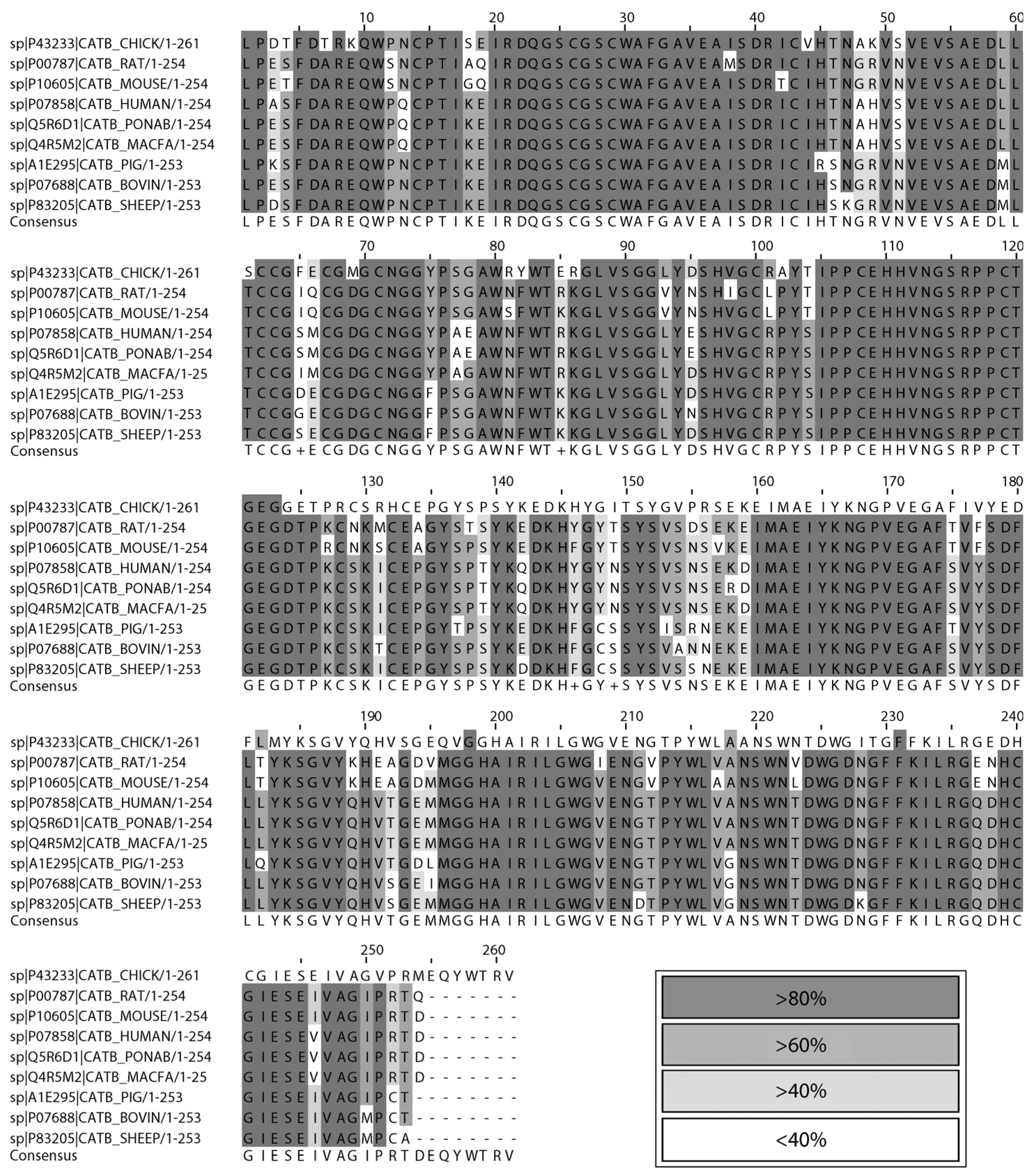
Importantly, species differences may complicate inhibitor development. For example, human cathepsins K [5,6,7,8] and S inhibitors [9,10] show reduced efficacy in rodents due to structural divergence, necessitating the use of costly primate [6,8,11,12] or rabbit models [13,14,15]. Considering these challenges, we investigated whether mouse cathepsin B exhibits similar species-specific divergence that could limit its utility for inhibitor testing. In their mature active forms, human and mouse CatB (hCatB and mCatB) share 83% amino acid identity (Figure A1) and similar biochemical properties, including the Ki value for binding to chicken cystatin and the kon value for binding the irreversible CatB inhibitor CA-074 [16]. Despite these similarities, high-resolution structural data and proteomic comparisons are not available, hampering rational inhibitor design.
Designed ankyrin repeat proteins (DARPins) are antibody mimetics exhibiting extreme selectivity and initially served as cocrystallization chaperones [17]. Using a second generation DARPin library, our lab previously developed DARPins 8h6 and 81 through eight rounds of selection against both mouse and human CatB [18]. These cross-species ligands inhibited both orthologs and enabled successful use in in vivo tumor imaging in a mouse breast cancer model [19]. Building on this work, we have developed DARPin 4m3 to achieve mCatB-specific binding, hypothesizing it would reveal subtle interfacial differences undetectable with cross-reactive tools. Here, we resolve the crystal structure of DARPin 4m3 and mouse cathepsin B complex at 1.67 Å, identify selectivity determinants and compare substrate specificities using proteomics data.

2. Results

2.1. DARPin 4m3 Selectively Binds Mouse and Not Human Cathepsin B

DARPin 4m3 was identified using ELISA screening of clones isolated after four successive rounds of ribosome display selection from the same previously used DARPin library against mouse recombinant CatB [18,19,20] (Figure 1a). Size-exclusion chromatography revealed complex formation between DARPin 4m3 and active mCatB, with an elution peak around 44 kDa (Figure 1b), but no complex formation with hCatB or the inactive mCatB zymogen (mproCatB; Figure 1b). Nano-DSF analysis corroborated binding, showing increased thermal stability of mCatB in the presence of DARPin 4m3 (Figure 1c). At pH 7, mCatB alone aggregated at 37 °C (Tagg), increasing to 53 °C with DARPin 4m3. At pH 6, Tagg increased from 48 °C (mCatB alone) to over 60 °C (complex). Notably, mCatB exhibited greater intrinsic stability at pH 6 than pH 7 regardless of complex formation.

2.2. Binding Affinity and Mode of Inhibition of mCatB by DARPin 4m3

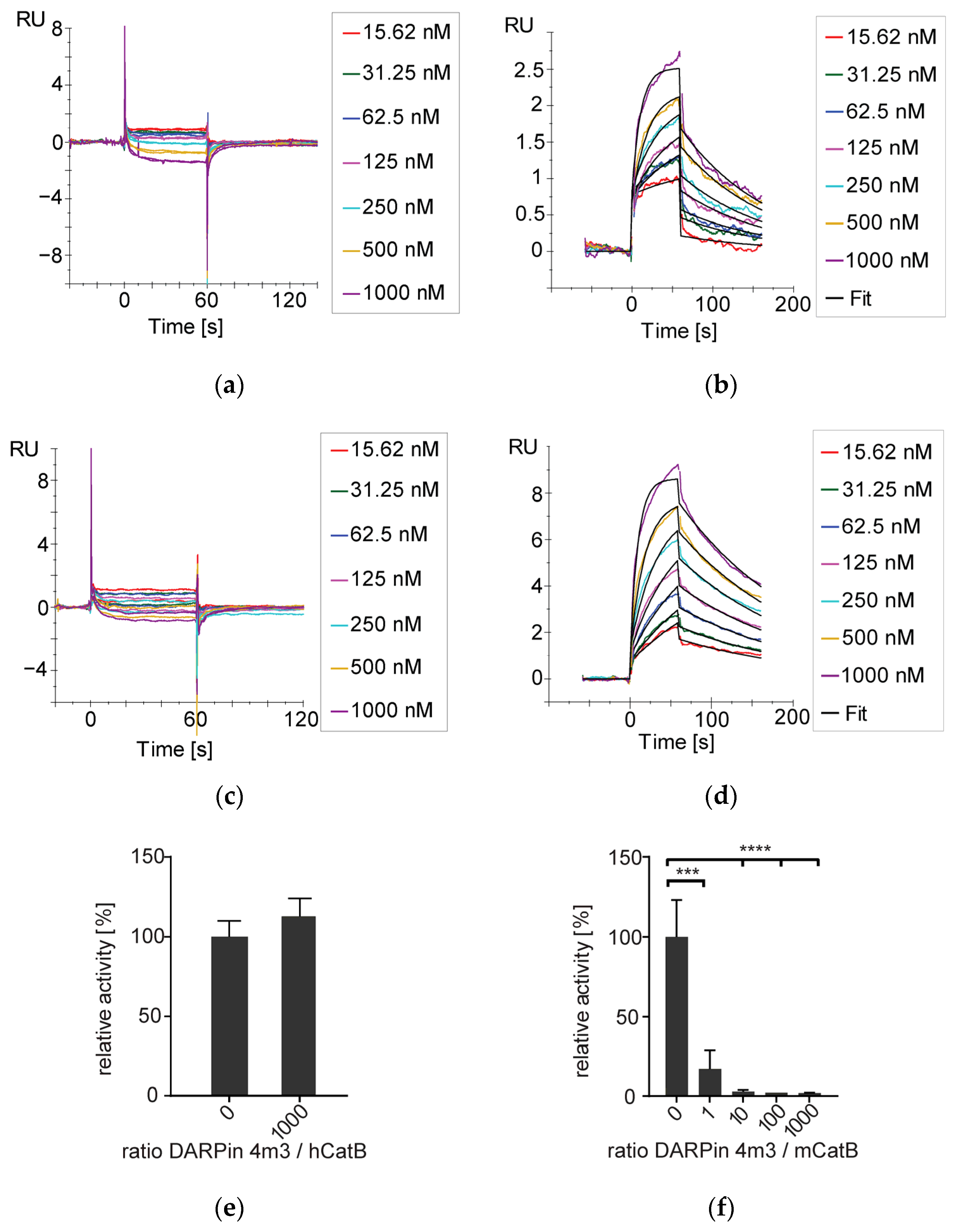
Surface plasmon resonance (SPR) analysis was used to determine the binding affinity of DARPin 4m3 for mCatB. DARPin 4m3 bound to immobilized mCatB at both pH 6 and pH 7, however, showed no interaction with immobilized hCatB (Figure 2). Affinity was slightly higher at pH 6 than pH 7 (KD = 65.7 nM vs. 108.3 nM) (Table 1; Figure 2), in agreement with enhanced complex thermostability at pH 6 observed by nano-DSF (Figure 1c).
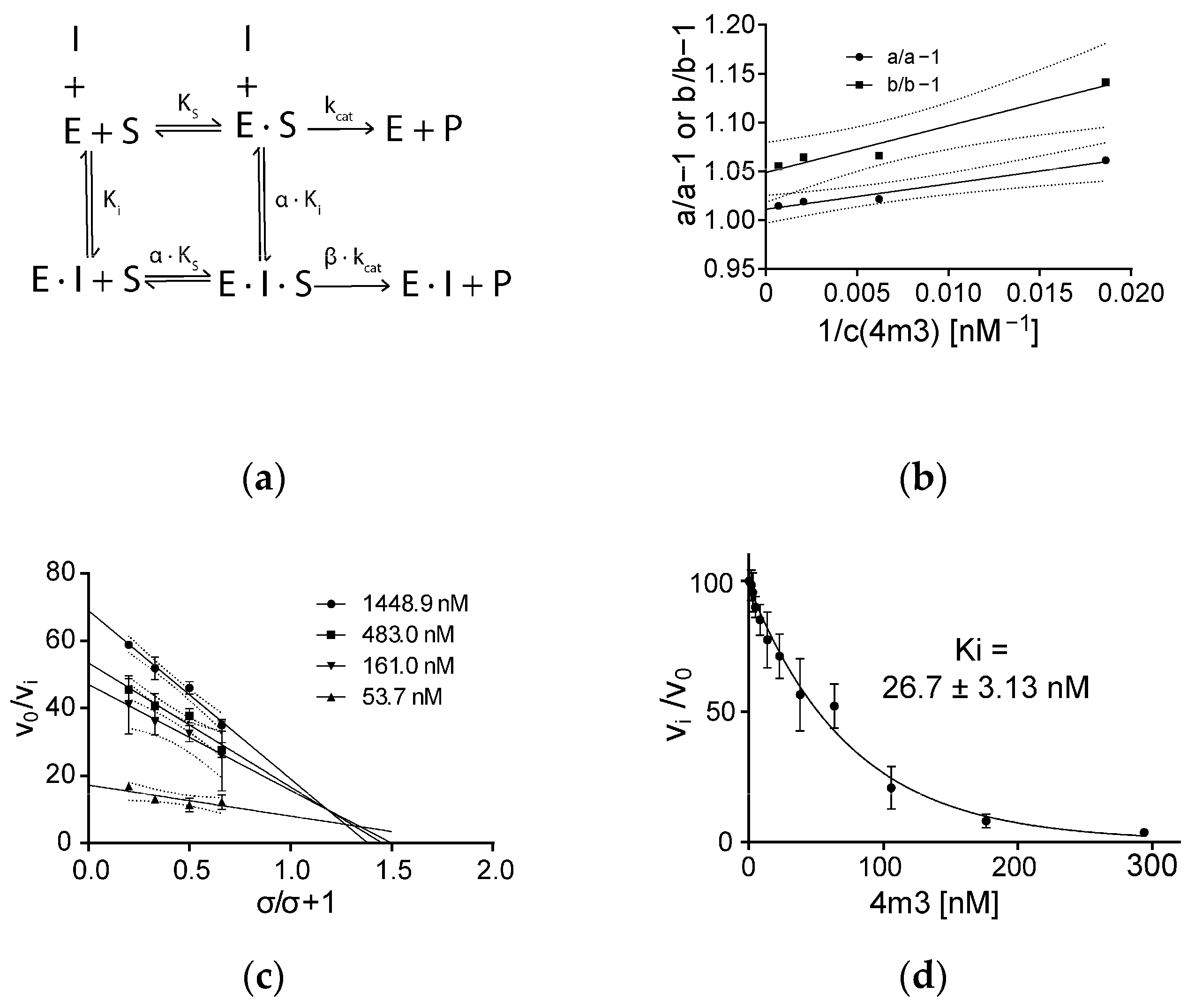
Activity measurements demonstrated that DARPin 4m3 inhibits mCatB, but not hCatB, even at 1000-fold molar excess (Figure 2e,f), aligning with size-exclusion chromatography data. To elucidate the inhibition mechanism, we used the general modifier scheme (Figure 3a–c) [21] and determined the inhibition constant using the equation for hyperbolic mixed-type inhibition (Figure 3d) [22]:
v i = v 0 2 · 1 β 1 + σ α + σ · 1 + σ α + σ · α K i E t + I t E t 1 2 + 4 · 1 + σ α + σ · α K i E t + α + σ + β 1 + σ α + σ β 1 + σ 1 + σ α + σ · α K i E t I t E t
Kinetic analysis revealed hyperbolic mixed-type inhibition (α = 1.77 ± 0.042; and β = 0.047 ± 0.0066; Figure 3c). The parameter α, representing the ratio between competitive to noncompetitive inhibition constants, was greater than 1, indicating predominantly competitive inhibition. This confirms competition between DARPin 4m3 and the substrate z-Arg-Arg-AMC for the binding site. We calculated a competitive Ki of 26.7 ± 3.13 nM (Figure 3d) and, using α, a noncompetitive Ki of 47.25 nM. The parameter β represents the ratio of the turnover rate of the inhibited enzyme to that of the uninhibited enzyme. A β value greater than 0 indicates residual catalytic activity in the enzyme–inhibitor complex, albeit at reduced turnover rates.
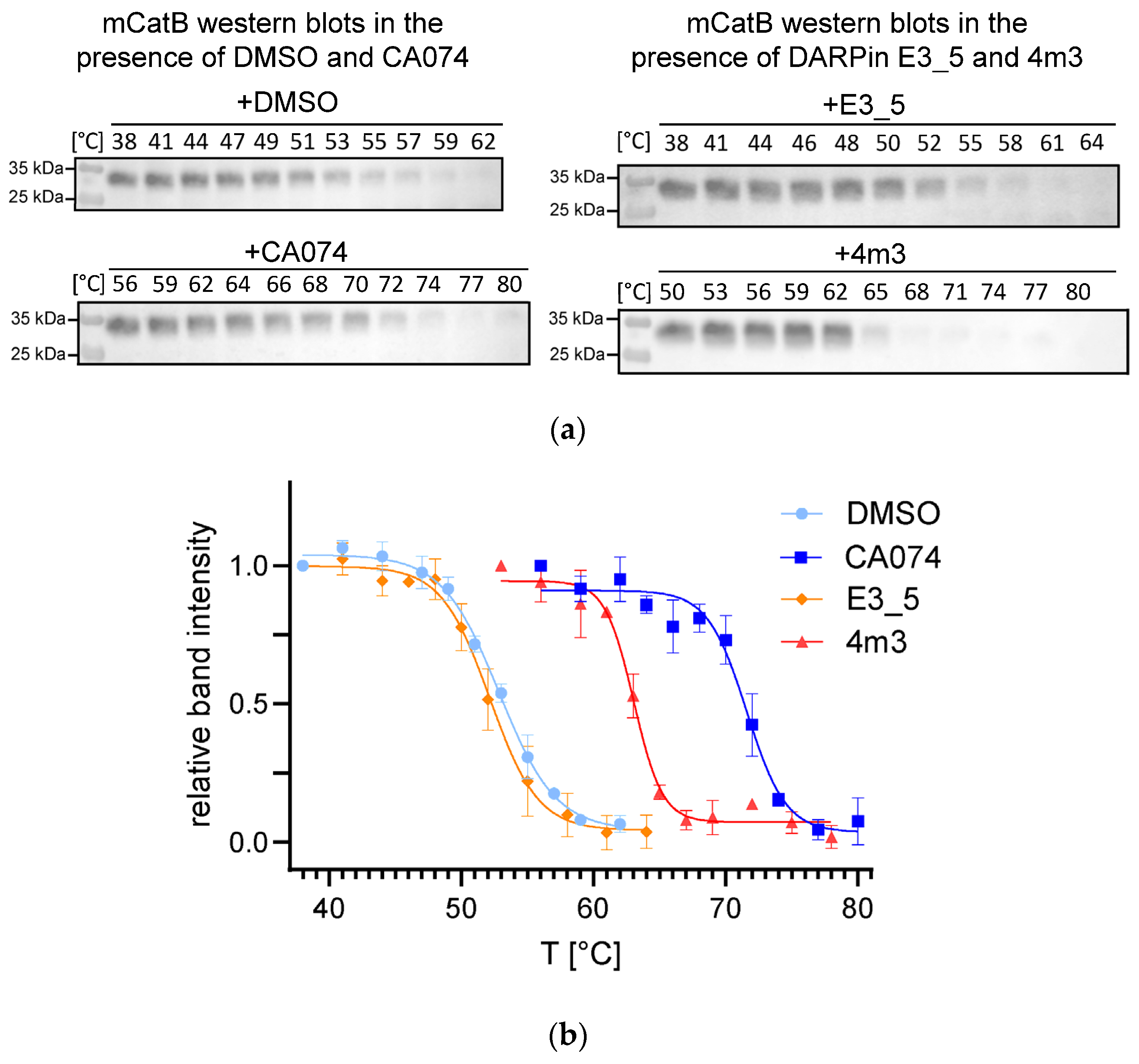
Further, we performed cellular thermal shift analysis (CETSA) in RAW 264.7 cell llysates, a mouse macrophage cell line, which is known to express high levels of CatB to evaluate DARPin 4m3 binding to endogenous mCatB. DARPin 4m3 successfully stabilized mCatB, increasing its apparent aggregation temperature (Tagg) from 52.1 ± 0.6 °C (negative control: DARPin E3_5, specific for maltose-binding protein [23] to 62.9 ± 0.5 °C (Figure 4b, Table 2). Western blot quantification using ImageJ [24] confirmed stabilization comparable to the positive control CA-074 (an irreversible CatB-selective E-64 analog; Tagg = 71.6 ± 0.9 °C), while DMSO (52.9 ± 0.6 °C; solvent control) and DARPin E3_5 showed no such effect (Figure 4a, Table 2).

2.3. Crystal Structure of the Mouse Cathepsin B–DARPin 4m3 Complex

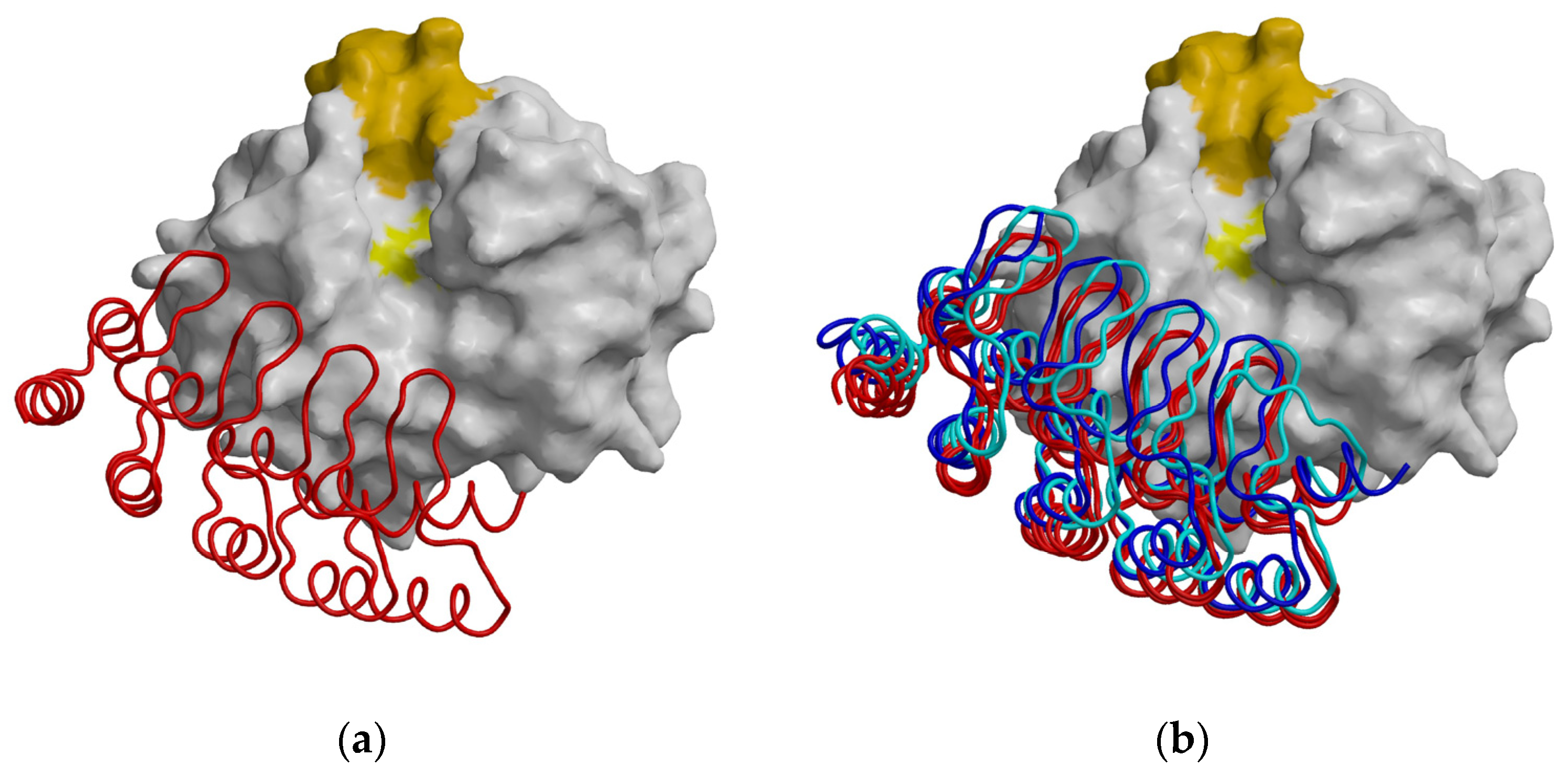
To elucidate differences in DARPins binding between human and mouse cathepsin B, we determined the crystal structure of mCatB in complex with DARPin 4m3 at 1.67 Å resolution (Figure 5a). The complex crystallized in the orthorhombic space group P212121 with two complexes per asymmetric unit. The structures include residues L1–D254 of mCatB and D2–A160 of DARPin 4m3. Superimposition of Cα atoms yielded RMSDs of 0.37 Å (mCatB monomers), 0.39 Å (DARPin 4m3 molecules), and 0.65 Å (full complexes), indicating only minor crystal-packing effects. For comparison, hCatB monomers (PDB: 1HUC) superimpose with 0.41 Å. Pairwise RMSDs between mCatB and hCatB (0.57–0.64 Å; 83.0% sequence identity) reveal subtle structural differences. Table A1 shows the diffraction data and refinement statistics. Table A2 presents a summary of the results from pairwise structural alignment of complexes between cathepsins B and DARPins.

2.4. Structural Comparison of the Cathepsins B, DARPins and Their Complexes

To visualize binding similarities and differences, we superimposed all available DARPin–CatB complex structures (PDB: 5MBM; 5MBL) onto the first pair of molecules in the mCatB–DARPin 4m3 complex. The DARPin molecules revealed overall similar positioning with solvent-exposed catalytic sites, though subtle differences were evident (Figure 5b). Specifically, the mCatB–DARPin 4m3 and hCatB–DARPin 8h6 complexes shared analogous orientations at the interdomain interface of the enzyme and L-domain surface, maintaining exposure of the Cys–His catalytic dyad (Figure 5b).
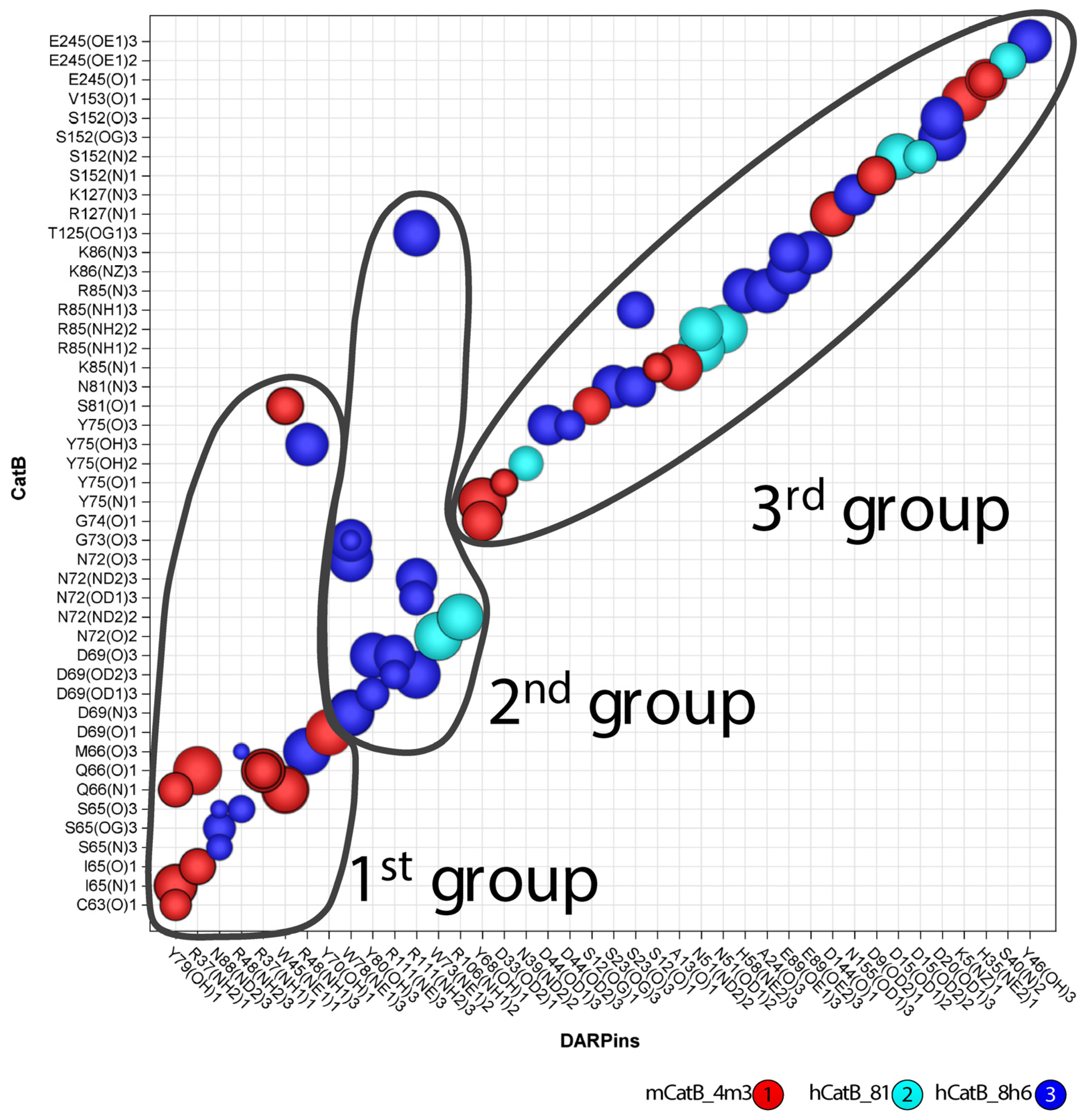
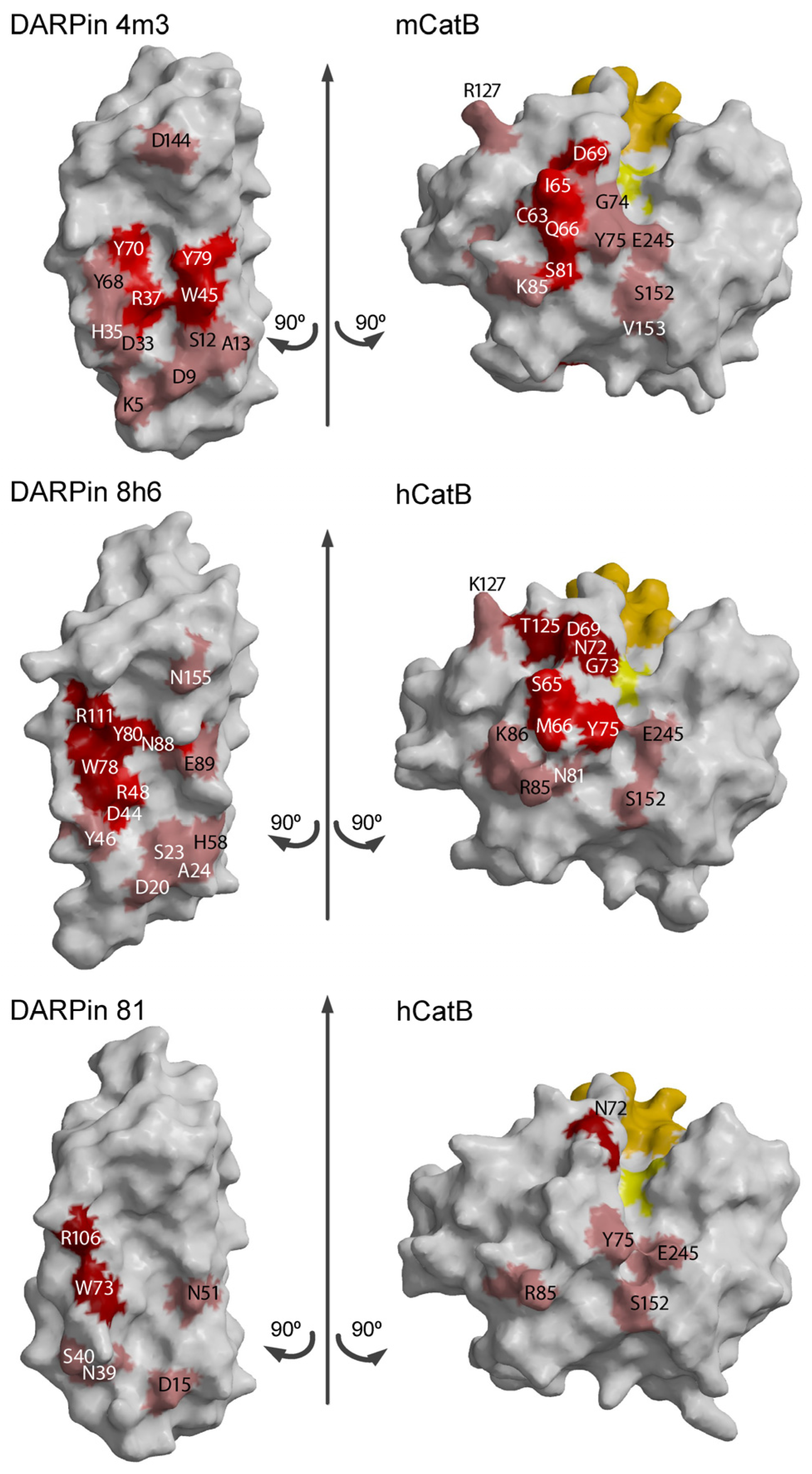
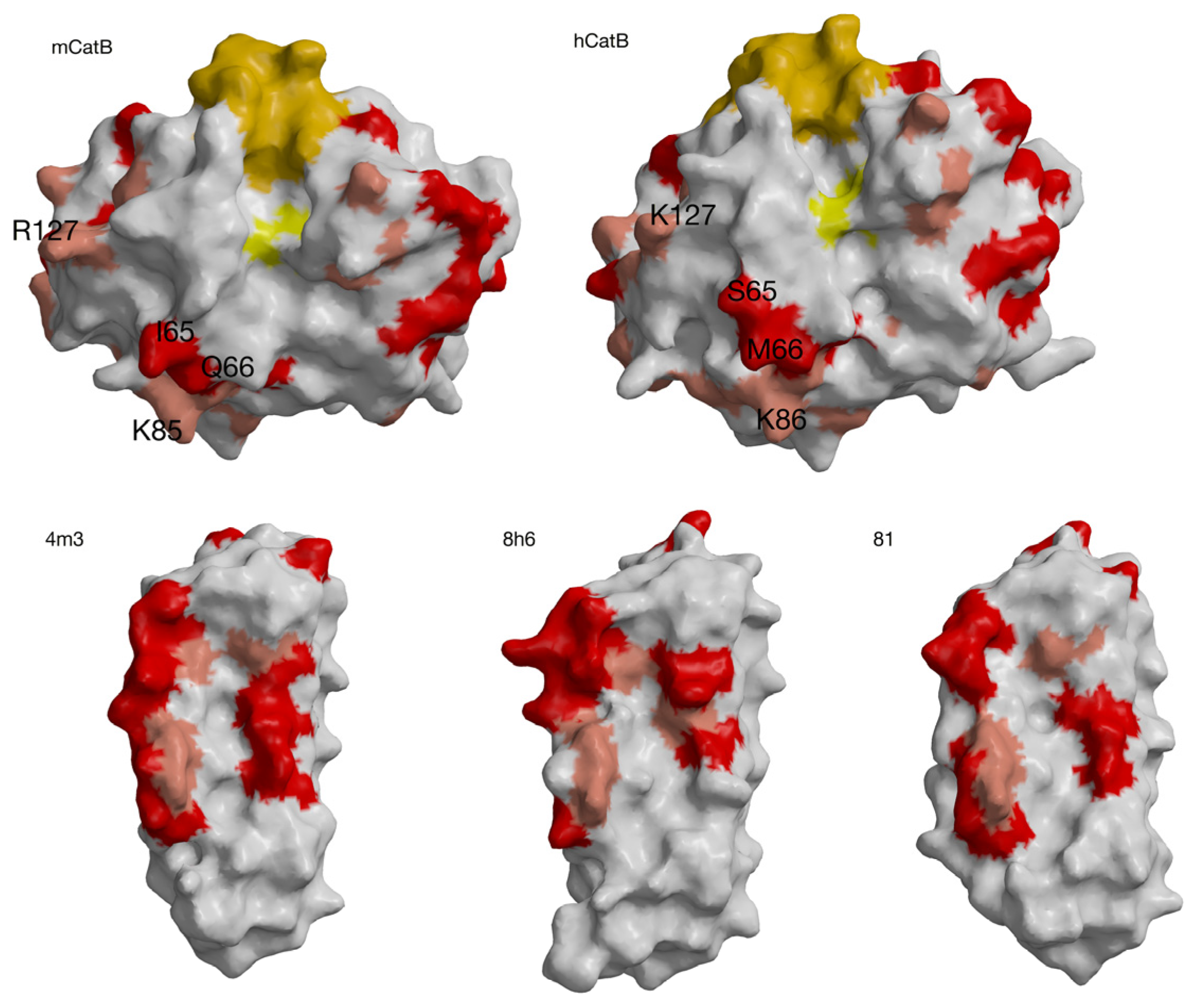
To map interface differences, we created a 2D interaction table comparing DARPin binding across species. While 11 residues in mCatB and hCatB interacted with 11 residues in DARPin 4m3 and 8h6, only 6 hCatB residues interacted with 6 residues in DARPin 81. Color coding revealed three interaction groups (Figure 6). Group 1 (shared between mCatB/hCatB and 4m3/8h6) featured key mCatB residues C63, I65, and Q66 binding DARPin 4m3 Y79, R37, and W45, respectively, while in hCatB, S65 and M66 interacted with DARPin 8h6 N88 and R48. Position 66 thus showed additional divergence (mCatB Q66 vs. hCatB M66). Group 2 (exclusive to hCatB with 8h6/81) involved hCatB N72 interacting with DARPin 8h6 R111 and DARPin 81 W73, R106, plus hCatB G73 and T125 binding DARPin 8h6 W78 and R111. Group 3 contained nearly identical residues conserved across all complexes.
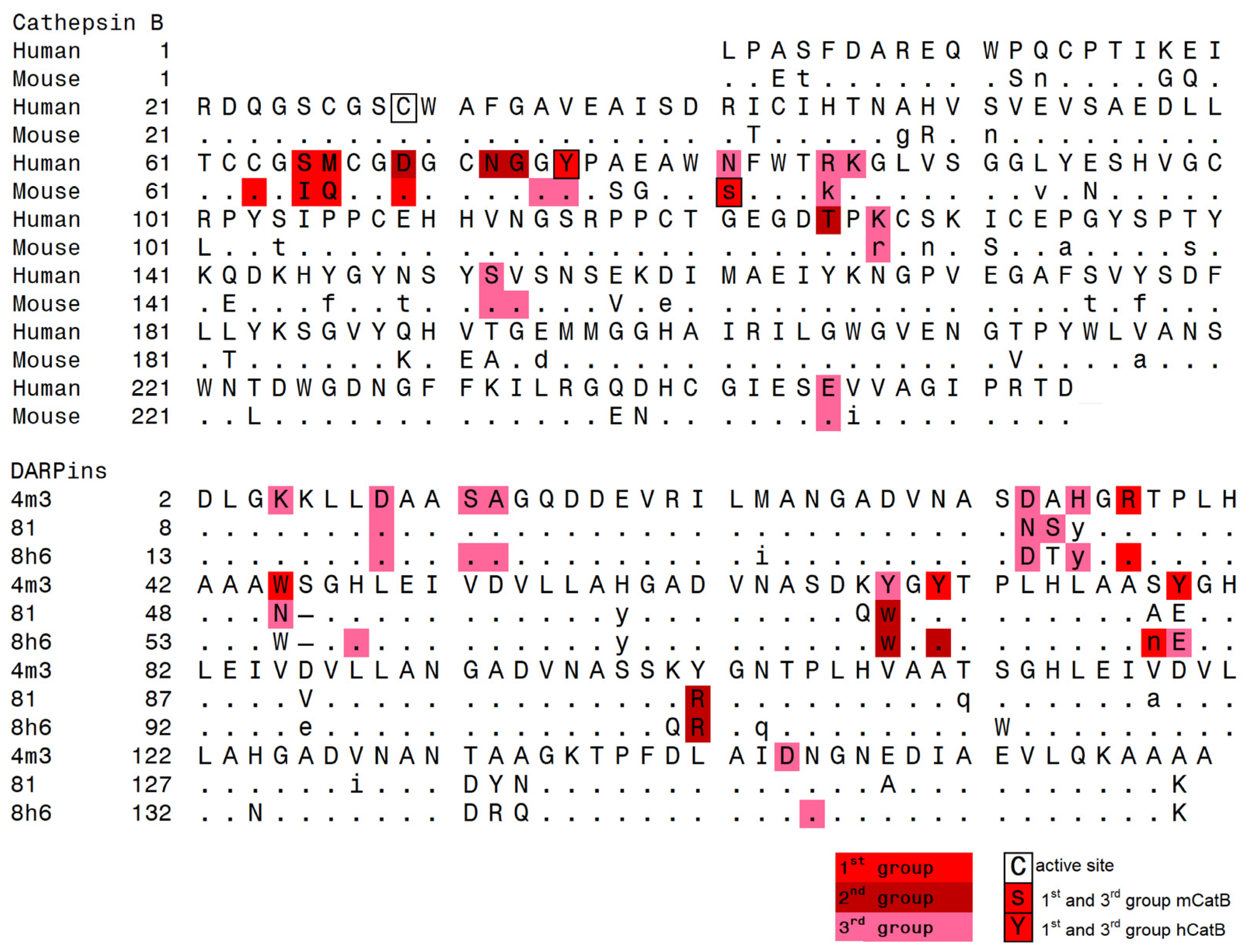
To correlate interaction interfaces with sequence divergence, we mapped the interacting residues onto a sequence alignment of mouse and human CatB (Figure 7), color-coding them by interaction group (shades of red). The primary contact region (residues S66 to K87 in hCatB and C63 to K86 in mCatB) coincided with the area of greatest sequence divergence. Only minor sequence differences occurred outside this interface. Consistent with the interaction differences analysis (Figure 6), the most significant variations occurred at positions 65 and 66: Ile and Gln in mCatB versus Ser and Met in hCatB. Notably, hCatB N72 formed contacts with DARPin 8h6 R111 and DARPin 81 residues W73 and R106. These interactions were absent in mCatB, where tyrosine (Y101) in DARPin 4m3, a smaller residue compared to R111 in DARPin 8h6 or R106 in DARPin 81, occupies the structurally equivalent position (Figure 7).
To assess the impact of the I65/Q66→S65/M66 substitution on the mCatB-DARPin 4m3 interface, we performed protein–protein docking simulations using ClusPro 2.0 [27]. Both wild-type and mutant complexes were docked under identical conditions. Analysis of the top-ranked docked complexes revealed minimal changes in interfacial hydrogen bond networks upon mutation (Table A6 and Table A7). However, we observed slight differences in ClusPro docking scores, particularly when the interaction region was not specified (average difference 0.5, standard deviation 4.6; Table A5, IDs 1358636 & 1358637), with larger differences noted when the interaction region was specified (average difference 1235.8, standard deviation 52.8; Table A5).
Interaction energies, including van der Waals and electrostatic interactions, were also calculated for our complex and for the four top-ranked ClusPro docking models of both wild-type and mutated mCatB (Table A8) using MAIN [26]. Our complex showed interaction energies of −425.3554 (molecules A/B) and −538.8692 (molecules A2/B2). For the mCatB wild-type complex, the lowest total energy (−344.8188) was obtained with the 006_00 docking model (docking ID 1357926), representing a difference of −80.5366 and −194.0504 compared to the A/B and A2/B2 models, respectively. The lowest energy (−748.2675 energy unit) was obtained with the 000_00 docking model. For the mutated mCatB complex, the lowest energy (−416.8979) was obtained with the 000_00 docking model (docking ID 1357923), while the 002_00 docking model yielded the highest energy (−548.9533).
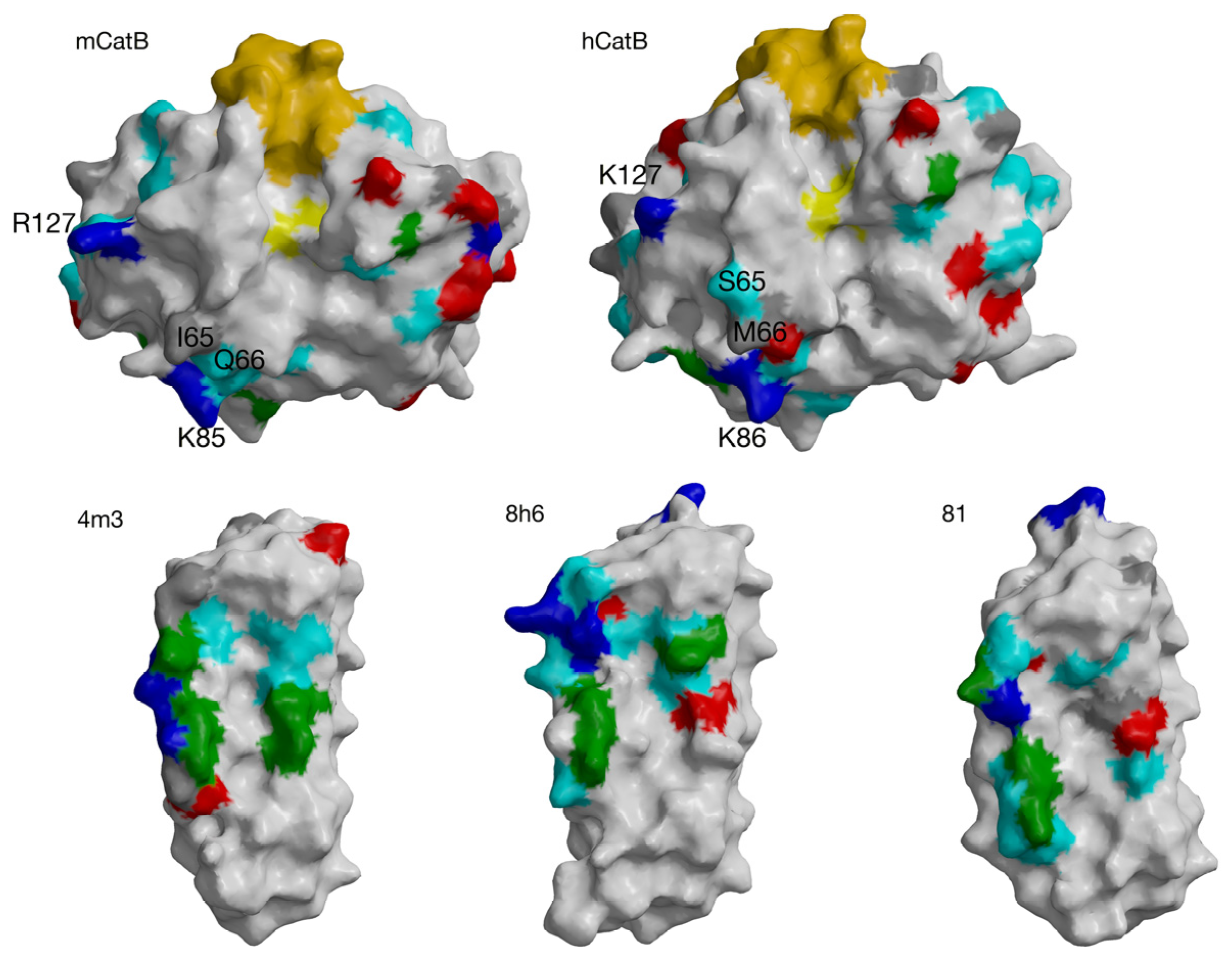
These analyses suggest the I65/Q66→S65/M66 substitution induces subtle changes in the energetic landscape of the DARPin interaction (Figure A2 and Figure A3). The substitution of hydrophobic/polar residues to polar/hydrophobic residues may contribute to local structural divergence near the active site but does not appear to be a primary determinant of DARPin binding energetics. While docking simulations [27] and MAIN calculations [26] provide estimates of binding affinity and are not equivalent to experimental determination of interaction constants, these in silico analyses support the hypothesis that the I65/Q66/S65/M66 residues contribute to the energetic stability of the DARPin interaction.
Rotating the structures of the complex by ±90° with minor spatial adjustments visualizes the interaction groups by mapping their color codes from Figure 7 onto the molecular surfaces (Figure 8).

2.5. Substrates as Indicators of Differences Between Mouse and Human CatB

To compare the specificity between mouse and human CatB, we performed mass spectrometry analysis of MEF cell lysates treated with mCatB using the same approach as before. The data for human cathepsins K, V, B, L, S, and F were also taken from the same study [29].
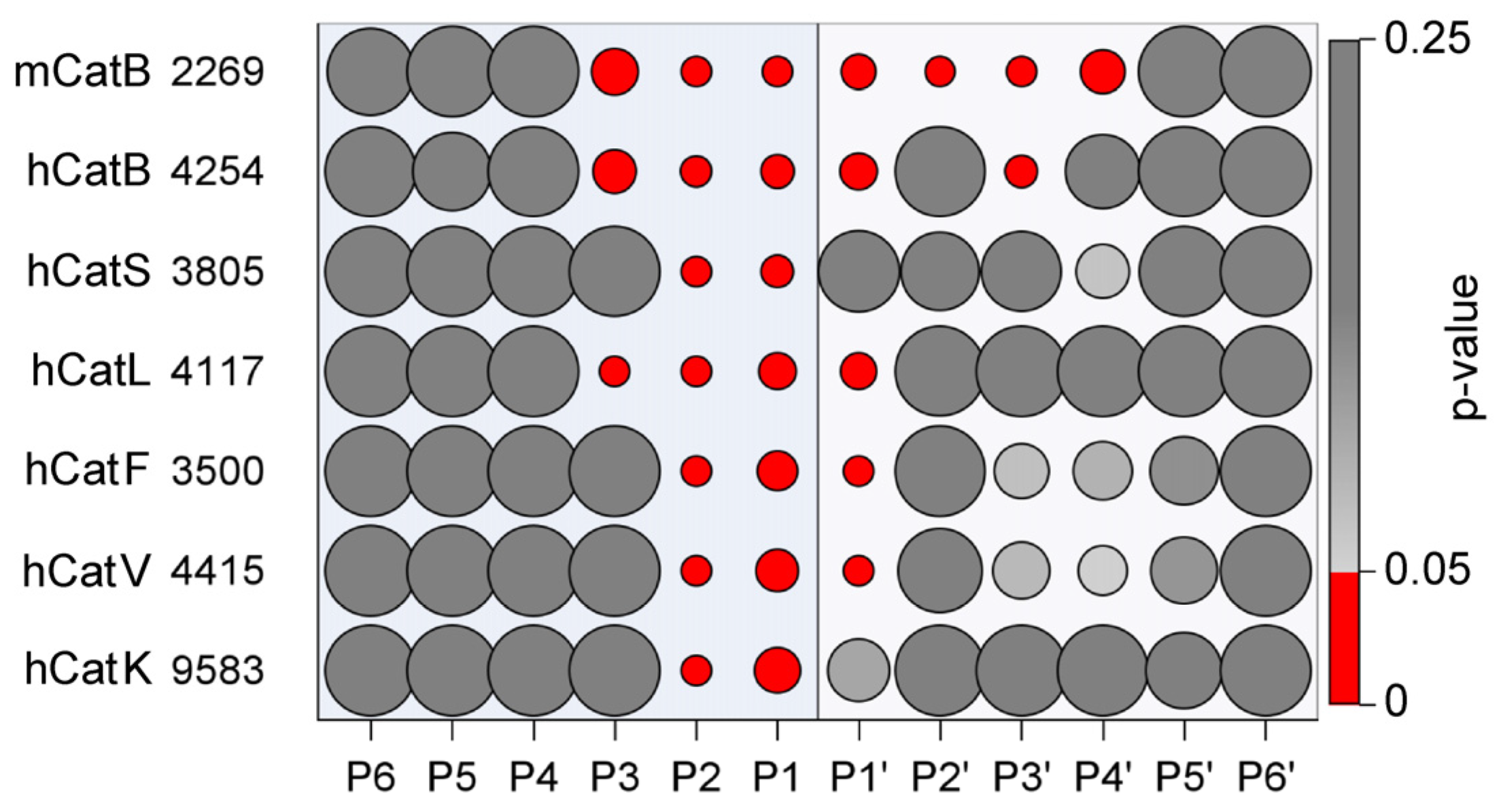
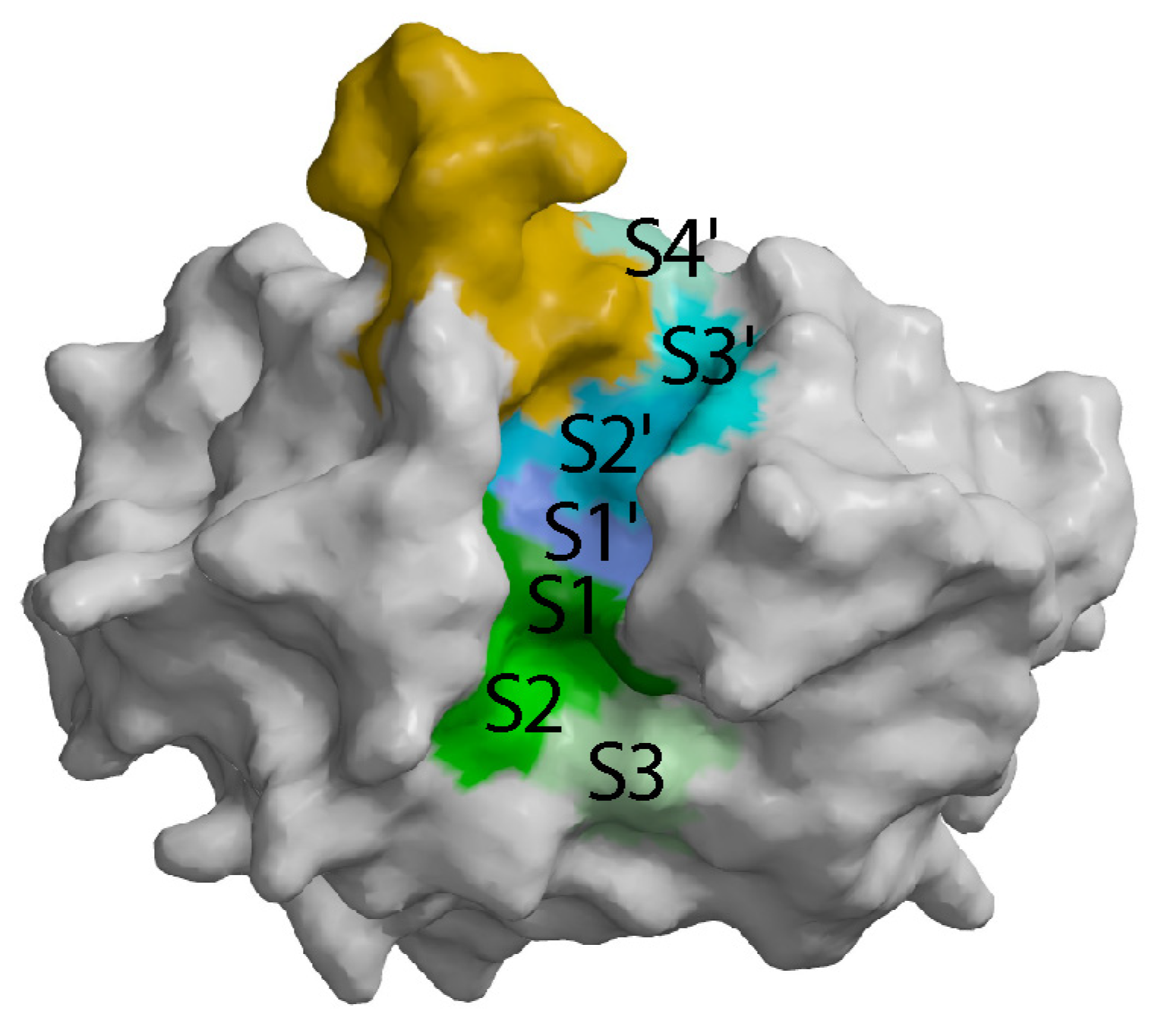
The peptides/substrates data were then analyzed using Schechter-Berger nomenclature. The Anderson–Darling test revealed non-normal residue distributions (heterogeneous positions) at 7 substrate positions (P3–P4′) for mCatB (Figure 9; visualized structurally in Figure A5), compared to 5 positions for hCatB. This suggests mCatB engages more substrate-binding subsites during catalysis.
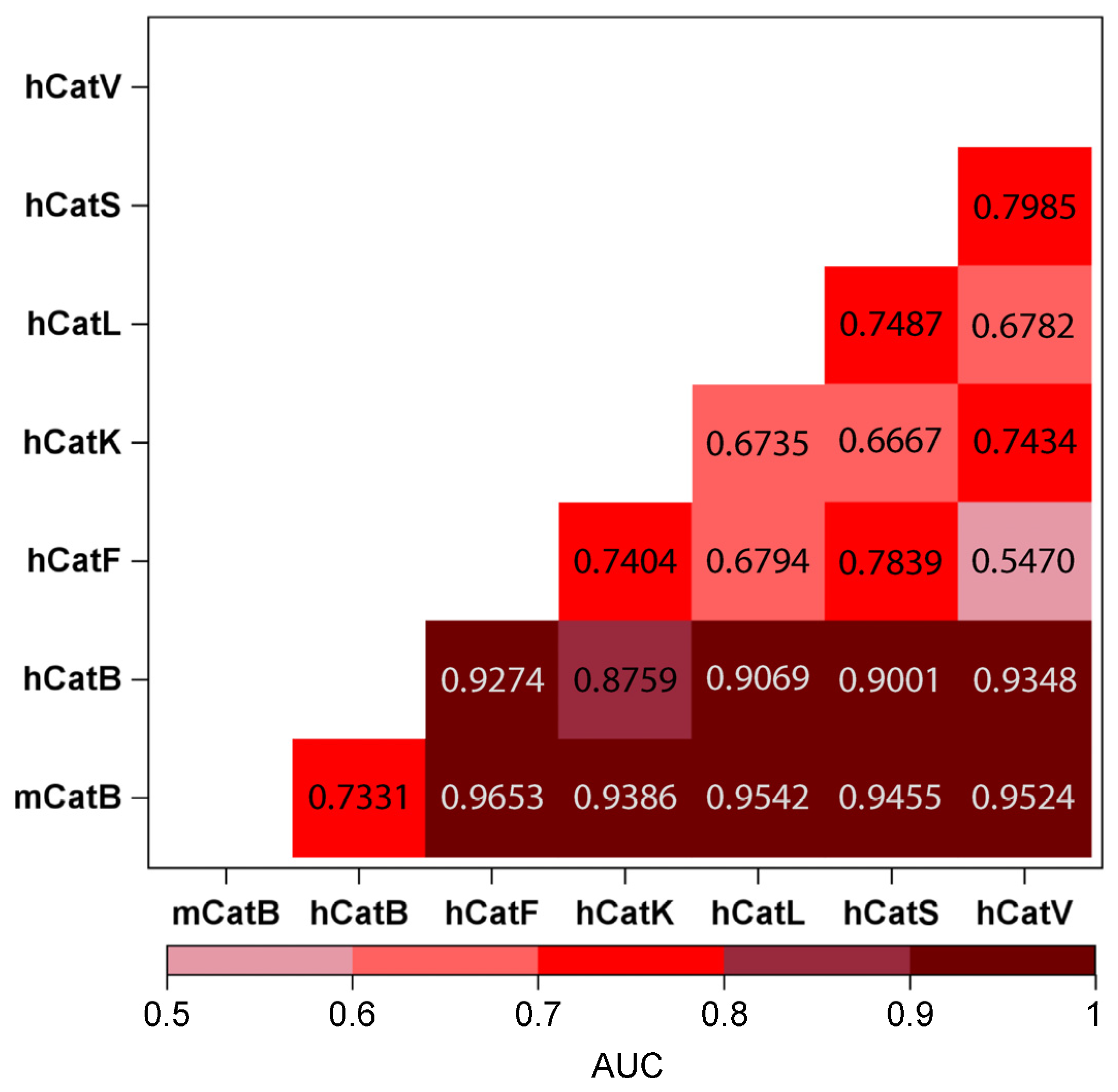
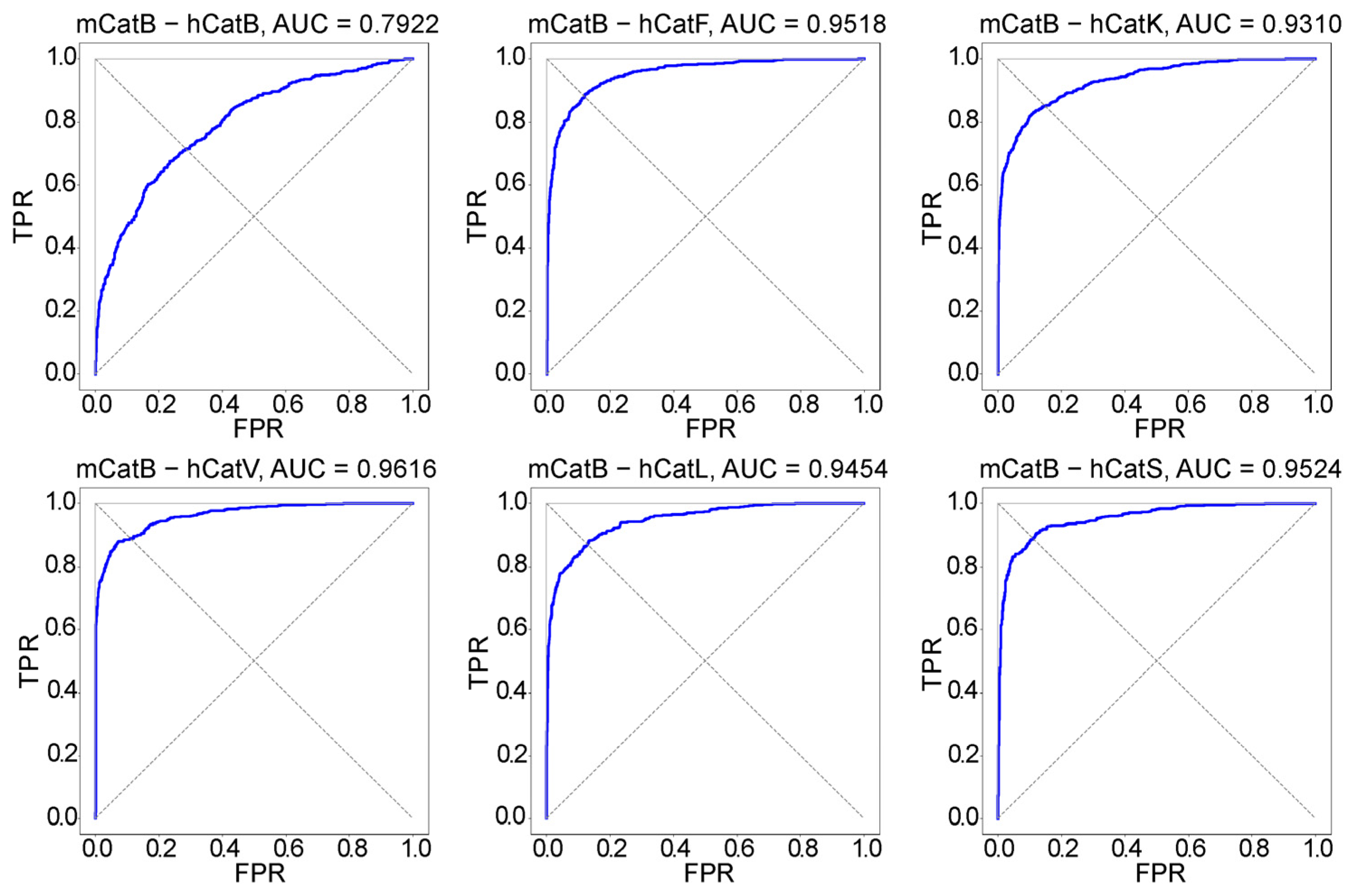
In our previous study, we used Support Vector Machine learning algorithms to predict cleavage sites by differentiating cleaved and non-cleaved sequences [29]. Modeled performance was quantified using the area under the Receiver Operating Characteristic curve (AUC-ROC). Here, we repurpose AUC as a similarity metric for pairwise comparisons of cathepsin cleavage datasets for a different goal: Discrimination of two datasets. The AUC values for pairwise comparisons of substrate cleavage data sets across cathepsins were thus calculated by selecting different ranges of positions: P3–P4′ (Figure 10, Table A3), P4–P4′ (Figure A4, Table A3), and P15–P15′ (Table A3). The differences between the peptides of mCatB vs. hCatB and human cathepsins K, V, L, S, and F are most obvious when positions P3–P4′ and P4–P4′ are considered (Table A3). The lower AUC values indicate greater similarity between two data sets (reduced discriminative power), while higher AUC values reflect greater dissimilarity (enhanced discriminative power). The color gradient (light pink towards maroon red shades) represents increasing dissimilarity (higher AUC). Mouse and human CatB datasets showed strong similarity (AUC = 0.73), yet they remained distinguishable from each other and formed a distinct cluster relative to the datasets of other cathepsins (Figure 10). Notably, hCatV and hCatF data sets exhibited highest similarity (lowest AUC, light pink).
The discrimination of mCatB and hCatB cleavage sites encouraged us to seek substrates specific to hCatB or mCatB. To identify species-specific substrates, we clustered the combined cleavage data sets. Using a maximum of 400 clusters, we obtained 22 clusters containing 227 substrates (Supplementary Data S1). These included 18 clusters (218 substrates) specific to hCatB and 4 clusters (9 substrates) specific to mCatB (Table A4). The hCatB-specific substrates represented 161 unique protein sequences, including actins, tubulins, kinases, ribosomal proteins, histones, and nucleolar proteins (Supplementary Data S1). This further supports the idea that mouse and human cathepsin B do not have entirely identical physiological roles, although the differences in substrate list may in part reflect the different types of cell lines used in the proteomic analysis—mouse embryonic fibroblasts (MEFs) vs. human neuroblastoma cell line (SH-SY5Y).

3. Discussion

Cathepsin B has been one of the most studied human cysteine cathepsins, especially after it was found to be linked with cancer and arthritis. In addition to its direct therapeutic potential, the enzyme was widely targeted for prodrug and antibody–drug conjugate activation [30,31,32,33] and evaluated for diagnostic imaging as well as for target for targeted drug delivery in cancer animal models [1,2,19]. However, despite a vast amount of information about human cathepsin B [34,35,36], little is known about mouse cathepsin B [16], including a detailed comparison of cross-species efficacy.
To address this gap, we determined the crystal structure of mCatB bound to the inhibitory designed ankyrin repeat protein (DARPin) 4m3. This highly potent and selective inhibitor exhibits nanomolar affinity for mCatB but no detectable binding to hCatB, demonstrating that species-specific targeting is achievable despite high structural similarity. DARPin 4m3 also had a greater stabilizing effect (Figure 1c) and greater affinity (Figure 2b,d) for mCatB at pH 6 than at pH 7, which agrees with an earlier study that showed large pH-induced structural changes already at pH 7.4 and 37 °C [37]. Structure analysis reveals DARPin 4m3 binds adjacent to but does not occlude the mCatB active site cleft, mirroring the binding mode of DARPins 8h6 and 81 on hCatB. Consistent with this, kinetic studies indicate hyperbolic mixed-type inhibition (Figure 3b,c), where the inhibitor-bound enzyme retains partial catalytic activity toward small substrates like z-RR-AMC that can enter the cleft and be processed. Similar inhibition mechanisms occur with DARPins 8h6 and 81 targeting hCatB and DARPin AR_F8 targeting caspase-2 [19,38].
DARPin 4m3 binding contacts occurred at the regions which were most different between mCatB and hCatB, indicating that the engineering of the selectivity of DARPin 4m3 addressed the most potent region of the differences (Figure 7 and Figure A1). Notably, three distinct interaction groups at the DARPin interface (Figure 6) explain the high selectivity of 4m3, highlighting the potential of DARPin scaffolds to exploit subtle ortholog differences. While active site subsites show identical residues (Figure A2 and Figure A3), substrate specificity analysis via SVM-based machine learning reveals divergent cleavage preferences between mCatB and hCatB, albeit with greater mutual similarity (AUC = 0.73 than CatL or CatV (AUC = 0.82–0.89) (Figure 10). This aligns with their closer phylogenetic relationship [39]. Clustering identified species-specific cleavage patterns (Supplementary Data S1), offering a pathway for developing selective substrates. This approach could extend to other proteases, pending broader proteomic data sets.
Collectively, mCatB and hCatB show sufficient functional divergence to warrant careful preclinical model selection. Our mCatB structure enables rational design of murine-specific probes and inhibitors [40], facilitating translational research. Critically, species-selective inhibitors like DARPin 4m3 can dissect host-derived CatB roles in xenograft tumor models [3,41], distinguishing tumor-cell versus microenvironmental contributions [42,43]. Thus, while mCatB remains valuable for human CatB research, its differences necessitate context-specific validation.

4. Materials and Methods

4.1. Expression and Purification of Recombinant Proteins

DARPin 4m3 was selected using four rounds of ribosomal display against mouse cathepsin B, as previously described [19]. For expression, the DARPin 4m3 sequence was cloned into the pET22b+ vector. Due to degradation issues during expression, the 6×His-tag was relocated to the C-terminus. The Rosetta gami B(DE3)pLysS strain was transformed using this construct. Cultures grew in Terrific Broth with appropriate antibiotics at 37 °C until OD600 reached approximately 1.5. Flasks were then transferred to 4 °C for 15 min, and expression was induced by the addition of 1 mM IPTG. Expression was then continued at 18 °C for 20 h and 300 rpm.
Sample preparation for Ni-NTA chromatography followed established protocols for cathepsin purification [44]. Ni-NTA purifications were followed by size-exclusion chromatography on a Superdex 75 column in 20 mM HEPES, 200 mM NaCl, pH 7.4.
Human and mouse CatB were expressed as soluble proteins in Escherichia coli strain Rosetta gami B(DE3)pLysS, as previously described [44]. The enzymes were then active-site titrated using the broad-spectrum cysteine cathepsin inhibitor E64 as described earlier [45].

4.2. Inhibition Assay

We measured the activity of human and murine CatB toward the substrate z-RR-AMC in the presence of DARPin 4m3. Enzyme solutions (10 nM each) were mixed with DARPin 4m3 (present at 1- to 1000-molar excess over CatB) and incubated at 37 °C for 15 min in cathepsin activity buffer (100 mM sodium phosphate buffer, 5 mM DTT, 1 mM EDTA, 0.1% PEG6000, pH 6.0) before cathepsin activity was measured in a microplate reader at 37 °C as described before [19].
The inhibition mechanism of DARPin 4m3 against mCatB was determined using the general modifier scheme [21]. The Km of z-RR-AMC for mCatB was determined to be 547.7 µM. The enzyme concentration (mCatB) in the assay was 1 nM, while the substrate and inhibitor concentrations varied. Substrate concentrations (z-RR-AMC) ranged from 135 µM to 1080 µM, whereas inhibitor (DARPin 4m3) concentrations ranged from 53.7 nM to 1448.9 nM.
For inhibition constant (Ki) determination, 1 nM mCatB was incubated with DARPin 4m3 (1.8 nM to 294 nM) for 15 min at 37 °C in cathepsin activity buffer. Initial reaction rates against 700 µM z-RR-AMC were measured and nonlinearly fitted as described by Szedlacsek et al. [22] for the hyperbolic mode of inhibition. This fit can be used as a standard for any mechanism, even in the absence of tight binding conditions. Fitting and graphical analyses were performed using the GraphPad Prism5 for Windows (GraphPad Software, Boston, MA, USA).

4.3. Nano-Differential Fluorimetry Analysis

Protein samples were diluted to 0.5 mg/mL in 100 mM PBS (pH 6 and 7). Measurements were made in the range of 20 to 95 °C with a ramp rate of 1 °C/min by monitoring the intrinsic tryptophan fluorescence absorbances at 350 and 330 nm on Nanotemper Prometheus (NanoTemper Technologies GmbH, München, Germany). The manufacturer’s software calculated the fluorescence intensity ratio and its first derivative (PR.Stability Analysis, v1.1).

4.4. Surface Plasmon Resonance

SPR was performed with Biacore T200 (Cytiva, Marlborough, MA, USA) on CM5 sensor chips. Mouse and human CatB (100 nM) was immobilized on the chip at 30 µL/min until it reached 700 response units (RU). After immobilization, seven different concentrations of DARPin 4m3 were then run over the chip. Results were analyzed using the Biacore T200 Kinetics Summary software (v3.2). Assays were performed in sodium phosphate-buffered saline (20 mM Na-phosphate, 150 mM NaCl) at pH 6 or 7 and 25 °C.

4.5. Analytical Size-Exclusion Chromatography

Analytical SEC was used to check the interaction between DARPin 4m3 and CatB. Samples were diluted in 20 mM sodium phosphate, 150 mM NaCl, pH 7.2. DARPin 4m3 (20 mM) and CatB were mixed in a 2:1 molar ratio, then incubated at approximately 20–22 °C for 10 min and centrifuged at 20,000× g for 10 min. Samples were run at a flow rate of 1 mL/min at room temperature.

4.6. Cellular Thermal Shift Assay

The CETSA was performed as previously described [46]. Briefly, RAW 264.7 cells were pelleted and resuspended in cathepsin activity buffer (100 mM sodium phosphate, 1 mM EDTA, 0.1% PEG 6000, 5 mM DTT, pH 6). The cell suspensions were subjected to three freeze–thaw cycles in liquid nitrogen and centrifuged at 32,000 RCF for 20 min at 4 °C. The protein content of the supernatant was measured using the Bradford assay. Aliquots were treated with 10 µM of the specified analyte and incubated at room temperature for 10 min. Samples were then exposed to a specified temperature in a preheated PCR machine for 3 min, followed by incubation at room temperature for 3 min and then snap-frozen. After thawing at room temperature, samples were centrifuged again at 32,000 RCF for 20 min at 4 °C. The supernatant was transferred to new tubes and analyzed by Western blot using anti-mouse CatB antibodies. Band intensities were quantified using ImageJ software, v1.53k [24]. To obtain apparent aggregation temperatures (Tagg), band intensities were fitted in GraphPad Prism using the Boltzmann sigmoidal equation.

4.7. Structure Determination

The complex of DARPin 4m3 and mouse CatB was formed by mixing at a molar ratio of 3:2 in 20 mM MES, 30 mM NaCl, pH 6, and incubating for 15 min at room temperature. The complex was then purified by size-exclusion chromatography on a Superdex 75pg (Cytiva, Marlborough, MA, USA) at 4 °C with a flow rate of 1 mL/min. The sample was concentrated to approximately 24.6 mg/mL using Amicon Ultra-15 Centrifugal Filter Units (Merck, Darmstadt, Germany) with a cut-off of 10 kDa. Crystals were grown using the sitting-drop vapor method in 0.1 M Bis-Tris, 20% PEG3350, 0.2 M sodium acetate, and pH 6.5. The ratio of protein solution to mother liquor was 2:3 (5 µL drops). The crystals grew for one week. They were then soaked in mother liquor containing 10% glycerol and frozen in liquid nitrogen until data collection. Diffraction data were obtained at the Elettra synchrotron, XRD2 beamline, in Trieste, Italy.
The seven data sets with resolutions ranging approximately from 1.7 to 3.6 Å were collected and processed using XDS software (release 2022, built = 20220220) [47]. The complex structure was solved by molecular replacement with Phaser [48], using PDB ID entry 5MBM as a model. The space group was P212121, and the resolution was 1.67 Å. The data collection and refinement statistics are presented in Table A1. It contains two molecules in the asymmetric unit, referred to as molecules A and B (the calculated RMSDs are presented in Table A1). The MAIN software (release 2025) [26] was used for map calculation, model building, refinement, and validation. For refinement, the maximum likelihood free kick target function (ML) was used, which applies all structural factors instead of part of the test data set to calculate phase error estimates [49]. The CatB–DARPin complex was deposited in the Protein Data Bank (PDB).

4.8. Data Sets of Human Cathepsins K, V, L, S, F, and mCatB Substrates

All the cleavage sites for human cathepsins K, V, L, S, and F were taken from our previous study [29]. The procedure was essentially the same as described earlier, except that mouse embryonic fibroblasts (MEF) were used as a source of mouse proteins. Mouse cells were used to ensure better matching with the mouse protease, as it was shown that substrates and proteases have co-evolved during evolution [50]. Lysates of MEFs were treated with mouse cathepsin B and the cleavages were determined by consecutive reverse phase high-performance liquid chromatography (RP-HPLC) and liquid chromatography–tandem mass spectroscopy (LC-MS/MS) on an LTQ Orbitrap XL or Orbitrap Velos mass spectrometer (Thermo) using the N-terminal combined fractional diagonal chromatography (COFRADIC) protocol. All the cleavage sequences were then identified in the same way as described [29]. In total, 2269 cleavage sites were identified, which is less than for human cathepsin B (4254 cleavage sites).

4.9. Evaluation of Substrate Differences Between mCatB and Human Cathepsins B, K, V, L, S, and F Using Support Vector Machine Algorithm and Clustering

Data analysis was performed using our SAPS-ESI (Statistical Approach to Peptidyl Substrate–Enzyme-Specific Interactions) software platform, developed with Python 3.8 and SAS for Windows 9.4 [29,51]. A total of 2269 cleavage sites were analyzed for mCatB and 4254 for hCatB, while human cathepsins K, V, L, S, and F had 9583, 4415, 4117, 3805, and 3500 cleavage sites, respectively, for comparative analysis. First, the distribution of amino acid residues near cleavage sites was evaluated using the Anderson–Darling normality test. Positions with non-normal residue distribution or heterogeneous positions are marked with small red circles (p-value less than or equal to 0.05) or light gray circles (p-values greater than 0.05 and less than or equal to 0.08) or dark gray (p-values greater than 0.08) when the distribution of residues at specific positions is visualized (Figure 9).
Previously, we used the SVM algorithm to predict the cleavage sites of cathepsins K, V, B, L, F, S, and V based on cleaved and non-cleaved 8-amino-acid-long peptides. Here, we used the SVM algorithm to classify the two groups of cleavage sites of two different cathepsins based on AUC-ROC, a measure of classification performance. This is a graphical representation that illustrates the performance of a binary classification model at different thresholds. A larger AUC indicates the ROC curve of an excellent binary model (ideal at AUC = 1.0) that can perfectly classify two selected groups. Conversely, a smaller AUC below 75% indicates similar groups of cleavage sites of two cathepsins.
Pairwise similarity analyses were performed in Python 3.8 using scikit-learn with a Support Vector Machine (SVM) classifier. Cleaved sequences of mCatB were compared with those of hCatB, hCatK, hCatV, hCatL, hCatS, and hCatF, as well as between selected human cathepsins. For each pairwise comparison, we defined positive and negative datasets. For example, cleaved sequences of mCatB were labeled as positive (code “1”), and cleaved sequences of hCatB were labelled as negative (code “0”).
We examined three sequence regions around the cleavage site—P3–P4′, P4–P4′, and P15–P15′—to identify which range best differentiates cathepsin pairs. Figure 9 illustrates these positions, where red markers indicate positions with residues contributing most to the differences between cathepsins. Specific positions were determined using the Anderson–Darling normality test, identifying positions with reduced amino acid variability (typically one or two predominant residues [29]).
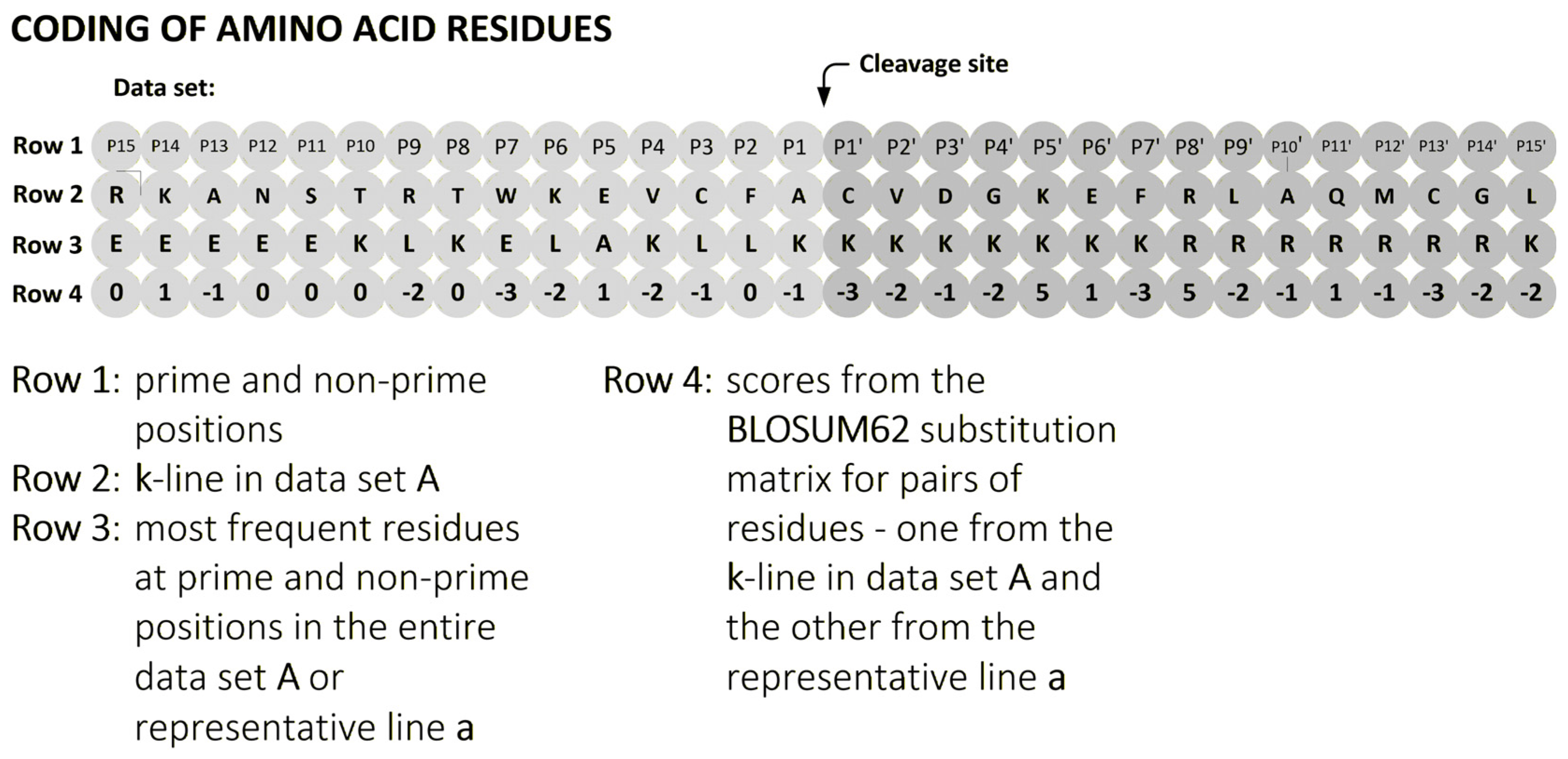
Selected residues were encoded as numerical features using BLOSUM62 substitution scores (Figure A6). Each residue pair (e.g., A vs. K at position P1) was assigned its corresponding BLOSUM62 value.
Model training and validation were performed using a 25-fold jackknife cross-validation approach. In each iteration, 25% of the cleavage sites were reserved for testing, and the remaining 75% were used for training. This process was repeated multiple times with different random splits to ensure that most data points served in both training and testing across iterations. The maximum number of training iterations was 200,000.
SVM hyperparameters were optimized by grid search, testing the following ranges:
  • Regularization parameter C = [0.001, 0.01, 0.1, 1]
  • Kernel = [‘linear’, ‘rbf’, ‘poly’, ‘sigmoid’]
  • Gamma = [‘scale’, ‘auto’]
  • Class weight = [‘balanced’, ‘none’]
  • Jackknife fraction = [0.10, 0.25]
The optimal combination—yielding the highest AUC—was: kernel = ‘rbf’, gamma = ‘scale’, C = 0.001, decision_function_shape = ‘ovo’, tolerance = 0.0001, class weight = ‘balanced’, and jackknife = 0.25.
To ensure robustness, the entire workflow (data splitting, training, and parameter optimization) was repeated multiple times. The AUC (Area Under the ROC Curve) was computed for each run, and the reported values represent the highest AUCs obtained across repetitions.
Model performance was evaluated using ROC curves, with AUC results summarized in Figure A4 for the P4–P4′ region. Table A3 presents AUC values for all analyzed feature sets (P3–P4′, P4–P4′, and P15–P15′). Figure 10 shows pairwise AUC comparisons for the P3–P4′ region, which proved most informative for distinguishing cathepsin cleavage site specificities.
The combined data sets of two cathepsin substrates were also used for clustering, with the main goal being to obtain clusters of substrates from only one of the two cathepsins. The Ward method and the BLOSUM62 substitution matrix were used for classification as previously described [29]. The clustering variables were the specific positions from P3 to P4′. Clustering was performed for a maximum of 400 clusters. The clusters are listed in the Supplementary Data S1.

4.10. Docking

Protein–protein docking simulations were performed using the ClusPro 2.0 server [27]. Mutations were introduced using ChimeraX 1.10 [52], and both wild-type and mutant complexes were docked under identical conditions using ClusPro with and without specified interaction region. The resulting top-ranked docked complexes were further analyzed for interaction energy and hydrogen-bond networks at the interface using the MAIN software [26] and include van der Waals (Lennard–Jones potential) and electrostatic energy of interactions.
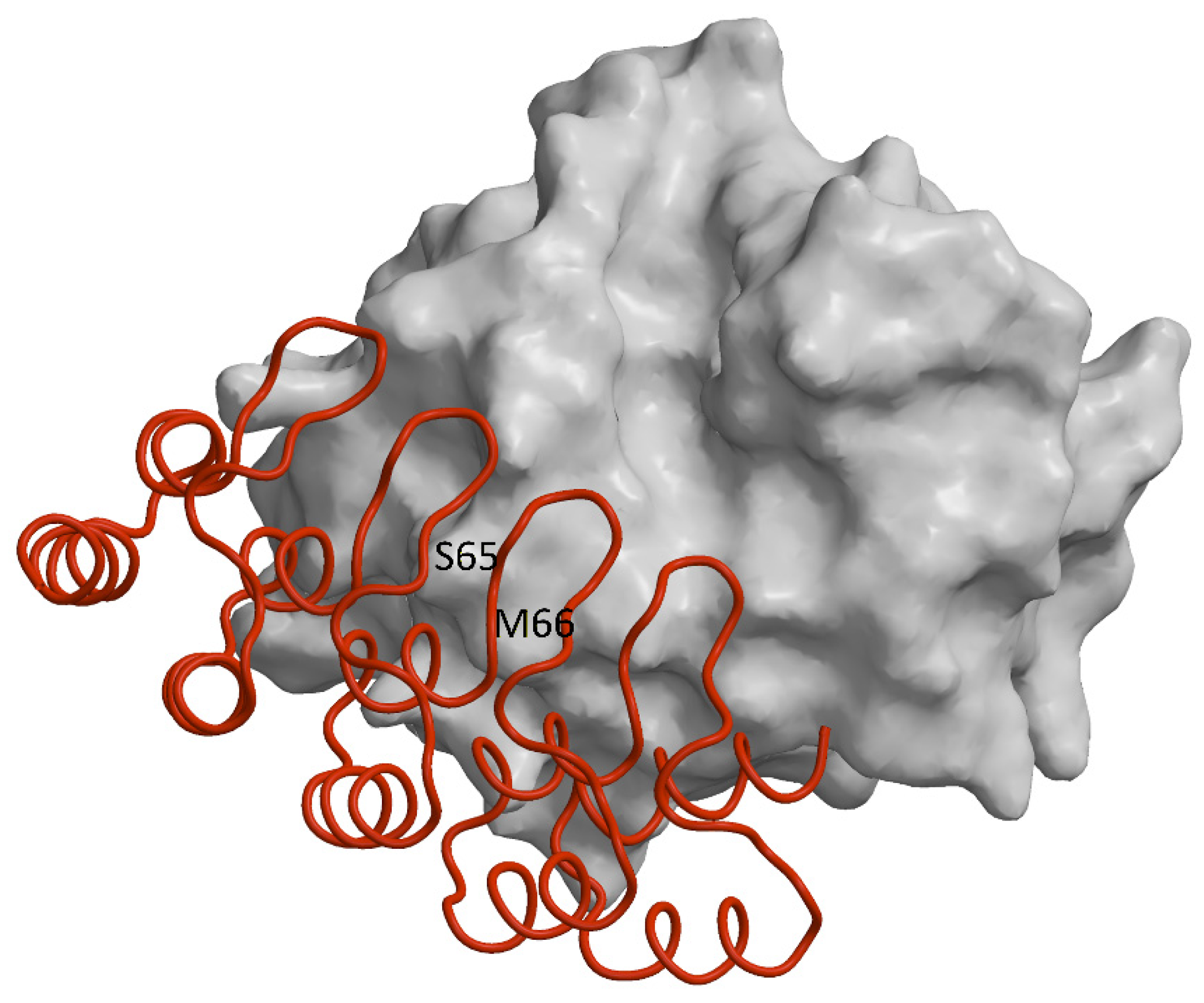
Cluster score from the ClusPro server [27] are presented in Table A5. Dockings with ID numbers 1357923 and 1358636 represent the mutated mCatB complex with DARPin 4m3, with and without specified interaction region, respectively (detailed coefficient weights are provided in Table A7). The “600Eelec” parameter set, known to provide reliable performance for enzyme–inhibitor complexes [27], was used. Docking results were validated using the wild-type complex of mCatB and DARPin 4m3, with (docking ID 1357926) and without (docking ID 1358637) specified interaction region (Table A6). Calculated interaction energies for our complex (molecules A/B and A2/B2), as well as for four docking models each of wild-type and mutated mCatB with DARPin 4m3, are shown in Table A8. Figure A6 displays the electrostatic model with code 002_00 (Table A7) for the complex of mutated mCatB (I65/Q66→S65/M66 substitution) and DARPin 4m3.

4.11. Data Availability

The CatB–DARPin 4m3 complex was deposited to the Protein Data Bank (PDB) and was assigned the entry 9S60.
Data sets of substrates of human CatK, V, B, L, S, F, and mCatB are available in the Supplementary Data S1.

4.12. Alignment and Comparison of CatB Sequences

The sequences of CatB from different animal species were compared using the Clustal Omega tool, v1.2.2) [53] and then colored in Jalview, v2.11.5.0 [54] according to the percent identity with the consensus sequence of nine animal species (rat, mouse, human, chicken, pig, cattle, sheep, orangutan, and macaque).

Supplementary Materials

The following supporting information can be downloaded at: https://www.mdpi.com/article/10.3390/ijms262411910/s1.

Author Contributions

Conceptualization, B.T. and O.V.; software, L.T. and D.T.; validation, M.Z.; formal analysis, M.Z. and L.T.; investigation, M.Z., L.K., K.G., F.I., L.T. and A.U.; resources, B.T. and D.T.; data curation, L.T., M.N. and D.T.; docking, L.T. and D.T.; writing—original draft preparation, M.Z.; writing—review and editing, M.Z., L.T., B.T., D.T., O.V. and K.G.; visualization, M.Z. and L.T.; supervision, B.T. and O.V.; funding acquisition, B.T. and D.T. All authors have read and agreed to the published version of the manuscript.

Funding

This research was funded by Slovene Research and Innovation Agency, grant number P1-0140 to B.T. and P1-0048 to D.T.

Institutional Review Board Statement

Not applicable.

Informed Consent Statement

Not applicable.

Data Availability Statement

The original contributions presented in this study are included in the article/Supplementary Materials. For further inquiries, please contact the corresponding author.

Acknowledgments

We would like to thank Markus Seeger for the DARPin library and Urban Javoršek for all the help with experimental work.

Conflicts of Interest

Author Olga Vasiljeva is employed by the company CytomX Therapeutics, Inc. The remaining authors declare that the research was conducted in the absence of any commercial or financial relationships that could be construed as a potential conflict of interest.

Abbreviations

The following abbreviations are used in this manuscript:
(m/h)Cat(mouse/human) cathepsin
DARPindesigned ankyrin repeat proteins
nano-DSFnano-differential scanning fluorimetry
SPRsurface plasmon resonance
CETSAcellular thermal shift assay
AUCarea under curve
AMC7-amino-4-methylcoumarin
ROCreceiver operating characteristic

Appendix A

Appendix A.1. Figures

Figure A1. Alignment of amino acid sequences of mature CatB from chicken, rat, mouse, human, orangutan, macaque, pig, bovine, and sheep.
Ijms 26 11910 g0a1
Figure A2. Structure-based alignments of mCatB and hCatB and DARPins with MAIN [26]. Areas with different amino acids are shown in red and homologs are shown in tomato red. The active site is colored yellow and the amino acid residues of the occlusion loop from 108 to 119 are colored orange. Residues involved in the interaction between cathepsin B and DARPins are indicated by a one-letter code and a number. Protein structures were generated using MAIN software [26] and rendered using Raster3D [28].
Ijms 26 11910 g0a2
Figure A3. Structure-based alignments of mCatB and hCatB and DARPins with MAIN [26]. The colors of the different residues and homologs represent their chemical properties, namely the hydrophobic A, G, I, V, L, P, M, and C (dark gray), the hydrophilic S, T, N, Q (cyan), the negatively charged D, E (red), the positively charged K, R (blue) and the aromatic hydrophobic Y, F, W, H (green). The CSO29C is colored yellow, and the amino acid residues of the occlusion loop from C108 to C119 are colored orange. Residues involved in the interaction between cathepsin B and DARPins are indicated by a one-letter code and a number. The protein structures were generated with MAIN [26] and rendered using Raster3D [28].
Ijms 26 11910 g0a3
Figure A4. ROC curves and calculated AUC values for the positions from P4 to P4′ for combinations of substrates of mouse cathepsin B (mCatB) with separate substrates of human cathepsin B (hCatB), human cathepsin F (hCatF), human cathepsin K (hCatK), human cathepsin L (hCatL), human cathepsin V (hCatV), and human cathepsin S (hCatS) (see also Table A3).
Ijms 26 11910 g0a4
Figure A5. The positions S3–S4′ for the binding of substrates are shown in mCatB: prime sites S1′–S4′ (blue shading) and non-prime sites S1–S3 (green shading). Residues at the sites: S1′ 23, 176, 199; S2′ 24, 33, 221; S3′ 180, 181, 225, 231; S4′: 22, 224; S1 26, 27, 29, 71, 198; S2 30, 73, 74, 200, 245; S3 76, 173, 245. Positions were determined based on inhibitors bound to human cathepsin B.
Ijms 26 11910 g0a5
Figure A6. Coding of amino acid residues using the BLOSUM62 substitution matrix.
Ijms 26 11910 g0a6
Figure A7. Docked complex of mutated mCatB (I65/Q66→S65/M66 substitution) and DARPin 4m3. The electrostatic model with code 002_00 (Table A7, red letters) is shown. Mutated mCatB is displayed as a white surface. DARPin 4m3 is shown as a red ribbon. The positions of the mutated residues in mCatB are labeled S65 and M66.
Ijms 26 11910 g0a7

Appendix A.2. Tables

Table A1. Structural data of the mCatB and DARPin 4m3 complex: (a) the data collection and refinement statistics and (b) the calculated RMSD between cathepsin B and DARPin molecules in the asymmetric unit and between human and mouse cathepsin B using superposition.
Data collection and refinement statistics.
PDB entry
Data collection
Space groupP21 21 21
Cell dimensions
     a, b, c   (Å)52.643, 109.921, 142.637
90.00, 90.00, 90.00
Resolution (Å)49.387–1.690 (1.67)
Rmeans6.0 % (82.6 %)
I/бꟾ22.11 % (3.11 %)
Completeness (%)99.9 % (99.9 %)
Redundancy12.44 (12.54)
Refinement
Resolution (Å)49.387–1.67
No. reflections96,907
Rwork/Rfree0.1931/0.2177
No. atoms14,655
     Protein3741–3750
     Inhibitor2262
     Water2640
B-factors37.79
     Protein36.77
     Inhibitor35.08
     Water49.34Molecule 1Molecule 2RMSD (Å)Sequence Identity (%)
R.m.s. deviations Mouse cathepsin BHuman
cathepsin B
0.7083.1
     Bond lengths (Å)0.014Mouse cathepsin B-molecule AMouse cathepsin B-molecule B0.38100
     Bond angles (°)1.527Mouse cathepsin B-molecule A and DARPin BMouse cathepsin B-molecule B and DARPin B20.65100
Data were collected from one crystal. Hydrogen atoms were excluded from the calculations.
Values in parentheses are for the highest resolution shell.
DARPin BDARPin B20.39100
(a)(b)
Table A2. Summary of the results of pairwise structure alignment.
Protein 3D Structure 1Protein 3D Structure 2Alignment LengthRMSDSequence Identities (%)Number of Different ResiduesNumber of Homologs
mCatBhCatB2530.6883.02320
4m3811580.6586.8146
4m38h61580.8588.1711
8h6811590.6889.363
Table A3. Comparison of the combinations of pairs of data sets of the substrates of human cysteine cathepsins K, V, B, L, S, F and mouse cathepsin B by calculation of areas under the curve (AUC) of the ROC curve after using the Support Vector Machine (SVM) algorithm.
NoCathepsin 1Cathepsin 2P3–P4′ (AUC)P4–P4′ (AUC)P15–P15′ (AUC)
1mCatBhCatB0.73310.79220.9668
2mCatBhCatK0.93860.93100.9722
3mCatBhCatV0.95240.96160.9743
4mCatBhCatL0.95420.94540.9754
5mCatBhCatS0.94550.95240.9788
6mCatBhCatF0.96530.95180.9745
7hCatFhCatB0.92740.93600.9384
8hCatKhCatB0.87590.92700.9042
9hCatVhCatB0.93480.82910.9573
10hCatLhCatB0.90690.89800.8884
11hCatShCatB0.90010.91920.9105
12hCatFhCatK0.74040.73240.7744
13hCatFhCatL0.67940.74060.7423
14hCatKhCatL0.67350.73380.7325
15hCatKhCatV0.74340.77590.9267
16hCatKhCatS0.66670.79200.8163
17hCatFhCatS0.78390.87880.8655
18hCatFhCatV0.54700.63930.8667
19hCatLhCatV0.67820.65570.6694
20hCatShCatL0.74870.79310.8082
21hCatShCatV0.79850.83870.8371
Table A4. Separate clusters (336, 339, 389, 396) with only mCatB substrates. The columns are UniProt code, sequential number of clusters among 400 clusters, positions from P3 to P4′, cleavage position in the protein and the name of protein.
UniProtClusterP3P2P1P1′P2′P3′P4′Cleavage (P1 Position)Protein Name
Q3UWM4336KKGMATA916Lysine-specific demethylase 7
Q80TJ7336KKGLATA1001Histone lysine demethylase PHF8
Q9WTU0336KKGMATA1074Lysine-specific demethylase PHF2
Q9R1Q8339QAGMTGY188Transgelin-3
Q9WVA4339QAGMTGY188Transgelin-2
P63325389KKAEAGA14040S ribosomal protein S10
Q61464389KFTQAGA395Zinc finger protein 638
P39749396KTGGAGK369Flap endonuclease 1
P97386396KRGTAGC102DNA ligase 3
Table A5. Cluster scores (interaction energies between the two molecules) generated by the ClusPro server [27] are summarized for the docking runs performed with mutated mCatB (mut mCatB) and DARPin 4m3 (4m3) carrying the I65/Q66→S65/M66 substitution. Two docking jobs were used: one with (ID 1357923) and one without (ID 1358636) a specified interaction region. These results were validated against dockings of the wild-type mCatB–DARPin 4m3 complex performed under the same conditions, with (ID 1357926) and without (ID 1358637) the specified interaction region. For each docking, the coefficient weights for the interaction energy terms between the two proteins are listed. Here, Erep and Eattr represent the repulsive and attractive components of the van der Waals energy, respectively; Eelec denotes the electrostatic energy; and EDARS primarily reflects desolvation contributions. The parameter set “600Eelec” corresponds to the balanced weighting scheme, which has been shown to provide reliable performance for enzyme–inhibitor complexes [27].
ID 1357923ID 1357926ID 1358636ID 1358637
mut mCatB+
4m3
mCatB+4m3
(PDB 9S60)
mut mCatB+4m3mCatB+4m3
(PDB 9S60)
Specified Interaction RegionSpecified Interaction Region
Coefficient WeightsE=0.40Erep+−0.40Eatt+600Eelec+1.00EDARSE=0.40Erep+−0.10Eatt+600Eelec+0.00EDARSE=0.40Erep+−0.40Eatt+600Eelec+1.00EDARSE=0.40Erep+−0.40Eatt+600Eelec+1.00EDARS
RepresentativeClusterWeighted scoreNumber of cluster membersWeighted scoreNumber of cluster membersWeighted scoreNumber of cluster membersWeighted scoreNumber of cluster members
Center0−1927.8227−407.7249−603.389−603.587
Lowest Energy −1991.6 −569.9 −633.8 −633.8
Center1−1733.296−321.1107−736.468−715.585
Lowest Energy −1797.4 −362.6 −840.9 −762.6
Center2−1412.983−318.4101−690.266−736.466
Lowest Energy −1628.9 −496.6 −690.2 −840.9
Center3−1444.764−334.285−687.059−690.365
Lowest Energy −1570.3 −447.2 −687.0 −690.3
Center4−1508.362−359.477−770.852−686.856
Lowest Energy −1887.9 −404.4 −770.8 −686.8
Center5−1528.547−365.462−633.649−762.351
Lowest Energy −1621.3 −365.4 −762.3 −762.3
Center6−1422.744−312.843−661.547−770.849
Lowest Energy −1560.4 −383.4 −758.2 −770.8
Center7−1467.233−333.939−693.643−693.641
Lowest Energy −1650.4 −350.1 −708.4 −708.4
Center8−1497.133−308.634−615.543−615.839
Lowest Energy −1653.3 −409.5 −615.5 −615.8
Center9−1446.431−313.033−628.541−628.038
Lowest Energy −1624.5 −384.5 −628.5 −628.0
Center10−1415.330−315.332−580.539−581.037
Lowest Energy −1665.5 −397.4 −635.7 −636.1
Center11−1531.829−311.329−605.636−605.637
Lowest Energy −1645.1 −376.4 −697.9 −697.8
Center12−1464.027−336.525−590.734−590.733
Lowest Energy −1673.4 −340.1 −692.7 −692.7
Center13−1559.023−323.121−613.530−613.833
Lowest Energy −1646.4 −344.3 −675.2 −675.6
Center14−1472.023−330.918−597.826−576.426
Lowest Energy −1625.1 −341.3 −680.2 −680.2
Center15−1446.222−330.014−614.025−614.324
Lowest Energy −1446.2 −342.3 −630.8 −630.9
Center16−1410.821−321.313−631.922−592.020
Lowest Energy −1513.6 −343.8 −647.9 −647.8
Center17−1404.419−327.512−600.521−600.820
Lowest Energy −1678.2 −343.8 −636.0 −636.2
Center18−1448.317 −571.118−571.417
Lowest Energy −1559.4 −679.8 −679.9
Center19−1480.916 −642.915−649.216
Lowest Energy −1574.2 −642.9 −649.2
Center20−1415.913 −602.414−642.615
Lowest Energy −1525.9 −668.9 −642.6
Center21−1550.47 −596.314−596.214
Lowest Energy −1590.9 −634.0 −633.9
Center22−1475.96 −579.313−602.713
Lowest Energy −1475.9 −607.5 −669.1
Center23−1432.75 −655.113−579.312
Lowest Energy −1645.6 −655.1 −607.5
Center24−1435.25 −626.313−577.411
Lowest Energy −1435.5 −626.3 −613.6
Center25 −577.412−655.211
Lowest Energy −613.5 −655.2
Center26 −598.910−625.811
Lowest Energy −708.5 −625.8
Center27 −581.89−581.89
Lowest Energy −604.5 −604.5
Center28 −568.65
Lowest Energy −647.8
Table A6. Calculated hydrogen bonds between mCatB and DARPin 4m3 are shown for the four top-ranked docking complexes generated by the ClusPro server [27] (docking ID 1357926) and are compared with the hydrogen bonds identified in the experimentally determined complex (PDB 9S60). These docking models were used to validate the mutated mCatB–DARPin 4m3 complex (I65/Q66→S65/M66) presented in Table A7. ClusPro provides four sets of docking models based on different scoring schemes: balanced (000_00), electrostatic-favored (002_00), hydrophobic-favored (004_00), and van der Waals plus electrostatics (006_00). The docking complexes most similar to our complex (PDB code 9S60), based on hydrogen-bond patterns, are highlighted in cyan, magenta, red, and green. If a docking model lacked a hydrogen bond corresponding to one present in our complex, the respective cell was shaded with the appropriate solid color.
mouse cathepsin BDARPin 4m3 000_00006_00002_00004_00
Seq.1AtomRes.Seq.2Seq.3AtomAtomSeq.49S60Bond length (Å)Bond length (Å)Bond length (Å)Bond length (Å)
896OCYS624330NE1TRP45
906OCYS633877OGSER12
906OCYS634837OHTYR792.772.67022.78612.63992.638
907NGLY644330NE1TRP45
914NILE654816OGSER78
914NILE654837OHTYR793.222.82323.45482.88943.0181
932OILE654219NH2ARG372.982.82183.15753.24172.9154
933NGLN664837OHTYR792.912.8713.20432.75972.7713
944OE1GLN663772NZLYS5
944OE1GLN664216NH1ARG373.342.68022.72712.68092.66
944OE1GLN664701OHTYR70
944OE1GLN664788OLEU75
944OE1GLN664816OGSER78
945NE2GLN663777OLYS5
945NE2GLN663838NASP9
945NE2GLN663847OD2ASP9
945NE2GLN664330NE1TRP453.54 2.969
945NE2GLN664837OHTYR79
949OGLN664216NH1ARG3732.67562.69552.94732.8724
949OGLN664219NH2ARG37 3.35823.07143.12823.2709
966OGLY684216NH1ARG37
966OGLY684701OHTYR70
975OD1ASP694216NH1ARG37
975OD1ASP694219NH2ARG37
975OD1ASP694676OTYR68 3.3878
975OD1ASP694701OHTYR70 2.92.7721
975OD1ASP695112OGSER99 3.2379
975OD1ASP695116NLYS100
975OD1ASP695132NZLYS100 2.74352.7872
975OD1ASP695175ND2ASN103 3.0613.0298
976OD2ASP694183ND1HIS35
976OD2ASP694216NH1ARG37
976OD2ASP694650NZLYS67
976OD2ASP694655OLYS67
976OD2ASP694673OHTYR68
976OD2ASP694701OHTYR70 3.0169
976OD2ASP695112OGSER99 2.88712.8617
976OD2ASP695116NLYS100 3.4947
976OD2ASP695132NZLYS100 2.90372.8426
976OD2ASP695138NTYR101 3.06283.1699
976OD2ASP695175ND2ASN103
1005OD1ASN725155OHTYR101 2.78152.5237
1005OD1ASN725132NZLYS100
1006ND2ASN725155OHTYR101
1010OASN724650NZLYS67
1010OASN725132NZLYS100 3.1431
1018NGLY745155OHTYR101
1018NGLY744673OHTYR68
1024OGLY744183ND1HIS35 2.67312.754
1024OGLY744673OHTYR683.14 2.60482.62262.6693
1042OHTYR754162OD2ASP332.582.92562.83562.85012.8709
1042OHTYR754192OHIS35
1042OHTYR754330NE1TRP45
1042OHTYR754630OD1ASP66
1067OGSER774162OD2ASP33 3.0181
1060NSER774189NE2HIS35 3.447
1067OGSER774189NE2HIS35 2.9973
1077OGLY784837OHTYR79
1119OGSER813880OSER12 3.427
1119OGSER814330NE1TRP453.04 2.77
1119OGSER813847OD2ASP9
1119OGSER813877OGSER123.03 2.77442.7806
1122OSER814330NE1TRP45 2.8007 3.1864
1122OSER814837OHTYR79
1123NPHE824837OHTYR79
1197NZLYS853846OD1ASP9
1197NZLYS853849OASP9
1197NZLYS853877OGSER12
1197NZLYS853880OSER122.712.8243 2.82162.7342
1197NZLYS853890OALA133.462.9464 2.86282.7085
1197NZLYS853950OE1GLU18
1197NZLYS853951OE2GLU18
1197NZLYS854342OTRP45 2.7365 2.7946
1197NZLYS854353OSER46 2.83153.09392.83782.959
1197NZLYS854840OTYR79
1197NZLYS854862NE2HIS81 2.9283
1197NZLYS855327NE2HIS114
1219NZLYS863859OALA10
1219NZLYS863880OSER12
1219NZLYS863890OALA13
1219NZLYS863897OGLY14
1219NZLYS863909OE1GLN15
1219NZLYS864342OTRP45
1219NZLYS864353OSER46
1219NZLYS864840OTYR79 2.9024
1219NZLYS865294OTHR111
1219NZLYS865305OSER112
1219NZLYS865757OD2ASP144
1219NZLYS865768OD1ASN145
1219NZLYS865789OD1ASN147
1723OE1GLU1225132NZLYS100 2.61
1724OE2GLU1225132NZLYS100 2.778
1724OE2GLU1225155OHTYR101 2.93292.8396
1742OD1ASP1245769ND2ASN145
1743OD2ASP1245769ND2ASN145
1743OD2ASP1245155OHTYR101
1759OTHR1255769ND2ASN145
1746NTHR1255155OHTYR101
1752OG1THR1255155OHTYR101
1787NEARG1275768OD1ASN145
1787NEARG1274819OSER78
1787NEARG1275610OALA134
1790NH1ARG1274840OTYR79
1790NH1ARG1275327NE2HIS114
1790NH1ARG1275756OD1ASP144 3.47032.7657
1790NH1ARG1275759OASP1443.382.9402 2.85852.8483
1790NH1ARG1275768OD1ASN145 2.74782.6823
1790NH1ARG1275773OASN145
1790NH1ARG1275780OGLY146
1793NH2ARG1275756OD1ASP144 2.8136
1793NH2ARG1275757OD2ASP144 2.8135
1793NH2ARG1275768OD1ASN145
1793NH2ARG1275773OASN145
1793NH2ARG1275780OGLY146
1793NH2ARG1275789OD1ASN147
1793NH2ARG1275756OD1ASP144 2.7293
1793NH2ARG1274819OSER78
1793NH2ARG1275305OSER112
1793NH2ARG1275327NE2HIS114
1793NH2ARG1275757OD2ASP144 2.6142
1793NH2ARG1275759OASP1443.32 2.8846
1793NH2ARG1275610OALA134
1793NH2ARG1275617OGLY135
1793NH2ARG1275759OASP144 2.9702
1838NZLYS1305756OD1ASP144
1838NZLYS1305757OD2ASP144
1838NZLYS1304353OSER46
1838NZLYS1305759OASP144
1838NZLYS1305768OD1ASN145
1991NZLYS1415759OASP144
1991NZLYS1415773OASN145
1991NZLYS1415780OGLY146
2136OSER1503772NZLYS5
2158NSER1523846OD1ASP9 2.89162.83382.96052.9852
2158NSER1523847OD2ASP93.053.0655 2.96393.1333
2165OGSER1523846OD1ASP9 2.81682.79382.92982.9162
2165OGSER1523847OD2ASP9 3.0765
2165OGSER1523877OGSER12
2165OGSER1523880OSER12
2165OGSER1524162OD2ASP33
2168OSER1523847OD2ASP9 2.9045
2168OSER1523772NZLYS5 3.4027
2184OVAL1533772NZLYS53.37 2.68122.9603
2185NSER1543772NZLYS5 3.3823
2192OGSER1543794NZLYS6 2.6882.561
2192OGSER1543910NE2GLN15
2192OGSER1543772NZLYS5 2.8022
2204OD1ASN1553726OD1ASP2
2204OD1ASN1553794NZLYS6
2205ND2ASN1553726OD1ASP2
2205ND2ASN1553727OD2ASP2
2205ND2ASN1553847OD2ASP9
2205ND2ASN1553727OD2ASP2
2205ND2ASN1553794NZLYS6
2205ND2ASN1553847OD2ASP9
2209OASN1553794NZLYS6
3482ND2ASN2383726OD1ASP2
3482ND2ASN2383727OD2ASP2
3482ND2ASN2383772NZLYS5
3564OGSER2443772NZLYS5
3567OSER2443772NZLYS5 2.67283.05173.4348
3567OSER2443846OD1ASP9
3567OSER2443847OD2ASP9
3579OE1GLU2453772NZLYS5 2.5268
3579OE1GLU2454165NALA34 3.13762.70233.4453
3579OE1GLU2454174OALA34 3.3716
3579OE1GLU2454175NHIS35 3.09713.1293
3579OE1GLU2454183ND1HIS35
3579OE1GLU2454189NE2HIS35 3.4091
3579OE1GLU2454650NZLYS67 2.8072.5528
3580OE2GLU2454165NALA34 2.8597
3580OE2GLU2454175NHIS35 2.7623.3268
3580OE2GLU2454183ND1HIS35 2.85
3580OE2GLU2454189NE2HIS352.9 3.3773
3580OE2GLU2454650NZLYS67 2.81163.1788
3580OE2GLU2454673OHTYR68
Table A7. Hydrogen bonds were calculated for the mutated mCatB–DARPin 4m3 complex (I65/Q66→S65/M66) using the two highest-ranked docked models generated by the ClusPro server [27] (docking ID 1357923). ClusPro produces four scoring-based model sets; in this case, only two were used: Balanced (000_00), and Electrostatic-favored (002_00). Among these, the 002_00 model (highlighted in red) shows the greatest similarity in hydrogen-bond pattern to our complex (PDB code 9S60) and is therefore also illustrated in Figure A7.
mutated mCatB DARPin 4m3 000_00002_00
Seq.1AtomRes.Seq.2Seq.3AtomAtomSeq.4Bond length (Å)Bond length (Å)
886OTHR614322NE1TRP45
906OCYS634829OHTYR792.54942.5218
906OCYS633869OGSER12
914NSER654829OHTYR793.0232.9128
914NSER655167ND2ASN103
921OGSER654280OHIS41
921OGSER654281NALA42
921OGSER654761OHIS742.8814
921OGSER654808OGSER783.46022.8349
921OGSER654829OHTYR79 3.4503
921OGSER654854NE2HIS81
921OGSER655166OD1ASN103
921OGSER655167ND2ASN103
924OSER654211NH2ARG373.3352.7094
925NMET664829OHTYR792.67532.697
941OMET664208NH1ARG372.81472.788
941OMET664211NH2ARG373.2862
941OMET664829OHTYR79
952NGLY684211NH2ARG37
958OGLY684693OHTYR70
958OGLY684208NH1ARG37
967OD1ASP694208NH1ARG37
967OD1ASP694211NH2ARG37
967OD1ASP694693OHTYR703.0486
967OD1ASP694808OGSER78
967OD1ASP695104OGSER99
967OD1ASP695167ND2ASN1033.098
967OD1ASP695124NZLYS100 2.8428
968OD2ASP695124NZLYS100 3.1307
968OD2ASP694208NH1ARG37
968OD2ASP694211NH2ARG37
968OD2ASP694693OHTYR703.0127
968OD2ASP694808OGSER78
968OD2ASP695104OGSER992.8854
968OD2ASP695108NLYS100
968OD2ASP695130NTYR1013.019
997OD1ASN725124NZLYS100
997OD1ASN725147OHTYR101 2.8299
998ND2ASN725147OHTYR101
997OD1ASN725167ND2ASN103
1002OASN724693OHTYR70
1009OGLY734665OHTYR68
1016OGLY744665OHTYR682.69962.5513
1016OGLY744175ND1HIS68 3.0273
1010NGLY744665OHTYR68 3.4597
1034OHTYR754154OD2ASP332.83012.8683
1034OHTYR754153OD1ASP33
1059OGSER774154OD2ASP333.0075
1059OGSER774153OD1ASP33
1059OGSER774175ND1HIS35
1069OGLY784829OHTYR79
1111OGSER813869OGSER122.80872.7825
1114OSER814322NE1TRP452.98812.8261
1111OGSER813838OD1ASP9
1111OGSER813764NZLYS5
1111OGSER813838OD1ASP9
1111OGSER813839OD2ASP9
1114OSER813838OD1ASP9
1115NPHE823838OD1ASP9
1189NZLYS853718OD1ASP2
1189NZLYS853719OD2ASP2
1189NZLYS853838OD1ASP9
1189NZLYS853839OD2ASP9
1189NZLYS853841OASP9
1189NZLYS853872OSER122.82252.7958
1189NZLYS853882OALA132.8872.9848
1189NZLYS854334OTRP453.29622.7322
1189NZLYS854345OSER462.80472.7191
1189NZLYS854832OTYR79
1211NZLYS864832OTYR79 2.9751
1211NZLYS865286OTHR111
1211NZLYS865297OSER112
1211NZLYS865761ND2ASN145
1211NZLYS865781OD1ASN147
1211NZLYS863901OE1GLN15
1211NZLYS863942OE1GLU18
1211NZLYS863943OE2GLU18
1716OE2GLU1225147OHTYR1012.8632
1715OE1GLU1225124NZLYS100
1716OE2GLU1225124NZLYS100
1715OE1GLU1225147OHTYR101
1735OD2ASP1245147OHTYR101
1734OD1ASP1245761ND2ASN145
1735OD2ASP1245761ND2ASN145
1735OD2ASP1245279OG1THR111
1735OD2ASP1244829OHTYR79
1738NTHR1255147OHTYR101
1744OG1THR1255147OHTYR101
1738NTHR1254829OHTYR79
1751OTHR1254829OHTYR79
1779NEARG1275602OALA134
1779NEARG1275765OASN145
1782NH1ARG1275751OASP1442.85012.8624
1782NH1ARG1275760OD1ASN1452.71652.7153
1782NH1ARG1275297OSER112
1782NH1ARG1274832OTYR79
1785NH2ARG1275748OD1ASP1442.61522.9704
1785NH2ARG1275749OD2ASP1442.61522.6974
1785NH2ARG1275751OASP1442.88912.9265
1785NH2ARG1275602OALA134
1785NH2ARG1275609OGLY135
1785NH2ARG1275286OTHR111
1785NH2ARG1275765OASN145
1785NH2ARG1275781OD1ASN147
1785NH2ARG1275319NE2HIS114
1830NZLYS1305751OASP144
1830NZLYS1305760OD1ASN145
1830NZLYS1303872OSER12
1830NZLYS1304345OSER46
1983NZLYS1415765OASN145
1983NZLYS1415772OGLY146
1983NZLYS1413882OALA13
1983NZLYS1413889OGLY14
2125OGSER1503764NZLYS5
2157OGSER1523764NZLYS5
2150NSER1523838OD1ASP92.95122.8781
2157OGSER1523838OD1ASP92.92792.8744
2150NSER1523839OD2ASP92.95742.8958
2157OGSER1523839OD2ASP93.10873.1892
2157OGSER1523869OGSER12
2157OGSER1523872OSER12
2157OGSER1524154OD2ASP33
2176OVAL1533764NZLYS52.9539
2184OGSER1543902NE2GLN15
2184OGSER1543786NZLYS6 2.6395
2197ND2ASN1553839OD2ASP9
2847OGLY1985124NZLYS100
3559OSER2443764NZLYS53.426
3556OGSER2443764NZLYS5
3559OSER2443764NZLYS5 2.7417
3559OSER2443838OD1ASP9
3571OE1GLU2454157NALA343.46192.876
3572OE2GLU2454157NALA34
3571OE1GLU2454166OALA343.3640
3571OE1GLU2454167NHIS353.0915
3571OE1GLU2454181NE2HIS353.4298
3571OE1GLU2454642NZLYS672.8035
3572OE2GLU2454181NE2HIS353.3363
3572OE2GLU2454642NZLYS672.7912
3571OE1GLU2453764NZLYS5 2.7712
3572OE2GLU2453764NZLYS5 2.8691
3571OE1GLU2454642NZLYS67
3572OE2GLU2454181NE2HIS35
3572OE2GLU2454642NZLYS67
3572OE2GLU2454665OHTYR68
Table A8. Interaction energies were calculated for the mCatB–DARPin 4m3 complex (wild-type) and for docked models of the wild-type and two mutated complexes (I65/Q66→S65/M66) using the MAIN program [26]. Both van der Waals interactions (Lennard–Jones potential) and electrostatic energies were evaluated. Interaction energies are presented for two molecular pairs derived from our complex: mCatB (molecule A) with DARPin 4m3 (molecule B), and mCatB (molecule A2) with DARPin 4m3 (molecule B2). For comparison, four top-ranked ClusPro-docked models were analyzed for both the wild-type complex (docking ID 1357926) and the mutated complex (docking ID 1357923). ClusPro provides models generated under four scoring schemes: Balanced (000_00), Electrostatic-favored (002_00), Hydrophobic-favored (004_00), and van der Waals plus electrostatics (006_00).
ComplexVan Der Waals ContributionElectrostatic ContributionTotal
mCatB and DARPin 4m3 (PDB code 9S60), molecules A (mCatB) and B (DARPin 4m3)−85.6724−339.6830−425.3554
mCatB and DARPin 4m3 (PDB code 9S60), molecules A2 (mCatB) and B2 (DARPin 4m3)−94.5953−444.2739−538.8692
mCatB and DARPin 4m3, docking model 000_00, ID 1357926−28.4291−719.8384−748.2675
mCatB and DARPin 4m3, docking model 002_00, ID 1357926−64.7532−555.6167−620.3699
mCatB and DARPin 4m3, docking model 004_00, ID 1357926−41.1605−529.7449−570.9054
mCatB and DARPin 4m3, docking model 006_00, ID 1357926−27.8825−316.9363−344.8188
Mutated mCatB and DARPin 4m3, docking model 000_00, ID 1357923−65.0729−351.8250−416.8979
Mutated mCatB and DARPin 4m3, docking model 002_00, ID 1357923−32.7603−516.1930−548.9533
Mutated mCatB and DARPin 4m3, docking model 004_00, ID 1357923−32.6505−426.5532−459.2037
Mutated mCatB and DARPin 4m3, docking model 006_00, ID 1357923−10.2918−416.8580−427.1498

References

  1. Kramer, L.; Turk, D.; Turk, B. The future of cysteine cathepsins in disease management. Trends Pharmacol. Sci. 2017, 38, 873–898. [Google Scholar] [CrossRef]
  2. Biasizzo, M.; Javoršek, U.; Vidak, E.; Zarić, M.; Turk, B. Cysteine cathepsins: A long and winding road towards clinics. Mol. Asp. Med. 2022, 88, 101150. [Google Scholar] [CrossRef] [PubMed]
  3. Olson, O.C.; Joyce, J.A. Cysteine cathepsin proteases: Regulators of cancer progression and therapeutic response. Nat. Rev. Cancer 2015, 15, 712–729. [Google Scholar] [CrossRef]
  4. Halangk, W.; Lerch, M.M.; Brandt-Nedelev, B.; Roth, W.; Ruthenbuerger, M.; Reinheckel, T.; Domschke, W.; Lippert, H.; Peters, C.; Deussing, J. Role of cathepsin B in intracellular trypsinogen activation and the onset of acute pancreatitis. J. Clin. Investig. 2000, 106, 773–781. [Google Scholar] [CrossRef]
  5. Marquis, R.W.; Ru, Y.; LoCastro, S.M.; Zeng, J.; Yamashita, D.S.; Oh, H.J.; Erhard, K.F.; Davis, L.D.; Tomaszek, T.A.; Tew, D.; et al. Azepanone-based inhibitors of human and rat cathepsin K. J. Med. Chem. 2001, 44, 1380–1395. [Google Scholar] [CrossRef]
  6. Stroup, G.B.; Lark, M.W.; Veber, D.F.; Bhattacharyya, A.; Blake, S.; Dare, L.C.; Erhard, K.F.; Hoffman, S.J.; James, I.E.; Marquis, R.W.; et al. Potent and selective inhibition of human cathepsin K leads to inhibition of bone resorption in vivo in a nonhuman primate. J. Bone Miner. Res. 2001, 16, 1739–1746. [Google Scholar] [CrossRef] [PubMed]
  7. Desmarais, S.; Massé, F.; Percival, M.D. Pharmacological inhibitors to identify roles of cathepsin K in cell-based studies: A comparison of available tools. Biol. Chem. 2009, 390, 941–948. [Google Scholar] [CrossRef]
  8. Lindström, E.; Rizoska, B.; Henderson, I.; Terelius, Y.; Jerling, M.; Edenius, C.; Grabowska, U. Nonclinical and clinical pharmacological characterization of the potent and selective cathepsin K inhibitor MIV-711. J. Transl. Med. 2018, 16, 125. [Google Scholar] [CrossRef] [PubMed]
  9. Thurmond, R.L.; Sun, S.; Sehon, C.A.; Baker, S.M.; Cai, H.; Gu, Y.; Jiang, W.; Riley, J.P.; Williams, K.N.; Edwards, J.P.; et al. Identification of a potent and selective noncovalent cathepsin S inhibitor. J. Pharmacol. Exp. Ther. 2004, 308, 268–276. [Google Scholar] [CrossRef]
  10. Ameriks, M.K.; Axe, F.U.; Bembenek, S.D.; Edwards, J.P.; Gu, Y.; Karlsson, L.; Randal, M.; Sun, S.; Thurmond, R.L.; Zhu, J. Pyrazole-based cathepsin S inhibitors with arylalkynes as P1 binding elements. Bioorganic Med. Chem. Lett. 2009, 19, 6131–6134. [Google Scholar] [CrossRef]
  11. Kumar, S.; Dare, L.; Vasko-Moser, J.A.; James, I.E.; Blake, S.M.; Rickard, D.J.; Hwang, S.M.; Tomaszek, T.; Yamashita, D.S.; Marquis, R.W.; et al. A highly potent inhibitor of cathepsin K (relacatib) reduces biomarkers of bone resorption both in vitro and in an acute model of elevated bone turnover in vivo in monkeys. Bone 2007, 40, 122–131. [Google Scholar] [CrossRef]
  12. Jerome, C.; Missbach, M.; Gamse, R. Balicatib, a cathepsin K inhibitor, stimulates periosteal bone formation in monkeys. Osteoporos. Int. 2011, 22, 3001–3011. [Google Scholar] [CrossRef]
  13. Takahashi, D.; Iwasaki, N.; Kon, S.; Matsui, Y.; Majima, T.; Minami, A.; Uede, T. Down-regulation of cathepsin K in synovium leads to progression of osteoarthritis in rabbits. Arthritis Rheum. 2009, 60, 2372–2380. [Google Scholar] [CrossRef]
  14. Pennypacker, B.L.; Duong, L.T.; Cusick, T.E.; Masarachia, P.J.; Gentile, M.A.; Gauthier, J.Y.; Black, W.C.; Scott, B.B.; Samadfam, R.; Smith, S.Y.; et al. Cathepsin K inhibitors prevent bone loss in estrogen-deficient rabbits. J. Bone Miner. Res. 2011, 26, 252–262. [Google Scholar] [CrossRef]
  15. Pennypacker, B.L.; Oballa, R.M.; Levesque, S.; Kimmel, D.B.; Duong, L.T. Cathepsin K inhibitors increase distal femoral bone mineral density in rapidly growing rabbits. BMC Musculoskelet. Disord. 2013, 14, 344. [Google Scholar] [CrossRef]
  16. Caglič, D.; Kosec, G.; Bojič, L.; Reinheckel, T.; Turk, V.; Turk, B. Murine and human cathepsin B exhibit similar properties: Possible implications for drug discovery. Biol. Chem. 2009, 390, 175–179. [Google Scholar] [CrossRef]
  17. Binz, H.K.; Stumpp, M.T.; Forrer, P.; Amstutz, P.; Plückthun, A. Designing repeat proteins: Well-expressed, soluble and stable proteins from combinatorial libraries of consensus ankyrin repeat proteins. J. Mol. Biol. 2003, 332, 489–503. [Google Scholar] [CrossRef] [PubMed]
  18. Seeger, M.A.; Zbinden, R.; Flütsch, A.; Gutte, P.G.M.; Engeler, S.; Roschitzki-Voser, H.; Grütter, M.G. Design, construction, and characterization of a second-generation DARPin library with reduced hydrophobicity. Protein Sci. 2013, 22, 1239–1257. [Google Scholar] [CrossRef] [PubMed]
  19. Kramer, L.; Renko, M.; Završnik, J.; Turk, D.; Seeger, M.A.; Vasiljeva, O.; Grütter, M.G.; Turk, V.; Turk, B. Non-invasive in vivo imaging of tumour-associated cathepsin B by a highly selective inhibitory DARPin. Theranostics 2017, 7, 2806–2821. [Google Scholar] [CrossRef] [PubMed]
  20. Zahnd, C.; Amstutz, P.; Plückthun, A. Ribosome display: Selecting and evolving proteins in vitro that specifically bind to a target. Nat. Methods 2007, 4, 269–279. [Google Scholar] [CrossRef]
  21. Baici, A. The specific velocity plot. A graphical method for determining inhibition parameters for both linear and hyperbolic enzyme inhibitors. Eur. J. Biochem. 1981, 119, 9–14. [Google Scholar] [CrossRef] [PubMed]
  22. Szedlacsek, S.E.; Ostafe, V.; Serban, M.; Vlad, M.O. A re-evaluation of the kinetic equations for hyperbolic tight-binding inhibition. Biochem. J. 1988, 254, 311–312. [Google Scholar] [CrossRef]
  23. Kohl, A.; Binz, H.K.; Forrer, P.; Stumpp, M.T.; Plückthun, A.; Grütter, M.G. Designed to be stable: Crystal structure of a consensus ankyrin repeat protein. Proc. Natl. Acad. Sci. USA 2003, 100, 1700–1705. [Google Scholar] [CrossRef]
  24. Schneider, C.A.; Rasband, W.S.; Eliceiri, K.W. NIH Image to ImageJ: 25 years of image analysis. Nat. Methods 2012, 9, 671–675. [Google Scholar] [CrossRef]
  25. Li, Z.; Jaroszewski, L.; Iyer, M.; Sedova, M.; Godzik, A. FATCAT 2.0: Towards a better understanding of the structural diversity of proteins. Nucleic Acids Res. 2020, 48, W60–W64. [Google Scholar] [CrossRef]
  26. Turk, D. MAIN software for density averaging, model building, structure refinement and validation. Acta Crystallogr. Sect. D Biol. Crystallogr. 2013, 69, 1342–1357. [Google Scholar] [CrossRef] [PubMed]
  27. Kozakov, D.; Hall, D.R.; Xia, B.; Porter, K.A.; Padhorny, D.; Yueh, C.; Beglov, D.; Vajda, S. The ClusPro web server for protein-protein docking. Nature Protocols 2017, 12, 255–278. [Google Scholar] [CrossRef]
  28. Merritt, E.A.; Bacon, D.J. Raster3D: Photorealistic molecular graphics. In Methods in Enzymology; Elsevier: Amsterdam, The Netherlands, 1997; Volume 277, pp. 505–524. [Google Scholar]
  29. Tušar, L.; Loboda, J.; Impens, F.; Sosnowski, P.; Van Quickelberghe, E.; Vidmar, R.; Demol, H.; Sedeyn, K.; Saelens, X.; Vizovišek, M.; et al. Proteomic data and structure analysis combined reveal interplay of structural rigidity and flexibility on selectivity of cysteine cathepsins. Commun. Biol. 2023, 6, 450. [Google Scholar] [CrossRef]
  30. Dubowchik, G.M.; Firestone, R.A. Cathepsin B-sensitive dipeptide prodrugs. 1. A model study of structural requirements for efficient release of doxorubicin. Bioorg. Med. Chem. Lett. 1998, 8, 3341–3346. [Google Scholar] [CrossRef]
  31. Dubowchik, G.M.; Mosure, K.; Knipe, J.O.; Firestone, R.A. Cathepsin B-sensitive dipeptide prodrugs. 2. Models of anticancer drugs paclitaxel (Taxol®), mitomycin C and doxorubicin. Bioorg. Med. Chem. Lett. 1998, 8, 3347–3352. [Google Scholar] [CrossRef] [PubMed]
  32. Hochdörffer, K.; Abu Ajaj, K.; Schäfer-Obodozie, C.; Kratz, F. Development of Novel Bisphosphonate Prodrugs of Doxorubicin for Targeting Bone Metastases That Are Cleaved pH Dependently or by Cathepsin B: Synthesis, Cleavage Properties, and Binding Properties to Hydroxyapatite As Well As Bone Matrix. J. Med. Chem. 2012, 55, 7502–7515. [Google Scholar] [CrossRef]
  33. Pryyma, A.; Gunasekera, S.; Lewin, J.; Perrin, D.M. Rapid, High-Yielding Solid-Phase Synthesis of Cathepsin-B Cleavable Linkers for Targeted Cancer Therapeutics. Bioconjug. Chem. 2020, 31, 2685–2690. [Google Scholar] [CrossRef]
  34. Keppler, D.; Sloane, B.F. Cathepsin B: Multiple enzyme forms from a single gene and their relation to cancer. Enzym. Protein 1996, 49, 94–105. [Google Scholar] [CrossRef]
  35. Xie, Z.; Zhao, M.; Yan, C.; Kong, W.; Lan, F.; Narengaowa; Zhao, S.; Yang, Q.; Bai, Z.; Qing, H.; et al. Cathepsin B in programmed cell death machinery: Mechanisms of execution and regulatory pathways. Cell Death Dis. 2023, 14, 255. [Google Scholar] [CrossRef]
  36. Kos, J.; Mitrović, A.; Mirković, B. The current stage of cathepsin B inhibitors as potential anticancer agents. Future Med. Chem. 2014, 6, 1355–1371. [Google Scholar] [CrossRef]
  37. Turk, B.; Dolenc, I.; Zerovnik, E.; Turk, D.; Gubensek, F.; Turk, V. Human cathepsin B is a metastable enzyme stabilized by specific ionic interactions associated with the active site. Biochemistry 1994, 33, 14800–14806. [Google Scholar] [CrossRef] [PubMed]
  38. Schweizer, A.; Roschitzki-Voser, H.; Amstutz, P.; Briand, C.; Gulotti-Georgieva, M.; Prenosil, E.; Binz, H.K.; Capitani, G.; Baici, A.; Plückthun, A.; et al. Inhibition of caspase-2 by a designed ankyrin repeat protein: Specificity, structure, and inhibition mechanism. Structure 2007, 15, 625–636. [Google Scholar] [CrossRef] [PubMed]
  39. Reiser, J.; Adair, B.; Reinheckel, T. Specialized roles for cysteine cathepsins in health and disease. J. Clin. Investig. 2010, 120, 3421–3431. [Google Scholar] [CrossRef]
  40. Katunuma, N. Structure-based development of specific inhibitors for individual cathepsins and their medical applications. Proc. Jpn. Acad. Ser. B Phys. Biol. Sci. 2011, 87, 29–39. [Google Scholar] [CrossRef] [PubMed]
  41. Sloane, B.; Yan, S.; Podgorski, I.; Linebaugh, B.; Cher, M.; Mai, J.; Cavallo-Medved, D.; Sameni, M.; Dosecu, J.; Moin, K. Cathepsin B and tumor proteolysis: Contribution of the tumor microenvironment. Semin. Cancer Biol. 2005, 15, 149–157. [Google Scholar] [CrossRef]
  42. Vasiljeva, O.; Papazoglou, A.; Krüger, A.; Brodoefel, H.; Korovin, M.; Deussing, J.; Augustin, N.; Nielsen, B.S.; Almholt, K.; Bogyo, M.; et al. Tumor Cell–Derived and Macrophage-Derived Cathepsin B Promotes Progression and Lung Metastasis of Mammary Cancer. Cancer Res. 2006, 66, 5242–5250. [Google Scholar] [CrossRef]
  43. Gocheva, V.; Wang, H.W.; Gadea, B.B.; Shree, T.; Hunter, K.E.; Garfall, A.L.; Berman, T.; Joyce, J.A. IL-4 induces cathepsin protease activity in tumor-associated macrophages to promote cancer growth and invasion. Genes Dev. 2010, 24, 241–255. [Google Scholar] [CrossRef]
  44. Novinec, M.; Pavšič, M.; Lenarčič, B. A simple and efficient protocol for the production of recombinant cathepsin v and other cysteine cathepsins in soluble form in Escherichia coli. Protein Expr. Purif. 2012, 82, 1–5. [Google Scholar] [CrossRef]
  45. Rozman-Pungerčar, J.; Kopitar-Jerala, N.; Bogyo, M.; Turk, D.; Vasiljeva, O.; Stefe, I.; Vandenabeele, P.; Brömme, D.; Puizdar, V.; Fonović, M.; et al. Inhibition of papain-like cysteine proteases and legumain by caspase-specific inhibitors: When reaction mechanism is more important than specificity. Cell Death Differ. 2003, 10, 881–888. [Google Scholar] [CrossRef] [PubMed]
  46. Jafari, R.; Almqvist, H.; Axelsson, H.; Ignatushchenko, M.; Lundbäck, T.; Nordlund, P.; Molina, D.M. The cellular thermal shift assay for evaluating drug target interactions in cells. Nat. Protoc. 2014, 9, 2100–2122. [Google Scholar] [CrossRef] [PubMed]
  47. Kabsch, W. XDS. Acta Crystallogr. Sect. D Biol. Crystallogr. 2010, 66, 125–132. [Google Scholar] [CrossRef] [PubMed]
  48. McCoy, A.J.; Grosse-Kunstleve, R.W.; Adams, P.D.; Winn, M.D.; Storoni, L.C.; Read, R.J. Phaser crystallographic software. J. Appl. Crystallogr. 2007, 40, 658–674. [Google Scholar] [CrossRef]
  49. Pražnikar, J.; Turk, D. Free kick instead of cross-validation in maximum-likelihood refinement of macromolecular crystal structures. Acta Crystallogr. Sect. D Biol. Crystallogr. 2014, 70, 3124–3134. [Google Scholar] [CrossRef]
  50. Timmer, J.C.; Zhu, W.; Pop, C.; Regan, T.; Snipas, S.J.; Eroshkin, A.M.; Riedl, S.J.; Salvesen, G.S. Structural and kinetic determinants of protease substrates. Nat. Struct. Mol. Biol. 2009, 16, 1101–1108. [Google Scholar] [CrossRef]
  51. SAS Institute. Statistical Analysis Software (SAS) User’s Guide Version 9.4; SAS Institute, Inc.: Cary, NC, USA, 2016. [Google Scholar]
  52. Meng, E.C.; Goddard, T.D.; Pettersen, E.F.; Couch, G.S.; Pearson, Z.J.; Morris, J.H.; Ferrin, T.E. UCSF ChimeraX: Tools for structure building and analysis. Protein Sci. 2023, 32, e4792. [Google Scholar] [CrossRef]
  53. Sievers, F.; Higgins, D.G. The Clustal Omega multiple alignment package. In Multiple Sequence Alignment; Katoh, K., Ed.; Humana: New York, NY, USA, 2021; pp. 3–16. ISBN 978-1-0716-1035-0. [Google Scholar]
  54. Waterhouse, A.M.; Procter, J.B.; Martin, D.M.A.; Clamp, M.; Barton, G.J. Jalview Version 2—A multiple sequence alignment editor and analysis workbench. Bioinformatics 2009, 25, 1189–1191. [Google Scholar] [CrossRef] [PubMed]
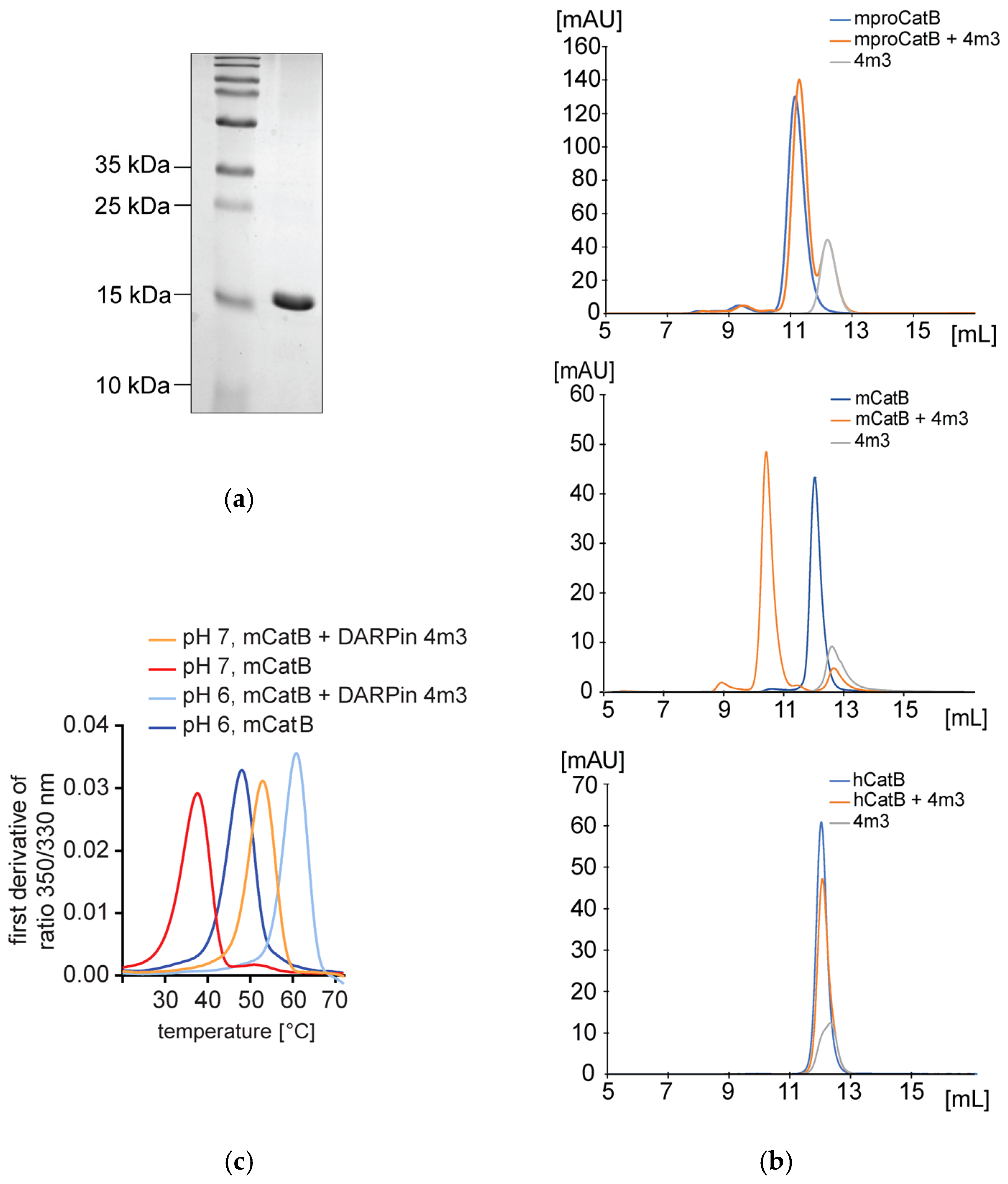
Figure 1. Interaction of purified DARPin 4m3 with mCatB and hCatB. (a) SDS-PAGE of the purified DARPin 4m3. (b) Analytical size-exclusion chromatography to assess complex formation between DARPin 4m3 and CatB, where the molar ratio of DARPin 4m3 to CatB is 2:1. The blue line represents CatB (mproCatB, mCatB or hCatB). The orange line represents the sample in which DARPin 4m3 and CatB were mixed and incubated. The gray line represents DARPin 4m3 on SEC. (c) Nano-differential scan fluorometry analysis of mCatB alone and in complex with DARPin 4m3 at pH 6 or pH 7. The presence of 4m3 thermostabilizes mCatB.
Ijms 26 11910 g001
Figure 2. Analysis of DARPin 4m3 binding and inhibition of mCatB and hCatB. (a) Surface plasmon resonance analysis of DARPin 4m3 binding to immobilized hCatB at pH 7. (b) DARPin 4m3 binding to immobilized mCatB at pH 7. (c) DARPin 4m3 binding to immobilized hCatB at pH 6. (d) DARPin 4m3 binding to immobilized mCatB at pH 6 (DARPin 4m3 concentration used is shown for panels (ad). (e) Inhibition assay of DARPin 4m3 against hCatB. Even at a 1000-fold excess, 4m3 did not inhibit mCatB activity. (f) Inhibition assay of DARPin 4m3 against mCatB. Reactions were performed at various molar ratios of 4m3 to mCatB. *** (p < 0.001) and **** (p ≤ 0.0001) denote significant differences between groups according to one-way ANOVA/Tukey’s multiple comparisons tests.
Ijms 26 11910 g002
Figure 3. Kinetics of inhibition of mCatB with DARPin 4m3. (a) Enzyme inhibition (modulation) scheme according to the general modifier mechanism. (b) Primary specific velocity plot for mCatB in the presence of inhibitory DARPin 4m3. (c) Secondary specific plot for mCatB in the presence of inhibitory DARPin 4m3. (d) Inhibition assay of mCatB (1 nM) by DARPin 4m3 (1.80–294 nM) for determination of Ki values. The solid line represents a nonlinear fit using an equation from Szedlacsek et al. [22]. A Ki value of 26.7 nM was determined for the interaction.
Ijms 26 11910 g003
Figure 4. CETSA melting curves (fitted with Boltzmann sigmoid function) for mCatB in RAW 264.7 cell lysates in the presence of various analytes (DMSO, CA074, DARPin E3_5, and DARPin 4m3). Western blots of mCatB, from which band intensities were quantified, are shown above the melt curves. (a) On the left, there are examples of Western blots of mCatB after incubation with the selective CatB inhibitor CA074 (+) and its solvent DMSO (−) and on the right, of Western blots of mCatB in the presence of the generic DARPin E3_5 (−) and the mCatB-selective DARPin 4m3. (b) Melting curves of mCatB in the presence of the mentioned molecules. Solid lines represent Boltzmann sigmoid fits of the relative mCatB band intensities from the Western blots, which were quantified by densitometry. The apparent Tagg of mCatB in the presence of the analytes were 52.2 ± 0.6 °C (DARPin E3_5), 62.9 ± 0.5 °C (DARPin 4m3), 52.9 ± 0.6 °C (DMSO), and 71.6 ± 0.9 °C (CA074).
Ijms 26 11910 g004
Figure 5. Structure comparison of DARPin binding to cathepsin B. (a) Crystal structure of mouse cathepsin B in complex with DARPin 4m3 viewed from the top of the active-site cleft. mCatB is shown as a white surface, with the catalytic residue colored yellow and the occluding loop residues at the top in orange. DARPin 4m3 is shown as a red ribbon. (b) Crystal structure of mouse cathepsin B and DARPin 4m3 complex (molecules B and B2, shown in red) superimposed DARPin 81 (cyan) and DARPin 8h6 (blue).
Ijms 26 11910 g005
Figure 6. Interacting residues of mCatB/hCatB and DARPins. Each circle denotes interactions between cathepsin and DARPin residues on the vertical and horizontal axes. Circle colors (red, cyan, and blue) correspond to the mouse and human complexes, as indicated in the bottom right corner. The circle radius represents interaction distance: smaller circles indicate closer interactions, while larger circles indicate longer interactions.
Ijms 26 11910 g006
Figure 7. Structure-based alignment of mCatB, hCatB, and DARPins generated with FatCat [25] and MAIN [26]. Identical residues are written as dots, homologous residues as lowercase letters, and different residues as uppercase letters. The active site C29 and hCatB Y65, and mCatB S81 are highlighted with frames. Residues forming interactions between cathepsin and DARPin are colored red, dark red, and Indian red, corresponding to the three interacting groups defined in Figure 6. Residues labeled Y and s indicate interactions that split between two groups.
Ijms 26 11910 g007
Figure 8. 3D visualization of the interacting residues between mCatB/hCatB and DARPins, divided into three groups (red, dark red, and Indian red) as defined in Figure 7. The active site residue is shown in yellow, and the occluding loop residues are shown in orange. Protein structures were generated with MAIN [26] and rendered with Raster3D [28]. Arrows indicate the direction of the rotation of the complex subunits.
Ijms 26 11910 g008
Figure 9. Normality of substrate residue distributions. The p-values for the normality of the distributions of the residues at the positions from P6 to P6′ (columns) for each cathepsin (rows) are indicated by the size of the circles. The red, light gray, and gray circles indicate p-values ≤ 0.05 (not normal), >0.05 and ≤0.08 (normal but close to the limit 0.05), and >0.08, respectively.
Ijms 26 11910 g009
Figure 10. Calculated AUC values for pairwise comparisons of cleavage sites from different cathepsins for the P3–P4′ region, which proved most informative for distinguishing cathepsin cleavage site specificities. Values between 0.5 and 0.6 (light pink) indicate the most similar substrate groups; 0.6 to 0.7 (rose), 0.7 to 0.8 (red), 0.8 to 0.9 (deep pink), and 0.9 to 1.0 (maroon) represent progressively greater differences, with maroon indicating the most distinct groups.
Ijms 26 11910 g010
Table 1. Kinetic and equilibrium constants for the interaction between mCatB and DARPin 4m3. Experimental values were obtained from the SPR data shown in Figure 2.
ka [1/Ms]kd [1/s]KD [nM]χ2 [RU2]
mCatB pH 69.80 × 1046.44 × 10−365.70.021
mCatB pH 78.55 × 1049.25 × 10−3108.30.004
Table 2. CETSA results showing temperatures at which mCatB reached 50% of its maximum band intensity on Western blots in the presence of DARPin E3_5, DARPin 4m3, DMSO, and CA074.
DARPin E3_5DMSODARPin 4m3CA074
Tagg (50% of mCatB maximum band intensity)52.1 °C52.9 °C62.9 °C71.6 °C
95% confidence interval51.6 °C–52.8 °C52.3 °C–53.5 °C62.39 °C–63.35 °C70.7 °C–72.4 °C
Disclaimer/Publisher’s Note: The statements, opinions and data contained in all publications are solely those of the individual author(s) and contributor(s) and not of MDPI and/or the editor(s). MDPI and/or the editor(s) disclaim responsibility for any injury to people or property resulting from any ideas, methods, instructions or products referred to in the content.