


Abstract
Neat chlorosulfonic acid reacts with silica gel to give silica sulfuric acid in which sulfuric acid is immobilized on the surface of silica gel via covalent bonds. A combination of silica sulfuric acid and wet SiO2 was used as an effective deacetalizating agent for the conversion of acetals to their corresponding carbonyl derivatives under thermal conditions.
Introduction
Acetals are widely used as protecting groups in organic synthesis and, as a consequence, many methods have been examined for both their formation and removal [1,2]. Typically, deprotection of acetals requires the use of protic [3] or Lewis acids [4], iodotrimethylsilane [5], cobalt or manganese salts in the presence of air or O2 [6] pyridinium tosylate [7], montmorillonite K10 [8], cerium ammonium nitrate(CAN) [9], etc.
On the other hand, any reduction in the amount of sulfuric acid needed and/or any simplification in handling procedures is desirable for risk reduction, economic advantages and environmental protection [10]. In addition, there is current research and general interest in heterogeneous systems because of the importance such systems have in industry and in developing technologies [11]. In continuation of our studies on the application of inorganic acidic salts [12] we have found that silica gel reacts with chlorosulfonic acid to give silica sulfuric acid (I). It is interesting to note that the reaction is easy and clean without any work-up procedure because HCl gas is evolved from the reaction vessel immediately (Scheme 1).
Scheme 1.

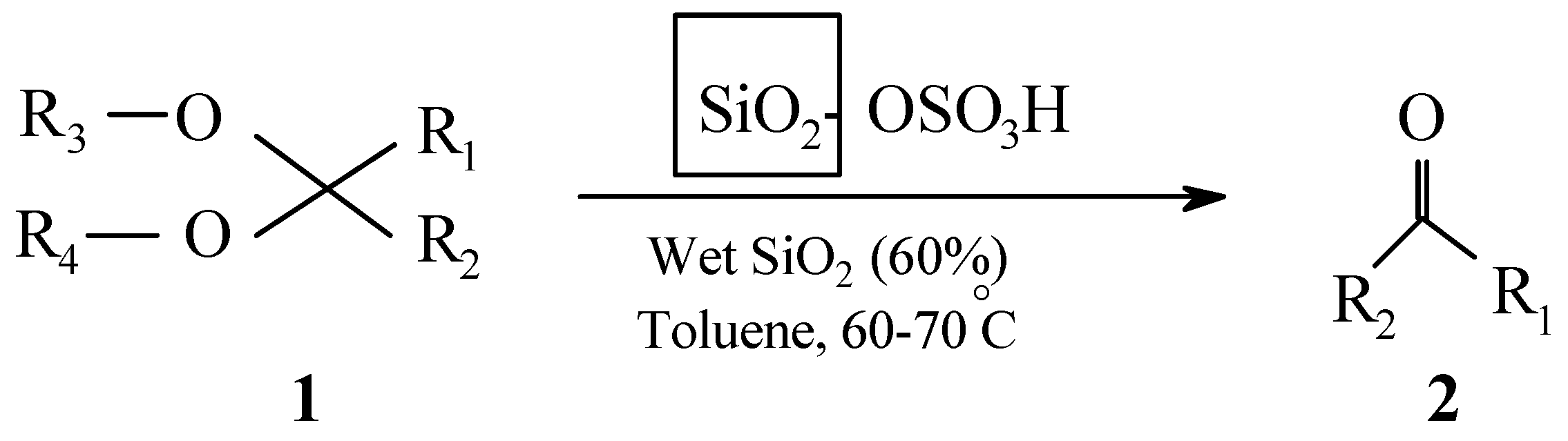
We hoped that the silica sulfuric acid (I) would be a superior proton source to all of the reported acidic solid supports or acidic resins such as polystyrene sulfonic acid and Nafion-H [13] for running reactions under heterogeneous conditions. Here we wish to report a convenient method for the deacetalization of acetals by using silica sulfuric acid (I) and wet SiO2 (II) under thermal conditions (Scheme 2).
Results and Discussion
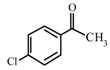
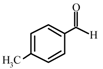
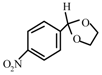
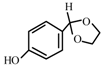
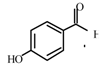
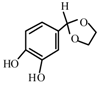
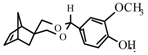
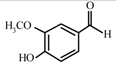
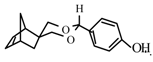
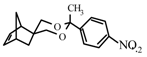
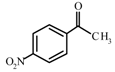
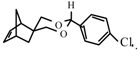
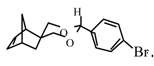
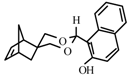
Different types of acetals and ketals (1) were subjected to the deacetalization reaction in the presence of silica sulfuric acid and wet SiO2 (60% w/w) under thermal conditions with quantitative yields. We used toluene as a solvent at 60-70 °C. The results of deacetalization reactions are shown in Table 1.
Scheme 2.
Conclusions
Silica sulfuric acid is an excellent proton source for acetal deprotection reactions in terms of convenience, cheapness, easy production and insolubility to all of organic solvents. The cheapness and availability of the reagents, easy procedure and work-up make this method attractive for large scale operations.
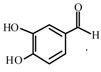
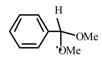
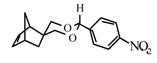
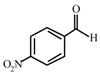
Table 1.
Deprotection of Acetals and Ketals in Toluene at 60-70 °C







Acknowledgments
Financial support for this work by the Office of Research Affairs, Yazd University, Yazd, Iran and also Bu-Ali Sina University, Hamadan, Iran, are gratefully acknowledged.
Experimental
General
Chemicals such as carbonyl compounds, ethylene glycol, chlorosulfonic acid and silica gel were purchased from the Fluka, Merck and Aldrich chemicals companies. Acetals and 5-norbornene-2,2-dimethylol were synthesized according to the our previously reported procedure [1]. The deacetalization products were characterized by comparison of their spectral (IR, 1H-NMR), TLC and physical data with the authentic samples. Silica sulfuric acid was prepared according to our very recently reported procedure as follows [14].
Preparation of silica sulfuric acid
A 500 mL suction flask equipped with a constant-pressure dropping funnel and a gas inlet tube for conducting HCl gas over an adsorbing solution (i. e. water) was used. It was charged with silica gel (60.0 g). Chlorosulfonic acid (23.3 g, 0.2 mol) was added dropwise over a period of 30 min at room temperature. HCl gas evolved from the reaction vessel immediately (Scheme 1). After the addition was complete the mixture was shaken 30 min. A white solid (silica sulfuric acid) 76.0 g was obtained.
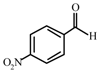
Typical procedure for deacetalization of acetals (1) to the corresponding aldehydes (2): Preparation of 4-nitrobenzaldehyde (2g).
A mixture of 1g (0.07 g, 0.25 mmol), silica sulfuric acid (I) (0.3 g) and wet SiO2 (60% w/w, 0.3 g) in toluene (3 mL) was heated at 60-70°C for 60 minutes. Then the solvent was removed under reduced pressure. The product, 4-nitrobenzaldehyde (2g), was obtained in quantitative yield by addition of ethanol and water.
References
- Pourjavadi, A.; Mirjalili, B.F. J. Chem. Res. 1999, 562.
- Firouzabadi, H.; Iranpour, N.; Zolfigol, M.A. Bull. Chem. Soc. Jap. 1998, 71, 2169. [CrossRef]
- Green, T.W.; Wuts, P.G.M. Protective Groups in Organic Synthesis; John Wiley and Sons, Inc.: New York, 1991. [Google Scholar]
- Sen, S.E.; Roach, S.L.; Boggs, J.K.; Ewing, G.J.; Magrath, J. J. Org. Chem. 1997, 62, 6684. [CrossRef]
- Butler, D.N.; Halton, B.; Warrener, R.N. Aus. J. Chem. 2000, 53, 561.
- Hashemi, M.M.; Kalantari, F. Synth. Commun 2000, 30, 1857.
- Sterzycki, R. Synthesis 1979, 724.
- Gautier, E.G.L.; Graham, A.E.; Mckillop, A.; Standen, S.P.; Taylor, R.J.K. Tetrahedron Lett. 1997, 38, 1881.
- Ates, A.; Gautier, A.; Leroy, B.; Plancher, J.M.; Quesnel, Y.; Marko, I.E. Tetrahedron Lett. 1999, 40, 1799.
- Riego, J.M.; Sedin, Z.; Zaldivar, J.M.; Marziano, N.C.; Tortato, C. Tetrahedron Lett. 1996, 37, 513.
- Turro, N.J. Tetrahedron 1987, 43, 1589.
- Zolfigol, M.A. Synth. Commun. 2000, 30, 1593. Zolfigol, M.A.; Bagherzadeh, M.; Chehardoli, G.; Mallakpour, S.E. ibid. 2001, 31, 1149. Zolfigol, M.A.; Bagherzadeh, M.; Ghorbani Choghamarani, A.; Keypour, H.; Salehzadeh, S. ibid. 2001, 31, 1661. Zolfigol, M.A.; Sadeghi, M.M.; Mohammadpoor-Baltork, I.; Ghorbani Choghamarani, A.; Taqian-nasab, A. Asian J. Chem. 2001, 13, 887. Zolfigol, M.A.; Bagherzadeh, M.; Madrakian, E.; Ghaemi, E.; Taqian-nasab, A. J. Chem. Res. 2001, 140. Zolfigol, M.A.; Ghaemi, E.; Madrakian, E. Molecules 2001, 6, 614. Zolfigol, M.A.; Ghaemi, E.; Madrakian, E.; Kiany-Borazjani, M. Synth. Commun. 2000, 30, 2057. Zolfigol, M.A.; Madrakian, E.; Ghaemi, E. Indian J. Chem. 2000, 39B, 308. Zolfigol, M.A.; Kiany-Borazjani, M.; Sadeghi, M.M.; Memarian, H.R.; Mohammadpoor-Baltork, I. Synth. Commun. 2000, 30, 2945. Zolfigol, M.A.; Kiany-Borazjani, M.; Mallakpour, S.E.; Nassr-Isfahani, H. ibid. 2000, 30, 2573. Zolfigol, M.A.; Kiany-Borazjani, M.; Sadeghi, M.M.; Mohammadpoor-Baltork, I.; Memarian, H.R. ibid. 2000, 30, 3919. Zolfigol, M.A.; Kiany-Borazjani, M.; Sadeghi, M.M.; Memarian, H.R.; Mohammadpoor-Baltork, I. J. Chem. Res. 2000, 197. Salehi, P.; Khodaie, M.; Zolfigol, M.A.; Keyvan, A. Synth. Commun. 2001, 31, 1947.
- Olah, G.A; Molhotra, R.; Narang, S.C. J. Org. Chem. 1978, 43, 4628. [CrossRef]
- Zolfigol, M.A. Tetrahedron 2001, 57, 9509.
- Sample Availability: Samples of substrates 1c, 1g-1l and the 3-nitro and 4-cyano analogs of substrate 1g are available from MDPI.
© 2002 by MDPI (http://www.mdpi.org). Reproduction is permitted for noncommercial purposes.