Abstract
Two series of diesters with bend-rod shapes were synthesized and their thermal properties characterized by POM and DSC. The central group conformational mobility and polarity as well as the length of the mesogenic groups were varied in order to correlate these parameters with mesophase stability. Results indicate that series II diesters are enantiotropic and that their mesophase sensitivity to central group structural changes is limited.
Introduction
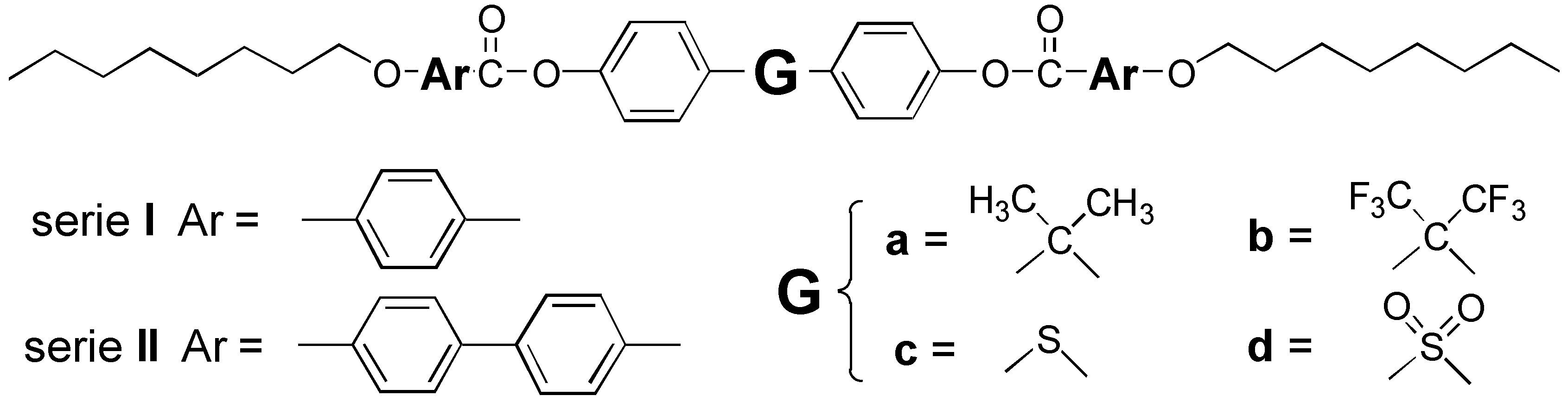
Most of the liquid crystals synthesized to present have the conventional anisodiametric rod-like structure. As yet, only this conventional type of liquid crystals have been used in technological applications. Liquid crystals with non-conventional structures that apart from the lineal geometry are important for the theoretical understanding of the liquid crystalline phenomena and they have potential new applications. It was found recently that two achiral bent-rod shape liquid crystalline systems spontaneously generate helical structures in smectic arrangements [1]. Likewise, nematics arrangements of this type of mesogens are also interesting while the origin of this ferroelectric behavior is still under investigation [2]. The goal of this study was the synthesis and characterization of the mesomorfic properties of a series of diesters were the length of the mesogenic groups as well as polarity and conformational mobility of the central group was varied as shown in Scheme 1.
Scheme 1.
Experimental
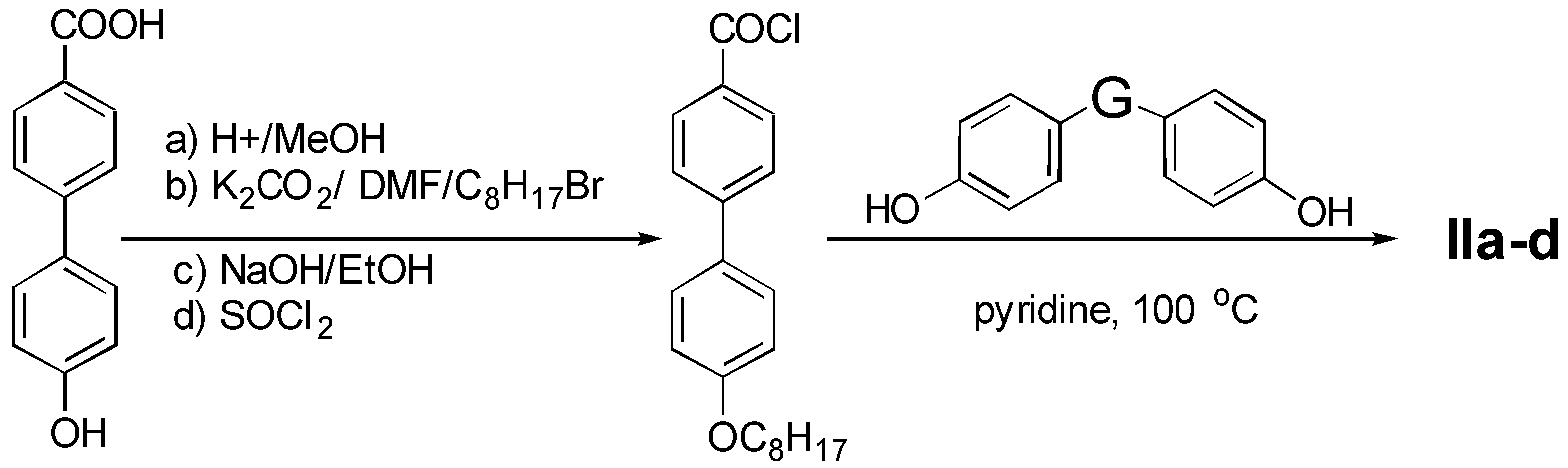
The diesters were synthesized by reaction of either 4-n-octiloxybenzoyl choride or 4’-n-octiloxybifenil-4-carbonyl chloride with the corresponding diphenols at near reflux temperature in pyridine as shown in Scheme 2. Structural characterization and purity checks of the diesters were perform by tlc and 1H RMN. Thermal transitions were characterized by differential scanning calorimetry, DSC, (scanning rate 10°C/min, temperature range: 50-260°C) and polarizing optical microscope, POM (Temperature range: r. t.-260°C).
Scheme 2.
Results and Discussion
The mesogen deviation from the preferential geometry to generate mesophases due to the introduction of a non lineal central group, G, does not preclude mesomorphic organisation in the heating cycles, HC, or cooling cycles, CC, as long as the mesogenic arms have a minimum length. Thus, none of series I compounds showed mesomorfic properties. On the contrary, all series II compounds are enantiotropic liquid crystals. The preliminary results indicate that the mesophase stability (Ti). is not very sensitive to variations either in the angle or in the polarity of G. Likewise, mesophase range (Ti-Tm) present only small variations.
| Thermal Properties of diesters II | |||||
| IIa | IIb | IIc | IId | ||
| HC | Tm | 182 | 175 | 175 | 160 |
| Ti | 249 | 260 | 245 | 240 | |
| CC | Td | 248 | 259 | 244 | 220 |
| Tc | 180 | 170 | 170 | 175 | |
Acknowledgements
Financial support for this research was provided by ANPCyT and SGCyT-UNS. P. D. R. thanks SGCyT-UNS for a fellowship.
References and Notes
- Pelzl, G.; Diele, S.; Jakli, A.; Lischka, Ch.; Wirt, I.; Weissflog, W. Helical superstructures in novel smectic mesophase formed by achiral banana-shaped molecules. Liquid Cristals 1999, 26, 135. [Google Scholar] [CrossRef]
- Kishikawa, K.; Harris, M.C.; Swager, T.M. Nematic Liquid crystals with bent-rod shapes: mesomorphic thiophenes with lateral dipole moments. Chem. Mater. 1999, 11, 867. [Google Scholar] [CrossRef]