

Using Empirical Rules from 13C NMR Analysis to Determine the Stereochemistry of the Epoxide Located at the 5,6-position of Decalinic Systems
Abstract
:Introduction
Results and Discussion
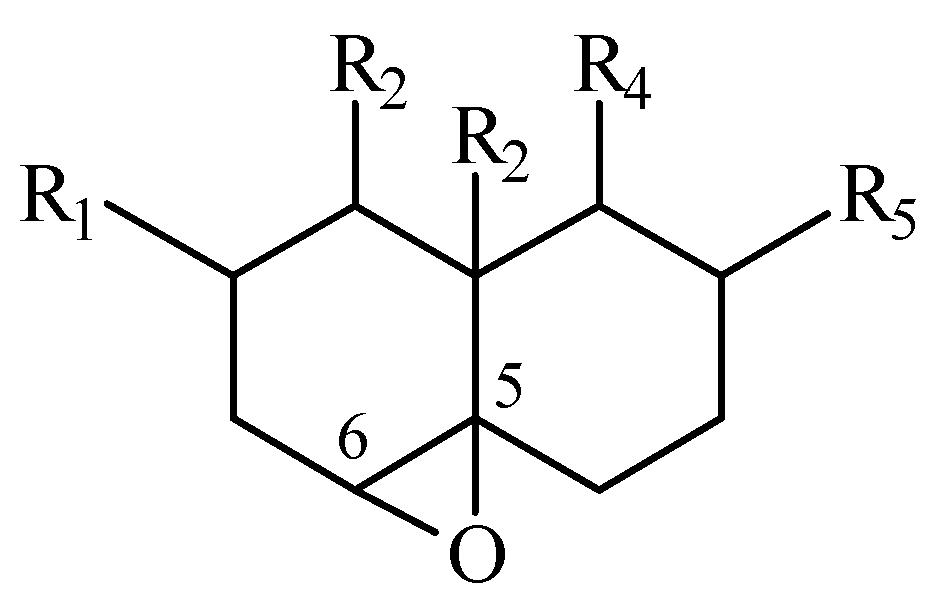
Experimental
Acknowledgements:
References and Notes
- Cardá, M.; Sanz, J. F.; Marcos, J. A. J. Org. Chem. 1992, 57, 804–811.
- Tori, K.; Komeno, T.; Sangaré, M.; Septe, B.; Delpech, B.; Ahond, A.; Luckacs, G. Tetrahedron Lett. 1974, 14, 1157–1160.
- Sangaré, M.; Septe, B.; Berenger, G.; Luckacs, G. Tetrahedron Lett. 1977, 18, 699–702.
- Cross, A. D. J. Am. Chem. Soc. 1962, 84, 3206.
- (a) Beierbeck, H.; Saunders, J. K. Can. J. Chem. 1976, 54, 632–641. ; (b) Beierbeck, H.; Saunders, J. K. Can. J. Chem. 1976, 54, 2985–2995.
- Colombo, M.I.; Bustos, D.A.; Gonzalez Sierra, M.; Olivieri, A. C.; Ruveda, E. A. Can. J. Chem. 1986, 61, 552–555.
Share and Cite
Cravero, R.M.; Labadie, G.R.; Sierra, M.G. Using Empirical Rules from 13C NMR Analysis to Determine the Stereochemistry of the Epoxide Located at the 5,6-position of Decalinic Systems. Molecules 2000, 5, 323-324. https://doi.org/10.3390/50300323
Cravero RM, Labadie GR, Sierra MG. Using Empirical Rules from 13C NMR Analysis to Determine the Stereochemistry of the Epoxide Located at the 5,6-position of Decalinic Systems. Molecules. 2000; 5(3):323-324. https://doi.org/10.3390/50300323
Chicago/Turabian StyleCravero, Raquel M., Guillermo R. Labadie, and Manuel Gonzalez Sierra. 2000. "Using Empirical Rules from 13C NMR Analysis to Determine the Stereochemistry of the Epoxide Located at the 5,6-position of Decalinic Systems" Molecules 5, no. 3: 323-324. https://doi.org/10.3390/50300323
APA StyleCravero, R. M., Labadie, G. R., & Sierra, M. G. (2000). Using Empirical Rules from 13C NMR Analysis to Determine the Stereochemistry of the Epoxide Located at the 5,6-position of Decalinic Systems. Molecules, 5(3), 323-324. https://doi.org/10.3390/50300323
