Citrus Peel Hydrolates as By-Products of Hydrodistillation: Volatile Characterisation and the Role of Enzymatic Pretreatment

 ,
,  ,
,  and
and 
Abstract
1. Introduction
2. Results and Discussion
2.1. Volatile Composition of Orange, Mandarin and Clementine Peel Hydrolates
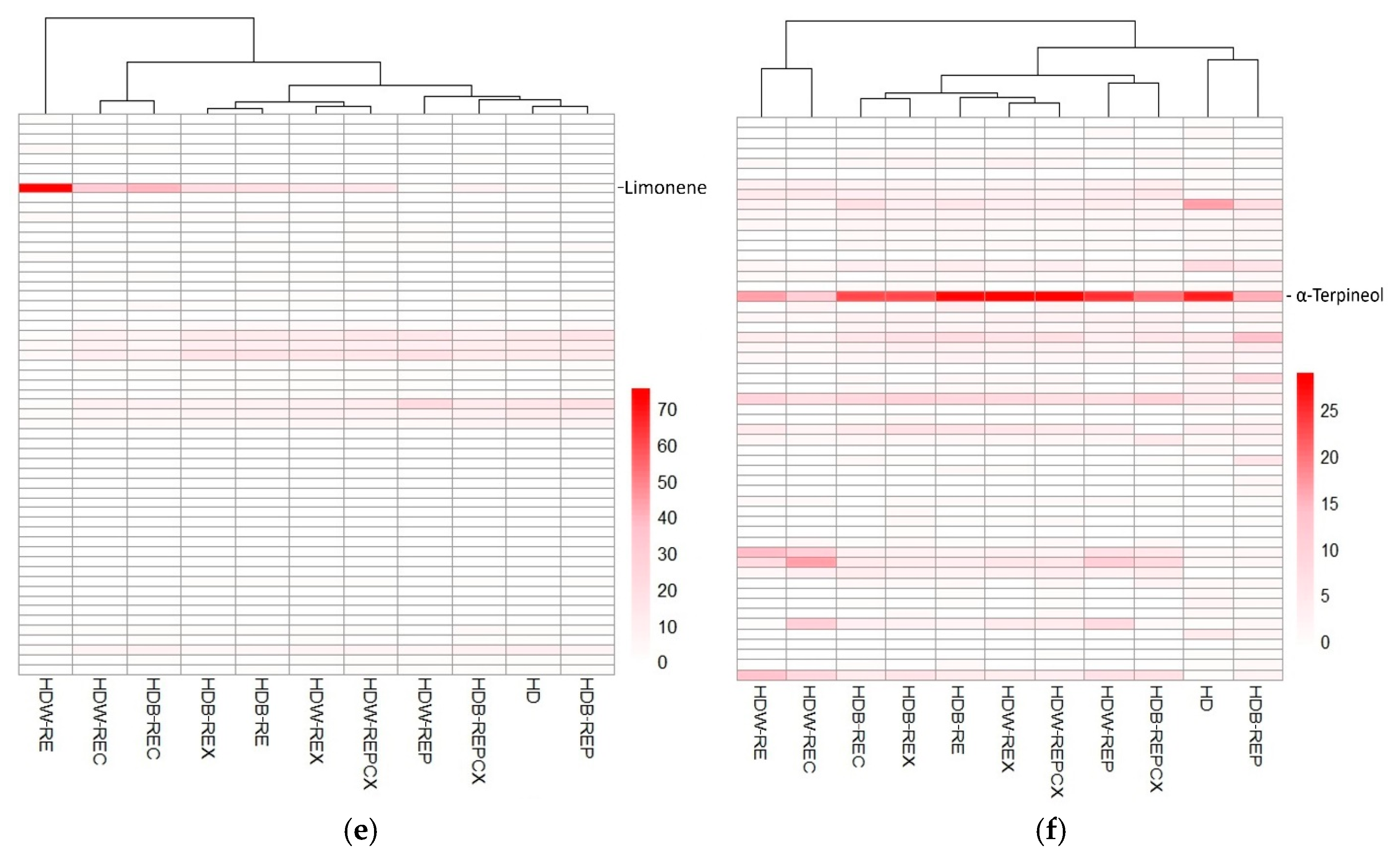
2.2. Comparison of the Volatile Composition of Hydrolates and Essential Oils from Orange, Mandarin, and Clementine Peel
2.3. Impact of Enzymatic Pre-Treatments on the Volatile Composition of Orange, Mandarin and Clementine Peel Hydrolates
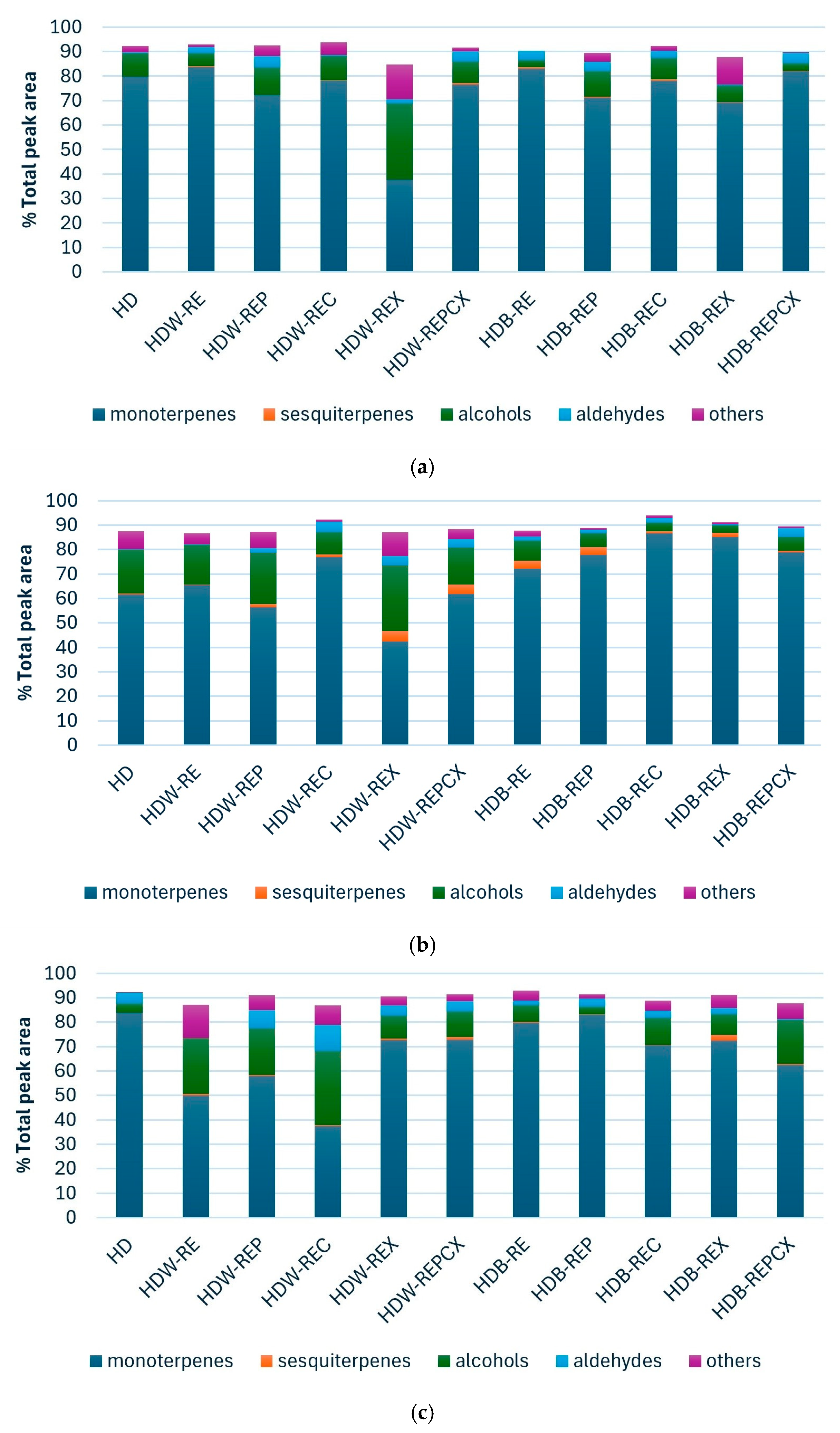
2.3.1. Orange Peel
2.3.2. Mandarin Peel
2.3.3. Clementine Peel
3. Materials and Methods
3.1. Chemicals
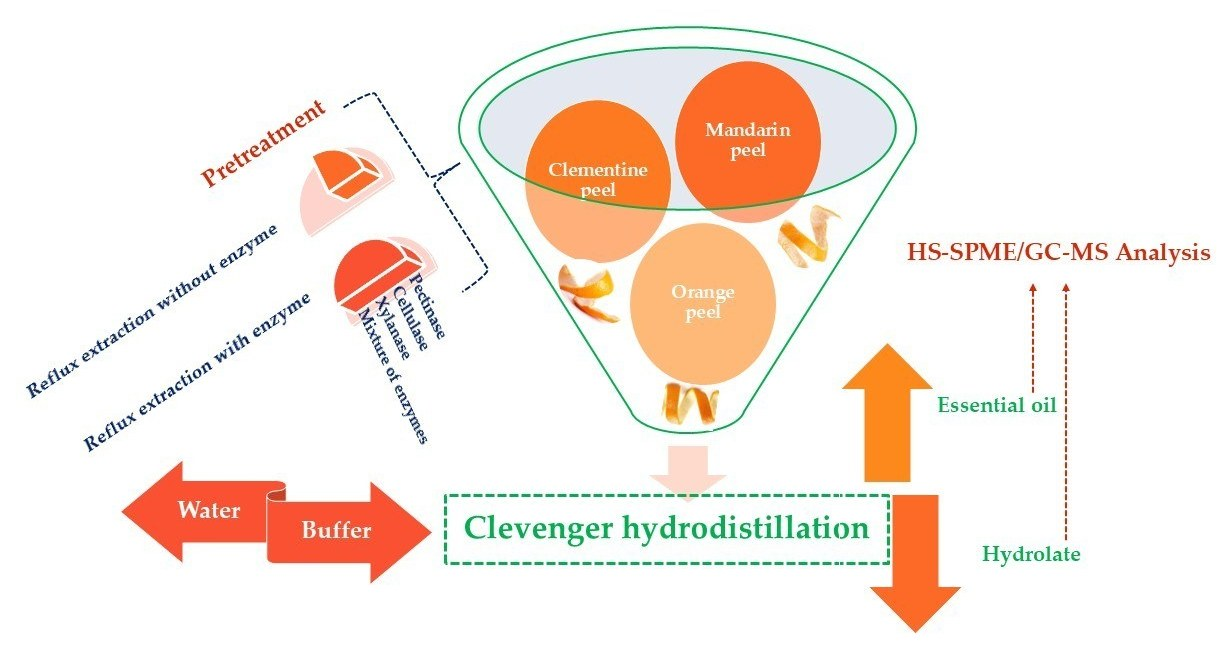
3.2. Extraction Procedure
3.3. Headspace Solid-Phase Microextraction (HS–SPME) with Gas Chromatography-Mass Spectrometry (GC–MS) Analysis
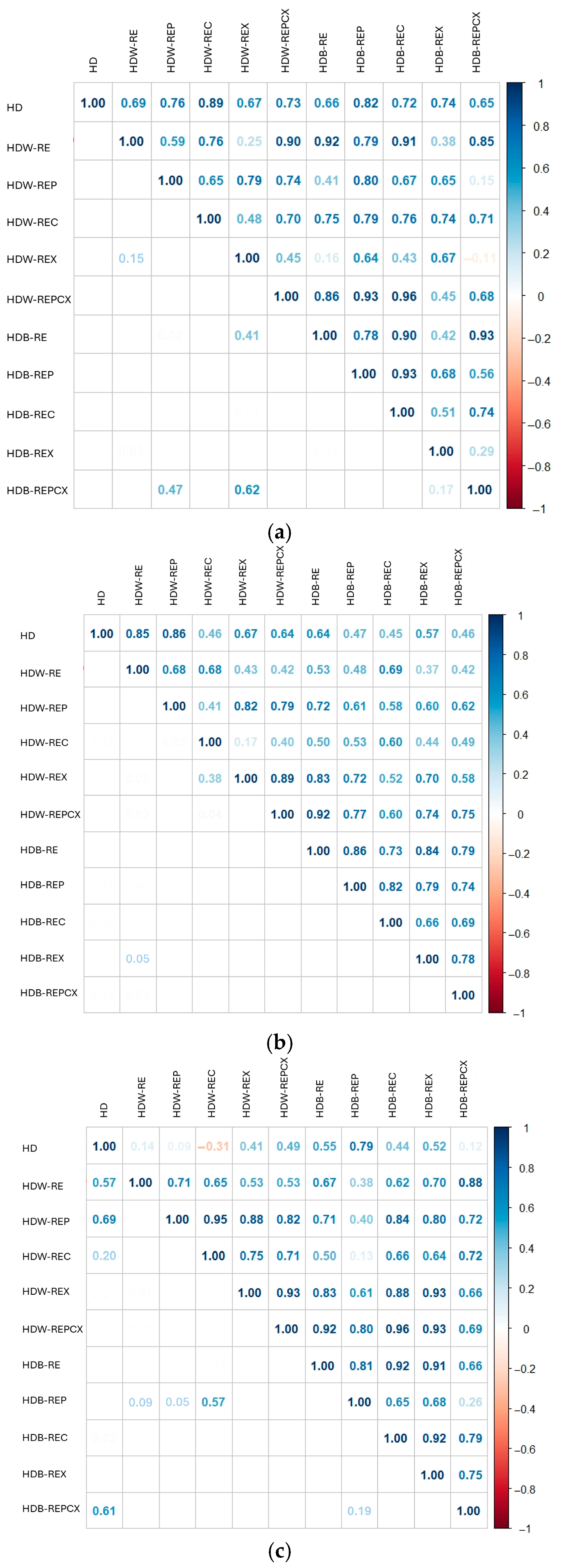
3.4. Statistical Analysis
4. Conclusions
Supplementary Materials
Author Contributions
Funding
Institutional Review Board Statement
Informed Consent Statement
Data Availability Statement
Conflicts of Interest
Abbreviations
| HD | hydrodistillation without pretreatment (no-pretreatment control) |
| HDW–RE | hydrodistillation with reflux extraction pretreatment in water (no-enzyme control) |
| HDW–REP | hydrodistillation with reflux extraction pretreatment assisted by pectinase enzymes in purified water |
| HDW–REC | hydrodistillation with reflux extraction pretreatment assisted by cellulase enzymes in purified water |
| HDW–REX | hydrodistillation with reflux extraction pretreatment assisted by xylanase enzymes in purified water |
| HDW–REPCX | hydrodistillation with reflux extraction pretreatment assisted by pectinase/cellulase/xylanase enzymes in purified water |
| HDB–RE | hydrodistillation with reflux extraction pretreatment in citrate buffer (no-enzyme control) |
| HDB–REP | hydrodistillation with reflux extraction pretreatment assisted by pectinase enzymes in citrate buffer |
| HDB–REC | hydrodistillation with reflux extraction pretreatment assisted by cellulase enzymes in citrate buffer |
| HDB–REX | hydrodistillation with reflux extraction pretreatment assisted by xylanase enzymes in citrate buffer |
| HDB–REPCX | hydrodistillation with reflux extraction pretreatment assisted by pectinase/cellulase/xylanase enzymes in citrate buffer |
References
- Kumar, H.; Guleria, S.; Kimta, N.; Nepovimova, E.; Dhanjal, D.S.; Sethi, N.; Suthar, T.; Shaikh, A.M.; Bela, K.; Harsányi, E. Applications of citrus peels valorisation in circular bioeconomy. J. Agric. Food Res. 2025, 20, 101780. [Google Scholar] [CrossRef]
- Wedamulla, N.E.; Fan, M.; Choi, Y.J.; Kim, E.K. Citrus peel as a renewable bioresource: Transforming waste to food additives. J. Funct. Foods 2022, 95, 105163. [Google Scholar] [CrossRef]
- Panwar, D.; Saini, A.; Panesar, P.S.; Chopra, H.K. Unraveling the scientific perspectives of citrus by-products utilization: Progress towards circular economy. Trends Food Sci. Technol. 2021, 111, 549–562. [Google Scholar] [CrossRef]
- Singh, B.; Singh, J.P.; Kaur, A.; Yadav, M.P. Insights into the chemical composition and bioactivities of citrus peel essential oils. Food Res. Int. 2021, 143, 110231. [Google Scholar] [CrossRef]
- Mahato, N.; Sinha, M.; Sharma, K.; Koteswararao, R.; Cho, M.H. Modern Extraction and Purification Techniques for Obtaining High Purity Food-Grade Bioactive Compounds and Value-Added Co-Products from Citrus Wastes. Foods 2019, 8, 523. [Google Scholar] [CrossRef]
- Vitalini, S.; Iriti, M.; Vinciguerra, V.; Garzoli, S. A Comparative Study of the Chemical Composition by SPME-GC/MS and Antiradical Activity of Less Common Citrus Species. Molecules 2021, 26, 5378. [Google Scholar] [CrossRef]
- Ndiaye, E.H.B.; Gueye, M.T.; Ndiaye, I.; Diop, S.M.; Diop, M.B.; Thiam, A.; Fauconnier, M.L.; Lognay, G. Chemical Composition of Distilled Essential Oils and Hydrosols of Four Senegalese Citrus and Enantiomeric Characterization of Chiral Compounds. J. Essent. Oil Bear. Plants 2017, 20, 820–834. [Google Scholar] [CrossRef]
- Lante, A.; Tinello, F. Citrus hydrosols as useful by-products for tyrosinase inhibition. Innov. Food Sci. Emerg. Technol. 2015, 27, 154–159. [Google Scholar] [CrossRef]
- Gómez-Mejía, E.; Dias, M.I.; Pereira, C.; Pires, T.C.; Palá-Paúl, J.; Rosales-Conrado, N.; León-Gonzáles, M.E.; Calhelha, R.; Roriz, C.L. A biorefinery approach for the simultaneous obtention of essential oils, organic acids and polyphenols from citrus peels: Phytochemical characterization and bioactive potential. Food Chem. 2025, 486, 144641. [Google Scholar] [CrossRef]
- Almeida, H.H.; Fernandes, I.P.; Amaral, J.S.; Rodrigues, A.E.; Barreiro, M.F. Unlocking the potential of hydrosols: Transforming essential oil byproducts into valuable resources. Molecules 2024, 29, 4660. [Google Scholar] [CrossRef]
- Jakubczyk, K.; Tuchowska, A.; Janda-Milczarek, K. Plant hydrolates–Antioxidant properties, chemical composition and potential applications. Biomed. Pharmacother. 2021, 142, 112033. [Google Scholar] [CrossRef]
- Aćimović, M.; Tešević, V.; Smiljanić, K.T.; Cvetković, M.; Stanković, J.; Kiprovski, B.; Sikora, V. Hydrolates: By-products of essential oil distillation: Chemical composition, biological activity and potential uses. Adv. Technol. 2020, 9, 54–70. [Google Scholar] [CrossRef]
- FDA. The United States Code of the Federal Regulations; Title 21; FDA: Washington, DC, USA, 2013; Volume 3.
- Xie, X.; Xue, H.; Ma, B.; Guo, X.; Xia, Y.; Yang, Y.; Xu, K.; Li, T.; Luo, X. Comparative Analysis of Hydrosol Volatile Components of Citrus × Aurantium ‘Daidai’and Citrus × Aurantium L. Dried Buds with Different Extraction Processes Using Headspace-Solid-Phase Microextraction with Gas Chromatography–Mass Spectrometry. Molecules 2024, 29, 3498. [Google Scholar] [CrossRef]
- Değirmenci, H.; Erkurt, H. Relationship between volatile components, antimicrobial and antioxidant properties of the essential oil, hydrosol, and extracts of Citrus aurantium L. flowers. J. Infect. Public Health 2020, 13, 58–67. [Google Scholar] [CrossRef] [PubMed]
- Labadie, C.; Ginies, C.; Guinebretiere, M.H.; Renard, C.M.G.C.; Cerutti, C.; Carlin, F. Hydrosols of orange blossom (Citrus aurantium), and roseflower (Rosa damascena and Rosa centifolia) support the growth of a heterogeneous spoilage microbiota. Int. Food Res. J. 2015, 76, 576–586. [Google Scholar] [CrossRef] [PubMed]
- Monsef-Esfahani, H.R.; Amanzade, Y.; Alhani, Z.; Hajimehdipour, H.; Faramarzi, M.A. GC/MS Analysis of Citrus aurantium L. Hydrolate and its Comparison with the Commercial Samples. Iran. J. Pharm. Res. 2004, 3, 177–179. [Google Scholar]
- Taktak, O.; Ben Youssef, S.; Abert Vian, M.; Chemat, F.; Allouche, N. Physical and chemical influences of different extraction techniques for essential oil recovery from Citrus sinensis peels. J. Essent. Oil Bear. Plants 2021, 24, 290–303. [Google Scholar] [CrossRef]
- Chàvez-González, M.L.; López-López, L.I.; Rodríguez-Herrera, R.; Contreras-Esquivel, J.C.; Aguilar, C.N. Enzyme-assisted extraction of citrus essential oil. Chem. Pap. 2016, 70, 412–417. [Google Scholar] [CrossRef]
- Xhaxhiu, K.; Wenclawiak, B. Comparison of supercritical CO2 and ultrasonic extraction of orange peel essential oil from Albanian moro cultivars. J. Essent. Oil Bear. Plants 2015, 18, 289–299. [Google Scholar] [CrossRef]
- Mishra, D.; Shukla, A.K.; Dixit, A.K.; Singh, K. Aqueous enzymatic extraction of oil from mandarin peels. J. Oleo Sci. 2005, 54, 355–359. [Google Scholar] [CrossRef]
- Penić, M.; Ninčević Grassino, A.; Aladić, K.; Jokić, S.; Jerković, I.; Dent, M. Effects of enzymatic Pretreatment on Yield and Volatile Composition of Citrus peel Essential Oils. Molecules 2026, 31, 657. [Google Scholar] [CrossRef]
- Lin, X.; Cao, S.; Sun, J.; Lu, D.; Zhong, B.; Chun, J. The Chemical Compositions, and Antibacterial and Antioxidant Activities of Four Types of Citrus Essential Oils. Molecules 2021, 26, 3412. [Google Scholar] [CrossRef] [PubMed]
- Zareiyan, F.; Khajehsharifi, H. Analyzing Bioactive Compounds in Essential Oil of Citrus maxima and Citrus sinensis Peel. J. Essent. Oil Bear. Plants 2021, 24, 677–682. [Google Scholar] [CrossRef]
- Meryem, S.; Mohamed, D.; Nour-Eddine, C.; Faouzi, E. Chemical Composition, Antibacterial and Antioxidant Properties of Three Moroccan Citrus Peel Essential Oils. Sci. Afr. 2023, 20, e01592. [Google Scholar] [CrossRef]
- Robinson, P.K. Enzymes: Principles and biotechnological applications. Essays Biochem. 2015, 59, 1–41. [Google Scholar] [CrossRef] [PubMed]
- Bisswanger, H. Enzyme assays. Perspect. Sci. 2014, 1, 41–55. [Google Scholar] [CrossRef]
- Walia, A.; Guleria, S.; Mehta, P.; Chauhan, A.; Parkash, J. Microbial xylanases and their industrial application in pulp and paper biobleaching: A review. 3 Biotech 2017, 7, 11. [Google Scholar] [CrossRef]
- Zhang, S.B.; Wang, Z.; Xu, S.Y. Optimization of the aqueous enzymatic extraction of rapeseed oil and protein hydrolysates. J. Am. Oil Chem. Soc. 2007, 84, 97–105. [Google Scholar] [CrossRef]
- Adams, R.P. Identification of Essential Oil Components by Gas Chromatography/Mass Spectrometry, 4th ed.; Allured Publishing Corporation: Carol Stream, IL, USA, 2007. [Google Scholar]
- NIST Chemistry WebBook. NIST Standard Reference Database. 2023. Available online: https://webbook.nist.gov/chemistry/ (accessed on 12 September 2025).
- Kolde, R. Pheatmap: Pretty Heatmaps R Package Version 1.0.12. 2019. Available online: https://CRAN.R-project.org/package=pheatmap (accessed on 12 September 2025).




| Plant Scientific Name | Methodology | Major Compounds | Reference |
|---|---|---|---|
| Citrus aurantium | Extraction procedure: steam distillation; Parameters: 15 g dry pollens, 210 mL water, 1 h distillation; (ultrasound–microwave); Parameters: 15 g dry pollens, 210 mL water, processing conditions (ultrasound: 7 min, 90 W; microwave: 75 s, 280 W) | Flower bud: linalool (56.5%), α-terpineol (13.0%), trans-geraniol (7.9%) | [14] |
| Citrus medica var. sarcodactylus | Extraction procedure: hydrodistillation (Clevenger–type apparatus); Parameters: 16 g fresh exocarp, (ratio plant/water not mentioned), 3 h distillation | Fruit exocarp: α-terpineol (44.7%), terpinen-4-ol (21.6%), α-citral (8.0%), cis-geraniol (7.2%), β-citral (5.8%) | [6] |
| Citrus aurantium | Extraction procedure: steam distillation (Clevenger–type apparatus); Parameters: 100 g dry flowers, (ratio plant/water not mentioned), 4 h distillation | Flower: linalool (16.58%), neryl acetate (6.48%), nerolidol (5.87%), linalyl acetate (5.0%), limonene (4.79%) | [15] |
| Citrus sinensis, Citrus reticulata, Citrus maxima and Citrus aurantifolia | Extraction procedure: steam distillation (Clevenger–type apparatus); Parameters: 100 g dry peel, 1.5 L water, 1.5 h distillation | Peel: C. sinensis: linalool (34.8%); C. reticulata: linalool (17.5%), α-terpineol (10.1%), trans-carveol (12.2%), citronellol (16.4%); C. maxima: trans-linalooloxide (21.3%), α-terpineol (13.0%), cis-linalool oxide (furanoid) (10.3%); C. aurantifolia: geranial (18.3%), nerol (15.8%), neral (15.3%), geraniol (13.1%), α-terpineol (14.6%) | [7] |
| Citrus aurantium | Extraction procedure: steam distillation and hydrodistillation of fresh flowers (ratio plant/water and time of distillation not mentioned) | Flower: linalool (44.1%), α-terpineol (23.7%), methyl anthranylate (4.2%) | [16] |
| Citrus sinensis, Citrus limon, Citrus medica | Extraction procedure: steam distillation; Parameters: 100 g fresh peel, 300 mL water (isolation time not mentioned), | Peel: C. limon: geraniol (48.27%), α-terpineol (29.98%); C. sinensis: terpinolene (12.41%), α-terpineol (4.41%); C. medica: citral (17.4%), α-terpineol (16.81%) | [8] |
| Citrus aurantium | Extraction procedure: hydrodistillation (Clevenger–type apparatus); Parameters: 100 g dry flowers, (ratio plant/water not mentioned), 3.5 h distillation | Flower: laboratory obtained samples: geraniol (26.6%), α-terpineol (20.7%), linalool (15.4%), benzene acetaldehyde (5.5%); traditional samples: linalool (44.1%), methyl anthranilate (11.8%), cis-linalool oxide (6.1%); industrial samples: 1,8-cineol (15.9%), linalool (13.8%), α-terpineol (6.6%) | [17] |
| Pretreatment | Chi-Squared | p-Value |
|---|---|---|
| HD | 5.364 | 0.068 |
| HDW–RE | 7.489 | 0.023 |
| HDW–REP | 3.918 | 0.141 |
| HDW–REC | 4.548 | 0.102 |
| HDW–REX | 4.122 | 0.127 |
| HDW–REPCX | 2.536 | 0.281 |
| HDB–RE | 5.536 | 0.062 |
| HDB–REP | 1.539 | 0.463 |
| HDB–REC | 11.104 | 0.003 |
| HDB–REX | 9.404 | 0.009 |
| HDB–REPCX | 8.083 | 0.017 |
Disclaimer/Publisher’s Note: The statements, opinions and data contained in all publications are solely those of the individual author(s) and contributor(s) and not of MDPI and/or the editor(s). MDPI and/or the editor(s) disclaim responsibility for any injury to people or property resulting from any ideas, methods, instructions or products referred to in the content. |
© 2026 by the authors. Licensee MDPI, Basel, Switzerland. This article is an open access article distributed under the terms and conditions of the Creative Commons Attribution (CC BY) license.
Share and Cite
Dent, M.; Penić, M.; Grassino, A.N.; Aladić, K.; Jokić, S.; Jerković, I. Citrus Peel Hydrolates as By-Products of Hydrodistillation: Volatile Characterisation and the Role of Enzymatic Pretreatment. Molecules 2026, 31, 1118. https://doi.org/10.3390/molecules31071118
Dent M, Penić M, Grassino AN, Aladić K, Jokić S, Jerković I. Citrus Peel Hydrolates as By-Products of Hydrodistillation: Volatile Characterisation and the Role of Enzymatic Pretreatment. Molecules. 2026; 31(7):1118. https://doi.org/10.3390/molecules31071118
Chicago/Turabian StyleDent, Maja, Marija Penić, Antonela Ninčević Grassino, Krunoslav Aladić, Stela Jokić, and Igor Jerković. 2026. "Citrus Peel Hydrolates as By-Products of Hydrodistillation: Volatile Characterisation and the Role of Enzymatic Pretreatment" Molecules 31, no. 7: 1118. https://doi.org/10.3390/molecules31071118
APA StyleDent, M., Penić, M., Grassino, A. N., Aladić, K., Jokić, S., & Jerković, I. (2026). Citrus Peel Hydrolates as By-Products of Hydrodistillation: Volatile Characterisation and the Role of Enzymatic Pretreatment. Molecules, 31(7), 1118. https://doi.org/10.3390/molecules31071118