


Abstract
The generation of ε-carbonyl cations and their reactions with nucleophiles is accomplished readily without transition metal cation stabilization, using the ε-bromide dienoate or dienone starting materials and GaCl3 or InCl3 catalysis. Arene nucleophiles are somewhat more straightforward than allyltrimethylsilane, but allyltrimethylsilane and propiophenone trimethysilyl enol ether each react successfully with InCl3 catalysis. The viability of these cations is supported by DFT calculations.
1. Introduction
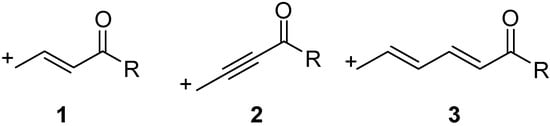
The reaction of electrophilic allyl and propargyl compounds with nucleophiles is a commonly used technique in organic chemistry. However, this chemistry becomes challenging when the system involves an electron-withdrawing group, such as a carbonyl. As a result, the generation and reaction of cations at the site γ- to a carbonyl or carbonyl equivalent (1 and 2) has seen only limited work, although it constitutes a fundamental form of umpolung chemistry (Figure 1). A modest but growing number of methods have been developed to obtain synthetic equivalents of these species. Propargyldicobalt [1] and allyliron [2] cations bearing electron withdrawing groups have been successfully generated and reacted with nucleophiles at the γ-site and are highly electrophilic. Activated cyclopropanes may serve as γ-carbonyl cation equivalents in the presence of Lewis acids, and they have close to the same level of electrophilicity [3]. Allylpalladiums and -iridiums bearing EWG’s are significantly less electrophilic but act catalytically and react well with stronger nucleophiles [4,5,6,7,8]. Methods giving an equivalent overall transformation, involving cationic species but not γ-carbonyl cations themselves, are known [9]. Nevertheless, methodology involving direct generation of γ-carbonyl cations without additional stabilization has remained elusive.
Figure 1.
γ- and ε-carbonyl cations.
Research on vinylogous versions of γ-carbonyl cations, specifically on equivalents of ε-carbonyl cation equivalents (3), is still more scattered (Figure 2). The Green group has reported vinylogous Nicholas reactions involving compounds 4–5 to functionalize the site ε- to the carbonyl or carbonyl equivalent [10]. Activated vinylcyclopropanes (6) can, in principle, serve as ε-carbonyl cation equivalents, but Lewis acid mediated openings of these systems often favor reaction at the γ-site [3,11,12,13]. Transition metal mediated couplings are, in general, ε-selective, but again are only modestly electrophilic [14,15,16,17,18,19,20,21]. As a consequence, there the is an absence of work on ε-carbonyl cations or their equivalents that features both catalysis and high electrophilicity. Furthermore, the existence of a number of natural products containing ε-arylated carbonyls indicates significant synthetic utility to any methods capable of accessing such cations [22,23,24]. Unlike the γ-carbonyl cations themselves, the further conjugation possible to ε-carbonyl potentially ameliorates the effect of the electron-withdrawing group. As a result, we considered it worth investigating whether the ε-carbonyl cations themselves (3) could be generated, and whether this would be amenable to Lewis acid catalysis.
Figure 2.
Existing ε-carbonyl cation equivalent precursors.
2. Results
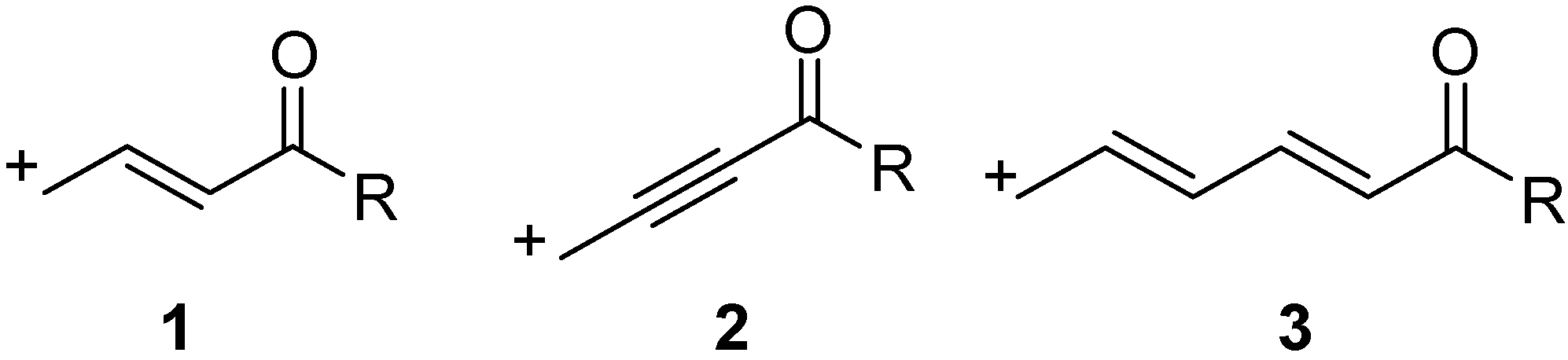
The viability of direct generation of ε-carbonyl cations was initially addressed computationally, using DFT calculations employing the B3LYP functional and 6-311++G(d,p) basis set. The allyl bromide (7) to allyl cation (7+) transformation was the benchmark with which to compare results, as the viability of experimentally verified allyl cation synthetic chemistry has been established, most notably with indium(III) and related catalysts [25,26,27,28]. Compared to this was ionization of 5-bromo-1,3-pentadiene (8a) to give pentadienyl cation (8a+), and the analogous ionizations of ethyl 6-bromosorbate (8b), 6-bromo-1-phenyl-2,4-butan-1-one (8c). In addition, the ethyl 4-bromocrotonate (9) to γ-carbonyl cation species 9+ transformation was included, as an example of a process that has proven difficult experimentally (Scheme 1, Table 1).
Scheme 1.
Allyl- and dienyl bromide ionization reactions.
Table 1.
Ionization energies of select allyl- and dienyl bromides 1.
The results of the calculations were promising. The ionization energy of 8a to dienyl cation 8a+ was unsurprisingly the most favored, the process being 16.8 kcal/mol lower in energy than allyl cation generation. Somewhat to our surprise, the ionizations of the ε-carbonyl cation precursors 8b and 8c also were found to be favored substantially (by 10.9 kcal and 12.7 kcal, respectively), relative to the process with allyl bromide. Finally, the analogous ionization of ethyl 4-bromocrotonate was found to be 6.9 kcal/mol higher in energy than that of allyl bromide, consistent with the difficulty in discrete generation of γ-carbonyl cations. As a result of these findings, we chose to test these observations with an experiment. Given the notably mild conditions reported in the group 13 catalyzed electrophilic reactions of allyl bromides [25,26,27,28], we chose to pursue the analogous approach for ε-carbonyl cations.
The ester- and phenyl ketone-substituted dienyl bromides, 8b–8c, were chosen as substrates. Ethyl 6-bromohexadienoate (ethyl 6-bromosorbate, 8b) was obtained by literature radical bromination of ethyl sorbate [29]. Phenyl ketone 8c was prepared from 1-phenyl-2,4-butadienone [30], by HG-II-induced cross metathesis with allyl bromide (Scheme 2) [31].
Scheme 2.
Preparation of phenyl ketone 8c.
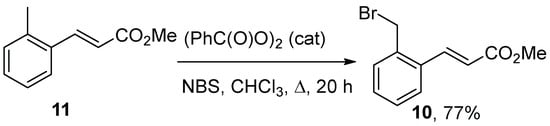
In addition, a third substrate chosen for the study was 10, employing an aryl spacer rather than one of the alkene spacers between the ester and bromide. Compound 10 was prepared by the radical bromination of cinnamate ester derivative 11 (10, 77%) (Scheme 3), itself being prepared by the Wittig reaction of o-tolualdehyde [32].
Scheme 3.
Preparation of benzylic bromide 10.
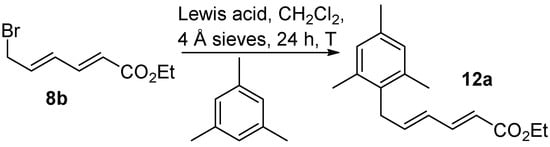
Experimental work began with ethyl 6-bromohexadienoate (ethyl 6-bromosorbate, 8b). Test reactions were undertaken with mesitylene (5 equiv) as the nucleophile, and catalytic amounts (10 mol%) of Lewis acids CuCl, SnCl4, InCl3, GaCl3, and BiI3, in CH2Cl2 with 4 Å molecular sieves (Table 2, Scheme 4). CuCl and BiI3 afforded no product and minimal amounts of product, respectively. Conversely, GaCl3, InCl3, and SnCl4 gave more significant amounts of conversion to 12a over 24 h, although small amounts of starting material remained. Repetition of the reactions at reflux afforded complete starting material consumption, but also gave some polar decomposition byproduct. Ultimately, GaCl3 at room temperature proved to be the most successful Lewis acid, giving 12a in a 68% yield. Reducing the amount of GaCl3 to 5 mol% decreased the yield noticeably (47%), while an increase to 15 mol% made a negligible difference (67% yield). Omission of the 4 Å molecular sieves also gave a decrease in the yield of 12a (51%, 58% brsm).
Table 2.
Optimization of 12a formation.
Scheme 4.
Formation of 12a as a model reaction.
The characterization of 12a was most clearly defined from the 1H NMR spectrum, which revealed a doublet (J = 15.4 Hz) at 5.77 ppm (Hα), a doublet of doublets (J = 15.4, 11.0 Hz) at 7.30 ppm (Hβ), a doublet of doublets (J = 15.2, 11.0 Hz) at 6.02 ppm (Hγ), and doublet of triplets (J = 15.2, 5.7 Hz) at 6.23 ppm (Hδ), indicative of the conjugated diene of (E, E-) geometry resulting from ε-substitution. A small amount (<5% of the mixture) of isomeric material was co-eluted with the main product. Most of the 1H NMR spectral resonances are obscured by the dominant isomer due to the similar 1H spectral features, but with the Hε methylene observable as a doublet of doublets (J = 7.4, 1.5 Hz) at 3.65 ppm, and with the Hβ observable as a doublet of doublets (J = 15.1, 11.6 Hz) at 7.85 ppm, we have assigned this minor compound as the (2E, 4Z)-isomer of 12a.
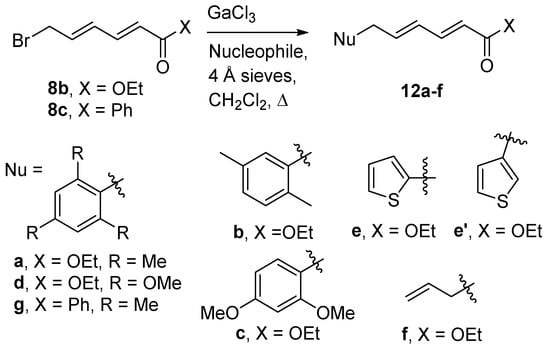
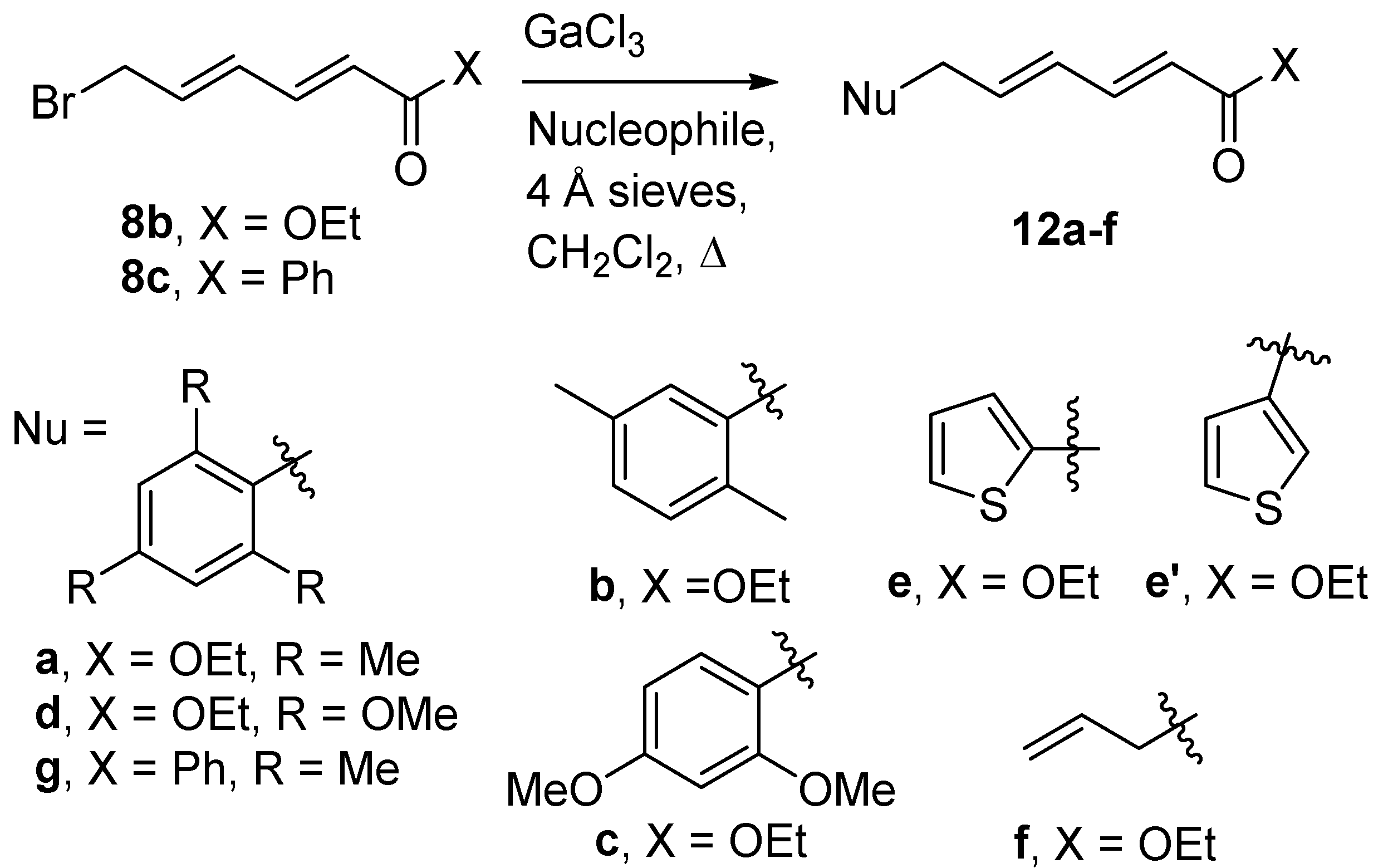
These conditions were adopted for other arene nucleophiles, with the exception that the yields were found to be, in general, superior for other nucleophiles at reflux (Scheme 5, Table 3). p-Xylene, under analogous conditions, gave a modest yield of 12b at rt (33% yield, 54% brsm), but better yields (65%) at reflux. 1,3-Dimethoxybenzene gave 12c in 56% yield at reflux, while 1,3,5-trimethoxybenzene required 20 mol% GaCl3 for complete conversion, giving 12d in 51% yield. Thiophene gave a 63% yield of product, as a 72:28 mixture C-2 (12e) and C-3 (12e′) substitutions. With allyltrimethylsilane, no condensation product was observed with 10 mol% GaCl3. Switching the catalyst to InCl3 was much more successful; 10 mol% InCl3 in CH2Cl2 at reflux gave approximately 80% conversion and 53% of 12f, while 20 mol% InCl3 gave 12f in a 66% yield. Finally, the phenyl ketone 8c and mesitylene with GaCl3 at reflux gave 12g in a 50% yield.
Scheme 5.
Reactions of ε-bromo dienyl carbonyls 8b, 8c.
Table 3.
Results for condensation reactions of 8b, 8c.
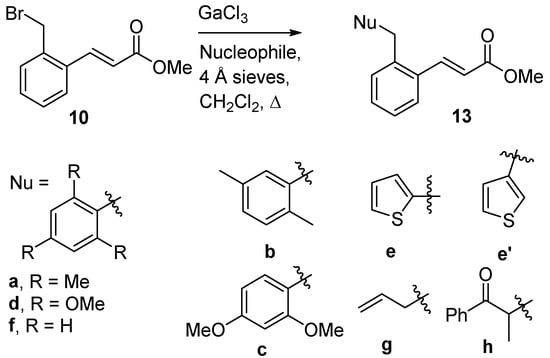
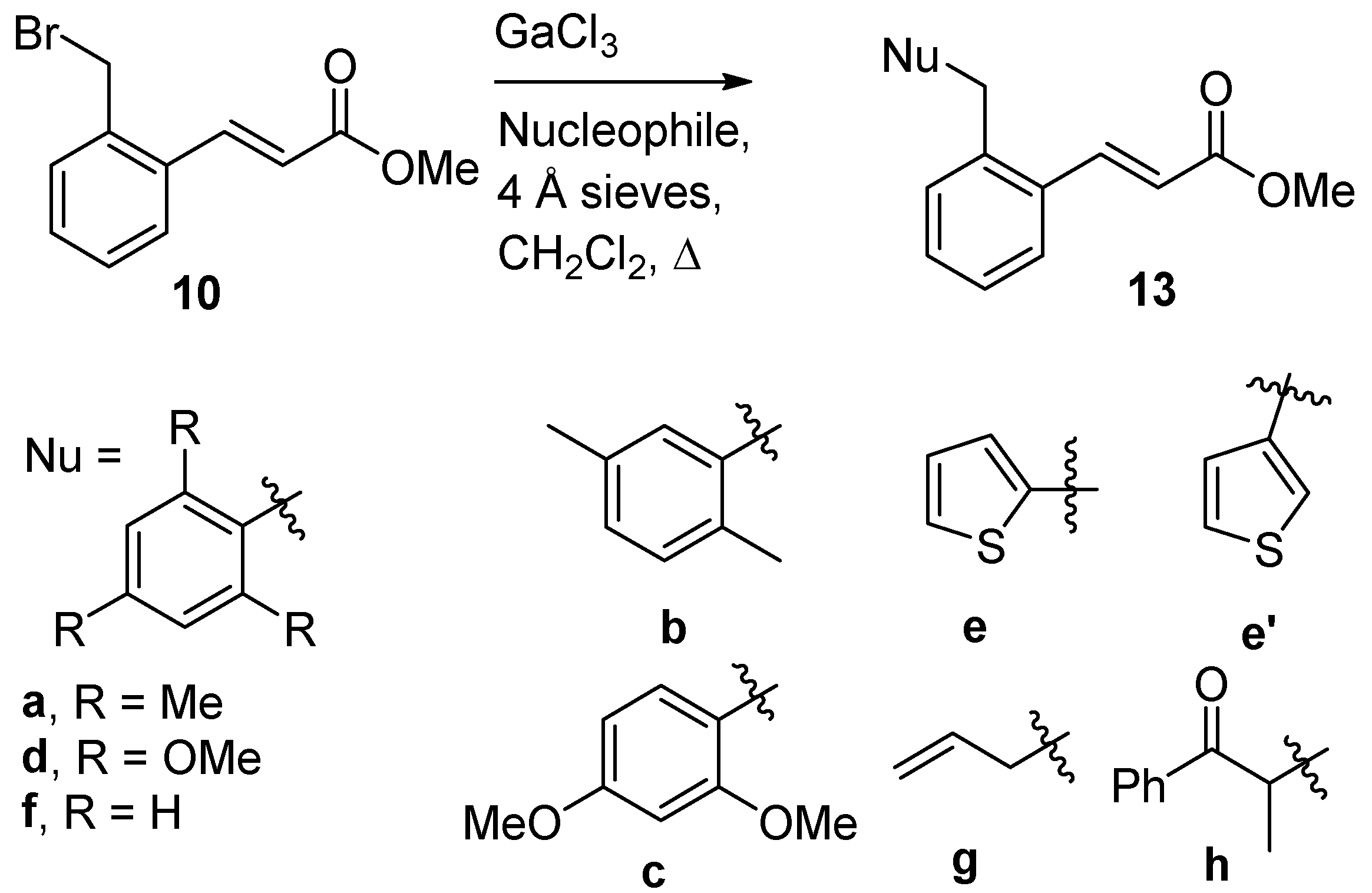
The benzylic bromide analogue, 10, also reacted under the optimized conditions, again at reflux (Scheme 6, Table 4). Mesitylene afforded 13a in a 73% yield, with no evidence of even trace amounts of isomeric products present. p-Xylene (13b, 76% yield), 1,3-dimethoxybenzene (13c, 77% yield), and 1,3,5-trimethoxybenzene (13d, 75% yield) behaved analogously. Thiophene worked well, again affording an isomeric mixture of C-2 and C-3 substitution products (13e and 13e′, 92% yield, 13e:13e′ = 71:29). The aromatic nucleophiles could be extended to benzene itself (13f, 72% yield), although a greater amount of GaCl3 catalyst (30 mol%) was required.
Scheme 6.
Reactions of ε-bromo aryl alkenoate 10.
Table 4.
Results for reactions of 10.
The reaction with allyltrimethylsilane was again more difficult than for arene nucleophiles with GaCl3 catalysis. In this case, while 10 mol% GaCl3 showed no significant conversion, 50 mol% GaCl3 gave a 46% yield of 13g. InCl3 again proved to be a superior catalyst with allyltrimethylsilane; 10 mol% of InCl3 afforded a 29% yield of 13g, while raising the catalyst amount to 20 mol% InCl3 gave 13g in 64% (78% brsm). Finally, a switch to higher temperature reaction conditions (1,2-dichloroethane, reflux) demonstrated that propiophenone trimethylsilyl enol ether was also amenable to reaction with 10 (13h, 82% yield) with the use of InCl3 as the catalyst.
3. Discussion
An analysis of the results suggests several issues worth discussing. First of all, despite the unmanageable superficial appearance of ε-carbonyl cations, they are quite viable. Transition metal stabilization of the cationic dienyl (or enynyl) unit is not mandatory. The use of dienyl bromides and Ga(III) or In(III) catalysts is capable of generating ε-carbonyl cations that react with nucleophiles in moderate yields with 8b–c, and in good yields with 10. The reactions require somewhat more vigorous conditions than with allyl bromide itself, and we attribute this to the presence of the Lewis basic carbonyl functions in the substrates, and in some cases, the reacting nucleophiles. Arene nucleophiles react with greater facility than allylsilanes using GaCl3, although conditions can normally be found using InCl3 that give synthetically useful yields of 12f and 13g. InCl3 also allows the successful reaction of an enol silane (13h). The successful incorporation of benzene as a nucleophile (13f) indicates that the current protocol can allow incorporation of less reactive nucleophiles than the Nicholas reaction-based ε-carbonyl cation equivalents [10] and far less reactive nucleophiles than the analogous transition metal catalyzed equivalents [14,15,16,17,18,19,20,21]. The question of competitive conjugate addition does not appear problematic with the arene, allylsilane, or enol silane nucleophiles. For example, the crude reaction product of 8b and allyltrimethylsilane showed no evidence of conjugate addition byproducts. Conversely, trial reactions with triethylsilane, a substantially stronger nucleophile than arenes or allyltrimethylsilane [33], appeared to give mixtures whose 1H NMR spectra included multiple aliphatic resonances, suggesting the conjugate addition may be a major reaction pathway there.
4. Materials and Methods
The starting materials and reagents involved in the reactions were purchased from commercial sources, unless otherwise noted. GaCl3 and InCl3 were stored under an inert atmosphere prior to use. Purification of synthesized products was conducted by either column chromatography (using SilaFlash® P60, 230–400 mesh, SiliCycle, Quebec City, QC, Canada), preparative TLC (SiliaPlate, 1000 μm thickness, SiliCycle, Quebec City, QC, Canada) or radial chromatography (Silica gel, 2000 μm thickness, EM Science, Gibbstown, NJ, USA). Analytical thin layer chromatography (TLC) was performed using Silicycle aluminum-backed sheets (SiliCycle, Quebec City, QC, Canada). Dichloromethane and tetrahydrofuran solvents (Sigma-Aldrich Canada, Milton, ON, Canada) were obtained from a solvent purification system. All of the reactions were performed under an atmosphere of nitrogen unless otherwise stated. Prior to reaction, all glassware was dried in an oven at 110 °C for a minimum of one hour and subsequently cooled in a desiccator. Reactions conducted at greater than 25 °C were conducted in a heated oil bath.
All of the NMR spectral analyses were conducted on 300 MHz and 500 MHz spectrometers (Bruker Canada, Milton, ON, Canada) at room temperature in solutions of CDCl3 (CIL, Andover, MA, USA). The residual CHCl3 peak was set to 7.27 ppm and 77.0 ppm for the 1H NMR and 13C NMR spectra, respectively. 1H NMR spectral data are listed with units of ppm for peak position (δ) and Hz for coupling constant (J). The following symbols were used for peak appearance: s, singlet; d, doublet; t, triplet; dd, doublet of doublets; dt, doublet of triplets; q, quartet; m, multiplet. The 1H and 13C NMR spectra are available in the Supplementary Materials. The IR analysis was conducted on an ATR infrared (FTIR) spectrometer (Bruker Canada, Milton, ON, Canada). For IR spectra listed in the characterization of compounds and the absorption peaks with the greatest functional group relevance are reported in wavenumbers (cm−1). High resolution mass spectrometry results were obtained by direct insertion probe on a Waters Xevo G2-XS Time-of-Flight Mass Spectrometer (Waters, Toronto, ON, Canada) in ASAP(+) mode at the University of Windsor Mass Spectrometry lab. The computational calculations were conducted with Gaussview 5.0.9 and B3LYP/6-311++G(d,p) to optimize the structures studied, both with and without solvation in dichloromethane. Final coordinates are available in the Supplementary Materials.
4.1. 6-Bromo-1-phenyl-2,4-hexadienone (8c)
A procedure for synthesis of similar compounds had previously been reported, [31] so this procedure was adapted to use on 1-phenyl-2,4-hexadienone. To a solution of 1-phenyl-2,4-hexadienone (0.2287 g, 1.33 mmol) and allyl bromide (0.56 mL, 6.6 mmol, 5 equiv.) in dichloromethane (40 mL) were added to the Hoveyda-Grubbs II catalyst (0.021 g, 0.034 mmol, 2.5 mol%). After stirring under N2 for 24 h, another portion of Hoveyda Grubbs II catalyst (0.021 g, 0.034 mmol, 2.5 mol%) was added. After 48 h total, the solvent was evaporated under reduced pressure and the product was subjected to flash chromatography (5:1 PE:Et2O) to yield 8c as a yellow solid (0.0982 g, 29%). IR (neat) λmax 3024, 2921, 2856, 1660, 1261, 1003, 693, and 590 cm−1; 1H NMR (00 MHz, CDCl3) δ 7.95 (d, J = 8.7 Hz, 2H), 7.58 (apparent t, J = 7.4 Hz, 1H), 7.49 (apparent t, J = 7.6 Hz, 2H), 7.39 (dd, J = 15.1, 11.0 Hz, 1H), 7.02 (d, J = 15.1 Hz, 1H), 6.53 (dd, J = 15.0 Hz, 11.0 Hz, 1H), 6.36 (m, 1H), and 4.07 (d, J = 7.7 Hz, 2H); 13C NMR (125 MHz, CDCl3) δ 190.2, 142.5, 137.8, 132.9, 132.6, 128.6, 128.4, 127.0, and 31.3; the HRMS m/e for C12H11BrO calculated (M + 1)+ 251.0072, found 251.0068.
4.2. Methyl 3-[2-(Bromomethyl)phenyl]acrylate (10)
Bromination was conducted with methods derived from those described by Snead [34]. Methyl 3-(2-methylphenyl)acrylate 11 (1.1761 g, 4.2 mmol) and N-bromosuccinimide (1.6947 g, 9.522 mmol) were heated to reflux in chloroform (35 mL). Once at reflux, benzoyl peroxide (0.1670 g, 0.6894 mmol) was added. The reaction was stirred at reflux for 20 h, then cooled, filtered through Celite® (Sigma-Aldrich Canada, Milton, ON, Canada) and concentrated under reduced pressure. The residue was then subjected to flash chromatography (10:1 petroleum ether: Et2O) and 0.8078 g (77%) of light yellow solid product 10 was obtained. The mp was 84.5–85.5 °C. IR (neat) λmax 3030, 2950, 1700, 1431, 1078, and 599 cm−1; 1H NMR (300 MHz, CDCl3) δ 8.03 (d, J = 15.9 Hz, 1H), 7.53 (m, 1H), 7.30 (m, 3H), 6.40 (d, J = 15.9 Hz, 1H), 4.54 (s, 2H), and 3.78 (s, 3H); 13C NMR (75 MHz, CDCl3) δ 166.7, 140.5, 136.4, 133.4, 130.5, 130.1, 129.1, 127.0, 120.4, 51.6, and 30.4; the HRMS m/e for C11H11BrO2 calculated (M + 1)+ 255.0021, and found 255.0019.
4.3. Ethyl 6-(2,4,6-Trimethylphenyl)-2,4-hexadienoate (12a)
To a suspension of GaCl3 (0.009 g, 0.05 mmol, 10 mol%) and 4Å molecular sieves (ca. 0.4 g), CH2Cl2 (6 mL) was added to mesitylene (0.37 mL, 2.67 mmol, 5 equiv.) and 8b (0.1161 g, 0.5299 mmol) at room temperature. The reaction was stirred under N2 and monitored by TLC for 26 h. Following removal of volatiles under reduced pressure and flash chromatography (10:1 PE:Et2O), 12a (0.0902 g, 68%) was isolated as a yellow oil. This compound was also made by methods outlined below in General Procedure 1, where the reaction was brought to reflux for 22 h after the reagents were added. This afforded the product 12a in a 63% yield. IR (neat) λmax 2975, 2919, 2861, 1709, 1638, and 1130 cm−1; 1H NMR (500 MHz, CDCl3) δ 7.30 (dd, J = 15.4 Hz, 11.0 Hz, 1H), 6.90 (s, 2H), 6.23 (dt, J = 15.2 Hz, 5.7 Hz, 1H), 6.02 (dd, J = 15.2 Hz, 11.0 Hz, 1H), 5.77 (d, J = 15.4 Hz, 1H), 4.21 (q, J = 7.2 Hz, 2H), 3.51 (d, J = 5.7 Hz, 2H), 2.31 (s, 3H), 2.28 (s, 6H), and 1.31 (t, J = 7.1 Hz, 3H); 13C NMR (125 MHz, CDCl3) δ 167.0, 144.5, 141.0, 136.5, 135.8, 131.9, 128.9, 128.1, 119.6, 60.0, 32.5, 20.8, 19.7, and 14.2; the HRMS m/e for C17H22O2 calculated (M + 1)+ 259.1698, and found 259.1691.
4.4. Ethyl 6-(2,5-Dimethylphenyl)-2,4-hexadienoate (12b)
General Procedure 1. To a suspension of GaCl3 (0.004 g, 0.02 mmol, 10 mol%) and 4Å molecular sieves (ca. 0.4 g), CH2Cl2 (6 mL) was added to para-xylene (0.14 mL, 1.1 mmol, 5 equiv.) and 8b (0.048 g, 0.22 mmol) at room temperature. The mixture was heated to reflux, stirred under N2 and monitored by TLC for 23 h. Following removal of volatiles under reduced pressure and flash chromatography (5:1 PE:Et2O), 12b (0.0349 g, 65%) was isolated as a yellow oil. This compound was also prepared where the reaction was stirred at room temperature for 23 h, and the yield of product 12b was 34%. IR (neat) λmax 2979, 2925, 1710, 1640, 1131, 1000, and 810 cm−1; 1H NMR (300 MHz, CDCl3) δ 7.29 (dd, J = 15.3 Hz, 10.5 Hz, 1H), 7.06 (d, J = 7.5 Hz, 1H), 6.96 (m, 2H), 6.26 (dt, J = 15.3 Hz, 6.0 Hz, 1H), 6.12 (dd, J = 15.9 Hz, 10.5 Hz, 1H), 5.80 (d, J = 15.0 Hz, 1H), 4.20 (q, J = 7.2 Hz, 2H), 3.46 (d, J = 6.3 Hz, 2H), 2.31 (s, 3H), 2.24 (s, 3H), and 1.29 (t, J = 6.9 Hz, 3H); 13C NMR (75 MHz, CDCl3) δ 167.0, 144.4, 141.6, 136.5, 135.4, 132.9, 130.0, 129.8, 128.9, 127.1, 119.7, 60.0, 36.6, 20.7, 18.7, and 14.1; the HRMS m/e for C16H20O2 calculated (M + 1)+ 245.1550, and found 245.1539.
4.5. Ethyl 6-(2,4-Dimethoxyphenyl)-2,4-hexadienoate (12c)
General Procedure 1 was carried out with GaCl3 (0.005 g, 0.030 mmol, 10 mol%), 1,3-dimethoxybenzene (0.20 mL, 1.5 mmol, 5 equiv.) and 8b (0.0653 g, 0.298 mmol). The reaction was monitored by TLC for 23 h under reflux and N2, and after purification by flash chromatography (3:1 PE:Et2O), 12c (0.0460 g, 56%) was isolated as a yellow oil. IR (neat) λmax 2935, 2837, 1708, 1207, 1155, 1132, and 1035 cm−1; 1H NMR (300 MHz, CDCl3) δ 7.28 (dd, J = 10.8 Hz, 5.1 Hz, 1H), 7.00 (d, J = 7.5 Hz, 1H), 6.50 (m, 2H), 6.21 (m, 2H), 5.78 (d, J = 15.3 Hz, 1H), 4.19 (q, J = 7.2 Hz, 2H), 3.80 (s, 6H), 3.42 (d, J = 6.6 Hz, 2H), and 1.29 (t, J = 6.9 Hz, 3H); 13C NMR (75 MHz, CDCl3) δ 167.1, 159.5, 157.9, 144.8, 142.6, 129.9, 128.4, 119.3, 103.8, 98.4, 59.9, 55.2, 32.8, and 14.1; the HRMS m/e for C16H20O4 calculated (M + 1)+ 277.1440, and found 277.1440.
4.6. Ethyl 6-(2,4,6-Trimethoxyphenyl)-2,4-hexadienoate (12d)
General Procedure 1 was carried out with GaCl3 (0.010 g, 0.057 mmol, 20 mol%), 1,3,5-trimethoxybenzene (0.2521 g, 1.499 mmol, 5 equiv.) and 8b (0.0629 g, 0.287 mmol). The reaction was monitored by TLC for 24 h under reflux and N2, and after purification by flash chromatography (3:1 PE:Et2O), 12d (0.0446 g, 51%) was isolated as a beige solid, and the mp was 69–70.5 °C. IR (neat) λmax 2941, 2837, 1697, 1595, and 1149 cm−1; 1H NMR (500 MHz, CDCl3) δ 7.25 (dd, J = 15.3 Hz, 11.0 Hz, 1H), 6.22 (dt, J = 15.1, 6.4 Hz, 1H), 6.15 (s, 2H), 6.10 (m, 2H), 5.74 (d, J = 15.3 Hz, 1H), 4.17 (q, J = 7.2 Hz, 2H), 3.82 (s, 3H), 3.80 (s, 6H), 3.43 (d, J = 6.4 Hz, 2H), and 1.27 (t, J = 7.2 Hz, 3H); 13C NMR (75 MHz, CDCl3) δ 167.3, 159.8, 158.7, 145.5, 143.2, 127.6, 118.8, 107.6, 90.6, 60.0, 55.7, 55.3, 26.1, and 14.3; the HRMS m/e for C17H22O5 calculated (M + 1)+ 307.1545, and found 307.1539.
4.7. Ethyl 6-(2-Thienyl)-2,4-hexadienoate (12e) and Ethyl 6-(3-thienyl)-2,4-hexadienoate (12e′)
General Procedure 1 was carried out with GaCl3 (0.004 g, 0.02 mmol, 10 mol%), thiophene (0.17 mL, 2.1 mmol, 10 equiv.) and 8b (0.0476 g, 0.217 mmol). The reaction was monitored by TLC for 23 h under reflux and N2, and after purification by flash chromatography (4:1 PE:Et2O), an 12e/12e′ mixture (0.0306 g, 63%) was isolated as a yellow oil. The product contained a 72:28 12e:12e′ based on 1H NMR spectral integration of the resonances at 3.70 ppm (12e), and 3.52 ppm (12e′) corresponding to the hydrogen atoms bonded to the sp3 carbon adjacent to the thiophene, but these two compounds were not able to be separated. IR (neat) λmax 2980, 2934, 1707, 1253, and 1131 cm−1; 1H NMR (500 MHz, CDCl3) δ 7.25–7.34 (m, 1H), 7.18 (d, J = 5.1 Hz, 1H), 6.96 (dd, 5.1, 3.5 Hz, 1H), 6.83 (m, 1H), 6.19–6.31 (m, 2H), 5.86 (d, J = 15.0 Hz, 1H), 4.21 (q, J = 7.2 Hz, 2H), 3.70 (d, J = 5.7 Hz, 2H), and 1.30 (t, J = 7.2 Hz, 3H). Resonances from minor product 12e′ were observed at: δ 6.98 (m, 1H), 6.93 (dd, J = 4.9, 1.2 Hz, 1H), 5.83 (d, J = 15.3 Hz, 1H), and 3.52 (d, J = 5.4 Hz, 2H); 13C NMR (125 MHz, CDCl3) δ 167.0, 144.0, 141.3, 140.6, 129.5, 127.0, 125.8, 125.1, 124.0, 120.8, 60.3, 33.1, and 14.3. Resonances from minor product 12e′ were observed at: δ 167.1, 144.3, 139.0, 129.3, 128.1, 125.8, 121.2, 120.3, 60.2, and 33.7; the HRMS m/e for C12H14O2S calculated (M + 1)+ 223.0793, and found 223.0797.
4.8. Ethyl 2,4,6-Nonatrienoate (12f)
A mixture of InCl3 (0.0127 g, 20 mol%), 4Å molecular sieves, 8b (0.0633 g, 0.289 mmol) and allyltrimethylsilane (0.23 mL, 5 equiv) in CH2Cl2 (7 mL) were heated to reflux under N2 for 14 h. Following a conventional workup, preparative TLC (7.5:1 hexanes: Et2O) afforded 12f (0.0343 g, 66%) as a faintly tan oil. IR (neat) λmax 2980, 2928, 1712, 1253, 1136, and 998 cm−1; 1H NMR (500 MHz, CDCl3) δ 7.25 (dd, J = 15.4 Hz, 10.5 Hz, 1H), 6.19 (d of ½ AB, J = 10.5, 15.2 Hz, 1H), 6.11 (t of ½ AB, J = 6.5, 15.2 Hz, 1H), 5.73–5.84 (m, 2H), 5.03 (dd, J = 17.1, 1.6 Hz, 1H), 4.99 (dd, J = 10.2, 1.6 Hz, 1H), 4.19 (q, J = 7.2 Hz, 2H), 2.27 (m, 2H), 2.19 (m, 2H), and 1.28 (t, J = 7.2 Hz, 3H). Resonances from the minor (2E, 4Z) isomer can be observed at 6.89 (dd, J = 15.7, 7.5 Hz, 1H), 5.73 (m, 1H), 5.10 (d, J = 10.3 Hz, 1H), and 4.18 (obscured q, J = 7.1 Hz, 2H); 13C NMR (125 MHz, CDCl3) δ 167.2, 144.8, 143.3, 137.4, 128.7, 119.5, 115.3, 60.1, 32.7, 32.2, and 14.3; the HRMS m/e for C11H16O2 calculated (M + 1)+ 181.1228, and found 181.1228.
4.9. 6-(2,4,6-Trimethylphenyl)-1-phenyl-2,4-hexadienone (12g)
To a suspension of GaCl3 (0.003 g, 0.02 mmol, 10 mol%), and 4Å molecular sieves (ca. 0.4 g), CH2Cl2 (6 mL) was added to mesitylene (0.12 mL, 0.86 mmol, 5 equiv.) and 8c (0.0438 g, 0.17 mmol) at room temperature. The reaction was heated to reflux, stirred under N2 and monitored by TLC for 20 h. Following the removal of volatiles under reduced pressure and flash chromatography (10:1 PE:Et2O), 12g (0.0251 g, 50%) was isolated as a yellow oil. IR (neat) λmax 3000, 2917, 2851, 1660, 1587, 1000, 693 cm−1; 1H NMR (300 MHz, CDCl3) δ 7.92 (d, J = 7.2 Hz, 2H), 7.55 (m, 1H), 7.36–7.50 (m, 3H), 6.90 (s, 2H), 6.83 (d, J = 15.0 Hz, 1H), 6.37 (dt, J = 15.0 Hz, 5.7 Hz, 1H), 6.10 (dd, J = 15.0 Hz, 11.1 Hz, 1H), 3.54 (d, J = 5.1 Hz, 2H), 2.30 (s, 3H), and 2.27 (s, 6H); 13C NMR (75 MHz, CDCl3) δ 190.8, 144.9, 143.0, 138.2, 136.5, 135.9, 132.5, 131.9, 129.0, 128.9, 128.5, 128.3, 124.0, 32.8, 20.9, and 19.8; the HRMS m/e for C21H22O calculated (M + 1)+ 291.1749, and found 291.1745.
4.10. Methyl 3-[2-(2,4,6-Trimethylbenzyl)phenyl]acrylate (13a)
General procedure 2. To a suspension of GaCl3 (0.004 g, 0.02 mmol, 10 mol%), and 4Å molecular sieves (ca. 0.4 g), CH2Cl2 (6 mL) was added to mesitylene (0.15 mL, 5 equiv.) and 10 (0.0532 g, 0.210 mmol) at room temperature. The reaction was heated to reflux, stirred under N2 and monitored by TLC for 24 h. Following removal of volatiles under reduced pressure and chromatography (5:1 PE:Et2O), 13a (0.0449 g, 73%) was obtained as a beige solid; mp was 81.5–83.0 °C. IR (neat) λmax 3056, 2969, 2948, 2915, 1713, 1164, 982, and 760 cm−1; 1H NMR (500 MHz, CDCl3) δ 8.24 (d, J = 15.6 Hz, 1H), 7.59 (dd, J = 6.9 Hz, 2.1 Hz, 1H), 7.14–7.23 (m, 2H), 6.93 (s, 2H), 6.60 (d, J = 7.8 Hz, 1H), 6.44 (d, J = 15.9 Hz, 1H), 4.10 (s, 2H), 3.86 (s, 3H), 2.32 (s, 3H), and 2.15 (s, 6H); 13C NMR (125 MHz, CDCl3) δ 167.4, 142.2, 139.1, 137.2, 135.9, 133.4, 132.7, 130.3, 128.9, 127.2, 126.5, 126.3, 119.5, 51.7, 31.8, 20.9, and 19.9; the HRMS m/e for C20H23O2 calculated (M + 1)+ 295.1698, and found 295.1699.
4.11. Methyl 3-[2-(2,5-Dimethylbenzyl)phenyl]acrylate (13b)
General procedure 2 was carried out with GaCl3 (0.004 g, 0.02 mmol, 10 mol%), para-xylene (0.13 mL, 5 equiv.) and 10 (0.0540 g, 0.213 mmol). The reaction was monitored by TLC for 21 h under reflux and N2, and after evaporation under reduced pressure and purification by flash chromatography (5:1 PE:Et2O), 13b (0.0452 g, 76%) was obtained as a faintly yellow solid; mp was 51.0–53.0 °C. IR (neat) λmax 3015, 2949, 2923, 2892, 1714, 1172, 1015, 977, and 765 cm−1; 1H NMR (500 MHz, CDCl3) δ 8.03 (d, J = 15.9 Hz, 1H), 7.61 (dd, J = 7.5 Hz, 1.5 Hz, 1H), 7.24–7.32 (m, 2H), 7.10, (d, J = 7.8 Hz, 1H), 6.98 (m, 2H), 6.75 (s, 1H), 6.38 (d, J = 15.9 Hz, 1H), 4.07 (s, 2H), 3.81 (s, 3H), 2.26 (s, 3H), and 2.23 (s, 3H); 13C NMR (125 MHz, CDCl3) δ 167.3, 142.4, 139.8, 137.7, 135.5, 133.5, 133.3, 130.4, 130.13, 130.11, 129.9, 127.2, 126.7, 126.6, 119.5, 51.7, 36.2, 21.0, and 19.1; the HRMS m/e for C19H21O2 calculated (M + 1)+ 281.1541, and found 281.1544.
4.12. Methyl 3-[2-(2,4-Dimethoxybenzyl)phenyl]acrylate (13c)
General procedure 2 was carried out with GaCl3 (0.003 g, 0.02 mmol, 10 mol%), 1,3-dimethoxybenzene (0.11 mL, 0.84 mmol, 5 equiv.) and 10 (0.0445 g, 0.175 mmol). The reaction was monitored by TLC for 22 h under reflux and N2, and after evaporation under reduced pressure and purification by flash chromatography (4:1 PE:Et2O), 13c (0.0423 g, 77%) was isolated as a light yellow viscous oil. IR (neat) λmax 2934, 2878, 2837, 1716, 1241, 1114, and 1036 cm−1; 1H NMR (300 MHz, CDCl3) δ 8.11 (d, J = 15.9 Hz, 1H), 7.58 (dd, J = 7.5 Hz, 1.2 Hz, 1H), 7.20–7.34 (m, 2H), 7.17 (dd, J = 6.0 Hz, 1.2 Hz, 1H), 6.81 (d, J = 8.3 Hz, 1H), 6.48 (d, J = 2.4 Hz, 1H), 6.38 (dd, J = 8.3, 2.4 Hz, 2H), 6.36 (d, J = 15.9 Hz, 1H), 4.03 (s, 2H), 3.83 (s, 3H), 3.80 (s, 3H), and 3.79 (s, 3H); 13C NMR (75 MHz, CDCl3) δ 167.4, 159.5, 157.9, 142.9, 140.7, 133.5, 130.6, 130.3, 130.0, 126.5, 126.4, 121.0, 119.0, 104.0, 98.4, 55.3, 51.6, and 32.1; the HRMS m/e for C19H20O4 calculated (M + 1)+ 313.1440, and found 313.1441.
4.13. Methyl 3-[2-(2,4,6-Trimethoxybenzyl)phenyl]acrylate (13d)
General procedure 2 was carried out with GaCl3 (0.004 g, 0.02 mmol, 10 mol%), 1,3,5-trimethoxybenzene (0.1907 g, 1.134 mmol, 5 equiv.) and 10 (0.0547 g, 0.215 mmol). The reaction was monitored by TLC for 22 h under reflux and N2, and after evaporation under reduced pressure and purification by flash chromatography (5:1 PE:Et2O), 13d (0.0552 g, 75%) was obtained as a colorless solid; the mp was 84–85 °C. IR (neat) λmax 2949, 2839, 1702, 1118, 949, and 764 cm−1; 1H NMR (300 MHz, CDCl3) δ 8.43 (d, J = 15.9 Hz, 1H), 7.53 (dd, J = 7.5 Hz, 1.2 Hz, 1H), 7.14–7.25 (m, 2H), 7.11 (m, 1H), 6.37 (d, J = 15.9 Hz, 1H), 6.17 (s, 2H), 4.06 (s, 2H), 3.84 (s, 3H), 3.83 (s, 3H), and 3.77 (s, 6H); 13C NMR (75 MHz, CDCl3) δ 167.7, 159.9, 158.9, 143.8, 141.6, 133.1, 129.7, 129.3, 126.1, 125.8, 118.4, 109.0. 90.5, 55.5, 55.3, 51.5, and 25.5; the HRMS m/e for C20H23O5 calculated (M + 1)+ 343.1545, and found 343.1547.
4.14. Methyl 3-[2-(2-Methylthienyl)phenyl]acrylate (13e) and Methyl 3-[2-(3-methylthienyl)phenyl]acrylate (13e′)
General procedure 2 was carried out with GaCl3 (0.003 g, 0.02 mmol, 10 mol%), thiophene (0.075 mL, 0.94 mmol, 5 equiv.) and 10 (0.0465 g, 0.183 mmol). The reaction was monitored by TLC for 20 h under reflux and N2, and after purification by flash chromatography (5:1 PE:Et2O), the 13e/13e′ mixture (0.0437 g, 92% combined) was found as a light yellow oil. Based on 1H NMR integration of the hydrogen atoms bonded to the sp3 carbon adjacent to the thiophene group (4.27 ppm for 13e and 4.10 ppm for 13e′), the product is an inseparable mixture of 13e:13e′ in a ratio of 71:29. IR (neat) λmax 2949, 1711, 1170, 977, 763, 731, and 698 cm−1; 1H NMR (300 MHz, CDCl3) δ 8.02 (d, J = 15.6 Hz, 1H), 7.57 (d, J = 7.5 Hz, 1H), 7.28 (m, 3H), 7.12 (d, J = 5.1 Hz, 1H), 6.88 (m, 1H), 6.72 (d, J = 3.0 Hz, 1H), 6.34 (d, J = 15.9 Hz, 1H), 4.27 (s, 2H), and 3.78 (s, 3H). Most resonances from minor product 13e′ were superimposed on those from 13e, but the following resonances from 13e′ were clearly observed: δ 6.83 (s, 1H), and 4.10 (s, 2H); 13C NMR (75 MHz, CDCl3) δ 167.1, 143.0, 141.9, 139.5, 133.1, 130.3, 130.2, 127.2, 126.8, 126.7, 125.1, 124.0, 119.6, 51.6, and 33.3. Some resonances from minor product 13e′ were superimposed on those from 13e but the following resonances from 13e′ were clearly observed: δ 142.2, 139.8, 133.2, 130.4, 130.1, 128.0, 126.9, 126.6, 125.7, 125.2, 121.4, 119.3, and 33.8; the HRMS m/e for C15H14O2S calculated (M + 1)+ 259.0793, and found 259.0801.
4.15. Methyl 3-[2-Benzylphenyl]acrylate (13f)
General procedure 2 was carried out with GaCl3 (0.0107 g, 0.061 mmol, 30 mol%), benzene (0.25 mL, 14 equiv.) and 10 (0.0518 g, 0.204 mmol). The reaction was monitored by TLC for 30 h under reflux and N2, and following a conventional (CH2Cl2) extractive workup and purification by preparative TLC (7:1 PE:Et2O); 13f (0.0367 g, 72%) was obtained as a faintly tan oil. IR (neat) λmax 3062, 3026, 2950, 1714, 1172, 1634, and 1599 cm−1; 1H NMR (300 MHz, CDCl3) δ 8.06, (d, J = 15.8 Hz, 1H), 7.61 (d, J = 7.5 Hz, 1H), 7.10–7.40 (m, 8H), 6.36 (d, J = 15.8 Hz, 1H), 4.16 (s, 2H), and 3.80 (s, 3H); 13C NMR (75 MHz, CDCl3) δ 167.2, 142.4, 140.14, 140.05, 133.5, 130.8, 130.1, 128.7, 128.5, 126.9, 126.7, 126.2, 119.4, 51.6, and 38.9; MS m/e 252 (M+).
4.16. Methyl 3-[2-(3-Butenyl)phenyl]acrylate (13g)
To a suspension of InCl3 (0.008 g, 0.04 mmol, 20 mol%) and 4Å molecular sieves (ca. 0.4 g), CH2Cl2 (6 mL) was added to allyltrimethylsilane (0.15 mL, 0.94 mmol, 5 equiv.) and 10 (0.0455 g, 0.179 mmol) at room temperature. The reaction was heated to reflux, stirred under N2 and monitored by TLC for 19 h. Following removal of volatiles under reduced pressure and purification by flash chromatography (5:1 PE:Et2O), 13g was isolated as a light beige oil (0.0246 g, 64%, 78% BRMS). Continued elution afforded starting 10 (0.0083 g, 18%) in subsequent fractions. IR (neat) λmax 3066, 2948, 1715, 1169, 979, and 763 cm−1; 1H NMR (300 MHz, CDCl3) δ 8.03 (d, J = 15.9 Hz, 1H), 7.57 (d, J = 7.8 Hz, 1H), 7.32 (m, 1H), 7.18-7.27 (m, 2H), 6.38 (d, J = 15.9 Hz, 1H), 5.87 (m, 1H), 4.97–5.11 (m, 2H), 3.83 (s, 3H), 2.86 (dd, J = 9.7, 6.0 Hz, 2H), and 2.34 (m, 2H); 13C NMR (75 MHz, CDCl3) δ 167.4, 142.3, 141.4, 137.4, 132.9, 130.0, 126.6, 126.5, 119.1, 115.4, 51.7, 35.4, and 32.7; the HRMS m/e for C14H16O2 calculated (M + 1)+ 217.1228, and found 217.1230.
4.17. Methyl 3-(2-(2-Methyl-3-oxo-3-phenylpropylphenyl)acrylate (13h)
To a suspension of InCl3 (0.0065 g, 0.029 mmol, 18 mol%) and 4Å molecular sieves (ca. 0.4 g) in 1,2-dichloroethane (5 mL) were added propiophenone trimethylsilyl enol ether (0.229 g, 1.11 mmol, 6.7 equiv.) and 10 (0.0422 g, 0.165 mmol) at room temperature. The reaction was heated to reflux, stirred under N2 and monitored by TLC for 15 h. Following a conventional extractive (CH2Cl2) workup and purification by preparative TLC (3:1 hexane:Et2O), 13h was isolated as a light beige oil (0.0420 g, 82%). IR (neat) λmax 3061, 2950, 1717, 1681, 1632, and 1597 cm−1; 1H NMR (300 MHz, CDCl3) δ 8.10 (d, J = 15.8 Hz, 1H), 7.88 (m, 2H), 7.55 (m, 2H), 7.45 (m, 2H), 7.17–7.31 (m, 3H), 6.40 (d, J = 15.8 Hz, 1H), 3.84 (s, 3H), 3.72 (m, 1H), 3.30 (dd, J = 14.0, 6.6 Hz, 1H), 1.87 (dd, J = 14.0, 7.8 Hz), and 1.19 (d, J = 6.9 Hz, 3H); 13C NMR (75 MHz, CDCl3) δ203.4, 167.2, 142.2, 139.4, 136.3, 133.3, 133.0, 131.2, 130.0, 128.7, 128.2, 127.0, 119.6, 51.7, 42.1, 36.6, and 17.3; MS m/e 508 (M+).
Supplementary Materials
The following supporting information can be downloaded at: https://www.mdpi.com/article/10.3390/molecules27103078/s1. Copies of the 1H NMR and 13C NMR spectra of all new compounds. Final coordinates for the computationally determined structures.
Author Contributions
Conceptualization, J.R.G.; methodology, P.M.P. and J.R.G.; writing—original draft preparation, P.M.P. and J.R.G.; writing—review and editing, J.R.G.; supervision, J.R.G.; funding acquisition, J.R.G. All authors have read and agreed to the published version of the manuscript.
Funding
Research was funded by the Natural Sciences and Engineering Research Council Canada (NSERC) Discovery Grant program (RGPIN-2016-04946).
Institutional Review Board Statement
Not applicable.
Informed Consent Statement
Not applicable.
Data Availability Statement
Not applicable.
Acknowledgments
We are grateful to the research group of James Gauld (University of Windsor) for advice regarding the DFT computational work.
Conflicts of Interest
The authors declare no conflict of interest.
Sample Availability
Samples of all compounds are available from the authors.
References
- Vizniowski, C.S.; Green, J.R.; Breen, T.L.; Dalacu, A.V. Propargyl chlorides as sources for cobalt stabilized ɣ-carbonyl cations. J. Org. Chem. 1995, 60, 7496–7502. [Google Scholar] [CrossRef] [Scilit]
- Charlton, M.A.; Green, J.R. Formation of quaternary centres via iron allyl cations. Rapid entry into spirocyclic ring systems. Can. J. Chem. 1997, 75, 965–974. [Google Scholar] [CrossRef] [Scilit]
- Bambal, R.; Kemmitt, R.D.W. Conjugate addition of allyltrimethylsilane to electrophilic cyclopropanes. J. Chem. Soc. Chem. Commun. 1988, 734–735. [Google Scholar] [CrossRef] [Scilit]
- Tsuji, J.; Ueno, H.; Kobayashi, Y.; Okumoto, H. Palladium-catalyzed regioselective reactions of α-acetoxy-β,γ-unsaturated nitriles and α-acetoxy-β,γ-unsaturated ester with nucleophiles. Tetrahedron Lett. 1981, 22, 2573–2574. [Google Scholar] [CrossRef] [Scilit]
- Nemoto, T.; Fukuda, T.; Matsumoto, T.; Hitomi, T.; Hamada, Y. Enantioselective construction of all-carbon quaternary stereocenters using palladium-catalyzed asymmetric allylic alkylation of α-acetoxy-β,γ-unsaturated carbonyl compounds. Adv. Synth. Catal. 2005, 347, 1504–1506. [Google Scholar] [CrossRef] [Scilit]
- Baeza, A.; Casas, J.; Nájera, C.; Sansano, J.M. Diastereoselective and enantiospecific synthesis of ɣ-substututed α,β-unsaturated nitriles from O-protected allylic cyanohydrins. J. Org. Chem. 2006, 71, 3837–3848. [Google Scholar] [CrossRef] [Scilit] [PubMed]
- Trost, B.M.; Lautens, M. Regiochemical control in the molybdenum-catalyzed reactions of trimethylsilyl- and ester-substituted allylic acetates. Organometallics 1983, 2, 1687–1689. [Google Scholar] [CrossRef] [Scilit]
- Zhang, Y.; Liebeskind, L. Synthesis of oxa- and aza[3.2.1] and [4.3.1]bicyclics via an unprecedented molybdenum mediated 1,5-“Michael-type” reaction. J. Am. Chem. Soc. 2005, 127, 11258–11259. [Google Scholar] [CrossRef] [Scilit]
- Henkie, J.R.; Dhaliwal, S.; Green, J.R. Bicatalytic allylation-cross-metathesis reactions as ɣ-carbonyl cation equivalents. Synlett 2012, 23, 2371–2374. [Google Scholar]
- Mahmood, A.; Ngenzi, R.; Penner, P.M.; Green, J.R. Remote functionalization in Nicholas reactions of vinylogous ɣ-carbonyl cations. Synlett 2016, 27, 1245–1250. [Google Scholar]
- Blanchard, L.A.; Scheider, J.A. Diethylaluminum chloride-amine complex mediated ammonolysis of activated cyclopropanes. J. Org. Chem. 1986, 51, 1372–1374. [Google Scholar] [CrossRef] [Scilit]
- Lifchits, O.; Charette, A.B. A mild procedure for Lewis acid-catalyzed ring-opening of activated cyclopropanes with amine nucleophiles. Org. Lett. 2008, 10, 2809–2812. [Google Scholar] [CrossRef] [Scilit] [PubMed]
- Wang, S.-W.; Guo, W.-S.; Wen, L.-R.; Li, M. Yb(OTf)3 catalyzed [3 + 2] annulations of D-A cyclopropanes with β-oxodithioesters: A regioselective synthesis of tetrahydrothiophenes. RSC Adv. 2015, 5, 47418–47421. [Google Scholar] [CrossRef] [Scilit]
- Fishetti, F.; Heck, R.F. The mechanism of reactions of organopalladium salts with vinylcyclopropanes. J. Organomet. Chem. 1985, 293, 391–405. [Google Scholar] [CrossRef] [Scilit]
- Burgess, K. Regioselective and stereoselective nucleophilic addition to electrophilic cyclopropanes. J. Org. Chem. 1987, 52, 2046–2051. [Google Scholar] [CrossRef] [Scilit]
- Sebelius, S.; Olsson, V.J.; Wallner, O.A.; Szabó, K.J. Palladium-catalyzed coupling of allylboronic acids with iodobenzene: Selective formation of the branched allylic product in the absence of directing groups. J. Am. Chem. Soc. 2006, 128, 8150–8151. [Google Scholar] [CrossRef] [Scilit]
- Sherry, B.D.; Fürstner, A. Iron-catalyzed addition of Grignard reagents to activated vinyl cyclopropanes. Chem. Commun. 2009, 7116–7118. [Google Scholar] [CrossRef] [Scilit]
- Garve, L.K.D.; Werz, D.B. Pd-catalyzed three-component coupling of terminal alkynes, arynes, and vinyl cyclopropane dicarboxylate. Org. Lett. 2015, 17, 596–599. [Google Scholar] [CrossRef] [Scilit]
- Wu, J.-Q.; Qiu, Z.-P.; Zhang, S.-S.; Liu, J.-G.; Lao, Y.-X.; Gu, L.-Q.; Huang, Z.-S.; Li, J.; Wang, H. Rhodium (III)-catalyzed C-H/C-C activation sequence: Vinylcyclopropanes as versatile synthons in direct C-H allylation reactions. Chem. Commun. 2015, 51, 77–80. [Google Scholar] [CrossRef] [Scilit]
- Yin, J.; Hyland, C.J.T. Ring-opening of vinylcyclopropane-1,1-dicarboxylates by boronic acids under ligandless palladium catalysis in neat water. J. Org. Chem. 2015, 80, 6529–6536. [Google Scholar] [CrossRef] [Scilit]
- Zell, D.; Bu, Q.; Feldt, M.; Ackermann, L. Mild C-H/C-C activation by Z-selective cobalt catalysis. Angew. Chem. Int. Ed. 2016, 55, 7408–7412. [Google Scholar] [CrossRef] [Scilit] [PubMed]
- Shahat, A.A.; Apers, S.; Pieters, L.; Vlietinck, A.J. Isolation and complete NMR assignment of the numbing principle from Chrysanthemum morifoilium. Fiterapia 2001, 72, 89–91. [Google Scholar] [CrossRef] [Scilit]
- Marques, J.V.; Kitamura, R.O.S.; Lago, J.H.G.; Young, M.C.M.; Guimarães, E.F.; Kato, M.J. Antifungal amides from Piper scrutifolium and Piper hoffmanseggianum. J. Nat. Prod. 2007, 70, 2036–2039. [Google Scholar] [CrossRef] [Scilit] [PubMed]
- Kornsakulkarn, J.; Thongpanchang, C.; Chainoy, R.; Choowong, W.; Nithithanasilp, S.; Thongpanchang, T. Bioactive metabolites from cultures of Favolaschia tonkinensis. J. Nat. Prod. 2010, 73, 759–762. [Google Scholar] [CrossRef] [Scilit] [PubMed]
- Kaneko, M.; Hayashi, R.; Cook, G.R. Intermolecular Friedel-Crafts reaction catalyzed by InCl3. Tetrahedron Lett. 2007, 48, 7085–7087. [Google Scholar] [CrossRef] [Scilit]
- Lim, H.J.; Keum, G.; Kang, S.B.; Kim, Y.; Chung, B.Y. A new direct allylation of the aromatic compounds with allylic chlorides catalyzed by indium metal. Tetrahedron Lett. 1999, 40, 1547–1550. [Google Scholar] [CrossRef] [Scilit]
- Hayashi, R.; Cook, G.R. Bi(OTf)3-catalyzed 5-exo-trig cyclization via halide activation. Tetrahedron Lett. 2008, 49, 3888–3890. [Google Scholar] [CrossRef] [Scilit]
- Sato, T.; Nichimoto, Y.; Yasuda, M.; Baba, A. Direct coupling reaction between alcohols and silyl compounds: Enhancement of Lewis acidity of Me3SiBr using InCl3. J. Org. Chem. 2006, 71, 8516–8522. [Google Scholar] [CrossRef] [Scilit]
- Shen, R.; Inoue, T.; Forgac, M.; Porco, J.A., Jr. Synthesis of photoactivatable acyclic analogues of the lobatamides. J. Org. Chem. 2005, 70, 3686–3692. [Google Scholar] [CrossRef] [Scilit]
- Liu, D.-N.; Tian, S.-K. Stereoselective synthesis of polysubstituted alkenes through as phosphine-mediated three-component system of aldehydes, α-halo carbonyl compounds, and terminal alkenes. Chem.-Eur. J. 2009, 15, 4538–4542. [Google Scholar] [CrossRef] [Scilit]
- Ferrié, L.; Amans, D.; Reymond, S.; Bellosta, V.; Capdevielle, P.; Cossy, J. Chemoselective cross-metathesis reaction between electron-deficient 1,3-dienes and olefins. J. Organomet. Chem. 2006, 691, 5456–5465. [Google Scholar] [CrossRef] [Scilit]
- Burks, H.E.; Kliman, L.T.; Morken, J.P. Asymmetric 1,4-Dihydroxylation of 1,3-Dienes by Catalytic Enantioselective Diboration. J. Am. Chem. Soc. 2009, 131, 9134–9135. [Google Scholar] [CrossRef] [Scilit] [PubMed]
- Mayr, H.; Patz, M. Scales of nucleophilicity and electrophilicity; a system for ordering polar organic and organometallic reactions. Angew. Chem. Int. Ed. Engl. 1994, 33, 938–957. [Google Scholar] [CrossRef] [Scilit]
- Schultz, A.G.; Lavieri, F.P.; Snead, T.E. 2,4-Cyclohexadien-1-ones in organic synthesis. Intramolecular Diels-Alder reactivity and the oxa-di-π-methane photorearrangement of Diels-Alder adducts. J. Org. Chem. 1985, 50, 3086–3091. [Google Scholar] [CrossRef] [Scilit]





Publisher’s Note: MDPI stays neutral with regard to jurisdictional claims in published maps and institutional affiliations. |
© 2022 by the authors. Licensee MDPI, Basel, Switzerland. This article is an open access article distributed under the terms and conditions of the Creative Commons Attribution (CC BY) license (https://creativecommons.org/licenses/by/4.0/).