Deep-Sea Target Localization with Entropy Reduction: Sound Ray Bending Correction Based on TOA Time Series Analysis and Joint TOA-AOA Fusion

Abstract
1. Introduction
2. Slant Range Estimation
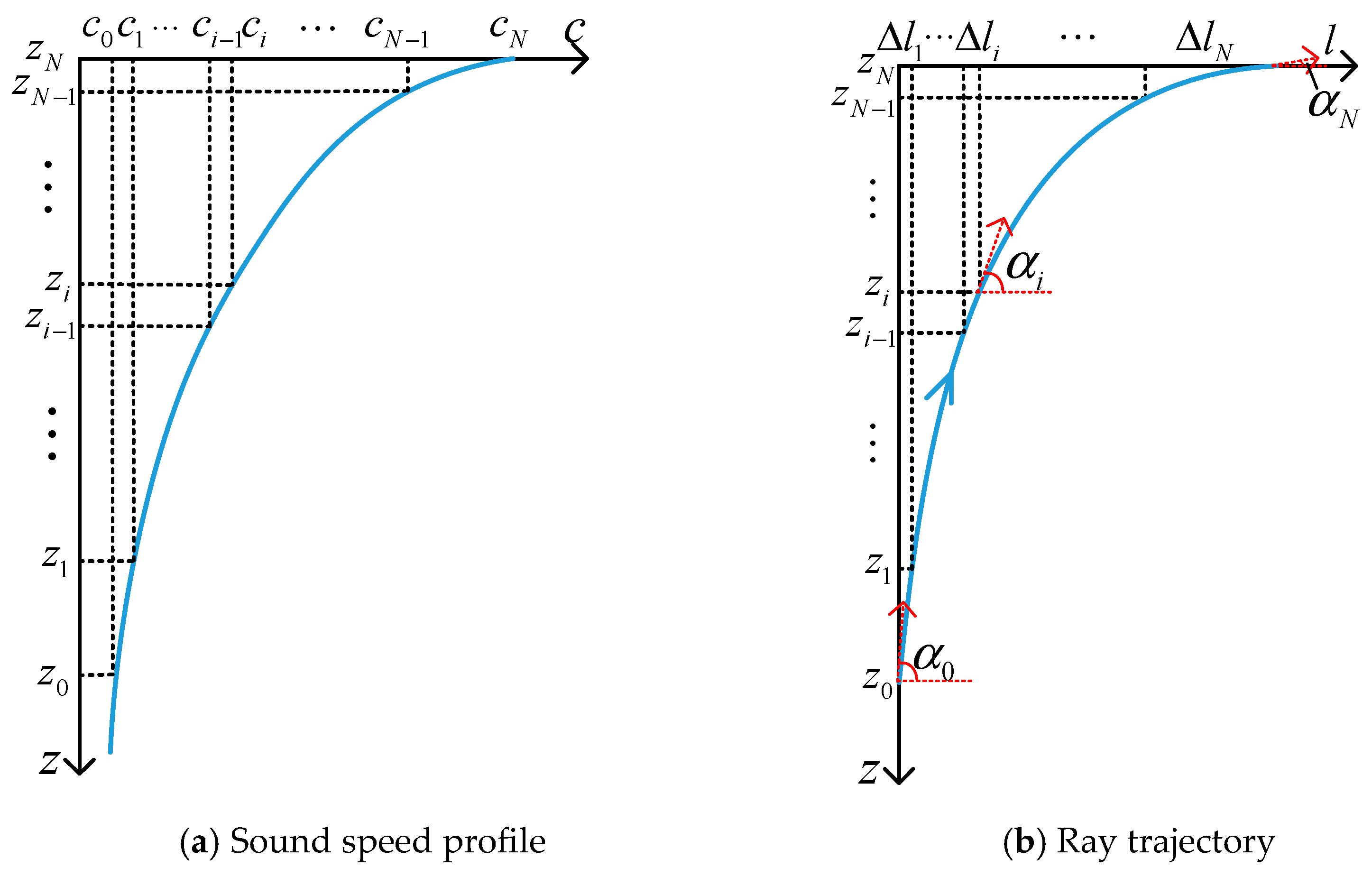
2.1. Ray Acoustics Theory
2.2. Slant Range Estimation Method Based on Sound Ray Bending Correction
| Algorithm 1: Slant range estimation method based on sound ray bending correction |
| Input: |
| Sensor depth , target depth ; |
| Propagation time measurement ; |
| Sound speed profile ; |
| Output: |
| Slant range ; |
| 1: Initialize the grazing angle range ; |
| 2: Divide the sound speed profile into layers; |
| 3: repeat |
| 4: Under the initial grazing angle , calculate the horizontal propagation range and propagation time using Formulas (1)–(3); |
| 5: Compare with the threshold ; |
| 6: if then |
| 7: The horizontal propagation range is ; |
| 8: else |
| 9: if then |
| 10: , ; |
| 11: else |
| 12: , ; |
| 13: until ; |
| 14: return ; |
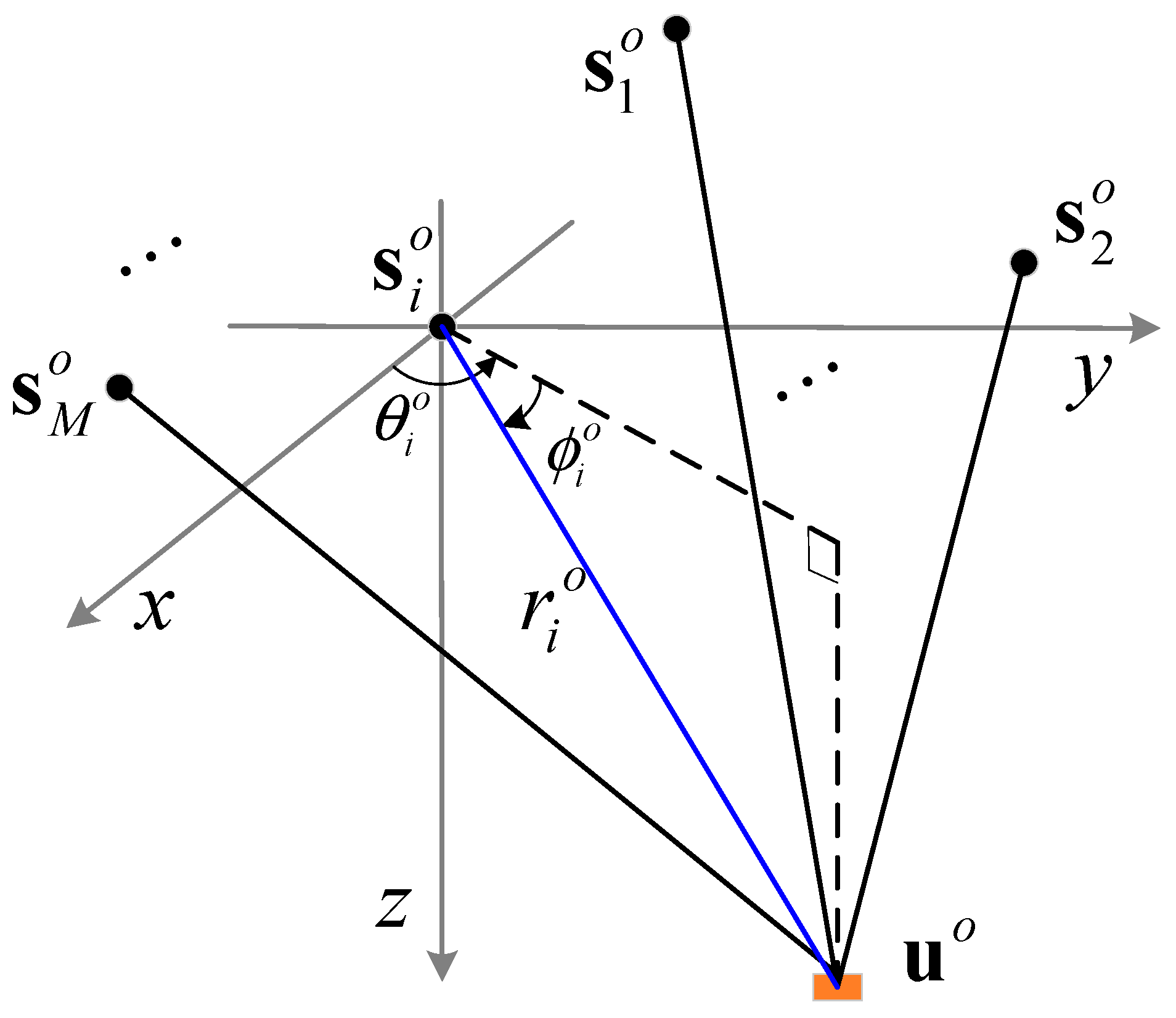
3. Scenario and Measurement Models
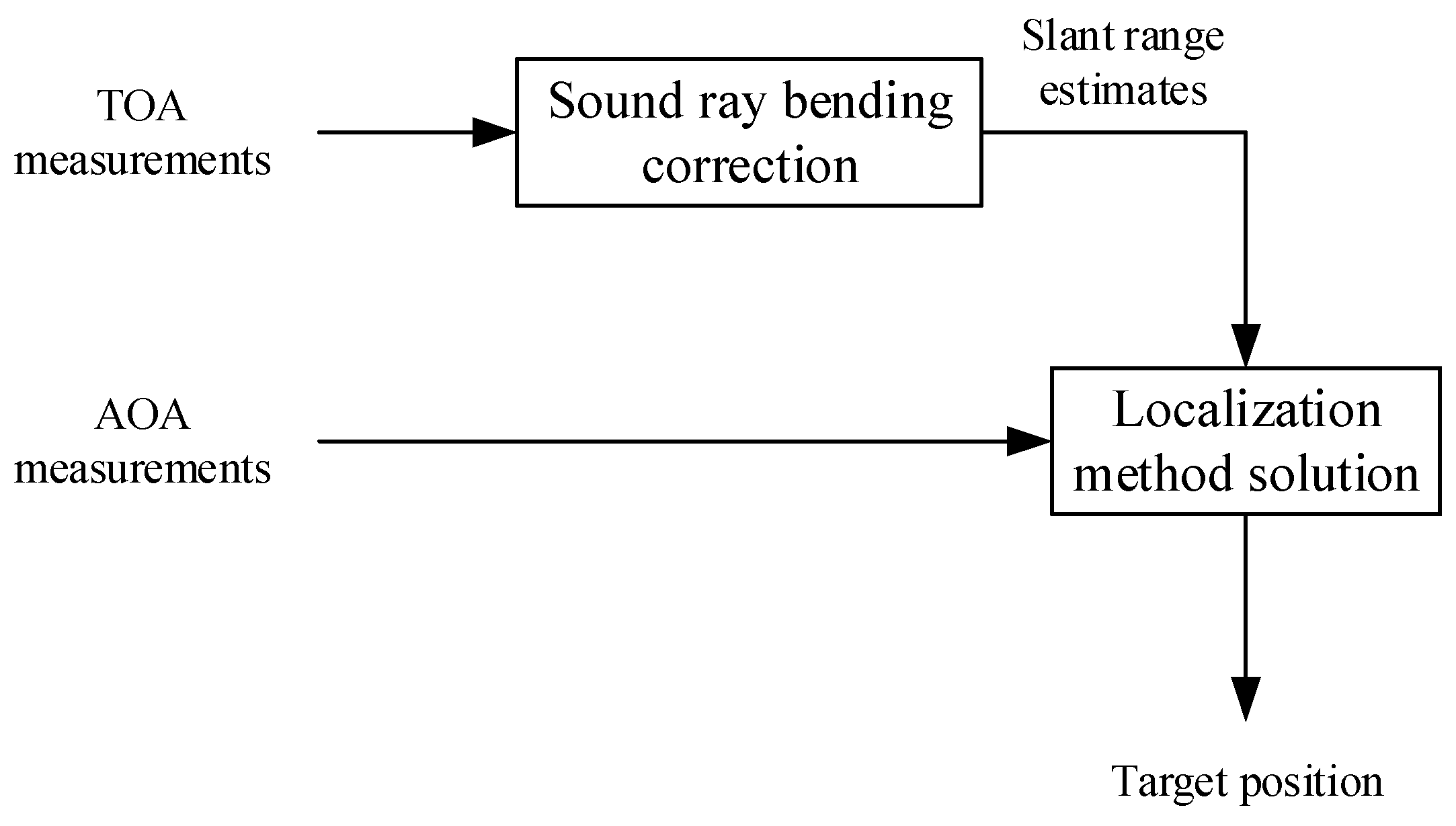
4. Deep-Sea Target Localization Framework Based on Sound Ray Bending Correction
4.1. Closed-Form Solution
4.2. Gauss-Newton MLE Solution
5. CRLB and Analysis
5.1. CRLB
5.2. Analysis
6. Simulation
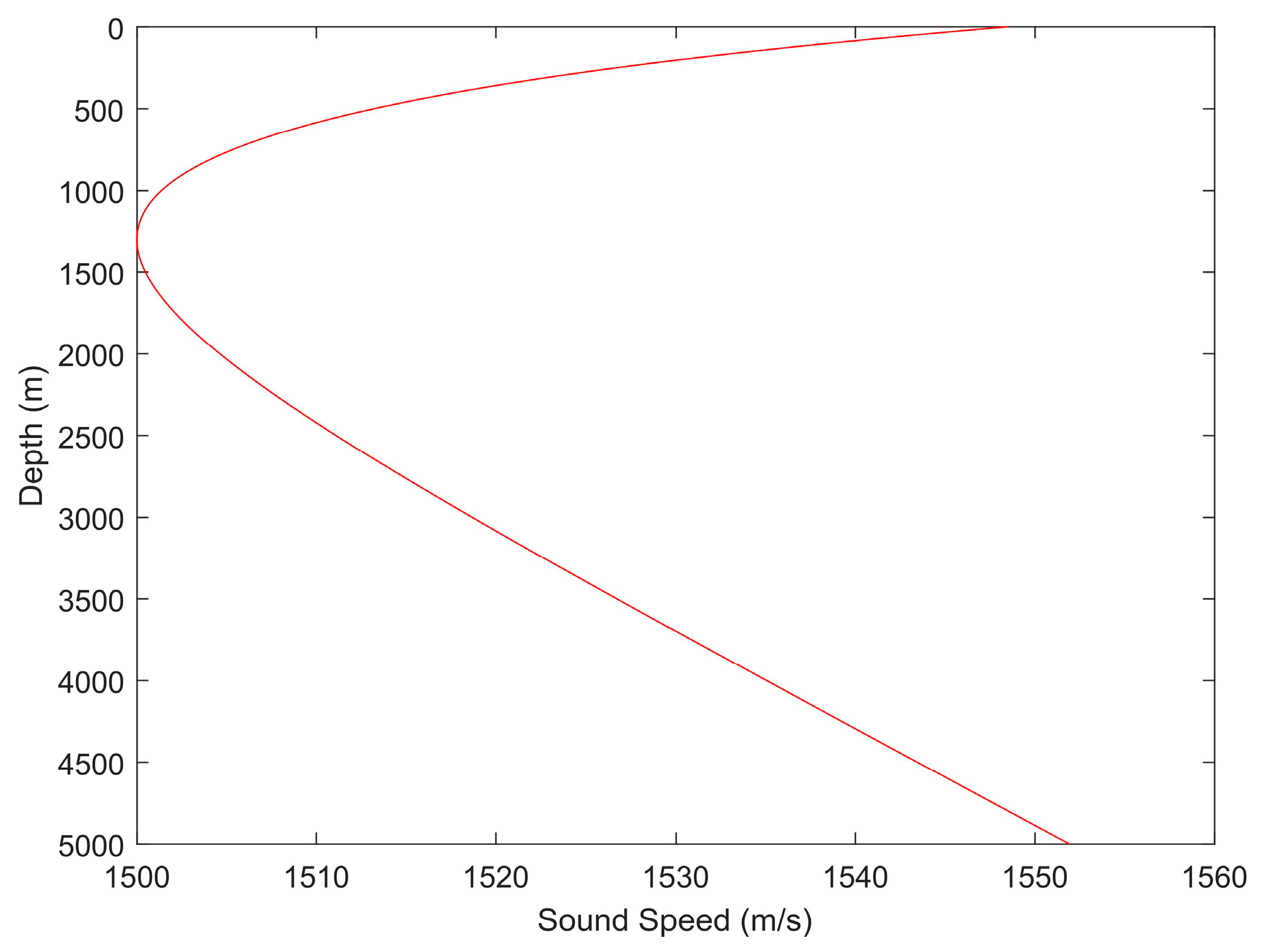
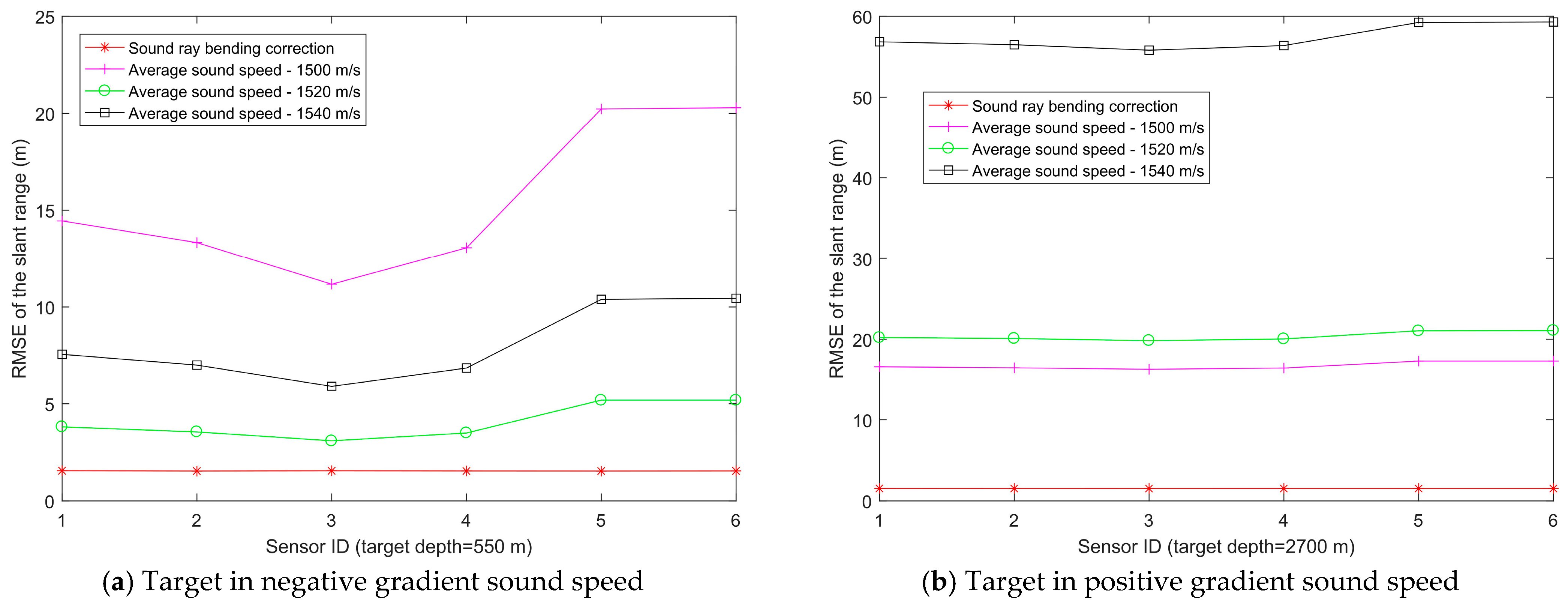
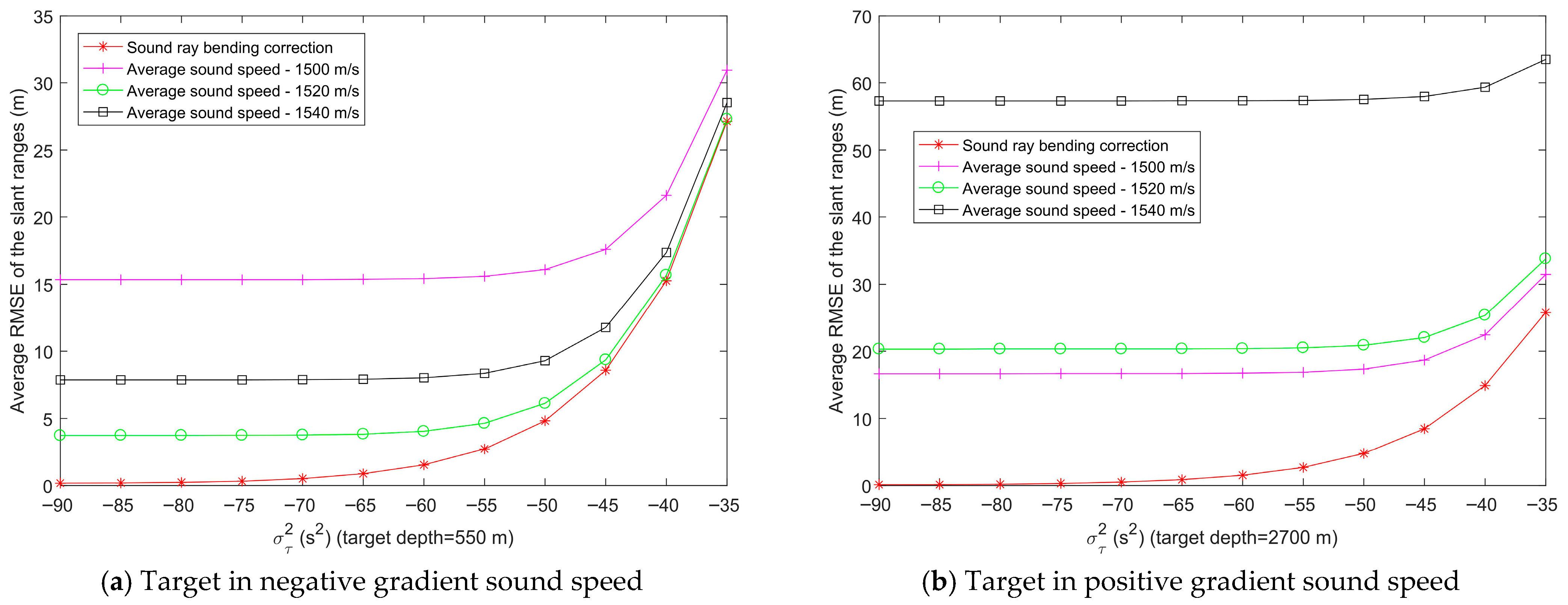
6.1. Simulation Experiment of Slant Range Estimation Based on Sound Ray Bending Correction
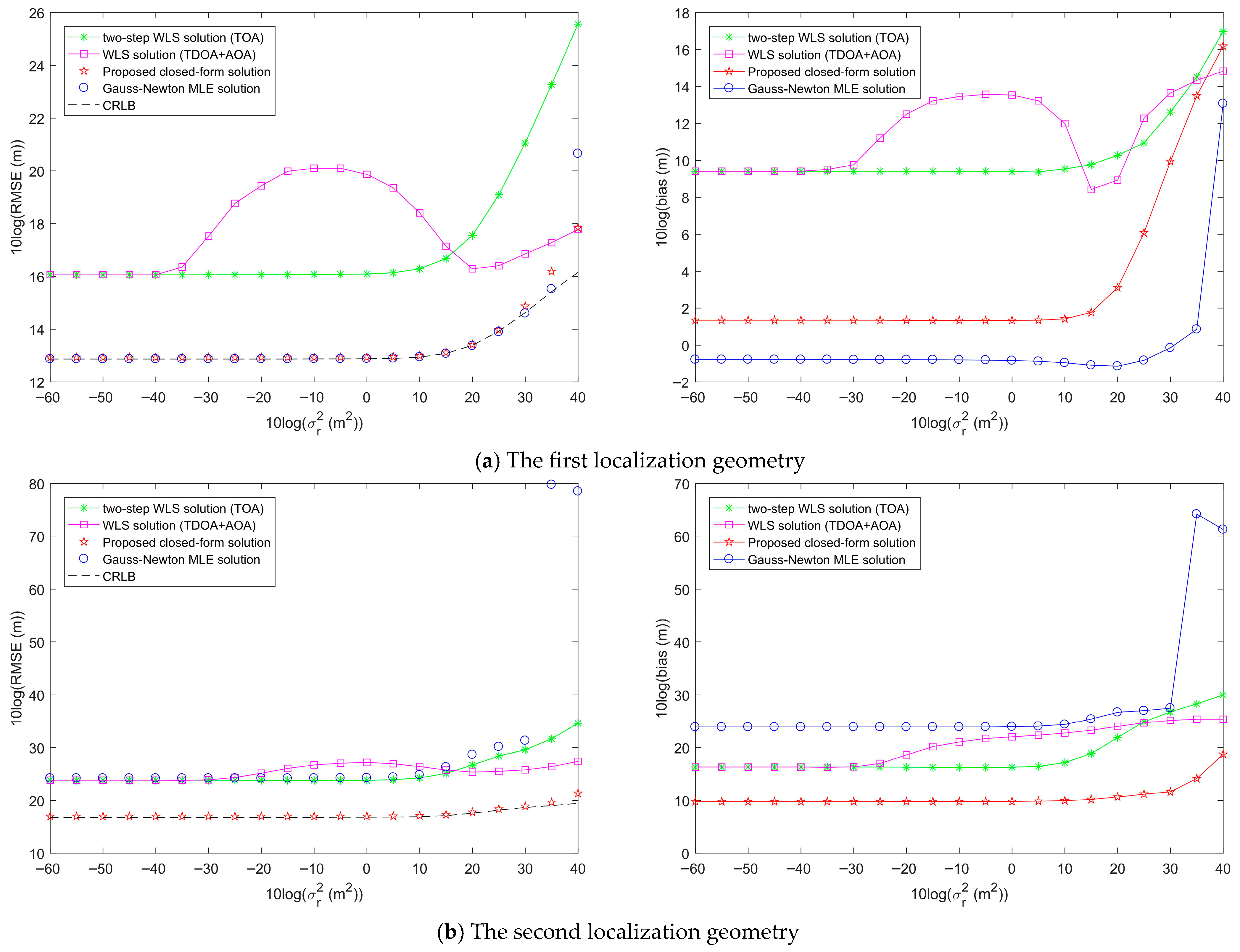
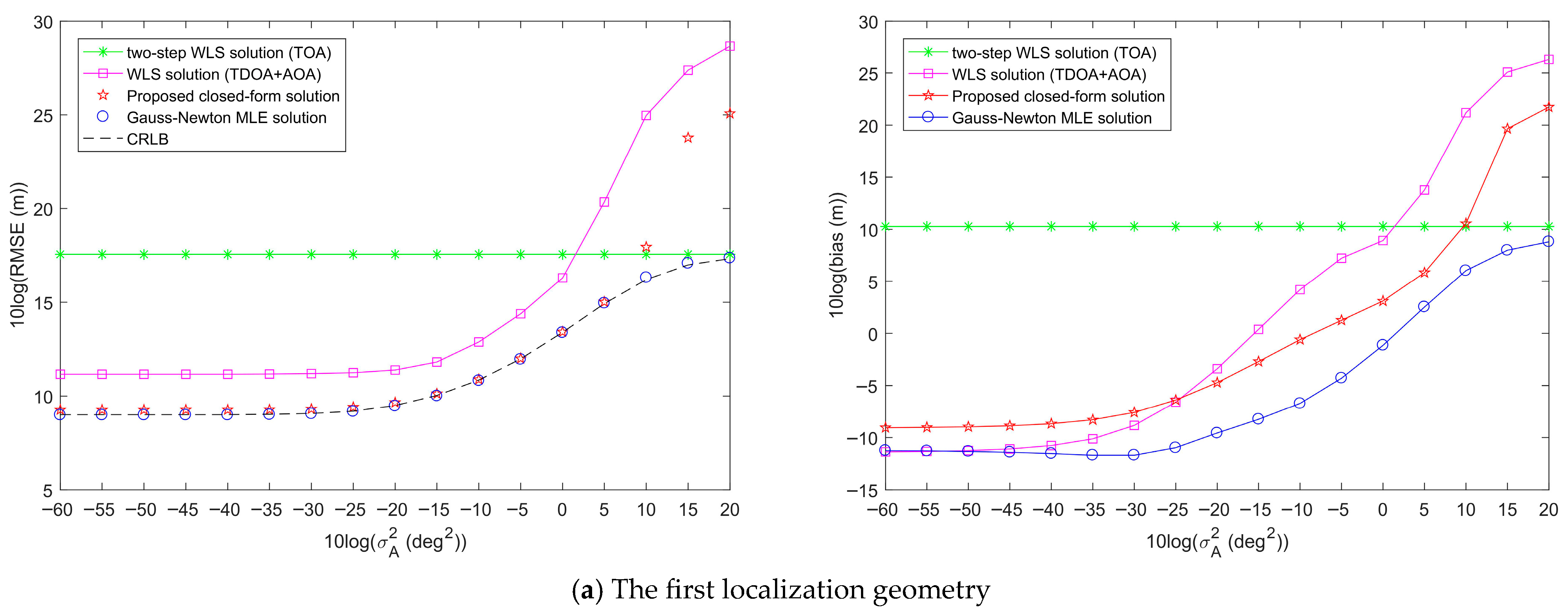
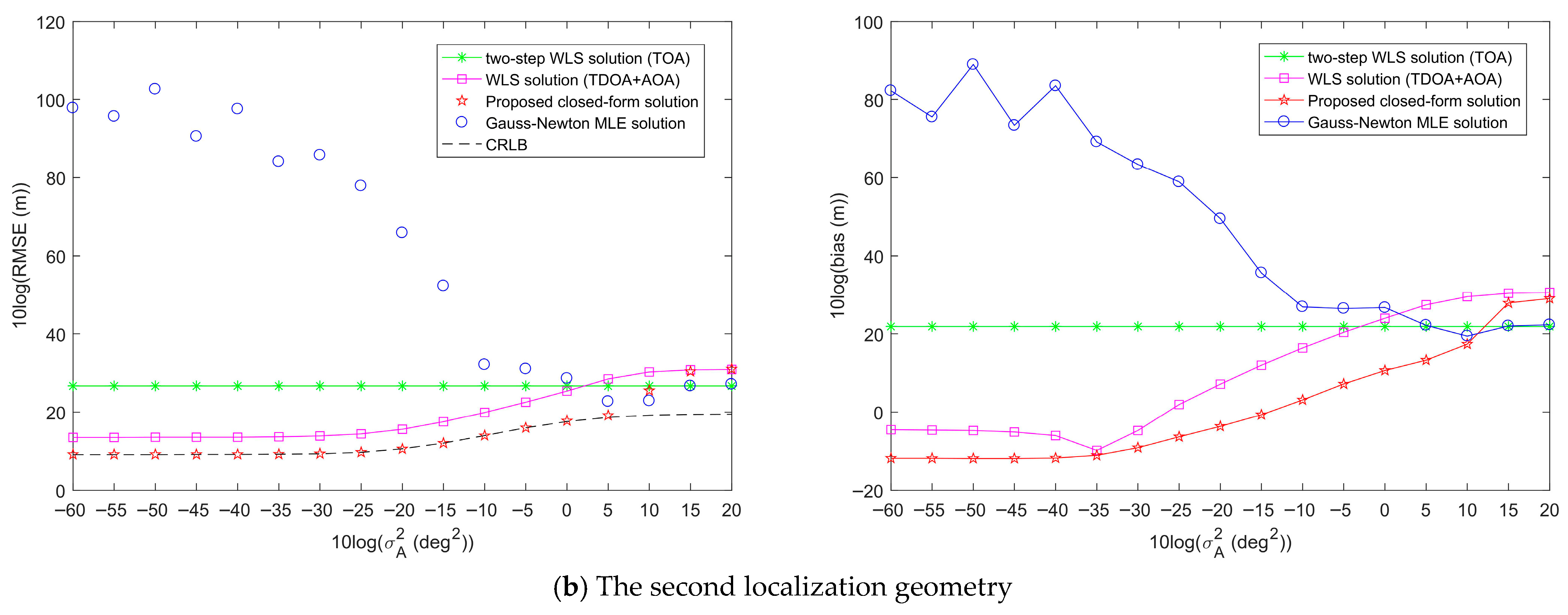
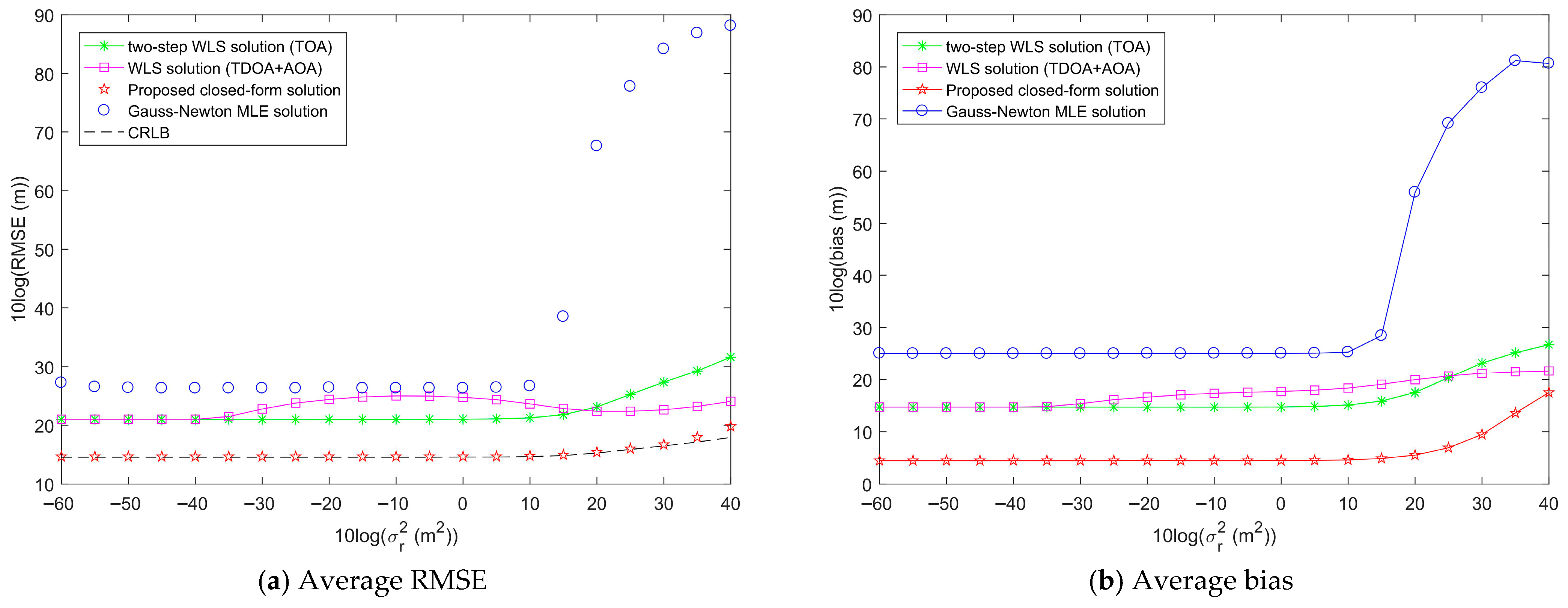
6.2. The Effect of Errors on the Performance of Localization Algorithms
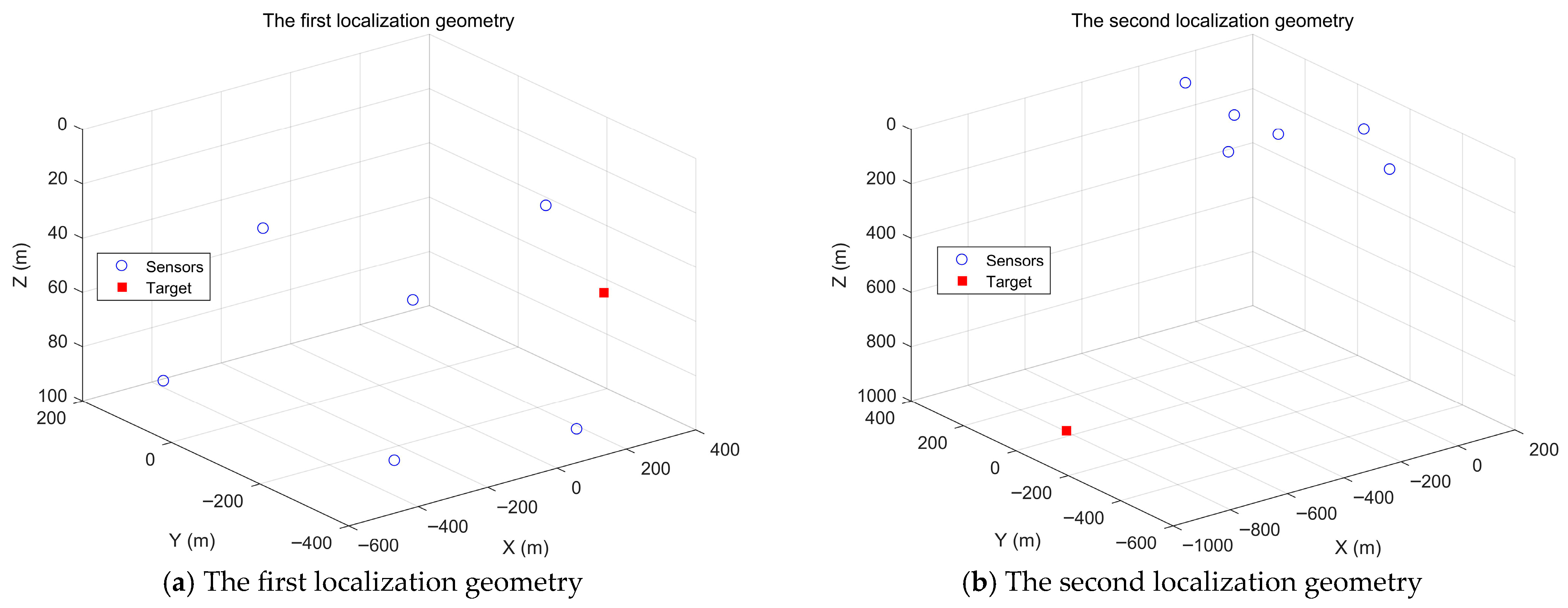
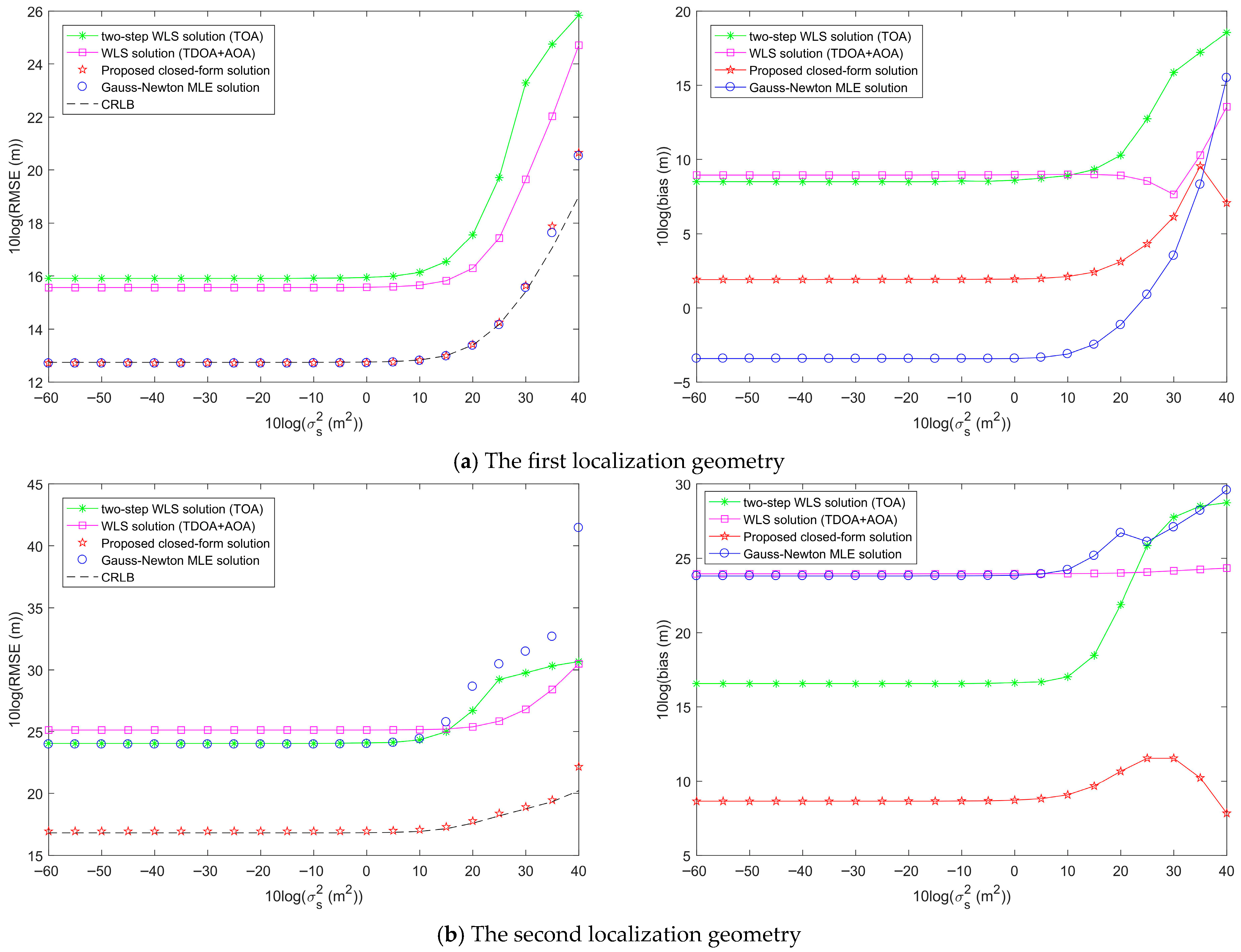
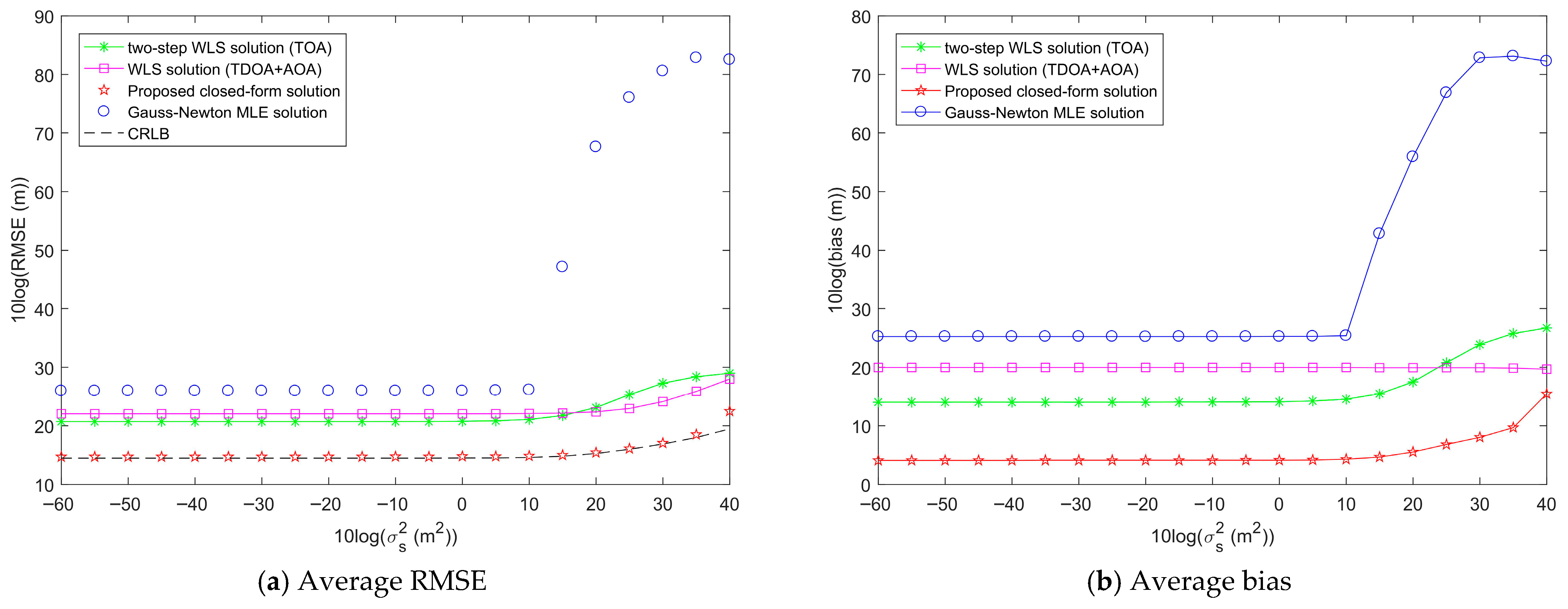
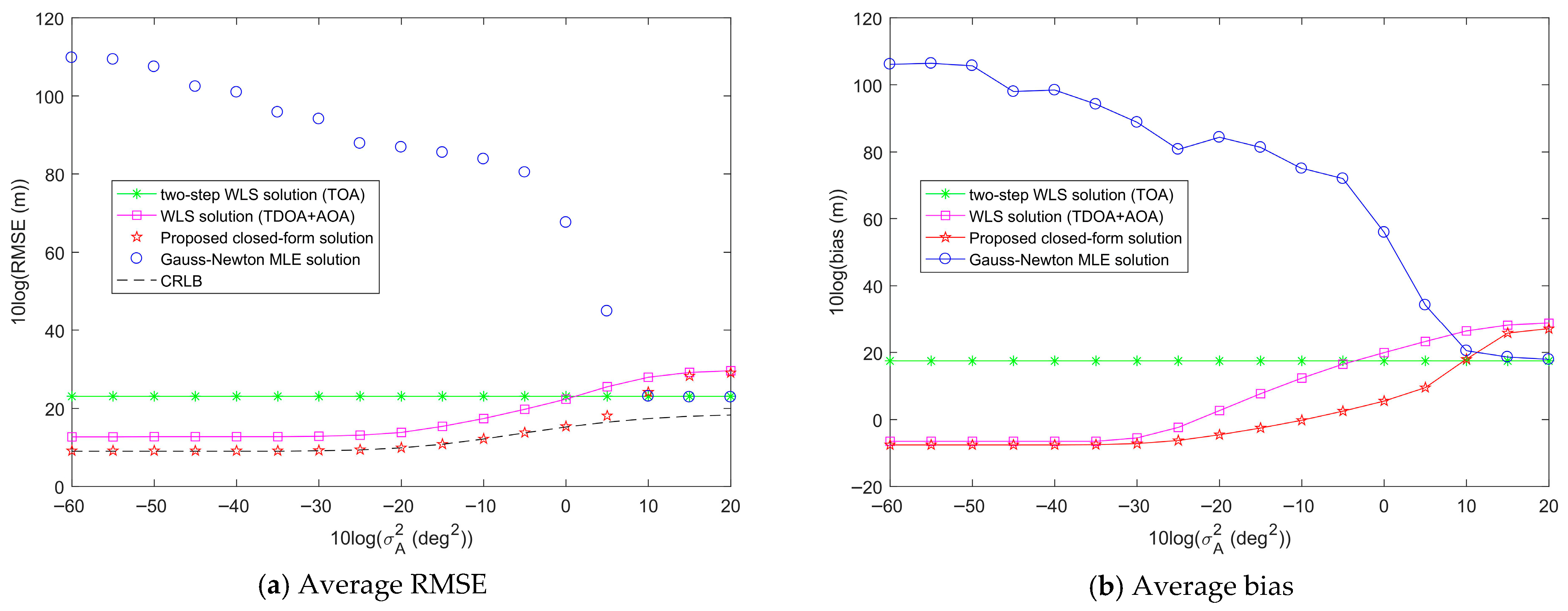
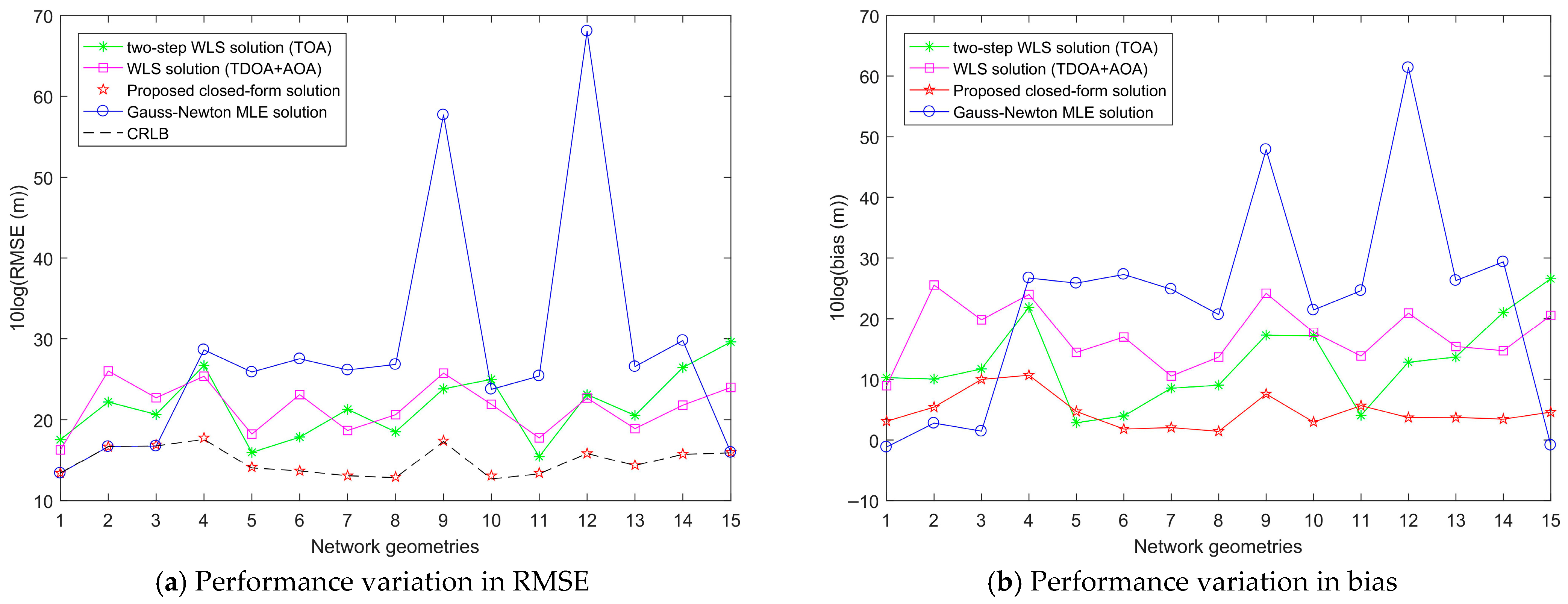
6.3. The Robustness of Localization Methods Against Localization Geometries
7. Conclusions
Author Contributions
Funding
Data Availability Statement
Conflicts of Interest
Abbreviations
| UASNs | Underwater acoustic sensor networks |
| TOA | Time of arrival |
| AOA | Angle of arrival |
| CRLB | Cramér-Rao lower bound |
| RMSE | Root mean square error |
| WLS | Weighted least squares |
| MLE | Maximum likelihood estimation |
Appendix A
Appendix B
Appendix C
References
- Luo, J.; Yang, Y.; Wang, Z.; Chen, Y. Localization algorithm for underwater sensor network: A review. IEEE Internet Things J. 2021, 8, 13126–13144. [Google Scholar] [CrossRef] [Scilit]
- Erol-Kantarci, M.; Mouftah, H.T.; Oktug, S. A survey of architectures and localization techniques for underwater acoustic sensor networks. IEEE Commun. Surv. Tutor. 2011, 13, 487–502. [Google Scholar]
- Han, Y.; Sun, D.; Zheng, C.; Zhang, J. Centralized underwater node localization using range based multilateral accumulation method (RBMAM). Appl. Acoust. 2018, 138, 115–120. [Google Scholar] [CrossRef] [Scilit]
- Isik, M.T.; Akan, O.B. A three dimensional localization algorithm for underwater acoustic sensor networks. IEEE Trans. Wirel. Commun. 2009, 8, 4457–4463. [Google Scholar] [CrossRef] [Scilit]
- Vio, R.P.; Cristi, R.; Smith, K.B. UUV localization using acoustic communications, networking, and a priori knowledge of the ocean current. In Proceedings of the OCEANS 2017-Aberdeen, Aberdeen, UK, 19–22 June 2017; pp. 1–7. [Google Scholar]
- Paull, L.; Saeedi, S.; Seto, M.; Li, H. AUV navigation and localization: A review. IEEE J. Ocean. Eng. 2014, 39, 131–149. [Google Scholar] [CrossRef] [Scilit]
- Yan, Y.; Yang, G.; Wang, H.; Shen, X. Semidefinite relaxation for source localization with quantized TOA measurements and transmission uncertainty in sensor networks. IEEE Trans. Commun. 2021, 69, 1201–1213. [Google Scholar] [CrossRef] [Scilit]
- Chang, S.; Li, Y.; He, Y.; Wang, H. Target localization in underwater acoustic sensor networks using RSS measurements. Appl. Sci. 2018, 8, 225. [Google Scholar] [CrossRef] [Scilit]
- Yang, L.; Yang, L.; Ho, K.C. Moving target localization in multistatic sonar by differential delays and doppler shifts. IEEE Signal Process. Lett. 2016, 23, 1160–1164. [Google Scholar] [CrossRef] [Scilit]
- Sun, Y.; Ho, K.C.; Yang, Y.; Chen, L. An asymptotically optimal estimator for source location and propagation speed by TDOA. IEEE Signal Process. Lett. 2023, 30, 1037–1041. [Google Scholar] [CrossRef] [Scilit]
- Yin, J.; Wan, Q.; Yang, S.; Ho, K.C. A simple and accurate TDOA-AOA localization method using two stations. IEEE Signal Process. Lett. 2016, 23, 144–148. [Google Scholar] [CrossRef] [Scilit]
- Zou, Y.; Zhang, W.; Xiao, Y.; Sun, Y. A simple and efficient joint source location and signal propagation speed estimator using AOA and TDOA measurements. IEEE Signal Process. Lett. 2025, 32, 4159–4163. [Google Scholar] [CrossRef] [Scilit]
- Pang, D.; Wang, G.; Ho, K.C. Hybrid AOA-TDOA localization of a moving source by single receiver. IEEE Trans. Commun. 2025, 73, 4088–4104. [Google Scholar] [CrossRef] [Scilit]
- Chen, S.; Ho, K.C. Achieving asymptotic efficient performance for squared range and squared range difference localizations. IEEE Trans. Signal Process. 2013, 61, 2836–2849. [Google Scholar] [CrossRef] [Scilit]
- Decarli, N.; Guerra, A.; Conti, A.; D’Errico, R.; Sibille, A.; Dardari, D. Non-Regenerative Relaying for Network Localization. IEEE Trans. Wirel. Commun. 2014, 13, 174–185. [Google Scholar] [CrossRef] [Scilit]
- Wang, Y.; Ho, K.C. TDOA positioning irrespective of source range. IEEE Trans. Signal Process. 2017, 65, 1447–1460. [Google Scholar] [CrossRef] [Scilit]
- Wang, Y.; Ho, K.C. An asymptotically efficient estimator in closed-form for 3-D AOA localization using a sensor network. IEEE Trans. Wirel. Commun. 2015, 14, 6524–6535. [Google Scholar] [CrossRef] [Scilit]
- Cong, L.; Zhuang, W. Hybrid TDOA/AOA mobile user location for wideband CDMA cellular systems. IEEE Trans. Wirel. Commun. 2002, 1, 439–447. [Google Scholar] [CrossRef] [Scilit]
- Jia, T.; Wang, H.; Shen, X.; Jiang, Z.; He, K. Target localization based on structured total least squares with hybrid TDOA-AOA measurements. Signal Process. 2018, 143, 211–221. [Google Scholar] [CrossRef] [Scilit]
- Luo, J.; Fan, L.; Wu, S.; Yan, X. Research on localization algorithms based on acoustic communication for underwater sensor networks. Sensors 2018, 18, 67. [Google Scholar] [CrossRef] [Scilit]
- Emokpae, L.E.; DiBenedetto, S.; Potteiger, B.; Younis, M. UREAL: Underwater reflection-enabled acoustic-based localization. IEEE Sens. J. 2014, 14, 3915–3925. [Google Scholar] [CrossRef] [Scilit]
- Zheng, C.; Sun, D.; Cai, L.; Li, X. Mobile node localization in underwater wireless networks. IEEE Access 2018, 6, 17232–17244. [Google Scholar] [CrossRef] [Scilit]
- Zhao, H.; Gong, Z.; Yan, J.; Li, C.; Guan, X. Unsynchronized underwater localization with isogradient sound speed profile and anchor location uncertainties. IEEE Trans. Veh. Technol. 2024, 73, 8864–8877. [Google Scholar] [CrossRef] [Scilit]
- Ameer, P.M.; Jacob, L. Underwater localization using stochastic proximity embedding and multi-dimensional scaling. Wirel. Netw. 2013, 19, 1679–1690. [Google Scholar] [CrossRef] [Scilit]
- Zhang, T.; Yan, L.; Han, G.; Peng, Y. Fast and accurate underwater acoustic horizontal ranging algorithm for an arbitrary sound-speed profile in the deep sea. IEEE Internet Things J. 2022, 9, 755–769. [Google Scholar] [CrossRef] [Scilit]
- Sun, D.; Zhang, P.; Cai, K. Joint estimation of underwater target location and sound speed profile based on argo data. IEEE Internet Things J. 2025, 12, 17110–17122. [Google Scholar] [CrossRef] [Scilit]
- Kang, Y.; Shen, X.; Wang, H. Joint sensor position calibration and target localization based on information interaction for underwater acoustic sensor networks with asynchronous clocks and sensor position errors. IEEE Sens. J. 2026, 26, 9145–9163. [Google Scholar] [CrossRef] [Scilit]
- Ho, K.C.; Sun, M. An accurate algebraic closed-form solution for energy-based source localization. IEEE Trans. Audio Speech Lang. Process. 2007, 15, 2542–2550. [Google Scholar] [CrossRef] [Scilit]
- Jia, T.; Ho, K.C.; Wang, H.; Shen, X. Localization of a moving object with sensors in motion by time delays and Doppler shifts. IEEE Trans. Signal Process. 2020, 68, 5824–5841. [Google Scholar] [CrossRef] [Scilit]
- Ma, Z.; Ho, K.C. TOA localization in the presence of random sensor position errors. In Proceedings of the IEEE International Conference on Acoustics, Speech and Signal Processing (ICASSP), Prague, Czech Republic, 22–27 May 2011; pp. 2468–2471. [Google Scholar]
- Kay, S.M. Fundamentals of Statistical Signal Processing: Estimation Theory; Prentice-Hall: Upper Saddle River, NJ, USA, 1993. [Google Scholar]
- Scharf, L.L. Statistical Signal Processing: Detection, Estimation, and Time Series Analysis; Addison-Wesley: Reading, MA, USA, 1991. [Google Scholar]
- Morozs, N.; Gorma, W. Channel modeling for underwater acoustic network simulation. IEEE Access 2020, 8, 136151–136175. [Google Scholar] [CrossRef] [Scilit]
- Porter, M.B. The BELLHOP Manual and User’s Guide: Preliminary Draft; Technical Report; Heat, Light, and Sound Research, Inc.: La Jolla, CA, USA, 2011; Available online: http://oalib.hlsresearch.com/Rays/HLS-2010-1.pdf (accessed on 23 March 2026).





Disclaimer/Publisher’s Note: The statements, opinions and data contained in all publications are solely those of the individual author(s) and contributor(s) and not of MDPI and/or the editor(s). MDPI and/or the editor(s) disclaim responsibility for any injury to people or property resulting from any ideas, methods, instructions or products referred to in the content. |
© 2026 by the authors. Licensee MDPI, Basel, Switzerland. This article is an open access article distributed under the terms and conditions of the Creative Commons Attribution (CC BY) license.
Share and Cite
Kang, Y.; Shen, X.; Wang, H.; Yan, Y.; Jia, T. Deep-Sea Target Localization with Entropy Reduction: Sound Ray Bending Correction Based on TOA Time Series Analysis and Joint TOA-AOA Fusion. Entropy 2026, 28, 373. https://doi.org/10.3390/e28040373
Kang Y, Shen X, Wang H, Yan Y, Jia T. Deep-Sea Target Localization with Entropy Reduction: Sound Ray Bending Correction Based on TOA Time Series Analysis and Joint TOA-AOA Fusion. Entropy. 2026; 28(4):373. https://doi.org/10.3390/e28040373
Chicago/Turabian StyleKang, Yuzhu, Xiaohong Shen, Haiyan Wang, Yongsheng Yan, and Tianyi Jia. 2026. "Deep-Sea Target Localization with Entropy Reduction: Sound Ray Bending Correction Based on TOA Time Series Analysis and Joint TOA-AOA Fusion" Entropy 28, no. 4: 373. https://doi.org/10.3390/e28040373
APA StyleKang, Y., Shen, X., Wang, H., Yan, Y., & Jia, T. (2026). Deep-Sea Target Localization with Entropy Reduction: Sound Ray Bending Correction Based on TOA Time Series Analysis and Joint TOA-AOA Fusion. Entropy, 28(4), 373. https://doi.org/10.3390/e28040373