A Time-Symmetric and Retrocausal Resolution of the EPR Paradox


Abstract
1. Introduction
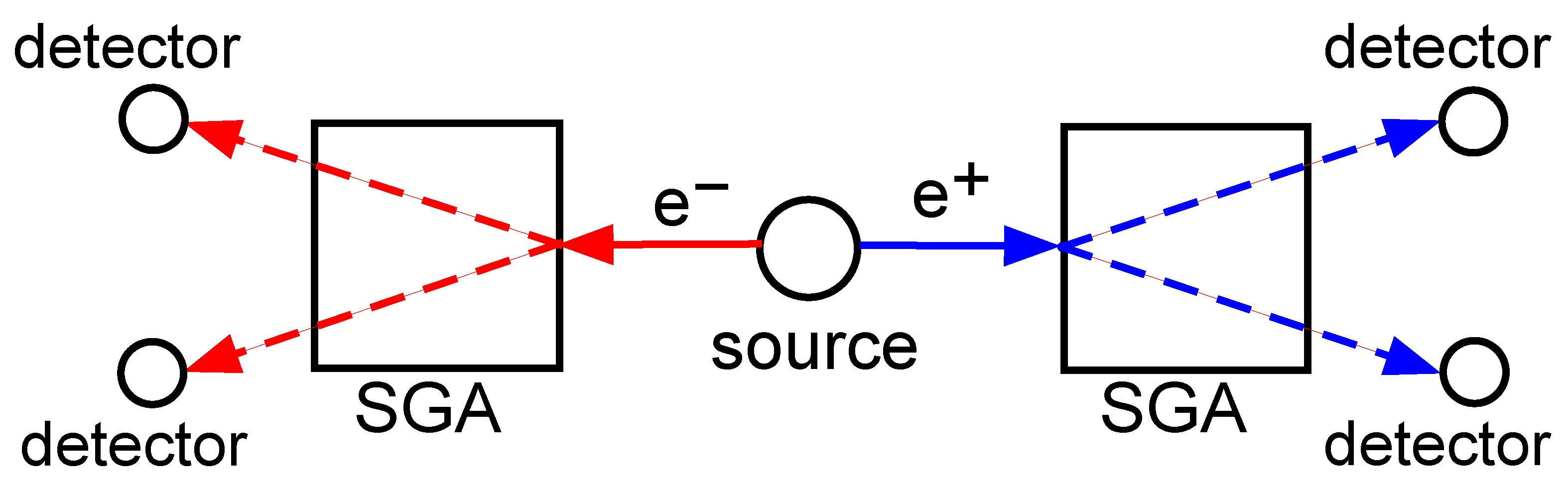
2. The Gedankenexperiment
3. The Copenhagen Interpretation (CI) Explanation
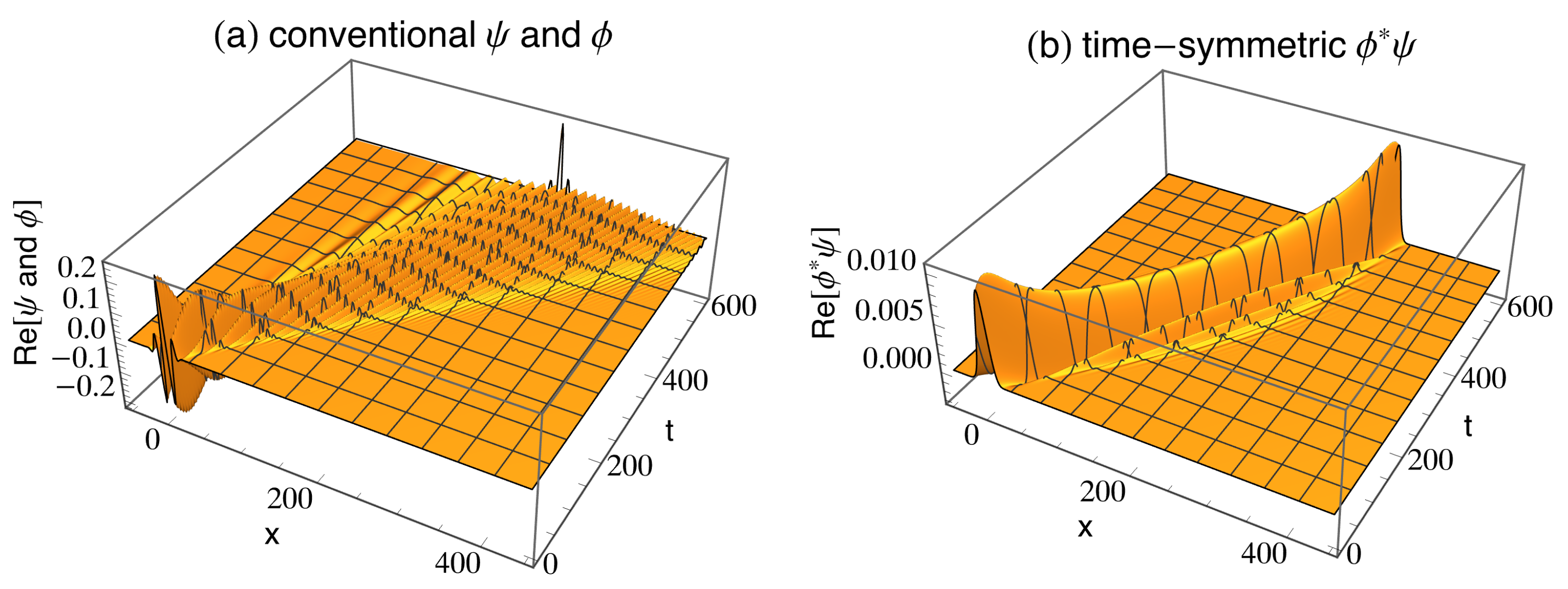
4. The Time-Symmetric Interpretation (TSI) Explanation
5. Discussion
6. Conclusions
Funding
Data Availability Statement
Acknowledgments
Conflicts of Interest
References
- Smolin, L. The Trouble with Physics: The Rise of String Theory, the Fall of a Science, and What Comes Next; Houghton Mifflin Harcourt: Boston, MA, USA, 2006. [Google Scholar]
- Einstein, A.; Podolsky, B.; Rosen, N. Can quantum-mechanical description of physical reality be considered complete? Phys. Rev. 1935, 47, 777. [Google Scholar] [CrossRef] [Scilit]
- Bricmont, J. Making Sense of Quantum Mechanics; Springer International Publishing: Cham, Switzerland, 2016; Volume 37. [Google Scholar]
- Stapp, H.P. Bell’s theorem and world process. Il Nuovo C. B (1971–1996) 1975, 29, 270–276. [Google Scholar] [CrossRef] [Scilit]
- Davidon, W.C. Quantum physics of single systems. Il Nuovo C. B (1971–1996) 1976, 36, 34–40. [Google Scholar] [CrossRef] [Scilit]
- De Beauregard, O.C. Einstein-Podolsky-Rosen non-separability and Feynman non-locality. Phys. Lett. A 1977, 60, 93–95. [Google Scholar] [CrossRef] [Scilit]
- Eberhard, P.H. Bell’s theorem and the different concepts of locality. Il Nuovo C. B (1971–1996) 1978, 46, 392–419. [Google Scholar] [CrossRef] [Scilit]
- Sutherland, R.I. Bell’s theorem and backwards-in-time causality. Int. J. Theor. Phys. 1983, 22, 377–384. [Google Scholar] [CrossRef] [Scilit]
- Price, H. Time’s Arrow & Archimedes’ Point: New Directions for the Physics of Time; Oxford University Press: Oxford, UK, 1996. [Google Scholar]
- Wharton, W.R. Backward causation and the EPR paradox. arXiv 1998, arXiv:quant-ph/9810060v1. Available online: https://arxiv.org/html/quant-ph/9810060v1/ (accessed on 15 November 2025). [CrossRef] [Scilit]
- Wharton, K.B. Time-symmetric quantum mechanics. Found. Phys. 2007, 37, 159–168. [Google Scholar] [CrossRef] [Scilit]
- Argaman, N. Bell’s theorem and the causal arrow of time. Am. J. Phys. 2010, 78, 1007–1013. [Google Scholar] [CrossRef] [Scilit]
- Corry, R. Retrocausal models for EPR. Stud. Hist. Philos. Sci. Part B Stud. Hist. Philos. Mod. Phys. 2015, 49, 1–9. [Google Scholar] [CrossRef] [Scilit]
- Cramer, J.G. The Quantum Handshake; Springer Publishing Company: Heidelberg, Germany, 2016. [Google Scholar]
- Kastner, R.E. The Transactional Interpretation of Quantum Mechanics: A Relativistic Treatment, 2nd ed.; Cambridge University Press: Cambridge, UK, 2022. [Google Scholar]
- Freedman, S.J.; Clauser, J.F. Experimental test of local hidden-variable theories. Phys. Rev. Lett. 1972, 28, 938. [Google Scholar] [CrossRef] [Scilit]
- Aspect, A.; Grangier, P.; Roger, G. Experimental realization of Einstein-Podolsky-Rosen-Bohm Gedankenexperiment: A new violation of Bell’s inequalities. Phys. Rev. Lett. 1982, 49, 91. [Google Scholar] [CrossRef] [Scilit]
- Aspect, A.; Dalibard, J.; Roger, G. Experimental test of Bell’s inequalities using time-varying analyzers. Phys. Rev. Lett. 1982, 49, 1804. [Google Scholar] [CrossRef] [Scilit]
- Weihs, G.; Jennewein, T.; Simon, C.; Weinfurter, H.; Zeilinger, A. Violation of Bell’s inequality under strict Einstein locality conditions. Phys. Rev. Lett. 1998, 81, 5039. [Google Scholar] [CrossRef] [Scilit]
- Bouwmeester, D.; Pan, J.W.; Mattle, K.; Eibl, M.; Weinfurter, H.; Zeilinger, A. Experimental quantum teleportation. Nature 1997, 390, 575–579. [Google Scholar] [CrossRef] [Scilit]
- Hensen, B.; Bernien, H.; Dréau, A.E.; Reiserer, A.; Kalb, N.; Blok, M.S.; Ruitenberg, J.; Vermeulen, R.F.; Schouten, R.N.; Abellán, C.; et al. Experimental loophole-free violation of a Bell inequality using entangled electron spins separated by 1.3 km. arXiv 2015, arXiv:1508.05949. [Google Scholar] [CrossRef] [Scilit]
- Commins, E.D. Quantum Mechanics: An Experimentalist’s Approach; Cambridge University Press: Cambridge, UK, 2014. [Google Scholar]
- Friederich, S.; Evans, P.W. Retrocausality in Quantum Mechanics. In Stanford Encyclopedia of Philosophy (Summer 2019 Ed.); Zalta, E.N., Ed.; Stanford University: Stanford, CA, USA, 2019; Available online: https://plato.stanford.edu/archives/sum2019/entries/qm-retrocausality (accessed on 12 November 2025).
- Mannucci, M.A. When the Weak Becomes Strong: Effective Observables via Time-Symmetric Quantum Selection. arXiv 2025, arXiv:2507.09716. [Google Scholar] [CrossRef] [Scilit]
- Tetrode, H.M. Über den Wirkungszusammenhang der Welt. Eine Erweiterung der klassischen Dynamik. Z. Phys. 1922, 10, 317–328. [Google Scholar] [CrossRef] [Scilit]
- Watanabe, S. Symmetry of physical laws. Part III. Prediction and retrodiction. Rev. Mod. Phys. 1955, 27, 179. [Google Scholar] [CrossRef] [Scilit]
- Aharonov, Y.; Vaidman, L. The two-state vector formalism of quantum mechanics. arXiv 2001, arXiv:quant-ph/0105101. [Google Scholar]
- Cramer, J.G. The transactional interpretation of quantum mechanics. Rev. Mod. Phys. 1986, 58, 647. [Google Scholar] [CrossRef] [Scilit]
- Heaney, M.B. A symmetrical interpretation of the Klein-Gordon equation. Found. Phys. 2013, 43, 733–746. [Google Scholar] [CrossRef] [Scilit]
- Heaney, M.B. A Time-Symmetric Formulation of Quantum Entanglement. Entropy 2021, 23, 179. [Google Scholar] [CrossRef] [Scilit] [PubMed]
- Dirac, P.A.M. Relativistic quantum mechanics. Proc. R. Soc. Lond. A 1932, 136, 453–464. [Google Scholar] [CrossRef] [Scilit]
- Purcell, E.M. Spontaneous Emission Probabilities at Radio Frequencies. Phys. Rev. 1946, 69, 681. [Google Scholar]
- Norsen, T. John S. Bell’s concept of local causality. Am. J. Phys. 2011, 79, 1261–1275. [Google Scholar] [CrossRef] [Scilit]
- Terletskii, Y.P. Paradoxes in the Theory of Relativity; Plenum Press: New York, NY, USA, 1968. [Google Scholar]
- Schrödinger, E. Über die kräftefreie Bewegung in der relativistischen Quantenmechanik. In Sitzungsberichte der Preussischen Akademie der Wissenschaften, Physikalisch-Mathematische Klasse; W. de Gruyter u. Company: Berlin, Germany, 1930. [Google Scholar]


Disclaimer/Publisher’s Note: The statements, opinions and data contained in all publications are solely those of the individual author(s) and contributor(s) and not of MDPI and/or the editor(s). MDPI and/or the editor(s) disclaim responsibility for any injury to people or property resulting from any ideas, methods, instructions or products referred to in the content. |
© 2026 by the author. Licensee MDPI, Basel, Switzerland. This article is an open access article distributed under the terms and conditions of the Creative Commons Attribution (CC BY) license.
Share and Cite
Heaney, M.B. A Time-Symmetric and Retrocausal Resolution of the EPR Paradox. Entropy 2026, 28, 319. https://doi.org/10.3390/e28030319
Heaney MB. A Time-Symmetric and Retrocausal Resolution of the EPR Paradox. Entropy. 2026; 28(3):319. https://doi.org/10.3390/e28030319
Chicago/Turabian StyleHeaney, Michael B. 2026. "A Time-Symmetric and Retrocausal Resolution of the EPR Paradox" Entropy 28, no. 3: 319. https://doi.org/10.3390/e28030319
APA StyleHeaney, M. B. (2026). A Time-Symmetric and Retrocausal Resolution of the EPR Paradox. Entropy, 28(3), 319. https://doi.org/10.3390/e28030319