Article

Bifurcation Diagrams of Nonlinear Oscillatory Dynamical Systems: A Brief Review in 1D, 2D and 3D


by
Wieslaw Marszalek
*,† and
Maciej Walczak
Department of Computer Science, Opole University of Technology, 45-758 Opole, Poland
*
Author to whom correspondence should be addressed.
The authors contributed equally to this work.
Entropy 2024, 26(9), 770; https://doi.org/10.3390/e26090770
Submission received: 12 July 2024 / Revised: 29 August 2024 / Accepted: 3 September 2024 / Published: 9 September 2024

Abstract

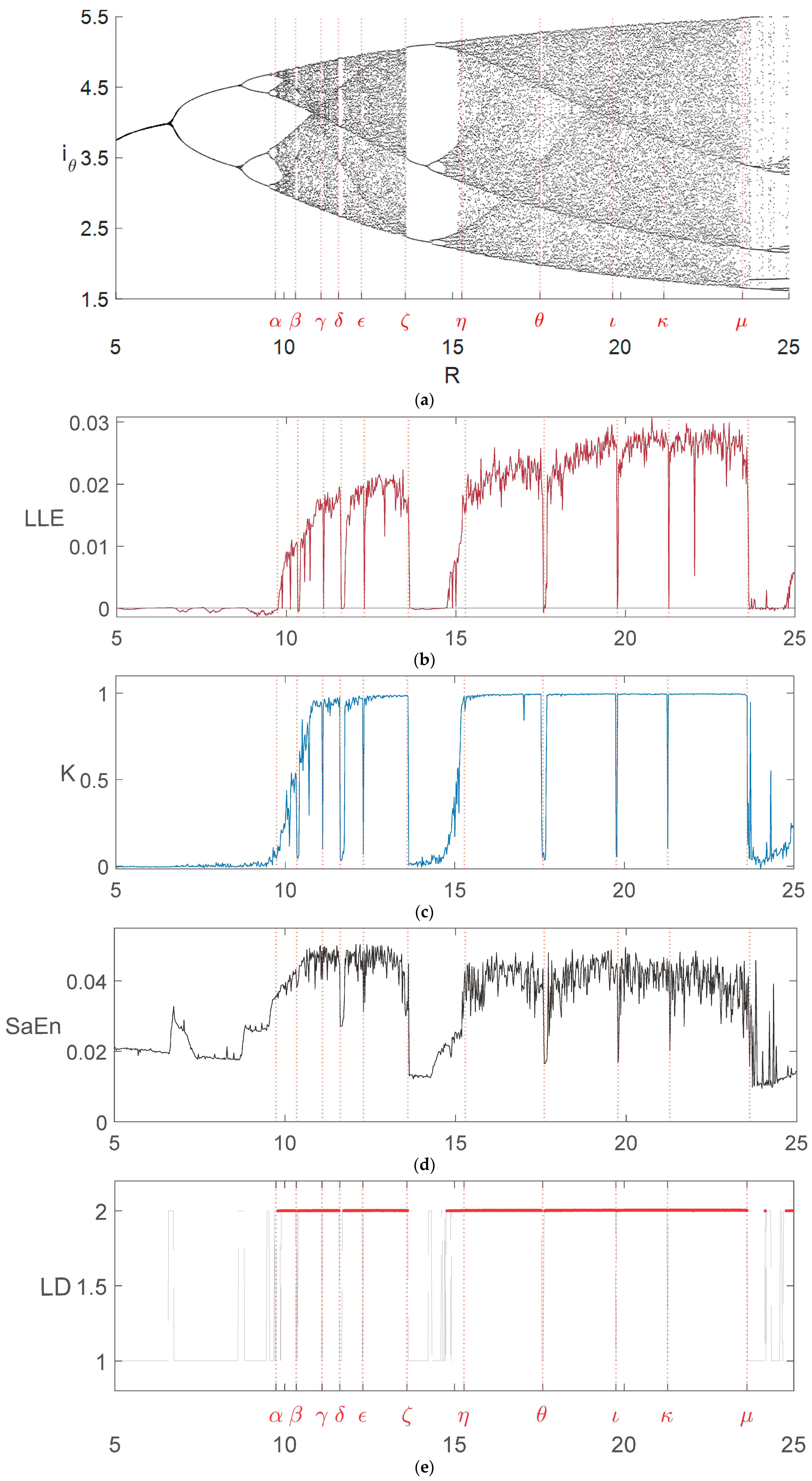
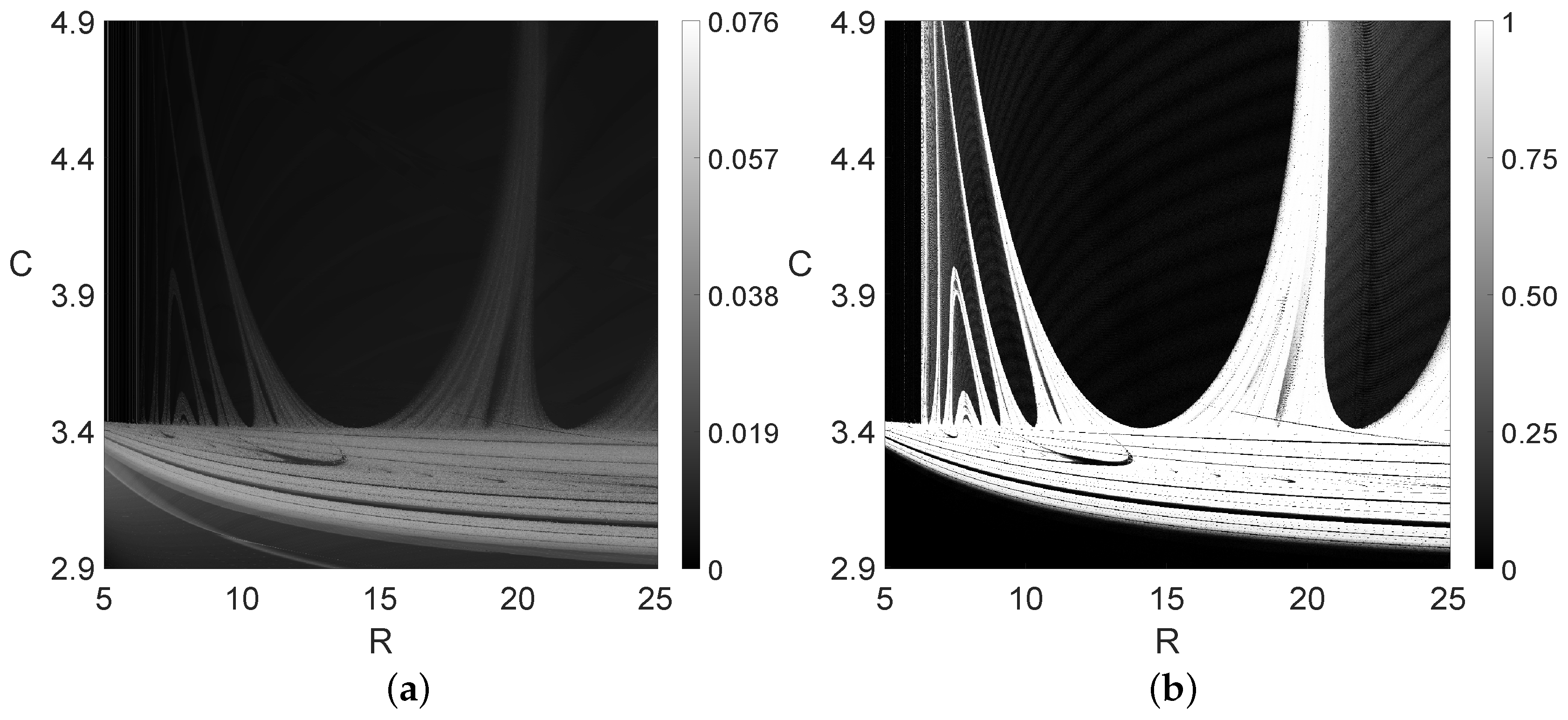
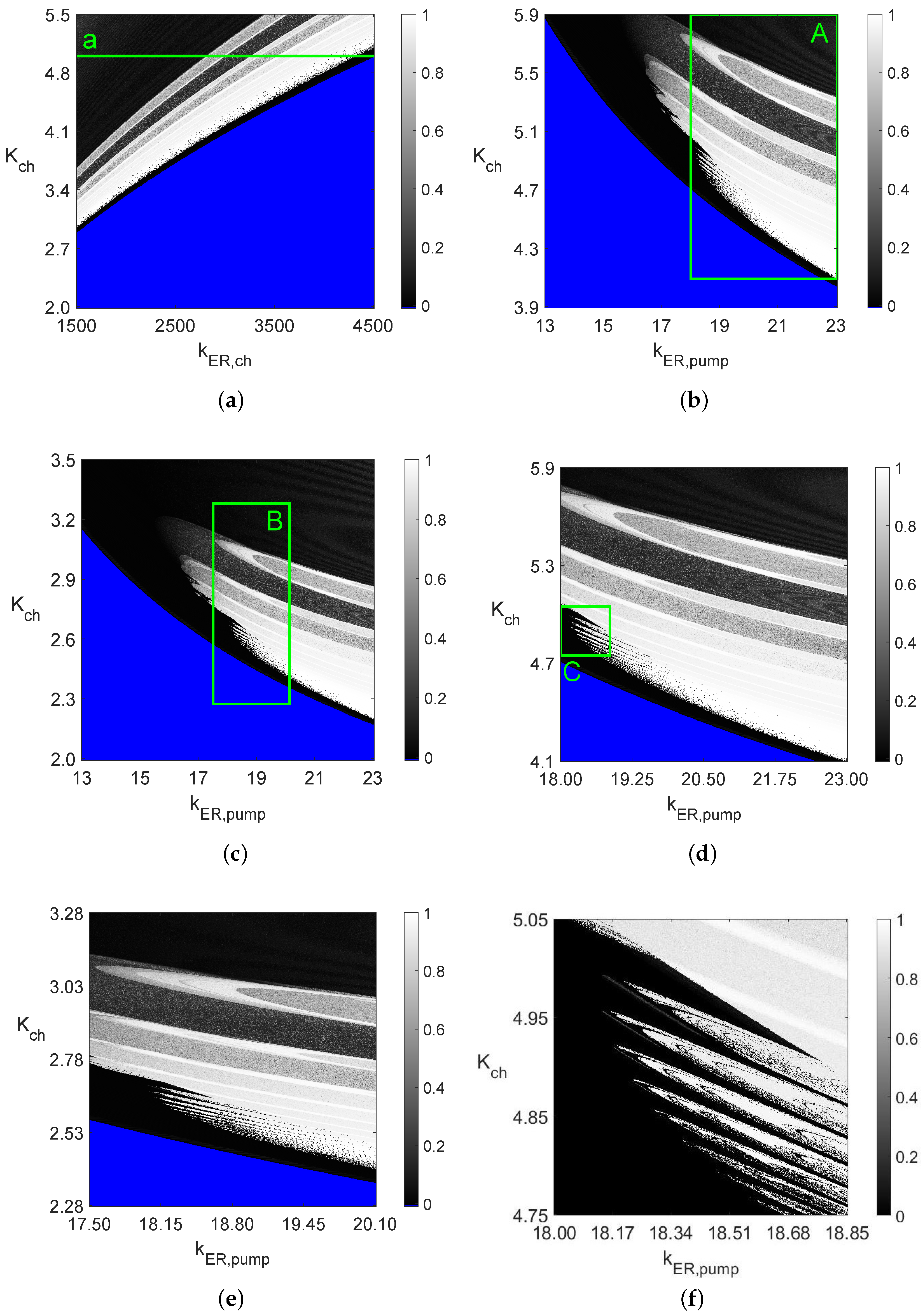
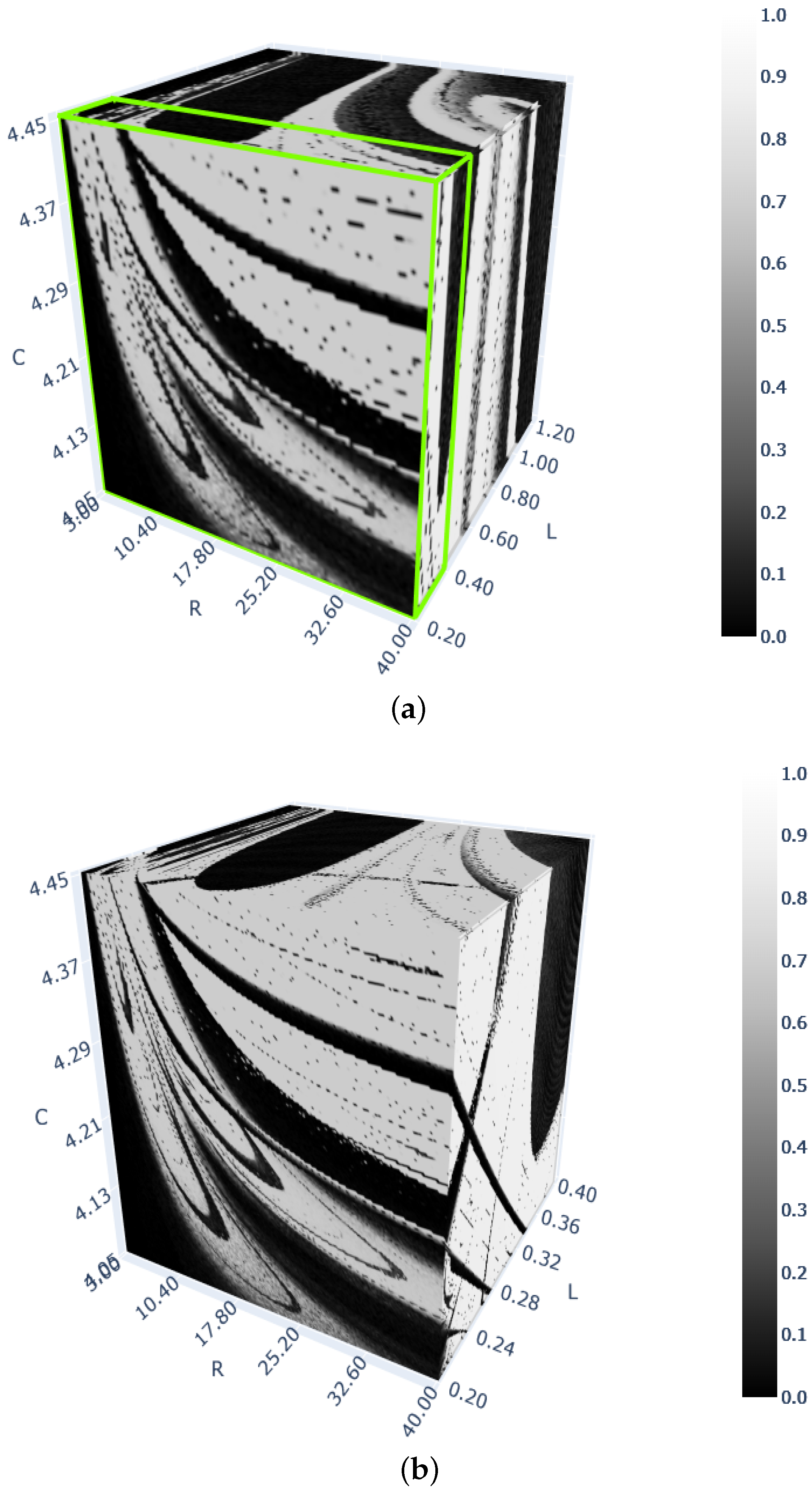
We discuss 1D, 2D and 3D bifurcation diagrams of two nonlinear dynamical systems: an electric arc system having both chaotic and periodic steady-state responses and a cytosolic calcium system with both periodic/chaotic and constant steady-state outputs. The diagrams are mostly obtained by using the 0–1 test for chaos, but other types of diagrams are also mentioned; for example, typical 1D diagrams with local maxiumum values of oscillatory responses (periodic and chaotic), the entropy method and the largest Lyapunov exponent approach. Important features and properties of each of the three classes of diagrams with one, two and three varying parameters in the 1D, 2D and 3D cases, respectively, are presented and illustrated via certain diagrams of the K values, 1K1, from the 0–1 test and the sample entropy values SaEn>0. The K values close to 0 indicate periodic and quasi-periodic responses, while those close to 1 are for chaotic ones. The sample entropy 3D diagrams for an electric arc system are also provided to illustrate the variety of possible bifurcation diagrams available. We also provide a comparative study of the diagrams obtained using different methods with the goal of obtaining diagrams that appear similar (or close to each other) for the same dynamical system. Three examples of such comparisons are provided, each in the 1D, 2D and 3D cases. Additionally, this paper serves as a brief review of the many possible types of diagrams one can employ to identify and classify time-series obtained either as numerical solutions of models of nonlinear dynamical systems or recorded in a laboratory environment when a mathematical model is unknown. In the concluding section, we present a brief overview of the advantages and disadvantages of using the 1D, 2D and 3D diagrams. Several illustrative examples are included.
Keywords: oscillatory signals; 0–1 test for chaos; sample entropy, largest Lyapunov exponent approach; bifurcation diagrams with one (1D), two (2D) and three (3D) varying parameters; electric arc system; calcium oscillatory system oscillatory signals; 0–1 test for chaos; sample entropy, largest Lyapunov exponent approach; bifurcation diagrams with one (1D), two (2D) and three (3D) varying parameters; electric arc system; calcium oscillatory system