Abstract
As a means of spread spectrum communication, frequency-hopping technology has good performance in anti-jamming, multiple-access, security, covert communications, and so on. In order to meet the needs of different frequency-hopping multiple-access (FHMA) communication scenarios, the research on frequency-hopping sequence (FHS) sets with a low-hit-zone (LHZ) is now becoming more and more crucial. In this paper, a general construction to obtain new families of LHZ-FHS sets is achieved via interleaving technique. Subsequently, based on two different shift sequences, two classes of LHZ-FHS sets with new flexible parameters not covered in the related literature are presented. The requirements for our new LHZ-FHS sets to obtain optimality or near-optimality with respect to the Peng–Fan–Lee bound are also introduced. Furthermore, as long as the base FHS set is fixed, the performances of new LHZ-FHS sets can be analyzed, such that the parameters of all appropriate shift sequences to obtain desired LHZ-FHS sets are also fixed.
1. Introduction
With advantages such as anti-fading, anti-jamming, multiple-access and secure properties, frequency-hopping multiple-access (FHMA) systems have found wide applications in both military communications and civil communications [1,2]. Despite the physical goals of various FHMA systems, such as military radio communication systems, ultra wide bandwidth (UWB) radio systems, and echolocation communication systems, being considerably different, the demands imposed on the frequency-hopping signals are almost same. The function of frequency-hopping sequence (FHS) in such systems is to decide which frequency we should choose to transmit the information in each time slot. The carrier frequencies of two communication parties hop according to the agreed FHS set. It is hard for a third party who does not know the frequency-hopping rules in advance to discover or track the communication so as to achieve covert communication.
Usually, in FHMA systems, mutual interference (MI) occurs if more than one user transmits information on the same frequency simultaneously, and that may cause an increase in the possibility of destroying the communication process. Clearly, it is desirable to maintain the MI between transmitters at as low a level as possible. On the other hand, the Hamming correlation properties of the employed FHS sets are closely related to the degree of the MI, and so can be important evaluation criteria for the performances of FHMA systems [2,3]. Therefore, it is of great importance to design FHS sets with good Hamming correlation properties.
Unlike synchronous FHMA systems, in the quasi-synchronous (QS) ones, some relative time delay between different users within a zone around the origin can be tolerated. Meanwhile, for a low-hit-zone (LHZ) FHS set, its Hamming cross-correlations and autocorrelations are relatively small, so long as the time delay between different sequences does not exceed a limited zone known as LHZ [4]. Therefore, LHZ-FHS sets are well suitable for QS-FHMA systems. Furthermore, the research on both the theoretical lower bounds and the desired constructions of conventional FHS sets is comparatively rich [3,5,6,7,8,9,10,11]. Thus, in some sense, it is urgent to design more LHZ-FHS sets with both the desired Hamming correlation properties and new flexible parameters.
For an LHZ-FHS set, its maximum periodic Hamming correlation (PHC) within the LHZ, together with the LHZ, the sequence length, the sequence set size, and the frequency slot size, are limited by some mathematical formulas known as theoretical bounds. The first research into the theoretical bounds on LHZ-FHS sets can be dated back to the work of Peng et al. [4], in which the well-known Peng–Fan–Lee bound was derived. Thereafter, there have been a few designs of LHZ-FHS sets achieving or asymptotically achieving the Peng–Fan–Lee bound [12,13,14,15,16,17,18,19,20,21,22,23,24]. In this paper, via the interleaving technique, we also present two classes of LHZ-FHS sets with new flexible parameters not covered in the relevant literature, and which have optimality or near-optimality with regard to the Peng–Fan–Lee bound. For comparison, the parameters of our newly constructed LHZ-FHS sets and those of some known results are listed in Table 1.
Table 1.
Comparison of parameters of different LHZ-FHS sets.
So far, by the interleaving technique, some constructions of desired FHS sets have been reported by many researchers and scholars. In 2009, Chung et al. obtained some classes of optimal conventional FHS sets [25]. In 2012, Niu et al. obtained some classes of optimal LHZ-FHS sets [13]. In 2013, Liu et al. obtained a class of LHZ-FHS sets having optimal partial Hamming correlation properties [16]. Recently, the authors of the present paper also obtained a class of optimal or near-optimal LHZ-FHS sets [15]. Compared with the constructions in [13] or [15], those in this paper have different parameter constrains and shift sequences or different base FHS sets.
The rest of this paper is organized as follows. In Section 2, some related definitions and lower bounds on FHS sets are introduced. In Section 3, a new general construction to design LHZ-FHS sets through interleaving technique is presented, based on which two new classes of optimal or near-optimal LHZ-FHS sets are also proposed in Section 4. Finally, some concluding remarks are given in Section 5.
2. Preliminaries
Let be a frequency slot set with available frequencies, be an FHS set with frequency-hopping sequences of length over F, and each element of every sequence in G is in F. For two frequency-hopping sequences , , their PHC function at time delay is defined as follows:
where if , and 0 otherwise. Additionally, all of the operations among the position indices are performed modulo . In addition, is called the periodic Hamming cross-correlation function when , while it is called the periodic Hamming autocorrelation function when .
The maximum periodic Hamming cross-correlation , the maximum periodic Hamming autocorrelation , and the maximum PHC of G are, respectively, defined as follows:
In 2004, Peng et al. [5] derived the following lower bound on the maximum PHC of an FHS set, which is also known as Peng–Fan bound.
Lemma 1
([5]: Peng–Fan bound). Let G be an FHS set with η frequency-hopping sequences of length ι over F with size ρ. Then,
where .
For the FHS set G, let integers . Then, the periodic Hamming cross-correlation LHZ , the periodic Hamming autocorrelation LHZ , the PHC LHZ , and the maximum PHC within the LHZ of G are, respectively, defined as
Specially, if , G can be viewed as a conventional FHS set, and its maximum PHC is denoted as .
In 2006, Peng et al. [4] derived the following lower bound on the maximum PHC of an LHZ-FHS set, which is also known as Peng–Fan–Lee bound.
Lemma 2
([4]: Peng–Fan–Lee bound). Let G be an FHS set with η frequency-hopping sequences of length ι over F with size ρ, and be its LHZ with regard to . Then, for any positive integer ,
where .
Obviously, the bound (1) is an exceptional case of the bound (2) when the parameter Z in the bound (2) equals .
Assume that we have an FHS set G, consisting of frequency-hopping sequences with length over frequency slot set F with size , and having maximum PHC within the LHZ . For the sake of simplicity, we denote G as an , LHZ-FHS set. Specially, if , we denote G as an FHS set.
Definition 1.
For the FHS set G, if its parameters can meet the equality in Bound (1), it is an optimal FHS set. Similarly, for the , LHZ-FHS set G, it is said to be an optimal LHZ-FHS set if the equality in Bound (2) is achieved, while it is said to be a near-optimal LHZ-FHS set if the right side of Bound (2) equals .
3. General Construction of New LHZ-FHS Sets via Interleaving Technique
The interleaved structure of sequences was proposed by Gong in [26,27]. Afterwards, some FHS sets were obtained via the interleaving technique [13,15,16,25]. In this paper, we will also introduce a general construction to design new families of LHZ-FHS sets through the interleaving technique. Some basics about the interleaved structure will be introduced firstly.
Let be an FHS of length over the frequency slot set F with size , be the residual class ring of integers modulo , and be a shift sequence of length over . Then, an matrix can be formed by placing g and w as follows:
By reading the elements in U row by row, we obtain a new sequence u of period over F. Conventionally, u is called the interleaved sequence, and g or w is referred to its base sequence or shift sequence, respectively. For short, we denote the interleaved sequence u as:
where is the interleaving operator, and is the cyclical left shift operator, such that .
Let be another shift sequence of length over . Then, through the base FHS g and the shift sequence t, we can obtain another interleaved sequence v as
For the interleaved sequence v and the time delay , we can represent the shift sequence of v as
Obviously, is also an interleaved sequence, and can be written as
Therefore, the calculation of the PHC function between u and v becomes the summation of the inner products between the pairwise columns in the matrices U and V. Namely,
Let
where should be calculated modulo . We can rewrite the Formula (4) as
Lemma 3
([13]). With the notations as above, for the interleaved sequence u and v, if , we have
where , and is the maximum periodic Hamming autocorrelation of g.
Different from the constructions in [13], we have the following general construction to design LHZ-FHS sets with just one shift sequence.
General construction.
Step 1: choose an FHS set as the base FHS set.
Step 2: select a positive integer with and generate a shift sequence .
Step 3: construct a new FHS set as follows:
Theorem 1.
The FHS set A in the general construction is an LHZ-FHS set, where
Proof.
Obviously, there are sequences of length in the FHS set A. Let and represent the maximum periodic Hamming autocorrelation and the maximum periodic Hamming cross-correlation of G, respectively. For any , their PHC function at relative time delay can be given in the following two cases.
Case 1: . According to Lemma 3,
as long as .
Case 2: . Similarly to Expression (5), we can easily have
In brief, the maximum PHC of A within the LHZ can be given by
where . This completes the proof. □
Remark 1.
Compared with the constructions in [13], in our general construction, there is no need to satisfy the condition that λ and ι should be coprime. Additionally, as only one shift sequence rather than a shift sequence set is employed, we can obtain a bigger LHZ value.
4. Two New Classes of Optimal or Near-Optimal LHZ-FHS Sets
In this section, through two new different shift sequences, we will introduce two classes of optimal or near-optimal LHZ-FHS sets with new parameters. Comparing to the constructions in [13] or [15], those in this paper have different parameter constrains and shift sequences or different base FHS sets. For simplicity, we use , to represent the right side of the bound (2) in the rest of this paper.
Construction 1.
Step 1: choose an optimal FHS set , as the base FHS set.
Step 2: Choose two positive integers and satisfying and . Let be an integer with and . Then, generate a shift sequence as follows:
where is the inverse element of modulo , and should be calculated modulo .
Step 3: construct a new FHS set as follows:
Theorem 2.
The FHS set B in Construction 1 is an , LHZ-FHS set, where
Moreover, if
or
then B is an optimal or a near-optimal LHZ-FHS set.
Proof.
According to Theorem 1, B is an LHZ-FHS set with parameters , where
Apparently, we have
On the other hand, as and should be calculated modulo , we have
Thus, when (mod , reaches its minimum value, . Additionally, as , we have the following conclusion:
Put the parameters of B into the bound (2). We have
Furthermore, as G is an optimal FHS set with respect to the bound (1), we have
Then, according to Definition 1, the conditions under which the LHZ-FHS set B can be optimal or near-optimal with respect to Bound (2) should be
or
This completes the proof. □
Example 1.
Choose an optimal base FHS set as
Let and . Based on Construction 1, we can generate a shift sequence as
Then, according to Construction 1, we can obtain a new FHS set , as
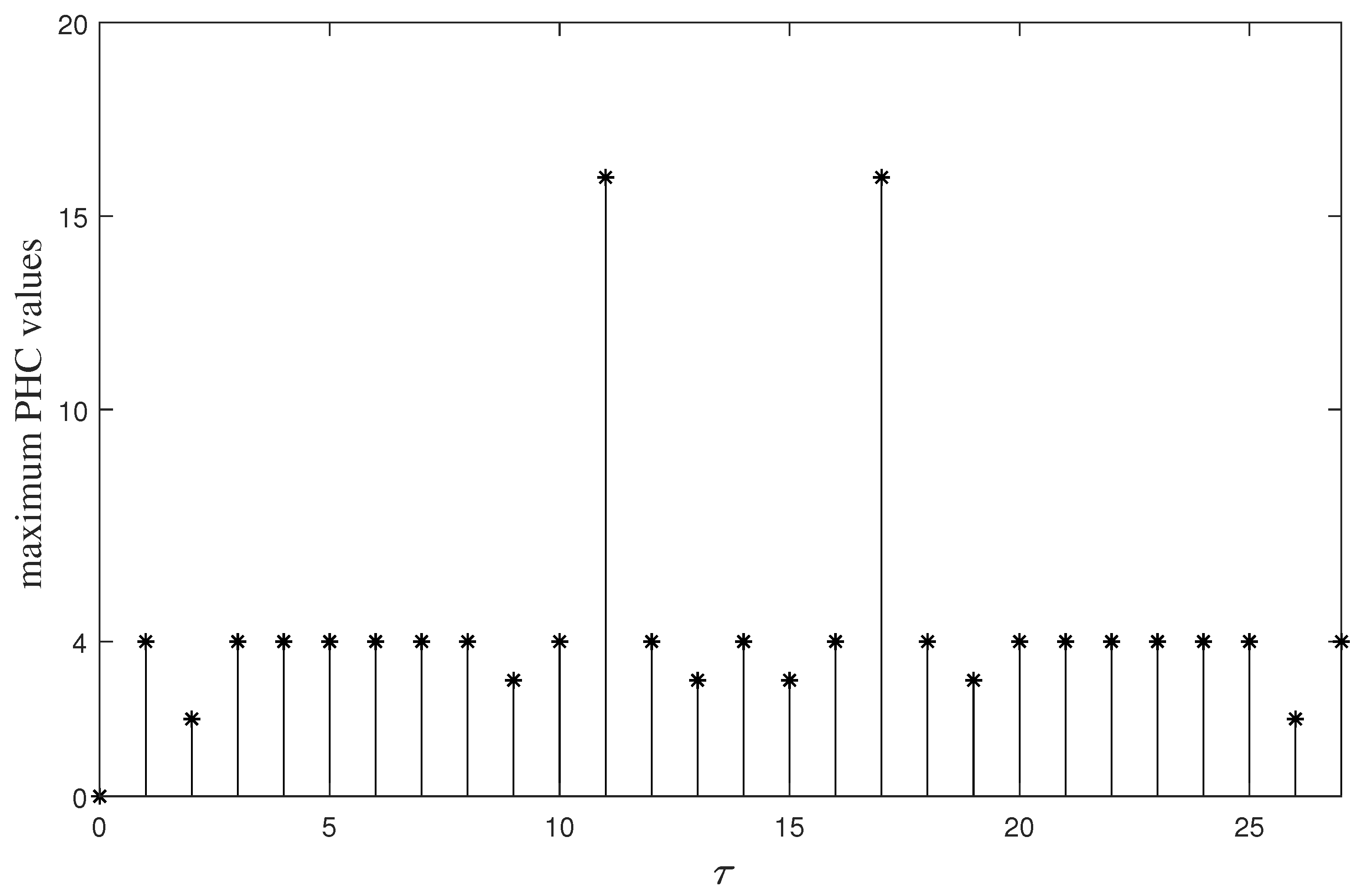
Figure 1 illustrates the maximum PHC values of FHS set B under different time delays . From Figure 1, it can be seen that we always have
for any and . Therefore, B is a LHZ-FHS set. Put the parameters of B and G into (6). It is easy to verify that both the left and right sides of (6) equal 25. Then, according to Theorem 2, B is an optimal LHZ-FHS set.
Figure 1.
The maximum PHC values of FHS set B under different time delays ().
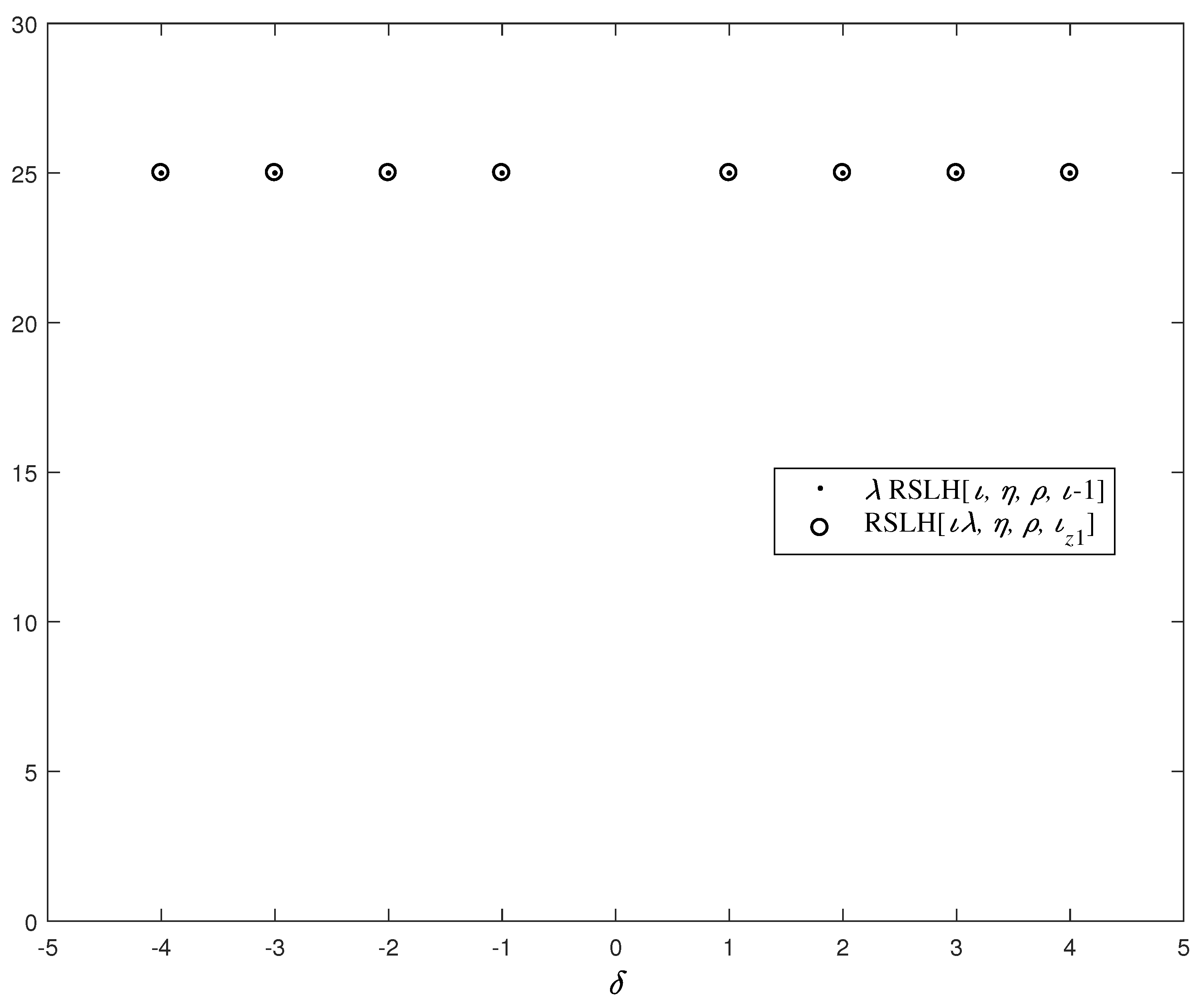
Furthermore, according to Construction 1, the value of δ can be −4, −3, −2, −1, 1, 2, 3 or 4. Through computer experiments, along with changes in δ, we analyze the corresponding and , as shown in Figure 2, where , , and . On the basis of Figure 2 and Theorem 2, for all the possible δ, B is always an optimal LHZ-FHS set.
Figure 2.
The PHC performance of the LHZ-FHS set B.
Construction 2.
Step 1: choose an optimal FHS set , as the base FHS set.
Step 2: Choose an integer satisfying . Let . Then, generate a shift sequence as follows:
Step 3: construct a new FHS set as follows:
Theorem 3.
The FHS set C in Construction 2 is an LHZ-FHS set, where
Moreover, if
or
then C is an optimal or a near-optimal LHZ-FHS set.
Proof.
Here, we are only concerned with the value of , and the rest of the proof is similar to the proof of Theorem 2. Obviously, we have
Case 1: . We have . Namely, . Then,
Thus, when , reaches its minimum value, . Thus, we have
Case 2: . We have . Let . Then,
As , we always have . Therefore, when , reaches its minimum value, . Thus, we have
In brief, we have the following conclusion:
This completes the proof. □
Example 2.
Choose an optimal base FHS set as
Let . Then, we have and the shift sequence as
According to Construction 2, we can obtain a new FHS set , as
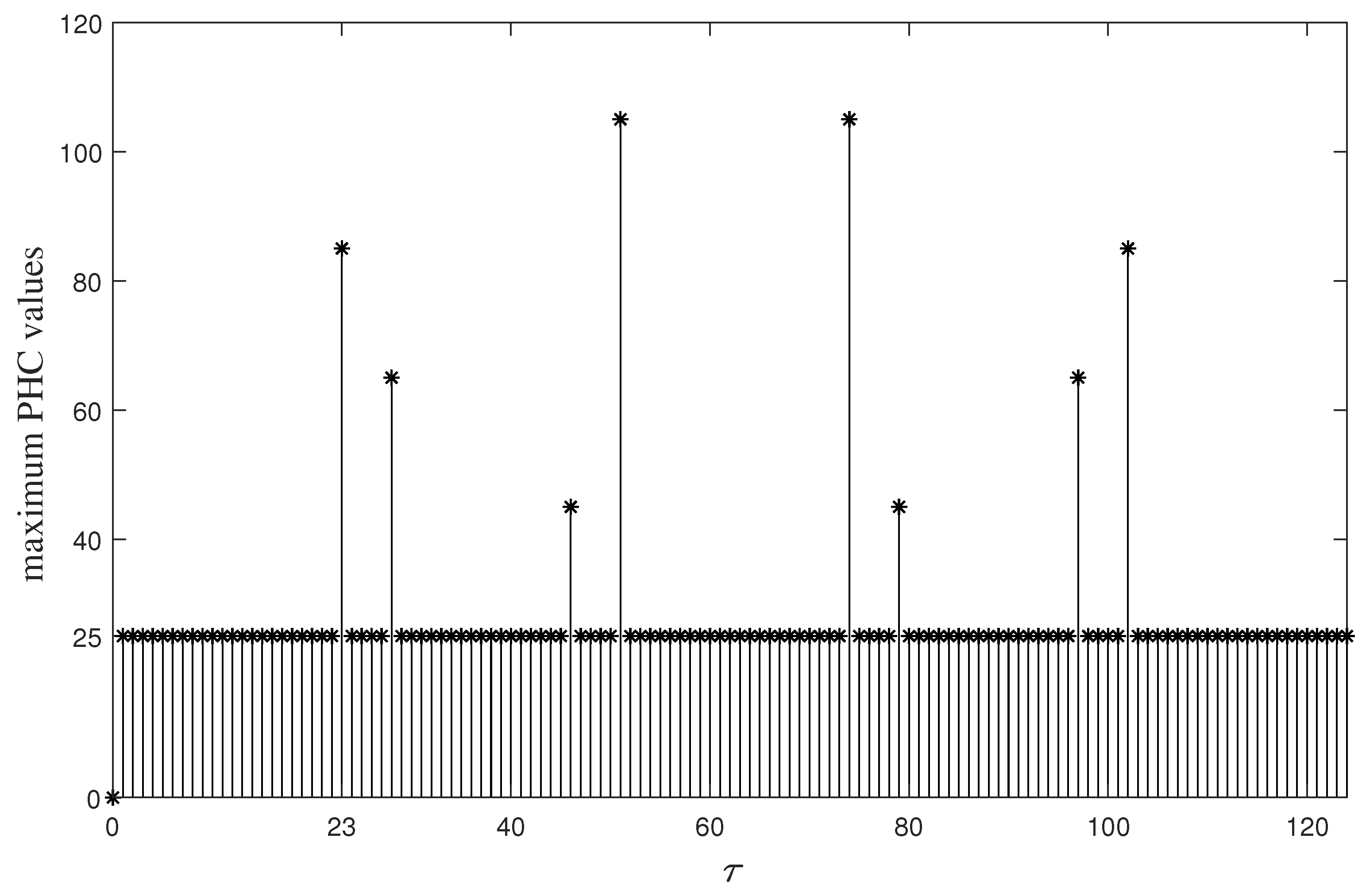
Figure 3 illustrates the maximum PHC values of FHS set C under different time delay . From Figure 3, it can be seen that we always have
for any and . Therefore, C is a LHZ-FHS set. Put the parameters of C and G into (9). It is easy to verify that both the left and right sides of (9) equal 3. Then, on the basis of Theorem 3, C is a near-optimal LHZ-FHS set in this situation.
Figure 3.
The maximum PHC values of FHS set C under different time delay .
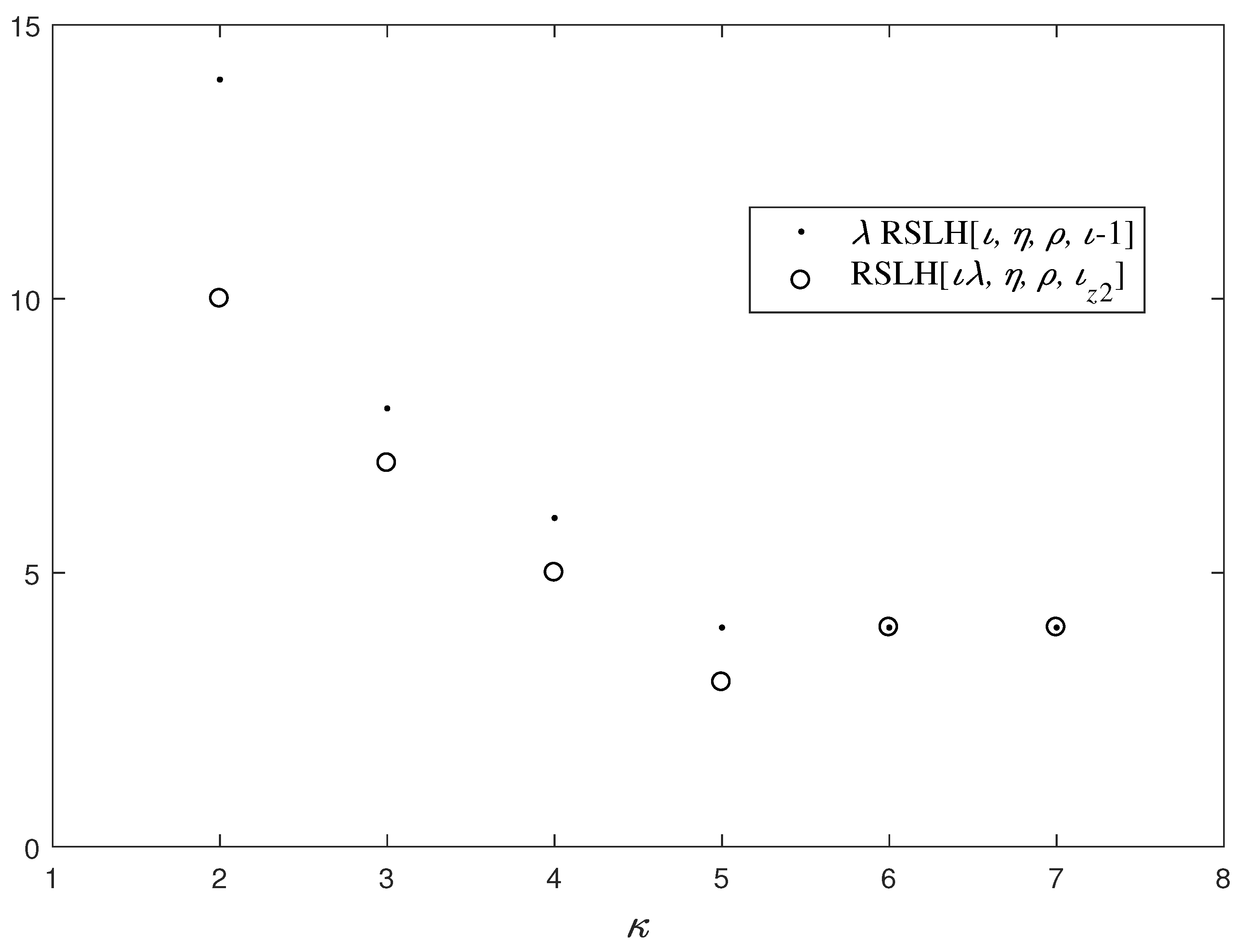
Furthermore, based on Construction 2, we have . Through computer experiments, as the value of κ varies from 2 to 7, we analyze the corresponding and , as shown in Figure 4, where , , and . According to Figure 4 and Theorem 3, C is a near-optimal LHZ-FHS set if , while it is an optimal LHZ-FHS set if .
Figure 4.
The PHC performance of the LHZ-FHS set C.
Remark 2.
To better accommodate different possible base sequence lengths, the relationships among ι, κ, and λ in Construction 1 and Construction 2 are generally distinct. Especially, if and , then Construction 1 is same as Construction 2.
5. Conclusions
In this paper, we had a general construction to design new families of LHZ-FHS sets through interleaving technique, based on which we introduced two new classes of LHZ-FHS sets. We also presented the requirements for our new LHZ-FHS sets to reach the optimality or near-optimality with regard to the Peng–Fan–Lee bound. Furthermore, provided that the base FHS set is selected, we can analyze the performances of all the newly constructed LHZ-FHS sets, which does bring convenience for us to choose the desirable value of , , or . Remarkably, our constructed LHZ-FHS sets have new parameters not included in the relevant literature (see Table 1), and so can be useful in QS-FHMA systems to minimize the MI.
Author Contributions
Conceptualization, L.Z.; methodology, L.Z. and H.W.; software, L.Z. and H.W.; validation, H.W.; project administration, H.W.; funding acquisition, L.Z. All authors have read and agreed to the published version of the manuscript.
Funding
This work was partly supported by the Guangdong Basic and Applied Basic Research Foundation (Grant No. 2023A1515010815), and the National Natural Science Foundation of China (Grant No. 61901096).
Institutional Review Board Statement
Not applicable.
Data Availability Statement
Data are contained within the article.
Conflicts of Interest
The authors declare no conflicts of interest.
References
- Golomb, S.W.; Gong, G. Signal Design for Good Correlation: For Wireless Communication, Cryptography and Radar; Cambridge University Press: Cambridge, UK, 2005. [Google Scholar]
- Fan, P.Z.; Darnell, M. Sequence Design for Communications Applications; Research Studies Press (RSP), Wiley: London, UK, 1996. [Google Scholar]
- Lempel, A.; Greenberger, H. Families of sequences with optimal Hamming correlation properties. IEEE Trans. Inf. Theory 1974, 20, 90–94. [Google Scholar] [CrossRef]
- Peng, D.Y.; Fan, P.Z.; Lee, M.H. Lower bounds on the periodic Hamming correlations of frequency hopping sequences with low hit zone. Sci. China Inf. Sci. 2006, 49, 208–218. [Google Scholar] [CrossRef]
- Peng, D.Y.; Fan, P.Z. Lower bounds on the Hamming auto- and cross correlations of frequency-hopping sequences. IEEE Trans. Inf. Theory 2004, 50, 2149–2154. [Google Scholar] [CrossRef]
- Solomon, G. Optimal frequency hopping for multiple access. Proc. Symp. Spread Spectrum Commun. 1977, 33–35. [Google Scholar]
- Kumar, P.V. Frequency-hopping code designs having large linear span. IEEE Trans. Inf. Theory 1988, 34, 146–151. [Google Scholar] [CrossRef]
- Ding, C.S.; Fuji-Hara, R.; Fujiwara, Y.; Jimbo, M.; Mishima, M. Sets of frequency hopping sequences: Bounds and optimal constructions. IEEE Trans. Inf. Theory 2009, 55, 3297–3304. [Google Scholar] [CrossRef]
- Ding, C.S.; Yang, Y.; Tang, X.H. Optimal sets of frequency hopping sequences from linear cyclic codes. IEEE Trans. Inf. Theory 2010, 56, 3605–3612. [Google Scholar] [CrossRef]
- Ge, G.; Miao, Y.; Yao, Z. Optimal frequency hopping sequences: Auto- and cross-correlation properties. IEEE Trans. Inf. Theory 2009, 55, 867–879. [Google Scholar] [CrossRef]
- Peng, D.Y.; Peng, T.; Tang, X.H.; Niu, X.H. A class of optimal frequency hopping sequences based upon the theory of power residues. In Proceedings of the Sequences and Their Applications—SETA 2008, Lexington, KY, USA, 14–18 September 2008; pp. 188–196. [Google Scholar]
- Ma, W.P.; Sun, S. New designs of frequency hopping sequences with low hit zone. Des. Codes Cryptogr. 2011, 60, 145–153. [Google Scholar] [CrossRef]
- Niu, X.H.; Peng, D.Y.; Zhou, Z.C. New classes of optimal low hit zone frequency hopping sequences with new parameters by interleaving technique. IEICE Trans. Fundam. Electron. Commun. Comput. Sci. 2012, 95, 1835–1842. [Google Scholar] [CrossRef]
- Chung, J.H.; Yang, K. New classes of optimal low-hit-zone frequency-hopping sequence sets by Cartesian product. IEEE Trans. Inf. Theory 2013, 59, 726–732. [Google Scholar] [CrossRef]
- Zhou, L.M.N.; Peng, D.Y.; Wang, C.Y.; Han, H.Y. Construction of optimal or near optimal frequency-hopping sequence set with low hit zone. IEICE Trans. Fundam. Electron. Commun. Comput. Sci. 2016, 99-A, 983–986. [Google Scholar]
- Liu, X.; Peng, D.Y.; Han, H.Y. Low-hit-zone frequency hopping sequence sets with optimal partial Hamming correlation properties. Des. Codes Cryptogr. 2013, 73, 167–176. [Google Scholar] [CrossRef]
- Wang, C.Y.; Peng, D.Y.; Han, H.Y.; Zhou, L.M.N. New sets of low-hit-zone frequency-hopping sequence with optimal maximum periodic partial Hamming correlation. Sci. China Inf. Sci. 2015, 58, 1–15. [Google Scholar] [CrossRef]
- Zhou, L.M.N.; Peng, D.Y.; Liang, H.B.; Wang, C.Y.; Ma, Z. Constructions of optimal low-hit-zone frequency hopping sequence sets. Des. Codes Cryptogr. 2017, 85, 219–232. [Google Scholar] [CrossRef]
- Zhou, L.M.N.; Peng, D.Y.; Liang, H.B.; Han, H.Y.; Wang, C.Y. Generalized methods to construct low-hit-zone frequency-hopping sequence sets and optimal constructions. Cryptogr. Commun. 2017, 9, 707–728. [Google Scholar] [CrossRef]
- Han, H.Y.; Zhang, S. New classes of strictly optimal low hit zone frequency hopping sequence sets. Adv. Math. Commun. 2020, 14, 579–589. [Google Scholar] [CrossRef]
- Tian, X.Y.; Han, H.Y.; Niu, X.H.; Liu, X. Construction of optimal frequency hopping sequence set with low-hit-zone. Entropy 2023, 25, 1044. [Google Scholar] [CrossRef] [PubMed]
- Zhang, X.; Niu, X.; Tan, X. Constructions of optimal low hit zone frequency hopping sequence sets with large family size. Adv. Math. Commun. 2024, 18, 39–54. [Google Scholar] [CrossRef]
- Tian, X.; Han, H.; Parampalli, U. Construction of low-hit-zone frequency-hopping sequence sets with strictly optimal partial Hamming correlation based on Chinese Remainder Theorem. Cryptogr. Commun. 2024. [Google Scholar] [CrossRef]
- Wang, C.Y.; Zhang, Y.; Wei, K.L.; Yu, Q.; Fan, F.Y. Optimal constructions of low-hit-zone frequency-hopping sequence sets via cyclotomy. IEEE Access 2023, 11, 24128–24136. [Google Scholar] [CrossRef]
- Chung, J.H.; Yang, K. New classes of optimal frequency-hopping sequences by interleaving techniques. IEEE Trans. Inf. Theory 2009, 55, 5783–5791. [Google Scholar] [CrossRef]
- Gong, G. Theory and applications of q-ary interleaved sequences. IEEE Trans. Inf. Theory 1995, 41, 400–411. [Google Scholar] [CrossRef]
- Gong, G. New designs for signal sets with low cross correlation, balance property and large linear span: GF(p) case. IEEE Trans. Inf. Theory 2002, 48, 2847–2867. [Google Scholar] [CrossRef]
Disclaimer/Publisher’s Note: The statements, opinions and data contained in all publications are solely those of the individual author(s) and contributor(s) and not of MDPI and/or the editor(s). MDPI and/or the editor(s) disclaim responsibility for any injury to people or property resulting from any ideas, methods, instructions or products referred to in the content. |
© 2024 by the authors. Licensee MDPI, Basel, Switzerland. This article is an open access article distributed under the terms and conditions of the Creative Commons Attribution (CC BY) license (https://creativecommons.org/licenses/by/4.0/).