1. Introduction
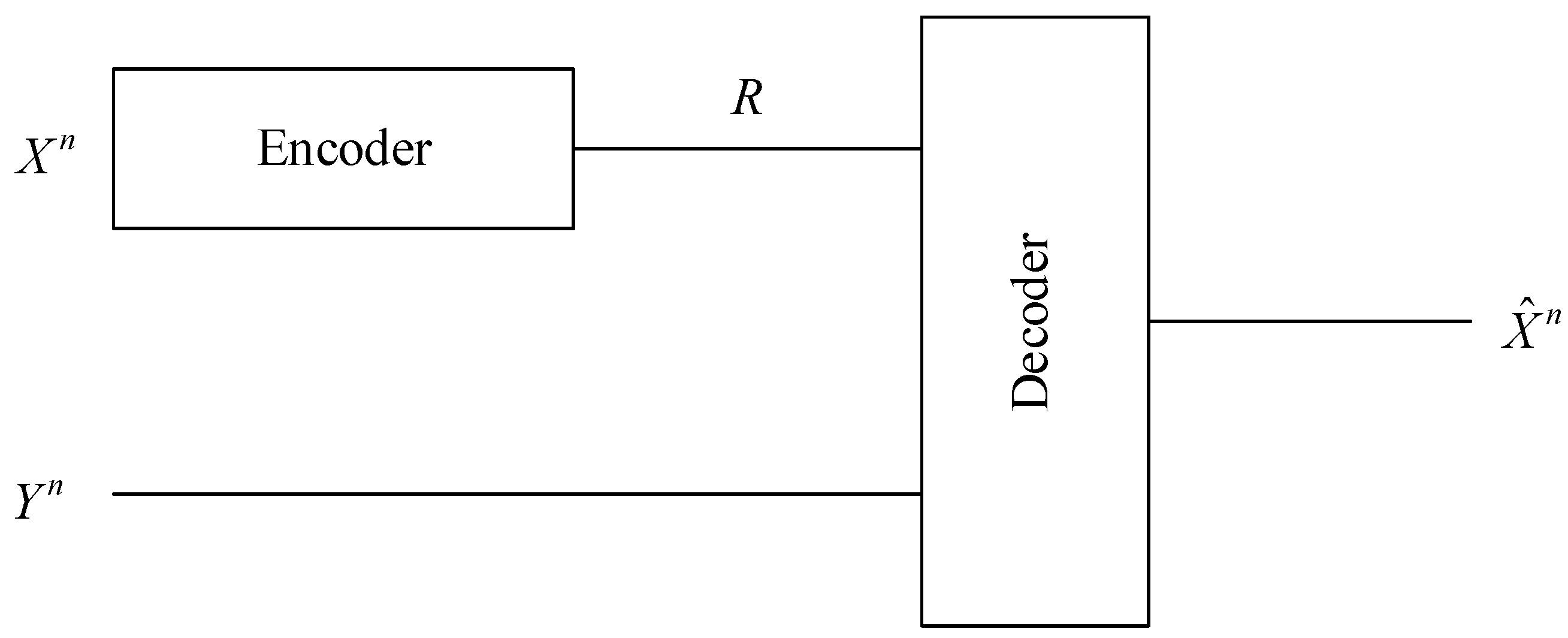
Consider the problem (see
Figure 1) of compressing
with side information
available only at the decoder. Here
is a joint memoryless source with zero-order joint probability distribution
on finite alphabet
. Let
and
be the marginal probability distributions of
X and
Y induced by the joint probability distribution
. Without loss of generality, we shall assume
for all
. This problem was first studied by Slepian and Wolf in their landmark paper [
1]. They proved a surprising result that the minimum rate for reconstructing
at the decoder with asymptotically zero error probability (as block length
n goes to infinity) is
, which is the same as the case where the side information
is also available at the encoder. The fundamental limit
is often referred to as the Slepian-Wolf limit. We shall assume
throughout this paper.
Different from conventional lossless source coding, where most effort has been devoted to variable-rate coding schemes, research on Slepian-Wolf coding has almost exclusively focused on fixed-rate codes (see, e.g., [
2,
3,
4,
5] and the references therein). This phenomenon can be partly explained by the influence of channel coding. It is well known that there is an intimate connection between channel coding and Slepian-Wolf coding. Intuitively, one may view
as the channel output generated by channel input
through discrete memoryless channel
, where
is the probability transition matrix from
to
induced by the joint probability probability distribution
. Since
is not available at the encoder, Slepian-Wolf coding is, in a certain sense, similar to channel coding without feedback. In a channel coding system, there is little incentive to use variable-rate coding schemes if no feedback link exists from the receiver to the transmitter. Therefore, it seems justifiable to focus on fixed-rate codes in Slepian-Wolf coding.
This viewpoint turns out to be misleading. We shall show that variable-rate Slepian-Wolf codes can significantly outperform fixed-rate codes in terms of rate-error tradeoff. Specifically, it is revealed that variable-rate Slepian-Wolf codes can beat the sphere-packing bound for fixed-rate Slepian-Wolf codes at rates close to the Slepian-Wolf limit. It is known [
6] that the correct decoding probability of fixed-rate Slepian-Wolf codes decays to zero exponentially fast if the rate is below the Slepian-Wolf limit. Somewhat surprisingly, the decoding error probability of variable-rate Slepian-Wolf codes can be bounded away from one even when they are operated below the Slepian-Wolf limit, and the performance degrades gracefully as the rate goes to zero. Therefore, variable-rate Slepian-Wolf coding is considerably more robust.
The rest of this paper is organized as follows. In
Section 2, we review the existing bounds on the reliability function of fixed-rate Slepian-Wolf coding, and point out the intimate connections with their counterparts in channel coding. In
Section 3, we characterize the reliability function of variable-rate Slepian-Wolf coding by leveraging the reliability function of channel coding with constant composition codes. Computable lower and upper bounds are derived. The bounds coincide at rates close to the Slepian-Wolf limit. The correct decoding probability of variable-rate Slepian-Wolf coding with rate below the Slepian-Wolf limit is studied in
Section 4. An illustrative example is given in
Section 5. We conclude the paper in
Section 6. Throughout this paper, we assume the logarithm function is to base
e unless specified otherwise.
2. Fixed-Rate Slepian-Wolf Coding and Channel Coding
To facilitate the comparisons between the performances of fixed-rate Slepian-Wolf coding and variable-rate coding, we shall briefly review the existing bounds on the reliability function of fixed-rate Slepian-Wolf coding. It turns out that a most instructive way is to first consider their counterparts in channel coding. The reason is two-fold. First, it provides the setup to introduce several important definitions. Second and more important, it will be clear that the reliability function of fixed-rate Slepian-Wolf coding is closely related to that of channel coding; indeed, such a connection will be further explored in the context of variable-rate Slepian-Wolf coding.
For any probability distributions
on
and probability transition matrices
, we use
,
,
, and
to denote the standard entropy, mutual information, divergence, and conditional divergence functions; specifically, we have
The main technical tool we need is the method of types. First, we shall quote a few basic definitions from [
7]. Let
denote the set of all probability distributions on
. The type of a sequence
, denoted as
, is the empirical probability distribution of
. Let
denote the set consisting of the possible types of sequences
. For any
, the type class
is the set of sequences in
of type
P. We will make frequent use of the following elementary results:
A block code
is an ordered collection of sequences in
. We allow
to contain identical sequences. Moreover, for any set
, we say that
if
for all
. Note that
does not imply
. The rate of
is defined as
Given a channel
, a block code
, and channel output
, the output of the optimal
maximum likelihood (ML) decoder is
where the ties are broken in an arbitrary manner. The average decoding error probability of block code
over channel
is defined as
The maximum decoding error probability of block code
over channel
is defined as
The average correct decoding probability of block code
over channel
is defined as
Definition 1. Given a channel , we say that an error exponent is achievable with block codes at rate R if for any , there exists a sequence of block codes such that The largest achievable error exponent at rate R is denoted by . The function is referred to as the reliability function of channel .
Similarly, we say that a correct decoding exponent is achievable with block channel codes at rate R if for any , there exists a sequence of block codes such that The smallest achievable correct decoding exponent at rate R is denoted by . It will be seen that is positive if and only if , where is the capacity of channel . Therefore, we shall refer to the function as the reliability function of channel above the capacity.
Remark 1. Given any block code of average decoding error probability , we can expurgate the worst half of the codewords so that the maximum decoding error probability of the resulting code is bounded above by . Therefore, the reliability function is unaffected if we replace by in (
4).
Definition 2. Given a probability distribution and a channel , we say that an error exponent is achievable at rate R with constant composition codes of type approximately if for any , there exists a sequence of block codes with for some such thatwhere is the norm. The largest achievable error exponent at rate R for constant composition codes of type approximately is denoted by . The function is referred to as the reliability function of channel for constant composition codes of type approximately .
Similarly, we say that a correct decoding exponent is achievable at rate R with constant composition codes of type approximately if for any , there exists a sequence of block codes with for some such that The smallest achievable correct decoding exponent at rate R for constant composition codes of type approximately is denoted by .
Remark 2. The reliability function is unaffected if we replace by in (5). Let
and
. Define
where in (
6),
and
are respectively the marginal probability distribution of
and the joint probability distribution of
X and
induced by
and
.
Let
be the smallest
with
. We have
It is known ([
7], Exercise 5.18) that
is a decreasing convex function of
R for
; moreover, the minimum in (
9) is achieved at
if and only if
where the probability distribution
Q and the constant
c are uniquely determined by the condition
.
It is shown in ([
8], Lemma 3) that, for some
, we have
It is also known ([
7], Corollary 5.4) that
where
is the smallest
R at which the convex curve
meets its supporting line of slope −1. It is obvious that
.
Proposition 1. if and only if the value ofdoes not depend on y for all such that . Define
. It is known ([
7], Exercise 5.3) that
where the minimum is taken over those
’s for which
whenever
; in particular,
if and only if for every
there exists an
with
and
.
Proposition 2. The minimum in (12) is achieved at if and only if the value ofdoes not depend on y for all such that . Proof. The proof is similar to that of Proposition 1. The details are omitted. ☐
One can readily prove the following result by combining Propositions 1 and 2.
Proposition 3. The following statements are equivalent:
;
;
the value ofdoes not depend on y for all such that .
Proposition 4. ;
with the possible exception of at which point the inequality not necessarily holds;
.
Remark 3. , , and are respectively the expurgated exponent, the random coding exponent, and the sphere packing exponent of channel for constant composition codes of type approximately . The results in Proposition 4 are well known [7,9]. However, bounding the decoding error probability of constant composition codes often serves as an intermediate step in characterizing the reliability function for general block codes; as a consequence, the reliability function for constant composition codes is rarely explicitly defined. Moreover, , , and are commonly used to bound the decoding error probability of constant composition codes for a fixed block length n; therefore, it is implicitly assumed that is taken from (see, e.g., [7]). In contrast, we consider a sequence of constant composition codes with block length increasing to infinity and type converging to for some (see Definition 2). A continuity argument is required for passing from to . For completeness, we supply the proof in Appendix B. Note that different from , the function has been completely characterized.
Proposition 5. ,
.
Remark 4. In view of the fact that is a continuous function of defined on a compact set, we can replace “inf" with “min" in the above equation, i.e., Proof. It is obvious that
; the other direction follows from the fact that every block code
contains a constant composition code
with
and
. Similarly, it is clear that
; the other direction follows from the fact that given any block code
, one can construct a constant composition code
with
and
[
9]. ☐
The expurgated exponent, random coding exponent, and sphere packing exponent of channel for general block codes are defined as follows:
Let
be the smallest
R to the right of which
is finite. It is known ([
7], Exercise 5.3) and [
10] that
By Propositions 4 and 5, we recover the following well-known result [
7,
10]:
with the possible exception of
at which point the second inequality in (
17) not necessarily holds.
Now we proceed to review the results on the reliability function of fixed-rate Slepian-Wolf coding. A fixed-rate Slepian-Wolf code
is a mapping from
to a set
. The rate of
is defined as
Given
and
, the output of the optimal
maximum a posteriori (MAP) decoder is
where the ties are broken in an arbitrary manner. The decoding error probability of Slepian-Wolf code
is defined as
The correct decoding probability of Slepian-Wolf code
is defined as
Definition 3. Given a joint probability distribution , we say that an error exponent is achievable with fixed-rate Slepian-Wolf codes at rate R if for any , there exists a sequence of fixed-rate Slepian-Wolf codes such that The largest achievable error exponent at rate R is denoted by . The function is referred to as the reliability function of fixed-rate Slepian-Wolf coding.
Similarly, we say that a correct decoding exponent is achievable with fixed-rate Slepian-Wolf codes at rate R if for any , there exists a sequence of fixed-rate Slepian-Wolf codes such that The smallest achievable correct decoding exponent at rate R is denoted by . It will be seen that is positive if and only if . Therefore, we shall refer to the function as the reliability function of fixed-rate Slepian-Wolf coding below the Slepian-Wolf limit.
The expurgated exponent, random coding scheme, and sphere packing exponent of fixed-rate Slepian-Wolf coding are defined as follows:
Equivalently, the random coding exponent and sphere packing exponent of fixed-rate Slepian-Wolf coding can be written as [
11]:
To see the connection between the random coding exponent and the sphere packing exponent, we shall write them in the following parametric forms [
11]:
and
where the joint distribution of
is
, which is specified by
Note that
and
coincide when
. Let
. It is shown in [
12] that
It is well known [
8,
11,
13] that the reliability function
is upper-bounded by
and lower-bounded by
and
, i.e.,
with the possible exception of
at which point the second inequality in (
23) not necessarily holds. Note that
is completely characterized for
.
Unlike
, the function
has been characterized for all
R. Specifically, it is shown in [
6,
14] that
Comparing (
14) with (
18), (
15) with (
19), (
16) with (
20), and (
13) with (
24), one can easily see that there exists an intimate connection between fixed-rate Slepian-Wolf coding for source distribution
and channel coding for channel
. This connection can be roughly interpreted as the manifestation of the following facts [
15].
Given, for each type
, a constant composition code
with
and
, one can use
to partition type class
into approximately
disjoint subsets such that each subset is a constant composition code of type
with the maximum decoding error probability over channel
approximately equal to or less than that of
. Note that these partitions, one for each type class, yield a fixed-rate Slepian-Wolf code of rate approximately
R with
. Since
(cf. (
2) and (
3)), it follows that
. The overall decoding error probability
of the resulting Slepian-Wolf code can be upper-bounded, on the exponential scale, by
, where
. In contrast, one has the freedom to choose
in channel coding, which explains why maximization (instead of minimization) is used in (
14)–(
16).
Given a fixed-rate Slepian-Wolf code with and , one can, for each type , lift out a constant composition code with and .
The correct decoding exponents for channel coding and fixed-rate Slepian-Wolf coding can be interpreted in a similar way. Note that in channel coding, to maximize the correct decoding probability one has to minimize the correct decoding exponent; this is why in (
13) minimization (instead of maximization) is used.
Therefore, it should be clear that to characterize the reliability functions for channel coding and fixed-rate Slepian-Wolf coding, it suffices to focus on constant composition codes. It will be shown in the next section that a similar reduction holds for variable-rate Slepian-Wolf coding. Indeed, the reliability function for constant component codes plays a predominant role in determining the fundamental rate-error tradeoff in variable-rate Slepian-Wolf coding.
3. Variable-Rate Slepian-Wolf Coding: Above the Slepian-Wolf Limit
A variable-rate Slepian-Wolf code
is a mapping from
to a binary prefix code
. Let
denote the length of binary string
. The rate of variable-rate Slepian-Wolf code
is defined as
It is worth noting that
depends on
only through
.
Given
and
, the output of the optimal
maximum a posteriori (MAP) decoder is
where the ties are broken in an arbitrary manner. The decoding error probability of variable-rate Slepian-Wolf code
is defined as
The correct decoding probability of Slepian-Wolf code
is defined as
Definition 4. Given a joint probability distribution , we say that an error exponent is achievable with variable-rate Slepian-Wolf codes at rate R if for any , there exists a sequence of variable-rate Slepian-Wolf codes such thatThe largest achievable error exponent at rate R is denoted by . The function is referred to as the reliability function of variable-rate Slepian-Wolf coding. The power of variable-rate Slepian-Wolf coding results from its flexibility in rate allocation. Since there are only polynomial number of types for any given
n (cf. (
1)), the encoder can convey the type information to the decoder using negligible amount of rate when
n is large enough. Therefore, without loss of much generality, we can assume that the type of
is known to the decoder. Under this assumption, an optimal fixed-rate Slepian-Wolf encoder of rate
R should partition
into
disjoint subsets for each
. It can be seen that the rate allocated to
is always
R if
. In general, the type
that dominates the error probability of fixed-rate Slepian-Wolf coding is different from
. In contrast, for variable-rate Slepian-Wolf coding, we can losslessly compress the sequences of types that are bounded away
by allocating enough rate to those type classes (but its contribution to the overall rate is still negligible since the probability of those type classes are extremely small), and therefore, effectively eliminate the dominant error event in fixed-rate Slepian-Wolf coding. As a consequence, the types that can cause decoding error in variable-rate Slepian-Wolf coding must be very close to
. This is the main intuition underlying the proof of the following theorem. A similar argument has been used in the context of variable-rate Slepian-Wolf coding under mismatched decoding [
16].
Theorem 1. .
Proof. The proof is divided into two parts. Firstly, we shall show that . The main idea is that one can use a constant composition code of type approximately and rate approximately to construct a variable-rate Slepian-Wolf code with , , and .
By Definition 2, for any
, there exists a sequence of constant composition codes
with
for some
such that
Since
for all
, we have
for all sufficiently
n, where
Let
. When
n is large enough, we can, for each
, construct a constant composition code
of length
and type
P by appending a fixed sequence in
to each codeword in
. It is easy to see that
for all
. One can readily show by invoking the covering lemma in [
17] that for each
, there exist
permutations
of the integers
such that
where
In view of (
25), we can rewrite
as
Given
, we can partition
into
disjoint subsets:
Now construct a sequence of variable-rate Slepian-Wolf codes as follows.
The encoder sends the type of to the decoder, where each type is uniquely represented by a binary sequence of length .
If for some , the encoder sends losslessly to the decoder, where each is uniquely represented by a binary sequence of length .
If for some , the encoder finds the set that contains and sends the index to the decoder, where each index in is uniquely represented by a binary sequence of length .
It is easy to verify (cf. (
1)–(
3)) that
By (
26)–(
28) and the construction of
, it is clear that
which implies
In view of (
29), (
30), and the fact that
is arbitrary, we must have
(cf. Definition 4).
Now we proceed to show that . The main idea is that one can extract a constant composition code of type approximately and rate approximately or greater from a given variable-rate Slepian-Wolf code of rate approximately R such that the average decoding error probability of this constant composition code over channel is bounded from above by , where is a constant that does not depend on n.
By Definition 4, for any
, there exists a sequence of variable-rate Slepian-Wolf codes
such that
Suppose
induces a partition of
,
, into
disjoint subsets
. Here the partition is defined as follows:
if
for some
i, and
if
for
. Let
It follows from the source coding theorem that
Note that
where (35) is due to (
33). Combing (
31) and (36) yields
Moreover, we have
since otherwise
which is absurd.
It follows from the weak law of large numbers that
We have
where (40) is due to (
37)–(
39), and (41) is due to (
34). Therefore,
is non-empty for all sufficiently large
n. Pick an arbitrary
from
for each sufficiently large
n. We can construct a constant composition code
of length
and type
for some
by concatenating a fixed sequence in
to each sequence in
such that
Moreover, since
it follows from (
32) that
In view of (
42)–(
44) and the fact that
is arbitrary, we must have
(cf. Definition 2). The proof is complete. ☐
The following result is an immediate consequence of Theorem 1 and Proposition 4.
Corollary 1. ;
with the possible exception of at which point the inequality not necessarily holds.
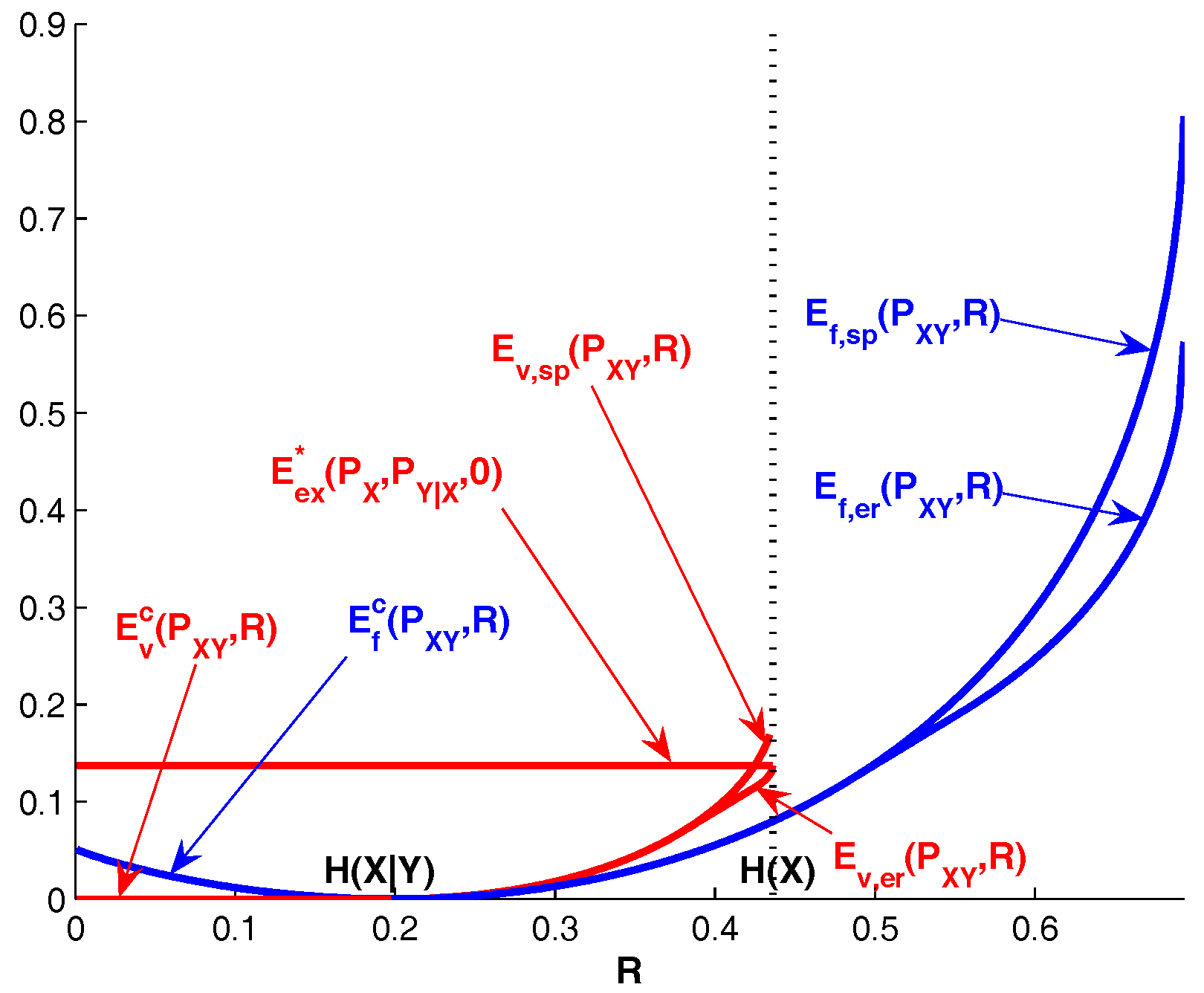
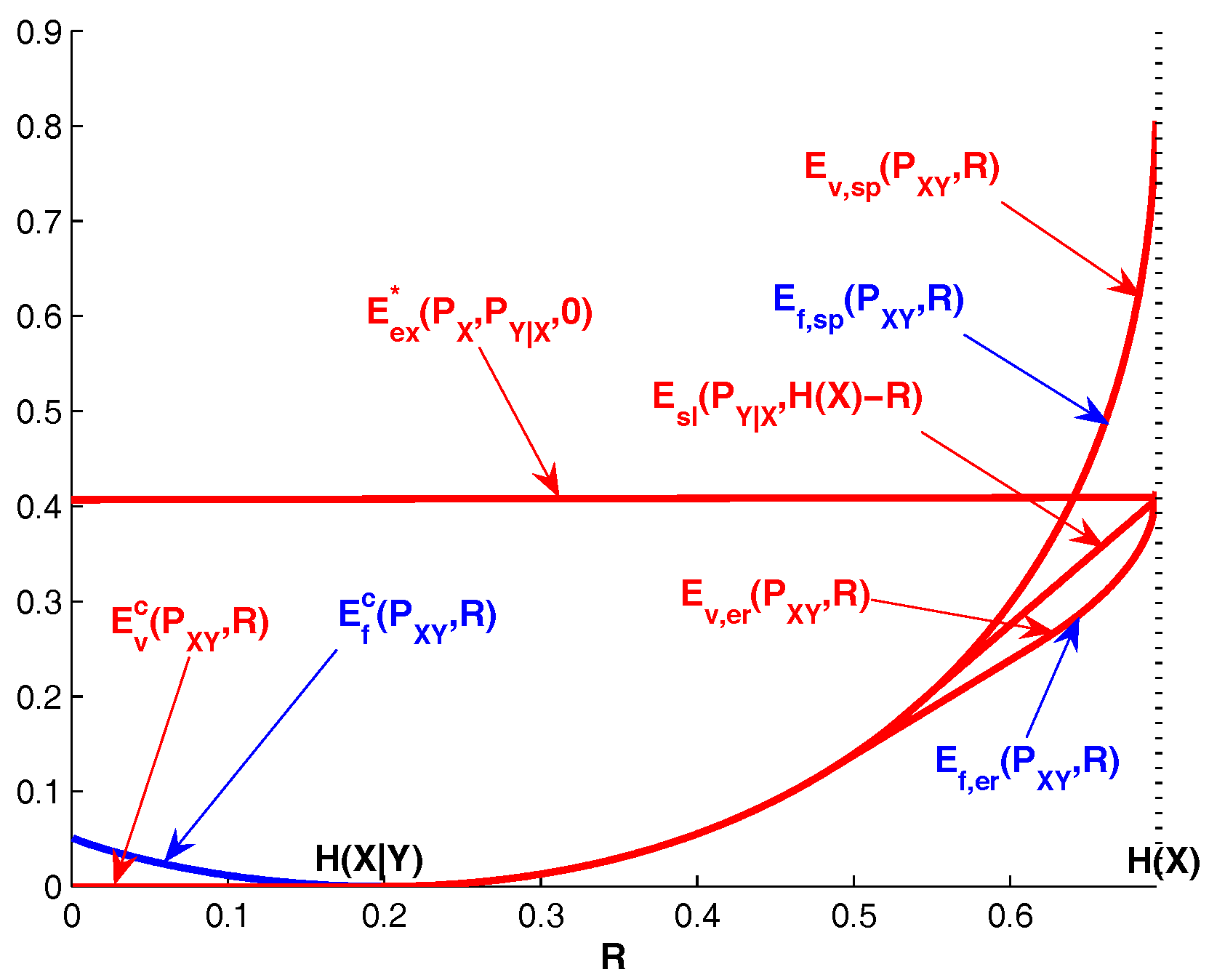
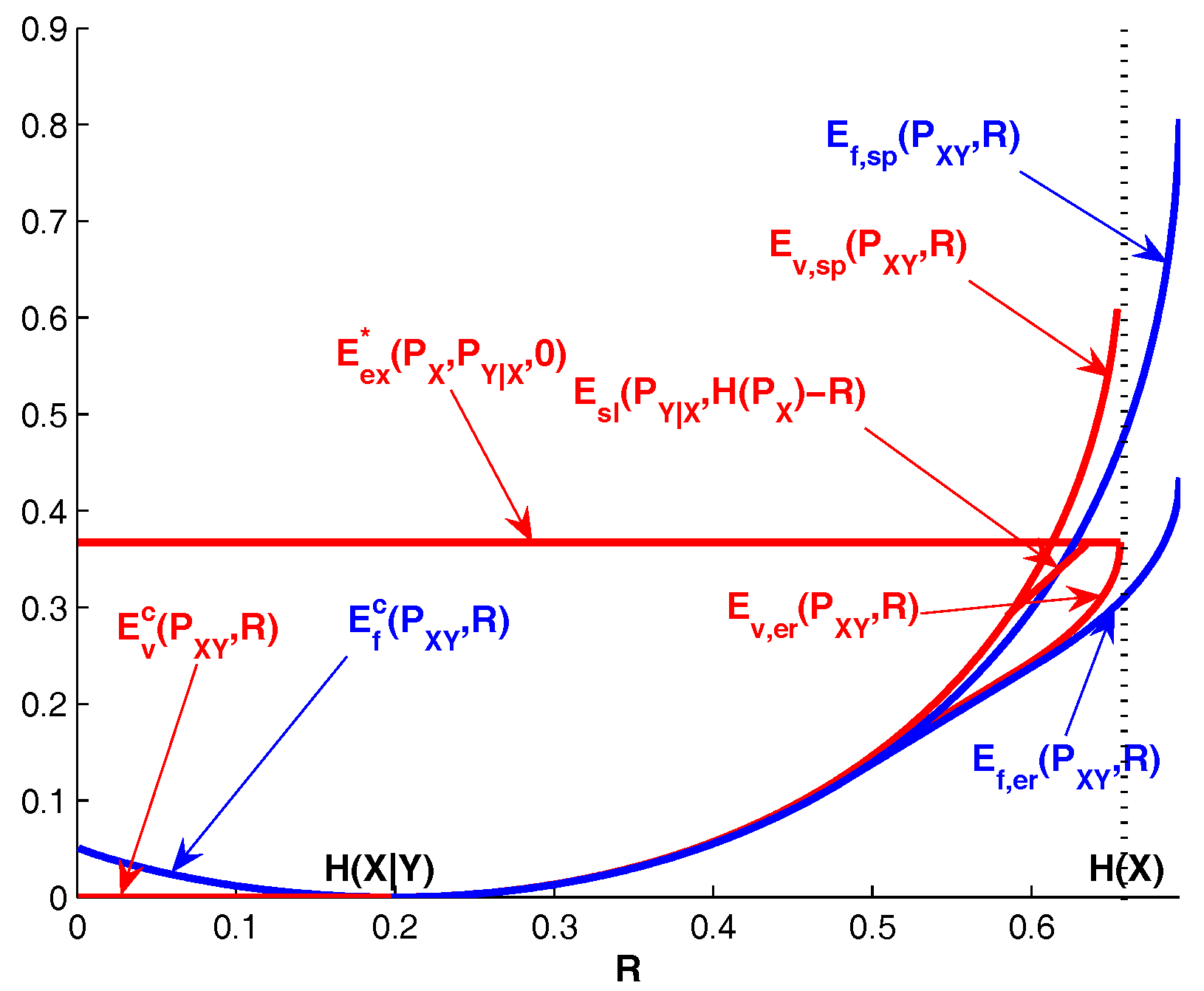
Remark 5. We have for , and for . Therefore, and are respectively the upper bound and the lower bound on the zero-error rate of variable-rate Slepian-Wolf coding.
In view of (11), we havefor . Note thatwhere the first inequality is strict unless the minimum in (20) is achieved at , (i.e., , where is the marginal distribution of induced by and in (21) and (22)). Therefore, variable-rate Slepian-Wolf coding can outperform fixed-rate Slepian-Wolf coding in terms of rate-error tradeoff.
For
, it is possible to obtain upper bounds on
that are tighter than
. Let
and
be respectively the expurgated exponent and the sphere packing exponent of channel
. The straight-line exponent
of channel
[
10] is the smallest linear function of
R which touches the curve
and also satisfies
where
is assumed to be finite. Let
be the point at which
and
coincide. It is well known [
10] that
for
. Since
, it follows from Theorem 1 that
for
.
Note that the straight-line exponent holds for arbitrary block codes; one can obtain further improvement at high rates by leveraging bounds tailored to constant composition codes. Let
be the concave upper envelope of
considered as a function of
. In view of ([
7], Exercise 5.21), we have
for any
and
. Now it follows from Theorem 1 that
for
.
The following theorem provides the second order expansion of at the Slepian-Wolf limit.
Theorem 2. Assuming (see Proposition 1 for the necessary and sufficient condition), we havewhere . Remark 6. If , then we have for , which implies It is also worth noting that the second order expansion of
at the Slepian-Wolf limit yields the redundancy-error tradeoff constant of variable-rate Slepian-Wolf coding derived in [
18].
Proof. Since
, it follows that
when
r is sufficiently close to zero. In this case, we have
where the last equality follows from the fact that
is a strictly decreasing convex function of
R for
.
Let
for
,
. Let
for
. By the Taylor expansion,
and
Here means .
As
, we have
,
for all
. Therefore, by ignoring the high order terms which do not affect the limit, we get
where the minimization is over
(
) subject to the constraints
for all ,
.
Introduce the Lagrange multipliers
and
for these constraints, and define
The Karush-Kuhn-Tucker conditions yield
Substituting (
46) into constraint 1, we obtain
which, together with (
46), yields
Constraint 2 and (
47) together yield
The proof is complete by substituting (
48) and (
49) back into (
45). ☐
4. Variable-Rate Slepian-Wolf Coding: Below the Slepian-Wolf Limit
Definition 5. Given a joint probability distribution , we say that a correct decoding exponent is achievable with variable-rate Slepian-Wolf codes at rate R if for any , there exists a sequence of variable-rate Slepian-Wolf codes such that The smallest achievable correct decoding exponent at rate R is denoted by .
In view of Theorem 1, it is tempting to conjecture that . It turns out this is not true. We shall show that for all R. Actually we have a stronger result—the correct decoding probability of variable-rate Slepian-Wolf coding can be bounded away from zero even when . This is in sharp contrast with fixed-rate Slepian-Wolf coding for which the correct decoding probability decays to zero exponentially fast if the rate is below the Slepian-Wolf limit. To make the statement more precise, we need the following definition.
Definition 6. Given a joint probability distribution , we say that a correct decoding probability is achievable with variable-rate Slepian-Wolf codes at rate R if for any , there exists a sequence of variable-rate Slepian-Wolf codes such that The largest achievable correct decoding probability at rate R is denoted by .
Theorem 3. for .
Remark 7. It is obvious that for . Moreover, since is a monotonically increasing function of R, it follows that .
Proof. The intuition underlying the proof is as follows. Assume the rate is below the Slepian-Wolf limit, i.e., . For each type P in the neighborhood of , the rate allocated to the type class should be no less than in order to correctly decode the sequences in . However, since almost all the probability are captured by the type classes whose types are in the neighborhood of , there is no enough rate to protect all of them. Note that if the rate is evenly allocated among these type classes, none of them can get enough rate; consequently, the correct decoding probability goes to zero. A good way is to protect only a portion of them to accumulate enough rate. Specifically, we can protect fraction of these type classes so that the rate allocated to each of them is about and leave the remaining type classes unprotected. It turns out this strategy achieves the maximum correct decoding probability as the block length n goes to infinity. Somewhat interestingly, although , the function does play a fundamental role in establishing the correct result.
The proof is divided into two parts. Firstly, we shall show that
. For any
, define
Since
for all
, we can choose
small enough so that
Using Stirling’s approximation
we have, for any
,
which implies that
converges uniformly to zero as
for all
. Moreover, it follows from the weak law of large numbers that
Therefore, for any
,
, and sufficiently large
n, we can find a set
such that
Now consider a sequence of variable-rate Slepian-Wolf codes specified as follows.
The encoder sends of type of to the decoder, where each type is uniquely represented by a binary sequence of length .
For each , the encoder partitions the type class into subsets . If for some , the encoder finds the subset that contains and sends the index to the decoder, where each index in is uniquely represented by a binary sequence of length .
The remaining type classes are left uncoded.
It follows from ([
8], Theorem 2) that for each
, it is possible to partition the type class
into
disjoint subsets
so that
uniformly for all
when
n is sufficiently large. In view of the fact that
and that
as a function of the pair
is uniformly equicontinuous, we have
for sufficiently small
.
For this sequence of constructed variable-rate Slepian-wolf codes
, it can be readily verified that
and
Since is arbitrary, it follows from Definition 6 that .
Now we proceed to prove the other direction. It follows from Definition 6 that for any
, there exists a sequence of variable-rate Slepian-Wolf codes
with
Recall the definition of
as well as
in the proof of Theorem 1. For
, define
Note that
since
where (50) is due to (
33).
Each
can be viewed as a constant composition code of type
P and we have
Note that for
and
,
Therefore, it follows from ([
9], Lemma 5) that
uniformly for all
and
when
n is sufficiently large. In view of the fact that
and that
as a function of the pair
is uniformly equicontinuous, we have
for sufficiently small
.
Now it is easy to see that
which implies
Since is arbitrary, this completes the proof. ☐