

Testing the Interacting Dark Energy Model with Cosmic Microwave Background Anisotropy and Observational Hubble Data

Abstract
1. Introduction
2. The Basic Background and Perturbation Equations of Interacting Dark Energy Model
3. Cosmological Effects, Observational Data Sets and Fitting Results
- OHD: The cosmic chronometer approach is a method to determine the Hubble parameter values at different redshifts with the use of most massive and passively evolving galaxies in our universe. These galaxies are known as cosmic chronometers. The idea is to determine and hence the Hubble parameter . Since the measurement of is obtained through the spectroscopic method with high accuracy, a precise measurement of the Hubble parameter lies on the precise measurement of the differential age evolution of such galaxies, and hence these measurements are considered to be model independent. In [76], Moresco et al. extract a sample of more than 130,000 of the most massive and passively evolving galaxies, obtaining five new cosmology-independent measurements in the redshift range 0.3 < z < 0.5, with an accuracy of ∼11–16% incorporating both statistical and systematic errors. Once combined, these measurements yield a 6% accuracy constraint of km/s/Mpc. This analysis highlights the wide potential of the cosmic chronometers approach: it permits us to derive constraints on the expansion history of the Universe with results that are competitive with standard probes. Moreovr, most importantly, the estimates are independent of the cosmological model, so it can constrain the cosmological beyond and including the CDM model. A detailed description about the cosmic chronometer method can be found in [76]. Here, we use 30 data points of the Hubble parameter in the redshift interval [76].
4. Conclusions
Acknowledgments
Author Contributions
Conflicts of Interest
References
- Adam, R.; Ade, P.A.R.; Aghanim, N.; Armitage-Caplan, C.; Arnaud, M.; Ashdown, M.; Atrio-Barandela, F.; Aumont, J.; Aussel, H.; Baccigalupi, C.; et al. Planck 2015 results. I. Overview of products and scientific results. Astron. Astrophys. 2016, 594. [Google Scholar] [CrossRef]
- Aghanim, N.; Arnaud, M.; Ashdown, M.; Aumont, J.; Baccigalupi, C.; Banday, A.J.; Barreiro, R.B.; Bartlett, J.G.; Bartolo, N.; Battaner, E.; et al. Planck 2015 results. XI. CMB power spectra, likelihoods, and robustness of parameters. Astron. Astrophys. 2016, 594. [Google Scholar] [CrossRef]
- Ade, P.A.R.; Aghanim, N.; Arnaud, M.; Aumont, J.; Baccigalupi, C.; Banday, A.J.; Barreiro, R.B.; Bartlett, J.G.; Bartolo, N.; Battaner, E.; et al. Planck 2015 results. XIII. Cosmological parameters. Astron. Astrophys. 2016, 594. [Google Scholar] [CrossRef]
- Weinberg, S. The Cosmological Constant Problem. Rev. Mod. Phys. 1989. [Google Scholar] [CrossRef]
- Carroll, S.M. The Cosmological Constant. arXiv 2001. [Google Scholar] [PubMed]
- Zlatev, I.; Wang, L.; Steinhardt, P.J. Quintessence, Cosmic Coincidence, and the Cosmological Constant. Phys. Rev. Lett. 1999, 82, 896–899. [Google Scholar] [CrossRef]
- Dymnikova, I.; Khlopov, M.Y. Decay of cosmological constant as Bose condensate evaporation. Mod. Phys. Lett. A 2000, 15, 2305–2314. [Google Scholar] [CrossRef]
- Dymnikova, I.; Khlopov, M.Y. Decay of cosmological constant in self-consistent inflation. Eur. Phys. J. C 2001, 20, 139–146. [Google Scholar] [CrossRef]
- Ray, S.; Khlopov, M.Y.; Ghosh, P.P.; Mukhopadhyay, U. Phenomenology of Λ-CDM model: A possibility of accelerating Universe with positive pressure. Int. J. Theor. Phys. 2011, 50, 939–951. [Google Scholar] [CrossRef]
- Doroshkevich, A.G.; Khlopov, M.Y.; Klypin, A.A. Large-scale structure formation by decaying massive neutrinos. Mon. Not. R. Astr. Soc. 1989, 239, 923–938. [Google Scholar] [CrossRef]
- Wang, W.; Gui, Y.-X.; Xu, L.; Lu, J. The Integrated Sachs–Wolfe Effect in Time Varying Vacuum Model. Phys. Rev. D 2010, 81, 083514. [Google Scholar] [CrossRef]
- Xu, L. Time Variable Cosmological Constant from Renormalization Group Equations. Mod. Phys. Lett. A 2010, 25, 377–388. [Google Scholar] [CrossRef]
- Xu, L.; Lu, J.; Li, W. Time Variable Cosmological Constants from the Age of Universe. Phys. Lett. B 2010, 690, 333–336. [Google Scholar] [CrossRef][Green Version]
- Xu, L.; Lu, J.; Li, W. Time Variable Cosmological Constants from Cosmological Horizons. arXiv 2010. [Google Scholar]
- Xu, L.; Wang, Y.; Noh, H. CMB Temperature and Matter Power Spectrum in a Decay Vacuum Dark Energy Model. Phys. Rev. D 2011, 84, 123004. [Google Scholar] [CrossRef]
- Xu, L. Unified Dark Fluid with Constant Adiabatic Sound Speed and Cosmic Constraints. Phys. Rev. D 2012, 85, 043003. [Google Scholar] [CrossRef]
- Xu, L. Unified Dark Fluid with Constant Adiabatic Sound Speed: Including Entropic Perturbations. Phys. Rev. D 2013, 87, 043503. [Google Scholar] [CrossRef]
- Xu, L. Spherical Collapse of a Unified Dark Fluid with Constant Adiabatic Sound Speed. Eur. Phys. J. C 2013, 73, 2344. [Google Scholar] [CrossRef][Green Version]
- Komatsu, E.; Smith, K.M.; Dunkley, J.; Bennett, C.L.; Gold, B.; Hinshaw, G.; Jarosik, N.; Larson, D.; Nolta, M.R.; Page, L.; et al. Seven-Year Wilkinson Microwave Anisotropy Probe (WMAP) Observations: Cosmological Interpretation. Astrophys. J. Suppl. Ser. 2011, 192, 18. [Google Scholar] [CrossRef]
- Lu, J.; Geng, D.; Xu, L.; Wu, Y.; Liu, M. Reduced modified Chaplygin gas cosmology. arXiv 2015. [Google Scholar]
- Xu, L.; Lu, J. Cosmological constraints on generalized Chaplygin gas model: Markov Chain Monte Carlo approach. arXiv 2010. [Google Scholar]
- Xu, L. Revisiting Generalized Chaplygin Gas as a Unified Dark Matter and Dark Energy Model. Eur. Phys. J. C 2012, 72, 1883. [Google Scholar] [CrossRef]
- Xu, L. Modified Chaplygin Gas as a Unified Dark Matter and Dark Energy Model and Cosmic Constraints. Eur. Phys. J. C 2012, 72, 1931. [Google Scholar] [CrossRef]
- Yang, W.; Xu, L. Unified dark fluid with fast transition: Including entropic perturbations. Phys. Rev. D 2013, 88, 023505. [Google Scholar] [CrossRef]
- Li, W.; Xu, L. Spherical top-hat Collapse of a Viscous Unified Dark Fluid. Eur. Phys. J. C 2014, 74, 2870. [Google Scholar] [CrossRef][Green Version]
- Li, W.; Xu, L. Viscous Generalized Chaplygin Gas as a Unified Dark Fluid: Including Perturbation of Bulk Viscosity. Eur. Phys. J. C 2014, 74, 2765. [Google Scholar] [CrossRef][Green Version]
- Wang, Y.; Wands, D.; Xu, L.; De-Santiage, J.; Hojjati, A. Cosmological constraints on a decomposed Chaplygin gas. Phys. Rev. D 2013, 87, 083503. [Google Scholar] [CrossRef]
- Yang, W.; Xu, L.; Wang, Y.; Wu, Y. Constraints on a decomposed dark fluid with constant adiabatic sound speed by jointing the geometry test and growth rate after Planck data. Phys. Rev. D 2014, 89, 043511. [Google Scholar] [CrossRef]
- Baldi, M.; Salucci, P. Constraints on interacting dark energy models from galaxy Rotation Curves. arXiv 2012. [Google Scholar]
- Amendola, L.; Quartin, M.; Tsujikawa, S.; Waga, I. Challenges for scaling cosmologies. Phys. Rev. D 2006, 74, 023525. [Google Scholar] [CrossRef]
- Amendola, L. Linear and non-linear perturbations in dark energy models. Phys. Rev. D 2004, 69, 103524. [Google Scholar] [CrossRef]
- Song, Y.-S.; Hollenstein, L.; Caldera-Cabral, G.; Koyama, K. Theoretical Priors On Modified Growth Parametrisations. arXiv 2010. [Google Scholar]
- Koyama, K.; Maartens, R.; Song, Y.-S. Velocities as a probe of dark sector interactions. arXiv 2009. [Google Scholar]
- Majerotto, E.; Valiviita, J.; Maartens, R. Adiabatic initial conditions for perturbations in interacting dark energy models. Mon. Not. R. Astron. Soc. 2010, 402, 2344–2354. [Google Scholar] [CrossRef]
- Valiviita, J.; Maartens, R.; Majerotto, E. Observational constraints on an interacting dark energy model. Mon. Not. R. Astron. Soc. 2010, 402, 2355–2368. [Google Scholar] [CrossRef]
- Valiviita, J.; Majerotto, E.; Maartens, R. Large-scale instability in interacting dark energy and dark matter fluids. arXiv 2008. [Google Scholar]
- Jackson, B.M.; Taylor, A.; Berera, A. On the large-scale instability in interacting dark energy and dark matter fluids. Phys. Rev. D 2009, 79, 043526. [Google Scholar] [CrossRef]
- Clemson, T.; Koyama, K.; Zhao, G.-B.; Maartens, R.; Valiviita, J. Interacting Dark Energy—Constraints and degeneracies. Phys. Rev. D 2012, 85, 043007. [Google Scholar] [CrossRef]
- Bean, R.; Flanagan, E.E.; Trodden, M. Adiabatic instability in coupled dark energy-dark matter models. Phys. Rev. D 2008, 78, 023009. [Google Scholar] [CrossRef]
- Gavela, M.B.; Honorez, L.L.; Mena, O.; Rigolin, S. Dark Coupling and Gauge Invariance. arXiv 2010. [Google Scholar]
- Yang, W.; Xu, L. Cosmological constraints on interacting dark energy with redshift-space distortion after Planck data. Phys. Rev. D 2014, 89, 083517. [Google Scholar] [CrossRef]
- Yang, W.; Xu, L. Testing coupled dark energy with large scale structure observation. arXiv 2010. [Google Scholar]
- Yang, W.; Xu, L. Coupled dark energy with perturbed Hubble expansion rate. Phys. Rev. D 2014, 90, 083532. [Google Scholar] [CrossRef]
- Yang, W.; Li, H.; Wu, Y.; Lu, J. Cosmological constraints on coupled dark energy. arXiv 2016. [Google Scholar]
- Salvatelli, V.; Said, N.; Bruni, M.; Melchiorri, A.; Wands, D. Indications of a late-time interaction in the dark sector. Phys. Rev. Lett. 2014, 113, 181301. [Google Scholar] [CrossRef] [PubMed]
- He, J.-H.; Wang, B. Effects of the interaction between dark energy and dark matter on cosmological parameters. arXiv 2008. [Google Scholar]
- Wang, B.; Abdalla, E.; Atrio-Barandela, F.; Pavon, D. Dark Matter and Dark Energy Interactions: Theoretical Challenges, Cosmological Implications and Observational Signatures. Rep. Prog. Phys. 2016, 79, 9. [Google Scholar] [CrossRef] [PubMed]
- Pu, B.-Y.; Xu, X.-D.; Wang, B.; Abdalla, E. Early dark energy and its interaction with dark matter. Phys. Rev. D 2015, 92, 123537. [Google Scholar] [CrossRef]
- Wang, Y.; Zhao, G.-B.; Wands, D.; Pogosian, L.; Crittenden, R.G. Reconstruction of the dark matter-vacuum energy interaction. Phys. Rev. D 2015, 92, 103005. [Google Scholar] [CrossRef]
- Nunes, R.C.; Pan, S.; Saridakis, E.N. New constraints on interacting dark energy from cosmic chronometers. Phys. Rev. D 2016, 94, 023508. [Google Scholar] [CrossRef]
- Xia, D.-M.; Wang, S. Constraining interacting dark energy models with latest cosmological observations. Mon. Not. R. Astron. Soc. 2016, 463, 952–956. [Google Scholar] [CrossRef]
- Mukherjee, A.; Banerjee, N. In search of the dark matter dark energy interaction: A kinematic approach. Class. Quantum Grav. 2017, 34, 035016. [Google Scholar] [CrossRef]
- Bhatia, A.S.; Sur, S. Phase Plane Analysis of Metric-Scalar Torsion Model for Interacting Dark Energy. arXiv 2016. [Google Scholar]
- Ebrahimi, E.; Golchin, H.; Mehrabi, A.; Movahed, S.M.S. Consistency of nonlinear interacting ghost dark energy with recent observations. arXiv 2017. [Google Scholar]
- Sharov, G.S.; Bhattacharya, S.; Pan, S.; Nunes, R.C.; Chakraborty, S. Generalized Ghost Dark Energy with Non-Linear Interaction. arXiv 2017. [Google Scholar]
- Kumar, S.; Nunes, R.C. Echo for interaction in the dark sector. arXiv 2017. [Google Scholar]
- Begue, D.; Stahl, C.; Xue, S.-S. A model of interacting dark fluids tested with supernovae data. arXiv 2017. [Google Scholar]
- Yang, W.; Baneerjee, N.; Pan, S. Constraining a dark matter and dark energy interaction scenario with a dynamical equation of state. arXiv 2017. [Google Scholar]
- Van de Bruck, C.; Mifsud, J.; Morrice, J. Testing coupled dark energy models with their cosmological background evolution. Phys. Rev. D 2017, 95, 043513. [Google Scholar] [CrossRef]
- Van de Bruck, C.; Mifsud, J.; Mimoso, J.P.; Nunes, N.J. Generalized dark energy interactions with multiple fluids. arXiv 2016. [Google Scholar]
- Brax, P.; van de Bruck, C.; Martin, J. Anne-Christine Davis, Decoupling Dark Energy from Matter. arXiv 2009. [Google Scholar]
- Brax, P.; van de Bruck, C.; Hall, L.M.H.; Weller, J.M. Slow-Roll Inflation in the Presence of a Dark Energy Coupling. Phys. Rev. D 2009, 79, 103508. [Google Scholar] [CrossRef]
- Brookfield, A.W.; van de Bruck, C.; Hall, L.M.H. New interactions in the dark sector mediated by dark energy. Phys. Rev. D 2008, 77, 043006. [Google Scholar] [CrossRef]
- Boehmer, C.G.; Caldera-Cabral, G.; Chan, N.; Lazkoz, R.; Maartens, R. Quintessence with quadratic coupling to dark matter. Phys. Rev. D 2010, 81, 083003. [Google Scholar] [CrossRef]
- Boehmer, C.G.; Caldera-Cabral, G.; Lazkoz, R.; Maartens, R. Dynamics of dark energy with a coupling to dark matter. Phys. Rev. D 2008, 78, 023505. [Google Scholar] [CrossRef]
- Salvatelli, V.; Marchini, A.; Lopez-Honorez, L.; Mena, O. New constraints on Coupled Dark Energy from Planck. Phys. Rev. D 2013, 88, 023531. [Google Scholar] [CrossRef]
- Ade, P.A.R.; Aghanim, N.; Armitage-Caplan, C.; Arnaud, M.; Ashdown, M.; Atrio-Barandela, F.; Aumont, J.; Baccigalupi, C.; Banday, A.J.; Barreiro, R.B.; et al. Planck 2013 results. XVI. Cosmological parameters. arXiv 2014. [Google Scholar]
- Hinshaw, G.; Larson, D.; Komatsu, E.; Spergel, D.N.; Bennett, C.L.; Dunkley, J.; Nolta, M.R.; Halpern, M.; Hill, R.S.; Odegard, N.; et al. Nine-Year Wilkinson Microwave Anisotropy Probe (WMAP) Observations: Cosmological Parameter Results. Astrophys. J. Suppl. 2013, 2008, 2. [Google Scholar]
- Samushia, L.; Reid, B.A.; White, M.; Percival, W.J.; Cuesta, A.J.; Lombriser, L.; Manera, M.; Nichol, R.C.; Schneider, D.P.; Bizyaev, D.; et al. The Clustering of Galaxies in the SDSS-III DR9 Baryon Oscillation Spectroscopic Survey: Testing Deviations from Λ and General Relativity using anisotropic clustering of galaxies. Mon. Not. R. Astron. Soc. 2013, 429, 1514–1528. [Google Scholar] [CrossRef]
- Ma, C.P.; Berschinger, E. Cosmological perturbation theory in the synchronous and conformal Newtonian gauges. Astrophys. J. 1955, 455, 7–25. [Google Scholar] [CrossRef]
- Kodama, H.; Sasaki, M. Cosmological Perturbation Theory. Prog. Theor. Phys. 1984, 78, 1–166. [Google Scholar] [CrossRef]
- Hu, W. Structure Formation with Generalized Dark Matter. Astrophys. J. 1998, 506, 485–494. [Google Scholar] [CrossRef]
- Luongo, O.; Quevedo, H. A unified dark energy model from a vanishing speed of sound with emergent cosmological constant. Int. J. Mod. Phys. D 2014, 23, 1450012. [Google Scholar] [CrossRef]
- Lewis, A.; Challinor, A.; Lasenby, A. Efficient computation of CMB anisotropies in closed FRW models. Astrophys. J. 2000, 538, 473–476. [Google Scholar] [CrossRef]
- Lewis, A.; Bridle, S. Cosmological parameters from CMB and other data: A Monte-Carlo approach. Phys. Rev. D 2002, 66, 103511. [Google Scholar] [CrossRef]
- Moresco, M.; Pozzetti, L.; Cimatti, A.; Jimenez, R.; Maraston, C.; Verde, L.; Thomas, D.; Citro, A.; Tojeiro, R.; Wilkinson, D. A 6% measurement of the Hubble parameter at z∼0.45: Direct evidence of the epoch of cosmic re-acceleration. arXiv 2016. [Google Scholar]
- Aviles, A.; Gruber, C.; Luongo, O.; Quevedo, H. Cosmography and constraints on the equation of state of the Universe in various parametrizations. Phys. Rev. D 2012, 86, 123516. [Google Scholar] [CrossRef]
- Xu, L.; Wang, Y. Cosmography: Supernovae Union2, Baryon Acoustic Oscillation, Observational Hubble Data and Gamma Ray Bursts. Phys. Lett. B 2011, 702, 114–120. [Google Scholar] [CrossRef]
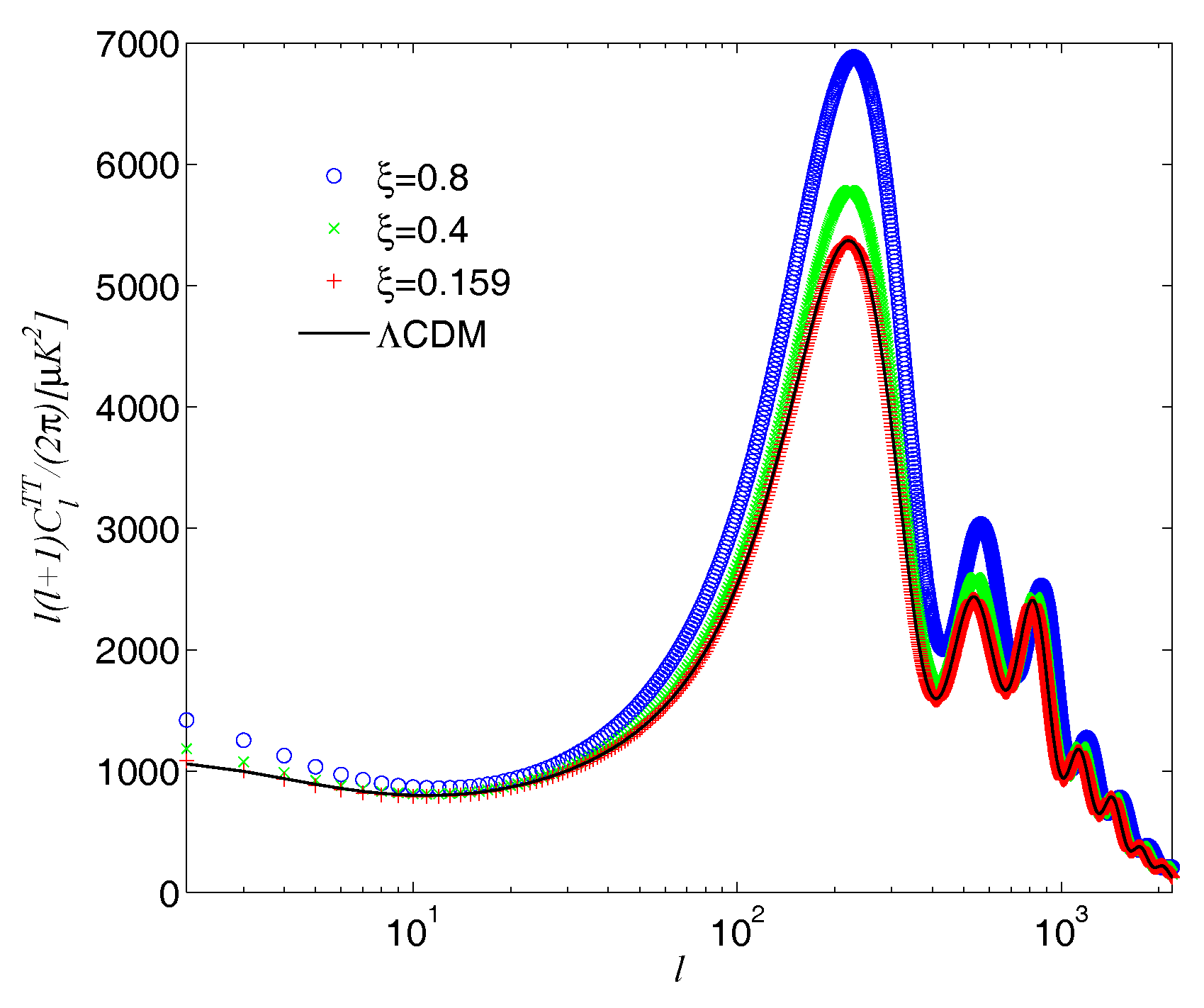
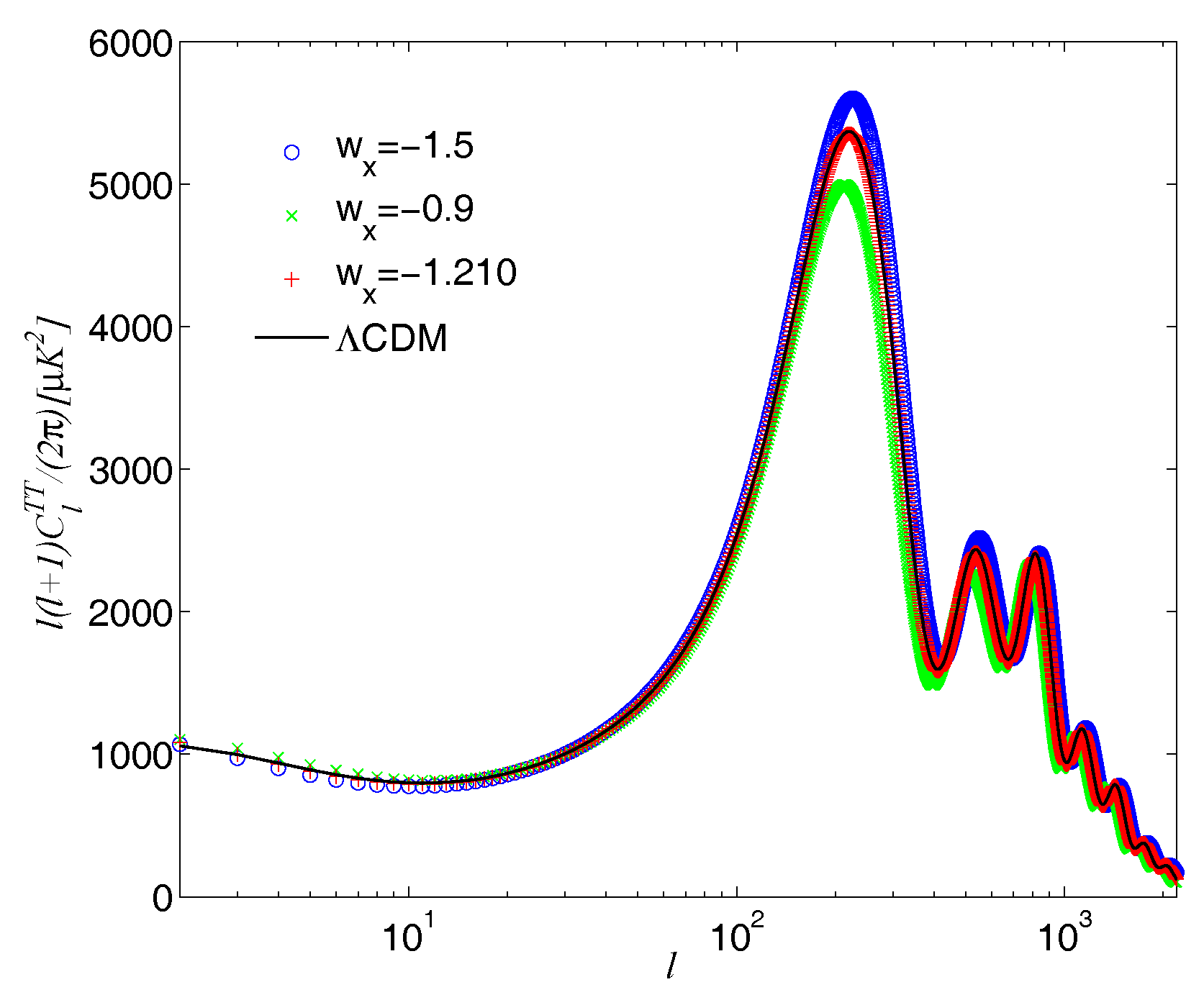
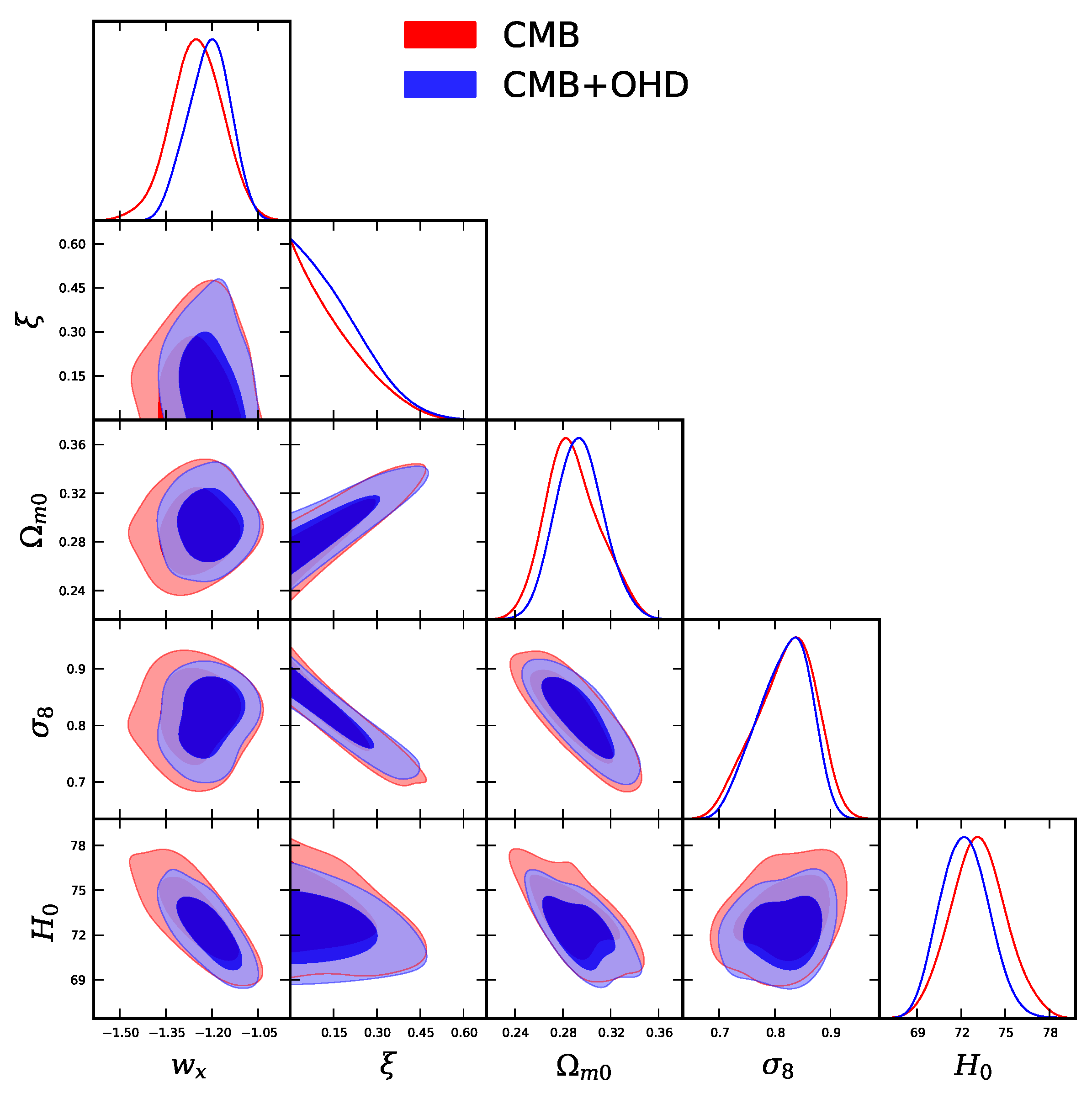

| Parameters | Mean with Errors (CMB) | Best Fit (CMB) | Mean with Errors (CMB + OHD) | Best Fit (CMB + OHD) |
|---|---|---|---|---|
© 2017 by the authors. Licensee MDPI, Basel, Switzerland. This article is an open access article distributed under the terms and conditions of the Creative Commons Attribution (CC BY) license (http://creativecommons.org/licenses/by/4.0/).
Share and Cite
Yang, W.; Xu, L.; Li, H.; Wu, Y.; Lu, J. Testing the Interacting Dark Energy Model with Cosmic Microwave Background Anisotropy and Observational Hubble Data. Entropy 2017, 19, 327. https://doi.org/10.3390/e19070327
Yang W, Xu L, Li H, Wu Y, Lu J. Testing the Interacting Dark Energy Model with Cosmic Microwave Background Anisotropy and Observational Hubble Data. Entropy. 2017; 19(7):327. https://doi.org/10.3390/e19070327
Chicago/Turabian StyleYang, Weiqiang, Lixin Xu, Hang Li, Yabo Wu, and Jianbo Lu. 2017. "Testing the Interacting Dark Energy Model with Cosmic Microwave Background Anisotropy and Observational Hubble Data" Entropy 19, no. 7: 327. https://doi.org/10.3390/e19070327
APA StyleYang, W., Xu, L., Li, H., Wu, Y., & Lu, J. (2017). Testing the Interacting Dark Energy Model with Cosmic Microwave Background Anisotropy and Observational Hubble Data. Entropy, 19(7), 327. https://doi.org/10.3390/e19070327

