


Abstract
The stability of topological close-packed (TCP) phases were found to be well related to the average value of the d-orbital energy level (
) for most reported high entropy alloys (HEAs). Excluding some HEAs that contain high levels of the elements aluminum and vanadium, the results of this study indicated that the TCP phases form at
> 1.09. This criterion, as a semi-empirical method, can play a key role in designing and preparing HEAs with high amounts of transitional elements.
1. Introduction
New types of alloy, which include high entropy alloys (HEAs) and multi-component alloys with equiatomic and near-equiatomic compositions, are garnering much research attention in the metallic materials community [1–3]. Compared to conventional metallic alloys based on one or two major elements, these new alloys generally contains 5–13 principal elements [2]. These alloys were named multi-component alloys by Cantor et al. [1] and defined as HEAs by Yeh et al. [2]. To date, many promising properties have been reported, including highly wear-resistant HEAs like Co1.5CrFeNi1.5Ti and Al0.2Co1.5CrFeNi1.5Ti [4,5]; high-strength body-centered-cubic (BCC) structured AlCoCrFeNiTi0.5 and AlCrFeNiMo0.2 HEAs (at room temperature) [6,7], and NbMoTaV HEA (at elevated temperatures) [8,9], and high corrosion resistant Cu0.5NiAlCoCrFeSi HEA [10]. Researchers are drawn to HEAs due to their unique compositions, microstructures, and adjustable properties. To date, many studies have been performed on HEAs, and they have become a hot topic for research in the materials community [11–32].
HEAs generally consist of simple solid solutions of face centered cubic (FCC) structures, body centered cubic (BCC) structurs or a combination of the two. Research findings show that a small quantity of intermetallic compound phase/metastable particles often form in HEAs after solidification or the completion of an aging treatment at intermediate temperatures [3,25,33]. These intermetallic compound phases/metastable particles, especially the topological close-packed (TCP) phases, are closely related to the mechanical properties of HEAs. Therefore, it is necessary to predict the occurrence of TCP phases which include the Laves phase, σ phase, R phase, μ phase, P phase, and so on.
In the past, most HEAs contained the elements Co, Fe, and Ni as their primary elements. Usually, some alloying elements, such as Al, B, Cr, Mo, Nb, Si, Ti, V, are added to HEAs that contain Co, Fe and Ni, forming alloy systems such as Al0.5CoCrCuFeNiTix [34], Al0.5CoCrCuFeNiBx [35], Al0.5CoCrCuFeNiVx [36], AlCoCrFeNiMox [37], AlCoCrCuFeNiMox [38], AlCoCrFeNiTix [6], AlCoCrFeNiNbx [39], AlCoCrFeNiSix [40], and AlCoCrFeNiTi0.5 [41]. It is worth noting that when the concentrations of Al, B, Cr, Mo, Nb, Si, Ti, and V exceed a critical value, some ordered phases might form, which could deteriorate the plasticity of the HEAs. For example, the plastic strain of as-cast AlCoCrFeNiNb0.25 alloy is remarkably lower than that of as-cast AlCoCrFeNi alloy due to the formation of the Laves phase [39]. Taking AlCoCrFeNiNbx alloys [39] as an example again, with the increase of x, the crystal structure of the alloys can transform from BCC to BCC + Laves phase. Although both the yield strength and hardness increase, the plasticity decreases dramatically. Another case to illustrate this point includes the structural transformation sequence for the CoCrFeNiMox system, where with the increase of x, it has been observed that FCC → FCC + σ → FCC + σ + μ [42]. The formation of the σ phase is considered to be due to two factors, one of which is the identical crystal structure and the similar electron configuration between Cr and Mo, and the other is the substitution capability among Co, Fe, and Ni elements. Similarly, in AlCoCrFeNiNbx and CoCrFeNiTix HEAs, the TCP phase forms with an increased content of Nb and Ti elements, which is explained by the large atomic size of Nb and Ti elements as well as its large negative enthalpies of mixing with other alloying elements [6,43]. However, the experimental results are far from proving this satisfactorily.
Recently, the valence electron concentration (VEC) was used to predict the existence of the σ phase, a TCP phase, in Cr- and/or V-containing HEAs [33] where the criterion worked well. Electronegativity was also successfully used to predict TCP phases in HEAs [44]. Yang et al. successfully used a simple thermodynamic rule, i.e., the entropic and the average heat of mixing, to predict phase selection in multicomponent alloys [45]. Liu et al. proposed an effective atomic size parameter to predict the phase stability in multicomponent systems [46]. These semi-empirical modes have achieved great success in predicting the stability of solid solution phases of HEAs. The d-orbital energy level (Md) physically correlates with electronegativity and metallic radius of elements, both of which are parameters used in the classical approach by Hume-Rothery and Darken and Gurry [47]. For example, the Md value will increase with the increase of metallic radius, and it will reduce with the increase of electronegativity, so the parameter Md has great potential for dealing with the stability of TCP, especially in those HEAs containing high mounts of certain transitional elements. Therefore, in this paper, another parameter was used: the average value of the energy level of d-orbital (
) parameters to predict all types of TCP phases of HEAs.
2. Results and Discussion
It is generally accepted that d-electron bonding is of great significance to the metallurgical properties of transition metals. The average value of the d-orbital energy level was proposed as:
where Ci is the atomic fraction of component i in the alloy, and (Md)i is the d-orbital energy level of element i in the M-element centered cluster in the i-M binary solid solution alloy, in which i is a solvent and M is a solute. This was proposed to design superalloys by Morinaga, et al. [47–51], who found that all of the Ni-based, Co-based, and Fe-based superalloys with the σ phase formed displayed higher
values (about 0.915) than those of alloys without forming the σ phase. To data, the
parameter has been successfully used to design superalloys. In HEAs, most principle elements are transition elements similar to superalloys. Therefore, in this paper, the parameters
can be adopted to study the stability of the TCP phase in HEAs that contain more transitional elements.
In HEAs, the matrix and commonly added alloying elements, including Ni, Fe, Co, Cr, and so on, have FCC, BCC, or a combination of the two as a structure. Previous research shows that the (Md)i value of transition metals in the BCC-structured Fe is slightly higher than that of transition metals in the FCC-structured Ni3Al, although they display the same variation trend [50,52]. It seems possible to establish a semi-empirical model to predict the presence of TCP phases in HEAs. When a new HEA is designed, the accurate structure was not known before testing, so in order to calculate its
value, it was necessary to assume a single structure for HEAs. According to previous research results, whether adopting the FCC structure or BCC structure, the (Md)i value was almost the same. Therefore, the assumed single structure may be a FCC or BCC structure, regardless of the real structure the HEA. For calculation convenience, all HEAs in this study were assumed to have a single FCC Ni3Al structure when the
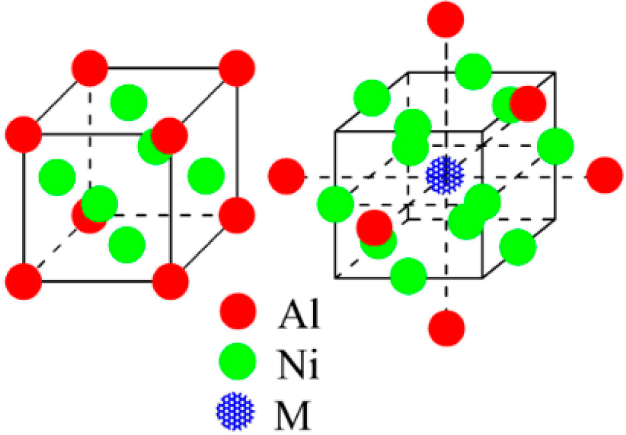
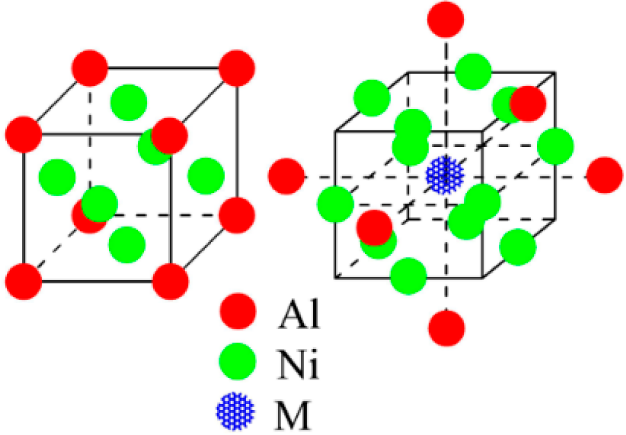
values were calculated. Thereunto, the (Md)i value was the individual element which was calculated based on the FCC Ni3Al structure, which is shown in Figure 1a. An Al atom is surrounded by twelve Ni atoms as its nearest neighbours, and surrounded by six Al atoms in its second nearest neighbours. The cluster used in the calculation was [MNi12Al6], which is shown in Figure 1b. An Al atom in the center was substituted for the various alloying elements of M (M = Ti, Cr, Mn, Fe, Co, Ni, Cu, V, Mo, and so on). More details can be found in Refs. [47,48].
Figure 1.
The calculation of (Md)i value: (a) Crystal structure of Ni3Al; and (b) Cluster model used in the calculation.
Although the (Md)i values calculated in BCC/(BCC + FCC)-structured HEAs were slightly lower than the actual data, this approach could successfully predict the stability of the TCP phase by providing a reasonable guideline.
According to the methods reported by Morinaga [47–50], the value of the parameter
was calculated for the reported HEA system that contained TCP phases. The values are shown in Table 1 [5,6,34,36–38,39,42,43,53–65]. It was found that all the HEAs in Table 1 were synthesized by arc melting and then solidified in a water-cooled copper hearth. As can be seen, a rule emerges in that TCP phases occurred when the value of
reached 1.09.
Table 1.
The crystal structure and the parameters,
, for typical reported multi-component HEAs.
To further illustrate this point, the
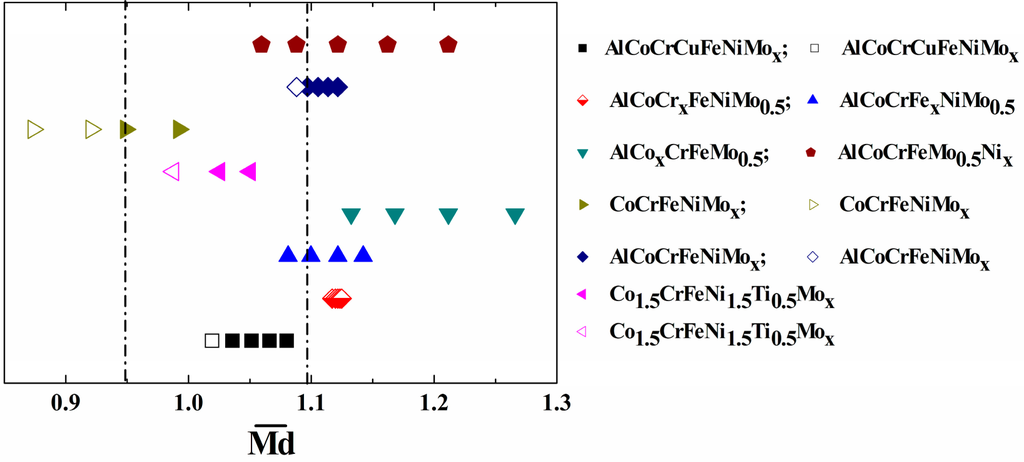
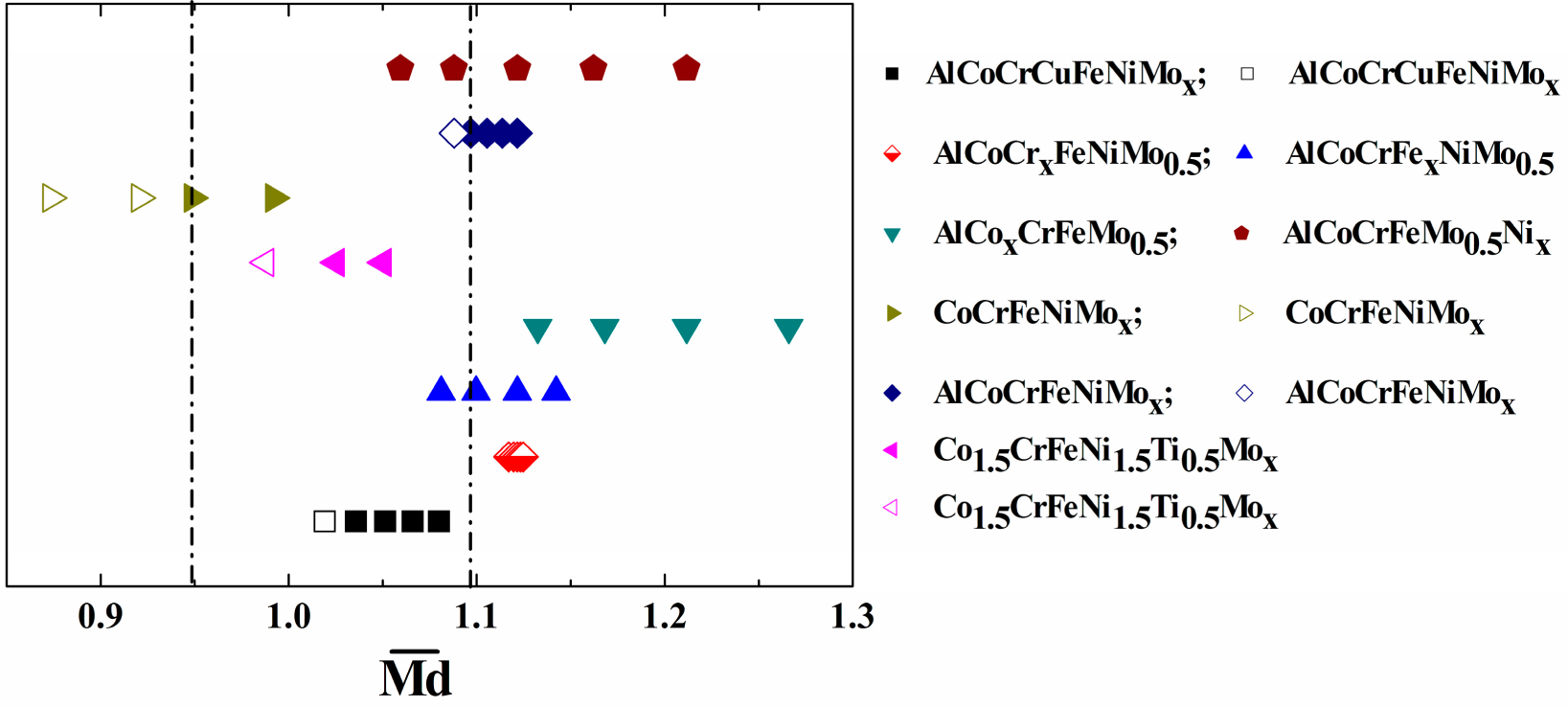
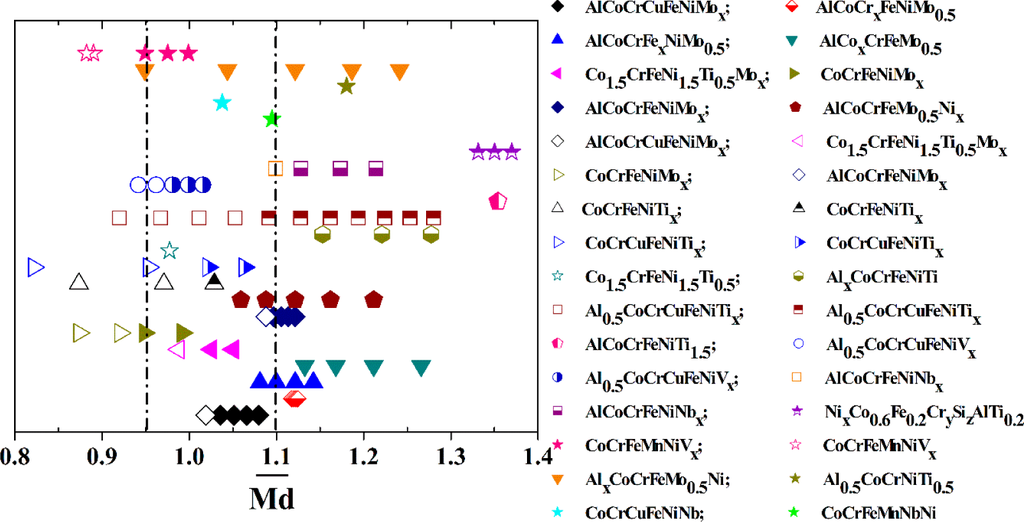
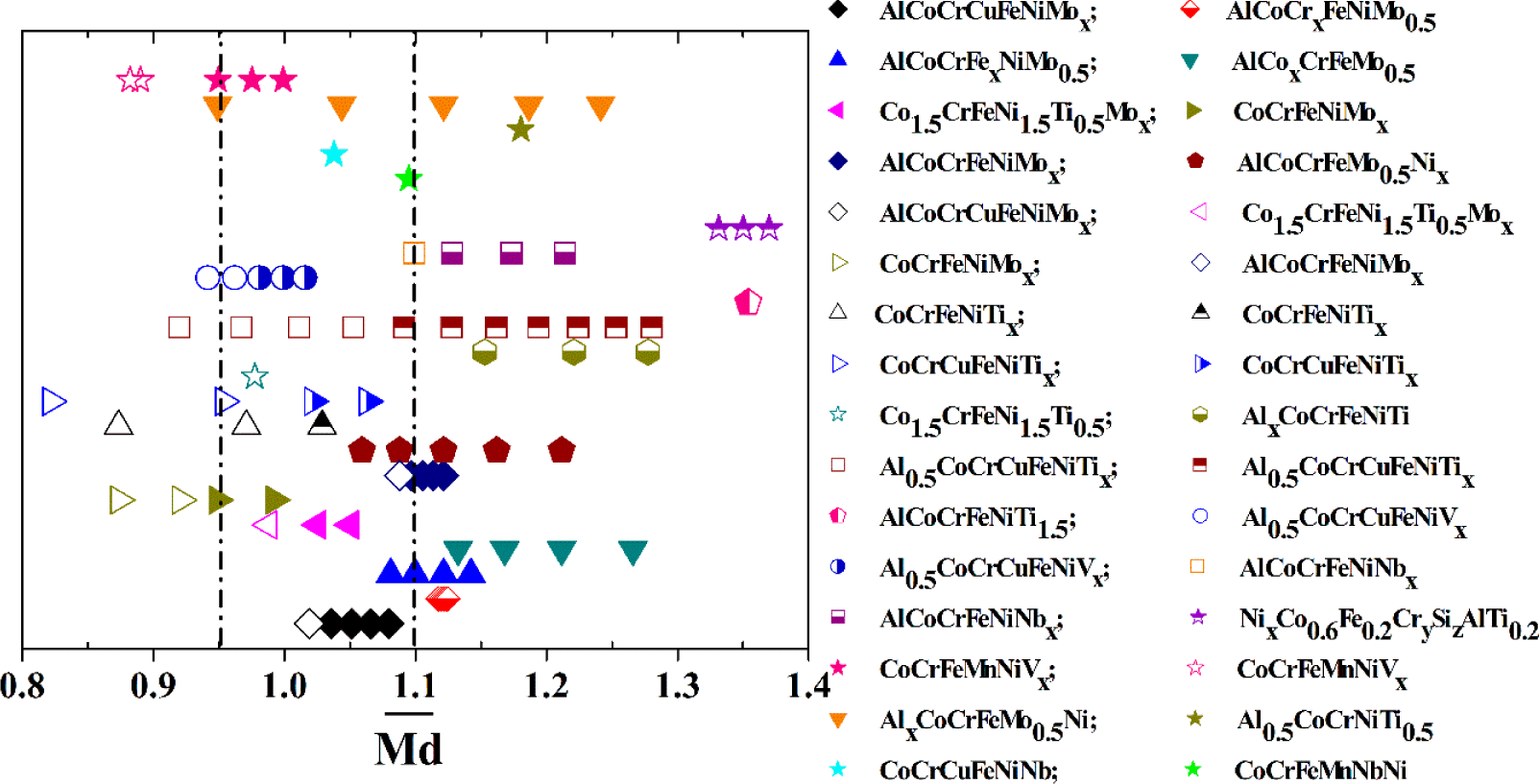
values for the HEA systems containing TCP phases were plotted in Figures 2 and 3, which clearly show the capability of
to quantitatively predict the formation of TCP phases in HEAs. It was found that when
> 1.09, stable TCP phases appeared except in a few exceptions where no TCP phases formed at
< ~0.95. In the range of
= ~0.95 to 1.09, the existence of TCP phases was unknown.
Figure 2.
Relationship between the
and the TCP phase stability for the HEA systems containing Al, Co, Cr, Fe, Ni, and Mo elements. Note on the legend: fully closed symbols and top-half closed symbols represent solid solution phase plus TCP phase; fully open symbols represent sole solid solution phases.
Figure 3.
Relationship between the
and the TCP phase stability for the HEA systems containing Al, Co, Cr, Cu, Fe, Ni, Mo, Si, Ti, V, Nb, and etc. elements. Note on the legend: fully closed symbols and top-half closed symbols represent solid solution phase plus TCP phase; fully open symbols represent sole solid solution phases.
This is a novel method to predict the formation of TCP phases of HEAs. It must be pointed out that the theory may work well only in HEAs with high amounts of transition elements, especially, when these transition elements are Co, Cr, Cu, Fe, Ni, Mo, Ti, Mn, and Nb elements. It was found that the Laves phase vanished in AlxCoCrFeNiTi0.5 alloys with high Al contents [66] and that the σ phase vanished in Al0.5CoCrCuFeNiVx alloys with high V contents [36].
This shows that the criterion
is invalid when the HEAs contain high levels of Al and V elements. The mechanisms of Al and V elements on the stability of TCP phases require further research. It should be noted that all statistic HEAs are nominal compositions in the paper. Therefore, in part of designed HEAs’ composition there may be a deviation in the actual active content after melting. The target of this paper is to use some parameters to predict the phase formation in high-entropy alloys, and from the prediction point of view only nominal compositions can be used, as actual compositions are only known after the materials are prepared. In this sense, the difference between the nominal composition and the actual composition is not a concern for the prediction we intend to make.
3. Conclusions
In this study, the average value of the energy level of the d-orbital (
) was used to predict the stability of TCP phases in HEAs. A TCP phase formation rule was proposed by calculating the
value for HEAs containing Al, Co, Cr, Cu, Fe, Ni, Mo, Si, Ti, Nb and other transition elements. TCP phases were found to be stable at
except for some HEAs containing high levels of the elements Al and V. Specifically, it was discovered that the applicable alloying elements were limited to some transition elements (such as Co, Cr, Cu, Fe, Ni, Mn, Mo, Ti, and Nb), particularly as these elements easily formed the TCP phase. A novel method was used to predict the formation of TCP phases in HEAs. However, the significant impact of large amounts of Al and V elements on the stability of the TCP phase remains unclear, and therefore, more research is needed in order to fully understand it.
Acknowledgments
This work was supported by the National Natural Science Foundation of China Nos. (51104029, 51134013, and 51471044) respectively, the Fundamental Research Funds for the Central Universities, Key Laboratory of Basic Research Projects of Liaoning Province Department of Education (LZ2014007) and the Natural Science Foundation of Liaoning Province (2014028013). We would like to thank Prof. Zhijun Wang for helpful discussions.
Author Contributions
Yiping Lu and Yong Dong designed the research and wrote the paper. Li Jiang, Tingju Li and Tongmin Wang performed the data analysis. Yiping Lu, Tongmin Wang and Yong Zhang contributed to the results analysis and discussion. All authors have read and approved the final manuscript.
Conflicts of Interest
The authors declare no conflict of interest.
References
- Cantor, B.; Chang, I.T.H.; Knight, P.; Vincent, A.J.B. Microstructural development in equiatomic multicomponent alloys. Mater. Sci. Eng. A 2004, 375, 213–218. [Google Scholar]
- Yeh, J.W.; Chen, S.K.; Lin, S.J.; Gan, J.Y.; Chin, T.S.; Shun, T.T.; Tsau, C.H.; Chang, S.Y. Nanostructured high-entropy alloys with multiple principal elements: novel alloy design concepts and outcomes. Adv. Eng. Mater. 2004, 6, 299–303. [Google Scholar]
- Zhang, Y.; Zuo, T.T.; Tang, Z.; Gao, M.C.; Dahmen, K.A.; Liaw, P.K.; Lu, Z.P. Microstructures and properties of high-entropy alloys. Prog. Mater Sci. 2014, 61, 1–93. [Google Scholar]
- Chuang, M.-H.; Tsai, M.-H.; Wang, W.-R.; Lin, S.-J.; Yeh, J.-W. Microstructure and wear behavior of AlxCo1.5CrFeNi1.5 Tiy high-entropy alloys. Acta Mater 2011, 59, 6308–6317. [Google Scholar]
- Hsu, C.Y.; Sheu, T.S.; Yeh, J.W.; Chen, S.K. Effect of iron content on wear behavior of AlCoCrFexMo0.5Ni high-entropy alloys. Wear 2010, 268, 653–659. [Google Scholar]
- Zhou, Y.J.; Zhang, Y.; Wang, Y.L.; Chen, G.L. Solid solution alloy of AlCoCrFeNiTix with excellent room-temperature mechanical properties. Appl. Phy. Lett. 2007, 90, 181904. [Google Scholar]
- Dong, Y.; Lu, Y.P.; Kong, J.R.; Zhang, J.J.; Li, T.J. Microstructure and mechanical properties of multi-component AlCrFeNiMox high-entropy alloys. J. Alloys Compd 2013, 573, 96–101. [Google Scholar]
- Senkov, O.N.; Scott, J.M.; Senkova, S.V.; Meisenkothen, F.; Miracle, D.B.; Woodward, C.F. Microstructure and elevated temperature properties of a refractory TaNbHfZrTi alloy. J. Mater. Sci. 2012, 47, 4062–4074. [Google Scholar]
- Senkov, O.N.; Senkova, S.V.; Woodward, C.; Miracle, D.B. Low-density, refractory multi-principal element alloys of the Cr-Nb-Ti-V-Zr system: Microstructure and phase analysis. Acta Mater 2013, 61, 1545–1557. [Google Scholar]
- Chen, Y.Y.; Duval, T.; Hong, U.T.; Yeh, J.W.; Shih, H.C.; Wang, L.H.; Oung, J.C. Corrosion properties of a novel bulk Cu0.5NiAlCoCrFeSi glassy alloy in 288 °C high-purity water. Mater. Lett. 2007, 61, 2692–2696. [Google Scholar]
- Otto, F.; Yang, Y.; Bei, H.; George, E.P. Relative effects of enthalpy and entropy on the phase stability of equiatomic high-entropy alloys. Acta Mater 2013, 61, 2628–2638. [Google Scholar]
- Gludovatz, B.; Hohenwarter, A.; Catoor, D.; Chang, E.H.; George, E.P.; Ritchie, R.O. A fracture-resistant high-entropy alloy for cryogenic applications. Science 2014, 345, 1153–1158. [Google Scholar]
- Hemphill, M.A.; Yuan, T.; Wang, G.Y.; Yeh, J.W.; Tsai, C.W.; Chuang, A.; Liaw, P.K. Fatigue behavior of Al0.5CoCrCuFeNi high entropy alloys. Acta Mater 2012, 60, 5723–5734. [Google Scholar]
- Takeuchi, A.; Amiya, K.; Wada, T.; Yubuta, K.; Zhang, W.; Makino, A. Entropies in alloy design for high-entropy and bulk glassy alloys. Entropy 2013, 15, 3810–3821. [Google Scholar]
- Koželj, P.; Vrtnik, S.; Jelen, A.; Jazbec, S.; Jagličić, Z.; Maiti, S.; Feuerbacher, M.; Steurer, W.; Dolinšek, J. Discovery of a superconducting high-entropy alloy. Phys. Rev. Lett. 2014, 113, 107001. [Google Scholar]
- Senkov, O.N.; Wilks, G.B.; Miracle, D.B.; Chuang, C.P.; Liaw, P.K. Refractory high entropy alloys. Intermetallics 2010, 18, 1758–1765. [Google Scholar]
- Lin, S.Y.; Chang, S.Y.; Chang, C.J.; Huang, Y.C. Nanomechanical properties and deformation behaviors of multi-component (AlCrTaTiZr)NxSiy high-entropy coatings. Entropy 2014, 16, 405–417. [Google Scholar]
- Lin, C.-M.; Tsai, H.-L.; Bor, H.-Y. Effect of aging treatment on microstructure and properties of high-entropy Cu0.5CoCrFeNi alloy. Intermetallics 2010, 18, 1244–1250. [Google Scholar]
- Lu, Y.P.; Dong, Y.; Guo, S.; Jiang, L.; Kang, H.J.; Wang, T.M.; Wen, B.; Wang, Z.J.; Jie, J.C.; Cao, Z.Q.; et al. A promising new class of high-temperature alloys: Eutectic high-entropy alloys. Sci. Rep. 2014, 4. [Google Scholar] [CrossRef]
- He, J.Y.; Liu, W.H.; Wang, H.; Wu, Y.; Liu, X.J.; Nieh, T.G.; Lu, Z.P. Effects of Al addition on structural evolution and tensile properties of the FeCoNiCrMn high-entropy alloy system. Acta Mater 2014, 62, 105–113. [Google Scholar]
- Guo, S.; Ng, C.; Lu, J.; Liu, C.T. Effect of valence electron concentration on stability of fcc or bcc phase in high entropy alloys. J. Appl. Phys. 2011, 109, 103505. [Google Scholar]
- Raghavan, R.; Kumar, K.C.H.; Murty, B.S. Analysis of phase formation in multi-component alloys. J. Alloy. Compd. 2012, 544, 152–158. [Google Scholar]
- Singh, A.K.; Kumar, N.; Dwivedi, A.; Subramaniam, A. A geometrical parameter for the formation of disordered solid solutions in multi-component alloys. Intermetallics 2014, 53, 112–119. [Google Scholar]
- Tsai, K.Y.; Tsai, M.H.; Yeh, J.W. Sluggish diffusion in Co–Cr–Fe–Mn–Ni high-entropy alloys. Acta Mater 2013, 61, 4887–4897. [Google Scholar]
- Otto, F.; Dlouhy, A.; Somsen, C.; Bei, H.; Eggler, G.; George, E.P. The influences of temperature and microstructure on the tensile properties of a CoCrFeMnNi high-entropy alloy. Acta Mater 2013, 61, 5743–5755. [Google Scholar]
- Bhattacharjee, P.P.; Sathiaraj, G.D.; Zaid, M.; Gatti, J.R.; Lee, C.; Tsai, C.W.; Yeh, J.W. Microstructure and texture evolution during annealing of equiatomic CoCrFeMnNi high-entropy alloy. J. Alloys Compd. 2014, 587, 544–552. [Google Scholar]
- Zhang, F.; Zhang, C.; Chen, S.L.; Zhu, J.; Cao, W.S. An understanding of high entropy alloys from phase diagram calculations. Calphad 2014, 45, 1–10. [Google Scholar]
- Singh, A.K.; Subramaniam, A. On the formation of disordered solid solutions in multi-component. J. Alloys Compd. 2014, 587, 113–119. [Google Scholar]
- Lee, C.P.; Chang, C.C.; Chen, Y.Y.; Yeh, J.W.; Shih, H.C. Effect of the aluminium content of AlxCrFe1.5MnNi0.5 high-entropy alloys on the corrosion behaviour in aqueous environments. Corros. Sci. 2008, 50, 2053–2060. [Google Scholar]
- Senkov, O.N.; Zhang, F.; Miller, J.D. Phase composition of a CrMo0.5NbTa0.5TiZr high entropy alloy: Comparison of experimental and simulated data. Entropy 2013, 15, 3769–3809. [Google Scholar]
- Gao, M.C.; Alman, D.E. Searching for next single-phase high-entropy alloy compositions. Entropy 2013, 15, 4504–4519. [Google Scholar]
- Miracle, D.B.; Miller, J.D.; Senkov, O.N.; Woodward, C.; Uchic, M.D.; Tiley, J. exploration and development of high entropy alloys for structural applications. Entropy 2014, 16, 494–525. [Google Scholar]
- Tsai, M.H.; Tsai, K.Y.; Tsai, C.W.; Lee, C.; Juan, C.C.; Yeh, J.W. Criterion for sigma phase formation in Cr- and V-containing high-entropy alloys. Mater. Res. Lett. 2013, 1, 207–212. [Google Scholar]
- Chen, M.R.; Lin, S.J.; Yeh, J.W.; Chen, S.K.; Huang, Y.S.; Tu, C.P. Microstructure and properties of Al0.5CoCrCuFeNiTix (x = 0−2.0) high-entropy alloys. Mater. Trans. 2006, 47, 1395–1401. [Google Scholar]
- Lee, C.P.; Chen, Y.Y.; Hsu, C.Y.; Yeh, J.W.; Shih, H.C. The effect of Boron on the corrosion resistance of the high entropy alloys Al0.5CoCrCuFeNiBx. J. Electrochem. Soc. 2007, 154, 424–430. [Google Scholar]
- Chen, M.R.; Lin, S.J.; Yeh, J.W.; Chen, S.K.; Huang, Y.S.; Chuang, M.H. Effect of vanadium addition on the microstructure, hardness, and wear resistance of Al0.5CoCrCuFeNi high-entropy alloy. Metall. Mater. Trans. A. 2006, 37, 1363–1369. [Google Scholar]
- Zhu, J.M.; Fu, H.M.; Zhang, H.F.; Wang, A.M.; Li, H.; Hu, Z.Q. Microstructures and compressive properties of multicomponent AlCoCrFeNiMox alloys. Mater. Sci. Eng. A 2010, 527, 6975–6979. [Google Scholar]
- Zhu, J.M.; Zhang, H.F.; Fu, H.M.; Wang, A.M.; Li, H.; Hu, Z.Q. Microstructures and compressive properties of multicomponent AlCoCrCuFeNiMox alloys. J. Alloys Compd. 2010, 497, 52–56. [Google Scholar]
- Ma, S.G.; Zhang, Y. Effect of Nb addition on the microstructure and properties of AlCoCrFeNi high-entropy alloy. Mater. Sci. Eng. A 2012, 532, 480–486. [Google Scholar]
- Zhu, J.M.; Fu, H.M.; Zhang, H.F.; Wang, A.M.; Li, H.; Hu, Z.Q. Synthesis and properties of multiprincipal component AlCoCrFeNiSix alloys. Mater. Sci. Eng. A 2010, 527, 7210–7214. [Google Scholar]
- Zhou, Y.J.; Zhang, Y.; Kim, T.N.; Chen, G.L. Microstructure characterizations and strengthening mechanism of multi-principal component AlCoCrFeNiTi0.5 solid solution alloy with excellent mechanical properties. Mater. Lett. 2008, 62, 2673–2676. [Google Scholar]
- Shun, T.T.; Chang, L.Y.; Shiu, M.H. Microstructure and mechanical properties of multiprincipal component CoCrFeNiMox alloys. Mater. Charact. 2012, 70, 63–67. [Google Scholar]
- Shun, T.T.; Chang, L.Y.; Shiu, M.H. Microstructures and mechanical properties of multiprincipal component CoCrFeNiTix alloys. Mater. Sci. Eng. A 2012, 556, 170–174. [Google Scholar]
- Dong, Y.; Lu, Y.P.; Jiang, L.; Wang, T.M.; Li, T.J. Effects of electro-negativity on the stability of topologically close packed phase in high entropy alloys. Intermetallic 2014, 52, 105–109. [Google Scholar]
- Ye, Y.F.; Wang, Q.; Lu, J.; Liu, C.T.; Yang, Y. The generalized thermodynamic rule for phase selection in multicomponent alloys. Intermetallics 2015, 59, 75–80. [Google Scholar]
- Wang, Z.J.; Huang, Y.H.; Yang, Y.; Wang, J.C.; Liu, C.T. Atomic-size effect and solid solubility of multicomponent alloys. Scr. Mater. 2015, 94, 28–31. [Google Scholar]
- Morinaga, M.; Yukawa, N.; Adachi, H. Superalloys. New PHACOMP and its application to alloy design, Proceedings of the Fifth International Symposium Superalloys (1984), Seven Springs, PA, USA, 7–11 October 1984.
- Morinaga, M.; Yukawa, N.; Adachi, H. Alloying effect on the electronic structure of Ni3Al (γ′). J. Phys. Soc. Jpn. 1984, 53, 653–663. [Google Scholar]
- Morinaga, M.; Yukawa, N.; Ezaki, H. Solid solubilities in transition-metal-based fcc alloys. Phils. Mag. A 1985, 51, 223–246. [Google Scholar]
- Morinaga, M.; Yukawa, N.; Adachi, H. Alloying effect on the electronic structure of BCC Fe. J. Phys. F 1985, 15, 1071–1084. [Google Scholar]
- Inoue, S.; Saito, J.; Morinaga, M.; Kano, S. Alloying effect on the electronic structures of Nb and Mo. J. Phys. Condens. Matter. 1994, 6, 5081–5096. [Google Scholar]
- Pauling, L. Nature of the Chemical Bond; Cornell University press: Ithaca, NY, USA, 1960. [Google Scholar]
- Hsu, C.Y.; Wang, W.R.; Tang, W.Y.; Chen, S.K.; Yeh, J.W. Microstructure and mechanical properties of new AlCoxCrFeMo0.5Ni high-entropy alloys. Adv. Eng. Mater 2010, 12, 44–49. [Google Scholar]
- Hsu, C.Y.; Juan, C.C.; Wang, W.R.; Sheu, T.S.; Yeh, J.W.; Chen, S.K. On the superior hot hardness and softening resistance of AlCoCrxFeMo0.5Ni high entropy alloys. Mater. Sci. Eng. A 2011, 528, 3581–3588. [Google Scholar]
- Chou, Y.L.; Yeh, J.W.; Shih, H.C. The effect of molybdenum on the corrosion behaviour of the high-entropy alloys Co1.5CrFeNi1.5Ti0.5Mox in aqueous environments. Corros. Sci. 2010, 52, 2571–2581. [Google Scholar]
- Juan, C.C.; Hsu, C.Y.; Tsai, C.W.; Wang, W.R.; Sheu, T.S.; Yeh, J.W.; Chen, S.K. On microstructure and mechanical performance of AlCoCrFeMo0.5Nix high-entropy alloys. Intermetallics 2013, 32, 401–407. [Google Scholar]
- Wang, X.F.; Zhang, Y.; Qiao, Y.; Chen, G.L. Novel microstructure and properties of multicomponent CoCrCuFeNiTix alloys. Intermetallics 2007, 15, 357–362. [Google Scholar]
- Zhang, K.B.; Fu, Z.Y. Effects of annealing treatment on phase composition and microstructure of CoCrFeNiTiAlx high-entropy alloys. Intermetallics 2012, 22, 24–32. [Google Scholar]
- Wang, L.M.; Chen, C.C.; Yeh, J.W.; Ke, S.T. The microstructure and strengthening mechanism of thermal spray coating NixCo0.6Fe0.2CrySizAlTi0.2 high-entropy alloys. Mater. Chem. Phys. 2011, 126, 880–885. [Google Scholar]
- Jiang, L.; Lu, Y.P.; Dong, Y.; Wang, T.M.; Cao, Z.Q.; Li, T.J. Effects of Nb addition on structural evolution and properties of the CoFeNi2V0.5 high-entropy alloy. Appl. Phys. A 2015, 119, 291–297. [Google Scholar]
- Huo, W.Y.; Shi, H.F.; Ren, X.; Zhang, J.Y. Microstructure and wear behavior of CoCrFeMnNbNi high-entropy alloy coating by TIG cladding. Adv. Mater. Sci. Eng. 2015, 2015. [Google Scholar] [CrossRef]
- Cheng, J.B.; Liu, D.; Liang, X.B.; Xu, B.S. Microstructure and electrochemical properties of CoCrCuFeNiNb high-entropy alloys coatings. Acta. Metall. Sin. 2014, 27, 1031–1037. [Google Scholar]
- Lee, C.F.; Shun, T.T. Age hardening of the Al0.5CoCrNiTi0.5 high-entropy alloy. Metall. Mater. Trans. A 2014, 45A, 191–195. [Google Scholar]
- Hsu, C.Y.; Juan, C.C.; Sheu, T.S.; Chen, S.K.; Yeh, J.W. Effect of aluminum content on microstructure and mechanical properties of AlxCoCrFeMo0.5Ni high-entropy alloys. JOM 2013, 65, 1840–1847. [Google Scholar]
- Stepanov, N.D.; Shaysultanov, D.G.; Salishchev, G.A.; Tikhonovsky, M.A.; Oleynik, E.E.; Tortika, A.S.; Senkov, O.N. Effect of V content on microstructure and mechanical properties of the CoCrFeMnNiVx high entropy alloys. J. Alloys. Compd. 2015, 628, 170–185. [Google Scholar]
- Dong, Y.; Lu, Y.P.; Zhang, J.J.; Li, T.J. Microstructure and properties of multi-component AlxCoCrFeNiTi0.5 high-entropy alloys. Mater. Sci. Forum. 2013, 745–746, 775–780. [Google Scholar]

© 2015 by the authors; licensee MDPI, Basel, Switzerland This article is an open access article distributed under the terms and conditions of the Creative Commons Attribution license (http://creativecommons.org/licenses/by/4.0/).