
From Branch to Digital: Modeling Customer Channel Preferences in Electronic Banking Services


Abstract
1. Introduction
1.1. The Digital Transformation of Banking Services
1.2. Technology Acceptance and Customer Behavior in Banking
1.3. Research Gaps and Study Motivation
1.4. Research Objectives and Questions
- 1
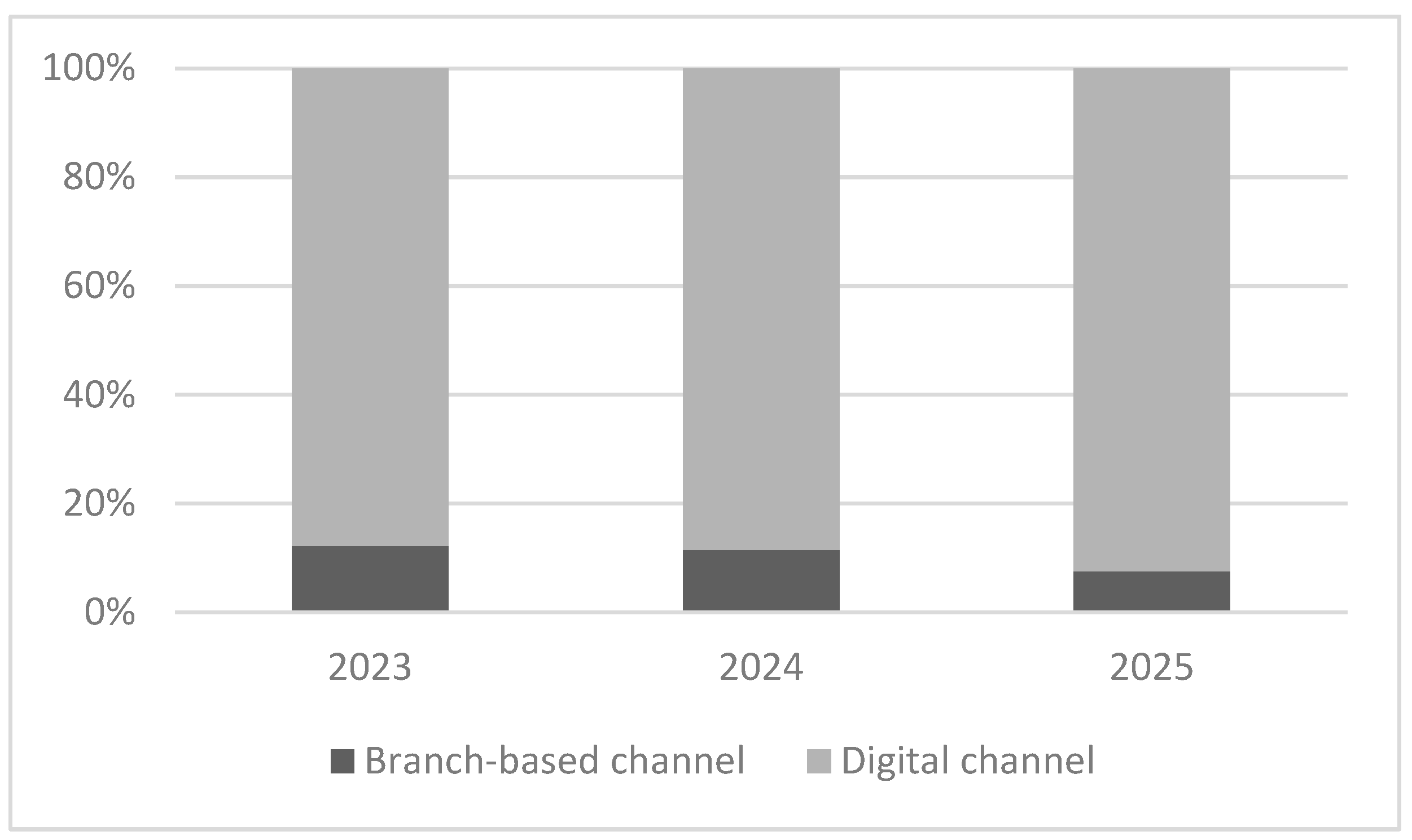
- Building on studies examining diffusion processes and market maturation in digital banking and electronic commerce [8,32], to what extent has the preference for digital banking channels over branch-based access increased across the study period, and can this increase be attributed to temporal trends that are independent of individual characteristics in the context of expanding financial services e-commerce?
- 2
- Consistent with technology acceptance and e-service quality literature emphasizing perception-based adoption drivers [36,39,49], how do customer perceptions of bank technologization influence the likelihood of using digital channels as primary mode of banking access, controlling for demographic and socioeconomic factors in online service delivery?
- 3
- Extending prior research suggesting that adoption determinants evolve as digital markets mature [32,64], does the relationship between perceived technologization and digital channel adoption strengthen over time, suggesting that technology perceptions become more important as digital financial services markets mature within the broader e-commerce ecosystem?
2. Materials and Methods
2.1. Research Design and Data Collection
2.2. Variables and Hypotheses
2.2.1. Dependent Variable
2.2.2. Main Independent Variables
2.2.3. Control Variables
2.3. Model Description
2.3.1. Pooled Model with Temporal Dimension
2.3.2. Year-Specific Models
3. Results
3.1. Descriptive Statistics
3.2. Logistic Regression Results
3.2.1. Model Fit and Diagnostics
3.2.2. Pooled Model Analysis
3.2.3. Year-Specific Model Comparison
4. Discussion
4.1. Hypotheses and Theoretical Implications
4.2. Demographic and Socioeconomic Influences
5. Conclusions
5.1. Methodological Contributions
5.2. Theoretical Implications
5.3. Practical Implications
5.4. Study Limitations
5.5. Future Research Directions
Author Contributions
Funding
Institutional Review Board Statement
Informed Consent Statement
Data Availability Statement
Conflicts of Interest
Appendix A
- ○
- Mainly through physical bank branches
- ○
- Mainly through digital channels (internet banking or mobile banking)
- ○
- Male
- ○
- Female
- ○
- 18–29 years
- ○
- 30–39 years
- ○
- 40–49 years
- ○
- 50 years or older
- ○
- Rural
- ○
- Urban
- ○
- Below minimum wage
- ○
- Between minimum wage and average wage
- ○
- Above average wage
- ○
- Less than 6 months
- ○
- Between 6 and 12 months
- ○
- Between 1 and 5 years
- ○
- More than 5 years
- ○
- All items reported in this appendix were used directly in the empirical models;
- ○
- No additional questionnaire items were included in the regression analysis beyond those reported here.
- ○
- The wording of the questionnaire did not change across survey years.
References
- Gomber, P.; Koch, J.-A.; Siering, M. Digital finance and FinTech: Current research and future research directions. J. Bus. Econ. 2017, 87, 537–580. [Google Scholar] [CrossRef]
- Ulrich-Diener, F.; Spacek, M. Digital transformation in banking: A managerial perspective on barriers to change. Sustainability 2021, 13, 2032. [Google Scholar] [CrossRef]
- Papathomas, A.; Konteos, G. Financial institutions’ digital transformation: Stages of the journey and business metrics to follow. J. Financ. Serv. Mark. 2024, 29, 590–606. [Google Scholar] [CrossRef]
- Gomber, P.; Kauffman, R.J.; Parker, C.; Weber, B.W. On the Fintech Revolution: Interpreting the Forces of Innovation, Disruption, and Transformation in Financial Services. J. Manag. Inf. Syst. 2018, 35, 220–265. [Google Scholar] [CrossRef]
- Dutta, S. The Rise of Platform-Based Models and Its Impact on Banking and Financial Services. Int. J. Bus. Manag. Res. 2020, 8, 132–136. [Google Scholar] [CrossRef]
- Xue, M.; Hitt, L.M.; Chen, P.-Y. Determinants and outcomes of Internet banking adoption. Manag. Sci. 2011, 57, 291–307. [Google Scholar] [CrossRef]
- Omarini, A.E. Banks and Fintechs: How to develop a digital open banking approach for the bank’s future. Int. Bus. Res. 2018, 11, 23–36. [Google Scholar] [CrossRef]
- Wang, K.-H. Beyond digital finance: The impact of Internet banking adoption on subjective life satisfaction. Financ. Res. Open 2025, 1, 1000012. [Google Scholar] [CrossRef]
- Neves, C.; Oliveira, T.; Santini, F.; Gutman, L. Adoption and Use of Digital Financial Services: A Meta-Analysis of Barriers and Facilitators. Int. J. Inf. Manag. Data Insights 2023, 3, 100201. [Google Scholar] [CrossRef]
- Alt, R.; Puschmann, T. The Rise of Customer-Oriented Banking—Electronic Markets Are Paving the Way for Change in Financial Industry. Electron. Mark. 2012, 22, 203–215. [Google Scholar] [CrossRef]
- Zhao, Y.; Bacao, F. How does the pandemic facilitate mobile payment? An investigation under COVID-19. Int. J. Environ. Res. Public Health 2021, 18, 1016. [Google Scholar] [CrossRef]
- Fu, J.; Mishra, M. FinTech in the time of COVID-19: Technological adoption during crises. J. Financ. Intermed. 2021, 50, 100945. [Google Scholar] [CrossRef]
- European Central Bank. Study on the Payment Attitudes of Consumers in the Euro Area (SPACE); ECB: Frankfurt, Germany, 2022. [Google Scholar]
- Citterio, A.; King, T.; Locatelli, R. Is digital transformation profitable for banks? Evidence from Europe. Financ. Res. Lett. 2024, 70, 106269. [Google Scholar] [CrossRef]
- Ayadi, R.; Chiaramonte, L.; Cucinelli, D.; Migliavacca, M. Digitalization and banks’ efficiency: Evidence from a European analysis. Int. Rev. Financ. Anal. 2025, 97, 103837. [Google Scholar] [CrossRef]
- Roman, A.; Rusu, V.; Romanciuc, E. Digitalisation and Financial Performance of the Banking Sector: An Empirical Investigation in European Countries. In Enhancing EU Workforces: Advancing Skills in the Administrative Area for Europe’s Future; Editura Universităţii “Alexandru Ioan Cuza” din Iaşi: Iași, Romania, 2024; p. 147. [Google Scholar]
- Grohmann, A.; Klühs, T.; Menkhoff, L. Does financial literacy improve financial inclusion? Cross-country evidence. World Dev. 2018, 111, 84–96. [Google Scholar] [CrossRef]
- Jiang, M.; Rifon, N.; Cotten, S.; Alhabash, S.; Tsai, H.-Y.; Shillair, R.; LaRose, R. Bringing older consumers on board to online banking: A generational cohort comparison. Educ. Gerontol. 2022, 48, 73–86. [Google Scholar] [CrossRef]
- Arner, D.W.; Barberis, J.; Buckley, R.P. The Evolution of Fintech: A New Post-Crisis Paradigm? Georget. J. Int. Law 2016, 47, 1271–1319. [Google Scholar] [CrossRef]
- Demirguc-Kunt, A.; Klapper, L.; Singer, D.; Ansar, S.; Hess, J.R. The Global Findex Database 2017: Measuring Financial Inclusion and the Fintech Revolution; World Bank: Washington, DC, USA, 2017. [Google Scholar] [CrossRef]
- Ghita-Mitrescu, S.; Duhnea, C.; Antohi, I.; Moraru, A. Non-Bank Financial Institutions—Actors in the Shadow Banking System. Ann. Univ. Oradea Econ. Sci. Ser. 2016, 25, 763–771. [Google Scholar]
- Manta, A.G.; Bădîrcea, R.M.; Gherțescu, C.; Manta, L.F. How does the nexus between digitalization and banking performance drive digital transformation in Central and Eastern European countries? Electronics 2024, 13, 4383. [Google Scholar] [CrossRef]
- Ghita-Mitrescu, S.; Duhnea, C.; Moraru, A.; Ilie, M. E-Banking and Fin-Tech Companies’ Services in Customers’ Perception. In Proceedings of the 1st Virtual International Conference: Path to a Knowledge Society—Managing Risks and Innovation, Niš, Serbia, 9–10 December 2019. [Google Scholar]
- van Dijk, J.A.G.M. The Digital Divide in Europe. In The Routledge Companion to Global Internet Histories; Goggin, G., McLelland, M., Eds.; Routledge: London, UK, 2017; pp. 125–138. [Google Scholar]
- Misa, A.; Aivaz, K. Impact of Training, Trust and Customer Satisfaction on the Reputation of Banks in Romania. Stud. Bus. Econ. 2025, 20, 125–141. [Google Scholar] [CrossRef]
- Kim, D.J.; Ferrin, D.L.; Rao, H.R. A Trust-Based Consumer Decision-Making Model in Electronic Commerce: The Role of Trust, Perceived Risk, and Their Antecedents. Decis. Support Syst. 2008, 44, 544–564. [Google Scholar] [CrossRef]
- Gefen, D.; Karahanna, E.; Straub, D.W. Trust and TAM in Online Shopping: An Integrated Model. MIS Q. 2003, 27, 51–90. [Google Scholar] [CrossRef]
- Rogers, E. Diffusion of Innovations, 5th ed.; Free Press: New York, NY, USA, 2003. [Google Scholar]
- Campbell, D.; Frei, F. Cost structure, customer profitability, and retention implications of self-service distribution channels: Evidence from customer behavior in an online banking channel. Manag. Sci. 2010, 56, 4–24. [Google Scholar] [CrossRef]
- Szopiński, T. Factors affecting the adoption of online banking in Poland. J. Bus. Res. 2016, 69, 4763–4768. [Google Scholar] [CrossRef]
- Shaikh, A.; Karjaluoto, H. Mobile banking adoption: A literature review. Telemat. Inform. 2015, 32, 129–142. [Google Scholar] [CrossRef]
- Chamboko, R. Digital financial services adoption: A retrospective time-to-event analysis approach. Financ. Innov. 2024, 10, 46. [Google Scholar] [CrossRef]
- Raza, S.A.; Umer, A.; Qureshi, M.A.; Dahri, A.S. Internet Banking Service Quality, E-Customer Satisfaction and Loyalty: The Modified E-SERVQUAL Model. TQM J. 2020, 32, 1443–1466. [Google Scholar] [CrossRef]
- Joseph, M.; Stone, G. An Empirical Evaluation of US Bank Customer Perceptions of the Impact of Technology on Service Delivery in the Banking Sector. Int. J. Retail Distrib. Manag. 2003, 31, 190–202. [Google Scholar] [CrossRef]
- Aivaz, K.; Mișa, A.; Teodorescu, D. Exploring the Role of Education and Professional Development in Implementing Corporate Social Responsibility Policies in the Banking Sector. Sustainability 2024, 16, 3421. [Google Scholar] [CrossRef]
- Davis, F. Perceived usefulness, perceived ease of use, and user acceptance of information technology. MIS Q. 1989, 13, 319–340. [Google Scholar] [CrossRef]
- Pikkarainen, T.; Pikkarainen, K.; Karjaluoto, H.; Pahnila, S. Consumer acceptance of online banking: An extension of the technology acceptance model. Internet Res. 2004, 14, 224–235. [Google Scholar] [CrossRef]
- Howcroft, B.; Hewer, P.; Hamilton, R. Consumer attitude and the adoption of home-based banking in the United Kingdom. Int. J. Bank Mark. 2002, 20, 111–121. [Google Scholar] [CrossRef]
- Venkatesh, V.; Morris, M.; Davis, G.; Davis, F. User acceptance of information technology: Toward a unified view. MIS Q. 2003, 27, 425–478. [Google Scholar] [CrossRef]
- Venkatesh, V.; Thong, J.Y.L.; Xu, X. Consumer acceptance and use of information technology: Extending UTAUT. MIS Q. 2012, 36, 157–178. [Google Scholar] [CrossRef]
- Martins, C.; Oliveira, T.; Popovič, A. Understanding Internet banking adoption: A unified theory of acceptance and use of technology and perceived risk application. Int. J. Inf. Manag. 2014, 34, 1–13. [Google Scholar] [CrossRef]
- Zhou, T.; Lu, Y.; Wang, B. Integrating TTF and UTAUT to explain mobile banking user adoption. Comput. Hum. Behav. 2010, 26, 760–767. [Google Scholar] [CrossRef]
- Slade, E.; Dwivedi, Y.; Piercy, N.; Williams, M. Modelling consumers’ adoption intentions of remote mobile payments in the United Kingdom: Extending UTAUT with innovativeness, risk, and trust. Psychol. Mark. 2015, 32, 860–873. [Google Scholar] [CrossRef]
- Alalwan, A.A.; Dwivedi, Y.K.; Rana, N.P.; Algharabat, R. Examining factors influencing Jordanian customers’ adoption of Internet banking. J. Retail. Consum. Serv. 2018, 40, 125–138. [Google Scholar] [CrossRef]
- Bashir, I.; Madhavaiah, C. Consumer attitude and behavioural intention towards Internet banking adoption in India. J. Indian Bus. Res. 2015, 7, 67–102. [Google Scholar] [CrossRef]
- Merhi, M.; Hone, K.; Tarhini, A. A cross-cultural study of the intention to use mobile banking. Technol. Soc. 2019, 59, 101151. [Google Scholar] [CrossRef]
- Teodorescu, D.; Aivaz, K.A.; Vancea, D.P.C.; Condrea, E.; Dragan, C.; Olteanu, A.C. Consumer trust in AI algorithms used in e-commerce: A case study of college students at a Romanian public university. Sustainability 2023, 15, 11925. [Google Scholar] [CrossRef]
- Mbama, C.; Ezepue, P. Digital banking, customer experience, and bank financial performance: UK customers’ perceptions. Int. J. Bank Mark. 2018, 36, 230–255. [Google Scholar] [CrossRef]
- Shankar, A.; Jebarajakirthy, C. The influence of e-banking service quality on customer loyalty. Int. J. Bank Mark. 2019, 37, 1119–1142. [Google Scholar] [CrossRef]
- Parasuraman, A.; Zeithaml, V.A.; Malhotra, A. E-S-QUAL: A Multiple-Item Scale for Assessing Electronic Service Quality. J. Serv. Res. 2005, 7, 213–233. [Google Scholar] [CrossRef]
- Santos, J. E-Service Quality: A Model of Virtual Service Quality Dimensions. Manag. Serv. Qual. 2003, 13, 233–246. [Google Scholar] [CrossRef]
- Moraru, A.-D.; Duhnea, C.; Mieila, M.; Ghiță-Mitrescu, S.; Ilie, M.; Necula, A.I. The challenge of banking services development—Giving its rightful place to customer satisfaction. J. Bus. Econ. Manag. 2022, 23, 626–649. [Google Scholar] [CrossRef]
- Harb, A.; Thoumy, M.; Yazbeck, M. Customer satisfaction with digital banking channels in times of uncertainty. Banks Bank Syst. 2022, 17, 27–37. [Google Scholar] [CrossRef]
- Yang, S.H.K.; Yae, R. The effect of digital quality on customer satisfaction and brand loyalty under environmental uncertainty: Evidence from the banking industry. Sustainability 2025, 17, 3500. [Google Scholar] [CrossRef]
- Jena, R. Factors impacting senior citizens’ adoption of e-banking in India. J. Risk Financ. Manag. 2023, 16, 380. [Google Scholar] [CrossRef]
- Windasari, N.; Kusumawati, N.; Larasati, N.; Amelia, R. Digital-only banking experience: Insights from Gen Y and Gen Z. J. Innov. Knowl. 2022, 7, 100170. [Google Scholar] [CrossRef]
- Chao, N.; Zhou, Y.; Yang, H. Digital transformation of rural banks: Scale development and validation. SAGE Open 2024, 14, 21582440241304457. [Google Scholar] [CrossRef]
- Dewan, S.; Riggins, F.J. The Digital Divide: Current and Future Research Directions. J. Assoc. Inf. Syst. 2005, 6, 298–337. [Google Scholar] [CrossRef]
- Adewale, S.; Balogun, O.S.; Sanusi, I.T.; Dada, O.A. The impact of age and income in using mobile banking apps: A study of association and classification. Int. J. E-Bus. Res. 2022, 18, 1–20. [Google Scholar] [CrossRef]
- Yates, S.R. Factors associated with electronic banking adoption. Financ. Couns. Plan. 2020, 31, 101–114. [Google Scholar] [CrossRef]
- Laukkanen, T. Consumer adoption versus rejection decisions in seemingly similar service innovations: The case of Internet and mobile banking. J. Bus. Res. 2016, 69, 2432–2439. [Google Scholar] [CrossRef]
- Rasheduzzaman, M.; Palash, M.; Mostafizur, R.; Samria, N.J.; Farid, M.S. Bridging the gender gap in mobile payment services: Insights from consumers of Bangladesh. Sci. Rep. 2025, 15, 33838. [Google Scholar] [CrossRef]
- Shonchoy, J.N.; Morduch, J.; Ravindran, S.; Abu, S. Narrowing the gender gap in mobile banking. J. Econ. Behav. Organ. 2022, 193, 276–293. [Google Scholar] [CrossRef]
- Thong, J.Y.L.; Hong, S.J.; Tam, K.Y. The Effects of Post-Adoption Beliefs on the Expectation-Confirmation Model for Information Technology Continuance. Int. J. Hum. Comput. Stud. 2006, 64, 799–810. [Google Scholar] [CrossRef]
- Rindfleisch, A.; Malter, A.; Ganesan, S.; Moorman, C. Cross-sectional versus longitudinal survey research: Concepts, findings, and guidelines. J. Mark. Res. 2008, 45, 261–279. [Google Scholar] [CrossRef]
- Menard, S. Longitudinal Research, 2nd ed.; Sage: Thousand Oaks, CA, USA, 2002. [Google Scholar]
- Dillman, D.; Smyth, J.; Christian, L. Internet, Phone, Mail, and Mixed-Mode Surveys: The Tailored Design Method, 4th ed.; Wiley: Hoboken, NJ, USA, 2014. [Google Scholar] [CrossRef]
- Tourangeau, R.; Rips, L.; Rasinski, K. The Psychology of Survey Response; Cambridge University Press: Cambridge, UK, 2000. [Google Scholar] [CrossRef]
- Bethlehem, J. Selection bias in web surveys. Int. Stat. Rev. 2010, 78, 161–188. [Google Scholar] [CrossRef]
- Evans, J.; Mathur, A. The value of online surveys. Internet Res. 2005, 15, 195–219. [Google Scholar] [CrossRef]
- Vittinghoff, E.; McCulloch, C. Relaxing the rule of ten events per variable in logistic and Cox regression. Am. J. Epidemiol. 2007, 165, 710–718. [Google Scholar] [CrossRef]
- Peduzzi, P.; Concato, J.; Kemper, E.; Holford, T.; Feinstein, A. A simulation study of the number of events per variable in logistic regression analysis. J. Clin. Epidemiol. 1996, 49, 1373–1379. [Google Scholar] [CrossRef] [PubMed]
- Polasik, M.; Wisniewski, T.P. Empirical analysis of Internet banking adoption in Poland. Int. J. Bank Mark. 2009, 27, 32–52. [Google Scholar] [CrossRef]
- Wolfinbarger, M.; Gilly, M.C. eTailQ: Dimensionalizing, Measuring and Predicting Etail Quality. J. Retail. 2003, 79, 183–198. [Google Scholar] [CrossRef]
- Cronbach, L. Coefficient alpha and the internal structure of tests. Psychometrika 1951, 16, 297–334. [Google Scholar] [CrossRef]
- Aiken, L.; West, S. Multiple Regression: Testing and Interpreting Interactions; Sage: Newbury Park, CA, USA, 1991. [Google Scholar]
- Dawson, J. Moderation in management research: What, why, when, and how. J. Bus. Psychol. 2014, 29, 1–19. [Google Scholar] [CrossRef]
- Govender, I.; Sihlali, W. A study of mobile banking adoption among university students using an extended TAM. Mediterr. J. Soc. Sci. 2014, 5, 451–459. [Google Scholar] [CrossRef]
- Lian, J.-W.; Yen, D.C. Online Shopping Drivers and Barriers for Older Adults: Age and Gender Differences. Comput. Hum. Behav. 2014, 37, 133–143. [Google Scholar] [CrossRef]
- Melović, B.; Šehović, D.; Karadžić, V.; Dabić, M.; Ćirović, D. Determinants of Millennials’ Behavior in Online Shopping—Implications on Consumers’ Satisfaction and E-Business Development. Technol. Soc. 2021, 65, 101561. [Google Scholar] [CrossRef]
- Olumekor, M.; Polbitsyn, S.; Khan, M.; Singh, H.; Alhamad, I. Ageing and Digital Shopping: Measurement and Validation of an Innovative Framework. PLoS ONE 2025, 20, e0315125. [Google Scholar] [CrossRef] [PubMed]
- Yang, J.; Wu, Y.; Huang, B. Digital finance and financial literacy: Evidence from Chinese households. J. Bank. Financ. 2023, 156, 107005. [Google Scholar] [CrossRef]
- Wei, X.; Yang, Z.; Yan, Y.; Sun, J. Rural E-Commerce, Digital Finance, and Urban–Rural Common Prosperity: A Quasi-Natural Experiment Based on China’s Comprehensive Demonstration of E-Commerce Entering Rural Areas Policy. Financ. Res. Lett. 2024, 69, 106237. [Google Scholar] [CrossRef]
- Huang, Z.; Han, J.; Xu, Z.; Dai, R. Digital Financial Inclusion and Urban–Rural Disparities. Int. Rev. Econ. Financ. 2025, 104, 104563. [Google Scholar] [CrossRef]
- Gomes, A.; Dias, J. Digital Divide in the European Union: A Typology of EU Citizens. Soc. Indic. Res. 2025, 176, 149–172. [Google Scholar] [CrossRef]
- Luo, X.; Niu, C. E-Commerce Participation and Household Income Growth in Taobao Villages; World Bank: Washington, DC, USA, 2019. [Google Scholar] [CrossRef]
- Al-Adwan, A.S.; Kokash, H.; Al Adwan, A.; Alhorani, A.; Yaseen, H. Building Customer Loyalty in Online Shopping: The Role of Online Trust, Online Satisfaction and Electronic Word of Mouth. Int. J. Electron. Mark. Retail. 2020, 11, 278–306. [Google Scholar] [CrossRef]
- Kassim, N.M.; Alam, S.S. Customer Loyalty in E-Commerce Settings: An Empirical Study. Electron. Mark. 2008, 18, 275–290. [Google Scholar] [CrossRef]
- Hosmer, D.; Lemeshow, S.; Sturdivant, R. Applied Logistic Regression, 3rd ed.; Wiley: New York, NY, USA, 2013. [Google Scholar] [CrossRef]
- Long, J. Regression Models for Categorical and Limited Dependent Variables; Sage: Thousand Oaks, CA, USA, 1997. [Google Scholar]
- Agresti, A. Categorical Data Analysis, 3rd ed.; Wiley: New York, NY, USA, 2013. [Google Scholar]
- Kleinbaum, D.; Klein, M. Logistic Regression: A Self-Learning Text, 3rd ed.; Springer: New York, NY, USA, 2010. [Google Scholar] [CrossRef]
- Cameron, A.; Trivedi, P. Microeconometrics: Methods and Applications; Cambridge University Press: Cambridge, UK, 2005. [Google Scholar] [CrossRef]
- Menard, S. Applied Logistic Regression Analysis, 2nd ed.; Sage: Thousand Oaks, CA, USA, 2002. [Google Scholar] [CrossRef]
- McFadden, D. Conditional logit analysis of qualitative choice behavior. In Frontiers in Econometrics; Zarembka, P., Ed.; Academic Press: New York, NY, USA, 1974; pp. 105–142. [Google Scholar]
- Hair, J.F., Jr.; Black, W.; Babin, B.; Anderson, R. Multivariate Data Analysis, 8th ed.; Cengage Learning: Boston, MA, USA, 2019. [Google Scholar]
- Steyerberg, E.; Vickers, A.; Cook, N.; Gerds, T.; Gonen, M.; Obuchowski, N.; Pencina, M.; Kattan, M. Assessing the performance of prediction models: A framework for traditional and novel measures. Epidemiology 2010, 21, 128–138. [Google Scholar] [CrossRef]
- Ryu, H.-S. What makes users willing or hesitant to use Fintech? The moderating effect of user type. Ind. Manag. Data Syst. 2018, 118, 541–569. [Google Scholar] [CrossRef]
- Han, L.; Ma, Y.; Addo, P.; Liao, M.; Fang, J. The Role of Platform Quality on Consumer Purchase Intention in the Context of Cross-Border E-Commerce: Evidence from Africa. Behav. Sci. 2023, 13, 385. [Google Scholar] [CrossRef]
- Porfírio, J.A.; Felício, J.A.; Carrilho, T. Factors affecting digital transformation in banking. J. Bus. Res. 2024, 171, 114393. [Google Scholar] [CrossRef]
- Shareef, M.; Baabdullah, A.; Dutta, S.; Kumar, V.; Dwivedi, Y. Consumer adoption of mobile banking services: An examination across adoption stages. J. Retail. Consum. Serv. 2018, 43, 54–67. [Google Scholar] [CrossRef]
- Baptista, G.; Oliveira, T. Understanding mobile banking: The unified theory of acceptance and use of technology combined with cultural moderators. Comput. Hum. Behav. 2015, 50, 418–430. [Google Scholar] [CrossRef]
- Friemel, T.N. The Digital Divide Has Grown Old: Determinants of a Digital Divide Among Seniors. New Media Soc. 2014, 18, 313–331. [Google Scholar] [CrossRef]
- Olson, K.; Phillips, A.; Smyth, J.; Stenger, R. The Urban–Rural Digital Divide in Internet Access and Online Activities During the COVID-19 Pandemic. Rural Sociol. 2025, 90, e70012. [Google Scholar] [CrossRef]
- Yu, C. Factors affecting individuals to adopt mobile banking: Evidence from the UTAUT model. J. Electron. Commer. Res. 2012, 13, 104–121. [Google Scholar]
- Mattila, M.; Karjaluoto, H.; Pento, T. Internet banking adoption among mature customers: Early adopters in Finland. J. Serv. Mark. 2003, 17, 514–528. [Google Scholar] [CrossRef]
- Keramati, A.; Taeb, R.; Larijani, A.M.; Mojir, N. A combinative model of behavioural and technical factors affecting mobile-payment services adoption. Serv. Ind. J. 2012, 32, 1315–1338. [Google Scholar] [CrossRef]
- Tutar, G.; Küçükoğlu, H.; Özdemir, A.; Alkan, Ö.; İpekten, O.B. An Investigation of Gender Differences in E-Commerce Shopping Frequency During COVID-19: Evidence from Türkiye. SAGE Open 2024, 14, 21582440241287630. [Google Scholar] [CrossRef]
- Ndubisi, N.O. Relationship marketing and customer loyalty. Mark. Intell. Plan. 2007, 25, 98–106. [Google Scholar] [CrossRef]
- Ball, D.; Coelho, P.; Machás, A. The role of communication and trust in explaining customer loyalty: An extension to the ECSI model. Eur. J. Mark. 2004, 38, 1272–1293. [Google Scholar] [CrossRef]
- Hidayat, K.; Idrus, M. The effect of relationship marketing on switching barriers, customer satisfaction, and trust. J. Innov. Entrep. 2023, 12, 29. [Google Scholar] [CrossRef]
- Rita, P.; Oliveira, T.; Farisa, A. The Impact of E-Service Quality and Customer Satisfaction on Customer Behavior in Online Shopping. Heliyon 2019, 5, e02690. [Google Scholar] [CrossRef]
- Nursalim, C.P.; Tannia, T.; Robert, A. Service Quality and Perceived Value Toward Customer Satisfaction in E-Commerce Delivery: The Role of Trust. Int. J. Appl. Bus. Int. Manag. 2025, 10, 136–153. [Google Scholar] [CrossRef]
- Pereira, M.d.S.; de Castro, B.S.; Cordeiro, B.A.; de Castro, B.S.; Peixoto, M.G.M.; da Silva, E.C.M.; Gonçalves, M.C. Factors of Customer Loyalty and Retention in the Digital Environment. J. Theor. Appl. Electron. Commer. Res. 2025, 20, 71. [Google Scholar] [CrossRef]



| Variable | Frequency (n) | % of Sample |
|---|---|---|
| Gender | ||
| Male | 253 | 32.3% |
| Female | 532 | 67.7% |
| Age group | ||
| 18–29 years | 480 | 61.1% |
| 30–39 years | 134 | 17.1% |
| 40–49 years | 106 | 13.5% |
| 50+ years | 65 | 8.3% |
| Living environment | ||
| Rural | 209 | 26.6% |
| Urban | 576 | 73.4% |
| Income | ||
| Low | 166 | 21.1% |
| Medium | 386 | 49.2% |
| High | 233 | 29.7% |
| Relationship length | ||
| <6 months | 76 | 9.7% |
| 6–12 months | 116 | 14.8% |
| 1–5 years | 313 | 39.9% |
| >5 years | 280 | 35.7% |
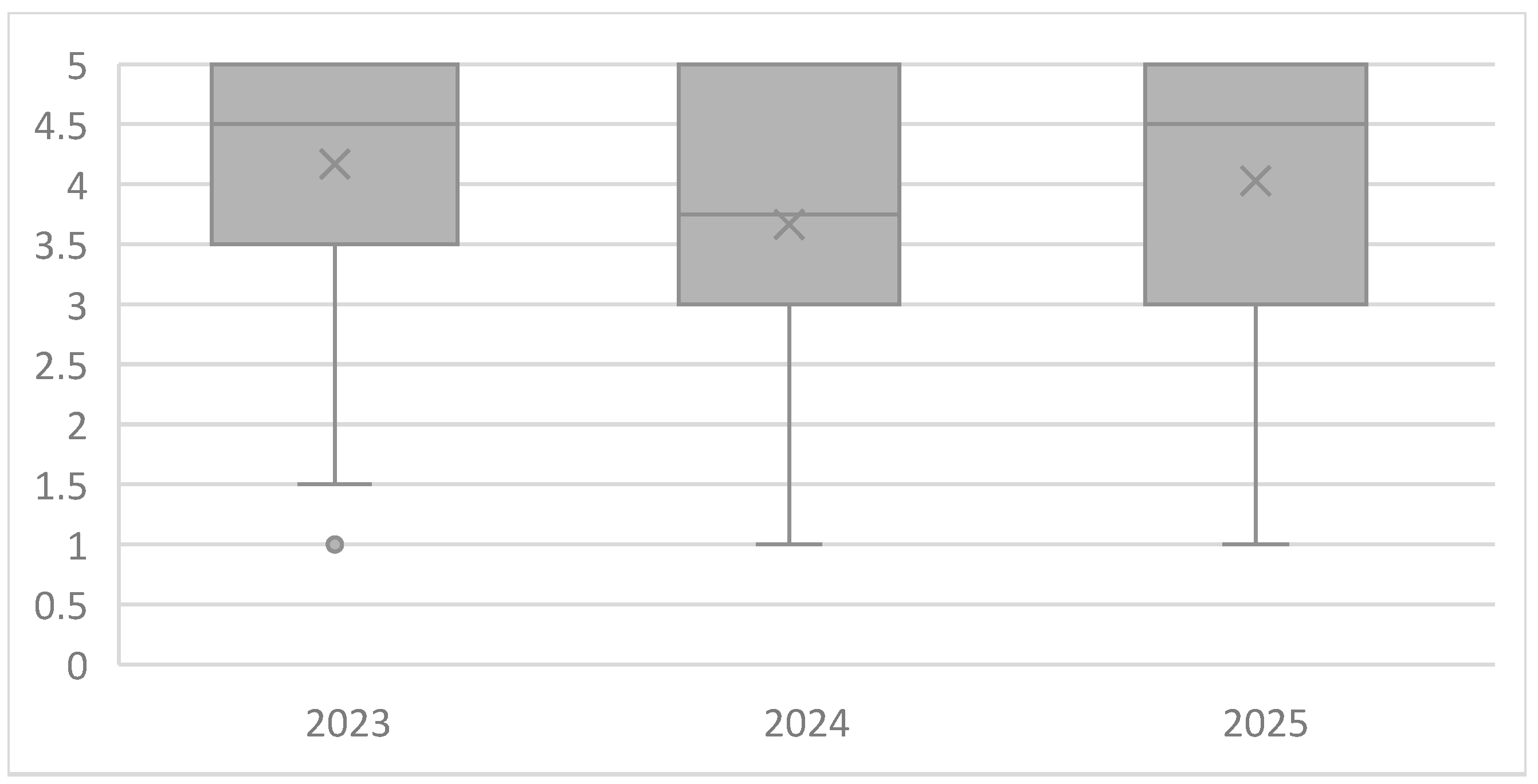
| Year | Mean | Std. Dev. | Min | Max | Median |
|---|---|---|---|---|---|
| 2023 | 4.17 | 0.85 | 1.0 | 5.0 | 4.50 |
| 2024 | 3.67 | 1.21 | 1.0 | 5.0 | 3.75 |
| 2025 | 4.03 | 1.13 | 1.0 | 5.0 | 4.50 |
| Variable | OR | 95% CI | p-Value |
|---|---|---|---|
| Year2024 (vs. 2023) | 2.53 | (0.27–22.78) | 0.412 |
| Year2025 (vs. 2023) | 1.41 | (0.10–19.09) | 0.794 |
| TechScore | 1.82 | (1.11–3.00) | 0.018 |
| Gender Female (vs. Male) | 1.08 | (0.60–1.89) | 0.795 |
| Age 30–39 (vs. 18–29) | 0.29 | (0.14–0.61) | 0.001 |
| Age 40–49 (vs. 18–29) | 0.21 | (0.10–0.45) | <0.001 |
| Age 50+ (vs. 18–29) | 0.06 | (0.03–0.14) | <0.001 |
| LivEnviron Urban (vs. Rural) | 2.70 | (1.58–4.60) | <0.001 |
| Income Medium (vs. Low) | 1.14 | (0.58–2.20) | 0.696 |
| Income High (vs. Low) | 3.15 | (1.35–7.58) | 0.009 |
| RelLength 6–12 m (vs. <6 m) | 0.98 | (0.35–2.74) | 0.972 |
| RelLength 1–5 y (vs. <6 m) | 1.12 | (0.45–2.60) | 0.794 |
| RelLength >5 y (vs. <6 m) | 1.24 | (0.49–2.95) | 0.637 |
| Interaction: 2024 × TechScore | 0.85 | (0.47–1.53) | 0.591 |
| Interaction: 2025 × TechScore | 1.26 | (0.62–2.62) | 0.535 |
| Variable | 2023 | 2024 | 2025 | ||||||
|---|---|---|---|---|---|---|---|---|---|
| OR | 95% CI | p-Value | OR | 95% CI | p-Value | OR | 95% CI | p-Value | |
| (Intercept) | 0.95 | (0.07–12.50) | 0.971 | 1.96 | (0.35–10.83) | 0.439 | 0.03 | (0.00–1.14) | 0.059 |
| TechScore | 1.86 | (1.14–3.02) | 0.012 | 1.52 | (1.10–2.10) | 0.010 | 3.37 | (1.57–7.22) | 0.002 |
| Gender Female (vs. Male) | 1.03 | (0.40–2.66) | 0.945 | 0.95 | (0.40–2.25) | 0.920 | 1.71 | (0.34–8.56) | 0.508 |
| Age 30–39 (vs. 18–29) | 0.48 | (0.14–1.63) | 0.24 | 0.22 | (0.08–0.64) | 0.005 | 0.08 | (0.00–1.05) | 0.055 |
| Age 40–49 (vs. 18–29) | 0.38 | (0.1–1.47) | 0.16 | 0.11 | (0.03–0.34) | <0.001 | 0.26 | (0.03–2.01) | 0.201 |
| Age 50+ (vs. 18–29) | 0.16 | (0.04–0.53) | 0.003 | 0.03 | (0.01–0.15) | <0.001 | 0.03 | (0.00–0.27) | 0.002 |
| LivEnviron Urban (vs. Rural) | 2.14 | (0.85–5.36) | 0.105 | 2.55 | (1.13–5.78) | 0.024 | 10.29 | (2.13–49.72) | 0.004 |
| Income Medium (vs. Low) | 0.70 | (0.22–2.20) | 0.549 | 1.39 | (0.54–3.59) | 0.491 | 1.49 | (0.19–11.64) | 0.702 |
| Income High (vs. Low) | 2.44 | (0.56–10.54) | 0.231 | 3.82 | (1.06–13.77) | 0.04 | 3.51 | (0.37–33.04) | 0.272 |
| RelLength 6–12 m (vs. <6 m) | 1.91 | (0.10–13.14) | 0.886 | 0.80 | (0.18–3.43) | 0.768 | 1.30 | (0.12–13.56) | 0.822 |
| RelLength 1–5 y (vs. <6 m) | 0.585 | (0.08–4.28) | 0.598 | 0.85 | (0.26–2.79) | 0.794 | 7.37 | (0.73–73.80) | 0.089 |
| RelLength >5 y (vs. <6 m) | 0.519 | (0.06–3.88) | 0.523 | 1.20 | (0.32–4.41) | 0.781 | 5.44 | (0.63–46.95) | 0.124 |
Disclaimer/Publisher’s Note: The statements, opinions and data contained in all publications are solely those of the individual author(s) and contributor(s) and not of MDPI and/or the editor(s). MDPI and/or the editor(s) disclaim responsibility for any injury to people or property resulting from any ideas, methods, instructions or products referred to in the content. |
© 2026 by the authors. Licensee MDPI, Basel, Switzerland. This article is an open access article distributed under the terms and conditions of the Creative Commons Attribution (CC BY) license.
Share and Cite
Ghita-Mitrescu, S.; Antohi, I.; Duhnea, C.; Moraru, A.-D. From Branch to Digital: Modeling Customer Channel Preferences in Electronic Banking Services. J. Theor. Appl. Electron. Commer. Res. 2026, 21, 65. https://doi.org/10.3390/jtaer21020065
Ghita-Mitrescu S, Antohi I, Duhnea C, Moraru A-D. From Branch to Digital: Modeling Customer Channel Preferences in Electronic Banking Services. Journal of Theoretical and Applied Electronic Commerce Research. 2026; 21(2):65. https://doi.org/10.3390/jtaer21020065
Chicago/Turabian StyleGhita-Mitrescu, Silvia, Ionut Antohi, Cristina Duhnea, and Andreea-Daniela Moraru. 2026. "From Branch to Digital: Modeling Customer Channel Preferences in Electronic Banking Services" Journal of Theoretical and Applied Electronic Commerce Research 21, no. 2: 65. https://doi.org/10.3390/jtaer21020065
APA StyleGhita-Mitrescu, S., Antohi, I., Duhnea, C., & Moraru, A.-D. (2026). From Branch to Digital: Modeling Customer Channel Preferences in Electronic Banking Services. Journal of Theoretical and Applied Electronic Commerce Research, 21(2), 65. https://doi.org/10.3390/jtaer21020065