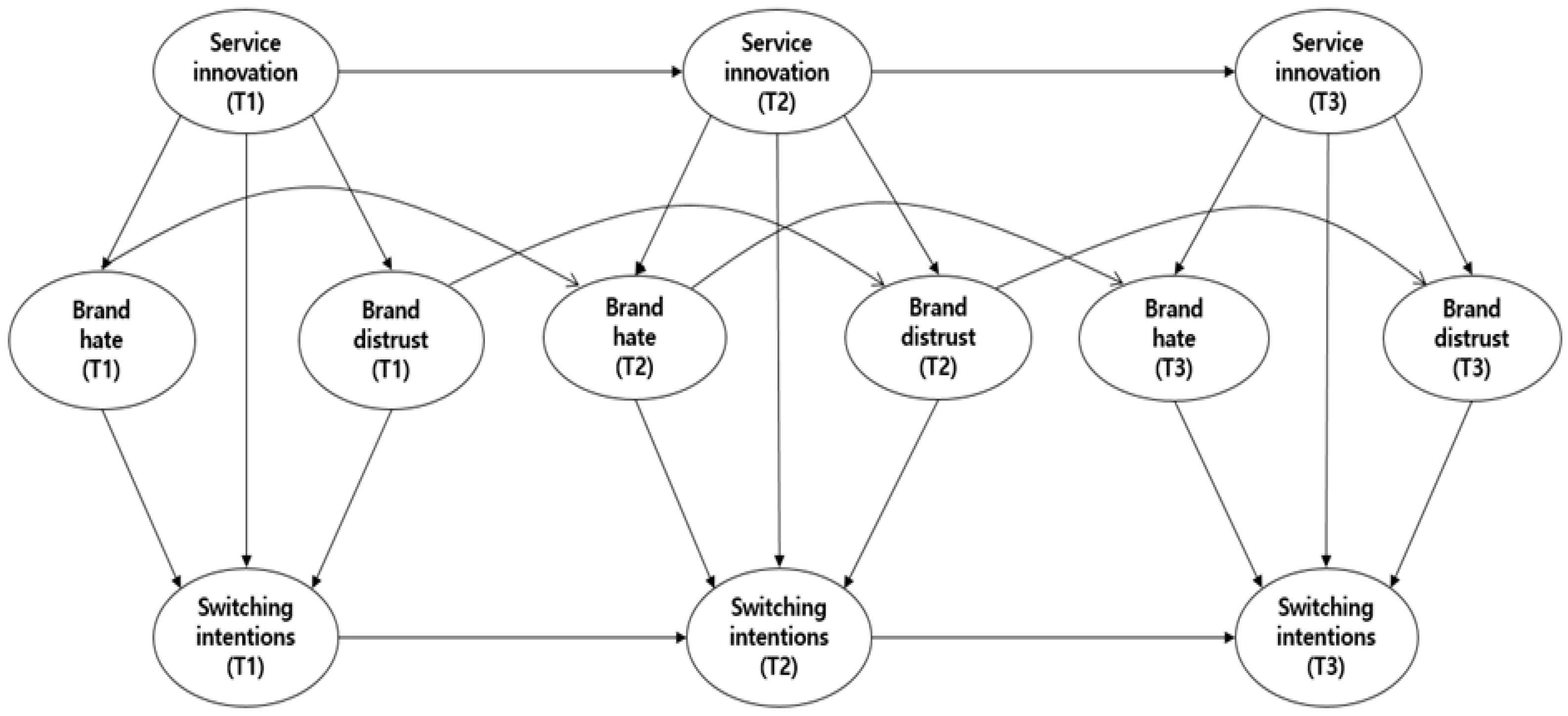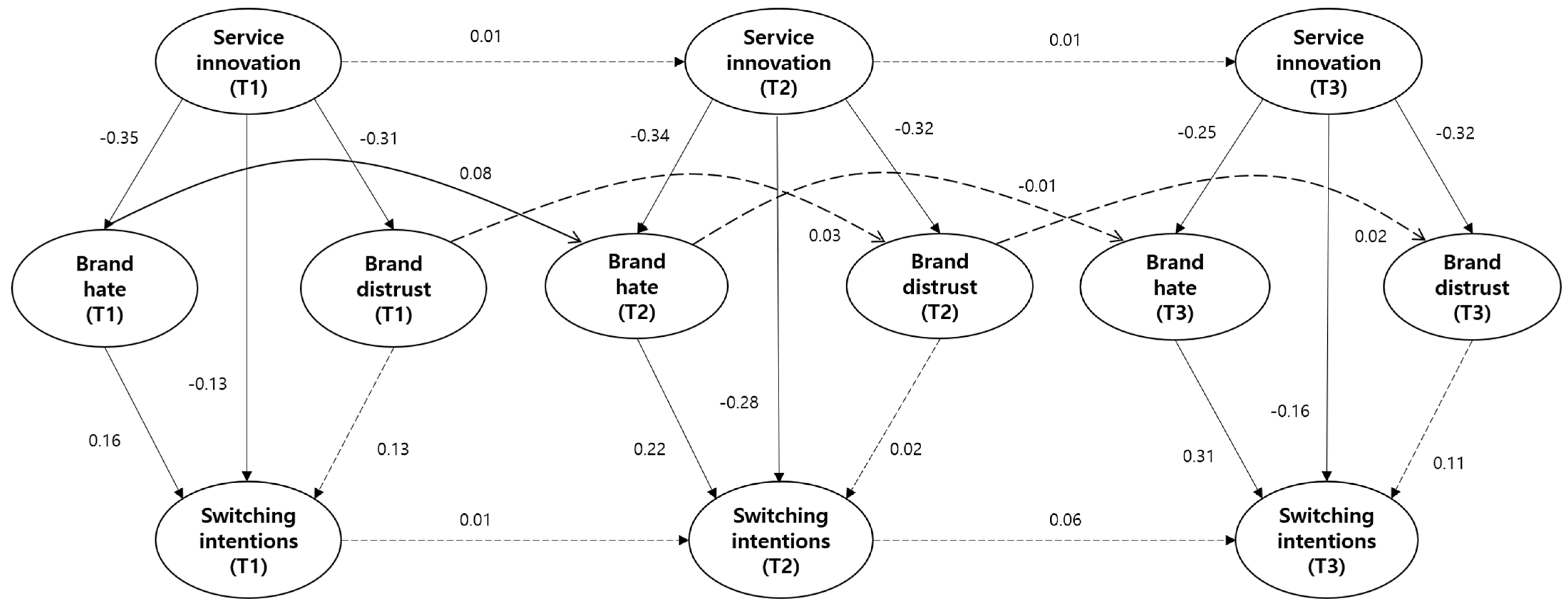
Descriptive Trajectories of How Service Innovation Shapes Customer Exit Intentions in Online Travel Agencies



Abstract
1. Introduction
2. Conceptual Foundations: Innovation and the Temporal Attenuation of Negative Emotions
2.1. Service Innovation as a Recovery and Retention Mechanism
2.2. Temporal Dynamics in Consumer Emotions and Behaviors
2.3. Divergent Roles of Brand Hate and Brand Distrust
2.4. Switching Intentions as a Temporal Construct
2.5. Hypothesis Development
3. Methodology
3.1. Data Collection
3.2. Measures
3.3. Measurement Invariance
3.4. Common Method Bias
3.5. Attribution Analysis
4. Results
4.1. Analytical Methods
4.2. Measurement Model
4.3. Structural Model
5. Discussion
5.1. Theoretical Implications
5.2. Managerial Implications
5.3. Limitations and Future Research Directions
Author Contributions
Funding
Institutional Review Board Statement
Informed Consent Statement
Data Availability Statement
Conflicts of Interest
References
- Hidayat, K.; Idrus, M. The effect of relationship marketing towards switching barrier, customer satisfaction, and customer trust on bank customers. J. Innov. Entrep. 2023, 12, 29. [Google Scholar] [CrossRef]
- Roy, S.K.; Sharma, A.; Bose, S.; Singh, G. Consumer-brand relationship: A brand hate perspective. J. Bus. Res. 2022, 144, 1293–1304. [Google Scholar] [CrossRef]
- Grégoire, Y.; Tripp, T.M.; Legoux, R. When customer love turns into lasting hate: The effects of relationship strength and time on customer revenge and avoidance. J. Mark. 2009, 73, 18–32. [Google Scholar] [CrossRef]
- Liu, C.; Guo, Y.M.; Lee, C. The effects of relationship quality and switching barriers on customer loyalty. Int. J. Innov. Manag. 2011, 31, 71–79. [Google Scholar] [CrossRef]
- Feng, C.; Ma, R.; Jiang, L. The impact of service innovation on firm performance: A meta-analysis. J. Serv. Manag. 2021, 32, 289–314. [Google Scholar] [CrossRef]
- Gustafsson, A.; Snyder, H.; Witell, L. Service innovation: A new conceptualization and path forward. J. Serv. Res. 2020, 23, 111–115. [Google Scholar] [CrossRef]
- Mahmoud, M.A.; Hinson, R.E.; Anim, P.A. Service innovation and customer satisfaction: The role of customer value creation. Eur. J. Innov. Manag. 2018, 21, 402–422. [Google Scholar] [CrossRef]
- Heidenreich, S.; Freisinger, E.; Landau, C. The dark side of business model innovation: An empirical investigation into the evolvement of customer resistance and the effectiveness of potential countermeasures. J. Prod. Innov. Manag. 2022, 39, 824–846. [Google Scholar] [CrossRef]
- Vakulenko, Y.; Shams, P.; Helloström, D.; Hjort, K. Service innovation in e-commerce last mile delivery: Mapping the e-customer journey. J. Bus. Res. 2019, 101, 461–468. [Google Scholar] [CrossRef]
- Chen, V.T.P.; Guo, R. The impact of consumers’ attitudes towards technology on the acceptance of hotel technology-based innovation. J. Hosp. Tour. Technol. 2021, 12, 624–640. [Google Scholar] [CrossRef]
- Zhang, Y.; Ha, H. Does service innovation reduce customer defection intentions among disappointed customers? A latent growth modeling approach in the hotel sector. Int. J. Hosp. Manag. 2025, 124, 103954. [Google Scholar] [CrossRef]
- Kucuk, S.U. Brand Hate: Navigating Consumer Negativity in the Digital World, 2nd ed.; Palgrave Macmillan: London, UK, 2020. [Google Scholar]
- Mal, C.L.; Davies, G.; Diers-Lawson, A. Through the looking glass: The factors that influence consumer trust and distrust in brands. Psychol. Mark. 2019, 35, 936–947. [Google Scholar] [CrossRef]
- Kuppens, P.; Verduyn, P. Emotion dynamics. Curr. Opin. Psychol. 2017, 17, 22–26. [Google Scholar] [CrossRef]
- Törmänen, T.; Saqr, M.; López-Pernas, S.; Mänty, K.; Suoraniemi, J.; Heikkala, N.; Järvenoja, H. Emotional dynamics and regulation in collaborative learning. Learn. Instr. 2025, 100, 102188. [Google Scholar] [CrossRef]
- Frank, D.; Chrymeros, P.; Mitkidis, P. The paradox of technology: Negativity bias in consumer adoption of innovative technologies. Psychol. Mark. 2023, 40, 554–566. [Google Scholar] [CrossRef]
- Sheehan, B.; Jin, H.S.; Gottlieb, U. Customer service chatbots: Anthropomorphism and adoption. J. Bus. Res. 2020, 115, 14–24. [Google Scholar] [CrossRef]
- Duverger, P. Using dissatisfied customers as a source for innovative service ideas. J. Hosp. Tour. Res. 2012, 36, 537–563. [Google Scholar] [CrossRef]
- Bergkvist, L.; Eisend, M. The dynamic nature of marketing constructs. J. Acad. Mark. Sci. 2021, 49, 521–541. [Google Scholar] [CrossRef]
- Kim, K.; Ha, H. The dynamics of perceived justice and its outcomes in the online tourism sector: Inter-relationships and temporal and carryover effects. Curr. Issues Tour. 2024, 27, 4740–4756. [Google Scholar] [CrossRef]
- Johnson, M.D.; Herrmann, A.; Huber, K. The evolution of loyalty intentions. J. Mark. 2006, 70, 122–132. [Google Scholar] [CrossRef]
- Sacharin, V.; Sander, D.; Scherer, K.R. The perception of changing emotion expressions. Cogn. Emot. 2012, 26, 1273–1300. [Google Scholar] [CrossRef]
- Valor, C.; Antonetti, P.; Crisafulli, B. Emotions and consumers’ adoption of innovations: An integrated review and research agenda. Technol. Forecast. Soc. Change 2022, 179, 121609. [Google Scholar] [CrossRef]
- Ramírez, S.A.O.; Veloutsoe, C.; Morgan-Thomas, A. On the antipodes of love and hate: The conception and measurement of brand polarization. J. Bus. Res. 2024, 179, 114687. [Google Scholar] [CrossRef]
- Lewicki, R.J.; McAllister, D.J.; Bies, R.J. Trust and distrust: New relationships and realities. Acad. Manag. Rev. 1998, 23, 438–458. [Google Scholar] [CrossRef]
- Cho, J. The mechanism of trust and distrust formation and their relational outcomes. J. Retail. 2006, 82, 25–35. [Google Scholar] [CrossRef]
- Bansal, H.S.; Taylor, S.F. The service provider switching model (SPSM): A model of consumer switching behavior in the services industry. J. Serv. Res. 1999, 2, 200–218. [Google Scholar] [CrossRef]
- Han, H.; Kim, W.; Hyun, S.S. Switching intention model development: Role of service performances, customer satisfaction, and switching barriers in the hotel industry. Int. J. Hosp. Manag. 2011, 30, 619–629. [Google Scholar] [CrossRef]
- Verduyn, P.; Lavrijsen, S. Which emotions last longest and why: The role of event importance and rumination. Motiv. Emot. 2015, 39, 119–127. [Google Scholar] [CrossRef]
- Baumeister, R.F.; Bratslavsky, E.; Finkenauer, C.; Vohs, K.D. Bad is stronger than good. Rev. Gen. Psychol. 2001, 5, 323–370. [Google Scholar] [CrossRef]
- Lewicki, R.J.; Brinsfield, C. Trust repair. Annu. Rev. Organ. Psychol. Organ. Behav. 2017, 4, 287–313. [Google Scholar] [CrossRef]
- Kim, P.H.; Dirks, K.T.; Cooper, C.D.; Ferrin, D.L. When more blame is better than less: The implications of internal vs external attributions for the repair of trust after a competence- vs integrity-based violation. Organ. Behav. Hum. Decis. Process. 2006, 99, 49–65. [Google Scholar] [CrossRef]
- Manohar, S.; Paul, J.; Strong, C.; Mittal, A. INNOSERV: Generalized scale for perceived service innovation. J. Bus. Res. 2023, 160, 113723. [Google Scholar] [CrossRef]
- Zhang, C.; Laroche, M. Brand hate: A multidimensional construct. J. Prod. Brand Manag. 2020, 30, 392–414. [Google Scholar] [CrossRef]
- Hegner, S.M.; Fetscherin, M.; van Delzen, M. Determinants and outcomes of brand hate. J. Prod. Brand Manag. 2017, 26, 13–25. [Google Scholar] [CrossRef]
- Oliver, R.L. Satisfaction: A Behavioral Perspective on the Consumer, 2nd ed.; Routledge: New York, NY, USA, 2010. [Google Scholar]
- Zarantonello, L.; Romani, S.; Grappi, S.; Bagozzi, R.P. Brand hate. J. Prod. Brand Manag. 2016, 25, 11–25. [Google Scholar] [CrossRef]
- Hair, J.F.; Risher, J.J.; Sarstedt, M.; Ringle, C.M. When to use and how to report the results of PLS-SEM. Eur. Bus. Rev. 2019, 31, 2–24. [Google Scholar] [CrossRef]
- Podsakoff, P.M.; MacKenzie, S.B.; Lee, J.; Podsakoff, N.P. Common method bias in behavioral research: A critical review of the literature and recommended remedies. J. Appl. Psychol. 2003, 88, 879–903. [Google Scholar] [CrossRef]
- Kock, N. Common method bias in PLS-SEM: A full collinearity assessment approach. Int. J. E-Collab. 2015, 11, 1–10. [Google Scholar] [CrossRef]
- Anderson, R.E.; Swaminathan, S. Customer satisfaction and loyalty in e-markets: A PLS path modeling approach. J. Mark. Theory Pract. 2011, 19, 221–234. [Google Scholar] [CrossRef]
- Evermann, J.; Tate, M. Assessing the predictive performance of structural equation model estimators. J. Bus. Res. 2016, 69, 4565–4582. [Google Scholar] [CrossRef]
- Chin, W.W.; Peterson, R.A.; Brown, P.S. Structural equation modelling in marketing: Some practical reminders. J. Mark. Theory Pract. 2008, 16, 287–298. [Google Scholar] [CrossRef]
- Henseler, J.; Ringle, C.; Sarstedt, M. A new criterion for assessing discriminant validity in variance-based structural equation modeling. J. Acad. Mark. Sci. 2015, 43, 115–135. [Google Scholar] [CrossRef]
- Sharma, P.; Liengaard, B.D.; Hair, J.F.; Sarstedt, M.; Ringle, C.M. Predictive model assessment and selection in composite-based modeling using PLS-SEM: Extensions and guidelines for using CVPAR. Eur. J. Mark. 2023, 57, 1662–1677. [Google Scholar] [CrossRef]
- Shmueli, G.; Sarstedt, M.; Hair, J.F.; Cheah, J.H.; Ting, H.; Vaithilingam, S.; Ringle, C.M. Predictive model assessment in PLS-SEM: Guidelines for using PLSpredict. Eur. J. Mark. 2019, 53, 2322–2347. [Google Scholar] [CrossRef]
- Hair, J.F.; Hult, G.T.M.; Ringle, C.M.; Sarstedt, M. A Primer on Partial Least Squares Structural Equation Modeling (PLS-SEM), 3rd ed.; Sage: Los Angeles, CA, USA, 2021. [Google Scholar]
- Cole, D.A.; Maxwell, S.E. Testing mediational models with longitudinal data: Questions and tips in the use of structural equation modeling. J. Abnorm. Psychol. 2003, 112, 558–577. [Google Scholar] [CrossRef]


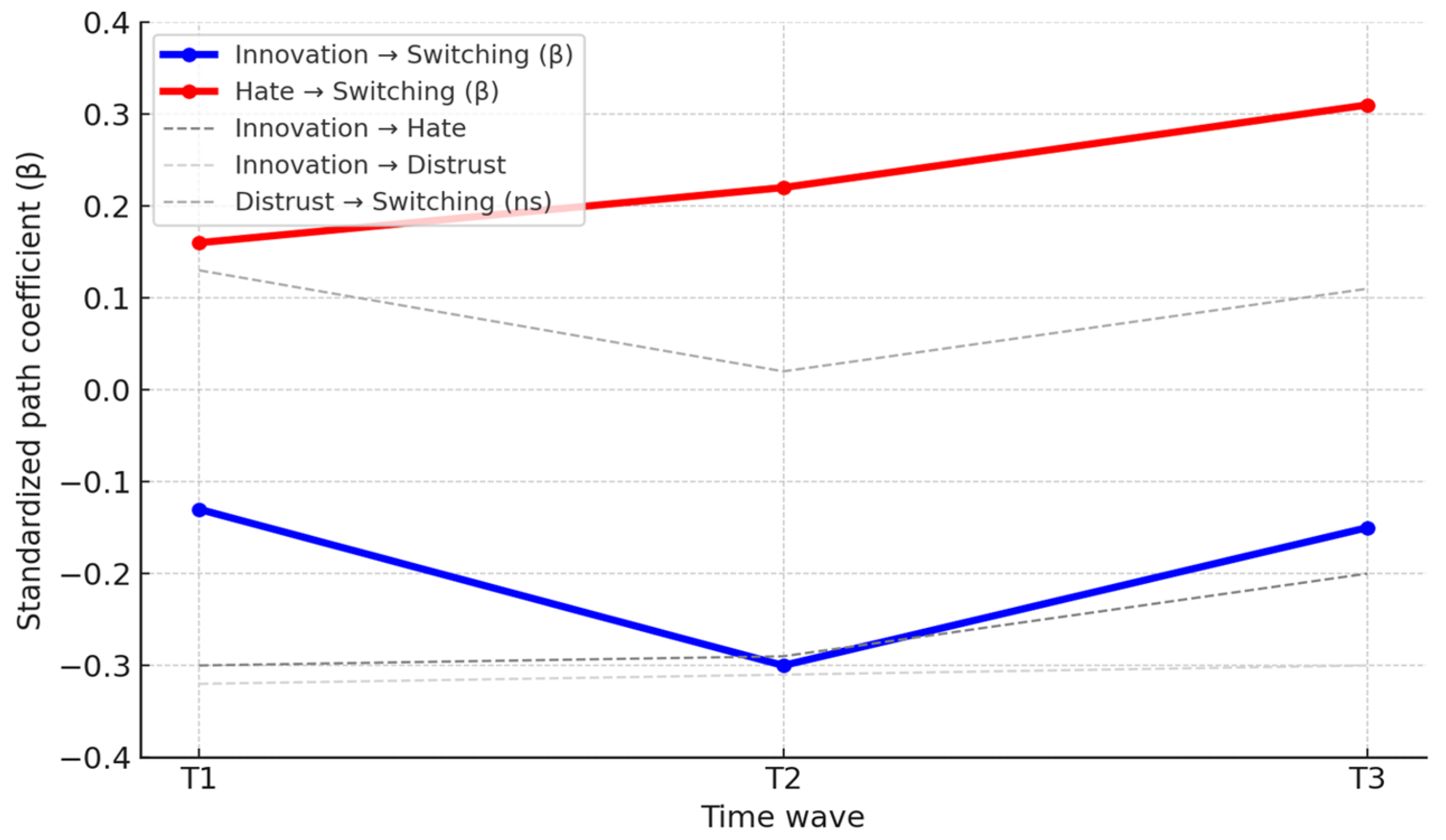
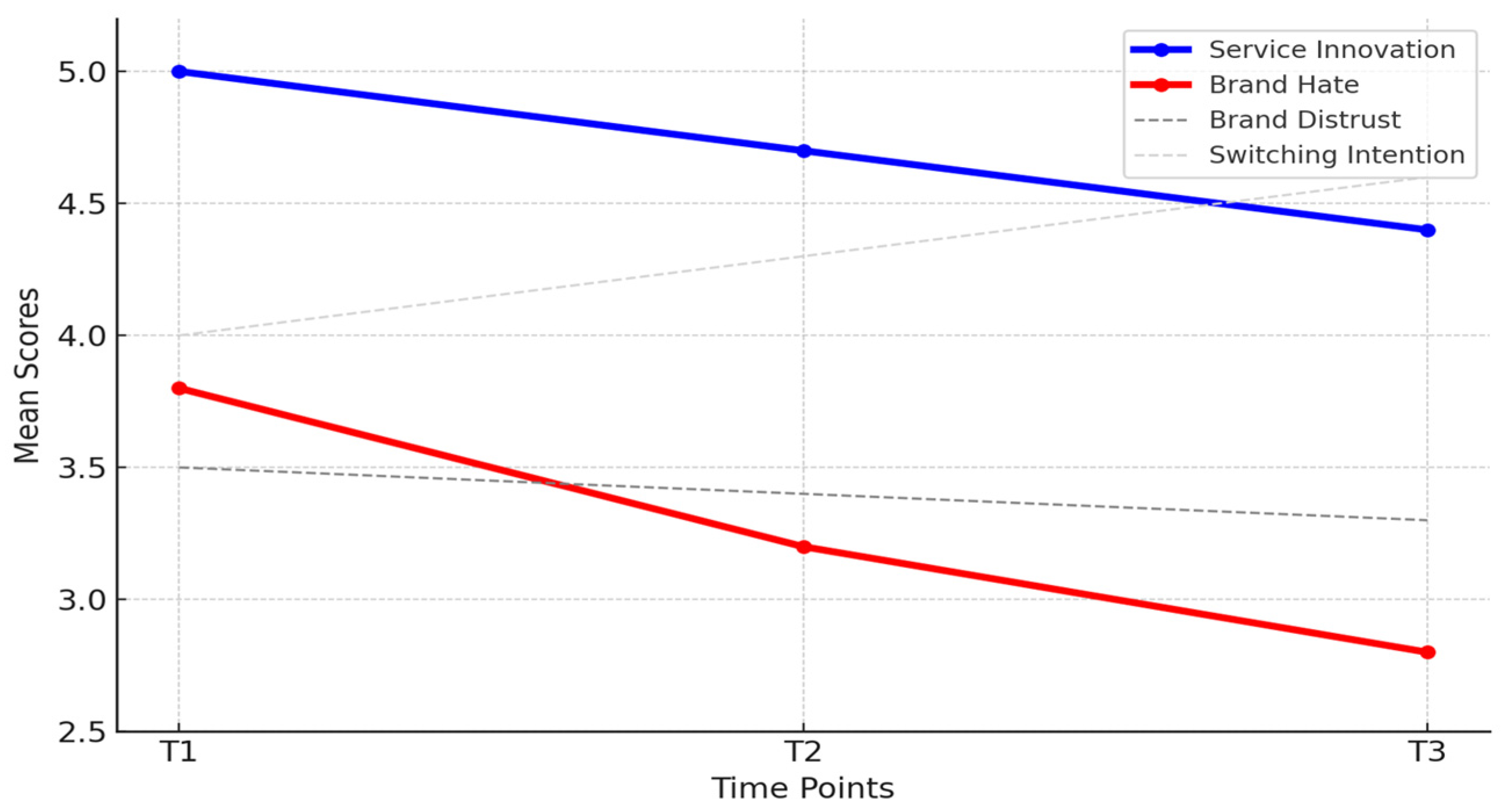

| Construct | Outer Loading | AVE | ||||
|---|---|---|---|---|---|---|
| T1 | T2 | T3 | T1 | T2 | T3 | |
| Perceived service innovation (T1: CR = 0.83, α = 0.81; T2: CR = 0.95, α = 0.95; T3: CR = 0.84, α = 0.83) | 0.63 | 0.88 | 0.67 | |||
| AAA continuously introduces new, technology-based service products/offerings. | 0.85 | 0.94 | 0.82 | |||
| AAA introduces technologies for excellent user experience (UX). | 0.78 | 0.93 | 0.82 | |||
| AAA continuously brings new features to its content solutions. | 0.81 | 0.94 | 0.81 | |||
| AAA introduces new services. | 0.74 | 0.94 | 0.81 | |||
| Brand hate (T1: CR = 0.74, α = 0.73; T2: CR = 0.94, α = 0.94; T3: CR = 0.80, α = 0.76) | 0.64 | 0.89 | 0.67 | |||
| I have a feeling of revulsion toward this AAA. | 0.85 | 0.95 | 0.86 | |||
| I feel displeased when I think about this AAA. | 0.80 | 0.94 | 0.85 | |||
| I feel threatened when I think about this AAA. | 0.76 | 0.95 | 0.74 | |||
| Brand distrust (T1: CR = 0.75, α = 0.75; T2: CR = 0.94, α = 0.94; T3: CR = 0.84, α = 0.81) | 0.67 | 0.89 | 0.71 | |||
| AAA looks suspicious and distrustful. | 0.81 | 0.95 | 0.87 | |||
| The way AAA operates its business is irresponsible and unreliable. | 0.80 | 0.94 | 0.89 | |||
| AAA engages in damaging and harmful behavior to customers to pursue its own interests. | 0.84 | 0.94 | 0.79 | |||
| Switching intentions (T1: CR = 0.78, α = 0.77; T2: CR = 0.93, α = 0.93; T3: CR = 0.79, α = 0.78) | 0.67 | 0.87 | 0.69 | |||
| Improbably…Probably | 0.81 | 0.93 | 0.81 | |||
| Unlikely…Likely | 0.79 | 0.94 | 0.84 | |||
| No change…Certain | 0.87 | 0.93 | 0.84 | |||
| 1 | 2 | 3 | 4 | 5 | 6 | 7 | 8 | 9 | 10 | 11 | 12 | |
|---|---|---|---|---|---|---|---|---|---|---|---|---|
| 1. Perceived service innovation (T1) | ||||||||||||
| 2. Brand hate (T1) | 0.43 | |||||||||||
| 3. Brand distrust (T1) | 0.39 | 0.45 | ||||||||||
| 4. Switching intentions (T1) | 0.28 | 0.38 | 0.37 | |||||||||
| 5. Perceived service innovation (T2) | 0.03 | 0.04 | 0.05 | 0.08 | ||||||||
| 6. Brand hate (T2) | 0.04 | 0.10 | 0.06 | 0.06 | 0.35 | |||||||
| 7. Brand distrust (T2) | 0.04 | 0.09 | 0.06 | 0.07 | 0.34 | 0.49 | ||||||
| 8. Switching intentions (T2) | 0.03 | 0.05 | 0.02 | 0.06 | 0.37 | 0.32 | 0.30 | |||||
| 9. Perceived service innovation (T3) | 0.09 | 0.08 | 0.06 | 0.07 | 0.02 | 0.03 | 0.03 | 0.04 | ||||
| 10. Brand hate (T3) | 0.05 | 0.04 | 0.08 | 0.04 | 0.06 | 0.04 | 0.05 | 0.10 | 0.29 | |||
| 11. Brand distrust (T3) | 0.03 | 0.49 | 0.08 | 0.06 | 0.05 | 0.03 | 0.03 | 0.08 | 0.37 | 0.49 | ||
| 12. Switching intentions (T3) | 0.05 | 0.07 | 0.04 | 0.07 | 0.06 | 0.03 | 0.04 | 0.11 | 0.30 | 0.44 | 0.41 |
| Time Wave | Construct | Average Loss Difference | t-Value |
|---|---|---|---|
| T1: | |||
| Brand hate | −0.154 | 3.164 ** | |
| Brand distrust | −0.129 | 2.959 ** | |
| Switching intentions | −0.086 | 2.027 * | |
| T2: | |||
| Perceived service innovation | 0.010 | 3.086 ** | |
| Brand hate | 0.006 | 1.059 | |
| Brand distrust | 0.004 | 1.294 | |
| Switching intentions | 0.002 | 1.255 | |
| T3: | |||
| Perceived service innovation | −0.182 | 3.326 ** | |
| Brand hate | −0.013 | 2.283 * | |
| Brand distrust | 0.000 | 0.364 | |
| Switching intentions | −0.032 | 3.178 ** | |
| Overall model | 2.238 | −0.052 | 3.373 ** |
| Time Wave | Paths | Coefficient | 95% CI (2.5–97.5%) |
|---|---|---|---|
| T1 | Perceived service innovation → switching intentions | −0.130 ** | [−0.230, −0.033] |
| Perceived service innovation → brand hate | −0.347 ** | [−0.437, −0.261] | |
| Perceived service innovation → brand distrust | −0.315 ** | [−0.401, −0.232] | |
| Brand hate → switching intentions | 0.164 * | [0.016, 0.302] | |
| Brand distrust → switching intentions | 0.128 (ns) | [−0.005, 0.260] | |
| T2 | Perceived service innovation → switching intentions | −0.284 ** | [−0.383, −0.184] |
| Perceived service innovation → brand hate | −0.336 ** | [−0.423, −0.245] | |
| Perceived service innovation → brand distrust | −0.323 ** | [−0.409, −0.230] | |
| Brand hate → switching intentions | 0.223 * | [0.025, 0.462] | |
| Brand distrust → switching intentions | 0.021 (ns) | [−0.264, 0.225] | |
| T3 | Perceived service innovation → switching intentions | −0.158 ** | [−0.291, −0.032] |
| Perceived service innovation → brand hate | −0.246 ** | [−0.377, −0.122] | |
| Perceived service innovation → brand distrust | −0.320 ** | [−0.444, −0.208] | |
| Brand hate → switching intentions | 0.314 ** | [0.046, 0.634] | |
| Brand distrust → switching intentions | 0.113 (ns) | [−0.115, 0.293] | |
| Carryover effects | |||
| Brand hate (T1) → Brand hate (T2) | 0.076 * |
| Path Coefficient | T1 Coefficient | Δ T1 − T2 | Δ T2 − T3 | Significant Change? |
|---|---|---|---|---|
| Perceived service innovation → Switching intentions | −0.130 | −0.154 | 0.126 | Yes (both) |
| Perceived service innovation → brand hate | −0.347 | 0.011 | 0.090 | No/Yes |
| Perceived service innovation → brand distrust | −0.315 | −0.008 | 0.003 | No |
| Brand hate → switching intentions | 0.164 | 0.059 | 0.091 | Yes (both) |
| Brand distrust → switching intentions | 0.128 | −0.107 | 0.092 | Yes (T2–T3) |
Disclaimer/Publisher’s Note: The statements, opinions and data contained in all publications are solely those of the individual author(s) and contributor(s) and not of MDPI and/or the editor(s). MDPI and/or the editor(s) disclaim responsibility for any injury to people or property resulting from any ideas, methods, instructions or products referred to in the content. |
© 2025 by the authors. Licensee MDPI, Basel, Switzerland. This article is an open access article distributed under the terms and conditions of the Creative Commons Attribution (CC BY) license (https://creativecommons.org/licenses/by/4.0/).
Share and Cite
Xia, Y.; Ha, H.-Y. Descriptive Trajectories of How Service Innovation Shapes Customer Exit Intentions in Online Travel Agencies. J. Theor. Appl. Electron. Commer. Res. 2025, 20, 280. https://doi.org/10.3390/jtaer20040280
Xia Y, Ha H-Y. Descriptive Trajectories of How Service Innovation Shapes Customer Exit Intentions in Online Travel Agencies. Journal of Theoretical and Applied Electronic Commerce Research. 2025; 20(4):280. https://doi.org/10.3390/jtaer20040280
Chicago/Turabian StyleXia, Yingxue, and Hong-Youl Ha. 2025. "Descriptive Trajectories of How Service Innovation Shapes Customer Exit Intentions in Online Travel Agencies" Journal of Theoretical and Applied Electronic Commerce Research 20, no. 4: 280. https://doi.org/10.3390/jtaer20040280
APA StyleXia, Y., & Ha, H.-Y. (2025). Descriptive Trajectories of How Service Innovation Shapes Customer Exit Intentions in Online Travel Agencies. Journal of Theoretical and Applied Electronic Commerce Research, 20(4), 280. https://doi.org/10.3390/jtaer20040280