


Abstract
The high savings propensity of households has led to inconsistencies between income and consumption classes in China. The issue of unleashing the consumption potential of households arouses public concern. This paper explores the effect of digital finance DF on unleashing the consumption potential of households from the perspective of household consumption habits. By examining the inconsistency between income and consumption classes, the findings reveal that households in China have substantial untapped consumption potential, and that prioritizing household consumption potential is a more effective approach to stimulating consumption. The mechanism analysis shows that DF facilitates consumption growth through both reducing time costs and precautionary savings, as well as easing credit and liquidity constraints. Notably, these effects are more pronounced in underconsumption households compared to equal-consumption households.
1. Introduction
Stimulating household consumption is a key policy objective worldwide, as it directly enhances individual welfare and drives economic growth. In China, high household savings rates and unique consumption behaviors create substantial heterogeneity in consumption patterns, even among households with similar incomes. Many households possess sufficient income to afford higher consumption but do not fully utilize this potential, giving rise to the concept of household consumption potential (PHC). Understanding PHC is crucial for designing policies and financial innovations that effectively promote household welfare and sustainable consumption growth in China’s socio-economic context.
Household underconsumption relative to income can be explained through several complementary mechanisms. First, precautionary savings—driven by income uncertainty and potential economic shocks—encourage households to reduce current consumption as a buffer against future risks [1,2,3]. Second, liquidity constraints prevent households from converting available resources into consumption, particularly in the absence of adequate credit access [4,5,6]. Third, heterogeneity in household preferences, age, risk tolerance, and saving motives further contributes to divergent consumption behaviors even among households with comparable incomes [7,8,9]. These theoretical perspectives explain why income-based measures alone fail to capture the distribution of material well-being or identify households with untapped consumption potential [10,11]. In China, the high propensity to save in bank deposits or financial assets reinforces these effects, as some higher-income households do not translate income into proportional consumption [12]. Conversely, some lower-income households may allocate a higher share of resources to consumption, highlighting the complexity of PHC across income classes.
Digital finance (DF), as an emerging financial technology, has reshaped household consumption by improving access to financial services, reducing transaction costs, and alleviating credit and liquidity constraints [13,14,15,16,17,18,19,20]. Prior studies generally focus on aggregate consumption growth or structural changes in household consumption, often overlooking heterogeneity across income or consumption potential classes [21,22]. Moreover, the digital divide implies that DF adoption and its consumption effects vary by age, education, income, and regional development [23]. Integrating these insights suggests that DF’s consumption-enhancing effects are conditional: households with underutilized consumption potential may benefit disproportionately, while those with already balanced consumption may respond less strongly.
Despite the growing literature on DF and household consumption, few studies examine how DF affects PHC when income and consumption are inconsistent. Conventional approaches—such as income-based indicators, aggregate marginal propensity to consume (MPC), or Engel-curve residuals—are limited because they obscure household heterogeneity and are prone to endogeneity, particularly reverse causality between income and consumption. This paper addresses these gaps by first, defining PHC based on mismatches between income- and consumption-based classes, adopting mixture distributions and the expectation-maximization (EM) algorithm to construct class boundaries [24]. Second, using household-level CFPS data to examine DF’s effectiveness in unleashing consumption potential, identifying which households benefit most. Third, investigating DF’s underlying mechanisms via time cost reduction, risk mitigation, credit access, and liquidity enhancement, thereby linking behavioral heterogeneity to policy-relevant outcomes.
2. Consumption Potential Identification
It is crucial to identify which households have consumption potential due to the inconsistency between the income and consumption classes. In this paper, consumption potential is based on households that are not in the same income bracket as their consumption level. Households whose income classes are equal to or greater than the consumption class threshold are typically recognized as having considerable consumption potential. Conversely, households in which the income class is below the consumption class threshold may be prone to overconsumption, indicating an increased risk of financial instability or vulnerability. Our identification assumption is that once we control for the income class at the year and household level, the consumption class-based real consumption is comparable. The expectation-maximization algorithm for solving mixed distribution models has a sizable panel component that enables the estimation of sophisticated income and consumption processes and establishes who constitutes the poor, the work, the middle and the upper classes [24]. Specifically, households that have a lower income class than their consumption class are categorized as overconsumption, while those whose income and consumption fall within the same class are categorized as equal consumption. Households whose income class is higher than their consumption class are classified as underconsumption.
2.1. The Data
The analysis of class membership is based on the household income and consumption dataset sourced from the China Family Panel Studies (CFPS). Household income and consumption were examined in a biennially conducted nationally representative survey of China’s communities, families, and individuals between 2010 and 2018. The CFPS, which covers a vast array of domains for families and individuals across 162 counties in China, is carried out by the Institute of Social Science Survey at Peking University. The survey collects information on various aspects of the participants’ lives, including their economic activities, education outcomes, family dynamics and relationships, and health status. For household income, the household disposable income from all sources is defined as the total personal income of all the members of the family. For household consumption, there are eight types of household consumption expenditures identified through a questionnaire that focuses on the following nonproductive expenditures: (1) daily food, (2) clothing, (3) housing, (4) household appliances and daily used commodities and necessities, (5) transportation and communication, (6) entertainment and education, (7) medical care, and (8) other expenditures. In terms of consumption structures, this variable can be divided into survival consumption, which includes daily necessities, clothing, water and electricity, food, local transportation and communication expenses, and non-survival consumption, which includes all other necessities. In this study, all nominal values were deflated using the 2010 national Consumer Price Index (CPI) to obtain real terms, including household consumption, income, and total assets. Given the micro-level nature of the survey data, we prioritized data reliability. Specifically, any observation with missing values in the variables of interest was removed from the analysis. To mitigate the influence of extreme outliers, we applied 1% winsorization to household consumption, income, and total assets, capping the lower and upper 1% of the distribution. These preprocessing steps ensure the robustness of our empirical analyses and reduce potential biases arising from missing or extreme values.
2.2. Estimation of Mixture Distributions via the EM Algorithm
Assume that there is a finite number, K, of societal classes whose behavior is governed by their unique circumstances. The path of the outcome vector , which describes their behavior, follows a logarithm normality distribution for each of these classes. With such groups in a society, the overall distribution will be a mixture of these distributions as follows:
where is the weight of the distribution in the total distribution, also known as the probability that the sample data belong to the distribution, is the parameter if the subdistribution, and , .
Given the income or consumption variable , it is uncertainly specified as belonging to the subdistribution. Consider a latent variable , where represents which distribution comes from.
The log-likelihood of the parameter given the logarithm normality distribution would be as follows:
The EM algorithm is an iterative method developed to solve and problems. The estimation of mixture model parameters through maximum likelihood (ML) is made easier with the use of the expectation-maximization (EM) algorithm.
First, we use the k-means method as the initial parameter value of the EM algorithm. Then, the EM algorithm proceeds by iterating through multiple steps, each of which is divided into two fundamental stages: the E-step and the M-step. In the generic iteration , the E-step calculates the logarithmic likelihood function of latent variable in the joint distribution according to the parameter of the previous iteration:
In the M-step, solve the parameter that maximizes and complete a parameter update . The parameters are updated through iteration for until the algorithm falls below a certain threshold, such as in the current paper.
2.3. Potential of Household Consumption by Interclass Comparison
Table 1 provides the parameters of the model fits, categorized by years, for each class in income and consumption, including the estimated mean and standard deviation of each normal distribution along with its corresponding mixing proportion . Based on the results obtained from k-means, a four-component mixture appears to be the best and most efficient model. Economically, these four latent classes map naturally onto widely used socio-economic categories—poor, working class, middle class, and upper class—that are well grounded in the development literature [25,26]. To further demonstrate the robustness of our class specification, we provide additional evidence in Appendix A Figure A1, which compares the fitted distributions under alternative specifications with three classes () and four classes (). The results clearly show that the four-class model provides a superior fit to the data and more accurately reflects meaningful socio-economic heterogeneity. In contrast, a five-class specification () generates an additional subgroup that is statistically identifiable but economically ambiguous—for example, splitting the upper class into two subcategories that lack clear policy relevance. Because this would weaken the interpretability and policy implications of our results, we do not pursue K = 5 further in our analysis.
Table 1.
Estimated parameters of the mixture components for each year.
Income growth in each class is much more rapid than that estimated by consumption growth. Consumption habits are formed over time, and the changes in household consumption are relatively small compared to income. It is worth noting that the poor consume more than their income according to Table 1. The poor often struggle to make ends meet to maintain their daily lives. Overall, the gap between income and consumption is narrowing year by year among the poor. Household consumption is influenced by many factors, such as income. Grouping based on income does not capture the consumption habits and the increase in consumption potential. Therefore, it is crucial for research on household consumption to compare consumption and income class inconsistency.
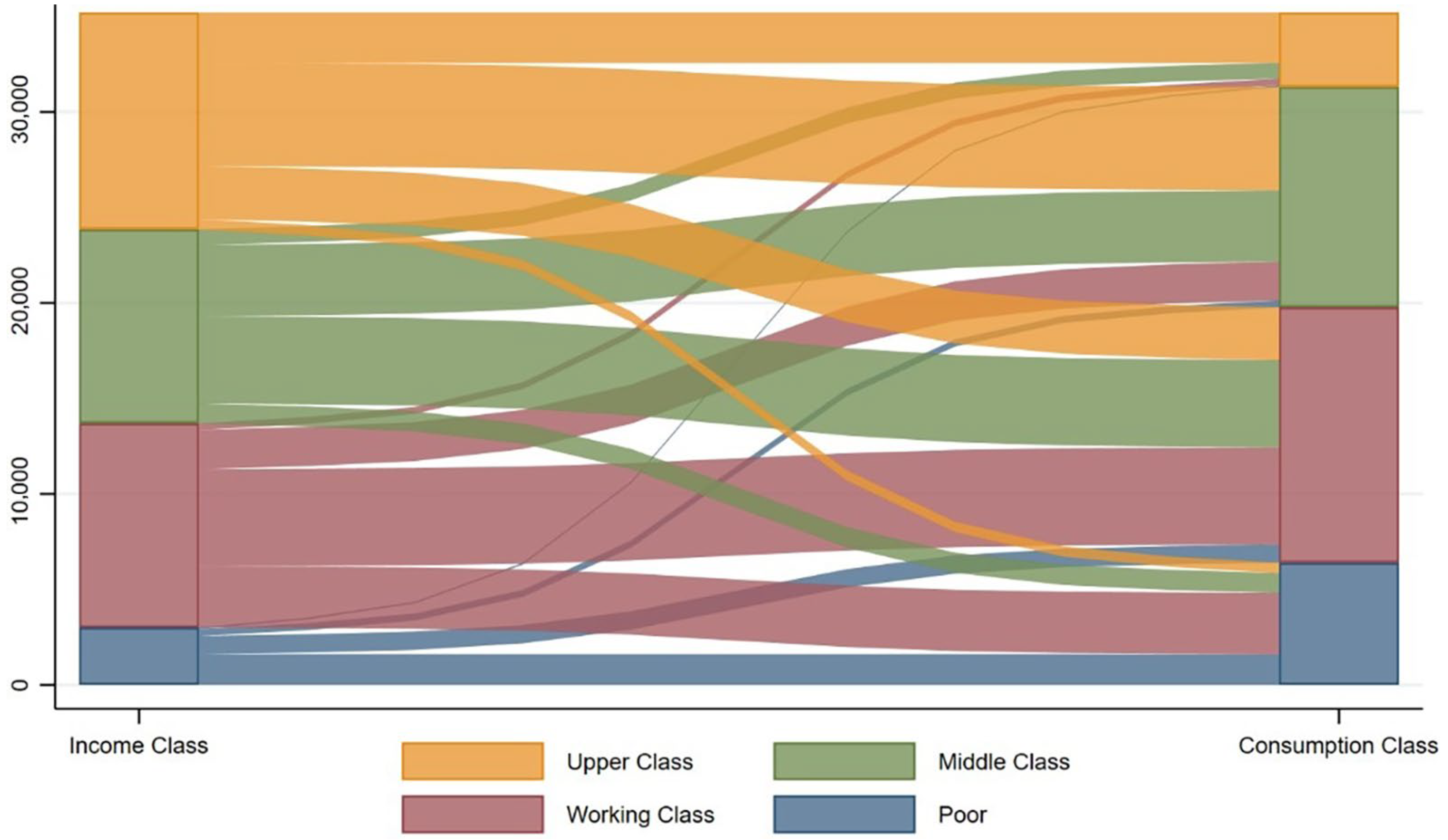
According to Table 1, the estimated mean as class threshold can be interpreted as ‘‘poor’’, ‘‘working class’’, ‘‘middle class’’ and ‘‘upper class’’ income and consumption groups. Figure 1 shows the potential of household consumption determined by interclass comparison, which is compared with the different classes of income and consumption by the EM algorithm.
Figure 1.
Potential of household consumption by interclass comparison.
Table 2 shows presents the distribution of household consumption potential across different income classes, categorizing households based on their consumption behavior. The rows represent different income classes, while the columns categorize households according to their consumption patterns: underconsumption, equal-consumption, and overconsumption. Each row shows the percentage of households within each income class that fall into one of the three consumption categories. Class column shows the total proportion of each income class in the sample. The last row (potential) shows the overall distribution of household consumption potential across all income classes in the sample, indicating the proportion of households exhibiting underconsumption, equal-consumption, and overconsumption on a national scale.
Table 2.
Two-way table of household consumption potential by income class %.
Different from MPC theory, which enhances the consumption of low-income populations, it seems more appropriate to focus on household consumption potential due to the inconsistency between income and consumption classes. For one thing, regarding the income class, the poor and working class households hold a unique disposition to voraciously consume what we call overconsumption, the class share of households falling within this definition is 46.5% and 22.4%, respectively. For the poor, insufficient income is a primary driver of poverty, which causes many households to be unable to meet the necessary expenses associated with maintaining a basic standard of living. These households often resort to borrowing or engaging in excessive spending practices. To address this issue and increase household consumption, it is essential to raise their income, which remains a significant challenge. There are households in the working and middle classes that persist in maintaining excessive consumption habits. In addition, equal-consumption definitions agree with regard to only 37.1% of the overall population, suggesting that a large portion of income and consumption class households are not consistently categorized. Taking the middle class as an example, 28.9% are middle class by income only. Of those who are middle class by income but not consumption, 36.7% are middle class by consumption (approximately 10.6% of the overall population), and 55.2% are working class and poor by consumption (approximately 15.9% of the overall population). The increase in the proportion of household underconsumption with the upgradation of class suggests that maintaining savings remains an inherent preference for many households in China. Even with an increase in household income, these households tend to allocate the additional funds toward savings rather than consumption. An interesting policy issue is how many households have the ability to increase their consumption within the scope of the same income class. A total of 86.9% of the examined households have insufficient consumption, which is a 48.1 percentage point increase compared to the lower income classes (poor and working class) considering MPC. As a result, the potential of household consumption is viewed as a good perspective of incentive consumption because it is less susceptible for households to budget constraints in China.
There is considerable PHC in China account for 86.9% of the overall population, indicating that for any income class, more than half of the households have consumption potential. In addition, 49.8% of households exhibit inadequate levels of consumption. Both the high-income and middle-income groups should be encouraged to continue to exhibit relatively low consumption habits, comprising 76.7% and 55.2% of their class, respectively. Together, these facts suggest that many households earning upper-class incomes still consume similar to middle class households, and many households earning middle- or working-class incomes still consume similar to working- or poor-class households.
3. Digital Finance and the Potential for Household Consumption
We examine the links between digital finance and the PHC. First, we regress household consumption on digital finance and control variables with different consumption habits to obtain evidence of unleashing household consumption potential. Second, we examine how DF unleashes household consumption potential from the perspective of consumption structure. Household consumption is divided into survival consumption and non-survival consumption.
3.1. The Model and Data
To explore the determinants of the PHC, an empirical model of the effect of digital finance on household consumption is established. The following empirical model can then be obtained:
where the dependent variable is the natural logarithm of consumption for household in city in year . denotes the index of digital financial inclusion in the city where the household is located. represents a set of control variables at the household and city levels. and represent city fixed effects and year fixed effects, respectively; is the random error term. To reduce the possible reverse causality problem, we lag the development indicators of digital finance by one period. In addition, we cluster the standard errors at the city level. To capture the liberation of consumption potential, we estimate the regression with varying household consumption habits.
The data for this study comes from four main sources. First, the CFPS datasets provide household consumption and household head information and household variables. Control variables representing the household head’s characteristics and household factors are sourced from the CFPS, including the household head’s age, gender, health status, years of education, social security, family size, elderly dependency ratio (EDR), child dependency ratio (CDR), logarithm of income, and total assets. Second, a city-level index of DF comes from the region-level index system of digital financial inclusion. The application of the DF index is widely recognized in the literature and comprises three level-I indices that are further constructed by several level-II indicators representing the use of digital technology in households. Third, we also control for the ratio of debt to GDP in cities, which reflects city financial development and is sourced from the City Statistical Yearbook of China. Finally, instrument variable (IV) data are used for the development of digital finance, namely, the spherical distances between the geographic locations of households and Hangzhou, as well as the spherical distances between the locations of households and provincial capitals. These data are obtained through the use of geographical information systems (GIS) for calculation.
Table 3 displays the descriptive statistics of the main variables in 2012 and 2018. From the perspective of household economic situation, household consumption, income, and assets demonstrate an upward trend. In 2018, households had an average consumer expenditure of 58,410 yuan, which represents a notable increase of 56.7% compared to the average consumer expenditure of 37,259 yuan recorded in 2012. Additionally, the pace of digital financial inclusion in China is rapidly accelerating. In fact, the emergence of digital finance has brought significant revolutionary changes. In particular, mobile payments are the most influential and relatively mature form of payment in China. The underlying new economic landscape caused by digital finance arouses widespread concern.
Table 3.
Descriptive statistics.
3.2. Impact of Digital Finance on Unleashing Consumption Potential
After classifying household consumption habits that are inconsistent with income and consumption classes in the previous section, a regression is conducted using a double fixed effect for time and location according to Equation (5). In addition, given the possibility of a reverse causal relationship between digital finance development and household consumption, IV estimation is adopted due to endogeneity. We then select the spherical distance between household locations and Hangzhou, as well as between household locations and provincial capitals, as the IV [18,27]. Since digital finance is subject to temporal changes, we interact the IV with the nationwide (excluding the abovementioned city) digital finance development index averages to create new instrumental variables that account for time-varying effects. The regression results are reported in Table 4, where the first-stage regression results are reported in Columns (2), (5), and (8). It is evident that both sets of the IV based on these distance metrics are significantly negatively correlated with digital finance development, indicating that the further the households are from the center of digital finance development, the lower the level of digital finance development is, as expected. The IV is validated by the F-statistic and p value from the Hansen test, indicating that it is effective. Table A1 presents the mean of the dependent variable and the standard deviation of the independent variable. In this paper, we replace the DF with a digital finance index by Liao et al. [28] to conduct a robustness test (Appendix A Table A2), showing consistent findings. In our baseline regressions, DF is lagged by one period, and dynamic lead-lag tests (Appendix A Table A3) show no evidence of pre-trends, while alternative IVs, including a 1984 postal/fixed-line shift-share instrument, yield consistent results (Appendix A Table A4). In addition, we conduct placebo tests using household expenditure categories that should not theoretically be affected by digital finance (other household spending), and the coefficients are statistically insignificant (Appendix A Table A5), further supporting the validity of our IV strategy.
Table 4.
Impact of digital finance on potential household consumption.
Digital finance can facilitate the unleashing of household consumption potential. Table 4 shows that digital DF facilitates the unleashing of household consumption potential. For households with underconsumption, a one standard deviation increase in DF leads to an approximately 1.04% increase in consumption, compared with 6.87% for equal-consumption households. The economic significance reports the approximate percentage change in household consumption associated with a one standard deviation increase in DF, calculated as (exp(β × SD(DF)) − 1) × 100%. For overconsumption households, DF has no significant effect. This indicates that DF primarily benefits households whose consumption was previously constrained, while not promoting excessive consumption among those already consuming beyond their means.
This phenomenon originates: Firstly, households facing financial constraints due to limited access to traditional financial services benefit significantly from the introduction and accessibility of digital finance DF. DF provides essential services such as microloans, savings accounts, and mobile payments, which are crucial for meeting immediate consumption needs and improving overall financial stability. These services offer an alternative and often more accessible means of obtaining credit, enabling these households to smooth out consumption over time. As a result, their consumption capacity increases markedly, allowing them to afford goods and services that were previously out of reach. In contrast, Overconsumption families generally have higher incomes and better access to traditional financial services. Their financial needs are usually well-catered to by existing banking institutions, credit facilities, and investment opportunities. For these families, the financial products offered by DF do not provide substantial additional benefits over their existing financial arrangements. Consequently, the introduction of DF does not significantly alter their consumption patterns, as they are not constrained by a lack of financial services. Secondly, for Underconsumption and Equal-consumption families, additional financial resources provided by DF can have a significant positive impact on their consumption levels. These households often operate at or near subsistence levels, where additional income or credit can greatly enhance their ability to purchase essential goods and services. The marginal utility of each additional unit of currency is high for these families. Access to DF can lead to substantial improvements in their quality of life and consumption potential, as even small increases in available financial resources are highly valued. On the other hand, Overconsumption families are already consuming at a relatively high level. The principle of diminishing marginal utility suggests that as consumption increases, the additional satisfaction gained from consuming one more unit of a good or service decreases. Therefore, for these families, the incremental benefit of additional financial resources provided by DF is minimal. They may prioritize saving or investing any additional funds rather than increasing their consumption, which explains the lack of significant impact observed in this group.
3.3. Further Analysis of Consumption Structures
Table 5 further analyzes the effect of digital finance on consumption for different household types based on Table 4. Table 5 presents a further analysis of the impact of digital finance on household consumption potential, taking into account consumption structure.
Table 5.
Impact of digital finance on household consumption structure.
There is heterogeneity in the impact of DF on consumption structure among households with different consumption potentials. For underconsumption households, an increase in the DF significantly contributes to the consumption of both survival and non-survival consumption, with a greater contribution to non-survival consumption. For households with equal consumption levels, an increase in the DF has no significant effect on survival consumption but significantly contributes to the consumption of non-survival. For overconsumption households, DF has no significant impact on either survival or non-survival consumption. From an economic significance perspective, a one standard deviation increase in DF is associated with an increase in survival consumption of 0.32% and non-survival consumption of 0.58% for underconsumption households. For equal-consumption households, the corresponding increase in non-survival consumption is 0.43%, while survival consumption remains largely unaffected. Thus, DF has a promotion effect on both survival and non-survival consumption. However, the survival consumption demands of equal-consumption households are already mostly satisfied, and the release of consumption potential is reflected in their non-survival consumption. In short, the release of household consumption potential by DF is more evident in non-survival consumption, especially for households with equal consumption levels, where the promotion of non-survival consumption is greater.
According to budget constraint theory, households prioritize meeting basic needs within their income limits. Underconsumption households, with their lower income levels, face tighter budget constraints. DF alleviates these constraints by providing microloans, savings accounts, and convenient payment systems. Furthermore, DF offers financial resources that allow these households to borrow against their future income, thereby enhancing both survival and non-survival consumption in the present. After addressing basic needs, the remaining financial resources can be directed towards improving their quality of life through non-survival consumption. However, in equal-consumption households, income and consumption levels are balanced, and basic needs are already met. Their survival consumption has reached or is near saturation. Consequently, additional financial resources from DF do not significantly impact survival consumption. Instead, these households allocate new financial resources towards non-survival consumption, such as education, health, and leisure activities, to enhance their quality of life. Additionally, since basic needs are satisfied, the MPC for survival consumption is low. Conversely, the MPC for non-survival consumption is higher. Therefore, additional financial resources provided by DF are mainly used to increase non-survival consumption.
4. Possible Channels
To investigate how DF unleashes consumption potential in households with different consumption habits, we consider conducting mediation and moderation effect analyses on two channels, namely, increasing consumption demand and expanding capital supply. Since this paper focuses on unleashing consumption potential, households with insignificant overconsumption were excluded from the possible channel analysis. First, households’ utilization of DF may trigger payment facilitation, which can significantly decrease consumers’ shopping time and foster consumption in both online and offline settings. Second, insurance would bear important implications for the relationship between DF and the liberation of household consumption potential. Unforeseen expenses are realized by households as part of their expenses; they must then make their savings active by trying to compress their consumption as much as possible. As an essential part of digital finance, internet insurance plays a crucial role in reducing preventative savings for households. Third, the significant impact of DF on consumption is its opportunity to expand credit supply to households, given their motivation to smooth out their consumption patterns. By providing additional credit, DF can have a positive impact on consumption. Fourth, unlike traditional cash payments, DF addresses the issue of liquidity constraints faced by households, which can often limit their consumption. To understand the possible channels of DF, we conduct analyses of these four possible mechanisms.
4.1. Mediation Effect Analysis
Table 6 illustrates the role of household online shopping frequency in digital finance development and household consumption. Online shopping frequency is measured using the number of weekly online purchases recorded in the CFPS database. The frequency of online shopping is treated as a dummy variable and is defined as 1 if a household member has made at least one online purchase per week, otherwise, the indicator is set to 0. To mitigate concerns about simultaneity between online shopping and consumption, we instrument the online shopping frequency with the one-period lag of the predicted probability of online spending. Columns (2)–(3) and (4)–(5) report the 2SLS regression results, respectively.
Table 6.
The mediation effect of consumption time costs.
The results indicate that DF is positively associated with more frequent online shopping, which in turn correlates with higher household consumption, especially among underconsumption households. In these households, greater DF penetration is linked to higher likelihoods of regular online purchasing, and this association is accompanied by higher consumption levels. Compared with equal-consumption households, underconsumption households in areas with higher DF development exhibit a stronger link between online shopping and consumption. These findings suggest that one plausible channel through which DF may influence consumption is by lowering time costs and improving payment convenience, thereby shaping household consumption habits. However, we acknowledge that the mediation analysis cannot fully rule out simultaneity and potential omitted factors. The results should therefore be interpreted as suggestive rather than definitive evidence of mechanisms.
Table 7 presents the results of the examination of whether the development of internet insurance can help boost consumption by alleviating household precautionary saving motives. The data are sourced from the internet insurance index in the index system of digital financial inclusion. To address potential endogeneity concerns arising from the simultaneous determination of internet insurance participation and household consumption, we use the lagged value of internet insurance (insurance) as an instrumental variable. Columns (2)–(3) and (4)–(5) report the 2SLS regression results, respectively.
Table 7.
The mediation effect of precautionary motive.
Precautionary saving is a significant factor that limits household consumption potential. Households may reduce their current consumption and resort to more precautionary saving when facing imperfect social security systems for education, health care, and other necessities and experiencing a high degree of uncertainty about future income. The development of digital finance, particularly internet-based insurance, may alleviate such concerns by providing easier access to risk management tools. The availability of online insurance products allows households to purchase coverage on demand without a complex process, potentially reducing uncertainty and encouraging consumption. Table 7 shows that higher levels of DF are associated with greater uptake of internet insurance, with the effect particularly evident among households at the equal-consumption level. Moreover, the association between internet insurance and higher consumption appears stronger among underconsumption households, which is consistent with the notion that more risk-averse households have greater latent consumption potential that can be released when risk exposure is reduced. These findings suggest that internet insurance may be one plausible channel linking DF development to household consumption. Nevertheless, we acknowledge that simultaneity and omitted variable bias cannot be fully ruled out. The mediation results should therefore be interpreted as indicative evidence of mechanisms rather than definitive causal relationships.
4.2. Moderation Effect Analysis
Table 8 presents a two-sided analysis from the perspectives of credit and liquidity demands, with the aim of investigating whether the development of digital finance enhances household consumption mechanisms. The household ratio of debts (excluding real estate liabilities) to total assets and the ratio of liquid assets to total assets are used as proxy variables for credit demands and liquidity demands, respectively. To address potential endogeneity, we use the lagged baseline values of these moderating variables from 2010 to construct the interaction terms with digital finance development. The empirical analysis is then conducted for the period 2012–2018. This allows us to examine whether the effect of digital finance on household consumption varies with households’ initial credit and liquidity conditions.
Table 8.
The moderation effect of credit demands and liquidity demands.
First, the development of digital finance alleviates household credit demands and enhances the liberation of consumption potential. Digital financial development can facilitate intertemporal consumption smoothing for credit-constrained consumers by allocating resources in a reasonable and effective manner, thereby unleashing suppressed consumption demand. If the development of digital finance can promote consumption by increasing credit supply, it means that households facing higher demand for credit will experience a greater increase in consumption. Table 8 shows that the coefficient of the interaction term should be significantly positive. Compared with households with equal consumption levels, DF has a stronger stimulating effect on consumption among households with insufficient consumption levels when facing higher demand for credit. Digital finance can expand financial accessibility and provide credit to households that are excluded from traditional finance. When the credit needs of these households are met, it can boost household consumption. Digital finance has a greater impact on households with insufficient consumption levels through the supply of credit, which reveals the potential for DF to unleash the power of consumption through credit supply channels.
Second, the demand for liquidity is also one of the important factors that contribute to the release of consumption channels through DF. As far as households with consumption potential are concerned, the interaction term of DF and liquidity demand is significantly positive, with a greater effect of promoting consumption for underconsumption households. As is widely acknowledged, traditional financial markets are incomplete, and the liquidity of households cannot be fully satisfied when society is engaged in cash-based consumption. With the convenience of payment methods, household consumption can be further unleashed compared to situation present under cash payments. In underconsumption households, consumption is more sensitive to liquid funds such as cash. As a financial innovation, DF changes the payment method of consumption, allowing these households to easily access liquid funds, thereby unleashing their consumption potential.
5. Discussion
Our study highlights that the effect of DF on household consumption is heterogeneous across different consumption potential classes. While prior research has documented the role of DF in promoting overall household consumption through improved access to financial services [29,30], these studies typically measure consumption outcomes at the aggregate level, ignoring within-income group differences. By focusing on the inconsistency between income and consumption classes, our results reveal that DF has a particularly strong impact on underconsumption households, while its effect on equal-consumption or overconsumption households is less pronounced. This finding extends the literature by emphasizing that DF’s consumption-enhancing effects are not uniform but conditional on households’ latent consumption potential.
Our findings further suggest that DF affects household consumption through both practical and psychological mechanisms. Mental accounting theory posits that individuals treat money differently depending on its source or intended use [31], and recent studies have shown that digital financial tools reduce the psychological barriers to spending, especially for households with limited liquidity [32]. Consistent with this view, we find that DF facilitates consumption not only by easing liquidity constraints and providing access to credit, but also by reducing psychological frictions such as transaction costs and perceived scarcity. This dual mechanism perspective provides a more comprehensive explanation than prior studies that typically emphasize either liquidity or credit access in isolation.
PHC-based class mismatch framework offers a more robust and policy-relevant alternative to conventional MPC and Engel-curve residual measures, which are prone to endogeneity and obscure household heterogeneity. Our study also contributes methodologically by clarifying the limitations of conventional consumption measures such as MPC-by-income and Engel-curve residuals [33]. These traditional approaches not only assume uniform behavior within income brackets, thereby obscuring heterogeneity such as underconsumption among moderate- or high-income households, but also face serious endogeneity concerns. In particular, Engel-curve residual methods are highly vulnerable to reverse causality between income and consumption, making the resulting estimates less robust and difficult to interpret. By contrast, our PHC-based class mismatch framework avoids these pitfalls by focusing on systematic discrepancies between income and consumption classes. This allows us to uncover nuanced patterns of household behavior and to show how DF can unlock previously untapped consumption potential. In doing so, the PHC framework provides policymakers and researchers with a more stable and policy-relevant tool to identify household groups that are especially responsive to DF interventions.
Our results also underscore the importance of the digital divide in shaping the distributional effects of DF. Consistent with Cohen & Smetters [34] and Arvidsson et al. [35], access to digital financial tools varies significantly across demographic and socioeconomic groups. We extend this literature by showing that this divide not only affects DF adoption but also amplifies disparities in consumption within similar income brackets. Underconsumption households derive larger benefits from DF due to alleviated credit and liquidity constraints, while households with already balanced consumption levels show limited responsiveness. This finding highlights that the potential of DF to stimulate consumption is conditional on both access and existing behavioral patterns, suggesting that policies promoting DF adoption should consider underlying heterogeneity to maximize effectiveness.
6. Conclusions
Due to the presence of savings behavior, there is often a significant discrepancy between household consumption and income classes. For households in which the income class is no lower than the consumption class, there is often a high potential for consumption. Based on this phenomenon, this paper explores the impact of digital finance on household consumption potential.
Some intriguing conclusions are discovered. First, Chinese households have strong consumption potential. Compared with the MPC theory that promotes the consumption of low-income households, the method utilized herein is a more efficient way to boost consumption by releasing the consumption potential of households with incomes equal to or greater than the consumption class. Second, digital finance can effectively release household consumption potential in a reasonable manner. For households with consumption potential but inadequate or unequal levels of consumption, DF can significantly promote household consumption. However, for households with excessive levels of consumption, DF does not have a significant effect. Furthermore, DF has a stronger promotion effect on households with consumption potential but inadequate levels of consumption. In terms of consumption structure, DF has a significant impact on both survival and non-survival consumption. However, for households with equal levels of consumption, DF only promotes non-survival consumption. Finally, potential release through DF can be facilitated through two aspects, namely, consumption demand and funding supply. From the perspective of consumption demand, the mediation effect of consumption time costs and precautionary motives shows that DF can not only reduce shopping time costs but also improve household risk resistance by promoting insurance penetration, thereby promoting household consumption. From the perspective of funding supply, the moderation effect of credit and liquidity demands suggests that DF expands financial services accessibility and is more conducive to the release of consumption potential for households with higher credit and liquidity demands.
This paper measures consumption potential from the perspectives of income and consumption distribution, quantifying the concept of household consumption habits and providing a direction for future research on household consumption. There is still much available research space regarding household consumption potential. On the one hand, analyzing the household characteristics and consumption structures of different household consumption habits can lead to exploring the possible factors that may influence the release of household potential. However, such exploration raises another issue, i.e., that a significant portion of households engaging in excessive consumption are from the income-poor class, which may be driven by the digital divide. Due to risk control, these households may potentially be excluded from accessing digital finance. This is a problem that deserves considerable attention in future research.
Author Contributions
Conceptualization, Z.D. and G.L.; data curation, Z.D.; formal analysis, Z.D.; methodology, Z.D.; project administration, G.L.; software, Z.D.; funding acquisition, G.L.; supervision, G.L.; visualization, Z.D.; writing—original draft, Z.D.; writing—review and editing, Z.D. All authors have read and agreed to the published version of the manuscript.
Funding
This research was funded by the Fundamental Research Funds for the Central Universities [Development of a Fundamental Measurement Methodology for Common Prosperity and Its Application in China].
Institutional Review Board Statement
The study was conducted in accordance with the Declaration of Helsinki, and the protocol was approved by the Ethics Committee of IRB00001052-14010 on 17 April 2014.
Informed Consent Statement
Informed consent for participation was obtained from all subjects involved in the study.
Data Availability Statement
Restrictions apply to the availability of these data. Data were obtained from China Family Panel Studies (CFPS) and are available at https://www.isss.pku.edu.cn/cfps/ with the permission of CFPS.
Conflicts of Interest
The authors declare no conflicts of interest.
Abbreviations
The following abbreviations are used in this manuscript:
| DF | Digital finance |
| PHC | The potential for household consumption |
| MPC | Marginal propensity to consume |
Appendix A
Figure A1.
Fitted income distributions under different latent class specifications (K = 3 vs. K = 4). Notes: this figure compares the fit of the Gaussian mixture model (GMM) with different numbers of latent classes. In both subplots, the solid black line represents the kernel density of the actual log income data. The colored dashed lines represent the fitted distribution for each estimated latent class. The top subplot shows the model specification with three classes (K = 3). The bottom subplot shows our benchmark model with four classes (K = 4). This specification provides a superior fit to the data, clearly identifying four distinct and economically interpretable components that correspond to the poor, working class, middle class, and upper class.
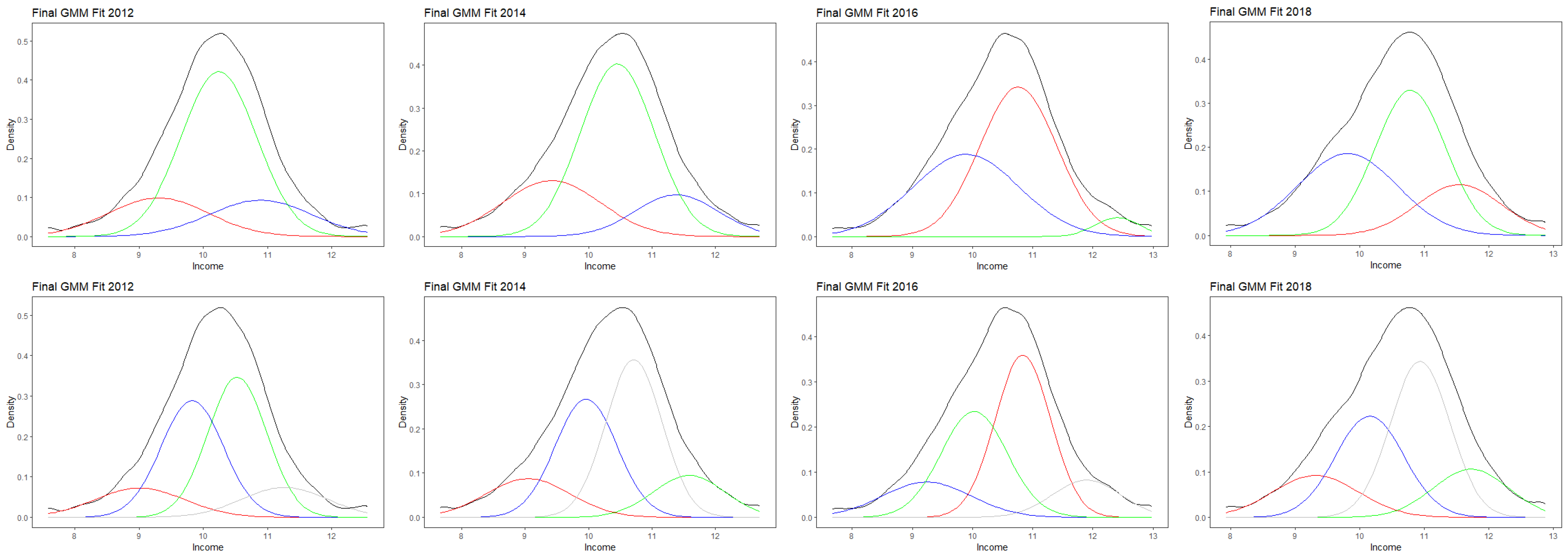
Table A1.
Effects sizes of baseline means for all dependent and independent variables.
Table A2.
Impact of Liao et al. [28], digital finance index on potential household consumption (robustness).
Table A3.
Lagged digital finance index and potential household consumption.
Table A4.
Robustness using 1984 postal/fixed-line shift-share IV.
Table A5.
Placebo tests using other household expenditures.
References
- Xiao, J.J.; Tang, C.Y.; Shim, S.Y. Acting for happiness: Financial behavior and life satisfaction of college students. Soc. Indic. Res. 2009, 92, 53–68. [Google Scholar] [CrossRef] [Scilit]
- Kimball, M.; Weil, P. Precautionary saving and consumption smoothing across time and possibilities. J. Money Credit Bank. 2009, 41, 245–284. [Google Scholar] [CrossRef] [Scilit]
- Gjertson, L. Emergency saving and household hardship. J. Fam. Econ. Iss. 2016, 37, 1–17. [Google Scholar]
- Browning, M.; Crossley, T.F. The life-cycle model of consumption and saving. J. Econ. Perspect. 2001, 15, 3–22. [Google Scholar] [CrossRef] [Scilit]
- Browning, M.; Lusardi, A. Household saving: Micro theories and micro facts. J. Econ. Lit. 1996, 34, 1797–1855. [Google Scholar]
- Campbell, J.Y.; Mankiw, N.G. The response of consumption to income—A cross-country investigation. Eur. Econ. Rev. 1991, 35, 723–757. [Google Scholar] [CrossRef] [Scilit]
- Yao, R.; Gutter, M.S.; Hanna, S.D. The financial risk tolerance of blacks, hispanics and whites. J. Financ. Couns. Plan. 2005, 16, 1–32. [Google Scholar]
- Modigliani, F.; Brumberg, R. Utility analysis and the consumption function: An interpretation of cross-section data. Fr. Modigliani 1954, 1, 388–436. [Google Scholar]
- Fisher, P.J.; Montalto, C.P. Effect of saving motives and horizon on saving behaviors. J. Econ. Psychol. 2010, 31, 92–105. [Google Scholar] [CrossRef] [Scilit]
- Jencks, C. The hidden prosperity of the 1970s. Public Interest. 1984, 77, 37. [Google Scholar]
- Cutler, D.M.; Katz, L.F. Rising inequality—Changes in the distribution of income and consumption in the 1980s. Am. Econ. Rev. 1992, 82, 546–551. [Google Scholar]
- Liu, M.; Ma, Q.-P. The impact of saving rate on economic growth in Asian countries. Natl. Account. Rev. 2022, 4, 412–427. [Google Scholar] [CrossRef] [Scilit]
- Song, Q.; Li, J.; Wu, Y.; Yin, Z. Accessibility of financial services and household consumption in China: Evidence from micro data. N. Am. J. Econ. Finance 2020, 53, 101213. [Google Scholar] [CrossRef] [Scilit]
- Du, Z.; Lv, G. Measures the potential for household consumption: A comparison based on inconsistencies between income and consumption classes. Appl. Econ. Lett. 2024, 6, 1–6. [Google Scholar] [CrossRef] [Scilit]
- Gur, Y.E. Development and application of machine learning models in US consumer price index forecasting: Analysis of a hybrid approach. Data Sci. Finance Econ. 2024, 4, 469–513. [Google Scholar] [CrossRef] [Scilit]
- Zheng, C.; Chowdhury, M.M.; Gupta, A.D. Investigating the influence of ownership on the relationship between bank capital and the cost of financial intermediation. Data Sci. Finance Econ. 2024, 4, 388–421. [Google Scholar] [CrossRef] [Scilit]
- Li, Z.; Guo, F.; Du, Z. Learning from Peers: How Peer Effects Reshape the Digital Value Chain in China? J. Theor. Appl. Electron. Commer. Res. 2025, 20, 41. [Google Scholar] [CrossRef] [Scilit]
- Li, J.; Wu, Y.; Xiao, J.J. The impact of digital finance on household consumption: Evidence from China. Econ. Model. 2020, 86, 317–326. [Google Scholar] [CrossRef] [Scilit]
- Li, Z.H.; Yang, C.Y.; Huang, Z.H. How does the fintech sector react to signals from central bank digital currencies? Finance Res. Lett. 2022, 50, 5. [Google Scholar] [CrossRef] [Scilit]
- Yue, P.P.; Korkmaz, A.G.; Yin, Z.C.; Zhou, H.G. The rise of digital finance: Financial inclusion or debt trap? Finance Res. Lett. 2022, 47, 8. [Google Scholar] [CrossRef] [Scilit]
- Yang, B.; Ma, F.; Deng, W.; Pi, Y. Digital inclusive finance and rural household subsistence consumption in China. Econ. Anal. Policy 2022, 76, 627–642. [Google Scholar] [CrossRef] [Scilit]
- Yu, C.J.; Jia, N.; Li, W.Q.; Wu, R. Digital inclusive finance and rural consumption structure—Evidence from Peking university digital inclusive financial index and China household finance survey. China Agric. Econ. Rev. 2022, 14, 165–183. [Google Scholar] [CrossRef] [Scilit]
- Wang, J.; Yin, Z.; Jiang, J. The effect of the digital divide on household consumption in China. Int. Rev. Financ. Anal. 2023, 87, 102593. [Google Scholar] [CrossRef] [Scilit]
- Anderson, G.; Farcomeni, A.; Pittau, M.G.; Zelli, R. A new approach to measuring and studying the characteristics of class membership: Examining poverty, inequality and polarization in urban China. J. Econom. 2016, 191, 348–359. [Google Scholar] [CrossRef] [Scilit]
- Conger, R.D.; Conger, K.J.; Martin, M.J. Socioeconomic status, family processes, and individual development. J. Marriage Fam. 2010, 72, 685–704. [Google Scholar] [CrossRef] [Scilit]
- McLanahan, S.; Percheski, C. Family structure and the reproduction of inequalities. Annu. Rev. Sociol. 2008, 34, 257–276. [Google Scholar] [CrossRef] [Scilit]
- Kong, S.T.; Loubere, N. Digitally down to the countryside: Fintech and rural development in China. J. Dev. Stud. 2021, 57, 1739–1754. [Google Scholar] [CrossRef] [Scilit]
- Liao, G.K.; Li, Z.H.; Wang, M.X.; Albitar, K. Measuring China Surban digital finance. Quant. Finance Econ. 2022, 6, 385–404. [Google Scholar] [CrossRef] [Scilit]
- Zhou, T.; Wu, P.; Chen, H. Digital finance and household consumption: Evidence from China. J. Econ. Behav. Organ. 2020, 178, 201–218. [Google Scholar]
- Liu, Y.; Li, J.; Zhang, X. Mobile payments and household consumption: Micro-evidence from China. China Econ. Rev. 2021, 67, 101607. [Google Scholar]
- Thaler, R.H. Mental accounting and consumer choice. Mark. Sci. 1990, 9, 199–214. [Google Scholar]
- Duflo, E.; Gale, W.; Liebman, J.; Orszag, P.; Saez, E. Savings incentives and liquidity constraints: Evidence from a field experiment. Q. J. Econ. 2017, 132, 1–52. [Google Scholar]
- Deaton, A.; Muellbauer, J. Economics and Consumer Behavior; Cambridge University Press: Cambridge, UK, 1980. [Google Scholar]
- Cohen, A.; Smetters, K. Digital finance and inequality: Evidence from household-level data. Rev. Econ. Stud. 2020, 87, 2562–2593. [Google Scholar]
- Arvidsson, N.; Wrigth, R.; Beck, T. Financial inclusion and the digital divide: Household-level evidence. J. Bank. Finance 2021, 125, 106098. [Google Scholar]

Disclaimer/Publisher’s Note: The statements, opinions and data contained in all publications are solely those of the individual author(s) and contributor(s) and not of MDPI and/or the editor(s). MDPI and/or the editor(s) disclaim responsibility for any injury to people or property resulting from any ideas, methods, instructions or products referred to in the content. |
© 2025 by the authors. Licensee MDPI, Basel, Switzerland. This article is an open access article distributed under the terms and conditions of the Creative Commons Attribution (CC BY) license (https://creativecommons.org/licenses/by/4.0/).