
Assessing the Influence of Stimulatory Feeding of Bee Colonies on Mineral Composition and Antioxidant Activity of Bee Venom
by
 , , , , , , and
Adrian Dan Rășinar
1,† ,
,
Isidora Radulov
2,*,
Adina Berbecea
2,*,
Doris Floares (Oarga)
2,
Nicoleta Vicar
2,
Eliza Simiz
1,
Monica Dragomirescu
1 and
Silvia Pătruică
1,†
1
Faculty of Bioengineering of Animal Resources, University of Life Sciences “King Mihai I” from Timișoara, Calea Aradului No. 119, 300645 Timisoara, Romania
2
Faculty of Agriculture, University of Life Sciences “King Mihai I” from Timișoara, Calea Aradului No. 119, 300645 Timişoara, Romania
*
Authors to whom correspondence should be addressed.
†
These authors contributed equally to this work.
Insects 2025, 16(4), 423; https://doi.org/10.3390/insects16040423
Submission received: 4 March 2025
/
Revised: 27 March 2025
/
Accepted: 14 April 2025
/
Published: 17 April 2025
(This article belongs to the Section Social Insects and Apiculture)
Simple Summary
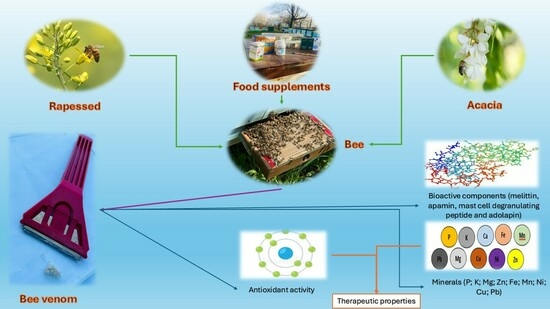
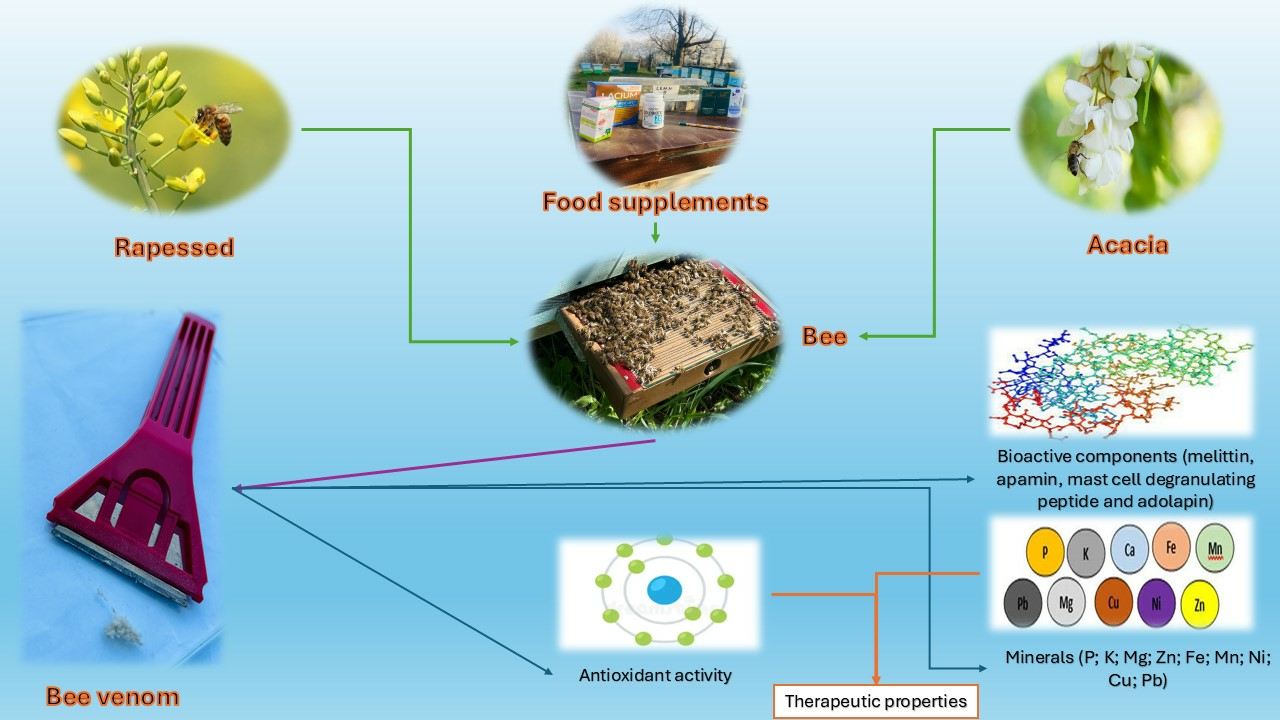
Bee venom is a natural product traditionally used in therapy and known for its health benefits. However, little research has focused on its mineral content, which varies based on the environment. Our study analyzed the mineral composition of bee venom and investigated how different supplements, such as probiotics, essential oils, and various nectar and pollen sources, influence its properties. We measured moisture, pH, mineral levels, and antioxidant activity. The results showed that potassium was the most abundant mineral, followed by calcium, magnesium, and phosphorus. These findings help improve the understanding of bee venom composition.
Abstract
Bee venom is a complex natural beekeeping product, traditionally used in apitherapy, with a wide spectrum of pharmacological properties. Research on the mineral content of bee venom is limited and challenging to compare across studies due to the varying regions where they are conducted. Our study aimed to assess the mineral content of bee venom and how supplementary feeding of bee colonies with probiotic products, essential oils, as well as rapeseed and acacia nectar and pollen, affects the mineral content and antioxidant activity of the venom. The parameters analyzed included moisture, pH, dry matter, ash, impurities, and levels of macro and micro elements and antioxidant activity. The moisture content of the samples was 10–22%, and pH ranged between 5.84 to 6.41. The macro element content of the venom showed that potassium was the most abundant macro element, followed by calcium, magnesium, and phosphorus. Pb was identified in samples collected indicating lead pollution in the area where the hives were located in the case of the three harvests. In all samples, the highest DPPH radical scavenging activity was observed at a concentration of 2.00 mg/mL, with sample V6 showing the maximum value of 87.05%.