1. Introduction
The research in this study highlights the experiences of women from a variety of religious backgrounds in the United States to tell their stories and allow their voices to be heard (
Daly, 2007). The present study is valuable because it is one of the few large qualitative studies to collect and analyze interview data from women of several different religious faiths (
Robinson, 1994), orientations (
Robinson & Blanton, 1993), and beliefs (
Kaslow & Robinson, 1996) noting that religious factors contribute to marital satisfaction. The aim is to examine the rich and varied religious experiences of women from diverse faith traditions, and how these experiences can inspire not just marital satisfaction, but genuine marital flourishing, achieved through three distinct types of commitment (
Johnson et al., 1999).
1.1. Women and Religion
There is power and strength in women, including faith-filled women, but not much research is conducted to understand them. Many studies have addressed women speaking out about life experiences such as abuse (
Barkhuizen & Pretorius, 2005) and fear (
Hassouneh-Phillips, 2001), highlighting the imperative need to heed their voices. However, it is important for scientists and researchers to comprehend not just what portrays “bad” relationships but also how to promote “good” relationships (
Totenhagen et al., 2013).
Religion has a widespread impact on people’s lives, and much attention has been directed towards the idea that men and women may experience religion differently (
Lummis, 2004). Of men and women who are actively engaged in religious life and worship, women practice their religion more often, with greater involvement, and are more inclined to label faith as being central and offering meaning and purpose to their lives (
Lummis, 2004;
Bruce et al., 2006). Faithful women can certainly be powerful participants in marriage. However, few studies to date have focused on the religious experiences of women and how they strengthen their commitment to marriage.
1.2. Effectual Religiosity
Much research has examined whether religiosity contributes to marital satisfaction. For example,
Dudley and Kosinski (
1990) found that couples who share the same religion, pray together, and attend religious services tend to report higher marital satisfaction. Building on these insights, we introduce the concept of effectual religiosity to capture the dimension of religious involvement that might actively create such positive outcomes. Effectual means producing an effect or having the power to produce an effect (
Merriam-Webster, n.d.). This term’s theological usage also highlights its active connotation. In the New Testament, for instance, Paul speaks of “the effectual working of His power” (Ephesians 3:7,
King James Bible, 1769/2017), where the Greek word translated as “effectual” can also be rendered “active”. By grounding our terminology in this biblical and linguistic context, we underscore that effectual religiosity implies an engaged, dynamic form of faith. Accordingly, for the purposes of this study, we define effectual religiosity as religious beliefs that lead to actions and behaviors which are actively lived out and produce desired effects in individuals’ and couples’ faith and relationships.
Another factor that may contribute to the construction of meaning in marital relationships is the couple’s perception of marriage as sacred. Sacredness in this context refers to the belief that marriage is not merely a social contract, but a divinely ordained union imbued with spiritual significance and moral purpose (
Dollahite et al., 2012). When couples frame their relationship in sacred terms, they are more likely to see their bond as enduring, non-substitutable, and guided by transcendent values. This sacred framing can influence behavior in key relational domains, including sexual fidelity.
Research has shown that adherence to religious teachings, often a vehicle through which sacred meanings are cultivated, promotes less permissive attitudes toward sexual activity, which in turn supports greater marital fidelity.
Wade and DeLamater (
2002), for example, found that “a high level of reported religious influence is the strongest significant predictor of less permissive sexual attitudes” (p. 905).
Atkins et al. (
2001) similarly reported that individuals who did not attend religious services were 2.5 times more likely to have engaged in infidelity compared to those who attended more than once per week. In qualitative work,
Leavitt et al. (
2023) found that religious couples in flourishing marriages consistently cited both sexual fidelity and religious devotion as central to their marital success.
Taken together, these findings suggest that when couples view their marriage as sacred, grounded in divine intent and religious obligation, they are more likely to adopt sexual norms that discourage infidelity. This protective function of religious influence can help foster trust, stability, and a sense of covenantal responsibility within the relationship.
1.3. Theoretical Foundations
Relationship commitment is described as the intention to remain in a relationship, a psychological attachment to, and a long-term perception toward the relationship (
Arriaga & Agnew, 2001). More specifically, from an interdependence theory perspective (
Kelley et al., 2003), an individual’s commitment is supported by three separate factors: his or her level of satisfaction with the relationship, amount of investment in the relationship, and perceived quality of alternatives to the relationship (
Rusbult et al., 2012). As individuals become increasingly interdependent, they tend to develop stronger commitment (
Rusbult & Van Lange, 2008).
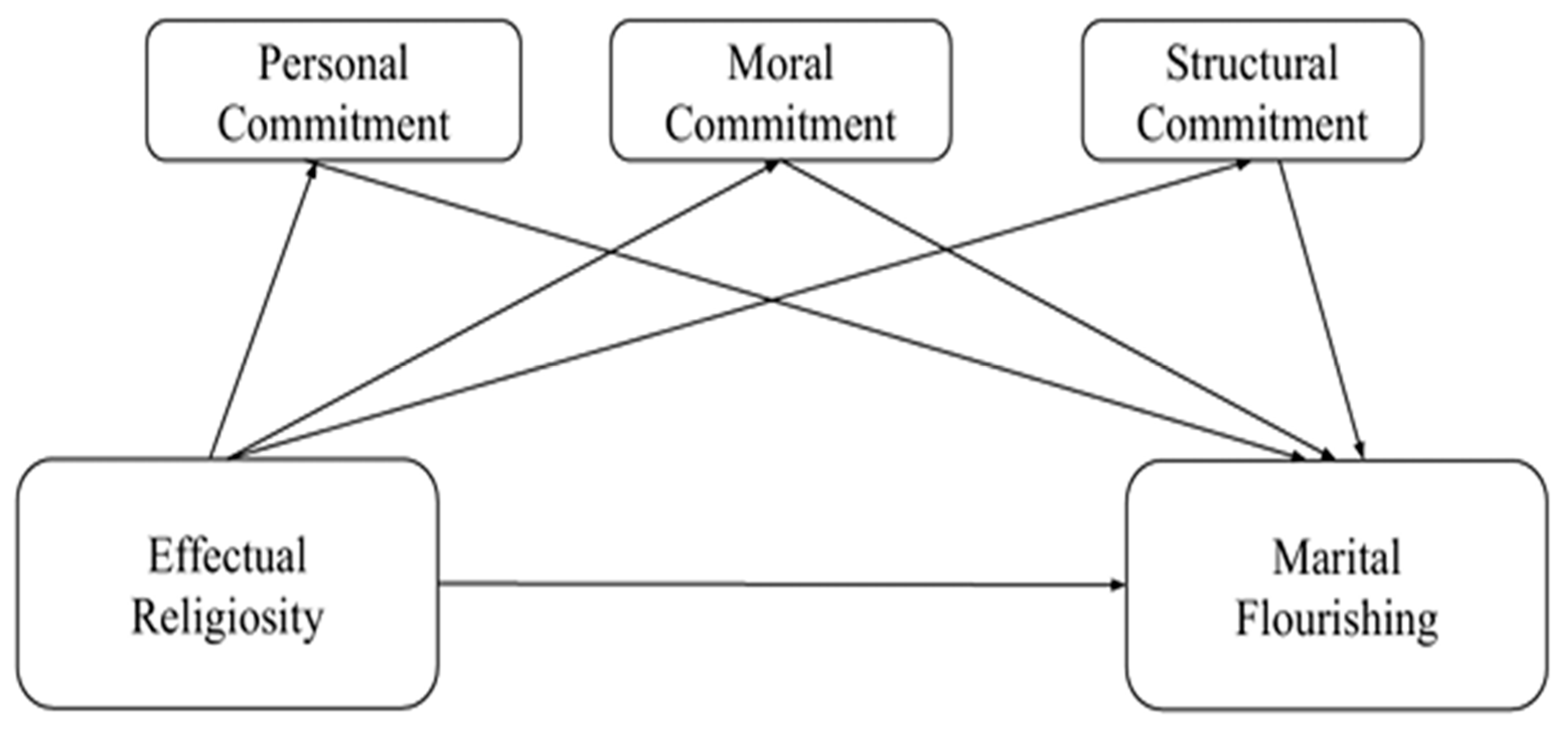
This study proposes a conceptual model (see
Figure 1) rooted in interdependence theory and Johnson’s tripartite commitment framework to explain how effectual religiosity shapes women’s marital commitment. The tripartite commitment paradigm (
Johnson et al., 1999) presents three major types of commitment: personal, moral, and structural. The first two types of commitment, personal and moral, are understood as proximal, or exclusive to the individual (stemming from the person’s own attitudes and values). In contrast, the third type of commitment, structural, is understood as being outside of the individual, or distal, (arising from the constraints that make ending the relationship highly undesirable) (
Johnson et al., 1999). Interdependence theory, specifically when applied through Johnson’s tripartite commitment framework, serves as a valuable lens through which to view and consider relationship stability.
Relationship commitment, as conceptualized through Johnson’s tripartite model, consists of three distinct yet interrelated components: personal, moral, and structural commitment. These dimensions do not operate in isolation. Rather, they often interact in meaningful ways to shape the quality and stability of a relationship. To illustrate this interaction, consider the metaphor of a musical triad, which is a chord composed of three notes arranged in thirds. When played individually, each note produces a simple, solitary tone. But when played together, they create a fuller, more harmonious sound. Similarly, when all three forms of commitment are present and well-developed, they can reinforce one another, producing a more resilient and satisfying marital bond. This integrative effect is supported by findings from
Li et al. (
2021), who identified a “Higher Tripartite Commitment” profile among couples that demonstrated significantly better outcomes in marital quality. These couples reported higher satisfaction and lower levels of conflict and ambivalence, outcomes attributed to their balanced investment across personal, moral, and structural dimensions of commitment.
When considered together, each of these dimensions of commitment works in connection with each other, contributing to the differences observed in the quality of a relationship (
Li et al., 2021). The tripartite nature of commitment requires researchers who wish to understand why couples remain together to go beyond focusing solely on romantic personal commitment. Instead, they should examine the origins of all three types of commitment, how these types interact, and how they influence the couple’s dynamics and the longevity of their relationship (
Li et al., 2021). With that foundation, let’s delve deeper into aspects of marital commitment.
1.4. Commitment
Clements and Swensen (
2000) highlight that commitment to one’s spouse emerges as a strong predictor of marital quality. On a spiritual level, personal beliefs and behaviors may serve as vital tools for couples seeking to maintain their commitment within a marriage.
Olson et al. (
2013) found that faith community support and general religiosity were significantly related to increased marital commitment. Several other studies and reviews further underscore the link between religiosity and heightened marital satisfaction and stability (
Burr et al., 2012;
Mahoney et al., 2001;
Sherkat & Ellison, 1999). Not only stability but marital quality is also a desired outcome in marriage. It is deep commitment plus quality that may create marital flourishing.
According to
Pew Research Center (
2023), current divorce rates reveal the challenges many couples face in upholding their marital commitments. However, research has found that marital commitment was strongest when couples have a clear sense of a future together (
Waite & Joyner, 2001). Since commitment entails a steadfast alignment that encompasses the degree of dependence on a relationship (
Lin & Rusbult, 1995), could religiosity aid with that alignment? We would argue that indeed it does.
Lambert and Dollahite (
2006) found that religiosity instilled in couples a desire for relationship permanence, which helped them navigate conflict and stay aligned.
1.5. Personal, Moral, and Structural Commitment
According to
Johnson et al. (
1999), marital commitment can be understood in three interrelated forms: personal (“I want to continue in this marriage”), moral (“I ought to continue”), and structural (“I have to continue”). Personal commitment involves attraction to one’s partner, attraction to the relationship, and relationship identity (e.g., name changes, wearing rings), with rewarding and valuable aspects of the marriage enhancing self-concept (
Kurdek, 2000).
Broderick and O’Leary (
1986) found a positive correlation between personal commitment and marital satisfaction, while
Stanley and Markman (
1992) described it as the desire to maintain or improve the relationship, sacrifice for it, invest in it, and link personal goals with a partner’s welfare—even in difficult times. Religion can shape personal commitment by acting as an attractant through shared values; in the 2015 Pew Religious Landscape Study, 89% of Americans reported believing in God and 60% considered religion important in their lives (
Pew Research Center, 2015;
McCullough et al., 2000). A partner’s faithfulness may foster attraction, while differences in faith (e.g., conversion or marrying “outside the faith”) can strain family relationships (
Marks, 2005). Moral commitment is rooted in viewing marriage as a sacred covenant before God, friends, and family, warranting protection (
Kurdek, 2000), and includes behaviors such as forgiveness, monogamy, sacrifice, and experiencing God’s love through the relationship (
Hui et al., 2007;
Goodman et al., 2013). Religiosity can shape moral norms regarding sexual behavior, such as abstinence before marriage and fidelity within it (
Hadden, 1983;
Dollahite & Lambert, 2007), and strengthen bonds through shared spiritual practices (
Goodman et al., 2013). Structural commitment involves investments of time, money, children, and shared experiences that raise the cost of ending a marriage (
Lin & Rusbult, 1995). While constraints can be perceived positively (
Li et al., 2021), religiosity and faith community involvement may reinforce them by discouraging divorce and providing communal support (
Lambert & Dollahite, 2008;
Larson & Goltz, 1989). Procreation often strengthens structural ties, as children add purpose to marriage (
Dollahite et al., 2012) and religious contexts may encourage childbearing (
Heaton, 1986), with their presence increasing the social and logistical complexities of ending the relationship (
Johnson et al., 1999).
1.6. Marital Flourishing
While much research has examined the link between religiosity and marital satisfaction, there is growing interest in how religious orientation contributes to marital flourishing, a broader and more holistic concept (
Robinson, 1994).
Tavakol et al. (
2017) defines marital satisfaction as “a sense of happiness, satisfaction, and joy experienced by the husband or wife when they consider all aspects of their marriage” (p. 197) and has been associated with physical and mental health, life happiness, workplace success, and social communication. Research also indicates a correlation between religiosity and the satisfaction couples experience (
Marks & Dollahite, 2016), with satisfaction reflecting the balance of positive versus negative feelings and the fulfillment of important personal needs. Yet satisfaction and happiness, often linked to subjective well-being, represent only part of the picture.
Aristotle’s concept of
eudaimonia, “flourishing,” describes a life dedicated to virtuous, meaningful goals, intrinsically rewarding activities, and strong friendships (
Fowers & Owenz, 2010), and he considered marriage a form of friendship. Flourishing marriages, therefore, go beyond satisfaction to embody moral purpose, virtue, shared values, long-term growth, and deep relational fulfillment (
Fowers & Owenz, 2010). Some scholars contend that satisfaction ratings alone cannot capture the full richness of marriage and advocate including a eudaimonic dimension highlighting human flourishing within the relationship (
Fowers et al., 2016). Flourishing develops over time as couples adapt to each other’s interests, understand personality traits, set boundaries, and establish routines; while satisfying marriages may share some traits with flourishing ones, struggling marriages achieve few of these conditions, and harmful marriages may damage psychological and physical health (
Fowers & Owenz, 2010).
We propose that healthy marriages include goal-directed priorities, such as religious practices, and that marriages flourish when these goals are pursued intentionally, collaboratively, positively, and purposefully. If flourishing marriage is as important as studies suggest, more is needed than correlation alone (
Marks & Dollahite, 2011) making the study of religion’s role in strengthening marital commitment an important endeavor.
1.7. Current Study
Numerous studies on the intersection of marriage and religion have primarily focused on distal dimensions of religious affiliation and attendance at their religious institution.
Mahoney et al. (
1999) found that prior research had focused on distal religious factors that are only loosely connected to marriage and that previous studies had predominantly used single-item measures of marital satisfaction to assess the marital domain, often overlooking specific aspects of marriage that are connected to religious or spiritual constructs. In that same study, the need for further study on more proximal factors of religiosity was emphasized and their interplay with commitment. According to
Mahoney et al. (
1999), these proximal factors include joint religious activities and sanctification of marriage.
In the present study, we will explore in-depth interviews from religious women that include their stories and lived experiences.
Marks and Dollahite (
2020) have posited that for researchers examining religion and families, deep respect for a family’s religious beliefs and practices (even admiration to the point of “holy envy”) can facilitate deep qualitative scholarship. Holy envy refers to when a scholar carefully recognizes the admirable qualities and strengths within the individual, couple, or family group under study, leading to a deep admiration for these virtues and strengths, even aspiring to cultivate similar virtues within oneself (
Marks & Dollahite, 2020). In this study, we will examine the women’s voices using this “holy envy” lens.
1.8. Research Question
According to
Miller (
1987), what is found when we study women are the “parts of the total human potential that have not been fully seen, recognized, or valued” (p. 10). Miller states that these are the parts that have “not therefore flourished, and perhaps they are precisely the ingredients that we must bring into action in the conduct of all human affairs” (p. 10). Consequently, in this current qualitative study, we aim to use those ingredients and amplify women’s voices by exploring the following research question: Can effectual religiosity strengthen marital commitment which in turn will promote marital flourishing for women of faith? Acting on religious orientation, faith and beliefs may produce desirable marital outcomes. However, “I do” spoken in many marriage vows is often easier said than done. It is the enduring “I will” that weaves together the threads of commitment. Some healthy aspects of religion may fortify those threads. This study will examine if marital commitment is strengthened by effectual religiosity and whether this commitment reportedly fosters greater marital flourishing.
2. Materials and Methods
Data for this study were taken from the American Families of Faith (AFF) national research project, which employs a strength-based approach to discover themes in successful, highly religious marriages and families. We obtained the approval from Brigham Young University, IRB #17273 on 2 April 2018. The aim of the current study is to examine connections between religion, marital commitment, and marital flourishing. We also refer the reader to an article by
Dollahite and Marks (
2018) for a detailed description of the American Families of Faith project’s methods and sample.
The present study draws upon data from the American Families of Faith qualitative interview archive, which comprises interviews with over 260 heterosexual, married couples. The sample includes highly religious couples representing a wide range of racial, ethnic, regional, denominational, and socioeconomic backgrounds. The interview process for the roughly one dozen branches of the American Families of Faith project has been ongoing from 2001 to the present.
Interviews were conducted conjointly with spouses to explore the influence of religious involvement on marital and family dynamics. To ensure meaningful representation, religious minority groups, including Jewish, Muslim, and Latter-day Saint families, as well as racial and ethnic minority groups, such as African American, Asian, Hispanic, and Native American families, were intentionally oversampled. Notably, 51% of participating families identified as members of an ethnic or racial minority group. The sample consisted primarily of same-faith couples (89%), with 11% in interfaith marriages. While nearly 200 peer-reviewed publications have emerged from this seminal dataset, the current study is among the first to focus exclusively on the marital experiences and perspectives of women.
2.1. Data Collection
The families participating in this national study reflect considerable religious diversity (representing over 20 distinct denominations), geographic breadth, and racial/ethnic representation, with 51% identifying as members of racial or ethnic minority groups. All married participants had at least one child. Educational attainment among participants ranged from a high school diploma to doctoral degrees, and participants varied widely in socioeconomic status. Recruitment was conducted through religious gatekeepers, including clergy, pastors, and other faith leaders, across all eight socio-religious regions of the United States (
Silk & Walsh, 2006). To focus on individuals who were deeply committed to their faith, gatekeepers were specifically asked to recommend not merely “successful” couples but those considered exemplary in their devotion to marriage, family, and religion. Approximately 90% of those referred by religious leaders agreed to participate in the study. The average length of marriage among participants exceeded 20 years, and many couples reported long-term involvement in the same faith community. On average, participating families reported contributing 7% of their household income to religious causes and dedicating 11 h per week to personal or family-based religious practices.
Data was collected through semi-structured qualitative interviews, consisting of approximately 25 questions focused on the intersection of faith and family life. Interviews were conducted in person by faculty researchers and trained graduate research assistants, lasting between one and four hours (M = 2 h). All interviews were audio recorded, transcribed verbatim, and subsequently uploaded into NVivo software for qualitative analysis. First access date for this publication was 16 September 2022. For further information, including an overview of the methodology and a full list of publications from this data set, please visit
https://americanfamiliesoffaith.byu.edu/.
2.2. Data Selection
This study utilized NVivo 12 qualitative data analysis software to systematically identify and extract participant responses most pertinent to the central research question: Can effectual religiosity strengthen marital commitment which in turn will promote marital flourishing for women of faith? The analysis began with the use of NVivo’s auto coding function to sort responses by gender, thereby isolating the dataset to include 19,685 statements from the 261 female participants (wives). Subsequently, the text search and custom context functions were employed to locate 1254 references across interviews with 250 of the 261 women. These references included key terms related to religion and marriage, such as faith, vow, and commitment and other variations drawn from a curated list of approximately 20 terms, selected to facilitate focused exploration of the research questions. Each identified reference was accompanied by 60 words of surrounding context, before and after the term, providing greater interpretive depth for subsequent analysis.
The research team conducted an open-coding analysis of the 1254 marriage-related excerpts provided by the female participants. Employing a collaborative, team-based coding approach (
Marks, 2015), the research team systematically analyzed 1254 marriage-related quotations from the women’s interviews. As coders reviewed approximately the first quarter of these interview responses, several prominent themes began to emerge. In response, the coding team, in collaboration with the lead research assistant, consolidated overlapping or conceptually similar codes and engaged in collective discussions to refine and clarify the key emerging concepts. To guarantee rigor, accuracy, and replicability using these codes, a comprehensive codebook was developed specifying inclusion and exclusion criteria for each thematic category (
Marks, 2015). As coding progressed, the codebook was iteratively revised to reflect additional insights and ensure consistency across the dataset. This refined process ultimately yielded 279 quotations explicitly addressing women’s experiences with religion strengthening their marital commitment, representing responses from 196 women (75% of the total female participant pool). The composition of this thematic subsample closely mirrored that of the full sample, though Christian wives were slightly overrepresented, while Jewish and Muslim wives were slightly underrepresented. In addition, the NVivo 12 software was updated to NVivo 14 during the coding process.
2.3. Sample
Participants in this study were drawn from all eight socio-religious regions of the United States, as defined by prior research (
Silk & Walsh, 2006). The sample included individuals affiliated with a range of religious traditions, including Judaism, Islam, and various denominations within Christianity. Couples were intentionally selected based on their demonstrated strength of religious commitment, allowing for a focused investigation into the family processes, lived experiences, and relational outcomes associated with highly religious women.
2.4. Analysis
In the present study, our coding team conducted axial coding of the 279 excerpts associated with the core theme of “religion strengthening marital commitment” as expressed by women of faith. Following methodological guidelines outlined by
Bernard et al. (
2016), the research team used the established codebook to track and categorize axial codes while also assessing inter-rater reliability, which yielded a high agreement score of 0.91 for the themes discussed in this article. The team then conducted a systematic examination of the coded excerpts to identify and organize sub-themes within the broader thematic framework. These findings provide meaningful insight into the study’s central research questions.
3. Findings
Our qualitative analyses revealed three core themes concerning commitment in marital relationships. These themes included: (1) Personal Commitment, with the following subthemes: (a) Decision to marry; (b) Religious beliefs and practices; (c) Requires effort and sacrifice. (2) Moral Commitment, with the following subthemes: (a) Sexual relations before marriage; (b) Promises made before God, friends, and family; (c) Fidelity and feelings about divorce. (3) Structural Commitment, with the following subthemes: (a) Religious institution and faith community; (b) God is part of our union; (c) The family unit.
Across 196 interviews with women, 279 references to marital commitment were organized into three themes: Personal Commitment (140 references), Moral Commitment (48 references), and Structural Commitment (91 references) (see
Table A1). Within Personal Commitment, Religious Beliefs and Practices (88 references, 47 interviews) was by far the most cited subtheme, followed by Requires Effort and Sacrifice (30 references, 24 interviews) and Decision to Marry (22 references, 12 interviews). Moral Commitment was most often expressed through Promises Made Before God, Friends, and Family (27 references, 26 interviews), with fewer mentions of Fidelity and Feelings About Divorce (14 references, 13 interviews) and Sexual Relations Before Marriage (7 references, 7 interviews). Structural Commitment featured frequent references to Church and Faith Community (42 references, 26 interviews), God is a Part of Our Union (26 references, 20 interviews), and The Family Unit (23 references, 21 interviews). Overall, faith-related factors—spanning personal beliefs, sacred promises, and religious community—emerged as a central thread linking all three types of commitment.
A particularly noteworthy aspect of this study is the spontaneous emergence of the topic: effectual religiosity strengthens the triad chord of marital commitment. Participants were asked questions about how their religion affected their marriage and family. However, participants were neither directly nor indirectly prompted to discuss how their religious beliefs directly affected their marital commitment in the context of personal, moral, and structural commitment. Despite the absence of targeted questioning, this theme surfaced 279 times across approximately 75% of the interviews. Although a direct question may have produced a larger quantity of relevant data, the unsolicited nature of these responses highlights the inherent significance of the theme. That nearly half of the women raised the topic independently suggests its intrinsic relevance to their lived experiences and may strengthen the validity of the findings by minimizing the risk of response bias or interviewer influence. In the findings, to protect the identity of participants, all names have been replaced with pseudonyms.
3.1. Personal Commitment
To restate, according to
Johnson et al. (
1999) personal commitment is a desire to continue in a relationship. “I want to continue in this marriage.” Following is a statement from a Christian woman who felt a personal commitment to her spouse and portrayed how religiosity integrated into that connection. Michelle said the following:
I think that it’s impossible to separate our beliefs and the institution of marriage because… the sense of commitment, the sense of shared responsibility, the sense of teamwork… I think if you have a spiritual basis from which to approach all those things, and … our relationship together too. You know, we’ve been married over 19 years and sometimes your spouse drives you crazy but you love him. And sometimes you just have to see him as God sees him. Not sometimes. All the time, actually. But to know that they are… the set of wonderful qualities that you married him for are always [there] and that they can never lose that, then it just helps you get over the tough spots.
Personal commitment stems from an internal place deep in the heart, where decisions that affect the rest of your life reside. It can be helpful for both partners to come from a similar place of mind when contemplating the idea of marriage.
Sunnafrank (
1992) stated, “When the discovery of attitude similarity by potential marriage partners increases attraction, [it can foster] the development of highly committed romantic relationships” (p. 454). We now examine the attitude similarity stemming from personal commitment in the following couples concerning their decision to marry.
3.1.1. Decision to Marry
Some nuances of personal commitment can be apparent even before one enters matrimony by affecting the decision to get married and whom to marry. It also may affect their religious beliefs and practices and often requires much effort and sacrifice. In choosing a mate, statements concerning a sincere, personal, belief in God were prevalent among the women interviewed. For instance, a Muslim woman named Banafsha stated:
I think that the most important thing and the criteria [regarding] whom I wanted to marry [was a man] who has faith in God and who is God-conscious.
An African American Christian woman named Destiny shared her feelings about a similar idea:
Marriage is not a feeling; it is a covenant. So, because of that I wanted to make sure that he was the one for me before I married him. And so, we were friends before we got married, and we both loved the Lord with all of our hearts before we got married. So, there’s a lot of things we did to make sure this was of God and we had a lot of opposition before we got married, people not thinking we were going to stay together because they didn’t want us together. But we knew it was of God.
Iffah, a Muslim woman said this about the influence her religious values had on choosing a mate:
The religious values that we had were very important in our deciding whether we were made for each other. So how we met, we got to know each other from the religious faith years ago, so that had a lot to do with it. Also, the religious values that we had were important in deciding whether we were for each other [to marry].
Impressed with her husband’s religious devotion when they met, Iram, a Muslim woman said the following:
How many college guys do you see who would excuse themselves on a date and say, “Excuse me, I have to go pray.” We were at the beach…and he would take out his prayer rug and pray. People were walking by and staring. I was used to beer-drinking and [ungentlemanly behavior]. It made me wake up.
Along with being spiritually attracted to a mate and having similar religious attitudes, it may be important to note desirable qualities when choosing to marry or re-evaluating a decision to marry a certain person. Danielle, a white Christian woman had this to say concerning low points in marriage:
There’ve been times that I’ve found myself getting very upset with him, falling out of love with him, being disgusted, thinking, “I do not wish to be married to this person” and then I can rear back and think, “Who is thinking these things? Where are these thoughts coming from?” … And so sometimes I have [to] sit down and read the [Bible] chapter on marriage, or I will literally make a list of all the qualities I love about him to fall in love again… and keep my vision clear about who it is I’m married to and why I’m committed to this.
When religion affects a woman’s decision to marry, the aspects of incorporating that religion into daily life come into play. Next, we will examine some of the beliefs and practices that some faithful women experience that influence their personal commitment to marriage.
3.1.2. Religious Beliefs and Practices
For many couples, the personal matter of religious beliefs and practices reportedly had a tremendous impact on marital commitment. Personal religious beliefs can stir up deep feelings concerning marriage and the practice of those beliefs (through prayer, scripture study, attending religious service, acts of service) may help to solidify one’s marital commitment. First, we will look at the beliefs that some participants had concerning their religion and marriage. Jennifer, a white Jehovah’s Witness from Massachusetts, shared her belief in a very direct way. She stated, “Marriage is forever. It’s not entered lightly. [It’s] entered very carefully. And it’s considered a commitment forever.” Li-Fen, an Asian Christian woman said, “God created marriage, and let no man separate. Commitment marriage is God’s blessing; commitment is very important.”
One Latter-day Saint (Mormon) Hispanic woman, named Esmerelda, shared a part of her story concerning religious beliefs in marriage:
I was raised in a home that was Catholic, my mom was very Catholic and after we were Mormons, we are Mormons. But the belief of us is that marriage is… if you marry it’s… first it was until death do you part and now it is for all of eternity. So, it has to be a decision that’s well thought out, meditated, because the idea is that you marry to form a family, and it is forever.
Personal religious ideals may act as a compass when deciding how to act when trials arise. Alisia, a Catholic woman said the following:
For me, my religious beliefs… remind me of my commitment with my husband that I married in the church. And from [that], God blessed us. And it helps me to think about the meaning of our relationship and our commitment to one another. What did we say on that day that we were going to do, regardless of health and illness and the good and bad. It was just to obtain, to try to solve conflict with the idea of maintaining and preserving this family together. So that reminds me of that commitment.
Turning to practicing what they believe, we next examine some of the participants religious behaviors, or practices. For some participants, praying and studying scripture were acts of faith that could be performed as a couple but also, are quite meaningful when performed personally. An African American Baptist wife named Adrienne told us:
If I didn’t have the Word of God as a direction, [there are] times when you want to take the easy way out. If you know God, and you made this commitment with God, then you want to be faithful, so you try to work through your problems instead of just saying, “To heck with it!”
Jehovah’s Witness, Jaime, shared how scripture reading blessed her marriage:
When I look at what Jehovah says in the Bible, in the Bible for husbands and for wives, Jehovah wants us to be successful; he wants us to be strong. And I do know when we follow it, it makes not for a perfect marriage, but a very, very happy marriage… I absolutely know that Jehovah’s principles in the Bible are essential. And they can’t be ignored if you want to make a marriage work today.
Praying can be a meaningful practice to couples when searching for spiritual strength. Danielle, a Christian shared her thoughts about the power of prayer:
[When] there’s no job and you’re wondering where you’re going to go next. One of us can be really down and the other one says, “Well, let’s pray about it.” And where I’m down… where you’re so caught up in your misery you don’t even see that as an option. And it helps to have your spouse say, “Yeah, let’s pray.”
While many participants emphasized the constructive role of religious practices in nurturing marital resilience and moral clarity, not all accounts were uniformly affirmative. Some women offered more critical reflections, suggesting that certain interpretations or enactments of religious belief may yield unintended relational harm. These counter-narratives serve as an important corrective, underscoring that effectual religiosity is not homogenous in its outcomes. For instance, a Jewish wife named Miriam articulated this tension:
Well, there is a dark side. I just think there are things about any religion. Judaism is one of them that if you take the practices literally that they can be harmful not just to marriage but relationships in general.
Miriam’s comment draws attention to interpretive flexibility and potential rigidity within religious traditions. For her, the “dark side” of religion emerges not from faith itself, but from adherence to practices that may constrain emotional expression, reinforce hierarchical roles, or discourage open dialog within relationships. Her insight highlights a tension shared by a minority of participants who felt that certain religious teachings, when applied without nuance, could inhibit mutual understanding or create unrealistic expectations in marriage. These reflections remind us that the lived experience of religiosity is deeply contextual, shaped not only by doctrine, but by how individuals and communities interpret and embody that doctrine in daily life.
In this way, Miriam’s voice complicates the broader narrative, offering a necessary reminder that religious commitment, while often a source of strength, can also present relational challenges when practiced in rigid or isolating ways. With proper balance, religious beliefs and practices may strengthen a couple’s commitment to each other that will not result in harm. These actions, however, can oftentimes seem easier said than done. The next theme examines how these couples accomplish such practices.
3.1.3. Requires Effort and Sacrifice
Personal commitment reportedly required effort and sacrifice from those involved in the marriage. In our interviews, we heard from women their personal accounts of what it feels like to be in a committed relationship (
Adams & Jones, 1997). The decisions to marry, the decision to move forward with their beliefs and practices as well as the effort and sacrifice it takes to execute those actions, stems from the women personally. Often women described their feelings, like this Native American Christian woman named Rozene:
Til death do us part. I’m not too much into obeying, [yet] I promise to obey. I believe in commitment. It’s work. It hasn’t always been easy, but I found it worthwhile to work it out.
Often, to make marital commitment stronger, one can self-reflect and ask questions that require effort and sacrifice. Maria, a member of the Church of Jesus Christ of Latter-day Saints stated:
Think, “What can I do to make this relationship good again?” Sometimes it’s as simple as working on something together, taking a break, and praying. Look inside to see your faults; the Lord will show you your weakness if you want to look. Quit wanting your way. Bless your spouse, and they’ll bless you. Don’t quit or give up. You made a covenant, and God will bless it if you try your best.
Sometimes a wife can feel as if the effort and sacrifice to keep a marriage strong is a result of the life experiences that can often “test” us. Susan, a Methodist woman stated: I think marriage just really tests covenants, you know? It’s a lifelong commitment. And it will be tested, I think in a way that no other covenant that you make is tested.
Joelle, an African American Christian said, “Just because you are having a hard time with something in your marriage doesn’t mean that you should quit it or that it’s not God ordained. It just means that you need to work your way through it.”
An Orthodox Jewish wife named Asha said the following:
Well, especially in our society, it seems like commitment is really a dirty word. You know, to not be “whatever” [but] to say, “Well yeah, this is something that’s important enough that even when it isn’t so satisfying and fulfilling, I’m going to keep doing it.”
Finishing off our theme of personal commitment, Raven, an African American Christian summed up her feelings toward marriage when she said the following:
First, [marriage] is a commitment to each another and holding that person with high esteem. I [have] love and respect for that person. [It is] a commitment to honor that person and to be with that person for eternity and not have anything that would interfere with that… It’s a place of loyalty, a place of sacrifice, where you will think of that person [before] you. So, you give to that person selflessly… always trying to do your best for that person. Sacrificial love, that’s kind of what it is.
In summation, personal commitment may be strengthened by a person’s religious attitudes towards whom to marry, their religious beliefs and practices, as well as the effort and sacrifice necessary to obtain such commitment. It is interesting to note that in all three sub-themes, there is a slight overlap where participant’s thoughts reflected multiple ideas of how their religion shapes their personal commitment. This convergence suggests that religious influence on commitment is often holistic rather than compartmentalized, intertwining belief, behavior, and sacrifice in a mutually reinforcing way. Such overlap may indicate that for many individuals, the religious framework provides both a guiding philosophy and a motivational force that informs their deepest relational choices.
3.2. Moral Commitment
This commitment reflects an individual’s belief in the sanctity of marriage. A desire for consistency among one’s values and sense of moral obligation to the partner and relationship is paramount (
Ramirez, 2008). Moral commitment is where a marital partner feels morally obligated to continue in a relationship. To restate, moral commitment encompasses a fusion of relationship-type obligations, personal moral duties, and consistency in values (
Johnson et al., 1999). “I ought to continue in this marriage.” According to
Adams and Jones (
1997) several research models that study marriage include the idea that commitment involves a sense of moral obligation or a belief in the sanctity of marriage as an institution. We found this to be the case for several of our participants. An African American Catholic woman shared the importance of this when asked about what makes her marriage so strong:
[I give] solid, commitment to my partner. Knowing that he is the person that I exchanged vows with. Children are very important, but my spouse is the person that I said “I do” to. And all other directions follow from that commitment that we made.
Promises made and kept with moral commitment in mind may also include feelings and attitudes towards sexual relations before marriage, promises made before God, friends, and family, as well as feelings about fidelity and divorce.
3.2.1. Sexual Relations Before Marriage
Highly religious couples often hold the sacred belief that sexual relations should be kept within the boundary of matrimony. They feel it is a moral duty to comply with this belief. In addition, many consider the lives of the children that could be a result of that sexual union. Kimberly, a Latter-day Saint woman said the following:
[Not] having sexual relations before you married is… hard for a lot of people to understand. The concept of total chastity before marriage seems like the greatest sacrifice that any person in our modern [world] could make, but there again, I don’t feel that that is a sacrifice, I feel that that’s a way of ensuring further blessings for my life.
A Hispanic Catholic woman named Marcia stated this about the act of procreation as it involves God:
I feel that [having a family] is a mission, a sacrament, something sacred and it’s something for three people: it’s between God and us. So, God is the one who gives us the strength to overcome everything, and He can achieve whatever happens until death because it’s not easy. And marriage is the gift that we receive to be like God, creators of other human beings. These are children. [We are] co-creators. Co-creators.
As reported, several faithful women from different religious traditions believed that the practice of sexual exclusivity guided their moral decisions before marriage. However, honoring that fidelity during their marriage was described as stemming from marital vows and promises made, resulting in longer and more flourishing marriages.
3.2.2. Promises Made Before God, Friends, and Family
Moral commitment often stems from a lifelong relationship between God, friends, and family. When covenants, vows, or promises are made before these individuals, it can add another layer of moral cement, strengthening marital commitment. One Jehovah’s Witness Hispanic woman named Andrea stated, “I feel that when somebody gets married it is a contract that one is doing not only with the spouse but also with God.” A Christian woman named Holly stated:
When you get married you, at least in our religion, we get married in the church, you say your vows before God, and the other congregation members that are there, your family members… are there to support you in your commitment to each other. So I think that’s an important piece of marriage to me, is that you’re not just having a civil service, but it’s a religious service, and your commitment to each other, you make that promise to God.
Promises, covenants, or vows are often made during a wedding ceremony that act as a binding contract between the couple and God. A Latter-day Saint wife named Heidi said the following:
We feel it’s a covenant marriage, that it’s a promise between [husband] and I, and the Lord. The Lord’s involved in that promise. As we promise to stay obedient to God’s laws, and to stay obedient to the laws of marriage, to stay committed to one another, to only be together with one another, that there are great blessings from God that come from that, from that union, that promise.
Another example is of an African American Baptist woman named Cindy, who had been married for several decades. [She] wasn’t religious when she first got married, but with increased discipleship, her promise remained steadfast and sure:
[At the start] we didn’t have a relationship with Christ, but still, you know, you make a promise to God and these witnesses… So, we came to know the Lord in 1980, and that’s when we really started to know what the word of God said, and you know, when you make a commitment and a promise to God, for us, it’s nobody but Jesus that has kept us together. This commitment and covenant that you made before the Lord, for me, that is what it’s all about.
Moral obligation to God has guided these women to honor the vows they made at marriage and reinforced the promises they made to Him. This type of commitment also shaped many of our participants’ views towards fidelity and divorce.
3.2.3. Fidelity and Feelings About Divorce
For virtually all the women we interviewed, commitment in marriage meant loyalty and fidelity which made their marriages flourish. Also, feelings against divorce were motivated by religion, family, tradition, or other means and were often quite strong among our participants. Li Fen, an Asian Christian woman stated:
God created marriage, let no man separate. We would not think about divorce no matter how big the difficulties are. We must work out and resolve the difficulties in the Lord. We would not address divorce easily. This idea cannot emerge into my mind.
Tamar, a Conservative Jewish wife, offered this strong statement about divorce: “There’s no such thing as divorce. That’s just not an option. Period. Done. Finito. Just figure it out.” Karen, a Catholic woman, spoke about God being a safeguard in her marriage and stated, “God’s present in our marriage and [He is] a part of it that keeps us together when you want to walk away. It kind of just helps bind you together.”
Lucy, a Presbyterian woman, also talked about her feelings towards divorce:
Now, I’m certainly not a hard-core person that says, “We can never get divorced.” I understand that there are situations… where that may be the best option. But I also feel that my faith and my vows are before God. I think that does impact your marriage. Everyone has hard times in a marriage, and certainly, there are times when it would be easy to walk out the door, but I think that having made a commitment, that’s a promise that makes you stop and think, “Well yeah, I could just walk out the door, but no, there’s something bigger here than me just getting fed up and walking out the door.”
For many of our participants, religion acted as a prominent guide for their moral commitment through the challenges of marital life. The moral aspect of commitment to marital relationships is often seen as an important social institution, warranting care and protection (
Adams & Jones, 1997). This institution may become one of the few enduring pillars that provide couples with a sense of purpose and direction. Another pillar we can now examine are various religious structural commitments that significantly enhance marital flourishing for some of our participants.
3.3. Structural Commitment
To restate, according to
Johnson et al. (
1999), structural commitment involves factors such as alternative situations, social pressures, termination procedures, and time/resource investment. These external factors encourage spouses to remain together. Often, the composite result is a feeling that “I have to continue in this relationship.” Typically, in this context, constraints encompass factors that preclude partners from terminating a relationship and may be considered a component of structural commitment. However, we agree with
Ramirez (
2008) that specific examinations of how perceptions of choice and constraint are collectively associated with relational processes are lacking. We propose that certain aspects of structural commitment that are affected by religion may strengthen a marriage, rather than be construed as a reason to tear it down. As effectual religiosity takes its place beside various structural commitments, marriages may be edified. As an example, Marcia, a Catholic wife said the following:
By putting Jesus, God, in the middle of your relationship, everything can be overcome. But [if you work] alone, nothing. It is very difficult. So, you have to put God in there because if you don’t, it’s very difficult.
Religiosity woven into structural commitment components were reportedly (a) Religious institution and faith community, (b) recognizing God as a part of their union, and (c) the establishment of a family unit.
3.3.1. Religious Institution and Faith Community
A potential benefit of faith community involvement in influencing marital commitment is a sense of shared ties and social support that is often deep enough to be compared with “family” (
Marks & Dollahite, 2016). It is this protective “structure” that provides the strength to a struggling marriage or continues to bolster an already flourishing union. Haliman, an Arab American Muslim wife, said this about their mosque:
We go pray in the afternoon and at night we spend some time in the mosque. And sometimes it helps me to release stress. We receive lessons from religion at the end of the week, and it releases stress.
Joelle, an African American Christian woman stated how her church gave her marital support:
We would go to their women’s meeting, and we got such a strong foundation about how your marriage should work and that Jesus would always be your backup if your marriage was not working and that it’s his obligation to me to [help] make my marriage work. So, my obligation had to be first to Jesus, and then to making the marriage work. I am sold out to Jesus. Because I am born again spiritually, everything is centered around God.
In contrast, for some, attending church is not a strengthening factor. Destiny, an African American woman said, “What I needed didn’t always come from my faith community.” Destiny said the following:
Although I don’t practice it on a regular basis and I do believe that I have a relationship with God and I do pray, I don’t always like people say you have to go to church. Well, I don’t. And I don’t think that’s something that’s going to send me to hell because I don’t go to church either.
For many, however not all, of our participants, their church and faith community offered much needed strength and support. If we enlarged this practice and focused on possible religious ideologies that were formed through the structure of their church and faith community, one that emerged from the interviews was that God was an integral part of their marital union.
3.3.2. God Is a Part of Our Union
Many women in our study felt as if God was a part of their marital structure, their holy union, which gave them a sense of obligation to God or a religious pressure to stay committed in their marriage. It was as if they turned on God, the very structure of their marriage would crumble. A Catholic woman named Kathy, said, “God is such an important part of our marriage. We were married in a church and God is the focus. I think that’s why we have a strong marriage. God is in the center.” When asked “What do you think Islam teaches about marriage?” Isad, a Muslim wife said, “It should be like that example, heaven … Like live in the heaven…”
Wyanet, a Native American woman, in response to her husband’s comments on marriage said, “Like he was saying, this union we have had, I feel like we’re blessed by God.” Susan, a Methodist woman, explained the change of heart both she and her husband had concerning the role that God played in their union:
For a long time [my husband] and I thought, “What does a wedding matter? I know he loves me, and he knows I love him. Why do the whole marriage thing?” Then we got to the church, with people there to witness and God part of the union. When we left, we said, “We had no idea it would be like this.” It was so powerful. We had thought public vows were just for the family, but we were wrong. The transformation in the church was, I think, a feeling of God’s presence.
Kira, a Lutheran woman shared her feelings about God being part of their union when she says, “It’s that trust and that promise. God’s relationship with us is reflected in marriage.” An Asian Christian wife, Yang, stated, “As Christians, beliefs really influence us. Marriage is in God’s hands, and God the Father is the father of our family.”
Tara, a Latter-day Saint woman, explained her thoughts about her marital relationship with God:
It’s a three-way partnership with God being a party to making this marriage work and to helping us through this life. Obviously, we’ve covenanted with each other very specifically about being faithful to each other and about helping each other throughout this life and then beyond.
Another Christian wife and mother said the following:
I believe [marriage is] ordained of God… And I know that we’re put on this earth to learn and our family units are the perfect place to learn. Heavenly Father could have set it up so that we were all separate individuals, but we wouldn’t have learned as much that way… We needed to be in [families.]
On the topic of families, we now turn to the final subtheme of structural commitment, the family unit.
3.3.3. The Family Unit
The family unit is viewed by many religions and religious persons as the fundamental unit of society. Religious beliefs, attitudes, and culture towards family may be a significant supporting factor for couples to stay committed to marriage. Miriam, a Jewish woman, gave us her viewpoint on how observing Shabbat, the Jewish Sabbath, strengthened her marriage and family:
We are trying to be more observant of Shabbat by spending time together as a family and I think that’s strengthening for a couple to sort of put everything else aside for an entire day… and spend that time together.
Many participants stated that an important reason for their union was to create a family. It may be the case for some that spouses continue in unsatisfying marriages because of concerns for dependent children (
Adams & Jones, 1997). The women of faith we interviewed had profound reasons for religion strengthening their marriage and ultimately their family structure. Maggie, an African American Baptist, said this about the role the Lord plays in her marriage and family:
Well, to me religion has been a glue to our marriage because it has kept us together for 55 years, and I know if it wasn’t for the Lord, ain’t no way in the world. In marriage you have ups and downs. It’s something that is not all day happy, but it’s a good thing and I always promise myself, when I got married, I wanted to stay with my husband to raise my kids so they could have a father at the house because I grew up without a father in the home.
Joelle, an African American Christian woman spoke about family in response to a question asking, “what sources of strength are important to you in your marriage?”
I have a strong commitment to family, and my husband is my family as well as my other family and we grew up with a strong commitment to family. My mother has taught us from the very beginning, “There is nobody like your family, nobody.” So, I have a strong commitment to family, and I feel an obligation to our kids. Once you have children you have an obligation to present to them a marriage or a family so that they can have an idea of what it looks like and how to grow into it.
Raising children involves joint duties and obligations, creating a practical model that binds spouses together as they collaborate to meet their children’s needs. This collaboration can be bolstered as personal and moral commitment rise. However, when low levels of personal and moral commitments are present, the effect of structural commitment becomes more prominent may create a sense of entrapment in the relationship (
Ramirez, 2008). For those marriages that intertwine personal, moral, and structural commitment, the result can be divine. Focusing on God’s purpose, Kari, a Christian woman, said the following:
So, [the ideal of marriage is] two people that love each other will stay together for life, and be committed together, and become one. And that they can also grow in the Lord together. And another obvious [purpose] is to bring children up to have faith and believe in God, so that you can support each other in doing that, and the different roles that you play. Both [parents] are different, [but both help with] God’s purpose for life.
In summation, Blanca, a Hispanic Christian said, “Marriage and family are the greatest fountains of happiness and support in life.”
4. Discussion
The purpose of this study was to explore how effectual religiosity may strengthen marital commitment in women and thereby promote marital flourishing, according to interdependence theory. This study used qualitative research data and methodology to explore how women of faith view religiosity and the ways in which it strengthens their marital commitment. Qualitative methods can be helpful in exploring participants’ interpretations of processes and how they utilize those processes in daily living (
Marks & Dollahite, 2011).
Rather than treating religion as a static background variable, the findings illuminate how religiosity actively informs women’s meaning-making processes, shaping their perceptions of self, spouse, and covenant. Across 196 in-depth interviews, participants described their religious beliefs and practices not merely as influences on their marriages, but as deeply embedded sources of identity, moral orientation, and emotional investment. That religion was referenced 279 times in relation to marital commitment underscores its frequency and salience in these women’s lived experience (see
Table A1).
Among the three types of commitment-personal, moral, and structural-personal commitment emerged most prominently, comprising 50% of all coded references. Participants consistently described choosing a spouse not as a romantic or circumstantial decision but as a sacred act of discernment. Statements like “marriage is a covenant, not just a feeling” capture the theological framing many brought to marriage, echoing
Johnson et al.’s (
1999) description of personal commitment as a volitional investment grounded in meaning and intentionality. In the case of highly religious marriages, the actions of both spouses may rely heavily upon the influence of the effectual religiosity manifested in those marriages. Thus involving interdependence theory in a three-way connection.
Likewise, personal commitment was not experienced in isolation. Like the three notes of a musical triad, personal, moral, and structural commitments often worked together to create a richer and more resonant marital bond. For example, religious practices such as prayer, scripture study, and attendance at a religious institution often served multiple purposes, reinforcing personal desire to remain married, affirming moral duty to one’s spouse, and connecting individuals to a broader religious community that created social structure and accountability. This interplay echoes findings from
Li et al. (
2021), who observed that couples demonstrating higher levels across all three commitment types reported greater satisfaction and lower ambivalence.
Importantly, women described these religious practices not as rote obligations but as intentional disciplines that shaped both marital dynamics and individual identity. In moments of conflict or hardship, participants reported turning to prayer or sacred texts not only for comfort but to recalibrate emotional responses and reaffirm their marital purpose. These practices, while personal in form, often had relational consequences, again turning back to interdependence theory. They enhanced empathy, promoted forgiveness, and encouraged long-term thinking. Spiritual devotion, in this sense, has become a source of behavioral stability and emotional resilience. At the same time, effectual religiosity was not romanticized as effortless. Many participants acknowledged that sustaining a strong marriage required what might be called spiritual labor—ongoing effort, sacrifice, and self-regulation informed by their faith. Rather than seeing love or commitment as static states, women described them as evolving realities, continually renewed through practice and conviction. This dynamic view aligns with emerging scholarship on relational spirituality, which emphasizes that religious engagement influences not just belief but behavioral patterns, emotional tone, and self-understanding within relationships (
Mahoney et al., 2001).
Taken together, these findings suggest that religion’s role in marital commitment is neither incidental nor uniformly idealized. Instead, effectual religiosity, particularly when lived out in daily practice, functions as both a moral compass and relational infrastructure, helping women to frame, reinforce, and re-choose their commitment over time. To reiterate an example from the empirical evidence, a devoted wife said the following:
The real way that will give you blessings is to let go of your way and try to bless your spouse and the more you bless your spouse, the more he blesses you and then, all of a sudden, you’re back on the road again. Don’t quit, don’t give up. You made a covenant, and God will bless that covenant if you try your best.
The interdependence upon each other emerges as spousal focus shifts outward and upward, rather than inward. It is also through the interplay of all three types of commitment, personal, moral, and structural, that marital resilience is most fully realized. Religion, then, emerges not as a homogenous or one-dimensional force, but as a dynamic and generative resource that continually informs the ethical commitments, emotional labor, and covenantal thoughts of women in marriage.
4.1. Implications and Applications
Each couple that attends relationship therapy comes with their distinctive personal narratives. It would be most beneficial if therapists understood the influence of the couple’s religious beliefs on their perceptions and beliefs about their relationship. However, according to
Duba and Watts (
2009), all ethical codes of mental health professions require clinicians to be respectful of their clients’ religious affiliations. To that end, clinicians may consider asking couples they are serving whether there are sacred beliefs or practices that they would like to make the therapist aware of, to provide sensitized provision of care.
In a study conducted by
Hook and Worthington (
2009), all the pastoral counselors indicated that they would be open to discussing religion if it came up in couple counseling and almost all (98.4%) reported that they would use specific religious practices in couple counseling.
Along with tailoring therapeutic interventions, training and education for therapists may benefit from integrating training modules focused on effectual religiosity and spiritual sensitivity. The findings also support the development of assessment tools that may help therapists and counselors identify the degree of religious alignment between partners and how that alignment correlates with other marital variables. There is also the intersection of religiosity with other couple identity factors (e.g., culture, ethnicity, or gender roles) that can shape marital relationships. Future counseling perspectives may benefit from exploring how these intersections work together within a religious environment.
4.2. Limitations and Directions for Future Research
This study investigates how highly religious adherents from eight diverse faith and ethnic communities articulate the influence of their religious beliefs and practices on their marital relationships. Drawing from a large qualitative dataset, the purpose of these interviews has been to examine how committed couples integrate faith into their marital relationship and family life. The resulting body of work, spanning over two hundred peer-reviewed publications, seeks to illuminate the relational strengths that emerge when religion is a central organizing feature in marriage. A guiding aim of this exemplar research (
Bronk et al., 2013) is to encourage greater understanding across ideological and cultural differences. We invite readers to move beyond assumptions and listen closely to the lived experiences of highly religious families from diverse ethnic and religious communities.
Our approach centers on analyzing the personal narratives of individuals who view their faith as integral to their marriage and family life. This study offers insight into how religiosity may strengthen marital commitment, particularly in the forms of personal, moral, and structural investment. However, there are important limitations to acknowledge. This research draws from a selective, non-random sample of individuals who exemplify high levels of religious involvement and stable, flourishing marriages. As such, the findings are not generalizable to all religious populations or marital contexts. Furthermore, as a qualitative study based on a couple of interviews, no causal relationships or statistical inferences can be drawn. The purpose of this research is descriptive and interpretive, to understand how deeply religious individuals describe and experience commitment in their own terms. Nonetheless, if personal, moral, and structural commitment each carry unique relational benefits, scholars must move beyond the assumption that commitment is a unitary phenomenon to fully understand its complexity and variability (
Johnson et al., 1999). This study contributes to that effort by offering a more nuanced and experience-based account of how faith is lived out within enduring marital relationships. We hope this work proves valuable to scholars, educators, practitioners, and faith communities by offering a nuanced and respectful window into the ways religion may be thoughtfully woven into the fabric of family life.
There is no indication in the present study how this tripartite nature of commitment, strengthened by religiosity, would work with mixed faith couples, those of varying religiosity, or perhaps those with struggling marriages. A future study incorporating these factors may prove to be beneficial. It is also advisable that a complementary study focusing primarily on men’s experiences and viewpoints be performed to complete the picture. This would provide a more holistic understanding of the interaction between religiosity, commitment, and marital flourishing.
5. Conclusions
This study illuminated the integral role that effectual religiosity plays in strengthening marital commitment among married women of faith. By exploring personal, moral, and structural dimensions of commitment, it became clear that religious belief and practice are not peripheral aspects of these women’s marriages. They are integral and woven into the very fabric of their marital tapestry. The central finding in this study revealed that women, across Christian, Muslim, and Jewish faiths, share common sentiments that their religion has a profound effect on their marital commitment. While participants demonstrated that effectual religiosity required effort and sacrifice on their part, many viewed their contribution as a labor of love, resulting in not only a more thriving marriage, but a stable family life as well.
Personal commitment emerged as the most influenced by religiosity, highlighting how faith-based practices and beliefs can inspire intentional effort, sacrificial love, and enduring devotion. Even though each commitment type offered unique contributions to the overall marital bond, together they formed a harmonious triad, support and enriched by the participants’ shared religious convictions. The women interviewed did not merely express that their faith sustained their marriage. They described a relationship where faith and marriage were deeply inseparable, each reinforcing and sanctifying the other. The components of their religion were not mere appendages to their marital commitment. They were part of the body, the whole, the marriage itself. For these couples, the inclusion of effectual religiosity in their marital union allowed the notes of the triad commitment chord to work together, resonating with harmony. As such, effectual religiosity may serve not only as a spiritual anchor but as a divine catalyst for marital flourishing.
We recognize the exploratory scope of this study and encourage future research to build upon this foundational work by including a wider range of gender, familial, cultural, and religious contexts to enrich and expand understanding.
Author Contributions
Conceptualization, T.M.C., L.D.M. and A.L.-B.; methodology, T.M.C. and L.D.M.; software, T.M.C.; validation, T.M.C., E.M.L. and C.N.C.; formal analysis, T.M.C., E.M.L. and C.N.C.; investigation, L.D.M. and D.C.D.; resources, T.M.C., L.D.M. and D.C.D.; data curation, T.M.C., L.D.M. and D.C.D.; writing—original draft preparation, T.M.C.; writing—review and editing, T.M.C., L.D.M., A.L.-B. and D.C.D.; visualization, T.M.C., L.D.M., D.C.D. and A.L.-B.; supervision, T.M.C., L.D.M., D.C.D. and A.L.-B.; project administration, T.M.C., L.D.M. and D.C.D.; funding acquisition (internal), L.D.M. and D.C.D. All authors have read and agreed to the published version of the manuscript.
Funding
This research received no external funding.
Institutional Review Board Statement
We obtained the approval from Brigham Young University, code IRB# 17273 at 2 April 2018.
Informed Consent Statement
Informed consent was obtained from all subjects involved in the study.
Data Availability Statement
Data is unavailable due to privacy or ethical restrictions.
Acknowledgments
The first author would like to thank and acknowledge Eliza M. Lyman and Christina N. Cooper both of whom performed qualitative coding and analysis for this project.
Conflicts of Interest
The authors declare no conflict of interest.
Appendix A
Table A1.
Numeric Content Analysis.
Table A1.
Numeric Content Analysis.
| Theme | Number of References | Number of Interviews |
|---|
| Theme One: Personal Commitment |
| 1A: Decision to Marry | 22 | 12 |
| 1B: Religious Beliefs and Practices | 88 | 47 |
| 1C: Requires Effort and Sacrifice | 30 | 24 |
| Theme Two: Moral Commitment |
| 2A: Sexual relations before marriage | 7 | 7 |
| 2B: Promises Made Before God, Friends, and Family | 27 | 26 |
| 2C: Fidelity and Feelings About Divorce | 14 | 13 |
| Theme Three: Structural Commitment |
| 3A: Church and Faith Community | 42 | 26 |
| 3B: God is a Part of Our Union | 26 | 20 |
| 3C: The Family Unit | 23 | 21 |
| Total: | 279 | 196 |
References
- Adams, J. M., & Jones, W. H. (1997). The conceptualization of marital commitment: An integrative analysis. Journal of Personality and Social Psychology, 72(5), 1177. [Google Scholar] [CrossRef]
- Arriaga, X. B., & Agnew, C. R. (2001). Being committed: Affective, cognitive, and conative components of relationship commitment. Personality and Social Psychology Bulletin, 27(9), 1190–1203. [Google Scholar] [CrossRef]
- Atkins, D. C., Baucom, D. H., & Jacobson, N. S. (2001). Understanding infidelity: Correlates in a national random sample. Journal of Family Psychology, 15(4), 735. [Google Scholar] [CrossRef]
- Barkhuizen, M., & Pretorius, R. (2005). Professional women as victims of emotional abuse within marriage or cohabitating relationships: A victimological study. Acta Criminologica: African Journal of Criminology & Victimology, 18(1), 10–20. [Google Scholar]
- Bernard, H. R., Wutich, A., & Ryan, G. W. (2016). Analyzing qualitative data: Systematic approaches. SAGE Publications. [Google Scholar]
- Broderick, J. E., & O’Leary, K. D. (1986). Contributions of affect, attitudes, and behavior to marital satisfaction. Journal of Consulting and Clinical Psychology, 54, 514–517. Available online: https://psycnet.apa.org/record/1986-30618-001 (accessed on 28 May 2025). [CrossRef]
- Bronk, K. C., King, P. E., & Matsuba, M. K. (2013). An introduction to exemplar research: A definition, rationale, and conceptual issues. New Directions for Child and Adolescent Development, 2013(142), 1–12. [Google Scholar] [CrossRef]
- Bruce, D., Woolever, C., Wulff, K., & Smith-Williams, I. (2006). Fast-growing churches: What distinguishes them from others? Journal of Beliefs & Values, 27(01), 111–126. [Google Scholar] [CrossRef]
- Burr, W. R., Marks, L. D., & Day, R. D. (2012). Sacred matters: Religion and spirituality in families. Routledge. [Google Scholar]
- Clements, R., & Swensen, C.H. (2000). Commitment to one’s spouse as a predictor of marital quality among older couples. Current Psychology, 19, 110–119. [Google Scholar] [CrossRef]
- Daly, K. J. (2007). Qualitative methods for family studies and human development. SAGE. [Google Scholar]
- Dollahite, D. C., Hawkings, A. J., & Parr, M. R. (2012). Something more: The meanings of marriage for religious couples in America. Marriage & Family Review, 48, 339–362. [Google Scholar] [CrossRef]
- Dollahite, D. C., & Lambert, N. M. (2007). Forsaking all others: How religious involvement promotes marital fidelity in Christian, Jewish, and Muslim couples. Review of Religious Research, 4(3), 290–307. [Google Scholar]
- Dollahite, D. C., & Marks, L. D. (2018). Introduction to the special issue: Exploring strengths in American families of faith. Marriage & Family Review, 54(7), 617–634. [Google Scholar] [CrossRef]
- Duba, J. D., & Watts, R. E. (2009). Therapy with religious couples. Journal of Clinical Psychology, 65(2), 210–223. [Google Scholar] [CrossRef]
- Dudley, M. G., & Kosinski, F. A., Jr. (1990). Religiosity and marital satisfaction: A research note. Review of Religious Research, 32(1), 78–86. [Google Scholar] [CrossRef]
- Fowers, B. J., Laurenceau, J. P., Penfield, R. D., Cohen, L. M., Lang, S. F., Owenz, M. B., & Pasipanodya, E. (2016). Enhancing relationship quality measurement: The development of the Relationship Flourishing Scale. Journal of Family Psychology, 30(8), 997. [Google Scholar] [CrossRef] [PubMed]
- Fowers, B. J., & Owenz, M. B. (2010). A eudaimonic theory of marital quality. Journal of Family Theory & Review, 2(4), 334–352. [Google Scholar] [CrossRef]
- Goodman, M.A., Dollahite, D. C., Marks, L. D., & Layton, E. (2013). Religious faith and transformational processes in marriage. Family Relations: Interdisciplinary Journal of Applied Family Science, 62(5), 808–823. [Google Scholar] [CrossRef]
- Hadden, J. K. (1983). Televangelism and the mobilization of a new Christian right family policy. In W. D’Antonio, & J. Aldous (Eds.), Families and religions: Conflict and change in modern society (pp. 247–266). Sage. [Google Scholar]
- Hassouneh-Phillips, D. S. (2001). “Marriage is half of faith and the rest is fear Allah” marriage and spousal abuse among American Muslims. Violence Against Women, 7(8), 927–946. [Google Scholar] [CrossRef]
- Heaton, T. B. (1986). How does religion influence fertility?: The case of Mormons. Journal for the Scientific Study of Religion, 25(2), 248–258. [Google Scholar] [CrossRef]
- Hook, J. N., & Worthington, E. L. (2009). Christian couple counseling by professional, pastoral, and lay counselors from a protestant perspective: A nationwide survey. The American Journal of Family Therapy, 37(2), 169–183. [Google Scholar] [CrossRef]
- Hui, S. K. A., Lindsey, C. R., & Elliott, T. R. (2007). Church attendance and marital commitment beliefs of undergraduate women. Journal of Applied Social Psychology, 37(3), 501–514. [Google Scholar] [CrossRef]
- Johnson, M. P., Caughlin, J. P., & Huston, T. L. (1999). The tripartite nature of marital commitment: Personal, moral, and structural reasons to stay married. Journal of Marriage and Family, 61(1), 160–177. [Google Scholar] [CrossRef]
- Kaslow, F., & Robinson, J. A. (1996). Long-term satisfying marriages: Perceptions of contributing factors. American Journal of Family Therapy, 24(2), 153–170. [Google Scholar] [CrossRef]
- Kelley, H. H., Holmes, J. G., Kerr, N. L., Reis, H. T., Rusbult, C. E., & Van Lange, P. A. M. (2003). An atlas of interpersonal situations. Cambridge University Press. [Google Scholar]
- King James Bible. (2017). Available online: https://www.ingjamesebibleonline.org/ (accessed on 28 May 2025). (Original work published 1769).
- Kurdek, L. A. (2000). Attractions and constraints as determinants of relationship commitment: Longitudinal evidence from gay, lesbian, and heterosexual couples. Personal Relationships, 7(3), 245–262. [Google Scholar] [CrossRef]
- Lambert, N. M., & Dollahite, D. C. (2006). How religiosity helps couples prevent, resolve, and overcome marital conflict. Family Relations, 55, 439–449. [Google Scholar] [CrossRef]
- Lambert, N. M., & Dollahite, D. C. (2008). The threefold cord: Marital commitment in religious couples. Journal of Family Issues, 29, 592–614. [Google Scholar] [CrossRef]
- Larson, L. E., & Goltz, J. W. (1989). Religious participation and marital commitment. Review of Religious Research, 30(4), 387–400. [Google Scholar] [CrossRef]
- Leavitt, C. E., Hendricks, J. J., Clarke, R. W., Marks, L. D., Dollahite, D. C., & Rose, A. H. (2023). Integrity and fidelity in highly religious marriages. Family Relations, 73(3), 2134–2151. [Google Scholar] [CrossRef]
- Li, X., Jin, M. K., Corkery, S., & Curran, M. (2021). Tripartite commitment and relationship quality: A person-centered approach. Marriage & Family Review, 58(1), 63–88. [Google Scholar] [CrossRef]
- Lin, Y. H. W., & Rusbult, C. E. (1995). Commitment to dating relationships and cross-sex 67 friendships in America and China. Journal of Social and Personal Relationships, 12(1), 7–26. [Google Scholar] [CrossRef]
- Lummis, A. T. (2004). Facing the stained-glass ceiling: Gender in a Protestant seminary. Sociology of Religion, 65(2), 180. [Google Scholar] [CrossRef]
- Mahoney, A., Pargament, K. I., Jewell, T., Swank, A. B., Scott, E., Emery, E., & Rye, M. (1999). Marriage and the spiritual realm. Journal of Family Psychology, 13, 321–338. [Google Scholar] [CrossRef]
- Mahoney, A., Pargament, K. I., Tarakeshwar, N., & Swank, A. B. (2001). Religion in the home in the 1980s and 90s. Journal of Family Psychology, 15, 559–596. [Google Scholar] [CrossRef]
- Marks, L. D. (2005). How does religion influence marriage? Christian, Jewish, Mormon, and Muslim perspectives. Marriage & Family Review, 38(1), 85–111. [Google Scholar] [CrossRef]
- Marks, L. D. (2015). A pragmatic, step-by-step guide for qualitative methods: Capturing the disaster and long-term recovery stories of Katrina and Rita. Current Psychology, 34, 494–505. [Google Scholar] [CrossRef]
- Marks, L. D., & Dollahite, D. C. (2011). Mining the meanings and pulling out the processes from psychology of religion’s correlation mountain. Psychology of Religion and Spirituality, 3(3), 181–193. [Google Scholar] [CrossRef]
- Marks, L. D., & Dollahite, D. C. (2016). Religion and families. Routledge. [Google Scholar]
- Marks, L. D., & Dollahite, D. C. (2020). Surmounting the empathy wall: Deep respect and holy envy in qualitative scholarship. In Strengths in diverse families of faith (pp. 146–157). Routledge. [Google Scholar] [CrossRef]
- McCullough, M. E., Hoyt, W. T., Larson, D. B., Koenig, H. G., & Thoresen, C. (2000). Religious involvement and mortality: A meta-analytic review. Health Psychology, 19(3), 211. [Google Scholar] [CrossRef]
- Merriam-Webster. (n.d.). Effectual. In Merriam-Webster.com dictionary. Available online: https://www.merriam-webster.com/dictionary/religiosity (accessed on 4 October 2023).
- Miller, J. B. (1987). Women and power. Women & Therapy, 6, 1–10. [Google Scholar] [CrossRef]
- Olson, J. R., Goddard, H. W., & Marshall, J. P. (2013). Relations among risk, religiosity, and marital commitment. Journal of Couple & Relationship Therapy, 12(3), 235–254. [Google Scholar] [CrossRef]
- Pew Research Center. (2015). America’s changing religious landscape. Available online: https://www.pewresearch.org/religion/2015/05/12/americas-changing-religious-landscape/ (accessed on 28 May 2025).
- Pew Research Center. (2023). Views of divorce and open marriages. Available online: https://www.pewresearch.org/social-trends/2023/09/14/views-of-divorce-and-open-marriages/ (accessed on 28 May 2025).
- Ramirez, A., Jr. (2008). An examination of the tripartite approach to commitment: An actor partner interdependence model analysis of the effect of relational maintenance behavior. Journal of Social and Personal Relationships, 25(6), 943–965. [Google Scholar] [CrossRef]
- Robinson, L. C. (1994). Religious orientation in enduring marriage: An exploratory study. Review of Religious Research, 35(3), 207–218. [Google Scholar] [CrossRef]
- Robinson, L. C., & Blanton, P. W. (1993). Marital strengths in enduring marriages. Family Relations, 42(1), 38–45. [Google Scholar] [CrossRef]
- Rusbult, C. E., Agnew, C. R., & Arriaga, X. B. (2012). The investment model of commitment processes. In P. A. M. Van Lange, A. W. Kruglanski, & E. T. Higgins (Eds.), Handbook of theories of social psychology (Vol. 2, pp. 218–231). Sage. [Google Scholar] [CrossRef]
- Rusbult, C. E., & Van Lange, P. A. (2008). Why we need interdependence theory. Social and Personality Psychology Compass, 2(5), 2049–2070. [Google Scholar] [CrossRef]
- Sherkat, D. E., & Ellison, C. G. (1999). Recent developments and current controversies in the sociology of religion. Annual Review of Sociology, 25(1), 363–394. [Google Scholar] [CrossRef]
- Silk, M., & Walsh, A. (2006). Religion by region. Alta Mira. [Google Scholar]
- Stanley, S. M., & Markman, H. J. (1992). Assessing commitment in personal relationships. Journal of Marriage and Family, 54(3), 595–608. [Google Scholar] [CrossRef]
- Sunnafrank, M. (1992). On debunking the attitude similarity myth. Communications Monographs, 59(2), 454. [Google Scholar] [CrossRef]
- Tavakol, Z., Moghadam, Z. B., Nasrabadi, A. N., Salehiniya, H., & Rezaei, E. (2017). A review of the factors associated with marital satisfaction. Galen Medical Journal, 6(3), e641. [Google Scholar] [CrossRef]
- Totenhagen, C. J., Curran, M. A., Serido, J., & Butler, E. A. (2013). Good days, bad days: Do sacrifices improve relationship quality? Journal of Social and Personal Relationships, 30(7), 881–900. [Google Scholar] [CrossRef]
- Wade, L. D., & DeLamater, J. D. (2002). Relationship dissolution as a life stage transition: Effects on sexual attitudes and behaviors. Journal of Marriage and Family, 64(4), 898–914. [Google Scholar] [CrossRef]
- Waite, L. J., & Joyner, K. (2001). Emotional satisfaction and physical pleasure in sexual unions: Time horizon, sexual behavior, and sexual exclusivity. Journal of Marriage and Family, 63(1), 247–264. [Google Scholar] [CrossRef]
| Disclaimer/Publisher’s Note: The statements, opinions and data contained in all publications are solely those of the individual author(s) and contributor(s) and not of MDPI and/or the editor(s). MDPI and/or the editor(s) disclaim responsibility for any injury to people or property resulting from any ideas, methods, instructions or products referred to in the content. |
© 2025 by the authors. Licensee MDPI, Basel, Switzerland. This article is an open access article distributed under the terms and conditions of the Creative Commons Attribution (CC BY) license (https://creativecommons.org/licenses/by/4.0/).





 ,
,