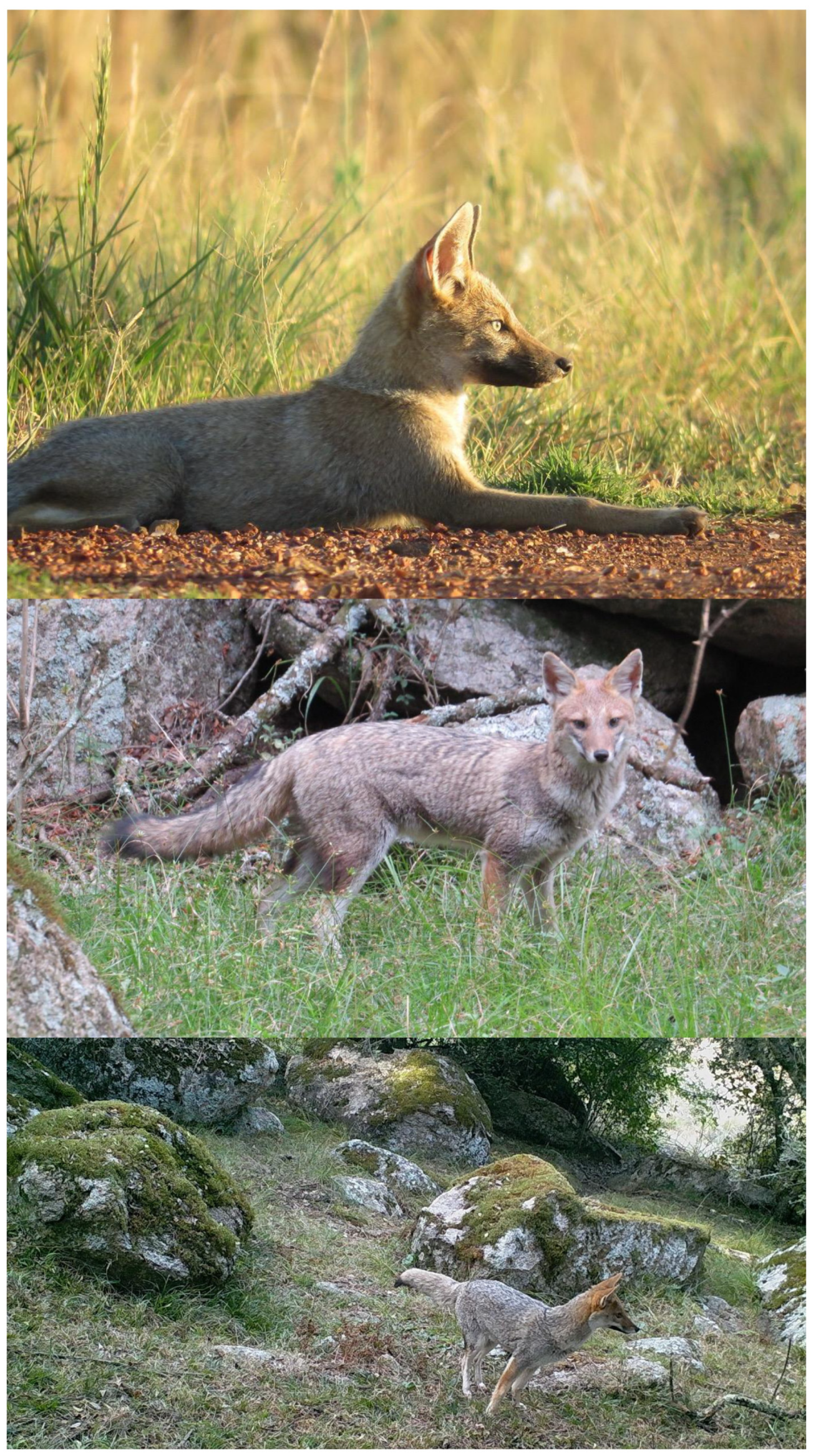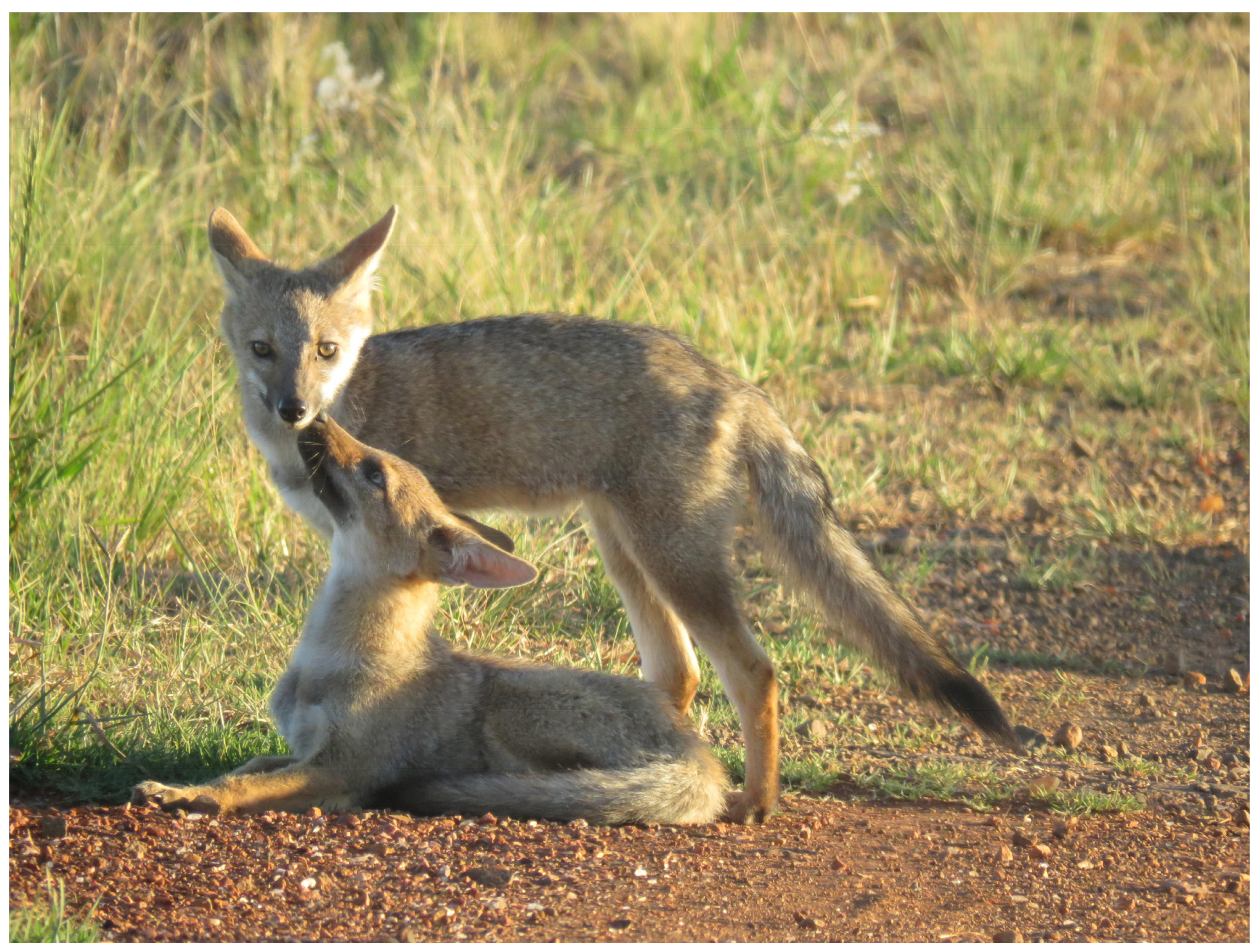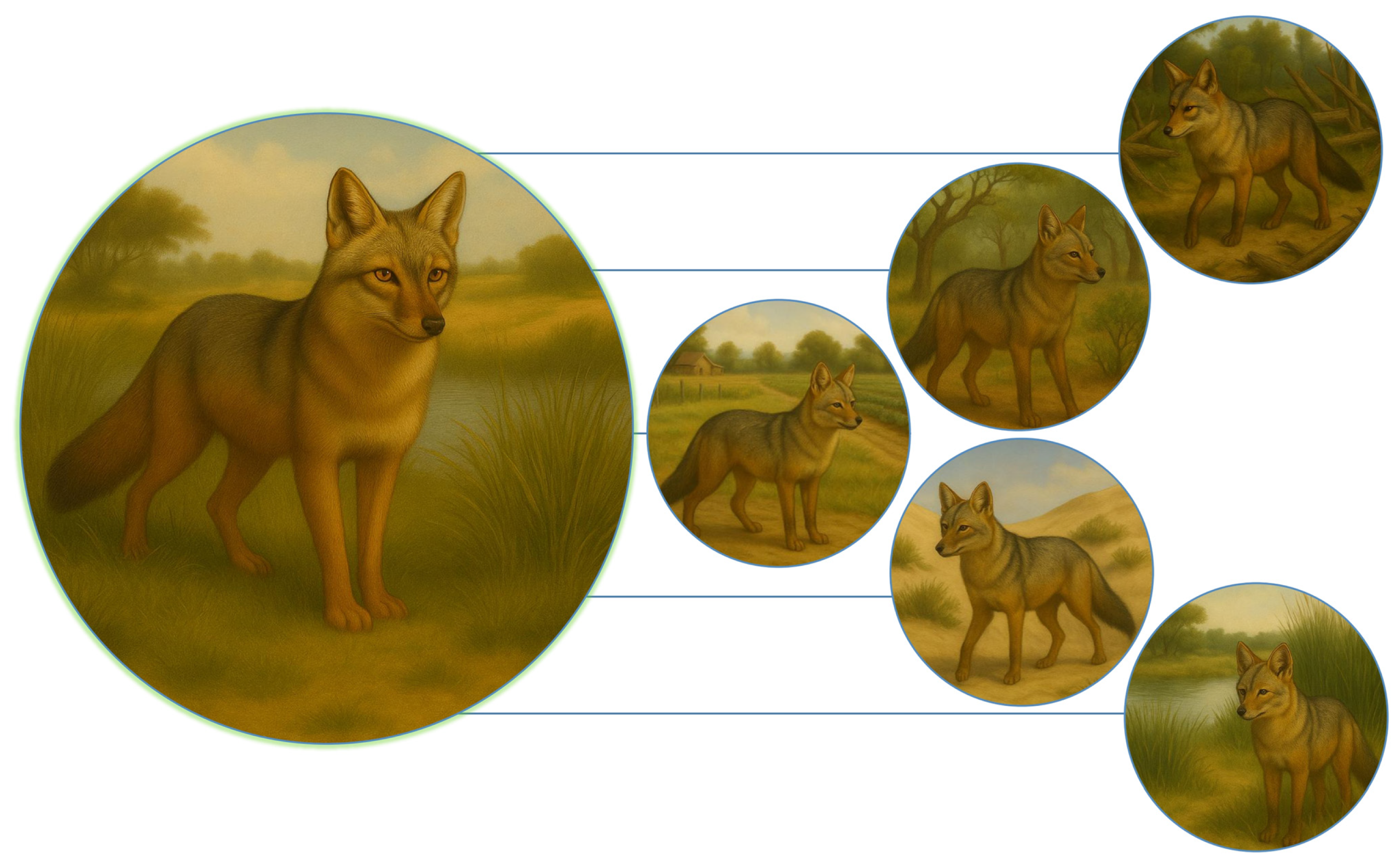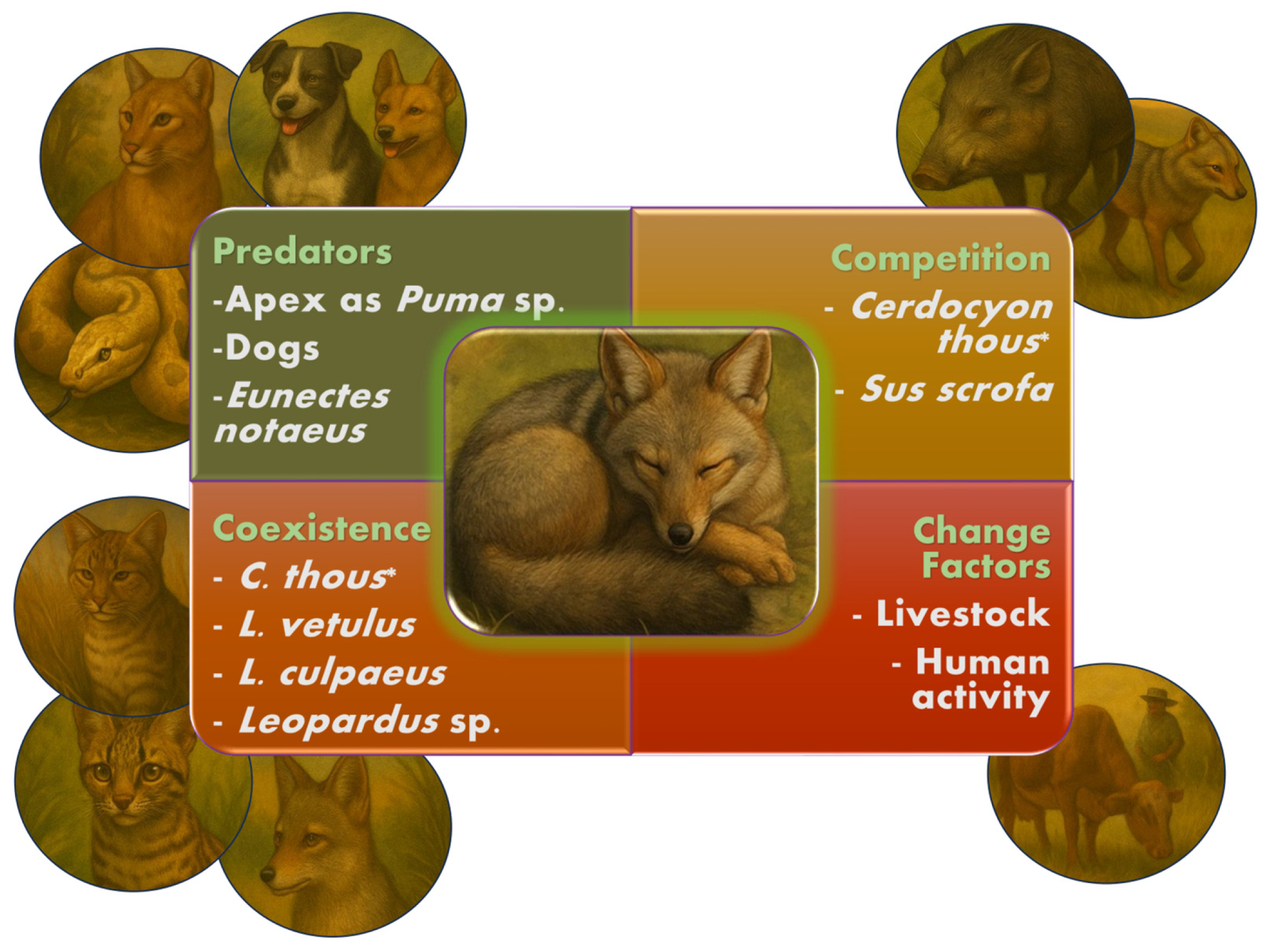
The Pampas Fox (Lycalopex gymnocercus, ‘Zorro Gris Pampeano’): An Integrative Review of the Ecological, Health, and Conflict Roles of a Key Mesopredator in Southern South America


Simple Summary
Abstract
1. Introduction
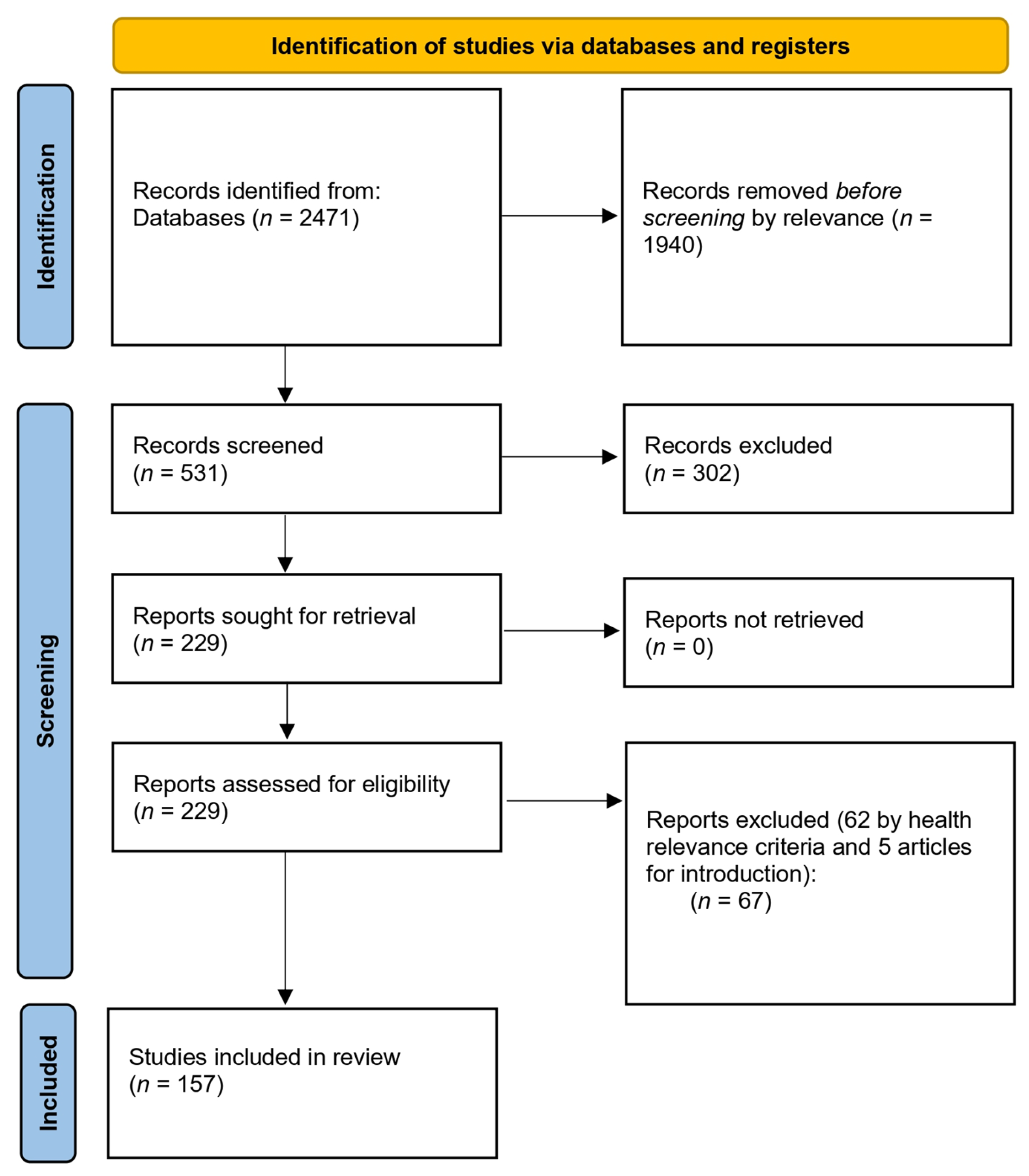
2. Materials and Methods
- What is the ecological role and importance of the Pampas fox in South American ecosystems?
- What is the significance of the Pampas fox in the circulation of pathogens at the wildlife–domestic animal–human interface?
- How do human activities and perceptions shape the coexistence between Pampas foxes and people?
- Google Scholar (all years, no citations filter):
- ➢
- Intitle: “Lycalopex gymnocercus”
- ➢
- Intitle: “Pseudalopex gymnocercus”
- SciELO and PubMed:
- ➢
- “Lycalopex gymnocercus”
- ➢
- “Pseudalopex gymnocercus”
3. Results
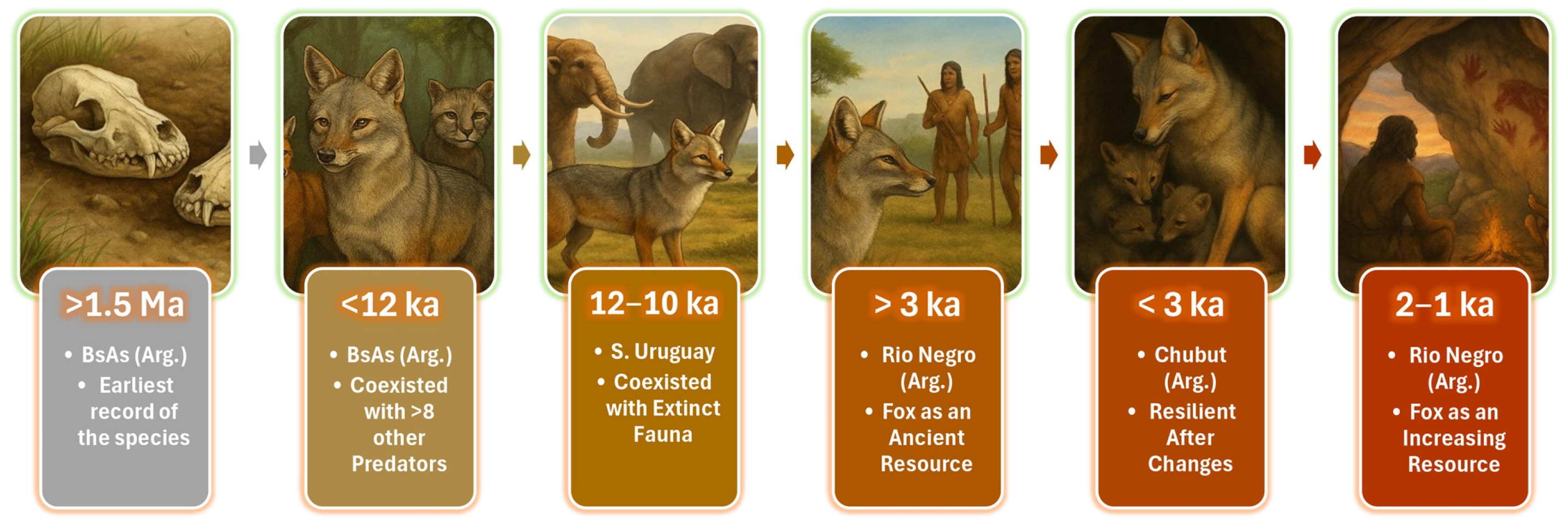
3.1. Fossil Record and Ecology
3.1.1. From Deep-Time to Anatomy: Evolutionary and Morphological Insights
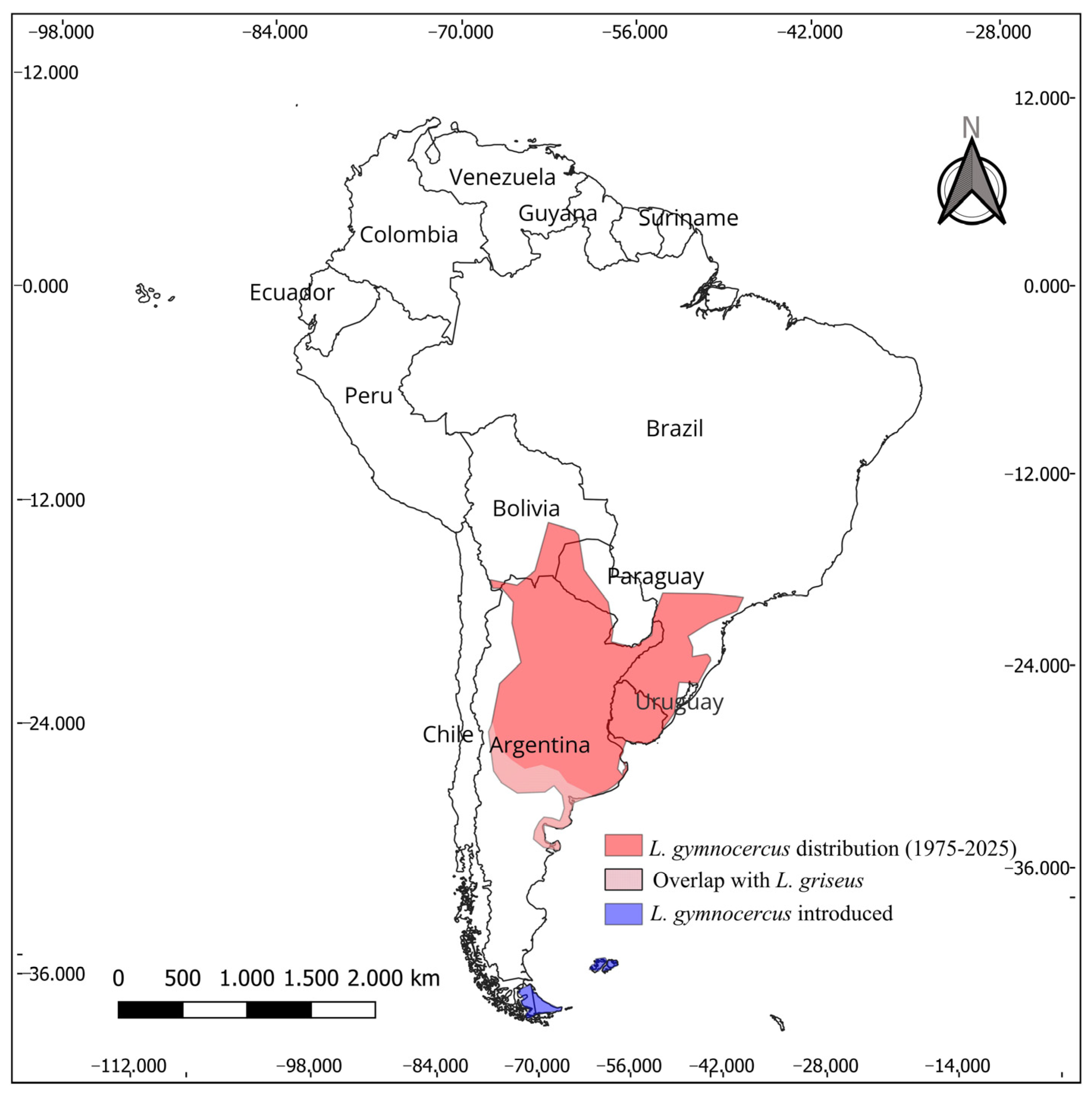
3.1.2. Distribution, Habitat, Breeding Ecology and Ecological Flexibility
3.1.3. Diet and Trophic Habits
Animal Dietary Profile
Plant Dietary Profile and Seed Dispersion
3.1.4. Final Ecological Aspects
3.2. Health
3.3. Socioenvironmental Conflicts
4. Discussion
4.1. Ecology
4.2. Health
4.3. Conflicts
4.4. Beyond the Species: Socio-Ecological and Ethical Dimensions of the Pampas Fox Paradigm
5. Conclusions
Author Contributions
Funding
Institutional Review Board Statement
Informed Consent Statement
Data Availability Statement
Acknowledgments
Conflicts of Interest
Declaration of Generative AI and AI-assisted Technologies in the Writing Process
References
- Lucherini, M.; Pessino, M.; Farias, A. Pampas fox (Pseudalopex gymnocercus). In Canids: Foxes, Wolves, Jackals, and Dogs: Status Survey and Conservation Action Plan; Sillero-Zubiri, C., Hoffmann, M., Macdonald, D.W., Eds.; IUCN: Gland, Switzerland, 2004; pp. 63–68. Available online: https://www.researchgate.net/profile/Ariel-Farias-4/publication/256802919_Pampas_fox_Pseudalopex_gymnocercus/links/0c960523c6e256c9f5000000/Pampas-fox-Pseudalopex-gymnocercus.pdf (accessed on 3 August 2025).
- Lucherini, M.; Luengos-Vidal, E.M. Lycalopex Gymnocercus (Carnivora: Canidae). Mamm. Species 2008, 820, 1–9. [Google Scholar] [CrossRef]
- Lucherini, M. Lycalopex gymnocercus, Pampas Fox. The IUCN Red List of Threatened Species™; IUCN: Gland, Switzerland, 2016; ISSN 2307-8235. Available online: https://www.researchgate.net/profile/Mauro-Lucherini/publication/307512657_Lycalopex_gymnocercus/links/57c72da708aefc4af34c7c67/Lycalopex-gymnocercus.pdf (accessed on 2 August 2025).
- GBIF Occurrence Download. Available online: https://www.gbif.org/occurrence/download/0008828-251025141854904 (accessed on 2 December 2025).
- Smith, P.; Louise-Smith, R. Natural history notes on Pampas Fox Lycalopex gymnocercus (Mammalia: Carnivora: Canidae) in the Paraguayan Chaco. Sitientibus Sér. Ciênc. Biol. 2023, 23, 1–6. [Google Scholar] [CrossRef]
- Scioscia, N.; Beldoménico, P.; Denegri, G. Contrastación de un Programa de Investigación Científica Progresivo en Parasitología: Los Endoparásitos del Zorro Gris Pampeano Lycalopex gymnocercus; Philosophy and History of Biology: São Paulo, Brazil, 2016; Volume 11, pp. 107–120. Available online: https://scholar.googleusercontent.com/scholar?q=cache:Z1v1k_z4OWMJ:scholar.google.com/&hl=es&as_sdt=0,5 (accessed on 2 December 2025).
- Perea, D.; Badín, A.; Manzuetti, A. Una fauna local lujanense (pleistoceno superior–holoceno inferior) del sur de Uruguay: Santa Regina, departamento de Colonia. Rev. Bras. Paleontol. 2021, 24, 392–403. [Google Scholar] [CrossRef]
- Manzuetti, A.; Ubilla, M.; Rinderknecht, A.; Perea, D. The pampas fox Lycalopex gymnocercus (Carnivora, Canidae) in the late pleistocene of northern Uruguay. Ameghiniana 2020, 57, 582–590. [Google Scholar] [CrossRef]
- Ramírez, M.A.; Prevosti, F.J. Systematic revision of “Canis” ensenadensis ameghino, 1888 (Carnivora, Canidae) and the description of a new specimen from the Pleistocene of Argentina. Ameghiniana 2014, 51, 37–51. [Google Scholar] [CrossRef]
- Guillermo, A.A.; Fernández, F.J.; Cordero, J.A. Aportes a la zooarqueología de la cuenca media del río Limay durante el Holoceno tardío: Sitio arqueológico Carriqueo (Provincia de Río Negro, Argentina). Magallania 2024, 53, 1–22. [Google Scholar]
- Bonomo, M.; Castro, J.C.; Silva, C.B. Tecnología y subsistencia en el sitio arqueológico Cerro Tapera Vázquez (Parque Nacional Pre-Delta, República Argentina). Cuad. LEPAARQ 2014, 11, 53–81. [Google Scholar] [CrossRef]
- D’Agostino, R.L.; Udrizar-Sauthier, D.E. Lo pasado no tan pisado: Mamíferos carnívoros terrestres holocénicos del noreste del Chubut. In Proceedings of the XXXI Jornadas Argentinas de Mastozoología, La Rioja, Argentina, 23–26 October 2018. [Google Scholar]
- Guillermo, A.A.; Fernández, F.J. Análisis zooarqueológico del sitio Álvarez 4 (noroeste de Patagonia, Argentina). Un aporte al estudio de la subsistencia de los grupos humanos de la cuenca media del río Limay durante el Holoceno tardío. Arqueología 2022, 28, 9915. [Google Scholar] [CrossRef]
- Brum-Zorrilla, N.; Langguth, A. Karyotype of South American pampas of Pseudalopex gymnocercus (Carnivora, Canidae). Experientia 1980, 36, 1043–1044. [Google Scholar] [CrossRef]
- Molina, W. A comparison of heterochromatic regions in three species of neotropical canids. Zool. Anz. 2015, 254, 1–7. [Google Scholar]
- Lipp, V.B.; Trigo, T.C.; Tchaicka, L.; Eizirik, E.; de Freitas, T.R.O. Estabelecimento das técnicas de microssatélites em duas espécies de canídeosneotropicais Cerdocyon thous e Pseudalopex gymnocercus (Carnivora, Canidae). Salão Iniciaç. Cient. 2002, 2002, 14. [Google Scholar]
- Pizzano, B.R.; Gallo, O.; Godinho, R.; Casanave, E.B.; Castillo, D.F. Genetic diversity and population structure of the pampas fox, Lycalopex gymnocercus, in a human-dominated landscape of southern Espinal, Argentina. Mastozool. Neotrop. 2021, 28, e0571. [Google Scholar] [CrossRef]
- Castillo, D.F.; Mac Allister, M.E.; Fernández, G.P.; Cosse, M.; Udrizar Sauthier, D.E.; Godinho, R.; Casanave, E.B. Diversidad Genética, Estructura de Población y Flujo de Genes del Zorro Lycalopex gymnocercus en Argentina y Uruguay. In Proceedings of the Libro de Resúmenes, Proceedings of the XXXV Jornadas Argentinas de Mastozoología, Ciudad de San Luis, Argentina, 26–29 November 2024; Sociedad Argentina para el Estudio de los Mamíferos: Córdoba, Argentina, 2024; p. 77. Available online: https://ri.conicet.gov.ar/bitstream/handle/11336/264159/CONICET_Digital_Nro.21a01e43-b29e-4070-87c3-040f6c96876e_R.pdf?sequence=5&isAllowed=y (accessed on 2 December 2025).
- Garcez, F.S. Filogeografia e História Populacional de Lycalopex vetulus (Carnivora, Canidae), Incluindo sua Hibridação com L. gymnocercus. Master’s Thesis, Faculdade de Biociências, Porto Alegre, Brazil, 2015. [Google Scholar]
- Soibelzon, L. South American Fossil Land Carnivores (Carnivora, Mammalia): State of the Art. In Molecular Population Genetics, Evolutionary Biology and Biological Conservation of the Neotropical Carnivores; Ruiz-García, M., Shostell, J., Eds.; Nova Science Publishers: New York, NY, USA, 2012; Available online: https://www.academia.edu/3255880/SOUTH_AMERICAN_FOSSIL_LAND_CARNIVORES_CARNIVORA_MAMMALIA_STATE_OF_THE_ART (accessed on 2 December 2025).
- Tchaicka, L. Abordagens Filogenéticas, Filogeográficas e Populacionais em Canídeos Sul-Americanos. Ph.D. Thesis, Universidade Federal do Rio Grande do Sul, Porto Alegre, Brazil, 2006. [Google Scholar]
- Chemisquy, A.; Prevosti, F.J.; Martínez, P.; Raimondi, V.; Cabello-Stom, J.E.; Acosta-Jamett, G.; Montoya-Burgos, J.I. How many species of grey foxes (Canidae, Carnivora) are there in Southern South America? Mastozool. Neotrop. 2018, 26, 81–97. [Google Scholar]
- Favarini, M.O. Relações Filogenéticas Entre Espécies do Gênero Lycalopex (Mammalia, Canidae) Inferidas com o uso de Marcadores do DNA Mitocondrial. Master’s Thesis, Pontifícia Universidade Católica do Rio Grande do Sul, Porto Alegre, Brazil, 2011. [Google Scholar]
- Tchaicka, L.; de Freitas, T.R.O.; Bager, A.; Vidal, S.L.; Lucherini, M.; Iriarte, A.; Novaro, A.; Geffen, E.; Garcez, F.S.; Johnson, W.E.; et al. Molecular assessment of the phylogeny and biogeography of a recently diversified endemic group of South American canids (Mammalia: Carnivora: Canidae). Genet. Mol. Biol. 2016, 39, 442–451. [Google Scholar] [CrossRef]
- Petrigh, R.S.; Fugassa, M.H. Molecular identification of a Fuegian dog belonging to the Fagnano Regional Museum ethnographic collection, Tierra del Fuego. Quat. Int. 2013, 317, 14–18. [Google Scholar] [CrossRef]
- Zunino, G.E.; Vaccaro, O.B.; Canevari, M.; Gardner, A.L. Taxonomy of the genus Lycalopex (Carnivora: Canidae) in Argentina. Proc. Biol. Soc. Wash. 1995, 108, 729–747. [Google Scholar]
- Prevosti, F.J.; Segura, V.; Cassini, G.; Martin, G.M. Revisión del estatus sistemático de los zorros grises patagónico y pampeano (Canidae: Lycalopex griseus y L. gymnocercus) usando morfometría geométrica 3D. Mastozool. Neotrop. 2013, 20, 289–302. [Google Scholar]
- de Bubadué, J.M.; Cáceres, N.; dos Carvalho, R.S.; Meloro, C. Ecogeographical variation in skull shape of South-American canids: Abiotic or biotic processes? Evol. Biol. 2016, 43, 145–159. [Google Scholar] [CrossRef]
- Schiaffini, M.I.; Segura, V.; Prevosti, F.J. Geographic variation in skull shape and size of the Pampas fox Lycalopex gymnocercus (Carnivora: Canidae) in Argentina. Mamm. Biol. 2019, 97, 50–58. [Google Scholar] [CrossRef]
- Luengos Vidal, E.; Lucherini, M.; Casanave, E.; Sillero-Zubiri, C. Morphometrics of Pampas foxes (Pseudalopex gymnocercus) in the Argentine Pampas. Mammalia 2009, 73, 63–67. [Google Scholar] [CrossRef]
- Chatellanaz, M. Record of a leucistic pampas fox Lycalopex gymnocercus (Carnivora: Canidae) in northeastern of Argentina. Oecología Aust. 2021, 25, 889–893. [Google Scholar] [CrossRef]
- de Mello, L.M. First record of piebaldism in Lycalopex gymnocercus (carnivora, canidae) in the pampa biome, Southern Brazil. Oecología Aust. 2020, 24, 191–195. [Google Scholar] [CrossRef]
- de Souza-Junior, P.; Santos, L.M.; Souza, E.C.; Souza, W.V.; Carvalho, N.C.; Anjos, B.L.; Santos, A.L. Osteologia do membro torácico de Lycalopex gymnocercus Fischer, 1814 (Carnivora, Mammalia): Abordagens comparada, radiográfica e osteométrica. Pesq. Vet. Bras. 2018, 38, 195–221. [Google Scholar] [CrossRef]
- de Souza-Junior, P.; dos Santos, L.M.R.P.; Viotto-Souza, W.; Carvalho, N.d.C.d.; Souza, E.C.; Kasper, C.B.; Abidu-Figueiredo, M.; Santos, A.L.Q. Functional myology of the thoracic limb in Pampas fox (Lycalopex gymnocercus): A descriptive and comparative analysis. Am. J. Anat. 2018, 233, 783–806. [Google Scholar] [CrossRef]
- de Souza-Junior, P.; Viotto-Souza, W.; Pereira-Mendes, V.; Coelho-Simas-Bernardes, F.; Dos Anjos, B.L.; Abidu-Figueiredo, M.; Quagliatto-Santos, A.L. Clavicle in Carnivorans: A Forgotten Bone. Anat. Rec. 2020, 303, 1831–1841. [Google Scholar] [CrossRef]
- de Souza-Junior, P.; de Carvalho, N.D.C.; de Mattos, K.; Figueiredo, M.A.; Santos, A.L.Q. Brachial Plexus in the Pampas Fox (Lycalopex gymnocercus): A Descriptive and Comparative Analysis. Anat. Rec. 2017, 300, 537–548. [Google Scholar] [CrossRef]
- Silva, M.F.M.; Souza, W.V.; Almada, R.M.; Carvalho, A.D.; Souza-Júnior, P. Anatomía comparada de los músculos supinador y pronador redondo de tres especies carnívoras silvestres. Rev. Argent. Anat. Online 2015, 6, 117–122. [Google Scholar]
- de Moura-Bubadué, J.; Cáceres, N.; dos Santos-Carvalho, R.; Sponchiado, J.; Passaro, F.; Saggese, F.; Mondanaro, A.; Raia, P.; Carotenuto, F. Character displacement under influence of Bergmann’s rule in Cerdocyon thous (Mammalia: Canidae). Hystrix It. J. Mamm. 2016, 27, 83–90. [Google Scholar]
- Souza, E.C.; Neto, L.F.; Rodrigues-Santos, E.A.; Abidu-Figueiredo, M.; Carvalho, A.D.; Souza-Junior, P. Caracterización anatómica de los riñones del Zorro Pampeano (Lycalopex gymnocercus): Morfometría, topografía y vasos renales. Rev. Electron. Vet. 2018, 19, 1–8. [Google Scholar]
- Leão-Neto, L.F.; Candiota-Souza, E.; Aparecida-Rodriguez, E.; Moral-Montana, M.; Diaz-Carvalho, A.; Souza-Junior, P. Esqueletopia e topografia da artéria celíaca no Lycalopex gymnocercus (Fischer, 1814). A Rev. Acad. Ciênc. Anim. 2019, 17, 1–7. [Google Scholar] [CrossRef]
- Viotto-Souza, W.; Souza-Júnior, P.; Abidu-Figueiredo, M.; Uchôa, T.; Quagliatto-Santos, L.A. Topografia da papila parotídea em Cerdocyon thous (Linnaeus, 1766) e Lycalopex gymnocercus (G. Fisher, 1814). Rev. Bras. Ciênc. Vet. 2016, 23, 1–2. Available online: https://pesquisa.bvsalud.org/portal/resource/pt/biblio-1491613 (accessed on 2 December 2025).
- Cassanego, G.R. Parâmetros Oftalmológicos e Ecobiométricos Sob Anestesia Geral do Graxaim-do-Campo (Lycalopex gymnocercus) e do Graxaim-do-Mato (Cerdocyon thous) em Cativeiro. Master’s Thesis, Universidade Federal de Santa Maria, Santa Maria, Brazil, 2023. [Google Scholar]
- Souza-Júnior, P.; de Mattos, K.; de Carvalho, N.d.C.; Quagliatto-Santos, A.L. Topografia da intumescência lombar e do cone medular em Lycalopex gymnocercus (G. Fischer, 1814). Rev. Bras. Ciênc. Vet. 2014, 21, 173–177. [Google Scholar]
- Lorenzão, C.J.; Zimpel, A.V.; Novakoski, E.; da Silva, A.A.; Martinez-Pereira, M.A. Comparison of the Lumbosacral Plexus Nerves Formation in Pampas Fox (Pseudalopex gymnocercus) and Crab-Eating Fox (Cerdocyon thous) in Relationship to Plexus Model in Dogs. Anat. Rec. 2016, 299, 361–369. [Google Scholar] [CrossRef] [PubMed]
- Salerno-Depedrini, J. Estudo da Distribuição e dos Territórios das Artérias Cerebrais Rostral, Média e Caudal na Superfície do Encéfalo em Graxaim-do-Campo (Pseudalopex gymnocercus). Master’s Thesis, Universidade Federal do Rio Grande do Sul, Porto Alegre, Brazil, 2006. [Google Scholar]
- Dos Santos-Sousa, C.A. Morfologia Comparada do Pênis de Cerdocyon thous (Linnaeus, 1766) e Lycalopex gymnocercus (G. Fischer, 1814). Ph.D. Thesis, Programa de Pós-Graduação em Biologia Animal, Universidade Federal Rural do Rio de Janeiro, Seropédica, Brazil, 2021. [Google Scholar]
- Martins, F.P.; Souza, E.C.; Bernardes, F.C.S.; Abidu-Figueiredo, M.; Kasper, C.B.; de Souza-Júnior, P. Anatomical variations in cervical vertebrae in two species of neotropical canids: What is the meaning? Anat. Histol. Embryol. 2021, 50, 212–217. [Google Scholar] [CrossRef]
- Smith, P.D. Status and distribution of Paraguayan canids. Canid Biol. Conserv. 2022, 25, 1–12. [Google Scholar]
- Weiler, A.; Núñez, K.; Silla, F. Forest matters: Use of water reservoirs by mammal communities in cattle ranch landscapes in the Paraguayan Dry Chaco. Glob. Ecol. Conserv. 2020, 23, e01103. [Google Scholar] [CrossRef]
- Deliberador-Miranda, J.M.; Moro Rios, R.F.; Passos, F.d.C. Contribuição ao conhecimento dos mamíferos dos Campos de Palmas, Paraná, Brasil. Rev. Biotemas 2008, 21, 97–103. [Google Scholar][Green Version]
- Pereira, A.D.; França, E.A.; Arasaki, M.O.; Vidotto-Magnoni, A.P. First record of the pampas fox Lycalopex gymnocercus (Fischer, 1814) at the north-central region of Paraná state, Brazil. Notas Sobre Mamíferos Sudam. 2022, 4, 001–008. [Google Scholar] [CrossRef]
- Bager, A.; Castro, É.P. Banco de dados da comunidade de mamíferos de médio e grande porte da Estação Ecológica do Taim, Rio Grande do Sul, Brasil. Dataset Lat. Am. Data Sci. 2021, 1, 2–7. [Google Scholar] [CrossRef]
- de Oliveira, S.V.; Quintela, F.M.; Resende-Secchi, E. Medium and large sized mammal assemblages in coastal dunes and adjacent marshes in southern Rio Grande do Sul State, Brazil. Acta Scientiarum. Biol. Sci. 2013, 35, 55–61. [Google Scholar] [CrossRef][Green Version]
- Muzzachiodi, N.; Sabattini, R.A. La mastofauna como indicador de conservación del bosque nativo en un área protegida de Entre Ríos. Rev. Cient. Agropecu. 2002, 6, 5–15. [Google Scholar]
- Rojido-Nin, I.; Anderson, C.; Canavelli, S. Survey of Medium Mammals in Livestock Farms with Native Forest of the La Paz Department, 2018-2019; Partial Report; The Rufford Foundation: Entre Ríos, Argentina, 2019; Available online: https://media.rufford.org/media/project_reports/20588-1Presentation%20-%20Survey%20of%20medium%20mammals%20in%20livestock%20farms%20with%20native%20forest%20of%20the%20La%20Paz%20department.%202018-2019.pdf (accessed on 2 December 2025).
- Bó, M.S.; Isacch, J.P.; Malizia, A.I.; Martínez, M.M. Lista comentada de los mamíferos de la Reserva de Biósfera Mar Chiquita, Provincia de Buenos Aires, Argentina. Mastozoología Neotrop. 2002, 9, 5–11. [Google Scholar]
- Gonzalez, E.R.B.; D’Agostino, R.L.; Udrizar-Sauthier, D.E. Ecología del ensamble de mamíferos carnívoros terrestres del norte de la Península Valdés, Patagonia–Argentina. In Proceedings of the e-JAM.21: Jornadas Argentinas de Mastozoología, Sociedad Argentina para el Estudio de los Mamíferos, Online, 16–19 November 2021. [Google Scholar]
- Caruso, N.; Lucherini, M.; Fortin, D.; Casanave, E.B. Species-Specific Responses of Carnivores to Human-Induced Landscape Changes in Central Argentina. PLoS ONE 2016, 11, e0158229. [Google Scholar] [CrossRef] [PubMed]
- D’Agostino, R.L.; Udrizar Sauthier, D.E. Luz, cámara, acción: Mamíferos carnívoros terrestres del noreste del Chubut, Argentina. In Proceedings of the XXX Jornadas Argentinas de Mastozoología: Libro de Resúmenes, Sociedad Argentina para el Estudio de Mamíferos, Ciudad de Bahía Blanca, Argentina, 14 November 2017; p. 118. [Google Scholar]
- Gonzalez, E.R.B.; D’Agostino, R.L.; Udrizar Sauthier, D.E. Patrones de Actividad de Mamíferos Medianos y Grandes del Noroeste de Península Valdés, Patagonia Argentina. In Proceedings of the Libro de Resúmenes XXXIII Jornadas Argentinas de Mastozoología; Puerto Iguazú, Argentina, 7–11 November 2022, Sociedad Argentina para el Estudio de los Mamíferos & Ediciones CeIBA: Iguazú, Argentina, 2022; p. 95. ISBN 978-987-48419-2-6. Available online: https://ri.conicet.gov.ar/handle/11336/217685 (accessed on 2 December 2025).
- Castillo, L.L.; Martínez Retta, L.; Gatica, A.; Pardo, V.M. Primer registro de Lyncodon patagonicus (de Blainville, 1842) (Mammalia, Mustelidae) para el Parque Nacional Talampaya, La Rioja, República Argentina. Notas Sobre Mamíferos Sudam. 2024, 6, 1–7. [Google Scholar] [CrossRef]
- Villagra, J.A.; D’Agostino, R.L.; Klaich, M.J.; Udrizar Sauthier, D.E. Dejando huellas: Riqueza de mamíferos carnívoros y cingulados de Península Valdés, Chubut, Argentina. In Proceedings of the Libro de Resúmenes de las XXXII Jornadas Argentinas de Mastozoología, Puerto Madryn, Argentina, 12–15 November 2019; Sociedad Argentina para el Estudio de los Mamíferos: Puerto Madryn, Argentina, 2019; p. 87. [Google Scholar]
- Coletti, L.D. Padrão de Atividade dos Canídeos Simpátricos Graxaim-do-Campo (Pseudalopex gymnocercus) e Graxaim-do-Mato (Cerdocyon thous) no Parque Estadual de Itapuã, Viamão, Rio Grande do Sul. Bachelor’s Thesis, Universidade Federal do Rio Grande do Sul, Porto Alegre, Brazil, 2006. [Google Scholar]
- Faria-Corrêa, M. Ecologia de Graxains (Carnivora: Canidae; Cerdocyon Thous e Pseudalopex gymnocercus) em um Remanescente de Mata Atlântica na Região Metropolitana de Porto Alegre–Parque Estadual de Itapuã–Rio Grande do Sul, Brasil. Master’s Thesis, Universidade Federal do Rio Grande do Sul, Porto Alegre, Brazil, 2004. [Google Scholar]
- Faria-Corrêa, M.; Balbueno, R.A.; Vieira, E.M.; de Freitas, T.R.O. Activity, habitat use, density and reproductive biology of the crab-eating fox (Cerdocyon thous) and comparison with the pampas fox (Lycalopex gymnocercus) in a Restinga area in the southern Brazilian Atlantic Forest. Mamm. Biol. 2009, 74, 220–229. [Google Scholar] [CrossRef]
- dos Santos, M.F.M.; Pellanda, M.; Tomazzoni, A.C.; Hasenack, H.; Hartz, S.M. Carnivore mammals and their relation with habitat diversity in Aparados da Serra National Park, southern Brazil. Iheringia Sér. Zool. 2004, 94, 235–245. [Google Scholar]
- Turcatti, S.; Tirelli, F.; Queirolo, D. Spatial distribution and daily activity patterns of three carnivore species in temperate grasslands of southern Brazil and northern Uruguay. Braz. J. Anim. Environ. Res. 2023, 6, 3572–3589. [Google Scholar] [CrossRef]
- Di Bitetti, M.S.; Di Blanco, Y.E.; Pereira, J.A.; Paviolo, A.; Jiménez Pérez, I. Time partitioning favors the coexistence of sympatric crab-eating foxes (Cerdocyon thous) and pampas foxes (Lycalopex gymnocercus). J. Mammal. 2009, 90, 479–490. [Google Scholar] [CrossRef]
- Luengos-Vidal, E.M. Organización Espacial de Pseudalopex gymnocercus en los Pastizales Pampeanos. Ph.D. Thesis, Universidad Nacional del Sur, Bahía Blanca, Argentina, 2009. [Google Scholar]
- Martínez, S.D. Características y uso de las Cuevas del Zorro Pampeano (Pseudalopex gymnocercus) en un Área Agrícola Ganadera del sur de la Provincia de Buenos Aires. Bachelor’s Thesis, Universidad Nacional del Sur, Bahía Blanca, Argentina, 2016. [Google Scholar]
- Di Blanco, Y.E.; Desbiez, A.L.J.; di Francescantonio, D.; Di Bitetti, M.S. Excavations of giant armadillos alter environmental conditions and provide new resources for a range of animals. J. Zool. 2020, 310, 205–217. [Google Scholar] [CrossRef]
- Kaufmann, C.A. Análisis tafonómico de una asociación faunística generada por pequeños carnívoros de la Región Pampeana. Intersecc. Antropol. 2016, 17, 145–162. [Google Scholar]
- Weiler de Albertini, A. Determination of the Value of Livestock Landscapes in the Conservation of Birds and Medium and Large-Sized Mammals in the Paraguayan Dry Chaco. Ph.D. Thesis, Universidad de Salamanca, Salamanca, Spain, 2023. [Google Scholar]
- Rivas Varas, F.A. Diversidad de Carnívoros Terrestres en la Reserva Natural Puesto El Mesías; Ecorregión del Espinal, Santa Fe, Argentina. Bachelor’s Thesis, Universidad de Chile, Santiago, Chile, 2023. [Google Scholar]
- Albanesi, S.A.; Jayat, J.P.; Brown, A.D. Patrones de actividad de mamíferos de medio y gran porte en el pedemonte de Yungas del noroeste argentino. Mastozool. Neotrop. 2016, 23, 335–348. [Google Scholar]
- Tapucera, V. Interacciones Espacio-Temporales de Cuatro Especies de Carnívoros en un Agroecosistema del Sudoeste Bonaerense. Bachelor’s Thesis, Universidad Nacional del Sur, Bahía Blanca, Argentina, 2023. [Google Scholar]
- Caruso, N.C.; Luengos Vidal, E.M.; Manfredi, M.C.; Araujo, M.S.; Lucherini, M.; Casanave, E.B. Spatio-temporal interactions of carnivore species in a coastal ecosystem in Argentina. Ocean Coast. Manag. 2020, 198, 105311. [Google Scholar] [CrossRef]
- Castillo, D.; Luengos Vidal, E.M.; Lucherini, M.; Casanave, E.B. First Report on the Geoffroy’s Cat in a Highly Modified Rural Area of the Argentine Pampas. Cat News 2008, 49, 27–28. [Google Scholar]
- Lassaga, M.V.; Tamburini, D. Relevamiento del ensamble de medianos y grandes mamíferos de la Reserva Natural de la Defensa La Calera (Córdoba): Composición y uso del ambiente. Bachelor’s Thesis, Universidad Nacional de Córdoba, Facultad de Ciencias Exactas, Físicas y Naturales, Córdoba, Argentina, 2023. [Google Scholar]
- Periago, M.E.; Ojeda, R.A.; Díaz, S.M. Uso de hábitat de Mazama gouazoubira y Lycalopex gymnocercus en el Chaco árido de Córdoba, Argentina. In Memorias Congreso Internacional de Manejo de Fauna Silvestre en la Amazonía y Latinoamérica; Universidad Nacional de Salta: Salta, Argentina, 2012; Volume 3, pp. 1–6. [Google Scholar]
- Nasti, A. Carroñeo y dispersión de restos de cerdo doméstico (Sus scrofa) en contextos de humedales: Implicancias forenses. Rev. Arg. Antrop. Biol. 2021, 23, 038. [Google Scholar] [CrossRef]
- Castillo Sánchez, L.A.; Álvarez, M.C.; Nuñez, M.B.; Kaufmann, C.A.; Alcaraz, A.P.; Ochoa, A.C.; Gatica, A. ¿Potencial depredación intragremio? Puma concolor y Lycalopex gymnocercus en el ecotono Chaco-Monte, San Luis, República Argentina. Notas Sobre Mamíferos Sudam. 2021, 2, 52–59. [Google Scholar] [CrossRef]
- Álvarez, M.C.; Gatica, A.; Kaufmann, C.A.; Ochoa, A.C.; Alcaraz, A.P. Estudio de Restos Ingeridos por Puma concolor en el Parque Nacional Sierra de las Quijadas (Provincia de San Luis). In Proceedings of the Libro de Resúmenes de las XXXII Jornadas Argentinas de Mastozoología, Puerto Madryn, Argentina, 12–15 November 2019; Sociedad Argentina para el Estudio de los Mamíferos: Puerto Madryn, Argentina, 2019; p. 102. Available online: https://scholar.googleusercontent.com/scholar?q=cache:Na_qOqWR9JAJ:scholar.google.com/+%22Lycalopex+gymnocercus%22&hl=es&as_sdt=0,5&as_vis=1 (accessed on 2 December 2025).
- Chatellenaz Müller, M.; Vallejos, P.D. Pampas Foxes as Prey of Yellow Anacondas; Field Report; Universidad Nacional del Nordeste: Corrientes, Argentina, 2018; Available online: https://repositorio.unne.edu.ar/xmlui/bitstream/handle/123456789/33799/RIUNNE_FACENA_AR_Chatellenaz-M%C3%BCller-Vallejos.pdf?sequence=1 (accessed on 2 December 2025).
- Romero, V.L. Ecología Trófica, Uso del Hábitat y Densidad de Tres Especies de Cánidos (Carnivora, Canidae) Simpátricos en el Parque Nacional Mburucuyá, Corrientes, Argentina. Ph.D. Thesis, Universidad Nacional del Nordeste, Corrientes, Argentina, 2017. [Google Scholar]
- Fariñas Torres, T.; Chemisquy, M.A. Un cuento de tres zorros… Lycalopex gymnocercus (Fischer, 1814), L. culpaeus (Molina, 1972) y Cerdocyon thous (Linnaeus, 1766) en La Rioja, República Argentina, ¿coincidencia o simpatría? Notas Sobre Mamíferos Sudam. 2024, 6, 1–8. [Google Scholar] [CrossRef]
- Caruso, N.; Valenzuela, A.E.J.; Burdett, C.L.; Luengos Vidal, E.M.; Birochio, D.; Casanave, E.B. Summer habitat use and activity patterns of wild boar Sus scrofa in rangelands of central Argentina. PLoS ONE 2018, 13, e0206513. [Google Scholar]
- Marás, G.A.; Trucco, C.E.; Núñez-Regueiro, M.M.; Andrade-Díaz, S.M.; Trigo, C.B.; Caruso, M.F.; Derlindati, E.J.; Tálamo, A. Relationships between livestock grazing intensity and mammal predator-prey: A study case in Copo National Park in the dry Chaco forests. J. Nat. Conserv. 2022, 67, 126186. [Google Scholar] [CrossRef]
- Farias, A.A.; Kittlein, M.J. Small-scale spatial variability in the diet of pampas foxes (Pseudalopex gymnocercus) and human-induced changes in prey base. Ecol. Res. 2008, 23, 543–550. [Google Scholar] [CrossRef]
- Mignino, J.; Martínez, S.D.; Luengos-Vidal, E.M.; Lucherini, M. Actualistic taphonomy of pampas fox (Lycalopex gymnocercus) scat-derived bone accumulations from central Argentina: Contributions to archaeological and palaeontological studies. Hist. Biol. 2024, 36, 747–759. [Google Scholar] [CrossRef]
- Bossi, M.A.S.; Migliorini, R.P.; Santos, T.G.; Kasper, C.B. Comparative trophic ecology of two sympatric canids in the Brazilian Pampa. J. Zool. 2019, 307, 215–222. [Google Scholar] [CrossRef]
- García, V.B.; Kittlein, M.J. Diet, habitat use and relative abundance of pampas fox (Pseudalopex gymnocercus) in northern Patagonia, Argentina. Mamm. Biol. 2005, 70, 218–226. [Google Scholar] [CrossRef]
- Birochio, D. Ecología Trófica de Lycalopex gymnocercus en la Región Pampeana: Un Acercamiento Inferencial al uso de los Recursos. Ph.D. Thesis, Universidad Nacional del Sur, Bahía Blanca, Argentina, 2008. [Google Scholar]
- Bay Jouliá, R. Variación de la Dieta de Cánidos (Carnivora, Canidae) en Relación a la Cobertura Vegetal de Áreas Protegidas de la Provincia de Corrientes, Argentina. Bachelor’s Thesis, Universidad Nacional del Nordeste, Corrientes, Argentina, 2023. [Google Scholar]
- Porto, L.M.V.; Rui, A.M. Diet and habitat use by two sympatric canids in the Pampas of South America. Neotrop. Biol. Conserv. 2019, 14, 1–12. [Google Scholar] [CrossRef]
- Castillo, D.F.; Birochio, D.E.; Lucherini, M.; Casanave, E.B. Diet of adults and cubs of Lycalopex gymnocercus in Pampas grassland: A validation of the Optimal Foraging Theory? Ann. Zool. Fenn. 2011, 48, 251–256. [Google Scholar] [CrossRef]
- Varela, O.; Cormenzana-Méndez, A.; Krapovickas, L.; Bucher, E.H. Seasonal diet of the Pampas fox (Lycalopex gymnocercus) in the Chaco Dry Woodland, Northwestern Argentina. J. Mammal. 2008, 89, 1012–1019. [Google Scholar] [CrossRef]
- Kuester, P.F.; Wiesel, P.G.; Lobo, E. Frugivorous diet and food availability of Cerdocyon thous and Lycalopex gymnocercus in the Serra do Sudeste Region, RS, Brazil. Cad. Pesqui. 2022, 32, 11–22. [Google Scholar]
- Queirolo, D.; Kasper, C.B.; de Mello Beisiegel, B. Avaliação do risco de extinção do Graxaim-do-campo Lycalopex gymnocercus (G. Fischer, 1814) no Brasil. Biodivers. Bras. 2013, 3, 172–178. [Google Scholar] [CrossRef]
- Corbalán, V.E.; Literas, S.; Debandi, H.A.; Vicente, J. Phymaturus roigorum: Predation. Herpetol. Rev. 2024, 55, 351–352. [Google Scholar]
- Weihmüller, M.P.; Brizuela, C.; Mignino, J.; Robledo, A.I. Bones, carnivores, and grassland fires. Actualistic taphonomy of faunal assemblages from two caves in Central Argentina and its implication for the fossil record. Hist. Biol. 2022, 34, 2273–2286. [Google Scholar] [CrossRef]
- Rafuse, D.J.; González, M.E.; Kaufmann, C.A.; Álvarez, M.C.; Gutiérrez, M.A.; Massigoge, A. Análisis comparativo de los patrones de modificaciones óseas de dos carnívoros sudamericanos: El gato montés (Leopardus geoffroyi) y el zorro pampeano (Lycalopex gymnocercus). Aportes para la identificación de la acción de pequeños carnívoros en el registro arqueológico. Magallania 2014, 42, 125–142. [Google Scholar]
- Massigoge, A.; Gutiérrez, M.A.; Álvarez, M.C.; Kaufmann, C.A.; Rafuse, D.J.; González, M.E. Estudio comparativo de las marcas de dientes producidas por dos pequeños carnívoros sudamericanos. Rev. Chil. Antropol. 2014, 30, 42–54. [Google Scholar] [CrossRef]
- Kasper, C.B.; Bortolotto-Peters, F.; Uarth-Christoff, A.; Renato Ochotorena de Freitas, T. Trophic relationships of sympatric small carnivores in fragmented landscapes of southern Brazil: Niche overlap and potential for competition. Mammalia 2016, 80, 143–152. [Google Scholar] [CrossRef]
- Perazzo, G.X.; Garcez, D.K.; Trindade, C.R.; Pereira, K.M.; Tozetti, A.M. Is the presence of eggs a relevant cue for predators of freshwater chelonian nests? Neotrop. Biol. Conserv. 2018, 13, 350–355. [Google Scholar] [CrossRef]
- Schalk, C.M.; Morales, F. Predation of a Rhinella major (Anura: Bufonidae) by a Pampas Fox (Lycalopex gymnocercus) in the Bolivian Gran Chaco. Herpetol. Notes 2012, 5, 369–370. [Google Scholar]
- Carpinetti, B.N.; Pinardi, E.; Castresana, G.; Rojas, P.; Grilli, P.G.; Merino, M.L. Uso de nidos artificiales para determinar el posible impacto de cerdos silvestres (Sus scrofa) sobre especies de aves que nidifican en el suelo en Bahía Samborombón (Argentina). Mammal. Notes 2025, 11, 517. [Google Scholar] [CrossRef]
- Abreu, M.S.L.; da Rosa Wieliczko, A.; Mesquita, A.; Vieira, E.M. Consumo de pequenos mamíferos por canídeos simpátricos do sul do Brasil: Sobreposição de nichos e seleção de presas. Neotrop. Biol. Conserv. 2010, 5, 16–23. [Google Scholar] [CrossRef][Green Version]
- Canel, D.; Scioscia, N.P.; Denegri, G.M.; Kittlein, M. Dieta del zorro gris pampeano (Lycalopex gymnocercus) en la provincia de Buenos Aires. Mastozool. Neotrop. 2016, 23, 205–216. [Google Scholar]
- Periago, M.E.; Tamburini, D.M.; Ojeda, R.A.; Cáceres, D.M.; Díaz, S. Combining ecological aspects and local knowledge for the conservation of two native mammals in the Gran Chaco. J. Arid Environ. 2017, 147, 54–62. [Google Scholar] [CrossRef]
- Campos, C.M.; Ramos, L.; Manrique, N.; Cona, M.I.; Sartor, C.; de los Ríos, C.; Cappa, F.M. Filling gaps in the seed dispersal effectiveness model for Prosopis flexuosa: Quality of seed treatment in the digestive tract of native animals. Seed Sci. Res. 2020, 30, 215–223. [Google Scholar] [CrossRef]
- Dellafiore, C.M. ¿Afecta el zorro (Lycalopex gymnocercus) la germinación de piracanta (Pyracantha atalantioides, Rosaceae)? Mastozool. Neotrop. 2018, 25, 123–132. [Google Scholar] [CrossRef]
- Duarte Baschini, C.; Dellafiore, C.M. El zorro gris pampeano (Lycalopex gymnocercus) como dispersor de las semillas de mora (Morus nigra). Cuad. Investig. UNED 2021, 13, e3171. [Google Scholar] [CrossRef]
- D’Agostino, R.L.; Bosco, T.; Muñoz, G.M.; Baldi, R.; Udrizar-Sauthier, D.E. El efecto en la Germinación de Semillas de Schinus johnstonii y Condalia microphylla a partir de su Consumo por Lycalopex gymnocercus en Península Valdés, Chubut, Argentina. In Proceedings of the Libro de Resúmenes XXXVI Jornadas Argentinas de Mastozoología, El Calafate, Argentina, 23–26 September 2025; Sociedad Argentina para el Estudio de los Mamíferos: San Salvador de Jujuy, Argentina, 2023. Available online: https://ri.conicet.gov.ar/handle/11336/266961 (accessed on 2 December 2025).
- Vallese, H.A.; Soler, G.L.; Iaconis, K.M.; Palacios González, M.J.; Casanave, E.B.; Luengos Vidal, E.M. Caracterización de semillas de Acacia Aroma (Familia Fabacea) Dispersadas por Lycalopex gymnocercus y Cerdocyon thous (Familia Canidae) en el Chaco oriental de Argentina. In Proceedings of the XXX Jornadas Argentinas de Mastozoología, Ciudad de Bahía Blanca, Argentina, 14–17 November 2017; Sociedad Argentina para el Estudio de los Mamíferos: Bahía Blanca, Argentina, 2017; p. 206. Available online: https://ri.conicet.gov.ar/handle/11336/238712 (accessed on 2 December 2025).
- Duarte Baschini, C.; Dellafiore, C.M. Endozoocoria por el zorro gris pampeano, Lycalopex gymnocercus (Carnivora: Canidae) y germinación del tala, Celtis ehrenbergiana (Rosales: Cannabaceae). Cuad. Investig. UNED 2020, 12, e2615. [Google Scholar]
- Aguirre, F.; Nouhra, E.; Urcelay, C. Native and non-native mammals disperse exotic ectomycorrhizal fungi at long distances from pine plantations. Fungal Ecol. 2021, 49, 101012. [Google Scholar] [CrossRef]
- Giannitti, F.; Diab, S.G.; Uzal, F.A.; Fresneda, K.; Rossi, D.; Talmi-Frank, D.; Baneth, G. Infection with a Hepatozoon sp. closely related to Hepatozoon felis in a wild Pampas gray fox (Lycalopex–Pseudalopex–gymnocercus) co-infected with canine distemper virus. Vet. Parasitol. 2011, 182, 497–502. [Google Scholar] [CrossRef]
- Ruas, J.L. Caracterização da fauna parasitária do Pseudalopex gymnocercus (graxaim-do-campo) e do Cerdocyon thous (graxaim-do-mato) na região sul do Rio Grande do Sul. Ph.D. Thesis, Universidade Federal do Rio Grande do Sul, Porto Alegre, Brazil, 2005. [Google Scholar]
- Bertolazzi, S.; Paz, F.R.; Proença da Silveira, V.; Prusch, F.; Agnes, I.; Santana, W.O.; Ikuta, N.; Streck, A.F.; Lunge, V.R. Canine parvovirus 2 in free-living wild mammals from southern Brazil. J. Wildl. Dis. 2023, 59, 500–503. [Google Scholar] [CrossRef]
- Fuchs, L.; Baldone, V.; Rojas, M.; Fort, M.; Bedotti, D.; Venturini, C.; Giménez, H. Serological prevalence of toxoplasmosis and neosporosis in grey Pampa foxes (Pseudalopex gymnocercus) in La Pampa province (Argentina); Boletín de Divulgación Técnica INTA: La Pampa, Argentina, 2006; Volume 90, pp. 122–129. [Google Scholar]
- Lena Vadora, I.; Radcenco Alvez, P. Endoparasito del Zorro de Campo (Lycalopex gymnocercus) y Zorro de Monte (Cerdocyon thous) de la Región Noroeste del Uruguay. Bachelor’s Thesis, Universidad de la República, Facultad de Veterinaria, Montevideo, Uruguay, 2017. [Google Scholar]
- Marinho de Quadros, R.; Soares, J.F.; Xavier, J.S.; Pilati, C.; da Costa, J.L.; Miotto, B.A.; Miletti, L.C.; Labruna, M.B. Natural infection of the wild canid Lycalopex gymnocercus by the protozoan Rangelia vitalii, the agent of canine rangeliosis. J. Wildl. Dis. 2015, 51, 787–789. [Google Scholar] [CrossRef]
- Fiorello, C.V.; Robbins, R.G.; Maffei, L.; Wade, S.E. Parasites of free-ranging small canids and felids in the Bolivian Chaco. J. Zoo Wildl. Med. 2006, 37, 130–134. [Google Scholar] [CrossRef]
- Padilha, T.C.; Zitelli, L.C.; Webster, A.; Dall’Agnol, B.; da Rosa, V.B.; Souza, U.; Peters, F.B.; Jardim, M.; Trigo, T.C.; Rodrigues, R.O.; et al. Serosurvey of antibodies against zoonotic pathogens in free-ranging neotropical wild canids. Vet. Parasitol. 2021, 79, 101716. [Google Scholar]
- Deem, S.L.; Noss, A.J.; Cuéllar, R.L.; Villarroel, R.; Linn, M.J.; Forrester, D.J. Sarcoptic mange in free-ranging pampas foxes in the Gran Chaco, Bolivia. J. Wildl. Dis. 2002, 38, 625–628. [Google Scholar] [CrossRef]
- González-Rivas, C.J.; Castillo, G.; Simoncelli, I.D. Rhipicephalus sanguineus (Acari: Ixodidae) de mamíferos silvestres localizados en áreas urbanas de San Juan, Argentina. Acta Zool. Lilloana 2024, 68, 631–646. [Google Scholar] [CrossRef]
- Piccoli, M.F. Avaliação da Condição Corporal, Presença e Identificação de Ectoparasitos de Carnívoros Silvestres, com Ênfase em Canídeos, em Áreas de Influência da Usina Hidrelétrica de Barra Grande, sul do Brasil. Master’s Thesis, Universidade Federal do Rio Grande do Sul, Faculdade de Medicina Veterinária, Porto Alegre, Brazil, 2010. [Google Scholar]
- Ruas, J.L.; Soares, M.P.; Farias, N.A.R.; Brum, J.G.W. Infecção por Capillaria hepatica em carnívoros silvestres (Lycalopex gymnocercus e Cerdocyon thous) na região sul do Rio Grande do Sul. Arq. Inst. Biol. 2003, 70, 127–130. [Google Scholar] [CrossRef]
- Scioscia, N.P.; Hecker, Y.P.; Arranz-Solís, D.; Pedrana, J.; Urtizbiria, F.N.; Campero, L.M.; Olmos, L.; Scioli, M.V.; Dorsch, M.A.; Fiorani, F.; et al. Pampas fox (Lycalopex gymnocercus) of the Argentine Pampas as intermediate host for Neospora caninum. Parasitol. Int. 2022, 88, 102549. [Google Scholar] [CrossRef] [PubMed]
- Caprioli, R.A.; de Andrade, C.P.; Argenta, F.F.; Ehlers, L.P.; Soares, J.F.; Pavarini, S.P.; Driemeier, D.; Sonne, L. Angiostrongylosis in Cerdocyon thous (crab-eating fox) and Lycalopex gymnocercus (Pampas fox) in Southern Brazil. Parasitology 2018, 146, 617–624. [Google Scholar] [CrossRef] [PubMed]
- Padilha, T.; Batista, H.B.C.R.; Silvá, A.C.R.; Cunha-Neto, R.S.; Scheffer, K.C.; Souza, U.; Peters, F.B.; Marks, F.; Campos, A.S.A.; Ogrzewalska, M.; et al. Evidences of non-lethal rabies virus exposure in free-ranging wild carnivores from Brazilian Pampa. Mastozool. Neotrop. 2023, 30, e0980. [Google Scholar] [CrossRef]
- Weber, M.N.; Mosena, A.C.S.; da Silva, M.S.; Canova, R.; de Lorenzo, C.; Olegário, J.C.; Budaszewski, R.F.; Baumbach, L.F.; Soares, J.F.; Sonne, L.; et al. Virome of crab-eating (Cerdocyon thous) and pampas foxes (Lycalopex gymnocercus) from southern Brazil and Uruguay. Infect. Genet. Evol. 2020, 85, 104421. [Google Scholar] [CrossRef]
- Monteiro, G.S.; Fleck, J.D.; Kluge, M.; Rech, N.K.; Soliman, M.C.; Staggemeier, R.; Rodrigues, M.T.; Barros, M.P.; Heinzelmann, L.S.; Spilki, F.R. Adenoviruses of canine and human origins in stool samples from free-living pampas foxes (Lycalopex gymnocercus) and crab-eating foxes (Cerdocyon thous) in São Francisco de Paula, Rio dos Sinos basin. Braz. J. Biol. 2015, 75 (Suppl. S2), S11–S16. [Google Scholar] [CrossRef]
- Reck, J.; Gonchoroski, G.Z.; Ogrzewalska, M.; Fonseca, A.S.K.; Ikuta, N.; Lunge, V.R.; Jardim, M.; Trigo, T.C. Eco-epidemiological investigation of a disease outbreak among pampas foxes (Lycalopex gymnocercus) from a protected area in southern Brazil. J. Wildl. Dis. 2025, 61, 773–781. [Google Scholar] [CrossRef]
- Dall’Agnol, B.; Souza, U.A.; Weck, B.; Trigo, T.C.; Jardim, M.M.A.; Costa, F.B.; Labruna, M.B.; Peters, F.B.; Favarini, M.O.; Mazim, F.D.; et al. Rickettsia parkeri in free-ranging wild canids from Brazilian Pampa. Transbound. Emerg. Dis. 2018, 65, e224–e230. [Google Scholar] [CrossRef]
- Fuchs, L.; Baldone, V.; Fort, M.; Rojas, M.C.; Samartino, L.; Giménez, H. Brucelosis en el zorro gris pampeano (Pseudalopex gymnocercus) en la provincia de La Pampa (Argentina). Acta Bioquím. Clín. Latinoam. 2009, 43, 227–231. [Google Scholar]
- Oliveira de Araujo, G.O.; Huff, R.; Favarini, M.O.; Mann, M.B.; Peters, F.B.; Frazzon, J.; Frazzon, A.P.G. Multidrug resistance in enterococci isolated from wild pampas foxes (Lycalopex gymnocercus) and Geoffroy’s cats (Leopardus geoffroyi) in the Brazilian Pampa biome. Front. Vet. Sci. 2020, 7, 606377. [Google Scholar] [CrossRef]
- Birochio, D.; Asaroff, P. Impacto de las modificaciones antrópicas en la ecología trófica de un carnívoro nativo: El zorro pampeano (Lycalopex gymnocercus). In Ambiente, Sociedad y Producción: Algunos Aportes Académicos Interdisciplinarios; Boeri, P., Birochio, D., Eds.; Universidad Nacional de Río Negro: Viedma, Argentina, 2013. [Google Scholar]
- Santo Domingo, A.D.; Caruso, N.C.; Guerisoli, M.M.; Lucherini, M.; Luengos Vidal, E.M. Limited influence of hunting on the activity patterns and habitat use of Pampas fox (Lycalopex gymnocercus) in agroecosystems of central Argentina. Behav. Process. 2021, 192, 104476. [Google Scholar] [CrossRef] [PubMed]
- Travaini, A.; Zapata, S.C.; Martinez Peck, R.; Delibes, M. Percepción y actitud humanas hacia la prelación de ganado ovino por el zorro colorado (Pseudalopex culpaeus) en Santa Cruz, Patagonia Argentina. Mastozool. Neotrop. 2000, 7, 117–129. [Google Scholar]
- Ramirez, A.M.; Abate, S.D.; Winter, M. Descripción de la Población de Perros en el Área Natural Protegida Punta Bermeja en Temporada Invernal del año 2024. In IV Jornadas Internacionales y VI Nacionales de Ambiente, Viedma, Argentina, 6–8 November 2024; Universidad Nacional de Río Negro: Viedma, Argentina, 2024; Available online: http://rid.unrn.edu.ar:8080/handle/20.500.12049/12374 (accessed on 2 December 2025).
- Szynwelski, B.E.; Kretschmer, R.; Matzenbacher, C.A.; Ferrari, F.; Alievi, M.M.; Freitas, T.R.O. Hybridization in Canids—A Case Study of Pampas Fox (Lycalopex gymnocercus) and Domestic Dog (Canis lupus familiaris) Hybrid. Animals 2023, 13, 2505. [Google Scholar] [CrossRef] [PubMed]
- Peters, F.B.; Roth, P.R.O.; Pereira, M.S.; Piske, A.D.; Christoff, A.U. Aspectos da caça e perseguição aplicada à mastofauna na Área de Proteção Ambiental do Ibirapuitã, Rio Grande do Sul, Brasil. Biodiversidade Pampeana 2011, 9, 16–19. [Google Scholar]
- Figueiró, D.S.; Eizirik, E.; Silva, L.G. Padrões biogeográficos de atropelamentos do Cachorro-do-mato (Cerdocyon thous) e do Graxaím-do-campo (Lycalopex gymnocercus) no Rio Grande do Sul, Brasil. In Proceedings of the XI Jornada de Iniciação Científica FZB/FEPAM, Porto Alegre, Brazil, 25–28 August 2015. [Google Scholar]
- Rimoldi, P.G.; Biasatti, N.R.; Alesio, C.J.; Paiz, D.A.; Gastaudo, J.; Bassi, A.R.; Riganti, J.G.; Anthony, L.M.; Cane, J.; Ojeda, E.G.; et al. Atropellamiento de mamíferos nativos medianos y grandes en rutas del sur de la provincia de Santa Fe, Argentina. Hist. Nat. 2022, 12, 79–97. [Google Scholar]
- Aver, G.F.; Dal Corno, R.D.B.; Silva, D.E.; Corrêa, L.L.C. Roadkill occurrence of Cerdocyon thous (Linnaeus, 1766) and Lycalopex gymnocercus (G. Fisher, 1814) in Southern Brazil. Rev. Destaques Acad. 2023, 15, 1–13. [Google Scholar] [CrossRef]
- Bustos, S.; Lizárraga, L.; Teixeira, F.Z.; Bombelli, D.; Brunetto, L.; Nazaro, P.; Gonçalves, L.O. Amenaza de atropellamientos para los mamíferos medianos y grandes: Identificación de tramos críticos en el noroeste argentino. Mastozool. Neotrop. 2025, 32, e01112. [Google Scholar] [CrossRef]
- Paredes, E.; Zalazar, M.; Peruchena, N. Evaluación Preliminar de Atropellamientos de Cánidos Silvestres en Rutas del Noroeste de Corrientes (Argentina). In Proceedings of the XX Reunión de Comunicaciones Científicas y Tecnológicas, Corrientes, Argentina, 17–19 June 2014; Universidad Nacional del Nordeste: Corrientes, Argentina, 2014. Available online: https://repositorio.unne.edu.ar/xmlui/handle/123456789/51895 (accessed on 2 December 2025).
- Oliveira, D.S.; Silva, V.M. Vertebrados silvestres atropelados na BR 158, RS, Brasil. Biotemas 2012, 25, 229–235. [Google Scholar] [CrossRef]
- Tumeleiro, L.K.; Koenemann, J.; Ávila, M.C.N.; Pandolfo, F.R.; Oliveira, É.V. Notas sobre mamíferos da região de Uruguaiana: Estudo de indivíduos atropelados com informações sobre a dieta e conservação. Biodiversidade Pampeana 2006, 4, 38–41. [Google Scholar]
- Luengos Vidal, E.M.; Caruso, N.; Martínez, S.D.; Casanave, E.B.; Lucherini, M. Adaptarse o morir: Estrategias individuales y poblacionales claves para la supervivencia en ambientes antropizados del zorro pampeano. In Proceedings of the XXX Jornadas Argentinas de Mastozoología: Libro de Resúmenes, Bahía Blanca, Argentina, 14–17 November 2017; Sociedad Argentina para el Estudio de Mamíferos: Bahía Blanca, Argentina, 2017. [Google Scholar]
- Nanni, A.S. Dissimilar responses of the Gray brocket deer (Mazama gouazoubira), Crab-eating fox (Cerdocyon thous) and Pampas fox (Lycalopex gymnocercus) to livestock frequency in subtropical forests of NW Argentina. Mamm. Biol. 2015, 80, 260–264. [Google Scholar] [CrossRef]
- Martínez, S.D. Evaluación del Impacto de la Implementación de los Perros Protectores de Ganado en la Ecología de los Zorros Pampeanos (Lycalopex gymnocercus) en Sistemas Ganaderos Ovinos en el Sudoeste de la Provincia de Buenos Aires. Ph.D. Thesis, Universidad Nacional del Sur, Bahía Blanca, Argentina, 2023. [Google Scholar]
- Zambra, N.; Lacuesta, L.; Orihuela, A.; Ungerfeld, R. Ewes behavioural and physiological reactions to the odour of fox (Lycalopex gymnocercus) and wild boar (Sus scrofa) faeces. Appl. Anim. Behav. Sci. 2021, 237, 105290. [Google Scholar] [CrossRef]
- Martínez, S.D.; Luengos Vidal, E.M.; Cristiano, A.; Lucherini, M.; Casanave, E.B. Uso del espacio por el zorro gris Lycalopex gymnocercus en un área con ganadería ovina. In Proceedings of the Libro de Resúmenes de las XXXII Jornadas Argentinas de Mastozoología, Puerto Madryn, Argentina, 12–15 November 2019; Sociedad Argentina para el Estudio de los Mamíferos, Universidad Nacional de la Patagonia San Juan Bosco: Puerto Madryn, Argentina, 2019. Available online: https://scholar.googleusercontent.com/scholar?q=cache:9tLp9lvvo7wJ:scholar.google.com/+%22Lycalopex+gymnocercus%22&hl=es&as_sdt=0,5&as_vis=1 (accessed on 2 December 2025).
- Batista González, F.; Martins Fernandes, J. Validación de Luces Anti-Predación para el Control de Zorro de Campo (Lycalopex gymnocercus) y Zorro de Monte (Cerdocyon thous) en Uruguay. Bachelor’s Thesis, Universidad de la República, Facultad de Agronomía, Montevideo, Uruguay, 2018; p. 48. [Google Scholar]
- Zambra Márquez, N.P. Predadación ovina en Uruguay: Factores que Influyen en la Presencia de Predadores y Respuestas Comportamentales y Fisiológicas de sus Presas. Ph.D Thesis, Universidad de la República, Montevideo, Uruguay, 2022. [Google Scholar]
- Kihn, M.P.; Caruso, N.; Iaconis, K.; Palacios González, M.J.; Soler, L.G. Analysis of conflicts with wild carnivores in the Humid Chaco, Argentina. Anim. Biodivers. Conserv. 2021, 44, 251–265. [Google Scholar] [CrossRef]
- Martínez, S.D.; Luengos Vidal, E.M.; Lucherini, M.; Casanave, E.B. Conflicto carnívoros-ganadería en el SO bonaerense: Testeo preliminar de técnicas de mitigación no letales. In Proceedings of the XXX Jornadas Argentinas de Mastozoología: Libro de Resúmenes, Bahía Blanca, Argentina, 14–17 November 2017; Sociedad Argentina para el Estudio de los Mamíferos: Bahía Blanca, Argentina, 2017. Available online: https://scholar.googleusercontent.com/scholar?q=cache:t5yF2m8y1OsJ:scholar.google.com/+%22Lycalopex+gymnocercus%22&hl=es&as_sdt=0,5&as_vis=1 (accessed on 2 December 2025).
- Kihn, M.P.; Caruso, N.; Iaconis, K.M.; Palacios González, M.J.; Soler, L. Carnívoros y comunidades locales en el Chaco Húmedo de Argentina. In Coexistencia Entre Fauna Silvestre y Seres Humanos: Análisis de Experiencias en el Contexto Latinoamericano; Del Moral Sachetti, F., Soler, L., Castilla, M.C., Bravo Malca, A., de Souza, J., Gómez, N., Eds.; Comfauna; Fundación Natura: Bogotá, Colombia, 2022; pp. 200–218. ISBN 978-958-8753-92-8. Available online: https://ri.conicet.gov.ar/handle/11336/199269 (accessed on 2 December 2025).
- Fagnani, J.; Bentosela, M.; Barrera, G. Detección del estado atencional humano en zorros en cautiverio: Influencia de los niveles de sociabilidad. Rev. Psicol. 2017, 26, 42–53. [Google Scholar] [CrossRef]
- Barrera, G.; Jakovcevic, A.; Mustaca, A.; Bentosela, M. Learning interspecific communicative responses in Pampas foxes (Lycalopex gymnocercus). Behav. Process. 2012, 89, 44–51. [Google Scholar] [CrossRef] [PubMed]
- Real Academia Española. Zorro, rra. Available online: https://dle.rae.es/zorro (accessed on 3 November 2025).
- Real Academia Española. Diccionario del Estudiante, Zorro, rra. (Diccionario del Estudiante). Available online: https://www.rae.es/diccionario-estudiante/zorro (accessed on 3 November 2025).
- Real Academia Española. Perro, rra. Available online: https://dle.rae.es/perro (accessed on 3 November 2025).
- Real Academia Española. Diccionario de la Lengua Española. Perro, rra. Available online: https://www.rae.es/drae2001/perro (accessed on 3 November 2025).
- Asociación de Academias de la Lengua Española (ASALE). Diccionario de Americanismos Yegua. Available online: https://www.asale.org/damer/yegua (accessed on 3 November 2025).
- Vida Silvestre (NGO). A Cara o Cruz: Nuestra Fauna Echada a su Suerte. Available online: https://vidasilvestre.org.uy/actividades/a-cara-o-cruz-nuestra-fauna-echada-a-su-suerte/ (accessed on 3 November 2025).
- Banco Central del Uruguay. Monedas–Categoría “Monedas”. Available online: https://numismatica.bcu.gub.uy/category/monedas/page/18/ (accessed on 3 November 2025).
- Banco Central de la República Argentina. Billetes de la República Argentina. Available online: https://www.bcra.gob.ar/MediosPago/Nueva_familia_billetes.asp (accessed on 3 November 2025).
- Scalfi, G.; Barata, G.; Salazar Granada, M.; de Oliveira, M.M.; Pascotto Garroti, C.; Furukawa Liberato, T. Remarkable animals: The Brazilians’ perception about the fauna on the Real bill. Entreciencias Diálogos Soc. Conoc. 2016, 4, 405–421. [Google Scholar] [CrossRef]
- Vidal, B.; Verger, L.; Nagy, G.J. Exploring the One Health–One Welfare nexus and zoonoses. Sci. One Health 2025, 4, 100128. [Google Scholar] [CrossRef]
- Dellafiore, C.M.; Brignone, E.; Scilingo, V. Rol ecológico del zorro pampeano (Lycalopex gymnocercus) como dispersor de semillas en ambientes de agroecosistema y bosques serranos de Argentina. Eur. Sci. J. 2020, 16, 223. [Google Scholar] [CrossRef]
- Abbona, C.C.; Lebrasseur, O.; Prevosti, F.J.; Peralta, E.A.; González Venanzi, L.; Frantz, L.; Larson, G.; Gil, A.F.; Neme, G.A. Patagonian partnerships: The extinct Dusicyon avus and its interaction with prehistoric human communities. R. Soc. Open Sci. 2024, 11, 231835. [Google Scholar] [CrossRef]
- Gershon, L. What Makes Foxes So Fantastic? Available online: https://daily.jstor.org/what-makes-foxes-so-fantastic/ (accessed on 3 November 2025).
- European Commission–Directorate-General for Economic and Financial Affairs. The Estonian National Animal–The Wolf. Available online: https://economy-finance.ec.europa.eu/euro/euro-coins-and-notes/euro-coins/commemorative-coins/estonian-national-animal-wolf_en (accessed on 3 November 2025).
- Kimmig, S.E.; Flemming, D.; Kimmerle, J.; Cress, U.; Brandt, M. Elucidating the socio-demographics of wildlife tolerance using the example of the red fox (Vulpes vulpes) in Germany. Conserv. Sci. Pract. 2020, 2, e212. [Google Scholar] [CrossRef]





| Inclusion | Exclusion |
|---|---|
| Documents published (articles, reports, reviews, analyses, surveys, technical series) | - |
| In all languages and all years | - |
| Focused on the Pampas Fox Ecology, human–wildlife conflict and representative health-related studies | Not focused on the Pampas Fox (or inventories/checklists without analytical depth, or veterinary case reports, clinical procedures, drug dosages or surgical techniques) |
| Organ/System | Traits (Comparative Analysis) | References |
|---|---|---|
| Head & Skull Morphology (Skull Shape & Size) | L. gymnocercus is smaller than P. culpaeus but larger than L. griseus. Skull triangular and long-faced, with a robust interparietal crest; rostrum proportionally wider (27–32% of palate length vs. 24% in P. culpaeus), and head, neck, and ears less reddish. The frontal constriction lies closer to the postorbital apophysis than in L. griseus. Geometric morphometrics show nearly identical skull shapes between L. gymnocercus and L. griseus, differing mainly by a NE→SW climate-driven size cline. Climate rather than competition drives skull divergence, partitioning niche space by size. | [1,2,27,28,29] |
| Dentition | Dental formula 3/3–1/1–4/4–2/3 = 42; canines and premolars are “fox-like,” with enlarged carnassials and reduced molars. C. thous shows more robust molars for hard items, while L. gymnocercus resembles a small dog. Differences reflect opportunistic omnivory and a shift in response to climate and resource availability. | [1,2,27,28,29] |
| Body Size & Allometry | Adults weigh ~4–6 kg (range 2.4–8.0) and measure ~590–646 mm, heavier than L. griseus (2.5–4 kg) but lighter than C. thous (5–8 kg). Hindfoot 128–145 mm (vs. 122–130 in L. griseus). Body and skull size increase southward, forming climate-linked allometric gradients instead of taxonomic breaks. Males are only slightly larger. | [1,2,27,28,29,30,33] |
| Forelimb Skeleton & Musculature (incl. Clavicle & Rotation) | Adapted for cursorial, sagittal running: long radius–ulna and metacarpals, broad scapula, and in males a more robust distal humerus, giving a long, gracile, fast limb versus the shorter, stockier forelimb of C. thous. Vestigial clavicle (larger in males) increases shoulder freedom and stride, as in other cursorial canids. Muscle mass is mainly proximal (~82% shoulder/elbow vs. ~18% distal); subscapularis (high PCSA) stabilises the shoulder, with triceps, pectoralis profundus, latissimus dorsi, and serratus ventralis thoracis driving propulsion and trunk support. Supinator and pronator teres are small, forearm rotation-limited, and similar to C. thous; by contrast, Procyon cancrivorus shows significantly developed rotational musculature. | [2,33,34,35,37,38] |
| Spine & Peripheral Nerves | L. gymnocercus and C. thous may show C6/C7 fusions without loss of function, likely environmental rather than genetic. Brachial plexus (C6–T1) matches dogs; lumbosacral plexus (L5–S1 + S2) adds S2/S3 branches relevant to anesthesia and surgery. Cerebral arteries follow the standard canine plan. | [36,43,44,45,46,47] |
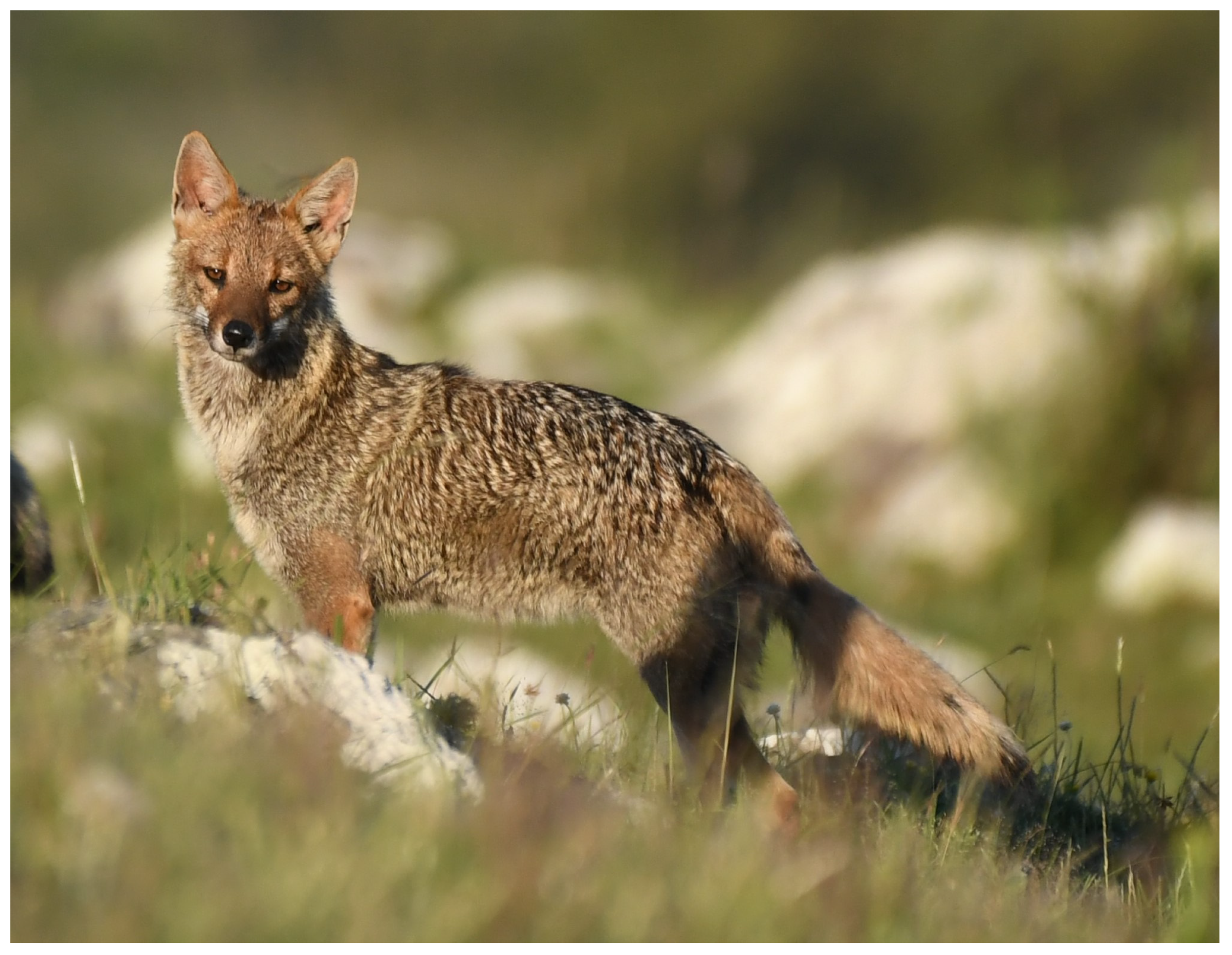
| Pelage Pattern/Range Use | Muzzle reddish to black; large triangular ears reddish outside and white inside. Back, shoulders, and flanks grey with a dark dorsal stripe; belly and inner limbs pale gray-white. Hind limbs grey laterally with reddish distal zones and a diagnostic black spot low on the rear; forelimbs reddish with blackish-brown soles (vs. red-yellow forelegs and red-brown soles in Lycalopex griseus). Tail bushy, grey with black tip, >50% of head–body length. Leucistic and piebald variants occur rarely in L. gymnocercus, not in L. griseus or Cerdocyon thous. Subspecies (L. g. gymnocercus, L. g. antiquus, L. g. lordi) differ slightly in size, pelage contrast, tail density, and the presence of axillary/pectoral dark patches, often intergrading at contact zones. | [1,2,28,31,32] |
| Internal Organs (Kidneys, Vessels, Glands, Eyes) | Kidneys are smooth, uni-papillate (~4.5 cm), celiac artery branching (hepatic, splenic, gastric) as in dogs; the parotid duct opposite the upper fourth premolar. Eyes (size, corneal diameter, IOP, tapetum) are similar to those of small dogs, supporting crepuscular vision. | [39,40,41,42] |
| Reproductive Anatomy (Penis & Baculum) | Both L. gymnocercus and C. thous possess a fibroelastic penis, consisting of a root, body, glans, baculum, and bulbus glandis, which enables a copulatory tie. C. thous shows a larger penile cross-section and corpus cavernosum, while L. gymnocercus has a proportionally larger corpus spongiosum; urethral lumen similar (~0.09 mm2). Total penile area averages ~20.2 mm2 in L. gymnocercus and ~27.0 mm2 in C. thous. Histology (HE, Mallory, orcein, Picrosirius red) and α-actin immunostaining confirm fibroelastic architecture, contradicting the traditional Musculo-cavernous model and supporting a taxonomic revision of canid penile types. | [46] |
| Region/Ecosystem | Dominant Diet Components | Notable Features | Reference |
|---|---|---|---|
| Pampas grasslands (Argentina) | Rodents, hares, insects, and fruits | Ontogenetic variation; central-place foraging | [74,89] |
| Agroecosystems (Buenos Aires) | Livestock carrion, rodents, and fruits | Diet shifts with the presence of feral horses | [89] |
| Dry Chaco (Argentina) | Fleshy fruits (Ziziphus mistol), arthropods, rodents | Predominantly frugivorous year-round | [90,97] |
| Brazilian Pampa (sympatry) | Insects, rodents, fruits (more than 10, like Syagrus sp. or Hovenia sp.) | Moderate niche overlap; different habitat use | [91,98] |
| Coastal dunes/scrubland (San Blas) | Mammals (mostly European hare), insects and fruits | Low reliance on anthropogenic waste | [93] |
| Protected areas (Corrientes) | Variable: reflects vegetation cover | Adaptive to habitat structure | [94] |
| Species Dispersed | Ecosystem/Region | Effect of Gut Passage | Ecological Role | Reference |
|---|---|---|---|---|
| Syagrus romanzoffiana | Pampa Biome, Rio Grande do Sul, Brasil | Endozoochory confirmed; no fecal germination; seedlings found far from adults suggest effective dispersal. | Likely seed disperser | [98] |
| Natives: Acacia gilliesii, Bromelia urbaniana, Cucurbitella asperata, Prosopis spp., Ziziphus mistol, Cactaceae and Z. mays (crop) | Arid Chaco, Argentina | Confirmed dispersal; not species-specific | Effective disperser; perceived as pest locally | [110] |
| Prosopis flexuosa | Semi-arid Chaco | No significant improvement in germination vs. control | Secondary disperser; limited effectiveness | [111] |
| Pyracantha atalantioides (exotic) | Córdoba Mountains | Enhanced viability and germination | Promoter of plant invasion | [112] |
| Morus nigra (exotic) | Córdoba | Viable seeds; reduced germination rate vs. control | Long-distance dispersal of invasive | [113] |
| Schinus johnstonii, Condalia microphylla | NE Chubut, Patagonia | Higher germination rates and faster germination | Key disperser of native shrubs | [114] |
| Acacia aroma | Eastern Chaco, agro--pastoral | 65% intact seeds; some damaged/parasitised; 3.4% germinated in faeces | Potential disperser of native legumes | [115] |
| Celtis ehrenbergiana | Córdoba | Faster germination, even from 6-year-old scats | Long-term viable disperser | [116] |
| Suillus granulatus, Rhizopogon pseudoroseolus (exotic fungi) | Mountain grasslands, Córdoba | Faeces inoculated pine seedlings with ECM fungi | Vector of exotic fungal spread | [117] |
Disclaimer/Publisher’s Note: The statements, opinions and data contained in all publications are solely those of the individual author(s) and contributor(s) and not of MDPI and/or the editor(s). MDPI and/or the editor(s) disclaim responsibility for any injury to people or property resulting from any ideas, methods, instructions or products referred to in the content. |
© 2025 by the authors. Licensee MDPI, Basel, Switzerland. This article is an open access article distributed under the terms and conditions of the Creative Commons Attribution (CC BY) license (https://creativecommons.org/licenses/by/4.0/).
Share and Cite
Vidal, B.; Verger, L.; Nagy, G.J. The Pampas Fox (Lycalopex gymnocercus, ‘Zorro Gris Pampeano’): An Integrative Review of the Ecological, Health, and Conflict Roles of a Key Mesopredator in Southern South America. Wild 2025, 2, 49. https://doi.org/10.3390/wild2040049
Vidal B, Verger L, Nagy GJ. The Pampas Fox (Lycalopex gymnocercus, ‘Zorro Gris Pampeano’): An Integrative Review of the Ecological, Health, and Conflict Roles of a Key Mesopredator in Southern South America. Wild. 2025; 2(4):49. https://doi.org/10.3390/wild2040049
Chicago/Turabian StyleVidal, Bernabé, Lorenzo Verger, and Gustavo J. Nagy. 2025. "The Pampas Fox (Lycalopex gymnocercus, ‘Zorro Gris Pampeano’): An Integrative Review of the Ecological, Health, and Conflict Roles of a Key Mesopredator in Southern South America" Wild 2, no. 4: 49. https://doi.org/10.3390/wild2040049
APA StyleVidal, B., Verger, L., & Nagy, G. J. (2025). The Pampas Fox (Lycalopex gymnocercus, ‘Zorro Gris Pampeano’): An Integrative Review of the Ecological, Health, and Conflict Roles of a Key Mesopredator in Southern South America. Wild, 2(4), 49. https://doi.org/10.3390/wild2040049